Good news for all Ryan Coogler fans: The Sinners director is bringing back a beloved TV show. Hulu has officially green lit a pilot of Coogler’s X-Files reboot, a project three years in the making, Deadline reports. Coogler has a five-year exclusive television deal with Disney, Hulu’s parent company.
Coogler is directing and writing the pilot episode, with Jennifer Yale coming on as showrunner. She previously held the role on The Copenhagen Test. Actress Danielle Deadwyler, known for roles in Till and The Harder They Fall, has signed on as co-lead.
The show will follow the original storyline of two FBI agents who bond as they work on cases around paranormal and unexplained phenomena. No confirmation has come over whether former stars Gillian Anderson and David Duchovny will have any role in the reboot.
The news came on Sunday, the same day Coogler won the BAFTA for Best Original Screenplay for Sinners. Coogler made history this year with a record 16 Oscar nominations for Sinners, including Best Original Screenplay and Best Picture. Coogler also wrote and directed Creed, Black Panther and Black Panther: Wakanda Forever.
This article originally appeared on Engadget at https://www.engadget.com/entertainment/tv-movies/ryan-cooglers-x-files-reboot-gets-the-green-light-at-hulu-140735536.html?src=rss
Scotch tape has been a household mainstay for nearly a century, but it still holds some scientific surprises. Researchers have discovered that the screeching sound emitted when one rapidly peels Scotch tape—akin to the screech of fingernails on a chalkboard—is the result of shock waves produced by micro-cracks propagating along the tape at supersonic speeds, according to a new paper published in the journal Physical Review E.
It was a 3M engineer named Richard Drew who developed the first transparent sticky tape in 1930. The impetus came from car manufacturing, specifically two-color designs, where the adhesives used were so sticky they often removed the paint when peeled off; the paint then needed to be manually touched up. Drew found a sandpaper adhesive with just the right amount of stickiness and used it to coat a roll of cellophane tape. (Fun fact: Drew also co-invented the snail-style dispenser for the tape with his 3M colleague, John Borden.) The tape was hugely popular during the Great Depression; consumers used it to repair everyday items rather than replace them. That popularity has never waned.
Scotch tape has also generated considerable interest among physicists. Back in 1939, scientists noticed that peeling tape could produce light—specifically, a glowing line where the tape end pulls away from the roll. The phenomenon was first recorded in the 17th century and is known as triboluminescence: the generation of light when a material is crushed, ripped, rubbed, or scratched. Diamonds, for instance, sometimes glow blue or red during the cutting process, while ceramics emit yellow-orange light when being cut by abrasive water jets.
Russia has opened an investigation into Telegram founder Pavel Durov for “abetting terrorist activities,” [non-paywalled source] in the latest sign that his uneasy relationship with the Kremlin has broken down. From a report: Two Russian newspapers, including the state-run Rossiiskaya Gazeta and Kremlin-friendly tabloid Komsomolskaya Pravda, alleged on Tuesday that the messaging app had become a tool of western and Ukrainian intelligence services.
The articles, credited to materials from Russia’s FSB security service, accused Telegram of enabling attacks in Russia and said that Durov’s “actions … are under criminal investigation.” Russia has restricted Telegram’s functions, accusing it of flouting the law and is seeking to divert users towards Max, a state-run rival messenger. The steps escalate pressure on a platform that remains deeply embedded in Russian public life.
There’s a type of knife tech often seen in science fiction that revolves around vibrating a blade to increase its sharpness. We’ve seen examples of this in franchises like Star Wars (vibroblades), Evangelion (the prog knife), Dune (pulse-swords) and the Marvel universe (vibranium), but what might surprise you is that the underlying science is sound. By vibrating a cutting tool at high frequencies, not only do you reduce friction, you essentially turn the blade into a saw, as tiny oscillations enhance the inherent sharpness of a blade.
However, up until recently, this tech largely only existed in fiction or for large companies that have the money to utilize the tech on an industrial scale. But that’s changing in a big way for home cooks this year thanks to Seattle Ultrasonics, which is releasing the world’s first ultrasonic chef’s knife: the C-200. After chopping, smashing and cooking with it for about a month, I’m convinced that this is the future of kitchen knives.
Design
From afar, the C-200 looks a lot like a regular 8-inch chef’s knife, but with a slightly more contemporary design. It features a three-layer san mai blade made from Japanese AUS-10 steel with a 13-degree edge angle per side (26 degrees total). However, upon closer inspection, you’ll notice there are some features that seem a bit out of place on a premium knife.
The first is that the C-200 doesn’t have a full tang, which is the back end of a blade that ideally extends into the handle to provide added strength and durability. This is usually a major no-no, particularly on a $400 knife. However, when you consider that Seattle Ultrasonics needed somewhere to put its vibration tech, there really isn’t any room for it other than inside the knife’s grip.
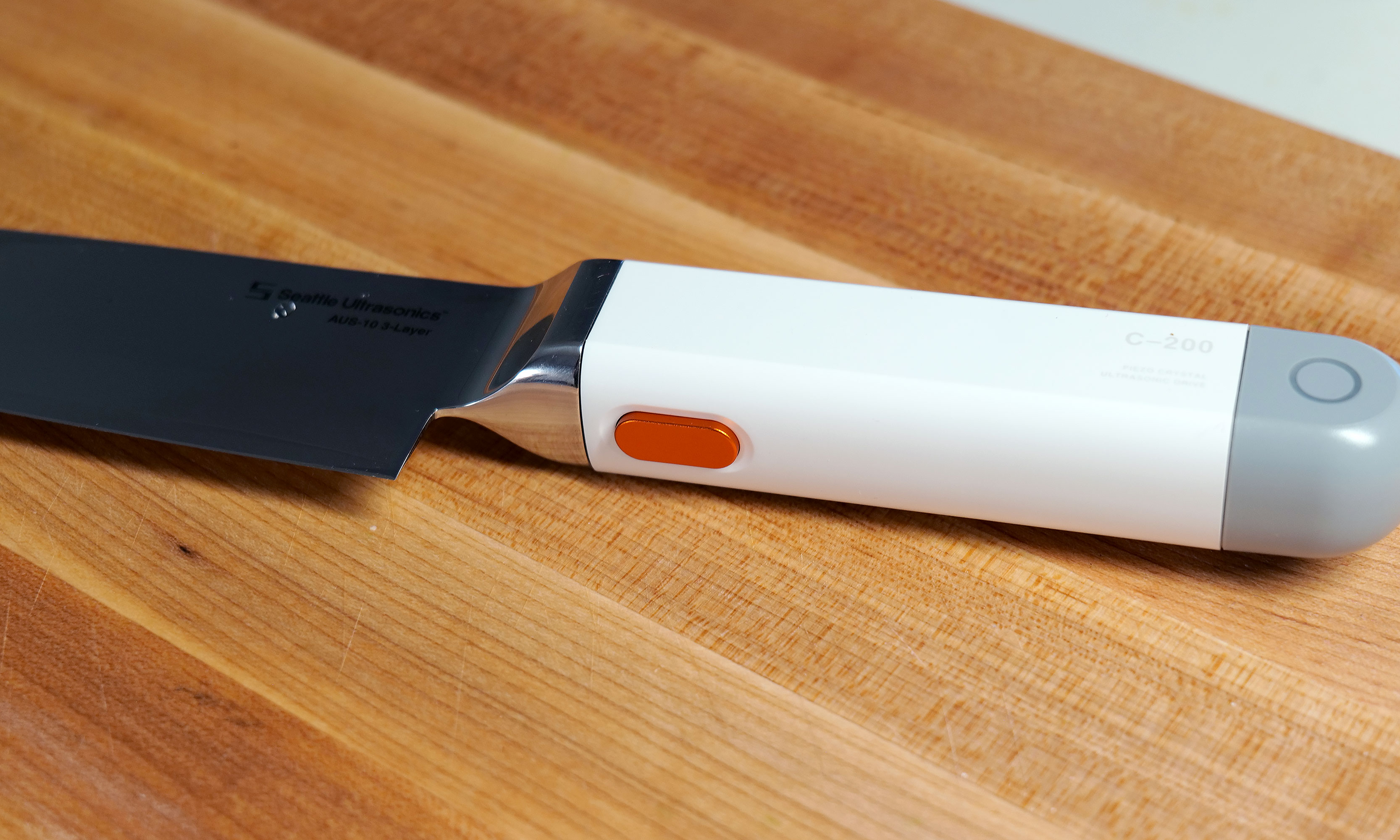
You won’t be able to feel it, but pressing this button allows the C-200’s blade to vibrate 30,000 times per second.
Sam Rutherford for Engadget
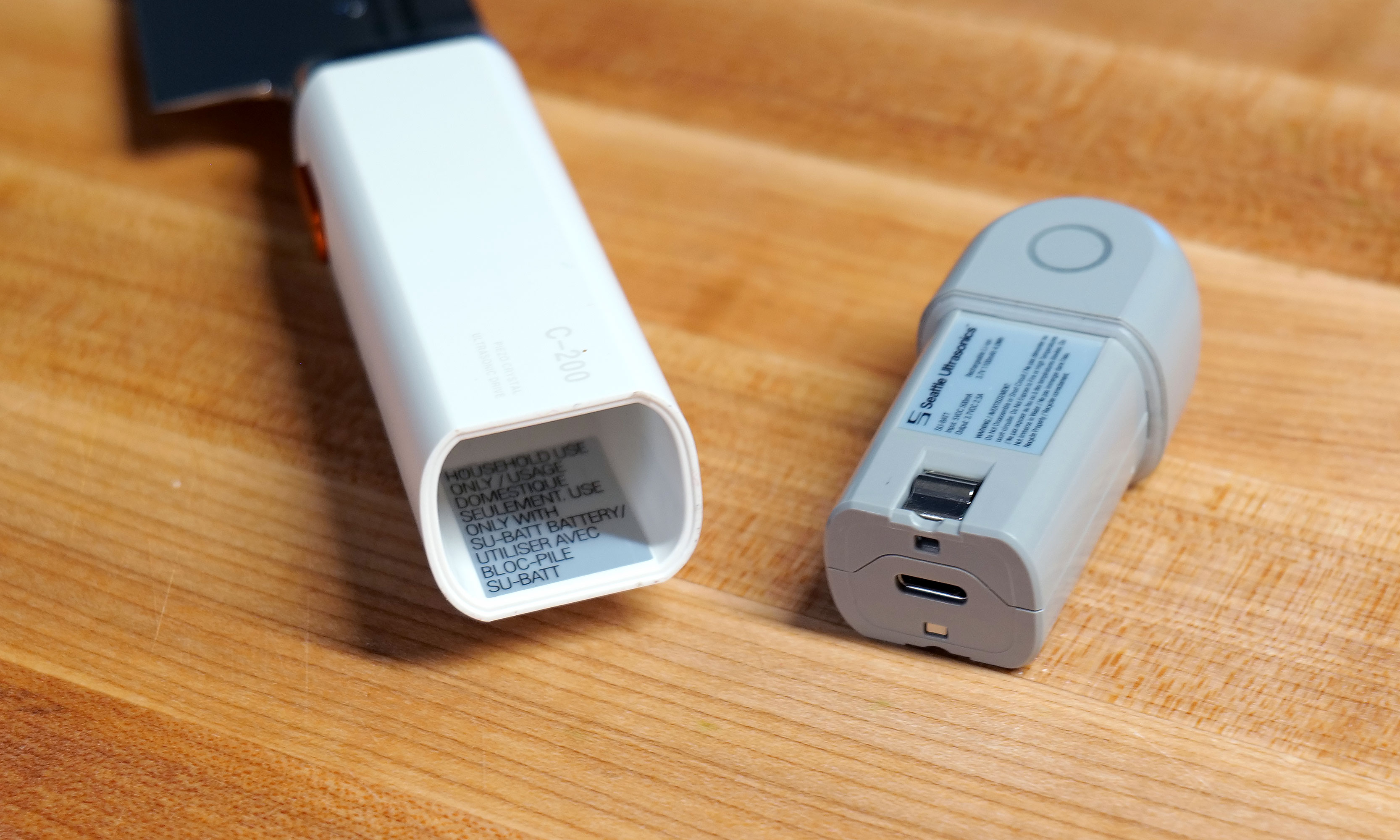
The knife’s second quirk is that the back of the plastic handle features small indicator lights on either side, which is obviously a bit weird. Furthermore, the entire gray section can be removed to reveal a small 1,100mAh battery with an onboard USB-C port. Frankly, the presence of a battery in a knife is just kind of funky. But hey, the power to vibrate the knife has to come from somewhere because it definitely isn’t being generated by your hands. And while Seattle Ultrasonics doesn’t include a charging adapter or cable in the box, I don’t mind because the company wisely took cues from the larger gadget industry and went with a power spec that’s already widely in use. Honestly, I wish more kitchen tech makers would do the same.
However, the knife’s biggest oddity is the big orange button on the bottom of its handle. This is what you use to make the blade vibrate, which it does at 33kHz. It’s positioned well so that it’s easy to press regardless of whether you do a traditional pinch grip or if you’re a bit more casual and prefer to hold the knife only using its handle. In the future, I can see this button becoming a touch-sensitive sensor, but for now, it’s simple and effective.
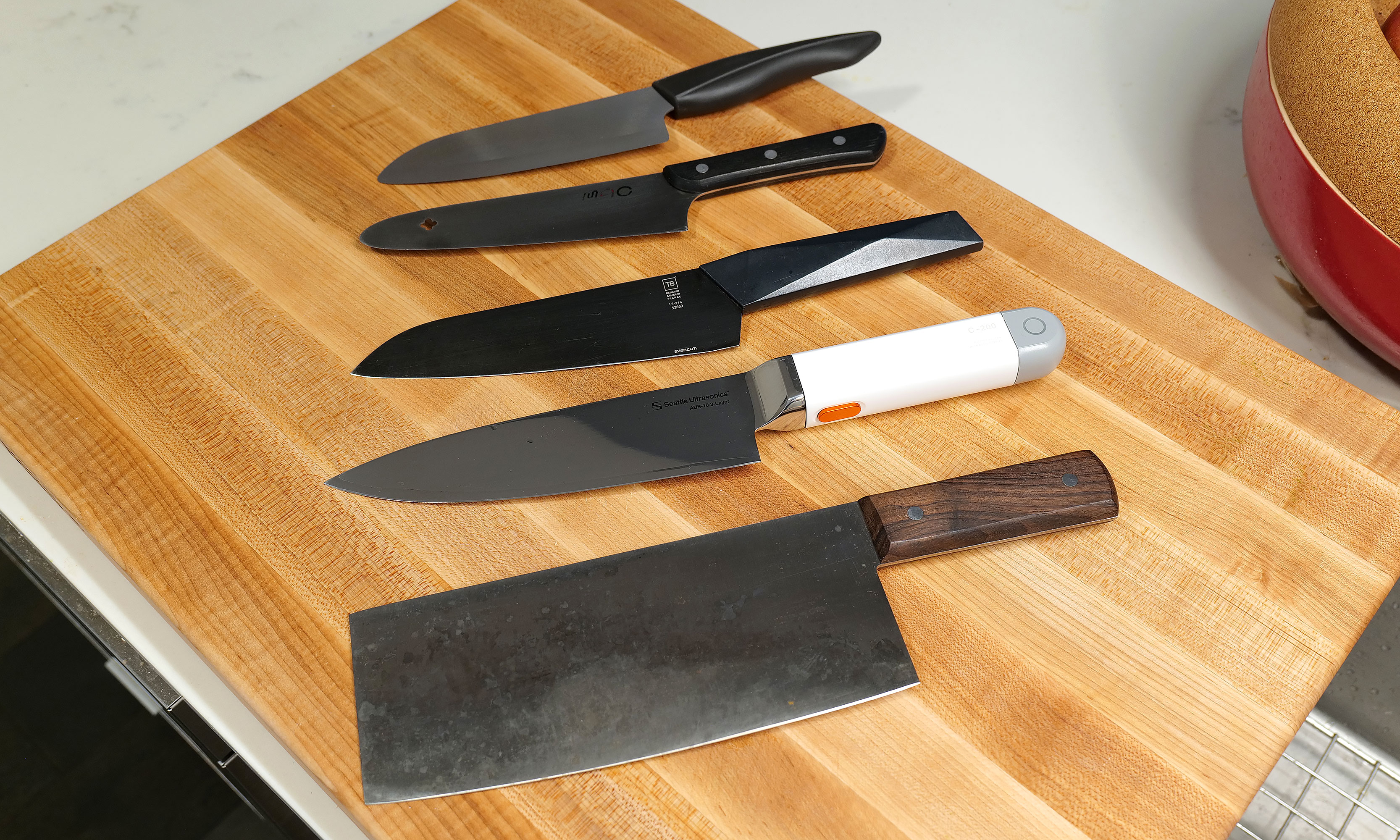
Here’s a small selection of knives I own sorted by weight (from top to bottom) compared to the C200: 6-inch Kyocera ceramic knife (97 grams), MAC molybdenum steel chef’s knife (110g), Furtif Evercut titanium carbide chef’s knife (190g), Seattle Ultrasonics C-200 (328g), Korin carbon steel cleaver (396g).
Sam Rutherford for Engadget
The main downside to the C-200’s design is that at 328 grams (around 0.75 pounds) it’s heavier and bulkier than a typical knife. When compared to other knives I own, which are made from a wide variety of materials including, ceramic, molybdenum steel, carbon steel and even titanium carbide, it weighs more than everything else aside from my big Chinese cleaver (396 grams). And while it fits nicely in my hand, my wife said it takes a bit more effort for her to wield. It’s not too much to the point where you don’t want to use it. But for quick tasks, sometimes I found myself subconsciously reaching for lighter options like my 6-inch ceramic knife, which weighs just 97 grams.
How it works
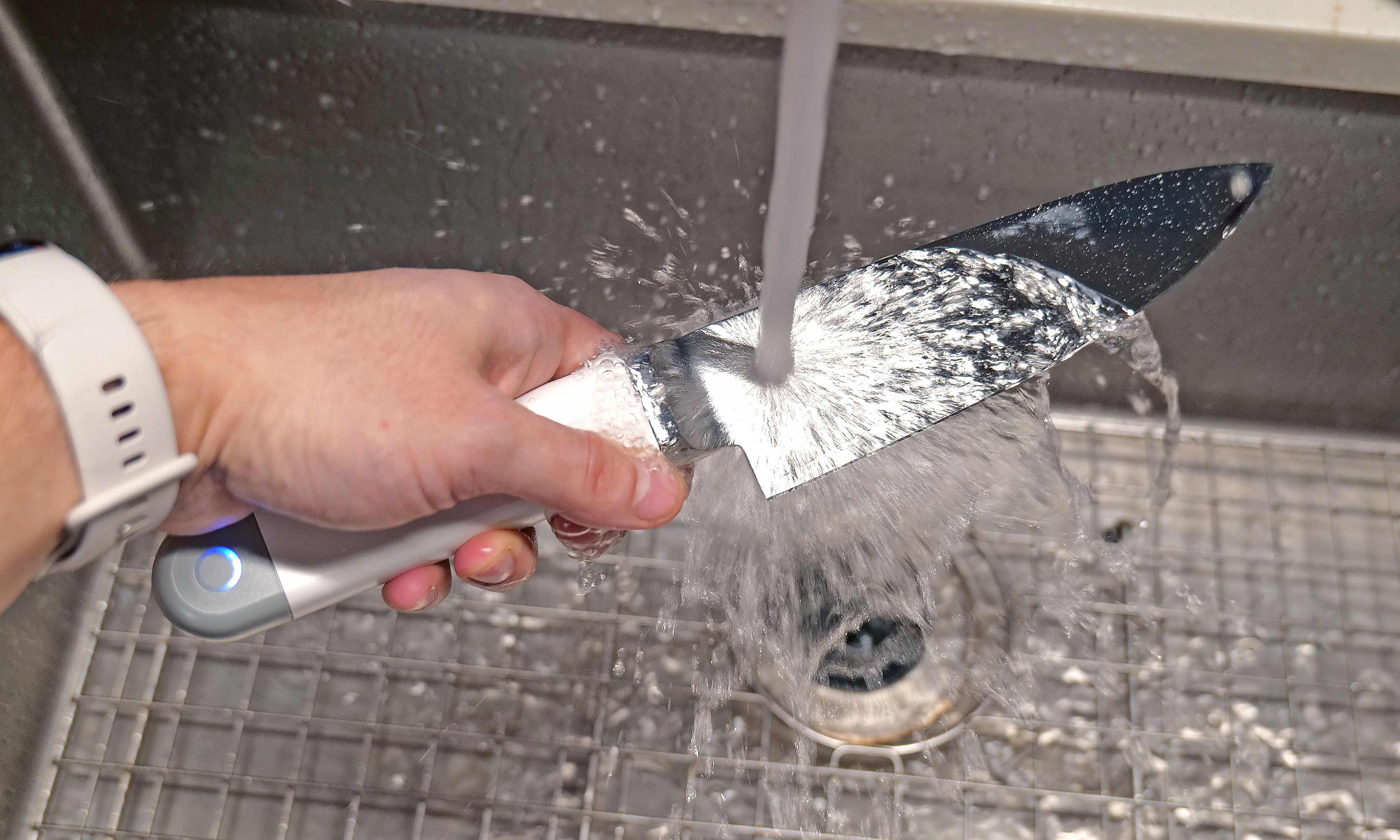
From a user standpoint, putting the C-200 to work couldn’t be simpler. Just press the button and let the knife do its thing. The big difference from how knives like this work in sci-fi is that there’s no audible hum or detectable vibration when it’s on. It’s practically silent (well, most of the time, but more on that later), so you have to trust that it’s on or check the indicator light on the handle. That said, if you still don’t believe anything is happening, you can run the edge of the blade under water or scrape it over some cut citrus, at which point the blade’s vibration will atomize nearby liquid into a fine mist. It’s a cool party trick that also doubles as a way to amp up a cocktail by adding a faint essence of lemon, lime or anything else you can think of.
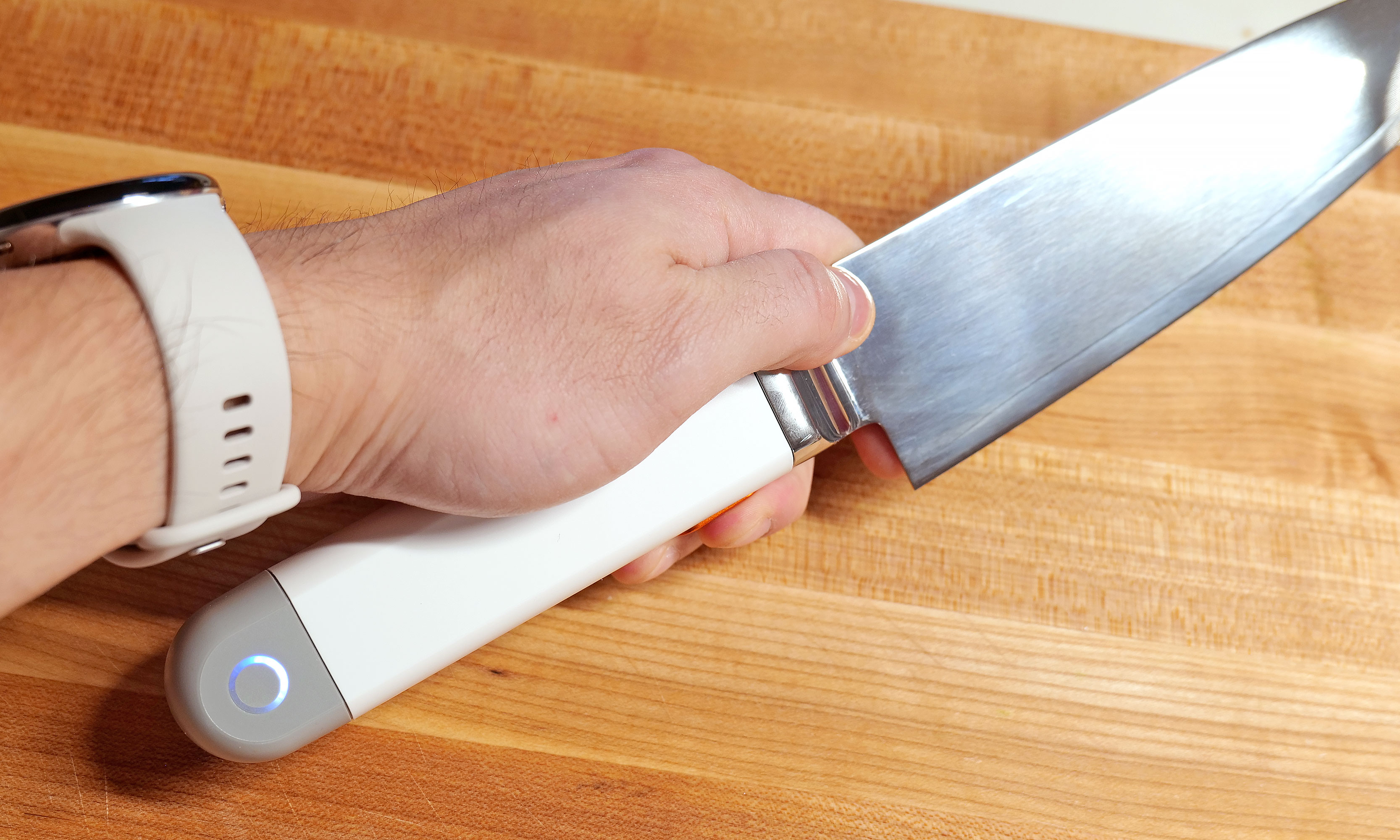
Pushing the C-200’s button is super easy, regardless of what kind of knife grip you prefer.
Sam Rutherford for Engadget
Inside, the knife relies on PZT-8 piezoelectric ceramic crystals to generate up to 30,000 vibrations per second, which propagate down the blade and make the knife function as if it’s sharper than it actually is. This all sounds rather fantastic, so how does it function in the real world?
In-use
To really put the C-200 through its paces, I cooked over a dozen meals that involved neatly slicing or preparing a wide variety of foods — including Hasselback potatoes, flank steak, pork belly, chives, sushi-grade tuna and all sorts of fruit.
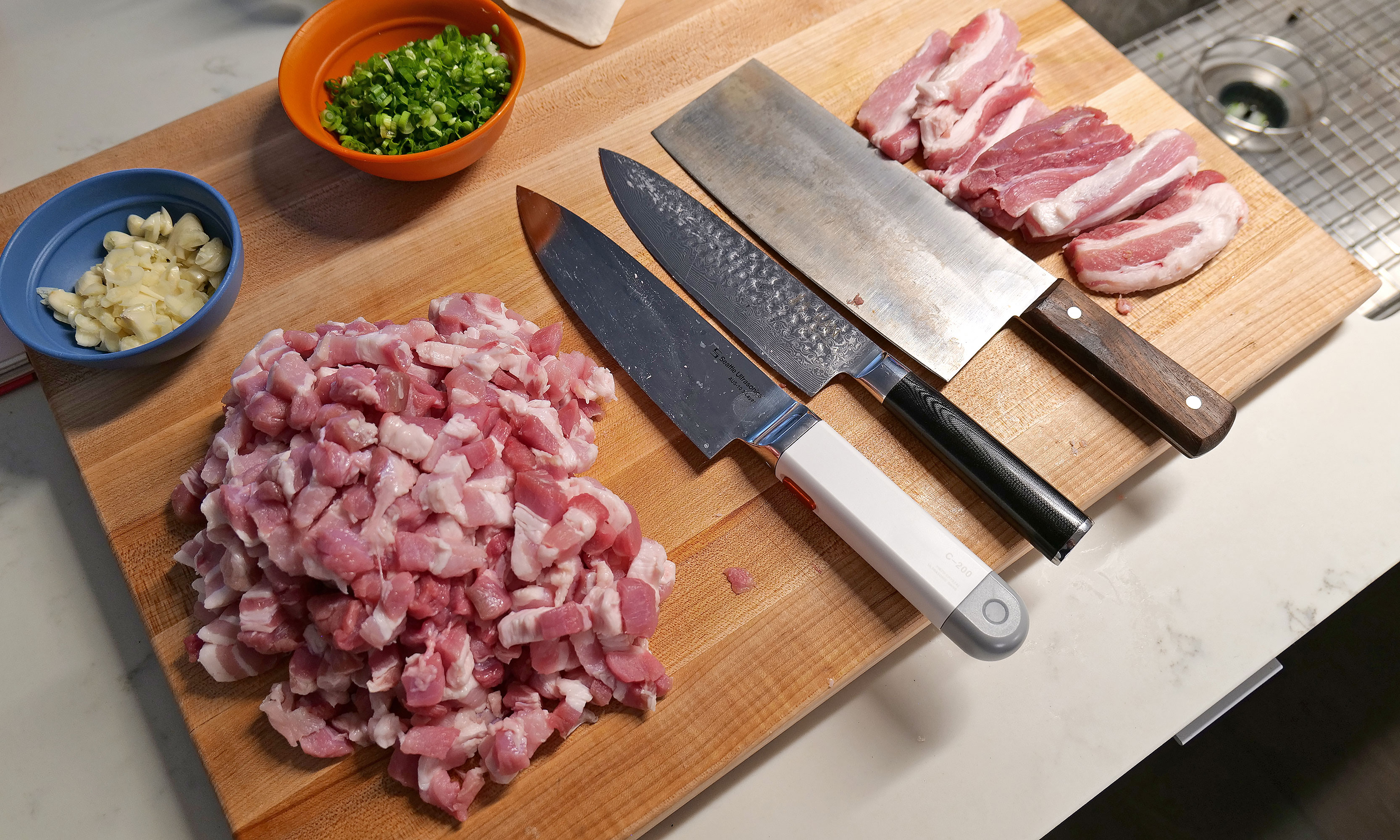
After prepping four pounds of pork belly with various knives, the C-200 really showed off how much of a difference its vibration tech makes.
Sam Rutherford for Engadget
In short, the C-200’s effectiveness depends a lot on what you’re chopping. For soft things like strawberries or a piece of cake, I didn’t notice much of a difference. To make things even more difficult, the knife arrived out of the box with an incredibly fine edge — the kind that makes shearing through a sheet of paper child’s play. So even though Seattle Ultrasonics says its knife can reduce cutting effort by up to 50 percent, there’s not much gain to be had when slicing foods that could just as easily be cut by a butter knife.
However, as I used it more, I found that the C-200 excels at cutting through delicate items like tomatoes, scallions and fish, where using a dull knife often results in bruising the food as you chop. This was most evident when I made poke at home, where Seattle Ultrasonic’s knife delivered cleaner, more precise cuts than anything else I own.
For me, the C-200’s $399 price tag is almost worth it just so I have an an easier time making my one of my all-time favorite dishes (lu rou fan).
Sam Rutherford for Engadget
When I whipped up some pico de gallo, I distinctly noticed how neatly the C-200 sliced through the skin of a tomato, instead of initially putting a crease in it before cleanly passing through its interior — which often happens when using dull knives. An additional benefit is that because of the vibrations, I found some foods like garlic didn’t stick to the side of the blade as much. This made it easier to keep track of how much I chopped while simultaneously reducing the mess from things falling willy-nilly during prep. But perhaps the most obvious demonstration of the knife’s prowess was when I diced an onion. When using my other knives or the C-200 without powering it on, I could feel when I tried to cut through thicker, more sturdy layers. But then, at the touch of a button, I was able to slice down with practically no resistance. It’s almost shocking because it feels like magic.
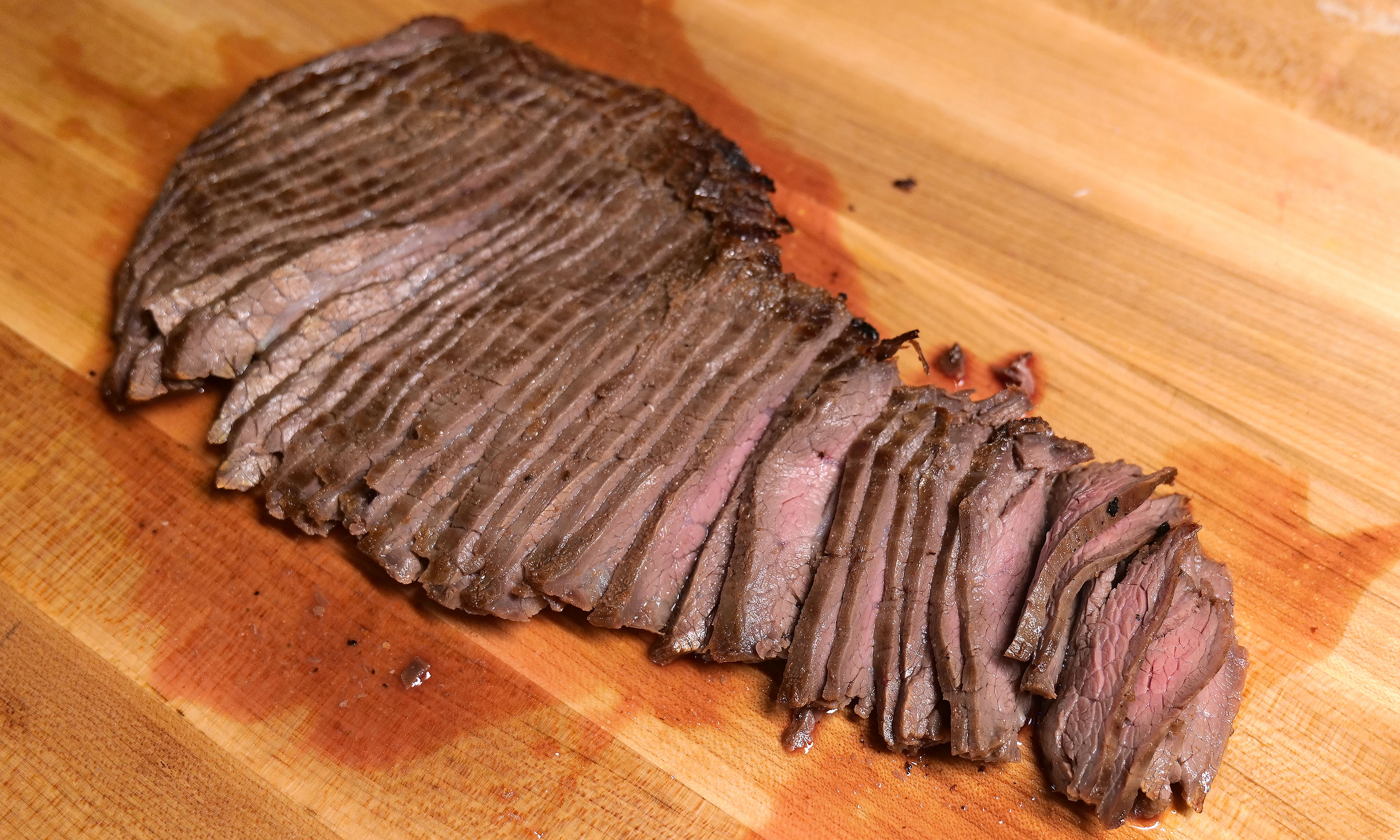
The C-200 truly excels at cutting denser foods like flank steak. Sadly mine ended up closer to medium than medium rare, but that’s not the knife’s fault.
Sam Rutherford for Engadget
The C-200 even has the ability to reduce the importance of certain knife techniques. Anyone who’s seen all the posts on r/kitchenconfidential about cutting chives will already know what I’m talking about. As J Kenji Lopez-Alt neatly demonstrated, the ideal way to get crisp, clean slices is to do a subtle forward or back cut instead of simply chopping straight down. But with Seattle Ultrasonics’ knife, I’ve found that it’s so sharp you can get away with almost any motion and still get good results. And if you do it the right way, things are even better.
Other types of food that makes the C-200 really shine are denser ingredients like meat and potatoes, where you can really feel the added cutting power. Previously, when I had to break down thick cuts of protein, I sometimes wished I owned a serrated electric knife. You know, the kind you break out once a year on Thanksgiving and then it sits and gathers dust for the other 364 days. But the C-200 made that desire a thing of that past, as it quickly and easily worked through flank steak while once again producing neat, uniform slices.
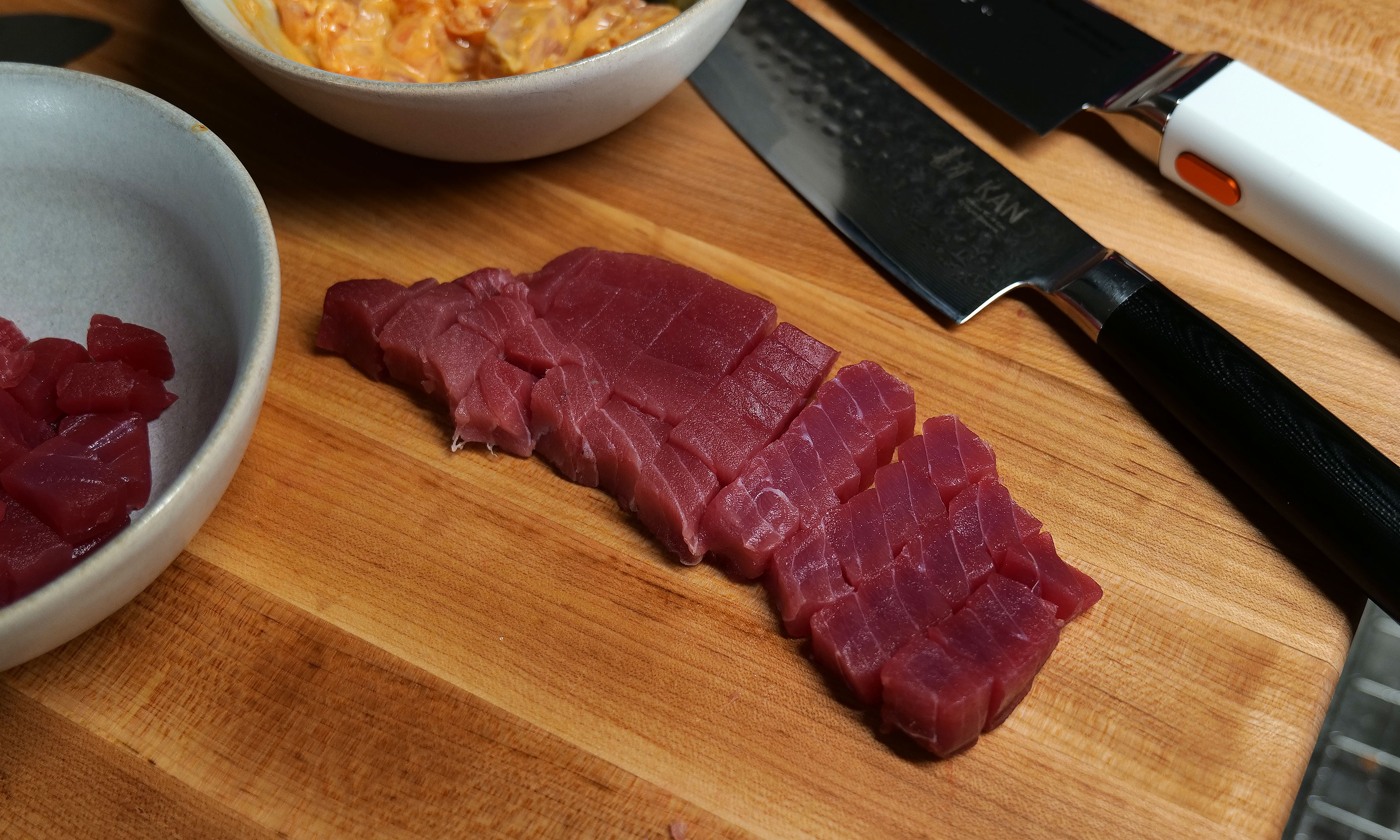
Sushi-grade tuna is another food that really shows off how the C-200’s increased sharpness is better at preserving the delicate texture of the fish.
Sam Rutherford for Engadget
My favorite application of the C-200 was when I was doing prep for Taiwanese braised pork (aka 滷肉飯). Despite this being one of my most beloved dishes that I taught myself how to cook because I couldn’t easily find it from local restaurants, I don’t make it very often because it’s a lot of work to cut multiple pounds of pork belly into small lardon-shaped pieces. Here, the knife’s vibrations made it so much easier to cut through all those layers of meat, fat and skin. If there’s any situation where the C-200 makes it 50 percent easier to slice through something, it’s this.
It might be hard to tell, but I was able to cut chives a little finer and more neatly with the C-200 (left) than with my other knives.
Sam Rutherford for Engadget
During my testing, two small issues cropped up. While it was quite rare, the knife would sometimes emit a faint high-pitched whine. When I asked Seattle Ultrasonic’s founder Scott Heimendinger about this behavior, he was rather frank, saying that this can occur when water or moisture accumulates in just the right spots on the blade. Furthermore, he said this only happens on a small number of V1 models, which the company is working to fix in the future. Thankfully, I don’t mind, but if it bothers you, making the noise go away is as easy as wiping down the knife down with a cloth or paper towel.
The C-200s battery can be easily removed for cleaning and charging.
Sam Rutherford for Engadget
The other complication came while I was working through the multiple pounds of pork belly I mentioned earlier. After 10 to 15 minutes of continuous use, the knife beeped and its indicator light turned red. Turns out the knife had overheated, which was something I had not even considered. This led to higher-than-normal temperatures inside the knife’s sealed electronics causing it to shut off. But after just 30 seconds, it returned to form. During later uses, I learned that simply taking my finger off the button between tasks, which happens naturally as you prep anyway, was more than enough to stop that situation from happening ever again.
On the flipside, I was happy to discover that despite lacking a full tang, the C-200 can handle fairly rough tasks, including laying the knife on its side to smash garlic or jamming it into an avocado to remove its pit. That said, I would really recommend against doing the latter, because between its inherent sharpness and its vibration tech, this is the first knife I’ve used that can slice cleanly through an entire avocado with almost no extra effort.
Cleaning and care
The Seattle Ultrasonics C-200 8-inch chef’s knife features an IP65 rating for the whole device, though the front half is actually a bit more resistant thanks to an IP67 rating for its button and bolster.
Sam Rutherford for Engadget
The last big concern about a knife with built-in electronics is how it handles clean-up. Thankfully, the C-200 features an IP65 rating for dust and water resistance. That means it can withstand rinsing and splashes without issue. And it’s actually even tougher than that, because the front of the knife, including its bolster and button, are rated IP67. This means it can take full submersions in water if need be. However, just because you can, doesn’t mean you should. Good kitchen protocol says you don’t throw knives you care about in the sink and forget them, just like how you wouldn’t put one in the dishwasher either.
But perhaps the greatest advantage of this tech is that it allows you to go longer between needing to get your knives sharpened, which if you’re like most home cooks, is probably never. To be clear, I haven’t tested this and in some respects I wish I had been able to test out a dull version of the C-200. That said, science dictates that slice for slice, an ultrasonic knife will simply cut better than an equivalent blade without the extra tech. So if you believe in the adage that a dull knife is more dangerous than a sharp one because you need to apply more force to get the same results, this is another bonus for both safety and convenience.
The not-so-optional accessory
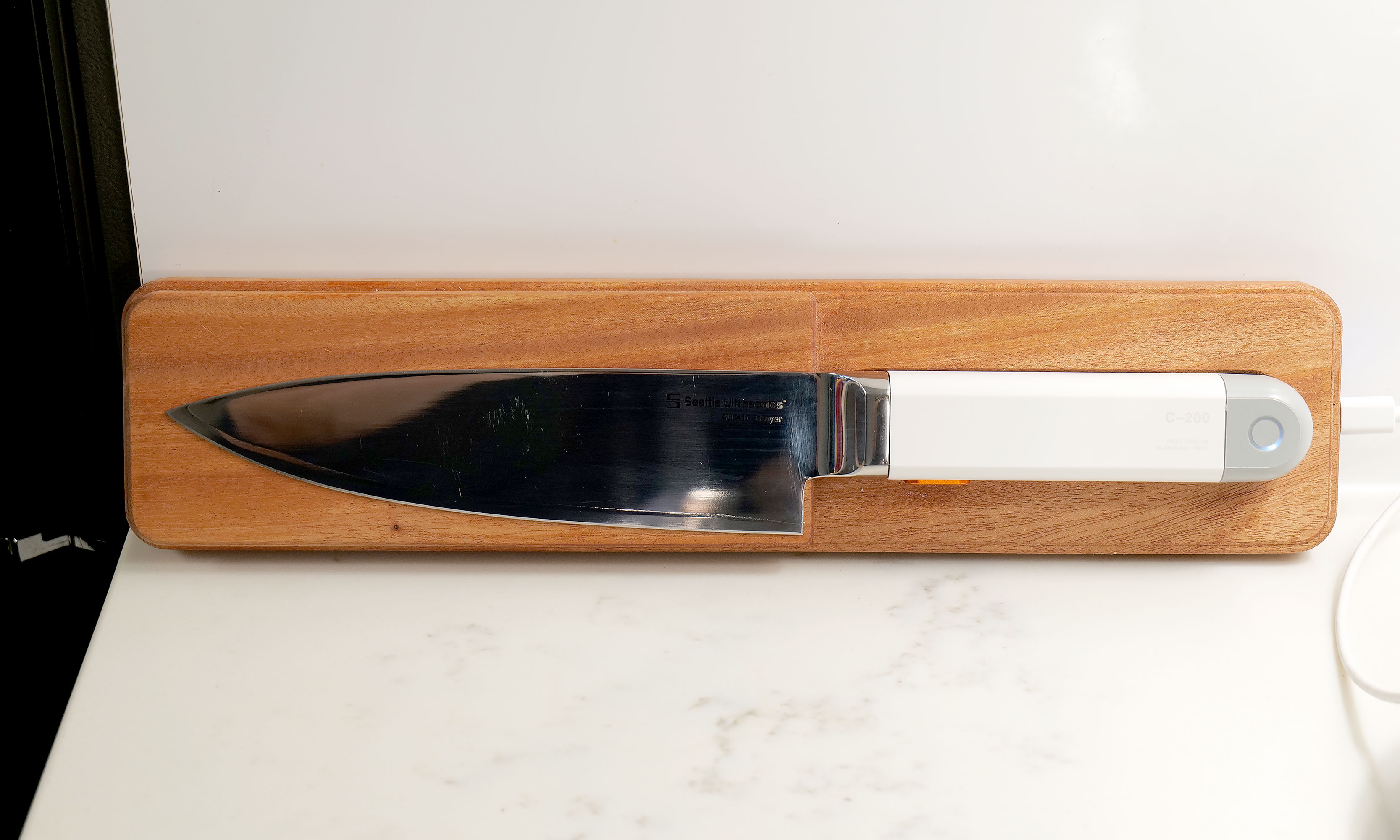
Seattle Ultrasonics’ wireless charging tile makes it incredibly easy to forget that the C-200 needs to be topped up between uses.
Sam Rutherford for Engadget
I fully admit the need to keep a knife charged up is a major annoyance and something I or anyone else probably doesn’t want to do. Thankfully, Seattle Ultrasonics thought of that by including support for wireless charging via the C-200’s magnetic tile and it’s dead simple to use. Just toss it on the charger when you’re not using and it will take care of itself, so you never have to worry about how much of its normal 20-minute runtime it may or may not have left. There are also holes around back so you can easily mount the charger on a wall or shelf. In short, the added convenience the charging tile brings is so valuable that I don’t really consider it an optional accessory. If you’re getting the C-200, you need to buy this too, which sadly means you’re looking at an all-in price of $500 for the bundle instead of just $400 for the knife by itself.
Wrap-up
As much as I love old-school knives, they’ll simply never be as sharp an equivalent blade with this newfound tech.
Sam Rutherford for Engadget
After using the C-200, I don’t think people need to rush out and throw all their old-school knives in the trash. The beauty of an ultrasonic blade like this is that it can handle everything your old cutlery is meant for, but with the touch of a button, it delivers sharpness unlike anything you’ve experienced before. And while it has some quirks, they’re nothing like the kind you typically encounter on first-gen gadgets. Its biggest drawback is that its magnetic charging tile feels like an essential accessory, but it adds extra cost on top of a product that already has a deservedly premium price tag.
Even though I’m sure knife makers will continue tweaking blade shapes and alloy mixes from now until the end of time, the addition of ultrasonic vibrations to a chef’s knife unlocks a completely new tier of performance. That’s because this technology is additive. All it does is enhance what a blade already does best. And when you look at related gadgets in the maker space, I don’t think it’s a coincidence that there’s a similar revolution that resulted in Adam Savage of Mythbusters fame naming a sonic cutter as one of his favorite things of 2025. When viewed that way, it makes me even more confident that the C-200 is the flagbearer for a new breed of kitchen knives.
This article originally appeared on Engadget at https://www.engadget.com/home/kitchen-tech/seattle-ultrasonics-c-200-review-this-is-the-future-of-kitchen-knives-140000051.html?src=rss
We may earn a commission from links on this page. Deal pricing and availability subject to change after time of publication.
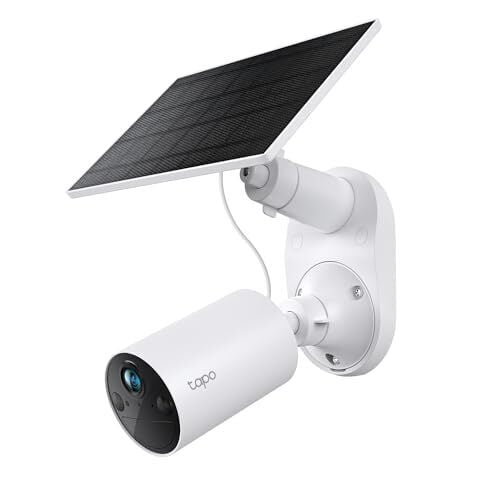
Home security cameras usually come with a tradeoff. You either run wires through your walls or climb a ladder every few weeks to recharge a battery. The TP-Link Tapo SolarCam C402 Kit skips both. It’s currently $39.98 on Amazon, down from its usual $59.99, and price trackers confirm this is its lowest tracked price to date.
Setup is straightforward: Mount the camera, position the panel where it gets steady sun, and let it handle the rest. TP-Link says around 45 minutes of direct sunlight per day is enough to keep the battery charged, and with an IP65 rating, the housing is designed to handle rain and dust. That makes it a budget-friendly option for a backyard, driveway, or shed where running power lines would be inconvenient.
Video tops out at 1080p and is not ultra-smooth, but it is detailed enough to identify someone approaching your door, and its 125-degree field of view captures a broad stretch of yard without the heavy curve you get from some wide-angle lenses. At night, you can switch between standard infrared for black-and-white video or use the built-in spotlight to capture color footage. The color mode looks better when there’s at least some nearby lighting, like a porch light or streetlamp, notes this PCMag review. There is also two-way audio for speaking to visitors and a built-in siren if you want an audible alert.
For storage, you can insert a microSD card up to 512GB, sold separately, or opt for Tapo’s cloud plan at $3.49 per month after a 30-day trial, which adds 30 days of video history and smart clip organization. On the plus side, it supports person, pet, and vehicle detection even without a paid subscription (which is not always the case with budget cameras). It also supports Amazon Alexa, Google Assistant, and IFTTT, though Apple HomeKit is not included. The main compromise is the 15fps video and the fact that you are relying on sunlight, so placement matters. For $40, though, this is one of the simpler ways to add a wire-free outdoor camera that does not demand constant maintenance.
Meta has struck a deal with AMD to buy up to six gigawatts worth of AI chips, bothcompanies announced. The agreement is structured in a way that could see AMD issue Meta up to 160 million shares of its common stock provided GPU shipment milestones are achieved — meaning Meta could own up to 10 percent of AMD if the deal fully completes.
Meta plans to purchase six gigawatts of AMD’s Instinct GPUs based on the MI450 architecture and optimized for Meta’s workloads, with the first gigawatt deployment set to begin in the second half of 2026. AMD and Meta will also expand on their EPYC CPU partnership, with Meta deploying “millions” of AMD EPYC CPUs and become a launch customer for its sixth-generation EPYC CPUs.
The tranche of AMD common stock will vest with the first one gigawatt of shipments, with additional tranches vesting as Meta scales to 6 gigawatts. Vesting is tied to AMD hitting certain stock price thresholds and Meta achieving certain technical and commercial milestones. The deal is very similar to one that AMD structured with OpenAI last year, with AMD obtaining up to a 10 percent stake in AMD in exchange for six gigawatts of Instinct GPUs.
Such deals are being likened to circular transactions that have created a tangle of interconnected dependencies between AI companies and chip manufacturers. Analysts have observed that such deals may magnify losses if demand for AI doesn’t match the sky-high market expectations.
The agreement also shows that AI companies are keen to diversify away from NVIDIA, with AMD being a key alternative. “By diversifying our partnerships and technology stack, we’re building a more resilient and flexible infrastructure,” Meta wrote in its news release.
This article originally appeared on Engadget at https://www.engadget.com/ai/meta-may-trade-ai-chips-for-shares-in-its-latest-amd-deal-134259842.html?src=rss
We may earn a commission from links on this page. Deal pricing and availability subject to change after time of publication.
The Beats Powerbeats Pro 2 were designed with workouts in mind, but their $249.99 list price has made them a harder sell unless you really value a locked-in fit. Right now, however, Grade-A refurbished pairs are $159.99 at Woot. For comparison, new units are listed at around $212 on Amazon, and used pairs are about $168. According to price trackers, the previous low was about $179.95, so this dip is roughly $20 below that mark. All told, that’s a $90 discount if you don’t mind a pre-owned device that has been tested and verified to work as intended. Prime members also get free shipping, while non-Prime customers pay a $6 fee.
The adjustable ear hooks of these earbuds keep them secure during runs, strength training, or high-impact workouts, and the IPX4 rating means sweat and light splashes won’t cause problems. The sound leans bold, with strong bass that keeps pace with hip-hop and electronic playlists. Active noise canceling reduces background noise at the gym, while transparency mode lets you hear traffic and announcements during outdoor runs. They also pair easily with Apple devices and support features similar to AirPods, though in a design that is more secure for exercise. For more on how these stack up in Apple’s ecosystem, see Senior Technology Editor Jake Peterson’s coverage of the Powerbeats Pro 2 fitness features in iOS 26.
Setup is simple, though if you need help with it, you can follow Lifehacker’s guide on how to configure every feature of your Powerbeats Pro 2. Battery life runs about eight to 10 hours per charge, and the case stretches total listening time to roughly 45 hours. That said, the built-in heart rate tracking is not flawless. Our Senior Health Editor, Beth Skwarecki, found it did not always sync reliably, especially when an iPhone was juggling workout apps and music at the same time. There is also no companion equalizer app, so you cannot tweak the sound profile beyond what Beats has tuned.
Samsung’s ready to launch its first new devices of 2026, and it’s got an Unpacked event in San Francisco to stream everything. The keynote starts at 10AM PT (1PM ET) and will be livestreamed on YouTube. The announcement on February 10 also said this launch will mark “a new phase in the era of AI as intelligence becomes truly personal and adaptive.”
What are we expecting? Based on leaked images of the new lineup, the company is not likely to have radically reinvented the look of the Galaxy S26, Galaxy S26+ or Galaxy S26 Ultra, sticking instead with a similar design to the Galaxy S25.
We’re expecting Qualcomm’s new Snapdragon 8 Elite Gen 5 chip to be in all Samsung Galaxy S26 phones, though Korean news site Yonhap News reports Samsung’s relatively new Exynos 2600 chip could be in some devices, depending on the region.
Despite the launch of the Qi 2 wireless charging standard, which added support for convenient magnetic alignment, Samsung still hasn’t brought the feature to its phones. Rumours suggest the S-series will have the spec’s higher speed wireless charging rates but will lack built-in magnets and have to depend on cases to add MagSafe-style charging and mounting.
Honestly? It could be a pretty mild launch event, especially after wowing everyone with the Galaxy TriFold at the start of the year.
Are you more interested in foldables than traditional candy bar devices? (If so, get ready for MWC 2026, kicking off next week. We’re expecting a lot of foldables.)
Yes, a truly new Neon Genesis Evangelion series is coming. The announcement came during a 30th-anniversary event in Japan. However, franchise creator Hideaki Anno won’t write the scripts. His replacement will be Yoko Taro, creator of the NieR video game series, who wears a giant spooky moon mask for interviews and game briefings. He’s also a cool guy underneath. Evangelion veteran Kazuya Tsurumaki will be on hand to direct episodes, produced by Studio Khara and Cloverworks.
Marathon players found cheating or developing cheats will receive a permaban.
In a detailed blog post, Bungie took a very declarative position against those caught trying to cheat: “We are taking a strong stance against cheating and anyone found to be cheating or developing cheats will be permanently banned from playing Marathon forever, no second chances.” The blog post added that an appeals system will be in place.
However, Bungie’s anti-cheat standards go beyond punishment. In the blog post, Bungie explained that Marathon’s dedicated servers have full authority on movement, shooting, actions and inventory. Since these key actions rely on the server, it will translate to smoother gunplay for players as well as the prevention of cheats related to teleportation, unlimited ammo or damage manipulation.
Pavel Durov, the founder of Telegram, is reportedly under criminal investigation by Russian authorities for “abetting terrorist activities.” According to the Financial Times, state-run publications are accusing Durov of enabling attacks on Russia and Telegram of becoming an intelligence tool for Ukraine and the west. Telegram was one of the apps that Russia blocked in the country just a few days ago, along with WhatsApp, in what seemed to be an effort to push local users towards the unencrypted state-owned app, Max.
When Telegram was banned, pro-Russian voices criticized the country’s decision, because it was apparently harming frontline operations. Russia’s own soldiers are using the app to communicate and coordinate their moves. Authorities near the Ukrainian border, for instance, send out warning for incoming drone and missile attacks through the messaging app. Even Vladimir Putin’s spokesperson uses Telegram to speak to the media.
Now, the Times says Russia is accusing Telegram of being the main instrument for “NATO countries’ secret services and the Kyiv regime.” Rossiiskaya Gazeta, a Russian state-run publication, added that Telegram was “intercepting location data, selling secret information and intimidating soldiers and their families.” Digital platforms like Telegram, the publication said, are “becoming strategic weapons.” Rossiiskaya Gazeta said its information came from Russia’s Federal Security Service, the country’s primary domestic security agency.
Durov has yet to issue a statement, but after Russia blocked access to Telegram, he said the country was restricting access” to the application to “force its citizens onto a state-controlled app built for surveillance and political censorship.” The Telegram founder was born in Russia and co-founded the country’s largest social network, VK. He left his country after Kremlin pressured him to sell his stake in the social network.
This article originally appeared on Engadget at https://www.engadget.com/apps/telegram-founder-pavel-durov-is-reportedly-under-criminal-investigation-in-russia-121000511.html?src=rss
King of Meat‘s reign is ending. The game will end service on April 9, less than a year after its October 2025 debut. The Amazon Games-published title will be playable until that date, but will then be taken entirely offline.
“Despite the creativity and innovation Glowmade brought to King of Meat, the game has unfortunately not found the audience we hoped for,” the announcement read.
Developer Glowmade had high hopes for King of Meat, its debut game, but it fell starkly short of expectations. The developer wanted a concurrent player count of at least 100,000, but peaked at 320, according to Insider Gaming. The game had a multi-million dollar marketing budget that included a video on MrBeast’s YouTube channel and custom-wrapped London buses. The company even made a pilot for an animated TV show. Here at Engadget, we were so-so on a preview version of the game.
December brought voluntary redundancies to Glowmade after previous assurances to staff. Anyone who has purchased King of Meat will be able to get a refund through their purchase platform and, in most cases, these refunds should process automatically by April 9.
While it seems that King of Meat struggled to reach its audience, Amazon has a history of pulling games that are popular. Last fall, Amazon Games announced it would wind down support for New World: Aeternum, which first debuted in 2021. The news came as the division faced layoffs, but just that week the game had reached almost 50,000 concurrent players on Steam.
This article originally appeared on Engadget at https://www.engadget.com/gaming/amazon-games-is-winding-down-king-of-meat-113049172.html?src=rss
The US Department of Defense has reportedly reached a deal to use Elon Musk’s Grok in its classified systems, according to Axios. That follows news that the Pentagon is currently in a dispute with another AI company, Anthropic, over limits on its technology for things like mass surveillance.
Last year, the White ordered Grok, along with ChatGPT, Gemini and Anthropic’s Claude to be approved for government use. Up until now, though, only Anthropic’s model has been allowed for the military’s most sensitive tasks in intelligence, weapons development and battlefield operations. Claude was reportedly used in the Venezuelan raid in which the US military exfiltrated the country’s president, Nicolás Maduro, and his wife.
However, the Pentagon demanded that Anthropic make Claude available for “all lawful purposes” including mass surveillance and the development of fully autonomous weapons. Anthropic reportedly refused to offer its tech for those things, even with a “safety stack” built into that model.
xAI, by contrast, agreed to a standard that would allow the DoD to employ its AI for any purpose it deems “lawful.” However, the xAI model is not considered by officials to be as cutting-edge or reliable as Anthropic’s Claude, and they admit that replacing Claude with Grok would be a challenge. The Pentagon is reportedly also negotiating deals with OpenAI and Gemini, both of which it considers to be on par with Anthropic.
xAI had announced a version of Grok for US government agencies in July 2025. Shortly before that, though, the chatbot started spouting fascist propaganda and antisemitic rhetoric while dubbing itself “MechaHitler.” All of that followed a public spat between Musk and Trump over the president’s spending bill, after which GSA approval of Grok seemed to stall. Earlier this week, Anthropic accused three Chinese AI labs of abusing Claude’s AI with “distillation attacks” to improve their own models.
This article originally appeared on Engadget at https://www.engadget.com/ai/the-us-military-will-reportedly-use-elon-musks-grok-ai-in-its-classified-systems-110049021.html?src=rss
Starting later this year, Apple will start manufacturing Mac minis meant for sale in the US within the country. The company took The Wall Street Journalon a tour of its Houston facility, where Foxconn is also building servers for Apple Intelligence, and was shown an empty warehouse. Apple says it will turn the space into a 220,000 square feet plant where it will produce the compact desktop computers. The decision to produce Mac minis for local sales within the US is part of the company’s efforts to make good on its pledge last year that it will spend $500 billion in the US over the next four years.
If you’ll recall, Apple announced it was going to ramp up its investments and hiring in the US after Tim Cook met with President Trump. The president said at the the time that the company was growing its US investments because it wanted to avoid tariffs. Prior to that pledge, during the Biden administration in 2021, Apple vowed to invest $430 billion domestically over the following five years.
As the Journal notes, Apple previously made Mac Pros in a facility in Texas, but production in the plant has dwindled in recent years. Sabih Khan, Apple’s COO, told the Journal that the company feels more confident in projecting the Mac mini’s long term demand. At the same time, the model makes up a tiny portion of Apple’s sales, making it one of the company’s best options if it wants bring more production into the US. It will be incredibly difficult, after all, to move the production of a more in-demand product, say the iPhone, stateside. The companies making and assembling iPhones in China already have factories fitted for and people with skills honed for the production of Apple’s best-selling device.
Khan said the Houston facility will be able to meet local demand as production ramps up, insinuating that it might start small. Apple will also continue manufacturing Mac minis in Asia for everyone else in the world.
This article originally appeared on Engadget at https://www.engadget.com/big-tech/apple-will-start-making-mac-minis-in-the-us-101000341.html?src=rss
alternative_right shares a report from Phys.org: A team of researchers working at Quantinuum in the United Kingdom and QuSoft in the Netherlands has now developed a quantum algorithm that solves a specific sampling task — known as complement sampling — dramatically more efficiently than any classical algorithm. Their paper, published in Physical Review Letters, establishes a provable and verifiable quantum advantage in sample complexity: the number of samples required to solve a problem.
“We stumbled upon the core result of this work by chance while working on a different project,” Harry Buhrman, co-author of the paper, told Phys.org. “We had a set of items and two quantum states: one formed from half of the items, the other formed from the remaining half. Even though the two states are fundamentally distinct, we showed that a quantum computer may find it hard to tell which one it is given. Surprisingly, however, we then realized that transforming one state into the other is always easy, because a simple operation can swap between them.”
Tesla is suing California’s Department of Motor Vehicles (DMV) to reverse a ruling that prevented the automaker from using the terms “Autopilot” and “Full Self-Driving” to sell cars, CNBC reported. That follows a December ruling by a California administrative law judge that forced Tesla to clean up its marketing language or risk a suspension of its sales license. Last week, the DMV determined that Tesla had made the necessary changes, including changing the name to “Full Self-Driving (Supervised),” and that no suspension would occur.
However, if you had “Tesla is going to sue them back” in your office pool, you can go ahead and claim your prize. The company filed a complaint on February 13 alleging that the DMV “wrongfully and baselessly” called Tesla a false advertiser. Calling the order “factually wrong” and “unconstitutional,” Tesla demanded that order be set aside.
The DMV had originally argued that Tesla’s terms for its driver assistance program gave consumers the impression that its cars were safe to drive without a human at the wheel. However, Tesla said that the DMV never proved that buyers were confused and that it was “impossible” to buy a Tesla without seeing “clear and repeated statements” that its systems aren’t fully autonomous.
Tesla’s appeal of the ruling isn’t a shocker given that the company is essentially betting its future on autonomous vehicles. CEO Elon Musk has long promised buyers that its vehicles would eventually become fully autonomous and that you’d even be able to rent them out to provide robo-taxi services. “If you fast forward a year, maybe [15 months], we’ll have over a million robo-taxis on the road,” he wrongly predicted back in 2019.
Following a sales decline last year that was particularly steep in Europe, Tesla is banking on its Cybercab two-seater to boost its fortunes. The company has started limited testing of automated vehicles as part of its Robotaxi pilot in Austin, Texas.
Last week, however, Tesla lost an appeal in a $243 million lawsuit verdict over a 2019 crash of a Model S — largely over its use of the terms “Autopilot” and “Full Self-Driving.” Last month, the company canceled Autopilot, its basic of advanced driver assistance tier, on new Model 3 and Model Y vehicles and switched its FSD (Supervised) tier to subscription-only.
This article originally appeared on Engadget at https://www.engadget.com/transportation/evs/tesla-sues-california-dmv-after-it-banned-the-term-autopilot-090845766.html?src=rss
U.S. battery storage installations hit a record 57.6 GWh in 2025, and Texas is now poised to surpass California as the nationâ(TM)s largest storage market in 2026. Electrek reports: According to the US Energy Storage Market Outlook Q1 2026 from the Solar Energy Industries Association (SEIA) and Benchmark Mineral Intelligence, installations are now four times higher than totals from just three years ago. The US had a total of 137 GWh of utility-scale storage installed as of 2025, plus 19 GWh of commercial and industrial systems and 9 GWh of residential storage. Analysts expect the growth streak to continue. More than 600 GWh of energy storage is projected to be deployed nationwide by 2030, even as the Trump administration targets clean energy industries.
Two-thirds of utility-scale storage installed in 2025 was built in red states, including nine of the top 15 states for new installations. Texas is projected to surpass California as the countryâ(TM)s largest battery storage market in 2026. Standalone battery projects accounted for nearly 30 GWh of new capacity in 2025, while solar-plus-storage installations made up about 20 GWh. Residential storage deployments reached 3.1 GWh last year, a 51% increase year-over-year. Analysts say virtual power plant programs in states such as Massachusetts, Texas, Arizona, and Illinois are helping drive adoption by reducing costs and easing strain during peak demand periods.
The supply chain is shifting to support the boom. In 2025, some battery cell manufacturers pivoted production from EV batteries to dedicated stationary storage cells, converting existing lines and adjusting future plans. Lithium-ion cell manufacturing for stationary storage reached more than 21 GWh in 2025, enough to power Houston overnight, according to SEIAâ(TM)s Solar and Storage Supply Chain Dashboard. Meanwhile, US factories now have the capacity to manufacture 69.4 GWh of battery energy storage systems annually.
An anonymous reader quotes a report from the Guardian: When two men knocked on Ida Huddleston’s door last May, they carried a contract worth more than $33m in exchange for the Kentucky farm that had fed her family for centuries. According to Huddleston, the men’s client, an unnamed “Fortune 100 company,” sought her 650 acres (260 hectares) in Mason county for an unspecified industrial development. Finding out any more would require signing a non-disclosure agreement. More than a dozen of her neighbors received the same knock. Searching public records for answers, they discovered that a new customer (PDF) had applied for a 2.2 gigawatt project from the local power plant, nearly double its annual generation capacity. The unknown company was building a datacenter. “You don’t have enough to buy me out. I’m not for sale. Leave me alone, I’m satisfied,” Huddleston, 82, later told the men.
As tech companies race to build the massive datacenters needed to power artificial intelligence across the US and the world, bids like the one for Huddleston’s land are appearing on rural doorsteps nationwide. Globally, 40,000 acres of powered land – real estate prepped for datacenter development — are projected to be needed for new projects over the next five years, double the amount currently in use. Yet despite sums that often dwarf the land’s recent value, farmers are increasingly shutting the door. At least five of Huddleston’s neighbors gave similar categorical rejections, including one who was told he could name any price.
In Pennsylvania, a farmer rejected $15m in January for land he’d worked for 50 years. A Wisconsin farmer turned down $80m the same month. Other landowners have declined offers exceeding $120,000 per acre — prices unimaginable just a few years ago. The rebuffs are a jarring reminder of AI’s physical bounds, and limits of the dollars behind the technology. […] As AI promises to transcend corporeal fallibility, these standoffs reveal its very physical constraints — and Wall Street’s miscalculation of what some people value most. In the rolling hills of Mason county and farmland across America, that gap is measured not in dollars but in something harder to price: identity.
In her first major interview as Microsoft’s new gaming chief, Asha Sharma said that “great games” must deliver emotional resonance and a distinct creative voice, while making clear that she has “no tolerance for bad AI.” Stepping in after Phil Spencer’s retirement, she’s pledging consistency, community trust, and a human-first approach to storytelling as Xbox enters a new era. Variety reports: Sharma was quick in laying out her top priorities for Microsoft Gaming in an internal memo announcing her promotion, noting “great games,” “the return of Xbox” and the “future of play” as her three main commitments to the gaming community. So first, what makes a great game for Sharma, whose roles prior to CoreAI include top positions at Instacart and Meta? The new Microsoft Gaming CEO tells Variety it’s all about games with “deep emotional resonance” and “a distinct point of view.” She wants to develop stories that make players “feel something,” like the kind of feelings Campo Santo’s 2016 first-person mystery “Firewatch” elicited in her.
Sharma takes on the mantle as head of the leading competitor to Sony’s PlayStation and Nintendo knowing full well she’s entering the role as an outsider to the larger gaming community and has “a lot to learn” still. But Sharma says she’s got a commitment to “being grounded in what the community is telling us.” “I’m coming into gaming as a platform builder,” Sharma said, adding that her goal is to “earn the right to be trusted by players and developers” and show the fanbase that “consistency” over time. In her interview with Variety, Sharma acknowledged the tumultuous state of the gaming industry, referencing Matthew Ball’s recent State of Video Gaming in 2026 report as evidence that the larger “transformation” of the sector is “protecting what we believe in while remaining open-minded about the future.”
Due to her strong background in AI, initial reactions to Sharma’s appointment have raised concerns about what her specific views are on the use of generative AI in game development. Sharma says her stance is simple: she has “no tolerance for bad AI.” “AI has long been part of gaming and will continue to be,” Sharma said, noting that gaming needs new “growth engines,” but that “great stories are created by humans.”
joshuark quotes a report from BleepingComputer: Microsoft is investigating a known issue that causes the mouse pointer to disappear in the classic Outlook desktop email client for some users. This bug has been acknowledged almost two months after the first reports started surfacing online, with users saying that Outlook became unusable after the mouse pointer vanished while using the app.
[…] Microsoft explained in a recent support document that the mouse pointer (and in some cases the cursor) will suddenly vanish as users move it across Outlook’s interface. “When using classic Outlook, you may find that the mouse pointer or mouse cursor disappears as you move the pointer over the Outlook interface,” it said. “Although the mouse pointer is not there, the email in the message list will change color as you hover over it. This issue has also been reported with OneNote and other Microsoft 365 apps to a lesser degree.”
Microsoft added that the Outlook team is investigating the issues and will provide updates as more information becomes available. While a timeline for a permanent fix is not yet available, Microsoft has offered three temporary workarounds that require affected users to click an email in the message list when the cursor disappears, which may cause it to reappear. Alternatively, switching to PowerPoint, clicking into an editable area, and then returning to Outlook may also restore the mouse pointer.
A 7,000-word “doomsday” thought experiment from Citrini Research helped trigger an 800-point drop in the Dow, “painting a dark portrait of a future in which technological change inspires a race to the bottom in white-collar knowledge work,” reports the Wall Street Journal. From the report: Concerns of hyperscalers overspending are out. Worries of software-industry disruption don’t go far enough. The “global intelligence crisis” is about to hit. The new, broader question: What if AI is so bullish for the economy that it is actually bearish? “For the entirety of modern economic history, human intelligence has been the scarce input,” Citrini wrote in a post it described as a scenario dated June 2028, not a prediction. “We are now experiencing the unwind of that premium.”
Many of Monday’s moves roughly aligned with the situation outlined by Citrini, in which fast-advancing AI tools allow spending cuts across industries, sparking mass white-collar unemployment and in turn leading to financial contagion. Software firms DataDog, CrowdStrike and Zscaler each plunged more than 9%. International Business Machines’ 13% decline was its worst one-day performance since 2000. American Express, KKR and Blackstone — all name-checked by Citrini — tumbled. That anxiety, coupled with renewed uncertainty about trade policy from Washington, weighed down major indexes Monday. The Dow Jones Industrial Average led declines, falling 1.7%, or 822 points. The S&P 500 shed 1%, while the Nasdaq composite retreated 1.1%.
[…] Monday’s market swings extended a run of AI-linked volatility. A small research outfit that has garnered a huge Substack following for macro and thematic stock research, Citrini said in its new post that software firms, payment processors and other companies formed “one long daisy chain of correlated bets on white-collar productivity growth” that AI is poised to disrupt. […] Shares in DoorDash also veered 6.6% lower Monday after Citrini’s Substack note called the delivery app a “poster child” for how new tools would upend companies that monetize interpersonal friction. In the research firm’s scenario, AI agents would help both drivers and customers navigate food deliveries at much lower costs.
An anonymous reader quotes a report from the Financial Times: Officials working with Donald Trump’s “Board of Peace” are exploring setting up a stablecoin for Gaza as part of efforts to reshape the devastated Palestinian enclave’s economy, according to five people familiar with the discussions. The talks around introducing a stablecoin — a type of cryptocurrency whose value is pegged to a mainstream currency, such as the US dollar — are at a preliminary stage, and many details of how one could be introduced in Gaza remain to be determined.
But officials have discussed the idea as part of their plan for the future of the enclave, where economic activity collapsed during Israel’s two-year war with Hamas and the traditional banking and payments system has been severely impaired. A person familiar with the project said the stablecoin was expected to be tied to the US dollar, with the hope that Gulf Arab and Palestinian companies with expertise in the field of digital currencies will help spearhead the effort. “This will not be a ‘Gaza Coin’ or a new Palestinian currency, but a means to allow Gazans to transact digitally,” the person said.
Work on the idea is being led by Liran Tancman, an Israeli tech entrepreneur and former reservist who is now working as an unpaid adviser to Trump’s “Board of Peace,” the US-led body tasked with rebuilding Gaza, according to two people familiar with the matter. […] According to the person familiar with the project, the “Board of Peace” and NCAG will decide on the stablecoin’s regulatory framework and access, although “nothing definitive” has yet been finalized. Speaking at a meeting of the “Board of Peace” in Washington last week, Tancman said the NCAG was working on building “a secure digital backbone, an open platform enabling e-payments, financial services, e-learning, and healthcare with user control over data”, but did not elaborate.