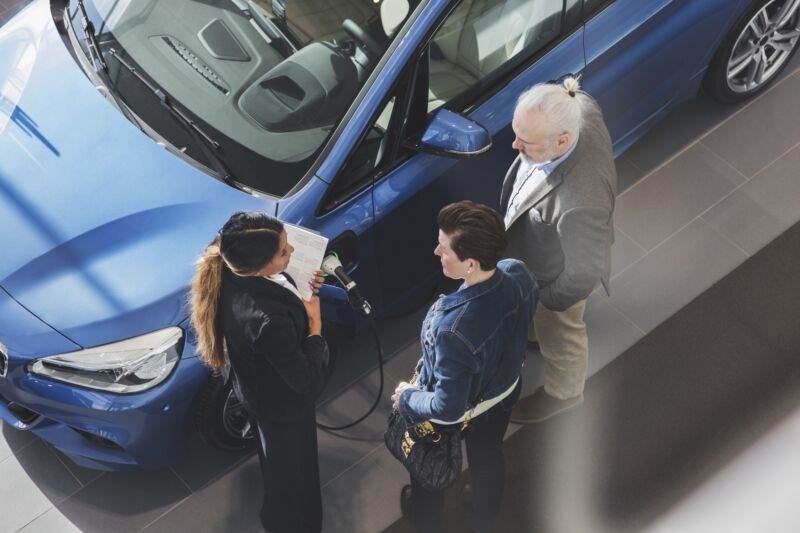
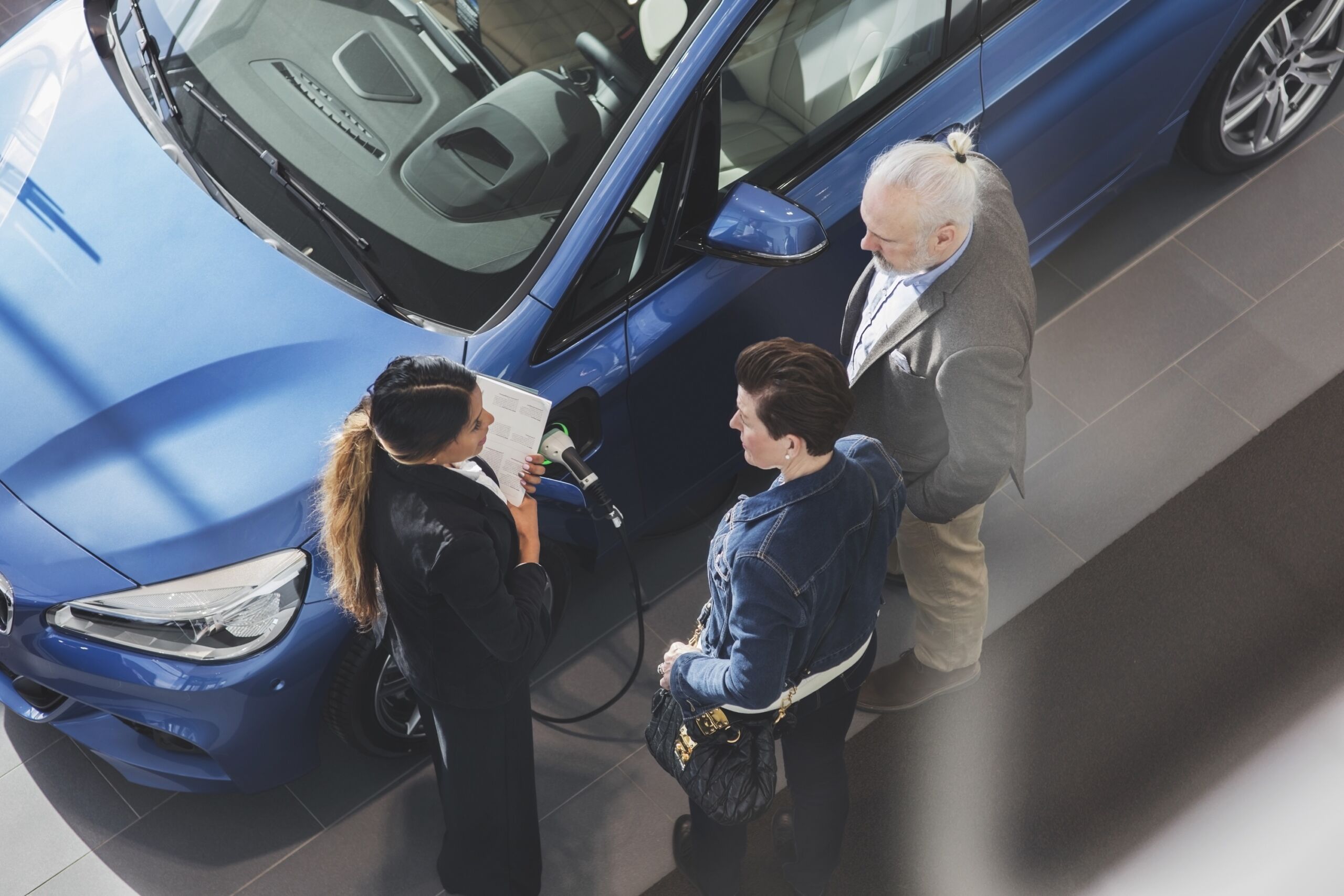
For such a car-centric nation, it’s a little depressing that the US lags behind the European Union and China when it comes to electric vehicle adoption. Without a large investment to redesign our towns and cities to make them walkable and accessible via public transport, switching en masse to electric cars is the main remaining avenue left to decarbonize our transport, after all. So it is rather encouraging to see signs that more US car buyers are opting to go electric, as sales have climbed 50 percent, year on year, as uptake reaches almost 8 percent.
According to Kelly Blue Book, US car buyers bought 313,086 battery EVs between the months of July and September 2023, compared to just 209,030 BEVs for the same three months of last year. Add in the 882 Toyota Mirai hydrogen fuel cell EVs and 68 Hyundai Nexo FCEVs that found homes in Q3 2023 and that’s a 50.1 percent increase, year on year.
The cumulative totals for all of 2023 so far are also looking healthy. KBB estimates that 873,082 BEVs have been bought this year, versus 586,965 for the first nine months of 2022. Add in about 2,800 FCEVs compared to around 1,000 last year, and clean vehicle sales grew 49 percent, year on year.
The EU has announced further plans to crack down on microplastics after its ban on glitter came into force. From a report: The proposal, which tackles tiny pellets used in nearly all plastic products, aims to cut plastic pellet pollution by 74% by the end of the decade. Overall, it would lead to a 7% reduction in Europe’s microplastic pollution, according to the European Commission. “The most important thing is to cut pollution at the source,” said Virginijus Sinkevicius, EU commissioner for the environment, oceans and fisheries, in an interview with the Guardian. “What we are looking to do is basically ensure we drastically cut, at the source, pollution of microplastics.”
Tiny, durable pellets of plastic — also known as nurdles or nibs — are melted down and reformed into everyday products, from office chairs to water bottles. But they leak into the environment at every stage of the supply chain. Over time, they break down into microplastics that are eaten and drunk by people and animals. The commission estimates between 52,000 and 184,000 tons of plastic pellets are released into the environment in the EU each year.
The days of Terminator and The Matrix could be closer to reality as the artificial intelligence wave continues to crash. A U.S. think tank released a report arguing that the AI that guides the likes of ChatGPT and those dystopian influencers from Meta could be used to create a new bioweapon.
Based in San Diego, Cleer started as a passion project for a couple of audio enthusiasts. Over the years, it has grown quite a bit with a number of successful products under its belt. Alpha is the company’s flagship over-the-ear headphones. It is also one of Cleer’s most popular products and what they call their…
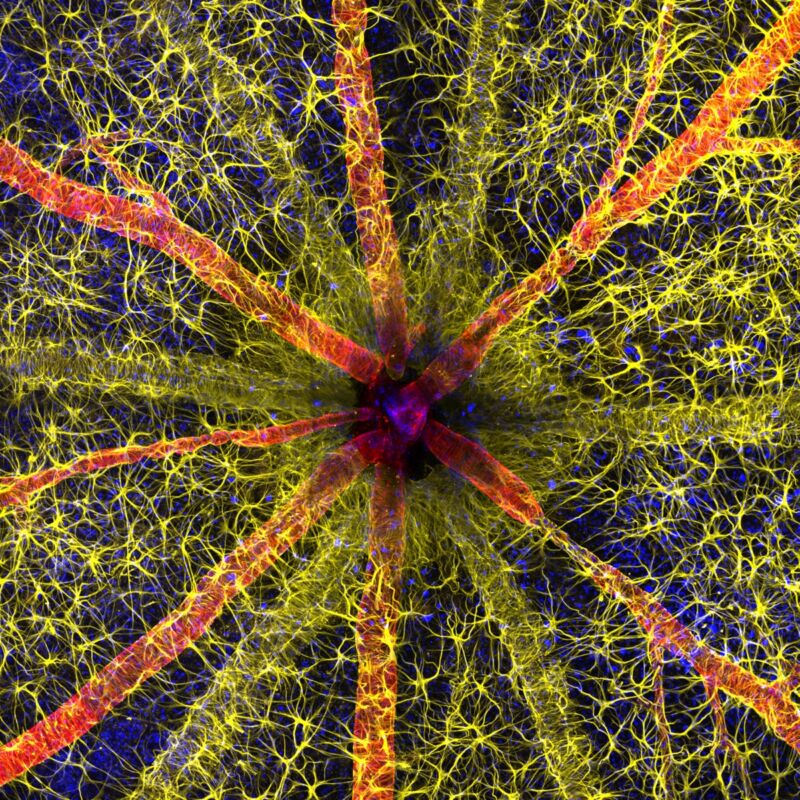
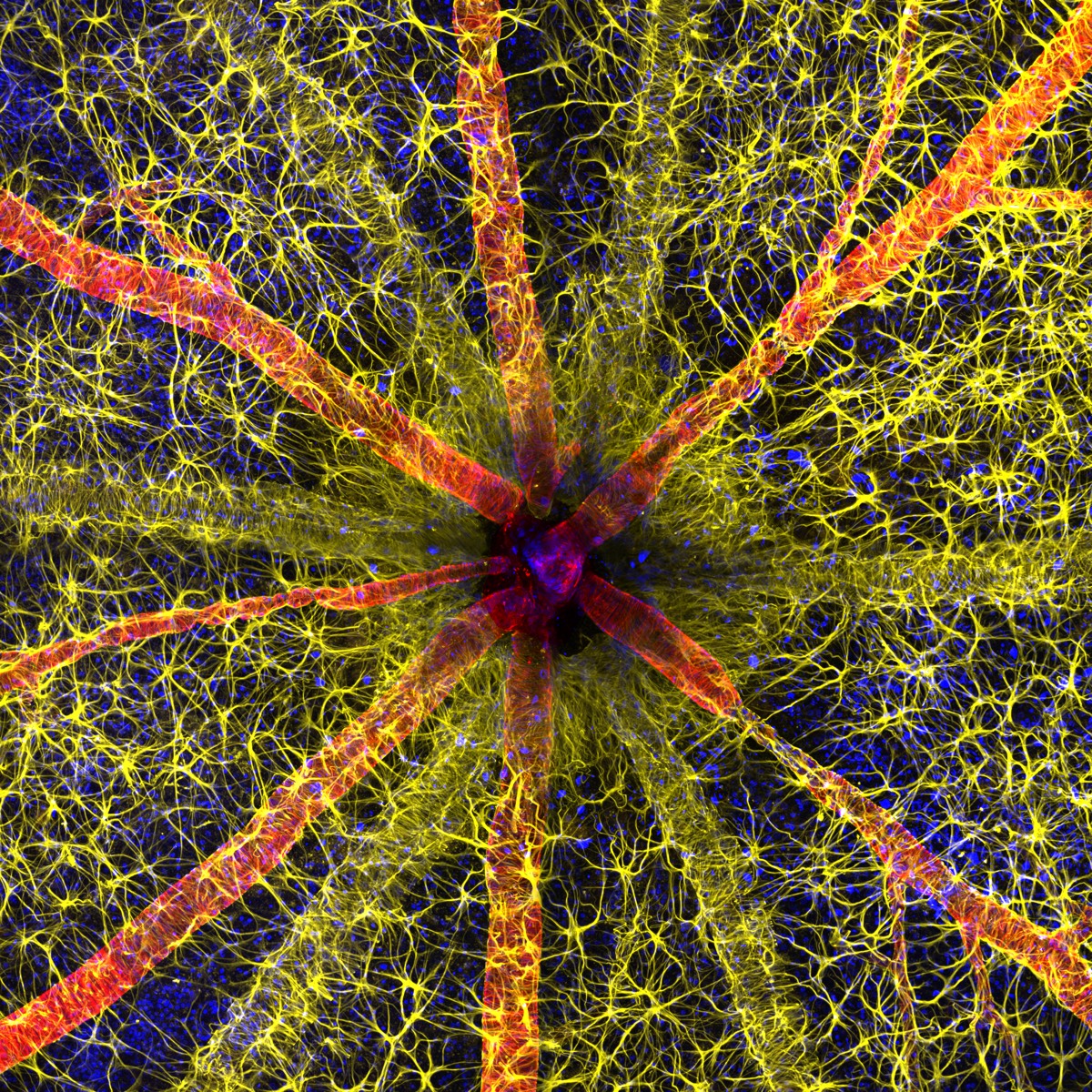
Enlarge/ The winning entry: a rodent optic nerve head with astrocytes (yellow), contractile proteins (red), and retinal vasculature (green). (credit: Hassanain Qambari and Jayden Dickson)
Millions of Americans with diabetes (about 1 in 5) face the risk of eventual blindness due to diabetic retinopathy, a condition that affects blood vessels in the retina, the light-sensitive tissue in the back of the eye. It’s a difficult condition to spot in its earliest stages, since many people don’t show immediate symptoms (although one 2021 study identified key biomarkers that potentially could one day help with early identification). By the late stages, the damage is often irreversible.
Hassanain Qambari’s research at the Lions Eye Institute in Perth, Australia, focuses on early detection and possible reversal of diabetic retinopathy, including taking precise images of the tiny micron-sized vessels in the eye. With colleague Jayden Dickson’s assistance, he created the winning image in the 2023 Nikon Small World Photomicrography Competition, depicting an optic nerve head in a rodent in exquisite detail.
Now in its 49th year, the annual competition is designed to highlight “stunning imagery from scientists, artists, and photomicrographers of all experiences and backgrounds from across the globe,” according to Nikon’s communications manager, Eric Flem, adding, “I am consistently awed by how these advancements make it possible to create art out of science for the public to enjoy.” Photomicrography involves attaching a camera to a microscope (either an optical microscope or an electron microscope) so that the user can take photographs of objects at very high resolutions. British physiologist Richard Hill Norris was one of the first to use it for his studies of blood cells in 1850, and the method has increasingly been highlighted as art since the 1970s.
While many of the flashy, marquee mobility and transportation demos that go on at CES tend to be of the more… aspirational variety, Honda’s electric cargo hauler, the Autonomous Work Vehicle (AWV), could soon find use on airport grounds as the robotic EV trundles towards commercial operations.
Honda first debuted the AWV as part of its CES 2018 companion mobility demonstration, then partnered with engineering firm Black & Veatch to further develop the platform. The second-generation AWV was capable of being remotely piloted or following a preset path while autonomously avoiding obstacles. It could carry nearly 900 pounds of sutff onboard and atow another 1,600 pounds behind it, both on-road and off-road. Those second-gen prototypes spent countless hours ferrying building materials back and forth across a 1,000-acre solar panel construction worksite, both individually and in teams, as part of the development process.
This past March, Honda unveiled the third-generation AWV with a higher carrying capacity, higher top speed, bigger battery and better obstacle avoidance. On Tuesday, Honda revealed that it is partnering with the Greater Toronto Airports Authority to test its latest AWV at the city’s Pearson Airport.
The robotic vehicles will begin their residencies by driving the perimeters of airfields, using mounted cameras and an onboard AI, checking fences and reporting any holes or intrusions. The company is also considering testing the AWV as a FOD (foreign object debris) tool to keep runways clear, as an aircraft component hauler, people mover or baggage cart tug.
This article originally appeared on Engadget at https://www.engadget.com/honda-to-test-its-autonomous-work-vehicle-at-torontos-pearson-airport-153025911.html?src=rss
What, you thought Tiffany Valentine, queen of tawdry glam, would drab herself down like any other inmate? Relish her jailhouse style in this exclusive clip fromChucky’s third episode, which sees Lexy (Alyvia Alyn Lind) visiting Tiffany (Jennifer Tilly), hoping she’ll provide some desperately needed information.
New York City Mayor Eric Adams announced Monday he is rolling out an Artificial Intelligence Action Plan in light of the growing “risks” of the technology. Adams said at a press conference that he hopes to use AI responsibly “to improve quality of life for New Yorkers.”
Sometimes, following instructions too precisely can land you in hot water — if you’re a large language model, that is. From a report: That’s the conclusion reached by a new, Microsoft-affiliated scientific paper that looked at the “trustworthiness” — and toxicity — of large language models (LLMs) including OpenAI’s GPT-4 and GPT-3.5, GPT-4’s predecessor. The co-authors write that, possibly because GPT-4 is more likely to follow the instructions of “jailbreaking” prompts that bypass the model’s built-in safety measures, GPT-4 can be more easily prompted than other LLMs to spout toxic, biased text. In other words, GPT-4’s good “intentions” and improved comprehension can — in the wrong hands — lead it astray.
“We find that although GPT-4 is usually more trustworthy than GPT-3.5 on standard benchmarks, GPT-4 is more vulnerable given jailbreaking system or user prompts, which are maliciously designed to bypass the security measures of LLMs, potentially because GPT-4 follows (misleading) instructions more precisely,” the co-authors write in a blog post accompanying the paper. Now, why would Microsoft greenlight research that casts an OpenAI product it itself uses (GPT-4 powers Microsoft’s Bing Chat chatbot) in a poor light? The answer lies in a note within the blog post: “[T]he research team worked with Microsoft product groups to confirm that the potential vulnerabilities identified do not impact current customer-facing services. This is in part true because finished AI applications apply a range of mitigation approaches to address potential harms that may occur at the model level of the technology. In addition, we have shared our research with GPT’s developer, OpenAI, which has noted the potential vulnerabilities in the system cards for relevant models.”
President Joe Biden’s presidential campaign launched its account on former President Donald Trump’s Truth Social platform on Monday. The reason? They thought it would be funny, according to an X post.
Apple has unveiled a new Apple Pencil. The latest model costs $79 ($69 for education) and it pairs and charges via a USB-C cable. It’ll be available in early November and it’s compatible with every iPad that has a USB-C port.
This is the company’s most budget-friendly Apple Pencil yet. It’s $20 less than the original model and $40 cheaper than the second-gen Apple Pencil. Apple says features of the new version include pixel-perfect accuracy, low latency and tilt sensitivity.
There’s no pressure sensitivity this time around, though, so if you want that feature, you’ll need to stick with either of the previous iterations. While you can attach the USB-C Apple Pencil magnetically to the side of your iPad for storage (in which case it will go into a sleep state to prolong the battery life), there’s no wireless charging support either. To top up the Pencil’s battery, you’ll need to slide back a cap to expose a USB-C port and plug in a charging cable.
Apple
Unlike the second-gen Pencil, you won’t be able to double tap the latest version to change drawing tools. Apple has also declined to offer free engraving this time around. However, if you have an M2-powered iPad, you’ll be able to take advantage of the hover feature that’s supported on the second-gen Pencil. That enables you to preview any mark you intend to make before it’s actually applied to your note, sketch, annotation and so on.
This is Apple’s latest step in its transition away from the Lightning port, which was largely prompted by European Union rules. The company started embracing USB-C on iPads several years ago, while it ditched the Lightning port in all iPhone 15 models. It’ll take Apple a while longer to move away from Lightning entirely. Several devices it sells — such as older iPhones, AirPods Max, Magic Mouse, Magic Trackpad and the first-gen Apple Pencil — still use that charging port. But this is another step toward an all-USB-C future, and one fewer charging cable you’ll need to carry around.
This article originally appeared on Engadget at https://www.engadget.com/the-new-79-apple-pencil-has-a-usb-c-charging-port-141732710.html?src=rss
Enlarge/ SpaceX said this week that Starship is stacked and ready to fly its second test flight. (credit: SpaceX)
In a remarkably frank discussion this week, several senior SpaceX officials spoke with Ars Technica on background about how working with the Federal Aviation Administration has slowed down the company’s progress not just on development of the Starship program, but on innovations with the Falcon 9 and Dragon programs as well.
The SpaceX officials said they want to be clear that the FAA is doing a reasonably good job with the resources it has, and that everyone supports the mission of safe spaceflight. However, they said, the FAA needs significantly more people working in its licensing department and should be encouraged to prioritize missions of national importance.
In recent months, according to SpaceX, its programs have had to compete with one another for reviews at the FAA. This has significantly slowed down the Starship program and put development of a Human Landing System for NASA’s Artemis program at risk. Inefficient regulation, the officials said, is decreasing American competitiveness as space programs in China and elsewhere around the world rise.
Baidu’s founder Robin Li declared his company’s large language model has finally caught up with OpenAI’s advanced GPT-4, claiming the lead in his country’s race to develop AI that can rival the US. From a report: The billionaire took the stage in Beijing Tuesday to run Ernie 4.0 through a Q&A designed to showcase its ability to provide answers and solve complicated puzzles on the fly. Ernie has matched OpenAI’s seminal product in terms of sophistication and general capabilities, Li told a packed house at a converted steel mill that now serves as an auditorium. The marquee Ernie chatbot now surpassed 45 million users — a milestone that still lags ChatGPT’s estimated 180 million, though the US bot launched months earlier. China’s search leader, often referred to as a homegrown equivalent to Google, is pinning its hopes on AI to help it surpass rivals from Alibaba Group Holding Ltd. to Tencent that control the rest of the internet.
Baidu is leading a wave of aggressive investment across China after ChatGPT demonstrated the disruptive potential of generative AI — which can craft video and content from simple commands. It’s regarded as a leader in a race with local big tech firms and scores of startups to create a next-generation platform for the world’s biggest internet market. They’re trying to compete with American names from Microsoft to Google to create services like ChatGPT and Dall-E, but US sanctions on Chinese access to the most advanced chips to train and run AI models, coupled with Beijing’s stringent censorship, could cloud their prospects. Washington is tightening curbs on shipments of AI chips to the country, stoking that uncertainty. “Ernie is not inferior in any respect to GPT-4,” Li told the audience.
Get another new look at The Boy and The Heron. Monarch: Legacy of Monsters teases Godzilla’s return in a new poster. Plus, American Horror Stories returns in a new teaser for its four-part event series. Spoilers now!
General Motors’ autonomous vehicle company Cruise can’t shake the safety scrutiny over its driverless robotaxis. Now the National Highway Traffic Safety Administration (NHTSA) is digging into whether or not these AVs are safe for the pedestrians being forced to live with them.
Some of Netflix’s competitors are reversing a streaming war tactic by licensing their old TV shows and movies to the streamer—boosting its programming offerings but also potentially squeezing its profit margins, analysts say.
Netflix relied heavily on programming that it licensed from other companies when it launched its streaming service in 2007. But after Walt Disney, NBCUniversal, Paramount and the then-Time Warner launched their own streaming services, they pulled many of their shows from Netflix to avoid feeding a company that had grown into an arch-competitor.
With legacy media groups under pressure to produce streaming profits, however, licensing revenue is looking attractive again—even if it comes from Netflix. This summer, Warner Bros Discovery’s HBO network began licensing a handful of older shows to Netflix, including Insecure, Six Feet Under, Ballers, and Band of Brothers.
Microsoft’s new Copilot AI has wormed its way into nearly every aspect of Windows 11. However, there’s a bit of a learning curve, but don’t worry. We’ve got you covered. We’ve put together a primer on the company’s new AI assistant, along with step-by-step instructions on how to both enable and disable it on your Windows computer.
What does Microsoft Copilot do?
Microsoft’s Copilot is a suite of AI tools that work together to create a digital personal assistant of sorts. Just like other modern AI assistants, the tech is based on generative artificial intelligence and large language models (LLM.)
You can use Copilot to do a whole bunch of things to increase productivity or just have fun. Use the service to summarize a web page or essay, write an email, quickly change operating system settings, generate custom images based on text, transcribe audio or video, generate a screenshot and even connect to an external device via Bluetooth. It also does the sorts of things other AI chatbots do, like creating lists of recipes, writing code or planning itineraries for trips. Think of it as a more robust version of the pre-existing Bing AI chatbot.
How to enable Microsoft Copilot
Update your computer to the latest version of Windows 11
First of all, you need the latest Windows 11 update, so go ahead and download that first.
1. Head to Settings and look for the Windows Update option.
2. Follow the prompts and reset your computer if required.
You’re now ready to experience everything Copilot has to offer. If Microsoft just dropped an update, you may have to wait a bit before it reaches your region. Click the tab to automatically install the latest update when available.
Once your computer is updated, click the Copilot button
As for enabling the feature, click the Copilot button on the taskbar or press Win + C on the keyboard. That’s all there is to it.
How to disable Microsoft Copilot
Engadget/Terrence O’Brien
Microsoft Copilot isn’t an always-on feature. Once it shows up in the taskbar, it only works when you ask it something. However, if you want to disable or delete the feature entirely, you have a couple of options.
The easiest method is to remove it from the taskbar. Out of sight, out of mind, right? Open up Settings and click on Personalization. Next, tap the Taskbar page to the right side. Look for Taskbar Items and then click on the Copilot toggle switch to remove it from the line-up. This ensures you won’t ever accidentally turn it on via the Taskbar, but you can still call up the AI by typing Win + C.
If you want to delete the toolset entirely, the process is a bit more involved. Start by opening a PowerShell window. Search for Windows PowerShell, right-click on the results and select the option to run as an administrator. Next, click yes on the UAC prompt. This opens up a command prompt.
Paste the following into the window: reg add HKCUSoftwarePoliciesMicrosoftWindowsWindowsCopilot /v “TurnOffWindowsCopilot” /t REG_DWORD /f /d 1
That should do it. Every trace of Copilot will disappear from your system.
What are the limitations of Copilot?
This is new technology, so the limitations are extensive. Like all modern LLMs, Microsoft’s Copilot can and will make up stuff out of thin air every once in a while, a phenomenon known as hallucination. It also doesn’t retain information from conversation to conversation, likely for security reasons. This means it restarts the conversation from a blank slate every time you close a window and open another one. It won’t remember anything about you, your preferences or even your favorite order from the coffee shop down the street. Finally, it doesn’t integrate with too many third-party sources of data, beyond the web, so you won’t be able to incorporate personal fitness data and the like.
What’s the difference between Github Copilot and Microsoft Copilot?
There is a primary difference between the two platforms, despite the similar names. Github Copilot is all about helping craft and edit code for developing software applications. Microsoft Copilot can whip up some rudimentary code but it’s far from a speciality. If your primary use case scenario for an AI assistant is code, go with Github. If you only dabble in coding, or have no interest at all, go with Microsoft.
This article originally appeared on Engadget at https://www.engadget.com/microsoft-copilot-heres-everything-you-need-to-know-about-the-companys-ai-assistant-130004909.html?src=rss
An anonymous reader quotes a report from The Verge: Google responded to congressional child online safety proposals with its own counteroffer for the first time Monday, urging lawmakers to drop problematic protections like age-verification tech. In a blog post, Google released its “Legislative Framework to Protect Children and Teens Online” (PDF). The framework comes as more lawmakers, like Sen. Elizabeth Warren (D-MA), are lining up behind the Kids Online Safety Act, a controversial bill intended to protect kids from dangerous content online.
In the framework, Google rejects state and federal attempts at requiring platforms to verify the age of users, like forcing users to upload copies of their government IDs to access an online service. Some states have recently gone as far as passing laws requiring platforms to obtain parental consent before anyone under 18 is allowed to use their services. Google dismisses these consent laws, arguing that they bar vulnerable teens from accessing helpful information. “Good legislative models — like those based on age-appropriate design principles — can help hold companies responsible for promoting safety and privacy, while enabling access to richer experiences for children and teens,” Kent Walker, Google’s president of global affairs, said in the blog post.