
Get a new look at Timothée Chalamet’s Wonka in a new poster. Rick & Morty teases what’s to come in a new poster. Plus, the Salem’s Lot reboot may be going straight to Max. Spoilers go!
Source: Gizmodo – Updates From Joker 2, Gen V, and More

Get a new look at Timothée Chalamet’s Wonka in a new poster. Rick & Morty teases what’s to come in a new poster. Plus, the Salem’s Lot reboot may be going straight to Max. Spoilers go!
Source: Gizmodo – Updates From Joker 2, Gen V, and More
Formula 1 may do its preseason tests right before the new schedule of races begins, but Formula E holds its trials months before the first E-Prix. The official action starts in Mexico City in January, but last week the all-electric series took to the turns of Valencia for its annual preseason test. 2024’s Season 10 will be the second for the ultra-efficient Gen3 car, following a debut that delivered lots of wheel-to-wheel racing and a hard-fought driver’s championship that was decided in the final two races. While there isn’t a new car this year, there’s still plenty to know before the lights go out in Mexico.
Teams lost a considerable amount of track time after a battery fire following the Tuesday morning session. The Race reports that the incident occurred in a pit stall occupied by WAE, the all-electric series’ battery supplier. The fire reportedly started from a battery that had been removed from the DS Penske driven by rookie Robert Shwartzman for three separate stints. Shwartzman had to stop on track due to an issue and once the car was back in the pit lane, the battery was removed and taken to WAE for inspection. Motorsport.com reports that the automatic battery safety system was activated causing the driver to stop. According to The Race, witnesses say there was a small audible explosion about 90 minutes after the car came to a halt on the circuit.
Formula E canceled the Tuesday afternoon and both Wednesday sessions while it looked into the cause of the fire. One person was taken to the hospital as a precaution but was released without any treatment. The series’ governing body, the FIA, deemed conditions safe to resume testing on Thursday afternoon following “investigations and findings provided by the technical suppliers,” Formula E explained.
As The Race notes, there has never been a traction battery fire at an E-Prix in nearly 10 years of events. There were incidents in 2015 and 2017, but those affected the smaller 12-volt battery. This was also unrelated to the new Attack Charge as Shwartzman had yet to demo that infrastructure. Formula E only had eight units for 11 teams and DS Penske didn’t have one at the time, The Race reports.
During the preseason test in Valencia, teams were required to put rookie drivers in their cars for three of the 18 scheduled hours of running. The lineup included former F2 driver Robert Shwartzman (DS Penske) and current F2 drivers Victor Martins (Nissan) and Zane Maloney (Andretti), among others. The rookie test saw the first female driver in a Gen3 Formula E car as well. LMP3 and GT4 driver Gabriela Jilkova got behind the wheel of the Porsche team’s EVs, completing a 46-lap run. Formula E previously held rookie tests ahead of the Berlin E-Prix and during an extra practice session in Rome, both happening earlier this year.
During a 10-hour session last Friday, Formula E held a simulated race, giving teams a 27-lap trial to test setups, run through safety car periods and demo the upcoming Attack Charge pit stops. The series had planned to introduce the stops last season, but supply-chain issues meant the technology would only be ready for the final few races. By then, Formula E felt it would be too late and decided to postpone the debut of Attack Charge to this season.
A first look at fast charging 👀🔋 pic.twitter.com/OLrvwLVO50
— ABB FIA Formula E World Championship (@FIAFormulaE) October 24, 2023
There is still a lot of unknown about how the stops will work, but what we do know is that they will take place during a specific window Formula E officials will announce right before the race. The series has also said that teams will be unable to double stack their two cars, a practice of pitting both vehicles back-to-back, which could lead to some interesting decisions about which driver gets priority. An Attack Charge stop is also expected to be quite long at 30-35 seconds. A mechanic hooks up a charging cable to the back of the car while the battery is replenished.
After strong showings at the start of the Gen3 era last season, it looks like Jaguar TCS Racing and TAG Heuer Porsche are going to be contenders once again. Jaguar and Porsche vehicles claimed four of the top five times in each of the three test sessions, including quick laps from the Envision team that runs Jaguar powertrains.
Jaguar’s Mitch Evans posted the fastest time of the week, notching a 1m24.474s mark that was over half a second quicker than the fastest lap in last year’s test. Evans, who finished third in the driver’s championship in Season nine, also topped the times in the second session. New teammate Nick Cassidy, who finished second in the championship last season while driving for Envision, kept Evans from sweeping all three sessions with a 1m24.617s in the final running of the week.
Season nine was one to forget for Mahindra. The team that’s been in Formula E since the series began finished 10th out of 11. Significant offseason changes include an all-new driver pairing of Edoardo Mortara and Season seven champ Nyck De Vries. Mortara was fifth fastest in the first session of the week while De Vries posted the third best time in session two. Mahindra was hampered by the battery fire as it suffered damage to its equipment and both cars, but both drivers showed great pace at different points during the week.
19 of the 21 drivers set lap times within 0.7 seconds of each other during the last session of the week. Sure, that’s one-lap pace as opposed to managing all of the nuances of a Formula E race (like energy consumption and regeneration), but it’s clear the drivers are learning how to unlock the potential of the Gen3 cars. Last year, for example, teams were grappling with new cars and new tires, having to figure out the optimal performance for a harder Hankook compound.
This article originally appeared on Engadget at https://www.engadget.com/formula-e-preseason-testing-2023-five-key-takeaways-from-valencia-133234132.html?src=rss
Source: Engadget – Formula E preseason testing 2023: Five key takeaways from Valencia
Nearly two years after its prototype debut and eight months after its public beta, Sony’s GT Sophy racing AI for Gran Turismo 7 is back, and going by Gran Turismo Sophy 2.0 now. It will be available to all PlayStation 5 users as part of the GT7 Spec II Update (Patch Update 1.40) being released on Wednesday, November 2 at 2 a.m. ET.
We got our first look at the Sophy system back in February 2022. At that point it was already handily beating professional Gran Turismo players. “Gran Turismo Sophy is a significant development in AI whose purpose is not simply to be better than human players, but to offer players a stimulating opponent that can accelerate and elevate the players’ techniques and creativity to the next level,” Sony AI CEO, Hiroaki Kitano, said at the time. “In addition to making contributions to the gaming community, we believe this breakthrough presents new opportunities in areas such as autonomous racing, autonomous driving, high-speed robotics and control.”
The system’s public beta this past February saw the AI competing against a small subset of the game’s user base in the “Gran Turismo Sophy Race Together” event. Players who had already progressed sufficiently through the game were granted access to the special race, where they faced off against four AI-controlled opponents in a limited number of tracks.
“The difference [between racers] is that, it’s essentially the power you have versus the other cars on the track,” Sony AI’s COO, Michael Spranger, told Engadget in February. “You have different levels of performance. In the beginning level, you have a much more powerful vehicle — still within the same class, but you’re much faster [than your competition].” That advantage shrank as players advanced through the race rounds and Sophy gained access to increasingly capable vehicles. In September, Sophy learned to drift.
“We have evolved GT Sophy from a research project tackling the grand challenge of creating an AI agent that could outperform top drivers in a top simulation racing game, to a functional game feature that provides all game players a formidable, human-like opponent that enhances the overall racing experience,” Spranger said in a press statement released Wednesday.
With Wednesday’s announcement, the number of vehicles Sophy can pilot rises from the meager four models available during the beta event, to 340 (yes, three hundred and forty) vehicles across nine unique tracks. Per Sony, that means Sophy can drive 95 percent of the playable in-game models and will select its car for the race based on what the player has available in their garage (that way they’re not randomly facing down a 918 in a Nissan Versa or are otherwise disadvantaged). The five percent of models it can’t drive are the handful of hyper-spec specialty cars like the karts or Dodge SRT Tomahawk VGT.
Players can match against Sophy in Quick Race mode (formerly “Arcade”) regardless of their advancement through the game or current skill level. As long as you have a PS5, a network connection and the latest update patch installed, you too can get Toretto’ed by a stack of algorithmic processes. Good luck.
This article originally appeared on Engadget at https://www.engadget.com/sony-gt-sophy-racing-ai-gran-turismo-7-ps5-130057992.html?src=rss
Source: Engadget – Sony’s ‘GT Sophy’ racing AI is taking all Gran Turismo 7 challengers
It’s easy to assume that the best tech gifts are the most expensive things. But there are plenty of options out there for the techie in your life that don’t require you to empty your wallet. If you’re struggling to come up with a gift for a coworker, family member or friend who’s an early adopter or a tech obsessive, we’ve gathered some of our favorite things that are both small and affordable. The best part: All of these gift ideas come in at $50 or less.
If you ask Psync Labs, it’ll tell you the problem with smart security cameras is that they don’t know what they’re seeing. Those motion pings you get with other products? Defined by how light shifts in front of its sensor, treating an approaching figure or low-flying bird with equal alarm. So, Psync’s focus is to improve machine vision, but to also go one step further and pair this vision with GPT-enabled generative AI to help it, and you, understand what it can see. Its first product, the Genie S, is a security camera that’ll send you a written description of what (it thinks) is going on.
On paper, the Genie S has a similar feature set to plenty of other affordable home security units I could mention. There’s a powered pan-tilt base, five megapixel camera (outputting 2K Video), four LEDs, a microphone and speaker. But there are differences, like the fact it’s in the shape of a cube that, when it’s not activated, points the lens toward the base. Psync says it’s the most compact camera in its class, but probably not by as big a margin as the company hopes. Setup is easy enough – put it on a table, or use the screw mount to place it somewhere more esoteric, plug in the six foot long USB-C cable, and you’re on your way.
Psync says that a smarter camera will be better-equipped to capture what’s going on at home, but that’s not its best use case. VP of marketing Echo Wong says that the hardware is able to record those “memorable moments that fly by quicker than we can pull out our phones.” But I don’t think you would want to buy this on the off-chance it catches junior’s first word or steps. The more prosaic sales line, the one that probably wouldn’t fly as well, is that it’s a security camera with the added promise of not bugging you with needless pings because of the promise of AI smarts.
Buy one of these, and you’ll get the choice of a unit with 32GB built-in storage for $35 or 64GB for $40. I mention this up-front because we’re very much in “you get what you pay for” territory in terms of the picture and sound quality. It shoots vertically-oriented 2K video but the clips are pretty fuzzy, even if you can zoom in to get some halfway useful detail if required. It doesn’t like too much light, so if it’s pointed at a window (and/or anything reflective) then chunks of the image will get blown out. Similarly, the sound quality is something of a throwback to an earlier age of crunchy, over-compressed streams. You’ll get similarly crunchy audio using the talk feature, which has similarly “walkie-talkie” vibes that you won’t find on pricier hardware.
Of course, that’s not what anyone is here for, but to see what this new company — of which little is known —has cooked up with AI. ViewSay is Psync’s transcription tool which uses GPT, a form of generative AI, to essentially let the camera describe in text what it’s seeing. ViewSay, which currently costs 99 cents a month, promises to identify objects, sort events that triggered the recording in a visual timeline, let you search through the clips with text and, of course, the aforementioned written pings. Pay, your fee, set this up, and your phone will ping when it spots something interesting, and give you the best description of what is going on that it can manage. Users can also set specific categories, like “Person,” “Vehicle,” “Pet” and will eventually be able to craft tailored alerts, like “a dog jumps on the couch” for alerts.
Oh, but there is a catch — because that fairly reasonable 99 cents a month is just a limited-time trial, before leaping up to $7 a month. Which, we can all agree, is more than a little bit too much to spend on a product like this, especially in this economic climate.
ViewSay is currently in beta, and while the app splash to get you to sign up promises plenty, the company is keen to keep expectations low. My impression so far is that while Psync has the bones of a workable idea here in theory, the nitty-gritty of practice isn’t. I pointed the camera at a neutral corner in my office and play-acted in front of it to see what it would do. My fake phone-call, where I learned that my (fictional) wife had discovered the secret to perpetual motion, went unremarked upon and undocumented. Well, kinda – the camera pinged my phone to say that “A man is sitting in a chair in a room, looking at his reflection in a mirror.”
Actually, I’m being unfair – since the system can also make fairly accurate guesses at other times. Like, while I was setting the hardware up late one evening, I got a ping to tell me that “a man is sitting on the floor, holding a cell phone in his hand.” A few days later, I pointed the camera at a TV which was turned off, and the Echo Show that was in front of it. I then turned back to use my laptop – which I think was only really visible in the reflection on the TV’s screen. Not long after, the app pinged to say it could see a “A man is sitting in front of a laptop, looking at the screen, and possibly using it for work or entertainment purposes.” Now, this was either a massively-lucky guess, a false positive or a sign of how accurate this will be in future.
When it detects something going on in this manner, the system records a 12-second clip to its local storage. These clips are retained for at least 14 days, and when you’ve looked at them in the app, you’re also able to save them to your phone. I understand you’ll also be able to take longer clips when motion is detected but that feature doesn’t yet appear to be available. You’ll also be able to share a live feed of your camera, using WebRTC, to up to four viewers – through a browser – for up to 30 minutes at a time. You might be wondering about how secure all of this is, and what exactly is happening to your data. Psync told me that its AI model is based on an AWS instance, and the footage is protected using 256-bit AES encryption. The footage recorded will be stored on the device locally, but the initial frame of the video is sent to the cloud for further analysis.
As something of an AI skeptic, and someone who isn’t thrilled at wiring up every corner of my home with a camera, I’m by default hostile to Psync’s plan here. But I can at least see where Psync is looking to add value to the standard security camera proposition. If you’re out and about, and you get a ping saying there’s a person in your living room, when there shouldn’t be, then that’s pretty helpful. Especially if you can just tune into the live feed and see for yourself what’s going on and if you need to do something about it. As much as the macro story is scary, I can understand the logic someone would apply to buy one or two of these.
But it’s worth saying too that what I just described isn’t yet what Psync is selling, only what it is gesturing toward. The system will require more training, and plenty more data from a broader user base, until it can start offering you more concrete descriptions. Now, I’m sure that in a year or two that will be the case, but until then, you’re essentially buying into an ecosystem where you’re paying for the privilege of being a beta tester.
This article originally appeared on Engadget at https://www.engadget.com/psyncs-genie-s-security-camera-uses-gpt-to-describe-what-it-sees-130043520.html?src=rss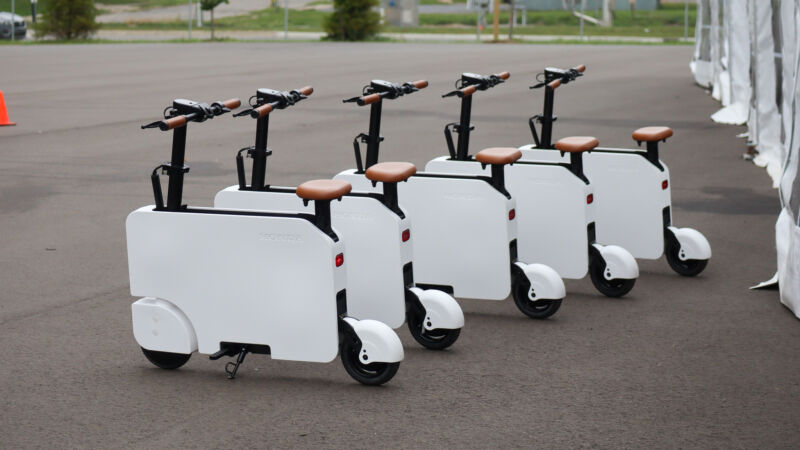
Enlarge / The Motocompacto was the product of one engineer’s spare time. (credit: Kevin Williams)
The transition to electrified transportation can come across as boring, which, arguably, isn’t all that untrue. Shouty, gas-powered sports cars have been replaced on roads by beige-colored electric crossovers. Electric scooters are ubiquitous now, cavalierly and awkwardly piled up on street corners of any global metropolitan center, serving as last-mile solutions for those unwilling to wait in traffic in the backseat of a rideshare car. It’s hard to remember that electric vehicles can be fun, exciting, interesting, and maybe most importantly—cute. The Honda Motocompacto might just be the cutest little last-mile solution and maybe the most exciting electric vehicle on the market, even if Honda itself isn’t quite sure what to do with it.
The Motocompacto certainly looks like no other electric scooter on the market. Appearing like a secret agent’s gadget from the Spy Kids universe, the all-white box can transform from what easily could be confused as a briefcase to an oddly rectangular sit-down scooter. Unique, if not unfamiliar, the Motocompacto’s form factor could seem a little contrarian in the era of traditional stand-up scooters or sit-down moped ones. I mean, who wants to straddle a motorized briefcase?
Well, it’s because the Motocompacto is a modern reinterpretation of an iconic Honda scooter—the Motocompo. Back in the early 1980s, Honda sold a square-shaped (gas-powered) scooter, meant to fold up and fit in the trunk of its City subcompact hatchback. Even though neither the Motocompo nor the Honda City ever made their way outside of Japan, the outrageously cute form factor serves as inspiration for the similarly named Motocompacto. Heck, Honda has even shown it off in the cargo area of the Prologue EV crossover, surely a nod to this charmingly Ska-filled ad.
Read 13 remaining paragraphs | Comments
Source: Ars Technica – Cute, fun to ride, but does it have a future? The Honda Motocompacto
An anonymous reader quotes a report from NPR: Peru’s Kimberly Garcia set a world record in her gold-medal winning turn at the women’s 20 kilometer race walk event at the Pan American Games this weekend. Until she didn’t. Once the race was over, organizers determined there was a serious “measuring problem” with the track, making the race times of Garcia, fellow medal winners Glenda Morejon of Ecuador and Peru’s Evelyn Inga, and their competitors null and void. The athletes guessed the track had been drawn up roughly 3 kilometers (about 1.9 miles) shorter than it was supposed to be. Garcia crossed the finish line in 1 hour, 12 minutes and 26 seconds. The world record of 1 hour, 23 minutes and 49 seconds is held by China’s Jiayu Yang. The athletes suspected something was amiss mid-race, according to the Associated Press.
The Santiago 2023 Corporation, the group in charge of the 2023 Pan American Games, placed the blame on the Pan American Athletics Association, which reportedly chose the person who measured the race course. In a statement following the race, Santiago 2023 said the official who measured the course “did not take accurate measurements of the route the athletes took during the race.” The group continued, “We deeply regret the inconvenience for the athletes, their coaches, the public and the attending press, but this situation cannot be attributed to the Organizing Committee.”


Read more of this story at Slashdot.
Source: Slashdot – A World Record In Race Walking Is Erased After the Course Was Measured Wrong

Enlarge (credit: Tooga/Getty Images)
X has banned the account of a prominent critic after he published data that he claims exposed the site’s embrace of the far-right after Elon Musk’s takeover last year.
Travis Brown, a software developer based in Berlin, alleges his account was first suspended on July 1 this year, several months after his data formed the basis of New York Times and CNN reports claiming that far-right influencers featured prominently among Twitter Blue subscribers, and how thousands of previously banned X accounts, including members of the far-right, were being reinstated on the site.
On Tuesday, Brown announced his decision to challenge his account’s suspension in court in Berlin. “This is a matter of principle,” he says. “I think it is important that platforms like Twitter are not allowed to shut down criticism arbitrarily.” X did not reply to repeated requests for comment.
Read 10 remaining paragraphs | Comments
Source: Ars Technica – Major critic of X sues after being banned from platform
YouTube is no longer preventing just a small subset of its userbase from accessing its videos if they have an ad blocker. The platform has gone all out in its fight against the use of add-ons, extensions and programs that prevent it from serving ads to viewers around the world, it confirmed to Engadget. “The use of ad blockers violate YouTube’s Terms of Service,” a spokesperson told us. “We’ve launched a global effort to urge viewers with ad blockers enabled to allow ads on YouTube or try YouTube Premium for an ad free experience. Ads support a diverse ecosystem of creators globally and allow billions to access their favorite content on YouTube.”
YouTube started cracking down on the use of ad blockers earlier this year. It initially showed pop-ups to users telling them that it’s against the website’s TOS, and then it put a timer on those notifications to make sure people read it. By June, it took on a more aggressive approach and warned viewers that they wouldn’t be able to play more than three videos unless they disable their ad blockers. That was a “small experiment” meant to urge users to enable ads or to try YouTube Premium, which the website has now expanded to its entire userbase. Some people can’t even play videos on Microsoft Edge and Firefox browsers even if they don’t have ad blockers, according to Android Police, but we weren’t able to replicate that behavior.
People are unsurprisingly unhappy about the development and have taken to social networks like Reddit to air their grievances. If they don’t want to enable ads, after all, the only way they can watch videos with no interruptions is to pay for a YouTube Premium subscription. Indeed, the notification viewers get heavily promotes the subscription service. “Ads allow YouTube to stay free for billions of users worldwide,” it says. But with YouTube Premium, viewers can go ad-free, and “creators can still get paid from [their] subscription.”
The website raised Premium’s rates to $14 a month in July from $12 before that. YouTube Premium also gives users access to offline viewing, background playback and higher-quality 1080p streaming, but it could be too expensive for those who just want an ad-free experience. The platform used to offer a more affordable option called Premium Lite in certain European regions, and it only cost €7 ($7.42) a month to remove advertisements from videos. However, it never made Lite available worldwide and ultimately killed that option by the end of October.
This article originally appeared on Engadget at https://www.engadget.com/youtube-is-taking-its-fight-against-ad-blockers-global-122041223.html?src=rss
Source: Engadget – YouTube is taking its fight against ad blockers global
You probably own a ton of gear that supports wireless charging now, but if you want to make your setup as cordless as possible, a single-device pad just won’t cut it. There are tons of multiple-item wireless chargers available now, but picking one can be a headache. You not only have to contend with varying levels of support, but different designs as well — the last thing you want is something that won’t fit on your nightstand or WFH desk. If you’re looking for the best multi-device wireless charging pad for your needs, Engadget can help. We’ve tested numerous wireless charging accessories that support up to three devices simultaneously, and we have some thoughts on which are the ones that are worth your money.
It won’t be shocking to hear that your smartphone choice influences your choice in a wireless charger. Only iPhone owners will need to consider Apple Watch compatibility. Likewise, you’ll need an Android phone if you expect to power a Galaxy Watch. Buy an iPhone 12 or newer and you can attach your phone magnetically using MagSafe, while the latest Android phones often have some form of fast wireless charging.
However, it’s not simply a question of getting the fastest charger. You should consider what you might buy in the future. Don’t buy a two-device charger if you have an iPhone and AirPods, but have been eyeing an Apple Watch. And if you think you might switch to an Android cell phone (or vice versa), you’ll want to get something more generic that doesn’t lock you into any one ecosystem.
Some chargers include cradles, trays and other features that are heavily optimized for particular products, and might not even account for year-to-year changes. Some vertical stands are too tall for small phones like the iPhone 13 mini, for instance. While you can never completely guarantee that next year’s phone or watch will work, it’s worth buying something more likely to last.
Having said all this, don’t be afraid to get a charger with vendor-specific features if you’re fiercely loyal to one brand. Apple isn’t expected to ditch MagSafe any time soon, and Samsung will likely keep making Galaxy Watches for a while to come.
Even without a charging cable to worry about, you’re probably buying a multi-device wireless charger with one location in mind. It might sit on your nightstand or on your desk. Not everyone buys a charger just for themselves, though; you might want to use one as a shared station for you and a partner.
If the charger will sit on your nightstand, you’ll likely want a compact, stable unit that won’t swallow all your free space or tumble to the floor (and if it does fall, one with enough durability to survive). You may also prefer a lay-flat phone pad so your screen is less likely to keep you awake. The Apple Watch and some other smartwatches can double as tiny alarm clocks, so you might want a vertical charging option for any wristwear.
At a desk, however, you may want a vertical phone stand so you can check notifications. Will the charger sit on a low table? Horizontal charger pads may make it easier to grab your devices in a hurry. Travel chargers should fold up or otherwise protect the pads while they’re in your bag. And, yes, aesthetics count. You may want something pretty if it’s likely to sit in a posh room where guests will see it.
If it’s a shared charging station, you’ll want something with multiple generic surfaces, and you’ll probably have to forgo charging more than one watch at a time. In those cases, consider the handful of 4-in-1 wireless chargers on the market, or models with USB ports.
It’s no secret that wireless charging is typically slower than wired, and powering multiple devices adds a new wrinkle. As these chargers often have to support a wide range of hardware, you’ll have to forget about the fastest, device-specific options from brands like Google, OnePlus and Samsung.
That’s not to say these will be slow, but there just isn’t much separating them on the charging speed front. As a general rule, the quickest multi-device chargers tend to top out at 15W for phones. And you’ll need an Apple MagSafe charger if you want to get that full 15W on an iPhone.
It’s rare that you’ll find a truly slow example, mind you. Even some of the most affordable options we’ve seen will recharge your phone at a reasonable 7.5W or 10W, and the 5W for other devices is more than enough. If you’re only docking overnight or while you work, speed won’t make a huge difference. Just be sure that whatever you buy is powerful enough for a phone in a case. It’s also worth noting that fast charging for other devices is rare, although you’ll occasionally find speedier options for the Apple Watch Series 7.
The difference between a good charger and a great one often boils down to little details. You won’t always need to pay extra to get those, but a larger outlay may be worthwhile to avoid frustrations for years to come.
A textured surface like rubberized plastic or fabric will reduce the chances your expensive gadgets will slide off their charging points. The base should have enough grip and weight that the charger won’t easily shift out of place. Any floating or vertical stands should be sturdy — steer clear if there’s any wobble.
You’ll also want to make a note of what’s included in the box. Some chargers don’t ship with power adapters, and we’ve seen numerous models whose Apple Watch “stands” are merely holders for your existing charging puck.
Then there’s helpful touches like status lights for confirming correct placement, although you’ll want to make sure they dim or shut off after a certain amount of time. And while it’s still true that cradles and trays can limit compatibility, you do want your devices to stay where you put them. Shelves and lips can prevent your phone or watch from sliding. Oh, and be wary of floating smartwatch mounts, as heavier timepieces might sag.
LinkedIn is adding a new, AI-powered perk for its premium subscribers: a built-in job coach that uses AI and LinkedIn data to help job seekers find, research and apply for roles. The new feature arrives as the company announced its user base has grown to 1 billion members as it looks to ramp up its investment in AI-driven features.
The Microsoft-owned company has increasingly been experimenting with AI features for its paying members. Earlier this year, it introduced the ability to use generative AI to write better profile descriptions and messages to hiring managers. But the latest AI perks aim to provide an even more personalized experience.
For now, the most prominent feature for job seekers will be AI-generated insights alongside each job posting. The tool can help summarize lengthy job descriptions and weigh in on whether the role is a good fit for a user based on the contents of their LinkedIn profile. For example, it can highlight specific work experiences users’ may want to emphasize in their application and provide tips on how to improve their LinkedIn profile to look more attractive to hiring managers.
Because LinkedIn is able to draw on its vast trove of career data, the tips it’s able to provide are much more personalized than what you’d likely get if you were to ask other generative AI services for tips, says LinkedIn product manager Rohan Rajiv. “This is made possible by generative AI, but also the datasets that bring all of this together,” Rajiv tells Engadget. “It’s your profile, your connections, and all of this that essentially can help you move your job search forward.”
For now, it’s still early days for the feature which is launching in beta to a limited set of LinkedIn Premium subscribers. But the company has signaled it intends to make AI a central part of its service going forward. “Today marks the beginning of a new journey, one where the power of AI is your ally in every career question and decision,” LinkedIn’s Chief Product Officer, Tomer Cohen, wrote in a blog post.
This article originally appeared on Engadget at https://www.engadget.com/linkedins-latest-premium-perk-is-an-ai-job-coach-120044855.html?src=rss
Source: Engadget – LinkedIn’s latest premium perk is an AI job coach

Enlarge / The Milky Way Galaxy rises over Namibia. (credit: Curt Belser)
Welcome to the Daily Telescope. There is a little too much darkness in this world and not enough light; a little too much pseudoscience and not enough science. We’ll let other publications offer you a daily horoscope. At Ars Technica, we’re going to take a different route, finding inspiration from very real images of a universe that is filled with stars and wonder.
Good morning. It is November 1, and today’s photo brings us inspiration from southern Namibia. Perhaps the most iconic tree in the southern region of Africa is the quiver tree—so named because its tubular branches can be fashioned into a carrier for arrows.
Curt Belser took this image of the Milky Way Galaxy rising over a quiver tree in May as part of a photography tour of Namibia. The Moon had already set, so that enhanced the darkness of the skies locally. This remote part of Africa already boasts some of the darkest skies in the world.
Read 5 remaining paragraphs | Comments
Source: Ars Technica – Daily Telescope: A dazzling view of the Milky Way from southern Africa
Following President Joe Biden’s sweeping executive order regarding AI development last week, at the UK AI Safety Summit yesterday, Vice President Kamala Harris announced even more machine learning initiatives, as well as the establishment of the United States AI Safety Institute. In cooperation with the Department of Commerce, the Biden administration will establish the United States AI Safety Institute (US AISI) within the NIST (National Institute of Standards and Technology). It will be responsible for creating and publishing guidelines, benchmark tests, best practices and more, for evaluating potentially dangerous AI systems. Tests may even include the red-team exercises President Biden mentioned in his executive order last week.
The Office of Management and Budget (OMB) — it’s an acronym-heavy morning — will release the administration’s first draft policy guidance on government AI use later this week.
— Mat Smith
You can get these reports delivered daily direct to your inbox. Subscribe right here!
The Google Pixel 7a is cheaper than ever at $374 in this early Black Friday deal
Apple’s Scary Fast Mac event: Everything announced about the M3 MacBook Pro and M3 iMac
Samsung credits strong smartphone and mobile display sales for income growth
Microsoft’s Windows 11 2023 update brings Copilot AI to more users
Microsoft’s Surface Laptop Studio packs a unique blend of performance and adaptability — even among 2-in-1 PCs. Thanks to refreshed specs plus a USB-A port and a microSD card reader, it seems like Microsoft’s second-gen mobile workstation has pretty much everything it needs. Unfortunately, with a high starting price and costly upgrades, the Surface Laptop Studio 2 is still difficult to recommend to everyone.
Google’s new feature for Chrome on iOS doesn’t massively change the browser, but it could be helpful if you find tapping the top of your iPhone screen a bit of a stretch. The company has rolled out the ability to move the browser’s address bar to the bottom of the screen from the top, a la Safari. Oddly, this isn’t yet a feature in Android’s Chrome app.
Continue reading.
Tesla was not at fault for a fatal 2019 crash that allegedly involved its Autopilot system, according to a jury in California. It’s the first US trial for a case claiming its software directly caused a death, with the car’s driver killed in the crash. The lawsuit alleged Tesla knowingly shipped cars with a defective Autopilot system. The jury ultimately found there was no defect, and Tesla was cleared on Tuesday.
The Ayaneo Kun is the highest-spec gaming machine the company has ever made, and after using it for a couple of weeks, Engadget’s James Trew says it’s both a fantastic gaming handheld and (if you want) a decent portable general-use PC. But it feels, he said, that the Kun is just a placeholder for the Kun 2, or the Kun 1S, Kun Pro or… whatever they call the next upgraded handheld. Notable specs include a huge 75Wh battery and the ability to play games at 1600p resolution — a substantial nudge above the usual 1200p max of other Ayaneo devices. Read on for the full breakdown.
This article originally appeared on Engadget at https://www.engadget.com/the-morning-after-us-government-announces-ai-safety-institute-111551804.html?src=rss
Source: Engadget – The Morning After: US government announces AI Safety Institute

Enlarge / Sierra Space’s Dream Chaser spaceplane is almost ready to leave its factory. (credit: Stephen Clark/Ars Technica)
LOUISVILLE, Colorado—The first Dream Chaser spaceplane built to go into orbit is starting to look the part. Its foldable wings and fuselage are covered in custom-fitted ceramic tiles to shield the spacecraft’s composite structure from the scorching heat of atmospheric reentry as it flies back to Earth. It has its landing gear, and technicians buzz around the vehicle to add the finishing touches before it leaves the factory.
Inside the spacecraft, workers are installing the final ducts for the environmental control system, which will make the pressurized compartment within Dream Chaser livable for astronauts at the International Space Station. The Dream Chaser’s job, at least for now, is to ferry cargo to and from the research complex orbiting some 240 miles (385 kilometers) above Earth. It will launch on top of a conventional rocket, maneuver in space like a satellite, and then land on a runway.
Across the hall from the production floor, Sierra Space has set up a mission control room, where engineers will monitor and command the spacecraft when it’s in orbit. Down the hall, a mock-up is in place for astronauts to train on how to enter the Dream Chaser and pack and unpack cargo while it’s docked at the station.
Read 55 remaining paragraphs | Comments
Source: Ars Technica – After decades of dreams, a commercial spaceplane is almost ready to fly
Dan Milmo reports via The Guardian: The Guardian has accused Microsoft of damaging its journalistic reputation by publishing an AI-generated poll speculating on the cause of a woman’s death next to an article by the news publisher. Microsoft’s news aggregation service published the automated poll next to a Guardian story about the death of Lilie James, a 21-year-old water polo coach who was found dead with serious head injuries at a school in Sydney last week.
The poll, created by an AI program, asked: “What do you think is the reason behind the woman’s death?” Readers were then asked to choose from three options: murder, accident or suicide. Readers reacted angrily to the poll, which has subsequently been taken down — although highly critical reader comments on the deleted survey were still online as of Tuesday morning. A reader said one of the Guardian reporters bylined on the adjacent story, who had nothing to do with the poll, should be sacked. Another wrote: “This has to be the most pathetic, disgusting poll I’ve ever seen.”
The chief executive of the Guardian Media Group, Anna Bateson, outlined her concerns about the AI-generated poll in a letter to Microsoft’s president, Brad Smith. She said the incident was potentially distressing for James’s family and had caused “significant reputational damage” to the organization as well as damaging the reputation of the journalists who wrote the story. “This is clearly an inappropriate use of genAI [generative AI] by Microsoft on a potentially distressing public interest story, originally written and published by Guardian journalists,” she wrote. Bateson added that it had demonstrated “the important role that a strong copyright framework plays in enabling publishers to be able to negotiate the terms on which our journalism is used.”
A Microsoft spokesperson said: “We have deactivated Microsoft-generated polls for all news articles and we are investigating the cause of the inappropriate content. A poll should not have appeared alongside an article of this nature, and we are taking steps to help prevent this kind of error from reoccurring in the future.”


Read more of this story at Slashdot.
Source: Slashdot – Microsoft Accused of Damaging The Guardian’s Reputation With AI-Generated Poll
A bunch of Sony headphones, earbuds and other audio devices are on sale at Amazon, including the Sony WH-CH720N headset, which is currently selling for the lowest price we’ve seen for it on the website. You can get the noise canceling wireless headphones for $98, down 35 percent from their original list price of $150. They have a lightweight, over-ear design with ample space around your ears so that they’d be comfortable to use. And while you can completely block out outside noise for full immersion, you can also switch on their Adjustable Ambient Sound mode that comes with 20 levels for when you want to be aware of your surroundings.
Buy Sony ANC headphones at Amazon – up to 53 percent off
You can pair the WH-CH720N with two Bluetooth devices at the same time, and you can easily switch between them at the touch of a button. Plus, the model supports both Alexa and Google’s voice assistants, and Sony says it can last for up to 35 hours on a single charge.
The most deeply discounted product among the ones currently on sale, however, are the Sony WH-XB910N wireless headphones. They have the power to enhance low-end frequencies for extra bass with their “dedicated bass duct on the headphone housing” and “increased airtightness between the driver units and eardrums.” The headphones use dual noise cancelation technology to keep ambient sounds out, and like the WH-CH720N, you can quickly switch between two connected Bluetooth devices. You can get the Sony WH-XB910N headphones right now for $118, which isn’t quite a record-low for the model but is still 53 percent lower than its original price.
If you’re looking for earbuds instead of headphones, you can also grab a pair of Sony LinkBuds S with noise canceling capabilities for $128 (36 percent off) from the sale. Want earbuds designed to let ambient sounds in? The Sony LinkBuds earbuds with an open-ring design now also cost $128, or 29 percent less than their original list price. Finally, you can find deals on subwoofers and sound bars from Amazon, as well, if those are what you’ve been eyeing for the upcoming holiday season.
Follow @EngadgetDeals on Twitter and subscribe to the Engadget Deals newsletter for the latest tech deals and buying advice.
This article originally appeared on Engadget at https://www.engadget.com/sony-anc-headphones-are-up-to-53-percent-off-at-amazon-095038076.html?src=rss
Source: Engadget – Sony ANC headphones are up to 53 percent off at Amazon
Tanay Tanay has developed a smart vertical farming system using a Raspberry Pi 4 as the central controller, with features such as Bluetooth and Wi-Fi support for remote plant monitoring, precise automated watering based on moisture levels, and environmental factor tracking. Tom’s Hardware reports: The end result is a Pi-powered system with tons of cool goodies to take your plant care to the next level. Tanay is able to monitor all sorts of environmental factors like how much light is available, how moist the air is, how much water is in the soil, what the temperature is and much more. The icing on the cake is a user-friendly interface that can be used to manually water the plants.
The main board for this project is a Raspberry Pi 4 B. It’s connected to an Arduino Nano R3 which is assigned to a specific plant. Some of the sensors confirmed in the design are a soil moisture sensor, an ambient light sensor as well as a water level depth detection sensor. You could always add more or take away modules depending on what you want to do with your vertical farm. For example, a camera could be used to log plant growth progress over time. Tanay explains that ThingSpeak, an IoT platform, was used in the project design. You can learn more about this Raspberry Pi project at Hackster.


Read more of this story at Slashdot.
Source: Slashdot – Raspberry Pi Smart Vertical Farming Takes Veggies To New Heights
Just days after President Joe Biden unveiled a sweeping executive order retasking the federal government with regards to AI development, Vice President Kamala Harris announced at the UK AI Safety Summit on Tuesday a half dozen more machine learning initiatives that the administration is undertaking. Among the highlights: the establishment of the United States AI Safety Institute, the first release of draft policy guidance on the federal government’s use of AI and a declaration on the responsible military applications for the emerging technology.
“President Biden and I believe that all leaders, from government, civil society, and the private sector have a moral, ethical, and societal duty to make sure AI is adopted and advanced in a way that protects the public from potential harm and ensures that everyone is able to enjoy its benefits,” Harris said in her prepared remarks.
“Just as AI has the potential to do profound good, it also has the potential to cause profound harm, from AI-enabled cyber-attacks at a scale beyond anything we have seen before to AI-formulated bioweapons that could endanger the lives of millions,” she said. The existential threats that generative AI systems present was a central theme of the summit.
“To define AI safety we must consider and address the full spectrum of AI risk — threats to humanity as a whole, threats to individuals, to our communities and to our institutions, and threats to our most vulnerable populations,” she continued. “To make sure AI is safe, we must manage all these dangers.”
To that end, Harris announced Wednesday that the White House, in cooperation with the Department of Commerce, is establishing the United States AI Safety Institute (US AISI) within the NIST. It will be responsible for actually creating and publishing the all of the guidelines, benchmark tests, best practices and such for testing and evaluating potentially dangerous AI systems.
These tests could include the red-team exercises that President Biden had mentioned in his EO. The AISI would also be tasked in providing technical guidance to lawmakers and law enforcement on a wide range of AI-related topics, including identifying generated content, authenticating live-recorded content, mitigating AI-driven discrimination, and ensuring transparency in its use.
Additionally, the Office of Management and Budget (OMB) is set to release for public comment the administration’s first draft policy guidance on government AI use later this week. Like the Blueprint for an AI Bill of Rights that it builds upon, the draft policy guidance outlines steps that the national government can take to “advance responsible AI innovation” while maintaining transparency and protecting federal workers from increased surveillance and job displacement. This draft guidance will eventually be used to establish safeguards for the use of AI in a broad swath of public sector applications including transportation, immigration, health and education so it is being made available for public comment at ai.gov/input.
Harris also announced during her remarks that the Political Declaration on the Responsible Use of Artificial Intelligence and Autonomy the US issued in February has collected 30 signatories to date, all of whom have agreed to a set of norms for responsible development and deployment of military AI systems. Just 165 nations to go! The administration is also launching a a virtual hackathon in efforts to blunt the harm AI-empowered phone and internet scammers can inflict. Hackathon participants will work to build AI models that can counter robocalls and robotexts, especially those targeting elderly folks with generated voice scams.
Content authentication is a growing focus of the Biden-Harris administration. President Biden’s EO explained that the Commerce Department will be spearheading efforts to validate content produced by the White House through a collaboration with the C2PA and other industry advocacy groups. They’ll work to establish industry norms, such as the voluntary commitments previously extracted from 15 of the largest AI firms in Silicon Valley. In her remarks, Harris extended that call internationally, asking for support from all nations in developing global standards in authenticating government-produced content.
“These voluntary [company] commitments are an initial step toward a safer AI future, with more to come,” she said. “As history has shown in the absence of regulation and strong government oversight, some technology companies choose to prioritize profit over: The wellbeing of their customers; the security of our communities; and the stability of our democracies.”
“One important way to address these challenges — in addition to the work we have already done — is through legislation — legislation that strengthens AI safety without stifling innovation,” Harris continued.
This article originally appeared on Engadget at https://www.engadget.com/kamala-harris-announces-ai-safety-institute-to-protect-american-consumers-060011065.html?src=rss
Source: Engadget – Kamala Harris announces AI Safety Institute to protect American consumers
Your EV may go a long way between charges, but can it carry dozens of passengers? GreenPower can boast both of those things with its latest electric school bus called “Mega Beast,” it announced in a press release spotted by Electrek. A massive 387 kWh battery supplies nearly 300 miles of range and it can carry up to 90 people — around three classrooms full of kids.
The long wheelbase Type D model features “the longest range and has the biggest battery pack in the school bus market,” GreenPower said. It uses a lithium iron phosphate (LFP) battery pack that offers high energy density and a longer life span, but a higher initial cost.
Mega Beast is a souped up version of GreenPower’s regular 140 mile range, 197.3 kWh Beast (“Beast” stands for “battery electric automotive school transportation”). Along with double the battery size, it offers better hill-climbing power, the company wrote.
Why the need for so much range, when buses usually do just two runs per day? This version is designed for longer range routes at rural schools, for example, or school districts that can’t necessarily charge a bus at mid-day. It’s also aimed at regions with “extreme weather conditions and schools that also use the all-electric bus for extra-curricular activities.”
Large electric school buses with around 100 miles of range can cost $300,000 to $400,000, up to four times the price of a diesel-powered school bus. However, maintenance costs are lower and the US Environmental Protection Agency (EPA) recently launched the Clean School Bus Program providing $5 billion over five years to replace existing school buses with zero-emission and low-emission models. Other companies building electric buses include Daimler via its Thomas-Built Buses division, along with Blue Bird.
This article originally appeared on Engadget at https://www.engadget.com/this-90-passenger-school-bus-has-nearly-300-miles-of-range-044741117.html?src=rss
Source: Engadget – This 90-passenger school bus has nearly 300 miles of range
The antitrust lawsuit Epic Games and Match Group have filed against Google was supposed to go to trial on November 6, but now it looks like the video game developer might go at it alone. Google and Match, the parent company of Tinder, OkCupid and Hinge, have reached an agreement and have agreed to drop all claims against each other. According to Bloomberg and The Wall Street Journal, Google has agreed to return the $40 million Match had place in escrow to cover the service fees it would supposedly owe the Alphabet unit while the dispute is ongoing.
Match also announced in its earning report that its apps will be using Google’s User Choice Billing program starting on March 31, 2024. Under the program, users will have the option to choose between Google’s and the developer’s billing systems when purchasing an app or paying for a subscription. If they choose to use Google’s system, then Match will have to pay Google 15 percent for recurring subscriptions and 30 percent for one-off payments. Google’s cut is reduced to 11 percent and 26 percent, respectively, for payments that go through the developer’s provided alternative. The dating services provider said that the terms they agreed on will offset the additional costs its apps will incur implementing the User Choice Billing program over three years starting in 2024.
Tinder’s parent company originally sued Google in 2022, accusing it of violating federal and state antitrust laws. Match said that Google previously assured it that it could use its own payment system. However, when it announced a new policy that would require all Android developers to process payments through the Play Store billing system, Google allegedly threatened to remove its apps from the store if it didn’t comply. Match also claimed that the company had been rejecting app updates that maintained the payment system it was using.
Later that year, Match had joined up with Epic Games, and the two consolidated their antitrust lawsuit against their common foe. They even expanded their allegations and accused Google of paying major developers hundreds of millions of dollars to keep their apps in the Play Store. Bloomberg says Epic is now scheduled to face Google in court alone on November 2, and the judge is waiting for both parties to decide whether they want a jury to make the decision for their case. Epic had also sued Apple over the same issue, but in Google’s case, the court has to acknowledge that Android users can sideload applications to their devices. The video game developer hasn’t dropped any hints that it’s also hashing out an agreement with the bigger company, but we’ll know for sure if the trial still pushes through on November 2.
This article originally appeared on Engadget at https://www.engadget.com/google-and-match-group-settle-antitrust-case-before-it-goes-to-trial-041158809.html?src=rss
Source: Engadget – Google and Match Group settle antitrust case before it goes to trial