Brümate’s early Black Friday sale knocks 25 percent off drinkware

Brümate is holding an early Black Friday sale, offering 25 percent off most drinkware sets, including the well-regarded Hopsulator Trio. The deals start today and end on November 7, so you have some time to think about which insulated cups catch your fancy. Once you decide, just enter the code “Cyber25” at checkout. As an example, this sale brings the price of the Hopsulator Trio down to $23.50 from $30.

Brümate makes insulated and leak-proof cups that keep liquids at their desired temperature until you’re done pushing the stuff through your gullet. The insulation here is certainly on point, which is why the company’s products made our list of the best gifts for coffee lovers.

On the opposite side of the spectrum, we put the Hopsulator Trio on our lists of the best outdoor gifts for dads and the best grilling gear, as the integrated insulation keeps cold beers cold even on the hottest of summer days. However, the Hopsulator is just for cans, though the company offers plenty of products to please devotees of loose liquid. Some of them could even serve as a decent container for a lunch stew or soup, so it’s a win/win.

Again, the sale ends on November 7. If you’re in the market for some insulated and leak-proof cups, now’s your time to shine. The cups and containers range in size from 12 ounces all the way to 40 ounces, for those looking to replicate the joy of slurping down a Big Gulp.

Follow @EngadgetDeals on Twitter and subscribe to the Engadget Deals newsletter for the latest tech deals and buying advice.

This article originally appeared on Engadget at https://www.engadget.com/brumates-early-black-friday-sale-knocks-25-percent-off-drinkware-150047391.html?src=rss

Source: Engadget – Brümate’s early Black Friday sale knocks 25 percent off drinkware

What to Know About the Coming U.S. Hydrogen Energy Boost

The Biden administration is betting on hydrogen to power the country, create well-paying jobs, and lower climate-warming emissions. Last month, the president announced that $7 billion will be invested to create seven regional hydrogen-producing hubs across the U.S., promising to work with unions and disadvantaged…

Read more…


Source: Gizmodo – What to Know About the Coming U.S. Hydrogen Energy Boost

Most monstrous marsquake ever reveals where it came from

Image of a dark crater on a background of reddish rocks, flecked with snow.

Enlarge / InSight captured seismic waves released when an impact formed this crater in 2021. But a similar event can’t be tied to any craters.

Earth has earthquakes. Mars has marsquakes. There is just one difference: marsquakes are most frequently caused by meteoroid crashes since the Red Planet lacks the tectonic plates that shift pieces of crust on Earth. So what caused the most intense marsquake ever when there has been no evidence of a collision?

Vibrations from the 4.7 magnitude quake sent tremors through the Martian crust for six hours (if not more) and were captured by NASA’s InSight lander in May 2022. Otherwise known as S1222a, this marsquake was assumed to have been caused by a meteoroid impact, so an international team of researchers immediately began searching for evidence of a fresh crater. The problem was that none existed. That’s when the team, led by planetary geophysicist Benjamin Fernando, began thinking that something was potentially going on beneath the surface.

“We undertook a comprehensive search of the region in which the marsquake occurred,” Fernando and his team said in a study recently published in Geophysical Research Letters. “We did not identify any fresh craters in the area, implying that the marsquake was likely caused by geological processes.”

Read 11 remaining paragraphs | Comments


Source: Ars Technica – Most monstrous marsquake ever reveals where it came from

When Linux Spooked Microsoft: Remembering 1998's Leaked 'Halloween Documents'

It happened a quarter of a century ago. The New York Times wrote that “An internal memorandum reflecting the views of some of Microsoft’s top executives and software development managers reveals deep concern about the threat of free software and proposes a number of strategies for competing against free programs that have recently been gaining in popularity.”

The memo warns that the quality of free software can meet or exceed that of commercial programs and describes it as a potentially serious threat to Microsoft. The document was sent anonymously last week to Eric Raymond, a key figure in a loosely knit group of software developers who collaboratively create and distribute free programs ranging from operating systems to Web browsers. Microsoft executives acknowledged that the document was authentic…

In addition to acknowledging that free programs can compete with commercial software in terms of quality, the memorandum calls the free software movement a “long-term credible” threat and warns that employing a traditional Microsoft marketing strategy known as “FUD,” an acronym for “fear, uncertainty and doubt,” will not succeed against the developers of free software. The memorandum also voices concern that Linux is rapidly becoming the dominant version of Unix for computers powered by Intel microprocessors.
The competitive issues, the note warns, go beyond the fact that the software is free. It is also part of the open-source software, or O.S.S., movement, which encourages widespread, rapid development efforts by making the source code — that is, the original lines of code written by programmers — readily available to anyone. This enables programmers the world over to continually write or suggest improvements or to warn of bugs that need to be fixed. The memorandum notes that open software presents a threat because of its ability to mobilize thousands of programmers. “The ability of the O.S.S. process to collect and harness the collective I.Q. of thousands of individuals across the Internet is simply amazing,” the memo states. “More importantly, O.S.S. evangelization scales with the size of the Internet much faster than our own evangelization efforts appear to scale.”

Back in 1998, Slashdot’s CmdrTaco covered the whole brouhaha — including this CNN article:

A second internal Microsoft memo on the threat Linux poses to Windows NT calls the operating system “a best-of-breed Unix” and wonders aloud if the open-source operating system’s momentum could be slowed in the courts.

As with the first “Halloween Document,” the memo — written by product manager Vinod Valloppillil and another Microsoft employee, Josh Cohen — was obtained by Linux developer Eric Raymond and posted on the Internet. In it, Cohen and Valloppillil, who also authored the first “Halloween Document,” appear to suggest that Microsoft could slow the open-source development of Linux with legal battles. “The effect of patents and copyright in combating Linux remains to be investigated,” the duo wrote.

Microsoft’s slogain in 1998 was “Where do you want to go today?” So Eric Raymond published the documents on his web site under the headline “Where will Microsoft try to drag you today? Do you really want to go there?”

25 years later, and it’s all still up there and preserved for posterity on Raymond’s web page — a collection of leaked Microsoft documents and related materials known collectively as “the Halloween documents.” And Raymond made a point of thanking the writers of the documents, “for authoring such remarkable and effective testimonials to the excellence of Linux and open-source software in general.”
Thanks to long-time Slashdot reader mtaht for remembering the documents’ 25th anniversary…

Read more of this story at Slashdot.


Source: Slashdot – When Linux Spooked Microsoft: Remembering 1998’s Leaked ‘Halloween Documents’

'Stupid' Daylight Saving Time Ritual Continues. But Why?

Many Americans want to abolish Daylight Saving Time, reports NBC News:
Since 2018, nearly all states have passed or entertained legislation that would drop the twice-a-year time shift. And 19 states have passed laws or resolutions in support of year-round daylight saving time, according to data from the National Conference of State Legislatures. But there’s a caveat: Nothing can change until Congress addresses a 1960s-era law blocking such action.
“This ritual of changing time twice a year is stupid,” U.S. Senator Marco Rubio said in March, reintroducing legislation to end Daylight Saving Time. In an official statement the Senator announced that “Locking the clock has overwhelming bipartisan and popular support. This Congress, I hope that we can finally get this done.”
But according to the Hill, “Both the House and Senate versions of the Sunshine Protection Act of 2023 haven’t appeared to go far. The Senate bill has been read twice and referred to a committee, while the House bill has only been referred to a subcommittee.”

While America waits, another medical association has come out in favor of ending Daylight Saving Time, reports NBC News:
The American Academy of Sleep Medicine is a medical association whose professionals advocate for policies that improve sleep health. On Tuesday, the academy released a statement calling on the U.S. to eliminate daylight saving time completely, stating that standard time best supports health and safety, as it aligns with people’s natural circadian rhythm. Undergoing the time switch itself raises the most concerns. Research shows that after the “spring forward” time change, workplace injuries, car crash deaths and heart attack risk have all increased. One 2023 study found that a week after transitioning from the time change, people reported more dissatisfaction with sleep and higher rates of insomnia.

Read more of this story at Slashdot.


Source: Slashdot – ‘Stupid’ Daylight Saving Time Ritual Continues. But Why?

Aussies Angry Over Being Asked to Use QR Codes at Restaurants

Long-time Slashdot reader smooth wombat writes:

: A recent social media post by an Aussie received a deluge of replies and comments. His comment? “I’m so f***ing tired of ‘tech’ being used to solve an ‘issue’ but only making everything worse and more inconvenient for everybody,” they wrote.

His comment was in response to going to a restaurant and having only a QR code to order from — literally a menu at the table with only the QR code on it. The app required to order from it “proceeded to charge a 6.5% venue surcharge, a 2% payment processing fee, and then had the audacity to ask for a tip (10%, 15%, 25%) as the cherry on top”.

From Australia’s News.com.au:

Hundreds of others enthusiastically agreed and many added they also didn’t like being asked to enter their personal details. “You’re waiting your own table and paying an extra fee for the privilege. It’s f***ed,” one person responded. “It’s also a big stinking FU to anyone old or not tech savvy. All just to hoover up your data,” another added.

Some, however, shared they preferred using QR codes to order their food — they removed the need to move to order more and limited engagement with staff. “I actually like the QR ordering because I don’t like people, but the surcharges and tipping can f*** off,” one said. “I love the QR codes — don’t need to leave the table to order another beer,” someone else wrote…

Jonathan Holmes-Ross, owner of board game restaurant, The Lost Dice in Adelaide told news.com.au that the use of QR code ordering had let his eatery “reduce costs by around 25%… We no longer have to take orders, work out bills and manually take payments,” he said. “This gives our wait staff more time to look after our customers, and the kitchen has excellent order information as the accuracy of the orders is great. We now have very few mistakes saving us time and waste. We can also mark items that have run out instantly on the app by using stock levels, again avoiding the disappointment of (the) customer.”

Read more of this story at Slashdot.


Source: Slashdot – Aussies Angry Over Being Asked to Use QR Codes at Restaurants

A SpaceX 'Falcon 9' Booster Rocket Has Launched 18 Times Successfully, a New Record

Ars Technica reports:

In three-and-a-half years of service, one of SpaceX’s reusable Falcon 9 boosters stands apart from the rest of the company’s rocket inventory. This booster, designated with the serial number B1058, has now flown 18 times.

For its maiden launch on May 30, 2020, the rocket propelled NASA astronauts Doug Hurley and Bob Behnken into the history books on SpaceX’s first mission to send people into orbit. This ended a nine-year gap in America’s capability to launch astronauts into low-Earth orbit and was the first time a commercial spacecraft achieved this feat… Over the course of its flights to space and back, that white paint has darkened to a charcoal color. Soot from the rocket’s exhaust has accumulated, bit by bit, on the 15-story-tall cylinder-shaped booster. The red NASA worm logo is now barely visible.

On Friday night, this rocket launched for the 18th time, breaking a tie at 17 flights with another Falcon 9 booster in SpaceX’s fleet… It fired three engines for a braking burn to slow for reentry, then ignited a single engine and extended four carbon-fiber landing legs to settle onto a floating platform holding position near the Bahamas. The drone ship will return the rocket to Cape Canaveral, where SpaceX will refurbish the vehicle for a 19th flight.

Other interesting statistics from the article:

This single booster rocket has launched 846 satellites into space. (Astrophysicist/spaceflight tracker Jonathan McDowell calculates there are now over 5,000 Starlink satellites in orbit.)
A SpaceX official told Ars Technica the company might extend the limit on Falcon 9 booster flights beyond 20 for Starlink satellites.
Friday’s launch became the 79th launch so far in 2023 of a Falcon rocket, with SpaceX aiming for a total of 100 by the end of December, and 144 in 2023 (an average of one flight every two-and-a-half days).
Since 2016, SpaceX has now had 249 consecutive successful launches of its Falcon 9 and Falcon Heavy rockets

Read more of this story at Slashdot.


Source: Slashdot – A SpaceX ‘Falcon 9’ Booster Rocket Has Launched 18 Times Successfully, a New Record

Microsoft Reverses Decision, Lets Employees Keep Free 'Xbox Game Pass Ultimate'

Microsoft has changed its mind, the Verge reported Friday, and now will continue giving a free Xbox Game Pass Ultimate to most of its 238,000 employees, according to an announcement from Xbox chief Phil Spencer.

Earlier reports had suggested that Microsoft was removing the free Xbox Game Pass Ultimate benefit — and some employees weren’t happy about it.

Read more of this story at Slashdot.


Source: Slashdot – Microsoft Reverses Decision, Lets Employees Keep Free ‘Xbox Game Pass Ultimate’

Whatever Happened to Amazon's Drone Delivery Service?

The New York Times shows an enormous Amazon drone hovering over a driveway in the Texas suburbs. (Alternate URL here.) The drone lets go of a large brown package, which plummets to the ground.

But 10 years after Amazon revealed its drone program, drone delivery is only “kind of” a reality, the Times argues — in one city in Texas. “The venture as it currently exists is so underwhelming that Amazon can keep the drones in the air only by giving stuff away.”

Years of toil by top scientists and aviation specialists have yielded a program that flies Listerine Cool Mint Breath Strips or a can of Campbell’s Chunky Minestrone With Italian Sausage — but not both at once — to customers as gifts….

Only one item can be delivered at a time. It can’t weigh over five pounds. It can’t be too big. It can’t be something breakable, since the drone drops it from 12 feet. The drones can’t fly when it is too hot or too windy or too rainy. You need to be home to put out the landing target and to make sure that a porch pirate doesn’t make off with your item or that it doesn’t roll into the street… But your car can’t be in the driveway. Letting the drone land in the backyard would avoid some of these problems, but not if there are trees. Amazon has also warned customers that drone delivery is unavailable during periods of high demand for drone delivery…

A more complicated issue was getting the technology to the point where it was safe not just most of the time but all of the time. The first drone that lands on someone’s head, or takes off clutching a cat, sets the program back another decade, particularly if it is filmed.

The drones also struggled with real-world issues like Texas heat waves. During one heat wave the drones were suspended. And when they flew again, “a 54-year-old professor of civil engineering at Texas A&M ordered a medication through the mail. By the time he retrieved the package, the drug had melted.” One of Amazon’s customers tells the Times that Amazon’s drones “feel more like a toy than anything — a toy that wastes a huge amount of paper and cardboard.”

Amazon claims that in the last 10 months their drones have delivered “hundreds” of items in Texas. Beyond that, Amazon recently announced that its drone deliveries would be expanding within the next 14 months, the Times points out — to Britain, Italy, and a new U.S. location. “Yet even on the threshold of growth, a question lingers. Now that the drones finally exist in at least limited form, why did we think we needed them in the first place?”

Read more of this story at Slashdot.


Source: Slashdot – Whatever Happened to Amazon’s Drone Delivery Service?

Researchers Found an Abundance of Helium In Canada's Baffin Island

Long-time Slashdot reader thepacketmaster writes: Documented in a recent article in the journal Nature, researchers have found an abundance of both helium-4 and helium-3 trapped in the volcanic rocks on Canada’s Baffin Island.

As the Earth formed, it is thought that helium-4 and helium-3 flowing on the solar wind became trapped in the minerals of the cooling planet. With heavier elements and minerals sinking to the bottom, this trapped helium was transported to the core, where it would have remained locked in its original forms.

Earth isn’t massive enough to hold on to helium in any significant quantities, though. Any that did not get trapped, or that was subsequently released when the minerals melted in the mantle or due to massive impacts, would have eventually seeped up to the surface and floated off into space. So, helium is relatively rare on Earth, and helium-3 is even more so.

Read more of this story at Slashdot.


Source: Slashdot – Researchers Found an Abundance of Helium In Canada’s Baffin Island

xAI’s ‘Grok’ chatbot will be available to X Premium+ subscribers only

Elon Musk’s new AI company, xAI, will release its chatbot to subscribers of X’s $16 per month Premium+ plan once it exits beta. The system, called Grok, is positioned to be a competitor to OpenAI’s ChatGPT and started rolling out to a select group of users this weekend.

Musk shared a few screenshots of the conversational AI on X, and confirmed its responses will unfortunately be laden with Musk-type humor. The CEO also further touted its capabilities compared to the competition, tweeting, “Grok has real-time access to info via the X platform, which is a massive advantage over other models.” There’s no public timeline yet for when it will be out of beta, but Musk said it “will be available to all X Premium+ subscribers” when it is.

The comments coincide with the timing of the first developer conference from rival company OpenAI — which Musk co-founded and remained on the board for until 2018 — on November 6. OpenAI’s ChatGPT costs $20 per month to use.

This article originally appeared on Engadget at https://www.engadget.com/xais-grok-chatbot-will-be-available-to-x-premium-subscribers-202127713.html?src=rss

Source: Engadget – xAI’s ‘Grok’ chatbot will be available to X Premium+ subscribers only

Will AI-Powered SEO Ruin Google's Search Results?

A long read at the Verge explores the quality of Google’s search results — and whether they’ve been affected by the Search Engine Optimization industry.
But it begins by saying that “A lot of folks’ complain that “The links that pop up when they go looking for answers online, they say, are “absolutely unusable”; “garbage”; and “a nightmare” because “a lot of the content doesn’t feel authentic.”

If so, the question is why. SEO Daron Babin warns that “We’re entering a very weird time, technologically, with AI, from an optimization standpoint… All the assholes that are out there paying shitty link-building companies to build shitty articles, now they can go and use the free version of GPT.”
Soon, he said, Google results would be even worse, dominated entirely by AI-generated crap designed to please the algorithms, produced and published at volumes far beyond anything humans could create, far beyond anything we’d ever seen before. “They’re not gonna be able to stop the onslaught of it,” he said. Then he laughed and laughed, thinking about how puny and irrelevant Google seemed in comparison to the next generation of automated SEO. “You can’t stop it…!”

Nowadays, he mostly invests in cannabis and psychedelics. SEO just got to be too complicated for not enough money, he told me. [SEO Missy] Ward had told me the same thing, that she had stopped focusing on SEO years ago.

But the Verge also spoke to Danny Sullivan, the former journalist who started the SEO-industry site Search Engine Land — who was eventually hired by Google as their “public liaison for serach.” And Sullivan “is pissed that people think Google results have gone downhill. Because they haven’t, he insisted. If anything, search results have gotten a lot better over time. Anyone who thought search quality was worse needed to take a hard look in the mirror.”
Sullivan was not the only person who tried to tell me that search results have improved significantly. Out of the dozen-plus SEOs that I spoke with at length, nearly every single one insisted that search results are way better than they used to be…

This was not what I had been noticing, and this was certainly not what I had been hearing from friends and journalists and friends who are journalists. Were all of us wrong…? I began to worry all the people who were mad about search results were upset about something that had nothing to do with metrics and everything to do with feelings and ~vibes~ and a universal, non-Google-specific resentment and rage about how the internet has made our lives so much worse in so many ways, dividing us and deceiving us and provoking us and making us sadder and lonelier.

SEO Lily Ray says Google did change its algorithm in 2016 to fight disinformation, trying to favor sites with “experience, expertise, authoritativeness, and trustworthiness.”
But the point that really hit me was that for certain kinds of information, Google had undone one of the fundamental elements of what had made its results so appealing from the start. Now, instead of wild-west crowdsourcing, search was often reinforcing institutional authority…

The second major reason why Google results feel different lately was, of course, SEO… Google is harder to game now — it’s true. But the sheer volume of SEO bait being produced is so massive and so complex that Google is overwhelmed. “It’s exponentially worse,” Ray said. “People can mass auto-generate content with AI and other tools,” she went on, and “in many cases, Google’s algorithms take a minute to catch onto it.”
The future that Babin had cackled about at the alligator party was already here. We humans and our pedestrian questions were getting caught up in a war of robots fighting robots, of Google’s algorithms trying to find and stop the AI-enabled sites programmed by SEOs from infecting our internet experience.

Read more of this story at Slashdot.


Source: Slashdot – Will AI-Powered SEO Ruin Google’s Search Results?

How to Train Your Dragon Remake Turns Tail, Retreats Deeper Into 2025

Dreamworks’ How to Train Your Dragon movies were well-liked hidden gems during the 2010s, and it seemed inevitable that the series would eventually return in some form. (In film, at least, because the series has been chugging along with various TV spinoffs.) Earlier this year, we learned that would be the case…

Read more…


Source: Gizmodo – How to Train Your Dragon Remake Turns Tail, Retreats Deeper Into 2025

FSF Warns About the Perils of Medical Devices with Un-Free Software

“Software that controls your body should always respect your freedom,” warns the program manager of the Free Software Foundation:

In July, users of the proprietary software app LibreLink, who live in the UK and use Apple devices, found that the app they depend on to monitor their blood sugar was not working anymore after the developer Abbott pushed an update for the app… Despite what its name may suggest, there is nothing libre about the LibreLink app. It’s proprietary software, which means users must depend on the company to keep it running and to distribute it. With free software, [a user] would have had the freedom to run, copy, distribute, study, change, and improve the software himself, or he could have leaned on a community of developers and users to share and fix the software, and the old version of the software would have been available to revert the update…

Two months later, with Apple’s update to iOS 17, users of the FreeStyle LibreLink and Libre 2 apps had reason again to fear that the software they rely on wouldn’t work after updating their iPhones. This time, users all over the world were affected. In September, Abbott warned Apple users: “As part of the upcoming iOS 17 release, Apple is introducing StandBy Mode and Assistive Access Mode … this release may impact your experience with the FreeStyle Libre 2 app, the FreeStyle LibreLink app, or the FreeStyle LibreLinkUp app. We recommend that you disable automatic operating system updates on the smartphone using the mentioned apps.” This warning was made because StandBy Mode would sometimes prohibit time-sensitive notifications such as glucose alarms, and the Assistive Access Mode would impact sensor activation and alarm setting modification in the app…

And a scenario where a company abandons service or updates to its users is not merely theoretical. This is the bitter reality faced by users of eye implants produced by Second Sight Medical Products since the company decided to abandon the technology in 2020 when facing the prospect of bankruptcy. [“>According to IEEE Spectrum], Terry Byland, whose sight has been dependent on the first-generation Argus implant since 2004, says of his experience, “As long as nothing goes wrong, I’m fine. But if something does go wrong with it, well, I’m screwed. Because there’s no way of getting it fixed.” That’s what also happened to Barbara Campbell, whose retinal implant suddenly stopped working when she was on a subway…

It’s up to us advocates of free software to inform the people around us of the issues with proprietary software in medical aids. Let’s encourage our friends, parents, and grandparents to ask their doctor about the software in their medical devices and to choose and insist upon free software over proprietary software.

Read more of this story at Slashdot.


Source: Slashdot – FSF Warns About the Perils of Medical Devices with Un-Free Software

X is reportedly soliciting people to buy recycled user handles for $50,000

X has been trying to find buyers for user handles it reclaimed from inactive accounts, even going so far as to send out solicitation emails asking for “a flat fee of $50,000 to initiate a purchase,” according to Forbes. Elon Musk announced back in May that X, formerly Twitter, would start purging accounts that have gone dormant, and has alluded to plans for recycling disused handles.

According to emails seen by Forbes, X now has a task force called the “@Handle Team” that’s working on creating a marketplace for buying handles tied to inactive accounts. X changed its policy this year to stipulate that users must log in every 30 days to remain active, and risk having their accounts suspended or permanently removed if they go long enough without signing on. It’s unclear how long a user would have to remain inactive for to actually be booted from the platform. After NPR quit the site this past spring, Musk began threatening to reassign its handle just a few weeks later.

As of now, obtaining another user’s inactive handle doesn’t seem to be something just anybody can do. X’s website still says it cannot release inactive usernames. But, the Forbes report suggests the company is looking at the possibility of a handle marketplace as yet another way to pull in money from its users. The company just recently introduced two new subscription tiers for paid users — a $16 per month Premium+ tier and a more pared-down $3 per month “basic” tier.

This article originally appeared on Engadget at https://www.engadget.com/x-is-reportedly-soliciting-people-to-buy-recycled-user-handles-for-50000-174504242.html?src=rss

Source: Engadget – X is reportedly soliciting people to buy recycled user handles for ,000

Blade, A Movie That's Sooooo Real, Should've Been Out This Weekend

Once upon time in the distant year of 2019, Marvel Studios held a pretty momentous Hall H panel at San Diego Comic-Con. With Avengers: Endgame in the rearview mirror and Spider-Man: Far From Home presently raking in cash at the box office, everyone was wondering what was coming next for the MCU. The Phase Four slate…

Read more…


Source: Gizmodo – Blade, A Movie That’s Sooooo Real, Should’ve Been Out This Weekend

CNN Criticizes Microsoft's 'Making a Mess of the News' By Replacing MSN's Staff With AI

CNN decries “false and bizarre” news stories being published by Microsoft on MSN.com, “one of the world’s most trafficked websites and a place where millions of Americans get their news every day.”

Microsoft’s decision to increasingly rely on the use of automation and artificial intelligence over human editors to curate its homepage appears to be behind the site’s recent amplification of false and bizarre stories, people familiar with how the site works told CNN.
The site, which comes pre-loaded as the default start page on devices running Microsoft software, including on Microsoft’s latest “Edge” browser… employed more than 800 editors in 2018 to help select and curate news stories shown to millions of readers around the world. But in recent years Microsoft has laid off editors, some of whom were told they were being replaced by “automation,” what they understand to be AI.
CNN points out that while Microsoft’s president “has publicly lectured on the responsible use” of AI, “the apparent role of AI in Microsoft’s recent amplification of bogus stories raises questions about the company’s public adoption of the nascent technology and for the journalism industry as a whole.” CNN notes that an AI-generated poll urging readers to guess the cause of a swimmer’s death “was not the first public blunder caused by Microsoft’s embrace of AI.”

In September Microsoft republished a story about Brandon Hunter, a former NBA player who died unexpectedly at the age of 42, under the headline, “Brandon Hunter useless at 42.” Then, in October, Microsoft republished an article that claimed that San Francisco Supervisor Dean Preston had resigned from his position after criticism from Elon Musk. The story was entirely false.

Some of the articles featured by Microsoft were initially published by obscure websites that might have gone unnoticed amid the daily deluge of online misinformation that circulates every day. But Microsoft’s decision to republish articles from fringe outlets has elevated those stories to potentially millions of additional readers, breathing life into their claims. Editors who formerly worked for Microsoft told CNN that these kinds of false stories, or virtually any other articles from low-quality websites, would not be prominently featured by Microsoft were it not for its use of AI. Ryn Pfeuffer, who worked intermittently as a contractor for Microsoft for eight years, said she received a call in May 2020 with the news that her entire team was being laid off. 2020 was the year, a Microsoft spokesperson told CNN in a statement on Wednesday, that the company began transitioning to a “personalized feed” that is “tailored by an algorithm to the interests of our audiences.”

MSN “has also published other junk content, including bogus stories about fishermen catching mermaids and Bigfoot spottings,” reports the tech news site Futurism, “in the wake of ditching its human editors in favor of automation.
“Noticing a pattern yet? The company pumps out trash-tier AI content, then waits until it’s called out publicly to quietly delete it and move onto the next trainwreck.”
We’ve known that Microsoft’s MSN news portal has been pumping out a garbled, AI-generated firehose for well over a year now. The company has been using the website to distribute misleading and oftentimes incomprehensible garbage to hundreds of millions of readers per month… And if MSN presents a vision of how the tech industry’s obsession with AI is going to play out in the information ecosystem, we’re in for a rough ride.

CNN got this reaction from a user whose default browser changed from Chrome to Microsoft Edge after a software update — and discovered their home page had switched to MSN.com. “It felt like I was standing in line at the grocery store reading a National Enquirer front page.”

A company spokesperson assured CNN that Microsoft was “committed to addressing the recent issue of low quality articles.”

Read more of this story at Slashdot.


Source: Slashdot – CNN Criticizes Microsoft’s ‘Making a Mess of the News’ By Replacing MSN’s Staff With AI

US Approves Massive Windfarm Project Off the Coast of Virginia

Tuesday Orsted cancelled two wind farms near New Jersey that would’ve generated about 2.2 gigawatts of energy. But the same day America’s Interior Department approved plans to install up to 176 wind turbines off the coast of Virginia with an estimated capacity of about 2.6 gigawatts of clean energy.

Located approximately 27 miles from the shores of Virginia Beach, the project will be America’s largest offshore wind project, capable of powering over 900,000 homes. In just its first 10 years it should save customers $3 billion in fuel costs, Dominion Energy told the Associated Press:
Dominion expects construction to be completed by late 2026… Construction of the project in Virginia is expected to support about 900 jobs each year and then an estimated 1,100 annual jobs during operations, the Interior Department said. The initiative has gained wide support from Virginia policymakers and political leaders, including Republican Gov. Glenn Youngkin, who last week attended a reception marking the arrival of eight monopile foundations for the windfarm.

Two pilot turbines have already been in place since 2020, the article points out. And when finished the new wind farm “would bolster and eventually replace the mostly natural gas-powered electricity that is contributing to costly climate change,” reports MarketWatch

President Biden, early in his first term, announced a goal of installing 30 gigawatts of offshore wind power by 2030, enough to power 10 million homes and prevent the spewing of 78 million metric tons of carbon-dioxide emissions… U.S. offshore wind has been helped along by nearly $8 billion in investments since Biden signed his signature, climate-heavy Inflation Reduction Act a little over a year ago… Biden’s team has projected that the U.S. could install 110 gigawatts of offshore wind power by 2050, a major jump considering there is less than 1 gigawatt installed today. Land-based wind farms across the U.S. already produce more than 140 gigawatts of energy, contributing to about 10% of the nation’s energy portfolio…

When measured by announced plans and pledges, the country has been barreling toward its offshore goal. To date, the Department of the Interior has approved four New England-based projects that, together with the new Coastal Virginia Offshore Wind project, promise to deliver 5 gigawatts of electricity, enough to power 1.75 million homes with average power use. A total of more than 51 gigawatts of wind power capacity is in the works off U.S. shores and the most ambitious 10 coastal states have combined offshore wind goals of generating more than 81 gigawatts.

Read more of this story at Slashdot.


Source: Slashdot – US Approves Massive Windfarm Project Off the Coast of Virginia

Futurama Lives On With Two Extra Seasons

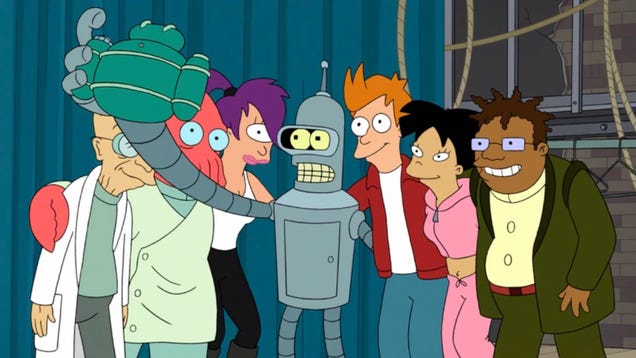
Over a year ago, Hulu announced it would be reviving Futurama, Matt Groening’s other very popular animated series that aired on Fox. Things were rough at first: it originally seemed like John DiMaggio wouldn’t reprise his role as Bender, to say nothing of how many times this show has ended, then been suddenly…

Read more…


Source: Gizmodo – Futurama Lives On With Two Extra Seasons