Eli Roth's Thanksgiving Is a Dumb, Disgusting Delight

The idea for Eli Roth to make a horror movie about Thanksgiving was originally a joke. Several holidays are synonymous with Hollywood horror. Halloween, of course. Christmas has a few movies. Valentine’s Day too. But Thanksgiving? That’s so silly. Or is it?

Read more…


Source: Gizmodo – Eli Roth’s Thanksgiving Is a Dumb, Disgusting Delight

Unauthorized 'David Attenborough' AI Clone Narrates Developer's Life, Goes Viral

An anonymous reader quotes a report from Ars Technica: On Wednesday, Replicate developer Charlie Holtz combined GPT-4 Vision (commonly called GPT-4V) and ElevenLabs voice cloning technology to create an unauthorized AI version of the famous naturalist David Attenborough narrating Holtz’s every move on camera. As of Thursday afternoon, the X post describing the stunt had garnered over 21,000 likes. “Here we have a remarkable specimen of Homo sapiens distinguished by his silver circular spectacles and a mane of tousled curly locks,” the false Attenborough says in the demo as Holtz looks on with a grin. “He’s wearing what appears to be a blue fabric covering, which can only be assumed to be part of his mating display.” “Look closely at the subtle arch of his eyebrow,” it continues, as if narrating a BBC wildlife documentary. “It’s as if he’s in the midst of an intricate ritual of curiosity or skepticism. The backdrop suggests a sheltered habitat, possibly a communal feeding area or watering hole.”

How does it work? Every five seconds, a Python script called “narrator” takes a photo from Holtz’s webcam and feeds it to GPT-4V — the version of OpenAI’s language model that can process image inputs — via an API, which has a special prompt to make it create text in the style of Attenborough’s narrations. Then it feeds that text into an ElevenLabs AI voice profile trained on audio samples of Attenborough’s speech. Holtz provided the code (called “narrator”) that pulls it all together on GitHub, and it requires API tokens for OpenAI and ElevenLabs that cost money to run. During the demo video, when Holtz holds up a cup and takes a drink, the fake Attenborough narrator says, “Ah, in its natural environment, we observe the sophisticated Homo sapiens engaging in the critical ritual of hydration. This male individual has selected a small cylindrical container, likely filled with life-sustaining H2O, and is tilting it expertly towards his intake orifice. Such grace, such poise.”

Read more of this story at Slashdot.


Source: Slashdot – Unauthorized ‘David Attenborough’ AI Clone Narrates Developer’s Life, Goes Viral

7 Things We Liked, and 3 We Didn't, About Scott Pilgrim Takes Off

Scott Pilgrim Takes Off, Netflix’s animated take on Bryan Lee O’Malley’s seminal graphic novel series, hit the streamer today, and it’s a must-watch for fans of either the comics themselves or Edgar Wright’s 2010 movie adaptation. It’s one of our favorite animated shows of the year, but to find out why… we really…

Read more…


Source: Gizmodo – 7 Things We Liked, and 3 We Didn’t, About Scott Pilgrim Takes Off

Sam Altman fired as CEO of OpenAI

Sam Altman has been fired as CEO of OpenAI, the company announced on Friday. New submitter tagous submitted this statement from the OpenAI’ board: Mr. Altman’s departure follows a deliberative review process by the board, which concluded that he was not consistently candid in his communications with the board, hindering its ability to exercise its responsibilities. The board no longer has confidence in his ability to continue leading OpenAI. View OpenAI’s blog post
The Verge reports:
Chief technology officer Mira Murati will be the interim CEO, effective immediately. The company will be conducting a search for the permanent CEO successor. When contacted by The Verge, OpenAI’s communications department declined to comment beyond the blog post. Employees at OpenAI found out about the news when it was announced publicly, according to multiple sources.
This is an extremely sudden turn of events as Altman has largely been the face of OpenAI, which arguably kickstarted the current AI arms race with last year’s hugely popular ChatGPT. Just last week, Altman keynoted at the company’s DevDay conference, where it announced a suite of major new updates to compete with other big tech companies like Microsoft and Google. Altman also spoke at Thursday’s Asia-Pacific Economic Cooperation conference.

Read more of this story at Slashdot.


Source: Slashdot – Sam Altman fired as CEO of OpenAI

OpenAI fires CEO Sam Altman, citing less than “candid” communications

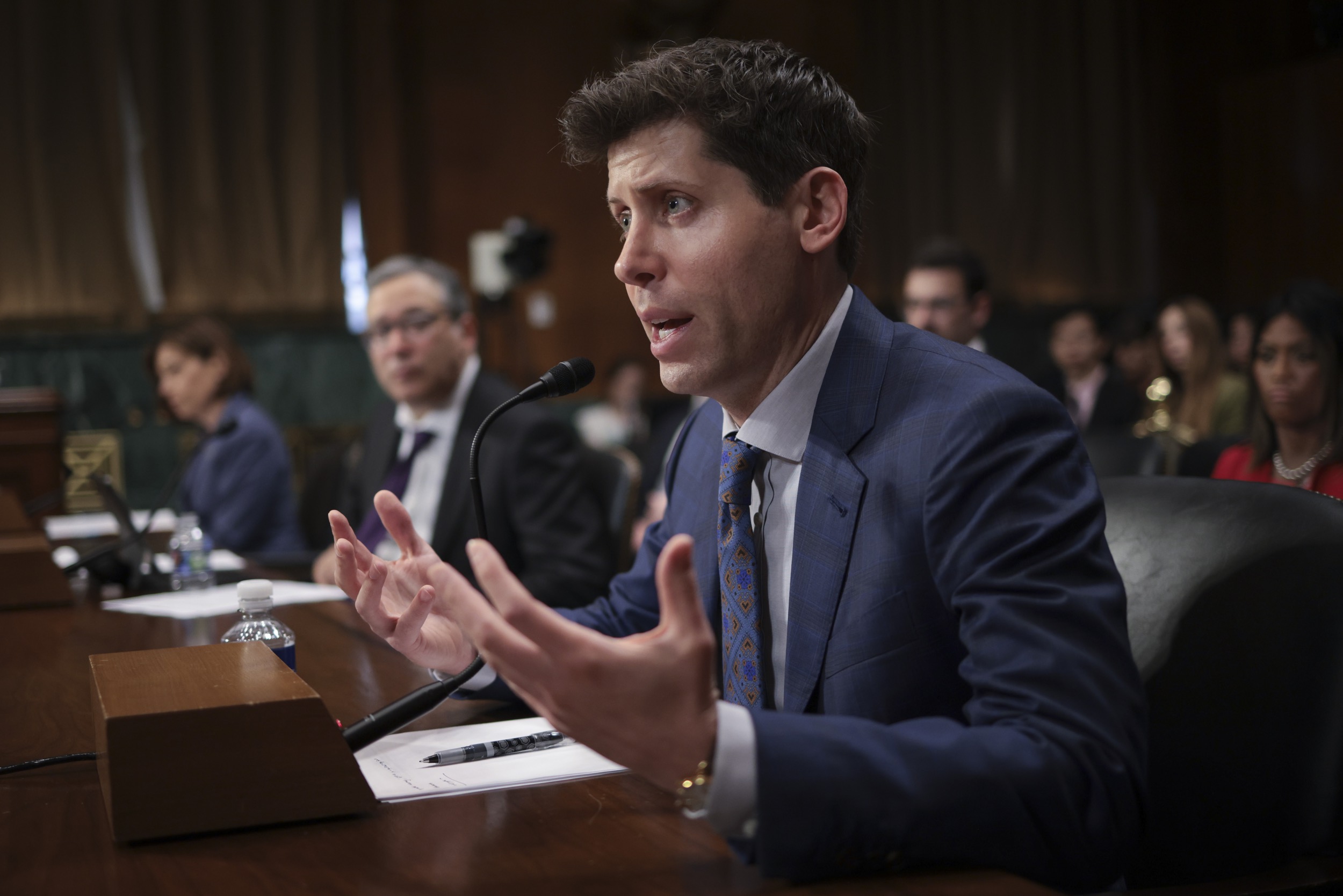
OpenAI CEO Sam Altman sits at a table and speaks into a microphone while testifying in a Senate hearing.

Enlarge / OpenAI CEO Sam Altman testifies about AI rules before the Senate Judiciary Subcommittee on Privacy, Technology, and the Law on May 16, 2023, in Washington, DC. (credit: Getty Images | Win McNamee )

OpenAI, the company behind ChatGPT and DALL-E, announced Friday that co-founder and CEO Sam Altman will be departing the company and vacating his seat on the board. CTO Mira Murati has been appointed interim CEO effective immediately, according to a blog post from the board of directors.

“Mr. Altman’s departure follows a deliberative review process by the board, which concluded that he was not consistently candid in his communications with the board, hindering its ability to exercise its responsibilities,” the blog reads, in part. “The board no longer has confidence in his ability to continue leading OpenAI.”

“We are grateful for Sam’s many contributions to the founding and growth of OpenAI,” the board writes in a prepared statement. “At the same time, we believe new leadership is necessary as we move forward.”

Read 7 remaining paragraphs | Comments


Source: Ars Technica – OpenAI fires CEO Sam Altman, citing less than “candid” communications

Google Delays Release of Gemini AI That Aims To Compete With OpenAI

Google’s company-defining effort to catch up to ChatGPT creator OpenAI is turning out to be harder than expected. From a report: Google representatives earlier this year told some cloud customers and business partners they would get access to the company’s new conversational AI, a large language model known as Gemini, by November. But the company recently told them not to expect it until the first quarter of next year, according to two people with direct knowledge. The delay comes at a bad time for Google, whose cloud sales growth has slowed while that of its bigger rival, Microsoft, has accelerated. Part of Microsoft’s success has come from selling OpenAI’s technology to its customers.

Read more of this story at Slashdot.


Source: Slashdot – Google Delays Release of Gemini AI That Aims To Compete With OpenAI

This 55-inch Samsung Frame TV is on sale for 35 percent off in Amazon's Black Friday sale

Samsung’s Frame smart TVs are cheaper than ever in a Black Friday deal that you can snag right now at both Amazon and Samsung direct. The TVs come in 32- to 85-inch configurations, and all of them have some sort of discount. Of note is the 55-inch model, which is 35 percent off and down to $978 — a new record low, and the steepest percent-discount of the bunch. If you’re looking for the biggest dollar-amount savings, that’s on the massive 85-inch TV, which is $1,000 off and on sale for $3,298. 

These are the latest Frame TV models, with QLED displays and support for 4K content, Quantum Dot technology and 100 percent color volume. That quality should be good enough for most people (if you want your next set to be OLED, we recommend checking out these deals on LG, Sony and Samsung OLED TVs), but the real selling point of the Frame series is its ability to blend into your home’s decor.

Thanks to its included slim wall mount, anti-reflective matte display and Art Mode, the Frame can mimic a piece of art hanging on your walls when you’re note actively watching TV. When we used it, we were also impressed that it comes with an external receiver/port hub/tuner box combo that connects to the panel via a wire, so you could cleverly hide that wire behind a wall or with some accessories to truly make the TV look like it’s a floating photo.

The only catch is that Samsung’s full collection of displayable art hides behind a $5-per-month paywall. Thankfully, you do get a few pieces of art for free that you can display on the Frame, and you can upload your own photos and images to the Frame from your phone or via a USB drive to display as well. Combine that with the ability to customize the hardware further with a personalized bezel (at an extra cost, of course), and you have a TV that you can make your own and that won’t be a big, blocky eyesore in your home like most other sets.

Your Black Friday Shopping Guide: See all of Yahoo’s Black Friday coverage, here. Follow Engadget for Black Friday tech deals. Learn about Black Friday trends on In The Know. Hear from Autoblog’s experts on the best Black Friday deals for your car, garage, and home, and find Black Friday sales to shop on AOL, handpicked just for you.

This article originally appeared on Engadget at https://www.engadget.com/this-55-inch-samsung-frame-tv-is-on-sale-for-35-percent-off-in-amazons-black-friday-sale-211336306.html?src=rss

Source: Engadget – This 55-inch Samsung Frame TV is on sale for 35 percent off in Amazon’s Black Friday sale

Gamma-ray burst charged Earth’s ionosphere from 2 billion light-years away

Image of a narrow beam of material extending from a complex spherical cloud of material.

Enlarge / Artist’s conception of a gamma-ray burst. (credit: NASA)

An astounding gamma-ray burst, dubbed GRB 221009A, continues to amaze even though it has been more than a year since it was detected. Scientists from Italy have recently published a study that shows how our planet’s ionosphere was impacted as a result of its high intensity and long duration.

The ionosphere is one of the Earth’s atmospheric layers, stretching from 60 km to more than 950 km in altitude. Containing electrically charged plasma, its lower half, called the bottom-side, extends until 350 km. Beyond 350 km lies the upper half, called the top-side.

Charging the top-side

According to Mirko Piersanti, who is a professor at the University of L’Aquila, gamma-ray burst effects have often been observed in the bottom-side but rarely in the top-side of the ionosphere. “That’s because the plasma density and conductivity in the top-side is much lower than the bottom-side. Also, to observe this effect, you need a satellite that can make observations, orbiting in this layer,” Piersanti said.

Read 8 remaining paragraphs | Comments


Source: Ars Technica – Gamma-ray burst charged Earth’s ionosphere from 2 billion light-years away

Apple reportedly pulls ads from X amid a growing backlash to antisemitic content on the platform

Another major advertiser is pulling its ads from X amid a growing backlash to antisemitic content on the platform. Axios reports that Apple has opted to “pause” all advertising on the platform after its ads were discovered near pro-Nazi posts and X owner Elon Musk appeared to publicly endorse an antisemitic conspiracy theory.

Apple’s pullback comes one day after IBM suspended its ad campaigns on X following a report from watchdog group Media Matters, which found the company’s ads appearing next to pro-Nazi content on X. Media Matters also highlighted ads from Apple, Comcast and Oracle, which it said also appeared adjacent to pro-Nazi memes and posts.

An executive at X previously told Engadget that the posts identified by Media Matters were no longer monetizable and that “the X system is not intentionally placing a brand actively next to this type of content, nor is a brand actively trying to support this content with placement.” X CEO Linda Yaccarino also said that “X has also been extremely clear about our efforts to combat antisemitism and discrimination.”

Apple didn’t immediately respond to a request for comment, but this wouldn’t be the first time the company has raised concerns about the direction of the platform under Musk’s leadership, and its role as a major advertiser. Apple CEO Tim Cook said in September the company was “constantly” questioning whether it should continue advertising on X. Apple also briefly paused ads on X (then Twitter) last year, amid a “misunderstanding” between the two CEOs. Musk and Cook later met at Apple’s headquarters in Cupertino and apparently resolved the disagreement.

This article originally appeared on Engadget at https://www.engadget.com/apple-reportedly-pulls-ads-from-x-amid-a-growing-backlash-to-antisemitic-content-on-the-platform-205849759.html?src=rss

Source: Engadget – Apple reportedly pulls ads from X amid a growing backlash to antisemitic content on the platform

OpenAI CEO Sam Altman ousted as 'board no longer has confidence' in his leadership

In a surprise shakeup of its c-suite Friday, OpenAI’s board of directors announced that CEO Sam Altman has been fired and will be leaving both the company and the board, effective immediately. Chief Technology Officer Mira Murati has been named interim CEO.

Altman’s oustering reportedly follows an internal “deliberative review process” which found he had not been “consistently candid in his communications with the board, hindering its ability to exercise its responsibilities,” the company announced. As such, “the board no longer has confidence in his ability to continue leading OpenAI.”

OpenAI, which owns popular AI chatbot ChatGPT, thanked Altman’ for his “many contributions to the founding and growth of OpenAI,” but believes that “as the leader of the company’s research, product, and safety functions, Mira is exceptionally qualified to step into the role of interim CEO.” The board added it has “the utmost confidence in her ability to lead OpenAI during this transition period.”

OpenAI’s board is comprised of the company’s Chief Scientist Ilya Sutskever, as well as Chairman and President Greg Brockman. Independent advisors, who hold no equity in the company, are also board members: Quora CEO Adam D’Angelo, tech entrepreneur Tasha McCauley and privacy advocate Helen Toner of the Georgetown Center for Security and Emerging Technology. Altman was also considered an independent advisor on the board, despite being CEO of the company prior to his departure.

Altman’s personal profile has grown alongside the meteoric rise of generative AI technologies over the past year, making him something of an unofficial face for both OpenAI and the burgeoning industry as a whole. Previously the president of Y Combinator, Alman has appeared before Congressional panels and committees, attended both Senate AI Insight forums, and made numerous rounds at industry conferences.

The suddenness of Friday’s announcement is certainly surprising given how steadily, and heavily, Altman has been promoting his company and its products int he days leading up to his termination.

Just last week, Altman took the stage at OpenAI’s 2023 Developers Day to announce a faster and more responsive GPT-4 Turbo platform as well as smaller, application-specific models simply dubbed GPTs. On Thursday. Altman attended the Asia-Pacific Economic Cooperation CEO Summit in San Francisco. “Something has qualitatively changed,” he said during the event. “Now I can talk to this thing. It’s like the ‘Star Trek’ computer I was always promised. … I think a lot of the world has collectively gone through a lurch this year to catch up.” 

Altman and Murati aren’t the only ones caught in this shuffle. Brockman will also be stepping down from his role as board president but will remain at OpenAI, reporting to the new CEO.

Altman co-founded OpenAI in 2015 and has served as its CEO since 2019. The company’s ultra-popular ChatGPT conversational AI is credited with kickstarting the generative AI boom with its release last November. The system, originally built atop the GPT-3.5 platform, initially enabled users to converse with a digital agent — more capable than the previous generation of Siri, Alexa and Assistant — using natural language. Those capabilities quickly expanded to include myriad languages and modalities, the generation of computer code, controlling remote processes and devices through API access.   

This is a developing story. Please check back for updates.

This article originally appeared on Engadget at https://www.engadget.com/openai-ceo-sam-altman-ousted-as-board-no-longer-has-confidence-in-his-leadership-204924006.html?src=rss

Source: Engadget – OpenAI CEO Sam Altman ousted as ‘board no longer has confidence’ in his leadership

EU Allows Use of Controversial Weedkiller Glyphosate for 10 More Years

After months of wrangling, the European Commission says it has decided to renew the license for the weedkiller compound glyphosate, approving its use in European Union countries for ten more years. From a report: Following the decision yesterday, the Commission released a statement saying that, on the basis of comprehensive safety assessments carried out by the European Food Safety Authority (EFSA) and the European Chemicals Agency (ECHA), it would renew the licence, “subject to certain new conditions and restrictions.” These include a ban on the use of the chemical to dry crops before harvest, and “the need for certain measures to protect non-target organisms.” Governments can still restrict the use of glyphosate in their own countries if they consider the risks too high, particularly in regard to the need to protect biodiversity, the statement added.

Glyphosate is the active ingredient in Roundup, the world’s most widely used herbicide. Over the years, a debate has developed about whether the chemical is safe to use on food crops, as well as its possible environmental impacts. Some studies point to a link between glyphosate and certain cancers; others suggest that the way in which it is used should not harm consumers. Glyphosate has been investigated extensively by food- and chemicals-safety agencies, but disagreements among researchers remain. The license allowing glyphosate’s use in the EU was last renewed for five years in 2017. Ahead of the authorization’s expiry in last December, the European Union temporarily extended it for another year to allow the EFSA to assess some 2,400 studies about the compound and to make a recommendation to governments.

Read more of this story at Slashdot.


Source: Slashdot – EU Allows Use of Controversial Weedkiller Glyphosate for 10 More Years

What is RCS and how is it different from SMS and iMessage?

In a dramatic reversal, Apple announced this week it would offer RCS support starting in 2024. The decision effectively ends one of the most protracted and confusing conflicts between iOS and Android. If you’re not sure what any of that means, don’t worry: We’re about to lay out what could change with Apple’s adoption of the GSMA’s next-generation messaging protocol. 

What is SMS?

Short Message Service (SMS) is one of the most ubiquitous messaging protocols on the planet. It dates back to the early days of mobile technology. In December 1992, Neil Papworth, at the time an engineer at Vodafone, sent the first SMS text message when he wished his boss “Merry Christmas.” By the start of 2011, approximately 80 percent of all mobile phone users globally — an estimated 3.5 billion people — were sending SMS messages every month.

In 2023, however, the standard has some notable drawbacks. SMS messages are limited to 160 characters, and texts you send can’t include photos, videos, audio or GIFs. For that, cell phones have long turned to a supporting protocol known as Multimedia Messaging Service (MMS), but it too has its share of technical limitations, including woefully small message size limits. SMS also doesn’t support end-to-end encryption.

But for all the ways SMS feels dated in an era dominated by instant messaging platforms, it has one defining advantage: SMS messages are routed through your carrier’s mobile network, meaning a data plan isn’t necessary to use the technology. That fact has meant SMS has often served as a fallback for more advanced protocols, including iMessage.

What is RCS?

RCS is short for Rich Communication Services, though sometimes it is also marketed as “Advanced Messaging.” Either way, it’s often positioned as a next-generation replacement for SMS and MMS. RCS allows users to take advantage of many features that were previously exclusive to over-the-top messaging platforms like WhatsApp.

For instance, the RCS Universal Profile includes full support for read receipts and typing indicators. It can also facilitate proper group chats, and allow users to send high-resolution images, video and audio clips. As of earlier this year, Google’s implementation of RCS also offers by default end-to-end encryption (E2EE) for both one-on-one and group chats.

Unlike SMS texts, RCS messages are routed over a mobile data connection or Wi-Fi link, with SMS functioning as a fallback. For that reason, the older protocol likely isn’t going anywhere anytime soon.

One thing that’s important to remember about RCS is that it is not and has never been envisioned as a replacement or competitor to instant messaging apps. At its heart, RCS is a communication protocol between mobile telephone carriers and between a phone and carrier. Taking advantage of RCS does not require signing up for a new service. As long as your phone and carrier support RCS, and you’re using a compatible app such as Messages by Google, you can take advantage of everything the protocol has to offer — provided, of course, the person or people you’re messaging meet those same requirements.

How does iMessage fit into all this?

Apple announced iMessage in June 2011, a few short months before Steve Jobs died later that same year. Unlike RCS, iMessage is a proprietary messaging protocol controlled exclusively by Apple and available (barring some unofficial workarounds) only on iPhone, iPad, Apple Watch and Mac devices. Starting in 2024, Apple plans to integrate support for RCS in its Messages app. However, at the moment the two protocols do not communicate with one another. As such, Apple’s Messages app will default to SMS/MMS when users attempt to send texts and media files to someone with an Android phone.

From the perspective of an iMessage user, it can feel like Android users are stuck in a bygone messaging era — even though the latter is not at fault for the situation. Due to iMessage’s reliance on SMS/MMS for Android communication, media files end up pixelated, there aren’t any read receipts or typing indicators and forget about trying to involve multiple iPhone and Android users in a single group chat.

How did we get here?

Although work on RCS began before Apple announced iMessage, the protocol had one major disadvantage that doomed it to a slow rollout. RCS is a multi-stakeholder project that includes the involvement of the GSMA, a trade body that represents the interests of the mobile communications industry at large. In 2015, Google took a more active role in the proliferation of RCS when it acquired Jibe Mobile. With Jibe’s technology as a base, it’s effectively Google that provides the glue that binds the RCS ecosystem together, but for a long time, the company did a poor job of aligning everyone involved in RCS toward a shared goal.

In fact, the early days of RCS were marked by false starts, with some carriers, including a group made up of AT&T, T-Mobile and Verizon forming a short-lived joint venture to push the protocol forward before eventually aligning themselves with Google. Even Samsung did its own thing for a while before it too eventually agreed to make Messages by Google the default messaging app it ships on phones in the US.

For that reason, Apple has had little reason to adopt RCS. After all, why would it give a bumbling competitor a freebie? And as recently as last year, it seemed there was little to no chance the situation was going to change anytime soon. “I don’t hear our users asking that we put a lot of energy into that,” Apple CEO Tim Cook told the Code Conference in 2022 when he was asked about RCS messaging. “Buy your mom an iPhone” was his final word on the matter.

But it was also last year that the European Union passed its landmark Digital Markets and Services Act (DMA). The legislation requires “gatekeepers” to not favor their own systems or limit third parties from interoperating within them. Gatekeepers are any company that meets specific financial and usage qualifications. Apple, according to the law, is one such company. 

At the start of November, Google sent the European Commission arguing that iMessage violates the DMA. It’s probably not an accident that Apple’s RCS announcement coincided with the deadline for companies to file challenges to the DMA at the EU’s General Court. On Friday, the EU announced Apple is contesting its DMA assignments. The details of the company’s complaints aren’t public, but Bloomberg reported last week Apple was planning to challenge the gatekeeper designations of both iMessage and the App Store.

Does Apple’s support of RCS mean the end of green text bubbles on iPhone?

It’s too early to tell. On Thursday, Apple provided precious few details about how it plans to display and treat RCS messages on its devices. What’s more, the company did note that iMessage “will continue to be the best and most secure messaging experience for Apple users.” That said, even if you take that statement to mean iMessage will continue to display texts from non-Apple devices differently from those sent from an iPhone, iPad or Mac, Apple’s adoption of RCS will lead to a better user experience for both iOS and Android users.

Again, Apple needs to provide specifics, but it’s easy to envision a future where its Messages app, thanks to RCS, properly displays high-resolution images and videos sent from Android phones, and allows both iOS and Android users to take part in group chats without something breaking. On Thursday, Apple also said it would work with GSMA members to improve the existing Universal Profile protocol, with a focus on adding end-to-end encryption to the standard.

Of course, whether that interoperability ends the stigma around green bubbles is harder to answer.

This article originally appeared on Engadget at https://www.engadget.com/what-is-rcs-and-how-is-it-different-from-sms-and-imessage-202334057.html?src=rss

Source: Engadget – What is RCS and how is it different from SMS and iMessage?

Watch David Tennant's New Doctor Who Debut

The 14th Doctor has arrived—a little earlier than we first expected. Although Doctor Who will return to TV in a little over a week in a big way to celebrate its 60th anniversary in a trio of specials, tonight the BBC released a short scene marking the first onscreen adventure for David Tennant’s latest take on the…

Read more…


Source: Gizmodo – Watch David Tennant’s New Doctor Who Debut

Race Cannot Be Used To Predict Heart Disease, Scientists Say

Doctors have long relied on a few key patient characteristics to assess risk of a heart attack or stroke, using a calculus that considers blood pressure, cholesterol, smoking and diabetes status, as well as demographics: age, sex and race. Now, the American Heart Association is taking race out of the equation. From a report: The overhaul of the widely used cardiac-risk algorithm is an acknowledgment that, unlike sex or age, race identification in and of itself is not a biological risk factor. The scientists who modified the algorithm decided from the start that race itself did not belong in clinical tools used to guide medical decision making, even though race might serve as a proxy for certain social circumstances, genetic predispositions or environmental exposures that raise the risk of cardiovascular disease.

The revision comes amid rising concern about health equity and racial bias within the U.S. health care system, and is part of a broader trend toward removing race from a variety of clinical algorithms. “We should not be using race to inform whether someone gets a treatment or doesn’t get a treatment,” said Dr. Sadiya Khan, a preventive cardiologist at Northwestern University Feinberg School of Medicine, who chaired the statement writing committee for the American Heart Association, or A.H.A. The statement was published on Friday [PDF] in the association’s journal, Circulation. An online calculator using the new algorithm, called PREVENT, is still in development.

Read more of this story at Slashdot.


Source: Slashdot – Race Cannot Be Used To Predict Heart Disease, Scientists Say

Half-Life's big 25th anniversary update includes four new multiplayer maps and much more

Half-Life is one of the greatest video games of all time and just ahead of its 25th anniversary on Sunday, Valve has released a major update for the first-person shooter. For one thing, the base game now includes Half-Life Uplink. This was a demo of Half-Life, but most of its content doesn’t appear in the original game.

Uplink was initially available on CDs that came free with magazines (remember those?) and hardware like sound cards. It’s also been available on the internet for a while for those who know where to look. But now players can access it by clicking the New Game button in Half-Life itself.

On top of that, Valve has added four spanking new multiplayer maps. Some might seem familiar, such as one based on an abandoned Xen outpost and another set at an old orbital satellite launch facility. “If we could switch on the oxygen lines, power, and fuel, we might just be able to light this candle,” Valve said. The company has added three other maps that were originally available on a disc called Half-Life: Further Data.

You can now, at long last, play the original Half-Life in widescreen without having to resort to mods or the fan remake Black Mesa. Valve has added controller support along with a string of other under-the-hood updates, UI tweaks and bug fixes. Steam Networking support should make multiplayer smoother too.

Although it’s a critical part of Valve’s history, Half-Life hadn’t been Verified for Steam Deck until now. It instead bore the Playable label. “We finally put our game through our own ‘Verified’ tests, and… we failed super hard,” Valve wrote. “So we fixed it! After re-testing the game, Half-Life gets to officially wear the green checkmark.” So, that means it should run on your new Steam Deck OLED without a hitch.

Best of all, in case you somehow don’t already have it in your library, Half-Life is free on Steam until November 20. Various Half-Life and Valve bundles are on sale too, while Half-Life Alyx is 66 percent off at $20.39.

It’s worth noting that Valve now considers the anniversary edition of Half-Life “to be the definitive version, and the one we’ll continue to support going forward.” As such, Valve says Half Life: Source will be less prominent on Steam, but it will remain available so modders can continue using its assets.

“We launched Half-Life on November 19, 1998. We are very proud of what we built back then and we remain extremely grateful for the community of players who have been enjoying it ever since,” Valve said. “The game hasn’t received as much attention in recent years as many other titles in our catalog, so we thought this milestone was a great opportunity to spruce up the player experience and add some fun new ways to play the game.”

Last but not least, Valve has released a new documentary to mark the 25th anniversary. The 65-minute film features developers and Valve co-founders discussing the company’s early days and their memories of working on Half-Life. Happy birthday, Mr. Freeman.

This article originally appeared on Engadget at https://www.engadget.com/half-lifes-big-25th-anniversary-update-includes-four-new-multiplayer-maps-and-much-more-193932590.html?src=rss

Source: Engadget – Half-Life’s big 25th anniversary update includes four new multiplayer maps and much more