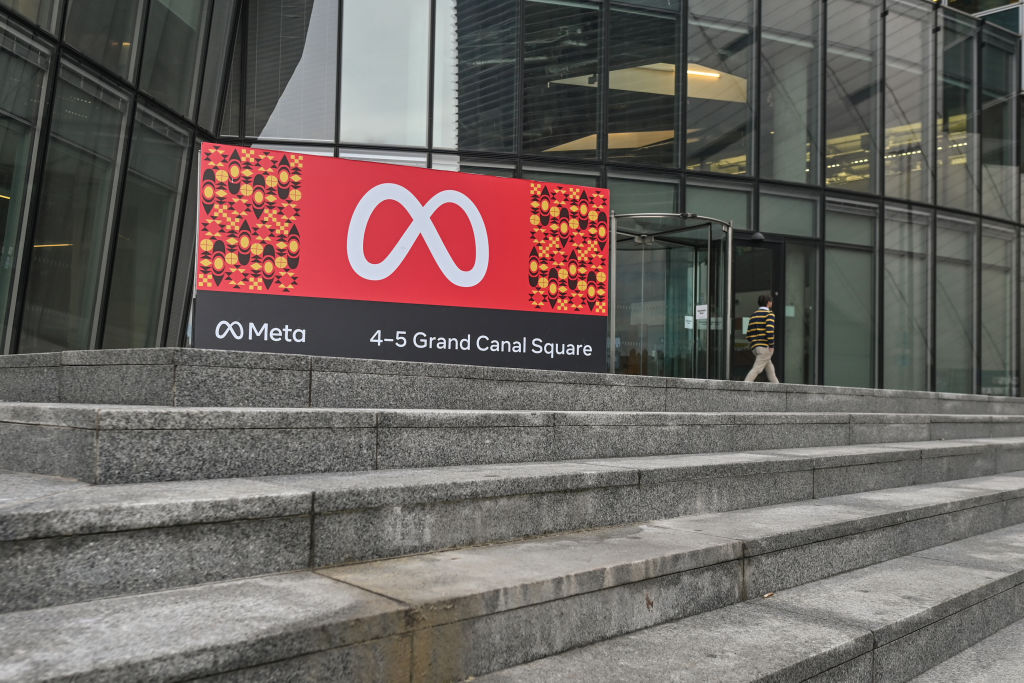
Meta sues FTC, hoping to block ban on monetizing kids’ Facebook data

Photo illustration in which the Facebook logo is displayed on the screen of an iPhone in front of a Meta logo

Enlarge (credit: Getty Images | Chesnot)

Meta sued the Federal Trade Commission yesterday in a lawsuit that challenges the FTC’s authority to impose new privacy obligations on the social media firm.

The complaint stems from the FTC’s May 2023 allegation that Meta-owned Facebook violated a 2020 privacy settlement and the Children’s Online Privacy Protection Act. The FTC proposed changes to the 2020 privacy order that would, among other things, prohibit Facebook from monetizing data it collects from users under 18.

Meta’s lawsuit against the FTC challenges what it calls “the structurally unconstitutional authority exercised by the FTC through its Commissioners in an administrative reopening proceeding against Meta.” It was filed against the FTC, Chair Lina Khan, and other commissioners in US District Court for the District of Columbia. Meta is seeking a preliminary injunction to stop the FTC proceeding pending resolution of the lawsuit.

Read 15 remaining paragraphs | Comments


Source: Ars Technica – Meta sues FTC, hoping to block ban on monetizing kids’ Facebook data

Can digital watermarking protect us from generative AI?

The Biden White House recently enacted its latest executive order designed to establish a guiding framework for generative artificial intelligence development — including content authentication and using digital watermarks to indicate when digital assets made by the Federal government are computer generated. Here’s how it and similar copy protection technologies might help content creators more securely authenticate their online works in an age of generative AI misinformation.

A quick history of watermarking

Analog watermarking techniques were first developed in Italy in 1282. Papermakers would implant thin wires into the paper mold, which would create almost imperceptibly thinner areas of the sheet which would become apparent when held up to a light. Not only were analog watermarks used to authenticate where and how a company’s products were produced, the marks could also be leveraged to pass concealed, encoded messages. By the 18th century, the technology had spread to government use as a means to prevent currency counterfeiting. Color watermark techniques, which sandwich dyed materials between layers of paper, were developed around the same period.

Though the term “digital watermarking” wasn’t coined until 1992, the technology behind it was first patented by the Muzac Corporation in 1954. The system they built, and which they used until the company was sold in the 1980s, would identify music owned by Muzac using a “notch filter” to block the audio signal at 1 kHz in specific bursts, like Morse Code, to store identification information.

Advertisement monitoring and audience measurement firms like the Nielsen Company have long used watermarking techniques to tag the audio tracks of television shows to track and understand what American households are watching. These steganographic methods have even made their way into the modern Blu-Ray standard (the Cinavia system), as well as in government applications like authenticating drivers licenses, national currencies and other sensitive documents. The Digimarc corporation, for example, has developed a watermark for packaging that prints a product’s barcode nearly-invisibly all over the box, allowing any digital scanner in line of sight to read it. It’s also been used in applications ranging from brand anti-counterfeiting to enhanced material recycling efficiencies.

The here and now

Modern digital watermarking operates on the same principles, imperceptibly embedding added information onto a piece of content (be it image, video or audio) using special encoding software. These watermarks are easily read by machines but are largely invisible to human users. The practice differs from existing cryptographic protections like product keys or software protection dongles in that watermarks don’t actively prevent the unauthorized alteration or duplication of a piece of content, but rather provide a record of where the content originated or who the copyright holder is.

The system is not perfect, however. “There is nothing, literally nothing, to protect copyrighted works from being trained on [by generative AI models], except the unverifiable, unenforceable word of AI companies,” Dr. Ben Zhao, Neubauer Professor of Computer Science at University of Chicago, told Engadget via email.

“There are no existing cryptographic or regulatory methods to protect copyrighted works — none,” he said. “Opt-out lists have been made made a mockery by stability.ai (they changed the model name to SDXL to ignore everyone who signed up to opt out of SD 3.0), and Facebook/Meta, who responded to users on their recent opt-out list with a message that said ‘you cannot prove you were already trained into our model, therefore you cannot opt out.’”

Zhao says that while the White House’s executive order is “ambitious and covers tremendous ground,” plans laid out to date by the White House have lacked much in the way of “technical details on how it would actually achieve the goals it set.”

He notes that “there are plenty of companies who are under no regulatory or legal pressure to bother watermarking their genAI output. Voluntary measures do not work in an adversarial setting where the stakeholders are incentivized to avoid or bypass regulations and oversight.”

“Like it or not, commercial companies are designed to make money, and it is in their best interests to avoid regulations,” he added.

We could also very easily see the next presidential administration come into office and dismantle Biden’s executive order and all of the federal infrastructure that went into implementing it, since an executive order lacks the constitutional standing of congressional legislation. But don’t count on the House and Senate doing anything about the issue either.

“Congress is deeply polarized and even dysfunctional to the extent that it is very unlikely to produce any meaningful AI legislation in the near future,” Anu Bradford, a law professor at Columbia University, told MIT Tech Review. So far, enforcement mechanisms for these watermarking schemes have been generally limited to pinky swears by the industry’s major players.

How Content Credentials work

With the wheels of government turning so slowly, industry alternatives are proving necessary. Microsoft, the New York Times, CBC/Radio-Canada and the BBC began Project Origin in 2019 to protect the integrity of content, regardless of the platform on which it’s consumed. At the same time, Adobe and its partners launched the Content Authenticity Initiative (CAI), approaching the issue from the creator’s perspective. Eventually CAI and Project Origin combined their efforts to create the Coalition for Content Provenance and Authenticity (C2PA). From this coalition of coalitions came Content Credentials (“CR” for short), which Adobe announced at its Max event in 2021. 

CR attaches additional information about an image whenever it is exported or downloaded in the form of a cryptographically secure manifest. The manifest pulls data from the image or video header — the creator’s information, where it was taken, when it was taken, what device took it, whether generative AI systems like DALL-E or Stable Diffusion were used and what edits have been made since — allowing websites to check that information against provenance claims made in the manifest. When combined with watermarking technology, the result is a unique authentication method that cannot be easily stripped like EXIF and metadata (i.e. the technical details automatically added by the software or device that took the image) when uploaded to social media sites (on account of the cryptographic file signing). Not unlike blockchain technology! 

Metadata doesn’t typically survive common workflows as content is shuffled around the internet because, Digimarc Chief Product Officer Ken Sickles explained to Engadget, many online systems weren’t built to support or read them and so simply ignore the data.

“The analogy that we’ve used in the past is one of an envelope,” Chief Technology Officer of Digimarc, Tony Rodriguez told Engadget. Like an envelope, the valuable content that you want to send is placed inside “and that’s where the watermark sits. It’s actually part of the pixels, the audio, of whatever that media is. Metadata, all that other information, is being written on the outside of the envelope.”

Should someone manage to remove the watermark (turns out, not that difficult, just screenshot the image and crop out the icon) the credentials can be reattached through Verify, which runs machine vision algorithms against an uploaded image to find matches in its repository. If the uploaded image can be identified, the credentials get reapplied. If a user encounters the image content in the wild, they can check its credentials by clicking on the CR icon to pull up the full manifest and verify the information for themselves and make a more informed decision about what online content to trust.

Sickles envisions these authentication systems operating in coordinating layers, like a home security system that pairs locks and deadbolts with cameras and motion sensors to increase its coverage. “That’s the beauty of Content Credentials and watermarks together,” Sickles said. “They become a much, much stronger system as a basis for authenticity and understanding providence around an image” than they would individually.” Digimarc freely distributes its watermark detection tool to generative AI developers, and is integrating the Content Credentials standard into its existing Validate online copy protection platform.

In practice, we’re already seeing the standard being incorporated into physical commercial products like the Leica M11-P which will automatically affix a CR credential to images as they’re taken. The New York Times has explored its use in journalistic endeavors, Reuters employed it for its ambitious 76 Days feature and Microsoft has added it to Bing Image Creator and Bing AI chatbot as well. Sony is reportedly working to incorporate the standard in its Alpha 9 III digital cameras, with enabling firmware updates Alpha 1 and Alpha 7S III models arriving in 2024. CR is also available in Adobe’s expansive suite of photo and video editing tools including Illustrator, Adobe Express, Stock and Behance. The company’s own generative AI, Firefly, will automatically include non-personally identifiable information in a CR for some features like generative fill (essentially noting that the generative feature was used, but not by whom) but will otherwise be opt-in.

That said, the C2PA standard and front-end Content Credentials are barely out of development and currently exceedingly difficult to find on social media. “I think it really comes down to the wide-scale adoption of these technologies and where it’s adopted; both from a perspective of attaching the content credentials and inserting the watermark to link them,” Sickles said.

Nightshade: The CR alternative that’s deadly to databases

Some security researchers have had enough waiting around for laws to be written or industry standards to take root, and have instead taken copy protection into their own hands. Teams from the University of Chicago’s SAND Lab, for example, have developed a pair of downright nasty copy protection systems for use specifically against generative AIs.

Zhao and his team have developed Glaze, a system for creators that disrupts a generative AI’s style of mimicry (by exploiting the concept of adversarial examples). It can change the pixels in a given artwork in a way that is undetectable by the human eye but which appear radically different to a machine vision system. When a generative AI system is trained on these “glazed” images, it becomes unable to exactly replicate the intended style of art — cubism becomes cartoony, abstract styles are transformed into anime. This could prove a boon to well-known and often-imitated artists especially, in keeping their branded artistic styles commercially safe.

While Glaze focuses on preventative actions to deflect the efforts of illicit data scrapers, SAND Lab’s newest tool is whole-heartedly punitive. Dubbed Nightshade, the system will subtly change the pixels in a given image but instead of confusing the models it’s trained with like Glaze does, the poisoned image will corrupt the training database its ingested into wholesale, forcing developers to go back through and manually remove each damaging image to resolve the issue — otherwise the system will simply retrain on the bad data and suffer the same issues again.

The tool is meant as a “last resort” for content creators but cannot be used as a vector of attack. “This is the equivalent of putting hot sauce in your lunch because someone keeps stealing it out of the fridge,” Zhao argued.

Zhao has little sympathy for the owners of models that Nightshade damages. “The companies who intentionally bypass opt-out lists and do-not-scrape directives know what they are doing,” he said. “There is no ‘accidental’ download and training on data. It takes a lot of work and full intent to take someone’s content, download it and train on it.”

This article originally appeared on Engadget at https://www.engadget.com/can-digital-watermarking-protect-us-from-generative-ai-184542396.html?src=rss

Source: Engadget – Can digital watermarking protect us from generative AI?

Over 75% of Web3 Games 'Failed' in Last Five Years

Web3 research and analytics firm CoinGecko: Around 2,127 web3 games have failed in the last five years since the GameFi niche emerged, representing 75.5% of the 2,817 web3 games launched. In other words, 3 out of every 4 web3 games have become inactive. The average annual failure rate for web3 games has been 80.8% from 2018 to 2023, based on the number of web3 games failed compared to launched.

Read more of this story at Slashdot.


Source: Slashdot – Over 75% of Web3 Games ‘Failed’ in Last Five Years

Meta’s “overpriced” ad-free subscriptions make privacy a “luxury good”: EU suit

Meta’s “overpriced” ad-free subscriptions make privacy a “luxury good”: EU suit

Enlarge (credit: NurPhoto / Contributor | NurPhoto)

Backlash over Meta’s ad-free subscription model in the European Union has begun just one month into its launch.

On Thursday, Europe’s largest consumer group, the European Consumer Organization (BEUC), filed a complaint with the network of consumer protection authorities. In a press release, BEUC alleges that Meta’s subscription fees for ad-free access to Facebook and Instagram are so unreasonably high that they breach laws designed to protect user privacy as a fundamental right.

“Meta has been rolling out changes to its service in the EU in November 2023, which require Facebook and Instagram users to either consent to the processing of their data for advertising purposes by the company or pay in order not to be shown advertisements,” BEUC’s press release said. “The tech giant’s pay-or-consent approach is unfair and must be stopped.”

Read 22 remaining paragraphs | Comments


Source: Ars Technica – Meta’s “overpriced” ad-free subscriptions make privacy a “luxury good”: EU suit

YouTube Music brings personalized album art to its 2023 Recap

YouTube Music users who have seen their Spotify- and Apple Music-using friends share their listening stats from this year can now join the party. YouTube Music Recap is now live and you can access it from the 2023 Recap page in the app. You’ll be able to see your top artists, songs, moods, genres, albums, playlists and more from 2023. There’s also the option to view your Recap in the main YouTube app, along with some other new features for 2023.

This year, you’ll be able to add custom album art. YouTube will create this using your top song and moods from the year, as well as your energy score. The platform will mash together colors, vibes and visuals to create a representation of your year in music.

YouTube Music Recap custom album art
YouTube Music

YouTube says another feature will match your mood with your top songs of the year. You might see, for instance, the percentages of songs you listened to that are classed as upbeat, fun, dancey or chill. Last but not least, you can use snaps from Google Photos to create a customized visual that sums up your year in music (and perhaps your year in travel too).

This article originally appeared on Engadget at https://www.engadget.com/youtube-music-brings-personalized-album-art-to-its-2023-recap-182904330.html?src=rss

Source: Engadget – YouTube Music brings personalized album art to its 2023 Recap

This Year's Windows Ugly Sweater Is the Holiday Cheer I Needed

Here at Gizmodo, we love an ugly holiday sweater, and it seems like Microsoft has outdone itself with another must-have nostalgia grab for Windows fans, specifically Windows XP fans. And here I thought there was no way it could top last year’s Clippy sweater.

Read more…


Source: Gizmodo – This Year’s Windows Ugly Sweater Is the Holiday Cheer I Needed

Tom Holland Only Wants to Do Spider-Man 4 If It's 'Worth the While'

When you make the third highest-grossing film of all time, the first thing people will ask about is a sequel. That’s exactly what happened when 2021’s Spider-Man No Way Home had its incredibly successful run. For the film’s star though, Tom Holland, a sequel isn’t a sure thing. To him, there’s more to it than money.…

Read more…


Source: Gizmodo – Tom Holland Only Wants to Do Spider-Man 4 If It’s ‘Worth the While’

A Star With Six Planets That Orbit Perfectly in Sync

Astronomers have discovered six planets orbiting a bright star in perfect resonance. The star system, 100 light-years from Earth, was described on Wednesday in a paper published in the journal Nature. From a report: The discovery of the system could give astronomers a unique opportunity to trace the evolution of these worlds to when they first formed, and potentially offer insights into how our solar system got to be the way it is today. “It’s like looking at a fossil,” said Rafael Luque, an astronomer at the University of Chicago who led the study. “The orbits of the planets today are the same as they were a billion years ago.”

Researchers think that when planets first form, their orbits around a star are in sync. That is, the time it takes for one planet to waltz around its host star might be the same amount of time it takes for a second planet to circle exactly twice, or exactly three times. Systems that line up like this are known as orbital resonances. But, despite the theory, finding resonances in the Milky Way is rare. Only 1 percent of planetary systems still preserve this symmetry.

Most of the time, planetary orbits get knocked out of sync by an event that upsets the gravitational balance of the system. That could be a close encounter with another star, the formation of a massive planet like Jupiter, or a giant impact from space on one planet that causes a ripple effect in other orbits. When this happens, Dr. Luque said, planetary orbits become too chaotic to mathematically describe, and knowledge of their evolution is indecipherable. Astronomers are lucky to find even one pair of exoplanets in resonance. But in the newly discovered star system, there are a whopping five pairs, because all six planets have orbits that are in sync with one another. Dr. Luque described it as “the 1 percent of the 1 percent.”

Read more of this story at Slashdot.


Source: Slashdot – A Star With Six Planets That Orbit Perfectly in Sync

Brain Injection Stopped Progression of Multiple Sclerosis in Trial of 15 People

Research published this week describes a promising start to using stem cell therapy for multiple sclerosis. In a small Phase I trial, patients who had stem cells directly injected into their brain appeared to tolerate it well and experienced no serious adverse effects. The treatment may have also stopped or slowed the…

Read more…


Source: Gizmodo – Brain Injection Stopped Progression of Multiple Sclerosis in Trial of 15 People

Evernote officially limits free users to 50 notes and one measly notebook

Evernote has confirmed the service’s tightly leashed new free plan, which the company tested with some users earlier this week. Starting December 4, the note-taking app will restrict new and current accounts to 50 notes and one notebook. Existing free customers who exceed those limits can still view, edit, delete and export their notes, but they’ll need to upgrade to a paid plan (or delete enough old ones) to create new notes that exceed the new confines.

The company says most free accounts are already inside those lines. “When setting the new limits, we considered that the majority of our Free users fall below the threshold of fifty notes and one notebook,” the company wrote in an announcement blog post. “As a result, the everyday experience for most Free users will remain unchanged.” Engadget reached out to Evernote to clarify whether “the majority of Free users” staying within those bounds includes long-dormant accounts that may have tried the app for a few minutes a decade ago and never logged in again. We’ll update this article if we hear back.

Evernote’s premium plans, now practically essential for anything more than minimal use, include a $15 monthly Personal plan with 10GB of monthly uploads. You can double that to 20GB (and get other perks) with an $18 tier. It also offers annual versions of those plans for $130 and $170, respectively.

The company acknowledged in its announcement post that “these changes may lead you to reconsider your relationship with Evernote.” Leading alternatives with more bountiful free plans include Notion, Microsoft OneNote, Google Keep, Bear (Apple devices only), Obsidian and SimpleNote.

Earlier this year, Evernote’s parent company, Bending Spoons, moved its operations from the US and Chile to Europe, laying off nearly all of the note-taking app’s employees. When doing so, it said the app had been “unprofitable for years.”

This article originally appeared on Engadget at https://www.engadget.com/evernote-officially-limits-free-users-to-50-notes-and-one-measly-notebook-174436735.html?src=rss

Source: Engadget – Evernote officially limits free users to 50 notes and one measly notebook

Expressive E Osmose review: A game-changing MPE keyboard, but a frustrating synthesizer

When I first got to see the Expressive E Osmose way back in 2019, I knew it was special. In my 15-plus years covering technology, it was one of the only devices I’ve experienced that actually had the potential to be truly “game changing.” And I’m not being hyperbolic.

But, that was four years ago, almost to the day. A lot has changed in that time. MPE (MIDI Polyphonic Expression) has gone from futuristic curiosity to being embraced by big names like Ableton and Arturia. New players have entered and exited the scene. More importantly, the Osmose is no longer a promising prototype, but an actual commercial product. The questions, then, are obvious: Does the Osmose live up to its potential? And, does it seem as revolutionary today as it did all those years ago? The answers, however, are less clear.

Expressive E Osmose keybed sideview.
Terrence O’Brien / Engadget

What sets the Osmose ($1,799) apart from every other MIDI controller and synthesizer (MPE or otherwise) is its keybed. At first glance, it looks like almost any other keyboard, albeit a really nice one. The body is mostly plastic, but it feels solid and the top plate is made of metal. (Shoutout to Expressive E, by the way, for building the OSMOSE out of 66 percent recycled materials and for making the whole thing user repairable — no glue or speciality screws to be found.)

The keys themselves have this lovely, almost matte finish and a healthy amount of heft. It’s a nice change of pace from the shiny, springy keys on even some higher-end MIDI controllers. But the moment you press down on a key you’ll see what sets it apart — the keys move side to side. And this is not because it’s cheaply assembled and there’s a ton of wiggle. This is a purposeful design. You can bend notes (or control other parameters) by actually bending the keys, much like you would on a stringed instrument.

This is huge for someone like me who is primarily a guitar player. Bending strings and wiggling my fingers back and forth to add vibrato comes naturally. And, as I mentioned in my review of Roli’s Seaboard Rise 2, I find myself doing this even on keyboards where I know it will have no effect. It’s a reflex.

It’s a very simple thing to explain, but very difficult to encapsulate its effect on your playing. It’s all of the same things that make playing the Seaboard special: the slight pitch instability from the unintentional micro movements of your fingers, the ability to bend individual notes for shifting harmonies and the polyphonic aftertouch that allows you to alter things like filter cutoff on a per-note basis.

These tiny changes in tuning and expression add an almost ineffable fluidity to your playing. In particular, for sounds based on acoustic instruments like flutes and strings, it adds an organic element missing from almost every other synthesizer. There is a bit of a learning curve, but I got the hang of it after just a few days.

Expressive E Osmose pitch bend settings.

What separates it from the Roli, though, is its formfactor. While the Seaboard is keyboard-esque, it’s still a giant squishy slab of silicone. It might not appeal to someone who grew up taking piano lessons every week. The Osmose, on the other hand, is a traditional keyboard, with full-sized keys and a very satisfying action. It’s probably the most familiar and approachable implementation of MPE out there.

If you are a pianist, or an accomplished keyboard player, this is probably the MPE controller you’ve been waiting for. And it’s hands-down one of the best on the market.

Where things get a little dicier is when looking at the Osmose as a standalone synthesizer. But let’s start where it goes right: the interface. The screen to the left of the keyboard is decently sized (around 4 inches) and easy to read at any angle. There are even some cute graphics for parameters such as timbre (a log), release (a yo-yo) and drive (a steering wheel).

Expressive E Osmose interface with cute icons for parameters like cutoff, filter resonance and envelope.
Terrence O’Brien / Engadget

There aren’t a ton of hands-on controls, but menu diving is kept to a minimum with some smart organization. The four buttons across the top of the screen take you to different sections for presets, synth (parameters and macros), sensitivity (MPE and aftertouch controls) and playing (mostly just for the arpeggiator at the moment). Then to the left of the screen there are two encoders for navigating the submenus, and the four knobs below control whatever option is listed above them on the screen. So, no, you’re not going to be doing a lot of live tweaking, but you also won’t spend 30 minutes trying to dial in a patch.

Part of the reason you won’t spend 30 minutes dialing in a patch is because there really isn’t much to dial in. The engine driving the Osmose is Haken Audio’s EaganMatrix and Expressive E keeps most of it hidden behind six macro controls. In fact, you can’t really design a patch from scratch — at least not the synth directly. You need to download the Haken Editor, which requires Max (not the streaming service), to do serious sound design. Then you need to upload your new patch to the Osmose over USB. Other than that, you’re stuck tweaking presets.

Expressive E Osmose macro controls.
Terrence O’Brien / Engadget

This isn’t necessarily a bad thing because, frankly, EaganMatrix feels less like a musical instrument and more like a PHD thesis. It is undeniably powerful, but it’s also confusing as hell. Expressive E even describes it as “a laboratory of synthesis,” and that seems about right; patching in the EaganMatrix is like doing science. Except, it’s not the fun science you see on TV with fancy machines and test tubes. Instead it’s more like the daily grind of real life science where you stare at a nearly inscrutable series of numbers, letters, mathematical constants and formulas.

I couldn’t get the Osmose and Haken Editor to talk to each other on my studio laptop (a five-year-old Dell XPS), though I did manage to get it to work on my work-issue MacBook. That being said, it was mostly a pointless endeavor. I simply can’t wrap my head around the EaganMatrix. I was able to build a very basic patch with the help of a tutorial, but I couldn’t actually make anything usable.

Hacken Editor and the EaganMatrix connected to the Osmose over USB.

There are some presets available on Patchstorage, but the community is nowhere near as robust as what you’d find for the Organelle or ZOIA. And, it’s not obvious how to actually upload those handful of presets to the Osmose. You can drag and drop the .mid files you download to the empty slots across the top of the Haken Editor and that will add them to the Osmose’s user presets. But you wont actually see that reflected on the Osmose itself until you turn it off and turn it back on.

Honestly, many of the presets available on Patchstorage cover the same ground as 500 or so factory ones that ship with the Osmose. And it’s while browsing those hundreds of presets that both the power and the limitations of the EaganMatrix become obvious. It’s capable of covering everything from virtual analog, to FM to physical modeling, and even some pseudo-granular effects. Its modular, matrix-based patching system is so robust that it would almost certainly be impossible to recreate physically (at least without spending thousands of dollars).

Now, this is largely a matter of taste, but I find the sounds that come out of this obviously over-powered synth often underwhelming. They’re definitely unique and in some cases probably only possible with the EaganMatrix. But the virtual analog patches aren’t very “analog,” the FM ones lack the character of a DX7 or the modern sheen of a Digitone, and the bass patches could use some extra oomph. Sometimes patches on the Osmose feel like tech demos rather than something you’d actually use musically.

Expressive E Osmose preset menus with the Acid Bass patch highlighted.
Terrence O’Brien / Engadget

That’s not to say there’s no good presets. There are some solid analog-ish sounds and there are a few decent FM pads. But it’s the physical modeling patches where EaganMatrix is at its best. They definitely land in a kind of uncanny valley, though — not convincing enough to be mistaken for the real thing, but close enough that it doesn’t seem quite right coming out of a synthesizer.

Still, the way tuned drums and plucked or bowed strings are handled by Osmose is impressive. Quickly tapping a key can get you a ringing resonant sound, while holding it down mutes it. Aftertouch can be used to trigger repeated plucks that increase in intensity as you press harder. And bowed patches can be smart enough to play notes within a certain range of each other as legato, while still allowing you to play more spaced out chords with your other hand. (This latter feature is called Pressure Glide and can be fine tuned to suit your needs.)

The level of precision with which you can gently coax sound out of some presets with the lightest touch is unmatched by any synth or MIDI controller I’ve ever tested. And that becomes all the more shocking when you realize that very same patch can also be a percussive blast if you strike the keys hard.

Expressive E Osmose logo close up.

But, at the end of the day, I rarely find myself reaching for Osmose — at least not as a synthesizer. I’ve been testing one for a few months now, and while I have used it quite extensively in my studio, it’s been mostly as a controller for MPE-enabled soft synths like Arturia’s Pigments and Ableton’s Drift. It’s undeniably one of the most powerful MIDI controllers on the market. My one major complaint on that front being that its incredible arpeggiator isn’t available in controller mode.

The Osmose is a gorgeous instrument that, in the right hands, is capable of delivering nuanced performances unlike anything else. Even if, at times, the borrowed sound engine doesn’t live up to the keyboard’s lofty potential.

This article originally appeared on Engadget at https://www.engadget.com/expressive-e-osmose-review-a-game-changing-mpe-keyboard-but-a-frustrating-synthesizer-170001300.html?src=rss

Source: Engadget – Expressive E Osmose review: A game-changing MPE keyboard, but a frustrating synthesizer

The Best Horror, Sci-Fi, and Fantasy Streaming in December 2023

Let’s get streaming! Welcome to io9’s latest edition of the Nerd’s Watch, where we pare down the enormous lists of new films and television shows arriving on all your favorite streaming services into the sci-fi, fantasy, and horror titles we think you’ll like most. (And sometimes, just the ones that we like most.)

Read more…


Source: Gizmodo – The Best Horror, Sci-Fi, and Fantasy Streaming in December 2023

Google's latest Android update includes AI-created image descriptions and animations for voice messages

Google is rolling out a trio of system updates to Android, Wear OS and Google TV devices. Each brings new features to associated gadgets. Android devices, like smartphones, are getting updated Emoji Kitchen sticker combinations. You can remix emojis and share with friends as stickers via Gboard.

Google Messages for Android is getting a nifty little refresh. There’s a new beta feature that lets users add a unique background and an animated emoji to voice messages. Google’s calling the software Voice Moods and says it’ll help users better express how they’re “feeling in the moment.” Nothing conveys emotion more than a properly-positioned emoji. There are also new reactions for messages that go far beyond simple thumbs ups, with some taking up the entire screen. In addition, you’ll be able to change chat bubble colors.

The company’s also adding an interesting tool that provides AI-generated image descriptions for those with low-vision. The TalkBack feature will read aloud a description of any image, whether sourced from the internet or a photo that you took. Google’s even adding new languages to its Live Caption feature, enhancing the pre-existing ability to take phone calls without needing to hear the speaker. Better accessibility is always a good thing.

Wear OS is getting a bunch of little updates. You can control more smart home devices and light groups directly from a watch, which comes in handy when creating mood lighting. You can also tell your smart home devices that you are home or away with a tap. There’s a new Assistant Routines feature that automates daily tasks and an Assistant At a Glance shortcut on the watch face that displays information relevant to your day, like the weather and traffic data.

As for Google TV, there are ten new free channels to choose from, bringing the grand total to well over 800. None of these channels require an additional subscription, but they will have commercials. All of these updates begin rolling out today, but it could be a few weeks before they hit everyone’s inbox.

This article originally appeared on Engadget at https://www.engadget.com/googles-latest-android-update-includes-ai-created-image-descriptions-and-animations-for-voice-messages-172522129.html?src=rss

Source: Engadget – Google’s latest Android update includes AI-created image descriptions and animations for voice messages

Activision Blizzard Had a Plan, or Ploy, To Launch Its Own Android Game Store

An anonymous reader shares a report: Until today, we’d never heard of “Project Boston.” It was Activision Blizzard King’s big plan to earn more money from its mobile games by changing its relationship with Google. And if things had gone differently, it would have given Activision Blizzard its own app store on Android. In late 2019, according to internal emails and documents I saw today in the courtroom during the Epic v. Google trial, the company decided it was going to dual-track two intriguing parallel plans.

The first plan was to build its own mobile game store — either in partnership with Epic Games and Clash of Clans publisher Supercell or all by itself — to bypass the Google Play Store. You’d download it from a website, sideload it onto your Android phone, and then you’d be able to purchase, download, and patch games like Candy Crush, Call of Duty: Mobile, and Diablo Immortal there. In private emails with Epic CEO Tim Sweeney, Activision Blizzard CFO Armin Zerza pitched it as the “Steam of Mobile” — a single place to buy mobile games, with a single payment system. Documents suggest the store would charge a transaction fee of 10 to 12 percent, lower than the 30 percent fee Google (and Nintendo, Sony, Microsoft, and Steam) impose on gaming transactions.

Read more of this story at Slashdot.


Source: Slashdot – Activision Blizzard Had a Plan, or Ploy, To Launch Its Own Android Game Store

ChatGPT is one year old. Here’s how it changed the world.

A toy tin robot blowing out a birthday candle.

Enlarge / An artist’s interpretation of what ChatGPT might look like if embodied in the form of a robot toy blowing out a birthday candle. (credit: Aurich Lawson | Getty Images)

One year ago today, on November 30, 2022, OpenAI released ChatGPT. It’s uncommon for a single tech product to create as much global impact as ChatGPT in just one year.

Imagine a computer that can talk to you. Nothing new, right? Those have been around since the 1960s. But ChatGPT, the application that first bought large language models (LLMs) to a wide audience, felt different. It could compose poetry, seemingly understand the context of your questions and your conversation, and help you solve problems. Within a few months, it became the fastest-growing consumer application of all time. And it created a frenzy.

During these 365 days, ChatGPT has broadened the public perception of AI, captured imaginations, attracted critics, and stoked existential angst. It emboldened and reoriented Microsoft, made Google dance, spurred fears of AGI taking over the world, captivated world leaders, prompted attempts at government regulation, helped add words to dictionaries, inspired conferences and copycats, led to a crisis for educators, hyper-charged automated defamation, embarrassed lawyers by hallucinating, prompted lawsuits over training data, and much more.

Read 12 remaining paragraphs | Comments


Source: Ars Technica – ChatGPT is one year old. Here’s how it changed the world.

Google Messages now lets you choose your own chat bubble colors

Google is rolling out a string of updates for the Messages app, including the ability to customize the colors of the text bubbles and backgrounds. So, if you really want to, you can have blue bubbles in your Android messaging app. You can have a different color for each chat, which could help prevent you from accidentally leaking a secret to family or friends.

With the help of on-device Google AI (meaning you’ll likely need a recent Pixel device to use this feature), you can transform photos into reactions with Photomoji. All you need to do is pick a photo, decide which object (or person or animal) you’d like to turn into a Photomoji and hit the send button. These reactions will be saved for later use, and friends in the chat can use any Photomoji you send them as well.

The new Voice Moods feature allows you to apply one of nine different vibes to a voice message, by showing visual effects such as heart-eye emoji, fireballs (for when you’re furious) and a party popper. Google says it has also upgraded the quality of voice messages by bumping up the bitrate and sampling rate.

In addition, there are more than 15 Screen Effects you can trigger by typing things like “It’s snowing” or “I love you.” These will make “your screen erupt in a symphony of colors and motion,” Google says. Elsewhere, Messages will display animated effects when certain reactions and emoji are used.

Screenshot of a Google app that reads
Google

On top of all of that, users will now be able to set up a profile that appends their name and photo to their phone number to help them have more control over how they appear across Google services. The company says this feature could help when it comes to receiving messages from a phone number that isn’t in your group chats. It could help you know the identity of everyone in a group chat too.

Some of these features will be available in beta starting today in the latest version of Google Messages. Google notes that some feature availability will depend on market and device.

Google is rolling out these updates alongside the news that more than a billion people now use Google Messages with RCS enabled every month. RCS (Rich Communication Services) is a more feature-filled and secure format of messaging than SMS and MMS. It supports features such as read receipts, typing indicators, group chats and high-res media. Google also offers end-to-end encryption for one-on-one and group conversations via RCS.

For years, Google had been trying to get Apple to adopt RCS for improved interoperability between Android and iOS. Apple refused, perhaps because iMessage (and its blue bubbles) have long been a status symbol for its users. However, likely to ensure Apple falls in line with European Union regulations, Apple has relented. The company recently said it would start supporting RCS in 2024.

This article originally appeared on Engadget at https://www.engadget.com/google-messages-now-lets-you-choose-your-own-chat-bubble-colors-170042264.html?src=rss

Source: Engadget – Google Messages now lets you choose your own chat bubble colors

Your Old Gmail Account Will Be Deleted Tomorrow If You Don’t Sign in Now

Gmail plans to start permanently deleting inactive accounts on December 1. Since November is almost over, we decided to give you one final urgent reminder to log into your old burner accounts to make sure they survive the Great Google Purge.

Read more…


Source: Gizmodo – Your Old Gmail Account Will Be Deleted Tomorrow If You Don’t Sign in Now

Microsoft President Says No Chance of Super-Intelligent AI Soon

The president of tech giant Microsoft said there is no chance of super-intelligent artificial intelligence being created within the next 12 months, and cautioned that the technology could be decades away. From a report: OpenAI cofounder Sam Altman earlier this month was removed as CEO by the company’s board of directors, but was swiftly reinstated after a weekend of outcry from employees and shareholders. Reuters last week exclusively reported that the ouster came shortly after researchers had contacted the board, warning of a dangerous discovery they feared could have unintended consequences.

The internal project named Q* (pronounced Q-Star) could be a breakthrough in the startup’s search for what’s known as artificial general intelligence (AGI), one source told Reuters. OpenAI defines AGI as autonomous systems that surpass humans in most economically valuable tasks. However, Microsoft President Brad Smith, speaking to reporters in Britain on Thursday, rejected claims of a dangerous breakthrough. “There’s absolutely no probability that you’re going to see this so-called AGI, where computers are more powerful than people, in the next 12 months. It’s going to take years, if not many decades, but I still think the time to focus on safety is now,” he said.

Read more of this story at Slashdot.


Source: Slashdot – Microsoft President Says No Chance of Super-Intelligent AI Soon

Damn, What Does Disney Have Against Nia DaCosta?

The Marvels is likely going to end up one of Marvel Studios’ worst-performing films in a considerable period of time—and at a time when people are largely questioning the direction of a franchise that has dominated cinema for 15 years, that’s not an ideal bit of publicity. Also not ideal? The weirdly public way Disney…

Read more…


Source: Gizmodo – Damn, What Does Disney Have Against Nia DaCosta?