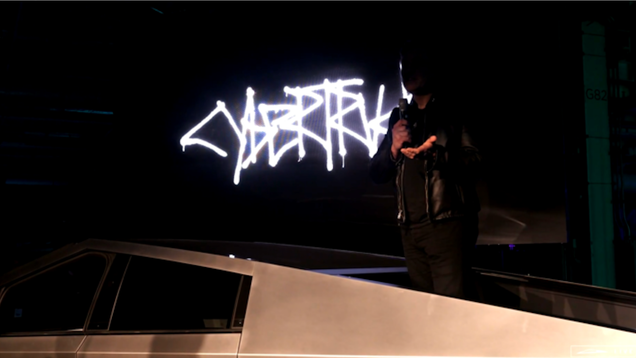
After years of production delays, Tesla CEO Elon Musk took to a dimly-lit stage on Thursday to hand-deliver the first batch of Cybertruck EVs to their new owners. The company has also, finally announced pricing for the luxury electric truck. Prospective buyers can expect to pay anywhere from $60,990 to $100,000 MSRP (and potentially $11,000 less after rebates and tax credits). The company has launched an online configurator tool for those interested in placing an order of their own.
Tesla also officially revealed the vehicle’s performance specs and model options at the event. The Cybertruck’s entry-level version is the $60,990 single-motor rear-wheel drive ($49,890 after “incentives” and an “est. 3-year gas savings,” per the configurator). It will offer an estimated 250 miles of range and a pokey 6.5 second zero-to-60. Who knew steel sheeting would be so heavy?. It won’t be released until the 2025 model year.
The mid-level model is the $79,990 all-wheel drive version and sports e-motors on each axle. It weighs just over 6,600 pounds — 1,900 less than the Rivian R1S and nearly 2,500 less than the Hummer EV. It will offer 340 miles of range, a more respectable 4.1-second zero-to-60 and 600 HP with 7435 lb-ft of torque. Its 11,000-pound towing capacity is a touch more than the Ford Lighting XLT’s 10,000-pound maximum.
For $99,990, you can buy the top of the line Cyberbeast — yes, you will have to refer to it as that in public. The Cyberbeast comes equipped with a trio of e-motors that will provide AWD handling, a 320 mile range, 2.6-second sero-to-60, a 130 MPH top speed, 845 horses and 10,296 lb-ft of torque. Despite those impressive specs, the Cyberbeast is stuck with the same 11,000 pound tow limit as the base model.
Both the Cyberbeast and the AWD iteration will be able to carry 121 cubic feet of cargo and accommodate five adult passengers. The Cybertruck line is compatible with Tesla’s supercharger network and can accept up to 250W maximum, enough to add 128 miles of range for every 15 minutes of charge time. The AWD and Cyberbeast are both currently available to order on Tesla’s website, though prospective buyers will need to put down a fully-refundable $250 deposit upon ordering.
Developing
This article originally appeared on Engadget at https://www.engadget.com/teslas-long-awaited-cybertruck-will-start-at-60990-before-rebates-211751127.html?src=rss
Android users might soon be able to turn their smartphones into a webcam for their PCs via Microsoft’s Link to Windows app, according to Android Authority.
Tesla delivered its first Cybertrucks on Thursday afternoon in Austin, Texas, four years after the dystopian electric vehicles were unveiled. Musk kicked off the delivery event by driving a Cybertruck up next to a crowd of people, standing on top of the car, and giving a speech in the dark. The top-end Cybertruck…
How hard is it to check whether an image is an AI deepfake or not? Well, Amazon claims it has some sort of answer with its own watermarking system for Amazon Titan Image Generator, the new AI art creator it announced today. Of course, it’s not that easy. Each business that makes use of the model will have to outline…
An anonymous reader shares a report: In late September, an arsonist set fire to a storage shed at Memorial Park used by the Santa Monica Pickleball Club, torching thousands of dollars worth of nets, rackets, balls, and other pickleball equipment. “Unknown suspect(s) caused a fire that damaged city property (Tennis Court Gate),” a police report I obtained using a public records request says. The report adds that there is body camera footage of the incident and police-shot photos, but the city refused to release them to me because there is an ongoing investigation. The arsonist is still at large.
We still don’t know the motive behind the arson, but the news caught my attention because it happened while I was in the midst of trying to understand what I’ve been calling the pickleball wars. For the last few months I’ve been trying to understand what’s been happening behind-the-scenes in cities large and small by filing public records requests aimed at learning how common beefs about pickleball are, and what’s causing them.
If you don’t already know about “the fastest growing sport,” Pickleball is kind of like tennis, but played on a court a quarter of the size using a plastic ball similar to a wiffle ball and a hard racket. The smaller court, hard ball, and hard racket means that pickleball is louder than tennis, a fact that is brought up very often by homeowners and homeowner associations who claim, somewhat dubiously, that the noise from pickleball drives down their home values. My hypothesis going into researching this article was that people who live in cities are mad at the noise created during the act of playing pickleball and they have probably complained to the government about it. What I found was surprisingly more complex: Thousands of pages of documents I’ve reviewed show that pickleball’s surging popularity is overwhelming under-resourced parks departments in city governments all over the country.
Kurt Wagner’s relationship with Mystique and Destiny has long been a messy, divisive one–but as the current era of X-Men comics is more explicit about their queer family, this week it righted the wrongs of the past to bring Kurt and his upbringing into a bold new light.
TikTok has introduced the Artist Account, which offers up-and-coming musicians new ways to curate their profiles in ways that boost discoverability. The new suite of tools are not just meant for rising stars: established pop icons can also add an artist tag to their profiles, giving their music its own tab next to their videos, likes and reposted content.
To be eligible for an artist tag, TikTok says you will need at least four sounds or songs uploaded to the app. Artists can also pin one of their tunes so it appears first in the music tab. If a musician drops new content, the app will tag songs as ‘new’ for up to 14 days before and up to 30 days after it goes live. Any new tracks will automatically be added to a profile’s music tab.
TikTok says over 70,000 artists are already using the new tools. The app has proven to be a breeding ground for content to go viral for new artists and established music makersalike thanks to the lightning speed of dance and lifestyle video trends. TikTok’s impact on the music industry has been so massive that even streamers like Spotify have looked into experimenting with video-first music discovery feeds.
This article originally appeared on Engadget at https://www.engadget.com/tiktoks-new-profile-tools-are-just-for-musicians-201723244.html?src=rss
One of the key selling points of Meta Quest VR headsets is that they can play PC VR titles, but you have to be physically connected via a link cable to the PC. There are some third-party workarounds that allow for wireless game streaming, like Virtual Desktop, but now Steam has unveiled an official solution.
Steam Link is a tool available for Meta Quest 2, 3 and Pro that wirelessly streams PC VR games from your Steam library directly to the headset, so you can continue to avoid cables like the plague. The free app already exists, but has been used to stream Steam games onto phones, tablets and TVs. This is the first time it’s available for VR titles.
There’s one major caveat. Just like Virtual Desktop, you still need a capable PC that can run high-end VR games. You just won’t need the link cable. It’s possible this service can work via cloud computing platforms, but the results are likely to be janky at best. Steam outlines recommended PC specs, suggesting the NVIDIA GTX970 GPU or better, 16GB of RAM and Windows 10 or newer.
Beyond the PC, you also need a 5GHz WiFi router with both the headset and the computer connected to the same network. You can download the Steam Link app directly from the Quest store to get started. This may not be the biggest deal in the world to folks who already use Virtual Desktop, but anything that gets more people into Half Life: Alyx is a good thing.
This article originally appeared on Engadget at https://www.engadget.com/steams-streaming-software-now-lets-you-wirelessly-play-pc-vr-games-on-quest-headsets-200502768.html?src=rss
Traumatic memories had their own neural mechanism, brain scans showed, which may help explain their vivid and intrusive nature. From a report: At the root of post-traumatic stress disorder, or PTSD, is a memory that cannot be controlled. It may intrude on everyday activity, thrusting a person into the middle of a horrifying event, or surface as night terrors or flashbacks. Decades of treatment of military veterans and sexual assault survivors have left little doubt that traumatic memories function differently from other memories. A group of researchers at Yale University and the Icahn School of Medicine at Mount Sinai set out to find empirical evidence of those differences.
The team conducted brain scans of 28 people with PTSD while they listened to recorded narrations of their own memories. Some of the recorded memories were neutral, some were simply “sad,” and some were traumatic. The brain scans found clear differences, the researchers reported in a paper published on Thursday in the journal Nature Neuroscience. The people listening to the sad memories, which often involved the death of a family member, showed consistently high engagement of the hippocampus, part of the brain that organizes and contextualizes memories. When the same people listened to their traumatic memories — of sexual assaults, fires, school shootings and terrorist attacks — the hippocampus was not involved.
[…] Indeed, the authors conclude in the paper, “traumatic memories are not experienced as memories as such,” but as “fragments of prior events, subjugating the present moment.” The traumatic memories appeared to engage a different area of the brain — the posterior cingulate cortex, or P.C.C., which is usually involved in internally directed thought, like introspection or daydreaming. The more severe the person’s PTSD symptoms were, the more activity appeared in the P.C.C. What is striking about this finding is that the P.C.C. is not known as a memory region, but one that is engaged with “processing of internal experience,” Dr. Schiller said.
In what either sounds like a blissful cruise through life or hell on Earth, nesting chinstrap penguins apparently take thousands of naps per day, in order to get enough sleep while remaining alert to threats.
One of the major concessions Microsoft made to regulators to get its blockbuster acquisition of Activision Blizzard over the line was agreeing to let users of third-party cloud services stream Xbox-owned games. Starting today, you can play three Call of Duty games via NVIDIA GeForce Now: Modern Warfare 3, Modern Warfare 2 and Warzone.
They’re the first Activision games to land on GeForce Now since Microsoft closed the $68.7 billion Activision deal in October. Activision Blizzard games were previously available on GeForce Now but only briefly, as the publisher pulled them days after the streaming service went live for all users in early 2020.
Microsoft first made its first-party games available on GeForce Now this year, beginning with Gears 5 in May. More recently, Microsoft started allowing GeForce Now users to stream PC Game Pass titles and Microsoft Store purchases.
Call of Duty titles are major additions, though, especially since that means Warzone fans can play the battle royale on their phone or tablet wherever they are without having to pay anything extra (free GeForce Now users are limited to one hour of gameplay per session). If you’ve bought MW2 or MW3 on Steam, you can play those through GeForce Now as well. NVIDIA notes that older CoD titles will be available through GeForce Now later.
Another key concession Microsoft made to appease UK regulators was to sell the cloud gaming rights for Activision Blizzard titles to Ubisoft. However, as evidenced here, Microsoft will still honor the agreements it made directly with various cloud gaming services.
This article originally appeared on Engadget at https://www.engadget.com/call-of-duty-games-start-landing-on-nvidia-geforce-now-195040692.html?src=rss
There’s still time to get acquainted with Formula E before the new season begins in January. To help with that, the all-electric racing series has opened up its vault and made every race from its first nine seasons available to stream for free. Starting with the first event in Beijing in 2014 through this past season’s finale in London, there’s a lot to relive or watch for the first time. If you’re trying to stream them all, that’s 90 hours of action over 116 races you have to look forward to.
Formula E’s new Race Replay archive is available for free via it’s website and mobile app. All you need to do in order to gain access to the back catalog is to register for an account. What’s more, the series says every race from 2024’s Season 10 will be available seven days after airing live. Even if you don’t have access to the required channels or platforms needed to watch live next year, you’ll still be able to follow along a few days after each event.
When the lights go out in Mexico City, Formula E will offer fans expanded viewing options in 2024. Roku will stream 11 races live through its Roku Channel for free. That platform will also offer previews, replays and other commentary in addition to the live events. Paramount+ will stream five races live as simulcasts with CBS, the broadcaster that has been home to Formula E in the US for a while now.
Season 10 begins January 13 in Mexico City before a double-header in Diriyah, Saudi Arabia later in the month. 17 total races are scheduled for 2024, including a US stop in Portland that has been expanded to its own double-header weekend after debuting last season. Formula E completed its preseason testing in Valencia in late October and you can read our key takeaways from that event here.
This article originally appeared on Engadget at https://www.engadget.com/formula-e-now-lets-you-stream-every-race-from-its-first-nine-seasons-for-free-193820963.html?src=rss
Enlarge/ City workers unload a truck containing pallets of bottled water to distribute during a water filter distribution event on October 26, 2021 in Hamtramck, Michigan. The state Department of Health and Human Services has begun distributing water filters and bottled water to residents due to elevated levels of lead found in the drinking water due to old and un-maintained water pipes in the city. (credit: Getty | Matthew Hatcher)
The Environmental Protection Agency on Thursday proposed a stricter rule on lead in drinking water that would require that all lead service lines in the country be replaced within 10 years, and would lower the current lead action level in drinking water from 15 parts per billion to 10 parts per billion.
More than 9.2 million American households have water connections that include lead piping, according to the White House. Lead moves from the pipes into the water when the plumbing experiences corrosion, which is most severe when the water is acidic or has low mineral content. There is no safe level of lead, which is a toxic metal with wide-ranging health effects, including neurotoxic effects. In children, lead exposure can damage the brain and nervous system, slow development, lower IQ, and cause learning, behavioral, speech, and hearing problems. In adults, it can increase the risk of high blood pressure, cardiovascular problems, and kidney damage.
The EPA estimates that the rule will generate between $9.8 billion to $34.8 billion in economic benefits each year based on health improvement, including higher IQs in children, healthier newborns, lower cardiovascular risks in adults, and a reduction in care for attention-deficit/hyperactivity disorder.
Bob’s Burgers has reliably delivered a Christmas-themed episode going back to season three—which gives us great hope we’ll be getting one as part of its current 14th season. But even if we don’t, the Fox show has already gifted us with a sleigh full of silly joy, cringe-inducing snafus, and useful wisdom. Here are 13…
Enlarge/ Apple wants to build more of its A- and M-series chips in the United States. (credit: Apple)
Late last year, Apple CEO Tim Cook announced that the company would definitely be buying chips made at Taiwan Semiconductor’s new Arizona-based fab once it had opened. Apple working with TSMC isn’t new; most, if not all, of the processors currently sold in Apple’s products are made on one of TSMC’s many manufacturing nodes. But being able to buy them from a US-based facility would be a first.
The issue, as outlined by some TSMC employees speaking to The Information in September, is that the Arizona facility would manufacture chips, but it wouldn’t be building a facility to handle packaging. And without packaging, the Arizona factory would essentially be a “paperweight,” requiring any chips made there to be shipped to Taiwan for assembly before they could be put in any products.
Today Apple announced that it had solved that particular problem, partnering with a company called Amkor to handle chip packaging in Arizona. Amkor says that it will invest $2 billion to build the facility, which will “employ approximately 2,000 people” and “is targeted to be ready for production within the next two to three years.” Apple says that it has already worked with Amkor on chip packaging for “more than a decade.”
Xbox chief financial officer Tim Stuart was pretty damn open about the company’s desire to make Xbox Game Pass the premiere game streaming service across all platforms, not just on Microsoft’s own console. During the 2023 Wells Fargo TMT Summit, Stuart said their main goal is to get Game Pass on “every screen that can…
US Senators John Kennedy (R-LA) and Jeff Merkley (D-OR) introduced a bipartisan bill Wednesday to end involuntary facial recognition screening at airports. The Traveler Privacy Protection Act would block the Transportation Security Administration (TSA) from continuing or expanding its facial recognition tech program. It would also require the government agency to explicitly receive congressional permission to renew it, and it would have to dispose of all biometric data within three months.
Senator Merkley described the TSA’s biometric collection practices as the first steps toward an Orwellian nightmare. “The TSA program is a precursor to a full-blown national surveillance state,” Merkley wrote in a news release. “Nothing could be more damaging to our national values of privacy and freedom. No government should be trusted with this power.” Other Senators supporting the bill include Edward J. Markey (D-MA), Roger Marshall (R-KS), Bernie Sanders (I-VT) and Elizabeth Warren (D-MA).
The TSA began testing facial recognition at Los Angeles International Airport (LAX) in 2018. The agency’s pitch to travelers framed it as an exciting new high-tech feature, promising a “biometrically-enabled curb-to-gate passenger experience.” The TSA said this summer it planned to expand the program to over 430 US airports within the next few years.
I was back at Washington National Airport this month, and @TSA was up to their old tricks—making it unclear that you ARE able to opt out of using facial recognition technology. I’ll keep holding them accountable. pic.twitter.com/absGn5v1Q3
The program at least technically allows travelers to opt-out, but that process isn’t always transparent in practice. Merkley posted the video above to X in September, demonstrating how agents guided travelers to the facial scanner without mentioning that it’s optional. No signs near the booths said it was optional or explicitly mentioned the gathering of facial data, either. The booths were arranged so that flyers would have difficulty entering their driver’s license or ID (required) without stepping in front of the facial scanner.
Advocacy groups supporting the bill include the ACLU, Electronic Privacy Information Center and Public Citizen. “The privacy risks and discriminatory impact of facial recognition are real, and the government’s use of our faces as IDs poses a serious threat to our democracy,” wrote Jeramie Scott, Senior Counsel and Director of EPIC’s Project on Surveillance Oversight, in Markley’s press release. “The TSA should not be allowed to unilaterally subject millions of travelers to this dangerous technology.”
“Every day, TSA scans thousands of Americans’ faces without their permission and without making it clear that travelers can opt out of the invasive screening,” Sen. Kennedy wrote in a separate news release. “The Traveler Privacy Protection Act would protect every American from Big Brother’s intrusion by ending the facial recognition program.”
This article originally appeared on Engadget at https://www.engadget.com/bipartisan-senate-bill-would-kill-the-tsas-big-brother-airport-facial-recognition-191010937.html?src=rss
Several companies have taken shots at Sonos over the years when it comes to multi-room audio and self-tuning speakers with built-in voice assistants. These devices are a lot more common in 2023 than they used to be, so there’s a whole host of options if you’re looking for alternatives to the Move or Era. JBL is the latest to give it a go with new additions to its Authentics line of speakers. While audio may be its primary use, these devices are the first to run two voice assistants simultaneously without having to switch from one to the other. And on the Authentics 300 ($450), you get a portable unit that doesn’t have to stay parked on a shelf.
Design
Most wireless JBL speakers fit into three categories. They’re either rugged and compact, modern-looking boomboxes or internally-lit party units. For this new Authentics series, the company opted for a more refined design: all black with a gold frame around the front speaker grille. It’s certainly an aesthetic that fits in nicely on a shelf, without the raucous palette of some of the company’s smaller options. All three of the Authentics speakers look almost exactly the same with the main difference being size, although the 300 does have a boombox-like rotating handle the other two don’t. That’s because it’s the only portable option in the range with a built-in battery.
JBL describes the Authentics look as “retro,” but I’m not sure I agree. Sure, there’s a classic vibe thanks to the ‘70s-inspired Quadrex grille the company has employed in the past, but the finer details and onboard controls are decidedly modern. Speaking of controls, up top you’ll find volume, treble and bass knobs that illuminate the level as you turn them. Pressing in the center of the volume dial gives you the playback controls. There are also Bluetooth, power and Moment buttons along with a thin light bar that indicates charging status when the speaker is plugged in. Around back is a microphone mute switch, along with Ethernet, 3.5mm aux, USB-C and power ports.
Software and features
Photo by Billy Steele/Engadget
The features and settings for the Authentics speakers are managed inside the JBL One app. Here, you’re greeted with a list of the company’s products you own as well as their connected status, battery level and whatever media is playing on the device. After selecting the Authentics 300, JBL dumps you into the specifics, with battery level once again visible up top. A media player is just below, complete with the ability to sync Amazon Music, Tidal, Napster, Qobuz, TuneIn, iHeartRadio and Calm Radio so you can play them directly inside this app.
JBL offers some limited EQ customization. There’s a manual slider with options for bass, mid and treble, but that’s it. You won’t find any carefully-tuned presets or the ability to make more detailed adjustments along the curve. To get to your tunes quickly, JBL offers a feature called Moment. Accessible via the heart button on the speaker, this allows you to save a favorite album or playlist from the app’s list of supported streaming services. You can also specify volume and auto-off timing during setup.
Lastly, a word on streaming music over Wi-Fi. The Authentics line supports a range of options here, including AirPlay, Chromecast, Alexa, Spotify Connect and Tidal Connect, all of which are more convenient than swiping over to the Bluetooth menu and pairing the speaker every time you use it. With Wi-Fi, playing music on the Authentics devices are just a couple of taps away inside of the app where you’re browsing and selecting music or podcasts from. The speakers also support multi-room audio via AirPlay, Alexa and the Google Home app
Double assistants, double the fun
Photo by Billy Steele/Engadget
JBL says the Authentics series is the first set of speakers to run two voice assistants simultaneously. Each of the three units can employ both Alexa and Google Assistant without you having to pick one or the other beforehand. This opens up availability across compatible smart home devices and it means your speaker choice isn’t as limited by your go-to assistant.
The speaker never had trouble hearing my commands and it didn’t mistake a query for one assistant with a question for the other. When you ask Google Assistant for help, a white light shows at the top center of the speaker grille. Summon Alexa and that LED burns blue until your convo is over. When you mute the microphones with the switch on the back of the 300, that light glows red and remains until you turn them back on. As is the case with any smart speaker, the voice command limitations are the general hindrances of the assistants themselves rather than any shortfalls of the speaker.
Sound quality
The Authentics 300 really shines with more mellow, chill music like jazz, bluegrass and acoustic-driven country. There’s a warm inviting sound with great clarity across those styles. When you jump to the full band chaos of metal and hardcore, or even the guitar-heavy but mellifluous tones of Chris Stapleton, the speaker’s tuning overemphasizes vocals and the lack of bassy thump creates a muddy overall sound.
Sure, you can dial up the bass with the physical controls or the EQ in the app, but that doesn’t add the kind of deep low-end that would open up the soundstage. It does improve the overall tuning of albums like Stapleton’s Higher, but there’s still an overemphasis on vocals. You can really hear the impact on The Killer’s Rebel Diamonds as Brandon Flowers almost entirely drowns out the backing synth on “Jenny Was A Friend Of Mine” from Hot Fuss.
At times though, the Authentics 300 is a joy to listen to. Put on some Miles Davis and the speaker is at its best. Ditto for the bluegrass of Nickel Creek, the mellow country tunes of Charles Wesley Godwin and classic Christmas mixes. However, the inconsistency across styles is frustrating. Interestingly, JBL says the Authentics speakers offer automatic self-tuning every time you power them on, but I didn’t notice much difference as I moved the 300 around.
Battery life
Photo by Billy Steele/Engadget
JBL says the Authentics 300 will last up to eight hours on a charge. Within two minutes of unplugging, the JBL One app already had the battery level down two percent while playing music via AirPlay 2, at about 30 percent volume. That may seem like a low level, but it’s good for “working music” on this speaker. After 30 minutes, the app was showing 88 percent, but things slowed down and I managed to still have 24 percent remaining when the eight-hours were up. During a test over Bluetooth, the percentages fell in a similar fashion, but I had no problem making it to eight hours at 50 percent volume (Bluetooth was quieter than AirPlay at 30 percent).
JBL does offer a Battery Saving Mode to help you maximize playtime when you’re away from home. This setting “optimizes” both volume and bass to extend battery life, according to the company. There’s also an optional automatic power off feature that kicks in at either 15 minutes, 30 minutes or an hour when you’re not connected to power and audio is no longer playing.
The competition
JBL offers two alternatives to the Authentics 300 within the same speaker range. The smaller Authentics 200 ($350) is more compact, but not portable, while the larger 500 ($700) is a high-fidelity unit with support for Dolby Atmos. Both still run two voice assistants at the same time and have both Bluetooth and Wi-Fi, along with everything else the Authentics line offers. In order to support that immersive audio, the Authentics 500 has more drivers than the other two, with three 25mm tweeters, three 2.75-inch mid-range and a 6.5-inch subwoofer. I look forward to seeing if the extra components and added 170 watts of output power improve sound quality, but it only has slightly lower frequency response than the 300 (40Hz vs. 45Hz).
If you’re looking for something portable that can also pull double duty at home, the Sonos Move 2 is a solid option. It’s too big to haul around with ease, but it does support both Bluetooth and Wi-Fi along with improved sound and better battery life compared to version 1.0. There’s also startling loudness and a durable design. What’s more, it’s the same price as the Authentics 300 at $449. For something more stationary and immersive, you could get the Sonos Era 300 without paying more. My colleague Nathan Ingraham noted the excellent sound quality on this unit during his review, but he did encounter inconsistent performance when it came to spatial audio. There’s also no Google Assistant support on this model.
Wrap-up
When I try to come up with a final verdict on the Authentics 300, I find myself running in circles. For every thing I like about the speaker, there’s immediately something that I don’t. The company certainly deserves some kudos for being the first to run two assistants at the same time and for figuring out how to do that with no confusion or headaches. However, the inconsistent sound quality is a major problem, especially on a $450 speaker. And while the device offers better-than-advertised battery life, it’s larger size makes portability an issue. So unless you absolutely need to seamlessly switch between Alexa and Google Assistant, there are better-sounding options.
This article originally appeared on Engadget at https://www.engadget.com/jbl-authentics-300-review-alexa-and-google-assistant-coexisting-190036434.html?src=rss
Hello fellow procrastinators. This is your last-minute warning that you have until the end of the day to log in to any inactive Google accounts before they start getting deleted on December 1. Google is going to wipe any accounts that have been “inactive” for two years, allowing the company to free up storage space, delete unused personal data, and continue the ongoing journey of intense cost cutting it has been on for the past year.
The plan to do this was announced in May, and Google says inactive accounts should get “multiple notifications over the months leading up to deletion, to both the account email address and the recovery email (if one has been provided),” so hopefully this isn’t a surprise to anyone. The company says it will “take a phased approach” to deleting accounts, starting with “accounts that were created and never used again,” so even if you’re reading this on December 1, there’s probably still time to log in to an old account and save it.
As for the caveats around “inactivity,” Google says this will only apply to personal accounts that don’t have any subscriptions running, so Google Workspace and Google One users have nothing to fear. The company says you’ll count as “active” if you “sign-in at least once every 2 years,” which is pretty easy to do. Confusingly it also lists certain activities you can perform that will count as “activity,” but those seem rather moot, since you would already need to be logged in to do them. The “Sign in with Google” OAuth platform on other websites also counts as account activity, and so does being signed in on an Android phone.
Meta has sued the Federal Trade Commission (FTC) in an attempt to stop regulators from reopening a landmark $5 billion privacy settlement from 2020 and to allow it to monetize kids’ data across apps like Facebook, Instagram and Whatsapp. This comes after a federal judge ruled on Monday that the FTC would be allowed to expand on 2020’s privacy settlement, paving the way for the agency to propose tough new rules on how the social media giant could operate in the wake of the Cambridge Analytica scandal.
Today’s lawsuit demands an immediate stop to the FTC’s proceedings, calling it an “obvious power grab” and an “unconstitutional adjudication by fiat.” A Meta spokesperson even referred to the FTC as “prosecutor, judge, and jury in the same case”, as reported by Bloomberg. This is the second attempt by Facebook’s parent company to stop the sanctions in court.
The FTC, for its part, says that Meta has repeatedly violated the terms of 2020’s settlement regarding user privacy. The agency also says that the company has violated the Children’s Online Privacy Protection Act (COPPA) by monetizing the data of younger users. The FTC has already been given the go ahead by a judge to restrict this type of monetization, a decision Meta hopes to overturn.
The FTC also seeks to implement new restrictions that limit Meta’s use of facial recognition, as well as a complete moratorium on new products and services until a third-party completes an audit to determine if the company’s complying with its privacy obligations.
“Facebook has repeatedly violated its privacy promises,” Samuel Levine, director of the FTC’s Bureau of Consumer Protection, said in a statement. “The company’s recklessness has put young users at risk, and Facebook needs to answer for its failures.” To that end, multiple states have sued Meta to stop the monetization of children’s data, along with the EU.
The FTC has been a consistent thorn in Meta’s side, as the agency tried to stop the company’s acquisition of VR software developer Within on the grounds that the deal would deter “future innovation and competitive rivalry.” The agency dropped this bid after a series of legal setbacks. It also opened up an investigation into the company’s VR arm, accusing Meta of anti-competitive behavior.
Corporations have been all over the FTC lately in attempts to paint the agency as a prime example of government overreach. Beyond Meta, biotech giant Illumina is suing the FTC to halt a decision that stops it from a $7 billion acquisition of the cancer detection startup Grail.
This article originally appeared on Engadget at https://www.engadget.com/meta-sues-ftc-to-block-new-restrictions-on-monetizing-kids-data-185051764.html?src=rss