Sam Altman's Return, the Mysterious Q, and More of the Top AI News of the Week

If you’re behind on what’s happening with the robot uprising, have no fear. Here’s a quick look at some of the weirdest and wildest artificial intelligence news from the past week. And be sure to check out our weekly newsletter on the biggest developments in AI.

Read more…


Source: Gizmodo – Sam Altman’s Return, the Mysterious Q, and More of the Top AI News of the Week

SpaceX Starship Version 2, Life Extension for Dogs, and More Top Science News of the Week

If you told a person on the street in the 1970s that humans would have no base on the Moon by the year 2000, they’d probably laugh in your face. Well, it’s 2023 and we still lack even the barest of lunar infrastructure. But this week, Alenia Space and the Italian Space Agency sketched out their plans for a sustainable…

Read more…


Source: Gizmodo – SpaceX Starship Version 2, Life Extension for Dogs, and More Top Science News of the Week

New algorithm finds lots of gene-editing enzymes in environmental DNA

Read 12 remaining paragraphs | Comments


Source: Ars Technica – New algorithm finds lots of gene-editing enzymes in environmental DNA

Amazon Taps SpaceX For Kuiper Launch

An anonymous reader writes: Amazon just inked a deal with chief competitor and Elon Musk-helmed SpaceX to launch internet-beaming satellites — a move that comes even as Amazon founder Jeff Bezos pursues his own space dreams with his own rocket company, Blue Origin, and as SpaceX builds its own internet constellation.

While Musk and Bezos have notoriously been publicly competitive and have a history of openly sparring on social media, with Musk regularly making crude jokes about Bezos and Blue Origin, it is not uncommon for business rivals to team up in the world of rocket launches. Some Amazon satellites will still ride on a large rocket made by Blue Origin, dubbed the New Glenn. But it’s been delayed for years and will make its launch debut next year at the earliest.

Read more of this story at Slashdot.


Source: Slashdot – Amazon Taps SpaceX For Kuiper Launch

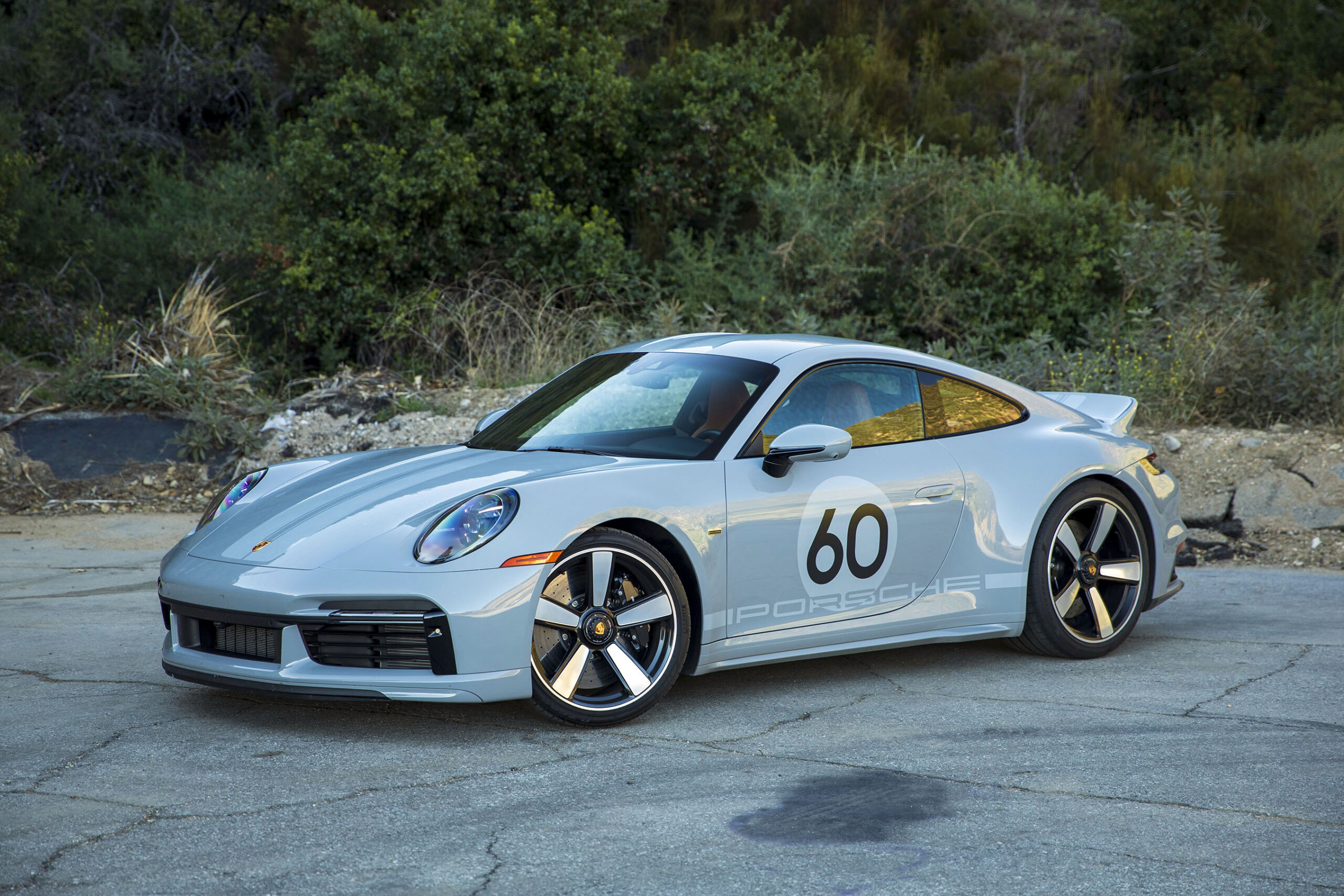
Porsche summons old-school cool with the 2024 911 Sport Classic

A grey Porsche 911 Sport Classic parked in the Angeles National Forest

Enlarge / We never get tired of seeing the different ways Porsche finds to tweak the venerable 911. It’s outdone itself with the Sport Classic, but the car comes with a price tag that means very few will experience it. (credit: Bradley Iger)

Sports cars have always been emotionally driven purchases, and perhaps no automaker understands this better than Porsche. There are more than two dozen iterations of the 911 on sale today, and while it can sometimes feel like sussing out the differences in character between one variant and another is an exercise in splitting hairs, the new Sport Classic tugs at enthusiasts’ heartstrings in a way that no other modern 911 can.

Part of the Heritage Design Edition series, which includes a 911 Targa as well as two more as-yet-unnamed models, the new Sport Classic leverages the formidable capability of the latest 911 Turbo while delivering a genuinely unique driving experience and a distinct sense of style.

While its purposeful stance comes courtesy of the Turbo’s widened body, elements like the bespoke carbon fiber hood, the Carrera GT-inspired carbon “double bubble” roof, and the eye-catching carbon fiber ducktail rear spoiler—the latter of which pays homage to the iconic 911 Carrera RS 2.7 of the early 1970s—help to provide the Sport Classic with a look all its own. The bodywork is also further differentiated from its Turbo sibling thanks to the deletion of the side intakes, a change that necessitated new tooling to stamp the unique panels that run from underneath the front of the doors all the way to the rear bumper. New inlets installed under the ducktail spoiler are on hand to channel air into the engine’s intake system.

Read 11 remaining paragraphs | Comments


Source: Ars Technica – Porsche summons old-school cool with the 2024 911 Sport Classic

Amazon's Q Has 'Severe Hallucinations' and Leaks Confidential Data in Public Preview, Employees Warn

Three days after Amazon announced its AI chatbot Q, some employees are sounding alarms about accuracy and privacy issues. From a report: Q is “experiencing severe hallucinations and leaking confidential data,” including the location of AWS data centers, internal discount programs, and unreleased features, according to leaked documents obtained by Platformer. An employee marked the incident as “sev 2,” meaning an incident bad enough to warrant paging engineers at night and make them work through the weekend to fix it.

[…] In a statement, Amazon played down the significance of the employee discussions. “Some employees are sharing feedback through internal channels and ticketing systems, which is standard practice at Amazon,” a spokesperson said. “No security issue was identified as a result of that feedback. We appreciate all of the feedback we’ve already received and will continue to tune Q as it transitions from being a product in preview to being generally available.”

Read more of this story at Slashdot.


Source: Slashdot – Amazon’s Q Has ‘Severe Hallucinations’ and Leaks Confidential Data in Public Preview, Employees Warn

Why the Entire AI World Was Talking About "Q" This Week

In the aftermath of last week’s shocking OpenAI power struggle, there was one final revelation that acted as a kind of epilogue to the sprawling mess: a report from Reuters that revealed a supposedly startling breakthrough at the startup. That breakthrough allegedly happened via a little known program dubbed “Q-Star”…

Read more…


Source: Gizmodo – Why the Entire AI World Was Talking About “Q” This Week

Roar of cicadas was so loud, it was picked up by fiber-optic cables

Read 11 remaining paragraphs | Comments


Source: Ars Technica – Roar of cicadas was so loud, it was picked up by fiber-optic cables

1960s Chatbot ELIZA Beat OpenAI's GPT-3.5 In a Recent Turing Test Study

An anonymous reader quotes a report from Ars Technica: In a preprint research paper titled “Does GPT-4 Pass the Turing Test?”, two researchers from UC San Diego pitted OpenAI’s GPT-4 AI language model against human participants, GPT-3.5, and ELIZA to see which could trick participants into thinking it was human with the greatest success. But along the way, the study, which has not been peer-reviewed, found that human participants correctly identified other humans in only 63 percent of the interactions — and that a 1960s computer program surpassed the AI model that powers the free version of ChatGPT. Even with limitations and caveats, which we’ll cover below, the paper presents a thought-provoking comparison between AI model approaches and raises further questions about using the Turing test to evaluate AI model performance.

In the recent study, listed on arXiv at the end of October, UC San Diego researchers Cameron Jones (a PhD student in Cognitive Science) and Benjamin Bergen (a professor in the university’s Department of Cognitive Science) set up a website called turingtest.live, where they hosted a two-player implementation of the Turing test over the Internet with the goal of seeing how well GPT-4, when prompted different ways, could convince people it was human. Through the site, human interrogators interacted with various “AI witnesses” representing either other humans or AI models that included the aforementioned GPT-4, GPT-3.5, and ELIZA, a rules-based conversational program from the 1960s. “The two participants in human matches were randomly assigned to the interrogator and witness roles,” write the researchers. “Witnesses were instructed to convince the interrogator that they were human. Players matched with AI models were always interrogators.”

The experiment involved 652 participants who completed a total of 1,810 sessions, of which 1,405 games were analyzed after excluding certain scenarios like repeated AI games (leading to the expectation of AI model interactions when other humans weren’t online) or personal acquaintance between participants and witnesses, who were sometimes sitting in the same room. Surprisingly, ELIZA, developed in the mid-1960s by computer scientist Joseph Weizenbaum at MIT, scored relatively well during the study, achieving a success rate of 27 percent. GPT-3.5, depending on the prompt, scored a 14 percent success rate, below ELIZA. GPT-4 achieved a success rate of 41 percent, second only to actual humans. “Ultimately, the study’s authors concluded that GPT-4 does not meet the success criteria of the Turing test, reaching neither a 50 percent success rate (greater than a 50/50 chance) nor surpassing the success rate of human participants,” reports Ars. “The researchers speculate that with the right prompt design, GPT-4 or similar models might eventually pass the Turing test. However, the challenge lies in crafting a prompt that mimics the subtlety of human conversation styles. And like GPT-3.5, GPT-4 has also been conditioned not to present itself as human.”

“It seems very likely that much more effective prompts exist, and therefore that our results underestimate GPT-4’s potential performance at the Turing Test,” the authors write.

Read more of this story at Slashdot.


Source: Slashdot – 1960s Chatbot ELIZA Beat OpenAI’s GPT-3.5 In a Recent Turing Test Study

World's Biggest Experimental Nuclear Fusion Reactor Launched In Japan

The world’s biggest operational experimental nuclear fusion center has been inaugurated in Naka, Japan. The Guardian reports: The goal of the JT-60SA reactor is to investigate the feasibility of fusion as a safe, large-scale and carbon-free source of net energy — with more energy generated than is put into producing it. The six-storey-high machine, in a hangar in Naka, north of Tokyo, comprises a doughnut-shaped “tokamak” vessel set to contain swirling plasma heated up to 200mC (360mF). It is a joint project between the European Union and Japan, and is the forerunner for its big brother in France, the under-construction International Thermonuclear Experimental Reactor (ITER).

Sam Davis, the deputy project leader for the JT-60SA, said the device would “bring us closer to fusion energy.” “It’s the result of a collaboration between more than 500 scientists and engineers and more than 70 companies throughout Europe and Japan,” Davis said at Friday’s inauguration. The EU energy commissioner, Kadri Simson, said the JT-60SA was “the most advanced tokamak in the world,” and called the start of operations “a milestone for fusion history.” “Fusion has the potential to become a key component for energy mix in the second half of this century,” Simson added.

Read more of this story at Slashdot.


Source: Slashdot – World’s Biggest Experimental Nuclear Fusion Reactor Launched In Japan

Pentagon Scientists Discuss Cybernetic 'Super Soldiers'

An anonymous reader quotes a report from Motherboard: On Wednesday, a group of military and military-adjacent scientists gathered at a conference to discuss the possibility of creating a super soldier. They discussed breeding programs, Marvel movies, The Matrix, and the various technologies the Pentagon is researching with the goal of creating a real life super soldier complete with cybernetic implants and thorny ethical issues surrounding bodily autonomy. The talk happened at the The Interservice/Industry Training, Simulation and Education Conference, or I/ITSEC, an annual conference where military leaders come to talk shop and simulation corporations gather to demo new products. It’s the kind of place where execs and generals don virtual reality helmets and talk about the virtues of VR sims. You could even catch members of congress talking about the importance of simulations and war. “Winning the war of cognition by pushing readiness and lethality boundaries,” reads the official poster for the 2019 I/ITSEC.

It was here, in Orlando, Florida, where five illustrious members of the military-industrial complex gathered to discuss super soldiers at the “Black Swan — Dawn of the Super Soldier” panel. Lauren Reinerman-Jones, an analyst from Defense Acquisition University, moderated a panel that included U.S. Army Developmental Command representatives George Matook and Irwin Hudson, research scientist J.J. Walcutt, and Richard McKinley, who works on “non-invasive brain stimulation” for the Air Force. I/TSEC advertised the panel in its program with a picture of the experts next to a posing Master Chief, the genetically enhanced super soldier from the Halo video game franchise. Throughout the conversation, which covered the nuts and bolts of what’s possible now and what’s about to be possible along with various ethical concerns, references to science fiction and fantasy stories were common. Some of the ideas discussed include synthetic blood, pain-numbing stimulants, limb regeneration, and non-invasive brain stimulation. The discussion references the John Scalzi book about a near future where Earth wages war by offering the elderly new youthful bodies in exchange for military service.

They also discuss the ethical and legal concerns surrounding the creation of super soldiers, as well as the societal norms and potential risks. “What risks are we willing to take? There’s all these wonderful things we can do,” Matook said. “We don’t want a fair fight. We really don’t, this is not an honorable thing. We want our guys to be over-matching any possible enemies, right? So why aren’t we giving them pharmaceutical enhancements? Why are we making them run all week when we could just be giving them steroids? There’s all these other things you could do if you change societal norms and ethics. And laws, in some cases.”

The discussion concludes with considerations about the long-term effects, reversibility of enhancements, and the potential ownership of enhanced individuals by the government. “So if you do these kinds of changes to an individual, what do you do when their service is up? What happens? Or are they just literally owned by the government for life,” asks Reinerman-Jones. Hudson replied with a grim joke: “Termination.”

Read more of this story at Slashdot.


Source: Slashdot – Pentagon Scientists Discuss Cybernetic ‘Super Soldiers’

Doctor Who Has Released an Official Recipe for Its Horrifying Curry

When Doctor Who returned to our screens this past weekend in “The Star Beast,” it brought with it all sorts of weird and occasionally fearsome threats, from the mischievous Meep to the insectoid Wrarth Warriors. But perhaps nothing could send you scurrying behind the sofa than one single joke/threat: a fish curry made…

Read more…


Source: Gizmodo – Doctor Who Has Released an Official Recipe for Its Horrifying Curry

Merriam-Webster's Word For 2023 Is 'Authentic'

On Monday, Merriam-Webster announced its word of the year is “authentic — the term for something we’re thinking about, writing about, aspiring to, and judging more than ever.” The Associated Press reports: Authentic cuisine. Authentic voice. Authentic self. Authenticity as artifice. Lookups for the word are routinely heavy on the dictionary company’s site but were boosted to new heights throughout the year, editor at large Peter Sokolowski told The Associated Press in an exclusive interview. “We see in 2023 a kind of crisis of authenticity,” he said ahead of Monday’s announcement of this year’s word. “What we realize is that when we question authenticity, we value it even more.”

Sokolowski and his team don’t delve into the reasons people head for dictionaries and websites in search of specific words. Rather, they chase the data on lookup spikes and world events that correlate. This time around, there was no particularly huge boost at any given time but a constancy to the increased interest in “authentic.” […] “Can we trust whether a student wrote this paper? Can we trust whether a politician made this statement? We don’t always trust what we see anymore,” Sokolowski said. “We sometimes don’t believe our own eyes or our own ears. We are now recognizing that authenticity is a performance itself.”

There’s “not false or imitation: real, actual,” as in an authentic cockney accent. There’s “true to one’s own personality, spirit or character.” There’s “worthy of acceptance or belief as conforming to or based on fact.” There’s “made or done the same way as an original.” And, perhaps the most telling, there’s “conforming to an original so as to reproduce essential features.”

Read more of this story at Slashdot.


Source: Slashdot – Merriam-Webster’s Word For 2023 Is ‘Authentic’

Michigan Installs First Wireless EV Charging Road In US

The first wireless charging public roadway in the United States has been installed in Detroit’s Corktown neighborhood. Electrek reports: Wireless charging provider Electreon provided inductive-charging copper coils that were installed below the road’s surface. The coils will charge EVs equipped with Electreon receivers as they drive over the road. The road’s charging segments transfer electricity wirelessly through a magnetic field, which is then transferred as energy to the vehicle’s battery, charging it. Detroit’s wireless charging roadway is a pilot that will test and aim to perfect the wireless charging technology in a real-world environment. Researchers are using a Ford E-Transit equipped with an Electreon receiver.

The plan is to open it up to the public in the next few years. MDOT and Electreon have entered a five-year commitment to develop and pilot the electric road system on Michigan roads. The pilot is on a quarter-mile stretch on 14th Street between Marantette and Dalzelle Streets in Detroit’s historic Corktown. It runs alongside the Newlab at Michigan Central Building, home to more than 60 tech and mobility startups, where the wireless charging tech will be further tested and developed beginning in early 2024. In 2024, MDOT will begin seeking bids to rebuild part of Michigan Avenue (US-12) and will install additional inductive charging.

Read more of this story at Slashdot.


Source: Slashdot – Michigan Installs First Wireless EV Charging Road In US

Chrome’s next weapon in the War on Ad Blockers: Slower extension updates

The logo for the board game Monopoly, complete with Uncle Pennybags, has been transformed to say Google.

Enlarge / Let’s see, you landed on my “Google Ads” space, and with three houses… that will be $1,400. (credit: Ron Amadeo / Hasbro)

Google’s war on ad blockers is just gearing up, with YouTube doing its best to detect and block ad blockers and Chrome aiming to roll out the ad block-limiting Manifest V3 extension platform in June 2024. A new article from Engadget detailing the “arms race” over ad blocking brings up an interesting point regarding the power that YouTube and Chrome have in this battle: a dramatic update advantage over the ad blockers.

In addition to hamstringing Chrome’s extension platform with no real user-centric justifications, Manifest V3 will also put roadblocks up before extension updates, which will delay an extension developer’s ability to quickly respond to changes. YouTube can instantly switch up its ad delivery system, but once Manifest V3 becomes mandatory, that won’t be true for extension developers. If ad blocking is a cat-and-mouse game of updates and counter-updates, then Google will force the mouse to slow down.

Chrome’s “Manifest V3” makes dramatic changes to the Chrome extension platform. The current platform, Manifest V2, has been around for over ten years and works just fine, but it’s also quite powerful and allows extensions to have full filtering control over the traffic your web browser sees. That’s great for protecting privacy, speeding up the web, and blocking ads, but it also means you can download a browser from the world’s biggest ad company and use it to block ads—and that was only going to last for so long.

Read 10 remaining paragraphs | Comments


Source: Ars Technica – Chrome’s next weapon in the War on Ad Blockers: Slower extension updates

Baldur's Gate 3's New Epilogue Is a Wonderful Goodbye, But Not the End

When Baldur’s Gate 3 released this summer, its ending was one of the rare moments where praise for Larian’s take on the world of Dungeons & Dragons wasn’t united in effusive lauding. Abrupt, a little messy, and lacking in closure to characters players had just spent hundreds of hours with, it was both interesting and…

Read more…


Source: Gizmodo – Baldur’s Gate 3’s New Epilogue Is a Wonderful Goodbye, But Not the End

A bitter pill: Amazon calls on rival SpaceX to launch Internet satellites

Read 16 remaining paragraphs | Comments


Source: Ars Technica – A bitter pill: Amazon calls on rival SpaceX to launch Internet satellites

Meta Will Enforce Ban On AI-Powered Political Ads In Every Nation, No Exceptions

An anonymous reader quotes a report from ZDNet: Meta says its generative artificial intelligence (AI) advertising tools cannot be used to power political campaigns anywhere globally, with access blocked for ads targeting specific services and issues. The social media giant said earlier this month that advertisers will be barred from using generative AI tools in its Ads Manager tool to produce ads for politics, elections, housing, employment, credit, or social issues. Ads related to health, pharmaceuticals, and financial services also are not allowed access to the generative AI features. This policy will apply globally, as Meta continues to test its generative AI ads creation tools, confirmed Dan Neary, Meta’s Asia-Pacific vice president. “This approach will allow us to better understand potential risks and build the right safeguards for the use of generative AI in ads that relate to potentially sensitive topics in regulated industries,” said Neary.

Read more of this story at Slashdot.


Source: Slashdot – Meta Will Enforce Ban On AI-Powered Political Ads In Every Nation, No Exceptions