Southern California Air Board Rejects Pollution Rules After AI-Generated Flood of Comments

Southern California’s air quality board rejected proposed rules to phase out gas-powered appliances after receiving more than 20,000 opposition comments generated through CiviClick, “the first and best AI-powered grassroots advocacy platform.” Phys.org reports: A Southern California-based public affairs consultant, Matt Klink, has taken credit for using CiviClick to wage the opposition campaign, including in a sponsored article on the website Campaigns and Elections. The campaign “left the staff of the Southern California Air Quality Management District (SCAQMD) reeling,” the article says. It is not clear how AI was deployed in the campaign, and officials at CiviClick did not respond to repeated requests for comment. But their website boasts several tools, including “state of the art technology and artificial intelligence message assistance” that can be used to create custom advocacy letters, as opposed to repetitive form letters or petitions often used in similar campaigns.

When staffers at the air district reached out to a small sample of people to verify their comments, at least three said they had not written to the agency and were not aware of any such messages, records show. But the email onslaught almost certainly influenced the board’s June decision, according to agency insiders, who noted that the number of public comments typically submitted on agenda items can be counted on one hand.

The proposed rules were nearly two years in the making and would have placed a fee on natural gas-powered water heaters and furnaces, favoring electric ones, in an effort to reduce air pollution in the district, which includes Orange County and large swaths of Los Angeles, Riverside and San Bernardino counties. Gas appliances emit nitrogen oxides, or NOx — key pollutants for forming smog. The implications are troubling, experts said, and go beyond the use of natural gas furnaces and heaters in the second-largest metropolitan area in the country.


Read more of this story at Slashdot.

OpenAI strikes a deal with the Defense Department to deploy its AI models

OpenAI has reached an agreement with the Defense Department to deploy its models in the agency’s network, company chief Sam Altman has revealed on X. In his post, he said two of OpenAI’s most important safety principles are “prohibitions on domestic mass surveillance and human responsibility for the use of force, including for autonomous weapon systems.” Altman claimed the company put those principles in its agreement with the agency, which he called by the government’s preferred name of Department of War (DoW), and that it had agreed to honor them.

The agency has closed the deal with OpenAI, shortly after President Donald Trump ordered all government agencies to stop using Claude and any other Anthropic services. If you’ll recall, the government US Defense Secretary Pete Hegseth previously threatened to label Anthropic “supply chain risk” if it continues refusing to remove the guardrails on its AI, which are preventing the technology to be used for mass surveillance against Americans and in fully autonomous weapons. It’s unclear why the government agreed to team up with OpenAI if its models also have the same guardrails, but Altman said it’s asking the government to offer the same terms to all the AI companies it works with.

Anthropic, which started working with the US government in 2024, refused to bow down to Hegseth. In its latest statement, published just hours before Altman announced OpenAI’s deal, it repeated its stance. “No amount of intimidation or punishment from the Department of War will change our position on mass domestic surveillance or fully autonomous weapons,” Anthropic wrote. “We will challenge any supply chain risk designation in court.”

Altman added in his post on X that OpenAI will build technical safeguards to ensure the company’s models behave as they should, claiming that’s also what the DoW wanted. It’s sending engineers to work with the agency to “ensure [its models’] safety,” and it will only deploy on cloud networks. As The New York Times notes, OpenAI is not yet on Amazon cloud, which the government uses. But that could change soon, as company has also just announced forming a partnership with Amazon to run its models on Amazon Web Services (AWS) for enterprise customers.

Tonight, we reached an agreement with the Department of War to deploy our models in their classified network.

In all of our interactions, the DoW displayed a deep respect for safety and a desire to partner to achieve the best possible outcome.

AI safety and wide distribution of…

— Sam Altman (@sama) February 28, 2026

This article originally appeared on Engadget at https://www.engadget.com/ai/openai-strikes-a-deal-with-the-defense-department-to-deploy-its-ai-models-054441785.html?src=rss

OpenAI Fires an Employee For Prediction Market Insider Trading

An anonymous reader quotes a report from Wired: OpenAI has fired an employee following an investigation into their activity on prediction market platforms including Polymarket, WIRED has learned. OpenAI CEO of Applications, Fidji Simo, disclosed the termination in an internal message to employees earlier this year. The employee, she said, “used confidential OpenAI information in connection with external prediction markets (e.g. Polymarket).” “Our policies prohibit employees from using confidential OpenAI information for personal gain, including in prediction markets,” says spokesperson Kayla Wood. OpenAI has not revealed the name of the employee or the specifics of their trades.

Evidence suggests that this was not an isolated event. Polymarket runs on the Polygon blockchain network, so its trading ledger is pseudonymous but traceable. According to an analysis by the financial data platform Unusual Whales, there have been clusters of activities, which the service flagged as suspicious, around OpenAI-themed events since March 2023. Unusual Whales flagged 77 positions in 60 wallet addresses as suspected insider trades, looking at the age of the account, trading history, and significance of investment, among other factors. Suspicious trades hinged on the release dates of products like Sora, GPT-5, and the ChatGPT Browser, as well as CEO Sam Altman’s employment status. In November 2023, two days after Altman was dramatically ousted from the company, a new wallet placed a significant bet that he would return, netting over $16,000 in profits. The account never placed another bet.

The behavior fits into patterns typical of insider trades. “The tell is the clustering. In the 40 hours before OpenAI launched its browser, 13 brand-new wallets with zero trading history appeared on the site for the first time to collectively bet $309,486 on the right outcome,” says Unusual Whales CEO Matt Saincome. “When you see that many fresh wallets making the same bet at the same time, it raises a real question about whether the secret is getting out.” […] Though this is the first confirmed case of a large technology company firing an employee over trades in prediction markets, it’s almost certainly not the last. Opportunities for tech sector employees to make trades on markets abound. “The data tells me this is happening all over the place,” Saincome says.


Read more of this story at Slashdot.

Human Brain Cells On a Chip Learned To Play Doom In a Week

Researchers at Cortical Labs used living human neurons grown on a chip to learn how to play Doom in about a week. “While its performance is not up to par with humans, experts say it brings biological computers a step closer to useful real-world applications, like controlling robot arms,” reports New Scientist. From the report: In 2021, the Australian company Cortical Labs used its neuron-powered computer chips to play Pong. The chips consisted of clumps of more than 800,000 living brain cells grown on top of microelectrode arrays that can both send and receive electrical signals. Researchers had to carefully train the chips to control the paddles on either side of the screen. Now, Cortical Labs has developed an interface that makes it easier to program these chips using the popular programming language Python. An independent developer, Sean Cole, then used Python to teach the chips to play Doom, which he did in around a week.

“Unlike the Pong work that we did a few years ago, which represented years of painstaking scientific effort, this demonstration has been done in a matter of days by someone who previously had relatively little expertise working directly with biology,” says Brett Kagan of Cortical Labs. “It’s this accessibility and this flexibility that makes it truly exciting.”

The neuronal computer chip, which used about a quarter as many neurons as the Pong demonstration, played Doom better than a randomly firing player, but far below the performance of the best human players. However, it learnt much faster than traditional, silicon-based machine learning systems and should be able to improve its performance with newer learning algorithms, says Kagan. However, it’s not useful to compare the chips with human brains, he says. “Yes, it’s alive, and yes, it’s biological, but really what it is being used as is a material that can process information in very special ways that we can’t recreate in silicon.” Cortical Labs posted a YouTube video showing its CL1 biological computer running Doom. There’s also source code available on GitHub, with additional details in a README file.


Read more of this story at Slashdot.

Google quantum-proofs HTTPS by squeezing 2.5kB of data into 64-byte space

Google on Friday unveiled its plan for its Chrome browser to secure HTTPS certificates against quantum computer attacks without breaking the Internet.

The objective is a tall order. The quantum-resistant cryptographic data needed to transparently publish TLS certificates is roughly 40 times bigger than the classical cryptographic material used today. Today’s X.509 certificates are about 64 bytes in size, and comprise six elliptic curve signatures and two EC public keys. This material can be cracked through the quantum-enabled Shor’s algorithm. Certificates containing the equivalent quantum-resistant cryptographic material are roughly 2.5 kilobytes. All this data must be transmitted when a browser connects to a site.

The bigger they come, the slower they move

“The bigger you make the certificate, the slower the handshake and the more people you leave behind,” said Bas Westerbaan, principal research engineer at Cloudflare, which is partnering with Google on the transition. “Our problem is we don’t want to leave people behind in this transition.” Speaking to Ars, he said that people will likely disable the new encryption if it slows their browsing. He added that the massive size increase can also degrade “middle boxes,” which sit between browsers and the final site.

Read full article

Comments

Perplexity Announces ‘Computer,’ an AI Agent That Assigns Work To Other AI Agent

joshuark shares a report from Ars Technica: Perplexity has introduced “Computer,” a new tool that allows users to assign tasks and see them carried out by a system that coordinates multiple agents running various models. The company claims that Computer, currently available to Perplexity Max subscribers, is “a system that creates and executes entire workflows” and “capable of running for hours or even months.”

The idea is that the user describes a specific outcome — something like “plan and execute a local digital marketing campaign for my restaurant” or “build me an Android app that helps me do a specific kind of research for my job.” Computer then ideates subtasks and assigns them to multiple agents as needed, running the models Perplexity deems best for those tasks. The core reasoning engine currently runs Anthropic’s Claude Opus 4.6, while Gemini is used for deep research, Nano Banana for image generation, Veo 3.1 for video production, Grok for lightweight tasks where speed is a consideration, and ChatGPT 5.2 for “long-context recall and wide search.”

This kind of best-model-for-the-task approach differs from some competing products like Claude Cowork, which only uses Anthropic’s models. All this happens in the cloud, with prebuilt integrations. “Every task runs in an isolated compute environment with access to a real filesystem, a real browser, and real tool integrations,” Perplexity says. The idea is partly that this workflow was what some power users were already doing, and this aims to make that possible for a wider range of people who don’t want to deal with all that setup.

People were already using multiple models and tailoring them to specific tasks based on perceived capabilities, while, for example, using MCP (Model Context Protocol) to give those models access to data and applications on their local machines. Perplexity Computer takes a different approach, but the goal is the same: have AI agents running tailor-picked models to perform tasks involving your own files, services, and applications. Then there is OpenClaw, which you could perceive as the immediate predecessor to this concept.


Read more of this story at Slashdot.

South Korea Set To Get a Fully Functioning Google Maps

South Korea has reversed a two-decade policy and approved the export of high-precision map data, paving the way for a fully functional Google Maps in the country. Reuters reports: The approval was made “on the condition that strict security requirements are met,” the Ministry of Land, Infrastructure and Transport said in a statement. Those conditions include blurring military and other sensitive security-related facilities, as well as restricting longitude and latitude coordinates for South Korean territory on products such as Google Maps and Google Earth, it said.

The decision is expected to hurt Naver and Kakao — local internet giants which currently dominate the country’s market for digital map services. But it will appease Washington, which has urged Seoul to tackle what it says is discrimination against U.S. tech companies. South Korea, still technically at war with North Korea, had shot down Google’s previous bids in 2007 and 2016 to be allowed to export the data, citing the risks that information about sensitive military and security facilities could be exposed. “Google can now come in, slash usage fees, and take the market,” said Choi Jin-mu, a geography professor at Kyung Hee University. “If Naver and Kakao are weakened or pushed out and Google later raises prices, that becomes a monopoly. Then, even companies that rely on map services — logistics firms, for example — become dependent, and in the long run, even government GIS (geographic information) systems could end up dependent on Google or Apple. That’s the biggest concern.”


Read more of this story at Slashdot.

Riding An Omnidirectional Motorball

You may recall (although I won’t fault you if you don’t) engineer James Bruton previously building an omnidirectional motorbike on two balls. But do you know what’s better than two balls? “Three balls?” Agreed, but James decided to go the less is more route anyways and made an omnidirectional motorball that balances on a single ball. To each their own. Now make one that balances on no balls at all and we’ve finally got hover technology.

FCC approves the merger of cable giants Cox and Charter

The Federal Communications Commission has given the go ahead for two of the US’ biggest cable providers, Charter Communications and Cox Communications, to merge. Charter announced its intention to acquire Cox for $34.5 billion in May 2025, with specific plans to inherit Cox’s managed IT, commercial fiber and cloud businesses, while folding the company’s residential cable service into a subsidiary.

“By approving this deal, the FCC ensures big wins for Americans,” FCC Chairman Brendan Carr said in a statement. “This deal means that jobs are coming back to America that had been shipped overseas. It means that modern, high-speed networks will get built out in more communities across rural America. And it means that customers will get access to lower priced plans. On top of this, the deal enshrines protections against DEI discrimination.”

The FCC claims that Charter plans to invest “billions” to upgrade its network following the closure of the deal, leading to “faster broadband and lower prices.” The company’s “Rural Construction Initiative” will also extend those improvements to rural states lacking in consistent internet service, a project the FCC was heavily invested in during the Biden administration, but has been pulling back from since President Donald Trump appointed Carr. The FCC also claims Charter will onshore jobs currently handled off-shore by Cox employees and commit to “new safeguards to protect against DEI discrimination,” which essentially amounts to hiring, recruiting and promoting employees based on “skills, qualifications, and experience.”

While Carr’s FCC paints a rosy picture of Charter’s acquisition, history has provided multiple examples of mergers having the opposite effect on jobs and pricing. For example, redundancies created when T-Mobile merged with Sprint in 2020 led to a wave of layoffs at the carrier. And funnily enough in 2018, not long after Charter’s merger with Time Warner Cable was approved by the FCC, the company raised prices on its Spectrum service by over $91 a year. 

The FCC’s obsession with diversity, equity and inclusion as part of the deal is stranger, if only because it appears to fall outside of the commission’s purpose of maintaining fair competition in the telecommunications industry. It does fit with other mergers the FCC has approved under Carr, however. Skydance’s acquisition of Paramount was approved in 2025 under the condition it wouldn’t establish any DEI programs.

This article originally appeared on Engadget at https://www.engadget.com/big-tech/fcc-approves-the-merger-of-cable-giants-cox-and-charter-230258865.html?src=rss

Trump Orders Federal Agencies To Stop Using Anthropic AI Tech ‘Immediately’

President Donald Trump has ordered all U.S. federal agencies to “immediately cease” using Anthropic’s AI technology, escalating a standoff after the company sought limits on Pentagon use of its models. CNBC reports: The company, which in July signed a $200 million contract with Pentagon, wants assurances that the Defense Department will not use its AI models will not be used for fully autonomous weapons or mass domestic surveillance of Americans. The Pentagon had set a deadline of 5:01 p.m. ET Friday for Anthropic to agree to its demands to allow the Pentagon to use the technology for all lawful purposes. If Anthropic did not meet that deadline, Pete Hegseth threatened to label the company a “supply chain risk” or force it to comply by invoking the Defense Production Act.

“The Leftwing nut jobs at Anthropic have made a DISASTROUS MISTAKE trying to STRONG-ARM the Department of War, and force them to obey their Terms of Service instead of our Constitution,” Trump said in a post on Truth Social. “Their selfishness is putting AMERICAN LIVES at risk, our Troops in danger, and our National Security in JEOPARDY.”

“Therefore, I am directing EVERY Federal Agency in the United States Government to IMMEDIATELY CEASE all use of Anthropic’s technology,” Trump wrote. “We don’t need it, we don’t want it, and will not do business with them again! There will be a Six Month phase out period for Agencies like the Department of War who are using Anthropic’s products, at various levels,” Trump said. On Friday, OpenAI said it would also draw the same red lines as Anthropic: no AI for mass surveillance or autonomous lethal weapons.


Read more of this story at Slashdot.

Under a Paramount-WBD merger, two struggling media giants would unite

Netflix has dropped out of the bidding war for Warner Bros. Discovery (WBD), making Paramount Skydance the expected owner of WBD. A Paramount-WBD merger remains subject to regulatory approval, but it’s likely that we will see a Paramount-Skydance-Warner-Bros.-Discovery media giant.

Such a conglomerate would unite two legacy media companies that have struggled with profitability for years and have strongly invested in streaming and cable.

With Paramount inching closer to WBD ownership, let’s look at what the union implies for streaming and cable.

Read full article

Comments

10 Hacks Every Oura Ring User Should Know

We may earn a commission from links on this page.

I’ve been tracking my sleep and recovery with the Oura ring for nearly five years now, and today I’ll share with you several of my favorite and most-overlooked features—including one feature you should turn off, and one feature you can use even if your subscription is expired. 

Turn off blood oxygen sensing to save battery

The Oura ring uses significantly more battery with blood oxygen sensing turned on. It may make sense to use this feature if you have a specific health concern, but most of us don’t need it on a daily basis. 

You’ll find Blood Oxygen Sensing under the hamburger menu, and can turn it off from there. You’ll lose the “average blood oxygen” and “breathing regularity” metrics, but you’ll gain an extra day or so of battery life. 

Sync workouts so you don’t have to log them all with your ring

I’ve said it before and I’ll say it again: the Oura ring is not a great workout tracker. Wearing the ring interferes with weightlifting workouts and it doesn’t have enough precision to seriously track other workouts like running. 

Oura is a great companion to other workout apps, though. If you track workouts with another device or even with a phone app like Apple’s Fitness app, you can make sure those workouts get synced properly so they show up in your Oura timeline. Go to Settings, and then to Apple Health (iPhone) or Health Connect (Android). Turn on those integrations from there. 

Tag auto-detected workouts (and laugh, if appropriate)

Aside from synced workouts, Oura will automatically detect workouts it thinks you’re doing. You’ll then see a card asking you to label the workout. Don’t just ignore those cards—Oura learns from your tags. 

So if you went for a walk, make sure that activity is tagged as a walk. But sometimes it will tag another activity as a workout when it actually wasn’t. I’ve seen hair brushing and yarn winding tagged as various forms of exercise. Take a look at the time the activity was logged, and think back to what you were actually doing at the time. (You can dismiss the activity if it wasn’t a workout or isn’t something you care to track.) 

Consider the charging case

The Oura ring only needs to be charged once or twice a week, but that means it’s hard to get into a routine of charging it regularly. I found that the perfect balance was charging it while I’m at the gym; some people prefer to charge while they’re in the shower. 

Short top-ups every few days are ideal for battery health. (Daily charging is arguably too much; only charging when the battery is dead is probably too little.) Oura recommends keeping the battery between 25% and 80% most of the time, if you can. 

So figure out where and when is most convenient to charge, and keep a charger there. That’s why the charging case is convenient—you can carry it in your gym bag, for example. Unfortunately it costs an extra $99 to buy the charging case, but nobody ever said owning an Oura ring is cheap. 

Check the ring’s tags and trends

The Trends item in the hamburger menu is one of Oura’s best hidden features. Tap it and you’ll be able to see things that have changed over the past several weeks. For example, as I’m writing this, I can see that my resting heart rate has improved over the past 8 weeks, getting back to my “baseline” after some time in which it was higher than normal.

If you’ve been diligent about tagging behaviors and lifestyle factors, you can see their effects on your readiness, sleep, activity, or stress. For example, I’m curious whether my mood is better when I take a vitamin D supplement in the winter. Mood isn’t one of the items that Oura tracks, but I can tap Trends and then choose from Stress or Sleep or even Activity (all things that suffer when I’m feeling down) and see whether the days I tagged “vitamins” tend to correlate with higher or lower levels. 

Log meals without tracking calories

Meal tracking was introduced as a companion to glucose tracking, but you don’t need to track your glucose to use the meals feature. Log your meals (you can even snap a picture of your plate) and Oura will give you feedback on how healthy the meal is, and keep track of whether you’re eating on a regular schedule or not. Calorie tracking is not involved. In fact, if you’d rather keep calories out of your Oura app entirely, check out the next item. 

Adjust your activity goal

Oura will give you an activity goal each day, usually a certain number of calories. If you feel your goals are too ambitious (or not ambitious enough), go to the Activity screen and select Edit activity goal. You can choose a different goal, and you can also choose whether you’d like to see this goal in calories or in steps. 

If you want to avoid seeing calories anywhere in the app, there’s a toggle for that. On the same screen, select Calorie opt out. This sets your target to steps and ensures that calorie mentions anywhere else in the app will be hidden. You can also access the calorie opt out from Settings and then Activity. 

Use Rest Mode for travel, menstrual cycles, and more

Oura has a Rest Mode setting that is intended for when you’re sick or recovering from an injury. (Oura may even prompt you to turn it on if your data indicates you may not be feeling well.) 

But it’s useful for more than just that. Rest Mode pauses your goals, and stops giving you readiness scores. It’s great for any time you don’t want the app to bother you about what you should be doing. I’ve seen Oura users say they use it for days of their menstrual cycle when they aren’t feeling up to their usual activity; it’s also useful for travel when you know you’ll be stuck in a car or airplane all day, or when your sleep will suffer due to jet lag. 

Use Labs to participate in studies (and get a sneak peek at new features)

If you like to beta test new features, check out the Labs item in the hamburger menu. The offerings will change from time to time, but often they are new features in the making. Right now, the only offering I see is a blood pressure profile study, in which Oura is collecting data to hopefully offer blood pressure estimates in the app in the future. 

When I signed up for this, I had to fill out a questionnaire and sign a research consent. (Not all Oura Labs items are studies, but they can be.) I can see that Oura thinks I probably don’t have hypertension (correct) and that it’s basing that in part on my good resting heart rate and activity level. Other Oura features like meal tracking and Symptom Radar first made their appearances in Labs. 

Download your data from the cloud

This is one of Oura’s lesser-known features: a web dashboard where you can view long-term trends, and a “membership hub” where you can download all your data. This spreadsheet download is available even if you don’t have an active subscription, but you do need a subscription for the trend viewer and for all of the software features I mentioned above. 

For the web viewer, go to cloud.ouraring.com. Here, if you click on Trends, you can see all your data—five years’ worth, for me. You can even compare two variables and see a calculation that shows if they’re correlated. My sleep score and total sleep time are highly correlated; my HRV and sleep time are not. 

To download CSV spreadsheets of your data (with or without a subscription), go to the membership hub and sign in. Select Export data and then Request your data. You’ll get a zip file filled with spreadsheets you can analyze to your heart’s content.

Trump orders federal agencies to drop Anthropic services amid Pentagon feud

President Donald Trump has ordered all US government agencies to stop using Claude and other Anthropic services, escalating an already volatile feud between the Department of Defense and company over AI safeguards. Taking to Truth Social on Friday afternoon, the president said there would be a six-month phase out period for federal agencies, including the Defense Department, to migrate off of Anthropic’s products. 

“The Leftwing nut jobs at Anthropic have made a DISASTROUS MISTAKE trying to STRONG-ARM the Department of War, and force them to obey their Terms of Service instead of our Constitution,” the president wrote. “Anthropic better get their act together, and be helpful during this phase out period, or I will use the Full Power of the Presidency to make them comply, with major civil and criminal consequences to follow.”  

Before today, US Defense Secretary Pete Hegseth had threatened to label Anthropic a “supply chain risk” if it did not agree to withdraw safeguards that insist Claude not be used for mass surveillance against Americans or in fully autonomous weapons. 

Anthropic did not immediately respond to Engadget’s comment request. Earlier in the day, a spokesperson for the company said the contract Anthropic received after CEO Dario Amodei outlined Anthropic’s position made “virtually no progress” on preventing the outlined misuses.

“New language framed as a compromise was paired with legalese that would allow those safeguards to be disregarded at will. Despite DOW’s recent public statements, these narrow safeguards have been the crux of our negotiations for months,” the spokesperson said. “We remain ready to continue talks and committed to operational continuity for the Department and America’s warfighters.” 

Advocacy groups like the Center for Democracy and Technology (CDT) quickly came out against the president’s threats. “This action sets a dangerous precedent. It chills private companies’ ability to engage frankly with the government about appropriate uses of their technology, which is especially important in national security settings that so often have reduced public visibility,” said CDT President and CEO Alexandra Givens, in a statement shared with Engadget. “These threats undermine the integrity of the innovation ecosystem, distort market incentives and normalize an expansive view of executive power that should worry Americans all across the political spectrum.”

For now, it appears the AI industry is united behind Anthropic. On Friday, hundreds of Google and OpenAI employees signed an open letter urging their companies to stand in “solidarity” with the lab. According to an internal memo seen by Axios, OpenAI CEO Sam Altman said the ChatGPT maker would draw the same red line as Anthropic.  

This article originally appeared on Engadget at https://www.engadget.com/ai/trump-orders-federal-agencies-to-drop-anthropic-services-amid-pentagon-feud-222029306.html?src=rss

US Military Accidentally Shoots Down Border Protection Drone With Laser

An anonymous reader quotes a report from the Associated Press: The U.S. military used a laser Thursday to shoot down a “seemingly threatening” drone flying near the U.S.-Mexico border. It turned out the drone belonged to Customs and Border Protection, lawmakers said. The case of mistaken identity prompted the Federal Aviation Administration to close additional airspace around Fort Hancock, about 50 miles (80 kilometers) southeast of El Paso. The military is required to formally notify the FAA when it takes any counter-drone action inside U.S. airspace.

It was the second time in two weeks that a laser was fired in the area. The last time it was CBP that used the weapon and nothing was hit. That incident occurred near Fort Bliss and prompted the FAA to shut down air traffic at El Paso airport and the surrounding area. This time, the closure was smaller and commercial flights were not affected. The FAA, CBP and the Pentagon confirmed the incident in a joint statement, saying the military “employed counter-unmanned aircraft system authorities to mitigate a seemingly threatening unmanned aerial system operating within military airspace.”

“At President Trump’s direction, the Department of War, FAA, and Customs and Border Patrol are working together in an unprecedented fashion to mitigate drone threats by Mexican cartels and foreign terrorist organizations at the U.S.-Mexico Border,” the statement said. The report notes that 27,000 drones were detected within 1,600 feet of the southern border in the last six months of 2024.

Illinois Democratic U.S. Sen. Tammy Duckworth, the ranking member on the Senate’s Aviation Subcommittee, is calling for an independent investigation to look into the matter. “The Trump administration’s incompetence continues to cause chaos in our skies,” Duckworth said.


Read more of this story at Slashdot.

How to Manage Your Increasingly Desperate App Notifications

My best friend messaged me on Facebook Messenger. It wasn’t urgent, so I swiped the notification away, making a mental note to reply later. Ten minutes later, Facebook sends another notification. “Reminder: [My friend] sent you a message.” This is clingy, even for Facebook. And it’s not the only app increasingly desperate for any crumb of attention.

In just the last couple months, I’ve personally gotten dozens of what I can only call desperation notifications. Push alerts from apps that don’t really need anything, but would really like it if I gave them some attention anyway. These include, but are not nearly limited to, the following:

  • The Disney+ app let me know that because I watched The Simpsons, I might be interested in watching The Simpsons Movie (which I also recently watched).

  • Discord informed me that someone in a server I’m also in updated their status, which is, I guess, a thing you can do in Discord.

  • Venmo would like me to know I can fund my Kalshi account with my Venmo balance. (I do not and will never have a Kalshi account.)

  • Reddit began sending push alerts for news stories from communities I wasn’t subscribed to and had never visited.

  • Duet sent an aggressive half-dozen notifications within 15 minutes of closing the app, including multiple alerts that read “She just likes you.” Which is a surprisingly exasperated tone for a dating app.

  • GrubHub asked me if I wanted to order food, precisely five minutes after I ordered food.

Some of these are obviously just advertisements disguised as alerts—its own annoying problem—but just as many seem to be little more than a reminder that an app exists. And if you could please open the app and boost its engagement numbers, that would be great.

Are app notifications really getting worse?

Disney+ notification that reads "Because you watched The Simpsons, we think you'll enjoy The Simpsons Movie."
Wow, I hadn’t thought of that, thanks Disney+.
Credit: Lifehacker

While it’s always hard to quantify vibes-based annoyances, there’s at least some data to back up the idea that companies are getting increasingly desperate for your notification attention. According to a 2025 analysis from the Reuters Institute for the Study of Journalism, news publishers have increasingly relied on push notifications to reach their audiences, as a way to avoid relying too much on platforms like Google or social media apps.

However, this bid for direct attention comes at a cost—and in the midst of an arms race with platforms. According to the Reuters report, 79% of respondents don’t get any news alerts at all, and 43% of those are because users actively disabled the notifications. Worse yet, iOS and Android have both experimented with questionably reliable AI summaries of notifications, making them even more annoying to deal with.

This report only examines one small segment of the notifications you might sift through on any given day, but it’s instructive of a broader trend. We increasingly live in an attention economy, where seemingly unrelated industries are in competition for your eyeballs. Which is how you end up with companies like Netflix investing in video games, or the video game industry competing with gambling sites and porn.

In that context, your notifications become the frontline in the battle for your attention. No, it doesn’t take a genius to know that someone who watched The Simpsons might be interested in watching The Simpsons. But if a quick notification can remind me to watch more of the show today, rather than play more Pathologic 3, that’s a win for Disney.

And any win is going to be worth it to most companies right now. Broadly speaking, the economy isn’t doing so hot. So, if a company can do something to show that engagement in their app went up by even 5%, they likely will. And sending more notifications is generally one of the cheaper and easier ways to juice internal numbers.

How to decrease app notification spam

Android notification with settings to sort incoming alerts.

Credit: Lifehacker

There’s at least one silver lining to the whole notification arms race problem: There are a lot of tools available to help get your alerts under control. Some are baked right into your phone’s OS, but there are also third-party tools you can use to enforce some peace and quiet. Here are some of the best options available.

Use your phone’s OS-level settings to manage notifications

Both major smartphone platforms have pretty robust tools to dictate what kind of alerts you can receive, and how disruptive they can be. We have full guides on tools for managing your Android and iOS notifications, but even if you don’t want to dive too deep into your phone’s settings, you can slowly whittle away the most annoying alerts as you receive them.

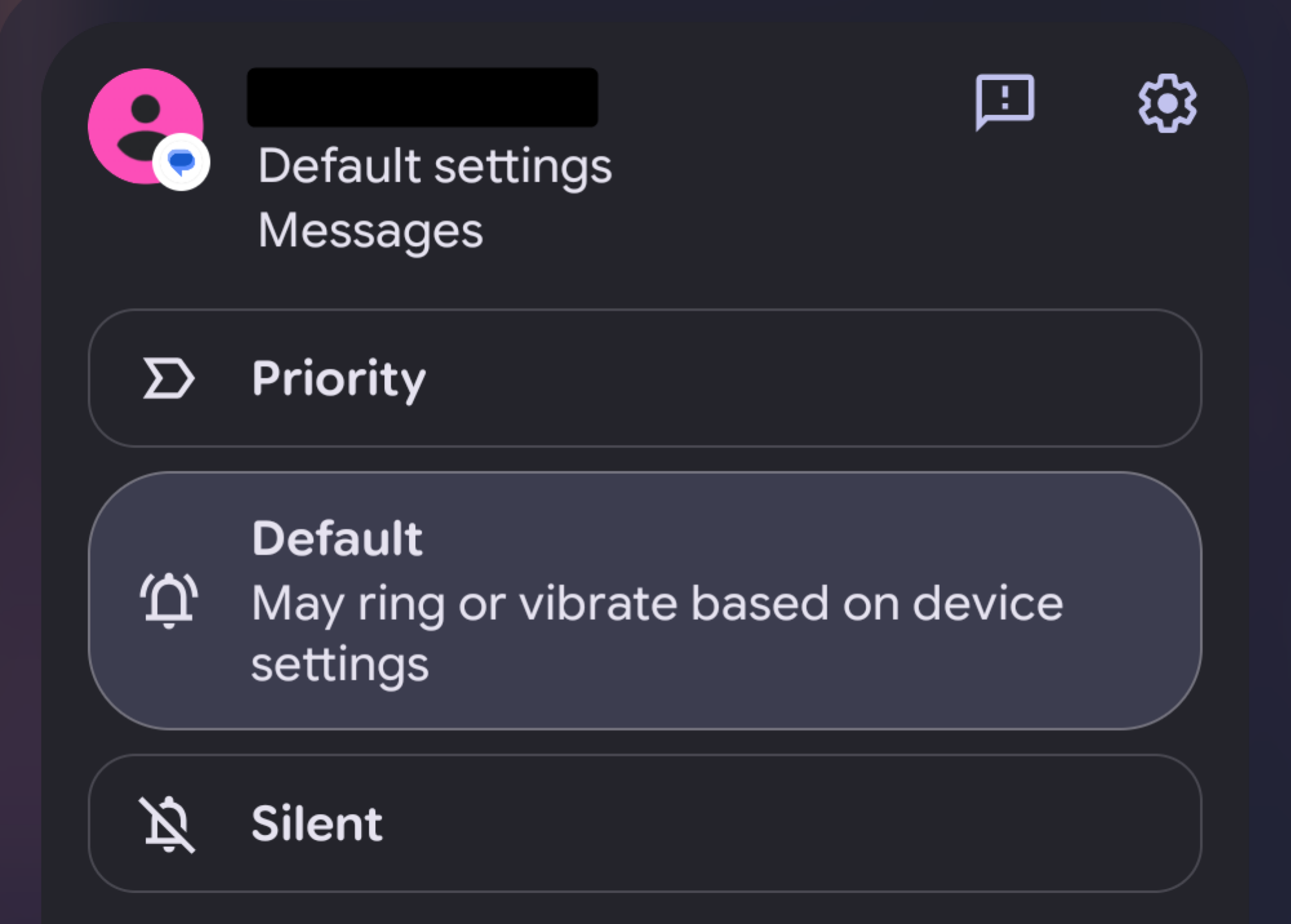
On Android, you can long-press a notification in your shade to find options to tweak or suppress the alerts. Most notifications can be sorted into either Priority, Default, or Silent, which behave differently depending on your default settings. You can also tap the Settings gear icon to dive into the app’s specific notification settings to disable categories of alerts. These will vary by app, but in many cases you can disable things like advertisements or news alerts without turning off messages you actually care about.

On iOS, you can find similar tools by swiping on a notification and tapping Options. Here, you’ll find quick shortcuts to do things like mute notifications from an app for a short period of time, or jump to more in-depth settings to disable categories of notifications. In my experience, it’s often easier to tweak these settings whenever I receive a particularly annoying alert, rather than audit all my notification settings at once.

Explore each app’s notification settings

Most apps have their own category of notification settings that can be adjusted individually. In some cases, these can overlap with the same settings you’ll find using the above method, but just as often, you’ll find a lot more toggles that don’t. Though, some apps are shadier than others in terms of how easy it is to find these settings.

For one instructive example, in the Reddit app, you can navigate to Settings > Account Settings > Manage notifications to find a lengthy list of possible alerts you can receive. That’s already pretty buried, but if you sign into the app with multiple accounts, you’ll need to go through this process for each account you’re signed into. Otherwise, notifications you turned off for one account might still pop up via another.

Most apps aren’t quite this chaotic, but it can still be annoying to dig through all the tedious menus. In some cases, this might be your only option, though. On Android, Reddit only has one notification category using the previous method, meaning you can only turn all notifications on or off at once. So, if you’re not finding the tools you need to selectively mute certain alerts in the OS-level settings, it might be worth digging through the app’s menus.

When all else fails, use third-party tools

It shouldn’t really be necessary to install an app just to get other apps to shut up, but if we must, then we must. BuzzKill, for Android, is a simple $4 app that gives you more robust tools to filter, manage, or suppress notifications than any of the built-in notification management settings.

What sets BuzzKill apart is that, on top of filtering notifications by which app is sending them, it can also filter alerts by things like words they contain, whether they have an image attached, or whether they’re part of a group chat. So, if you want to keep getting news alerts, but you’re just sick of hearing about that one guy who’s always in the headlines for some reason, you can selectively filter those out.

Unfortunately, this one’s likely to stay Android only, as iOS generally keeps apps in tighter sandboxes. BuzzKill needs to be able to read notifications from other apps in order to filter them, and that’s not something iOS generally allows apps to do. So, if you’re in the Apple ecosystem, you’ll have to stick with built-in tools for now.

More broadly, it also can’t hurt to let app developers know when you’re annoyed by their incessant pings. Companies might try to boost their engagement by testing how much they can poke your attention span before you turn them off (or uninstall the app) entirely. But turning off unnecessary alerts can send a signal that they’ve gone too far in the wrong direction. Sending feedback reports, where possible, can potentially send an even stronger signal.

Paramount agrees to buy Warner Bros. Discovery, pays Netflix $2.8 billion for breakup

Paramount Skydance and Warner Bros. Discovery are officially merging. The studio paid Netflix the $2.8 billion termination fee it was owed for breaking its original deal to buy Warner Bros. earlier today, and the historic film studio has now formally accepted Paramount’s offer.

Along with the deal, which values Warner Bros. Discovery at $31 per share, Paramount is making several commitments to assuage the fears of regulators and the entertainment community. Those include a guarantee that the new company will produce 30 theatrical films annually, that theatrical releases will have a minimum 45-day window in theaters before they’re brought to video on demand (something Netflix ultimately also agreed to) and that deal itself will close by Q3 2026.

This turnaround in Paramount’s fortunes has happened quickly. Warner Bros. Discovery announced that Paramount’s offer was superior to Netflix’s on Thursday, and not long after the streaming service said that it wouldn’t provide a counter offer, effectively abandoning its previous agreement.

Ultimately, Netflix and Paramount were vying for different parts of Warner Bros. Disocvery. Netflix was primarily interested in Warner Bros. proper, while Paramount Skydance wanted the whole company, cable networks and all. Either deal would need to be approved by regulators, which is the hurdle Paramount and Warner Bros. Discovery face now. The general assumption has been that the close relationship Paramount CEO David Ellison and his billionaire father Larry Ellison have with the Trump administration would smooth over any issues, but the deal will receive scrutiny abroad and likely also at the state level, based on a recent post from California Attorney General Rob Bonta.

Paramount Skydance has proven its willingness to comply with President Donald Trump, but delays in closing the deal could be costly. The company is on the hook to pay Warner Bros. Discovery “a daily ticking fee equal to $0.25 per share per quarter beginning after September 30, 2026.” The company also has to pay $7 billion to Warner Bros. Discovery if the deal is terminated for regulatory reasons. Netflix lost the battle for Warner Bros. Discovery, but getting a competitor to potentially overpay for the studio might be its own reward.

This article originally appeared on Engadget at https://www.engadget.com/entertainment/paramount-agrees-to-buy-warner-bros-discovery-pays-netflix-28-billion-for-breakup-215936514.html?src=rss

The New Ultrahuman Ring Pro Has a Surprisingly Feature-Filled Charging Case

We may earn a commission from links on this page.

Ultrahuman just launched its newest ring, the Ultrahuman Ring Pro. While it’s not yet available in the U.S., I’m excited for this to come to the market. The real game changer here isn’t what’s on the ring, but what Ultrahuman has managed to do with the charging case—that is, a lot more than just charging. 

Specs of the Ultrahuman Ring Pro

According to Ultrahuman, the new ring retails for $429 and has: 

  • 15-day battery life—that’s more than RingConn’s battery life and about double Oura’s

  • Storage for 250 days of data

  • Whole sizes 5 to 14

  • A faster processor that Ultrahuman says allows for more accurate data processing

  • Break points allowing the ring to be cut apart easily in emergencies

Physically, the ring looks similar to the Ultrahuman Ring Air, which I’ve previously reviewed. It has a smooth internal surface (no sensor bumps) with a small flat area at the base of the finger. 

The charging case is the real innovation here

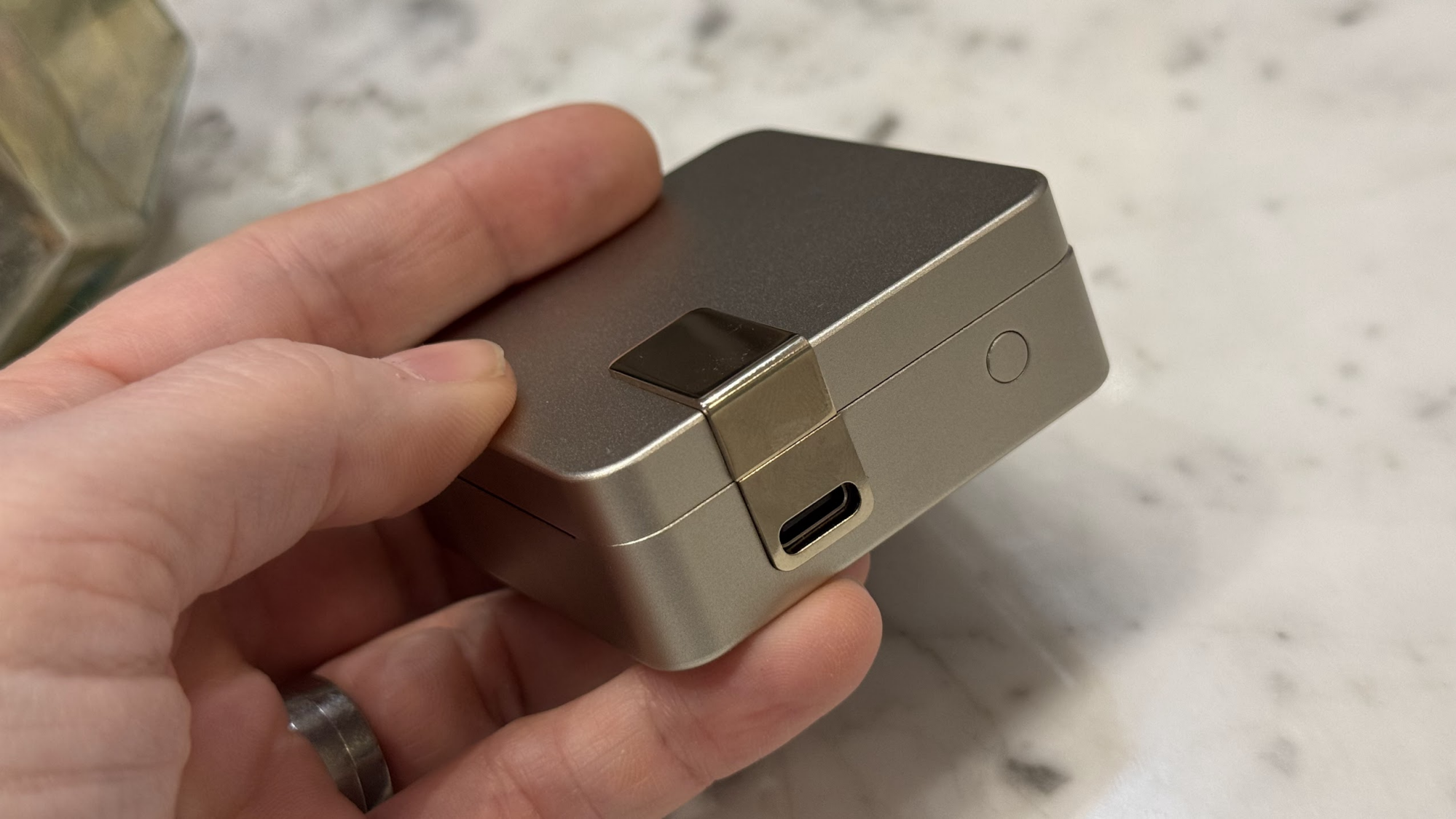
Ultrahuman Ring Pro charging case

Credit: Beth Skwarecki

What really intrigues me about this ring is not the ring itself, or even the fact that it has a charging case, but the fact that Ultrahuman is now using the charging case as a device in its own right. I haven’t seen anything like this from other smart ring manufacturers, and it’s a brilliant idea. 

For example, smart rings can’t easily act as an alarm, because then they would need components that can vibrate or make noise—thus adding to the bulk of the ring and reducing battery life. But a charging case can easily act as an alarm clock, especially since you’re likely to have it on your nightstand already. (Ultrahuman’s app has an alarm feature, but it didn’t play well with my iPhone’s silent mode and I didn’t find it reliable.) 

The charging case for the Ultrahuman Ring Pro also has LED indicators, can charge wirelessly, and has a USB-C port. The case has features for diagnostics and troubleshooting, including a button to hard reset the ring if needed. The case can also store up to a year’s worth of ring data and sync it to your phone later.

And you know what else I love about the new case? It isn’t sized to the ring. The ring attaches magnetically to the pins on the post, leaving empty space around it if the ring is a large size, and less empty space if it’s a smaller size. If you ever needed to replace the case, you wouldn’t need to find one in your specific size.

Why we can’t get this ring in the U.S. (yet?)

Legal action behind the scenes has been messing with the U.S. market for smart rings. About a year ago, there were plenty of options, but then Oura made the case to the U.S. International Trade Commission (ITC) that it believes its smart ring patent covers the design of nearly every smart ring out there. The ITC agreed, and Ultrahuman was one of the companies that needed to pull its rings from the U.S. market. 

Ultrahuman said almost immediately that it was working on a new ring design anyway, one that is so differently constructed that it can’t possibly run afoul of the ITC ruling. The Ring Pro appears to be the design it was referring to, with Ultrahuman conspicuously referring to its “unibody architecture” rather than using a design with a transparent lining (that transparent lining is one of the features of the patent at issue). 

It seems there is still a possibility that this approach may pay off. A spokesperson told me by email today: “We are working through the necessary steps to bring Ring PRO to our U.S. customers and hope to share good news soon.”

Photons that aren’t actually there influence superconductivity

Despite the headline, this isn’t really a story about superconductivity—at least not the superconductivity that people care about, the stuff that doesn’t require exotic refrigeration to work. Instead, it’s a story about how superconductivity can be used as a test of some of the weirder consequences of quantum mechanics, one that involves non-existent particles of light that still act like they exist.

Researchers have found a way to get these virtual photons to influence the behavior of a superconductor, ultimately making it worse. That may in the end tell us something useful about superconductivity, but it’ll probably take a little while.

Virtual reality

The story starts with quantum field theory, which is incredibly complex, but the simplified version is that even empty space is filled with fields that could govern the interactions of any quantum objects in or near that space. You can think of different particles as energetic excitements of these fields—so a photon is simply an energetic state of the quantum field.

Read full article

Comments

White House Stalls Release of Approved US Science Budgets

An anonymous reader shares a report: Weeks after the U.S. Congress rejected unprecedented cuts to science budgets that the administration of US President Donald Trump had sought for 2026, funding to several agencies that award research grants is still not freely flowing.

One reason is that the White House Office of Management and Budget (OMB) has been slow to authorize its release. The US National Institutes of Health (NIH) has so far not received approval to spend any of the research funding allocated in a budget bill signed into law on 3 February. The US National Science Foundation (NSF) was authorized to spend its funding just last week. And NASA has had its full funding authorized for release, but with an unusual restriction that limits spending on ten specific programmes — many of which the Trump team had tried to cancel last year.


Read more of this story at Slashdot.

‘The Death of Spotify: Why Streaming is Minutes Away From Being Obsolete’

An anonymous reader shares a column: I’m going to take the diplomatic hat off here and say with brutal honesty: basically everybody in the music business hates Spotify except for the people who work there. It’s a platform that sucks artists for everything they have, it actively prevents community building, and, despite all of that, the platform still struggles to maintain a healthy profit margin.

The streaming business model is fundamentally broken. And eventually, its demise will become more and more obvious to recognize. I’ll break down exactly why the DSP era is coming to a grinding halt, why the major labels are quietly terrified, and why the artists who don’t pivot now are going to go down with the ship.

[…] Jimmy Iovine put it bluntly: “The streaming services have a bad situation, there’s no margins, they’re not making any money.” This model only works for Apple, Amazon, and Google, because they don’t need their music platforms to be wildly profitable. Amazon uses music as a loss-leader to keep you paying for Prime. Apple uses it to sell $1,000 iPhones. As for Spotify, or any standalone music streaming company, they’re kind of screwed. And guess what — when the platform’s margins are structurally squeezed, guess who gets squeezed first? The artists.

[…] What if Jimmy is right? If the DSPs are “minutes away from obsolete,” what replaces them? Well, I’m not sure the DSPs are going to disappear overnight, but if you’re an artist or a manager trying to sustain yourself in this evolving music economy, the answer is direct ownership. The artists who will survive the next five years are the ones who are quietly shifting their focus away from the “ATM Machine.”

They are building their own cultural hangars. They are capturing phone numbers on Laylo. They are driving fans to private Discord servers. They are focusing on ARPF (Average Revenue Per Fan) through high-margin merch, vinyl, and hard tickets, rather than begging for fractions of a penny from a playlist placement. We are witnessing the death of the “Mass Audience” and the birth of the “Micro-Community.”


Read more of this story at Slashdot.