Everyone’s favorite sorta-poker game Balatro is set to cause yet another dip in global productivity levels. The roguelike — which encourages you to bend and twist the rules of poker in all kinds of wild ways — is available on Game Pass Ultimate, PC and Standard. Apple Arcade subscribers also have access to it at no extra cost.
A trailer that premiered during Monday’s ID@Xbox showcase also revealed the latest batch of cosmetic crossover card decks that are now available on all platforms. They include tie-ins with Critical Role, Dead by Daylight, Assassin’s Creed, Fallout, Bugsnaxand Rust. Those follow collabs with the likes ofCyberpunk 2077, Stardew Valley, The Witcher 3 and Vampire Survivors. Seems like everyone wants to be pals with Balatro developer LocalThunk!
Meanwhile, it emerged on Monday that PEGI, the body that runs the age rating system for games in Europe, has reclassified Balatro after determining it is suitable for players aged 12 and older. The board upped the age rating from 3+ to 18+ shortly after Balatro was released just over a year ago due to it containing “prominent gambling imagery and material that instructs about gambling,” per publisher Playstack. The game was also temporarily removed from digital console storefronts in some markets.
Playstack contended at the time that “Balatro does not allow or encourage gambling.” Following an appeal, PEGI’s complaints board has at last lowered the age rating to 12+. “Although the game explains the various hands of poker, the roguelike deck-building game contained mitigating fantastical elements that warranted a PEGI 12 rating,” the complaints board concluded.
Following that and a separate successful appeal for Luck Be A Landlord (which is also now rated 12+), PEGI plans to revise its guidelines for games that have gambling-related elements. “At this moment, any teaching or glamorization of simulated gambling automatically leads to a PEGI 18 rating,” it said in a statement on Monday. “On the basis of these appeals, the PEGI Experts Group will develop a more granular set of classification criteria to handle gambling themes and the simulation, teaching and glamorization of gambling in different age categories, which will now include 12 but also keep 18 as an age category for games that simulate gambling typically played in casinos and betting halls.”
This article originally appeared on Engadget at https://www.engadget.com/gaming/balatro-is-about-to-hook-a-lot-more-players-now-that-its-on-game-pass-192958603.html?src=rss
The CEO of Oracle and close confidant of President Trump has spent nearly half a billion dollars on his vision of bringing tech to the business of growing produce.
Major corporations are reshaping their workforces around AI with Salesforce announcing it will not hire software engineers in 2025 and other companies laying off thousands while shifting focus to AI-specific roles. Duolingo has laid off thousands after implementing ChatGPT-4, UPS cut 4,000 jobs in its largest layoff in 116 years, and IBM paused hiring for back-office and HR positions that AI can now handle.
Amazon is redirecting staff from Alexa to AI areas, while Intuit is laying off 10% of its non-AI workforce. Cisco plans to cut 7% of employees in its second round of job cuts this year as it prioritizes AI and cybersecurity. Salesforce reports its AI platform is boosting software engineering productivity by 30%. SAP is restructuring 8,000 positions to focus on AI-driven business areas. The trend extends globally, with Microsoft relocating thousands during an “exodus” from China, while entry-level jobs on Wall Street are becoming obsolete.
A study found that 3 out of 10 companies replaced workers with AI last year, with over one-third of firms using AI likely to automate more roles in 2025. Job listings at large privately-held AI companies have dropped 14.2% over six months, JP Morgan wrote in a note seen by Slashdot. The transformation is creating new opportunities, with rising demand for AI skills in job postings. A survey of more than 1,200 users found nearly two-thirds of young professionals use AI tools at work, with 93% not worried about job threats, as business leaders view Generation Z’s digital skills as beneficial for leveraging AI.
Google is planning to end support for SMS-based two-factor authentication in Gmail, Forbes reports. Sending a code to your personal phone via text message has long been an option Google offered to verify your identity, but it has unavoidable security issues the company wants to address.
The goal is to “reduce the impact of rampant, global SMS abuse,” Gmail spokesperson Ross Richendrfer tells Forbes, and the solution, at least for now, is QR codes. Instead of entering your number and receiving a text with a code you need to enter, Google will throw up a QR code you need to scan with your phone. The reliance on your smartphone is still present, but now you don’t have to rely on the lax security of SMS messages.
Using SMS two-factor authentication is better than nothing, but text messages aren’t as secure as other methods. Criminals can intercept your message just by convincing your carrier to port your number to a new phone. By tricking a provider to send multiple SMS messages to a number a criminal operation controls in a process called “traffic pumping,” they can even make money on each text, Google says. Considering the volume of SMS messages the company sends to both verify users and make sure people aren’t bulk-creating accounts to send spam, it’s not hard to see how SMS could be problem.
Ultimately, the goal for Google and other companies like it is to use passkeys and move away from passwords entirely, but adoption is slow, and making the current, much more familiar process secure is still meaningful.
This article originally appeared on Engadget at https://www.engadget.com/cybersecurity/gmail-will-stop-using-sms-for-two-factor-authentication-185615193.html?src=rss
It’s been well over two years, but the wait is almost over. The second season of Andor hits Disney+ on April 22. The platform just dropped a juicy trailer to get all of us Star Wars fans pumped and ready.
The footage shows plenty of cool stuff, including the return of Rogue One’s chief antagonist Orson Crennic and the beloved droid K-2SO. The Death Star makes an appearance, which isn’t surprising given the ending of the first season. Mon Mothma also attends an extravagant “let them eat cake” type of party.
There are a few bombastic explosions and several shots of the titular Cassian Andor walking down hallways. One thing this trailer doesn’t spoil is the plot. The footage is just a hodgepodge of cool moments, so we still have no idea what our favorite rebel spy will be getting up to in season two. To me, this is a good thing.
For the uninitiated, Andor is a prequel to Rogue One: A Star Wars Story and is set after the rise of the empire but before the events of the original Star Wars movie. It’s very good, with a tone that can only be described as “prestige Star Wars.” It stars Diego Luna, Stellan Skarsgård, Kyle Soller, Denise Gough and, sometimes, Forest Whitaker. Season two brings new actors into the fold, like Adria Arjona.
Disney+ is doing something unique with the release schedule here. Three episodes premiere on April 22, followed by another trio each week for a month. That adds up to 12 episodes. April is a big month for returning genre TV, as season two of The Last of Uspremieres on April 13.
This article originally appeared on Engadget at https://www.engadget.com/entertainment/tv-movies/disney-just-dropped-an-explosive-trailer-for-andor-season-2-184842360.html?src=rss
Oracle founder Larry Ellison’s agricultural technology venture Sensei Ag has largely failed to deliver on its ambitious goals despite costing more than half a billion dollars, more than he spent to purchase Hawaii’s Lanai island itself. Eight years after its founding, little of the revolutionary technology Sensei promised – including AI crop breeding, robotic harvesting, and advanced sensors – is being utilized in its six greenhouses on Lanai, according to WSJ.
The company has faced numerous setbacks, including greenhouses that weren’t built to withstand Lanai’s strong winds, solar panels that malfunctioned, and executives with limited agricultural experience. Far from its original mission to “feed the world,” Sensei currently grows lettuce and cherry tomatoes primarily for Hawaii’s local market, while its Canadian operations supply some East Coast supermarkets. The company has pivoted to focus on developing software and robotics at test centers in Southern California, aiming to eventually license technology packages to other indoor farms.
Natural-language search engine Perplexity will launch a web browser, joining a competitive and crowded space that has for years been dominated by Google.
The browser will be called Comet, but we know nothing at all about its features or intended positioning within the browser market at this stage. Comet was announced in an X post with a flashy animation but no details.
Perplexity followed up the X post with a link and an invitation to sign up for beta access to the browser. Those who follow the link will find a barebones website (again with no details) and a simple form for entering an email address.
Apple plans to ramp up its US hiring and investments. On Monday, the company said it will hire around 20,000 workers and spend over $500 billion in the US over the next four years.
In 2021, several months after former President Biden took office, Apple said it would invest $430 billion domestically over the following five years. Bloombergnotes today’s announcement marks an added $39 billion in spending and an extra 1,000 jobs annually over its previous numbers.
Apple said most of the 20,000 new jobs will focus on R&D, AI and machine learning, silicon engineering and software development. The company will also expand its data center capacity in North Carolina, Iowa, Oregon, Arizona and Nevada to help meet Apple Intelligence’s growing backend needs.
The company will also open an Apple Manufacturing Academy in Detroit, where its engineers will work alongside “experts from top universities such as Michigan State” to consult with small and medium-sized businesses on implementing AI and smart manufacturing techniques. Apple will also offer free in-person and online skills development courses. It already runs a Developer Academy in the Motor City.
The announcement follows a meeting between Tim Cook and President Donald Trump last week at the White House. Trump implied that Apple was making additional investments to avoid tariffs due to the iPhone maker’s heavy reliance on manufacturing in China. “They don’t want to be in the tariffs,” Trump said after the meeting.
Apple hasn’t said whether investments are related to tariffs, instead framing them as a sign of confidence in the nation’s ability to innovate. “We are bullish on the future of American innovation, and we’re proud to build on our long-standing US investments with this $500 billion commitment to our country’s future,” Cook said in a press release.
This article originally appeared on Engadget at https://www.engadget.com/big-tech/apple-plans-to-invest-500-billion-in-the-us-over-the-next-four-years-181217017.html?src=rss
Acura is gearing up to build its first entirely in-house battery-electric vehicles, but it has gotten a head start with the ZDX SUV. Built in collaboration with General Motors, the ZDX is a comfortable and competent luxury EV. More than that, it’s a shining example of what badge engineering looks like in the digital age.
Automakers have long collaborated with each other. Sometimes that means working together on a powertrain or vehicle platform for use in quite different products. Sometimes, it’s a little less involved—the Dodge Hornet differs very little from the Alfa Romeo Tonale, for example.
In the case of the Acura ZDX, the vehicle platform and the battery-electric powertrain are all thoroughly GM, what used to be called Ultium, until the American automaker retired that branding. It is, in essence, Acura’s take on the Cadillac Lyriq and is similar, if not identical, in terms of power output and pricing.
My dream of a Sayonara Wild Heartssequel might never be fulfilled, but the sudden arrival of an enhanced version for PS5 just filled my heart on a dreary Monday. Publisher Annapurna Interactive announced the upgrade for the 2019 rhythm action game during its latest showcase.
The PS5 edition includes support for 4K visuals, 120 fps gameplay and haptic feedback via the DualSense controller. There’s also a new unlockable mode called Remix Arcade that’s only available on this PS5 version. Here, you’ll try to nail high scores across random chunks of levels with no loading time between each. Developer Simogo notes that the mode will get progressively faster to add to the challenge.
Simogo had some downtime while figuring out its next big project after Lorelai and the Laser Eyesand the opportunity came up to bring Sayonara Wild Hearts to PS5. The PS4 version already works on the console and the team wasn’t really interested in only upgrading the fidelity.
However, the studio “thought about the hardware and what type of experience that would only be possible on it and remembered that PlayStation 5 has a very fast SSD, which would allow for the type of quick loading we needed for our long lost Infinite Shuffle mode.” Along with adding some new art and sound assets, the renamed Remix Arcade has “a random element that [will] sometimes mirror the level visually to keep players on their toes,” the studio said.
Best of all, the enhanced edition for PS5 is a free upgrade from the PS4 version. Sayonara Wild Hearts is also available in the PlayStation Plus Game Catalog. Otherwise, it costs $13.
Sayonara Wild Hearts is one of my favorite games of all time, so I’m more than happy to have an excuse to play through its riotously fun, heart-mending story yet again. I’m tempted to plug my PS VR2 headset back in to let the stylized art and signature neon purple wash over my eyes as the dreamy pop soundtrack fills my ears.
Here’s hoping Annapurna brings the game back to iOS as well — it left Apple Arcade a few months ago. I need to have Sayonara Wild Hearts available at all times. It’s not enough to have it on PS5, Steam Deck, Switch and PC (can you tell I like this game a whole lot?).
This article originally appeared on Engadget at https://www.engadget.com/gaming/playstation/an-enhanced-version-of-sayonara-wild-hearts-for-ps5-is-out-now-174752837.html?src=rss
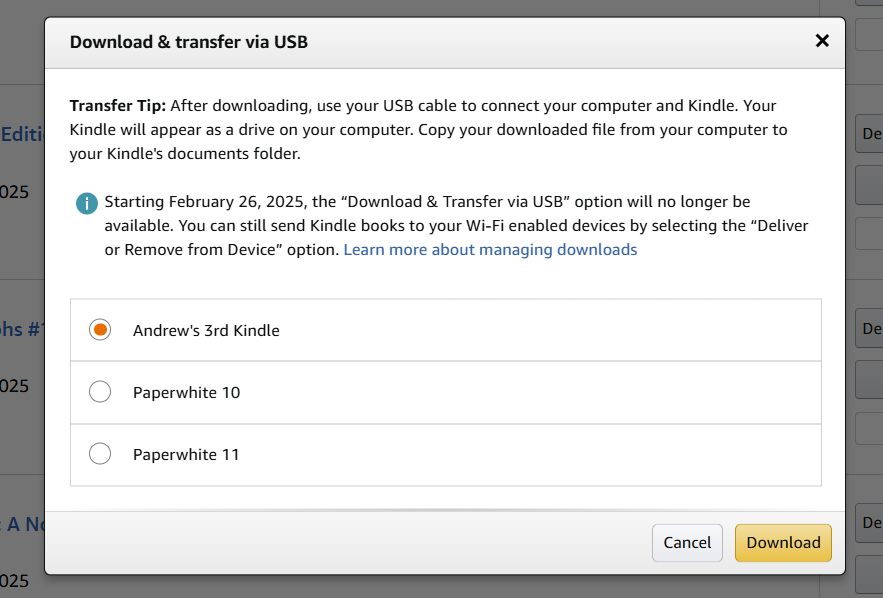
Later this week, Amazon is closing a small loophole that allowed purchasers of Kindle books to download those files to a computer and transfer them via USB. Originally intended to extend e-book access to owners of very old Kindles without Wi-Fi connectivity, the feature has also made it easier for people to download and store copies of the e-books they’ve bought, reducing the risk that Amazon might make changes to their text or remove them from the Kindle store entirely.
The “Download & transfer via USB” option on Amazon’s site is going away this Wednesday, February 26. People who want to download their libraries to their PC easily should do so within the next two days. This change only affects the ability to download these files directly to a computer from Amazon’s website—if you’ve downloaded the books beforehand, you’ll still be able to load them on your Kindles via USB, and you’ll still be able to use third-party software as well as the Send to Kindle service to get EPUB files and other books loaded onto a Kindle.
Downloading files to your PC through Amazon’s site is still possible, but it’s going away later this week.
Credit:
Andrew Cunningham
For typical Kindle owners who buy their books via Amazon’s store and seamlessly download them to modern or modern-ish Kindle devices over Wi-Fi, you likely won’t notice any change. The effects will be noticed most by those who use third-party software like Calibre to manage a local e-book library and people who have hopped to other e-reader platforms who want to be able to download their Kindle purchases and strip them of their DRM so they can be read elsewhere.
More than half the world’s countries have no plans to protect 30% of land and sea for nature, despite committing to a global agreement to do so less than three years ago, new analysis shows. From a report: In late 2022, nearly every country signed a once-in-a-decade UN deal to halt the destruction of Earth’s ecosystems. It included a headline target to protect nearly a third of the planet for biodiversity by the end of the decade — a goal known as “30 by 30.” But as country leaders gather in Rome to conclude Cop16 negotiations to save nature, analysis of countries’ plans by Carbon Brief and the Guardian found that many countries are will fall short. More than half are either pledging to protect less than 30% of their territory or are not setting a numerical target.
As the world turns, so do the console generations. The Nintendo Switch is over seven years old, so it’s due for a refresh. Nintendo Switch 2 rumors have been swirling for years, but now we have some signs of life. The company officially revealed the sequel to its most successful home console ever in a brief trailer on January 16.
The Switch 2 looks functionally very similar to the original system, albeit with a larger display, magnetic Joy-Cons and a sleeker design. The company also reaffirmed that the upcoming console will be backwards compatible with Switch games.
While the reveal did confirm some rumors and have a few interesting details for those who were paying close attention, Nintendo is still largely keeping its cards close to its chest. We’ll have to wait until a special Nintendo Direct at 9AM ET on April 2 for all the juicy information. Annoyingly, that date is a Wednesday and not a Two-sday.
The Nintendo Switch 2 was announced on January 16
The rumor mill had heavilysuggested that Nintendo would pull back the curtain on the Switch 2 on January 16, and that turned out to be the case.
The company hasn’t changed the core form factor. It’s a portable console with detachable Joy-Cons. The Switch 2 can be placed in a dock for big-screen gaming. There are some significant differences from the original console, however.
The most obvious one is that the next-gen Joy-Cons will no longer slide into place mechanically. Instead, they’ll attach to the main unit magnetically. There is a small connector that’s likely used to charge the controllers and perhaps remove the need to link them via Bluetooth. It’s unclear at this point if Joy-Cons from the original system will be compatible with the Switch 2.
One other big (and very welcome) change is the addition of a second USB-C port on the top of the device. That should make it much easier to plug in accessories while the Switch 2 is docked. It’s great to see that Nintendo has kept the headphone jack as well. Let’s just hope that Bluetooth headphone support is live from the jump this time and Nintendo doesn’t leave everyone waiting four yearsfor that feature.
The kickstand is getting an upgrade as well. As with the Switch OLED, it spans the length of the console. But, according to the trailer, this one looks fully adjustable, so you can tweak the viewing angle to one that works for you.
However, there are still a great many unknowns regarding the upcoming console. We don’t really know the specs yet, or what type of display it uses. We also don’t know anything about battery life, the UI or launch games. We’ll likely learn a whole lot on April 2.
When will the Nintendo Switch 2 come out?
2025. That’s all we know for sure at this point.
It’s highly unlikely that Nintendo will release the console before the dedicated Direct on April 2, and not only because that’s at the start of Nintendo’s next financial year. However, accessory manufacturer Genki, which has been a major source of leaks in recent months, claims the console will be released in April. Other reports have put the release window sometime in June.
In any case, we should learn the release date during the April 2 Direct if we haven’t already by then.
When can I try the Nintendo Switch 2?
Nintendo is planning a worldwide roadshow to let gamers go hands-on with the console. These events start in New York and Paris on April 3-6, with others taking place throughout the following two months. That lends credence to some suggestions that Nintendo will release the Switch 2 in June.
Ticket registration for the Switch 2 Experience events in the US (in New York, Los Angeles and Paris) starts on January 17 at 3PM ET and will remain open until January 26. A Nintendo Account is required to sign up. Nintendo will randomly select the recipients of the free tickets.
The full list of Nintendo Switch 2 Experience events is as follows:
North America:
New York, April 4-6, 2025
Los Angeles, April 11-13, 2025
Dallas, April 25-27, 2025
Toronto, April 25-27, 2025
Europe:
Paris, April 4-6, 2025
London, April 11-13, 2025
Milan, April 25-27, 2025
Berlin, April 25-27, 2025
Madrid, May 9-11, 2025
Amsterdam, May 9-11, 2025
Oceania:
Melbourne, May 10-11, 2025
Asia:
Tokyo (Makuhari), April 26-27, 2025
Seoul, May 31-June 1, 2025
Hong Kong, To be announced
Taipei, To be announced
Will the Nintendo Switch 2 have some weirdness?
Everything we’ve seen and so far about this console has been fairly, well, traditional. It looks like the original Switch, but better. That’s awesome, but will there be any of that unpredictable Nintendo magic? Maybe! There are two puzzling additions that folks can’t make hide nor hair of.
Genki, the accessories manufacturer, just published a landing page for their Nintendo Switch 2 accessories. This landing page features a video that includes a very detailed look at a Switch 2 mockup. pic.twitter.com/Db7RSk4YlQ
Keen eyes will have noticed a new button on the bottom of the right Joy-Con. It it not yet clear what this does. Could it initiate voice chat during gameplay? Could it calibrate the controllers? Could it create a room-sized hologram of Bowser in your living room? We’ll have to wait and see.
Now onto the updated Joy-Cons. There appears to be a new sensor on the connecting side of each controller. It looks a whole lot like an optical sensor, which is what a computer mouse uses. This has led to speculation that players will be able to flip the Joy-Con over and use it like a mouse. Of note: the trailer shows the Joy-Cons moving along a flat surface, connector side down and looking suspiciously like a mouse.
But why would anyone even want this? I can think of three words. New Mario Paint.
Mouse control isn’t the only “too strange for any company but Nintendo” rumor floating around. A patent filed by the company suggests you can swap the Switch 2’s Joy-Cons, snapping them onto either side of the console. That would align with the magnetic Joy-Con attachment scheme.
But much like the weird mouse rumors, it doesn’t necessarily align with, well, any logical reason for why you’d want to do that. The patent suggests it could allow for more user choice in where the headphone jack is. But since it’s Nintendo, the company that brought us Labo cardboard peripherals and the Game Boy Advance e-reader attachment, we have to wonder if there are… quirkier designs at hand.
Is the Nintendo Switch 2 backwards compatible?
The company confirmed in November 2024 that the Nintendo Switch 2 will be backwards compatible. It will also feature access to Nintendo Online, so users will be able to play all of those old retro titles.
In the initial Nintendo Switch 2 press release, Nintendo reiterated that physical and digital Switch games will work on the new system. However, it noted that “certain Nintendo Switch games may not be supported on or fully compatible with Nintendo Switch 2.” More details about which games those are will be revealed later.
Will old games be enhanced in any way?
The original Switch has, to put it mildly, struggled to run some of the late-generation software that’s come down the pike. Could these games be enhanced to take advantage of the increased horsepower of the Switch 2? We have no idea. We also don’t know if any of these releases will receive graphical upgrades, perhaps taking advantage of upscaling tech.
What will the cartridges taste like?
You may remember that the original Switch cartridges taste absolutely awful. This was on purpose, to discourage folks from putting the games in their mouth. Will the successor follow suit and continue to dip cartridges in a foul-tasting bitter coating? Only time will tell.
What about specs?
The rumors regarding specs are all over the place, so it’s tough to pin down. We know one thing for sure: It’ll be more powerful than the ancient Switch hardware, which was already antiquated back in 2017. One analyst allegedly got a hold of a spec sheet from the Korean United Daily News that said the Switch 2 would boast an eight-core Cortex-A78AE processor, 8GB of RAM, and 64GB of internal eMMC storage. This tracks for me, as these specs are about as underpowered in 2024 as the original Switch was in 2017. However, some reports do indicate that the console will include 12GB of RAM.
Another source suggests that the eight-core CPU will be packaged inside an NVIDIA-produced Tegra239 SoC (system on a chip). Given the current Switch runs on an NVIDIA chip, that makes a lot of sense. The CPU will be more powerful, but it’s the Switch 2’s new GPU that will be a major differentiator. It’s all-but-confirmed that the Switch 2 will support DLSS, NVIDIA’s “deep learning supersampling” upscaling tech, which would allow the console to render games at a low resolution internally while outputting a high-resolution image. (Fun fact: We actually wrote about how perfect DLSS was for the Nintendo Switch 2 when the technology was announced alongside the RTX 20 series back in 2018.)
There are still questions about the Switch 2 and DLSS: Will the system support newer DLSS features like frame generation? Will existing games be automatically tidied up by NVIDIA’s algorithm? Regardless of the exact implementation, DLSS upscaling will be a huge leap over the rudimentary techniques available to Nintendo Switch developers.
As for the display, there are many conflicting rumors. Early reports from solid sources suggested the Switch 2 would have an 8-inch display LCD display. The Switch 2’s display certainly looks larger than that of the original Switch in a side-by-side comparison in the reveal trailer. Some folks have worried that the Switch follow-up may actually be too big, especially for kids.
Certain analysts have suggested this would be an OLED screen, while others have said it would be a Mini-LED display. A Mini-LED display is basically an LCD display that has a backlight made of (surprise!) mini-LEDs rather than edge lighting. This allows for local dimming, making the blacks more black. I’m hedging my bets here. I think it’ll be a standard LCD, to cut costs, with an OLED or Mini-LED model coming later down the line. However, Mini-LED screens are slightly cheaper than OLED displays, so that’s certainly a possibility at launch.
As for resolution, recent reporting suggests that the console will output 1080p in handheld and 4K when docked. That’s much better than the OG Switch.
More tenuous “leaks” have intimated that the Switch 2 could also support a faster microSD card standard known as microSD Express. This allows for significantly faster transfer rates than the common UHS-I cards supported by the Switch today. It’s technically been around for several years, but we’ve only recently started to see microSD cards that take advantage of the spec hit the market.
So, in theory, all of this could bring a sizable boost in load times and general storage performance for the Switch 2 (though it’s still not likely to be on par with the SSDs in the PS5 or Xbox Series X/S). But again, these rumors are far from concrete. It’s also worth noting that microSD Express cards cost significantly more than what we usually see today — the SanDisk card we tested, for instance, starts at $45 for just 128GB of storage.
How much will the Nintendo Switch 2 cost?
We don’t have too much information regarding price but we do have plenty of history to work with. The original Nintendo Switch launched at $300, which is pretty much the “magic number” when it comes to Nintendo console releases in recent years. The Wii U also came in at $300.
However, there are plenty of rumors circulating that Nintendo could be upping the asking price for the Switch 2. Numerous outlets have reported it’ll be $400, or potentially even more expensive. However, the same analysts who say the console will be $400 were also fairly certain it would be out by the end of 2024 and, well, that didn’t happen.
Dipping back into history, there is some precedence for a price uptick. The GameCube was $200 and the Wii was $250. The Wii U and Switch increased to $300 and, well, numbers like to go up. A $400 price tag would make it nearly as expensive as a PS5 and Xbox Series X. That would also put it at the same price as the 256GB LCD Steam Deck.
Again, we should get confirmation of the price during the April 2 Nintendo Direct.
Do we know about any launch games?
Not so much. The reveal trailer offered a peek at a new Mario Kart game. Nintendo released Mario Kart 8 on the Wii U over a decade ago and it’s been milking that cash cow ever since, having sold more than 64 million copies of the game across that console and the Switch. It’s definitely time for a new entry!
It’s certainly been a long time since we’ve gotten a proper 3D Mario adventure as well, so a new one could be a launch title. That would be one heck of a system seller. Other than that, your guess is as good as mine. Past as prologue, we can expect something from Ubisoft and an off-the-wall title like 1-2-Switch.
If there’s a gimmick or hook involved with the console, we’ll also get a game that takes advantage of that. A dual release of Metroid Prime 4, just like Breath of the Wild and Twilight Princess before that, is also a possibility.
It’s all but nailed on that we’ll learn much more about the Switch 2 launch lineup during the April 2 Nintendo Direct, which starts at 9AM ET. You’ll definitely want to set your Alarmo for that one.
That’s everything we know about the Nintendo Switch 2 today. We’ll update this article with rumors we trust and with information we gather directly from sources. Any changes made to the article after its initial publishing will be listed below.
Update, February 24, 2025, 12:30 PM ET: This story has been updated to include speculation about storage and information about the new microSD Express standard.
Update, January 24, 2025, 12:36 PM ET: This story has been updated to include speculation about price, potential game enhancements and the taste of cartridges.
Update, February 5, 2025, 9:30AM ET: This story has been updated to note the time when the April 2 Nintendo Direct starts.
Jeff Dunn contributed to this report.
This article originally appeared on Engadget at https://www.engadget.com/gaming/nintendo/nintendo-switch-2-is-launching-soon-heres-everything-we-know-so-far-153308958.html?src=rss
Blendo Games’ latest installment of interactive weirdness, Skin Deep,is due to hit Steam on April 30, after nearly seven years of development. Skin Deep is a first-person sci-fi shooter, but it doesn’t look (or smell?) like any of the dramatic space operas or realistic, precision-based games that generally flood this genre.
Skin Deep takes place on a futuristic cargo starship managed by an insurance corporation and filled with its clients’ valuables, and you’re the cryogenically frozen security officer kept on board in case something goes awry. Space pirates ambush the ship, your body thaws, and a non-linear game of shooting, sneaking, sabotaging and smelling ensues, all presented in Blendo’s signature blocky 3D style.
Skin Deep features a mix of puzzles, madcap comedy and action scenes, and alongside the first-person gunplay, there’s a sneeze mechanic and a stink system that sometimes leaves little smelly clouds in your wake, alerting nearby pirates to your presence. It’s like Kingdom Come: Deliverance 2, but with fewer medieval peasants and way more space cats. Did we mention there are a bunch of cats that you have to save on the ship? Because there are, and some of them are dressed in little cowboy outfits.
For the odor mechanics, players become stinky only when it makes sense narratively, like when they’re expelled from the ship’s trash shoot alongside all the fish bones and rotten things. Your smell clouds subside once you figure out how to wash up. Sneezing follows a similar in-game logic.
Blendo Games
“If you’re crawling through a dusty vent your little sneezy air level will increase, then you’ll do a big sneeze noise,” Chung told Engadget in 2021. “And there’s a bag of pepper that we have. If you shoot it, a big cloud of pepper flies out. You can pick up a pepper bag and throw it at someone and they’ll start sneezing.”
Skin Deep is the most action-focused game that Blendo has ever made. The independent studio, led by Brendon Chung, has a lineup of award-winning titles under its belt, including Quadrilateral Cowboy, Gravity Bone and Thirty Flights of Loving. These titles tend to highlight clever puzzles and polygonal oddities, and Skin Deep is the first Blendo project to feature first-person shooter mechanics.
That’s not to say FPS development is a new idea for Chung. He got his start in game development by customizing levels in Doom, Quake, Half-Life, Quake 2 and Doom 3 when he was a kid, and FPS games are often what he’s drawn to as a player. He’s still using a modified port of id Software’s Doom 3 engine, idTech4, to make Skin Deep.
“I’ve played like a bazillion FPS games because I just really enjoy them,” Chung said in 2021, “but I feel like there’s so much that can be explored and that I wish these games would explore.” You know, like well-dressed cats and stink systems.
Blendo Games
When we talked with Chung four years ago, the Skin Deep FAQ page read, “Is Skin Deep going to take 4+ years of development time like your previous game Quadrilateral Cowboy?” And the answer was, “I hope not.” Today, there’s an “(update: oops…)” added to that response. Development on Skin Deep started around July 2018, according to the FAQ.
Skin Deep is published by Annapurna Interactive and it’s heading to Steam on April 30. A new demo is live now on Steam, as part of the Steam Next Fest hullaballoo. Steam Next Fest runs from February 24 at 1PM ET to March 3 at 1PM ET, showcasing a ton of fresh game demos and developer insights on the storefront.
This article originally appeared on Engadget at https://www.engadget.com/gaming/pc/blendo-games-oddball-sci-fi-shooter-skin-deep-hits-pc-on-april-30-173010803.html?src=rss