
How Lenovo’s AI Workmate Is Redefining Physical-Digital Productivity

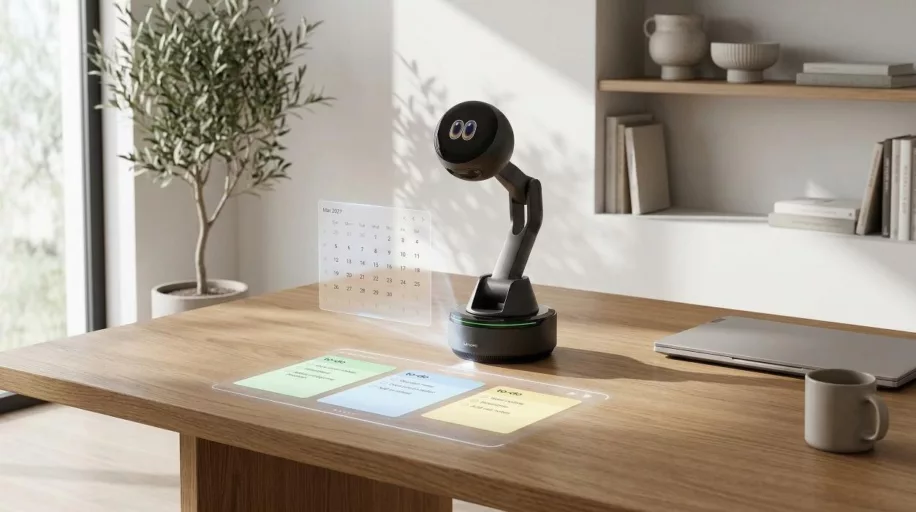
The “AI PC” has dominated headlines for two years, but we are finally moving past the era of chatbots living in a browser tab. At MWC 2026, Lenovo unveiled a vision for the future that feels less like a software upgrade and more like a new category of office furniture. The Lenovo AI Workmate Concept isn’t just another assistant; it is a robotic, “always-on” desk companion designed to bridge the gap between our physical movements and our digital work.

While competitors focus on “Agentic AI” that clicks buttons in the cloud, Lenovo is betting on Spatial AI—the idea that your desk, your printed documents, and even your hand gestures are the primary interface for the next decade of computing.

The Evolution of Lenovo’s AI Ambition

Lenovo is no stranger to digital assistants, but its journey has been one of quiet persistence. Long before the current generative AI explosion, Lenovo experimented with early iterations such as Lenovo Voice and the Alexa-powered Smart Assistant. However, those were peripheral.

The real shift began in early 2026 with the introduction of Lenovo Qira, a unified “Personal Ambient Intelligence” ecosystem. Unlike previous attempts, Qira is integrated at the system level across PCs and Motorola smartphones, focusing on on-device processing via the Personal Knowledge Base (PKB). The AI Workmate is the physical manifestation of this ecosystem. Lenovo is uniquely positioned to win this space because they own the hardware; they aren’t just building a “brain”—they are building the body that houses it.
Comparing the 2026 AI Assistant Landscape

The market for personal AI assistants is projected to reach approximately $37.7 billion in 2026. As we move through this year, the competition has split into three distinct “kingdoms”:

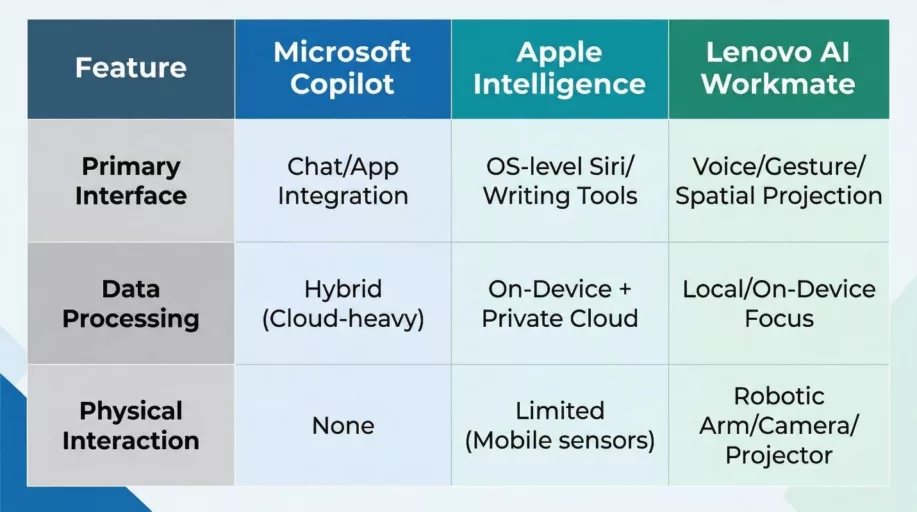
  1. The Cloud Titans (Google Gemini & Microsoft Copilot): Google Gemini and Microsoft Copilot remain the kings of big data, unparalleled at scanning “the whole library” of your corporate files. However, they remain largely “screen-bound.”
  2. The Privacy Loyalists (Apple Intelligence): Apple focuses on seamless, secure integration within the iPhone and Mac ecosystem. It is excellent for “Smart Writing,” but lacks a physical presence in the room.
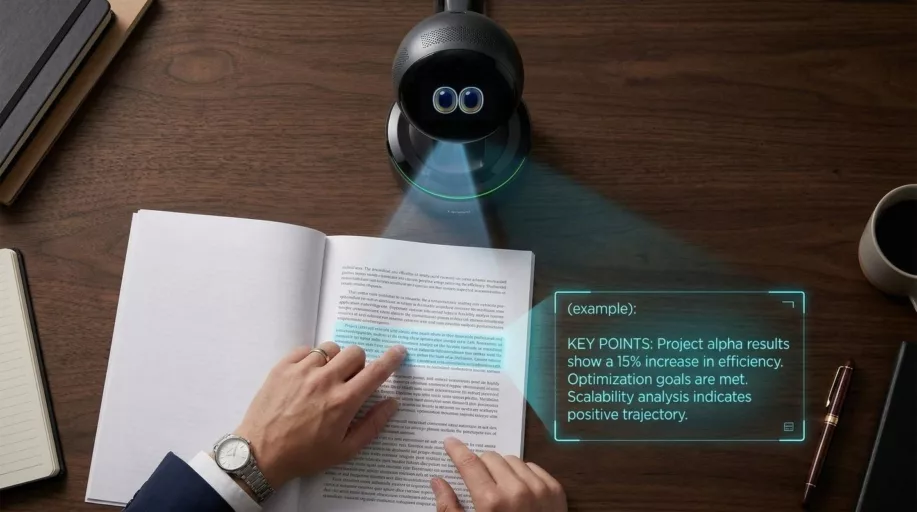
  3. The Physical Pioneers (Lenovo AI Workmate): This is where Lenovo carves its niche. While ChatGPT helps you write an email, the AI Workmate helps you scan a physical stack of papers on your desk, summarizes them locally, and projects the resulting PowerPoint outline onto your wall.
The Feature Set: Spatial and Physical AI

The AI Workmate Concept stands out because it treats the physical environment as a canvas. Its feature set is designed for the high-pressure professional who is tired of toggling between windows:

  • Spatial Interaction & Projection: Using built-in projectors, it can “extend” your monitor. If your screen is full, it projects your Slack notifications or a document summary onto your desk surface.
  • Document Summarization: It features a high-resolution camera that can scan a physical document placed in front of it, instantly converting it into a structured digital summary or a slide deck.
  • Gesture Control: Instead of reaching for a mouse to dismiss a notification, a simple wave of the hand tells the Workmate to snooze or file the alert.
  • Privacy-First “Always-On”: Because processing is handled by the NPU on the device, it can remain “always-listening” for voice commands without the privacy anxiety of cloud-based speakers.
Fitting Into the Future of Work

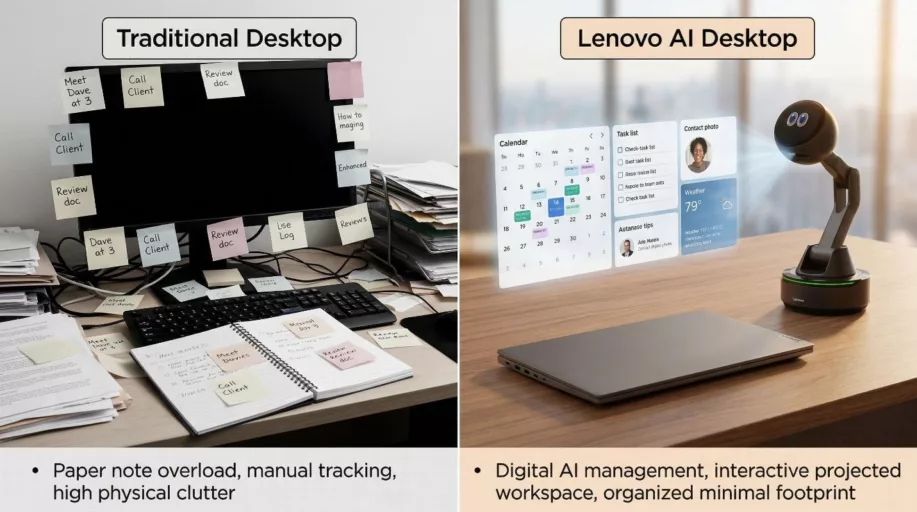
In a 2026 workspace, human-centric design is a top priority. The AI Workmate fits this trend by acting as a “buffer” between the user and their screen. It reduces cognitive load by handling the “drudge work”—organizing notes, monitoring screen time, and reminding users to take breaks—through natural interaction rather than jarring pop-ups.

For the home office, it acts as a central hub. It synchronizes schedules across multiple family devices and can transition into a “Work Companion” mode—a clock-like form factor (inspired by the Lenovo AI Work Companion Concept) that manages your daily plan with one-click automation.

The Roadmap to Success: Strategy and Pricing

To move this from a “Concept” to a market leader, Lenovo must avoid the “gadget” trap. Here is the recommended blueprint:

  1. Open API for “Physical Macros”: Lenovo should allow developers to create “Physical Macros.” Imagine a photographer placing a memory card on the desk, and the Workmate automatically projects an “Import and Edit” button.
  2. Seamless Integration with “Aura Edition”: The Workmate must be the “sidekick” to Lenovo’s Aura Edition PCs. If it doesn’t feel like a natural extension of the ThinkPad, users won’t adopt it.
  3. Enterprise Security Certification: Since the Workmate “sees” your desk, Lenovo must obtain top-tier security certifications to convince IT departments the camera isn’t a vulnerability.

Pricing Strategy: To compete with high-end peripherals, Lenovo should offer two tiers:

  • AI Workmate Pro ($599): The full robotic-arm version with projection and spatial sensors. This is priced as a premium productivity tool, similar to a high-end monitor.
  • AI Work Companion ($199): The “clock-style” version focusing on voice and scheduling without the robotics.
Wrapping Up

The Lenovo AI Workmate Concept is a bold declaration that the future of work isn’t just about faster chips—it’s about physical-digital harmony. By leveraging its massive hardware footprint and moving AI processing onto the device via Qira, Lenovo is building a unique value proposition that Microsoft and Google cannot easily replicate.

If Lenovo can price the Pro model under $600 and prove that its spatial projection is more than just a gimmick, they won’t just be selling a companion; they will be defining the hardware architecture of the AI era.

TikTok won’t add end-to-end encryption to DMs

If you’ve ever wondered if TikTok would ever offer a more secure messaging experience, you now have an answer. TikTok has told the BBC that it will not protect direct messages sent in the app with end-to-end encryption, because it believes it will make users less safe. In a briefing about security at its London office, TikTok said that implementing the technology would prevent its safety teams or law enforcement from being able to read messages if needed. The ByteDance-owned app framed it as a deliberate decision, made in an effort to keep users, especially younger ones, safe on its platform.

With end-to-end encryption, only the sender and receiver are able to read messages exchanged between them. The technology isn’t typically implemented in China, where ByteDance is located, though TikTok didn’t say whether its parent company had an influence on its decision. TikTok said messages sent through its app are still protected by standard encryption and only authorized employees will be able to access them if the app gets a request from authorities or gets user reports for harmful behavior.

You have a lot of other apps to choose from if you want to communicate through apps with end-to-end encryption. Apple’s iMessage and Google Messages use the technology, and there’s also Facebook Messenger, WhatsApp, Telegram and Signal. It looks like TikTok just isn’t the place to go if you want to use secure messaging, though it’s unclear if its US entity also shares the same stance. If you’ll recall, TikTok signed a deal to spin off its US business, which is now an entity called the TikTok USDS Joint Venture. A group of non-Chinese investors, including Oracle, purchased an 80 percent stake on the app, while ByteDance retained only a 19.9 percent stake. The entity will be in charge of content moderation in the country and will retrain TikTok’s algorithm on US users’ data.

This article originally appeared on Engadget at https://www.engadget.com/apps/tiktok-wont-add-end-to-end-encryption-to-dms-123431502.html?src=rss

Qualcomm Unveils Wi-Fi 8 Portfolio With Native AI For Ultra-Fast Connectivity

Qualcomm Unveils Wi-Fi 8 Portfolio With Native AI For Ultra-Fast Connectivity
The relentless pace of technology means that if you blink, there is something new on the horizon. Case in point, Qualcomm is already looking ahead to Wi-Fi 8 with the introduction of a robust portfolio to drive next-gen connectivity for the emerging AI era, and key among them is its new FastConnect 8800Mobile Connectivity System, along with

Indie rhythm game Beat Weaver looks like a mix of Amplitude and Thumper

Rhythm games never really went away after the decline of Guitar Hero and Rock Band, but it feels like they’re having a bit of a moment again. From projects like Clone Hero and YARG, to Fortnite Festival and Stage Tour (an upcoming title from Guitar Hero veterans at RedOctane), to indies with rhythm elements like Ratatan and People of Note, music games are still very much around. You can now add Beat Weaver to the mix. 

This upcoming game from Echolox Interactive — solo developer Christopher Lerch — is inspired by pre-Guitar Hero Harmonix titles like Amplitude and Frequency. (Given the way that tracks twist and turn, the trailer also reminds me a bit of Thumper. Thankfully, this doesn’t feel nearly as ominous.)

As in Amplitude, you control a ship that barrels along tracks. You’ll need to hit notes at the right time to be successful, of course, though Beat Weaver brings some interesting complexities to the formula.

Each track is linked to an instrument and you can switch between tracks at will. However, you’ll first need to unlock additional tracks. If you play a sequence of notes (i.e. phrases) without a mistake, you’ll activate one. As long as a track is active, it will sip away some of your energy. If that drops too low and you make an error, all the activated tracks will be disabled and you’ll need to gradually unlock them again. 

You’ll need to switch between tracks and complete more phrases to keep the full mix active. Songs can have up to 16 tracks, so you might need to stay on your toes. That said, you won’t need to hit every note dead on.

Lerch is aiming for more of a flow state feel and there are several difficulty levels. Plus, if an upcoming phrase looks overly complex for your current mood, you can stick to a track that has a simpler note pattern. Powerups that give you the opportunity to slow down and rewind tracks should help too.

Lerch originally started working on Beat Weaver as a hobby back in 2017. After receiving funding from Germany’s Press Start: Games Founding Grant program last year, Lerch was able to focus on Beat Weaver full time. The developer says the protracted development time “allowed me to experiment with audio playback systems and engine architecture to maximize the interactive music experience, as well as making maximum use of the third dimension with the dynamic note highway system.” 

Details about artists who are featured in the game will be revealed later. Lerch composed much of the music personally. Players will be able to add custom songs, though they’ll need to load in separate audio files for each playable instrument.

Lerch is developing Beat Weaver in a custom engine without using generative AI. “For rendering it doesn’t use any traditional texture mapping in favor of generating colors, patterns and skyboxes with shader code, noise functions, raymarching and mathematical expressions,” Lerch wrote. “Its comparatively low performance demands and dependencies allow it to run on older machines.”

This game just looks really neat. It’s nice to be excited about neat-looking things. Beat Weaver is slated to hit Steam (with support for Steam Deck) later this year.

This article originally appeared on Engadget at https://www.engadget.com/gaming/indie-rhythm-game-beat-weaver-looks-like-a-mix-of-amplitude-and-thumper-110000834.html?src=rss

‘Game of Thrones’ Movie In the Works

Warner Bros. is developing a feature film set in the world of Game of Thrones with writer Beau Willimon of Andor and House of Cards. “That’s about all we know right now, and as with everything ‘Thrones’ things could change, but the film is firmly in development,” reports TheWrap. Page Six Hollywood was first to break the news and speculated that the story could revolve around Aegon I, the legendary Targaryen king who spawned a dynasty. From the report: The Targaryens have been at the center of all things “Thrones” on HBO, with “Game of Thrones” following Daenerys Targaryen’s (Emilia Clarke) quest to usurp the throne, spinoff “House of the Dragon” set in the midst of the Targaryens’ reign and recent spinoff “A Knight of the Seven Kingdoms” following the squire-ship of Aegon “Egg” Targaryen towards the end of the family’s run atop the Iron Throne. All, of course, based on George R.R. Martin’s expansive book universe.


Read more of this story at Slashdot.

Apple’s new Studio Display XDR monitor has limited functionality on older Silicon Macs

If you’re looking to pre-order Apple’s new Studio Display XDR monitor today but have an older Mac, beware of some potential issues. According to the compatibility list spotted by Apple Insider, the new display will only work at 60Hz and not at its full 120Hz refresh rate on some older and less powerful Silicon models. Moreover, support for older Intel Macs isn’t mentioned at all for either the Studio Display XDR or cheaper Studio Display. 

All Apple Silicon Macs will work with both monitors, including those with the oldest M1 chips, according to the support pages. However, the compatibility list for the Studio Display XDR includes this nugget: “Mac models with M1, M1 Pro, M1 Max, M1 Ultra, M2, and M3 support Studio Display XDR at up to 60Hz. All other Studio Display XDR features are supported.” So even if you have a hotrod M1 Ultra-based Mac, the Studio Display XDR’s refresh rate is capped at 60Hz — despite the fact that the chip can drive third-party monitors at 120Hz. 

Similarly, only the iPad Pro M5 supports the Studio Display XDR at 120Hz, with all other compatible models (in the iPad Pro and iPad Air family) limited to 60Hz. 

Intel Mac support isn’t mentioned at all in the compatibility list for either display, though they may function in some limited manner when connected. Intel Macs just received their last new OS update with macOS Tahoe (and only three more years of security updates), but it’s still surprising that they’re not compatible with Apple’s latest monitors. 

This article originally appeared on Engadget at https://www.engadget.com/computing/accessories/apples-new-studio-display-xdr-monitor-has-limited-functionality-on-older-silicon-macs-082212069.html?src=rss

NASA Repairs Artemis 2 Rocket, Continues Eyeing April Moon Launch

NASA is eyeing an April launch window for the upcoming Artemis II mission after it repaired a helium-flow issue on the Space Launch System upper stage rocket. “Work on the rocket and spacecraft will continue in the coming weeks as NASA prepares for rolling the rocket out to the launch pad again later this month ahead of a potential launch in April,” NASA wrote in an update on Tuesday. Space.com reports: The repair work occurred inside the huge Vehicle Assembly Building (VAB) at NASA’s Kennedy Space Center (KSC) in Florida. Artemis 2’s SLS and Orion crew capsule have been in the VAB since Feb. 25, when they rolled back to the hangar from KSC’s Launch Pad 39B. Just a few days earlier, the Artemis 2 stack successfully completed a wet dress rehearsal, a two-day-long practice run of the procedures leading up to launch.

In the wake of that test, however, NASA noticed an interruption in helium flow in the SLS’ upper stage. That was a significant issue, because helium pressurizes the rocket’s propellant tanks. Rollback was the only option, as the affected area in the upper stage was not accessible at the pad. The problem took a potential March launch out of play for Artemis 2, which will send four astronauts on a roughly 10-day flight around the moon. It will be the first crewed flight to the lunar neighborhood since Apollo 17 in 1972.

The next Artemis 2 launch window opens in April, with liftoff opportunities on April 1, April 3-6 and April 30. And those options apparently remain in play, thanks to recent work in the VAB. That work centered on a seal in an interface through which helium flows from ground equipment into the SLS upper stage. That seal was obstructing the interface, which is known as a quick disconnect.


Read more of this story at Slashdot.

A Possible US Government iPhone-Hacking Toolkit Is Now In the Hands of Foreign Spies, Criminals

Security researchers say a highly sophisticated iPhone exploitation toolkit dubbed “Coruna,” which possibly originated from a U.S. government contractor, has spread from suspected Russian espionage operations to crypto-stealing criminal campaigns. Apple has patched the exploited vulnerabilities in newer iOS versions, but tens of thousands of devices may have already been compromised. An anonymous reader quotes an excerpt from Wired’s report: Security researchers at Google on Tuesday released a report describing what they’re calling “Coruna,” a highly sophisticated iPhone hacking toolkit that includes five complete hacking techniques capable of bypassing all the defenses of an iPhone to silently install malware on a device when it visits a website containing the exploitation code. In total, Coruna takes advantage of 23 distinct vulnerabilities in iOS, a rare collection of hacking components that suggests it was created by a well-resourced, likely state-sponsored group of hackers.

In fact, Google traces components of Coruna to hacking techniques it spotted in use in February of last year and attributed to what it describes only as a “customer of a surveillance company.” Then, five months later, Google says a more complete version of Coruna reappeared in what appears to have been an espionage campaign carried out by a suspected Russian spy group, which hid the hacking code in a common visitor-counting component of Ukrainian websites. Finally, Google spotted Coruna in use yet again in what seems to have been a purely profit-focused hacking campaign, infecting Chinese-language crypto and gambling sites to deliver malware that steals victims cryptocurrency.

Conspicuously absent from Google’s report is any mention of who the original surveillance company “customer” that deployed Coruna may have been. But the mobile security company iVerify, which also analyzed a version of Coruna it obtained from one of the infected Chinese sites, suggests the code may well have started life as a hacking kit built for or purchased by the US government. Google and iVerify both note that Coruna contains multiple components previously used in a hacking operation known as “Triangulation” that was discovered targeting Russian cybersecurity firm Kaspersky in 2023, which the Russian government claimed was the work of the NSA. (The US government didn’t respond to Russia’s claim.)

Coruna’s code also appears to have been originally written by English-speaking coders, notes iVerify’s cofounder Rocky Cole. “It’s highly sophisticated, took millions of dollars to develop, and it bears the hallmarks of other modules that have been publicly attributed to the US government,” Cole tells WIRED. “This is the first example we’ve seen of very likely US government tools — based on what the code is telling us — spinning out of control and being used by both our adversaries and cybercriminal groups.” Regardless of Coruna’s origin, Google warns that a highly valuable and rare hacking toolkit appears to have traveled through a series of unlikely hands, and now exists in the wild where it could still be adopted — or adapted — by any hacker group seeking to target iPhone users. “How this proliferation occurred is unclear, but suggests an active market for ‘second hand’ zero-day exploits,” Google’s report reads. “Beyond these identified exploits, multiple threat actors have now acquired advanced exploitation techniques that can be re-used and modified with newly identified vulnerabilities.”


Read more of this story at Slashdot.

OpenAI Is Developing an Alternative To GitHub

OpenAI is reportedly developing a code-hosting platform that could compete with GitHub, The Information reported on Tuesday. “If OpenAI does sell the product, it would mark a bold move by the creator of ChatGPT to compete directly against Microsoft, which holds a significant stake in the firm,” notes Reuters. From the report: Engineers from OpenAI encountered a rise in service disruptions that rendered GitHub unavailable in recent months, which ultimately prompted the decision to develop the new product, the report said. The OpenAI project is in its early stages and likely will not be completed for months, according to The Information. Employees working on it have considered making the code repository available for purchase to OpenAI’s customer base.


Read more of this story at Slashdot.

First Person POV Luge Footage

Note: Flashing lights.

This is a video of Italian Olympic luger Leon Felderer speeding down the track in Lillehammer, Norway at speeds up to 86MPH with nothing between him and the track but some spandex, a sled, and a prayer. I can’t even begin to tell you how many times there’s been nothing between me and certain death but spandex and a prayer. And sometimes just a prayer. I live hard. “Hard or stupid?” Hard AND stupid.

Meta signs a multimillion dollar AI licensing deal with News Corp

Meta has signed an AI licensing deal with News Corp that will allow the Meta AI maker to use content from The Wall Street Journal and other brands in its chatbot responses and for training of its AI models. News Corp confirmed to Engadget that it had struck a deal with Meta, but didn’t provide specifics on the terms of the arrangement. According to The Wall Street Journal, Meta will pay News Corp. “up to $50 million a year” for a three-year deal that covers content from The Journal, as well as the media giant’s other brands in the US and UK. 

News Corp previously struck a five-year deal with OpenAI that was valued at around $250 million. During a recent appearance at Morgan Stanley’s annual Technology, Media & Telecom (TMT) conference, News Corp CEO Robert Thomson hinted that the media company was in the “advanced stage with other negotiations.”

He described the company’s overall approach to such arrangements as “a woo and a sue” strategy, depending on whether companies want to pay for content or scrape it without permission. “We have what you might call a woo and a sue strategy,” he said. “We’ll woo you. We’d like you to be our partner. But if you’re stealing our stuff, we are going to sue you. So there’ll be a discount for those who hand themselves in, and there’ll be a penalty for those that resist.”

Meta didn’t immediately respond to a request for comment. But the company, which has been reorganizing its AI teams as it looks to create its next model, has struck a number of licensing deals in recent months. It previously signed multi-year agreements with USA Today, People, CNN, Fox News and other outlets.

This article originally appeared on Engadget at https://www.engadget.com/ai/meta-signs-a-multimillion-dollar-ai-licensing-deal-with-news-corp-234157902.html?src=rss

Google Chrome Is Switching To a Two-Week Release Cycle

Google is accelerating Chrome’s major release cadence from four weeks to two starting with version 153 on September 8th. “…our goal is to ensure developers and users have immediate access to the latest performance improvements, fixes and new capabilities,” says Google. “Building on our history of adapting our release process to match the demands of a modern web, Chrome is moving to a two-week release cycle.” The company says the “smaller scope” of these releases “minimizes disruption and simplifies post-release debugging.” They also cite “recent process enhancements” that will “maintain [Chrome’s] high standards for stability.” 9to5Google reports: There will still be weekly security updates between milestones. This applies to desktop, Android, and iOS, while there are “no changes to the Dev and the Canary channels”: “A Chrome Beta for each version will ship three weeks before the stable release. We recommend developers test with the beta to keep up to date with any upcoming changes that might impact your sites and applications.”

The eight-week Extended Stable release schedule for enterprise customers and Chromium embedders will not change. Chromebooks will also have “extended release options”: “Our priority is a seamless experience, so the latest Chrome releases will roll out to Chromebooks after dedicated platform testing. We are adapting these channels for the new two-week browser cycle and we will share more details soon regarding milestone updates for managed devices.”


Read more of this story at Slashdot.

Highguard has raided its last fortress, will shutdown on March 12

Highguard, the live-service multiplayer shooter that was announced at the Game Awards 2025, is shutting down on March 12. Developer Wildlight Studios shared that the game would be winding down alongside details of its final update, which include a new character, weapon and skill trees.

“Today we’re sharing difficult news. We have made the decision to permanently shut down Highguard on March 12,” Wildlight Studios shared via a statement on the Highguard X account. “Since launch, more than two million players stepped into Highguard’s world. You shared feedback, created content, and many believed in what we were building. For that, we are deeply grateful. Despite the passion and hard work of our team, we have not been able to build a sustainable player base to support the game long term. Servers will remain online until March 12. We hope you’ll jump in with us one more time to show your support and get those final great matches in while we still can.”

When Highguard shuts down next week, it will have been available to play for a grand total of 46 days. That’s longer than the two weeks Concord received, but tragic for an online multiplayer game that was still in some form of active development. Wildlight Studios laid off some of its staff not long after Highguard launched, but a smaller team of developers has been supporting the game with new content since then, adding things like a “5v5 raid mode” and today’s final update.

While it’s easy to chalk up Highguard‘s failure to a shrinking appetite for live-service games or an inability to find an audience for the game’s mix of competitive hero shooter and MOBA strategy mechanics, the reality is more complicated. The first hint that Highguard‘s launch might be troubled was the dearth of information or marketing shared about the game after its debut at the Game Awards. Wildlight Studios’ staff was full of former Respawn employees who shadowdropped Apex Legends to great success, and Bloomberg reports Wildight’s executives thought they could pull off something similar with Highguard. The difference is, little was known about Apex Legends until after it launched, while players had over a month to stew on the Highguard trailer and form all sorts of opinions.

Wildlight’s inability to keep players coming back — SteamDB shows the game peaked at over 97,000 concurrent players and is now sitting at around 300 — also hurt its chances. Dwindling player counts reportedly played a role in one of Wildlight’s investors, Tencent, pulling funding, which reduced the runway the studio had to continue working on the game and likely prompted its layoffs. It would be simple if the lesson here was for future studios to give up developing online multiplayer games, but it really seems like not one, but all of these elements led to Highguard‘s ultimate demise.

This article originally appeared on Engadget at https://www.engadget.com/gaming/highguard-has-raided-its-last-fortress-will-shutdown-on-march-12-225531035.html?src=rss

No fooling: NASA targets April 1 for Artemis II launch to the Moon

NASA has fixed the problem that forced the removal of the rocket for the Artemis II mission from its launch pad last month, but it will be a couple of weeks before officials are ready to move the vehicle back into the starting blocks at Kennedy Space Center in Florida.

The 322-foot-tall (98-meter) rocket could have launched as soon as this week after it passed a key fueling test on February 21. During that test, NASA loaded the Space Launch System rocket with super-cold propellants without any major problems, apparently overcoming a persistent hydrogen leak that prevented the mission from launching in early February.

However, another problem cropped up just one day after the successful fueling demo. Ground teams were unable to flow helium into the rocket’s upper stage. Unlike the connections to the core stage, which workers can repair at the launch pad, the umbilical lines leading to the upper stage higher up the rocket are only accessible inside the cavernous Vehicle Assembly Building (VAB) at Kennedy.

Read full article

Comments

You Can Now Customize Your Calling Card on Android

If you’re an Android user, you can now design what shows up on your contacts’ caller ID when you make calls in the Google Phone app. The Calling Cards feature is getting an upgrade that brings it more in line with Apple’s customizable Contact Poster on iOS.

Google’s Calling Cards update

Google first introduced Calling Cards for the Google Phone app last year, which allowed users to manually create full-screen calling cards for individual contacts with photos and customizable text. The feature was originally designed to have these cards show up on your device when contacts call you, but it didn’t allow you to create your own card to broadcast when you call other users.

Now, you’ll be able to select a photo and add text with customizable fonts and font colors for your own personal Calling Card. Recipients will see your card when you call them—and you can choose whether to send your calling card to everyone or just those in your contacts.

Once the update is rolled out to your device, you should see a pop-up on the Home tab in Google Phone prompting you to “Create your calling card.” Tap Get Started to link your Google Account. You’ll then be able to select a photo and add text as well as enable who will receive your calling card. Note that you can always edit or remove your customized calling card under Settings > Calling card.

Again, Apple users have been able to send a custom calling card to other iPhone users since the launch of iOS 17. The Contact Poster feature has even more design options, including photos, Memojis, and Monograms plus customizable text and backgrounds.

Downdetector, Speedtest sold to IT service provider Accenture in $1.2B deal

IT consultant and services provider Accenture has agreed to buy Speedtest and Downdetector owner Ookla from Ziff Davis for $1.2 billion in cash.

Accenture plans to integrate Ookla’s data products into its own offerings that are targeted at helping communications service providers, hyperscalers, government entities, and other types of customers “optimize … mission-critical Wi-Fi and 5G networks,” Accenture’s announcement today said.

Ookla’s platform also includes Ekahau, which offers tools for troubleshooting and designing wireless networks, and RootMetrics, which monitors mobile network performance.

Read full article

Comments

FCC chair calls Paramount/WBD merger “a lot cleaner” than defunct Netflix deal

Paramount Skydance’s $111 billion purchase of Warner Bros. Discovery (WBD) has a notable supporter in Federal Communications Commission Chairman Brendan Carr. The FCC boss told CNBC today that the Paramount/WBD combination “is a lot cleaner” than the now-defunct Netflix deal to buy WBD.

Netflix “would have had a very difficult path forward from a regulatory perspective” because of “the scope and scale” of the streaming service that would have been created by combining Netflix with WBD property HBO Max, Carr said. There were “a lot of concerns in DC” about Netflix buying the company, he said.

Netflix backed out of its deal with Warner Bros. instead of matching the Paramount offer. Although Paramount plans to merge its own Paramount+ streaming service with HBO Max, Carr said the Paramount/WBD merger “does not raise at all the same types of concerns [as Netflix]. I think there’s some real consumer benefits that could emerge from it.”

Read full article

Comments

Apple March Event Live Blog: MacBook Neo, iPhone 17e, M5 Macs, and More

It’s time for another Apple event! On Wednesday, March 4, Apple will announce new products, and despite the company’s commitment to secrecy, we know what most of the revelations are already. In fact, Apple has already announced a number of new products this week in lead up to the event, including the iPhone 17e, M4 iPad Air, and new Macs—including M5, M5 Pro, and M5 Max variants.

But even though the company has already shared a bunch of news across Monday and Tuesday, that doesn’t mean Wednesday’s event is going to be a bore. In fact, Apple may announce one of its most interesting products in years during its March 4 keynote: the MacBook “Neo.” This is a “budget” MacBook, smaller in size than the 13-inch MacBook Air, that may come in a variety of fun colors. Imagine the iPods of old, but now, as an ultra-portable (and potentially affordable) MacBook.

Nothing is set in stone, of course. Apple could defy the leaks and rumors and announce other products instead. But I highly suspect the MacBook Neo will be among the show stoppers at Wednesday’s event. Other rumors suggest Apple is gearing up to announce the first-ever touch-screen MacBook, and Apple’s own announcements seem to play into those claims. Tim Cook posted this video on X on Feb. 26, featuring an Apple logo being “sculpted” by a user on a MacBook’s lid. It could be nothing, or it could suggest that users will be interacting with their MacBooks with more than just a trackpad and keyboard.

We’ll only know once Apple makes its announcement during Wednesday’s keynote. For all those news, make sure to keep tabs on the live blog below. I’ll be updating it before, during, and after the event, with any and all news Apple happens to share.

LibreOffice Says Its UI Is Way Better Than Microsoft Office’s

darwinmac writes: While many users choose Microsoft Office over LibreOffice because of its support for the proprietary formats (.docx, .xlsx, and .pptx), others prefer Office for its “better” ribbon interface. These users often criticize LibreOffice for having a “clunky” UI instead of the “standard” ribbon interface you would find in Word, Excel, and other Office apps.

Now, Neowin reports that LibreOffice is fighting back, arguing that its UI is actually superior because it is customizable, with several modes such as the classic toolbar interface, an Office-inspired ribbon layout, a sidebar-focused design, and more. Furthermore, it argues that there is no evidence that the ribbon offers “superior usability” over other interface modes. LibreOffice says in a blog post: Incidentally, the characterization of ribbon-style interfaces as “modern” or “standard,” used by several users, is not based on any objective usability parameter or design principle, but is the result of Microsoft’s dominance in the market and the huge investments made when the ribbon was introduced in Office 2007 as a new paradigm for productivity software. The idea that “modern” equals “similar to a ribbon” is a normalization effect: the Microsoft interface has become a benchmark because of its ubiquity, not because of its proven advantages in terms of usability. Added to this is the fact that many users evaluate office software through the lens of familiarity with Microsoft Office and consider deviation from it as a problem rather than a design choice. Before this, LibreOffice had also criticized its competitor OnlyOffice, accusing it of being “fake open source” because it believes OnlyOffice is working with Microsoft to lock users into the Office ecosystem by prioritizing the formats mentioned earlier instead of LibreOffice’s own OpenDocument Format (ODF).


Read more of this story at Slashdot.

Ratatan is marching its way into your console library on July 16

The indie gaming news has been flying out of Nintendo’s event today at a rapid-fire pace. One of the announcements came from rhythm game Ratatan, which will release on July 16. The title will be arriving that day on the Nintendo Switch 2, PlayStation 5 and Xbox Series X/S. It’s already been available on PC since September as an early access game. 

Unfortunately, readers may notice that the original Switch isn’t on that list, which is not an oversight. “At this time, we have determined that the multiplayer experience on Nintendo Switch has not yet reached the quality level we aim to deliver,” the team said in a post on Steam. “As a result, we have decided not to proceed with a Nintendo Switch version for now.”

We first got our hands on Ratatan during Summer Games Fest 2025. Although the studio of Ratata Arts may not sound familiar, this group includes several devs from team that created the Patapon games, a series that began in 2007. That lineage is clear in the core concept and in the slightly brain-breaking level of attention required to keep your little army of Cobuns in sync and on beat. Ratatan brings some roguelite and RPG customization into the mix along with the familiar rhythm mechanics.

This article originally appeared on Engadget at https://www.engadget.com/gaming/ratatan-is-marching-its-way-into-your-console-library-on-july-16-214540775.html?src=rss