Google’s New Robot AI Can Fold Delicate Origami, Close Zipper Bags

An anonymous reader quotes a report from Ars Technica: On Wednesday, Google DeepMind announced two new AI models designed to control robots: Gemini Robotics and Gemini Robotics-ER. The company claims these models will help robots of many shapes and sizes understand and interact with the physical world more effectively and delicately than previous systems, paving the way for applications such as humanoid robot assistants. […] Google’s new models build upon its Gemini 2.0 large language model foundation, adding capabilities specifically for robotic applications. Gemini Robotics includes what Google calls “vision-language-action” (VLA) abilities, allowing it to process visual information, understand language commands, and generate physical movements. By contrast, Gemini Robotics-ER focuses on “embodied reasoning” with enhanced spatial understanding, letting roboticists connect it to their existing robot control systems. For example, with Gemini Robotics, you can ask a robot to “pick up the banana and put it in the basket,” and it will use a camera view of the scene to recognize the banana, guiding a robotic arm to perform the action successfully. Or you might say, “fold an origami fox,” and it will use its knowledge of origami and how to fold paper carefully to perform the task.

In 2023, we covered Google’s RT-2, which represented a notable step toward more generalized robotic capabilities by using Internet data to help robots understand language commands and adapt to new scenarios, then doubling performance on unseen tasks compared to its predecessor. Two years later, Gemini Robotics appears to have made another substantial leap forward, not just in understanding what to do but in executing complex physical manipulations that RT-2 explicitly couldn’t handle. While RT-2 was limited to repurposing physical movements it had already practiced, Gemini Robotics reportedly demonstrates significantly enhanced dexterity that enables previously impossible tasks like origami folding and packing snacks into Zip-loc bags. This shift from robots that just understand commands to robots that can perform delicate physical tasks suggests DeepMind may have started solving one of robotics’ biggest challenges: getting robots to turn their “knowledge” into careful, precise movements in the real world. DeepMind claims Gemini Robotics “more than doubles performance on a comprehensive generalization benchmark compared to other state-of-the-art vision-language-action models.”

Google is advancing this effort through a partnership with Apptronik to develop next-generation humanoid robots powered by Gemini 2.0. Availability timelines or specific commercial applications for the new AI models were not made available.


Read more of this story at Slashdot.

D-Wave quantum annealers solve problems classical algorithms struggle with

Right now, quantum computers are small and error-prone compared to where they’ll likely be in a few years. Even within those limitations, however, there have been regular claims that the hardware can perform in ways that are impossible to match with classical computation (one of the more recent examples coming just last year). In most cases to date, however, those claims were quickly followed by some tuning and optimization of classical algorithms that boosted their performance, making them competitive once again.

Today, we have a new entry into the claims department—or rather a new claim by an old entry. D-Wave is a company that makes quantum annealers, specialized hardware that is most effective when applied to a class of optimization problems. The new work shows that the hardware can track the behavior of a quantum system called an Ising model far more efficiently than any of the current state-of-the-art classical algorithms.

Knowing what will likely come next, however, the team behind the work writes, “We hope and expect that our results will inspire novel numerical techniques for quantum simulation.”

Read full article

Comments

How to Fly After May 7 If You Don’t Have a REAL ID

The final (final) deadline for the Department of Homeland Security’s REAL ID requirement is upon us, and unlike so many instances in the two decades since the new rules were passed, it doesn’t appear that air travelers are getting another extension to obtain an identification that complies.

The 2005 REAL ID Act aimed to standardize state-issued driver’s licenses and identification cards by 2008, though the rollout was delayed until 2020, then 2023, then 2025. Starting May 7, anyone age 18 and over passing airport security or entering certain federal buildings with their license will need a REAL ID.

Many states have issued REAL IDs in recent years upon license renewal or upgrade, so if yours has a gold or black star in the corner, you are already good to go. However, if you’ve procrastinated this change, you may still be able to fly with an alternative ID.

Alternatives to REAL ID for air travel

If you need to go through a TSA checkpoint after May 7 and don’t have a REAL ID-compliant license, you can use one of the following alternative forms of identification:

  • U.S. passport

  • U.S passport card

  • DHS Trusted Traveler card (Global Entry, NEXUS, SENTRI, FAST)

  • State-issued Enhanced Driver’s License (available to residents in Michigan, Minnesota, New York, Vermont, and Washington only)

TSA will also accept IDs like Enhanced Tribal Cards, permanent resident and border crossing cards, Department of Defense IDs (and other federal worker credentials), and foreign passports. TSA does accept expired IDs up to a year after expiration, and you may still be allowed to clear security without a valid ID upon completion of an identity verification process.

To get a REAL ID, you’ll need to check your state’s requirements. Typically, these include proof of your legal name, date of birth, Social Security number, address, and residency status. You’ll also need to go in person to have your photo taken and pay a fee. REAL ID is only required for clearing security at airports (and some federal buildings)—you do not need one to drive or vote.

The Curious Surge of Productivity in US Restaurants

The abstract of a paper published on National Bureau of Economic Research: We document that, after remaining almost constant for almost 30 years, real labor productivity at U.S. restaurants surged over 15% during the COVID pandemic. This surge has persisted even as many conditions have returned to pre-pandemic levels. Using mobile phone data tracking visits and spending at more than 100,000 individual limited service restaurants across the country, we explore the potential sources of the surge.

It cannot be explained by economies of scale, expanding market power, or a direct result of COVID-sourced demand fluctuations. The restaurants’ productivity growth rates are strongly correlated, however, with reductions in the amount of time their customers spend in the establishments, particularly with a rising share of customers spending 10 minutes or less. The frequency of such ‘take-out’ customers rose considerably during COVID, even at fast food restaurants, and never went back down. The magnitude of the restaurant-level relationship between productivity and customer dwell time, if applied to the aggregate decrease in dwell time, can explain almost all of the aggregate productivity increase in our sample.


Read more of this story at Slashdot.

This Mac Screen Blurring App Actually Helped Me Focus

Study after study shows that humans can’t really multitask but we all keep trying to do it anyway. Why is that?

In part, I blame our nice big computer monitors, which can fit lots of open windows at once. I have a habit of leaving a chat window open in the background when I should be focused on my writing, and I bet you do something similar, even if you know—and agree—with the research that suggests this only increases your distractibility. Recently I stumbled upon Monocle, a $4 indie Mac application that seeks to solve this problem.

Monocle blurs everything on your screen except for your current window. The idea is that this will force you to focus on the task at hand, instead of constantly monitoring several open windows. Sure, you could do the same thing by using all of your applications in full screen or by only having one application open at the time, but this approach means you can still switch easily between windows when that’s actually useful (as opposed to whenever your attention wanders).

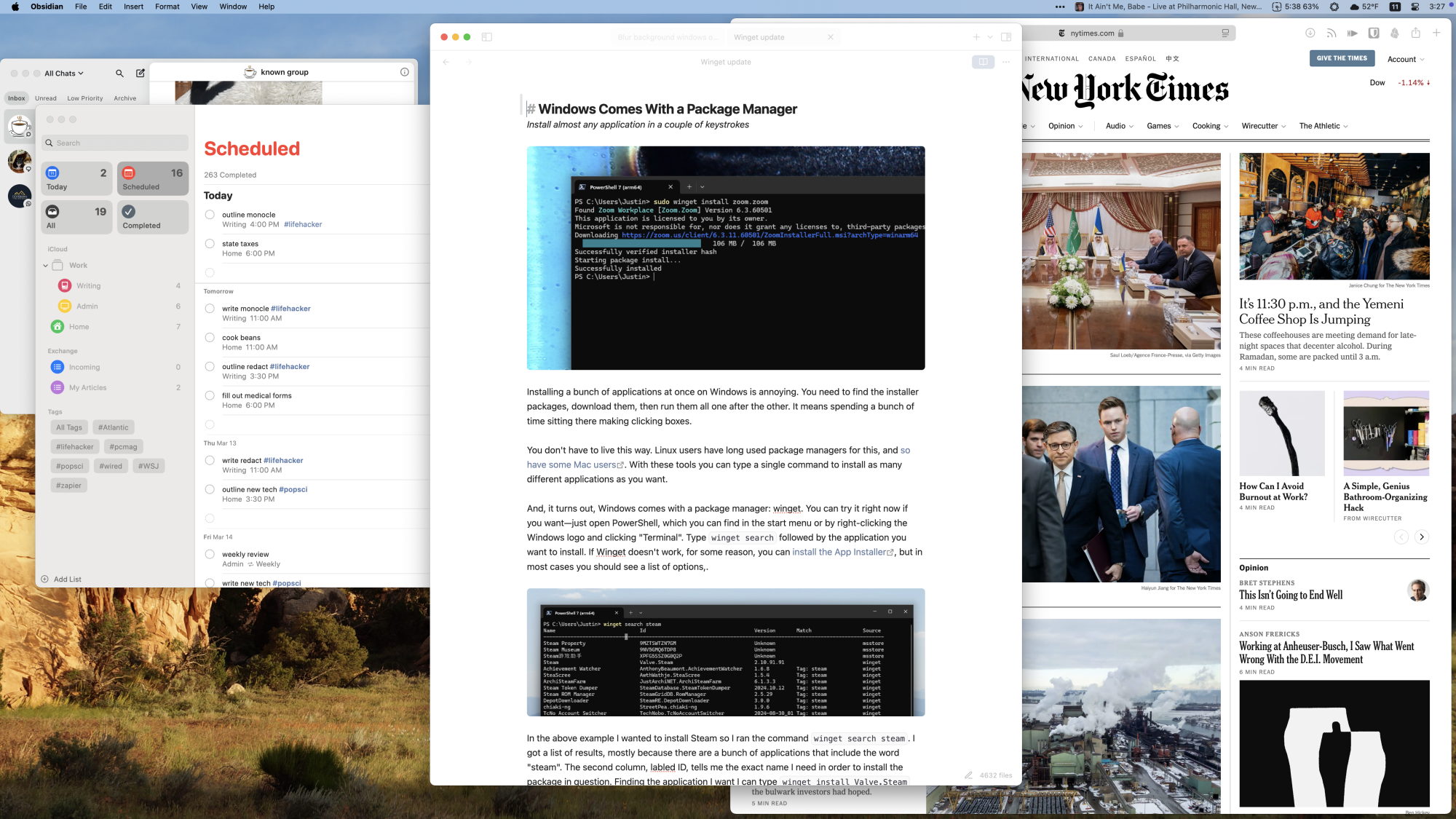
If this sounds a bit abstract, perhaps some screenshots will make things a bit more clear. Here’s a cluttered Mac desktop with multiple windows open:

A cluttered Mac desktop with many windows open

Credit: Justin Pot

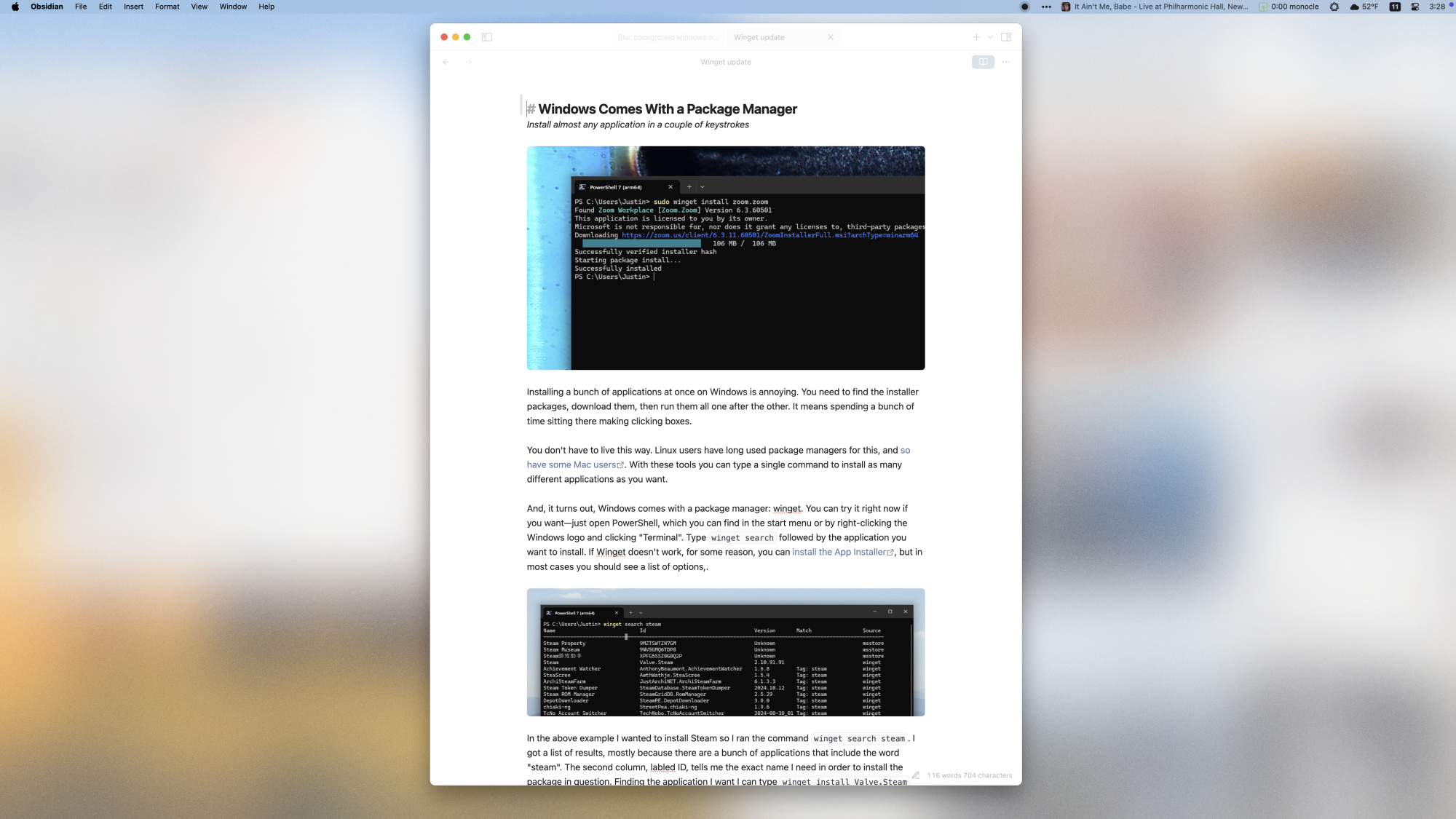
And here’s what that same desktop looks like with Monocle running:

The same desktop but only the middle window, which is a draft of a recent Lifehacker article I wrote, is showing completely—the rest, and the wallpaper, are blurred out.

Credit: Justin Pot

The currently open window is clear, as is the menu bar. All of the other windows, not to mention the wallpaper, are blurred. In theory, blurring everything you’re not currently working on will make it easier to focus.

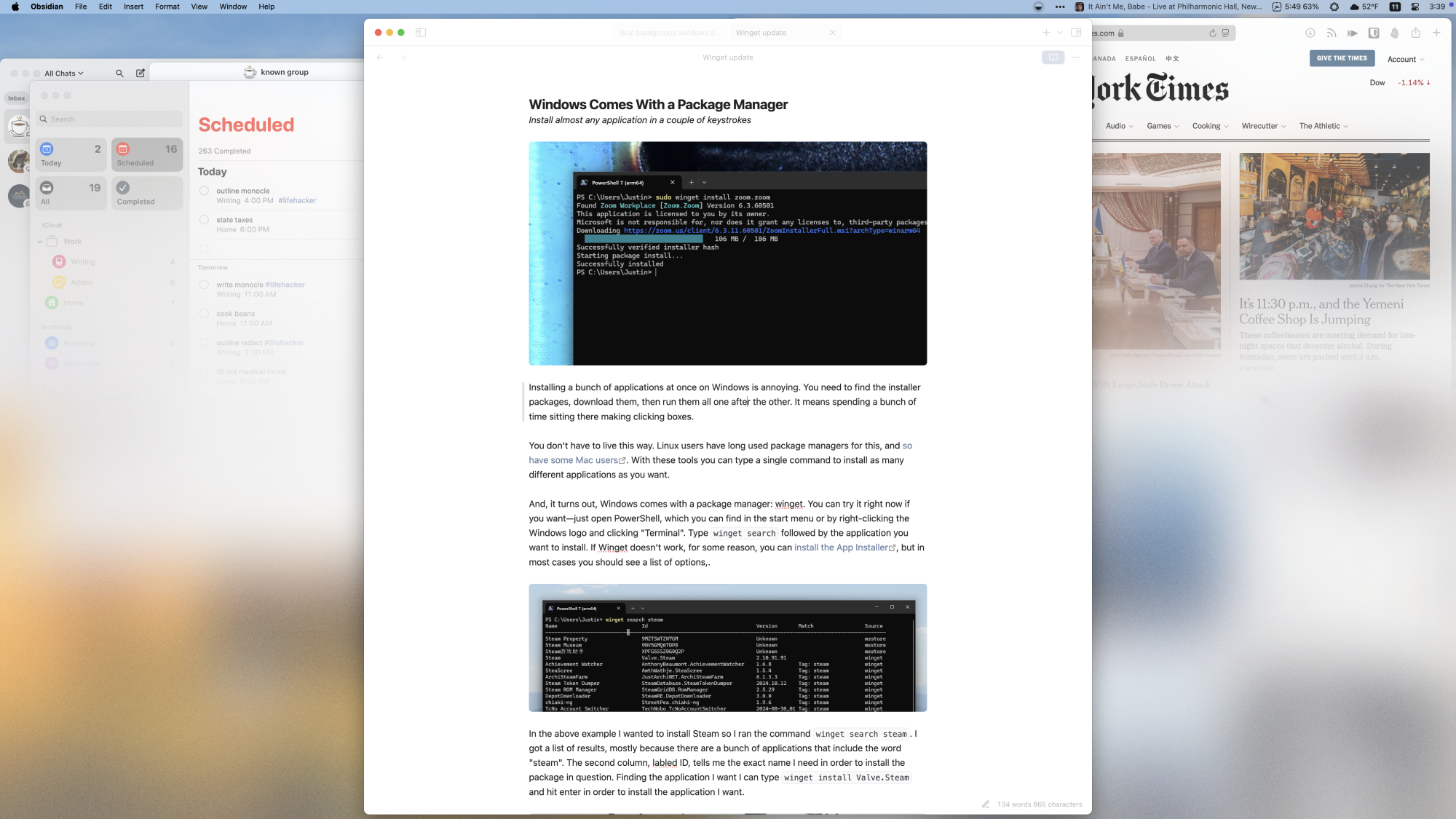
If this strikes you as too extreme, Monocle offers a compromise of sorts: an option that blurs only the bottom three quarters of each window. This allows you to note what’s open without getting sucked in:

The same desktop but the tops of each of the background windows are unblurred.

Credit: Justin Pot

There are a few more features in the settings worth exploring. You can exclude certain applications from triggering the effect, if you want. You can also adjust the graininess of the blurring and set up keyboard shortcuts for turning the feature on and off.

I tested out Monocle for a couple of days, mostly while writing. That, for me, is the primary task I do better at when I am solely focusing on the task at hand. For this use case, I found Monocle super helpful. It’s also the only time I really left the blurring turned on.

That’s because there are all sorts of tasks that actually require typing in one window while looking at another. When I’m researching, for example, I tend to have two windows open: Obsidian for my notes, and a browser for the information I’m gathering. I constantly need to be looking at both of those windows at once. I think most people have at least some tasks that likewise require multiple windows, and leaving blurring on during tasks like that isn’t going to be useful at all.

The good news is, you can toggle the blurring using either a keyboard shortcut or by clicking a menu bar icon. I recommend doing this often—it’s a good way to learn the kinds of work where you do (and do not) benefit from having multiple windows open. I also recommend hiding your Mac’s menu bar in addition to turning on the app—that blocks out even more things that could disrupt your focus.

If you’re curious about Monocle, the app offers a seven-day free trial. Try it out for yourself and see if it’s helpful.

Prince of Persia: The Lost Crown highlights March’s PS Plus lineup

Prince of Persia: The Lost Crown is the centerpiece of March’s PlayStation Plus game catalog entries. The critically acclaimed metroidvania title is accompanied by Captain Tsubasa: Rise of New Champions, UFC 5, Arcade Paradise and the, uh, unforgettably titled Bang-on Balls: Chronicles. Meanwhile, you’ll need a PS Plus Premium subscription to play the return of glorious PS1-era Mech-piloting action in the first three Armored Core games. This month’s arrivals will all be available from March 18.

Ubisoft’s Prince of Persia: The Lost Crown is, by all accounts, a terrific game. It has all the series’ elements like tight parkour controls, swordplay and challenging platforming (with a healthy share of magical secrets). Throw in its striking visual style with a rich color palette, and you have something special. Engadget’s Lawrence Bonk found it to be “a fantastic metroidvania that could easily sit next to some of the classics of the genre, like Hollow Knight and Castlevania: Symphony of the Night.”

Gameplay image of the gang of protagonists in Prince of Persia: The Lost Crown.
FromSoftware

It even has a handy “memory shards” feature that other metroidvania titles would do well to copy: Capture a screenshot of an area you want to return to later and pin it to your map. Lest the neat mechanic make things too easy (something the genre rarely has to worry about), you only get a limited number of memory shard slots.

Despite receiving rave reviews across the board, The Lost Crown reportedly only sold around 300,000 copies during its first few weeks after launch, so Ubisoft did its Ubisoft thing and disbanded the team that made it. (Sigh.) Although that means we almost certainly won’t see more DLC or a sequel, at least most of its developers are still working at Ubisoft on other projects. And hey, there’s another Prince of Persia game to look forward to as early as next year.

Image from the game Captain Tsubasa: Rise of New Champions.
Bandai Namco

Other highlights for Extra and Premium members include Captain Tsubasa: Rise of New Champions, which gives fast-paced arcade soccer a striking visual makeover (and a storyline!), and the nostalgic management sim (with bonus mini-games) Arcade Paradise.

You’ll also get the indie platformer Bang-On Balls: Chronicles, which is a bit like taking a 3D Kirby game, cutting most of the transformations and adding quirky, slapstick humor (like optional flatulence). There’s also UFC 5 if you’re into EA Sports’ take on bare-knuckle brawling.

Gameplay image of the original Armored Core game.
FromSoftware

Basking in the glow of the acclaimed 2024 entry Armored Core: Fires of Rubicon, Sony is turning back the clock to the series’ roots. PS Plus Premium subscribers can play Armored Core (1997), Armored Core: Project Phantasma (1997) and Armored Core: Master of Arena (1999) for the first time on their modern PlayStation consoles (PS5 and PS4).

The innovative (and highly customizable!) mech series laid the groundwork for the 2024 entry, which Engadget’s Igor Bonifacic praised as “an incredible achievement in game design and thematic cohesion, and, I think, a promise of what we can expect from FromSoftware’s next generation of talent.”

This month’s PS Plus games will be available from March 18. You can read the full list of entries on the PlayStation blog.

This article originally appeared on Engadget at https://www.engadget.com/gaming/playstation/prince-of-persia-the-lost-crown-highlights-marchs-ps-plus-lineup-194545416.html?src=rss

Google’s new robot AI can fold delicate origami, close zipper bags without damage

On Wednesday, Google DeepMind announced two new AI models designed to control robots: Gemini Robotics and Gemini Robotics-ER. The company claims these models will help robots of many shapes and sizes understand and interact with the physical world more effectively and delicately than previous systems, paving the way for applications such as humanoid robot assistants.

It’s worth noting that even though hardware for robot platforms appears to be advancing at a steady pace (well, maybe not always), creating a capable AI model that can pilot these robots autonomously through novel scenarios with safety and precision has proven elusive. What the industry calls “embodied AI” is a moonshot goal of Nvidia, for example, and it remains a holy grail that could potentially turn robotics into general-use laborers in the physical world.

Along those lines, Google’s new models build upon its Gemini 2.0 large language model foundation, adding capabilities specifically for robotic applications. Gemini Robotics includes what Google calls “vision-language-action” (VLA) abilities, allowing it to process visual information, understand language commands, and generate physical movements. By contrast, Gemini Robotics-ER focuses on “embodied reasoning” with enhanced spatial understanding, letting roboticists connect it to their existing robot control systems.

Read full article

Comments

Sonos reportedly scraps its long-expected streaming video device

Sorry to everyone who was waiting for Sonos to release a streaming video device — it seems that’s not happening anytime soon. The company is said to have canceled the long-expected product, which was reportedly far along in development.

Sonos leadership announced the cancellation in an all-hands call on Wednesday, according to The Verge. Interim CEO Tom Conrad says that, “for now,” the company won’t enter the streaming video market. The team that was working on the project, codenamed Pinewood, is set to be reassigned to other projects.

It was reported last month that Sonos could start selling the device this year for between $200 and $400. Pinewood was rumored to have a unified software experience with universal search for shows and movies from various streaming services like Netflix, Max and Disney+. Pinewood was believed to have Sonos Voice Control integration and to act as an HDMI hub for home entertainment devices such as game consoles. And, of course, the box would have synced with Sonos soundbars and speakers.

Per the report, Pinewood’s cancellation leaves Sonos without a major new product to start selling in the second half of 2025. Instead, it seems that the company will double down on rebuilding its reputation and the performance of its software after the disastrous rollout of a new mobile app in 2024.

That fiasco led to the ouster of former CEO Patrick Spence and other executives. Sonos also fired hundreds of workers as part of a restructuring plan.

Engadget has contacted Sonos for comment.

This article originally appeared on Engadget at https://www.engadget.com/entertainment/streaming/sonos-reportedly-scraps-its-long-expected-streaming-video-device-193445993.html?src=rss

D-Wave Claims ‘Quantum Supremacy,’ Beating Traditional Computers

D-Wave researchers have published findings in Science demonstrating what they call “quantum supremacy” by showing their quantum annealers can solve problems beyond the reach of classical computers. The team, led by Andrew D. King, demonstrated area-law scaling of entanglement in model quench dynamics of two-, three- and infinite-dimensional spin glasses.

The research shows quantum annealers rapidly generating samples that closely match solutions to the Schrodinger equation, supporting observed stretched-exponential scaling in matrix-product-state approaches. According to the paper, D-Wave’s processors completed these magnetic materials simulations in under 20 minutes, while the same calculations would require nearly a million years on Oak Ridge National Laboratory’s supercomputers.

The claim hasn’t gone unchallenged. Miles Stoudenmire from the Flatiron Institute’s Center for Computational Quantum Physics argues that classical computers can achieve comparable results using methods developed since D-Wave’s initial findings. “We’re just saying, ‘Look, this one problem at this one time didn’t beat classical computers. Try again,'” Stoudenmire noted. The quantum computing community has increasingly shifted terminology from “supremacy” to “advantage” or “utility,” focusing on solving practical business or scientific problems faster, more accurately, or more economically than classical alternatives.


Read more of this story at Slashdot.

My Favorite Amazon Deal of the Day: The Google Pixel 8a

We may earn a commission from links on this page. Deal pricing and availability subject to change after time of publication.

The new Pixel 9 lineup launched last summer—and the Pixel 9a is around the corner—so it’s no surprise there’s been a drop in prices for the Pixel 8 lineup. Amazon is offering the higher end Pixel 8 Pro for $599 (though prices seem to vary a bit based on location), but if your budget is a bit tighter, you can get the Pixel 8a for $399 (originally $499) after a $100 discount. That matches the Pixel 8a’s lowest-ever price, according to price-checking tools. (The Pixel 9a is likely to cost $499 when it launches, so if you want to save yourself some money and don’t need the latest device, this is a great choice.)

The Pixel “a” series is the Pixel lineup’s budget option. These devices tend to be missing some features of their pricier counterparts, but they often end up a better value for the money. For example, the Pixel 8a was available to preorder last May, and the biggest “cut” from the Pixel 8/8 Pro was the camera. Here is what assistant tech editor Michelle Ehrhardt had to say about the differences between the two:

The 8a’s camera is 64MP main wide/12MP ultrawide on the rear and 13MP on the front. By comparison, the regular Pixel 8 is 50MP main wide/12MP ultrawide on the rear and 10.5MP on the front. However, due to improved light sensing and pixel size, the Pixel 8’s camera may be a better choice for some.

The Pixel 8a has the same Tensor G3 processor as the Pixel 8/8 Pro, a slightly smaller 6.1-inch 120Hz “Actual” display, and a slightly better camera system in terms of pixels, but it may have weaker sensors. Still, the 8a is getting Google Gemini Nano support, like the other Pixels, along with seven years of guaranteed software support as well as the same new drop features. (You can read our full review of the 8a here.)

iRobot has new Roombas, but it doesn’t sound confident it’ll be around to sell them

iRobot, the creator of the Roomba and the company that popularized robot vacuums in the first place, told investors on Wednesday that it has “substantial doubt about [its] ability to continue.”

Beyond declining sales — the company reported that revenue decreased 47 percent in the US over the prior year in its fourth quarter earnings — iRobot is also struggling to pay off its debts. The company took on a $200 million bridge loan to stay afloat while it waited for its $1.7 billion acquisition deal with Amazon to be approved, which it’s still paying off.

The European Commission ultimately investigated the acquisition in 2023, and rather than address its concerns, Amazon terminated the deal and paid out its $94 million termination fee. That wasn’t enough to eliminate iRobot’s problems, though. The company now plans to review its options and see if it can find another way to stick it out, including “refinancing the company’s debt and exploring a potential sale or strategic transaction.”

The timing is particularly unfortunate given the line of new robot vacuums iRobot recently announced. The company has a new robot for most price points, but the Roomba 105 Vac Robot series, which are supposed to feature 70 times more suction than past models, and the Roomba Plus 505 Combo Robot + AutoWash Dock, which is able to clean corners better and has a dock that washes and heat-dries the robot’s mop, stand out as notable improvements. The company is also adopting lidar sensors across the board, something that was missing from previous robots and should allow for better, more accurate mapping.

It’s possible new products help iRobot get to a better place financially — the company still makes robots we recommend, after all — but that doesn’t change the fact that its facing stiff competition from companies like Roborock and Dreame, who are both getting much more adventurous with what their robot vacuums can actually do.

This article originally appeared on Engadget at https://www.engadget.com/home/smart-home/irobot-has-new-roombas-but-it-doesnt-sound-confident-itll-be-around-to-sell-them-191747458.html?src=rss

Everything You Can Expect to See at Google I/O 2025

Google I/O, the company’s annual developer’s conference, doesn’t start until May 20, but expectations are already swirling about what will be announced during the event. Here’s what we think might show up at this year’s Google I/O, plus details on how to watch.

When and how to watch Google I/O 2025

This year’s Google I/O is scheduled for May 20 and 21, with the first keynote beginning at 10 a.m. PT (1 p.m. ET). The event will be live streamed online at io.google and on YouTube. Anyone can view the keynotes and sessions without registering, though developers can register for free to receive event communications.

What’s coming to Google I/O 2025

The schedule for I/O 2025 hasn’t been published, and what we think we’ll see is (so far) based on rumors, speculation, and leaks. That said, there are a few things we can reasonably expect—or at least hope for.

First is the launch of Android 16, which Google has already pegged to Q2 2025. According to Android Police, leaks suggest an official release date of June 3, meaning an announcement at I/O is likely. Public betas have been rolled out with new features for photography, security, device management, foldable detection, and small tweaks to accessibility and health functionality.

Another possible release date announcement could come for Wear OS 5.1, which has some relatively minor new features and stability improvements. And while Google isn’t expected to launch Wear OS 6—which would follow suit with the release of Wear OS 4 in July 2023 and Wear OS 5 in July 2024—or even announce any of its features, it could hint at what we’ll see in Wear OS in the future.

Finally, Google recently confirmed the launch date for the first Android XR-powered headset and revealed more details about specs and features. This came following Samsung’s extended reality (XR) prototype reveal during January’s Galaxy Unpacked event. Other hardware news is less likely, as the Pixel 9a is expected to drop in March ahead of I/O.

Of course, AI is expected to be heavily featured at I/O 2025, with possible updates about Project Astra. The “advanced seeing and talking responsive agent,” announced at I/O 2024, is billed as a next-gen AI assistant that can receive real-world inputs and respond to what it sees. The event lineup could also include updates on Gemini features like Circle to Search, AI Overviews, and integrations with Android, Search, and YouTube—and maybe even the official switch from “Hey Google” to “Hey Gemini.”