Rondo Bogan ST’s new steel frame and progressive geometry are designed for bikepacking adventurers

Rondo has announced the release of its new Bogan ST, a fully redesigned off-road bike with an all-new steel frame, aimed at bikepackers.

The 2025 Bogan ST sports traditional tube profiles made from steel, a progressive geometry and a feature-filled design. It’s available for £2,899.

Alongside unveiling the Bogan, Rondo has confirmed full spec and pricing details for its IOON electric gravel bike, which scooped a Design and Innovation award when it was announced in January.

The Fazua mid-motor powered IOON follows in the footsteps of bikes such as the highly capable Mylc and soft-tailed RUUT.
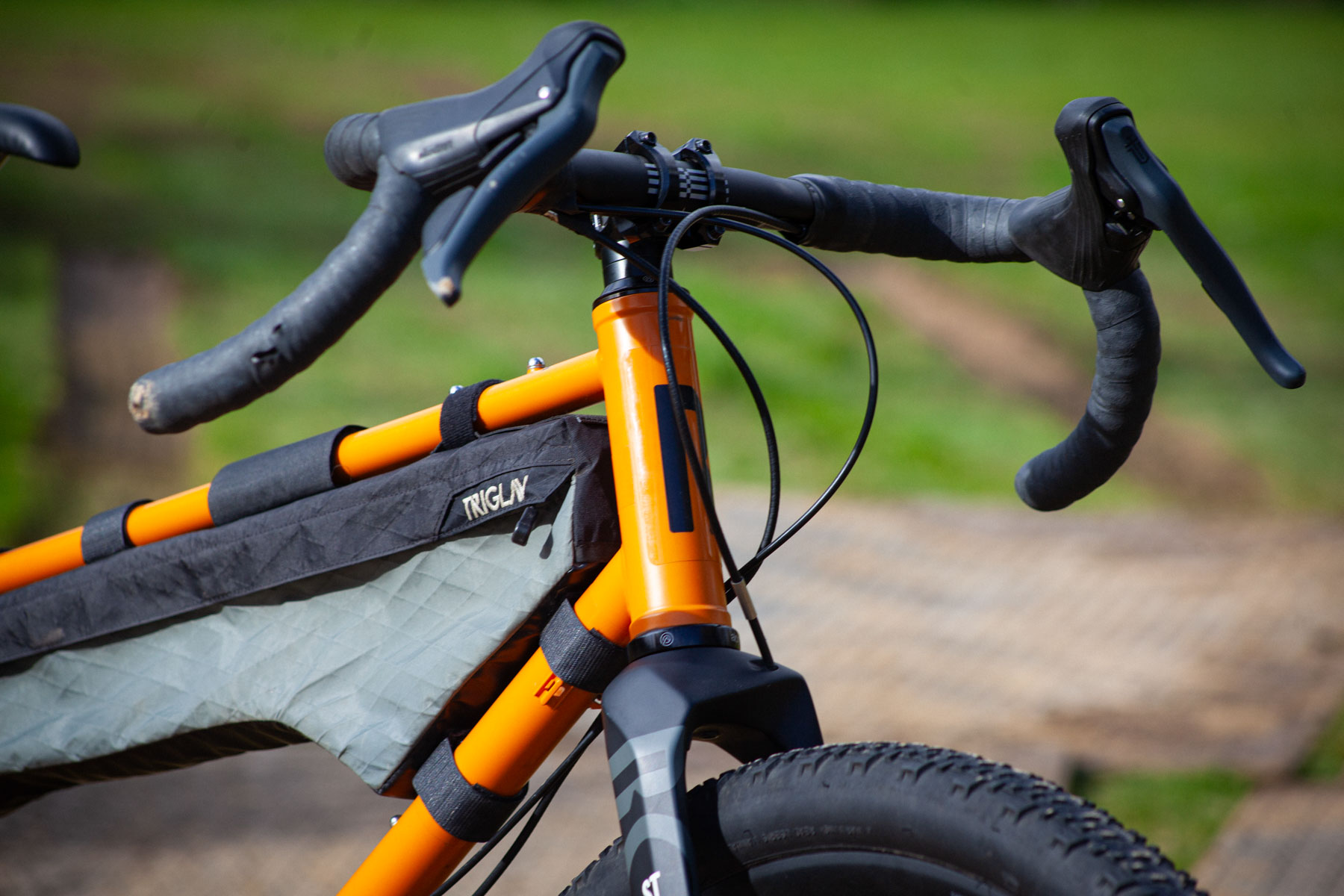
Bogan front end detail
The Bogan’s tough construction includes a ring-reinforced head tube. Warren Rossiter / OurMedia

The new 2025 Bogan has been redesigned from the ground up.

The all-new steel frame comes with geometry that Rondo says has been optimised to keep a fully laden bike more stable on rough terrain.

The slackened front end features a longer fork, making the Bogan suspension-ready.
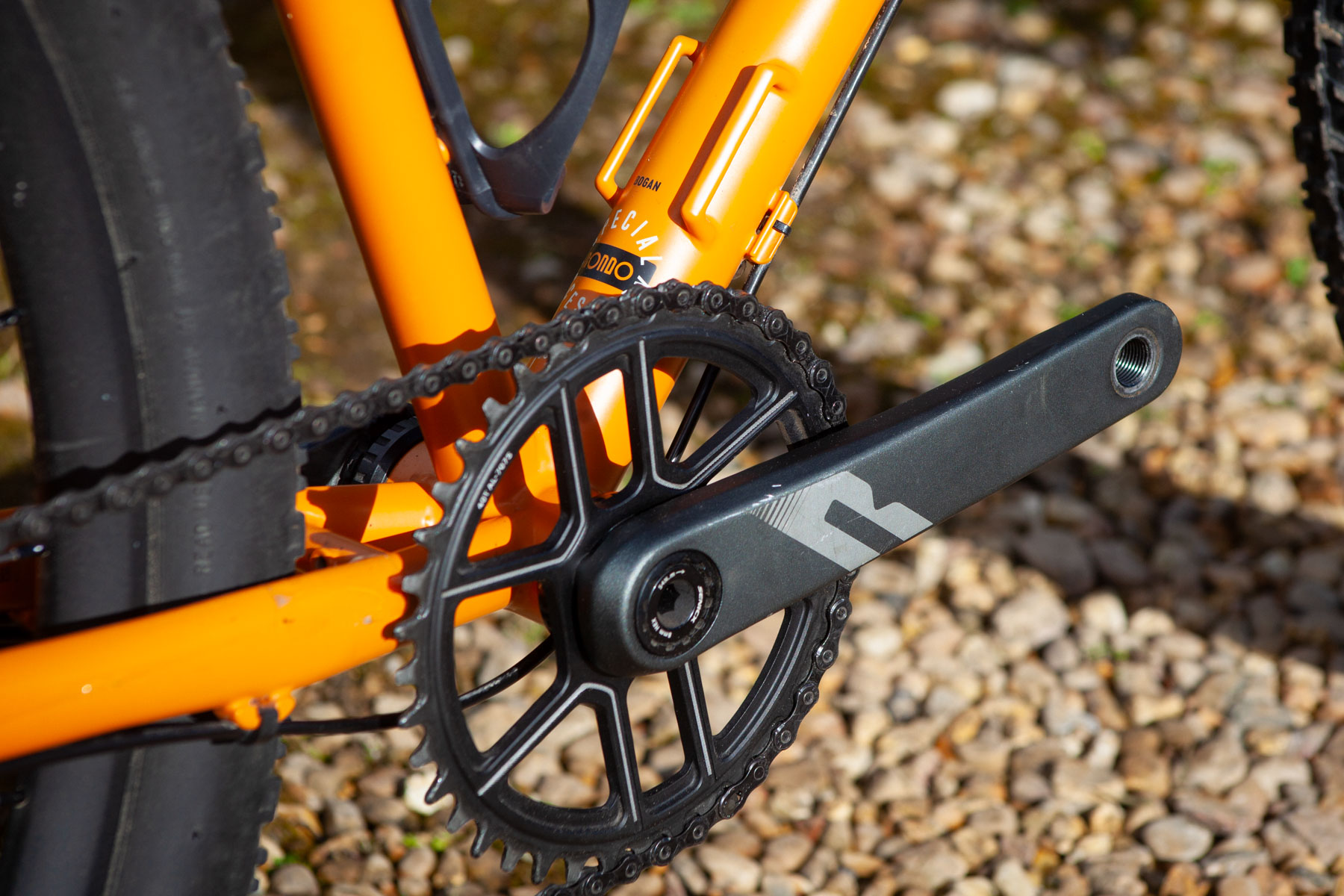
Rondo Bogan bottom bracket
The Bogan comes with a wealth of fittings for the adventurous gravel rider. Warren Rossiter / OurMedia

The tyre clearance is larger than the previous iteration, at 29×2.1in, or 27.5 with 2.6in tyres.

The down tube has external routing braze-ons, along with multi-bottle mounts and bars to strap a tool roll to easily.

The back end is SRAM Universal Derailleur Hanger and full-mount compatible.
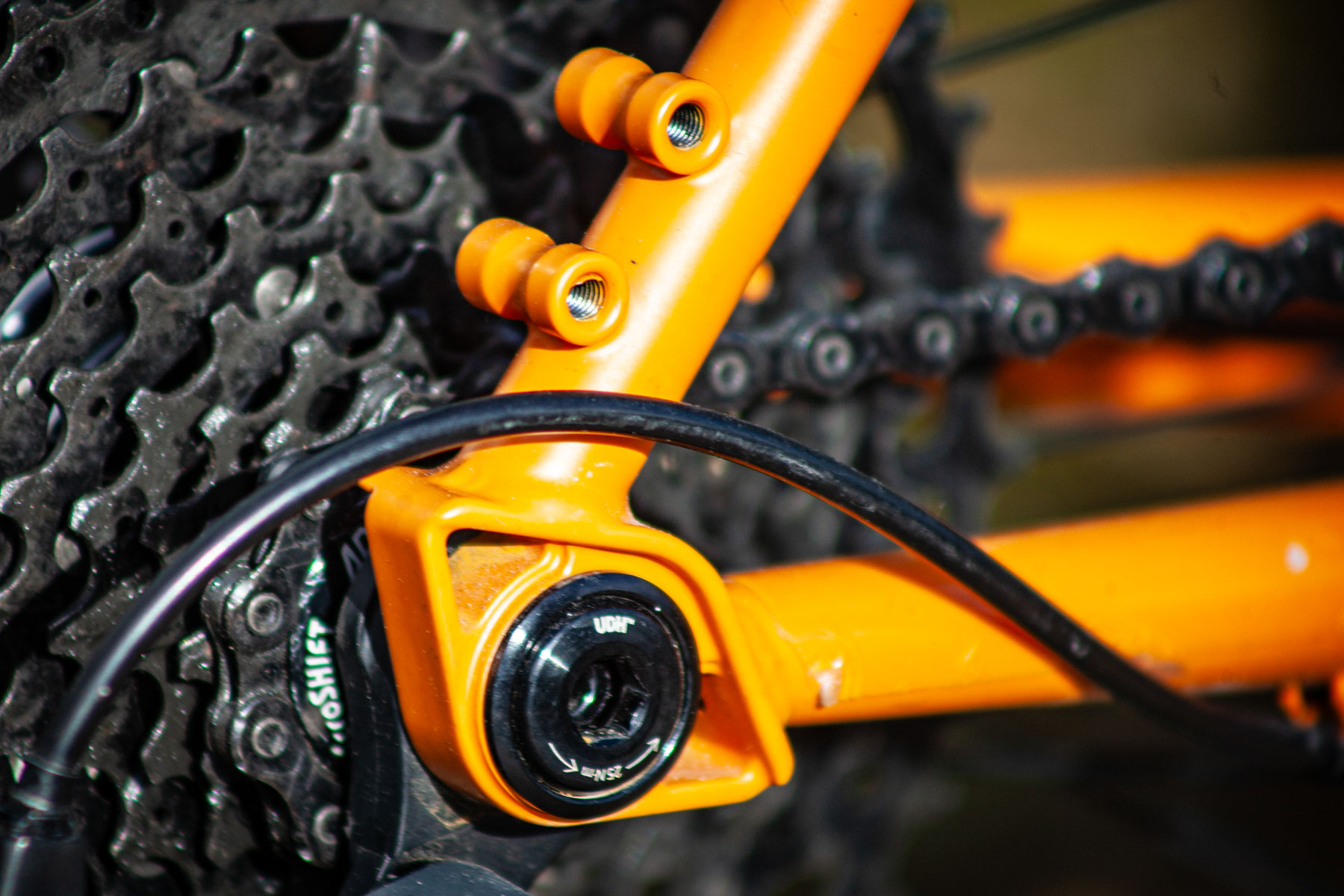
Rondo Bogan rear dropout
The new Bogan has gone UDH. Warren Rossiter / OurMedia

The Bogan comes complete with a made-to-measure frame bag, courtesy of Polish brand Triglav.

The Bogan ST is priced at £2,899 with SRAM Apex hydraulic brakes, X1 1×12 drivetrain and WTB Sport Terra wheels.


Rondo goes electric with the IOON
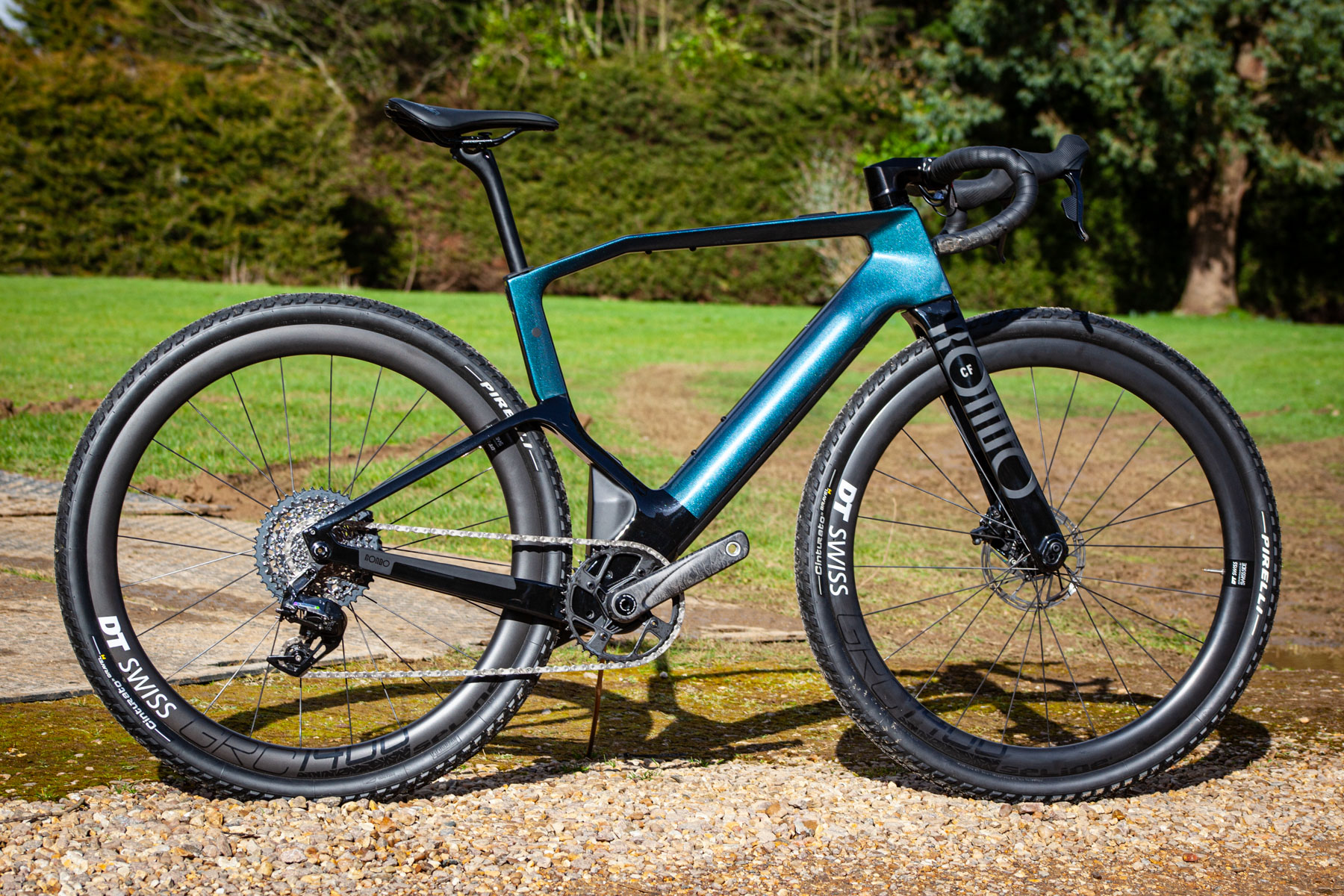
Rondo IOON
The IOON shares its angular design with the Rondo RUUT. Warren Rossiter / OurMedia

The IOON electric gravel bike made headlines earlier in the year when it won a Design and Innovation award.

The frameset, which bears plenty of resemblance to the pedal-powered Rondo RUUT, houses a Fazua Ride 60 drive system comprising a removable down-tube battery and a mid-mount motor.
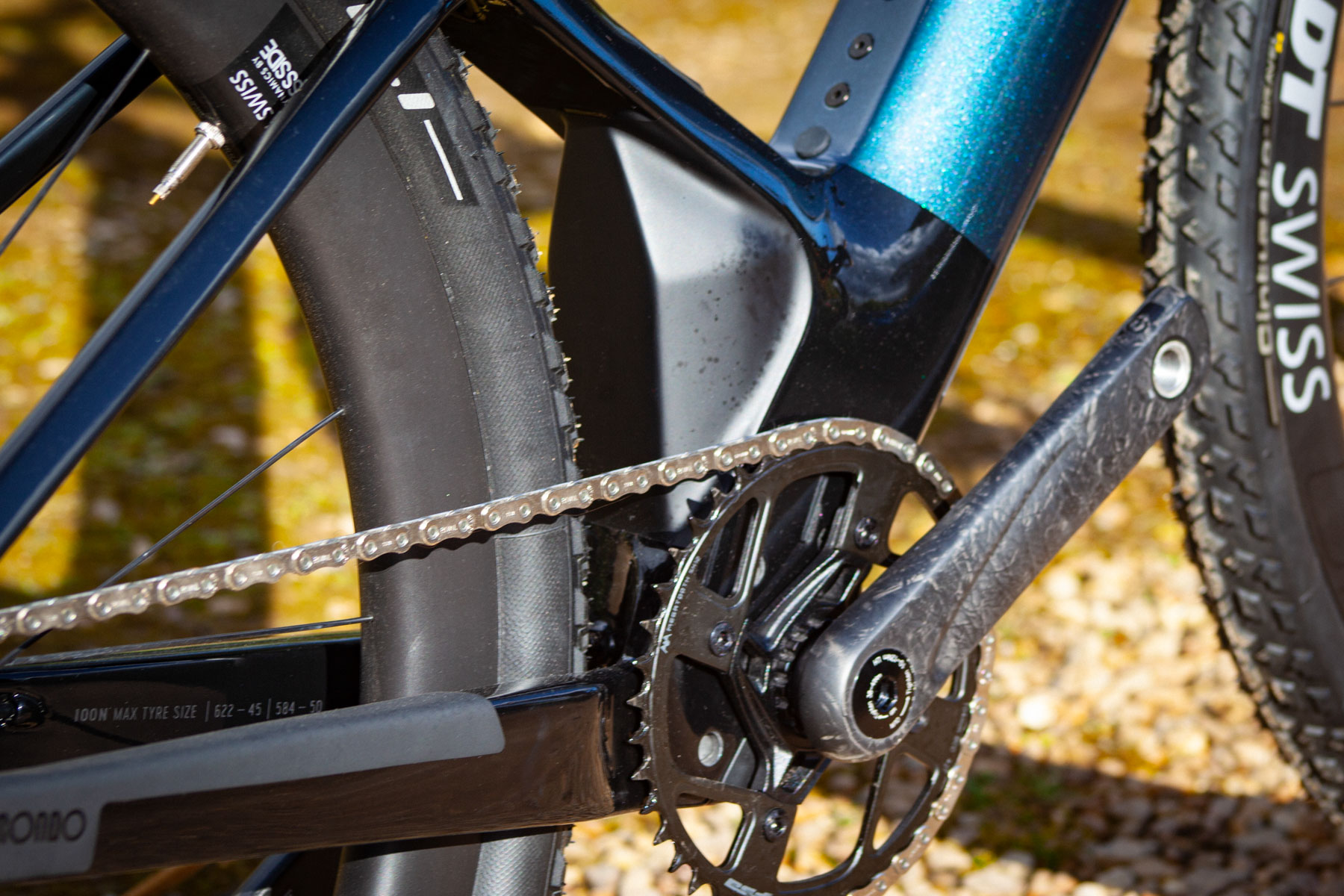
Rondo IOON bottom bracket shell detail
The IOON disguises its mid-motor and down-tube battery well. Warren Rossiter / OurMedia

The IOON CF1 comes with a SRAM Force drivetrain (although not necessarily the same Force drivetrain as this pre-production sample), DT Swiss HGC 1400 gravel wheels, a Fazua Ride 60 powertrain with a new 430Wh battery and a new Rondo ICF cockpit, including a new forged carbon stem.
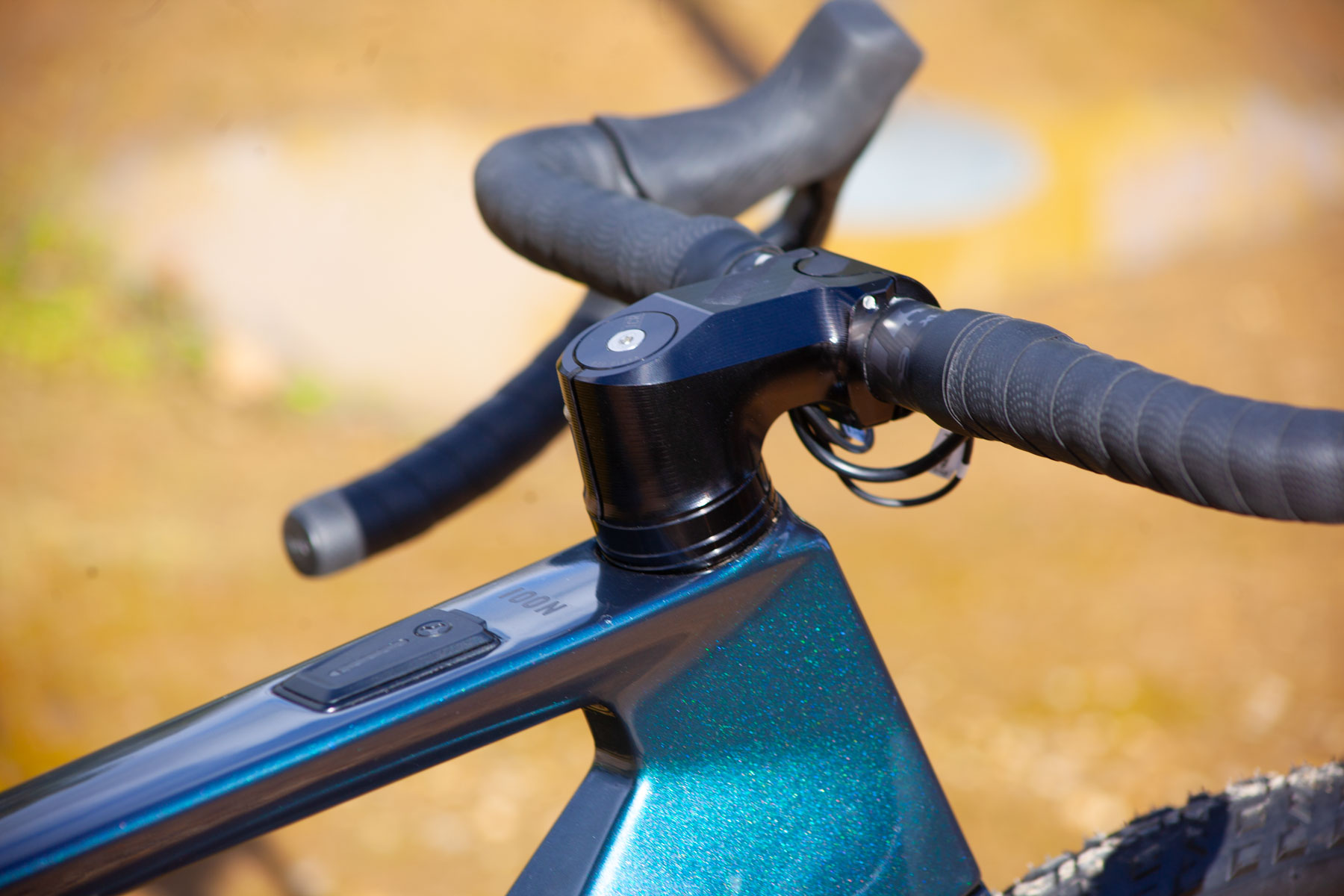
Rondo IOON stem detail
The IOON’s top-tube controller and forged carbon stem. Warren Rossiter / OurMedia

The CF1 is priced at £8,999, while Rondo is also offering a CF2 model with SRAM Apex AXS, Rondo wheels and the same powertrain for £6,199.

For those who prefer their gravel bikes to be of the flat-bar persuasion, there’s the IOON CFU with SRAM Apex AXS, DT Swiss HG1800 wheels and 50c Vittoria Terrino Max tyres for £5,999.
Announcing ECRO: a Comprehensive Racing Platform for Virtual Cycling

The world of virtual cycling continues to evolve, and the new E-Cycling Race Organization (ECRO) may just represent the next significant leap forward for competitive Zwift racing. Building upon the foundation established by the Chasing Tour, ECRO aims to “create a more immersive and strategic virtual cycling experience that benefits riders and team managers alike.”

From Chasing Tour to ECRO

Founded in 2022 by Jonathan Morin, the Chasing Tour successfully established a year-long racing calendar that brought structure and continuity to the Zwift racing scene (read about Chasing Tour 2023 here). Jonathan built ECRO by expanding this foundation into a comprehensive platform that introduces elements previously unseen in virtual cycling competitions.

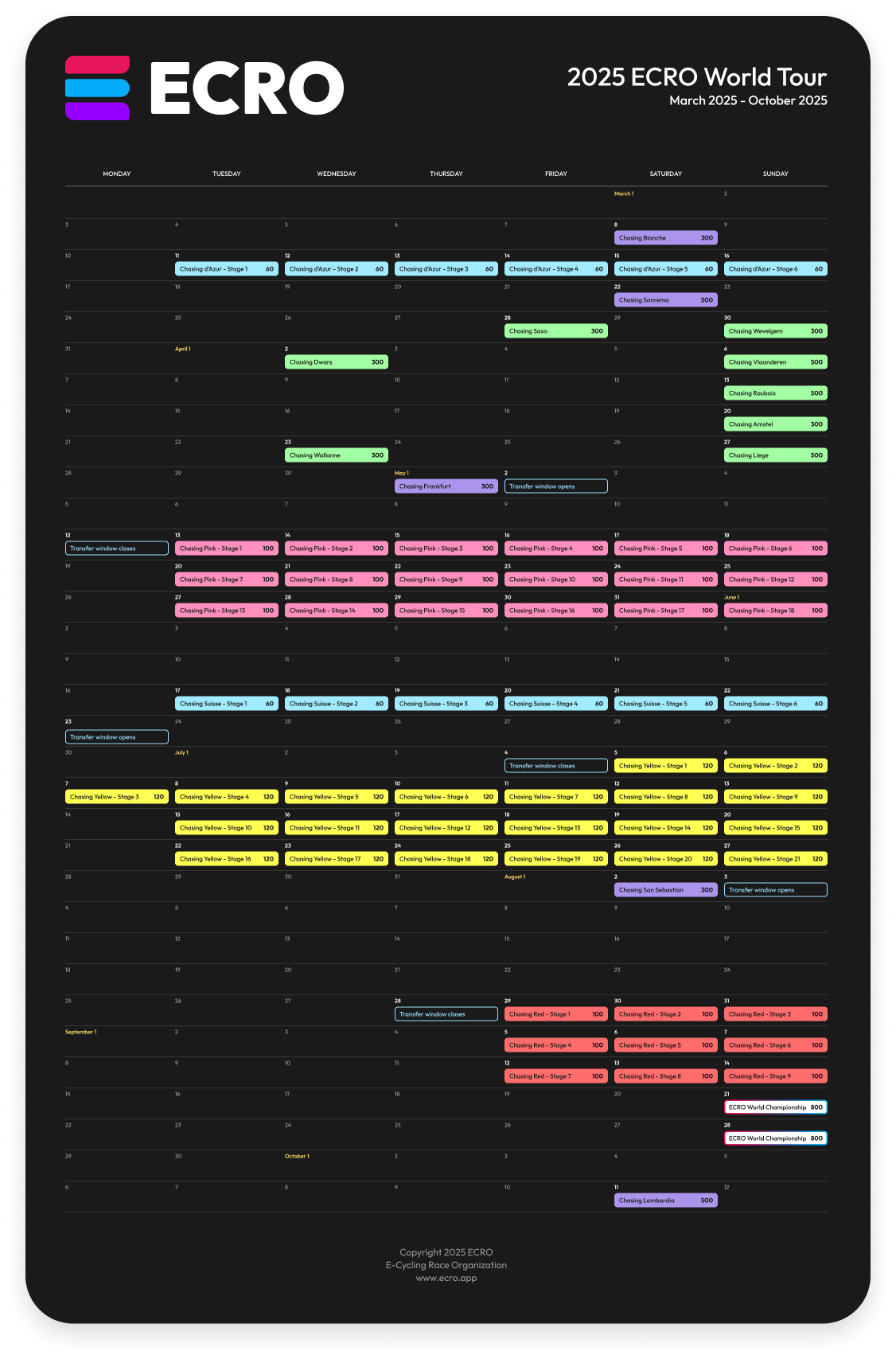
The ECRO World Tour 2025 will feature 75 races throughout the year, including single-day races, week-long tours, and three multi-week grand tours. This extensive calendar establishes a professional-level competition structure that mirrors real-world pro cycling, and it all kicks off on March 8, 2025, with Chasing Bianche!

New Dimensions: Rider Economics and Team Management

What sets ECRO apart is its introduction of economic elements to virtual cycling. The platform implements features like:

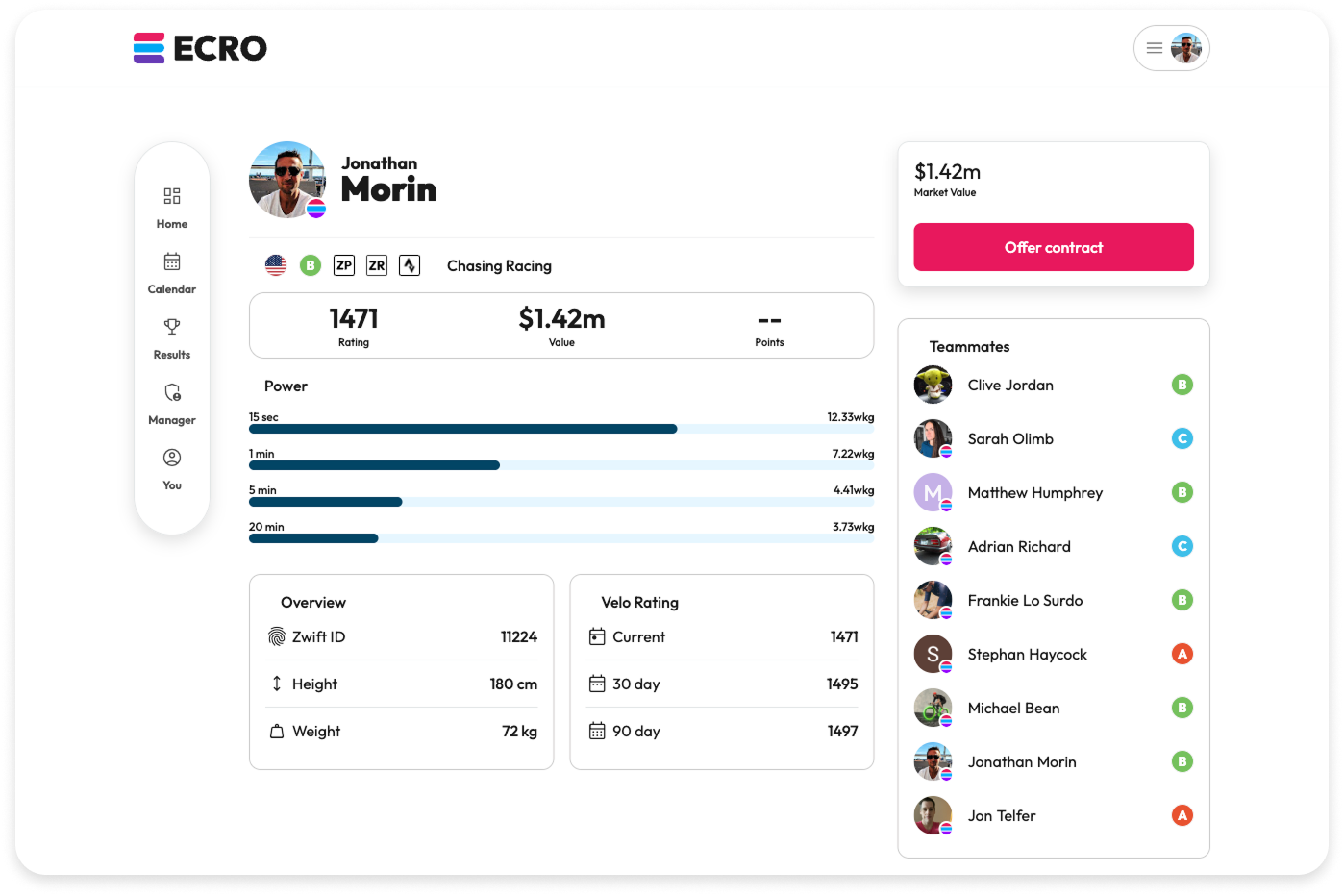
  • Rider Market Values: Riders have assigned virtual monetary values based on their performance and category
  • Team Contracts: Teams can sign riders to formal agreements
  • Rider Transfers: A transfer system allowing riders to move between teams
  • Team Financials: Teams manage a virtual budget, profiting from rider development and transfers

(It’s important to note that all financial aspects within ECRO—including rider values, team budgets, and prizes—are virtual and do not represent real-world currency. These virtual economics simply add an engaging layer of strategy and simulation to the competition.)

Clear Categorization

ECRO employs a straightforward categorization system based on the zwiftracing.app 90-day vELO ratings:

� A Category: 1900+ rating
� B Category: 1450-1899 rating
� C Category: 1150-1449 rating
� D Category: 850-1149 rating
� E Category: 0-849 rating
This system ensures fair competition within all skill levels, and scheduled recategorization points throughout the season help maintain competitive balance.

Team Structure and Competition

Teams add another dynamic element to the ECRO World Tour:

  • Teams can consist of up to 12 riders across any of the 5 categories
  • The top 6 riders in each category earn points for their team
  • Teams accumulate points throughout the season for overall standings

Comprehensive Scoring and Competition Format

ECRO’s competition structure is multi-layered, offering riders and teams various ways to earn points:

  1. Individual Race Events: Points awarded based on race tier and finishing position
  2. Stage Races: Multi-race competitions using a global time-gap system pioneered by Chasing Tour to determine overall standings
  3. Seasonal Series: Multiple races where cumulative points determine the winner
  4. Season-Long Competition: All points contribute to the overall ECRO World Tour standings

This structure rewards consistent participation and performance throughout the season, encouraging engagement with the entire calendar of events.

Registration and Pricing

To participate officially in the ECRO World Tour, riders and teams must obtain licenses:

  • Rider License: $7.99 for the 2025 season
  • Team License: $12.99 for the 2025 season

(While anyone can participate in ECRO events on Zwift, only licensed riders will have their results counted toward the official ECRO World Tour standings. These fees support the ongoing development of the platform.)

Benefits for the Entire Zwift Racing Ecosystem

ECRO’s approach delivers benefits to riders and managers alike:

For Riders:

  • Verified ECRO rider accounts with clear categorization
  • Opportunities to join teams and develop virtual cycling careers
  • Points-based competition with virtual prizes
  • Professional racing structure

For Team Managers:

  • Team creation and management tools
  • Strategic rider recruitment and contract management
  • Virtual financial system with potential growth through smart team building
  • Season-long competition against other teams

Only on Zwift

According to Jonathan, “ECRO has chosen Zwift as its exclusive platform because Zwift provides the best in-game racing experience available in virtual cycling. The robust features, established community, and technical capabilities of Zwift create the perfect environment for ECRO’s vision. By building on Zwift’s foundation, ECRO is invested in seeing Zwift continue to be the home of elite e-cycling racing, furthering the platform’s position as the premier virtual cycling experience.”

Looking Ahead

The ECRO platform represents the most comprehensive attempt yet to create a professional-level virtual cycling ecosystem that mirrors the structure, strategy, and engagement of real-world professional cycling.

So whether you’re a casual Zwift racer looking to test yourself against others, a competitive rider seeking structured competition, or someone interested in the team management aspects of cycling, I’d recommend looking into what ECRO is doing today.

For more information or to register for the ECRO World Tour 2025, visit www.ecro.app.

Your Thoughts

What do you think of ECRO’s approach to Zwift racing? Share your thoughts below!

Sidi’s new Atomus GTX is designed for gravel riding but looks more like a hiking boot

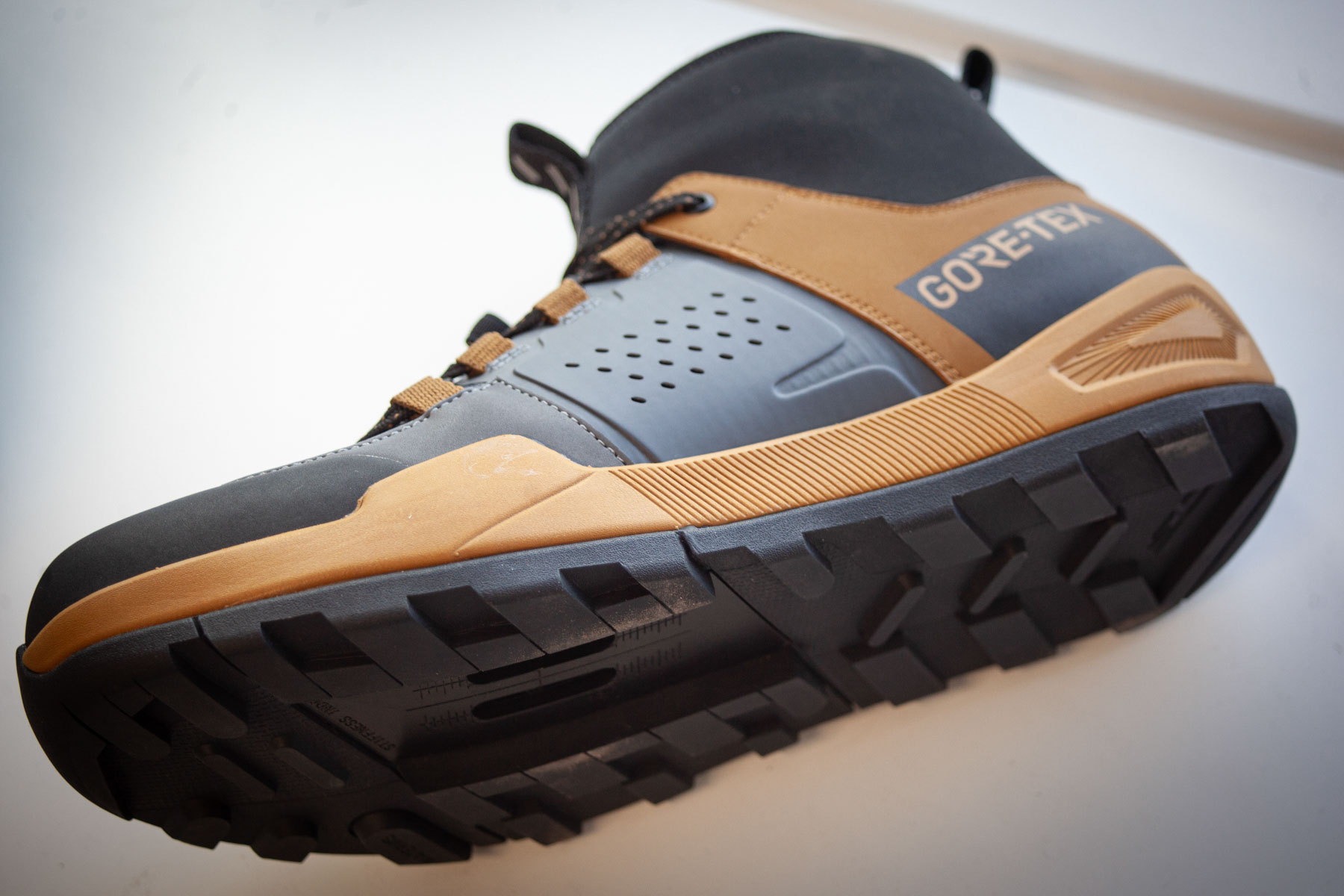
Sidi’s new Atomus GTX gravel boot takes the Italian shoemaker far away from its established racing roots.

Available from September, the Atomus GTX combines the rugged looks of a hiking boot with lots of practical tech for adventure and gravel riding.

The upper combines a padded outer with a high-top neoprene-like wrap-around cuff. Internally, there’s a full Gore-Tex membrane for added weather-proofing.

Sidi Atomus Gravel GTX
The Sidi Atomus Gravel GTX features a Gore-Tex membrane for all-weather use. Warren Rossiter / OurMedia

The outsole has a soft, pliable, deep tread and, while the cleat plate is stiff, the outsole has plenty of flex.

The new gravel boot registers a 3 out of 10 on Sid’s own stiffness scale. It is expected to retail for £250.

Strava apologises and backtracks on decision to ban links on its platform

Strava has issued an apology for its controversial decision to ban URL links on its platform late last year, and says it has reinstated this feature in a more limited form.

In a blog posted on its website on 3 March 2025, the popular cycling app wrote: “We recognize that disabling and removing links last September was disruptive to our community.”

Strava says its initial decision to ban links – a move that also saw all historic links on the site removed – was “necessary to protect users from a wave of harmful spam attacks that included links to fraudulent and misleading content”.

It concedes, however, it “moved fast” and “didn’t clearly communicate” the reasons behind the ban.

As a result, Strava says it is “sorry for the frustration this caused, and moving forward, we’re committed to greater transparency”.

Links are back on Strava – but there’s a catch

Links are back on Strava
Links are now allowed on Strava again, but only in certain places and to certain things.

Since links were banned and deleted in October 2024, Strava says it has made “significant improvements” to its spam detection systems, including an “an upgraded machine learning model”.

This, it says, has empowered it to re-enable links in user posts “in the places that matter most”.

So, while links will be allowed on Strava again, there are limitations on what and where its users can link to.

Strava says “anyone” (whether they are a free user, a subscriber or a verified athlete) can post links to the following areas of Strava:

  • Athlete profile
  • Club description 
  • Event descriptions
  • Activity descriptions

Strava says, however, that “only admins of verified clubs will be able to post links in club posts”.

This means club members will not be able to include links in club posts.

It also says “links to external websites are limited”. Exactly what this means remains to be seen, but it may remain difficult to link to sites such as charity collection pages, rider blogs or even your favourite multi-discipline cycling website, BikeRadar.

Strava says updates to its spam detection systems mean it can re-enable link sharing on its platform.

Previously shared links will not be reinstated

While it apologised for removing historic links last year, Strava nevertheless says “previously shared links will not be reinstated” on its site.

It also says any text posted on Strava that “was unintentionally identified and removed as a link” would not be reinstated either.

Justifying its decision, Strava wrote: “Our goal is to nurture sharing and engagement across our platform in an organic, helpful, and least disruptive manner.”

“To do this, we are re-enabling link sharing across some of the most engaging parts of Strava where this can be the most meaningful”.

Zwiftcast Episode 212: Women’s History Month Special 1 of 2

In March, Zwiftcast is spotlighting incredible women’s stories with two special episodes celebrating of Women’s History Month! Also this month, complete any Zwiftcast ride to unlock the exclusive Watch the Femmes headphones and show your support.
In this episode, hosts Rebecca Charlton, Dave Towle, and Kate Veronneau bring you all the latest news, including the return of Zwift Games and a look forward to Paris Roubaix Femmes Avec Zwift and the Tour de France Femmes Avec Zwift 2025. Plus, Wheel Talk Podcast hosts Abby Mickey, Loren Rowney, and Gracie Elvin pop in to talk Zwift cycling and motherhood.

Links/events mentioned in the episode:


Zwiftcast is available on Podbean, Apple Podcasts, YouTube, Amazon Music, and Spotify.

New Specialized Vado SL 2 Alloy ebike costs £2,000 less than its carbon equivalent

The new Specialized Vado SL 2 Alloy has an aluminium frame and costs around £2,000 less than the carbon version that was released last year. 

Trading carbon for aluminium has added some extra weight to the new Vado, but Specialized says it still weighs “as little as 20kg”, depending on the model. 

Available in two builds and with prices starting from £3,500, this new electric commuting bike benefits from many of the same features and tech as the lighter carbon models. 

As with its carbon equivalent, Specialized says the new Vado SL 2 is a “high-performance vehicle” that’s destined to relegate your car.

Motor and battery

Specialized Vado SL 2 Alloy motor.
The aluminium Vado SL 2 has the same motor as the carbon version. Specialized

At the heart of the aluminium Vado SL 2 Alloy lies the Turbo SL 1.2 electric bike motor. This is the same motor system as found in the Turbo Creo 2 SL and Levo SL electric mountain bike, which delivers up to 50Nm of torque.

Specialized claims the motor produces 43 per cent more torque and 33 per cent more power than the previous-generation SL 1.1, and is said to be quieter than its competitors from Fazua and TQ. 

The battery capacity for the alloy models remains unchanged at 520Wh, which Specialized says can deliver up to five hours of assisted riding. For riders looking for even more range, there’s the Range Extender, a 160Wh external battery that mounts to the bike via a bottle cage (sold separately).

Those who want to dive into their performance diagnostics can do so with the Specialized App, which displays how the battery charge is used and can also record heart rate, cadence and power data. 

Tech and features

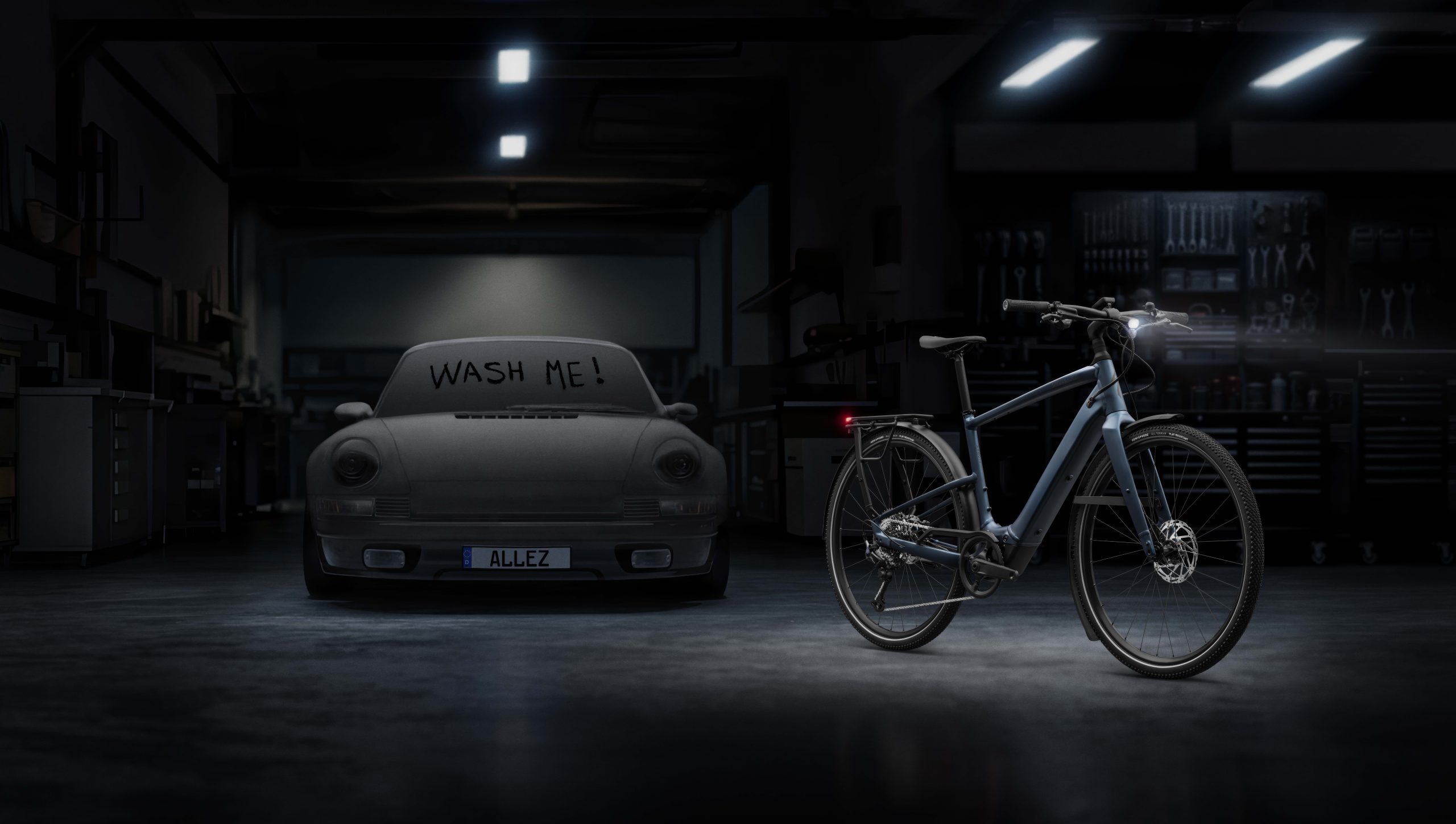
Specialized Vado SL 2 Alloy next to dirty car with 'wash me' written in dust on window.
Specialized says calling the Vado an ebike is “an insult” – implying this vehicle will replace your car. Specialized

While the more affordable Vado gets the same motor and battery as the carbon models, Specialized has downgraded it to the previous-generation Future Shock 3.1 damping system, not the FS 3.2 found on the carbon Vado. 

Nevertheless, it benefits from the system’s 20mm of travel, located between the stem and head tube.

The wide, 47mm tyres found on the more premium models make an appearance here though, promising to make the metal Vado capable on and off the tarmac. 

With the Specialized App, Vado owners can keep track of their bike’s health and be notified of any required servicing. 

When a service is required, the bike’s computer holds the relevant diagnostic data for Specialized dealers and approved bike shops to carry out the necessary work. 

Once complete, the service is recorded and synced to the owner’s Specialized App, which the brand says provides owners with a service history – just like a car.

The onboard computer is also Apple Find My enabled, which should offer iPhone users the ability to track their bike if it’s stolen. 

Equipped to carry

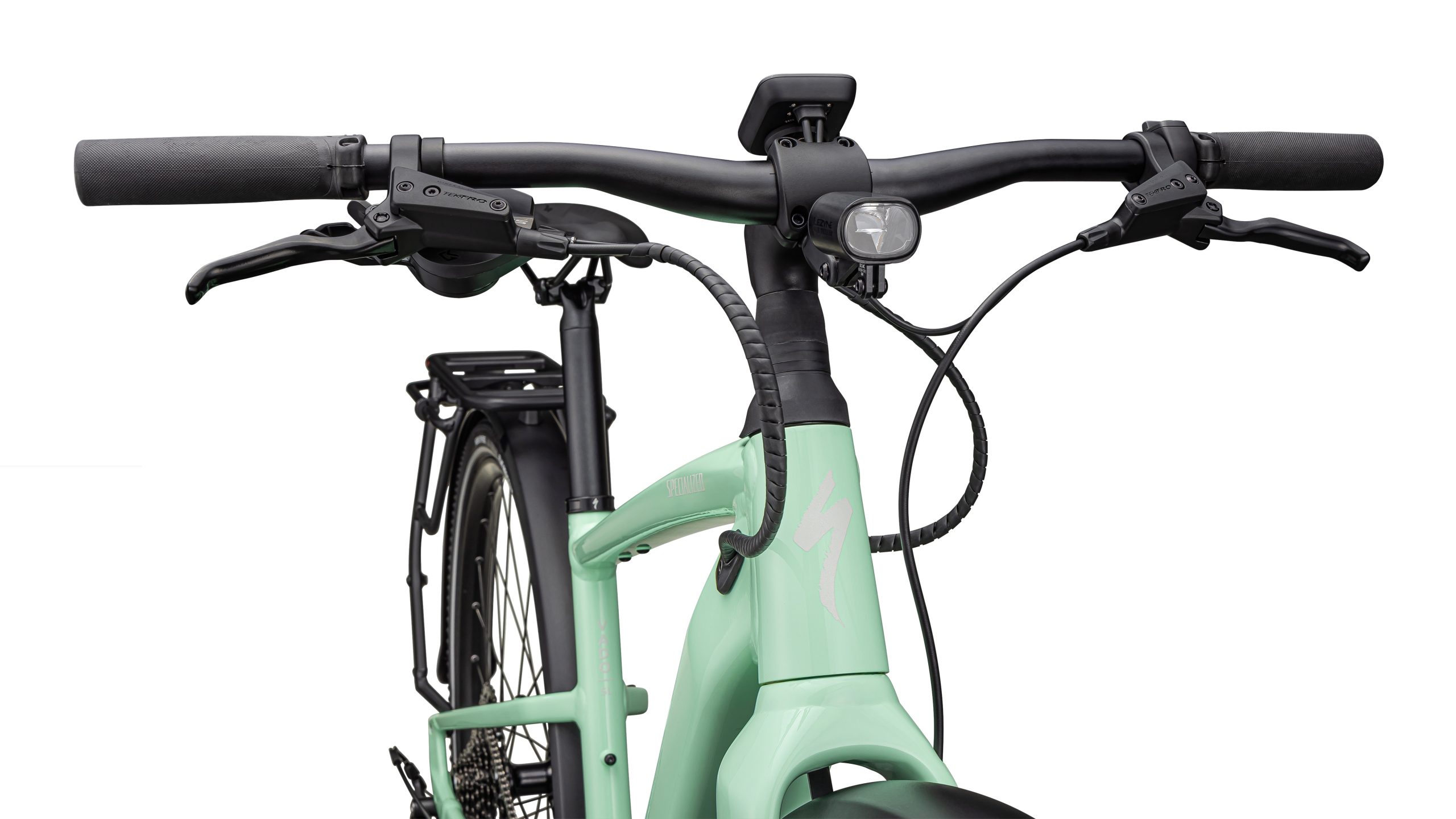
Specialized Vado SL 2 Alloy handlebar with light.
The Vado SL 2 Alloy comes with a rack and front light as standard. Specialized

Unlike the carbon Vado, which is available in both a bare-bones build and the cargo-ready Equipped model, the new aluminium Vado 4.0 and 5.0 are sold exclusively in the latter configuration.

The aluminium models come fitted with an MIK HD pannier rack (which is rated to carry up to 27kg) and DryTech fenders front and rear. 

Road safety and visibility during after-hours riding are taken care of by the included Spanninga Glow Brake Alert Taillight, and both models benefit from front lighting as standard. 

Availability and pricing

Specialized Vado SL 2 Alloy step-through.
It’s also available in a step-through design. Specialized

The aluminium Vado SL 2 is available in two ‘equipped’ iterations, dubbed 4.0 EQ and 5.0 EQ. Unlike the carbon models, they are both available with a step-through frame. 

The Vado SL 2 4.0 EQ is the most affordable option in the line-up, costing £3,500 / $4,500 / €4,250. 

Spend £300 (or $500) more and you get the Vado SL 2 5.0 EQ, which benefits from upgraded Tektro brakes and an 11-speed Shimano Cues drivetrain.

Say goodbye to slipped pedals with Race Face’s new ‘ultra-concave’ Turbine flats

Race Face has released its new Turbine Pedals, which are designed to offer a ‘locked-in’ ride feel for riders seeking extreme levels of grip.

The new mountain bike pedals are positioned towards riders at the rowdier end of the sport, with Race Face saying it has designed the Turbine Pedals for those who want their feet to stay planted no matter the terrain.

At $180 / €199 / AU$295, the Turbine Pedals are priced similarly to the brand’s Atlas pedals, which remain in the Race Face line-up as a less aggressive option.

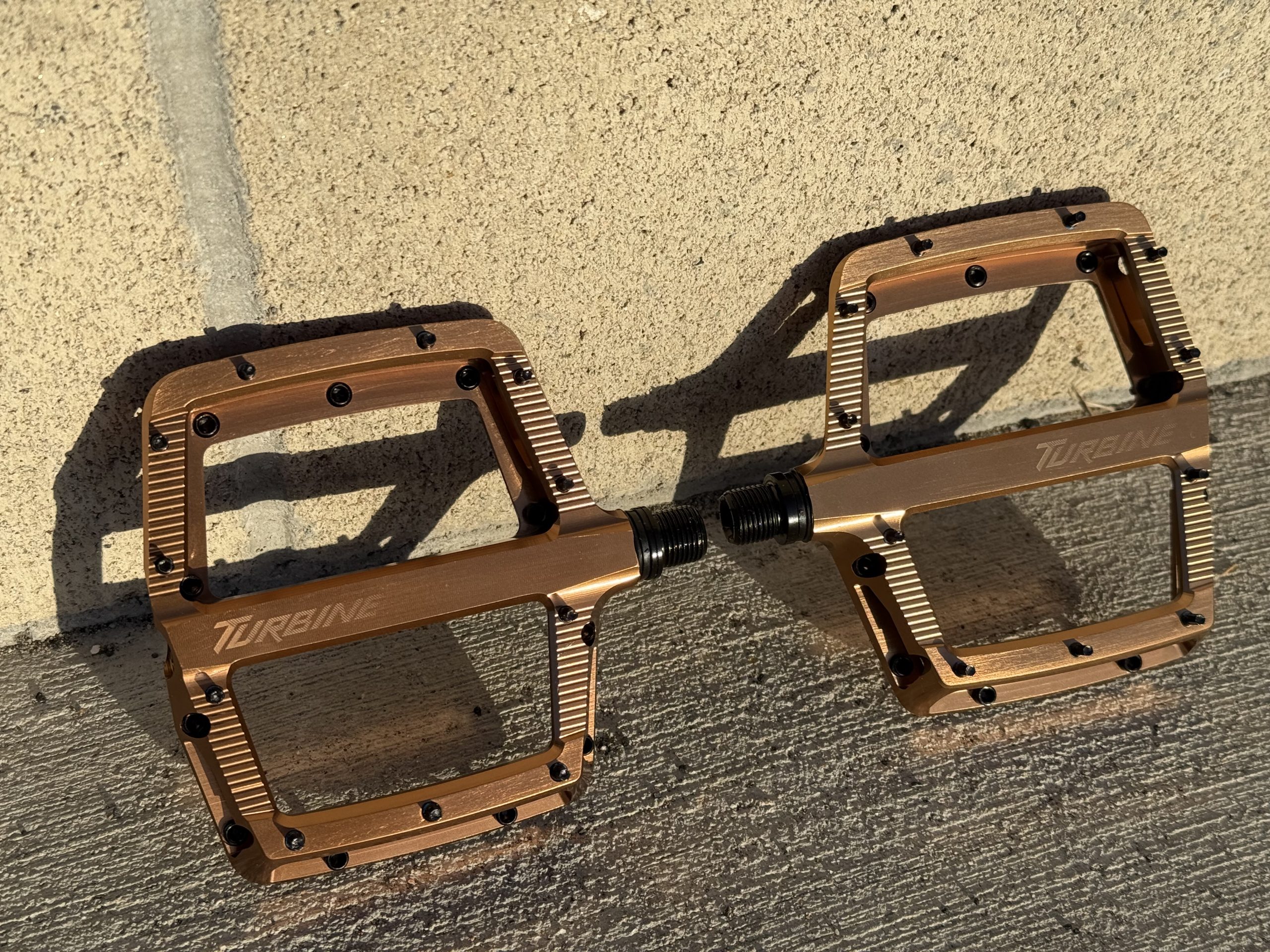
RaceFace Turbine Pedals platforms
The new Turbine Pedals come in a Kashmoney colourway to match Fox’s Kashima-coated forks. Nick Clark / Our Media

Race Face says the 3mm-deep concavity makes the Turbine the most concave pedal platform on the market. However, Burgetc and Praxis also offer 3mm-deep options, while HT’s ANS-10 Supreme had a 4mm concavity.

This bolsters grip levels by increasing the surface area of the interface between your shoe and the pedal, while adding support by cradling your foot in a secure pocket.

RaceFace Turbine Pedals concavity
A nut on the outside of the pedal enables you to access the internals for servicing. Nick Clark / Our Media

Unlike some manufacturers, Race Face has included concavity in the pedal chassis in all directions – front to rear and side to side, which it says results in an unmatched level of control.

Too much concavity can lead to issues with clearance and comfort, while too little compromises a secure feel, with Race Face saying extensive lab testing has enabled it to find the sweet spot.

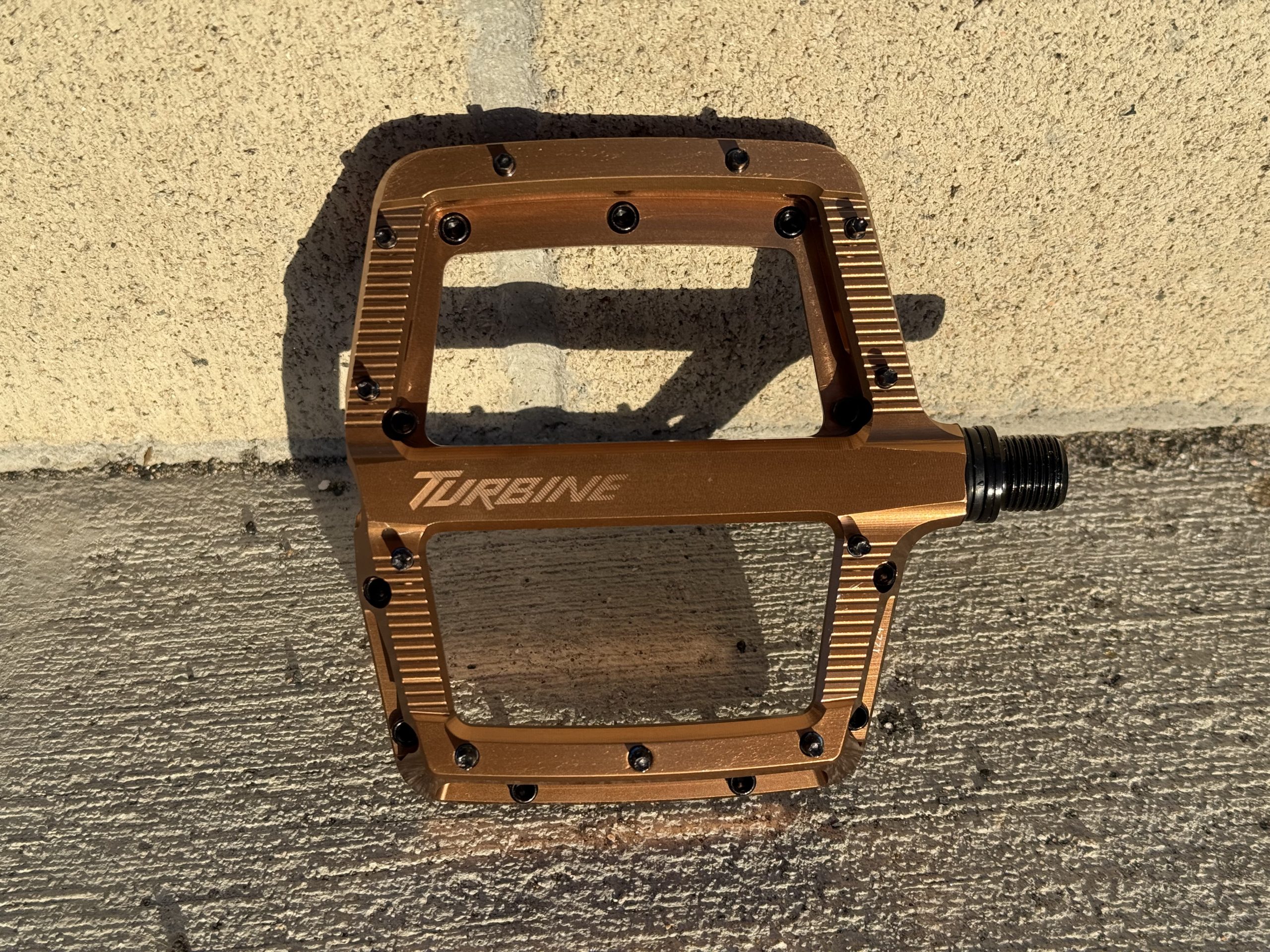
RaceFace Turbine Pedals one side
The front of the Turbine is wider than the rear. Nick Clark / Our Media

The Turbine Pedals also feature an asymmetric platform that creates a better interface with the sole of your shoe.

It’s wider at the front for increased support, while the shape recesses for better ground clearance.

Unlike the Atlas pedal, the Turbine doesn’t feature a bearing bump on the inbound side of the platform.

Instead, it uses an inboard bushing and an outboard ball bearing, allowing for a larger effective platform and a tighter stance for better ergonomics.

Race Face says the pedals went through one million cycles in testing, with no signs of wear, although the internals are fully rebuildable.

The platform is made from 6061 aluminium and measures 115x110mm with a 20mm maximum platform thickness, not including pins.

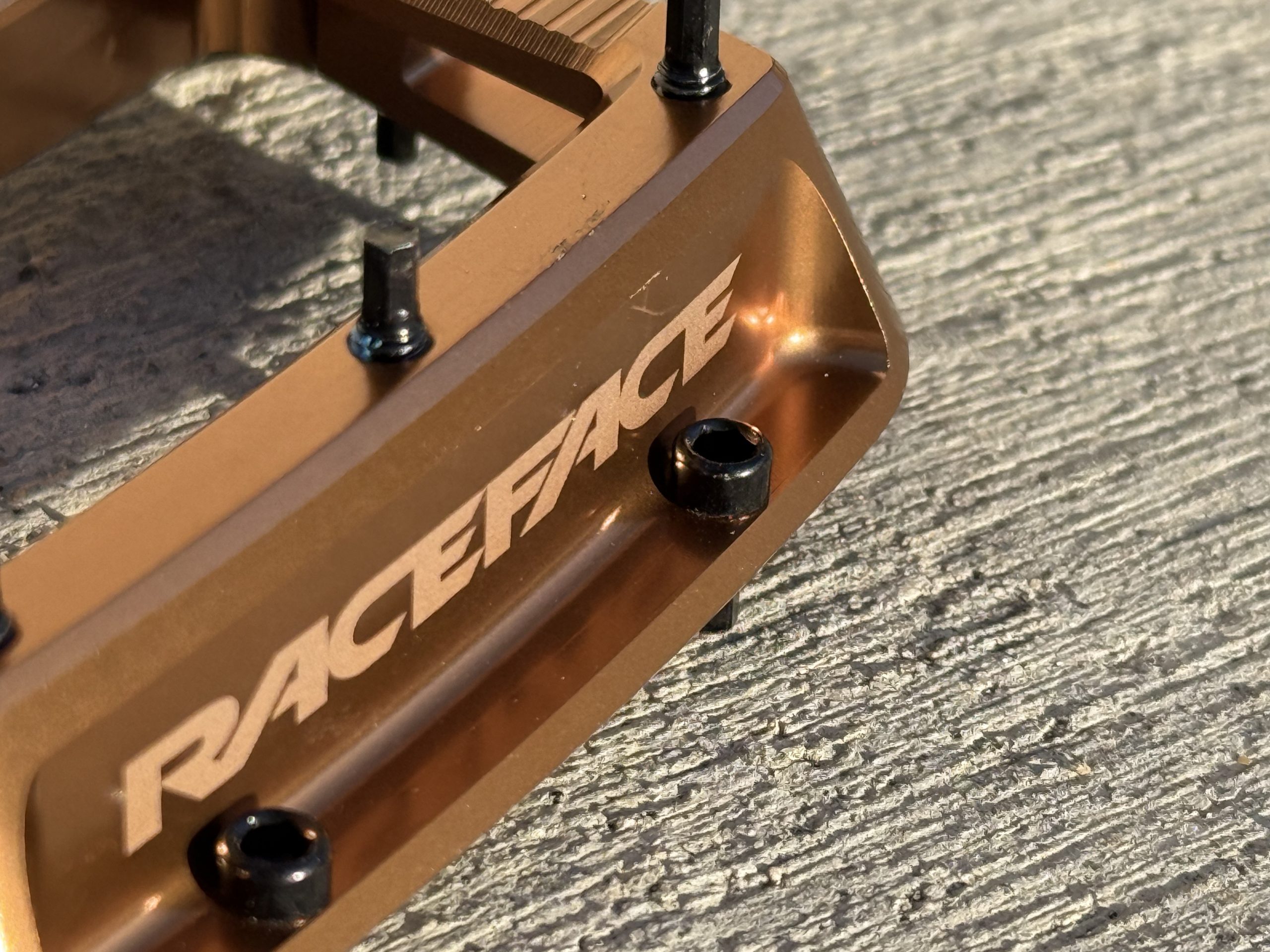
RaceFace Turbine Pedals pins
Bottom-mounted Allen-head pins are used for easier replacement. Nick Clark / Our Media

There are 11 height-adjustable pins per side. These are bottom-mounted, which should make for easy removal after rock strikes.

Race Face offers the Turbine Pedals in Black, Silver, Kashmoney, Purple, Orange, Red and Blue – and says they weigh in at 419g per set.

All About Zwift’s New Factory Tour Challenge

My friends, the day has finally arrived.

After years of Zwifters asking for a fourth in-game challenge, with Zwift Insider posting articles and the community offering heaps of challenge suggestions and even creating amazing concept art… it has arrived. Hurray!
Here’s a quick walkthrough:

Getting Started
You must be at level 40+ in order to take on the Factory Tour Challenge. Level 40+ riders probably already know how to sign up for Challenges but here’s a quick refresher anyway…

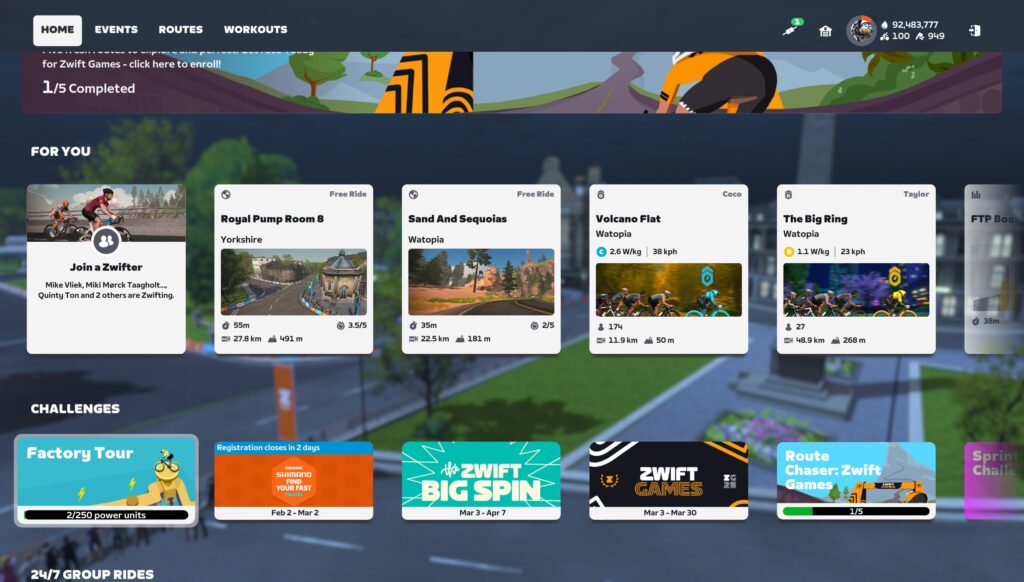
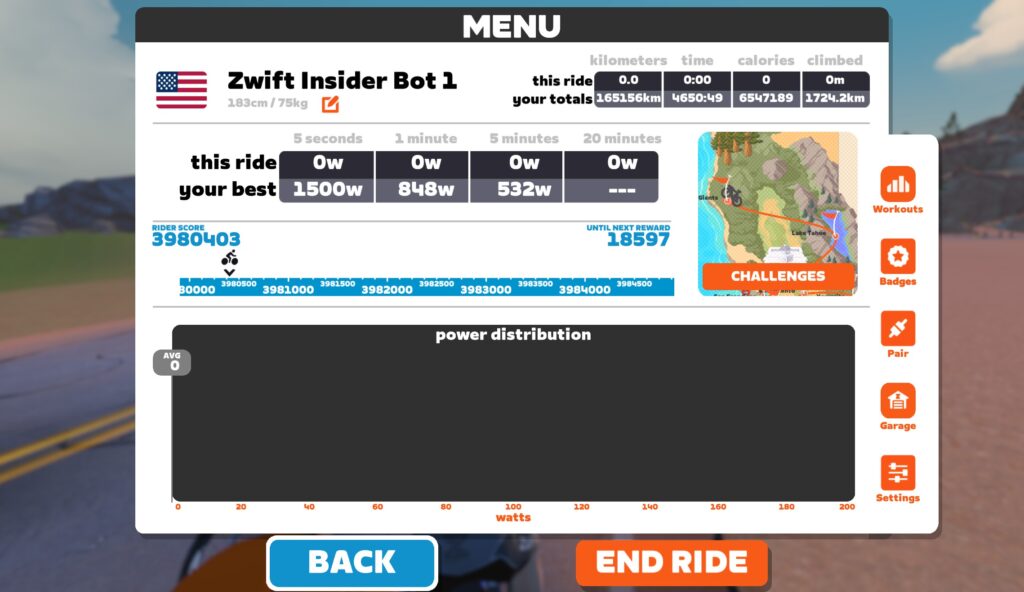
There are three ways to get signed up for the Factory Tour Challenge. The game actually prompted me to do it when I started my Zwift activity – that’s the first screen. It also showed up on my Challenges carousel on the homescreen (second screen). Lastly, you can always access the list of Challenges in the main menu, at the top-right:

What’s a “Power Unit”?

While the other three challenges (Climb Mt. Everest, Ride California, and Tour Italy) are based on accumulated distance or elevation, the Factory Tour Challenge is power-based. (The concept is that you’re powering a RoboPacer factory as you pedal your bike, so the animation for the challenge moves through the factory as you progress.)
Cyclists move through this challenge based strictly on the power you’re putting into the pedals, and progress is tracked using a metric Zwift calls “Power Units”.
One power unit is one watt-hour per kilogram, or Wh/kg. If you hold 1 w/kg (say, you’re an 80kg rider holding 80 watts) for an hour, that’s 1 Wh/kg, or 1 power unit. If you average 2 w/kg across your Zwift rides, each hour of riding will earn you 2 power units.

Finishing the Challenge

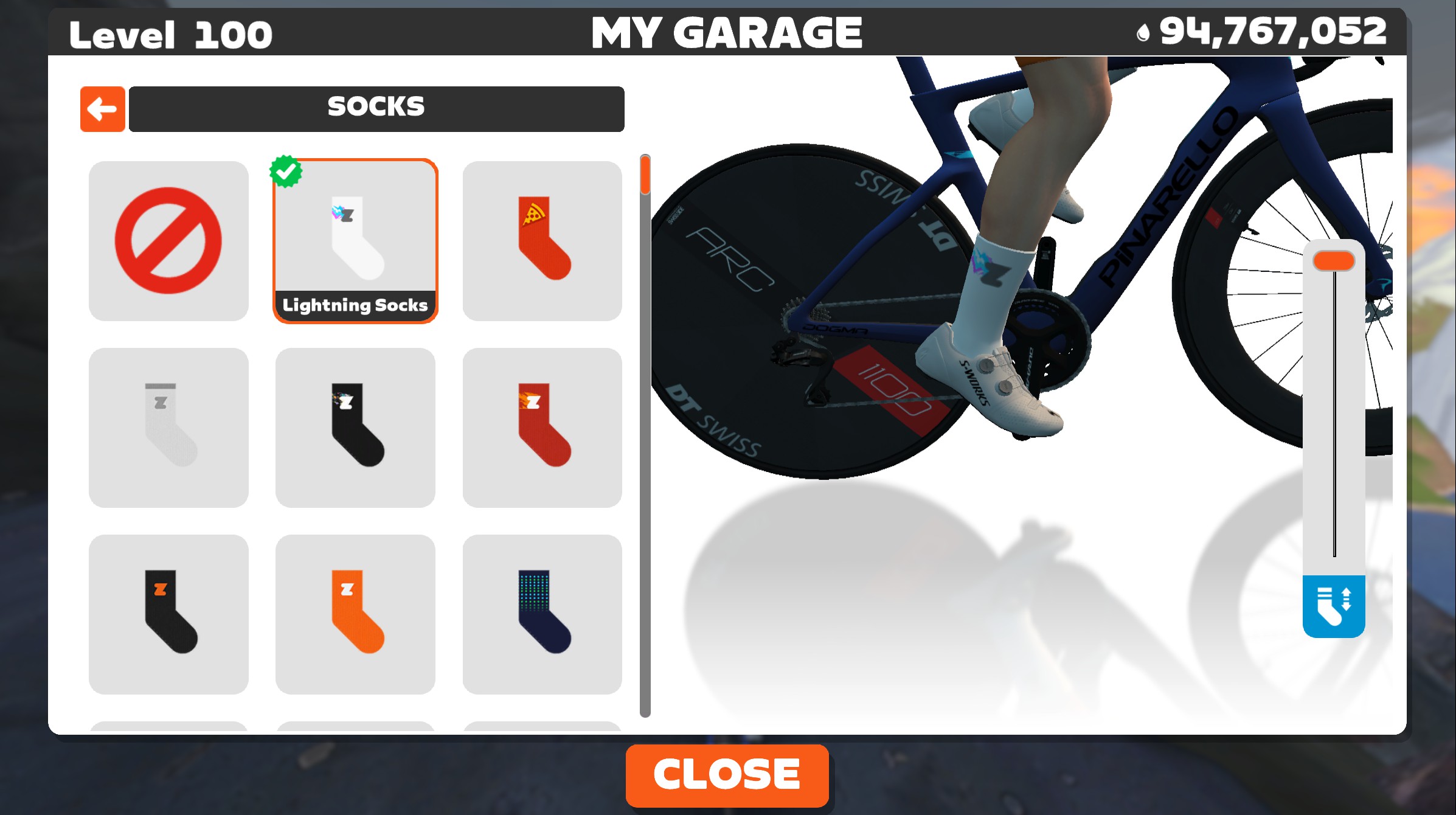
The Factory Tour Challenge is a 2-part challenge, like Climb Mt. Everest. The first part requires 250 power units to complete and awards you with Lightning Socks:

Once you finish the first part of the challenge, your progress will revert to 29% and you’ll automatically begin the second part which requires a whopping 600 additional power units to complete, unlocking the Aero Electric Socks.

How long will it take to complete the entire challenge? For riders, the math is fairly easy. Take your average w/kg multiplied by your hours of Zwifting per week. That’s how many power units you’ll be earning each week.

Examples:

  • 1 w/kg for 5 hours each week earns 5 power units each week, requiring 170 weeks to complete the challenge
  • 2 w/kg for 6 hours each week earns 12 power units each week, requiring 71 weeks to complete the challenge
  • 3 w/kg for 7 hours each week earns 21 power units each week, requiring 40 weeks to complete the challenge

As you can see, this is no short-term challenge. And I think that’s a good thing.

About the Socks

The new Lightning and Aero Electric socks work sort of like Fire Socks in that they unlock cool animations above certain effort levels:

  • @1.5 W/kg: Sparks and Tire Halo (both Lightning & Aero Electric socks)
  • @2.1 W/kg: Tire Sizzle Flash (both Lightning & Aero Electric socks)
  • @2.7 W/kg: Full Aero Lightning Effects (Aero Electric Socks only)
  • @3.2 W/kg: Full Aero Lightning Effects & Lightning Feet (Aero Electric Socks only)

In addition to the visuals, the Aero Electric Socks are particularly special because they are the first piece of performance apparel in Zwift. When you wear the socks, you receive a slight CdA reduction, making you faster in game. (Just how much faster is unclear, but I’ll definitely test the socks once I’ve got ’em.)

A Few Gotchas

There are three limits built into the Factory Tour Challenge, presumably to discourage cheating:

  • You can earn up to 4 Power Units per hour. (This limit resets at the top of the hour, so in theory you could ride at 4 W/kg for one hour, then sprint at 10 W/kg for 24 minutes and earn a total of 8 power units in 84 minutes. Good luck!)
  • You can earn a total of 15 Power Units per activity. If you save your ride/run and start a new activity, this counter is reset.
  • If you get the Cone of Shame (read more about it here) your progress will not count towards the challenge.

Also, a note for Zwift runners: this challenge doesn’t apply to you. While in my tests the game was awarding Power Units while running, those Power Units weren’t actually saved to my account. Reaching out to Zwift, they confirmed that this challenge does not apply to running.

Questions or Comments?

What are your thoughts on this fourth challenge? Got questions, comments? Share below!

Zwift Update Version 1.85 (141681) Released

Zwift version 1.85 begins its phased rollout today. This release delivers “Factory Tour”, the long-awaited fourth challenge, giving experienced Zwifters something to work toward. Read on for details!

New “Factory Tour” Challenge

This one will put a smile on the face of veteran Zwifters! After years of just three major in-game Challenges (Climb Mt. Everest, Ride California, and Tour Italy), today Zwift is releasing a fourth, giving longtime riders something new to work toward.

Called the “Factory Tour”, this challenge has Zwifters powering a RoboPacer factory with our watts. The more watts you put out, the faster you’ll complete the challenge. But it’s no small challenge, and there’s a hidden extra part 2! Here’s a quick video walkthrough:

Learn all about this new Challenge, including unlocks and more, on our All About Zwift’s New Factory Tour Challenge post.

“Tair Dringfa Fechan” Route Is Open

Zwift’s release notes say, “New badge alert: The Tair Dringfa Fechan route in Watopia is now available for free ride.” But that’s not entirely accurate, as the badge was actually added back in November, before races took on this route as the final race of ZRL Round 2 on December 17th.

Be that as it may, today the route changes from being event-only to being available for free rides in game. So all you badge hunters who didn’t race ZRL now have a chance to earn this route badge, and with it the 625XP bonus!

Read all about Tair Dringfa Fechan route >

Release Notes

Zwift provided notes on additional tweaks and bug fixes in this update:

  • In the Zwift Companion Action Bar, the Camera View and Emote menus now automatically close after making a selection.
  • We made it easier to see what you’ve selected when browsing details of events, routes, Climb Portal, and Pacer group rides on the home screen.
  • FIT files now include power target data from workouts.
  • We found the wooded park that went missing in central London and returned it to its proper location.
  • Fixed an issue that could cause riders in the New York world to swerve at an intersection in Central Park.
  • Stability improvements.

Discuss this update in Zwift’s forum >

Questions or Comments?

If you spotted any other changes or bugs in the update, please comment below!

The best bike I saw at Omloop Het Nieuwsblad was this wild gravel-inspired Trek Madone

While an unreleased Zipp wheel with an integrated TyreWiz pressure sensor on Tom Pidcock’s Scott Foil was one of the coolest developments from Omloop Het Nieuwsblad 2025, I loved Emma Norsgaard’s Trek Madone even more.

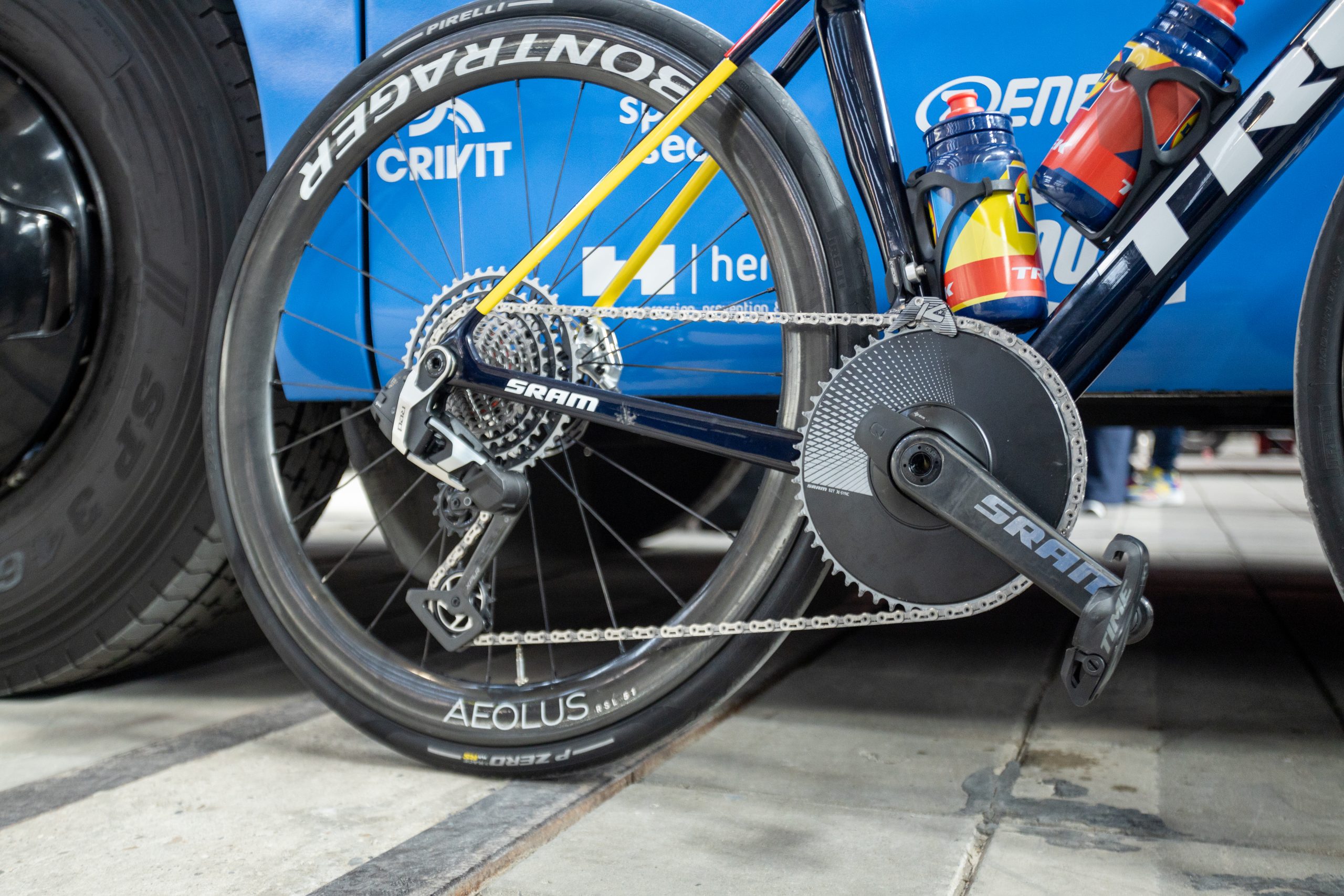
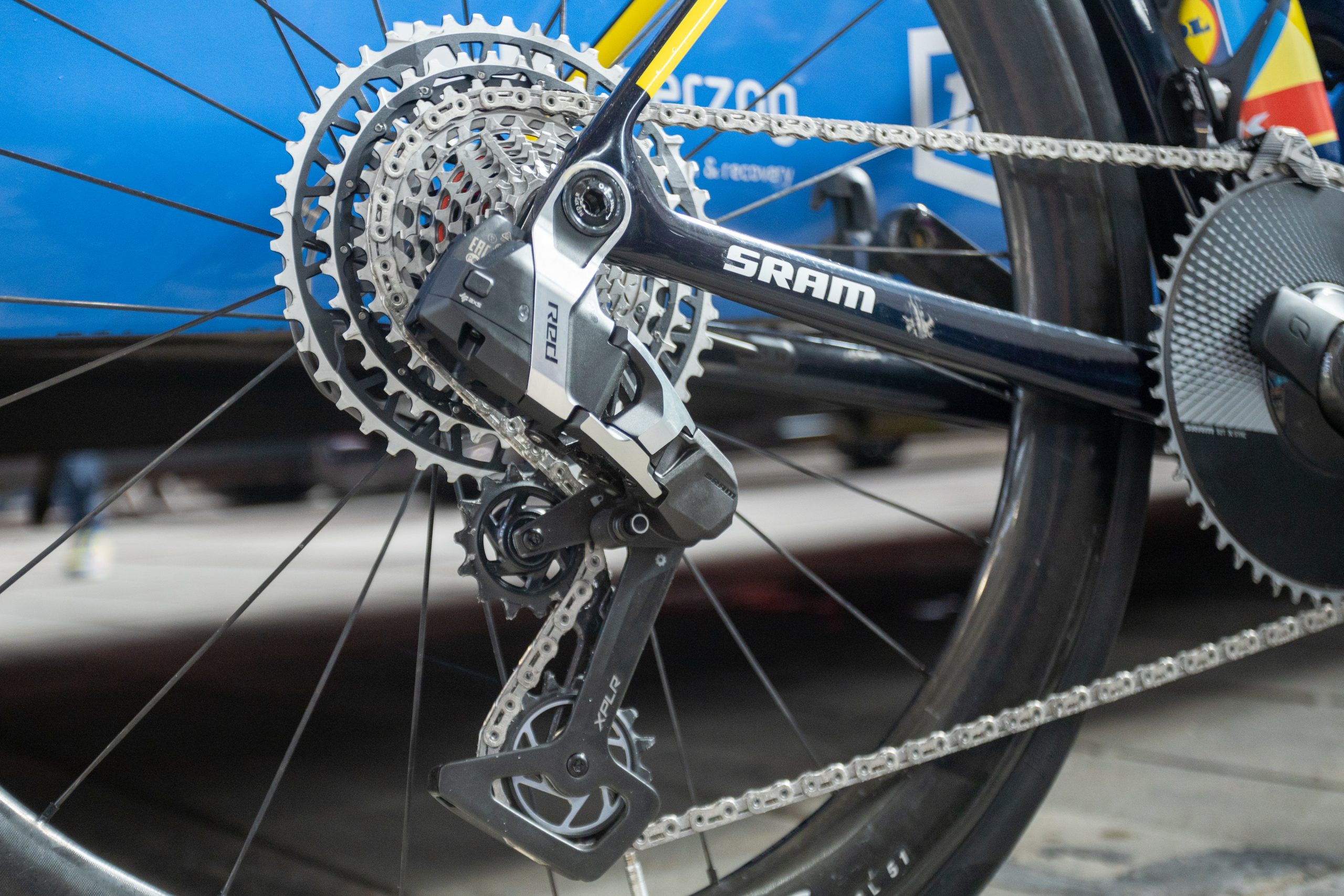
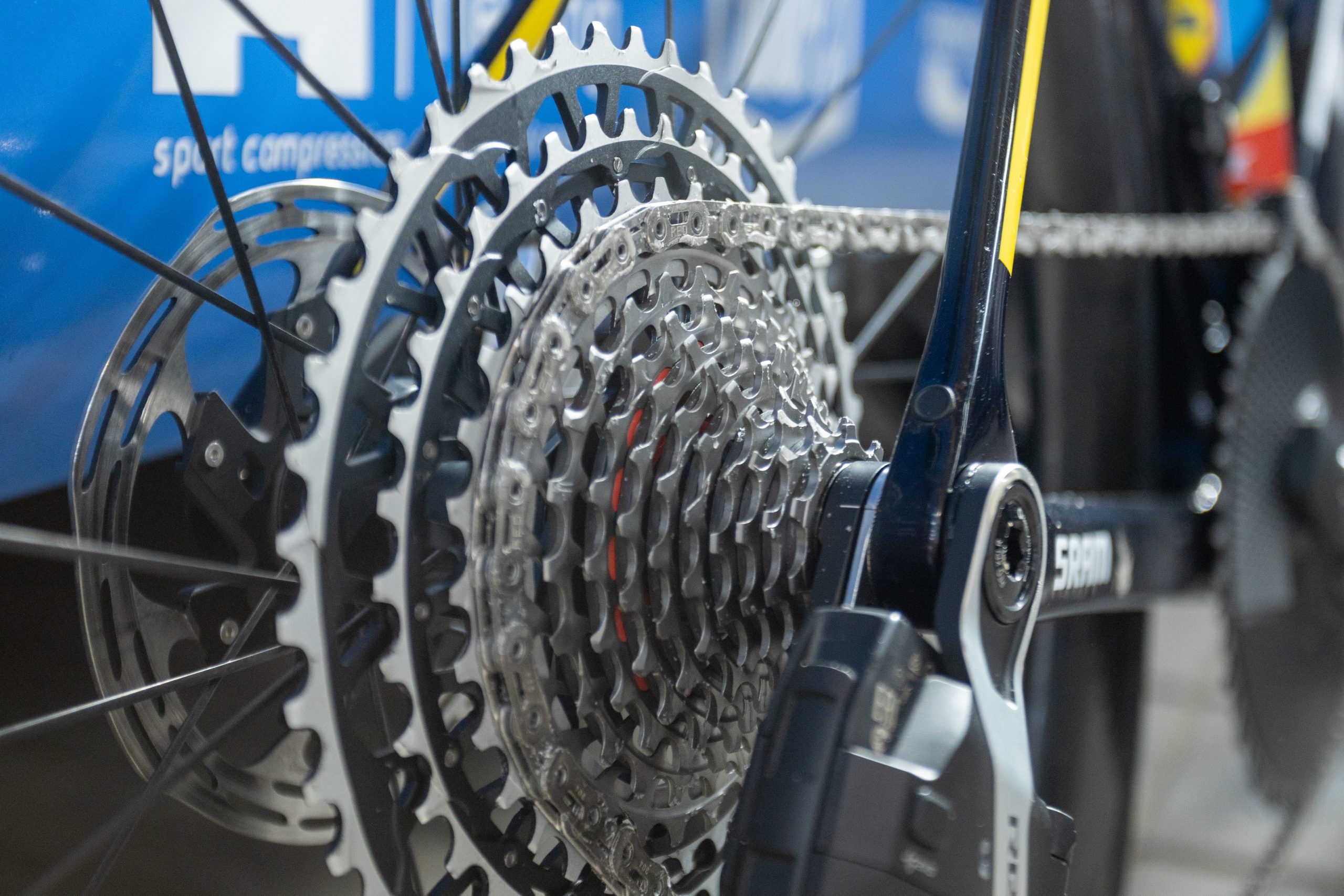
This aero road bike was set up with a mullet-gearing ensemble of SRAM’s Red XPLR AXS rear derailleur, a super-wide 10-46T cassette and a huge 52T aero 1x chainring. 

We have seen a number of riders in recent years opt for a 1x setup at Paris-Roubaix.

Running a 52T 1x chainring means you need a seriously wide cassette out back. Liam Cahill / Our Media

However, these setups almost always feature a relatively tight cassette because there are few hills to contend with in the Hell of the North.

It’s certainly unconventional to see such a large rear derailleur on a road race bike. Liam Cahill / Our Media

Omloop Het Nieuwsblad, meanwhile, is more akin to the Tour of Flanders, with steep climbs and cobbled bergs aplenty. A wider cassette is therefore essential, especially when paired with a large chainring.

SRAM uses a tight cluster at the 10T end of the cassette to give the rider smooth cadence jumps during flatland riding. I’d be very interested to hear Norsgaard’s unfiltered opinion of this setup. Liam Cahill / Our Media

It was also clear to see the Lidl-Trek mechanics had been busy with their Cyclowax chain-waxing machines.

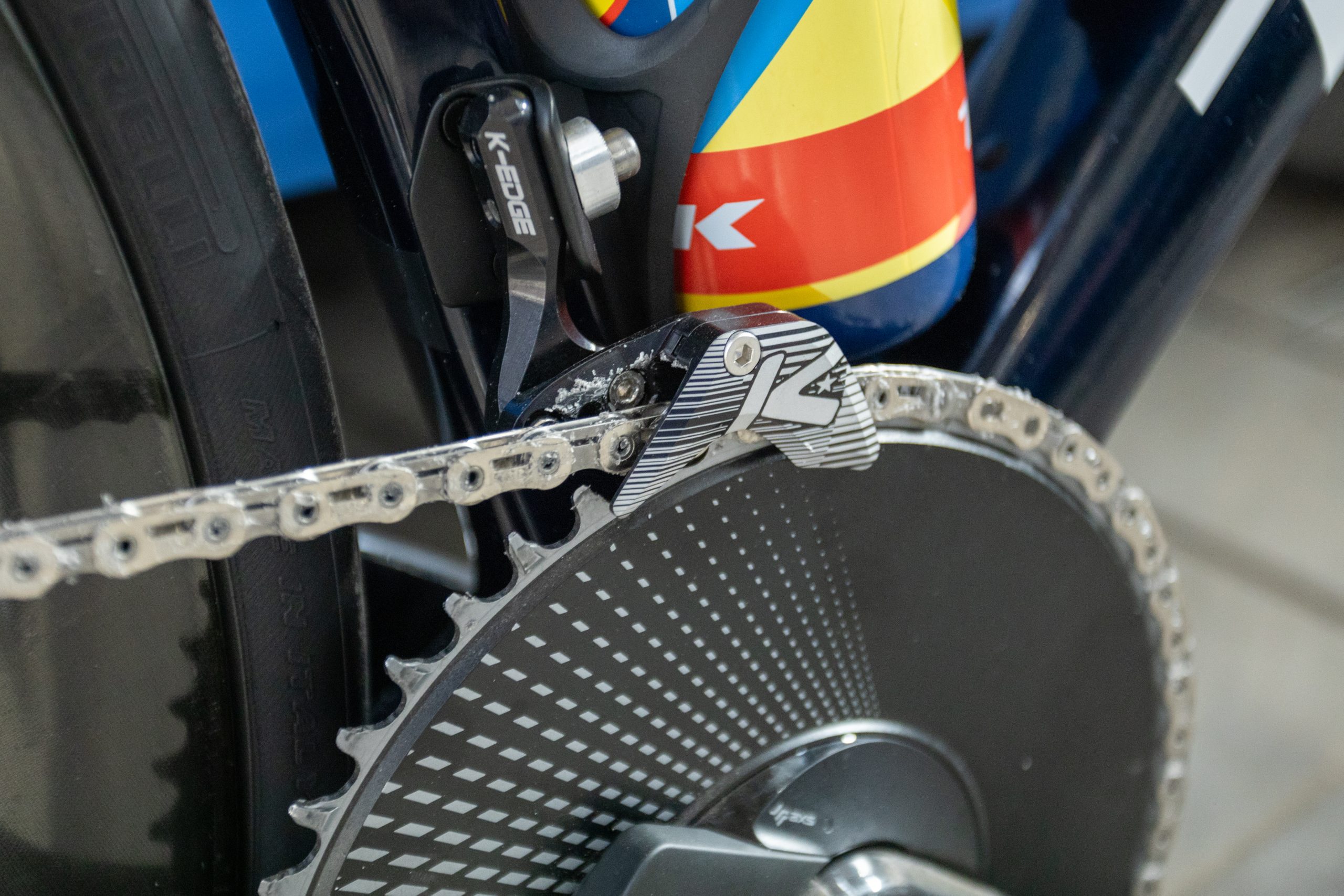
A K-Edge chain guide all but eliminates the chance of a dropped chain. Liam Cahill / Our Media

The team signed a partnership with the brand last year. The device is claimed to be “the holy grail” of immersive chain waxing, because it can wax a chain without removing it from the bike.

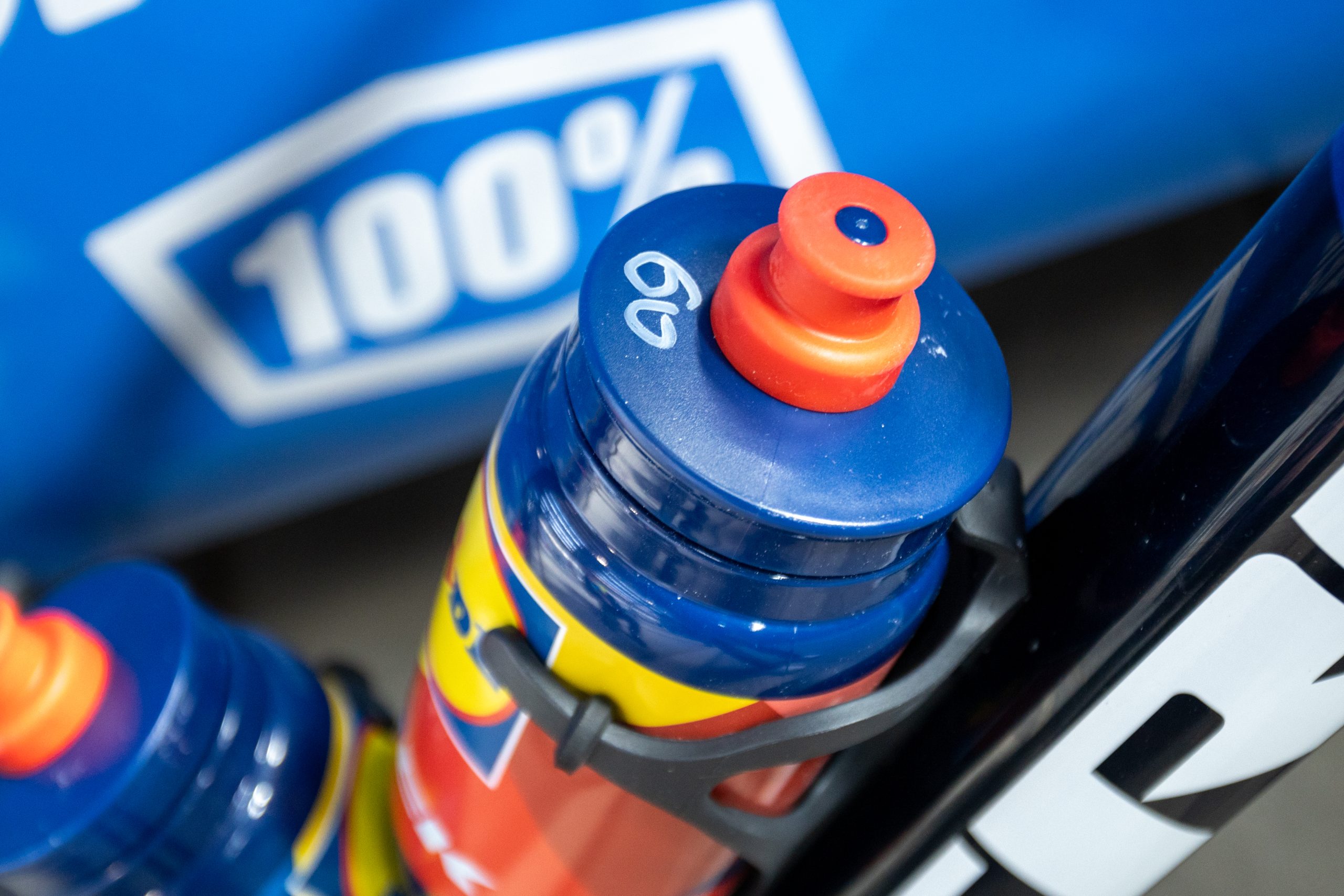
Touches such as this make it easy for the rider to calculate how much fuel they’re taking on. Liam Cahill / Our Media

Other, smaller tech highlights on this bike included bottles marked up with ’60g’, a clear indication for Norsgaard of the carbohydrate content within each 500ml bottle.

However, she’s not going to want those bottles and their precious fuel jettisoning themselves on the bumpy cobbles. The Lidl-Trek mechanics have neatly added extra purchase to the bottle cages.

Gone are the days when a rider’s saddle had to be pretty much flat. Liam Cahill / Our Media

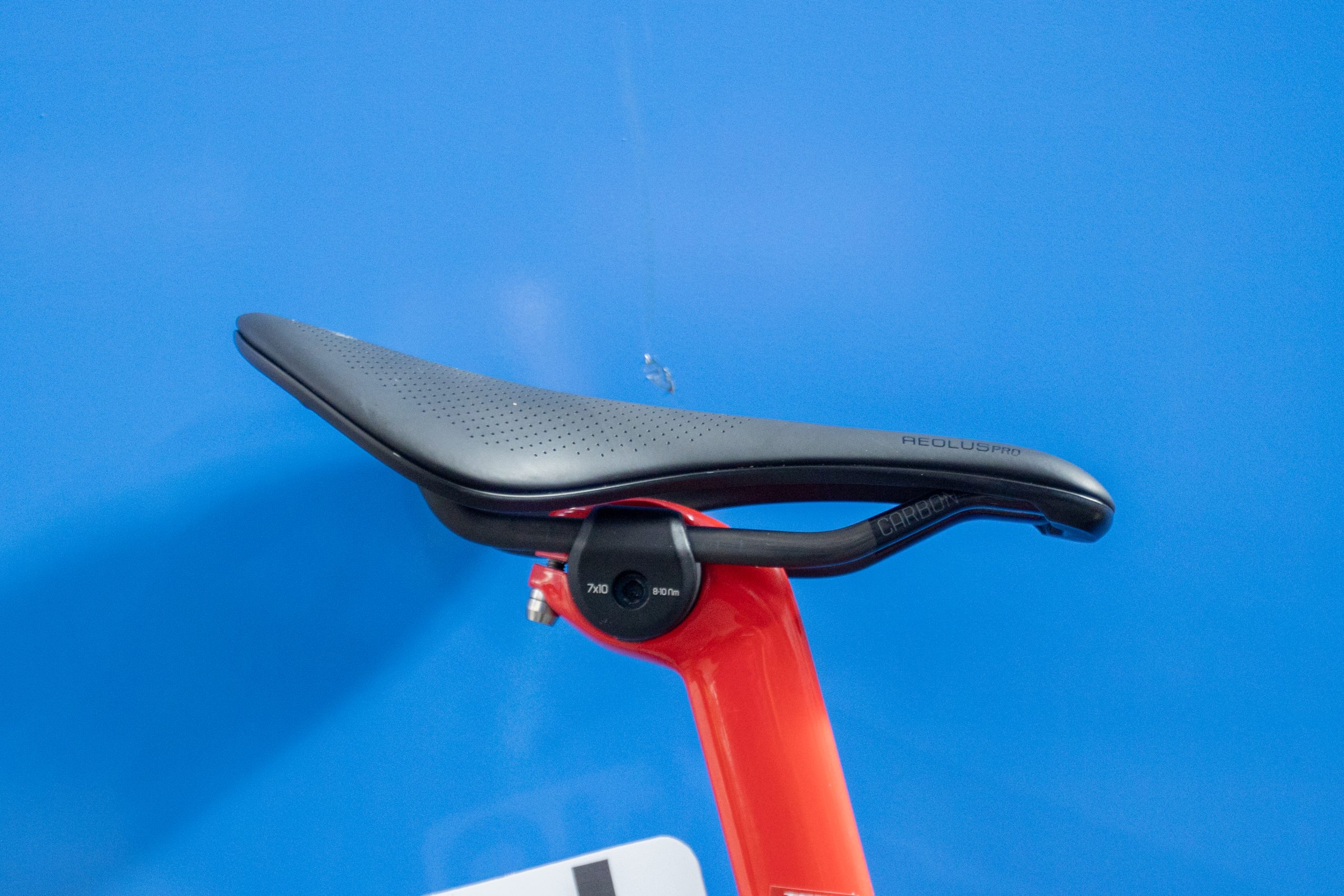
Norsgaard opts for Bontrager’s Aeolus Pro carbon saddle and runs it with a pretty significant drop towards the nose. This is likely to be a comfort choice for her low front end.

While Norsgaard ended up crashing out of Omloop, her bike represents an interesting approach to road race bike setup. I will certainly be keeping an eye on her Flanders gearing choices.

New Continental Grand Prix TR tyre uses tech from the GP 5000 but has a much lower price tag

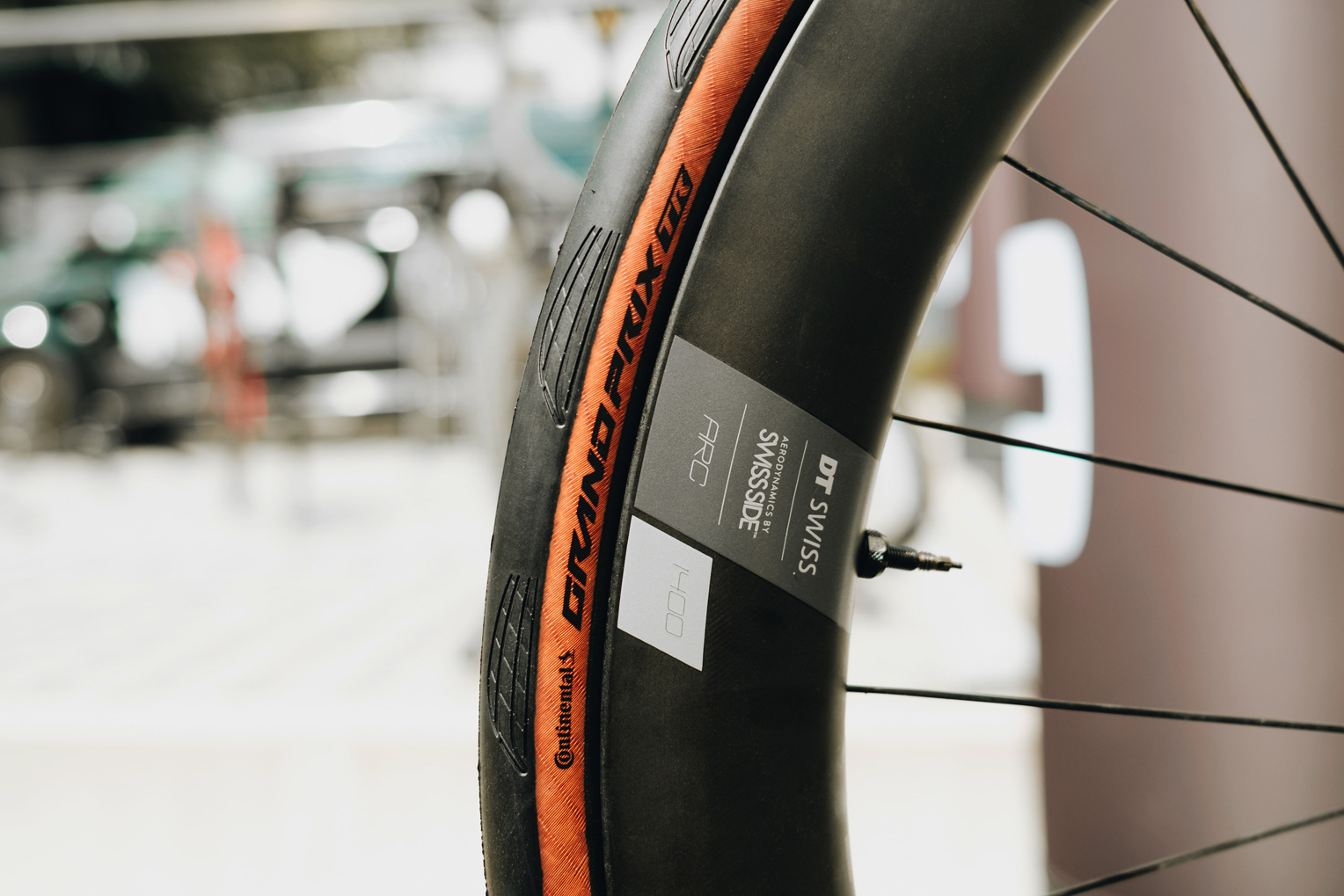
Continental has launched the Grand Prix TR, a new mid-tier tubeless-ready tyre with technology trickled down from the highly rated (and more expensive) Grand Prix 5000 range.

The Black Chili compound is the common component, which Continental says offers a competitive blend of grip and rolling resistance.

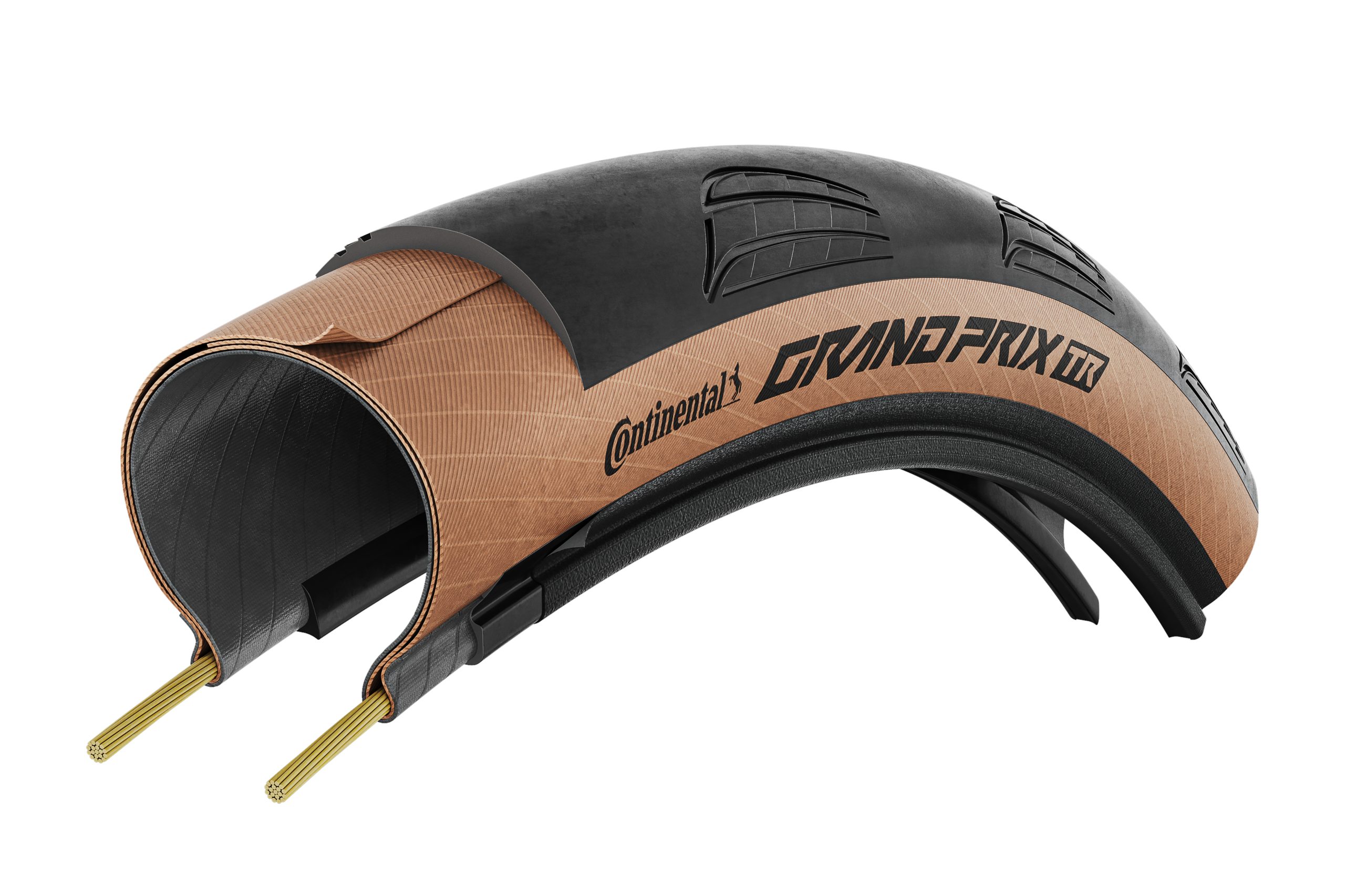
Under this, a new four-ply construction has been developed, which the brand claims delivers strong puncture protection without adding excess weight.

With a price tag of £54.95 / $67.95 / €61.95, the Grand Prix TR is firmly in the ballpark of other mid-priced all-season tubeless tyres. As a result, this could be a compelling option for riders looking for a tyre that combines both performance and value.

Previous form

Continental Grand Prix TR
The Continental Grand Prix TR bears the same Black Chili compound as its racier tyres. Continental

Continental has previous form here – for its top-of-the-range Grand Prix 5000 tyres, it has played with the number of plies depending on the purpose. 

A two-ply construction is used in the raciest TT TR (chiefly for reduced rolling resistance and weight), three plies in the all-round S TR race tyre, and four in the all-season leaning AS TR (which is the brand’s flagship all-season option).

Given there are also four plies used in the Grand Prix TR’s casing, it’s reasonable to view the tyre as an all-season or ‘endurance’ type tyre, rather than simply a cheaper race tyre. 

Continental Grand Prix TR
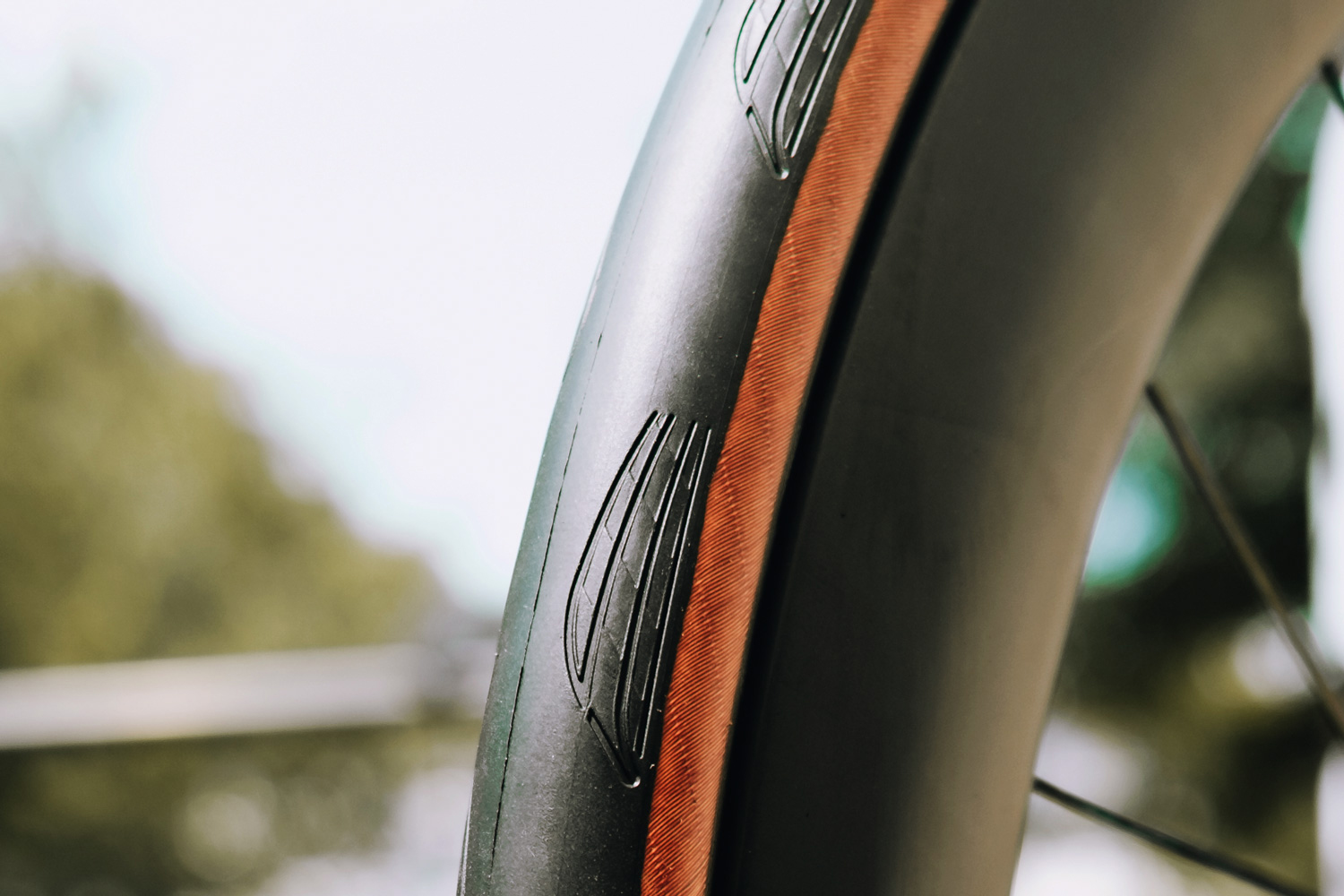
A modified tread pattern could be aimed at boosting grip or longevity – Continental simply says it’s inspired by its Lazer Grip design. Continental

Continental asserts that the casing is “completely new”, with a lower 60 TPI (threads-per-inch) count. This is lower than the Grand Prix 5000 range (120 TPI).

The tread pattern also appears lightly modified compared to that seen on the top-tier tyres, which could be a nod to the Grand Prix TR’s endurance focus – perhaps for a relative gain in grip or tyre life – but this remains to be seen.

For its money, the brand says it’s “inspired by” the Lazer Grip pattern seen on its premium tyres.

Stiff competition

Continental Grand Prix TR
The Grand Prix TR doesn’t have a dedicated puncture-protection belt. Continental

The Grand Prix TR’s price of £54.95 / $67.95 / €61.95 pitches it against some stiff competition in the mid-range tubeless market. The excellent Specialized S-Works Mondo (£50 / $70 / €80) and impressive Teravail Telegraph ‘Durable’ (£48 / $75) tyres are two such examples from our most recent all-season tyre testing.

The Grand Prix TR tyre is available in 700×25, 28, 30 and 32c variants, and with black or ‘transparent’ (tan) sidewalls. Claimed weights start from 310g for a 700x25c tyre, according to Continental.

The brand says all these tyres are compatible with hookless rims.

Clincher options

Continental Grand Prix clincher tyres
There’s also a clincher version of the new Grand Prix tyre. Continental

Fans of clincher setups are also catered for with a tube-type specific version of the Grand Prix TR – naturally, ‘TR’ will be dropped from the moniker (TR traditionally stands for ‘tubeless-ready’).

Continental says the Grand Prix clincher tyre will feature the same carcass, but with a three-ply design. This is likely intended to offset the presence of an inner tube.

The Grand Prix 5000 clincher remains at the head of Continental’s tube-type tyre range.

These are available in 700×28 and 30c sizes, both in black and ‘transparent’ sidewalls, and will cost £40.95 / $53.95 / €45.95 apiece.

New Cadex Aero hookless tyre spotted at opening spring classic

Cadex, Giant’s premium in-house brand, looks set to launch a new high-end race tyre.

An updated Cadex Aero tubeless tyre popped up on the Giant Propel bikes of Jayco AlUla at Omloop Het Nieuwsblad.

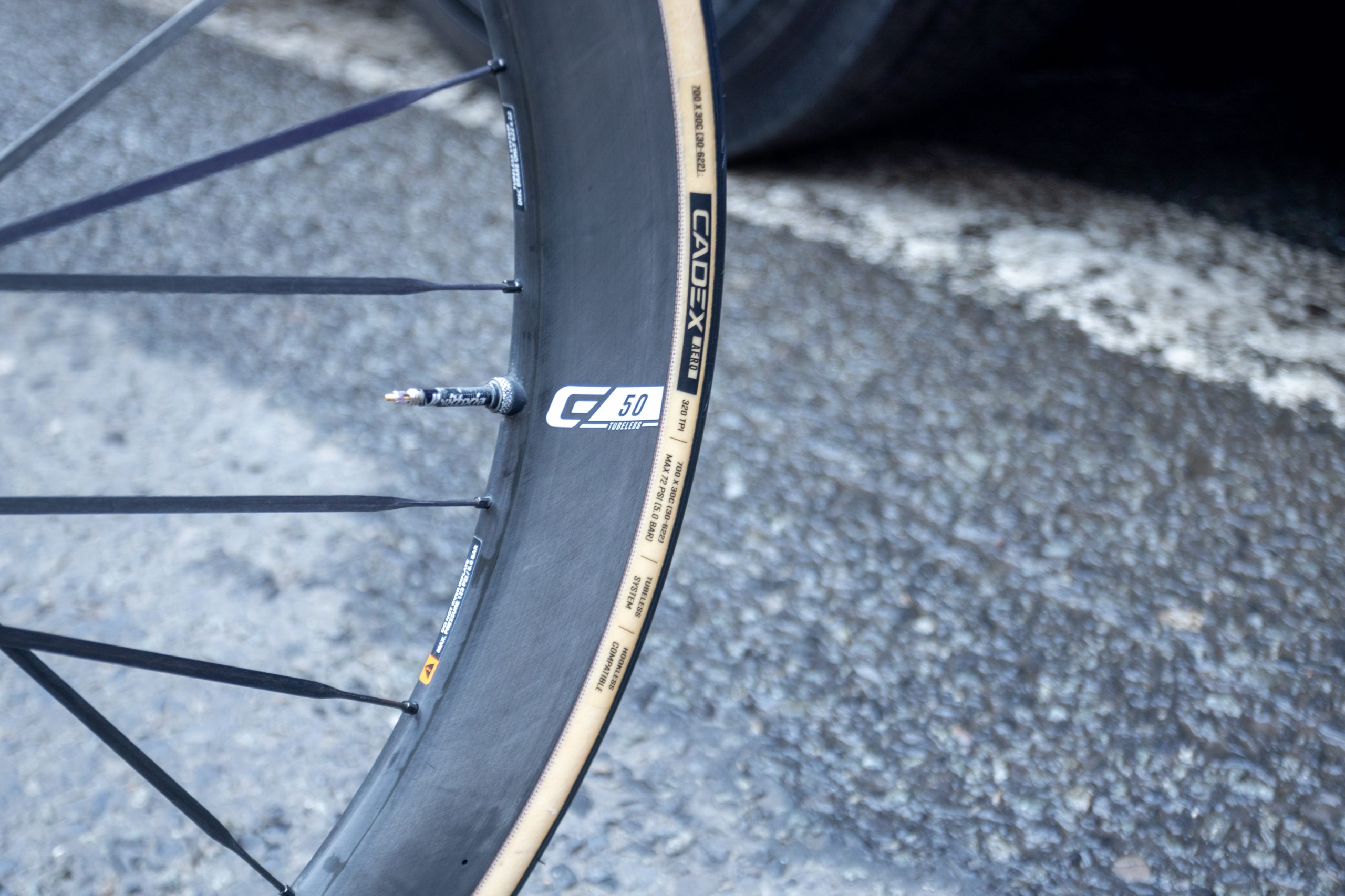
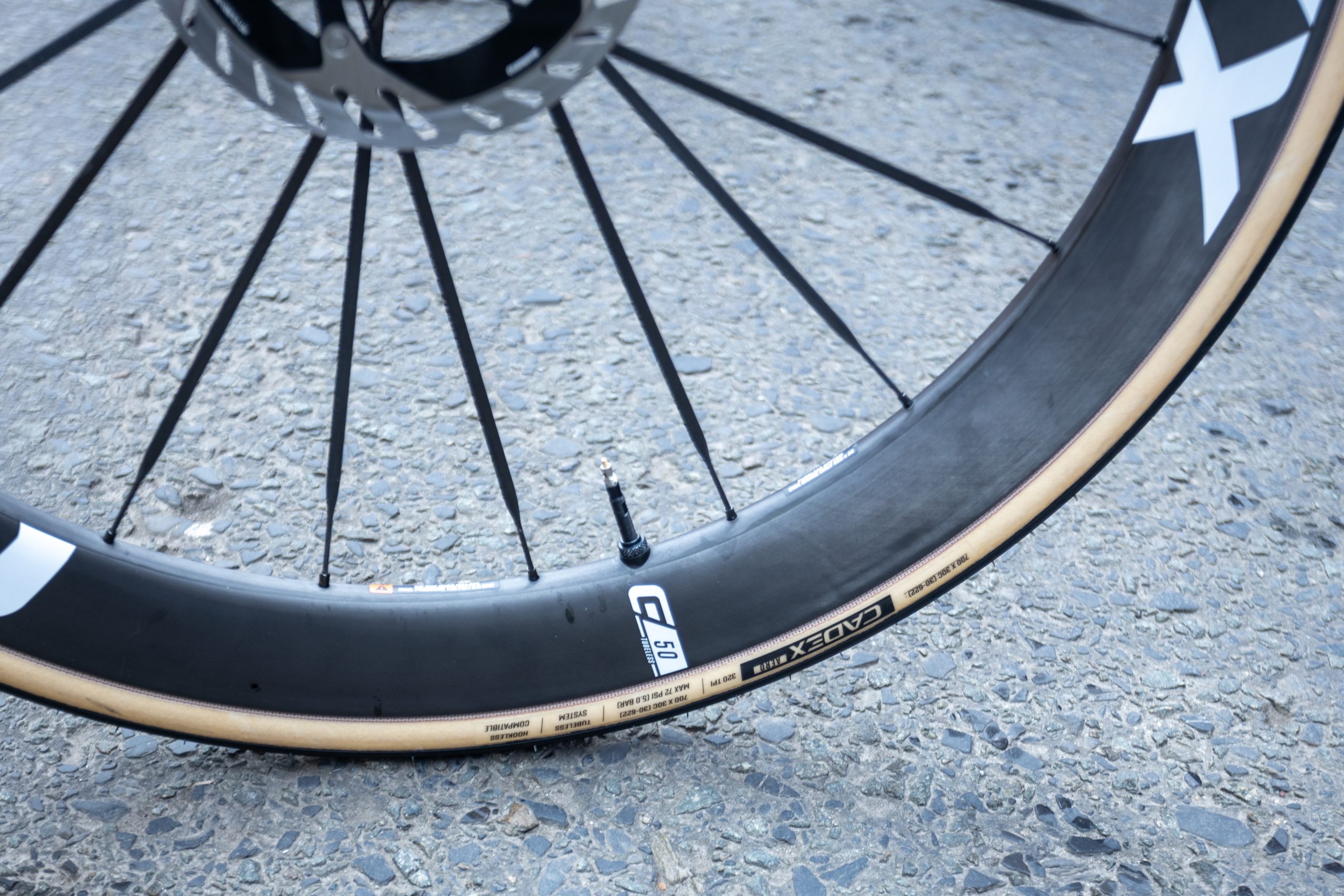
While Giant is yet to provide details on the new tyre, the sidewalls were handily badged up with some useful information.

We were able to glean some useful information on the new tyre. Liam Cahill / Our Media

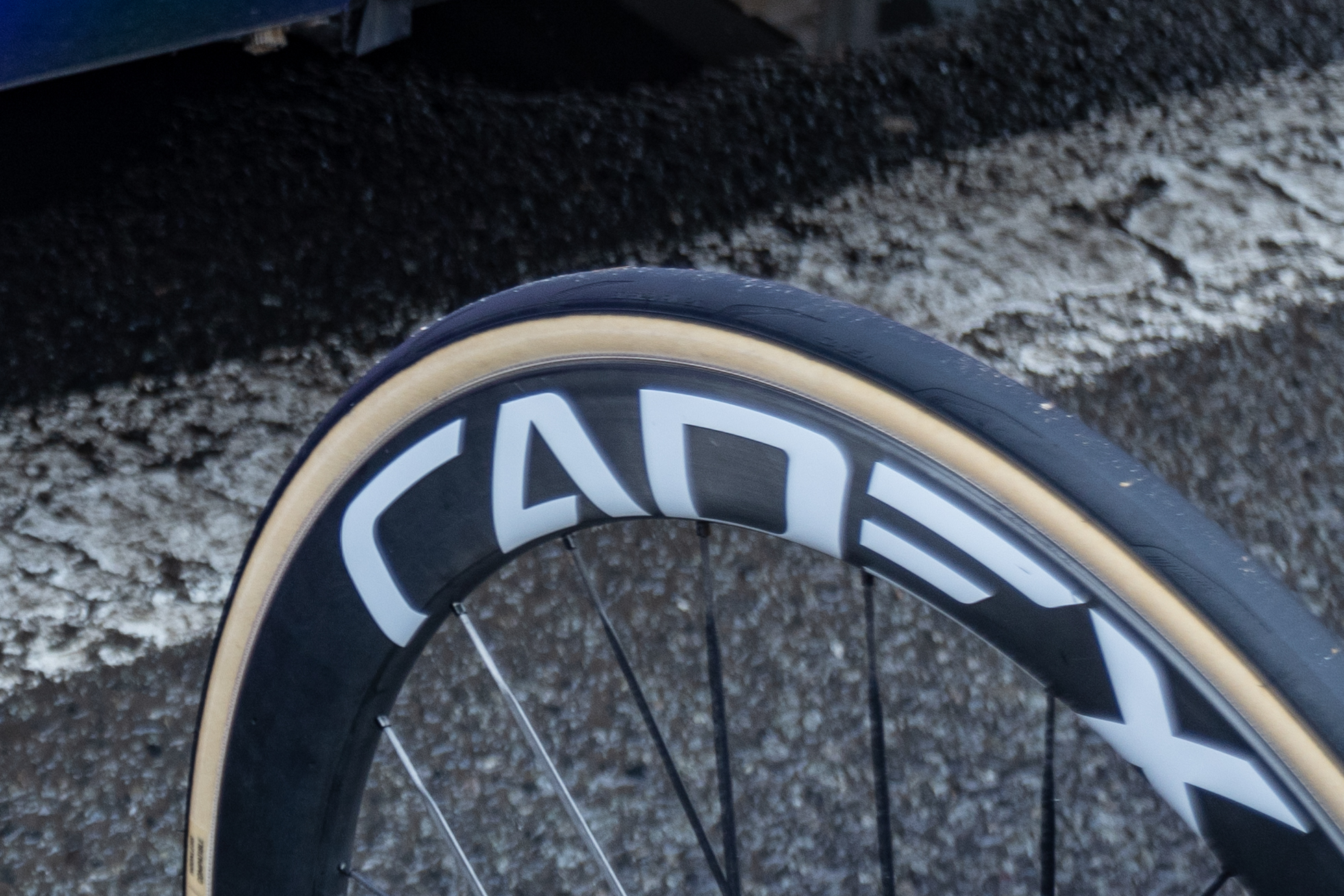
Firstly, the name ‘Cadex Aero’ suggests Giant may have designed these tyres to be aerodynamically optimised for Cadex’s rims. 

The original Cadex Aero tyre featured, according to Giant, taller sidewalls to help create an oval shape that “integrate[s] seamlessly” with the Cadex rims.

It appears it also might have worked some form of trip layer into the tread, as Continental did with its Aero 111 tyre (which was developed in partnership with DT Swiss).

The pattern on the compound doesn’t appear to have changed much. Liam Cahill / Our Media

On close inspection, this takes the form of a channel incorporated into the shoulder of the rubber compound. Whether this has been developed from the previous model is unclear.

What we can easily decipher, though, is that the casing uses a 320-threads-per-inch (TPI) construction. This is up from the 170 TPI construction of the outgoing model.

With Vittoria’s Corsa Pro, there is now a good selection of tan-sidewall tyres featuring high TPI counts. I’m all for it. Liam Cahill / Our Media

While unconfirmed, this casing could use a similar construction method to Vittoria’s Corsa Pro, where a lining is placed on the inside of the casing to make it airtight. When sealant is added, the system becomes sealed.

The Cadex Aero is also marked up as being compatible with hookless rims. This is unsurprising, given Cadex’s C50 Tubeless wheels feature a hookless design. 

Omloop Het Nieuwsblad is seen by many as the opening of the European road-racing season and the start of the spring classics.

In an attempt to tame the race’s cobblestone sectors, the Jayco team was using 30mm tyre widths across the board. However, races such as Paris-Roubaix feature even rougher cobbles and riders often reach for 32mm tyres for extra comfort.

Whether the new Cadex Aero tyre is available in wider 32mm or narrower 28mm sizes remains to be seen. But given the old model came only in 25mm width, the range could be limited.

Moon’s Titan Max 1700 could be the tech-laden commuting light you’ve been looking for

Moon’s new Titan Max 1700 bike light is due to be released later this year and combines a wealth of features designed to make it a popular choice for commuting.

Its compact design fits into a quarter-turn Garmin mount or can be used with the included Go-Pro adaptor.

The light comes with a wireless bar-mounting remote control that enables you to switch through variable lumen levels, maxing out at 1700.

You can also switch between dual-beam modes. One is a large-area, round beam for off-road and back-lane use, and the second is a capped STVZO beam pattern to make it more user-friendly on busier roads.

MOON Titan remote
The Titan comes with a wireless bar remote. Warren Rossiter / OurMedia

You can charge the light through its USB-C port or take advantage of its wireless-charging functionality. The USB-C port is also two-way, so in a pinch, you can use the Titan to charge your phone or bike computer.

The Titan has an IPX7 rating, meaning it has been tested by being fully submerged in one metre of water for 30 minutes.

This should ensure it’s up to the job of riding in a wet British winter.

Zwift Academy 2024 Finals, Episode 3

The finals for Zwift Academy 2024 have finished, and Zwift partnered with GCN to bring you a series of four episodes documenting the process at pre-season training camps. Who will come out on top and earn a pro contract?

The first and second episodes were released in previous weeks. Today is episode three, and the final episode will be released next Saturday.

In episode 3, the riders are tested in a sprint lead-out, including racing against the pros. Coaches also watch them support the pros in a second challenge, behaving as a team. How will they do? And will they be able to set aside their personal ambitions?

Watch Episode 3:

(As a reminder, there are 8 finalists this year. To learn a bit about each rider, see this post.)

Up Next

Watch this space for the final episode, premiering March 8 at 5pm UTC/12pm ET/9am PT.

Questions or Comments?

Share below!

Tom Pidcock debuts new Zipp wheelset with integrated tyre pressure sensor

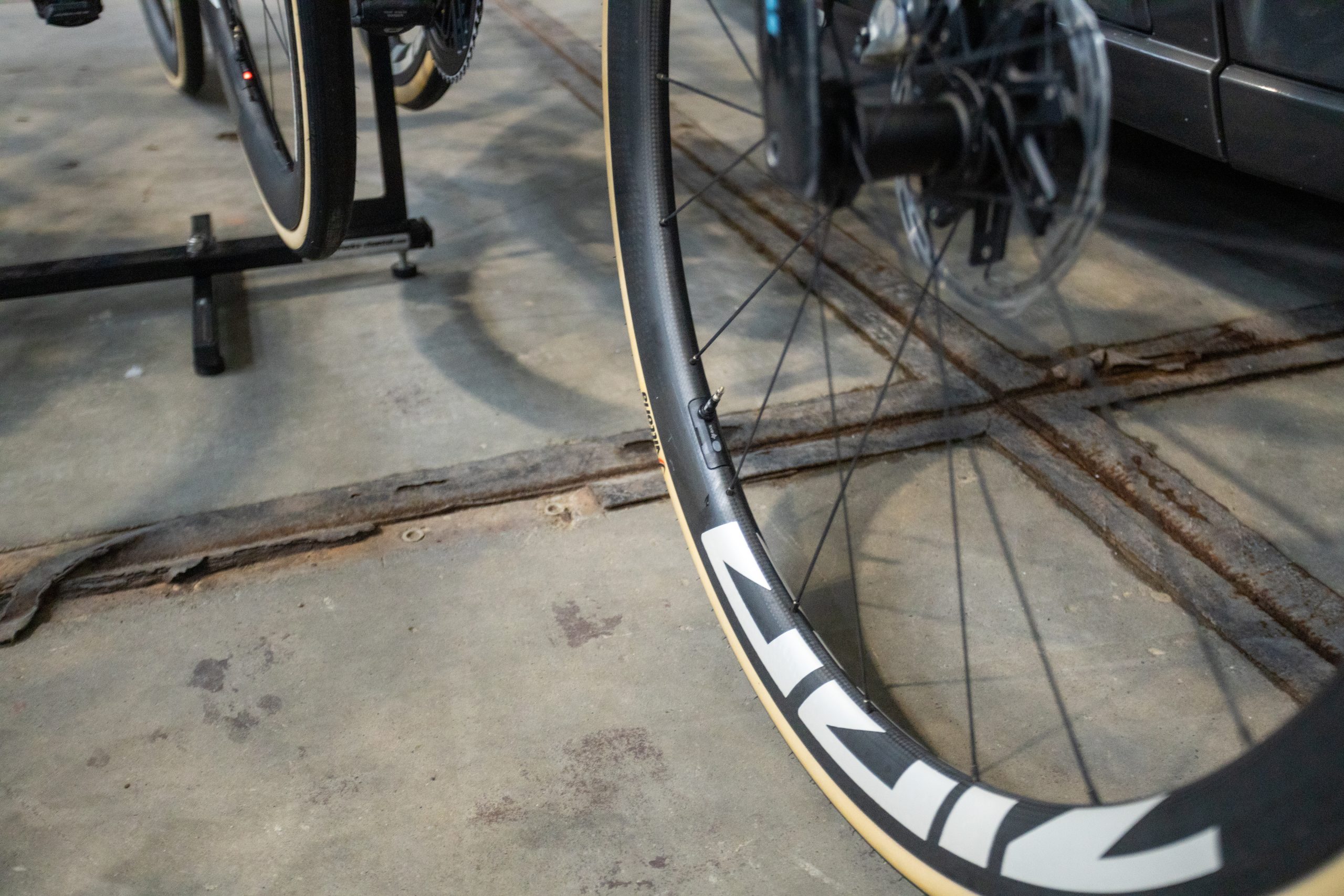
A new Zipp road wheelset with what appears to be an integrated tyre pressure sensor has been spotted at Omloop Het Nieuwsblad on Tom Pidcock’s bike.

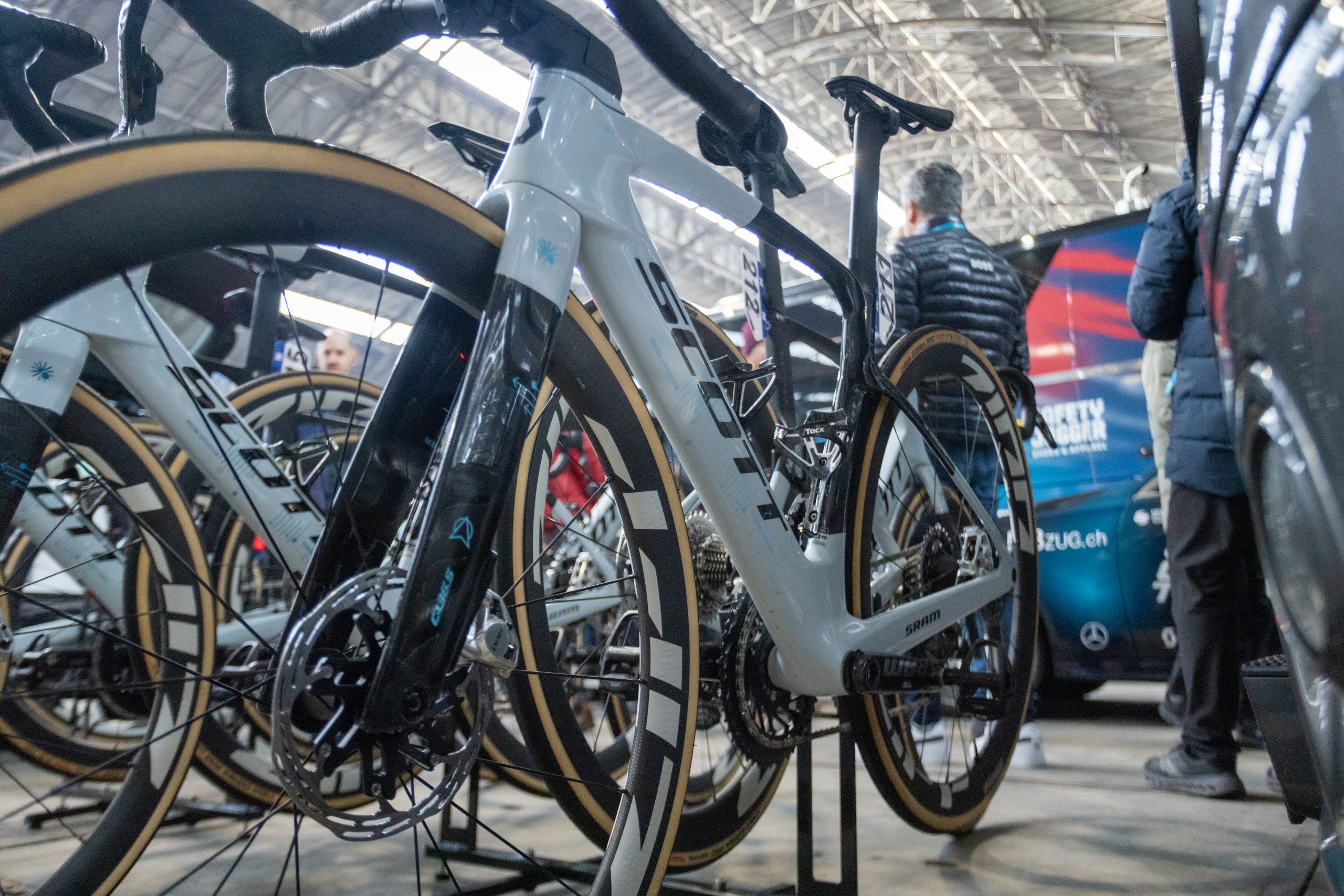
Pidcock’s Scott Foil initially looked to have a relatively standard build, ready to take on the cobbled climbs of the Spring Classics opener.

New Zipp wheel with integrated tyre pressure sensor
We spotted a new Zipp wheelset with an integrated tyre pressure sensor at Omloop Het Nieuwsblad. The red light on the wheel at the top of this picture shows the system is active. Liam Cahill / Our Media

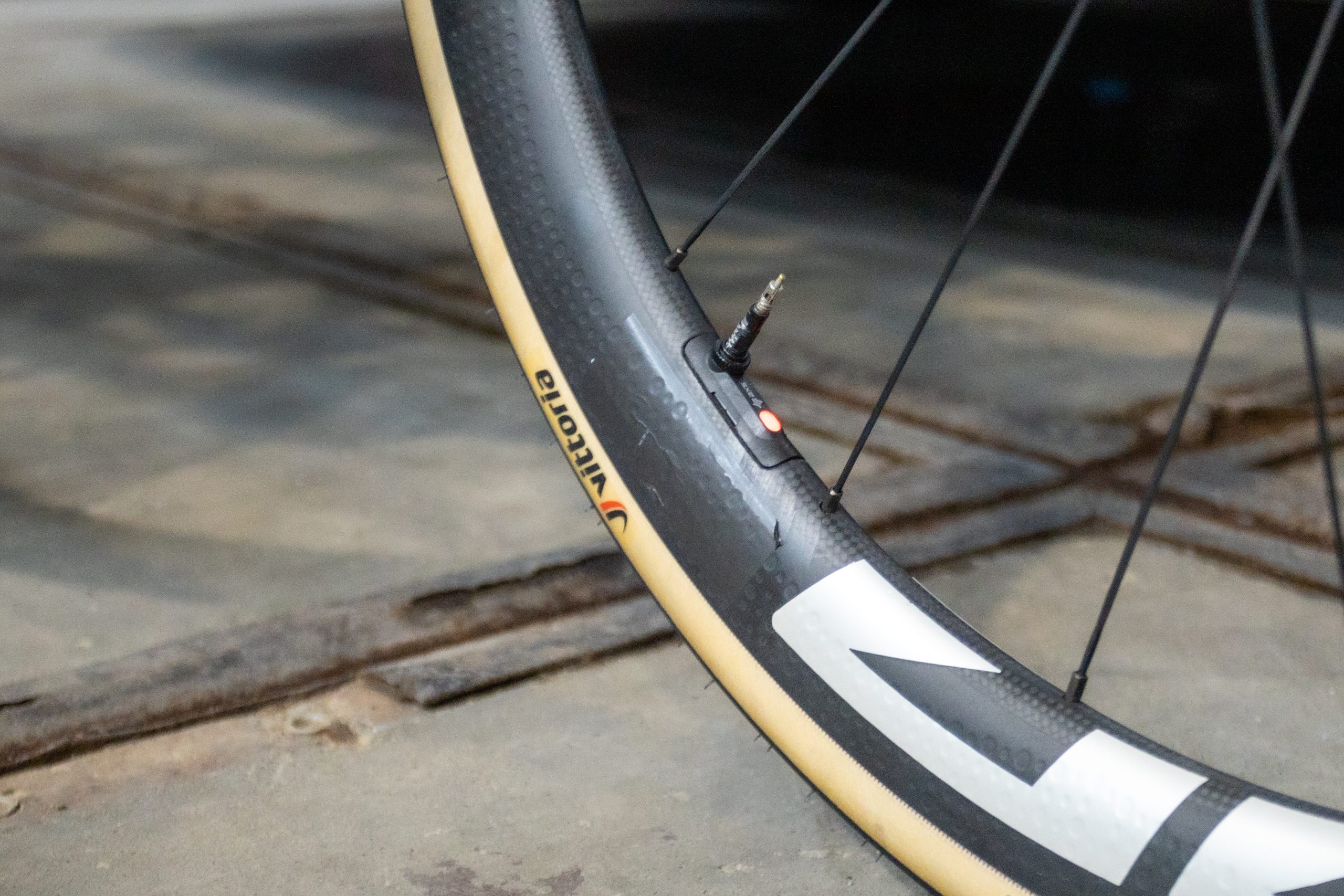
On closer inspection, though, the wheels apparently feature a Quarq Tyrewiz tyre pressure sensor built into the rim at the valve.

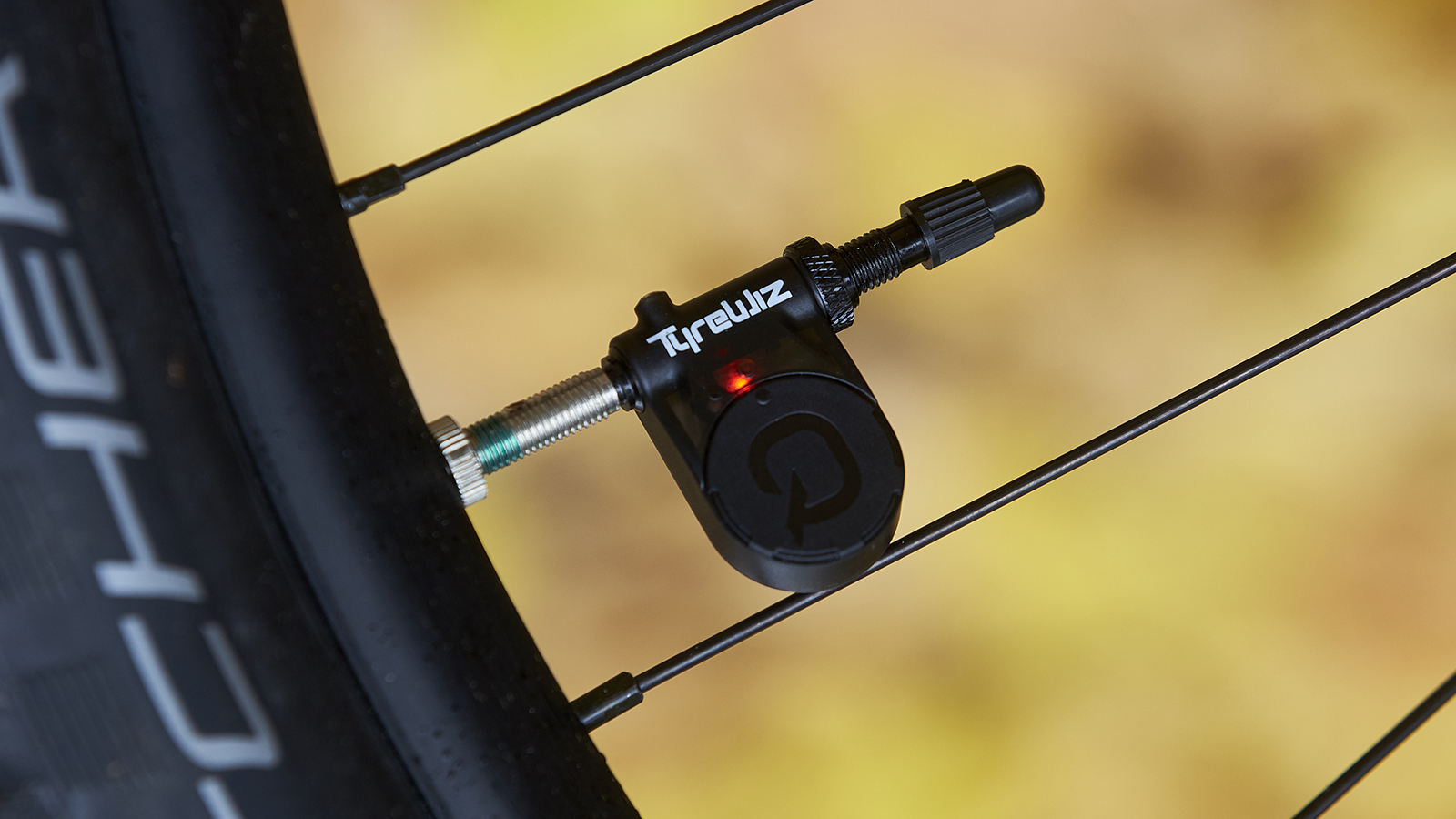
Quarq Tyrewiz Air Pressure Sensor
Quarq Tyrewiz’s offers real-time tyre pressure data, which reveals if your pressures have changed due to temperature changes, burping air or a slow puncture. Here’s the original system in its external form. The new wheelset appears to fully integrate this into the rim. Steve Behr

The current version of the Tyrewiz sits on a special valve, external from the rim.

Integrating the device into a custom recess will likely lead to a small aero saving, while also looking much tidier.

New Zipp Wheels
Tom Pidcock was among the riders using the new wheelset, on his Scott Foil aero bike. Liam Cahill / Our Media

The Tyrewiz gives a rider live tyre pressure data on their bike computer, giving the rider an indication if pressure is being lost (or not).

While this may sound like a small tech insight for a pro, it could enable them to get a quicker change from their team car, or to dispel any doubts about a slow flat or tubeless leak.

New Zipp wheel with integrated tyre pressure sensor
Electrical tape hides branding, but gives us vital clues about products brands don’t want seen. Liam Cahill / Our Media

Zipp has done well to disguise the new wheel, branding the set in a very similar fashion to its existing 303 Firecrest wheels.

A telltale sign, however, is the small piece of electrical tape covering what we can only assume is new branding.

Given pro teams usually want to show off their sponsors’ kit, covering branding usually means there’s something they want to keep secret (which is like catnip to a tech journalist).

Wide road bike tyre on Tom Pidcock's Scott Foil RC
While we can’t see much, the way this 30mm Vittoria Corsa Pro balloons out means we can assume the rim’s internal width is generous. Liam Cahill / Our Media

How the unit is powered is less clear. The current model uses a coin cell battery, which can easily be replaced, and it’s possible space inside the hollow rim has been requisitioned for this purpose.

Alternatively, the unit could be charged via an internal, rechargeable battery, although with no charging port visible, this seems unlikely.

Zipp has been contacted for comment, and we’ll update this article if we can find out any more information about this new tech.

New Specialized tyres and Roval wheels spotted at Omloop Het Nieuwsblad

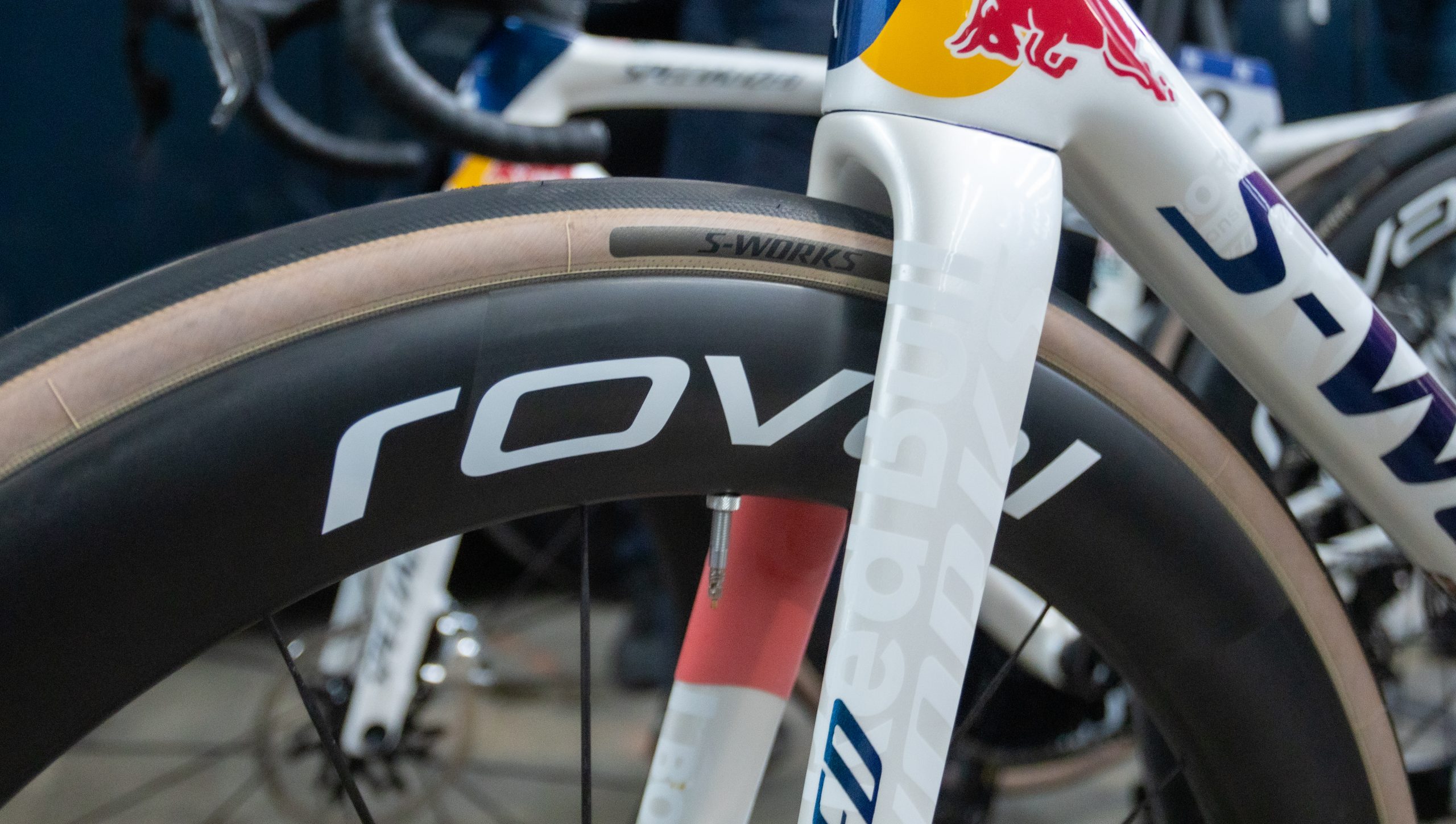
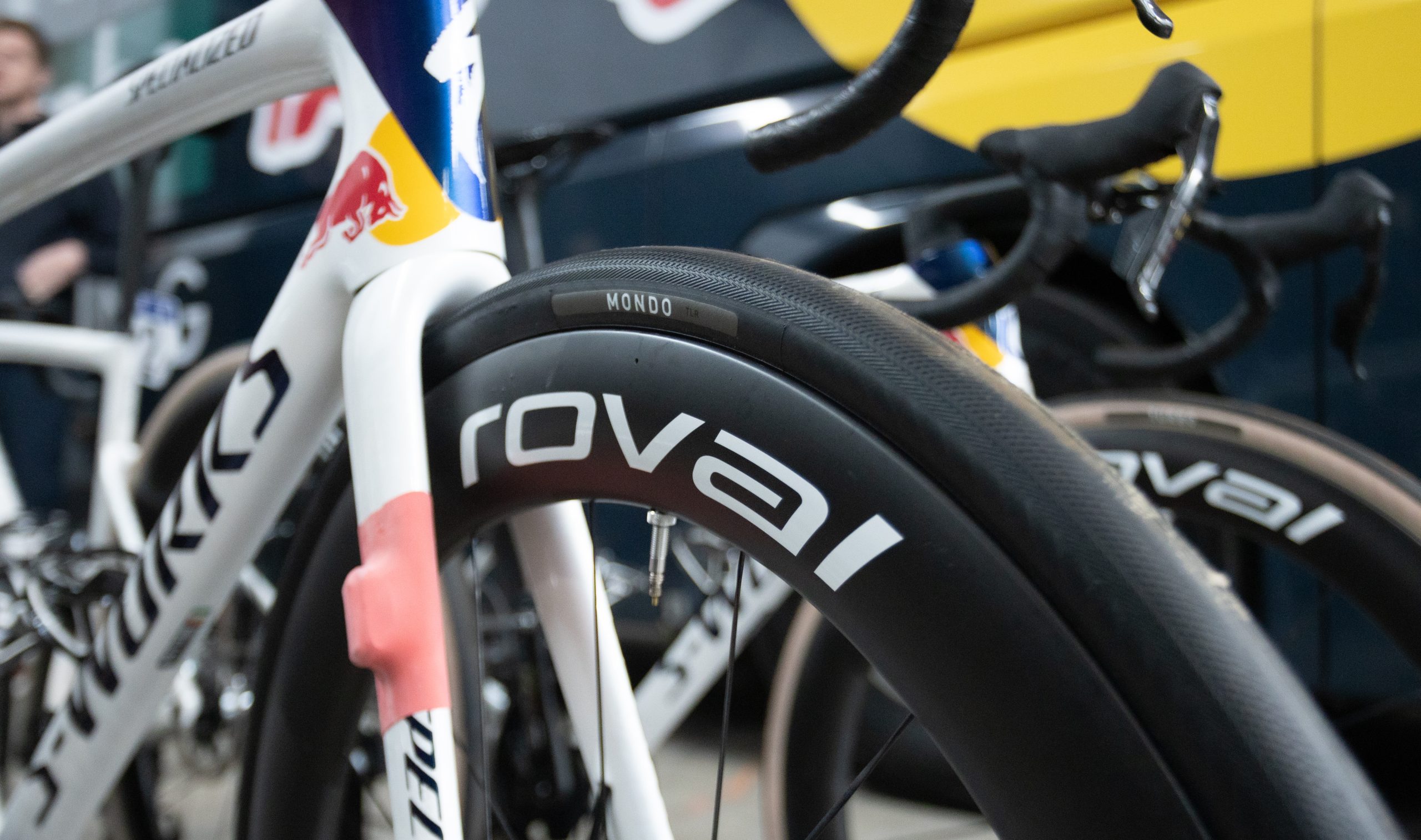
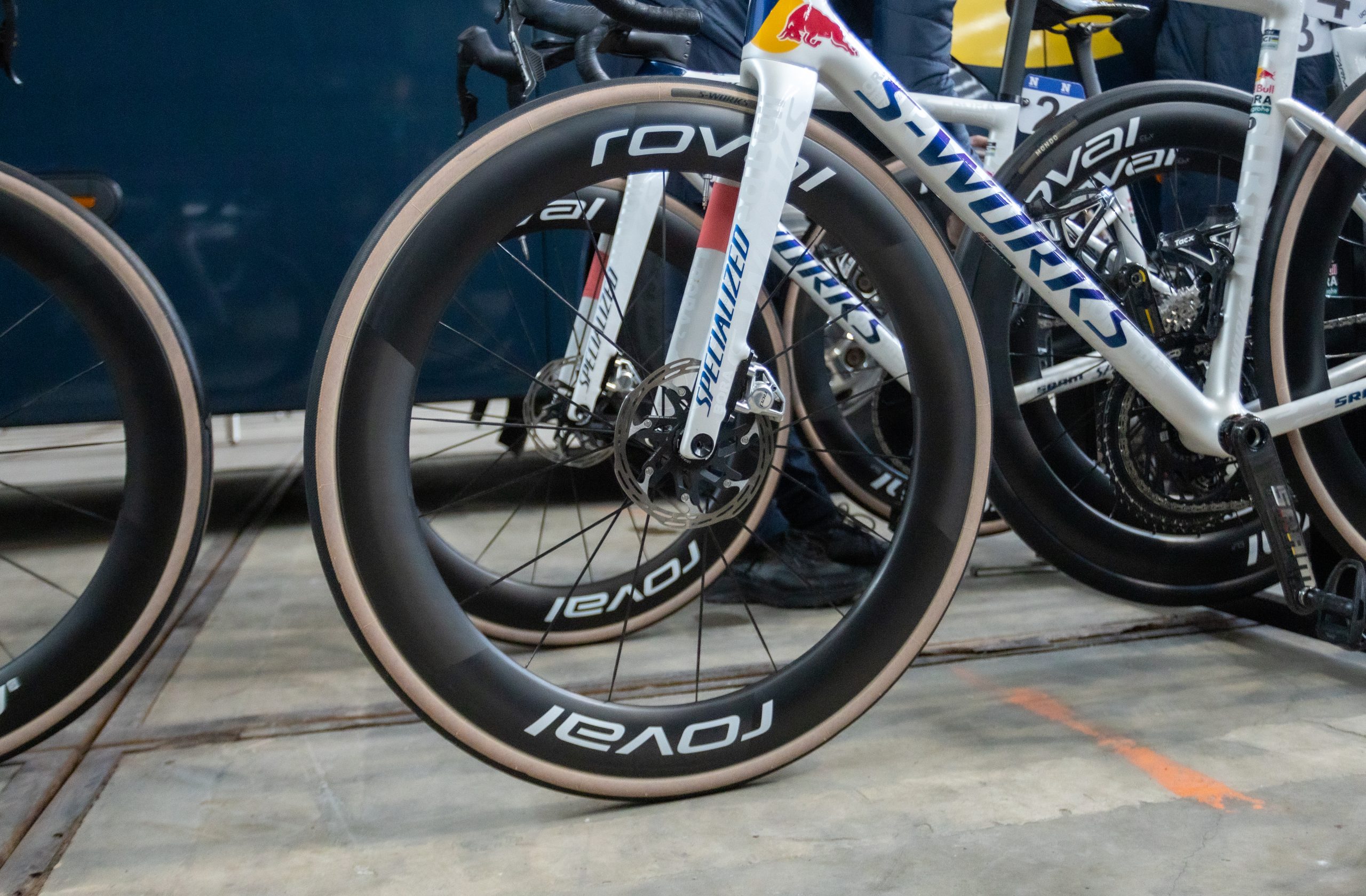
A new Specialized S-Works tubeless road tyre and Roval aero front wheel have been spotted at the start of Omloop Het Nieuwsblad.

Despite its tan sidewalls, a Red Bull-Bora-hansgroh mechanic told BikeRadar that, while the tyres are indeed new, it isn’t a tubeless version of the long-standing S-Works Turbo Cotton clincher.

New Specialised tubeless tyre on Roval wheel
The tyre features minimal branding. Liam Cahill / Our Media

Instead, the team mechanic said the tyre is an entirely new model. This could be a development of one of Specialized’s existing S-Works Turbo RapidAir 2BR tyres.

The tyre has yet to become popular in the pro peloton with several Specialized-sponsored riders, including Olympic road and time trial champion Remco Evenepoel, deferring to the tube-type S-Works Turbo Cotton.

New Specialised tubeless tyre on Roval wheel
The new tyre features a minimalist tread pattern. Liam Cahill / Our Media

Omloop Het Nieuwsblad is the opening race of the Spring Classics, and features several cobbled sections and climbs where wider tyres are often favoured for their ability to smooth out rough surfaces.

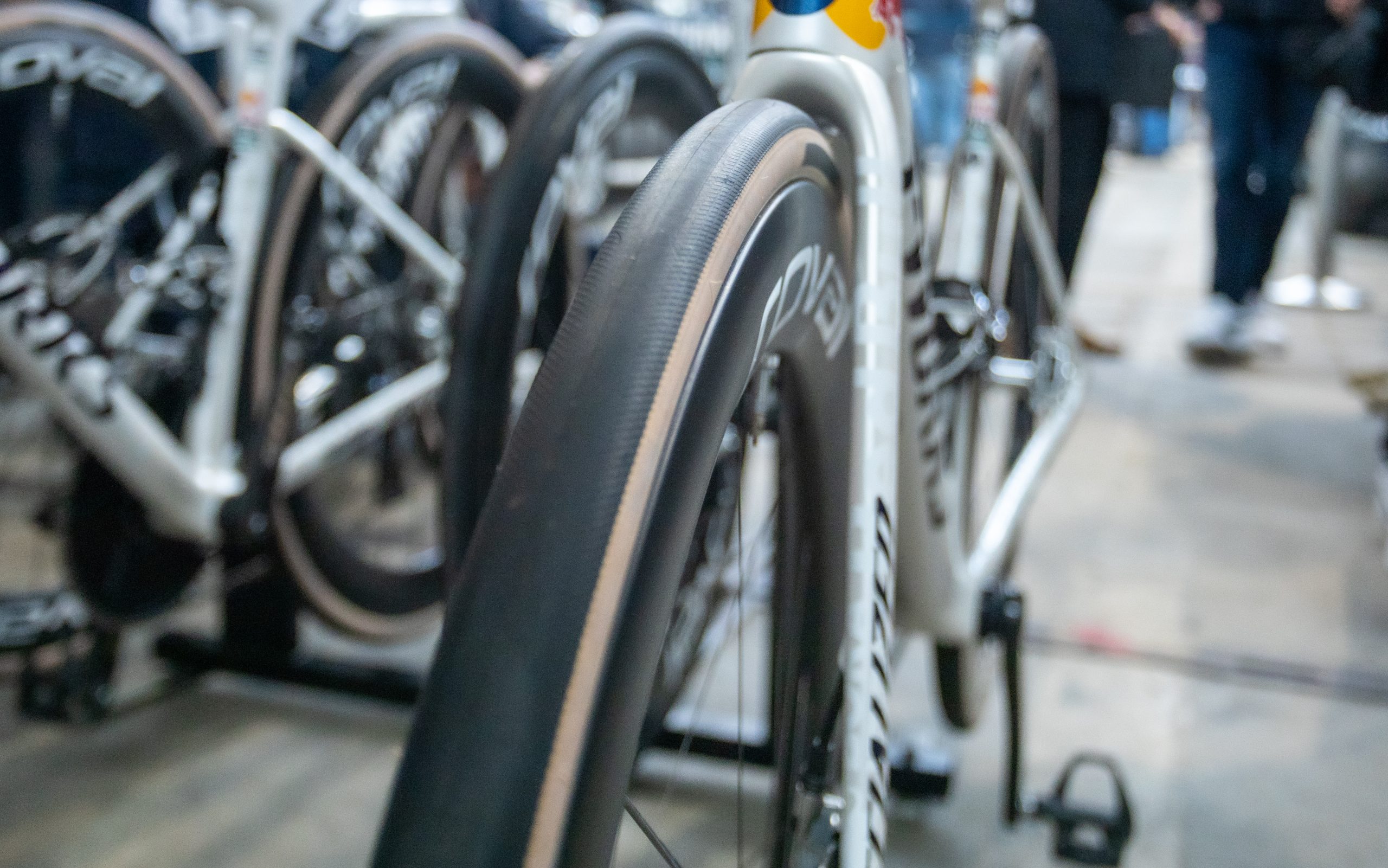
As expected, the new tyre was being used in wider forms, with the mechanic saying the tyre we saw was a 30mm-wide model.

Specialized S-Works Mondo tyre on Roval wheel
The Mondo features a little more shoulder tread. Liam Cahill / Our Media

This new tyre may not be available in a wider form, however, as Ryan Mullen chose the Specialized Mondo in a size 32mm. Or, perhaps, the new tyre uses a less robust casing, and Mullen simply didn’t want to take any chances.

Either way, we’ll have to wait for the official word from Specialized to be sure.

Few details, however, were available for what looks to be a new Roval aero front wheel.

New Specialised tubeless tyre on Roval wheel
Even faster wheels may be coming from Roval soon. Liam Cahill / Our Media

A visibly deeper rim is being used in comparison to the Roval Rapide CLX III Team – which is currently Roval’s fastest road bike wheelset.

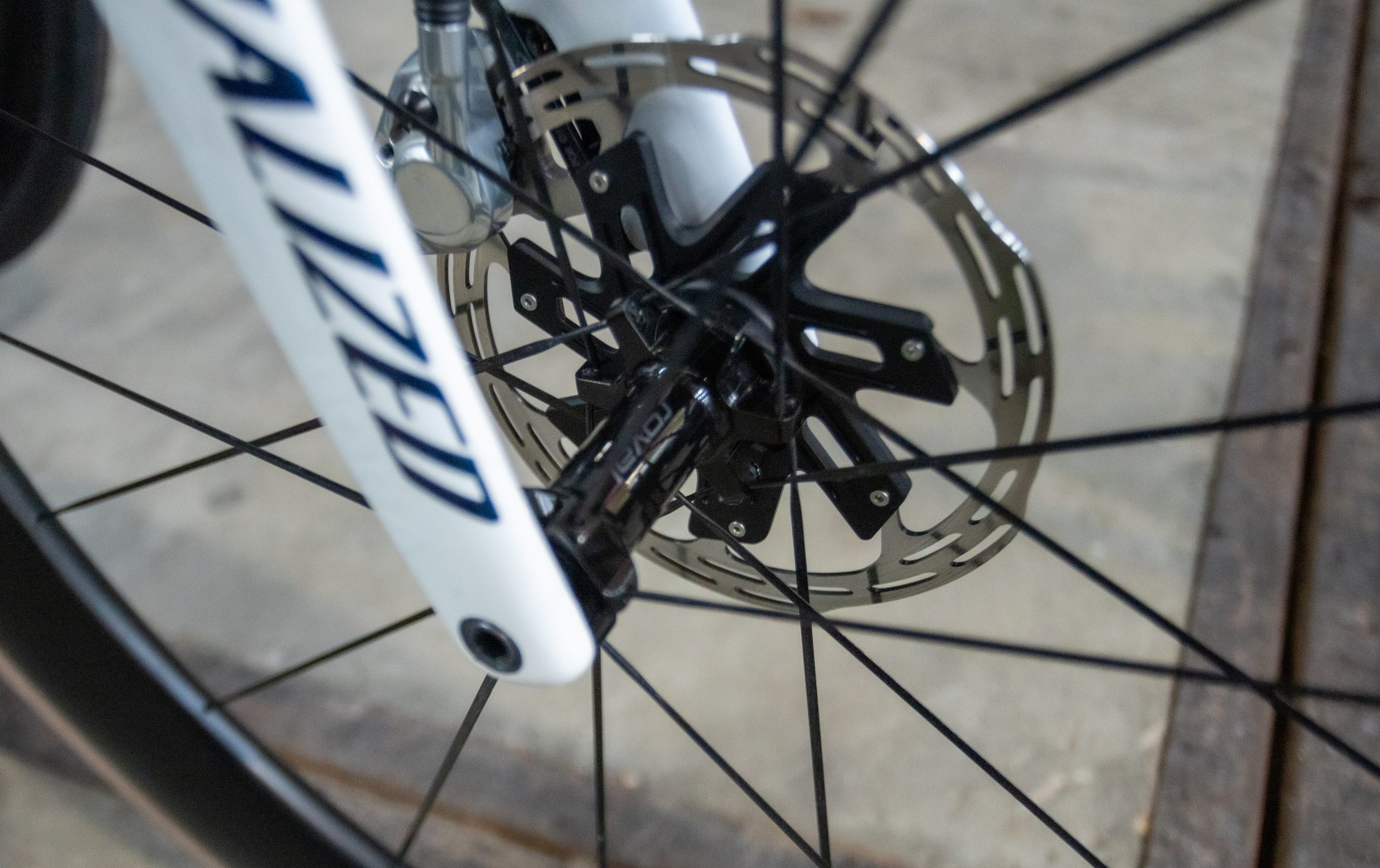
Roval front hub
The non-drive side flange features a much more angular design than the Rapide CLX III Team. Liam Cahill / Our Media

Another telltale sign comes at the hub. This is black, rather than the silver found on the Rapide CLX III Team wheels. It also appears to be a slimmer design.

The lacing on the drive side is radial, while the non-drive side gets a 2x pattern to help deal with braking forces.

We’ll just have to wait on an official release from Specialized and Roval for more details, although it’s safe to say the new wheel is almost certainly a faster option for flat or rolling races.

Woman Racer Spotlight: Megan Onweller

Name: Megan Onweller

Hometown: Lino Lakes, MN (born and raised Michigander)

How did you get into cycling? I started on a exercise e-bike, wanted MORE and started doing research. My sister was an avid cyclist and told me to get a bike and trainer. Which was SOOOOO complicated and foreign to me at the time. I often remind new riders that it’s OK to feel overwhelmed we all did at some point. 

How many years have you been racing on Zwift? 4 years I think, I started right around 2021 for the social impact of a team environment. I also ride with the Hugo Gravel Team in MN, and I was on Season 3 of From the Ground Up on YouTube. 

Are you part of a Virtual team? I am a part of the Drafting Dinos, I took a break but came back. Once a dino always a dino, LOL…

What do you love most about racing? Surprising myself on what I can do, and how I can improve. 

What is your favourite style of race (e.g. points, scratch, iTT, TTT, Chase, duathlon)?  I love TTT, it’s special in its own way. The teamwork and communication, the dedication of the overall team, it’s so refreshing. BUT I do love me a points race, getting to utilize the strategy of it all. The recon, the notes, and the joy of lining up to see what you can obtain for the team. It’s so damn fun! I have a 10 year old, too, and he loves to cheer me on. 

What is your favourite Zwift women’s race series? ZRL is always fun, Fearless also puts on a great women’s race. 

What is your most memorable racing experience, inside or outside or BOTH? I raced Unbound gravel last year and my favorite was pushing hard for my personal record. I ended up pulling a large group of men for about ½ of the course. There are some pretty awesome pics from it, but overall after feeling inferior to men on the bike it was very empowering. I felt like such a badass. It made all the training time on Zwift and outside so worth it. It was a great memory. My sister Paige Onweller was also in a pretty iconic women’s sprint finish at that race so it was a great race for memories! 

I think indoor was my first group ride with the Dinos an “easy” ride up the Alpe, haha. They were so encouraging, and I knew if I could have fun suffering up that beast I was in good company. The rest was history. 

What is your favourite food to eat post-race? I am a sucker for a chicken basket and fries after a long ride. I love me an horchata recovery shake as well from Scratch, it’s a 12 out of 10. 

What advice would you give to a woman entering her first Zwift race? Have fun! Don’t stress and never feel stupid for asking others for help, we all started out the same way. Also, if you are a mom it is NOT selfish to spend time on a bike. You are showing them important things like work ethic and we can do hard things. Time is time, we make up for it elsewhere. Mom guilt is real, but being happy and healthy is worth more than the time you will spend on the bike. 

Any upcoming race you are looking forward to? I am looking forward to some local gravel races and Iceman in Michigan. My whole family basically races it. This past year my partner, my dad, my son, and I all raced. My sister also did the pro race! It was quite a weekend. 

Where can people follow your racing adventures?

Oakley and Cinelli team up on sunglasses that ‘explore nature and self’

Oakley and Cinelli have joined forces to create two sets of cycling sunglasses that reflect their shared passion for “exploring both nature and self”.

The line-up consists of the Latch Panel Cinelli and Eye Jacket Redux Cinelli – as well as a custom Cinelli Nemo gravel bike (which isn’t for sale).

The Latch Panel Cinelli glasses are said to offer a fusion of street and sport style. These have a full-rim, shield lens with Oakley’s Latch hinge, and removable side panels “to block out distractions”. Oakley and Cinelli say the glasses have thin temples to fit under a hat or helmet. 

These limited-edition specs have an intentionally “worn” design. The brands say this “tells a story of passion and dedication”. 

The Eye Jacket Redux has the same strong silhouette as the original Eye Jacket, which was first released in 1994. 

Oakley x Cinelli Eye Jacket Redux glasses worn by Taylor Phinney.
The Oakley x Cinelli Eye Jacket Redux glasses worn by Taylor Phinney. Oakley

Both of the new glasses feature Oakley’s Prizm lenses, which help enhance contrast on road surfaces. The Latch Panel Cinelli glasses have Prizm Road Black lenses and the Eye Jacket Redux glasses have Prizm grey lenses. 

The glasses feature Unobtanium nose pads and the Eye Jacket Redux glasses also have Unobtanium earsocks to aid retention. 

The glasses are packed with custom micro bags and box sleeves. 

This is the first collaboration between Cinelli and Oakley, and it was launched with retired pro cyclist Taylor Phinney. He’s said to embody “the spirit of adventure and a unique perspective on cycling that transcends traditional notions of endurance and performance”.