Canyon’s new Exceed is the gravel biker’s MTB

Canyon’s long-running cross-country focused hardtail, the Exceed, has had a refresh for 2025, with its focus shifting from pure XC racing to adventure riding.

It’s fair to say the days of hardtail XC racing have largely passed, with almost the whole World Cup field now on full-suspension bikes, as are most privateer racers, even in national series.

The onward march of technicality in XC means the humble hardtail mountain bike is now rarely the fastest way up and down an XC race course.

Yes, there’ll always be hardcore hardtail fans in XC, who want the stiffest connection from crank to wheel, but those people are in ever-diminishing numbers.

Likewise, the growth of adventure riding and ultra-distance racing seems unabated. The Silk Road Mountain Race, the Tour Divide and other events are pulling in both household names and widespread coverage.
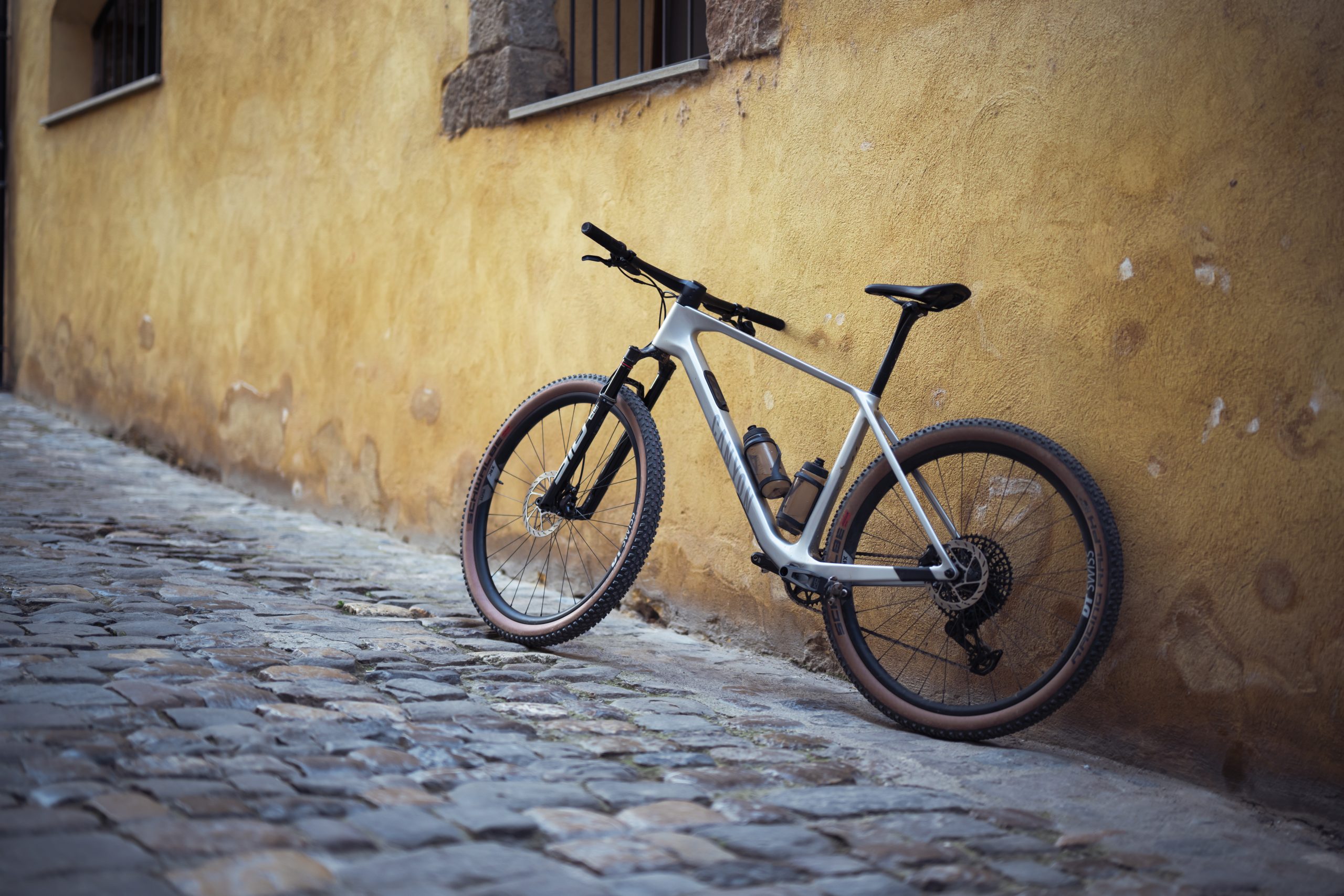
Canyon Exceed hardtail
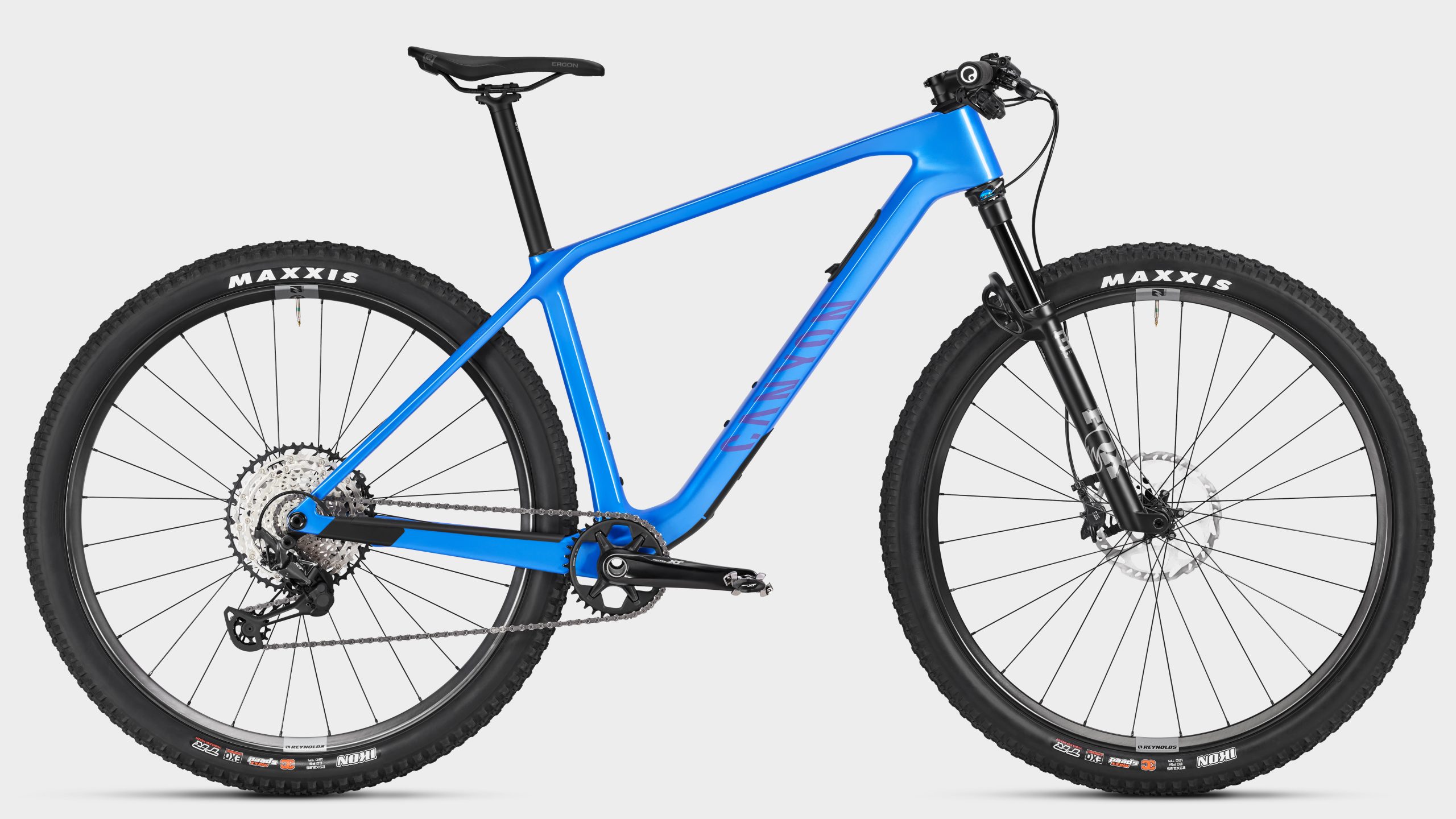
Canyon’s new Exceed is a do-it-all hardtail. Roo Fowler / Canyon

While the rapid growth of gravel riding has seen events such as these becoming a festival of curly bars, the reality is hardtails offer additional comfort over long, rough rides.

In my own experience, I’m now more likely to pull my cross-country bike out of the garage for a local long lap than I am my gravel bike.

I don’t lose much on road drags, and the slippery technical ups and downs that litter UK ‘gravel’ are simply more fun on a mountain bike.

All of the above points have been cited by Canyon as reasons why the new Exceed has lost its sharp, racy edge.

No longer is it a bike built specifically for the race course. It’s now designed to tap into the adventure-focused world the best gravel bikes have unlocked, but where broad tyres, suspension forks and less aggressive geometry excel.

Canyon’s 2025 Exceed hardtail
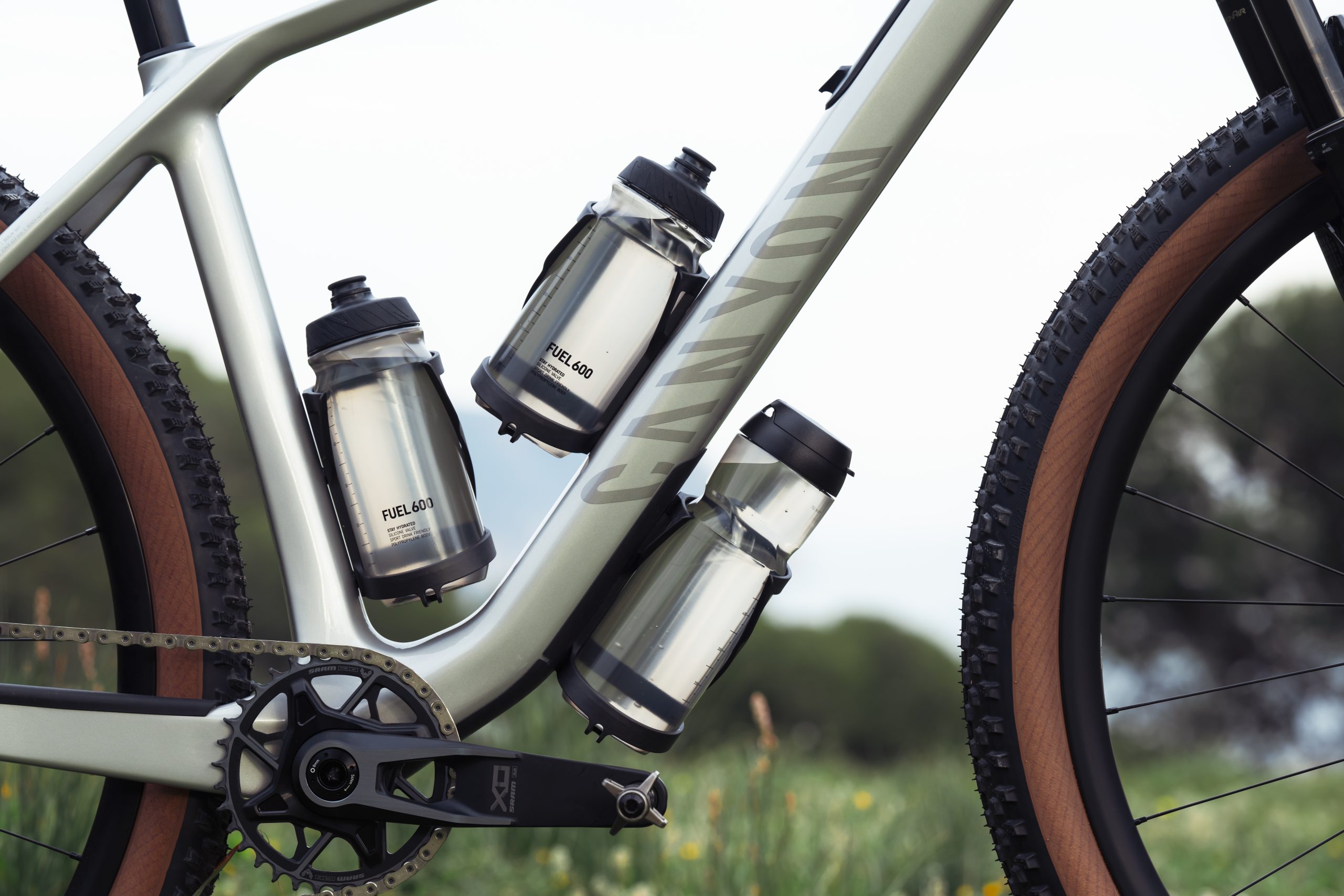
Canyon Exceed water bottles
Need a drink? Three bottles can be carried here. Roo Fowler / Canyon

So, the new Exceed is a simply effective, efficient off-road machine, then.

Canyon tells us the bike is no longer designed for weight weenies, but for riders looking for a fast and comfortable off-road experience, whether that’s speedy local laps or something altogether more adventurous.

Strap a race number on it and it’ll still perform, though.

The frame is built from carbon and has a much more modern aesthetic, with a more notably dropped top tube, than the outgoing model for added standover, slacker angles for more relaxed handling, and plenty of carrying capacity.
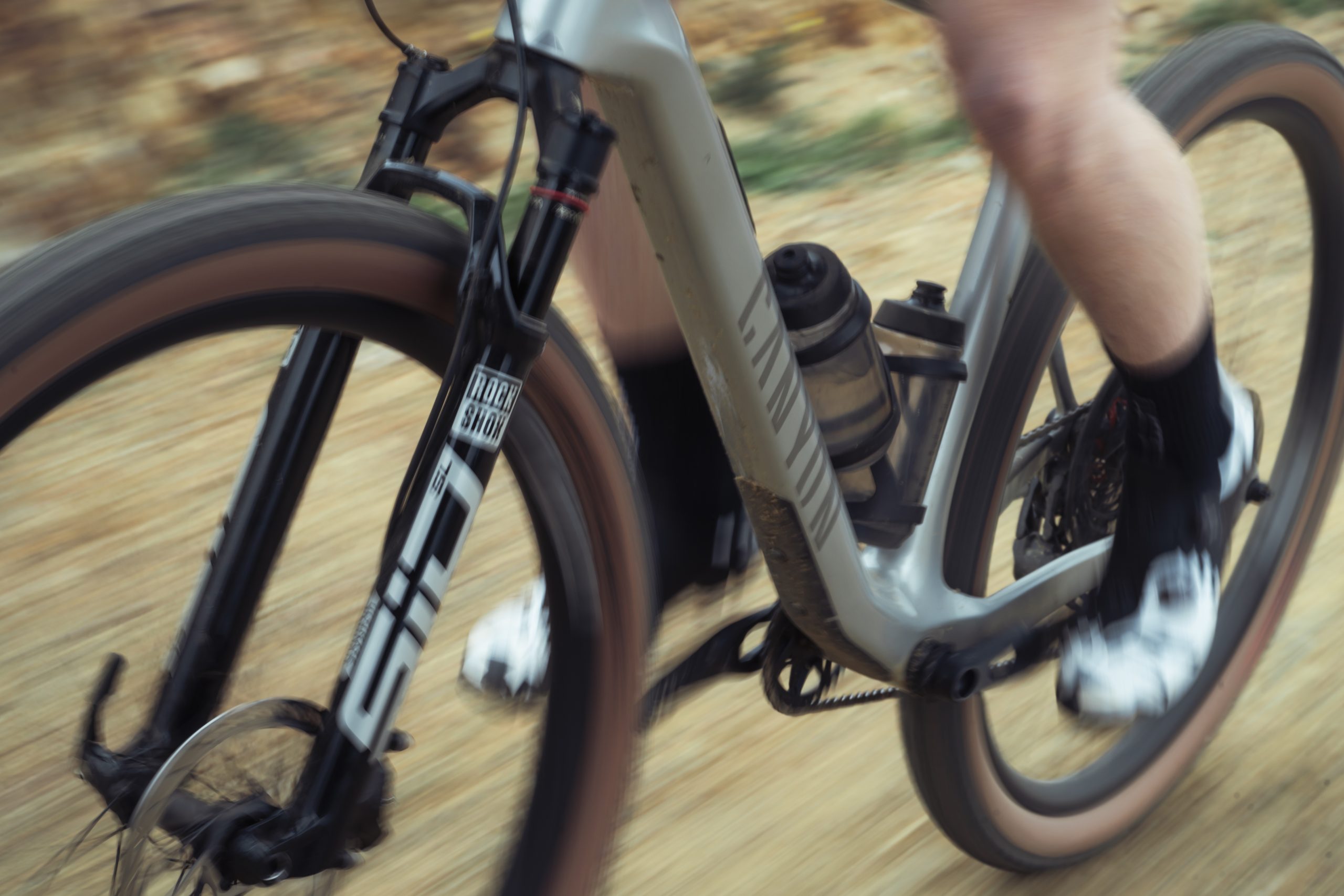
Canyon Exceed suspension
100mm-travel forks will be specced on all models. Roo Fowler / Canyon

Despite the lower top tube, Canyon has strived to ensure there’s still plenty of space inside the front triangle for load-carrying. There’ll be Canyon’s own flush-fit frame bags built specifically for the Exceed, for example.

Hardtails might not offer as much comfort as full-suspension mountain bikes, but Canyon has designed the frame to be compliant, adding a hint of comfort to its ride via lateral flex in the rear triangle.

Skinnier sections of chainstay near the bottom bracket are said to add compliance, without compromising power transfer to the rear wheel.

In addition, the frame flex helps the Exceed carve fast corners, according to Canyon.

This comfort is also aided by a new VCLS seatpost, available on the top-spec model, or aftermarket.

Canyon’s VCLS seatposts combine two D-shaped sections of post, allowing up to 20mm for forward/back movement, which is intended to increase the seated comfort of the bike.
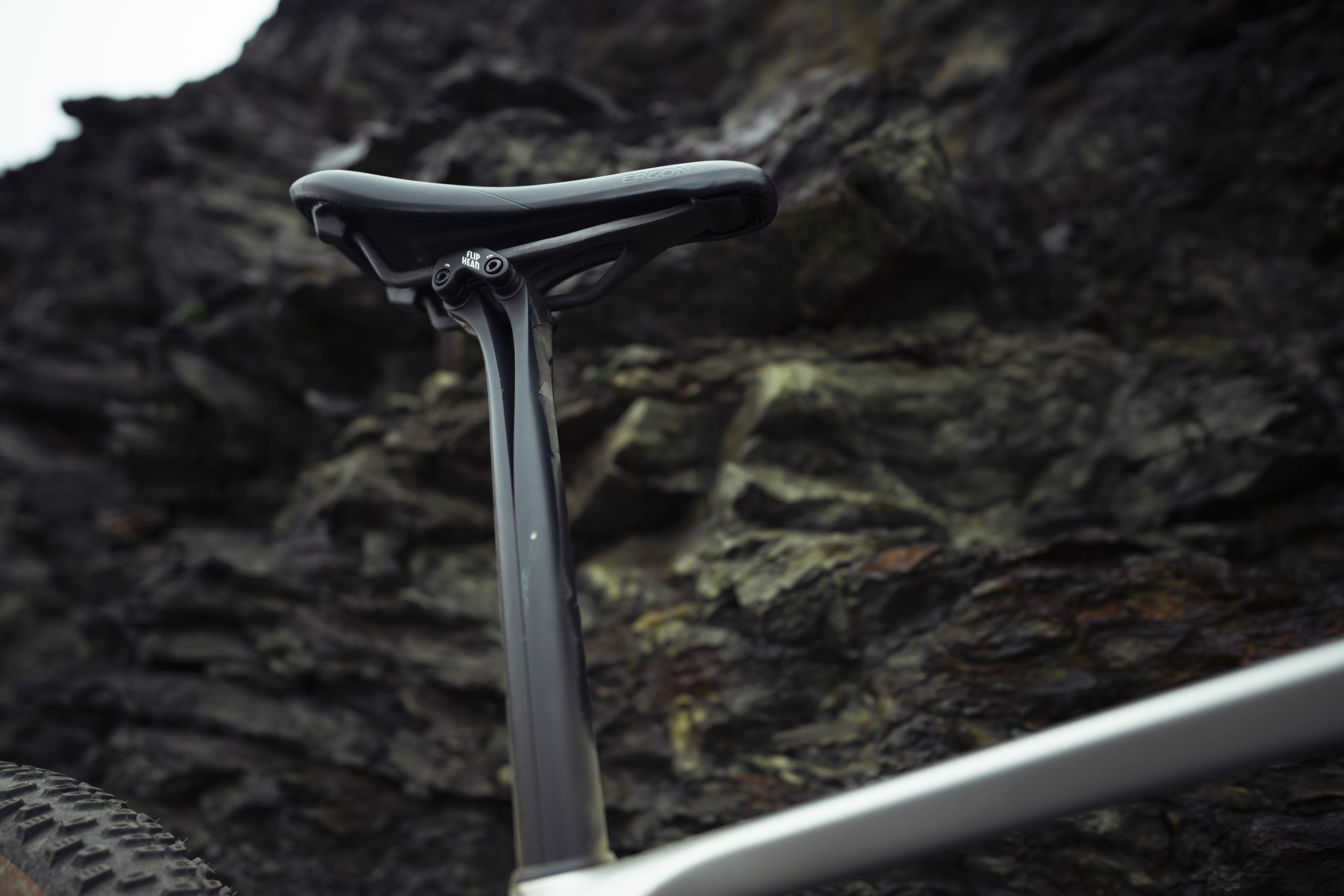
Canyon VCLS post.
The VCLS 2.0 post has been popular at BikeRadar in the past and it’s now available in an MTB-friendly diameter. Roo Fowler / Canyon

While the VCLS posts have always been 27.2mm in diameter – designed as they are for Canyon’s gravel bikes – there’s a 30.9mm option for the Exceed.

This means the seat tube is broad enough to accept a wide range of dropper posts, although none of the models comes with one as stock.

Dropper post cable routing is included in the frame, as is fully sheathed internal routing for gear cables and brake hoses.
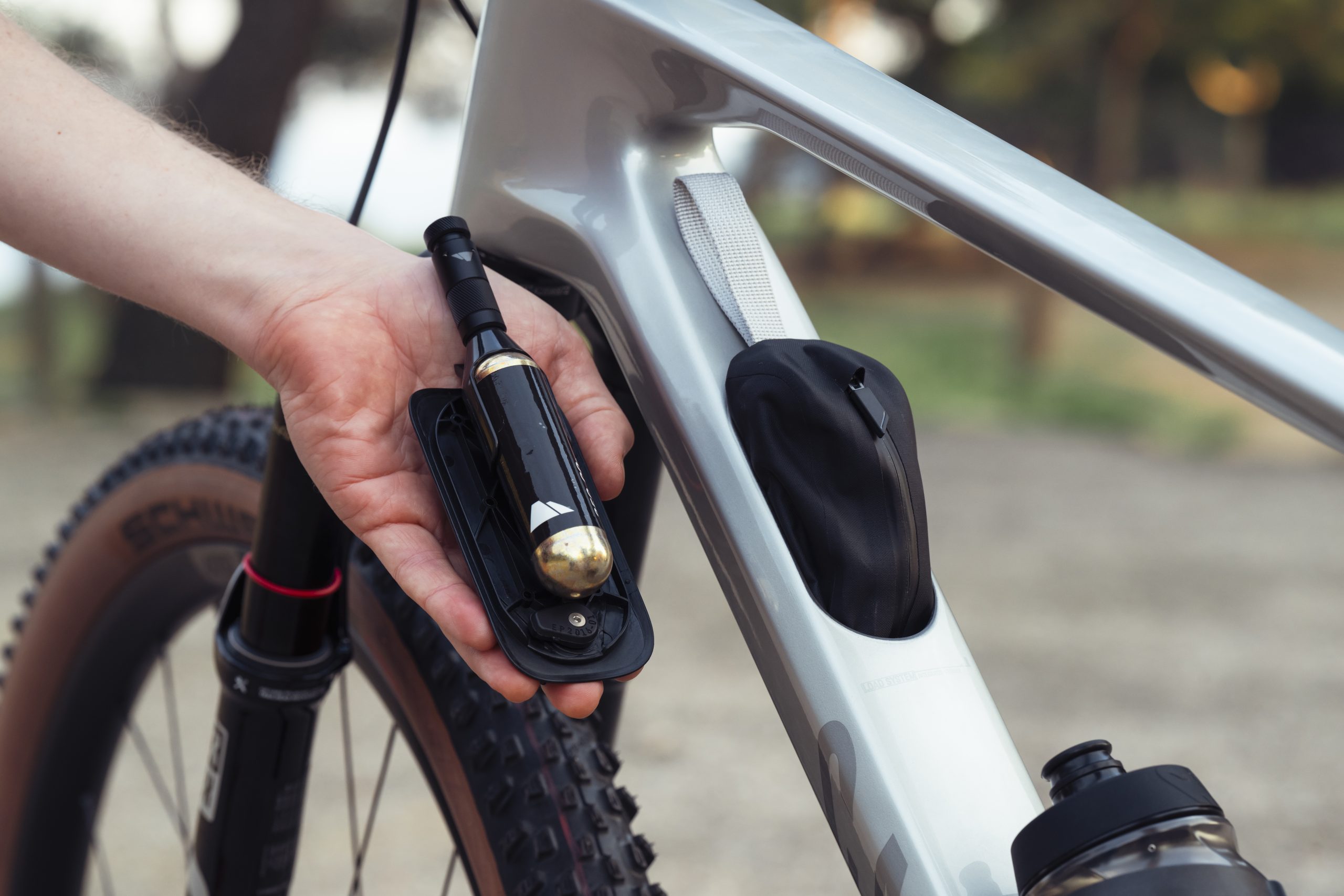
Canyon LOAD system
Stash your spares in the down tube. Roo Fowler / Canyon

Another update is the use of Canyon’s LOAD Internal Storage System. Like many brands’ bikes, the Exceed has a storage hole in its down tube, with the inside of the port’s lid able to carry a CO2 canister for speedy deployment in a race.

Final finishing touches include a threaded BB, three sets of bottle-cage bosses and enough frame protection to ward off chain slap, heel rub and rock strikes.
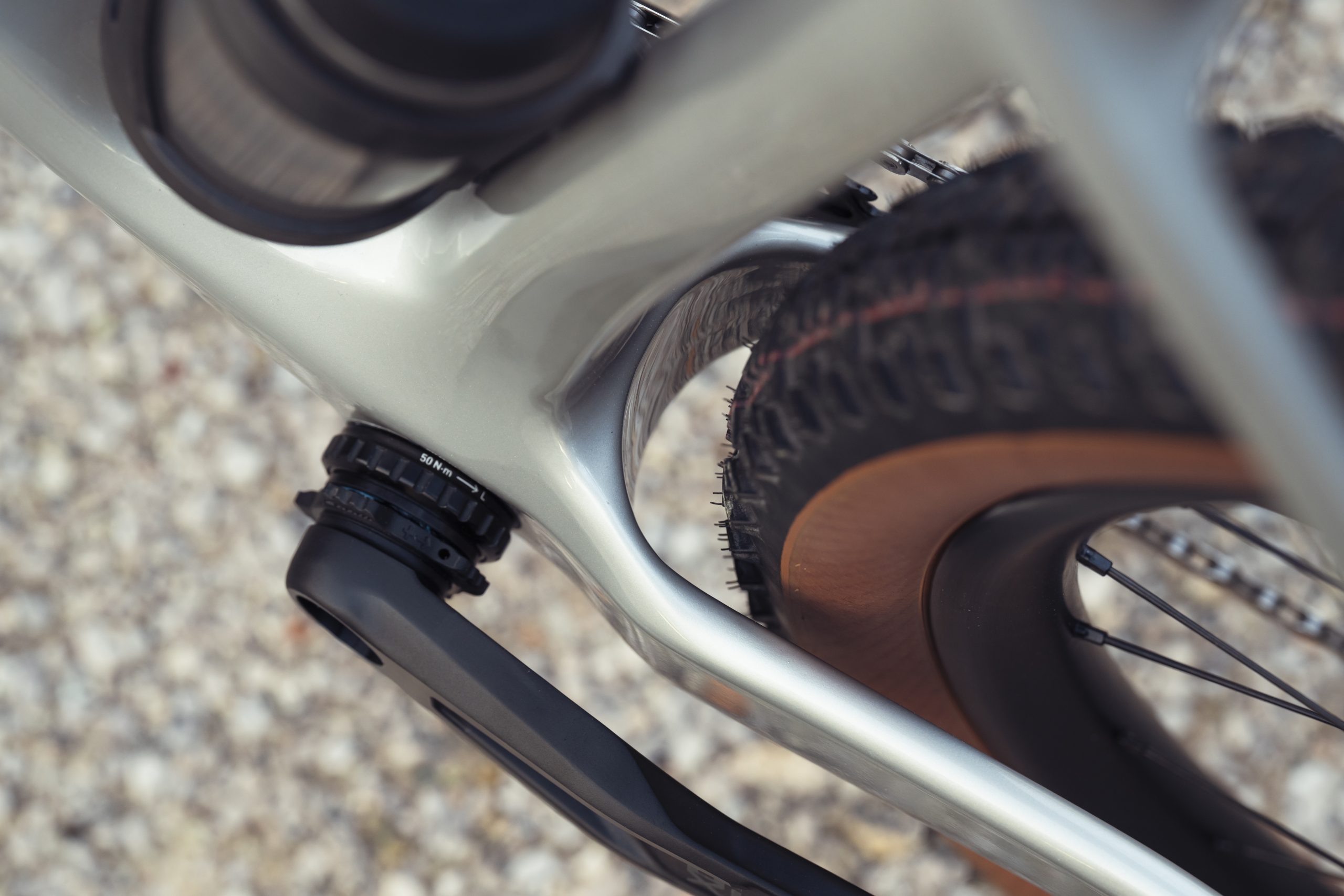
Canyon Exceed chainstays
Skinnier stays add comfort, while most will appreciate the threaded bottom bracket. Roo Fowler / Canyon

Canyon Exceed range details

Canyon Exceed CF 8
Canyon’s Exceed CF 8 in blue. Roo Fowler / Canyon

The Exceed has a middle-of-the-road geometry, which should be pretty easy to get on with.

Across the five sizes, reach numbers range from 408mm to 485mm. Head angles sit at 67 degrees, while effective seat angles are 75 degrees. Chainstays grow from 425mm on the XS to Medium bikes to 430mm and 435mm on the Large and X-Large bikes respectively.

Five models will be on offer, ranging from the €1,999 Exceed CF 5 to the Exceed CF 9 at €4,999.

Spec lists feature Shimano drivetrains on the three cheaper builds, with SRAM’s Transmission on the two pricier builds.

RockShox’s 100mm-travel Recon and SID forks dominate the spec lists, with the appearance of a Fox 32 Step-Cast on the mid-spec CF 7.
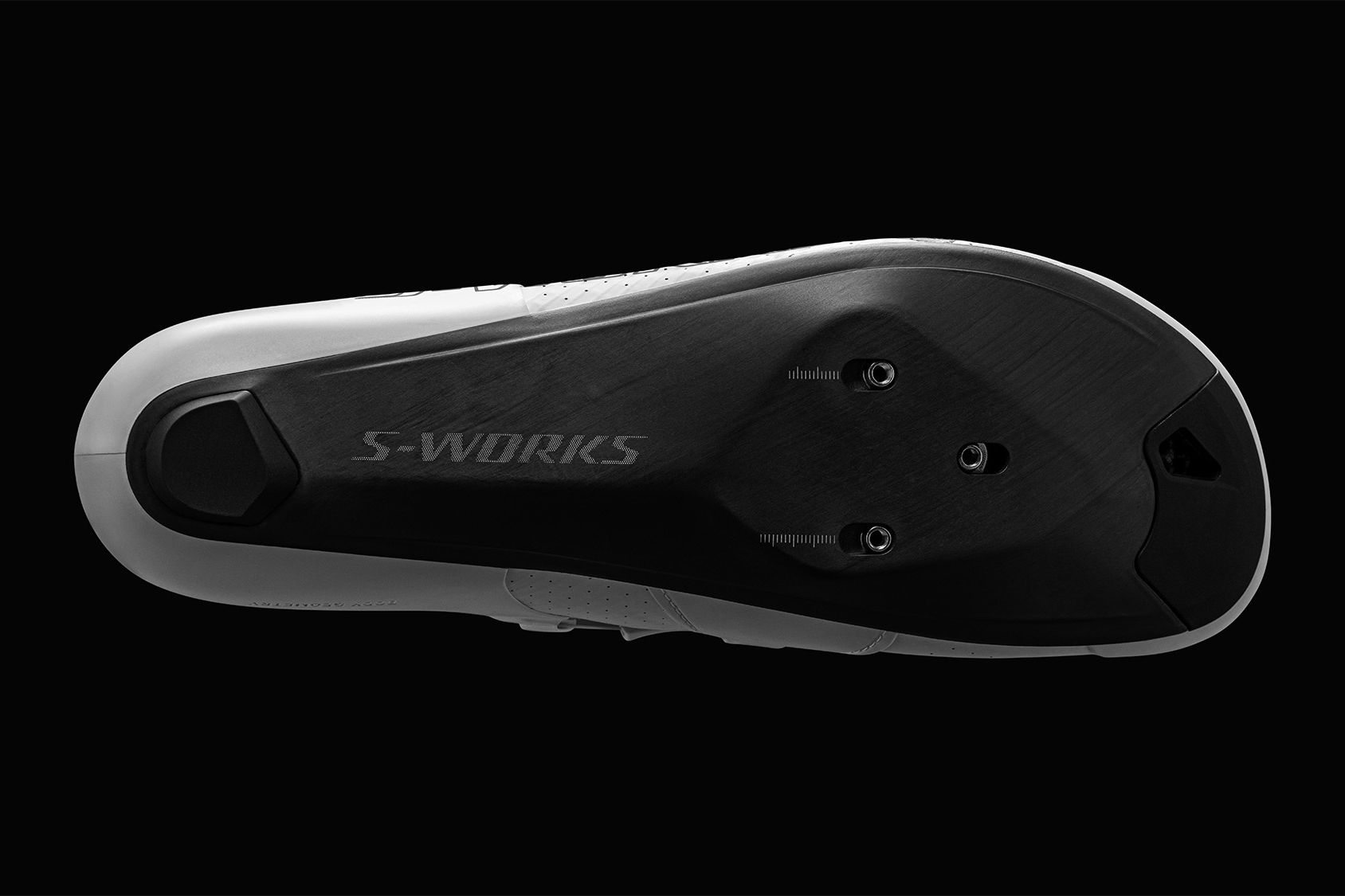
This new Specialized shoe is faster, more comfortable… and will cost you nearly £500

Specialized has launched the S-Works Ares 2 road shoe, claiming it offers the “most positive, locked-in feel without sacrificing comfort”.

Central to this is a new last design, which offers significantly more space for toe splay. This combines with a series of structured supports to reduce pressure, while promoting a secure fit.

The S-Works Ares 2 is available from today, costing £479 / $600 / €549 – over £100 more than the brand’s premium S-Works Torch and previous Ares shoe.

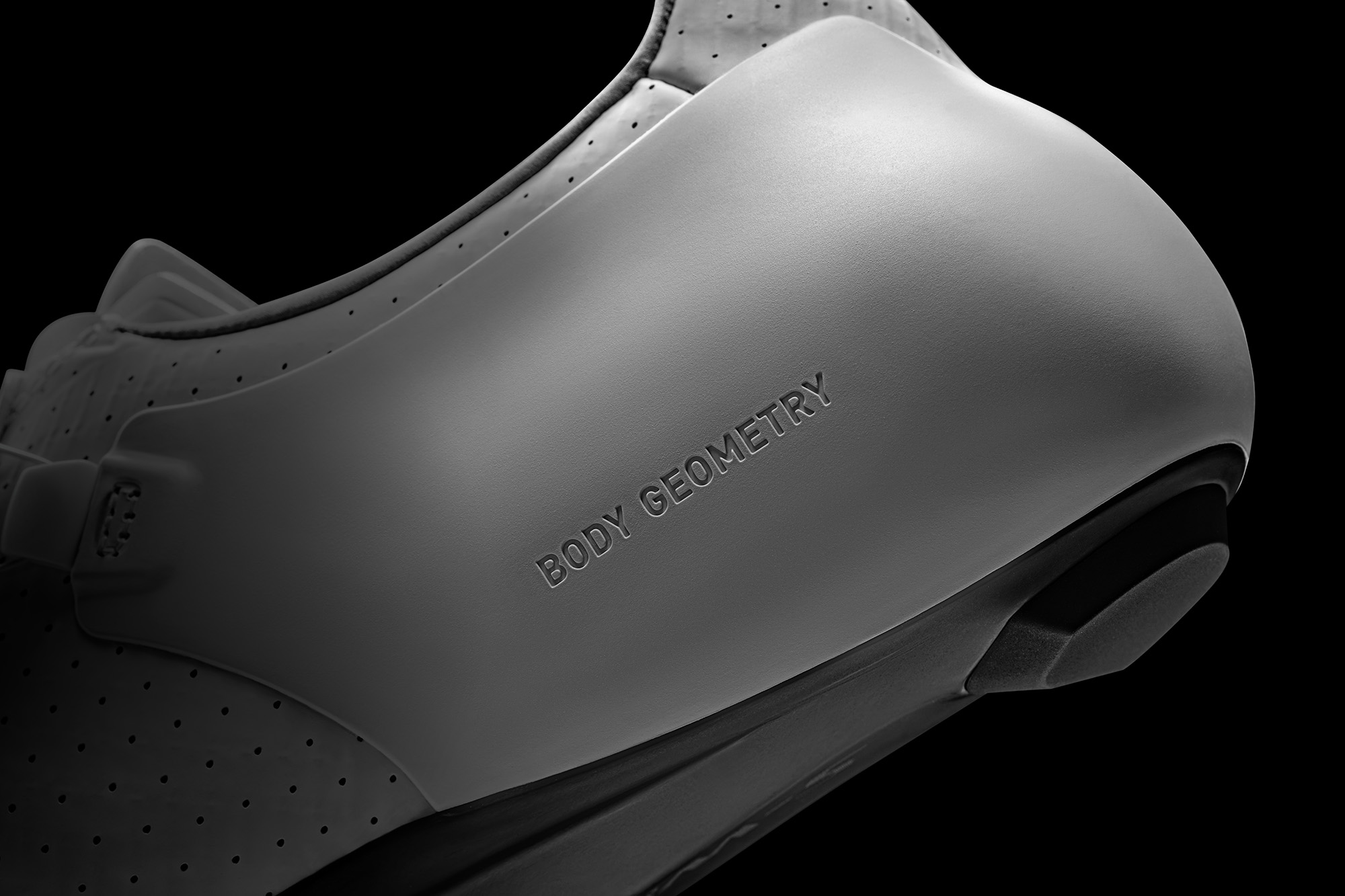
New Body Geometry last

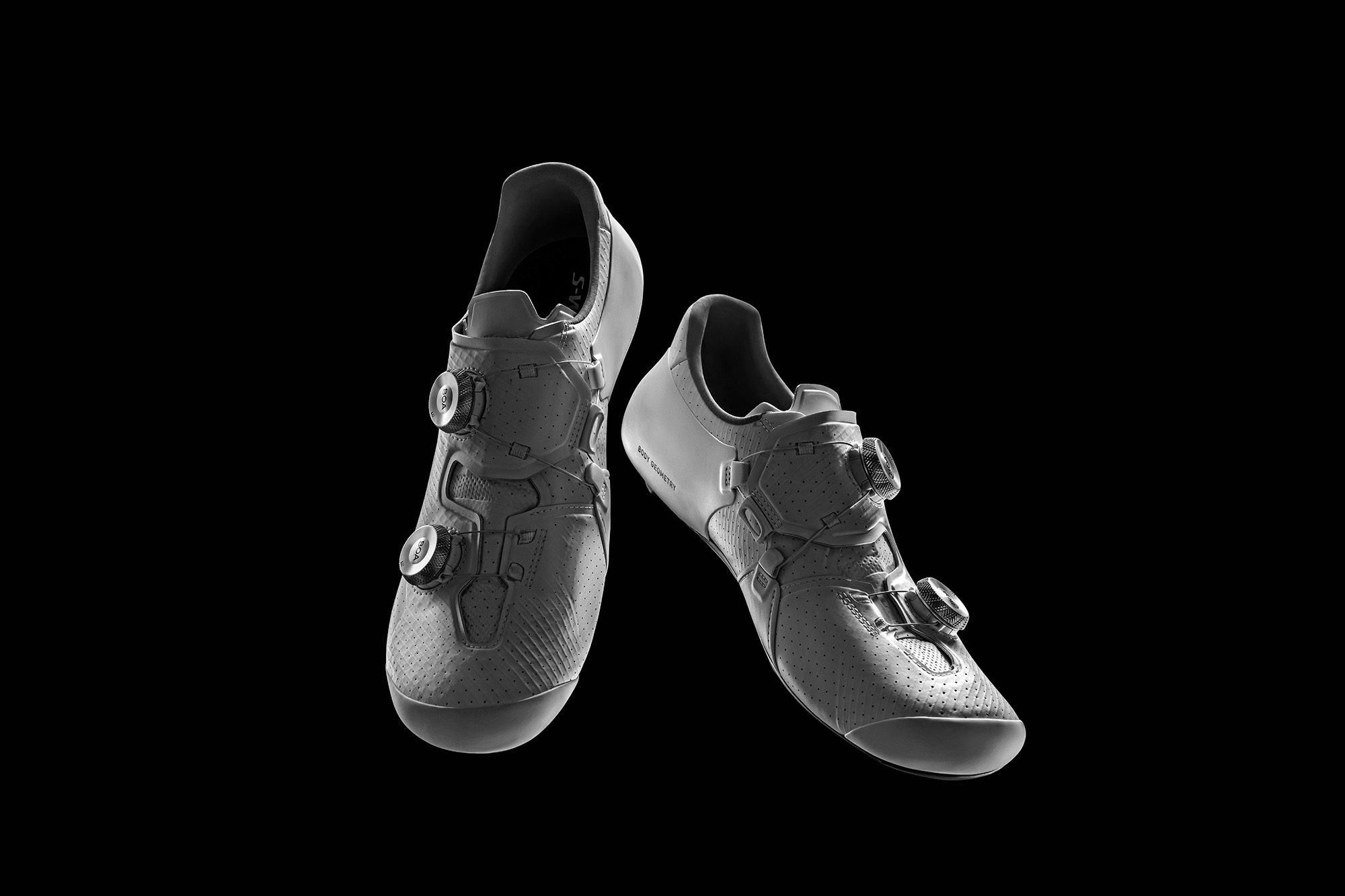
Specialized S-Works Ares 2
Specialized says the Ares 2 offers the “most positive, locked-in feel without sacrificing comfort”. Specialized

Specialized says its new, wider last design is the key to promoting a comfortable fit, dovetailing with other improvements (versus the old Ares shoe) for a secure fit.

As a reminder, the last is the internal base of the shoe, which your foot is in contact with.

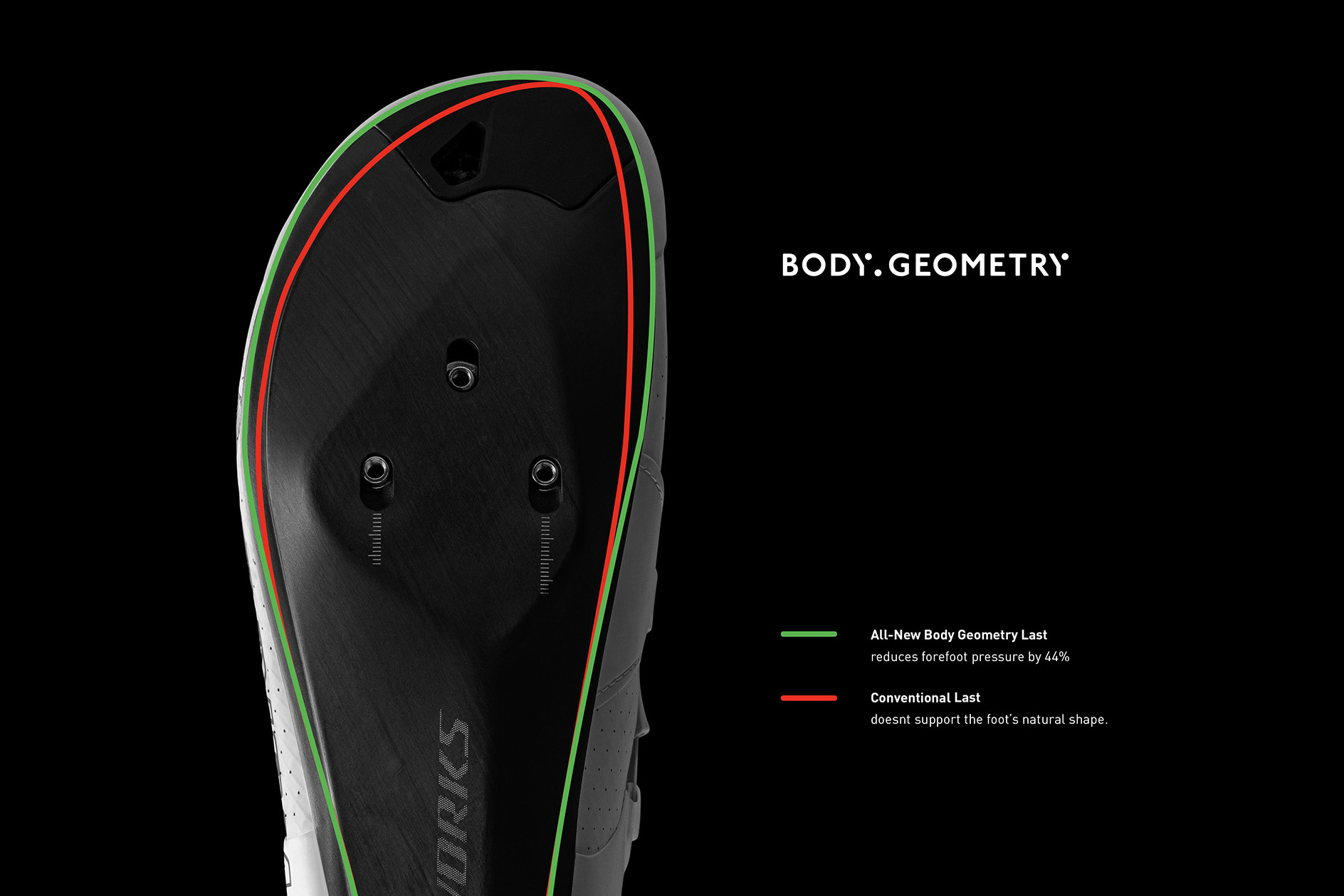
Specialized says that thanks to analysing 100,000 Retul foot scans, it has concluded that the lasts in road cycling shoes are too narrow and don’t support an average foot’s natural shape. 

Specialized S-Works Ares 2
The Ares 2 employs Specialized’s new Body Geometry last. Specialized

Specifically, it has widened the toebox area of its latest last to allow for greater toe splay and 20% more contact area, as opposed to forcing the feet to conform to a more limited area. 

This dovetails with a 1.5mm Varus Wedge support, which tilts the inner foot upward for improved foot, knee and hip alignment. Specialized suggests this can help reduce the chances of the knee collapsing inwards, plus delay maximal effort exhaustion by an average of 10 seconds.

A Metatarsal Button – a support under the centre of the foot – is used to help lift the foot from underneath. In so doing, Specialized claims the metatarsal bones are allowed to spread more, while the closure system isn’t required to clamp down onto the foot so tightly to achieve the same secure fit. 

In turn, this is said to reduce the chances of nerve impingement and improve circulation.

Specialized S-Works Ares 2
Specialized says it analysed 100,000 Retul foot scans in developing the Body Geometry last. Specialized

The shoe’s outsole also features arch supports which, when used with the brand’s customisable Body Geometry insoles, are said to improve power transfer and prevent arch collapse. 

However, these insoles aren’t supplied as standard with the Ares 2 shoes – they need to be purchased in addition to the very tall asking price.

All in, these features combine for a 44% reduction in forefoot pressure and a 7% watt increase in lactate threshold performance according to Specialized. The latter claim assumes the use of the Body Geometry insoles.

Specialized S-Works Ares 2 availability and prices

Specialized S-Works Ares 2
There are four colour options, including ‘Green Gecko’. Specialized

The S-Works Ares 2 shoes cost an eye-watering £479 / $600 / €549 – significantly more than the S-Works Torch and old Ares shoes.

If you have deep enough pockets, they’re available from today in size EU36-49, with half sizes from EU38.5-46.5.

Four colour options are on offer – black, white, white with Specialized ‘team’ branding and a striking ‘Green Gecko’ colourway. 

Is XC ready for 130mm travel? Fox thinks so with new 34SL fork

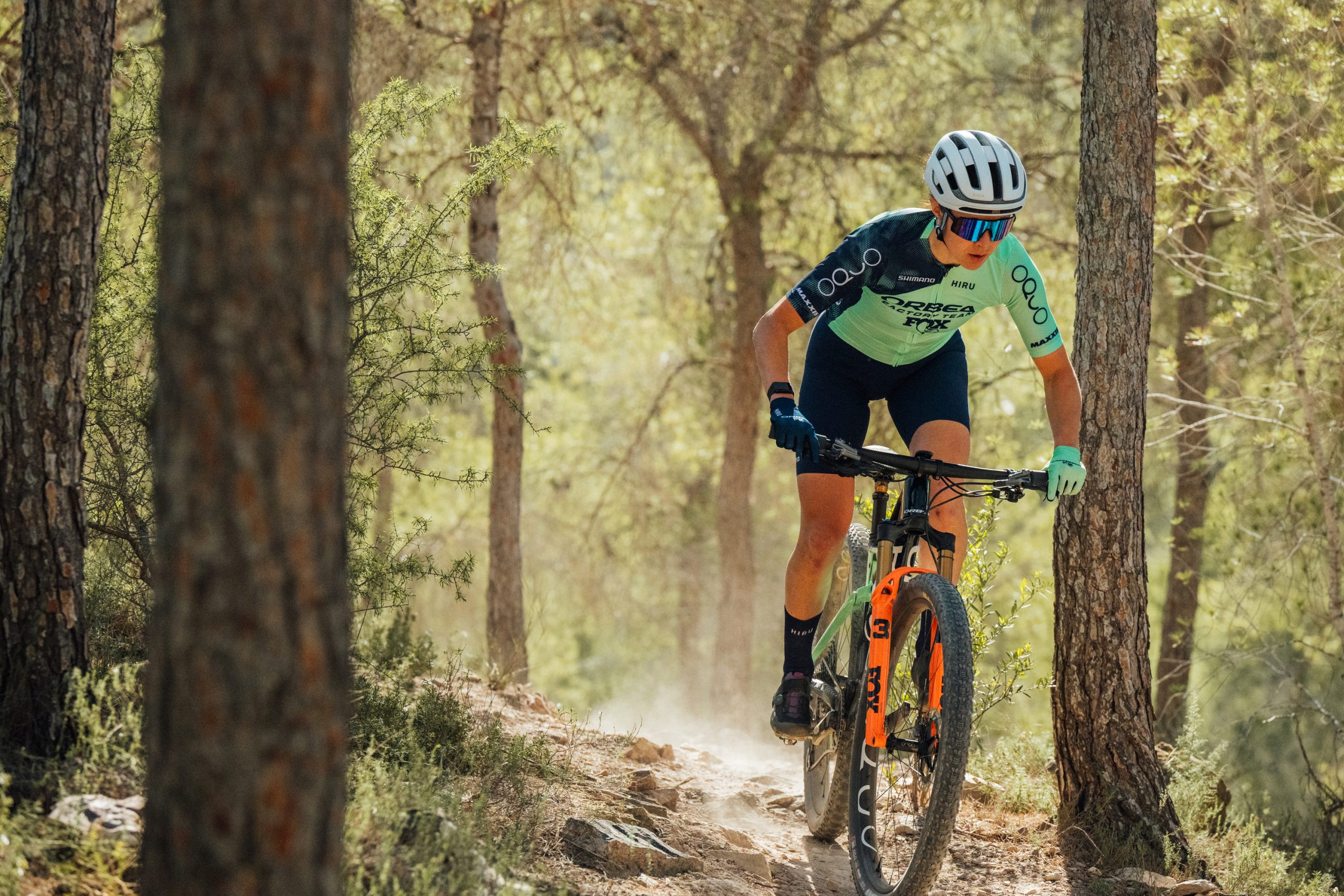
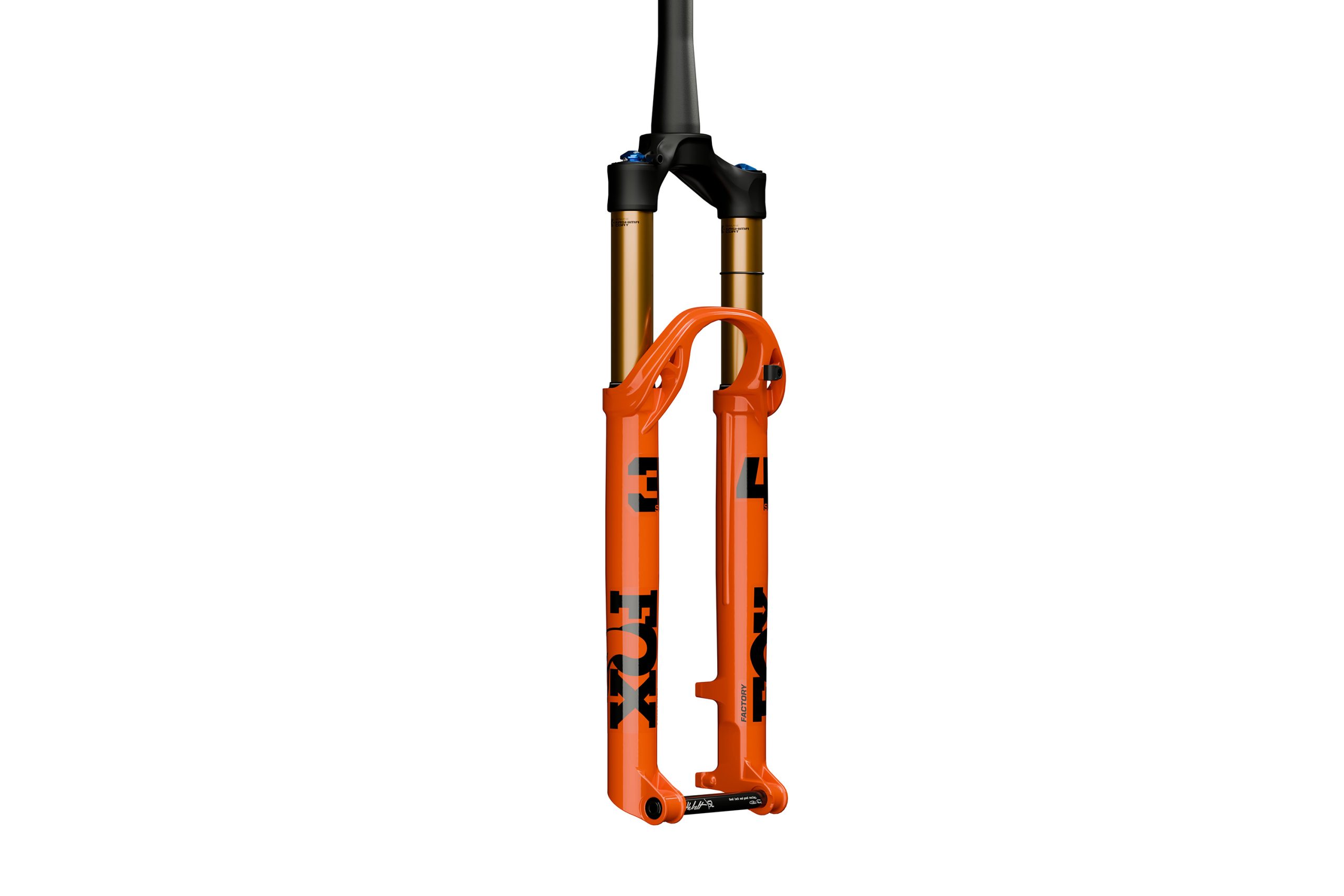
Fox has released its new 34SL cross-country mountain bike fork, with the brand betting big on bumps in XC travel by offering a 130mm variant and increasing air-spring volume.

Unlike the 34SC it replaces, the new 34SL uses a full-width 34 chassis for increased stiffness, which Fox says has resulted in a minimal weight increase over the Step-Cast variant. The new fork is only 3.2 per cent heavier at 1,475g compared to 1,422g, according to Fox.

The new fork looks to be shaped for the ever-increasing technical requirements of World Cup XC racing, with courses now including features that wouldn’t be out of place in a bike park.

With the next generation of cross-country bikes expected to spec the new 34SL fork, it seems likely that we’ll see a general boost in travel across brands.

Whether 130mm rear-suspension travel will follow is unknown, although many bikes, including Specialized’s Epic World Cup, use a mixed-travel setup.

For riders looking to stay in more traditional travel ranges, the new fork also comes in 110mm and 120mm variants.

The new fork is priced at £1,259 / $1,099 / €1,469 / AU$1,899 for the Factory 34SL, £1,119 for the Performance Elite 34SL and £749 / $649 / €869 / AU$1,149 for the Performance.

Ai arch

Fox 34 SL crown
The new crown design should receive a warmer welcome than the 38. Fox

The new Fox 34SL uses an optimised generatively designed fork arch that wraps around the lower legs to increase torsional stiffness.

Cut-outs have been made in strategic places to minimise weight.

We’ve seen this on the 32SC released last year, although this time Fox has placed the arch on the front of the fork.

Unlike the 32SC, the new fork uses a generatively designed crown made from 7000 series aluminium with larger internal lightning bores and a black anodised finish.

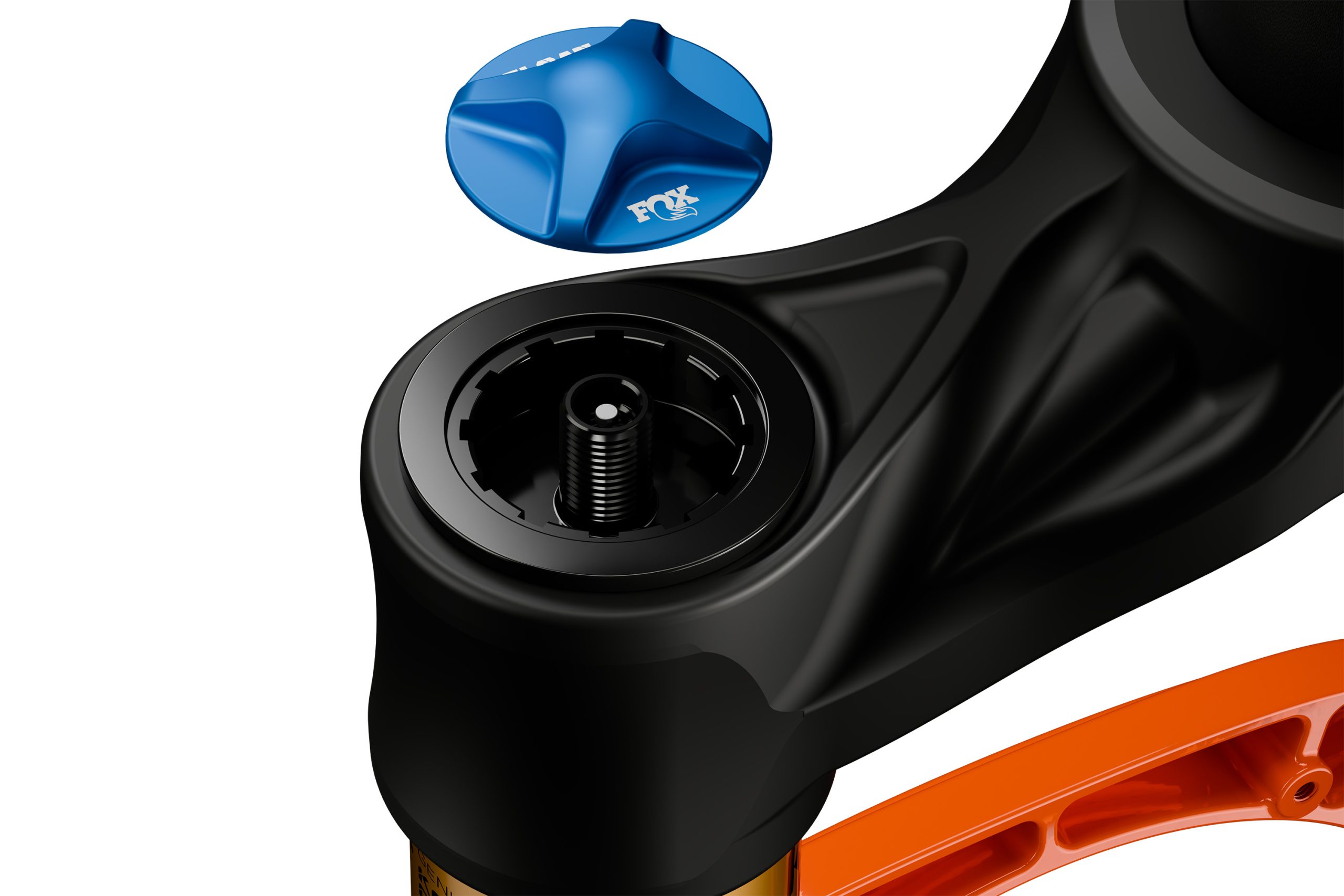
Fox 34SL air cap
You can finally retire the 15mm spanner on your workbench. Fox

In a win for mechanics worldwide, the damper can now be removed using a Shimano cassette tool.

The crown looks similar to the skeletal design seen on the RockShox SID Ultimate.

Combined with the full-width chassis and a Kabolt axle, the 34SL is said to be 17 per cent stiffer than the 34SC.

With the chassis being wider, the new fork also has room for 2.5in tyres.

We’ve seen a trend in riders picking wider tyres on the World Cup circuit, with many racers deciding better grip and higher volume is a worthwhile trade-off compared to the minimal increase in rolling resistance.

There is also room for 203mm rotors, which wasn’t possible on the Step-Cast design.

Better bushing overlap

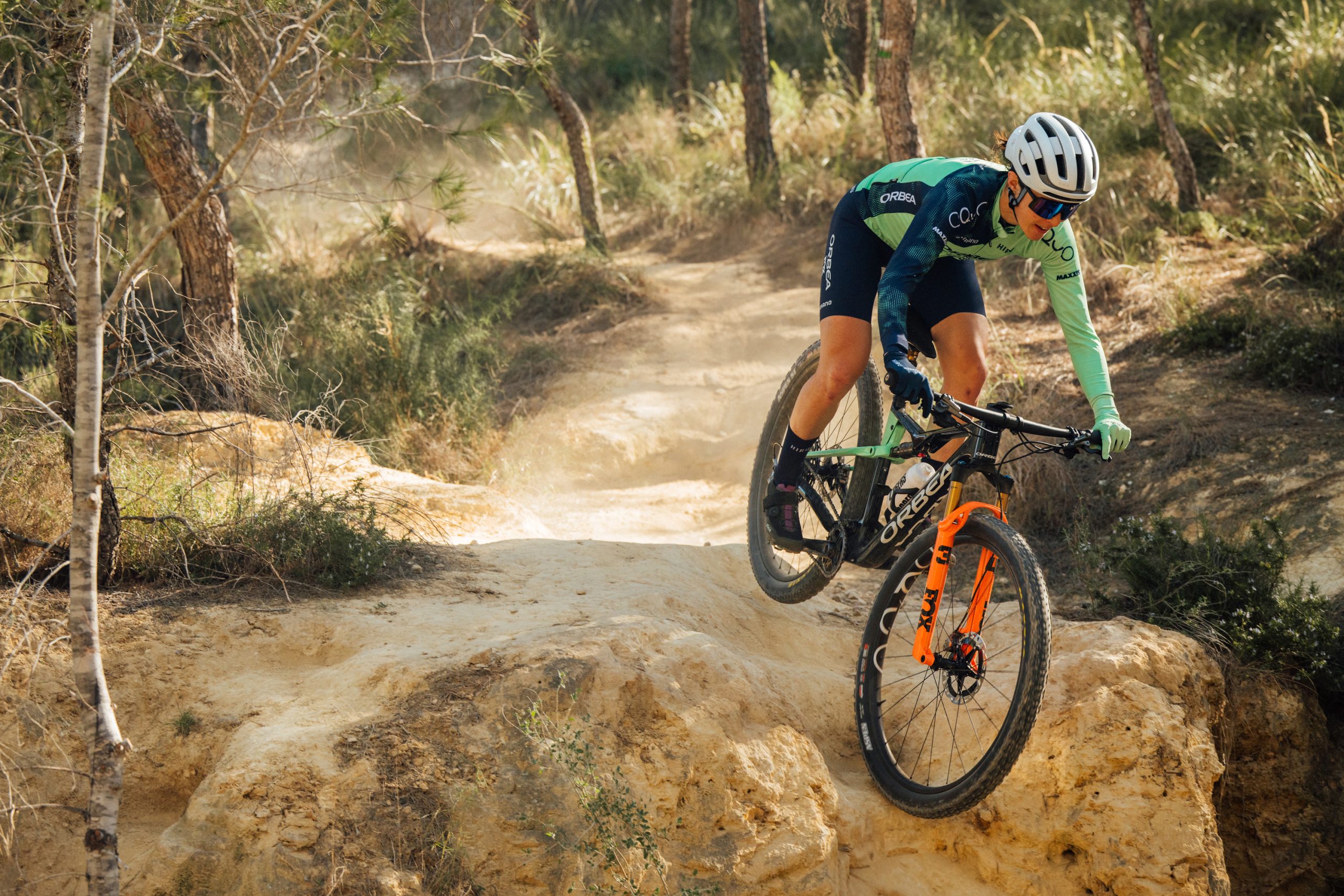
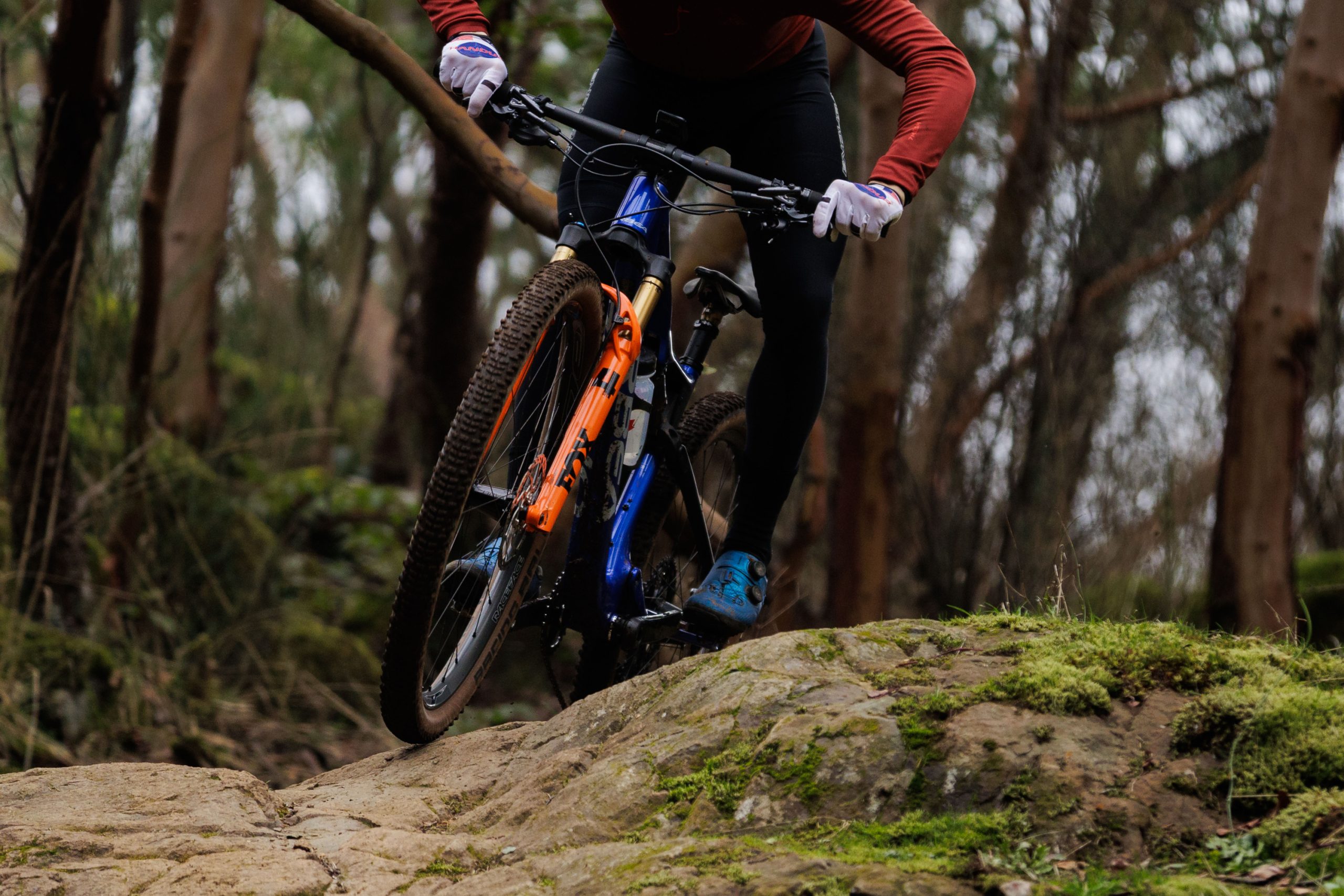
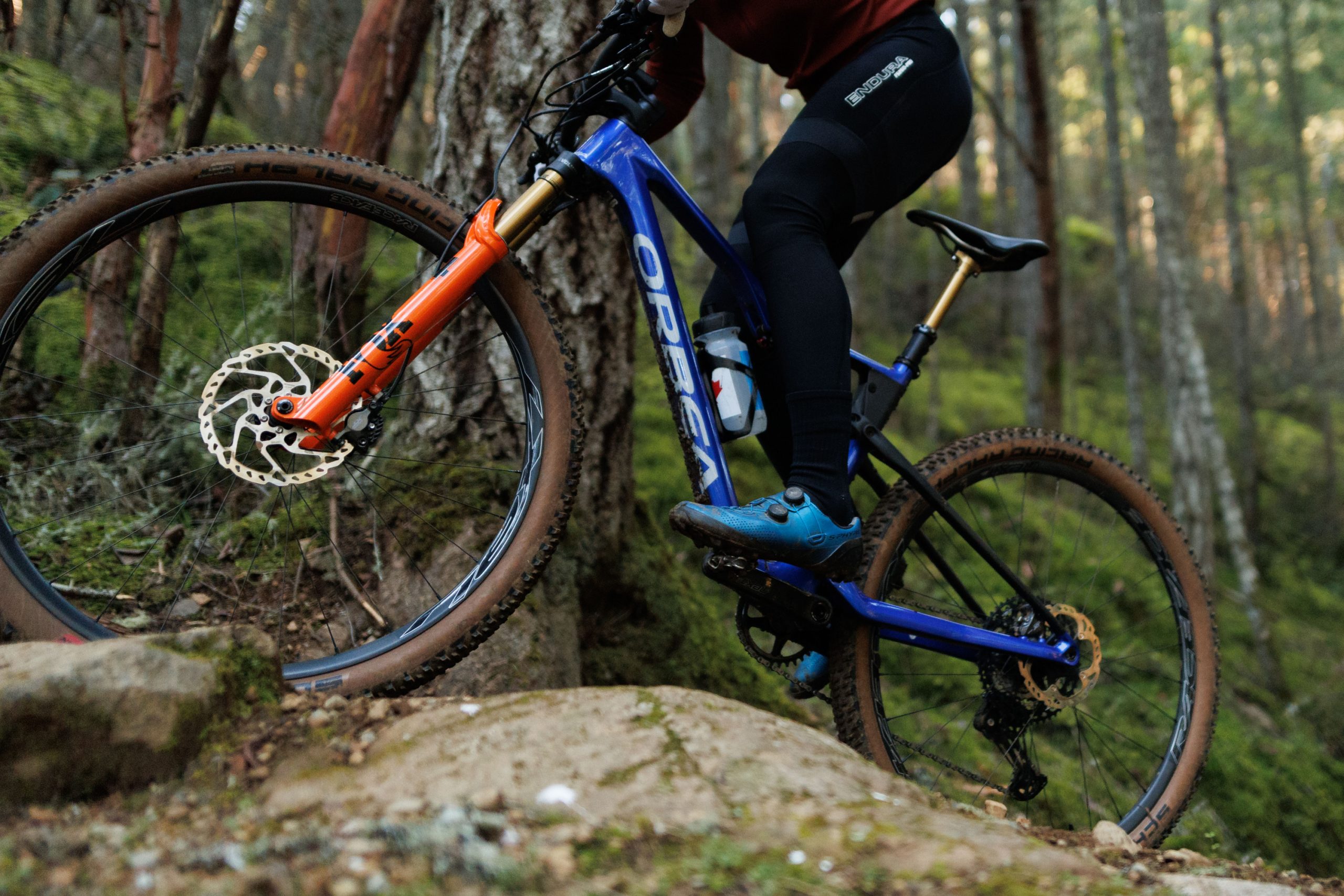
Fox 34SL Factory on Orbea Oiz
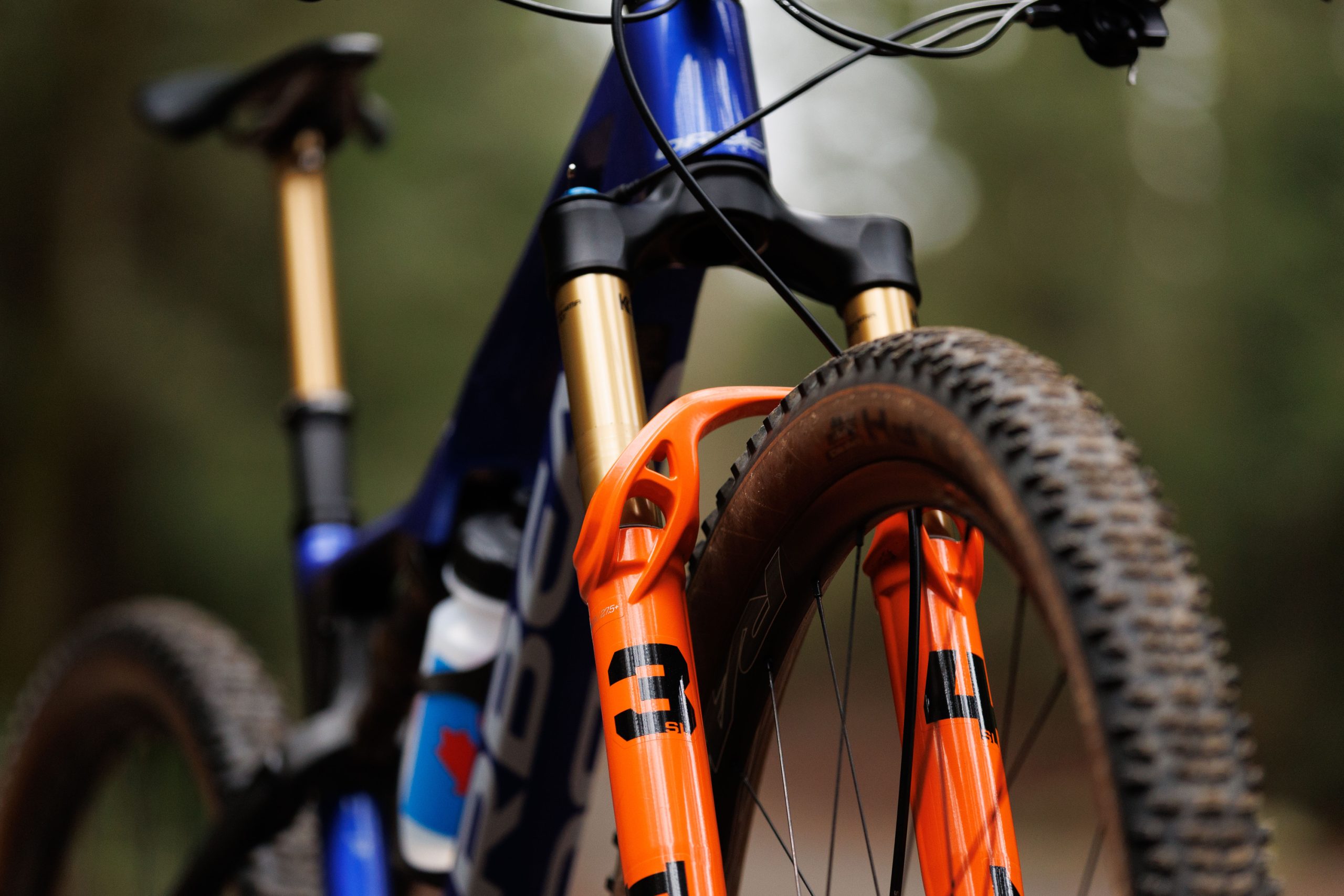
The new fork offers downcountry performance at an XC weight. Fox

The new 34SL sees an increased bushing overlap of 20mm, which Fox says has made the fork much more supple.

Bushings sit between the interface of the lower legs and stanchions of the fork, with most mountain bike forks featuring two on each leg.

The distance between the upper and lower bushings is called the ‘overlap’. 

Fox 34SL Factory on Orbea Oiz
Greater bushing overlap should make the 34SL more supple. Fox

When a side load is applied to the fork, the bending force is translated from the lower leg to the stanchion via the bushing. 

Increasing the overlap reduces friction, leading to a smoother compression throughout the stroke.

Fox says riders should notice increased suppleness at higher speeds when the bending forces are greater.

GRIP SL damper

Fox 34SL Factory
All variants of the 34SL feature a 44mm offset and 1.5in tapered steerer tube. Fox

Fox’s GRIP SL damper features inside the fork, with the short-travel specific damper reducing weight, while still being up to the task of World Cup XCO and XCM races.

The brand says the damper has optimised pedal-to-bump efficiency, while remaining one of the lightest on the market.

Inboard bypass channels

Fox 34SL Factory on Orbea Oiz
Fox has already tested the 34SL with World Cup XC racers. Fox

The fork features a new architecture that sees the bypass channels run on the inside of the legs.

Bypass channels reduce pressure ramping for increased small-bump sensitivity, while recirculating bath oil to lubricate the bushings and seals.

Fox says relocating the bypass channels to the inboard side reduces the dynamic friction by keeping them away from the fore-aft load path through the fork’s travel.

Weight savings

Fox 34SL Factory pack shot
The 34 SL Factory series is the lightest of the bunch. Fox

Fox has shaved grams in many areas to get the full-width chassis down to a competitive weight, with the Factory and Performance series forks both using the Kabolt SL axle, which saves 12g over the standard Kabolt axle.

The brand has also used double-butted stanchion tubes on the damper side, saving another 9g.

Twin Stick Lever

Fox Stick Lock lockout lever
The new Twin Stick lockout lever keeps a familiar design to the Remote Lockout it replaces. Fox

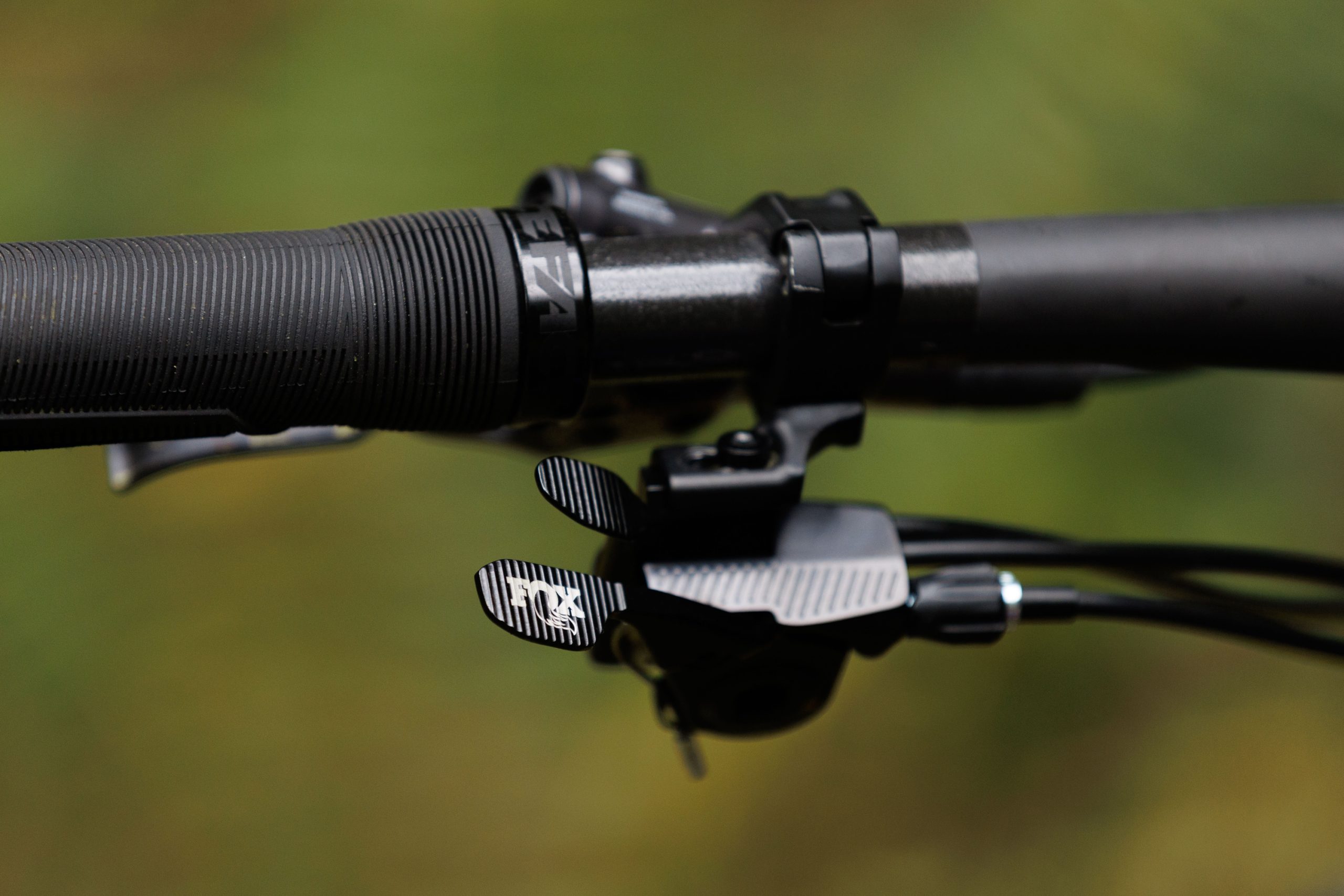
Alongside the new 34SL, Fox has released an updated bar-mounted lockout lever.

The new Twin Stick Lever combines a cable dropper post actuation and cable suspension lockout into the design – similar to Scott’s TwinLoc and Orbea’s Squidlock systems.

The lever uses ramps and catches to operate smoothly, with Fox saying very little lever force is required to operate both functions.

Twin Stick is compatible with both two- and three-position suspension-lockout systems and can be set up for fork-only should you be a hardtail hero.

The lever weighs 66g, or 76g with the clamp.

Fox says this helps to make its Super Light XC ecosystem the lightest on the market.

The Twin Stick Lever is priced at £184.95 / $149 / €199.

Simon Rides On

They’re the four words you never, ever want to hear. “I’m sorry. It’s terminal”, said the oncologist.

It was a shock, but not a surprise, which sounds peculiar, so let me explain. Prostate cancer has waxed and waned in my life the past seven years.

My first diagnosis, in 2017, permitted, even encouraged, optimism. It was “treatable”. Nine out of ten men with the flavour I then had get blasted with radiotherapy, undergo surgery or more rarely other forms of treatment, and cross the threshold of the oncologist’s office only to be signed off as cured, or at least in remission indefinitely.

That was me, until it wasn’t; until I became That Guy, the one in ten, where it comes back, but worse. So in September 2024 I heard Those Four Words.

Deep down, I knew they were coming. I’d seen the worrying test results, I’d done the reading. So yeah, shocked, but not surprised.

Family, friends – they’re the first to know, of course. Then colleagues. And the upshot of that was an abrupt and largely unexplained vanishing act from the newly-rebooted Zwiftcast. Long-time listeners will recall that I’d always planned to hand over to a new team. But like this? No, not like this.

This was all, oddly, contemporaneous with Sir Chris Hoy’s similar bombshell announcement, and like the great Olympian, I too started a brutal, gruelling six rounds of chemotherapy. Friends, it was hellish.

I was left hollowed out, weak as a kitten and felt like I’d never, ever get back on a bike again.

But then on the way to the hospital for another session, we drove past an artistic landmark in my home-town of Leeds in Yorkshire, England.

It’s a line from the great Chumbawumba anthem, Tubthumping, from 1997:

It resonated. It spoke to me. Let’s be frank, I won’t beat cancer. That’s not how it works. But I can Get Up Again and get back on a bike.

Plans were hatched. Strategies devised. And they included a YouTube channel. It would
document my ascent from the nadir of chemo to the moment I got back in the saddle. And beyond – it would follow my progress as I attempted to get back to something like the cyclist I was before Those Four Words.

The name? Well, it could only be Simon Rides On… a nod to my long, long association with Zwift and a forward-looking thought to spur me on. And much of the reasoning behind the channel is about that – accountability. It would be easy to give up, to accept my riding days are over, to focus on other things in the remaining time.

But I love riding a bike. Exercise, I strongly believe, is a panacea. I’ll get stronger, rid my body of the toxins of chemo and restore some kind of normality after a tumultuous few months. And committing to that on the internet, well, I gotta do it then haven’t I?

I know what you’re thinking – and no, I don’t know either. My oncologist doesn’t know. It could be two years, maybe five, possibly ten or more. However long it is, I’m determined to spend a portion of that time doing the thing that has brought me great joy, fantastic friendships and been a huge part of my life.

Do you want to join the ride? I’d love to have you along.


Simon Rides On launched on YouTube this week. Find the channel at youtube.com/@SimonRidesOn.

POC’s new helmets are the safest in the world according to Virginia Tech

POC’s new road and MTB helmets have been ranked as the safest Virginia Tech’s Helmet Lab has ever tested.

The Cytal road helmet and Cularis MTB helmet are rated number one in their respective classes by Virginia Tech.

POC says safety performance and ventilation were its priorities when developing the new helmets.

“We know how to develop highly ventilated, comfortable, aerodynamic and highly protective helmets; with the Cytal and Cularis, we wanted to challenge ourselves to take another step forward,” says POC’s chief product officer, Oscar Huss.

“In particular, we wanted to integrate more of our real-world testing and research knowledge to refine details and enhance helmet performance. And the Cytal and Cularis are a true embodiment of this approach.”

POC Cytal

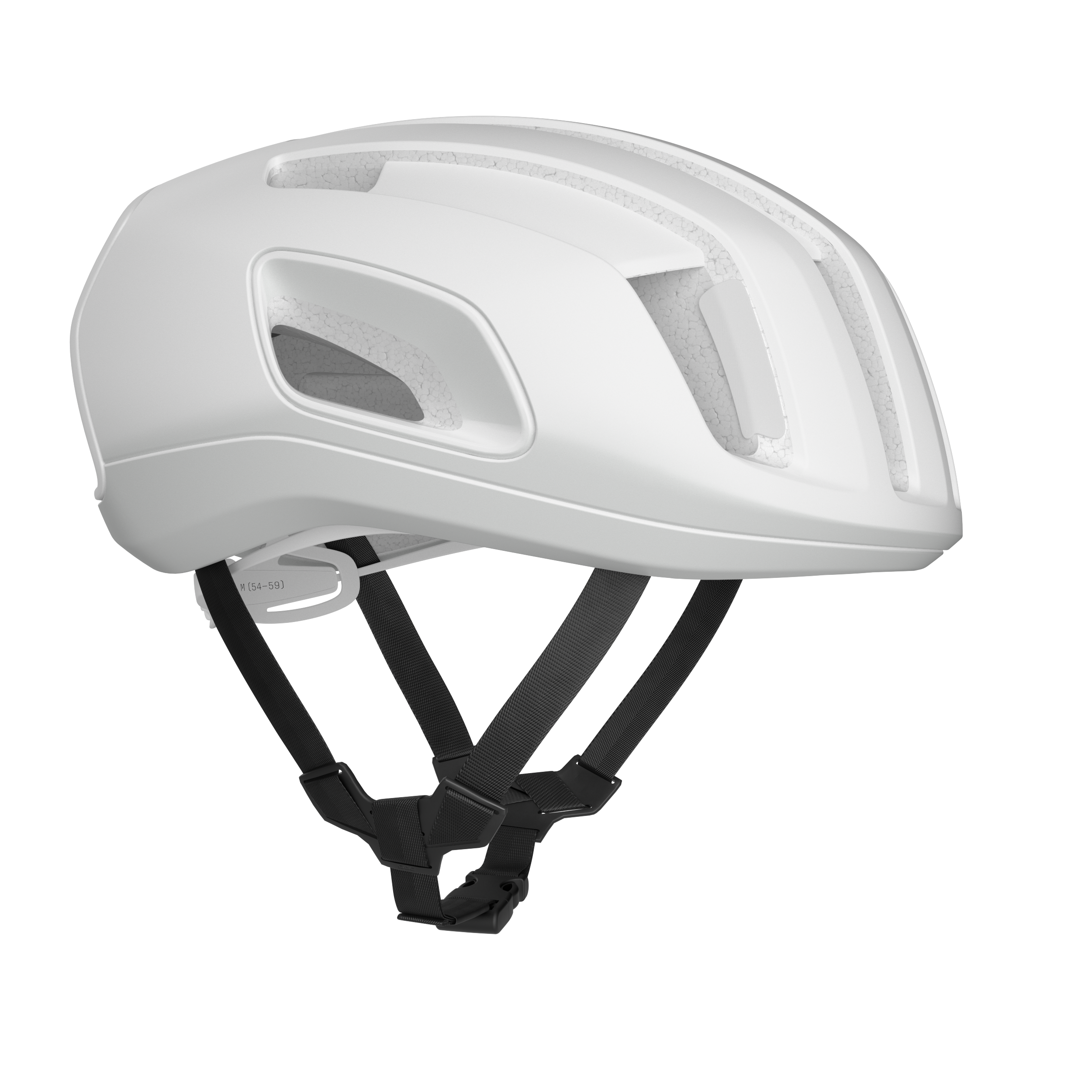
POC Cytal helmet in hydrogen white
POC’s Cytal road and gravel helmet in Hydrogen White. Poc Sports

Building on the success of the POC Cytal Carbon, released in the summer of 2024 and worn by EF Pro Cycling, the new Cytal road and gravel helmet is optimised for hot-weather riding.

According to POC, the Cytal uses the Venturi effect to channel air into the helmet and compress it, which improves both the cooling effect and aerodynamics.

The Cytal uses the same design as the Cytal Carbon, although without the carbon fibre used in the wing, the pricing becomes more accessible.

While the existing Cytal Carbon retails at £360 / $400 / €400, the new Cytal is priced at £290 / $330 / €320 / AU$500.

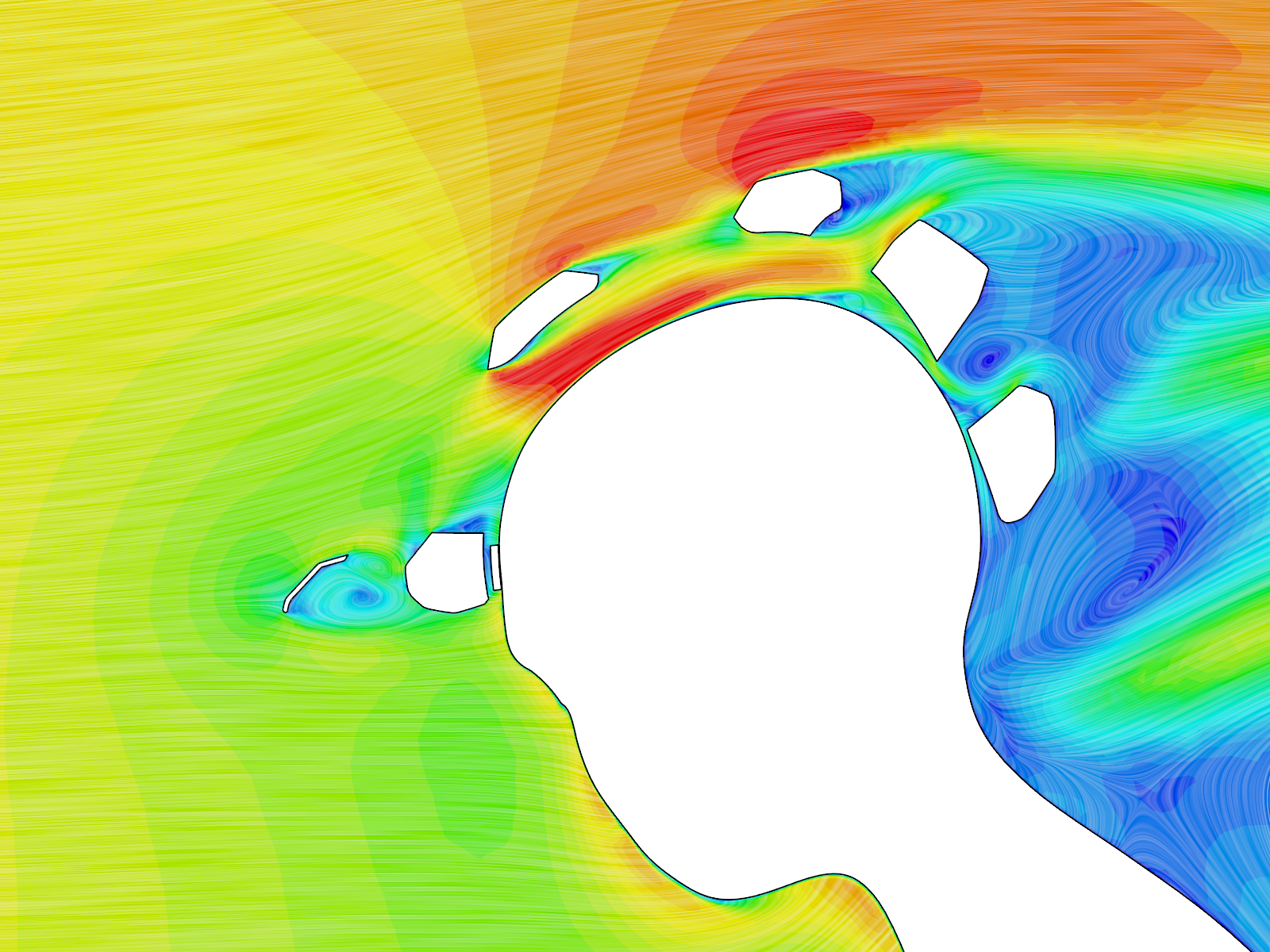
CFD Modelling for airflow with Poc Cularis helmet
The use of CFD modelling has helped POC optimise airflow through the Cularis helmet. Poc Sports

Alongside Computational Fluid Dynamics (CFD) modelling, the Cytal has also been tested thoroughly in the wind tunnel and in real-world scenarios to inform the development process.

Besides integrating the MIPS Air Node system to limit the impact of rotational forces on the brain, the Cytal’s safety features have also been developed using Finite Element Method (FEM) modelling.

The results are impressive, with the POC Cytal ranking as the best road helmet ever tested by Virginia Tech Helmet Ratings and number three overall, including all MTB helmets.

You can choose from nine colourways, including multiple monochrome options alongside ‘deep green’, navy, red and orange.

POC Cularis

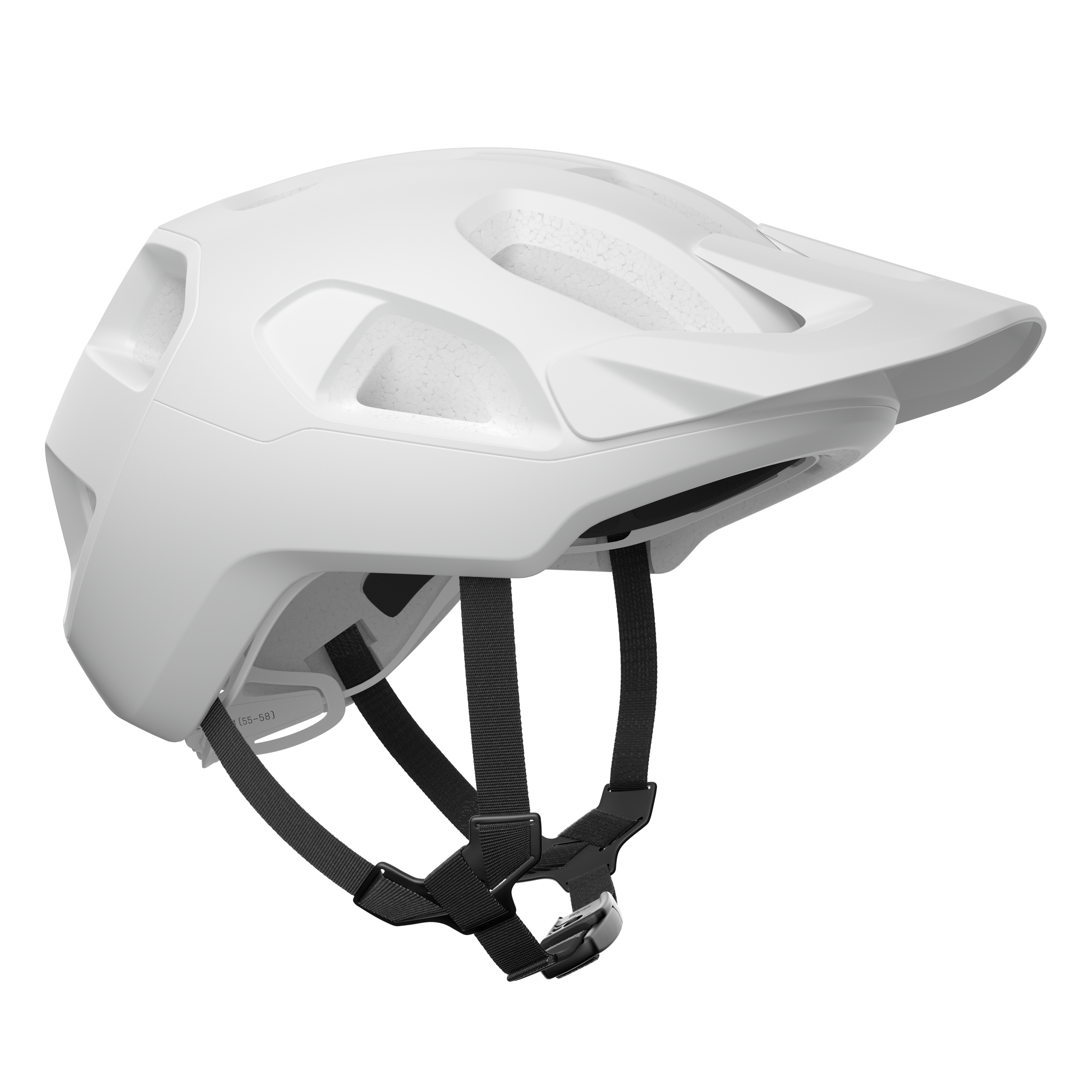
The Poc Cularis MTB helmet in Hydrogen White.
The POC Cularis MTB helmet in Hydrogen White.

A new model in POC’s line-up, the Cularis is a trail mountain bike helmet that’s designed to combine optimal safety with maximum ventilation.

POC’s product development team have been working with CFD modelling to make sure the Cularis provides a “super cool” fit.

Most notably, the Cularis ranks #1 out of 264 helmets tested at Virginia Tech since 2011, making it the safest MTB helmet it has ever tested.

The helmet features a ‘breakaway peak’, which is designed to detach in the event of a crash, as well as the MIPS Air Node system, for enhanced protection from angular impacts.

The POC Cularis retails at £200 / $240 / €230 / AU$350, and is available in three sizes and a choice of nine colourways.

All About Zwift’s New Specialized S-Works Tarmac SL8 Frame

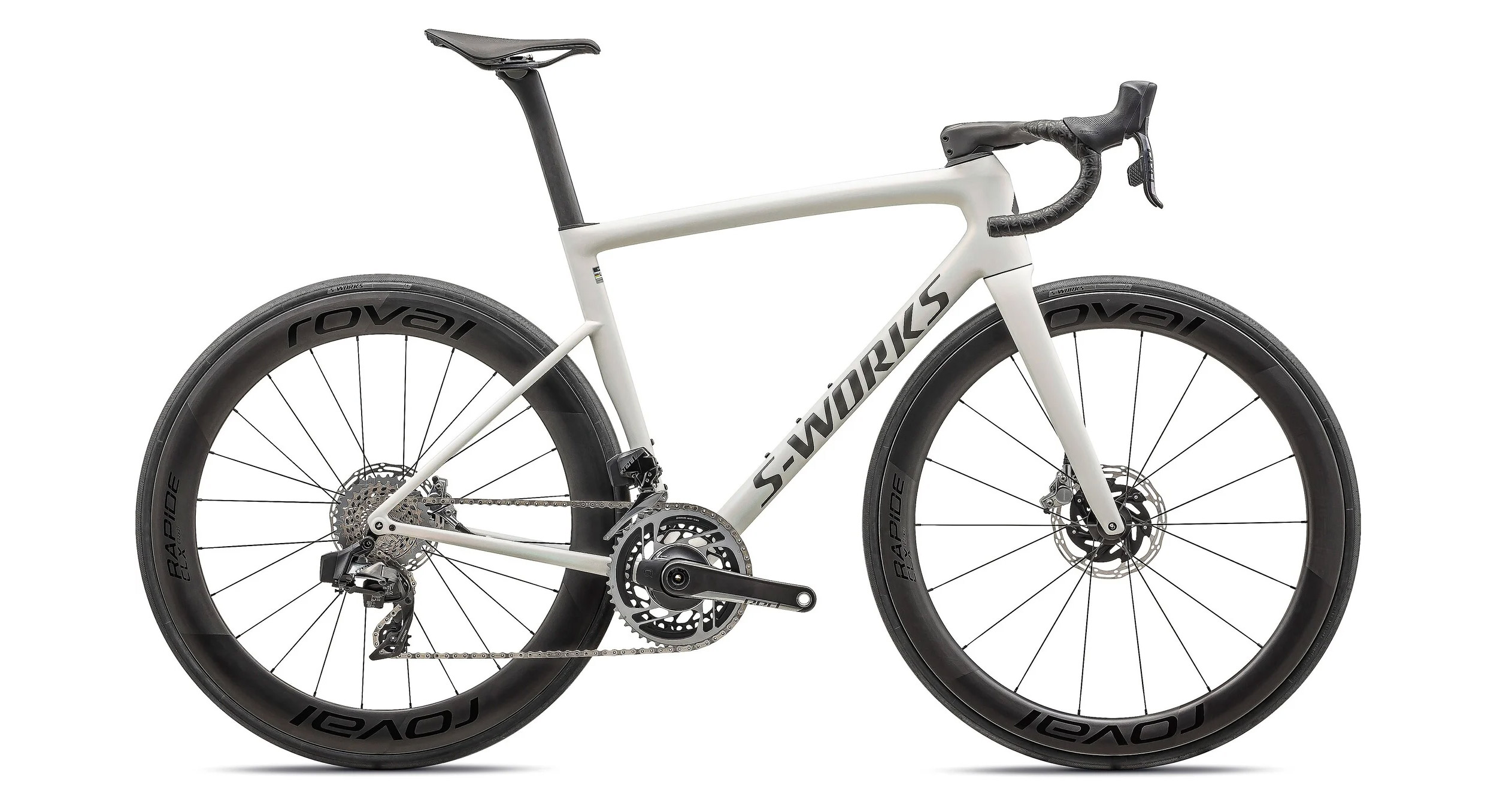
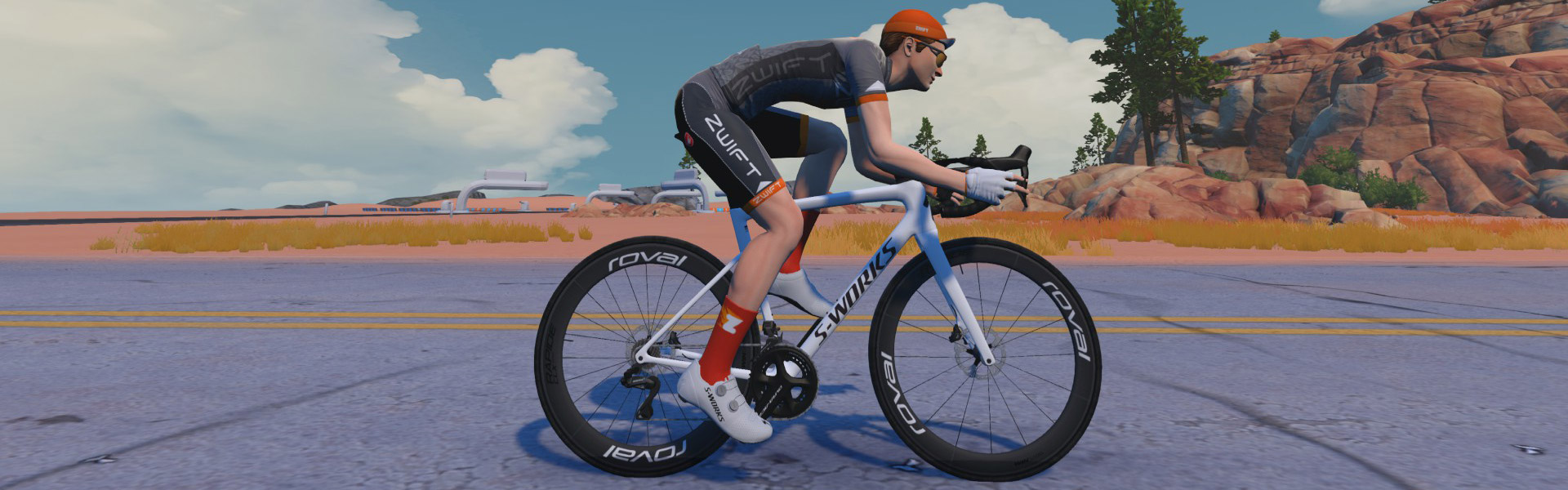
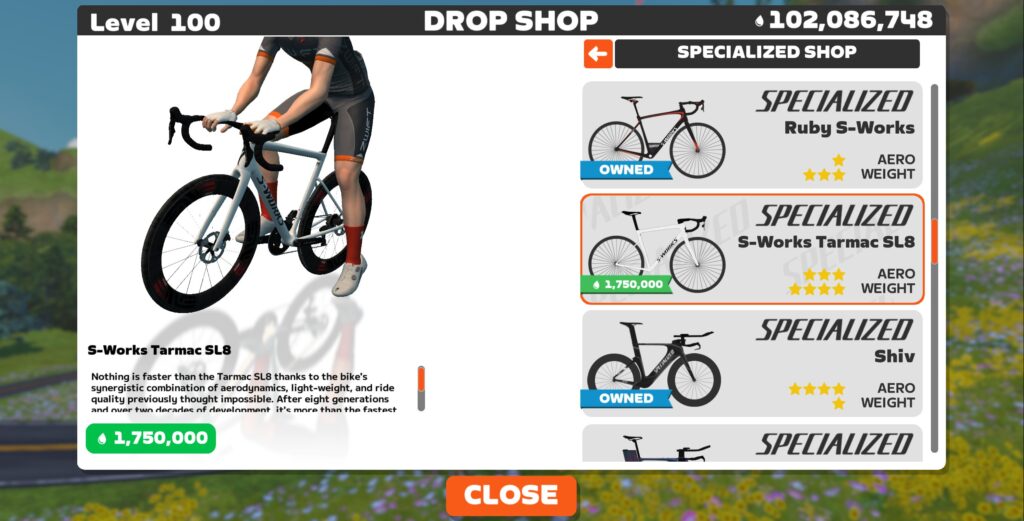
This week’s big Zwift update includes the welcome addition of several new bike frames, including two versions of the highly respected Tarmac SL8 from Specialized. Today we’ll look at the in-game performance of the S-Works Tarmac SL8, since it’s the fastest of the four “production” frames added this week.

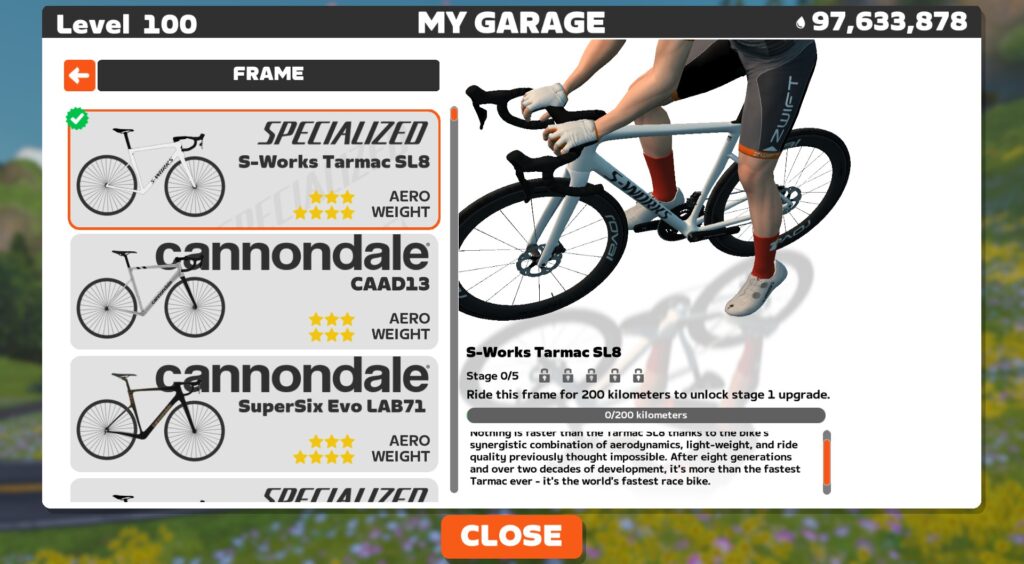
You’ll need to be updated to game version 1.86+ to see the S-Works Tarmac SL8 in Zwift’s Drop Shop. You’ll also need to be at level 40+ with 1,750,000 Drops to buy it. Here’s how it’s described in the Drop Shop:

“Nothing is faster than the Specialized Tarmac SL8 thanks to the bike’s synergistic combination of aerodynamics, light weight, and ride quality previously thought impossible. After eight generations and over two decades of development, it’s more than the fastest Tarmac ever – it’s the world’s fastest race bike.”

Those are big words, and while cyclists doubtless have differing opinions as to their veracity, what we’re concerned about here is in-game performance. Just how fast is this bike in Zwift, and how does it compare to other frames?

See our master list of all frames in Zwift >

It’s rated 3 stars for aero, 4 stars for weight, like a handful of other top newish all-arounders. But a 4-star system isn’t the most granular of performance measurements, so we ran this frame through our precise tests to measure performance at nerd-level detail. Let’s dive in!

Note: test results below are from a 75kg, 183cm rider holding 300W steady using Zwift’s stock 32mm Carbon wheelset.

Aero (Flat/Rolling) Performance

The S-Works Tarmac SL8 is very slippery, trimming 61.9s off our baseline Zwift Carbon frame over an hour of flat riding.

That puts it within 1.1 seconds of the game’s fastest frames, and when you consider that our tests have a 1-second margin of error, one could reasonably lump this frame in with the other fastest frames in terms of performance on flat roads.

Climb Performance

If you thought the S-Works Tarmac SL8 was fast on the flats, wait until you see how it climbs!

This Tarmac shaves 56 seconds off of our baseline Zwift Carbon’s time on an hourlong climb, which means it beats the S-Works Aethos (which was the fastest climbing bike in Zwift until this week) by 1.6 seconds.

That’s right, folks. We have a new top climber, and it’s super aero. There’s a new king in town.

Upgrading Your S-Works Tarmac SL8

Like all frames in Zwift, the S-Works Tarmac SL8 can be upgraded in five stages. As a high-end race bike, each of the five stages results in a performance improvement. The S-Works Tarmac SL8 upgrade stages are as follows:

  1. Ride 200km, pay 100,000 Drops for an aero upgrade
  2. Ride 260km, pay 200,000 Drops for a weight reduction
  3. Ride 320km, pay 350,000 Drops for a drivetrain efficiency improvement
  4. Ride 380km, pay 500,000 Drops for an aero upgrade
  5. Ride 440km, pay 750,000 Drops for a weight reduction

You can expect a fully-upgraded S-Works Tarmac SL8 to be approximately 28 seconds faster on a flat hour and 36 seconds faster on an hourlong climb vs the “stock” S-Works Tarmac SL8.

Conclusions

What we’ve seen in IRL road cycling, we’re seeing on Zwift: the industry moved away from the pure (but heavy) aero bikes and toward all-arounders that are nearly as slippery but weigh much less.

The Scott Addict RC was the first strong all-arounder on Zwift to give the Tron bike a run for its money. But in the past several months, Zwift added the Canyon Aeroad 2024 and Pinarello Dogma F 2024, which both outperform the Addict RC. And now the S-Works SL8 comes along, setting a new benchmark.

These fast all-arounders are within 1 second of the “pure” aero bikes (think S-Works Venge, Felt AR, Cervelo S5 2020) over an hour on flat ground in Zwift, but climb much faster. And that’s why we’re seeing them replacing the pure aero frames in Zwift race pelotons.

Other frames are within a few seconds of the S-Works SL8, so riders have the luxury of picking from a handful of top performers without feeling like they’re on a slow bike that will cost them the race. That said, if you want the frame that turns in the best all-around performance in Zwift, it’s the S-Works SL8.

And no: it doesn’t come with a color slider. (You can have any color frame you want… as long as it’s white.)

Questions or Comments?

To answer one question: no, it doesn’t come with a color slider. (You can have any color S-Works Tarmac SL8 you want, as long as it’s white!) What other questions or comments do you have? Share below…

Important note: this post contains speed test results for Zwift frames or wheels. These results may change over time, and a bike’s performance relative to others may also change. We don’t always revise posts when performance rankings change, but we do keep current, master versions of our speed test results which are always available. See the frame charts, wheel charts, and Tron vs Top Performers for current performance data.

All About Halo Bikes in Zwift

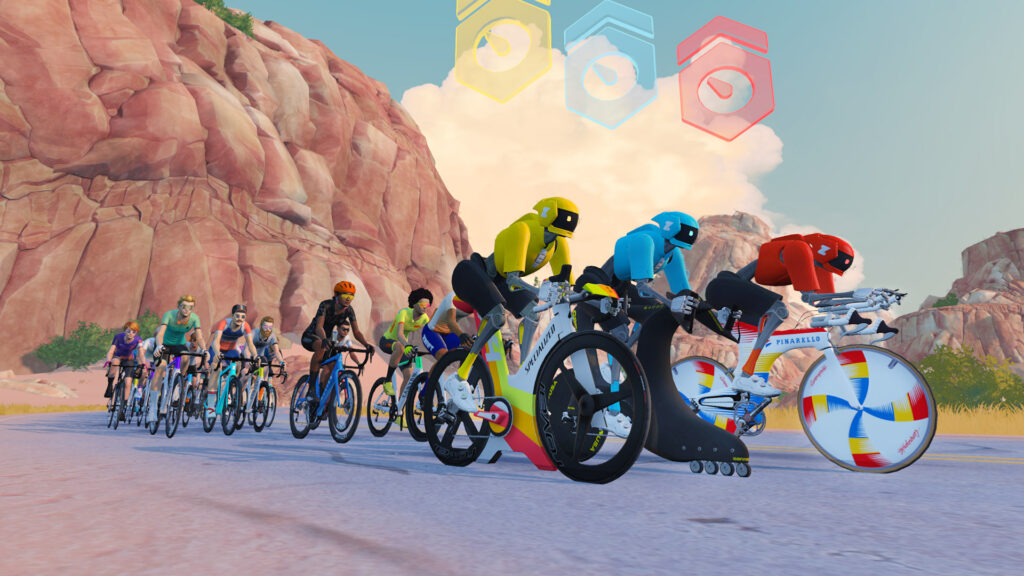
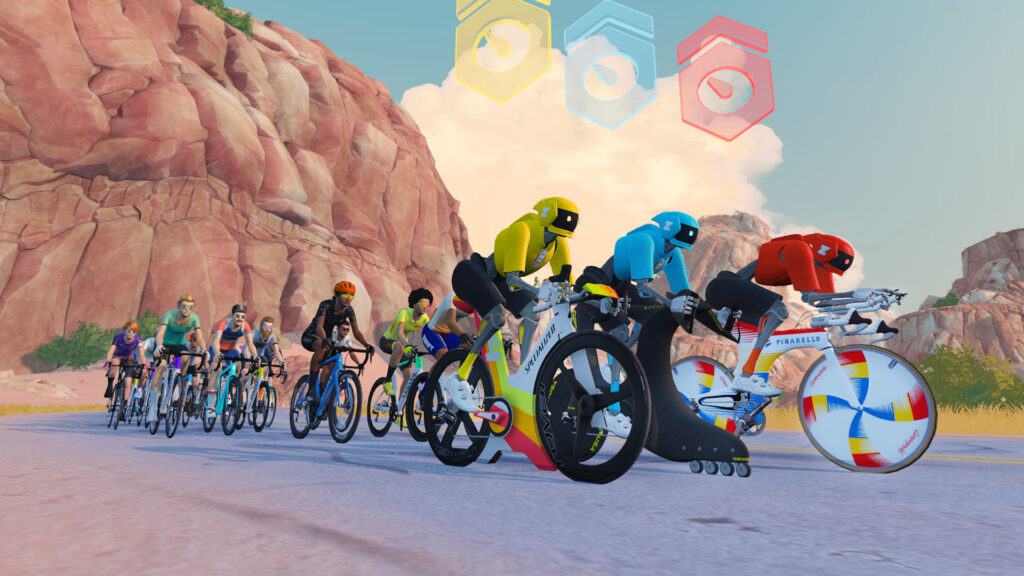
This week’s big Zwift update adds a new, highly prestigious type of bike to Zwift: the Halo Bike! These super unique bikes take a lot of work to unlock, a ton of Drops to purchase, and oodles more work and Drops to fully upgrade.

There are currently four available:

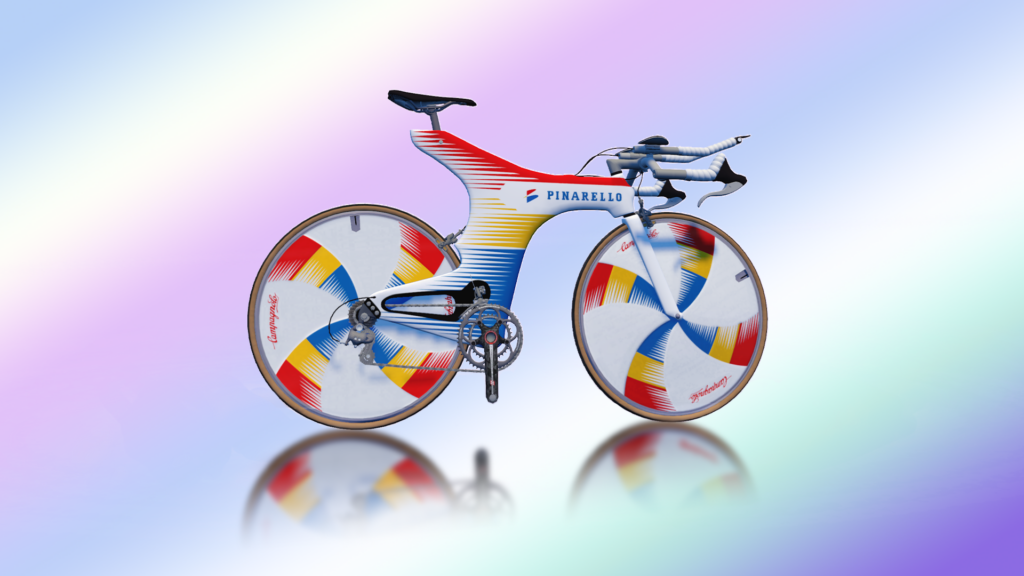
  • Pinarello Espada
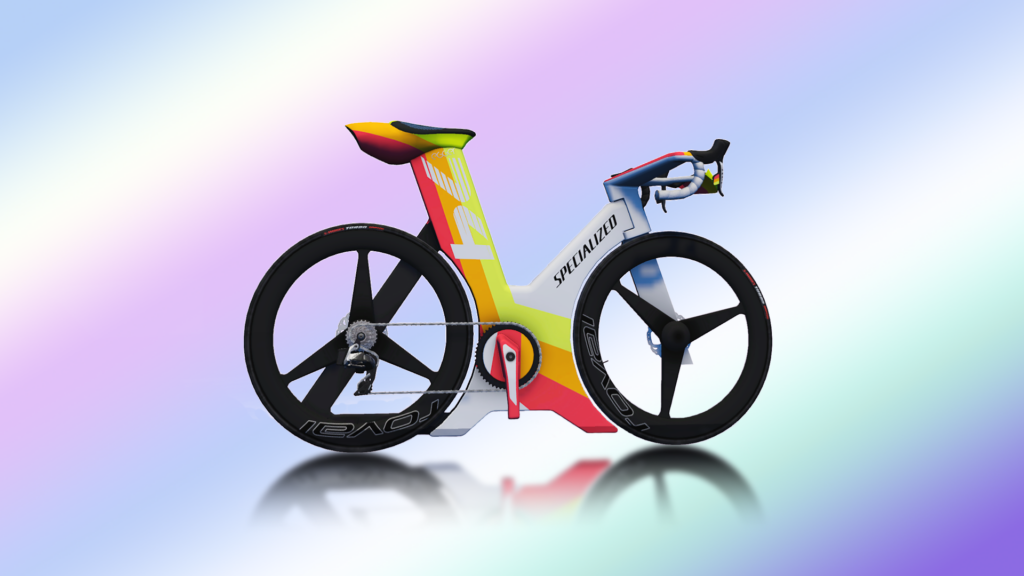
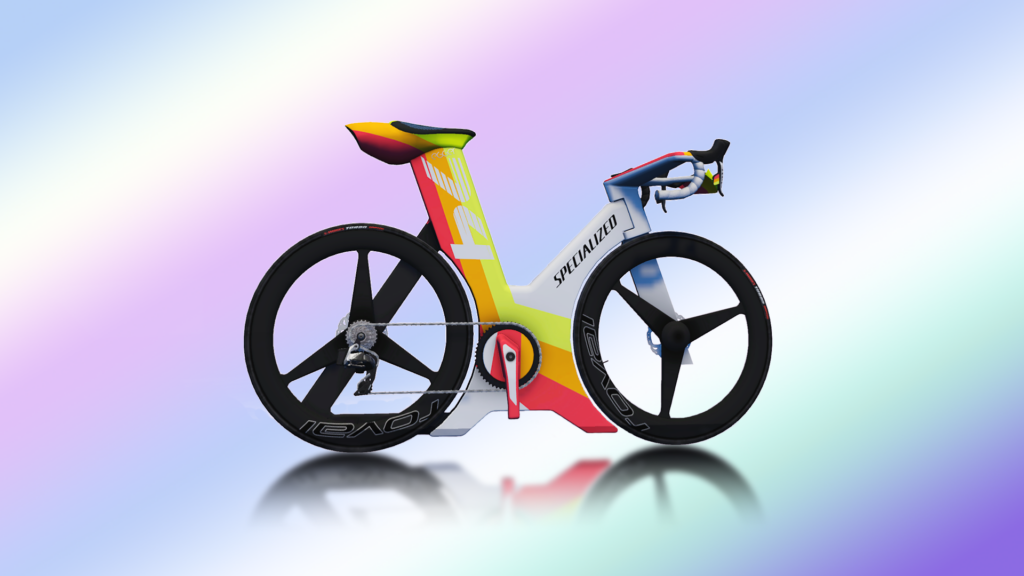
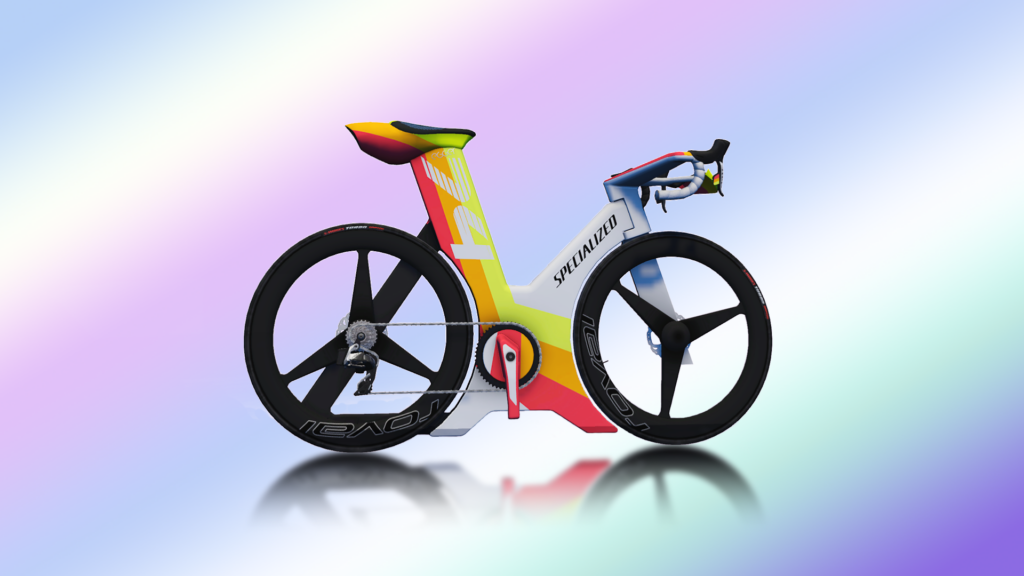
  • Specialized Project ’74
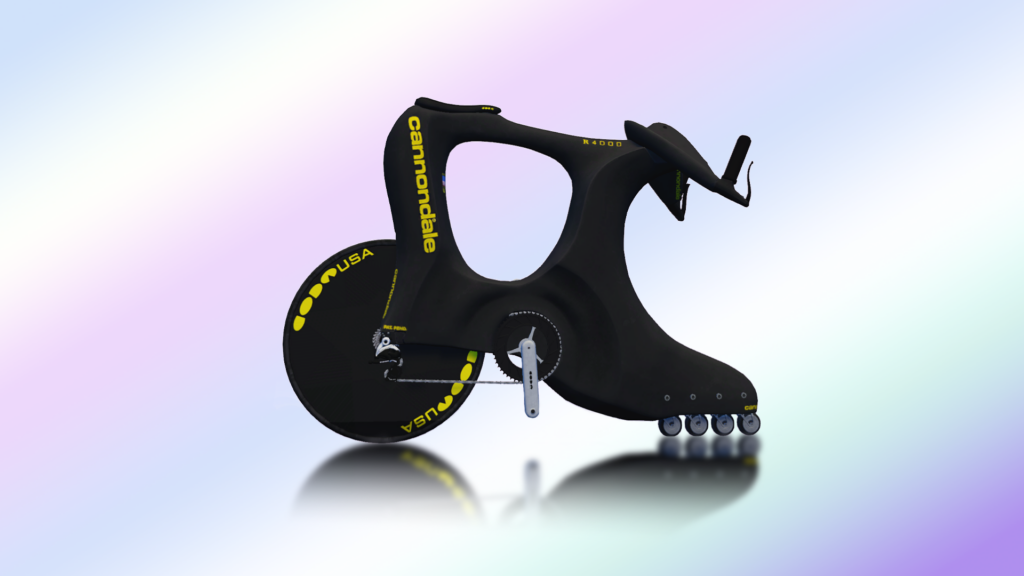
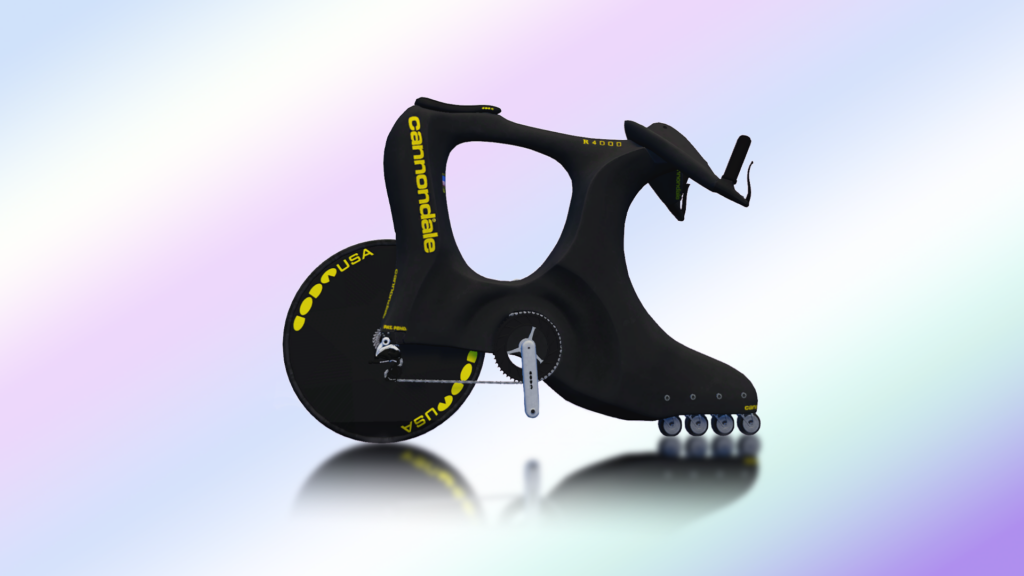
  • Cannondale R4000 Roller Blade
  • Zwift Concept Z1

Let’s dive into some details about how Halo Bikes work, then look at what makes each of these bikes special, including the results of our performance tests.

Unlocking Halo Bikes

Halo Bikes can be seen as brand loyalty rewards, because unlocking a brand’s Halo Bike requires you to fully upgrade three frames from that brand.

Example: fully upgrade (all 5 stages) the Pinarello Dogma F 2024, Pinarello Bolide TT, and Pinarello Dogma F10 to unlock the ability to purchase the Pinarello Espada.

Simply unlocking a Halo Bike doesn’t mean you own it, though. You still have to purchase the bike (which includes a wheelset that cannot be changed), at a hefty price of 10 million Drops. Yes, you read that right: 10. Million. Drops.

Upgrading Halo Bikes

Halo Bikes can be upgraded in 5 stages, just like every other bike in Zwift. But the work required to unlock each upgrade, and the Drops cost to purchase those upgrades, is around 5x more than even the best non-Halo Bikes. Wow!

That means it will cost you another 10 million Drops to fully upgrade a Halo Bike, on top of all the riding just to unlock each upgrade stage.

When it comes to performance at each upgrade stage, bikes of the same type will basically gain the same performance increases at each stage. (You can see this by comparing the pattern of dots on the scatterplots of the Project 74, R4000, and Concept Z1 below.) So, for example, a stage 3 Pinarello Dogma F 2024 frame will have gained the same boosts as a stage 4 Specialized Project 74 Halo Bike, since both are classified as road racing frames.

Below, we’ve listed the details of each upgrade stage for each bike.

Pinarello Espada Details

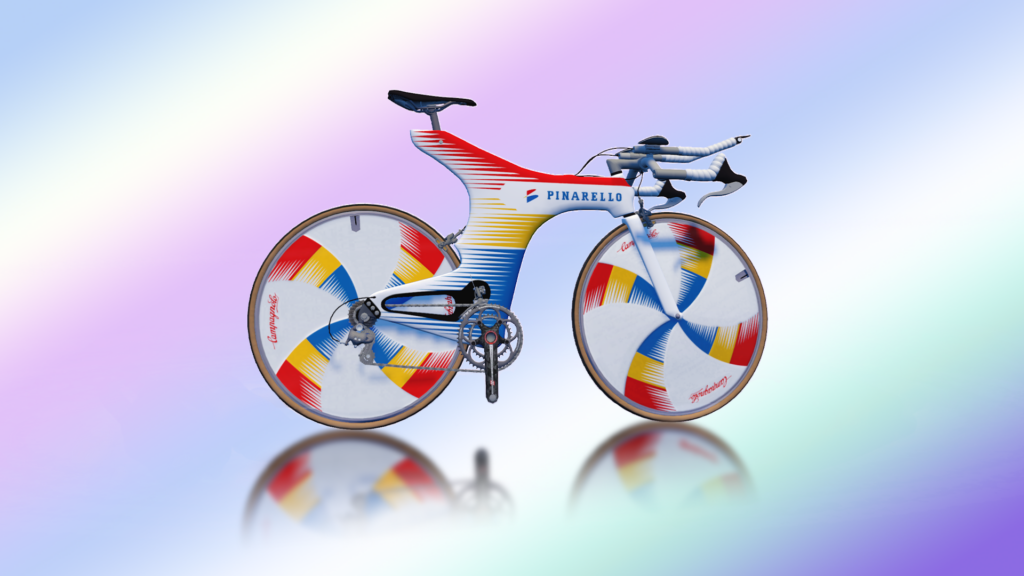
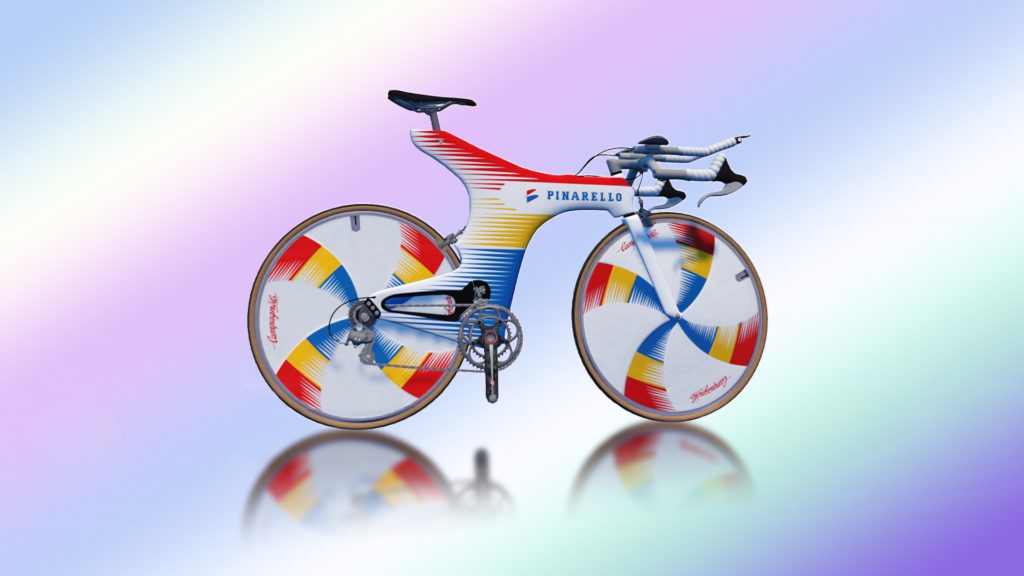
In 1994, Miguel “Big Mig” Induráin set a new hour record, breaking the 53-kilometer mark for the first time in history with a distance of 53.040 kilometers in Bourdeaux. And he did it atop the Pinarello Espada, a bike which quickly became legendary itself!

This bike was introduced to the game in April 2024 for the Pinarello Espada Challenge, and it has the distinction of being the only Halo Bike classified as a TT frame.

Designed by Fausto Beroglio, the carbon-framed, Campagnolo-equipped bike weighed in at 7.5 kilograms and was custom-molded to fit Big Mig. Only four versions of the bike were ever created, and Induráin won both of the long time trials at the 1995 Tour de France on a version modified to allow shifting.

Performance by Upgrade Stage

Like all frames in Zwift, the Pinarello Espada can be upgraded in five stages, with each upgrade resulting in a performance improvement. The Espada’s upgrade stages are as follows:

  1. Ride for 20 hours, pay 400,000 Drops for an aero upgrade
  2. Ride for 30 hours, pay 800,000 Drops for a weight reduction
  3. Ride for 40 hours, pay 1,200,000 Drops for a drivetrain efficiency improvement
  4. Ride for 50 hours, pay 2,600,000 Drops for a weight reduction
  5. Ride for 60 hours, pay 5,000,0000 Drops for an aero upgrade

If you’re wondering precisely how each upgrade stage impacts the bike’s performance, here is a chart showing speed test results at each upgrade stage (using our standard 75kg/183cm bot riding at 300W):

The Espada, it could be said, performs like a top-quality TT frame from the 1990’s. It loses ~26 seconds to the fastest TT frame in game (the Cadex Tri) across an hour, so you won’t want to use this for TT racing.

It’s also a heavy bike. It loses to nearly every TT frame when it comes to climbing, even at 4 W/kg, where its stellar aero performance still factors in significantly. It loses over 30 seconds in an hour of climbing compared to the best TT climbing frames (Scott Plasma RC Ultimate and Felt IA 2.0).

Specialized Project ’74 Details

The Project 74 bike from Specialized was conceived by Robert Egger to honor the founding of Specialized in 1974. Forged by the desire to “Innovate or Die”, this bike was Egger’s answer to the challenge of thinking outside the UCI box and beyond the double triangle.

Performance by Upgrade Stage

Like all frames in Zwift, the Specialized Project 74 can be upgraded in five stages, with each upgrade resulting in a performance improvement. The Project 74’s upgrade stages are as follows:

  1. Ride 550km, pay 400,000 Drops for an aero upgrade
  2. Ride 1050km, pay 800,000 Drops for a weight reduction
  3. Ride 1600km, pay 1,200,000 Drops for a drivetrain efficiency improvement
  4. Ride 2150km, pay 2,600,000 Drops for an aero upgrade
  5. Ride 2650km, pay 5,000,000 Drops for a weight reduction

If you’re wondering precisely how each upgrade stage impacts the bike’s performance, here is a chart showing speed test results at each upgrade stage (using our standard 75kg/183cm bot riding at 300W):

On flat roads, the Project 74 outperforms the best aero road setups in game, beating even the Tron bike by ~10 seconds across an hour. It’s the most aero road bike available in Zwift today. Take that, UCI!

On climbs, though, it’s a different story! This bike is actually the worst climber of the non-TT Halo Bikes, losing ~75 seconds to the best climbing bikes over an hour.

Cannondale R4000 Roller Blade Details

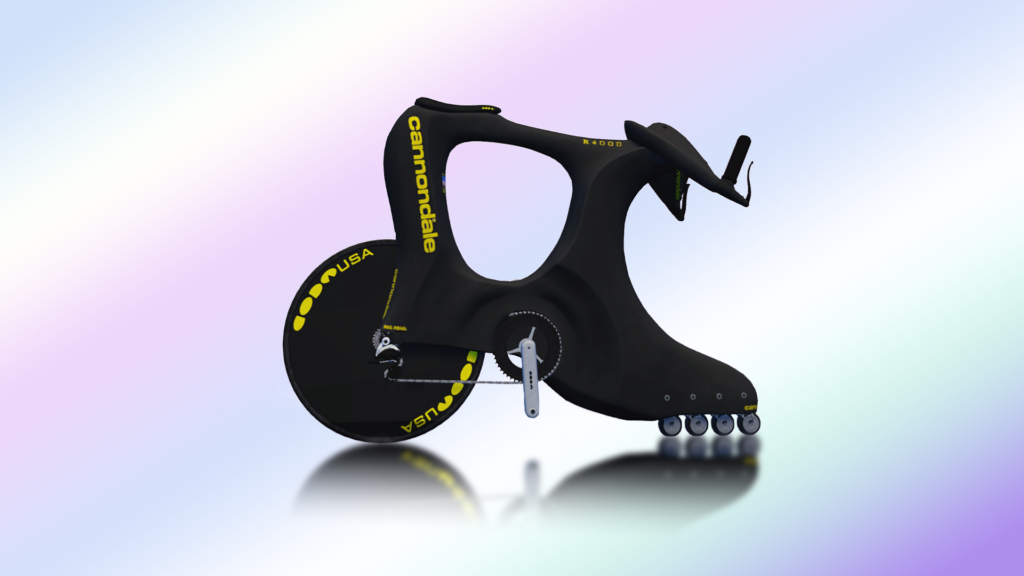
The Cannondale R4000 Roller Blade is a visionary concept bike from the mid 1990s featuring four inline skate wheels instead of a regular front wheel.

Performance by Upgrade Stage

Like all frames in Zwift, the Cannondale R4000 Roller Blade can be upgraded in five stages, with each upgrade resulting in a performance improvement. The R4000’s upgrade stages are as follows:

  1. Ride 550km, pay 400,000 Drops for an aero upgrade
  2. Ride 1050km, pay 800,000 Drops for a weight reduction
  3. Ride 1600km, pay 1,200,000 Drops for a drivetrain efficiency improvement
  4. Ride 2150km, pay 2,600,000 Drops for an aero upgrade
  5. Ride 2650km, pay 5,000,000 Drops for a weight reduction

If you’re wondering precisely how each upgrade stage impacts the bike’s performance, here is a chart showing speed test results at each upgrade stage (using our standard 75kg/183cm bot riding at 300W):

The R4000 is faster than the Concept Z1 on flat ground, but just a few seconds behind the Project 74. It beats the Tron bike by ~6 seconds across an hour, which means it beats all of the best “production” bike/wheel combos in game when it comes to flat performance.

On climbs, the R4000 is, like the Project 74, not a great performer (but anyone looking at this bike would assume this). It outclimbs the Project 74 by several seconds, but is handily beat by production climbing bikes, losing ~67 seconds over an hour to the best climbers.

Zwift Concept Z1 Details

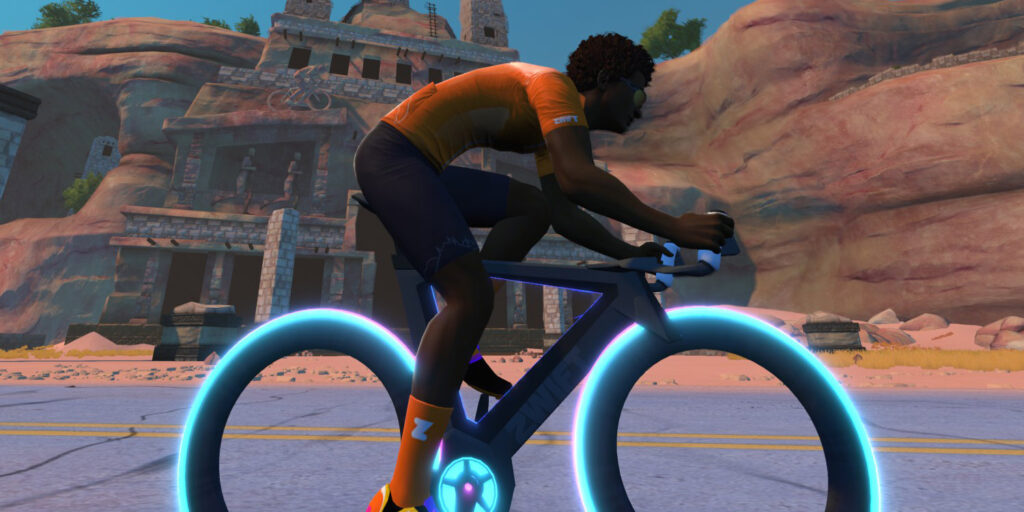
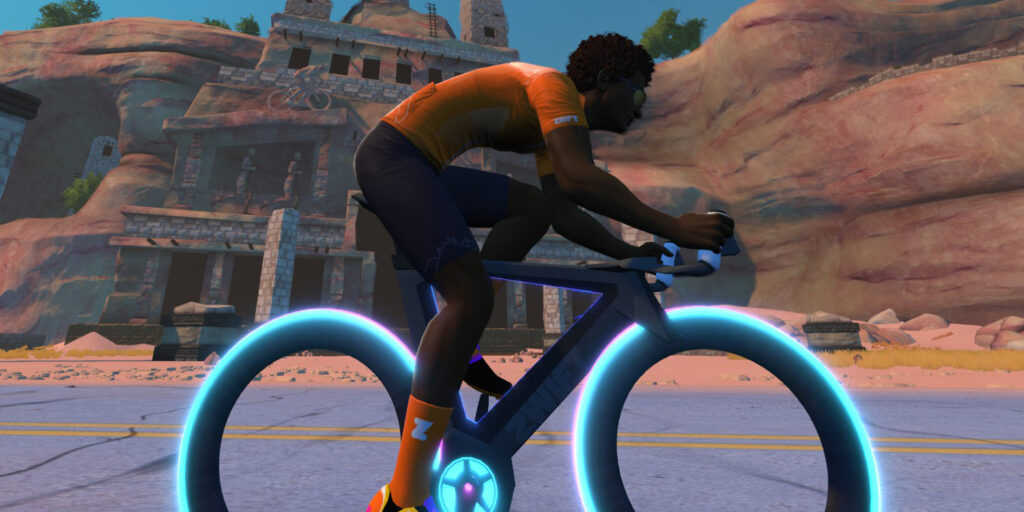
Zwift’s Concept Z1, aka “The Tron Bike”, has been in game since early days, and as such was the first “Halo Bike” in Zwift. Unlike the other bikes above, the only way to get the Tron is to finish the Climb Mt. Everest Challenge (including the extra bit).

This bike has some unique features, including rider posture idiosyncrasies and wheels that light up differently based on power output. (Dial in your slider just right and you’ll find some cool dual-tone lights!)

Performance by Upgrade Stage

Like all frames in Zwift, the Concept Z1 can be upgraded in five stages, with each upgrade resulting in a performance improvement. The Concept Z1’s upgrade stages are as follows:

  1. Ride 550km, pay 400,000 Drops for an aero upgrade
  2. Ride 1050km, pay 800,000 Drops for a weight reduction
  3. Ride 1600km, pay 1,200,000 Drops for a drivetrain efficiency improvement
  4. Ride 2150km, pay 2,600,000 Drops for an aero upgrade
  5. Ride 2650km, pay 5,000,000 Drops for a weight reduction

If you’re wondering precisely how each upgrade stage impacts the bike’s performance, here is a chart showing speed test results at each upgrade stage (using our standard 75kg/183cm bot riding at 300W):

The Concept Z1 is the fastest aero performer you can get with a reasonable amount of work in game, since the Project 74 and R4000 bikes will take significantly more time and effort! That said, the Concept Z1 just barely edges out the top aero performers, gaining ~1 second across an hour of flat riding.

Those top aero performers, though, handily beat the Concept Z1 on climbs, which means you may not want to use the Concept Z1 in a race that has any significant hills. Learn more about how the Concept Z1 compares to other top performer road frame+wheel combos by checking out our “Speed Tests: Concept Z1 (Tron) Bike vs Top Performers” post.

Questions or Comments?

What do you think of Zwift’s new Halo Bike concept? Which one are you working to unlock first, and why? Share below!

Confirmed: 2027 Tour de France to start in the UK with tri-nation Grand Départ

The Tour de France will return to the UK in 2027, with Scotland, England and Wales to host stages, and Edinburgh confirmed as the start city for the men’s race.

The 2027 Grand Départ will mark the first time both the Tour de France and Tour de France Femmes have started in the same country, outside France.

While Edinburgh has been announced as the host city for the men’s race, with Tour de France stages also confirmed to take place across Scotland, England and Wales, the start venue for the women’s race has not been revealed.

Six stages will take place on UK soil across both races, although whether the women’s race traverses all three of Scotland, England and Wales is also unconfirmed. The full routes will be announced this autumn.

“Britain has always welcomed the Tour with enthusiasm and pride, and this collaboration across England, Scotland and Wales promises to make the event even more special,” said Christian Prudhomme, general director of the Tour de France.

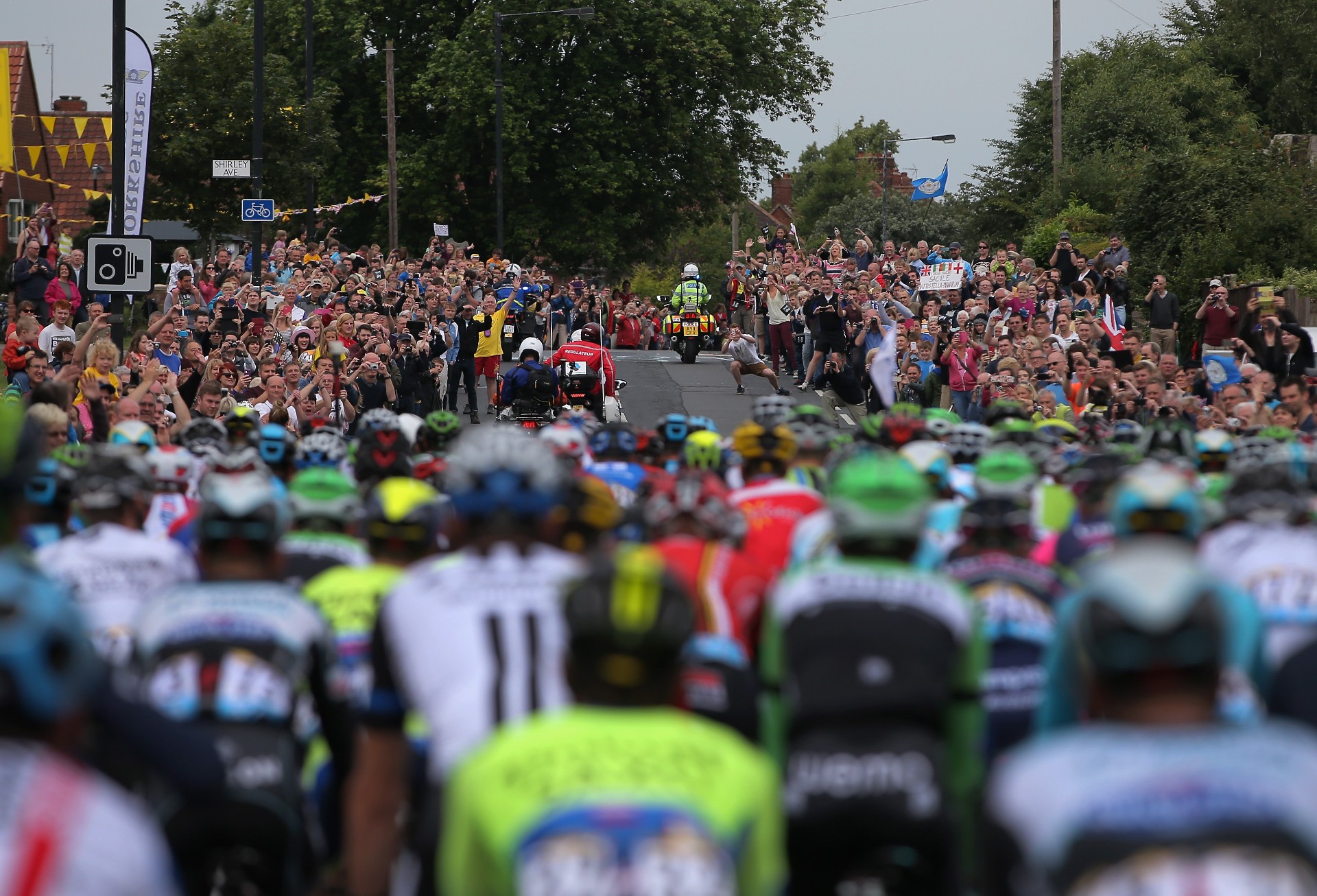
The Tour de France last touched British shores in 2014, when the race started with two stages in Yorkshire, before a third stage from Essex to London. Previously, London hosted the Grand Départ in 2007.
“I will always remember the riders applauding the spectators, crossing London Bridge in 2007,” said Prudhomme, at a press conference confirming Edinburgh as the start city of the 2027 Grand Départ.
“It was impossible for them to hear anything for three days because there were huge crowds everywhere.”

Crowds at the roadside for the three stages of the 2024 Grand Départ were reported to total 4.8 million, generating £131 million in revenue.

2014 Tour de France in Yorkshire
Millions of spectators lined the streets for the 2014 Grand Départ, with two stages in Yorkshire and a third finishing in London.

A British start for the Tour de France Femmes

The Tour de France Femmes first ran in 2022 and the 2027 event will see the race arrive in Britain for the first time. Prudhomme confirmed that the women’s race will continue to run separately from the men’s race, as is the current format, rather than combining with the men’s race into a single, concurrent event.

Prudhomme also suggested the Grand Départ will be broadcast on free-to-air television in the UK, despite 2025 being ITV 4’s final year showing the race, after Warner Bros. Discovery signed an exclusive deal with ASO.

“There will be discussions, of course, but I do hope the stages in the UK will be live and free-to-air,” said Prudhomme. “We are optimistic.”

The tri-nation 2027 Grand Départ has been described as ‘the largest free sporting event in British history’, and is said to represent a ‘strategic win’ between British Cycling, UK Sport, the UK Government, and the Scottish and Welsh Governments, to ‘drive lasting benefits for the sport and everyone who rides a bike’, according to organisers.

“The opportunity to host the Grand Départs of both the men’s and women’s Tour de France will cement Britain’s reputation as a destination for major international sporting events,” added culture secretary Lisa Nandy.

“This will stimulate growth, attract new visitors and leave a lasting legacy for athletes and fans alike.

“Staging the Tour de France Femmes in Britain for the first time will also be a historic occasion and inspire the next generation of female cyclists while supporting our mission of breaking down barriers for women and girls to get more involved in sport.”

2024 Tour de France Femmes
The Tour de France Femmes is coming to the UK for the first time. Getty Images

An international affair

The Grand Départ of the Tour de France has become an increasingly international affair, with six of the past ten editions of the men’s race starting outside of France. Last year, the race started in Florence, Italy, taking the Grand Départ to the home of the Giro d’Italia for the first time, while next year’s edition will start in Barcelona, Spain.

The Tour de France Femmes, however, has started in France for three of its four editions to date, with only the 2024 race starting outside of its home country, kicking off in the Netherlands.

In 2021, the British government attempted to bring the Tour back for the 2026 edition, but that bid was abandoned. Scottish Cycling was then reported to be interested in tabling a bid having got a taste for things by hosting the 2023 UCI World Cycling Championships.

That dream has now become a reality and the 2027 Grand Départ will come alongside a ‘landmark social impact programme’, according to organisers, with the aim of delivering ‘long-lasting benefits for thousands of people across the country by tackling inactivity, improving mental wellbeing, boosting economic growth and supporting communities to thrive’.

Jon Dutton, CEO of British Cycling, said: “The return of the Tour de France Grand Départ to Britain is an exciting moment for cycling in the UK. 

“Hosting both the men’s and women’s races together will be a first, and we believe it has the potential to inspire more people to discover the joy and benefits of cycling. 

“This is not just about the race – it’s about creating a national moment that encourages healthier lifestyles, supports cycle tourism and brings communities together.”

Zwiftcast Episode 213: Women’s History Month Special 2 of 2

This week, co-hosts Rebecca Charlton and Dave Towle are joined by an array of special guests for the second of two Zwiftcast episodes celebrating Women’s History Month.

Pro tip: join a Watch The Femmes ride to listen to the latest episode and earn an exclusive headphone unlock.

First, Eric Schlange takes us through bike upgrades, wind tunnels, and all the latest, biggest events.

Then WorldTour AG Insurance Soudal star Ashleigh Moolman Pasio drops in for a chat about returning from serious injury and why she’s supporting the next generation of women and girls from South Africa. Sindile Mavundla follows up, sharing the story of the Khaltsha Cycling Academy and why it’s transforming the lives of young girls. Here’s how you can support their great work.

And finally, the wonderful creator of the Zwiftcast, Simon Schofield, is back to share his story as he launches a new YouTube channel to document his return to the bike after being diagnosed with Stage 4 cancer.


Zwiftcast is available on Podbean, Apple Podcasts, YouTube, Amazon Music, and Spotify.

Speed Tests: Concept Z1 (Tron) Bike vs Top Performers

Our wheel and frame performance charts are useful tools, but they don’t answer one crucial question for many Zwift racers: how does X frame paired with Y wheelset perform compared to the Zwift Concept Z1 (Tron) bike?

With Zwift tweaking performance parameters and releasing new bikes this week, it was time to update this popular chart with current data. Below, you’ll find a scatter plot chart pitting the Tron bike against top-performing wheels and frames.

Tip: we charted how many seconds each setup saves across an hour of riding, which means you’ll find the top performers higher on the Y-axis and further right on the X-axis.

Frames used:

  • Zwift Concept Z1
  • S-Works Venge
  • S-Works Tarmac SL8
  • Pinarello Dogma F 2024
  • Canyon Aeroad 2024
  • Cannondale SuperSix EVO LAB71
  • S-Works Aethos

Wheels used:

  • Zipp 858/Super9
  • DT Swiss Disc   
  • ENVE 8.9 
  • ENVE 7.8   
  • Zipp 454   
  • Lightweight Meilenstein

Colored based on frame. Mouse over each point for details.
Zwift Concept Z1, S-Works Venge, S-Works Tarmac SL8, Pinarello Dogma F 2024, Canyon Aeroad 2024, Cannondale SuperSix EVO LAB71, Specialized Aethos

Chart updated March 18, 2025

Observations

The most surprising thing you can see immediately is that Zwift’s performance tweaks have turned the Tron bike into a leading aero bike, but a poor climber. It’s no longer an all-arounder.

See the old Tron vs Top Performers chart for comparison >

This change is due in part to Zwift making the Tron bike a bit heavier. But they also made the disc wheels a bit slower on road bikes, and those nerfed disc wheels no longer let us beat the Tron.

The next thing worth noting is how the new S-Works Tarmac SL8 is the best performer in almost every way. (See how its purple dots are higher and further right than all the other bikes.) It’s only edged out in pure aero performance, but even then its most aero setup (paired with the Zipp 858/Super9) only loses 2.4 seconds over an hour of flat roads to the Tron bike, while being 6.5 seconds faster on an hourlong climb.

Speaking of the new Tarmac, you can see that, with its release, there’s really no place for the S-Works Aethos. It used to be the pure climber that beat everyone else up the Alpe, but the Tarmac now edges it out while being much more aero. (It is possible that tests at lower power, perhaps 2 W/kg, would see the lighter Aethos edging the Tarmac whose superior CDA would have less of an effect at lower speeds. Stay tuned for more on this topic…)

Let’s talk about wheels a bit, since their performance was modified this week as well.

One big piece of news is that the DT Swiss Disc is no longer the obvious king. The Zipp 858/Super9 is just a bit more aero, and gains almost 5 seconds on the climb.

Another big piece of disc news is that all the disc wheels were made heavier this week. It used to be sort of an “even trade” going from a good disc wheelset to the best non-disc wheels… you would lose about as much in your flat time as you gained in your climb performance.

But now, going from the Zipp 858/Super9 to the ENVE 7.8 improves your climb hour by ~11s on the climb, while costing you less than 4s on the flats. This makes it hard to justify using a disc wheel on all but the flattest races.

The ENVE 8.9 wheels have received a bit of a polish, making them perhaps the best non-disc wheels available in terms of pure aero performance. If you’re looking for good climbing wheels, though, the Zipp 454s are probably your best bet. In fact, as you can see in the chart, they edged out the Lightweight Meilensteins! (The same disclaimer as above holds true here, though, that riders are lower speeds may see the lighter Lightweights beating the 454s.)

Your Thoughts

What conclusions do you draw from this chart? Share your thoughts below!

Chris King’s latest wheels pair its famous hubs with budget-friendly alloy rims

The new Chris King MTN30 AL wheelset pairs the American brand’s famous hubs with aluminium rims to create a budget-friendly mountain bike wheelset.

This will likely come as welcome news to riders who want quality hubs and professionally built wheels, but can’t justify the cost of carbon rims.

In fact, Chris King claims its new trail and all-mountain wheelset will have a ride quality that’s reminiscent of its carbon mountain bike wheels, despite costing around $1,000 less. 

As a result, Chris King says the MTN30 AL offers reliability and serviceability, alongside responsible manufacturing processes.

Ride quality and durability

Chris King MTN30 AL mountain bike wheel.
Christ King learned ride quality and durability were the most important features for shops and riders. Chris King

When designing the MTN30 AL, Chris King says it consulted bike shops and riders about what they wanted from an aluminium mountain bike wheelset.

Chris King’s wheel product manager, Greg Hudson, says: “We learned that ride quality and durability were the most important features.”

With hubs that are renowned for their quality, and backed by a lifetime warranty, Hudson says Chris King knows “how to make durable bike products”, so achieving durability didn’t feel like a problem. 

“However, it took a lot of comparative ride testing in the field and impact testing in the lab to create a wheel that both meets our durability standards and delivers the premium ride quality we were after,” he says. 

Chris King hub in MTNAL 30 wheelset.
The wheels come with Chris King’s famous hubs. Chris King

Hudson adds that Chris King was happy with its MTN30 carbon wheels, which it launched in 2022, and tried to bring as many design cues as possible to the alloy wheels. 

“They’re highly responsive and give the rider the right amount of trail feedback. We really hit that sweet spot between muted and too harsh. The ride feels very smooth but also connected to the terrain,” Hudson says. 

Chris King MTN30 AL specs and details 

Chris King MTN30 AL mountain bike wheel.
The MTN30 AL wheels are built at Chris King’s Portland, OR factory in a range of configurations. Chris King

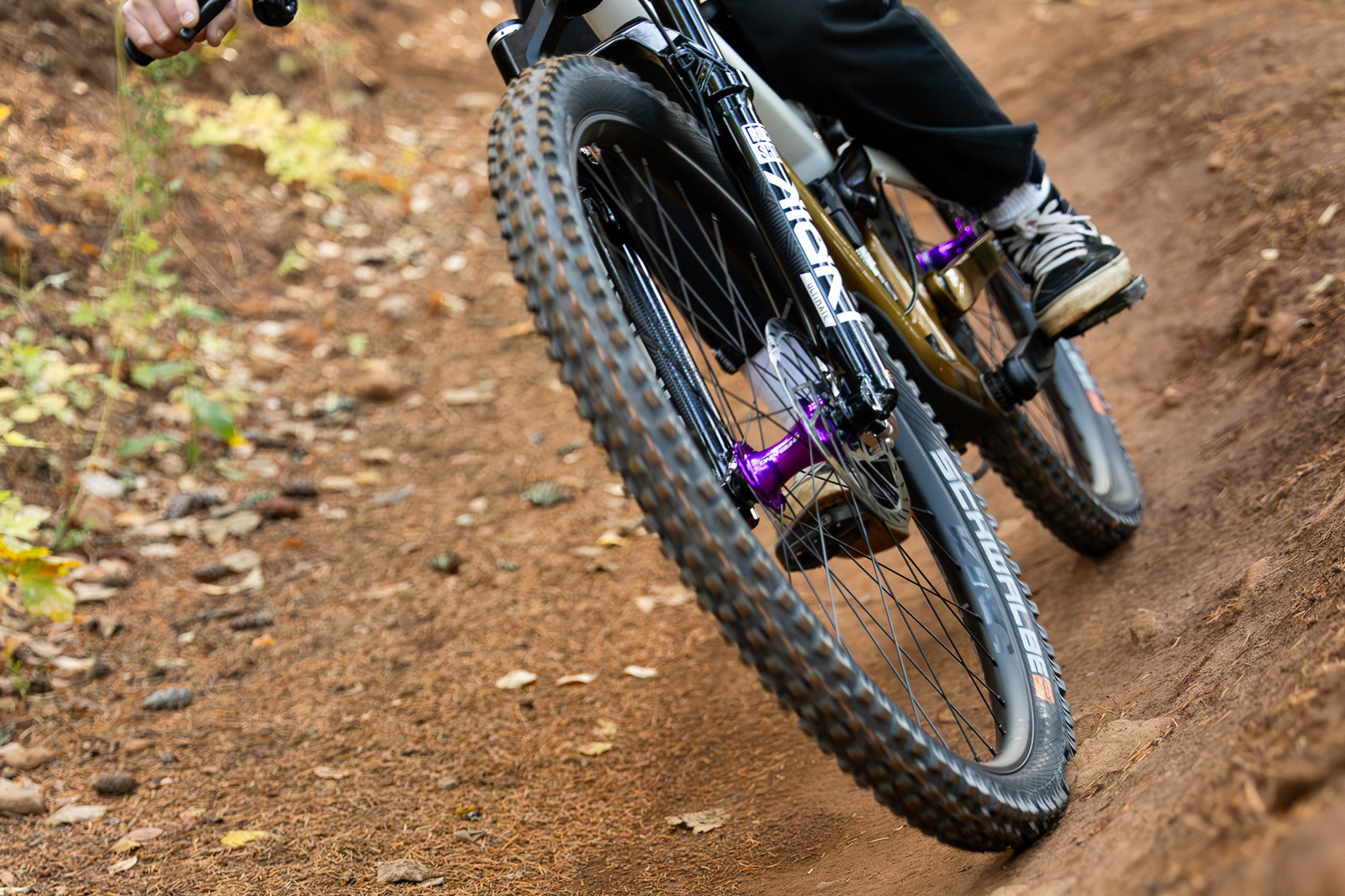
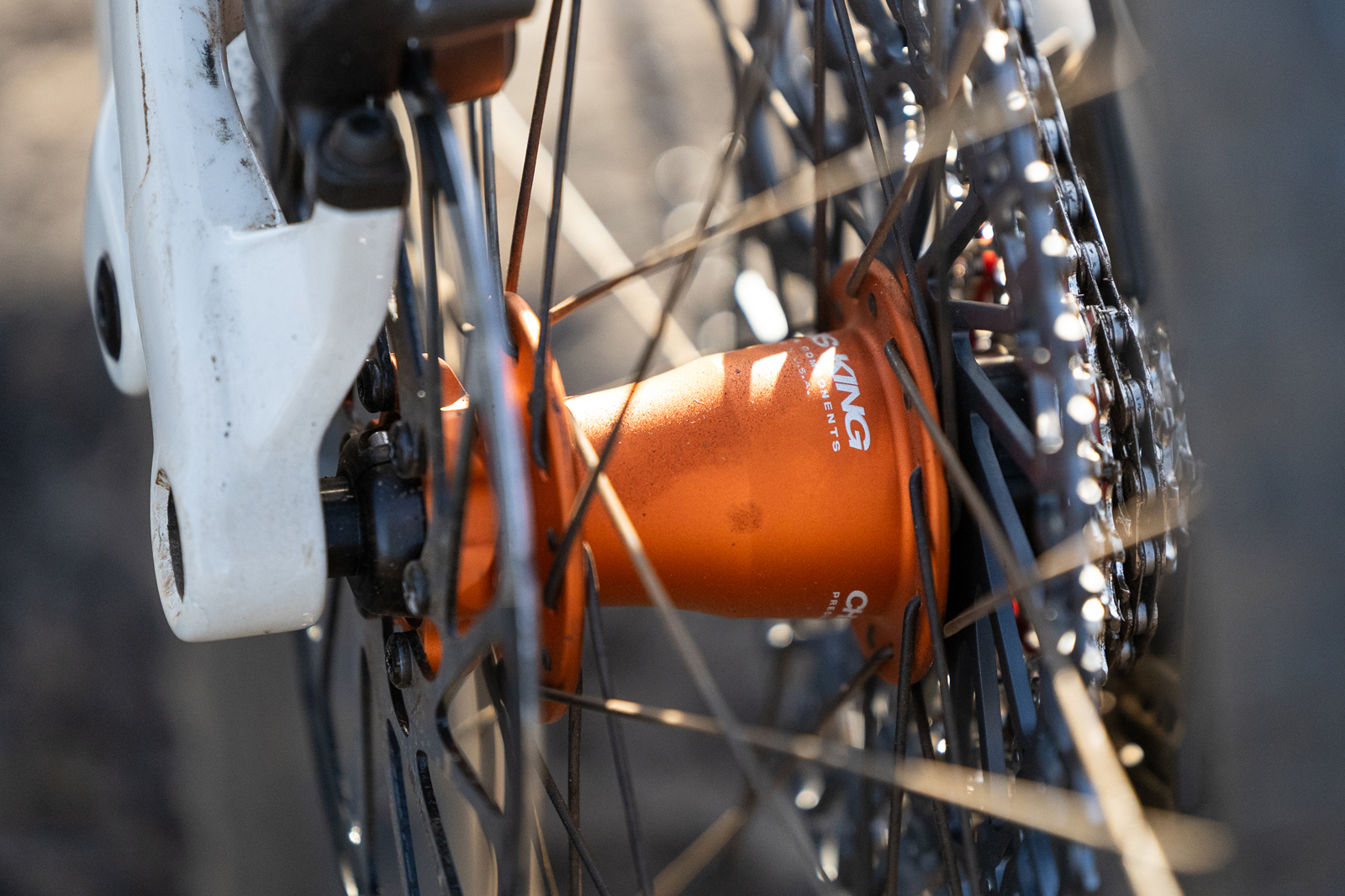
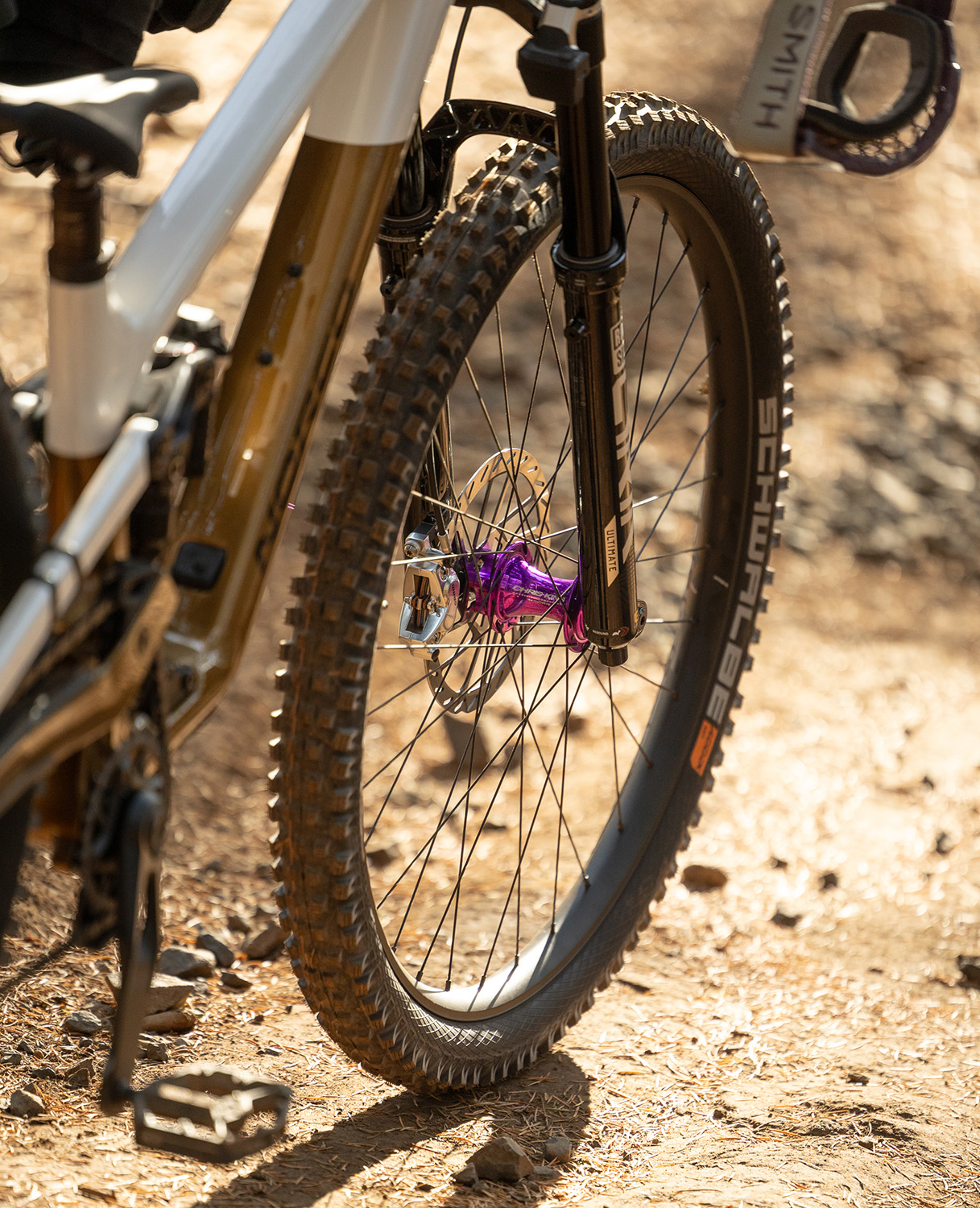
The MTN30 AL is built in-house at the Chris King factory in Portland, Oregon, using Sapim Race spokes and Chris King Boost Centerlock, Boost six-bolt, or Super Boost hubs.

The hubs will be available in all the usual Chris King colours.

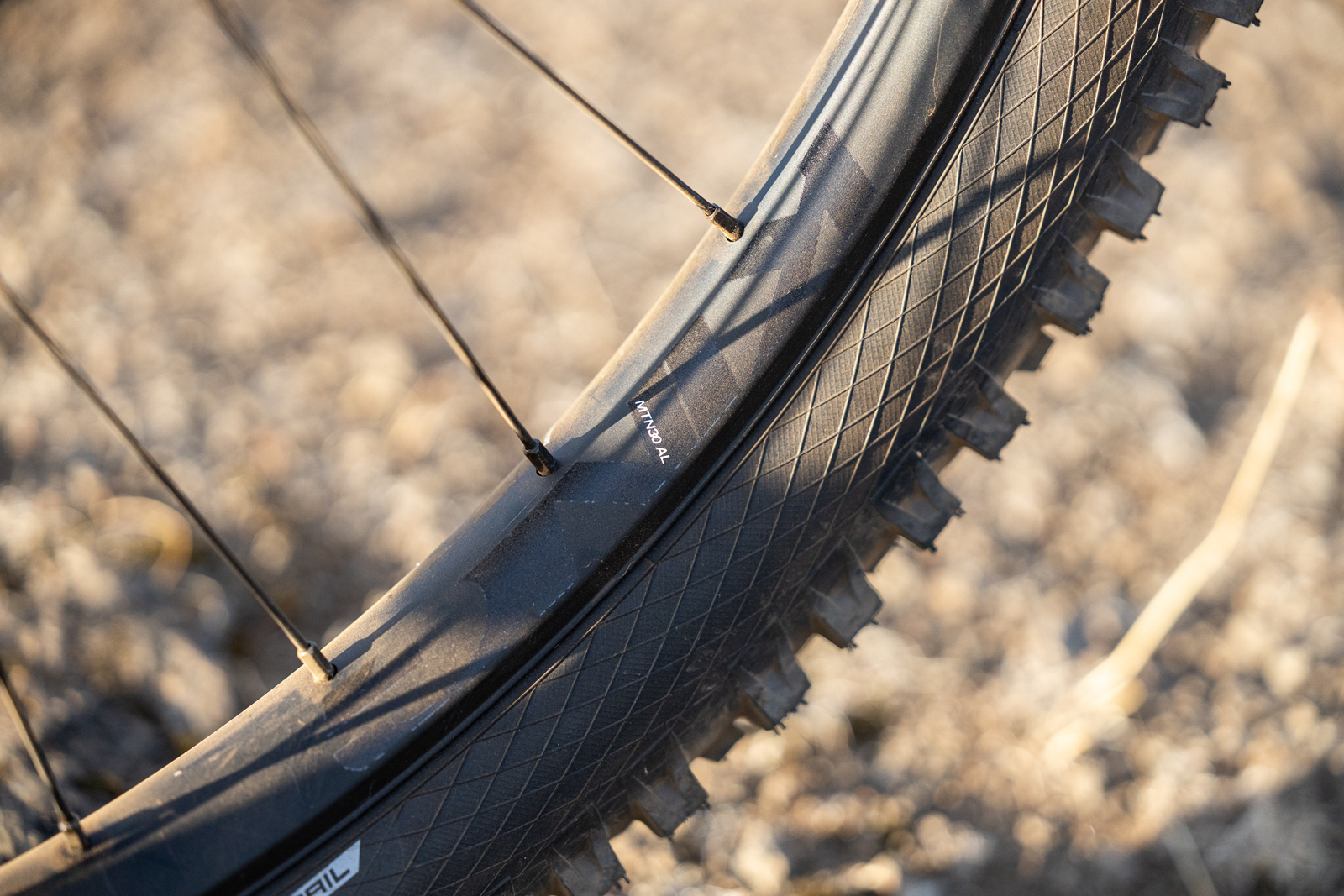
Chris King says the aluminium rims are made in the USA. They have 32 spoke holes, an internal rim width of 30mm and the tubeless-compatible, hookless rim bead is said to increase sidewall protection. 

The rim and decals have a subtle matt finish, letting the hub colour set the tone for your bike’s aesthetics.

The rims are backed with a two-year warranty on defects. The wheels also come with an affordable lifetime crash replacement programme for the original purchaser. 

The wheels will be available in 29in or 27.5in sizes, or in a mullet configuration – which is a first for Chris King. 

Lower cost, increased weight 

Chris King MTN30 AL mountain bike wheel rim.
The 29in aluminium rim weighs a claimed 595g. Chris King

The MTN30 AL costs from $1,250, which is roughly $1,000 less than Chris King’s MTN30 carbon wheelset. 

Unsurprisingly, the MTN30 AL weighs more than Chris King’s carbon mountain bike wheels. 

Chris King claims the 29in rims weigh 595g, which is 104g more than its 29in carbon mountain rim. 

It says the complete wheel weight starts at 2,080g for a mullet configuration, which is just over 300g more than its 29in MTN30 carbon wheels. 

All About Zwift’s New “Bike Upgrades” Functionality

This week, Zwift’s much-anticipated Bike Upgrades feature goes live, allowing Zwifters to trade Drops and accumulated riding for performance upgrades.

But how does it work? What sort of performance improvements can we expect? And what exactly is a “Halo Bike”? Dive in and find out!

Bike Upgrade: the Basics

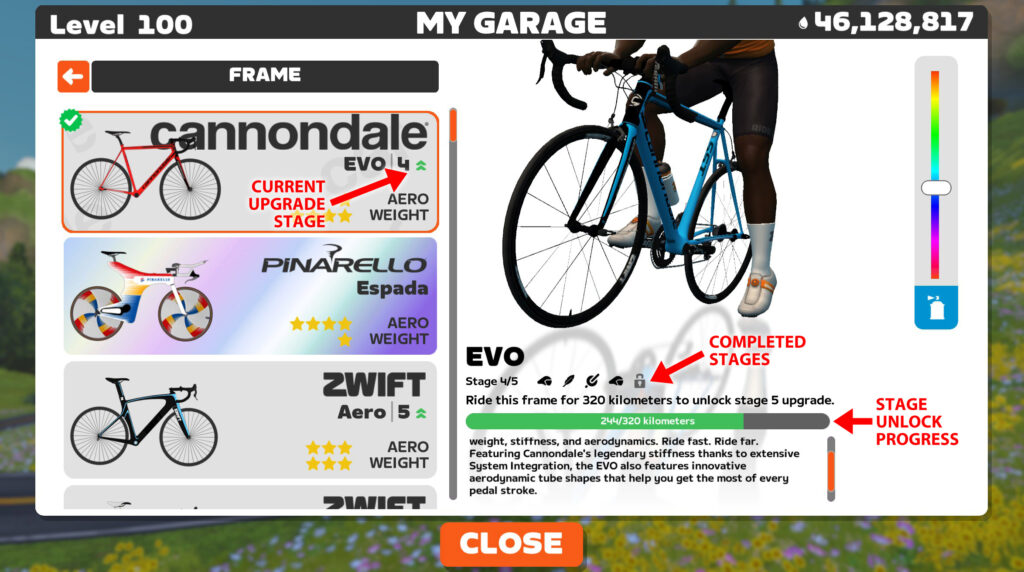
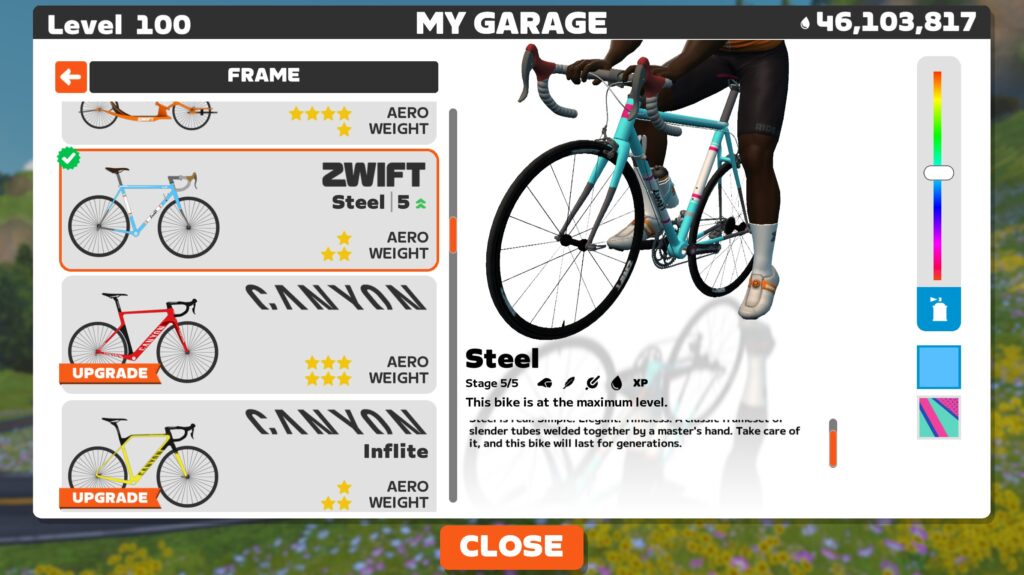
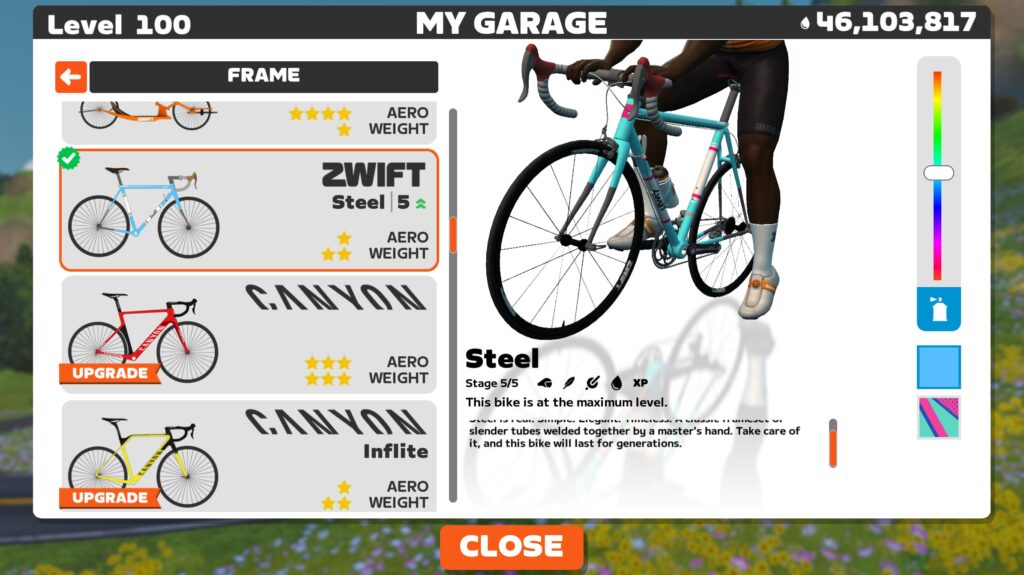
Every bike frame in Zwift now has 5 “stages” of upgrades available. As you ride a particular frame, you work your way toward completing the current stage. Completion progress is visible in your garage:

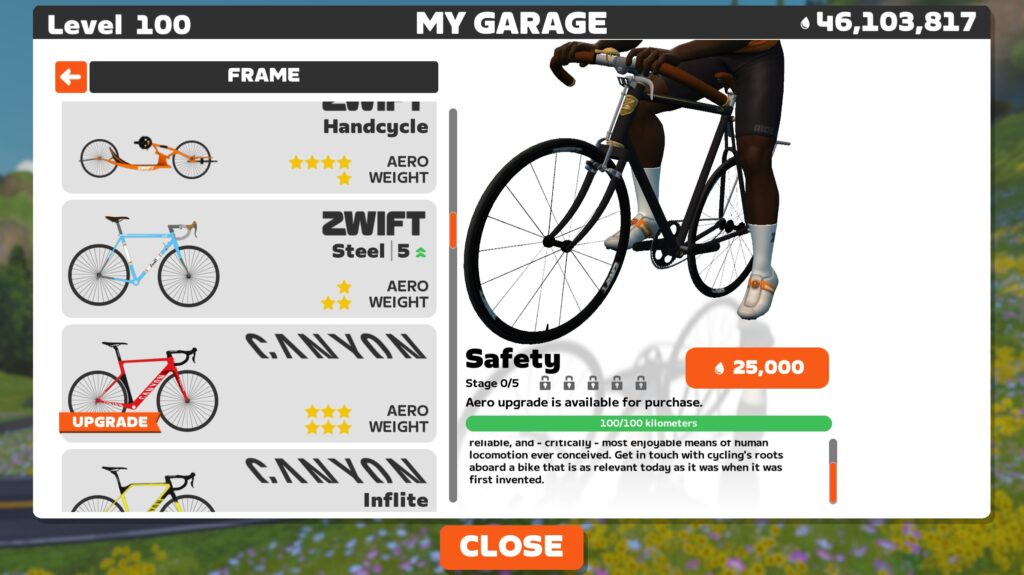
Completing the work required unlocks the ability to purchase that upgrade for your bike:

There are five types of bike upgrades:

  • CDA (aero) improvements
  • Weight reduction
  • Crr (rolling resistance) decreases
  • Drops earning increase (5%)
  • XP earning increase (5%)

Why Upgrades?

It seems that, with every new feature Zwift releases, there are people who comment, “Why did Zwift put the development resources into building this feature? I won’t be using this. Etc, etc…”

Bike Upgrades add another carrot to the game – a fresh incentive to get on your bike and put in the work. Will that carrot be attractive to all Zwifters? Of course not. No feature is. But Zwift is betting it will appeal to many.

Additionally, most experience Zwifters have millions of Drops saved, with nothing to spend them on (I’ve currently got 81 million.) Bike Upgrades give Zwifters a place to spend our Drops.

Lastly, Bike Upgrades add a strategic element for racers who may want to put some thought into which bike(s) to upgrade and when, for maximum in-game performance.

Upgrade Variations

While every bike in Zwift now has 5 stages of upgrades, it’s not the same upgrades for every bike. The upgrades available for a particular frame are based on two factors:

  1. Bike Type: climbing bikes get more weight reductions, TT bikes get more aero upgrades, and all other bikes get a more even mix of upgrades. Example: a maxed out TT frame compared to its un-upgraded version is about 45 seconds faster over an hour on flat roads, and 26 seconds faster on an hour of climbing. By contrast, a maxed out S-Works Aethos is about 21 seconds faster over an hour on flat roads, and 58 seconds faster on an hour of climbing, compared to its un-upgraded version.
  2. Bike Price: entry-level bikes get bigger performance increases in the early upgrade stages, while latter stages unlock Drops or XP bonuses. Higher-level bikes don’t unlock Drops or XP bonuses, but rather spread the performance increase upgrades across all 5 stages so you really have to put in the work to max out a top-level frame.

Additionally, the type of work you must do to unlock upgrades, the amount of work you must do to unlock an upgrade, and the cost of each upgrade vary between bikes based on three factors:

  1. Bike Type: climbing bikes require accumulated elevation, TT bikes require accumulated time, and all other bikes require accumulated distance. Example: to unlock upgrade stage 1, the S-Works Aethos (climbing frame) requires 2000 meters of climbing while the Cadex Tri TT requires 6 hours of use and the Felt AR 200km of distance.
  2. Upgrade Stage: each stage requires more effort to unlock than the stage before. Example, the S-Works Venge requires 200km of riding to unlock stage 1, but 440km for stage 5.
  3. Bike Price: just like outdoors, higher-end bikes cost more to upgrade. Example: in the climbing bike category, the S-Works Aethos requires 4000 meters of climbing and 750,000 Drops for its stage 5 upgrade, while the more entry-level Trek Emonda SL requires just 2000 meters of climbing and 200,000 Drops for its stage 5 upgrade.

Upgrades vary widely in price. A basic bike’s stage 1 upgrade only costs 25,000, while a Halo Bike’s stage 5 upgrade costs an astronomical 5 million Drops!

Performance Improvements

The big question on everyone’s mind is: just how much faster will upgraded bikes be?

While we can’t tell you exactly what each stage’s upgrade will trim off of your time (not yet, anyway), we can share overall time improvements for a “stage 0” (completely un-upgraded) frame vs its maxed out “stage 5” version. Here is the time savings you can expect across an hour of riding at 4 W/kg:

Bike Type Flat Roads (Stage 0 vs Stage 5) Climbs (Stage 0 vs Stage 5)
Climbing -21s -58s
TT -45s -26s
All Others -28s -36s

Note that the 1-hour time savings above is estimated based on test results with our bot (75kg, 183cm tall, at 300W). Flat tests are done on Tempus Fugit, while the climb test is done on Alpe du Zwift.

Halo Bikes

This update from Zwift also adds a new, highly prestigious set of bikes to Zwift: Halo Bikes! These are fast and unique bikes that take a lot of work to unlock, a ton of Drops to purchase, and oodles of work and Drops to fully upgrade.

There are four available today:

  • Pinarello Espada
  • Specialized Project ’74
  • Cannondale R4000 Roller Blade
  • Concept Z1*

* the Concept Z1 (Tron bike) is unique on this list, because many Zwifters already own it after completing the Climb Mt Everest Challenge. This is still the only way to unlock it, but if you want to upgrade your Tron bike, you have to fully upgrade 3 Zwift frames first.

Halo Bikes can be seen as brand loyalty rewards, because unlocking a brand’s Halo Bike requires you to first fully upgrade three frames from that brand. Simply unlocking a Halo Bike doesn’t mean you own it, though. You still have to purchase the bike, at a hefty price of 10 million Drops. Yes, you read that right: 10. Million. Drops.

Once you own it, a Halo Bike can be upgraded in 5 stages, just like every other bike in Zwift. But the work and cost of each upgrade is around 5x more than even the best non-Halo Bikes! So while Halo Bikes will be somewhat rare, fully-upgraded Halo Bikes will be rarer still.

Watch this space! We’ll be publishing a dedicated post all about Halo Bikes in the coming days, sharing performance details and more. Until then, catch the Halo Bikes in action from March 18-April 7 in Watopia with Robopacers Big Mig, Jacques, and Coco.

Upgrading Tips

Zwifters – especially racers and riders who collect unique in-game bikes – will probably be asking two questions:

Question #1: Which bike should I upgrade first?

If you’re a racer, it’s probably smart to upgrade the bike you race the most. Maxing out high-end race bikes like the S-Works Venge or Pinarello Dogma F 2024 requires 1600km of riding and 1.9 million Drops. That’s no small ask, but it is also doable in 3-5 weeks for many experienced riders.

If you just want a particular Halo Bike, and aren’t concerned with race performance, you’ll get there quickest by upgrading three lower-end bikes, because lower-end bikes can be upgraded to stage 5 much quicker than higher-end bikes.

Question #2: Are there ways to speed up the upgrade process?

The simple answer is “yes,” but a full explanation could be an article in itself. As explained above, depending on which type of frame you’re riding, upgrades will be unlocked based on accumulated elevation, distance, or time on the bike.

Shortening your upgrade time, then, means figuring out how to accumulate more elevation, distance, or time on the bike. A few ideas:

  • To gain elevation faster, do your structured workouts on climbs like Alpe du Zwift or Ventoux. The workout won’t feel any different, but you’ll be gaining more altitude than you would riding on a flat route.
  • To gain distance faster, ride in groups. Robopacers are an obvious choice, but group rides or races are also a good option.
  • To get more time on the bike, try adding another long, slow zone 2 endurance ride to your week. These sorts of rides do wonders for your riding, delivering increased mitochondrial density, improved lactate clearance, and new muscle capillaries, among other things.

One last tip for upgrading as quickly as possible: once you’ve done the work to unlock an upgrade, spend the Drops to buy it! Because until you purchase it, your work on the bike won’t go toward unlocking the next step.

Your Thoughts

Got questions or comments about bike upgrades? What bike are you going to upgrade first, and why? Comment below!

Zwift Update Version 1.86 (142579) Released

Zwift version 1.86 begins its phased rollout today. This is a major release – Zwift’s largest so far this year – delivering major changes to the Drop Shop and Garage including new bikes, frame/wheel performance modifications, and the much-anticipated Bike Upgrades system. Read on for details…

Bike Upgrades

Zwift’s release notes say, “the Zwift Garage now features a Bike Upgrade system that lets Zwifters upgrade any bike and hand cycle to five (5) upgrade stages for increased performance.”

It’s the long-awaited “Garage Upgrades” functionality announced back in September 2024, and it adds lots of new carrots for Zwifters to chase. It also gives us a reason to spend Drops and think strategically about which bikes to upgrade and when!

This is a big update, so we’ve put together a detailed post all about it.

Read “All About Zwift’s New ‘Bike Upgrades’ Functionality” >

Performance Changes

To support the Bike Upgrades system and increase in-game realism, this week’s update includes performance tweaks to nearly all bikes and wheelsets in game. Again, there’s way too much detail to share here, but the good news is we published a post last week detailing the new performance characteristics of all the road frames and wheels:

Read “Learn About Upcoming Frame and Wheelset Performance Changes on Zwift” >

There’s much more to talk about in this space, including performance changes to the Tron (Concept Z1) bike as well as TT, MTB, and Gravel frames. Watch Zwift Insider for more info soon.

7 New Bikes

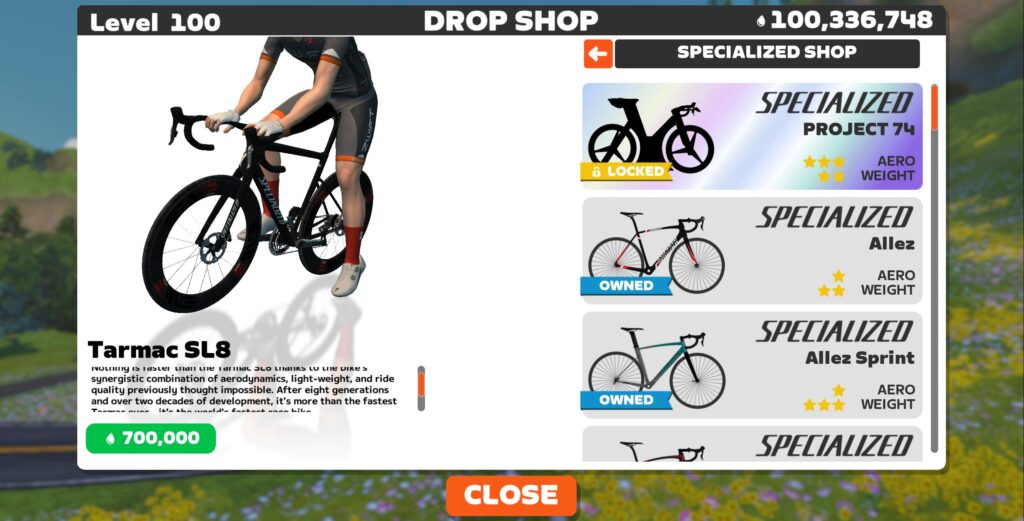
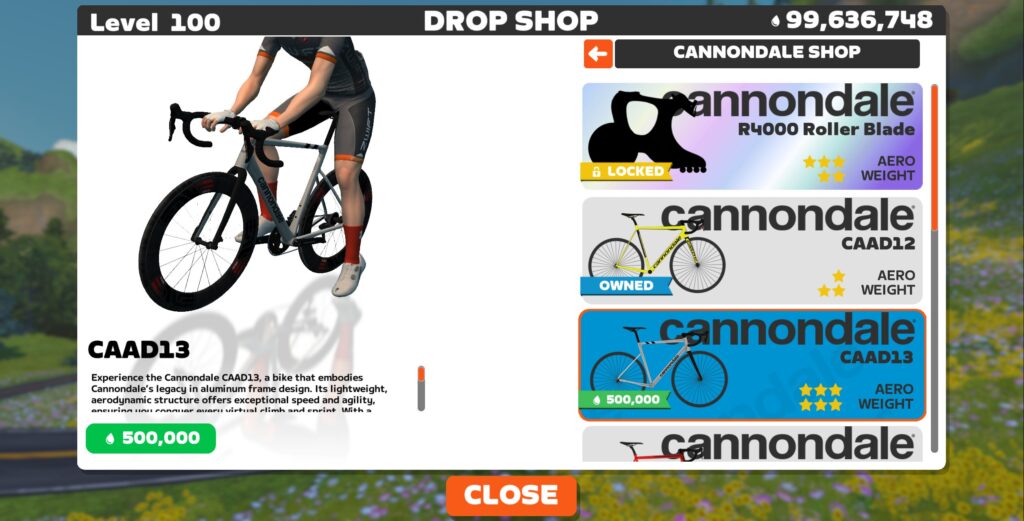
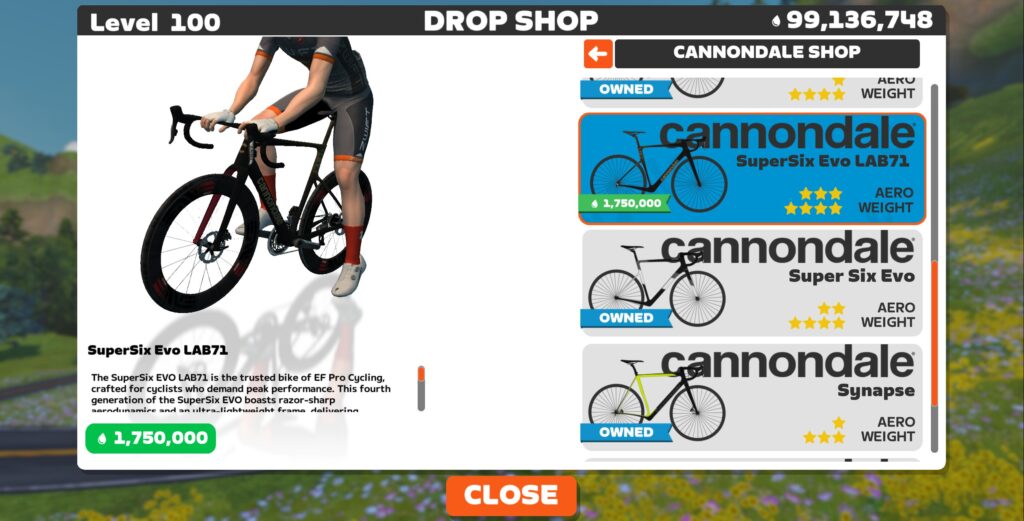
Everyone loves new bike day! Four new “production” road bikes have been added to the Drop Shop: the S-Works Tarmac SL8, Tarmac SL8, Cannondale CAAD13, and Cannondale Super Six EVO LAB71:

We are now running speed tests on these bikes. They are fast. We will publish results as soon as possible.

Additionally, three new “Halo Bikes” are now “available” in the Drop Shop: the Specialized Project 74, Pinarello Espada, and Cannondale R4000 Roller Blade:

We say “available” for the Halo Bikes because Zwifters will have to put in a lot of work and spend a pile of Drops before they even have the opportunity to unlock a Halo Bike. Read our Bike Upgrades post for more info.

Drop Shop Price Changes

The Pinarello Dogma F 2024 has slightly increased in price, from 1,400,000 to 1,750,000. That is the only frame with a new price. Wheels, on the other hand, have (almost) all increased in price:

Wheelset Old Price New Price
Bontrager Aeolus5 67,700 150,000
CADEX 36 223,900 375,000
CADEX 42 119,500 425,000
CADEX 65 216,900 450,000
Campy 35 250,000 350,000
Campy 50 150,000 450,000
DTSwiss 62 400,000 500,000
DTSwiss DISC 655,000 750,000
Enve SES 2.2 174,300 400,000
Enve SES 3.4 200,000 525,000
Enve SES 6.7 150,000 525,000
Enve SES 7.8 278,900 550,000
Enve SES 8.9 250,000 550,000
FFWD RYOT55 136,100 200,000
Giant SLR 0 165,100 450,000
HED Vanquish RC6 Pro 120,000 175,000
Mavic Comete Pro 38,400 200,000
Mavic Cosmic CXR60c 39,800 150,000
Mavic Cosmic Ultimate 38,400 525,000
Novatec R4 37,900 150,000
Roval Alpinist CLX 634,300 550,000
Roval CLX64 150,000 525,000
Roval Rapide CLX 200,000 500,000
Shimano C40 85,300 300,000
Shimano C50 165,000 250,000
Shimano C60 187,000 325,000
Zipp 202 135,200 350,000
Zipp 353 NSW 168,800 600,000
Zipp 404 115,600 425,000
Zipp 454 204,300 600,000
Zipp 808 200,000 425,000
Zipp 808/Super9 450,000 650,000
Zipp 858 300,000 600,000
Zipp 858/Super9 550,000 750,000
Zwift 32mm Carbon 32,000 100,000

Additionally, four wheelsets have had their unlock levels changed:

  • HED Vanquish RC6 Pro: 17 to 10
  • Shimano C60: 10 to 17
  • FFWD RYOT55: 18 to 6
  • Mavic Cosmic Ultimate: 6 to 18

New Routes

Three new routes (and route badges) arrived in this update. Two are now available to free ride, while the third (Hilltop Hustle) is event-only at this time.

Retired Bikes

This wasn’t mentioned in the release notes, but Zwift has “retired” many older bike models in today’s release by removing them from the Drop Shop. (This is the first mass bike retirement in Zwift’s history.)

Here’s the full list of bikes retired in this release:

  • Specialized
    • 2015 Shiv
    • 2019 Tarmac Pro
    • 2015 Tarmac
    • 2015 Roubaix
    • 2015 Amira
    • 2016 S-Works Amira
    • 2019 Ruby
    • 2015 S-Works Ruby
    • Specialized Allez 2015
  • Cannondale
    • CAAD12
  • Pinarello
    • 2019 Dogma F10
    • 2015 Dogma 65.1
  • Canyon
    • 2015 Ultimate
    • 2015 Speedmax
  • Cervelo
    • 2015 S3D
    • 2015 S5
  • Scott
    • Scott Foil 2015

If you already own one of these bikes, it will remain in your garage. But you won’t be able to purchase these bikes once you’ve installed version 1.86.

Release Notes

Zwift provided notes on additional tweaks and bug fixes in this update:

  • Improved the reliability of The Zwift Big Spin reward spinner.
  • Improved the navigation and appearance of the tabs shown on top of the Home screen.
  • Fixed an issue that caused Running progress to incorrectly count towards the Factory Tour challenge.
  • Fixed an issue that could cause the Shift Style and Gear Range settings to appear for trainers that do not support virtual shifting.
  • Windows: For Windows devices that are compatible with Video Screenshots, Video Screenshots is now disabled by default for devices that have less than 8 GB of RAM or fewer than 4 CPU cores. Video Screenshots can be re-enabled at any time for these devices under Settings → Video Screenshots.
  • iOS: Fixed an issue that could cause Bluetooth devices to not automatically reconnect if Zwift was open for an extended period of time.
  • Android: Fixed an issue that could prevent Bluetooth devices from automatically reconnecting after a disconnection.

Discuss this update in Zwift’s forum > (link coming soon)

Questions or Comments?

What do you think of this big update? Have you spotted any other changes or bugs in this release? Share below!

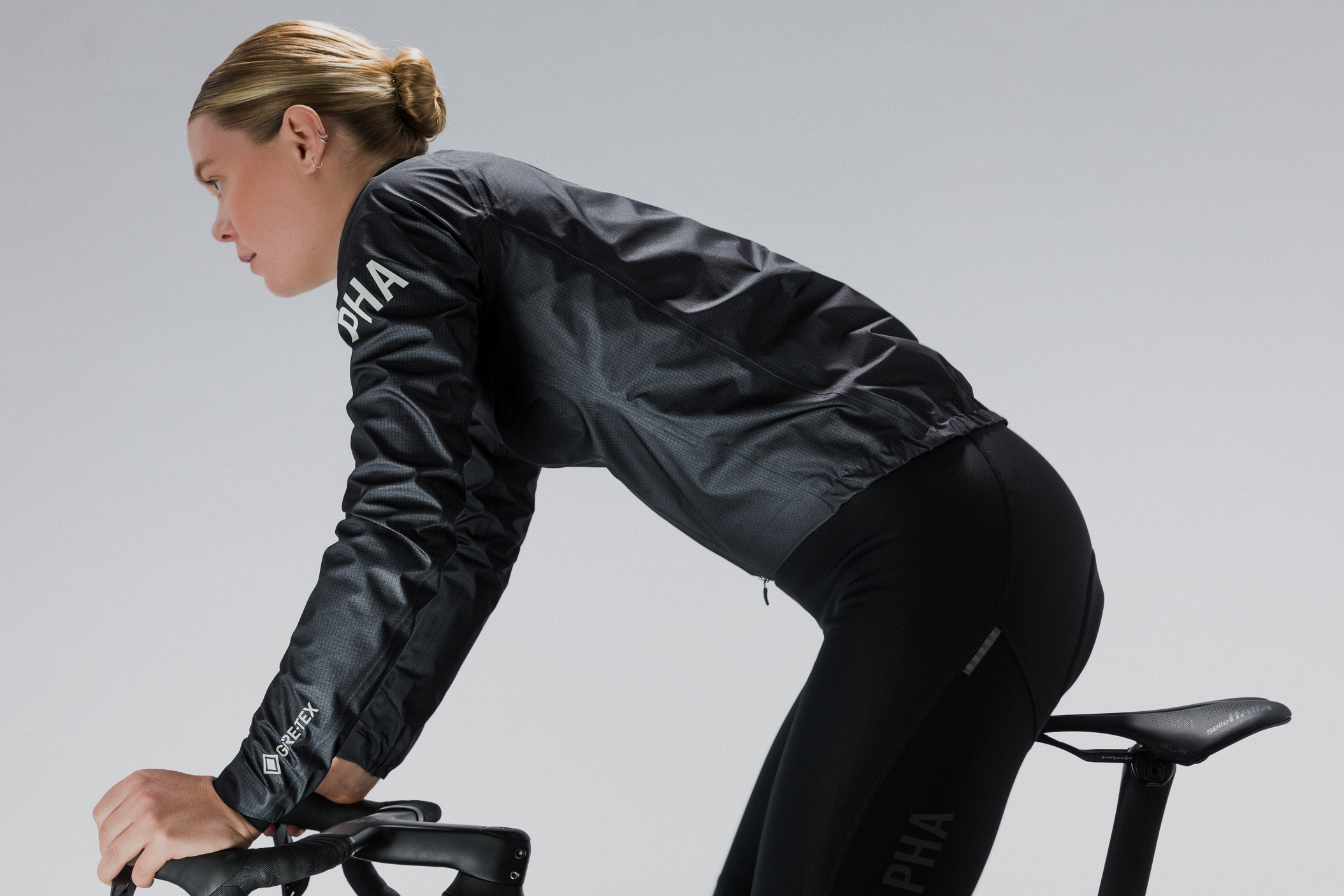
Rapha’s new rain jacket is its lightest ever – or is it?

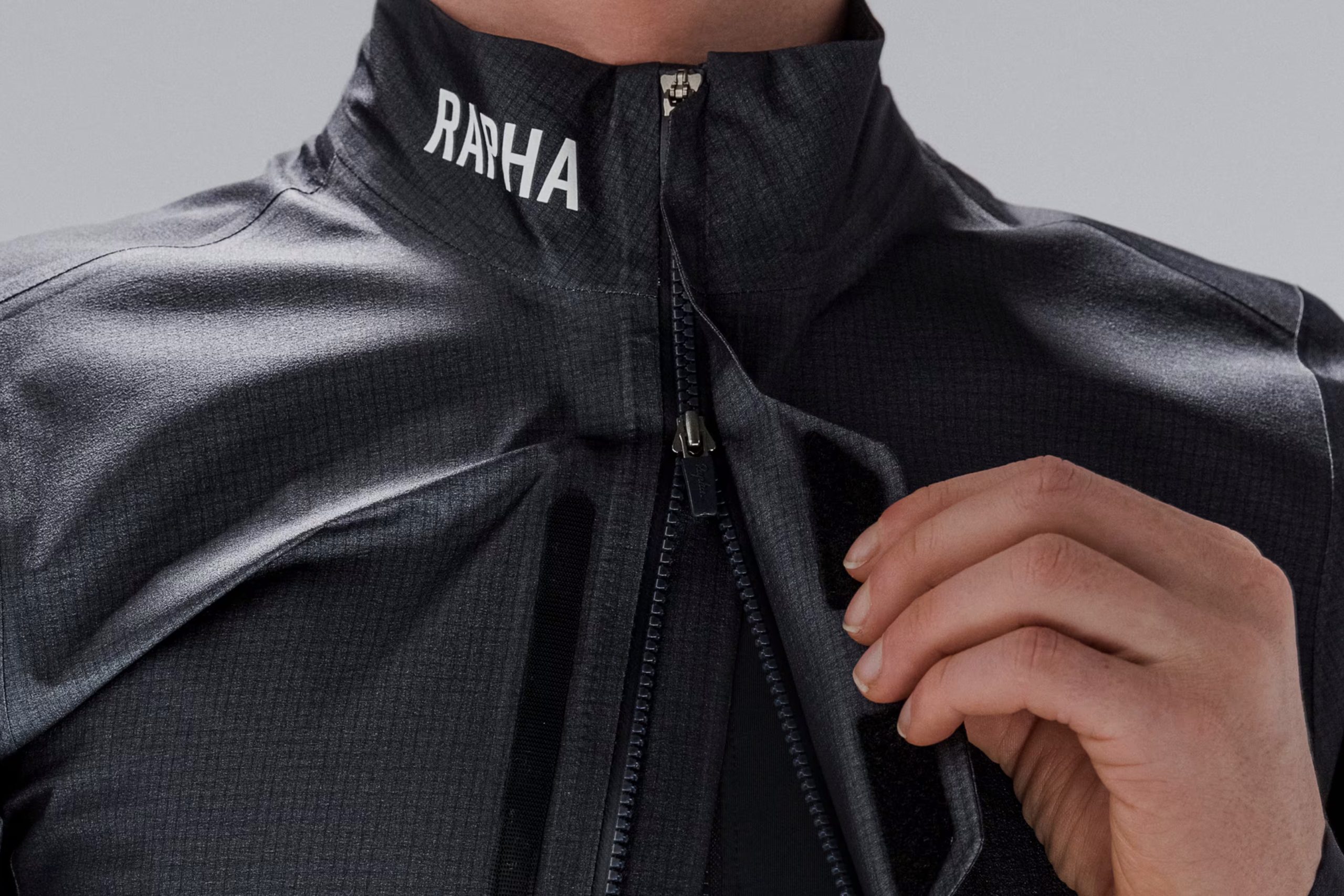
Rapha says its new Pro Team Lightweight Gore-Tex Jacket is its lightest ever rain jacket, but this might not be as light as one older jacket from the cycling clothing brand.

In a size medium, the brand says the waterproof cycling jacket weighs 128g – on our scales, our size large test sample weighs 135g.

The 7g difference could easily account for a size jump, but it’s worth recalling that Jack Luke weighed a size medium Pro Team Lightweight Gore-Tex Shakedry Jacket at 125g (3g lighter than the new garment), putting the brand’s claim into question.

PFAS-free fabric

Rapha Pro Team Lightweight Gore-Tex Jacket
The jacket is certainly light, but might not be as light as Rapha’s old Shakedry jacket. Rapha

Whatever you think about a 3g difference, though, the new jacket features a PFAS-free fabric from Gore, just like the Men’s Rapha Gore-Tex Rain Jacket I reviewed in late 2024.

That said, this comes with a qualifier that Gore’s fabrics are “made without intentionally added per- and poly-fluorinated substances, [but] may contain trace amounts.”

This fabric is claimed to be “new”, and Rapha says it played a key role in the “wear testing process” with Gore.

Rapha Pro Team Lightweight Gore-Tex Jacket
An ergonomic fit is said to be tailored for “aero bike positions”. Rapha

The fabric has a 3-layer woven ripstop construction which, in combination with an ergonomic fit, Rapha claims makes the jacket comfortable for training and racing in aggressive riding positions.

Initial impressions

Rapha Pro Team Lightweight Gore-Tex Jacket
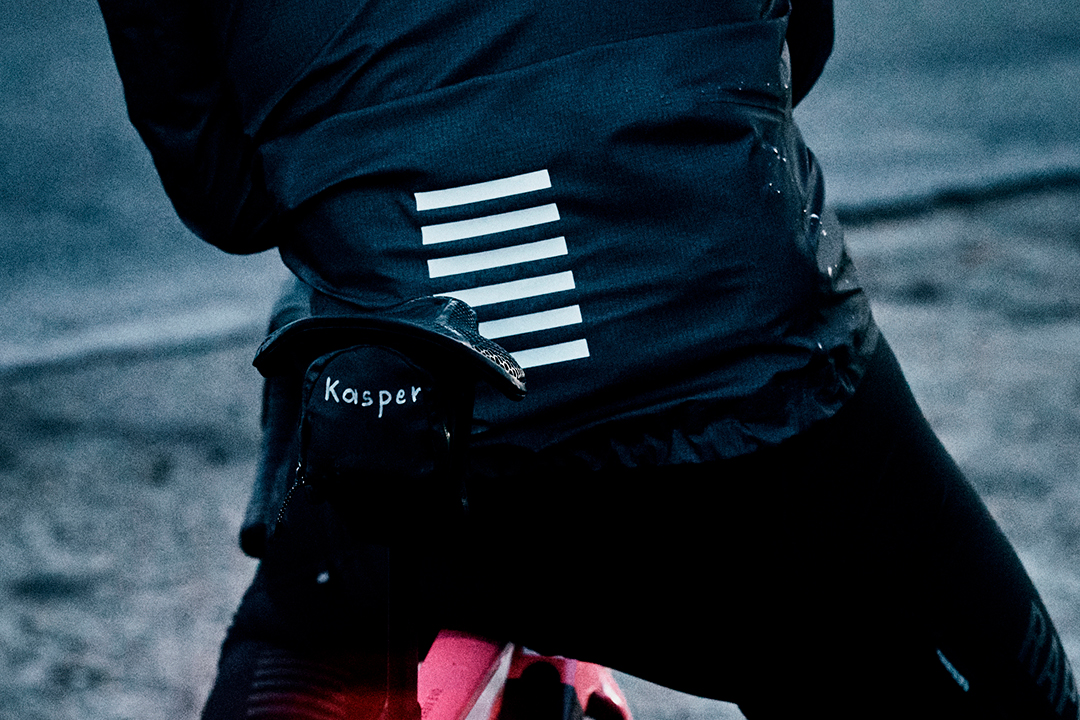
EF Education-EasyPost pro rider Kasper Asgreen is said to have been involved in the jacket’s development. Rapha

Hands-on with the jacket, a square-waffle pattern is visible on the outer fabric. It packs down into a jersey pocket relatively easily as claimed, but the fabric has a crinkly texture. 

This means the thinner-feeling Shakedry fabric (which has two layers) feels slightly easier to compress. 

The Pro Team Lightweight Gore-Tex Jacket also has a two-way zip, which the brand says will boost airflow when opened from the bottom. This is also how a rider will need to access a pocket, given there are no pockets on the jacket itself.

The jacket uses taped seams on the inside, and has a fleece-backed chin guard (as opposed to a wrap-over zip garage).

We’ll be putting the jacket to the test this spring, to see how it performs versus recently-tested PFAS-free rivals. 

The jacket is available from today and costs £295 / $390 / €335.

How the Race Was Lost: Zwift Games Stages 3 and 4 (Downtown Eruption and London Uprising)

The Zwift Games are upon us, and with them big race packs on fresh routes. Having finished third in stage 1 (read more) and second in stage 2 (read more), I was really enjoying myself in the 450-570 group.

But then the climb stages arrived, and everything changed. Here are my summaries of stages 3 and 4 of Zwift Games.

Stage 3: Warmup

It didn’t take long for me to realize that today wasn’t going to be pretty.

As I spun my legs to gently warm them up prior to the race, I could tell today (Tuesday, March 11) was a bad leg day. You know what I’m talking about. Sometimes these days are expected, other times they come as a surprise. Today was a bit of a surprise since I had ridden the day before and felt fairly good.

What was the cause? Poor sleep? Insufficient nutrition? Getting sick? I wasn’t sure. But I could tell something was off.

Stage 3: Volcano Implosion

Stage 3 took place on the new Downtown Eruption route in Watopia, and I knew exactly where I would have trouble here: the Volcano KOM. This segment has often been my undoing in races, as it’s just a bit too steep and long for me to hang on!

We had a big pack of 144 starters in the race, so I knew the effort was going to be extra tough. That’s just how it works on Zwift: bigger packs mean more strong riders, generally.

The course begins with a quick climb up the bottom half of the Hilly KOM, and it took ~450 watts for 50 seconds to hold onto the group here. Job done, but I knew the big test was up the road.

I made it to the foot of the Volcano KOM without incident, but it wasn’t long (around 600 meters in) before I saw my avatar drifting backward in the group. At 1.1km into the climb, the white flag came out. 75 riders rode away in a long string ahead, and I was quickly passed by several more.

At first, I sat up and spun easily, sinking down to 93rd place. Then I realized there was still a GC competition going on, so I pushed a bit to catch the wheels of the small group just ahead as we hit the flat halfway point of the Volcano KOM.

But then the road tilted up again, and that group rode away from me too! Jimmeny Christmas. This was bad.

Over the top, I found myself with just a couple of riders. We descended together, and I used the supertuck and some well-timed power to bridge us up to a small group just up the road.

The race may be lost, but you can still make it interesting, right?

You can tell it’s a bad leg day when your legs like you’re riding at threshold, but your heart rate doesn’t want to get above tempo zone. That’s what I was feeling on this day – like I couldn’t even push my legs hard enough to make my heart work hard!

Stage 3: Finish

Six of us made our way through Downtown Watopia, then it was time for the final challenge: the Hilly KOM. This climb is around 2 minutes long and, again, has been my nemesis in past races, seeing me dropped by just a few seconds as we crest the top.

Our group strung out and separated up this climb, and I finished somewhere in the middle of my pack of 6, for a final placement of 94th overall.

See my ride on Zwift.com >
See my ride on Strava >

Watch the Video

Stage 4: Warmup

On Saturday, March 15, I raced the second climbing stage on the new London Uprising route. I knew this one would be rough, too, because it features two big climbs: Fox Hill and Box Hill.

My legs felt nicely recovered during the warmup, and I spun my legs for around an hour prior to the race.

I’d been chatting with Nick Kalkounis from ZwiftHQ about the Zwift Games stages prior to this, sharing my results as he shared his. (Nick is a cool dude who’s done a lot of work with Zwift Racing Score. We met on my trip to the Specialized Win Tunnel back in October – read more about that here).

We decided to meet up for this race, and Nick invited Tim Hanson (of zwiftracing.app fame) along. So the three of us were having a sort of informal “race within the race.” Nick is a fit dude without a scrap of fat on his body, so I didn’t think I stood much chance against him on this course. But it’s always fun to race with friends anyway. Let’s go!

Stage 4: Outfoxed

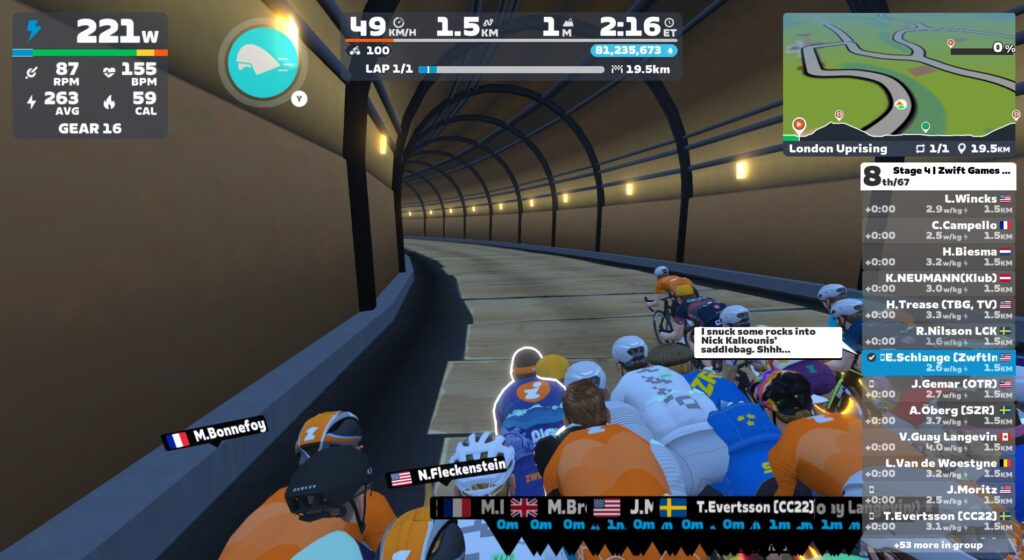
The London Uprising route begins by taking riders straight up Fox Hill. Then you descend, do a lap of the Classique, and head up Box Hill for the finish.

Simple. But not easy.

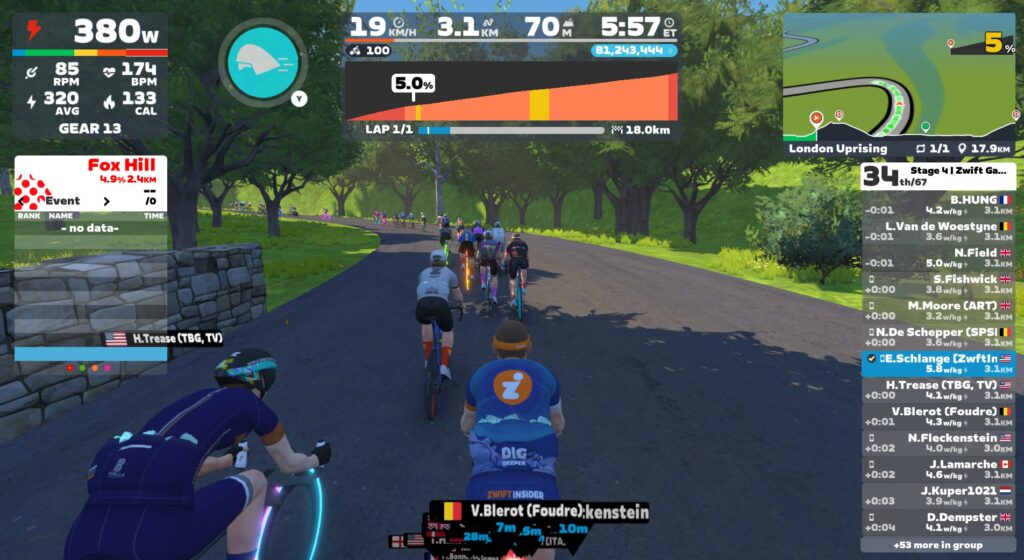
The start was pretty chill, since everyone knew the work would begin just up the road. 67 riders left the start pens, and soon enough we hit Fox Hill, and things exploded! Despite holding some solid power numbers (for myself, at least), I was dropped from the front group by the time we hit the first flattish spot just ~400 meters into the 2.4km climb. And I kept drifting back. 34th… 36th… 39th.

At 3.4km, I saw a gap to the group behind, so I pushed to hold the wheels just ahead. “Maybe Nick is in that group behind?” I hoped, against hope. Then I tapped his name in the Companion app and hit “Fan View”… and saw that he was sitting in 2nd place, on the 1st place rider’s wheel. Crap!

I finished Fox Hill in 39th, and joined a group of 7 riders. We were caught by a group of 8 from behind, despite my valiant supertucking, and that group headed to the Classique.

Soon enough, a few riders from our group got bored and attacked, leaving me in a pack of 10 riders with 3 up the road. By the time we hit the base of Box Hill, I was in a group of 8 constituting places 34-42.

Stage 4: Finish

On the first section of Box Hill, our group stretched out, and I simply didn’t have the legs to hold on. Most of them went up the road, then as it leveled out I found a bit of energy to push hard to reel in some riders just ahead.

I made it to the flat top of Box Hill with two other riders in 38-41st place, and my only goal was to beat both of them to the line. I deployed my aero powerup and went hard with 250 meters to go, but M. Moore (ART) had a much stronger sprint and blew past me. I finished 39th overall.

Chapeau to Nick Kalkounis, who hit the bottom of Box Hill with the front pack, and ended up finishing in 21st.

See my ride on Zwift.com >
See my ride on Strava >

Watch the Video

Takeaways

Races with climbs over a few minutes are always tough for me, and Zwift Games stages 3 and 4 were no exception. Stage 3 was especially rough because my legs just didn’t show up!

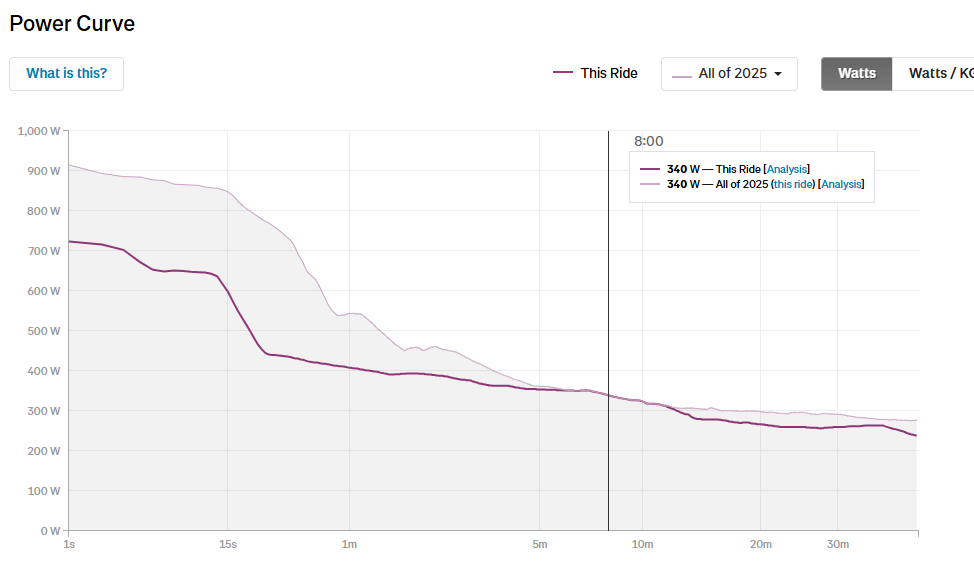
I actually had some decent power numbers in Stage 4, hitting 2025 bests in the 6-11 minute range as I climbed Fox Hill:

But that simply wasn’t good enough. It’s clear that my racing score puts me in a group where I have a shot at the podium in flat races, but will get dropped handily if the race features any significant climbing.

Which, to be honest, is how it should work. I have no complaints. If I want to put in a hard effort and know I won’t have a shot at a win, I can do a climbing race. If I want a shot at a podium, I need to stick to flatter events.

Your Thoughts

Did you race Zwift Games stages 3 and 4? How did they unfold for you? Share below!

New FFWD Ryot carbon wheels are wider and lighter but no more expensive

FFWD has announced a sweeping update to its Ryot carbon wheelset range, but has kept starting prices the same as the previous generation at a flat £1,349 / $1,599 / €1,499 for all rim depths.

This is a relatively rare occurrence in recent years, with bike and component prices generally seen to have risen throughout this period.

The new wheels feature a redesigned rim profile and hub system, as well as an “average weight saving of 100g” across the depth range. 

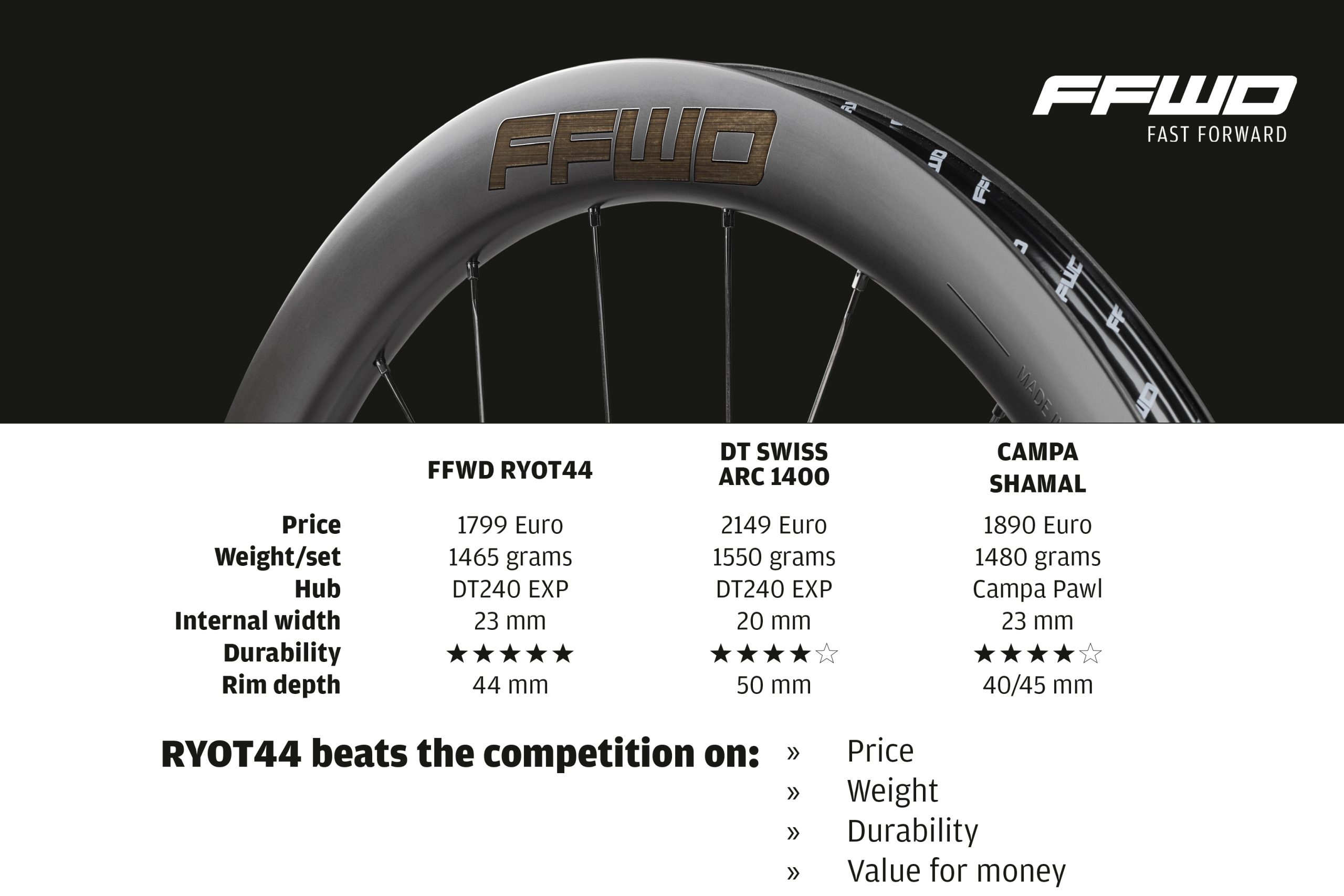
Value for money

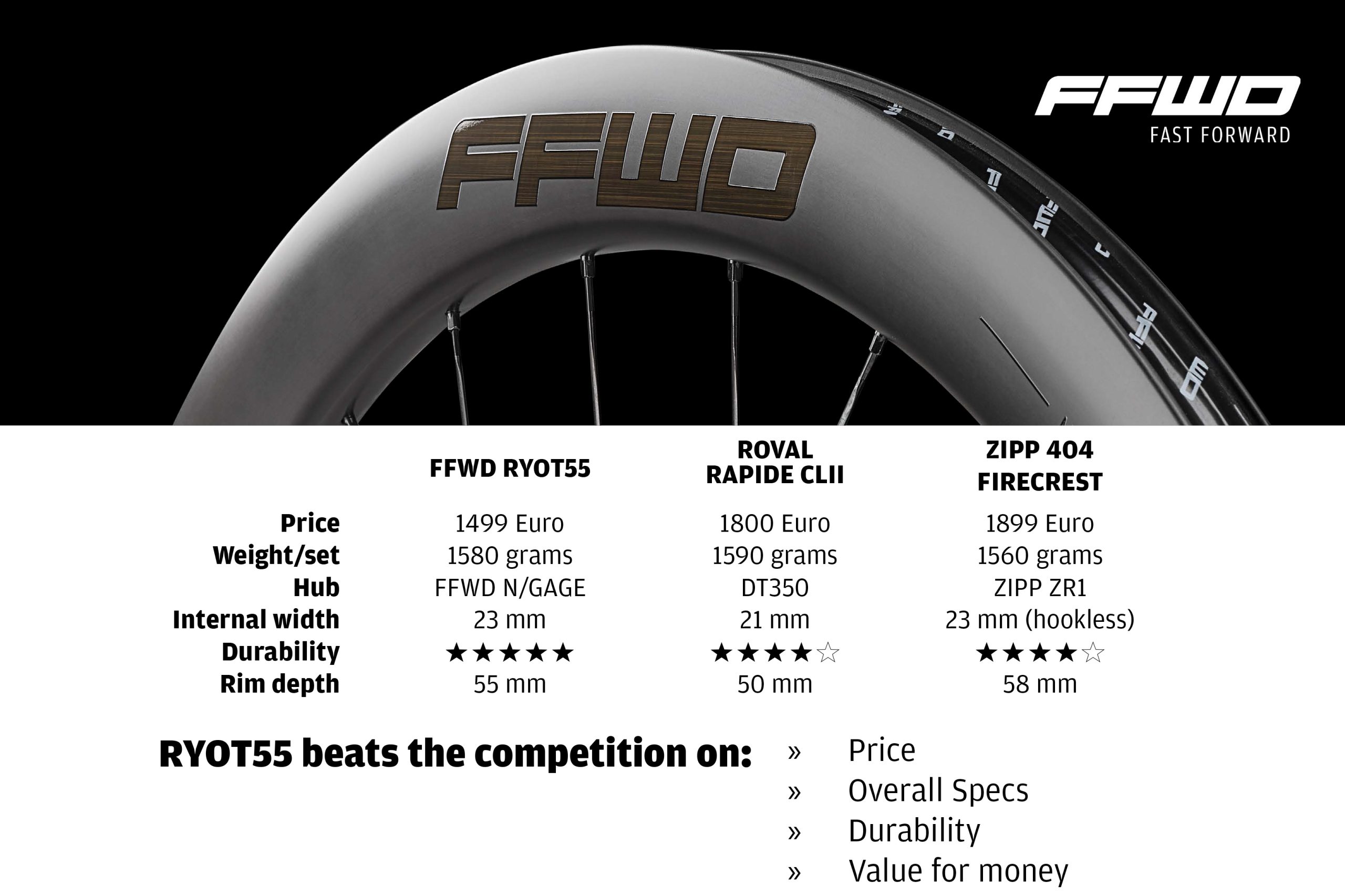
FFWD 2025 wheelset comparison table
FFWD compares its wheelsets to some of its key rivals. While some of its conclusions should be taken with a pinch of salt, there’s no doubt the specifications are competitive for the money. FFWD

While £1,349 / $1,599 / €1,499 remains a large investment for a wheelset, FFWD has modernised the Ryot wheels without asking customers to fork out more than before – something, in isolation at least, to be commended.

The brand already charged the same price across the four depths (33, 44, 55 and 77mm) and this remains the same.

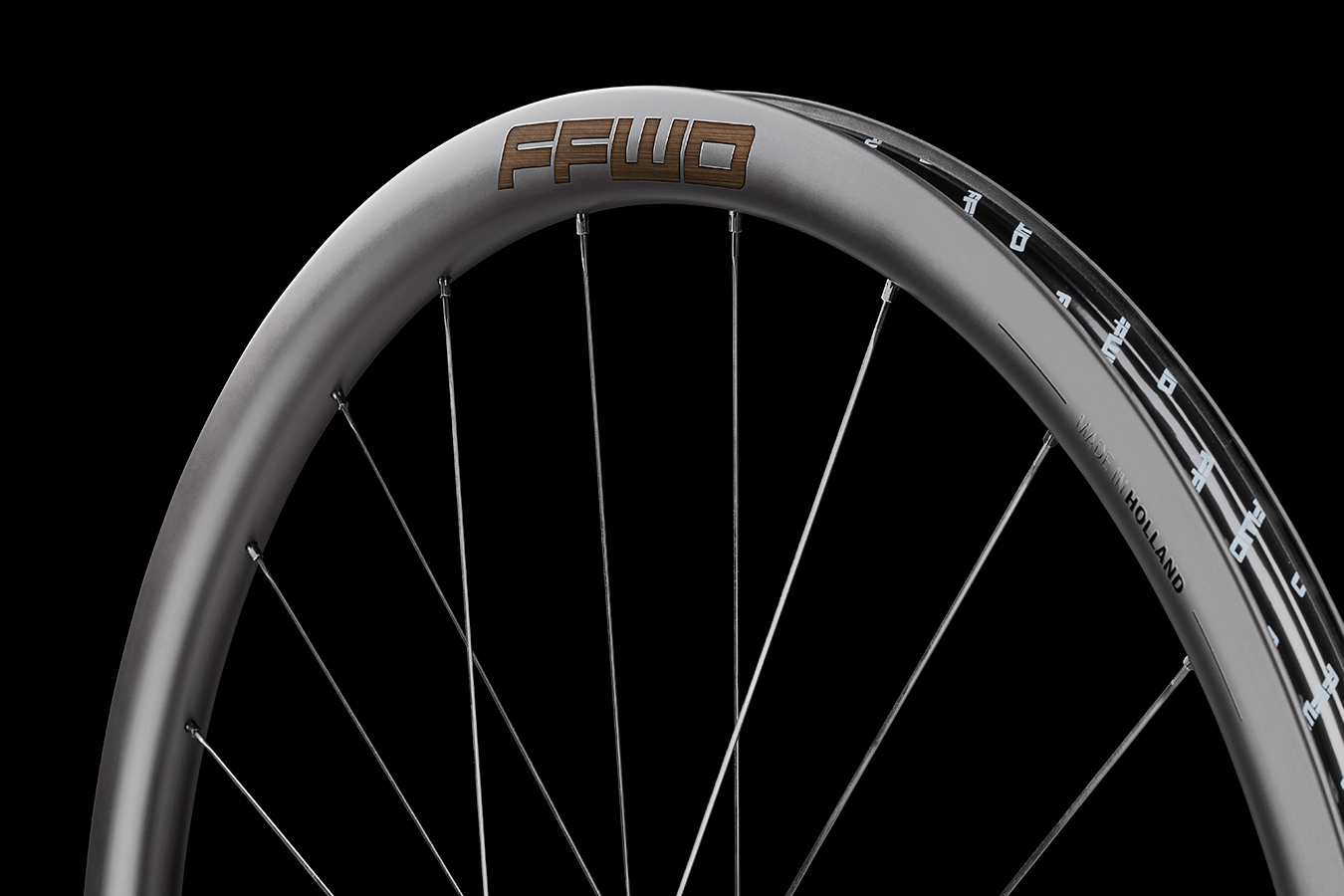
FFWD RYOT33
The Ryot 33 is the shallowest in the range, with 44, 55 and 77mm options also available. FFWD

Throughout, the hooked rims have been updated to 23mm wide internally (up from an already contemporary 21mm), which the brand says will help support wider tyres.

21mm is considered the optimal internal rim width on which to run 700x28c tyres by the ETRTO (European Tyre and Rim Technical Organisation), but with more riders opting to use even wider rubber, the width bump should future-proof these wheels. 

FFWD points specifically to the growing use of 30 and 32mm-wide tyres, and suggests riders using these widths will benefit from an improved shape.

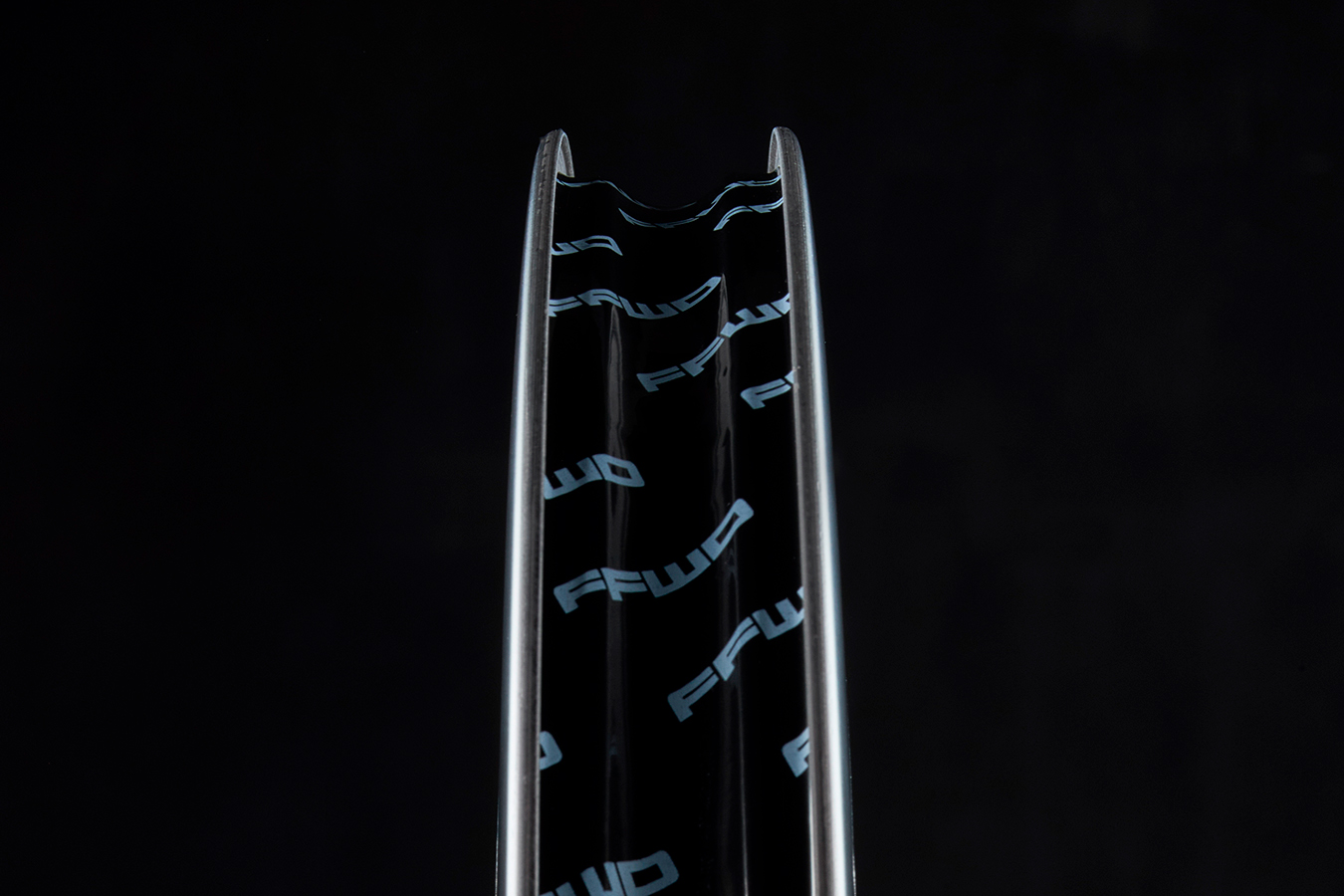
FFWD RYOT 23mm hooked rim
The internal channel is now progressive, rather than contemporary, at 23mm wide. FFWD

Externally, the Ryot 33 and 44 models are 30mm wide, and the deeper Ryot 55 and 77 rims are 31mm wide, as before. 

Despite the remodelling of the internal channel, FFWD says it has shaved an average of 100g from each of the wheelsets. It claims this was achieved mainly by applying the same carbon production techniques as used on the brand’s Raw wheelsets.

That said, it continues to use brass spoke nipples in the Ryot range – these are less prone to corrosion compared to alloy nipples, which are lighter. 

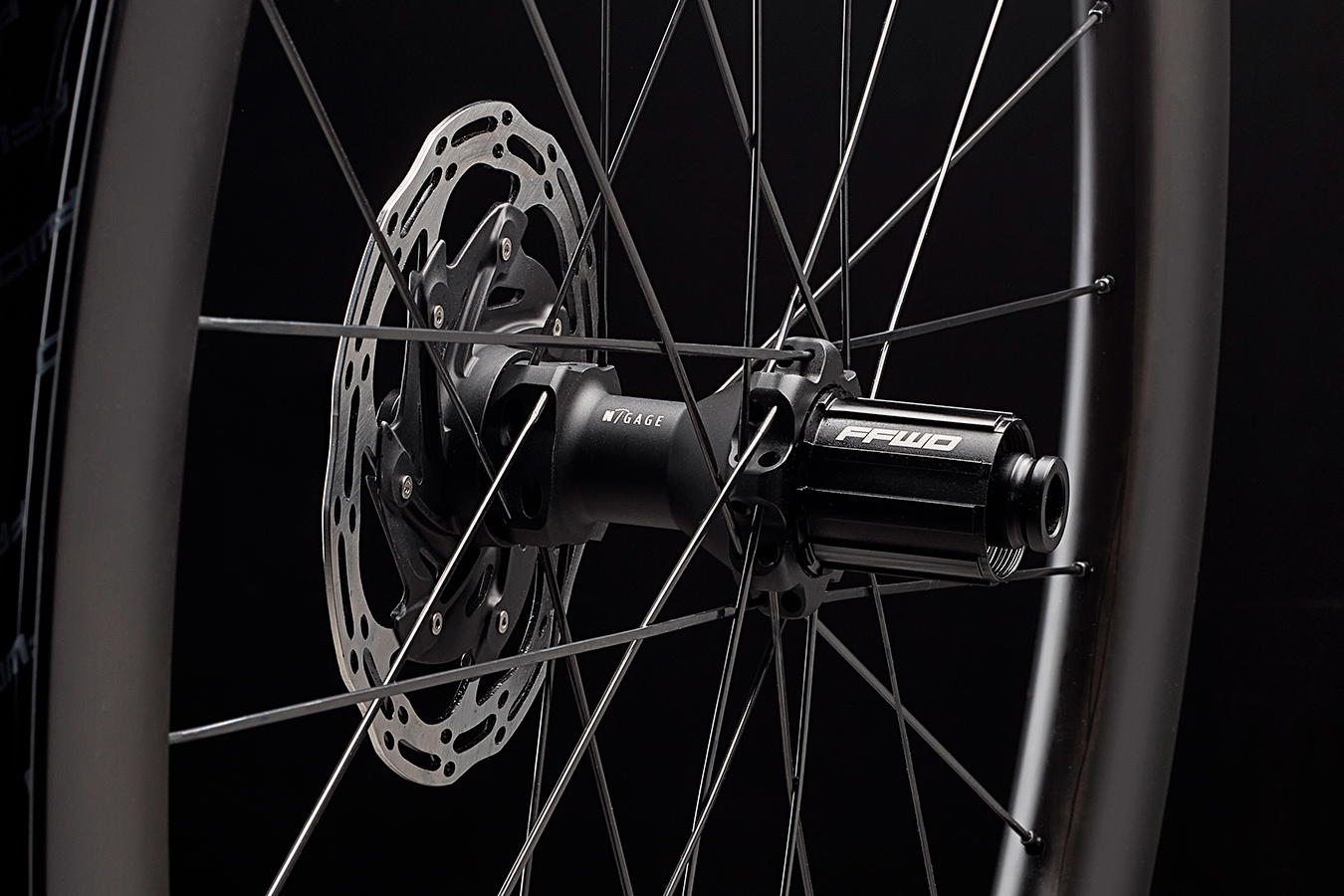
New N/Gage hub design

FFWD N/Gage rear hub
The N/Gage hub design project was focused on saving weight – the internals remain the same as FFWD’s old Two/One hubs. FFWD

No, this isn’t an unexpected revival of Nokia’s erstwhile gaming phone from the mid-2000s, but a new hub shell that replaces the outgoing Two/One design.

The internals remain the same, though, with 36t on a ratchet-based system yielding a 10-degree engagement angle. 

However, the hub shell has been redesigned to cut 50g in total across the front and rear hubs, while FFWD says it has improved the finish for greater durability, and employed a laser-etched logo in place of a standard decal (which can perish). 

FFWD 2025 wheelset comparison table
Even with the more expensive DT Swiss 240 EXP hubs specced, FFWD thinks the Ryot remains better value than other road bike wheels. FFWD

Despite this, FFWD continues to offer a DT Swiss 240 EXP hubset (as tested by Oscar Huckle in 2023) for a £250 / $300 / €300 premium.

It’s worth noting this premium has remained static too, like the standard-spec wheelset prices.

Top 5 Zwift Videos: Behind the Scenes of Zwift Academy, Indoor Cycling News, and The Big Spin

Now that the Zwift Academy 2024 winners have been announced, one Zwifter, namely Katie Kookaburra, can now share her inside look at the series. This week’s top video provides an interesting behind the scenes at the women’s Zwift Academy Finals!

Also included in this week’s top picks are videos about the latest indoor cycling news, The Big Spin, and the Zwift Ride sale.

My secret mission with PROs CANYON SRAM // Behind the scenes Zwift Academy!

Get an exclusive behind the scenes look at Zwift Academy from the one and only Katie Kookaburra.

Zwift and TrainerRoad Hug It Out?!

DCRainmaker and Desfit talk all things indoor cycling, including discussions on the new Zwift and TrainerRoad integration, smart bikes, and budget trainers.

Conquering Zwift’s Latest Challenge!

After hearing about the new BMX Bandit bike added for The Big Spin, Thomas Martinez, aka The Cycling Tattooist, rides The Big Spin and tries to get this coveted unlock.

Zwift Ride Sale has Arrived – 3 Reasons to Act Now + Extra Discount

ViveLeVelo discusses the new sale on the Zwift Ride and shares three reasons why you should purchase one.

Can I win the Zwift BMX Bandit First Try? | Stage 1 – The Zwift Big Spin 2025

After focusing most of her energy on running recently, Jessica Strange decides to switch things up and tackle stage 1 of The Big Spin.

Got a Great Zwift Video?

Share the link below and we may feature it in an upcoming post!

Woman Racer Spotlight: Alison Kerr

Name: Alison Kerr

Hometown: Glasgow, Scotland

How did you get into cycling? I used to run marathons and a friend said they thought I’d also be good on a bike, so when my ancient commuting bike needed replaced I bought a road bike in September 2019. But the traffic on the Glasgow roads I commuted on scared me, so the bike never got much use.

Fast forward to empty lockdown roads in April 2020 and I loved the freedom to escape the daily grind of lockdown/homeschooling/still working full time that the bike brought. I gained confidence on the bike and when traffic reappeared I held my road position and felt safe enough to ride IRL.

How many years have you been racing on Zwift? Since October 2020. I was concerned that lockdown would become a total lockdown/no leaving the house situation. So I bought a smart turbo in September 2020, discovered Zwift, and then the Zwift Riders Scotland team. I got utterly hooked on the social aspect, the ability to meet new people and make friends. Feeling like I was leaving the house mentally if not physically was a huge thing.

I saw a post about ZRL season 2 and took part with Zwift Riders Scotland January 2021 and loved racing as part of a team. It was perfect for childcare whilst my son was younger. I could still ride for several hours but be in the house, even helping him with homework and dictating spelling words at him to write down!

Are you part of a Virtual team? I’m in several and do different things with each. I now mainly ride WTRL TTT with Zwift Riders Scotland, I mainly race ZRL and some TTTs with Wahoo Esports ladies A, and love taking part in ladies team events, ZRL recons and mixed ladder with Level Velo.

What do you love most about racing? Racing in a team event. Especially cross category events where all categories add points. Knowing you are contributing to a team really makes me work harder. Hearing teammates’ voices as we ride makes me smile… although what the DS is telling me to do does not always make me smile! The friendly chat and banter in races is also great. Even in ladies A races, the riders can post jokes and have a laugh during it. Overall the Zwift racing world is an awesome, supportive community to be part of. 

What is your favourite style of race (e.g. points, scratch, iTT, TTT, Chase, duathlon)? I adore TTTs, knowing each pull you do helps, or even when you have given your all and just have to sit in and be part of the momentum. I think it is because I’m calmer, knowing none of my teammates are actively trying to drop me, not like in a standard race where competitors are. I can simply focus on my rotations and pulls. 

What is your favourite Zwift women’s race series? Current active series has to be Tour de Boudicca, Karla and the Warrior Games do so much to encourage all categories of ladies to try their hardest and push themselves to discover just what they can achieve whilst being in a super supportive setting. When Zwift Riders Scotland had no other A cat ladies able to take part, Karla helped find me a team for 2 years in a row. That’s how I first met Mim and some of the Level Velo ladies.

What is your most memorable racing experience, inside or outside or BOTH? In a Herd ladies series from back in 2021 I was dropped on the Legsnapper alongside one other rider I did not know. We gave each other a thumbs up and 2-up TT’d it to the finish line. We commented on each other’s activities in the app and that was the start of a hugely supportive friendship with my wonderful friend Bella (of the inspiring SeekTravelRide podcast) whom I’ve been lucky enough to visit twice in the Pyrenees and ride IRL.

She introduced me to other brilliant female riders Kirsty and Brandi, and for 4 years we’ve been a wonderful virtual and IRL support to each other despite us at times being in Oregon, Australia and UK. All from working with an unknown rider after getting dropped in a race. I don’t have a memorable outside race experience… yet. My 2025 resolution was to try an IRL race and I’ve just signed up to a hilly irl iTT in Scotland in March.

What is your favourite food to eat post race? Tuesday night is burger night in our house, so post ZRL it is usually a burger.

What advice would you give to a woman entering her first Zwift race? Message to say hi/good luck in the pen and I bet others reply to you and just that wee act will make you feel part of a community. Don’t be nervous, it is just 1 race, there are plenty of different styles of them on plenty of different types of routes. I’m sure you’ll find one that you enjoy. 

Any upcoming race you are looking forward to? The Rhino team have a really interesting mixed gender 2-up TT race starting in March. And I really, really hope that Herd do their “no spring chicken” race series March/April again. They held it last year with a ladies category and I adored the fact that my added years gave me some sort of bonus/payback.

Learn About Upcoming Frame and Wheelset Performance Changes on Zwift

Early one morning back in October 2024, I drove down to Morgan Hill, California to join a small team from Zwift at the Specialized Win Tunnel. The goal? To spend two days testing various frames and wheelsets in the tunnel in order to establish a realistic delta between the slowest and fastest frames and wheels in Zwift.

You can read all about our tunnel time if you’d like, but you’ll get to experience the result of those tests soon enough: Zwift is rolling out performance changes to frames and wheels in next week’s big update!

Zwift Insider has published mountains of speed tests over the years, so Zwift was nice enough to send over a pre-release game build that allowed us to run our standard tests and publish the results a few days before the release. That’s the post you’re reading now. Let’s dive in!

Why the Change?

Zwifters might wonder: why tweak the performance of all the frames and wheels now, 10+ years into the Zwift journey? It’s a fair question. There are two key reasons why this is happening now:

  1. Those wind tunnel tests in October showed that the aero performance delta between the slowest and fastest road frames on Zwift was too small, while the delta between the slowest and fastest wheels was too large. This change will make the universe of bikes perform more in line with real-world physics (more on this below).
  2. With the Bike Upgrades feature releasing soon, Zwift’s game team wanted to make sure they avoided the unrealistic situation of an upgraded slow frame like the Zwift Steel outperforming a fast frame like the Specialized Venge S-Works.

With that out of the way, let’s dive into fresh speed test data for all the road bike frames in Zwift. (We’ll publish separate posts about TT, mountain, and gravel frames in the near future.)

Test Methodology Notes

The following results are from tests done using our standard parameters: a 75kg rider, 183cm tall, without drafting, riding at 300 watts (4 W/kg) steady. If you ride at lower power (and most do!), the time gaps you’ll experience between different frames and wheels will typically be larger than what is shown below.

Flat tests were done on Watopia’s Tempus Fugit since it’s Zwift’s flattest route, while Climbing tests were done on Alpe du Zwift since it’s a long-steady climb.

If you’re interested in comparing these new performance numbers to what’s currently in game, check out our Frame and Wheel data chart pages.

Lastly, an important note about the accuracy of these results. While we present time data with tenths-of-a-second precision, it’s important to understand there is a 1-second margin of error in these results, so it’s probably not worth obsessing over fractional seconds.

Frame Performance Data

Time Savings Over 1 Hour

How many seconds does a frame save over an hour of riding compared to the basic Zwift Carbon frame? (Astute observers may notice that this is a different way of presenting data than our old style of simply displaying raw test results. We think showing the 1-hour time gap is more intuitive.)

Charts are sorted from the best-performing frames to the worst, and you can sort based on flat performance or climb performance.

Sort Chart By:

Flat Performance
Climb Performance

The following bikes are not included in this chart, because they performed worse than the baseline Zwift Carbon frame: Zwift Steel, Zwift Safety, Zwift Atomic Cruiser, Zwift Buffalo Fahrrad.

The following bikes are not included in this chart, because they performed significantly worse than the baseline Zwift Carbon frame: Zwift Steel, Zwift Safety, Zwift Atomic Cruiser, Zwift Buffalo Fahrrad.

Stacked Percentile Rank

This format lets you easily see how frames comparatively perform across both flats and climb. This is useful for selecting the best bike frame for a given race course.

Frame Changes Summarized

The difference between basic and fast frames has increased dramatically in our flat tests with this performance update. Previously (see data here) the fastest frames gained around 19 seconds spread out over an hour. Now, they gain around 75 seconds!

This isn’t because the most aero frames have gotten faster. Rather, Zwift kept the fast frames around the same performance level, but slowed down the mid-range and slower frames.

The performance gap between the basic and best climbing frames, on the other hand, has narrowed a bit. The fastest climbers used to gain about 70 seconds over an hour of climbing, but now they gain 54 seconds.

While most frames didn’t move dramatically in terms of percentile ranking, you may notice a few that did. Two of these are especially notable:

  • The Specialized Tarmac SL7 is now a much faster climber, in keeping with the frame’s real-world performance
  • The Uranium Nuclear has dropped out of the “fast four” grouping of top aero frames

Wheel Performance Data

Time Savings Over 1 Hour

How many seconds does a wheelset save over an hour of riding compared to the basic Zwift 32mm Carbon wheels?

Charts are sorted from the best-performing wheels to the worst, and you can sort based on flat performance or climb performance.

Sort Chart By:

Flat Performance
Climb Performance

Stacked Percentile Rank

This format lets you easily see how wheels comparatively perform across both flats and climb. This is useful for selecting the best wheelset for a given race course.

Wheel Changes Summarized

In terms of aero performance, the difference between basic and fast wheels has narrowed a bit, from around 72 seconds over an hour (see previous data) to 52 seconds. One big reason for this is Zwift’s new treatment of disc wheels on road bikes, which leads to an interesting performance change you can’t easily spot in the charts above.

Zwift has decided to make all disc wheelsets perform worse on road bikes than they do on TT bikes. They’re still pretty fast on road bikes, as long as climbing isn’t involved. But they are faster on TT bikes. (We’ll unpack this more in future posts.) It’s Zwift’s way of encouraging roadies to use more traditional wheels, while leaving the discs to the time trialists. As it should be.

When it comes to climbing, the difference between basic and fast climbing wheels has halved, from around 16 seconds over an hour to just 8. Zwift has adjusted wheelset weights based on manufacturer’s specifications, so this time gap should be a better reflection of what you’d see IRL.

While most wheels didn’t move dramatically in terms of percentile ranking, you may notice a few that did. Here are the wheelsets we caught that moved up in rank significantly (winners) and down (losers):

  • Winners:
    • Mavic Cosmic Ultimate UST
    • ROVAL CLX64
    • ENVE SES 6.7
    • Shimano C40
    • Shimano C60
    • Zwift Tri Spoke
  • Losers:
    • DTSwiss ARC 62

Price Changes

Next week’s big update includes a raft of price changes, and most of those are price increases. Frame prices are holding steady for the most part, but many wheelsets are going up in price.

So if you’ve had your eye on a particular wheelset, you may want to purchase it now – especially if its performance looks strong in the updated charts above.

(On the other hand, there are some new, fast frames being released next week. So you may just want to hold onto your Drops!)

Wrapping It Up

Whew… that’s a lot to digest, right?

There are two things I like about these performance changes. First, I like that we have several high-end bikes to choose from, and their performance varies just enough to make it interesting. Zwift clearly doesn’t want “one bike to rule them all,” and these changes show that.

Secondly, I love that the performance of in-game frames and wheels was modified based on the results of the team’s findings at the Win Tunnel. That means Zwift frames and wheels are performing more in line with their IRL counterparts, which I think is generally what Zwifters want to experience.

We’ll be working on additional posts that dig into the performance of top racing frames and wheels (including their comparison to the Tron bike) in the coming days. Stay tuned, because there’s a lot of news just up the road in regards to bike performance and upgrades.

Questions or Comments?

What do you think of all these performance changes? Got questions or comments? Share below!