In 2024, Tadej Pogačar won both the Giro d’Italia and the Tour de France, joining Fausto Coppi and Eddy Merckx among only eight male riders and Annemiek van Vleuten as the only female rider to complete the feat.
Prior to Pogačar‘s Giro-Tour double, this hadn’t been achieved since Marco Pantani in 1998 and no one has ever won the Giro, Tour and Vuelta a España in the same year.
Pogačar went on to win the World Championship, cementing his place alongside Merckx, Stephen Roche and van Vleuten as one of four riders to win cycling’s triple crown in a single season.
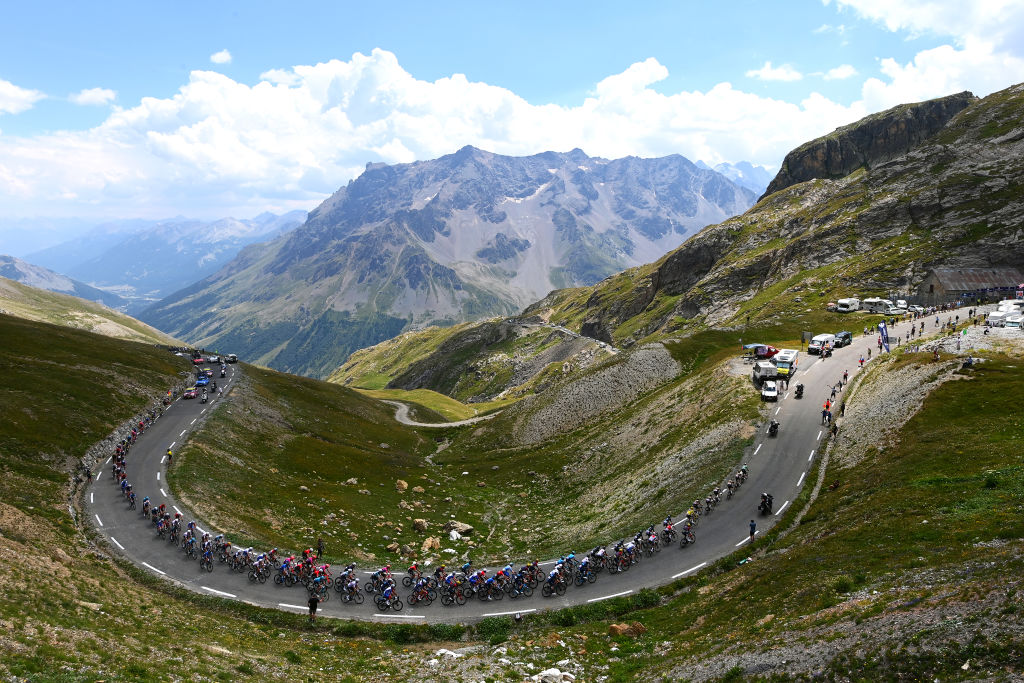
The high energy output needed to complete the Tour de France may not be sustainable over longer periods. Tim de Waele / Getty Images
A new study by a team of North American researchers published in Current Biologypossibly helps to explain why it’s so difficult to sustain the high energy expenditure needed to win multiple grand tours in a season.
Their study suggests that there’s a metabolic ceiling that limits the maximum sustainable rate of calorific expenditure over longer periods to around 2.5-times basal metabolic rate, which is how many calories you need to burn just to keep the lights on.
The research, reported in Scientific American magazine, looked at the metabolic output of 12 male and two female, mostly professional, elite ultramarathon runners, triathletes and cyclists, finding that they could burn as many as 11,000 calories in a day. But the researchers found that there was a limit to how long they could sustain this level of energy expenditure.
Riders in the Tour can be burning up to five times as many calories as at rest. Getty Images
Previous studies have looked at cyclists in the Tour de France and found that over the 23 days of the race they were expending between four and five times their basal metabolic rate. In shorter races such as ultramarathons and Iron Man triathlons, athletes have been found to reach close to ten times their basal metabolic rate.
The new research supports the hypothesis that, although elite athletes can sustain very high metabolic rates over shorter periods, over durations of 30 weeks or more their calorie burn cannot exceed 2.5 times their basal metabolic rate.
That equates to around 3,750 calories per day in a fit 70kg athlete.
In the study, athletes were asked to drink double-labelled water, which contains heavier, non-radioactive isotopes of hydrogen and oxygen. Testing how quickly this is passed into urine allows the calculation of how fast food is being metabolised to produce energy.
The study results indicated that, although participants could reach up to seven times their basal metabolic rate during races, over a 30 week period, their metabolic rates fell to 2.5 times their basal rate or less.
Riding a grand tour has pay-backs that take time to recover from. Tim De Waele
Scientific American quotes evolutionary biologist Amanda McGrosky of Elon University in North Carolina, who says that there’s evidence that intense physical activity has pay-backs including a slowing of digestion, lowered immunity and temporary shrinkage of brain tissue, as well as lowered sexual arousal.
The root cause of the putative limit is not clear. There’s a suggestion that it may be related to a limit in the body’s digestion and nutrient absorption, but it’s something that it’s thought possible could be exceeded thanks to advances in modern sports nutrition.
For now, the research suggests that it’s very hard to peak for two three-week grand tours in a season, let alone three, and may help explain why Pogačar‘s main priority after winning the 2025 Tour de France was a well-deserved rest, even if he did bounce back to win the World Championships for a third time eight weeks later.
The US Consumer Product Safety Commission issued a warning linking some Rad Power Bikes electric bike batteries to fires, stating they “pose a risk of serious injury and death”.
The batteries can “unexpectedly ignite and explode” especially when the battery or the harness has been exposed to water or debris, according to the CPSC, adding that it is aware of 31 reports of fire, including 12 reports of property damage totalling approximately $734,500.
The CPSC says: “Some of these incidents occurred when the battery was not charging, the product was not in use, and the product was in storage.”
Rad Power Bikes issued a statement in response to the CPSC’s warning, refuting the claims and stating that it “firmly stands behind” its batteries.
The CPSC says the affected batteries were sold with the following Rad Power Bikes electric bikes:
RadWagon 4
RadCity HS 4
RadRover High Step 5
RadCity Step Thru 3
RadRover Step Thru 1
RadRunner 2
RadRunner 1
Radrunner Plus
RadExpand 5
The batteries were also sold as replacement models. They have the battery model number HL-RP-S1304 or RP-1304, which is printed on a label on the back or rear of the ebike battery.
CPSC urges consumers to remove the battery from the electric bike and dispose of the battery following local hazardous waste disposal procedures. “Do not sell or give away these hazardous batteries,” it adds.
Rad Power Bikes has refused to agree to a recall and is unable to offer replacement batteries or refunds due to its financial situation.
The Seattle-based company filed a Work Adjustment and Retraining Notification with the Washington state regulators just last week, as part of an “advance written notice of a potential cessation of operations that could occur as early as January 2026,” a spokesperson told Geekwire.
The shutdown would affect 64 jobs at the company’s headquarters, including the CEO and CFO, but Rad Power Bikes said no final decision has been made and that it is seeking buyers and investors to continue operating.
In its statement in response to the CPSC warning, Rad Power Bikes said: “Reputable, independent third-party labs tested Rad’s batteries, both as part of our typical product testing and again during the CPSC investigation, and confirmed compliance with the highest industry standards. Our understanding is that the CPSC does not dispute the conclusions of these tests. It is also our understanding that the battery itself was not independently examined per industry-accepted test standards.”
“The incident rate associated with the batteries in the CPSC’s notice is a fraction of one per cent. While that number is low, we know even one incident is one too many, and we are heartbroken by any report involving our products.
“It is also widely understood that all lithium-ion batteries – whether in ebikes, e-scooters, laptops, or power tools – can pose a fire risk if damaged, improperly charged, exposed to excess moisture, subjected to extreme temperatures or improper modifications to the electrical components, all of which Rad repeatedly advises against in user manuals and customer safety guides. Contrary to the CPSC’s statement, mere exposure to water and debris does not create a hazard; rather, significant water exposure, as warned against in our manuals, can pose a hazard,” the statement continued.
If there’s anything my time on Zwift has taught me, it’s that trying to pedal while juggling a keyboard and mouse is awkward. A while back, I picked up a Stream Deck hoping for a better way to interact with Zwift, and I haven’t looked back since.
For the unfamiliar, the Elgato Stream Deck is a customizable set of programmable macro buttons that comes in several sizes. Since adding it to my setup, my keyboard and mouse have been collecting dust. It’s been a game-changer for convenience, immersion, and overall enjoyment.
What’s Wrong With the Usual Setup
As a frequent racer, group rider, and occasional ride leader, there’s always a lot happening during a ride. For what the Companion App does, it does well, but it doesn’t do much. Keyboard shortcuts help a bit but are still limited. And using a mouse or trackball? Forget it. Unless you’re willing to stop pedaling, you’re not clicking anything.
That just covers Zwift. If you’re also managing music, voice chat, or other apps, you can quickly find yourself off the back.
For me, the Stream Deck solved all of these problems. It gives me control of Zwift and every other app I need from one interface, all at the push of a button… or several. Between its built-in functionality and the add-ons available through the Elgato Marketplace, the possibilities are practically endless.
Making Zwift Control Effortless
Before diving into the cool functionality I’ve uncovered, I want to give a quick shout-out to a few developers whose tools have been key to my setup:
While I’ve done some fun customization with my deck, it’s people like this who have the real skills and are providing genuine benefits to the Zwift community.
With that out of the way, here are the controls I’ve found most useful:
Ride Controls – Directional arrows, select, back, Ride On (including a continuous “Ride On bomb”), powerup, U-turn, skip workout block, and a camera toggle for TTT events.
Communications – Push-to-talk for Discord (no more heavy breathing into the mic), Spotify controls, and in-game chat using voice input.
Ride Leader Controls – Announcements at the start of a ride, a random dad-joke generator, and route info pulled dynamically from the Sauce API.
Sauce Controls – Lap button, toggle windows on/off, and change profiles.
System Controls – Launch Zwift (one button starts all apps and logs in), shut down PC, reload apps, and access my audio mixer so I can play music during team events without drowning out voice chat.
Below are a few screenshots of how I have my primary pages configured. It’s not perfect, a bit of a mess of subfolders, but with time and muscle memory, I’ve made it work. For something that works well right out of the box, the Zwift Stream Deck profile (linked above) is an excellent starting point that will get you 95% of the way there.
My primary Stream Deck pages:
I’m sure there’s still plenty of potential I haven’t unlocked yet. The Sauce API is easy to work with and opens up tons of possibilities. With a few simple scripts, it’s possible to pull in and use ride data creatively, something I’d like to spend more time exploring.
As great as it is, there are still a few things the Stream Deck can’t quite handle. Pressing buttons within the Zwift interface is… well, a bit meh. There aren’t hotkeys for common actions like joining events or ending a ride, which I’ve tried to work around with macros, with limited success. I’ve mostly resigned to navigating the UI manually.
There’s also no steering, shifting, or braking like the Zwift Click or Play controllers offer. While the deck wouldn’t be ideal for those functions, it would definitely be a neat alternative.
Why I Can’t Ride Without It Now
After more than a year of using it full-time as my only way to control Zwift, I don’t think there’s any going back. Once I fine-tuned my layout and built the exact functions I needed, the experience just clicked. Now everything feels natural… smooth, consistent, and ready for any kind of ride.
The biggest difference is how it lets me stay focused on the ride instead of fumbling for the right key. It doesn’t necessarily make me faster, but it does make Zwift feel more immersive, like I’ve found a hidden upgrade most people overlook. At this point, it’s as essential to my setup as my trainer or fan.
Going Beyond the Basics
Even after all this time, I’m still finding new ways the Stream Deck could evolve with Zwift. I haven’t yet tried PedalGames, an add-on that ties gameplay elements to ride data, but there’s a lot of potential there. Being able to trigger in-game actions or mini-game events directly from the Stream Deck could make for a fun and interactive experience. It’s on my list to explore when I have some tinkering time.
That said, the Stream Deck isn’t exactly cheap. Between the hardware cost, time investment, and a bit of technical know-how, it’s not for everyone. If you’re curious but hesitant to spend the money, there are a few alternatives worth considering:
Stream Deck Mobile– Elgato’s app version gives you nearly all the same functionality on your phone or tablet. It’s freemium, and the free tier is great for testing.
Touch Portal or Deckboard – Software alternatives for phones or tablets that offer similar customization, often for free or a small one-time cost.
Alternative hardware decks – Off-brand macro pads can offer much of the same functionality. They’re a bit more DIY but great if you want physical buttons on a budget.
No matter which route you take, the key is finding something that reduces friction between you and the ride. There are plenty of approaches depending on your setup, budget, and how much you like to experiment.
Final Thoughts from the Pain Cave
Looking back, this little project has become one of my favorite tweaks to my Zwift setup. What started as curiosity has turned into something I now use every single ride without even thinking about it. The Stream Deck might not make me faster, but it makes every session smoother, more immersive, and more fun.
It’s not a perfect solution, and it’s definitely not the cheapest, but for anyone who enjoys tinkering, automating, or just personalizing their indoor setup, it’s hard to beat. The best part is that it grows with you: whether you’re just using it to launch Zwift or diving deep into APIs and scripting, there’s always something new to try.
Anything that helps you spend less time fiddling with menus and more time riding is a win. And for me, that’s exactly what this setup delivers.
What About You?
Do you use Stream Deck with Zwift? What are your favorite features? Got questions? Comment below!
Gobik has released the Superarmour, a thermal jacket designed to take on the coldest days.
The cycling jacket is claimed to keep you warm on rides where temperatures go as low as -8º, with an operating window that sees a maximum of 7º.
That’s a pretty narrow operating window, and it is clearly a specialist option, but it could be a good option for those who’d rather brave black ice than suffer an hour on an indoor trainer.
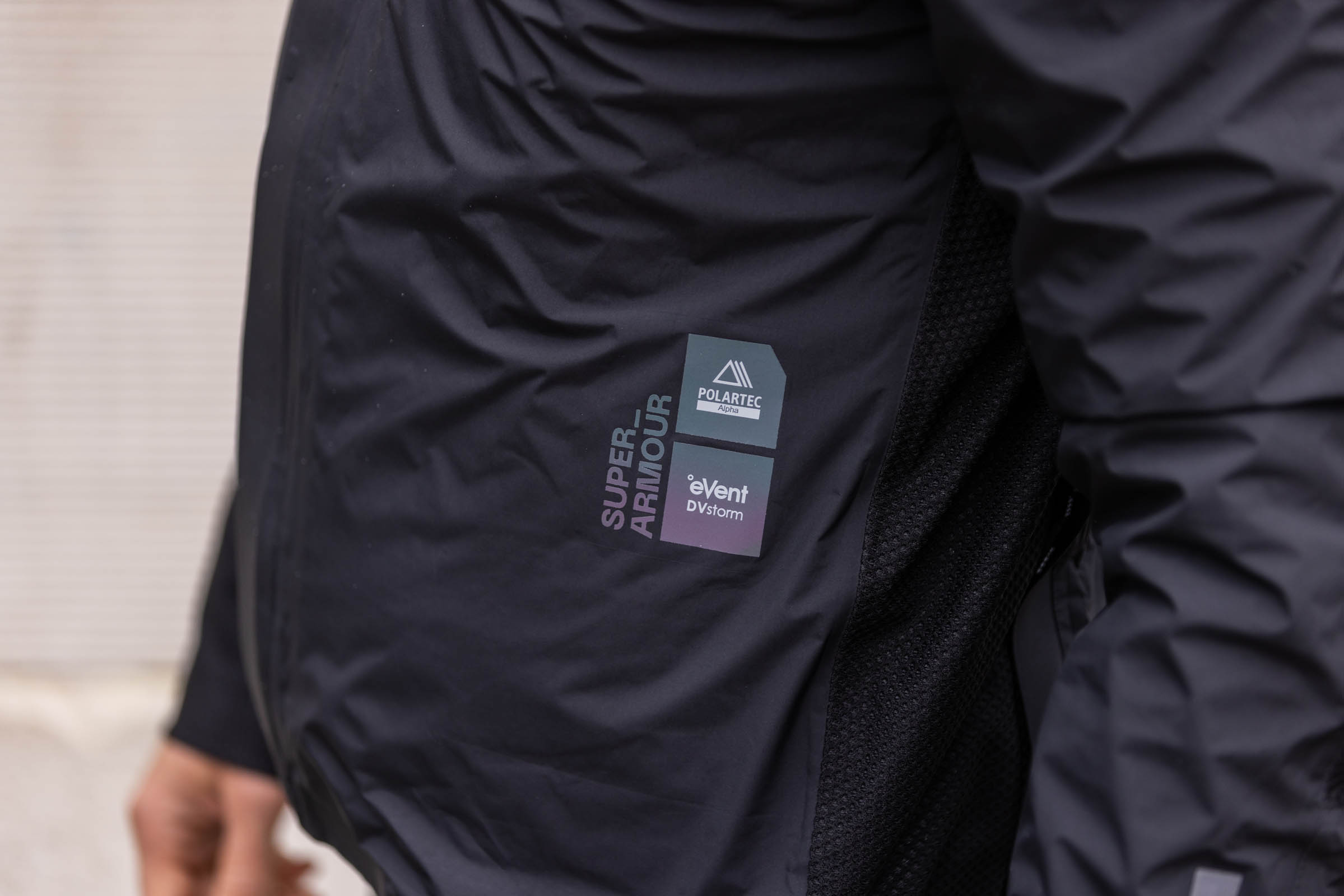
Its construction combines the eVent DVstorm membrane with Polartec Alpha thermal insulation. Together, Gobik claims these offer exceptional performance in cold and wet conditions.
All this protection doesn’t come cheap, however, with the jacket priced at €395.
Cold killing insulation
The Superarmour proudly displays its technologies on the outside. Scott Windsor / Our Media
The jacket’s eVent DVstorm membrane and fully taped seams offer a claimed waterproof rating of 10,000mm. To avoid overheating, the jacket also has a breathability rating of 20.000 g/m2/24h – you shouldn’t boil in the bag should the weather brighten up.
The material looks warm on fuzzy, but shouldn’t get clammy thanks to hydrophobic fibres. Scott Windsor / Our Media
On the inside of the jacket, Gobik has used Polartec’s Alpha insulation to keep things toasty and breathable.
The material features an open-fibre construction that enables airflow under the shell, which should keep things from getting clammy.
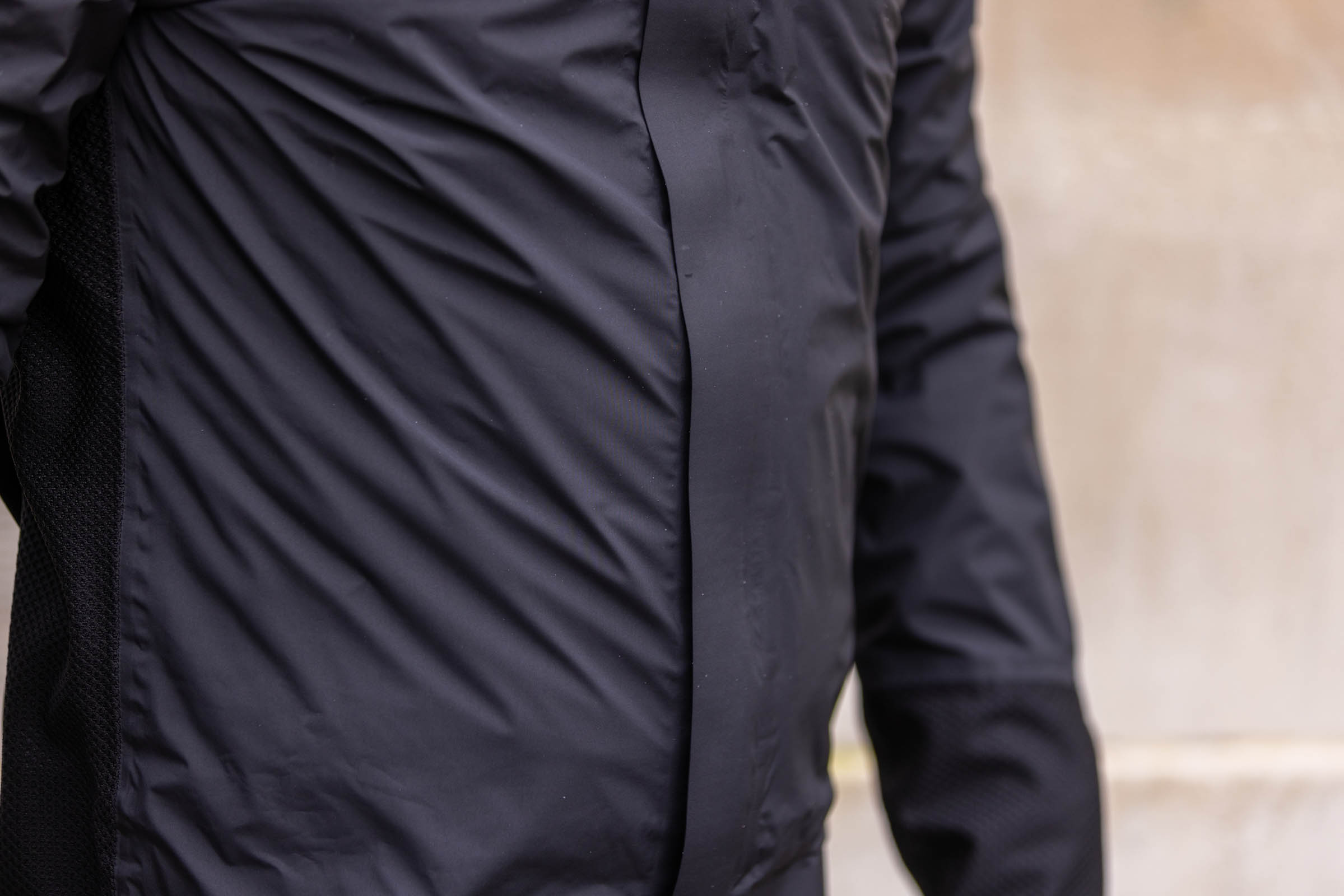
Alongside the Vision AquaGuard zipper, a heavy-duty placket is used to stop winds from entering the jacket. Scott Windsor / Our Media
In line with the premium construction materials, Gobik has used YKK’s Vision AquaGuard for the zipper.
This should stop any water from penetrating through the zip, as well as fending off cold winds.
There is also a magnetic storm flap at the collar, preventing any irritation from the zipper.
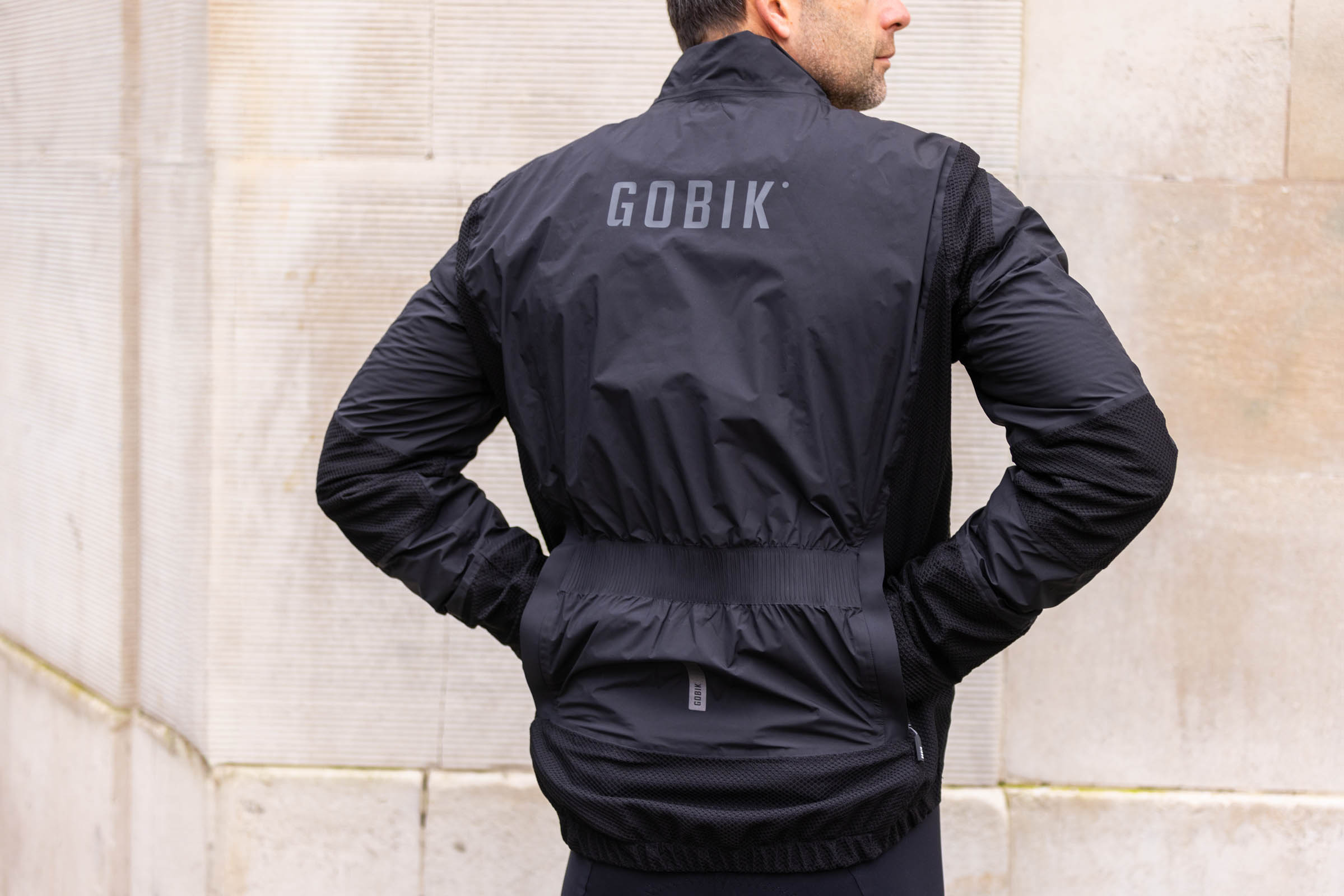
Zips are used on the rear pockets, so your belongings should stay put, however bumpy the road is. Scott Windsor / Our Media
At the back, there are two large zippered openings integrated for easy access to the interior pockets, even with gloves.
Inside, there are two mesh pockets to keep items safe from the elements.
Priced at €395, it’s definitely at the premium end of the market, though inline with other specialist options from similar brands.
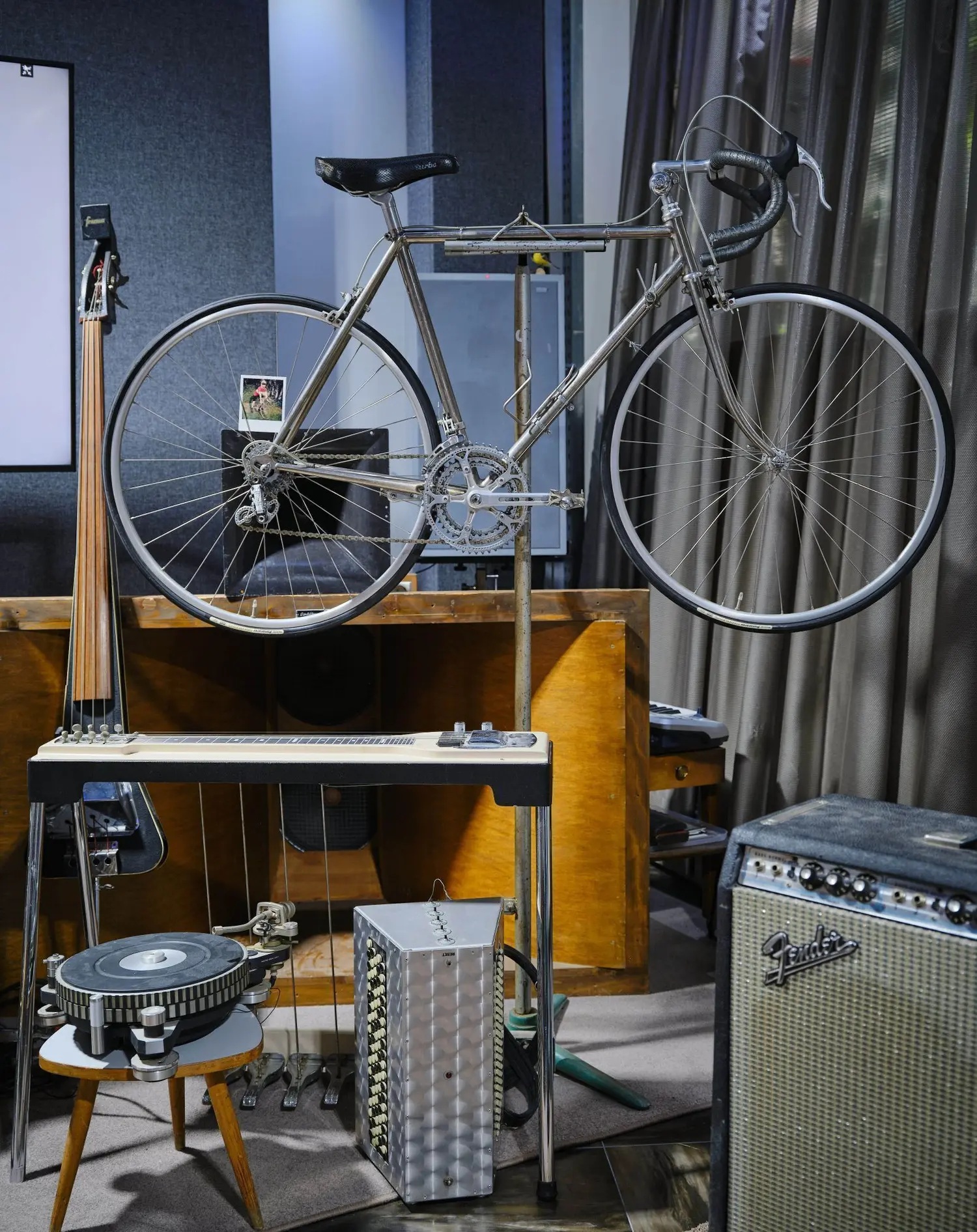
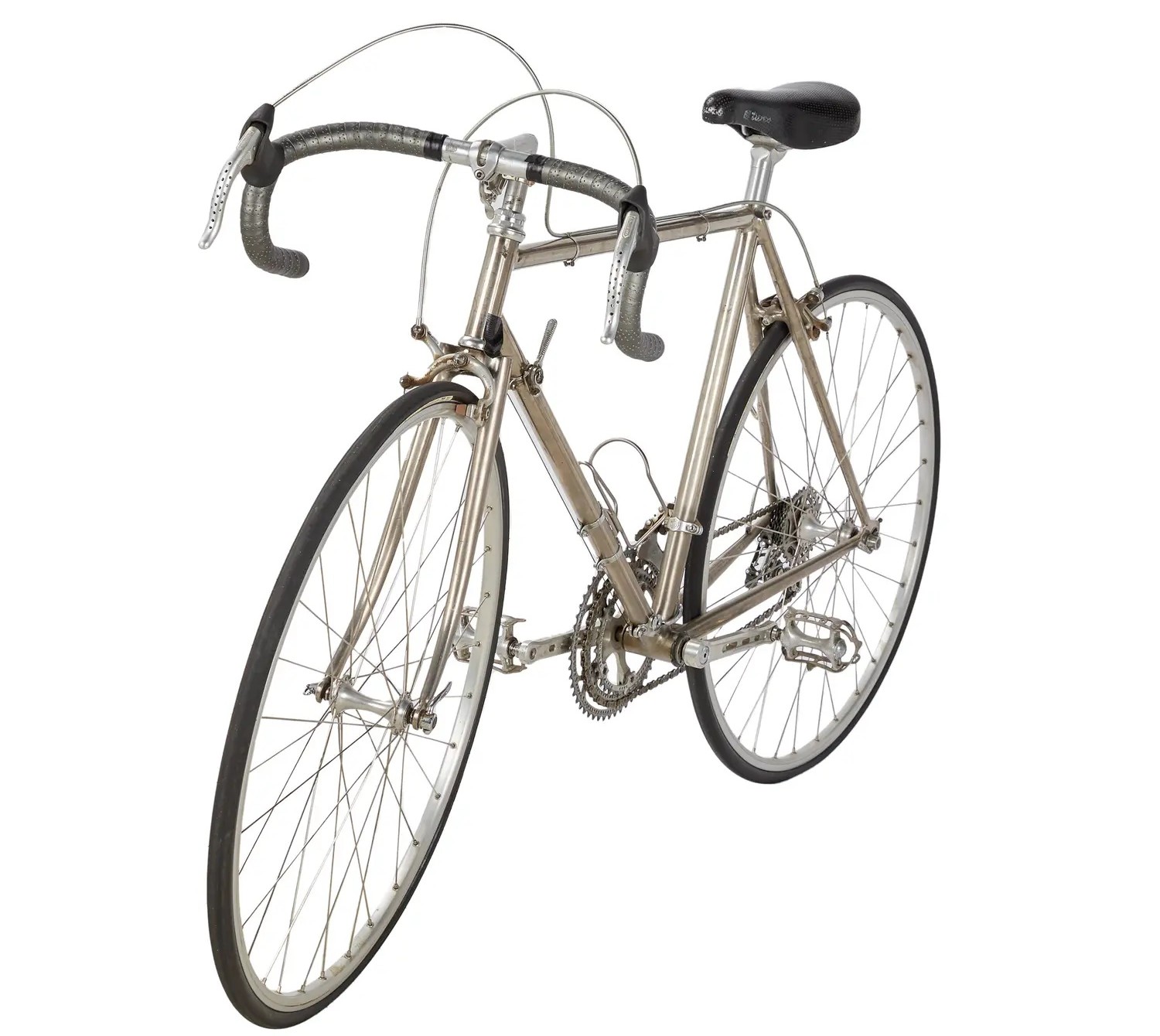
The titanium Speedwell bike ridden by Florian Schneider in Kraftwerk’s 1984 video for the band’s Tour de France remix has been sold at auction, fetching $57,600, a price that would net you three modern top-tier road bikes.
The lot was one of several possessions previously belonging to Schneider, who died in 2020, recently sold by Julien’s Auctions.
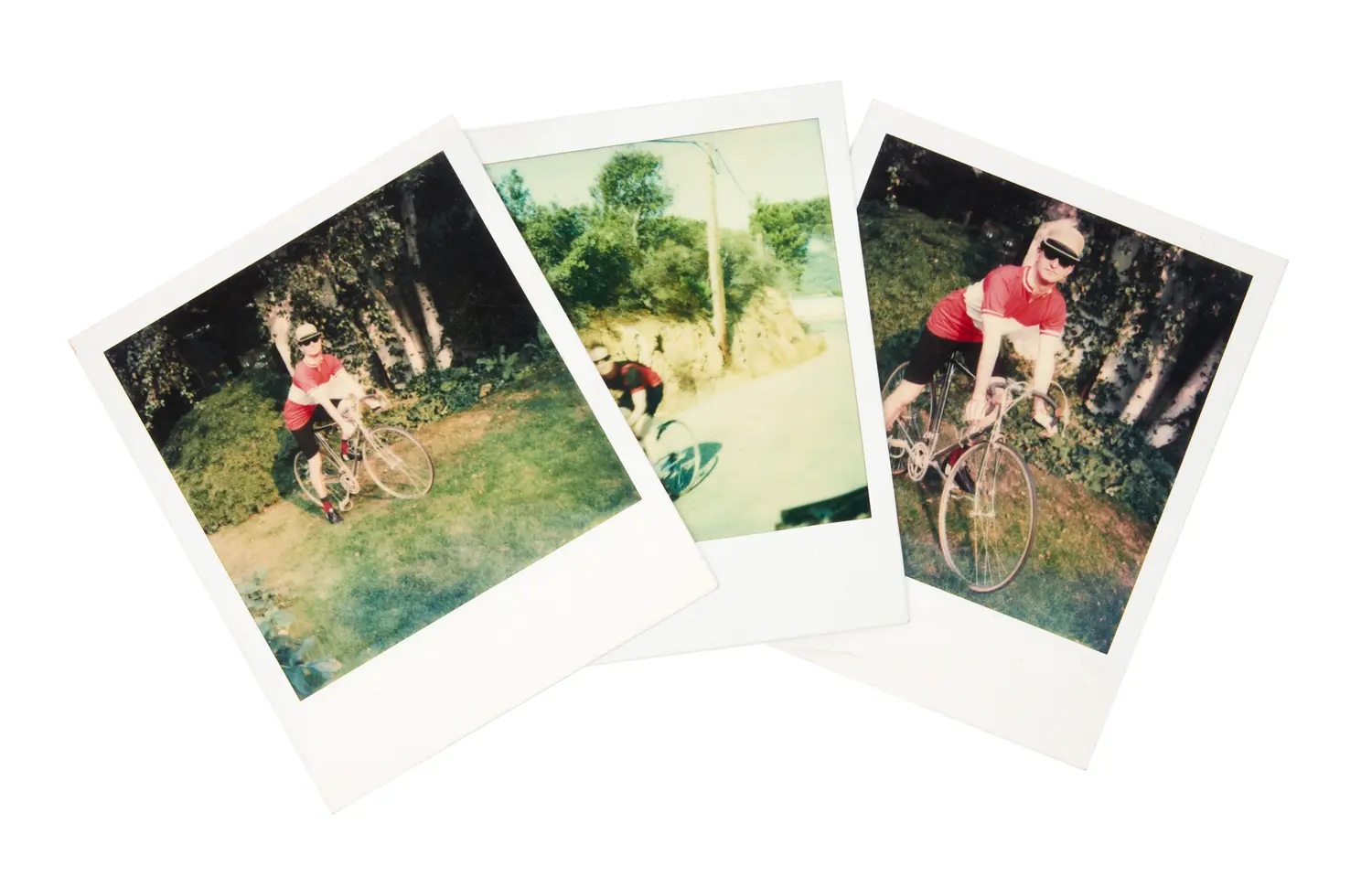
The bike was listed with an estimate of $4,000 to $6,000, so the $57,600 sold price (plus 28 per cent buyer’s premium) is a huge sum. A bike stand and three Polaroid photos of Schneider riding the bike were part of the lot.
The lot included three Polaroid photos of Schneider riding the bike.
While the original 1983 video for Tour de France featured shots of the race, Kraftwerk’s remix video shows the group’s four members in cycling on the flat around their native Düsseldorf.
The bike formed one of several lots of possessions of the late Schneider.
The all-silver titanium bike has had the Drillium treatment, with its triple chainrings and rear derailleur cage riddled with holes to reduce their weight.
While most of the groupset looks to be original, including the slightly perished lever hoods, the handlebars have been retaped and the intact-looking Panaracer tyres, new cables and Crane bell suggest that the bike may have been ridden more recently than 1984.
Kraftwerk’s Tour de France continues to be an inspiration for cyclists, with a Kraftwerk themed Canyon time trial bike designed by the band’s Ralf Hütter ridden by Tony Martin at the Tour’s Grand Départ from Düsseldorf in 2017.
Zwift Camp: Build is now underway. This is a 5-stage route-based workout series, with each stage lasting one week and focusing on developing power over a specific time interval.
My plan is to do each of the five workouts before their weeks begin, so I can write a post unpacking the workout and delivering some tips along the way. This post covers Stage 3’s workout on Watopia’s new Hot Laps route. Let’s roll!
Once again, I pulled the 7-Eleven bike out for this session…
Stage 3 Walkthrough: Chase Your Rival
The third stage of Zwift Camp: Build is focused on “Three 5-minute efforts” according to the event description. But it’s probably not laid out how you’d expect!
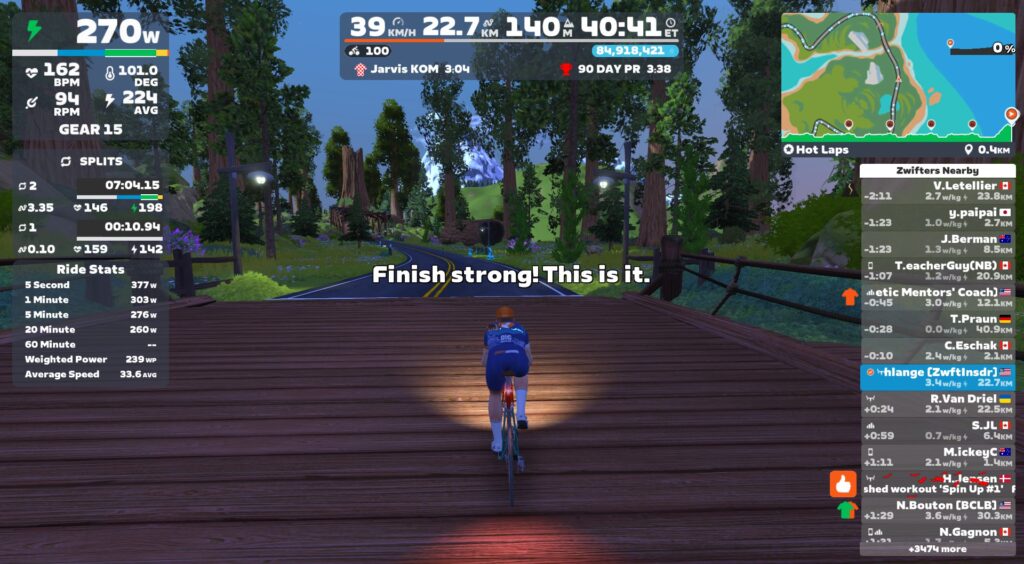
The stage is built around the new Hot Laps route in Watopia, which takes riders on 4 full laps of the Volcano Circuit, followed by a finish up the Jarvis KOM:
Follow the instructions on screen and you’ll use the first lap as a warmup and a bit of recon, learning where that little kicker is at, where you can recover a bit on descents, etc. The instructions have you begin your effort in earnest at the start of the second lap, and there are really two stated goals here:
Put in a hard, steady effort on laps 2, 3, and 4 while also
Negative splitting your lap times (that is, going faster each lap)
So you don’t want to start off with a maximal effort on lap 2, because you won’t be able to beat that effort the next lap!
My legs were tired from a metric century the day before, so I just targeted power numbers I knew I could hold:
Lap 2: 250W
Lap 3: 260W
Lap 4: 270W
I also kept an eye on my previous effort HoloReplay, making sure I beat him each lap.
You might think it would be hard to manage your power well enough to precisely hit power targets, but thanks to the average power number on the Splits HUD, I found it pretty easy. I was bang on my target for laps 2 and 3, then pushed extra hard on lap 4 just because I could, coming in a few watts above my 270W target.
What power targets should you shoot for? You won’t be able to hold true VO2 max power for three continuous laps, but if your legs are fresh, you should be able to push at or just above your FTP for all three laps. Something like this should be doable with fresh legs:
Lap 2: 100% of FTP
Lap 3: 103% of FTP
Lap 4: 106% of FTP
Or you could skip trying to hit a power target, and simply try to stay away from your previous effort HoloReplay every lap. Put in a hard but not maximal effort on lap 2, then just make sure you beat your HoloReplay on laps 3 and 4!
After finishing the fourth lap, the route takes you into Jarvis for a finishing effort up the Jarvis KOM. This short climb will take most riders 3.5-5 minutes to complete, so it’s actually a proper traditional VO2 max interval in terms of its length and the 5 minutes of recovery you get just before it begins. My advice? Just empty the tank. It’s the end of the workout, so put in a maximal effort up that KOM segment and see what you can do!
Overall, I found this the most fun Zwift Camp: Build stage yet. The challenge of pacing myself so I was both working hard but also negative splitting the laps kept me engaged, even if my tired legs didn’t let me ride anywhere near VO2 max targets. And while the HoloReplay bug persists (see below), my previous effort ghosts proved very motivating!
Drafting Note
Your previous effort ghost is an exact replay of your avatar from the previous lap, which means if you drafted on the previous lap, that ghost is moving at the speeds you attained while drafting.
This could make things difficult when you try to beat your ghost on the next lap, and you aren’t drafting.
It worked out fine for me in my on-demand workout, even though I was on a road bike, as I never drafted for a meaningful length of time. But basically, you’ll want to be either drafting most of the time, or not drafting most of the time. One simple way to make sure you don’t draft: ride a TT bike! It looks like they’re allowed in the events, and of course you can always use a TT bike in an on-demand ride.
What Is This Workout?
After Stage 1’s short neuromuscular sprint efforts, and Stage 2’s longer anaerobic sprints, you might expect stage 3 to focus on VO2 max power. And it does… sort of. Since the three laps are back-to-back-to-back, you won’t get the rest/recovery needed to execute traditional VO2 max intervals. Instead, you can work at pacing yourself at or just above FTP, finishing with a maximal effort on lap 4, then recovering a bit before doing one more hard VO2 max interval up the Jarvis KOM.
It’s not a traditional VO2 max workout, but it’s engaging and fun work. Plus, pacing the three Volcano Circuit laps for negative splits is good practice for Stage 4’s effort up The Grade. (Turning in your best effort on that climb really comes down to pacing it well, and starting a bit below your power target while finishing a bit above it is the best way to make that happen.)
Watch My Video
More On VO2 Max Power
VO2 max measures the maximal amount of oxygen your body can consume. It is a key measure of aerobic capacity and thus a key determinant of performance potential (read much more inthis TrainerRoad post). A few interesting things about VO2 max:
Genetics play a significant role in VO2 capacity, but untrained athletes can often improve by as much as 25%.
You might think that lung volume is what drives VO2 max, but in fact it’s largely determined by four factors: cardiac output (how much blood the heart can move), the oxygen-carrying capacity of that blood, the circulatory system itself, and muscular efficiency.
Strong anaerobic performance is particularly useful in “spiky” cycling disciplines like cyclocross, crits, and MTB racing
While world-class male cyclists have a VO2 max in the 75-90ml/kg/min range (recent studies are saying Tadej Pogačar may have the highest VO2 max of any winner in TdF history at 96ml/kg/min), mere mortals (good amateurs) are closer to 65-80ml/kg/min.
VO2 Max Training Tips
Traditional VO2 max training has you executing repeating intervals that are 2-6 minutes long, each 106-120% of your FTP, with very easy rest intervals in between roughly the same length as the VO2 max interval.
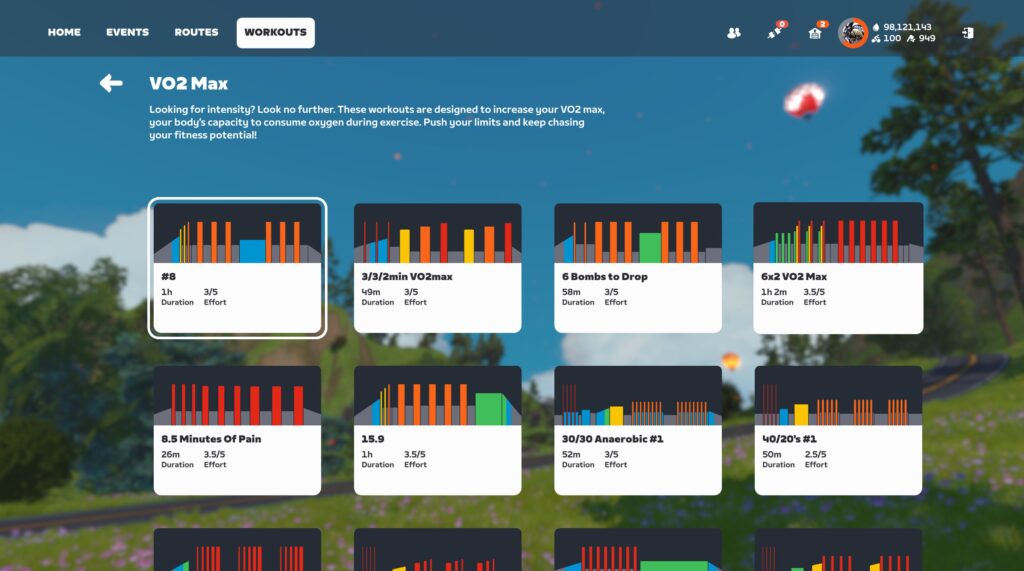
But there are other ways to do VO2 max work. Zwift has a “VO2 Max” folder in its workout directory, with 37 workouts to choose from at the time of this post:
Some of these workouts feature the more traditional, longer VO2 max intervals, while others have you doing high numbers of much shorter intervals (20-30 seconds). The important thing is accumulating time working at VO2 max levels.
You might also try Zwift Insider’s popular Saturday Tiny Races. This is a set of 4 short races completed in under an hour, making it basically a VO2 max workout disguised as a race.
Lastly, hill repeats are a classic outdoor VO2 max workout. Find a climb you can finish in 3-6 minutes, then hit it hard. Turn around at the top, taking your time coming down so you can recover nicely, then do it again. Aim for at least 4 repeats.
Suggestion Box
The third workout of Zwift Camp: Build was my favorite yet, even if my legs weren’t very fresh. Still, there were some things Zwift could change to improve the experience. Here are my suggestions:
Clean Up Lap Splits: Unlike stages 1 and 2, the Splits HUD was really useful for this workout. But there are two tweaks that would make it better: making sure splits finish right at the lap arch (the first few fire early, the last fires late), and keeping the Splits HUD up even after you finish the final volcano lap.
Fix HoloReplays: I set up my HoloReplay settings as suggested, to only show a single ghost from my previous effort. But it still showed two ghosts every time, from two different efforts, even though both were labeled “Previous.” Fix it, Zwift!
Improve the event description: I already mentioned this for earlier stages, but once again, a simple line or two in the event description would clarify what people are signing up for. The current description for this workout (“Target Effort: Three 5-minute efforts”) really isn’t accurate at all. It’s misleading at best.
‘Superhuman’ is a word bandied about for Tadej Pogačar’s race performances. His ability to just ride away from the best cyclists in the world on climbs, often seated, is truly impressive.
Now Ole Kristian Berg at Molde University in Norway has put numbers to the results. His paper, published in the Journal of Science and Cycling, estimates Pogačar’s VO2 max and power output in six climbs on the 2024 and 2025 Tours de France: Plateau de Beille, Isola 2000, Col de la Couillole, Hautacam, Peyragudes and Mont Ventoux.
Faster than Pantani
Berg estimates Pogačar averaged 421 watts on the climb of Mont Ventoux in the 2025 Tour de France. Tim de Waele/Getty Images
To estimate Pogačar’s power numbers, Berg started with Strava data for the six climbs and information on the UAE Team Emirates website.
Berg applied mechanical models of cycling power output and the results of previous studies to arrive at some truly remarkable figures.
He estimates Pogačar‘s mean power output over a climb of around 40 minutes as 442 watts (+/-15 watts).
To achieve that output, Berg estimates, requires a VO2 max of 80 mL/kg/min over the 40 minute climb, with a peak of 90 mL/kg/min. His estimates of power output in watts-per-kilogram across the various climbs are from 6.4 to 7.0.
Berg’s results are based on a few assumptions: he assumes zero wind and no drafting and estimates Pogačar‘s frontal area when racing, his race weight, his efficiency in turning energy into power and the air density. He also uses a pre-established number for the bike’s rolling resistance.
While Pogačar doesn’t publish his power data, Derek Gee, who has recently terminated his contract with Israel-Premier Tech, has, and Berg used this to validate his model of Pogačar‘s power output.
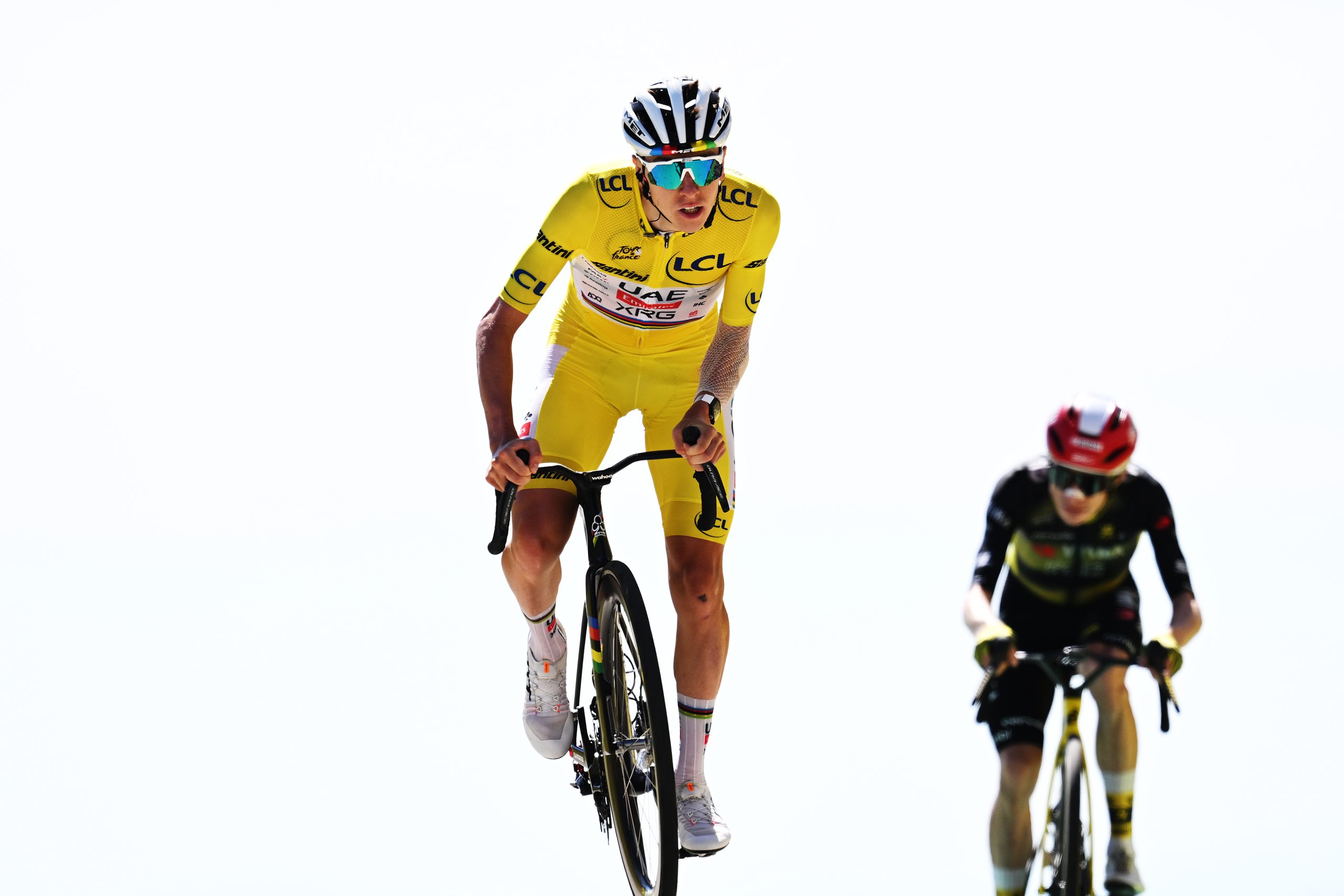
Berg suggests that Pogačar‘s peak outputs may have been even higher during his 1-2 with Vingegaard on the Plateau de Beille climb in the 2024 Tour de France. Tim de Waele/Getty Images
Berg points out that the finishing times of the first three finishers on the Plateau de Beille in the 2024 race were all faster than the previous record set by Marco Pantani in 1998. The peak performance numbers during moves such as the attack by Jonas Vingegaard and the counterattack by Pogačar on that climb were likely even higher, he states.
There have been reports of very high VO2 max numbers in lab tests of elite cyclists, including previous Tour de France winners, with numbers over 80 mL/kg/min and reaching over 90mL/kg/min. In previous posts, we’ve looked at why the Tour de France is getting faster and how Pogačar has become so good.
In 2019, we hooked up elite amateur climber Andrew Feather to an ergometer at the University of Bath to measure his VO2 max in the lab. Feather’s measured VO2 max was 78.7 mL/kg/min and his FTP was 350 watts.
That may not be enough to win him the Tour de France, but he was the only rider of 1,189 starters not to be overtaken by Pogačar on the recent Pogi Challenge hill climb in Slovenia. Feather did have a six minute start though.
As the days get shorter and colder, more and more riders are filling the roads of Zwift. As you ramp up your indoor training, gain tips and tricks from this week’s top videos to make your Zwift experience the best it can be.
We’re also highlighting a fun Zwift racing challenge, a tour of the Brompton bike factory, and a long-term review of the Zwift Ride.
8 Game-changing Zwift Indoor Cycling Tips
Lake District Cyclist shares 8 tips for having a more enjoyable experience riding indoors with Zwift.
If I Started Zwifting Today, This Is What I Would Do
If you’re looking to learn more about Zwift, this video is for you. Adam from Road to A shares 26 tips to help you become a better Zwifter.
I Raced Zwift A Category Until I Won
Watch as Jeff from Norcal Cycling races on Zwift over and over until he wins. How many tries will it take him to snag an A-category win?
Zwift x Brompton
In light of the Virtual Brompton World Championships, Thomas Martinez tours the Brompton factory with Zwift and rides a Brompton on the Wahoo KICKR.
What The Zwift Ride Is ACTUALLY Like
After riding the Zwift Ride for thousands of miles, Beijing Bonk shares a review.
Got a Great Zwift Video?
Share the link below and we may feature it in an upcoming post!
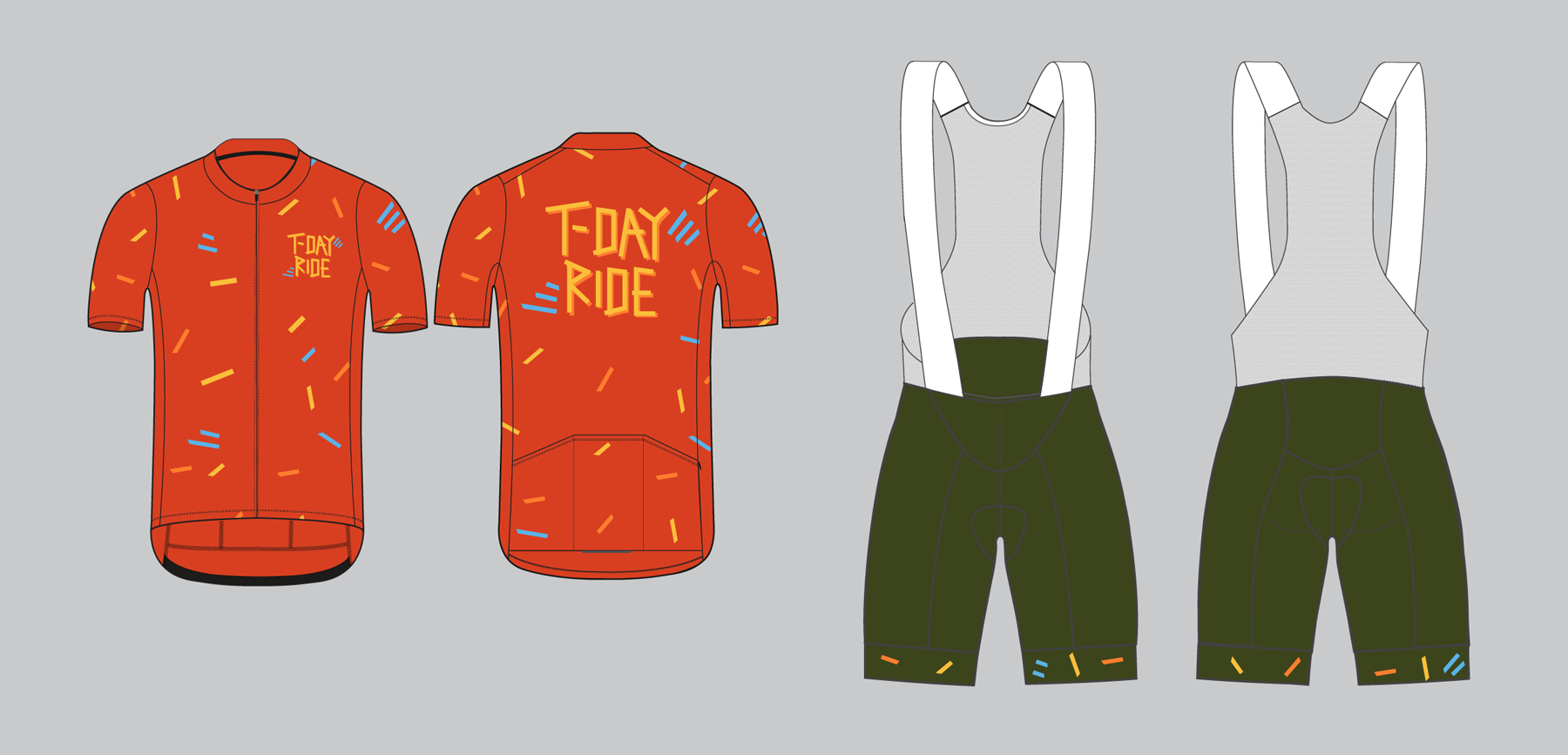
Zwift CEO and Co-Founder Eric Min has traditionally led a T-Day ride on Thanksgiving morning, inviting Zwifters to put in some early bike miles before spending time eating turkey and pumpkin pie with family and friends.
This ride is always popular, with thousands showing up. And often, Eric has a big-name guest on the ride as well! (Past guests have included Anna van der Breggen, Justin Williams, and Chloé Dygert.) This year’s special guest: Mathieu van der Poel!
See below for ride details…
Route and Schedule Details
Event start time is 4pm UTC/11am ET/8am PT on Thursday, November 27. This is an open-paced ride, so you can ride hard or easy. With lots of riders joining in, you’ll always have someone to ride with!
The ride is 60 minutes long and held on the new Spinfinity route in New York. This route takes you around the new Jarvis Island, the Volcano, up and over the Hilly KOM Reverse, and more.
If this ride is too late in the day for you and/or you’re looking for a longer ride, check out BMTR’s traditional Thanksgiving 100, which begins at 1pm UTC/8am ET/5am PT. Riders will be on the Watopia’s Waistband for 100km, and there are three pace groups: D at 1.6-2 W/kg, C at 2.2-2.6 W/kg, and B at 2.8-3.2 W/kg.
Starting just 5 minutes after BMTR’s ride, my Thursday Pizza Burner 100km kicks off at 1:05pm UTC/8:05am ET/5:05am PT on Tick Tock in Watopia. Ride with me at ~2.5 W/kg, or join the zinners up the road!
Several months ago, Zwift Co-Founder Jon Mayfield and I were talking about training for upcoming events, and he mentioned the Death Valley Century. This was a ride Jon had done several times already, and he was signed up to do it in November. Would I be interested in coming along?
After giving it some thought, I decided to pull the trigger. Why not? It was a place I’d never ridden before, plus I needed to plan an event or two to inspire my training.
I signed up, then mentioned it while chatting on Discord during my Thursday Pizza Burner 100km ride. Two ride regulars, Casey Tucker and Justin “Wagz” Wagner, both said the ride sounded interesting. Then texted me within a few days to say they’d signed up!
And just like that, there were four of us heading to Death Valley National Park for an epic century.
At least, that was the plan…
The Prologue
In the weeks leading up to the ride, I’d been messaging Jon to find out what he was planning, while also chatting back and forth in a text group with Wagz and Casey.
Jon was going to bring his telescope and camera, because he dabbles in astrophotography and Death Valley is a Gold Tier designated dark sky area, meaning, “On clear, moonless nights, the Milky Way casts visible shadows, and thousands of stars typically washed out by light pollution become readily apparent.” Epic stargazing? I’m in.
Wagz was driving in from Salt Lake City, Casey from Bend, OR, and I from NorCal, meaning we were all driving 8 or more hours to arrive in Death Valley on Friday, for the ride on Saturday. We decided to stay Saturday night as well, and maybe get a ride in on Sunday before heading out. Casey started researching alternative rides, and found an epic 25-mile climb up to a lookout called Dante’s View. Sunday’s ride: planned.
Things began to unravel in September, though. A big storm came through, dumping 1.5″ of rain in one day. (This may not sound like much, but Death Valley averages 2.2″ of rain annually. If a good portion of that arrives in a short time, chaos ensues: flash floods, washed out roads, etc. This will be important later on…)
Then the government shutdown began on October 1, meaning Planet Ultra could hardly even find anyone to talk to since Death Valley is a national park and those employees were off work until further notice. As the shutdown dragged on (43 days, the longest in history), we were notified that the route had been changed, then notified of further changes. By the time the shutdown ended, just a few days before the ride, Planet Ultra had settled on a metric century route for us to ride, with the option of removing our ride numbers and finishing out the full imperial century however we chose once we crossed the line.
So that was our Saturday ride plan.
But within a few days of the ride, the weather forecast, which had been wonderful for weeks, began to turn. First it was rain on Sunday. Then a bit of rain on Saturday. We realized there would be no stargazing, as clouds would fill the sky all weekend. And by mid-day Friday, as we were all making our way to Death Valley, it showed 1″ of rain on Saturday.
An email arrived from Planet Ultra. Subject line: URGENT!!! Death Valley Ride: CANCELLED.
A flurry of texts and phone calls followed between the four of us. The concensus was clear: we weren’t cancelling. The hotel was booked, we’d been granted our “Husband Passes,” and we were going to figure out a way to do something epic.
Even if it killed us.
Which was actually a distinct possibility.
Act 1: Night Riders
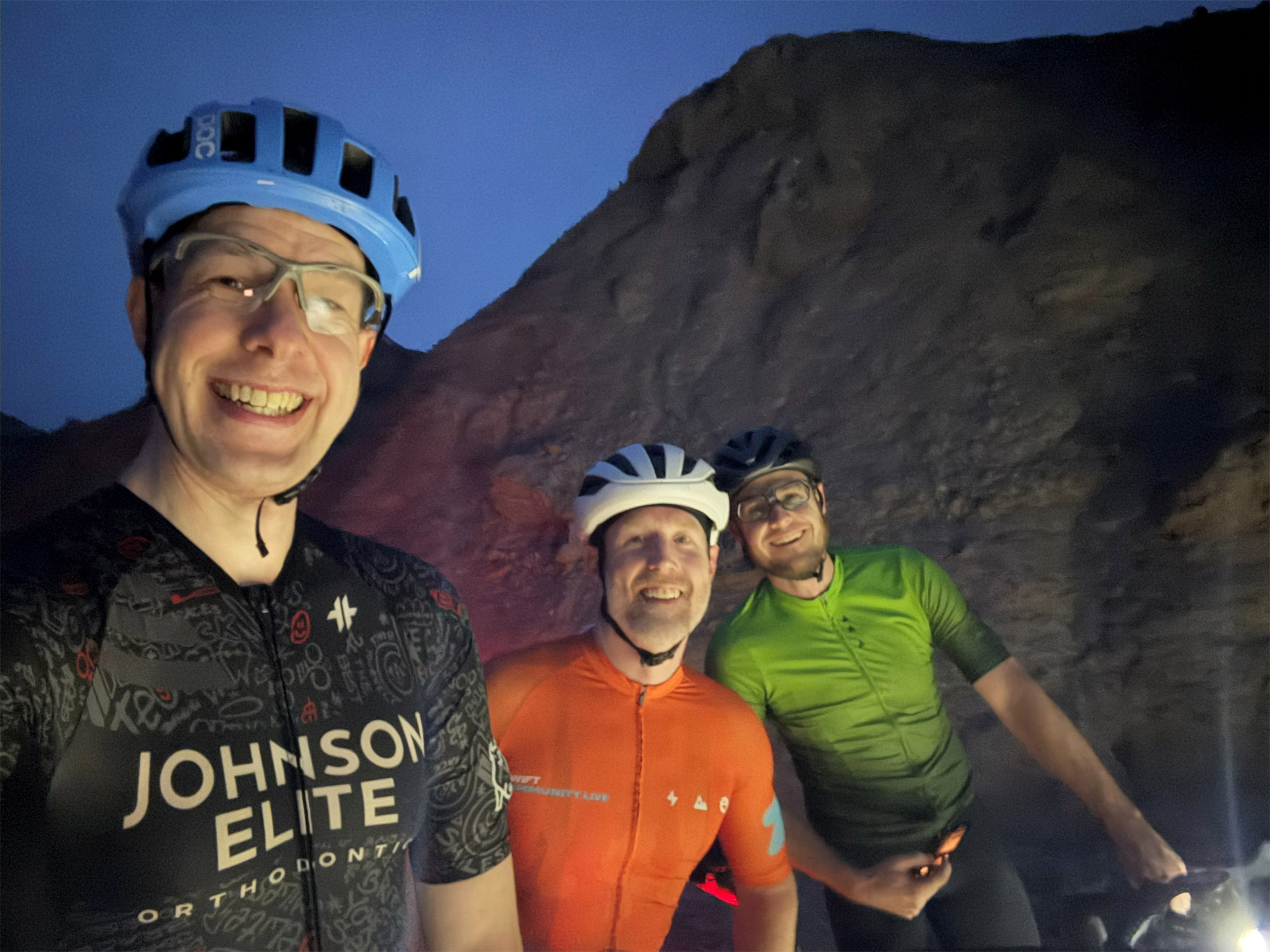
We were all targeting a 4pm Friday arrival, since that was the hotel’s check-in time. But Wagz and Casey arrived before I did, and decided we needed to do a shakeout ride. Knowing we didn’t have a lot of daylight, I kitted up in my car, grabbed my bike, and headed out with Wagz and Casey.
It’s funny: I hadn’t yet met these two in real life. But we’ve spent many hours riding together virtually while chatting on Discord. So when I pulled up and saw them, there was no introduction necessary – we had just ridden 100km in Watopia the day before! The jokes picked up right where we’d left them.
We headed out from Furnace Creek (Death Valley towns have great names) toward Badwater at 4:12pm. Casey and Wagz both had headlights, but I hadn’t brought one. Figuring we had about an hour of daylight, so we decided we’d ride out around 15-20km, then turn around and come back.
15km out, Casey suggested we take a left and ride the Artist’s Drive road instead of just flipping a u-turn. “It’s a nice little loop,” he said. (It was closed to automobiles due to recent floods, but his research said there was just a bit of gravel washed across the road here and there.) We rode around the barrier, crossed the first bit of gravel, and decided to give it a go.
And that’s when our shakeout ride turned spicy.
Have you ever climbed with another cyclist, where neither of you talks about how you don’t want to let the other guy beat you? The unspoken race? That’s what this was. And the problem was, none of us knew how long or steep the climb actually was.
4.5km and 325 meters of climbing later, we finished the main portion of the climb. And we realized we had a problem. Or more accurately: I had a problem. It was dark. I had no light. And we were nowhere near home.
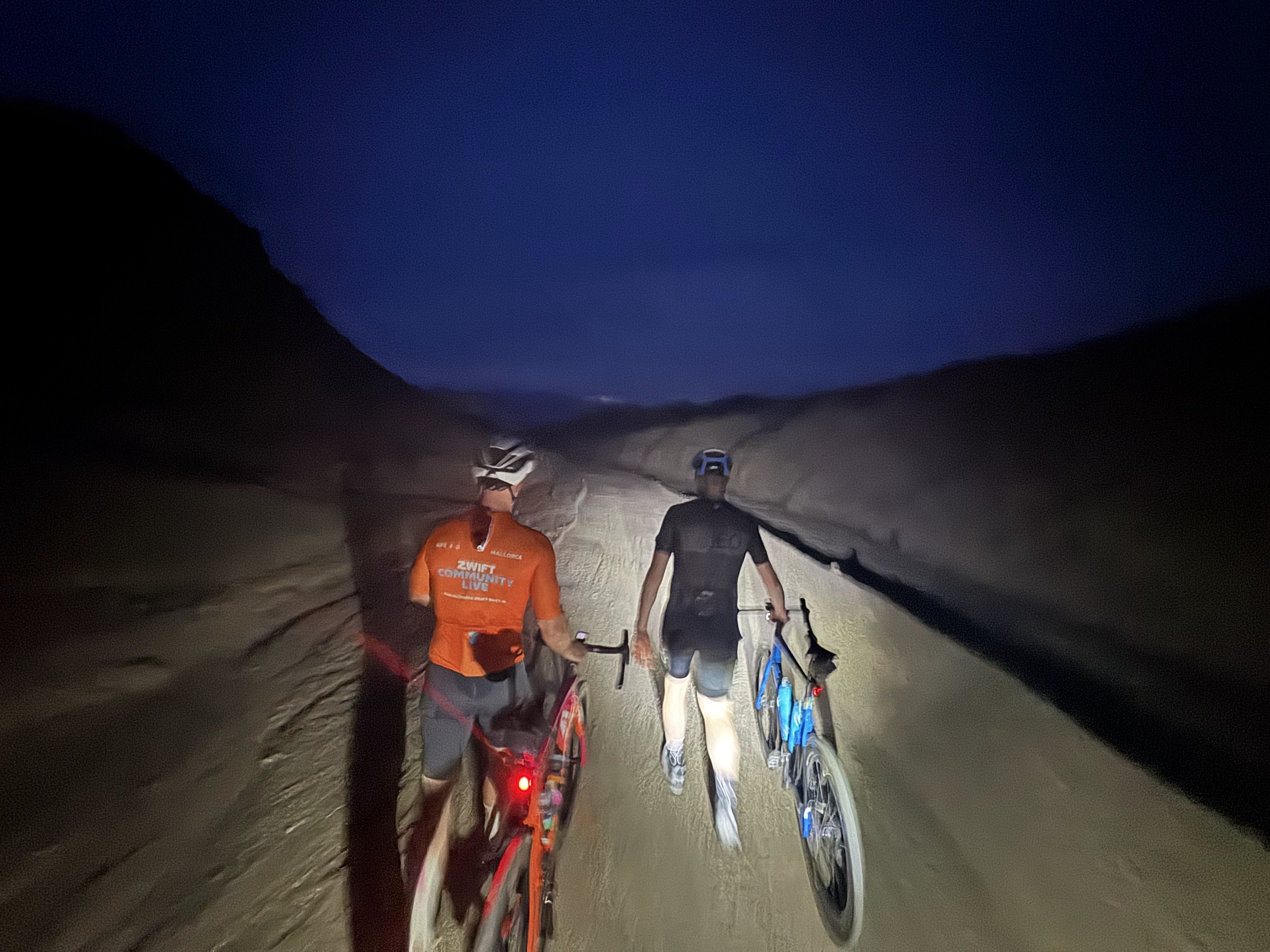
We began the main descent of Artist’s Drive, with me trying to stay sandwiched between Casey and Wagz so I could see the road. And this wasn’t just any road: it was an unfamiliar, twisty, and steep descent. Made all the more interesting by random gravel patches deposited from recent flooding!
It felt like we were just on the edge of crazy, which is a rather fun place to be. We only had to unclip and hike the bikes once, thanks to a particular deep gravel section. But apart from that, we made our way down, teasing Casey for his route suggestion and laughing at the irony of my gravel bike sitting in my garage, headlight and all.
By the time we returned to the main road it was pitch dark, and we still had 10km to go. We turned off all our lights for just a minute, to take in the total darkness of the place. Wow. Have you ever experienced that? It’s rather disorienting, like you’re floating in space.
Turning the lights back on, we made our way to the hotel. When we arrived, we checked the stats: our 1-hour ride had turned into a 100-minute ride covering 40km and 747m of climbing. And although nobody said it, I think we may have all been thinking the same thing: I went too hard, and I’m going to pay for it tomorrow.
Jon, Casey, Wagz, and I sat around the dinner table Friday night, looking at weather apps and roadmaps to plan our new Saturday route. We decided to start in the morning with an out-and-back to Badwater Basin, since it’s a key tourist attraction, being the lowest point in North America (282′ below sea level). That would give us 55km.
Then we could refill bottles and restock snacks upon our return to the hotel, and decide if we wanted to continue with the second leg of the ride: heading north for a 75km loop that included a nice little 11km, 570m climb.
Jon planned to join us for the first leg, but left the second leg up in the air depending on how he was feeling. (He had always ridden this event as a solo TT, so he wasn’t sure if he would want to ride part of it solo, or even make it a shorter day so he had the legs to take on Dante’s View the following day.)
Act 2: The Big Day
Heading to Badwater, while the rain storm moves up the valley toward us
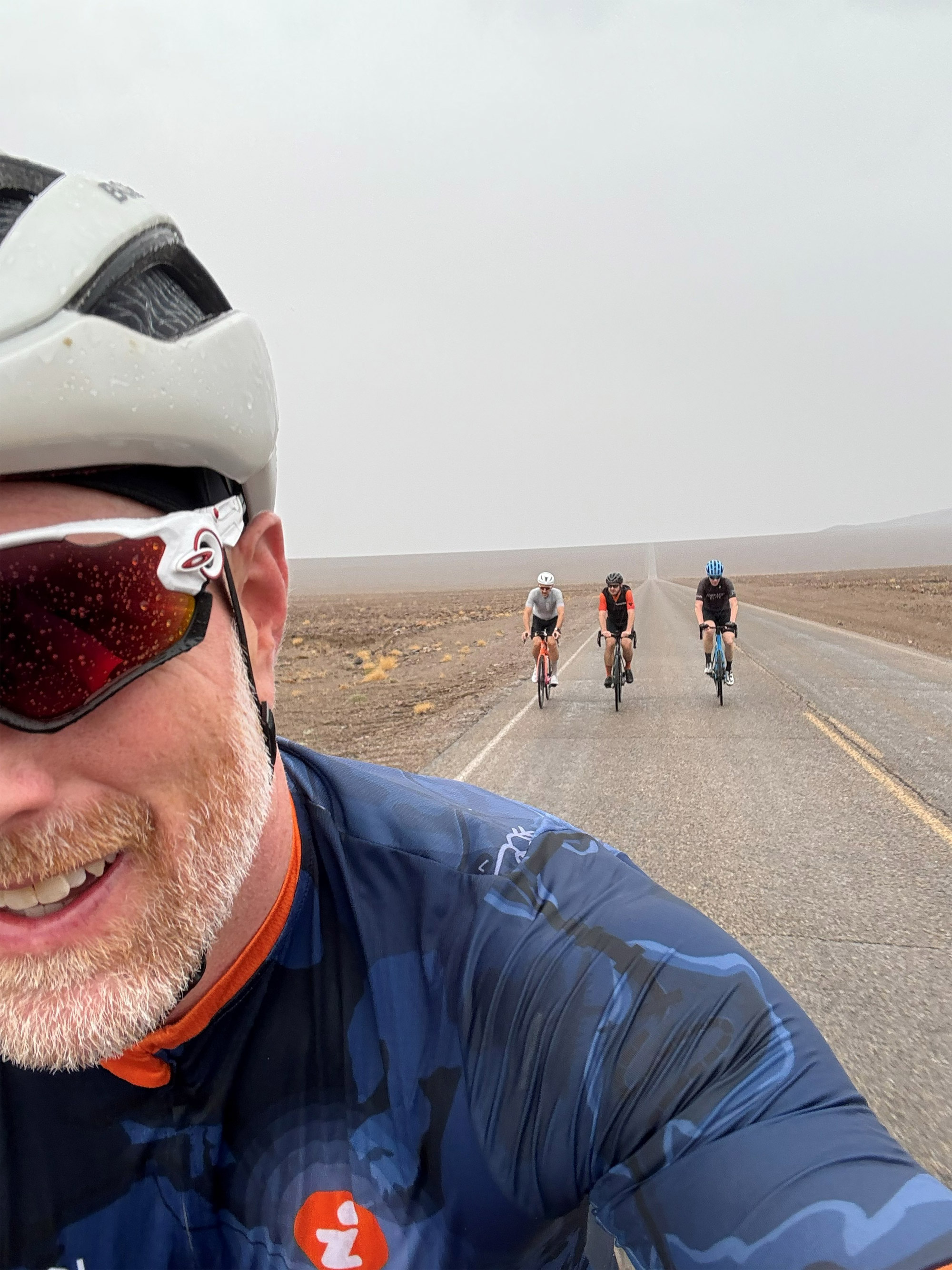
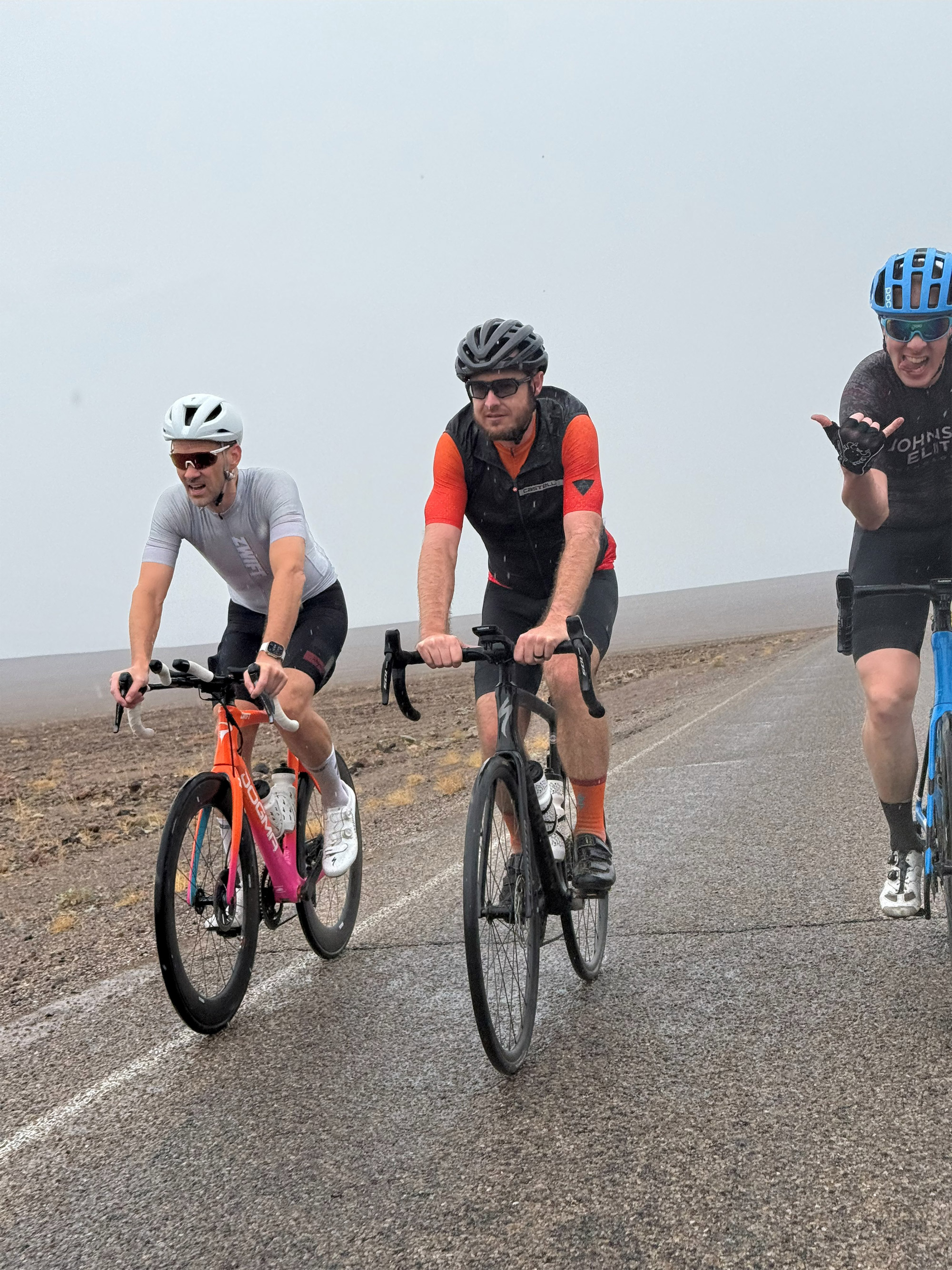
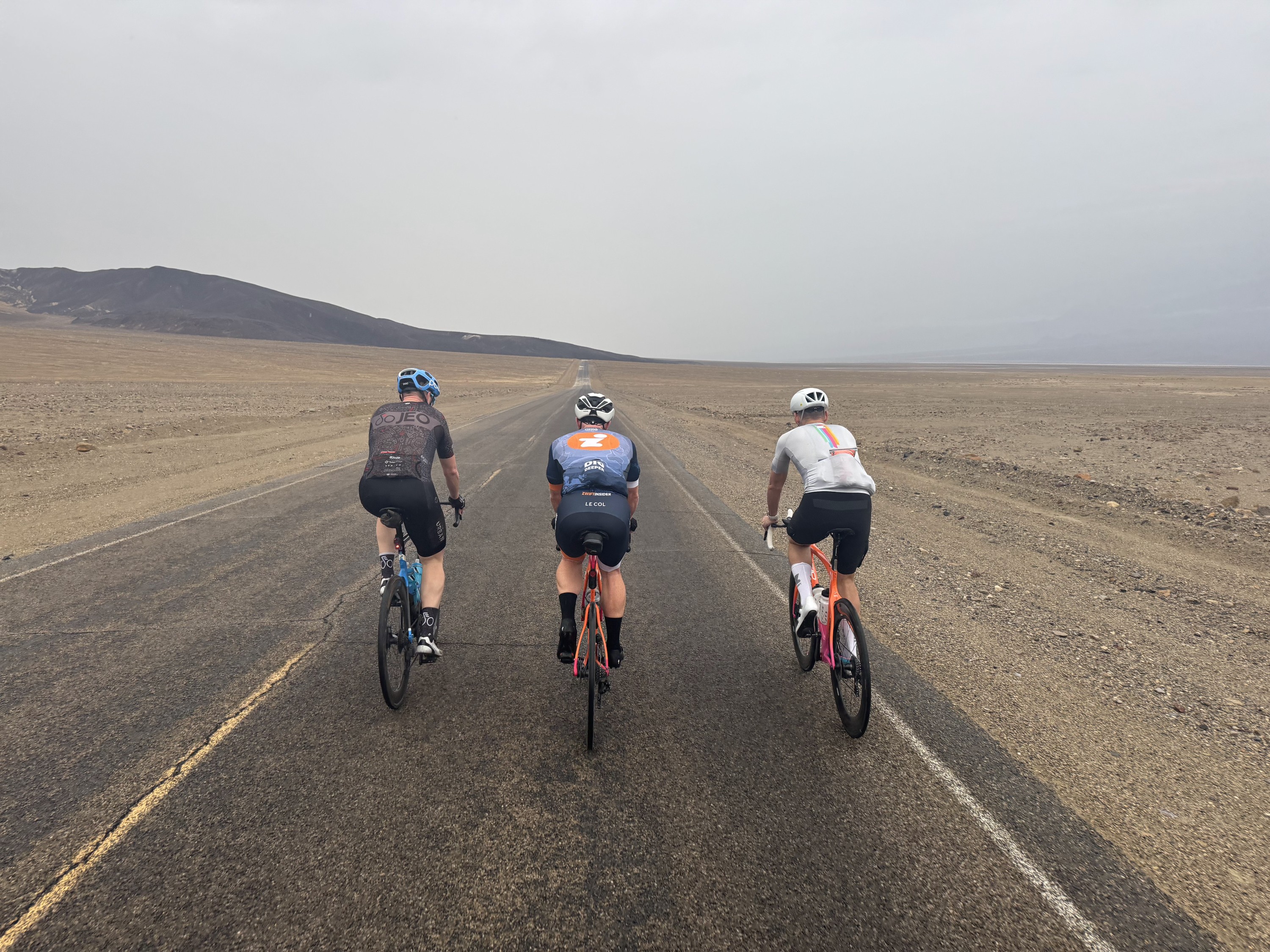
The four of us rode out from the hotel the next morning. Temps were in the low 60’s, with a light rain. We watched a handful of riders leave and head north, but we were heading south, hoping to finish up in low-elevation Badwater before things got too wet.
The road to Badwater Basin is rolling and smooth, and we quickly settled into an easy, albeit muddy, rhythm. Nobody wanted to push hard this early in the day, and it felt to me like the cancellation of the official event had given the whole affair a sort of casual feel. Which was nice.
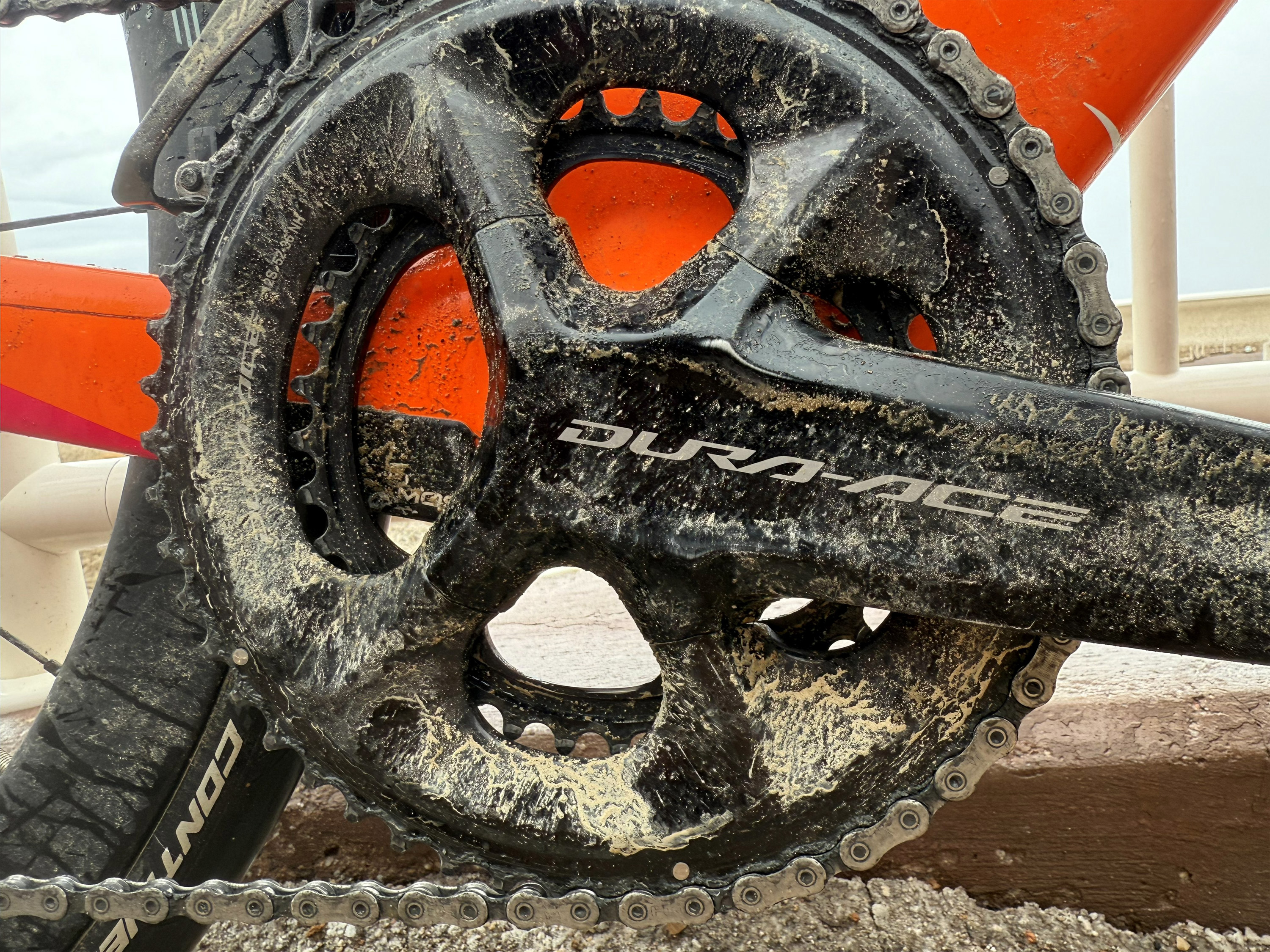
Alkaline mud was washing across the road’s low spots, and that mud quickly coated our shoes, socks, and backsides. It smelled distinctly like fresh, wet cement and left a slimy layer on bikes and clothes after rains washed most of it away.
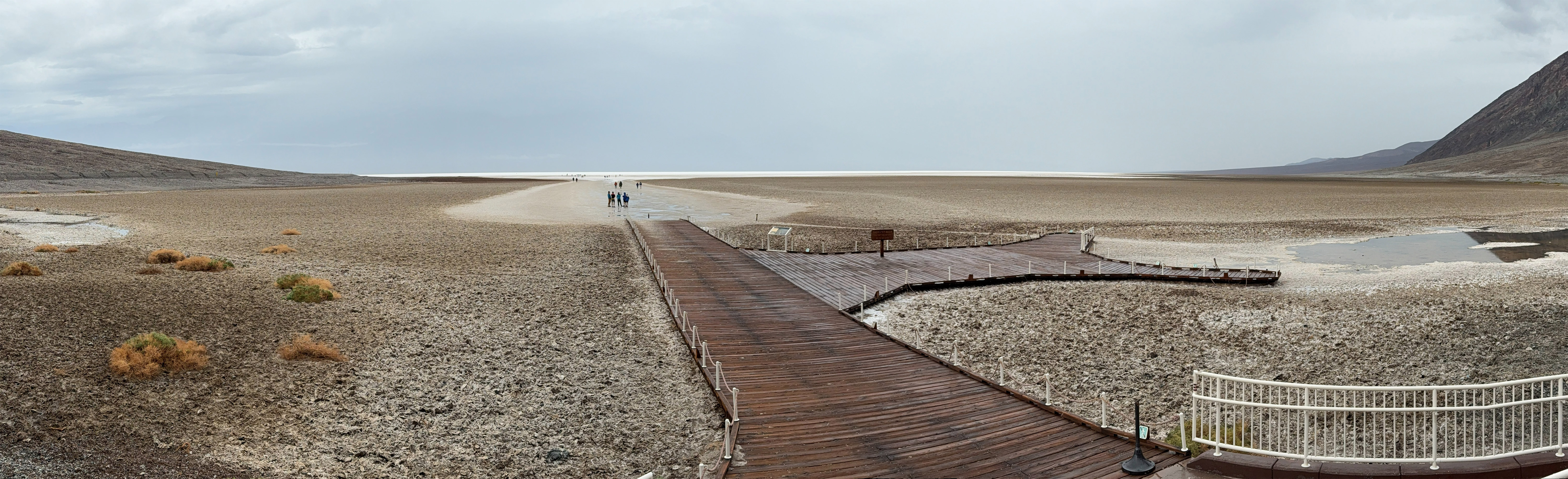
Badwater Basin was something to behold: a 200-square mile salt flat with a sign on the nearby cliff marking sea level, 282′ above us. We looked around a bit, watched people head out to the salt flats on the broad boardwalk, snapped a few photos, then headed back to the hotel.
At the hotel, Jon decided to hit the shower, change clothes, then head out on the second leg solo. Wagz, Casey, and I decided to restock provisions and head out together. The rain was still light, the temperature just right, and the northern roads didn’t seem likely to flood even if it poured down.
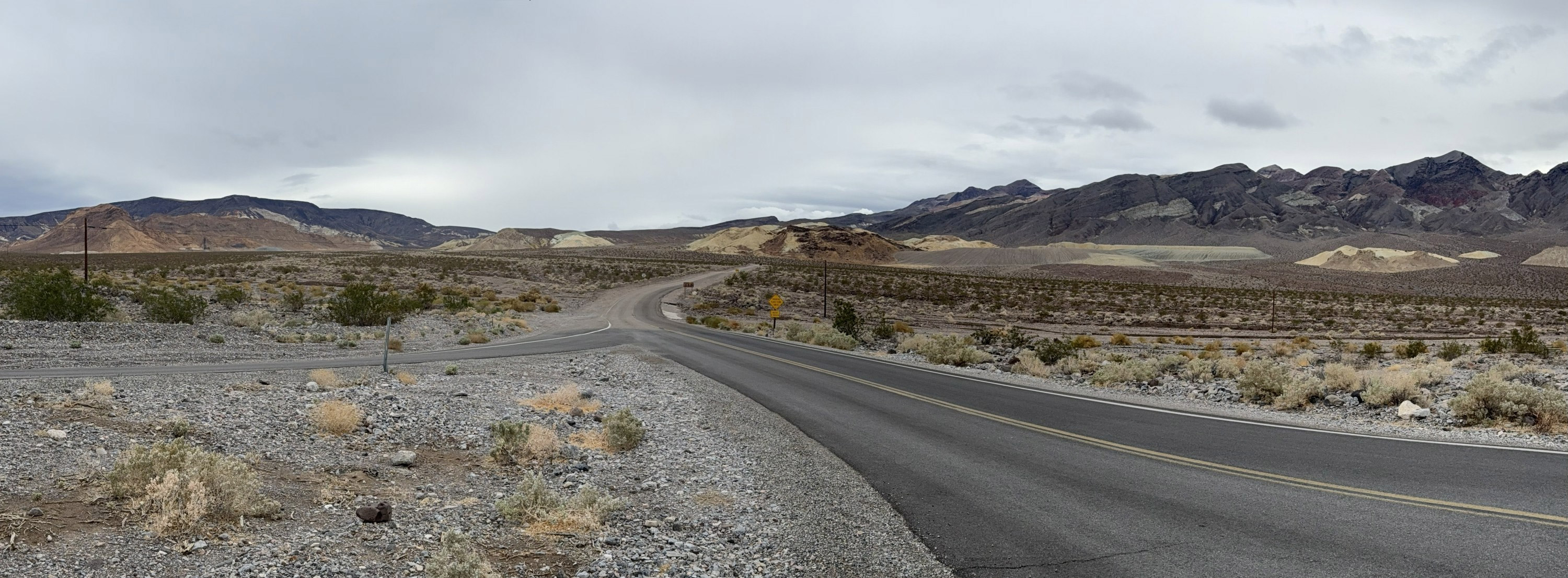
We started on HWY 190, churning through almost 30 flat kilometers. The best way to see the world is from a bicycle, especially if you’re not in race mode. We were able to enjoy the otherworldly scenery as we worked our way across the desert. The distant craggy mountains, the tumbleweeds, the sand dunes, the multicolored soils, the feels of the wind and rain, the unique smell of the place… everything mixed into a singular feast for the sense.
Eventually we turned left and onto the day’s big climb: Mud Canyon Road. 11km long and averaging 5.5%, this steady grade wasn’t bad apart from two things:
None of us could figure out how long the climb was. You would think we would have learned our lesson the previous night, but here we were, not sure if the climb was 6 or 12 miles long.
Casey tried to suck down a Honey Stinger mid-climb, and managed to inhale most of it into his windpipe. Between coughing fits, he said (and I quote): “It feels like there’s a porcupine in my throat,” and also, “I don’t think I’ve ever had my throat hurt this bad.” Turns out, those Honey Stingers live up to their name if you ingest them just right. (Of course, Wagz and I considered attacking at this point, but decided to be nice.)
From the top of the climb we bombed the descent of Beatty Cutoff Road, then headed back to the hotel via HWY 190. It began to rain in earnest in these final kilometers, which was actually rather nice, as it washed away some of the mud caked onto our bikes and clothes.
After Casey took a long pull on the front, I went forward and upped the watts, figuring it would be fun to “make it interesting” as we hit the small rise heading into Furnace Creek. But Casey, feeling his monster pull, fell off the back. Then Wagz attacked in the gutter, forcing me to chase his wheel for shelter! I figured he would drop me like he often does near the end of Pizza Burner rides, but quickly saw he had gone too early, with legs that were too tired. I managed to chase back onto his wheel, then sprint to glory across the invisible townline.
Returning to the hotel, it was cleanup time. We hopped into our showers fully kitted up, rinsing the remaining mud from our bodies and clothes. Casey and I even hauled our bikes into the showers, which worked quite nicely. (Although we found the next morning that the water had left some rust spots on our chains and cassettes, probably due to the chemical makeup of the local water and/or soil.)
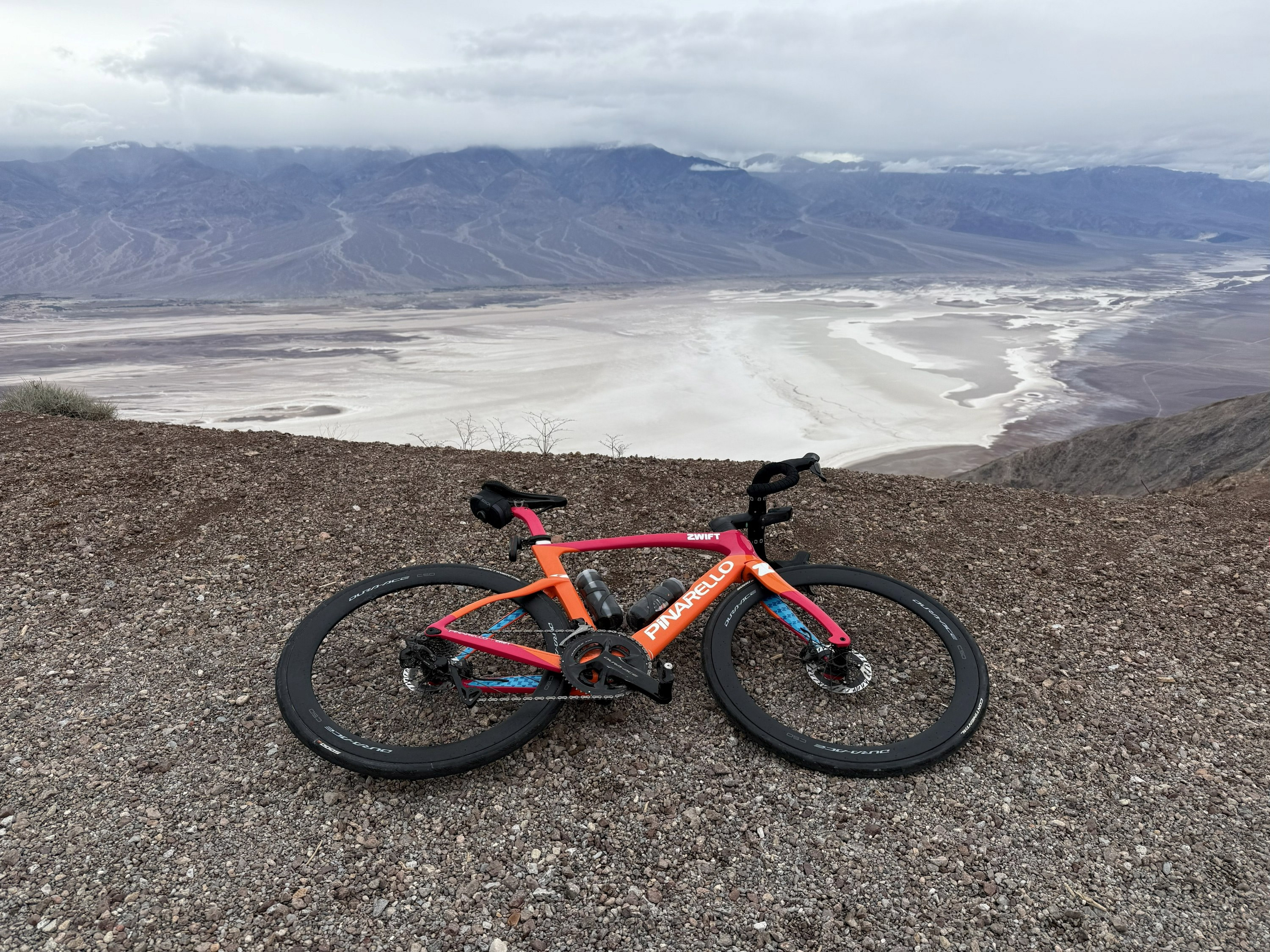
We reconvened with Jon for dinner at the all-you-can-eat buffet and shared stories of our rides. (Jon had ridden the same route as us, but the second portion was solo, on his Zwifty Pinarello with TT bars.) Soon enough, the conversation turned to the next day: what was our ride plan? Were we climbing to Dante’s View?
Wagz stated definitively what he’d been hinting at all day long: he needed to leave early to get back to his family. Jon felt like his legs were too cooked to take it on (he had been training for a half-marathon in the months leading up to this, and didn’t feel his cycling fitness was up to snuff.) And Casey chimed in with unexpected news: his parents, who had made the trip with him, wanted to head back early. He wouldn’t be riding the next day either.
But I’d had my heart set on attempting that epic climb, and my travel plans allowed me to stick around and do it. I let them know I was still going to go for it, even if they were only joining me in spirit!
As we wound down the conversation, our waiter came over to inform us that it was “Really coming down outside. You might want to head back to your rooms soon.” We left the restaurant to discover both main roads into the hotel were now flowing rivers, which was particularly irksome given we had our hearts set on ice cream.
That ice cream, it turned out, was served at a shop on the other side of the hotel grounds, requiring us to ford two newly-created driveway rivers. After spending some time trying to find a way across while staying dry, we made the decision to sacrifice one shoe/sock, stepping into the water and leaping the remaining distance across the road. It was a small sacrifice for ice cream.
Act 3: Solo, So High
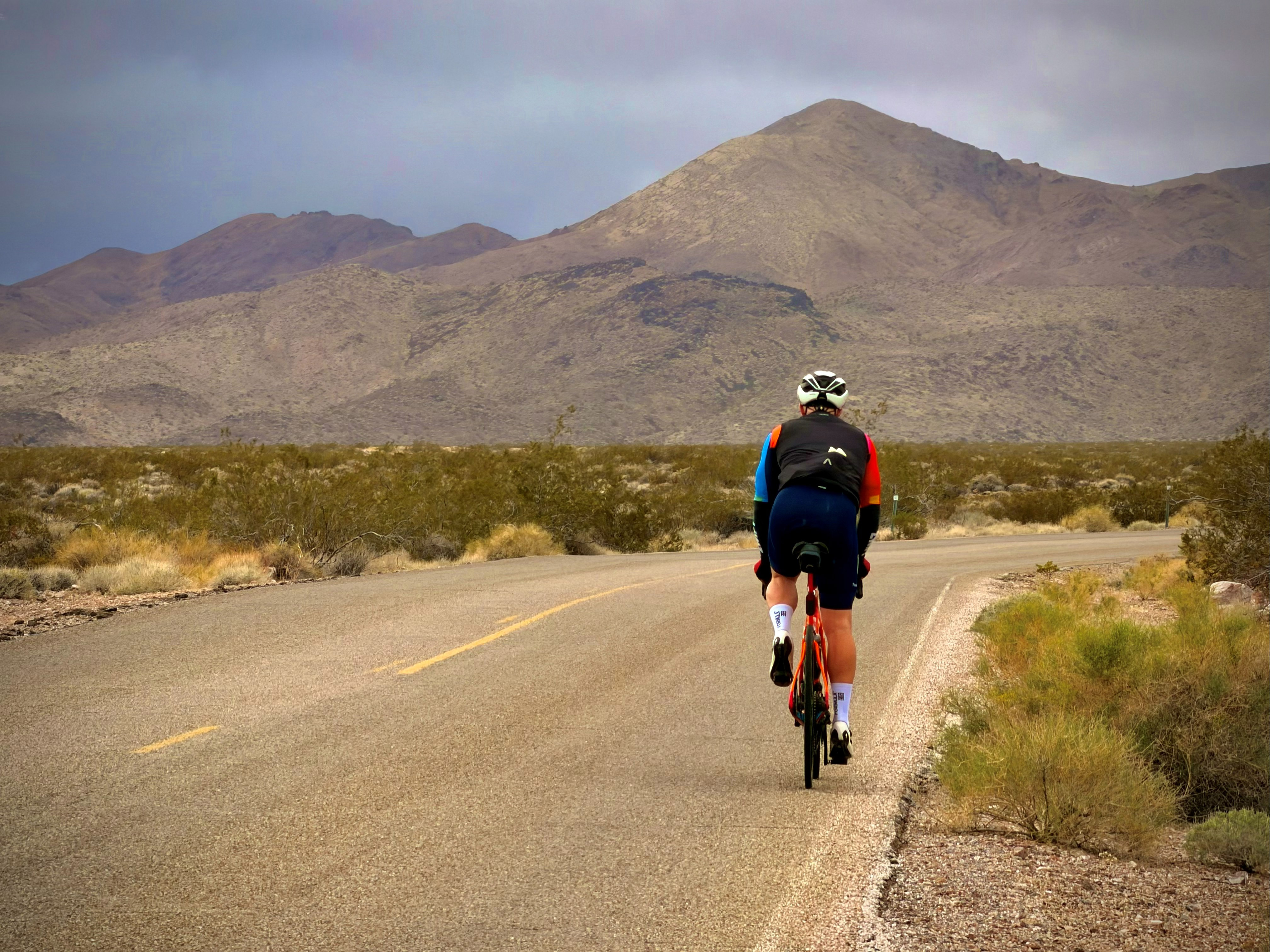
The next morning I bid farewell to Wagz and Casey, and began the 40km ride from Furnace Creek (-190′) up to Dante’s View (5,475′). Blue sky was visible through the clouds for the first time since our arrival, along with fresh snow on the highest peaks. The air was crisp, with a stiff breeze blowing up from the south.
Knowing this was a long climb, and knowing the steepest pitches were at the end, I kept my power squarely in the comfort zone, chugging along in zone 2 around 210 watts.
70 minutes in, I hit the halfway point (in terms of distance) to the top, and turned right off of HWY 190 onto the road to Dante’s View. I was feeling good, taking in the views while making slow but steady progress. The crosswind I’d been climbing with became a quartering headwind as the road shifted southward, but it was all doable, and I smiled and waved as the first cyclist I’d seen that day zoomed past, coming down from Dante’s View.
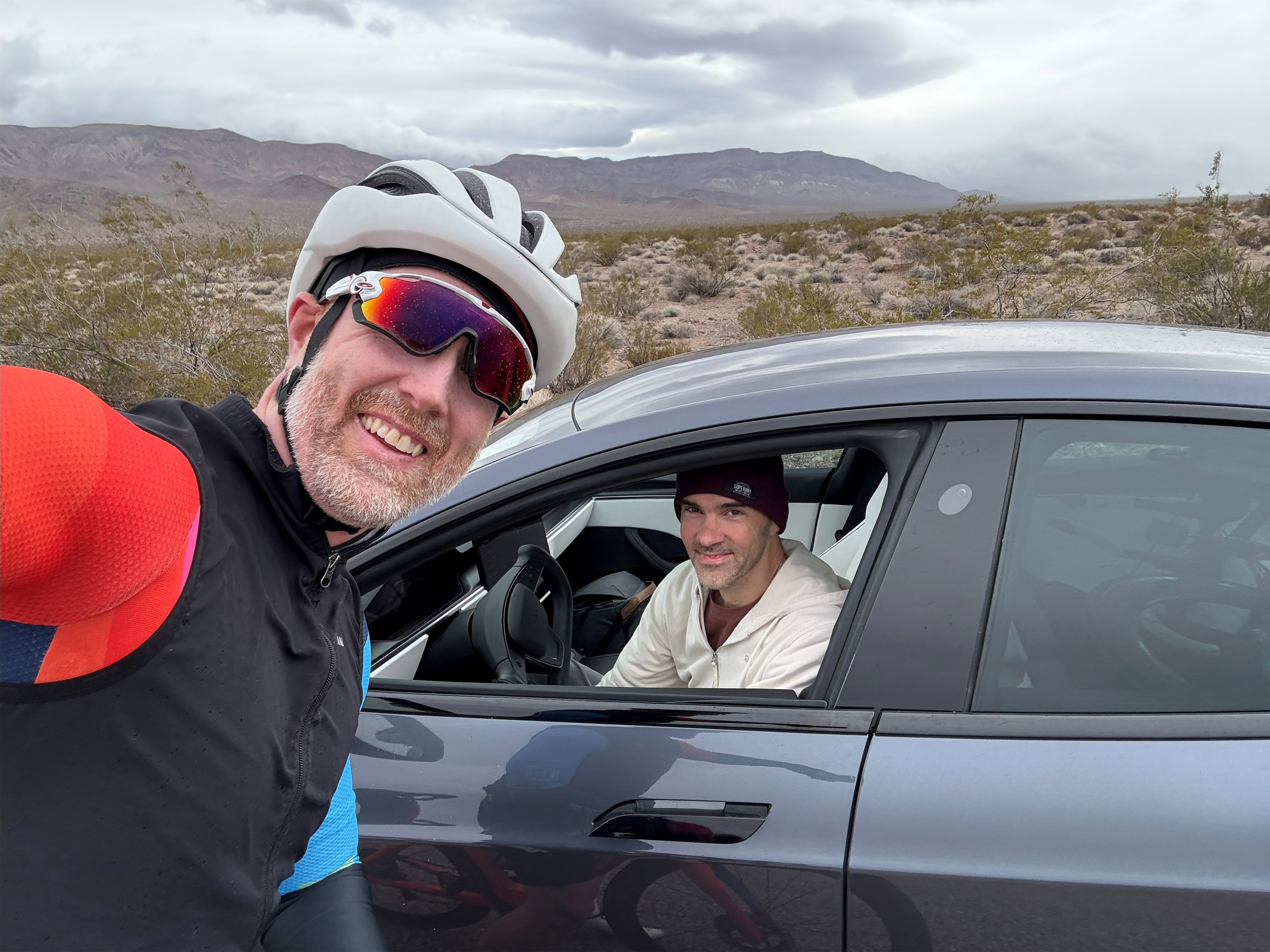
Traffic was quite sparse, and when my Varia radar indicated a car coming up behind, I scooted over to give it room. But this car slowed and pulled up alongside me. It was Jon! I had wondered that morning if I’d see him on the road, since he had said he’d never been up to Dante’s View. He asked if I needed anything – water? Clothes? A donut? I took a donut, then continued on as he zoomed up the road.
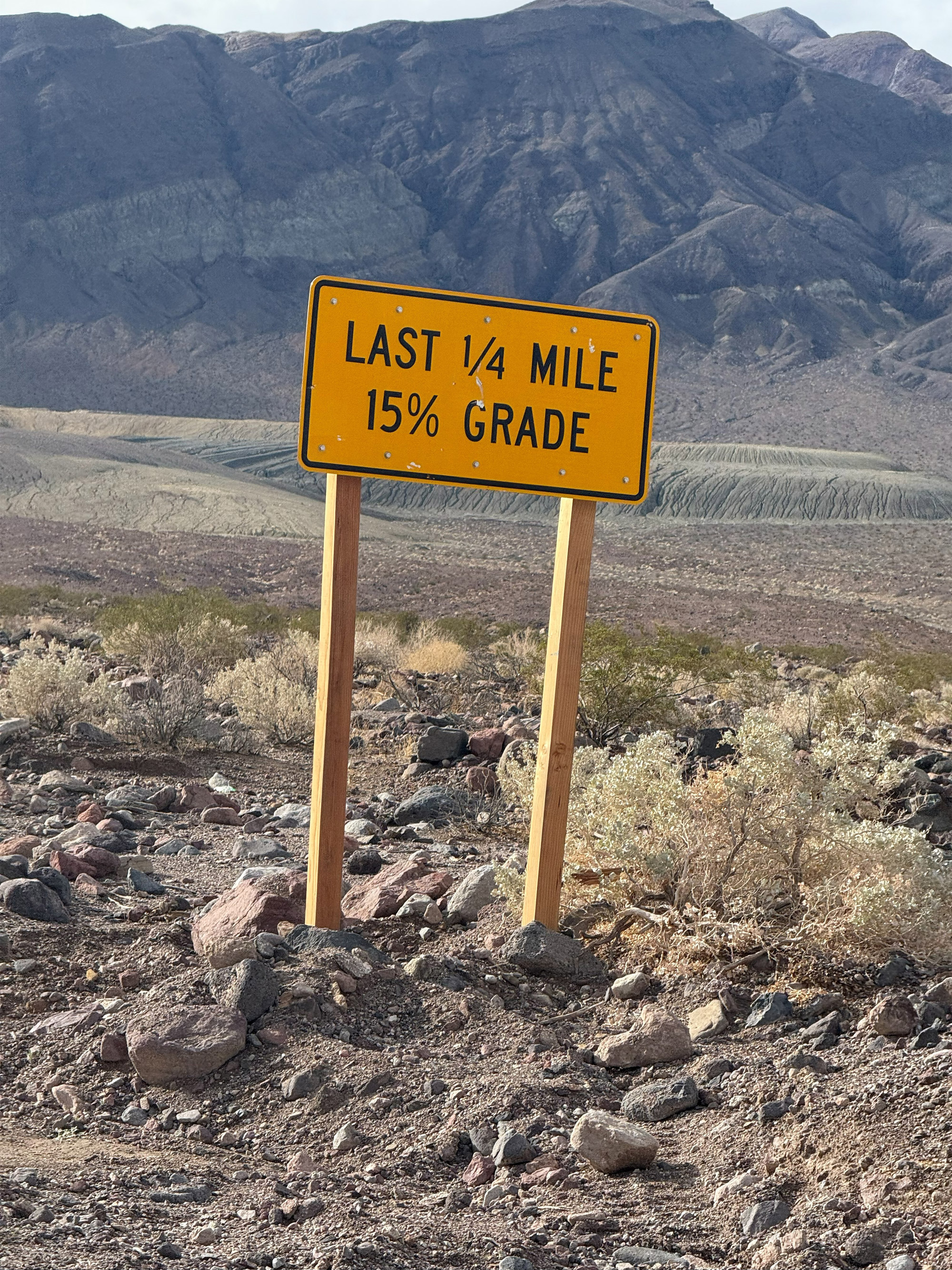
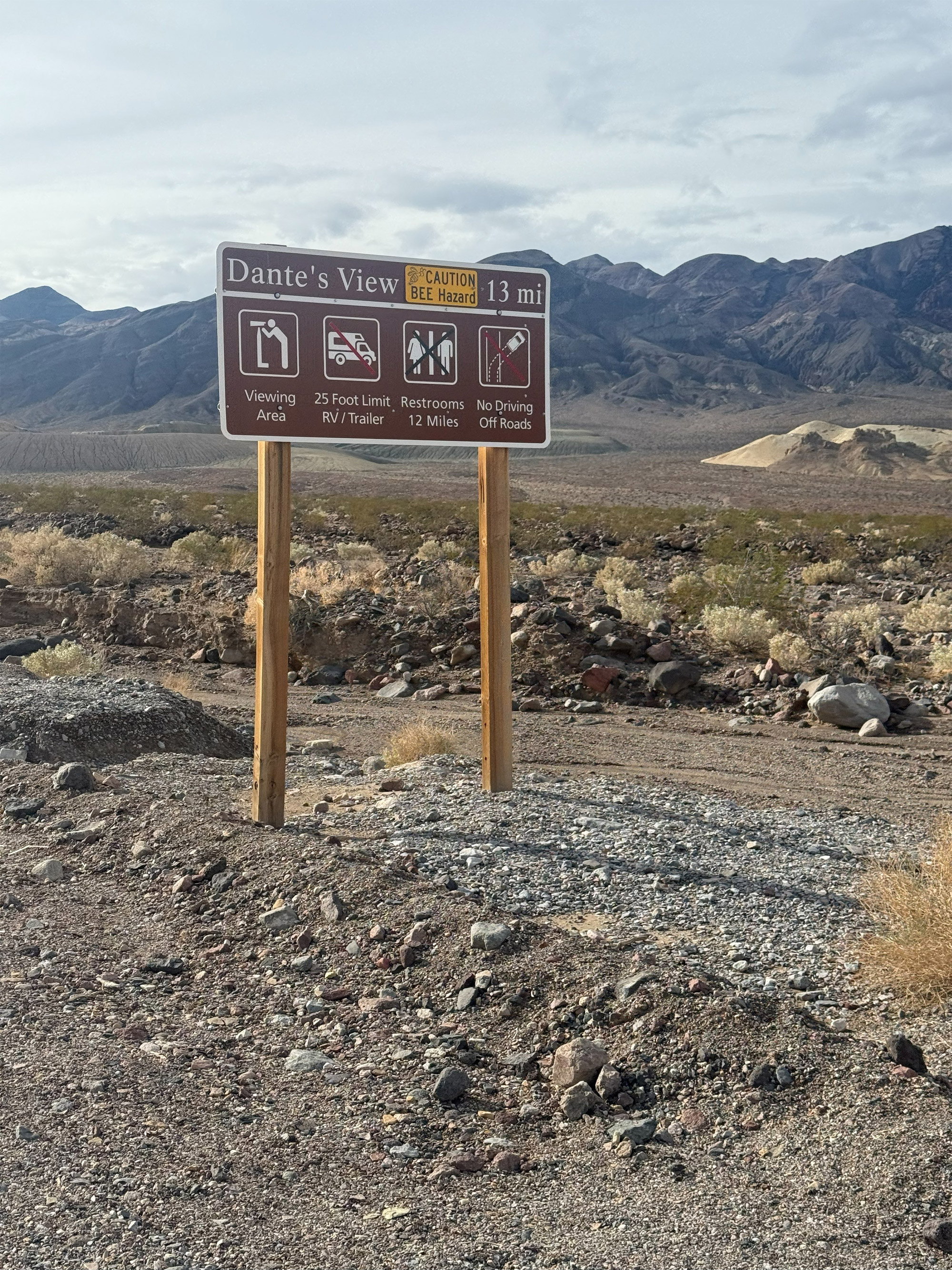
Three ominous signs on the way to Dante’s View…
31km in, everything changed. The road made a hard right, the landscape changed from a canyon to a wide-open prairie, and the wind, now a straight headwind, became stronger. And to my left, across the prairie, I saw the mist of rain marching across the prairie toward me.
I was forced to increase my efforts substantially just to make meaninful progress. Not only was the wind was stouter, but the road was steeper. (I didn’t realize this at the time, because Death Valley road pitches are oddly confusing. Sometimes it’s hard to know if you’re going up or down, or how steep the road really is!) Minutes before I’d been climbing at 18kph while holding 210W, and now I was working at 250-275W to move forward at just 10kph. I shot a quick video to record the ridiculousness of it all:
Near the middle of the prairie, I saw Jon’s Tesla coming down the mountain. He pulled over and I stopped, both of us shaking our heads as the wind howled around us.
“Do you want some warm clothes? I’ve got a wind jacket, some arm warmers…” Jon offered.
“No, I brought a vest, I think it’ll do the job,” I said, realizing it was probably time to put that vest on, as I’d worn just a jersey and bibs thus far and the temperature was definitely dropping. I pulled out my vest and put it on, and even that was a bit of a chore, given how hard the wind was blowing!
We talked a bit more about conditions at the top: “It’s really windy and cold up there,” Jon said. He refilled my bottles with water, and I grabbed a handful of sour gummy worms. “Are you sure you don’t want more clothes?”
I took the arm warmers. And as I pulled them on, I could feel rain starting to fall. At the last minute, I took the wind/rain jacket he offered, because cyclists know it’s OK to ride in the cold, and also OK to ride in the wet. But wet and cold? Not OK.
Bidding Jon farewell, I continued the push across the prairier. It was getting colder. (Looking at my head unit’s data, the temperature dropped 15°F from the start to the end of the prairie.) I pulled over again and put on the wind jacket. Much better!
I gritted my teeth, counting down the kilometers.
7 to go… 6 to go… just keep pushing…
I found myself alternatively yelling into the wind, yelling at myself to keep pushing, and laughing whenever a particularly hard gust came up. It felt wild and crazy, but I also felt alive. It was man vs nature, me vs the mountain, and I couldn’t give up now.
The interminable prairie section finally ended with 5km to go, and I began climbing through the canyon once again, longingly looking around each corner, hoping the end would be in sight. The wind was howling down the canyon, my hands were growing numb, but I couldn’t stop now. I knew I was so close!
After what felt like an endless number of blind curves with no end in sight, I rounded a corner to see the finish. But I groaned out loud when I saw it: the road pitch was insane! Cars were driving up and down the final stretch, and it looked like they were climbing vertically into the sky.
“There’s no way I can climb that without stopping or walking the bike,” I thought to myself. But I gritted my teeth and began to hammer as the road pitched up to 15%. I used every trick in the book, swinging wide on the corners to flatted them out, alternating standing and sitting to recruit every muscle possible.
A cyclist came down from the top, the second I’d seen on the day, and ominously yelled as he came past, “It’s worse coming down!”
I kept pushing, and soon enough, I realized something amazing: I was going to make it. I wouldn’t need to stop and rest.
Despite the temperature now being squarely at 32°F, it was like the clouds parted and the sun came out. Hallelujah! I was at the top!
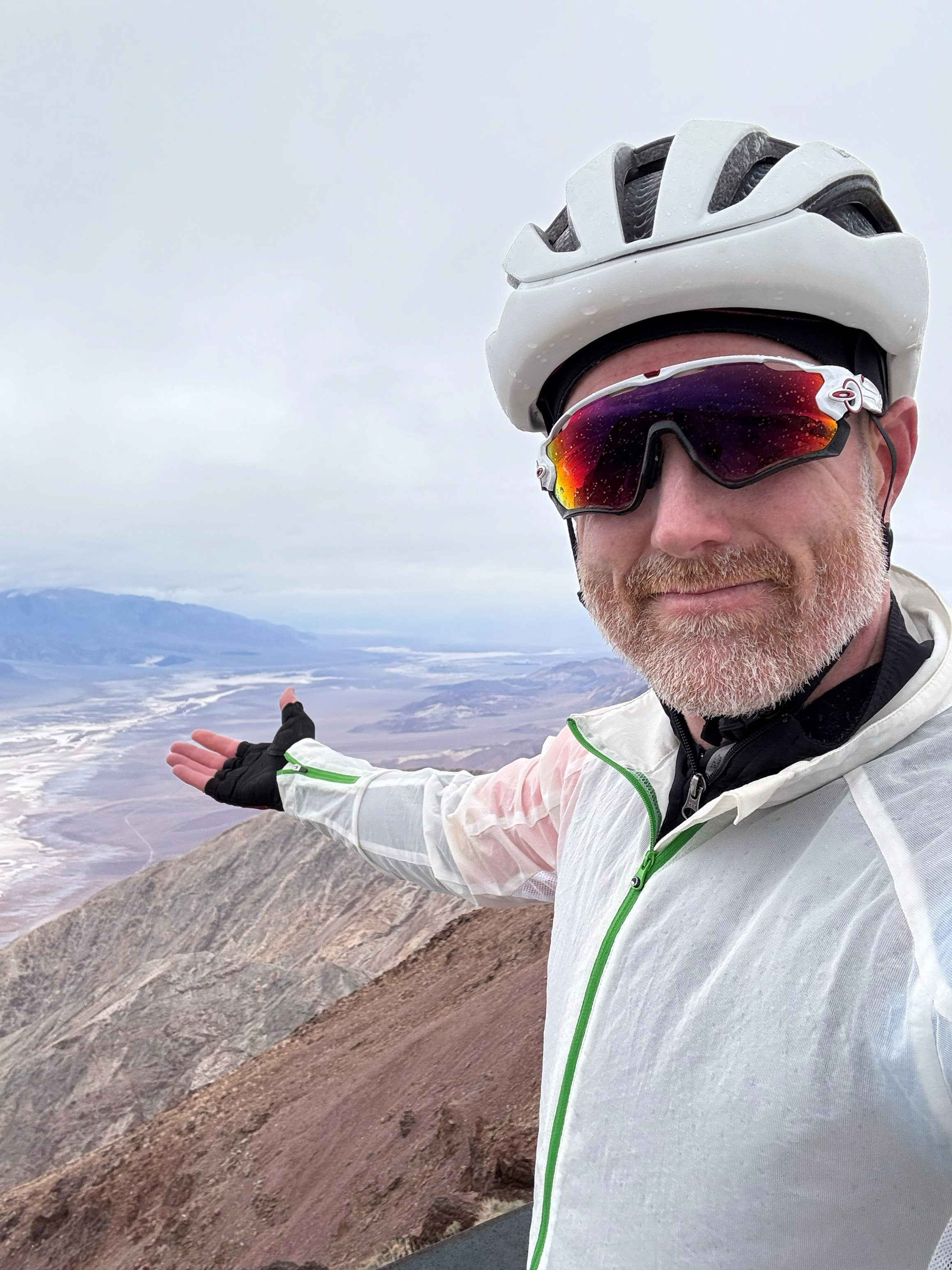
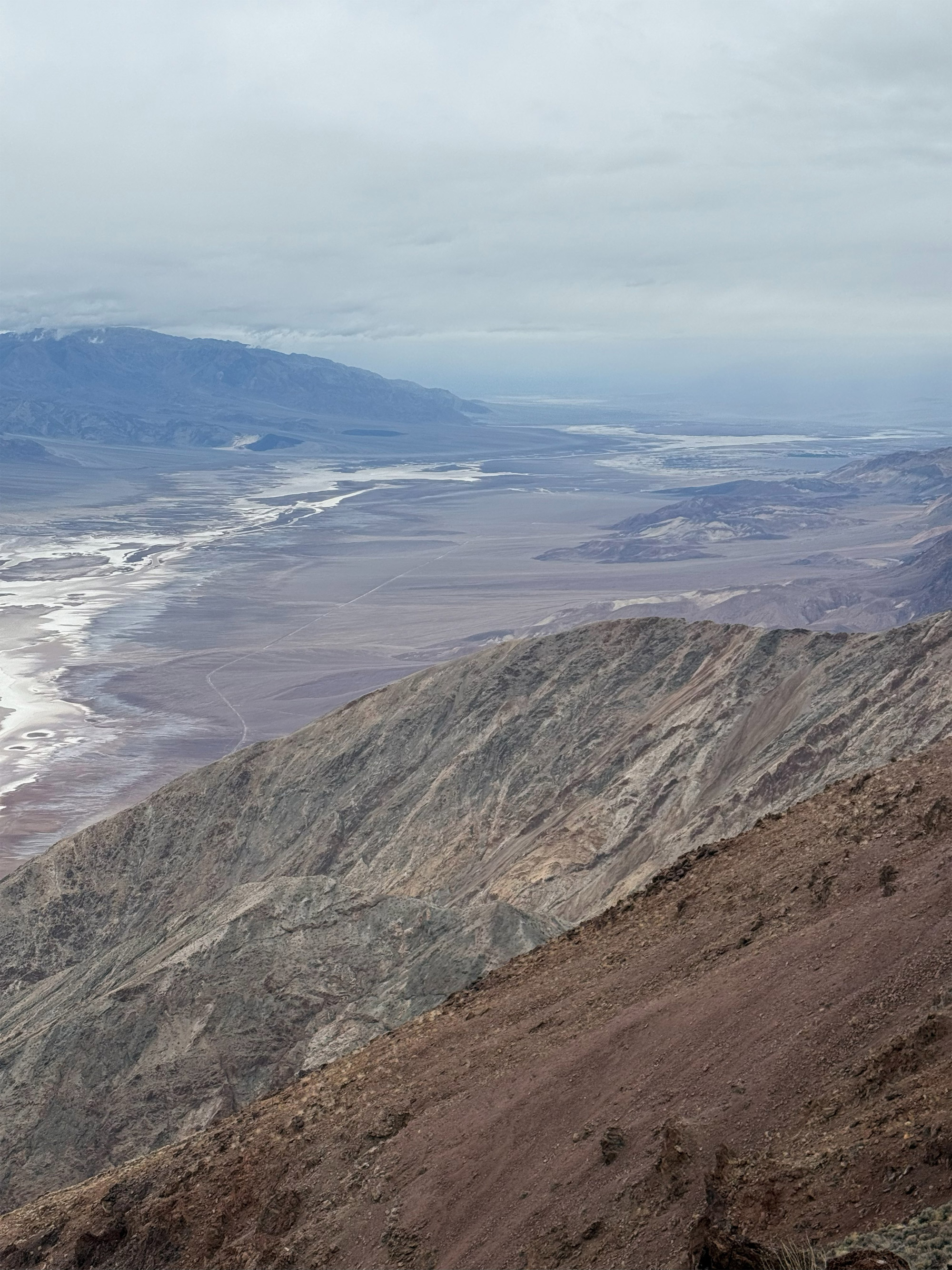
I stuck around for perhaps 10 minutes, drinking in the view while taking lots of pictures. It was a dizzying sight to look over the steep ledge and see Badwater Basin some 5757′ feet below.
But the wind was howling, and my hands weren’t regaining feeling. Neither were my wet toes. I needed to get off that mountain before any deep chill set in.
So I saddled up and began the tricky descent down the wet, -15% switchbacks, with the wind howling in my ears. That cyclist was right: it was worse coming down!
I figured the wind would subside as I made my way down, but it kept blowing hard, a cross wind hitting my front wheel and forcing me to constantly lean left to avoid being blown off the road. It was sketchy, and I was riding my brakes just to stay in control. I stopped twice to shake out my hands, to regain feeling. And as I left the prairie, I could feel the temperature warming.
I had figured I’d descend the 40km home in well under an hour, but it actually took me 70 minutes due to constant braking in hard crosswinds. I can honestly say I enjoyed the climb more than the descent… and that’s saying something!
But don’t get me wrong. If I had to do it all over again, I’d do it all over again. This was one of those epic rides that builds confidence and reminds you of what cycling is all about. If you ever get a chance to ride up to Dante’s View, do it. And bring warm clothes.
This was one of those rare adventure weekends all true cyclists love. It had the key elements: riding with friends, battling the weather, admiring new landscapes, even conquering an epic climb. This kind of stuff is good for the soul. It makes memories, while building physical and mental toughness.
While we were forced to change our initial plans, I’m happy we were able to repurpose those lemons into fine lemonade. Now I have to decide: where next? I’m open to suggestions…
Pro mountain bike rider, Matt Jones, has completed a death-defying stunt – jumping through two trucks, each moving in the opposite direction.
In a video shared by Red Bull, Jones is towed up to speed by a car before launching off a ramp and jumping through two moving trucks.
As each truck is travelling at speed, the time window for Jones to make the jump safely is said to be “less than a second” long.
In order to hit the precise timings required for Jones to safely complete the challenge, each truck was autonomously controlled using technology developed by Scania.
Combined with live GPS tracking data, this enabled Jones to use a traffic lights-style system on his tow car to determine whether or not it was safe to attempt the jump.
After multiple failed attempts at hitting the precise timing window on his run-up, Jones eventually gets a ‘green light’ on the second day of trying and makes the incredible jump.
Commenting on the video, Jones described the stunt as the “scariest thing I’ve ever done. Full stop”
Kudos also to the camera drone operator who follows Jones through the two trucks at the same time.
Matt Jones is a British slopestyle mountain biker turned YouTube star.
Red Bull is renowned for backing daredevil stunts as part of its marketing for its energy drinks.
As well as backing the Red Bull-BORA-hansgrohe WorldTour team, the brand also sponsors a number of individual athletes in pro cycling, such as Wout van Aert and Tom Pidcock.
Pidcock made similar headlines earlier this year following another video uploaded by Red Bull, which showed him hitting speeds of 95kph while descending the Rossfeld Panorama mountain pass.
Once again, this week’s top events come completely from Zwift’s community organizers! We’ve got two popular race series, a couple of feel-good group rides, and an extra-long ride with three pace options. See our picks below!
CTT Winter Series on Zwift
Popular Race of Truth
Cycling Time Trials (CTT) – the national governing body for time trials in England, Scotland, and Wales – launched their Winter Time Trial Series last week on Zwift. It’s proving hugely popular, with over a thousand finishers last week!
This week, due to popular demand, they’ve expanded their Saturday offering to two different events to accommodate riders in different time zones. Everyone is racing on Watopia’s Triple Twist (24.5km, 201m).
Regular ride leader Whitney Stidham was in a terrible bike crash back in September, and this Saturday is her first Saturday back, leading the 100km Giant Bagel Rolls Ride she’s led in the past. Join her, support her recovery, give her a Ride On, and get some endurance miles in!
Riders will be on Watopia’s Sugar Cookie route for 100km, at a 2.6-2.8 W/kg pace.
This event’s description text is entire in Polish, but it’s also got a lot of signups, earning it a spot on this list!
This is the second stage of a 5-week series which features a unique categorization scheme. Riders are categorized based on Zwift Racing Score, but into just two categories: 0-500, and 500-1000, with the higher category racing a longer route!
0-500 racers will be on Spinfinity (19.5km, 155m) while 500-1000 riders will be on Spinfinity Ultra (35km, 291m).
The Galaxy squad is celebrating teammate Gaby’s 80th birthday with a beginner-friendly spin around France’s Three Musketeers route (37.8km, 209m) on Saturday. The ride is not rubberbanded, but will be led at a pace of 1.6-2.2 W/kg.
Lots of riders already signed up for this one, and Galaxy says, “Everyone is welcome! However, we are looking to be especially encouraging to see ladies who are newer to Zwift, those trying to boost their fitness and endurance, or wanting to learn how to get more from their training just like Gaby does!”
Popular Ride Legacy Leader Endurance Challenge Kit Unlock
A regularly featured event here on Zwift Insider, the BMTR Flat 100 consistently gets lots of joiners because it’s well-led and run consistently week after week, year after year.
This week’s ride is on Makuri Islands’ Wandering Flats, with three pace groups to choose from.
We choose each weekend’s Notable Events based on a variety of factors including:
Is the event unique/innovative in some way?
Are celebrities (pro riders, etc) attending/leading?
Are signup counts already high, meaning the event is extra-popular?
Does the ride include desirable unlocks or prizes?
Does the event appeal to ladies on Zwift? (We like to support this under-represented group!)
Is it for a good cause?
Is it just plain crazy (extra long races, world record attempts, etc)?
Is it a long-running, popular weekly event with a dedicated leader who deserves a shout out?
In the end, we want to call attention to events that are extra-special and therefore extra-appealing to Zwifters. If you think your event qualifies, comment below with a link/details and we may just include it in an upcoming post!
Israel–Premier Tech has rebranded as NSN Cycling Team and will race under a Swiss licence with a base in Spain, it was revealed today.
The international sports and entertainment company NSN (Never Say Never) and Stoneweg, a global investment platform based in Geneva, Switzerland, have “entered into a joint venture” to take over the WorldTour and Development team structure ahead of the 2026 season.
The change in sponsorship follows protests at races against the participation of Israel–Premier Tech in light of Israel’s war on Gaza. These protests came to a head at the Vuelta a España where several stages were cut short and demonstrators labelled the team’s participation as “sportswashing”.
Former Israel–Premier Tech riders Alessandro de Marchi and Jakob Fuglsang also expressed relief over no longer riding for the team, while Derek Gee terminated his contract following “serious concerns related to racing for the team” and a “personal-belief standpoint”.
As a result of the mounting pressure on Israel–Premier Tech, both Premier Tech and Factor Bikes said they would withdraw their support for the team if it did not change its name or drop its affiliation with Israel.
Although Israel–Premier Tech said it would change its name, Premier Tech still dropped its sponsorship of the team in early November.
The Canadian company said at the time: “Although we took notice of the team’s decision to change its name for the 2026 season, the core reason for Premier Tech to sponsor the team has been overshadowed to a point where it has become untenable for us to continue as a sponsor.”
It is now rumoured that Factor Bikes has left the team, with Scott Bikes allegedly stepping in.
The team closed its website and social media accounts last weekend ahead of its relaunch on Thursday evening.
“We are proud to welcome NSN and Stoneweg to the team and announce our new name and identity: NSN Cycling Team,” said NSN Cycling Team general manager Kjell Carlström.
“This is an incredibly exciting new chapter for the team, and we can’t wait to make our debut as NSN Cycling Team.”
The team will return to the WorldTour level for the 2026 season with the name NSN Cycling, while its Continental-level development squad will be called NSN Development Team.
The UCI has stated 32in wheels will not be banned at mountain bike XCO World Cups, citing the value of product development and innovation that arises from mountain bike racing.
First reported by Mountain Bike Action Magazine, and then by Escape Collective, the UCI’s Fabrice Tiano – the governing body’s communications and media relations senior manager – states that: “The mountain bike commission always considered mountain bikes as the laboratory of cycling with very limited rules regarding equipment. That is the reason why 32-inch wheels will not be banned in mountain bikes.”
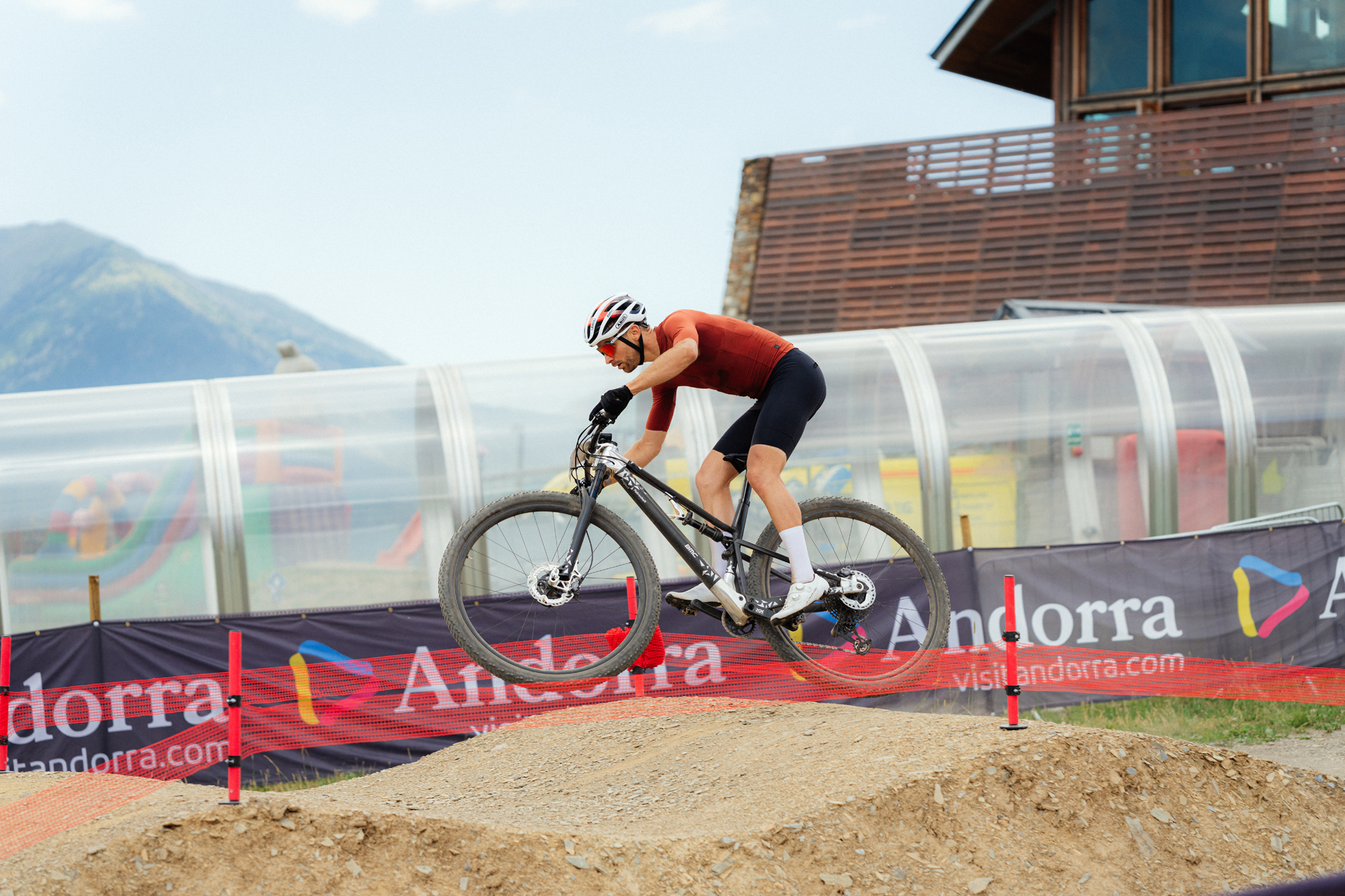
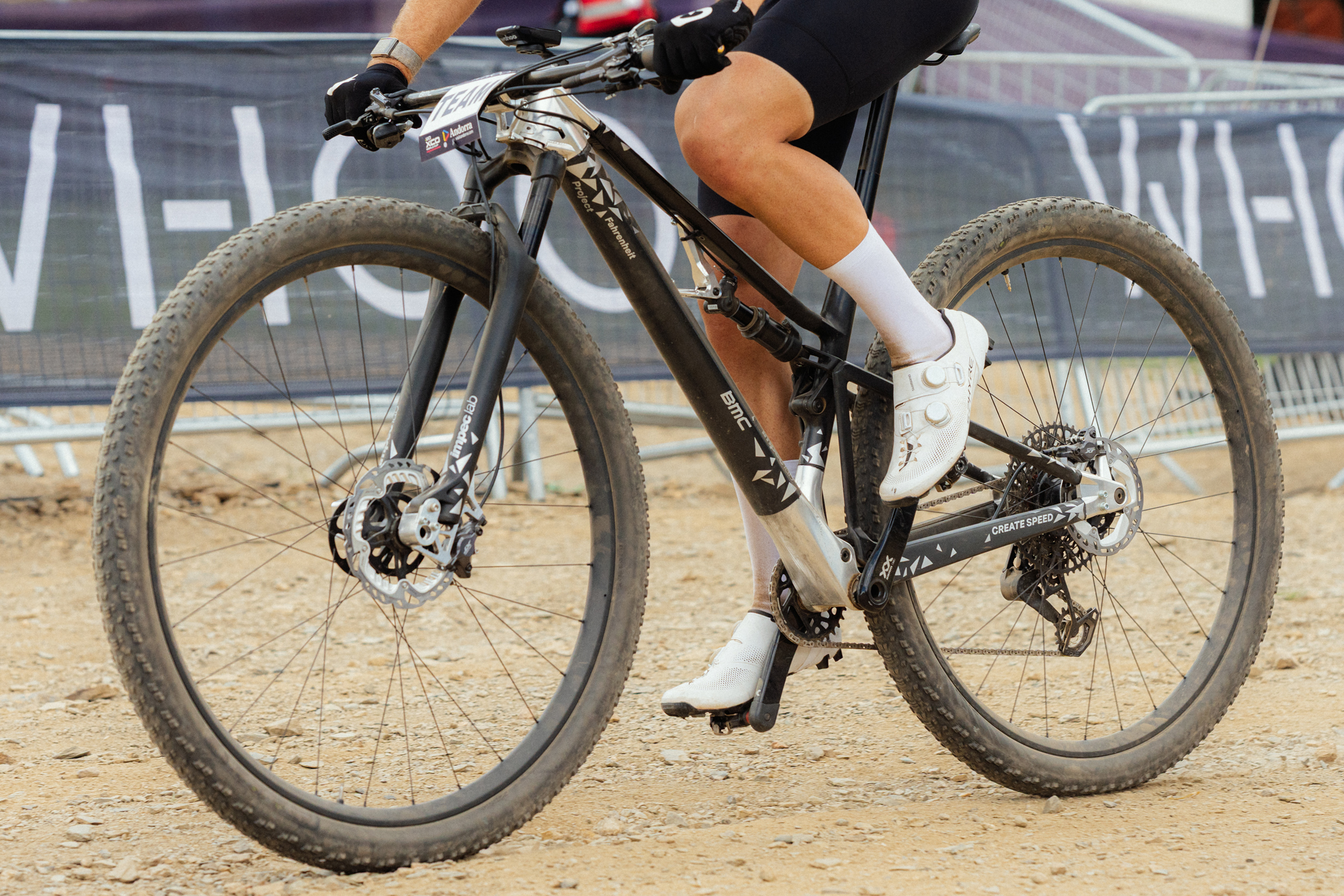
We approached the UCI for comment on whether 32in wheels will be banned or approved for racing at World Cups after spotting BMC’s 32in prototype at the Andorran round of the 2024 series, but no one from the organisation replied.
This official statement is big news for the sport because 32in wheels have the potential to repeat the revolution we saw when mountain bikes shifted from using 26in to 29in wheels in the early-to-late 2000s.
We spotted Maxxis’ 32in tyres at Eurobike. Jack Luke / Our Media
Clearly, the UCI’s decision is based on growing industry momentum behind 32in wheels.
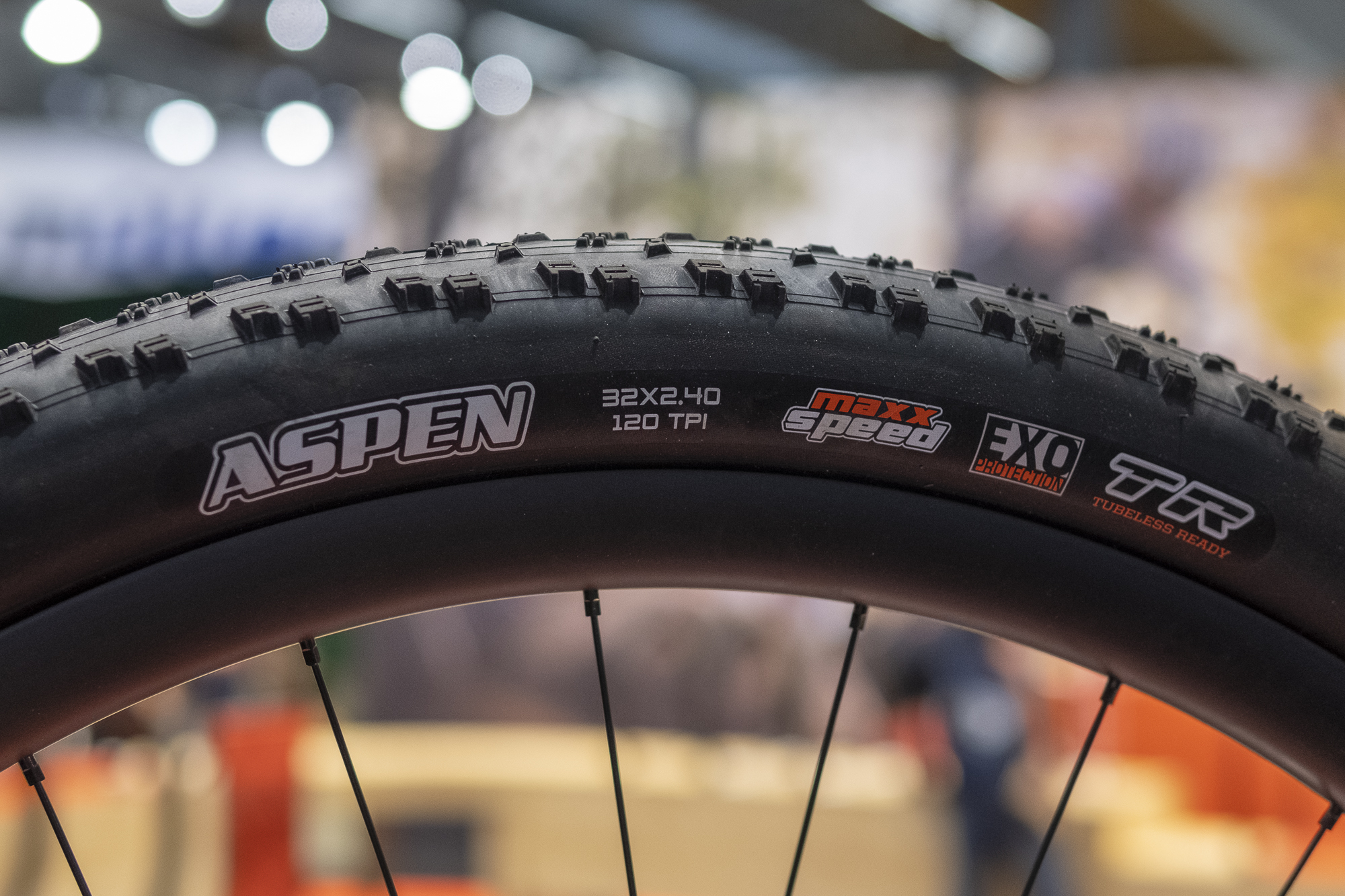
Maxxis is making the 32in Aspen XC race tyre, which was initially intended for the 2024 Olympics.
The BMC bike caused quite a stir, despite only being ridden during practice rather than the race itself.
KTM also teased a 32in XC race bike, but this time a hardtail. The brand seems to think it can make 32in wheels work for any size of rider, which is good news for shorter people wanting to try the new tech.
Brands such as DirtySixer and Zinn are already making 32in mountain bikes – that you can buy right now – and we’ve heard rumours from numerous other brands of their development, indicating the industry is on the cusp of being ready to embrace the new wheel size.
Weighing up the positives and negatives
29in, 27.5in and 26in mountain bike wheel sizes. BikeRadar
Those familiar with the move from 26in to 27.5in and now 29in wheels, and the benefits and negatives each of those wheel sizes offers, should be able to understand the arguments for and against the move from 29in to 32in wheels.
As positives, we’ve got higher rolling speeds and smoother bikes thanks to better bump roll-over, potentially leading to faster speeds and more exciting racing.
A larger tyre-to-ground contact patch should improve grip and slower handling provides more stability.
Negatively, handling may be slow and lethargic in tighter trail situations, and extra watts will be required to get those bigger wheels turning.
Just as on the first 29in-wheeled bikes, frame geometry may be impacted negatively until engineers can master how to fit those bigger wheels within the confines of a bike frame designed for human beings rather than giants.
BMC has confirmed the bike won’t be raced. Piper Albrecht
On the race track, speed is king and the stopwatch doesn’t lie.
Race teams, their bike sponsors, those brands’ engineers and, ultimately, the riders will naturally gravitate towards anything that gives them an advantage over the competition – the only thing that really matters is winning.
I expect many of the biggest race teams will be experimenting with 32in wheels in 2026, especially on faster, less technical courses where those biggest hoops are likely to be most advantageous.
The UCI has given teams carte blanche to do so – now there’s no uncertainty about whether or not a team can or cannot use 32in wheels, you can bet most will be feverously prototyping their own bike.
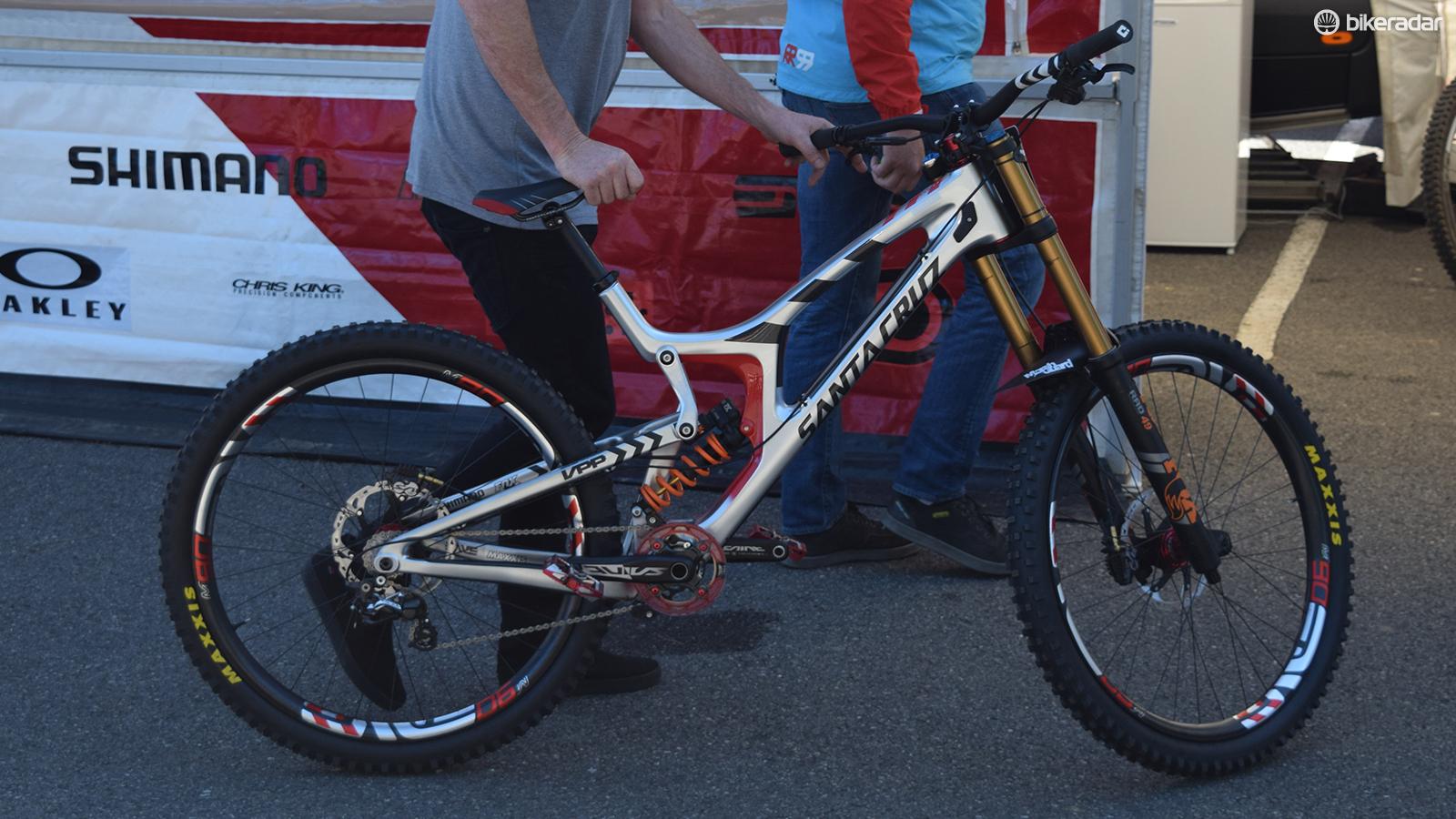
Greg Minnaar, along with the rest of the Santa Cruz Syndicate, raced the new 29in-wheeled V10 at the first round of the 2017 World Cup in Lourdes, France. Seb Stott / Immediate Media
But as we’ve seen in downhill racing, the exact – and winning – formula may take some time to settle on.
In 2017, when Santa Cruz launched its 29in-wheeled V10 at the Lourdes round of the World Cup, it made other brands look as if they were resting on their laurels.
Despite the V10 getting nowhere near the podium, a panicked scrabble ensued among the other manufacturers to produce a 29in-wheeled DH bike. The perceived benefits – real or psychological – were too hard to ignore.
That same back-footed scramble is less likely in the XC world – teams had an early warning with BMC’s prototype, so come 1 May 2026 in South Korea, teams will be ready to debut their polished rigs.
The rules still apply
Mixed wheel sizes are banned by the UCI in XCO events. Piper Albrecht
Despite the UCI’s rather libertarian – and surprising – statement in relation to 32in wheels, there are still rules that XCO race teams have to abide by.
The most important of these doesn’t apply to downhill.
Mixing wheel sizes has the green light for gravity-fed racing, and many bike manufacturers have settled comfortably on the mullet wheel setup being best.
Almost every downhill bike runs a 27.5in rear and 29in front wheel. There are some exceptions, and a lot of bikes can be switched between mullet and pure 29in.
But in the XC world, mixed wheel sizes are not allowed.
There could be plenty of compelling arguments for 29/32in mullets, mostly offering a better balance between the pros and cons I mentioned.
Although this is off the table for 2026’s World Cup series, it wouldn’t surprise me if we see some prototypes of this ilk kicking about at some point soon.
Trek has issued a recall and stop ride notice for more than 75,000 bikes sold in North America, due to an issue with the coaster brake.
The recall was issued last week by the US Consumer Product Safety Commission. It involves models – mostly children’s bikes – from Trek and its subsidiary Electra, alongside replacement wheels.
The recalled Trek and Electra bikes and replacement wheels are as follows:
Electra Townie Rental 1 Step Thru
Trek Precaliber 12
Trek Precaliber 16
Trek Precaliber 20
Trek Sprocket 1 16
Trek Precaliber 12 CB replacement wheel
Trek Precaliber 16 CB replacement wheel
Trek Precaliber 20 CB replacement wheel
Trek says the coaster brake on these products can fail to engage, resulting in the rider losing control and posing a crash hazard.
The rear coaster brake is said not to lubricate the internal surfaces on affected bikes adequately, which could accelerate wear and prevent the brake from working.
No incidents or injuries have been recorded, but users have been advised to contact an authorised Trek or Electra dealer to schedule a free repair at the dealer.
About 68,000 units identified in the recall notice were sold in the USA, while 6,822 were sold in Canada.
A Trek spokesperson told Bike Europe that just over 2,000 Trek Precaliber 12 kids’ bikes delivered to Europe have been affected.
Trek has given retailers recall replacement instructions and a poster to display, while the company is offering a financial incentive globally to ensure affected products are replaced.
“To encourage retailers and consumers to resolve this issue, we are issuing a consumer credit of €20 to spend in the store whilst the wheel is being replaced and compensating the retailer €15 for their labour on any bike affected they complete a claim for,” a Trek spokesperson told Bike Europe.
We all know bananas are a cyclist’s best friend. They’re packed with energy and nutrients, pocket-friendly and come ready-wrapped in biodegradable packaging.
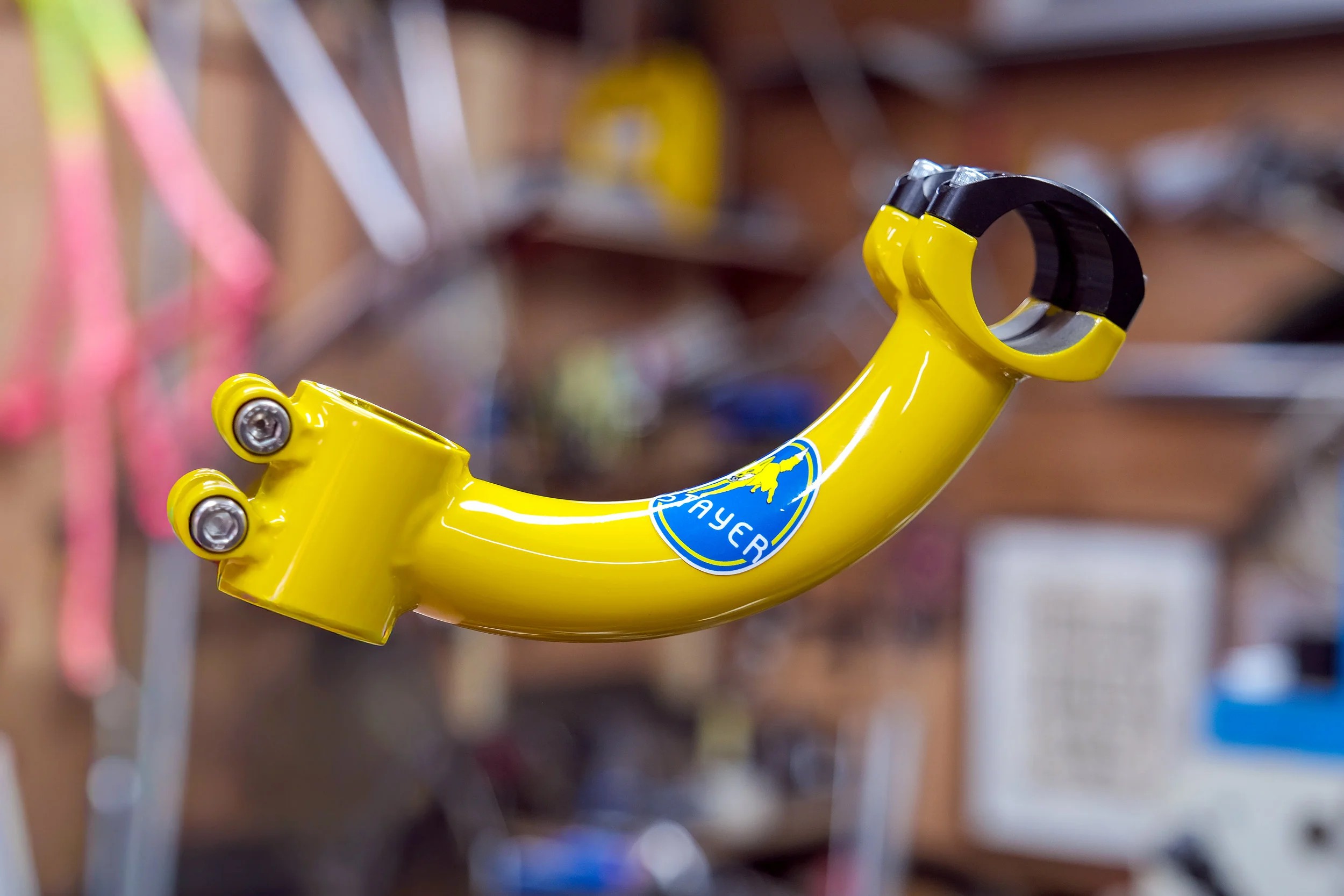
But if your love of bananas goes beyond the edible, why not swap out your stem to Stayer’s Banana Banana? It has 100mm of reach and, thanks to its banana shape, 100mm of rise.
Stayer says the stem has been used to satisfy the appetite of a 6ft 4in rider for a stem that made his cargo bike more comfortable and easier to ride.
The Banana Banana stem was designed to fit a basket to a drop-bar bike. Stayer Cycles
The original bunch of three Banana Banana stems were made in 2021 so that the Wizard Works luggage brand could fit a front basket to a drop-bar bike without it getting in the way of the handlebar, so it wasn’t just a novelty piece.
For the same price as the stem, you could buy around 250kg of bananas at Tesco. Stayer Cycles
If you don’t want a 100mm Banana, you can choose to pre-purchase a 60mm length/rise small Banana. And if you don’t like yellow, you can have a Banana Banana stem in any colour you want – maybe an unripe green one – for an extra £20.
Stayer says the Banana Banana stem will ship at the end of January 2026. With a price of £220, we calculate you could buy almost 250kg of the real thing at Tesco, though, which would be a lot more tasty and make good use of your cargo bike’s carrying capacity.
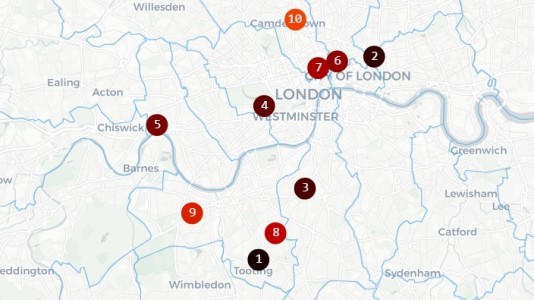
London Cycling Campaign has highlighted 10 junctions in London that it says have, over the past five years, seen the most accidents and fatalities to cyclists and pedestrians.
According to its analysis, the most dangerous junction for cycling is the Upper Tooting Road cluster in Wandsworth, which has been top of the list for the last three years.
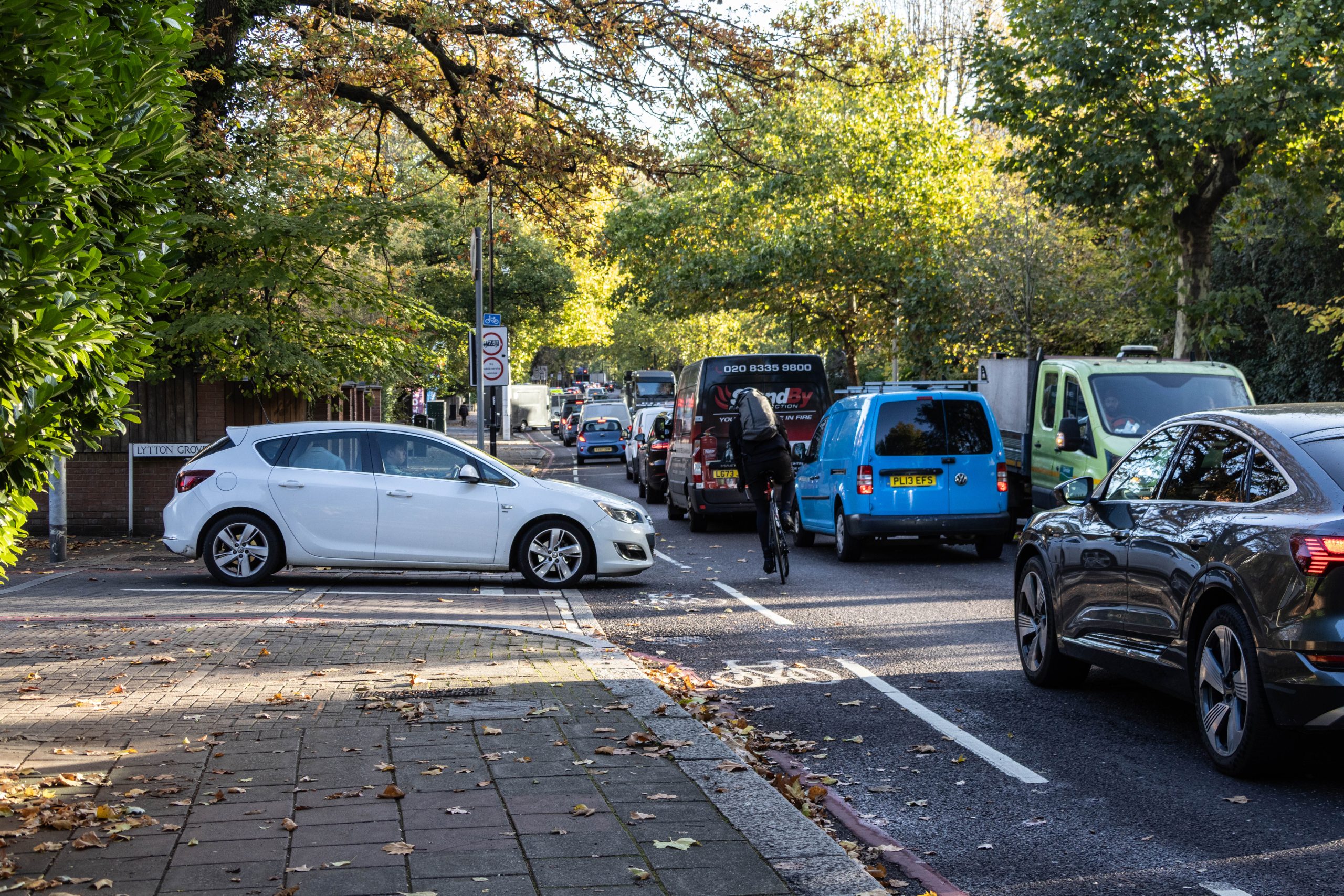
It highlights three ratruns that cross the road: Ansell Road, Lessingham Avenue and Derinton Road, as accident blackspots where, on average over the last five years, two cyclists a year have been seriously injured and four slightly injured.
LCC’s analysis shows that two other high-risk junctions are on the same CS7 Cycle SuperHighway corridor: Clapham High Street and Gauden Road, and Balham High Road and Ramsden Road.
The second most dangerous junction, according to the LCC, is between Great Eastern Street and Curtain Road in Hackney.
LCC highlights vehicle ratruns that cross cycleways as contributors to accidents at blackspots. London Cycle Campaign
It also highlights the junction on Cycleway C9 between King Street and Weltje Road in Hammersmith, which it says is used by motorists as a ratrun between the A4 and King Street, and that crosses the cycleway. It says Hammersmith & Fulham council has failed to take action, despite a number of serious collisions.
Looking at the data overall, LCC says its analysis highlights two factors that underlie accident blackspots: poor-quality junction design along designated cycle routes and the absence of adjacent low-traffic neighbourhoods, which would deter cross-traffic.
Limited mitigation
LCC’s interactive map highlights cycle and pedestrian accident blackspots across Greater London. London Cycle Campaign
LCC has also followed up what action, if any, has been taken to mitigate the risks at the dangerous junctions it has identified. In most cases, it states, little has been done to prevent a future serious collision or fatality, including on the Upper Tooting Road, which we highlighted as one of seven London cycling accident blackspots as long ago as 2016.
LCC’s analysis underlies its interactive dangerous junctions map on its site, which it has just updated with the latest 2024 data from emergency services. The map clusters junctions close to each other, and also weights collisions by severity and how recently they occurred.
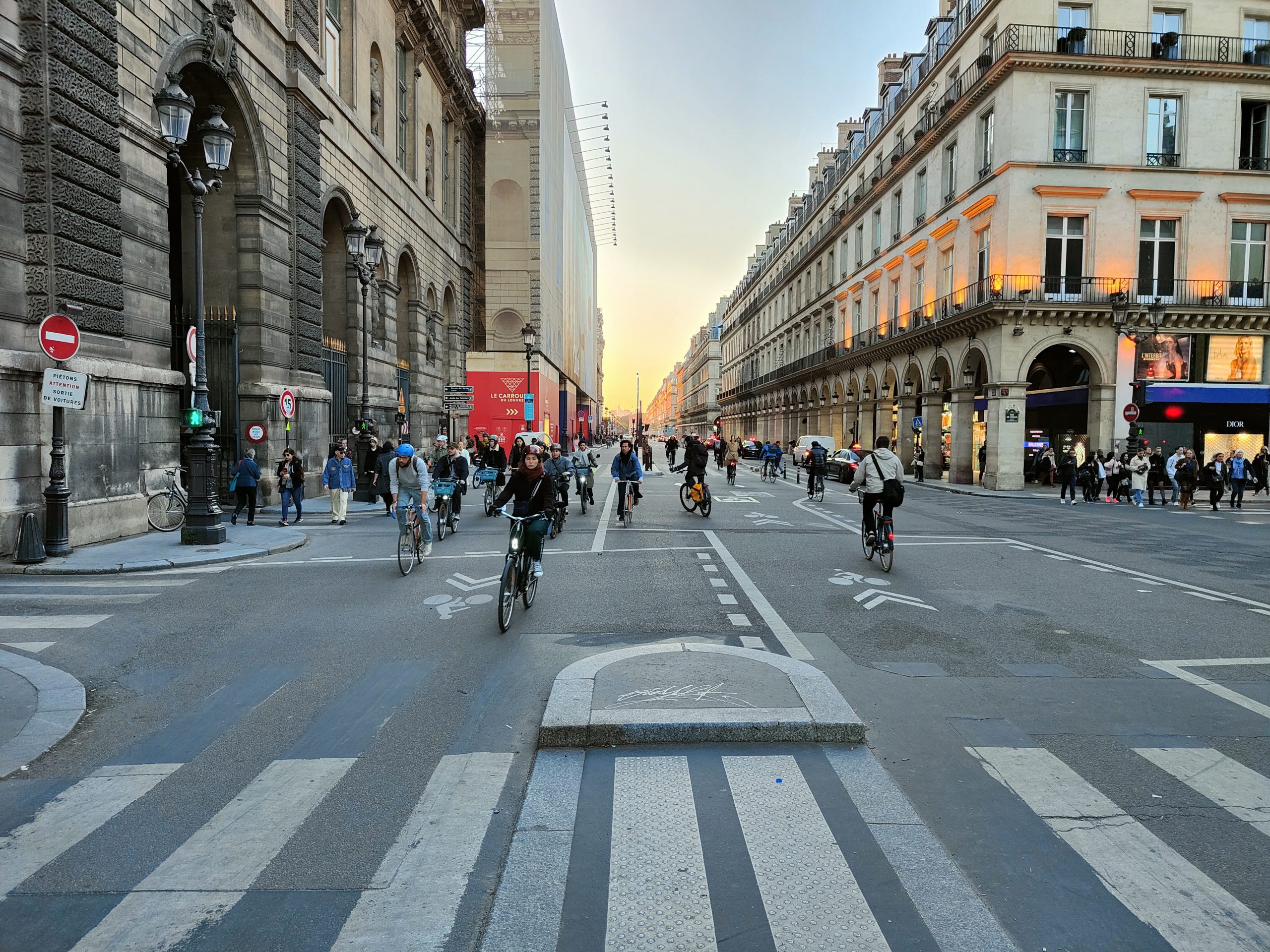
In contrast to London, Paris has done far more to make central areas such as the upmarket Rue de Rivoli cyclist-friendly. London Cycle Campaign
LCC asserts that Transport for London, which recently reported nine cyclist fatalities on London roads in the previous year, has avoided or delayed changes to accident hotspots, claiming that it has aimed to balance collision reduction with its impact on bus journey times.
It suggests more rigorous separation of buses from private motor vehicles, giving them priority and reducing capacity for private vehicles, would be a greater contributor to reduced bus journey times, though.
Alongside its analysis, LCC has launched a new email campaign, directed at the Mayor for London, to highlight its campaign for faster action to reduce risks at known dangerous junctions. You can read more and email the Mayor from its Dangerous Junctions page.
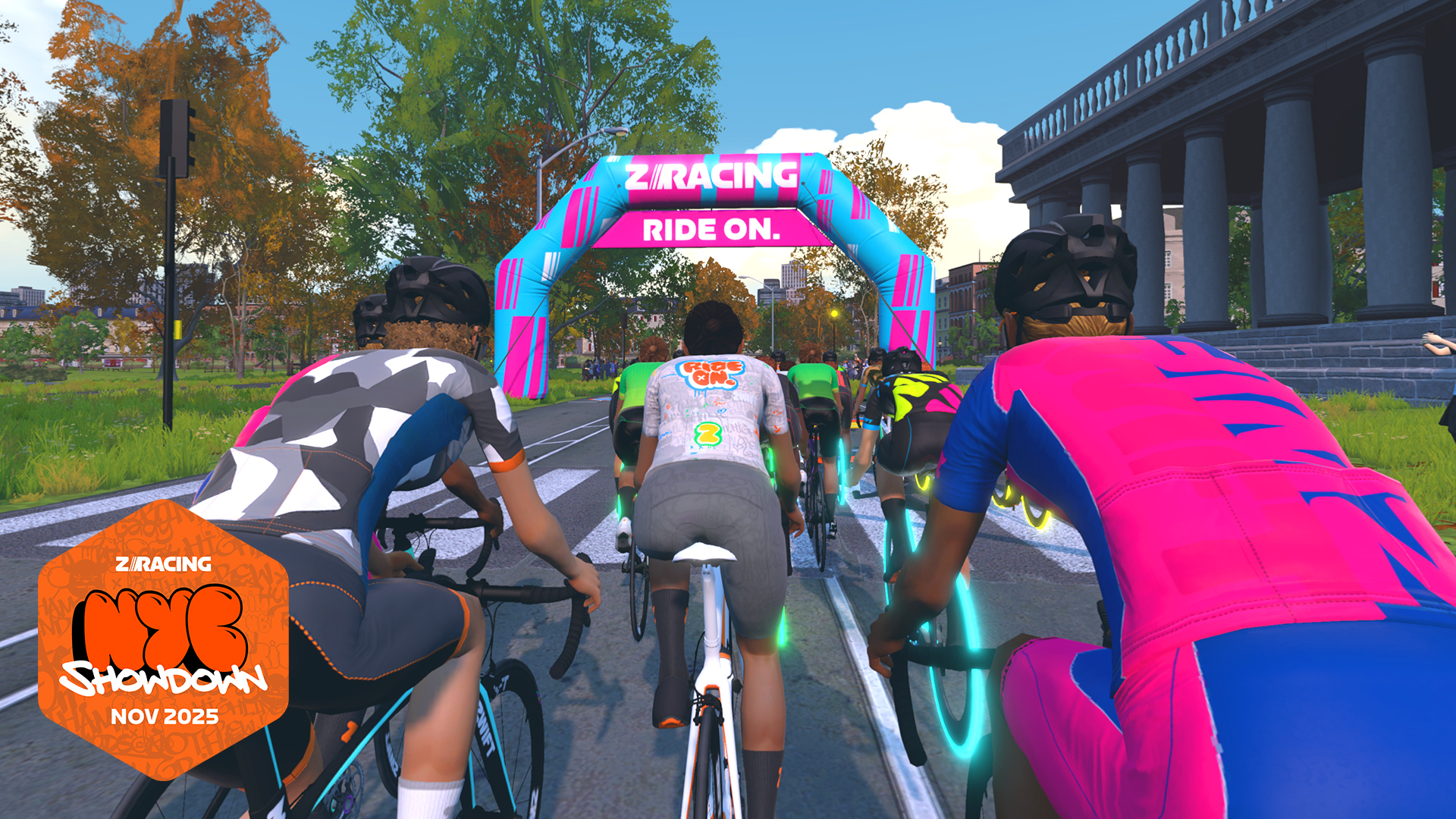
Next week, Zwift is mixing up their typical monthly ZRacing model by holding a week-long series of races on fresh New York routes. Each race is scheduled for just 2-3 days, but everything else is what we know and love about ZRacing… fast, hard races, with an overall time-based GC competition for the three races.
Your GC ranking is based on your best finishing time for each stage, and you can race each stage more than once to try for a better time.
Category Options
Zwift schedules three different flavors of ZRacing events in order to encourage “Fairer, more competitive racing for everyone.” They each use different racing score ranges for categorization and are titled Advanced, Range 1, and Range 2.
Extras
Get the Badge
Each month’s ZRacing series has a unique achievement badge, which you can unlock by finishing every stage for the month. There are no makeup events, so if you miss a stage, you miss out on the badge and competing in the GC.
One and Done
Zwift has planned these events to deliver a solid 1-hour workout, so each race should only take around 1 hour to complete, including your warmup and cooldown.








 CTT Winter Series on Zwift
 Popular
  Giant Bagel Rolls Ride – Whitney’s Comeback