
During the month of September on Phoronix were 271 original Linux/open-source news articles and another 19 featured Linux hardware reviews and benchmark articles, all written by your’s truly. Here is a look back at what excited Linux enthusiasts the most on Phoronix during September…
Category Archives: Unfiltered RSS
T-Mobile’s Starlink satellite service now works with a handful of apps
T-Mobile just announced that its T-Satellite with Starlink service now integrates with several apps. These include AllTrails, AccuWeather, X, WhatsApp and several others. Certain native apps also now integrate with the service, like Google Messages, Apple Music and Samsung’s weather app.
It’s important to note that users won’t always have access to the full app experience here, as satellite connectivity is limited. Some features may be limited and everything is likely to be noticeably slower. Still, being able to look at a map on AllTrails while actually on a trail in the middle of nowhere will be incredibly useful. It’ll be less useful to read some random screed on X while sitting next to the campfire, but whatever gets you through the night.
T-Mobile
T-Mobile promises that WhatsApp will allow for “sending voice notes, sharing photos or even calling your entire group chat.” This is a potential game-changer but it really depends on how slow everything is, which we won’t know until some explorers get out there to put the app through its paces.
The company has also integrated a number of business-focused apps into T-Satellite for those subscribed to the SuperMobile or T-Priority plans. These apps include the communications platform MultiLine and the AI-powered messaging service Dialpad.
T-Satellite uses Starlink satellites to provide coverage in remote parts of the world. It became broadly available back in July after months of testing. The service is available for both Android and iOS devices. It’s free for T-Mobile customers but everyone else can sign up for $10 a month.
This article originally appeared on Engadget at https://www.engadget.com/mobile/smartphones/t-mobiles-starlink-satellite-service-now-works-with-a-handful-of-apps-165732659.html?src=rss
Can today’s AI video models accurately model how the real world works?
Over the last few months, many AI boosters have been increasingly interested in generative video models and their seeming ability to show at least limited emergent knowledge of the physical properties of the real world. That kind of learning could underpin a robust version of a so-called “world model” that would represent a major breakthrough in generative AI’s actual operant real-world capabilities.
Recently, Google’s DeepMind Research tried to add some scientific rigor to how well video models can actually learn about the real world from their training data. In the bluntly titled paper “Video Models are Zero-shot Learners and Reasoners,” the researchers used Google’s Veo 3 model to generate thousands of videos designed to test its abilities across dozens of tasks related to perceiving, modeling, manipulating, and reasoning about the real world.
In the paper, the researchers boldly claim that Veo 3 “can solve a broad variety of tasks it wasn’t explicitly trained for” (that’s the “zero-shot” part of the title) and that video models “are on a path to becoming unified, generalist vision foundation models.” But digging into the actual results of those experiments, the researchers seem to be grading today’s video models on a bit of a curve and assuming future progress will smooth out many of today’s highly inconsistent results.
Microsoft Raises Xbox Game Pass Top Subscription 50% To $30 Monthly
Microsoft has announced that Xbox Game Pass Ultimate will cost $29.99 per month, up from $19.99. The company restructured its subscription service into three tiers ahead of the October 16 launch of two Xbox ROG Ally handheld consoles. The new Essential tier offers 50-plus games for $9.99 monthly. Premium includes 200-plus games for $14.99. Ultimate subscribers gain access to more than 400 games, day-one releases, improved cloud streaming quality, and services including EA Play, Ubisoft+ Classics, and Fortnite Crew.
Game Pass generated nearly $5 billion in fiscal 2025 revenue with 34 million subscribers in 2024. Console hardware prices are also increasing, with the Xbox Series X rising $50 to $649.99 starting October 3.


Read more of this story at Slashdot.
Trailer for del Toro’s Frankenstein is pure macabre mythology
Netflix has released the full official trailer for director Guillermo del Toro’s hotly anticipated new film Frankenstein, starring Oscar Isaac as the brilliant but tragically flawed mad scientist, Victor Frankenstein.
Del Toro has been telling interviewers for years about his enduring love for Mary Shelley’s novel and his long-standing desire to direct a film that would capture the novel’s sense of grand Miltonian tragedy. He loved the original script for Kenneth Branagh’s 1994 adaptation, Mary Shelley’s Frankenstein, but the final film, alas, deviated sharply from that script and was just not that good. After several false starts, del Toro finally signed on to film his vision for Netflix in 2023. He called this film “the culmination of a journey that has occupied most of my life,” at the Netflix Tudum event earlier this year, adding, “Monsters have become my personal belief system. There are strands of Frankenstein through my films.”
“It was a religion for me,” del Toro said during a press conference at the film’s world premiere in Venice last month. “Since I was a kid—I was raised very Catholic—I never quite understood the saints. And then when I saw Boris Karloff on the screen, I understood what a saint or a messiah looked like. So I’ve been following the creature since I was a kid, and I always waited for the movie to be done in the right conditions, both creatively in terms of achieving the scope that it needed for me to make it different, to make it at a scale that you could reconstruct the whole world.”
Here Are All the New AI-Powered Smart Home Features Google Just Announced
Did you know you can customize Google to filter out garbage? Take these steps for better search results, including adding my work at Lifehacker as a preferred source.
On Wednesday, Google officially announced a number of smart home initiatives. Alongside new devices—including Nest cameras, doorbells, and a new Google Home Speaker—the company rolled out a redesigned Google Home app. As you might expect in 2025, Google’s new smart home strategy is powered by the company’s AI, Gemini, with a new branding to boot: Gemini for Home.
The company is making a lot of claims for how its next-generation tech will improve your smart home. We’ll need to wait for the reviewers to put Gemini and the new Google Home app through their paces, not to mention all of Google’s new devices, but until then, we can take a peek at the future Google is selling us on:
Gemini for Home

Credit: Google
Google Assistant is nothing new, but even Google seems to think there’s been room for improvement. The company says the experience was “functional, not intuitive or natural,” which seems to be informing Google’s newest smart home assistant: Gemini for Home.
As you might expect, Gemini is replacing Google Assistant across all Google smart home products. The company’s argument here is that the new experience is much more natural than before: Previously, you might have needed to ensure your commands were succinct and to the point for the assistant to understand them. Going forward, Google says you can take advantage of the AI’s contextual awareness for more casual requests.
If you’re asking for help fixing your dishwasher, for example, you don’t need to preface each request with the problem at hand. You can begin with a question like “Hey Google, my dishwasher is having trouble draining. Where should I start?” If it suggests you check the filter, you don’t need to say “Hey Google, I’m trying to get my dishwasher to drain, but the filter seems fine. What’s the next step?” Instead, you can simply follow up with “Hey Google, the filter seems fine. What’s next?” Google says Gemini will understand the context, and continue to help.
If you want to bypass the the constant “Hey Googles,” you can say “Hey Google, let’s chat.” This kicks on Gemini Live, the AI’s voice mode, which let’s you have a back and forth with Gemini.
The company says you can do the same when asking questions about things like songs and movies. If you want to look up a song from a movie, but you don’t remember the name of either, you can share vague details about the movie and Gemini supposedly can put the pieces together.
Perhaps most importantly for the smart home itself, Google says Gemini can handle more complex requests. For example, you can ask it to turn off all lights except for a specific room, or trust that the AI will understand the context of the room you’re asking about, e.g., “Can you turn on the lights by the oven” will mean turning on the lights in the kitchen. My favorite of Google’s promised features, however, is that you can ask Gemini to add items to your grocery lists from recipes, rather than individual items. You can simply request a shopping list for Pad Thai, and, according to Google, Gemini will add all the ingredients necessary to your shopping list.
Gemini with smart cameras
Credit: Google
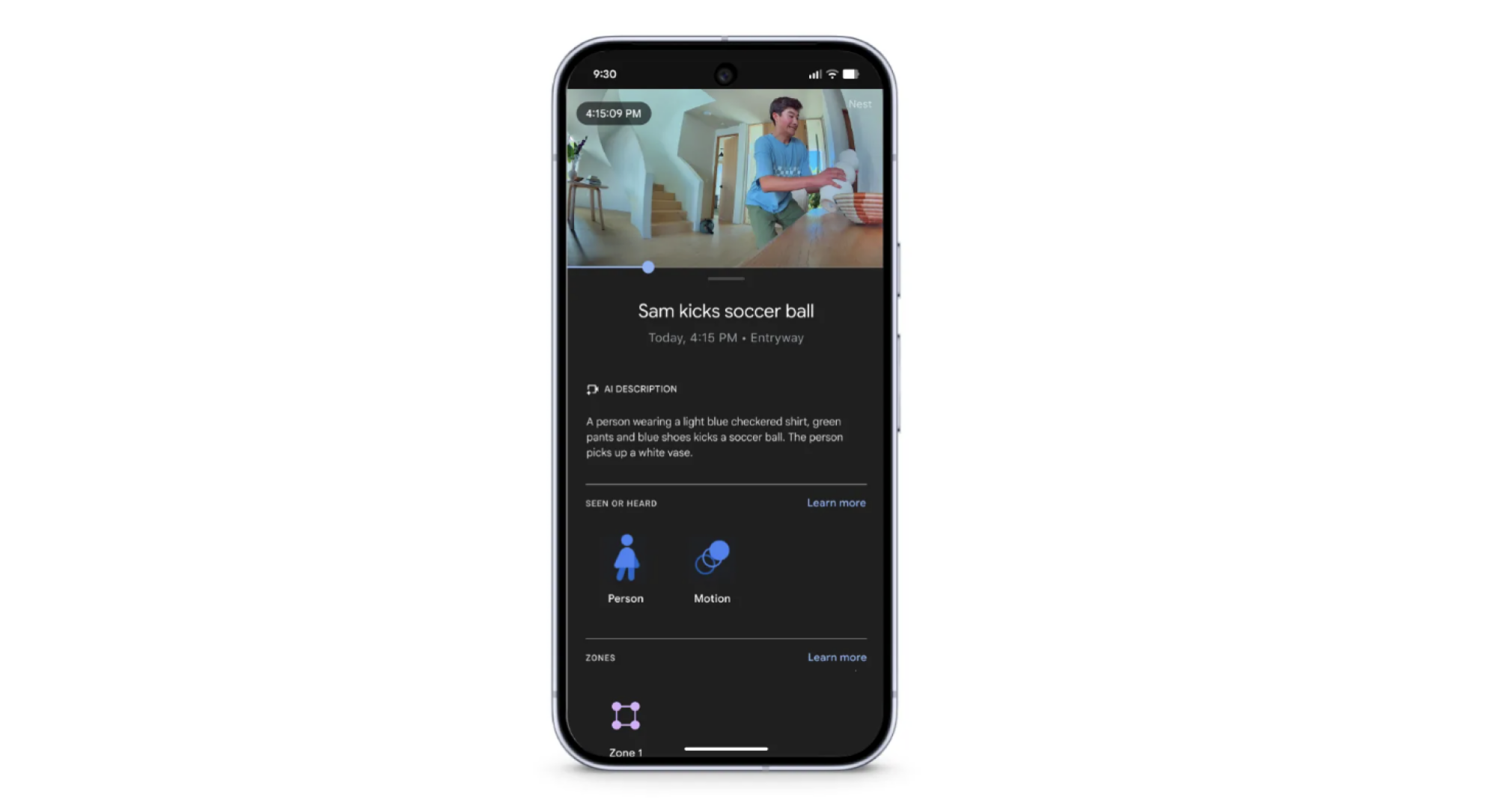
Google says Gemini for Home can also upgrade smart cameras connected to Google Home. The company argues that most smart camera alerts are “low context,” pinging you with things like “motion detected” or “person detected,” but leaving the rest on you to figure out what’s really going on.
With Gemini for Home, Google says it is using AI to make your smart camera experience more contextual. Alerts will offer a “full narrative of what’s happening,” so you can learn from the notification itself whether you have a USPS delivery, or simply a shadow moving in front of the camera. Gemini will also organize and summarize all of the day’s video clips—you can choose whether to review all the videos taken, or simply scan the summary for any updates the AI thought important. Google says you can ask Gemini questions about your clips, as well.
Speaking of which, you can ask Gemini to find specific video clips using natural language. Google says you can ask questions like “When did the kids get home,” or “Did I leave the car door open today?”
The new Google Home app
Credit: Google
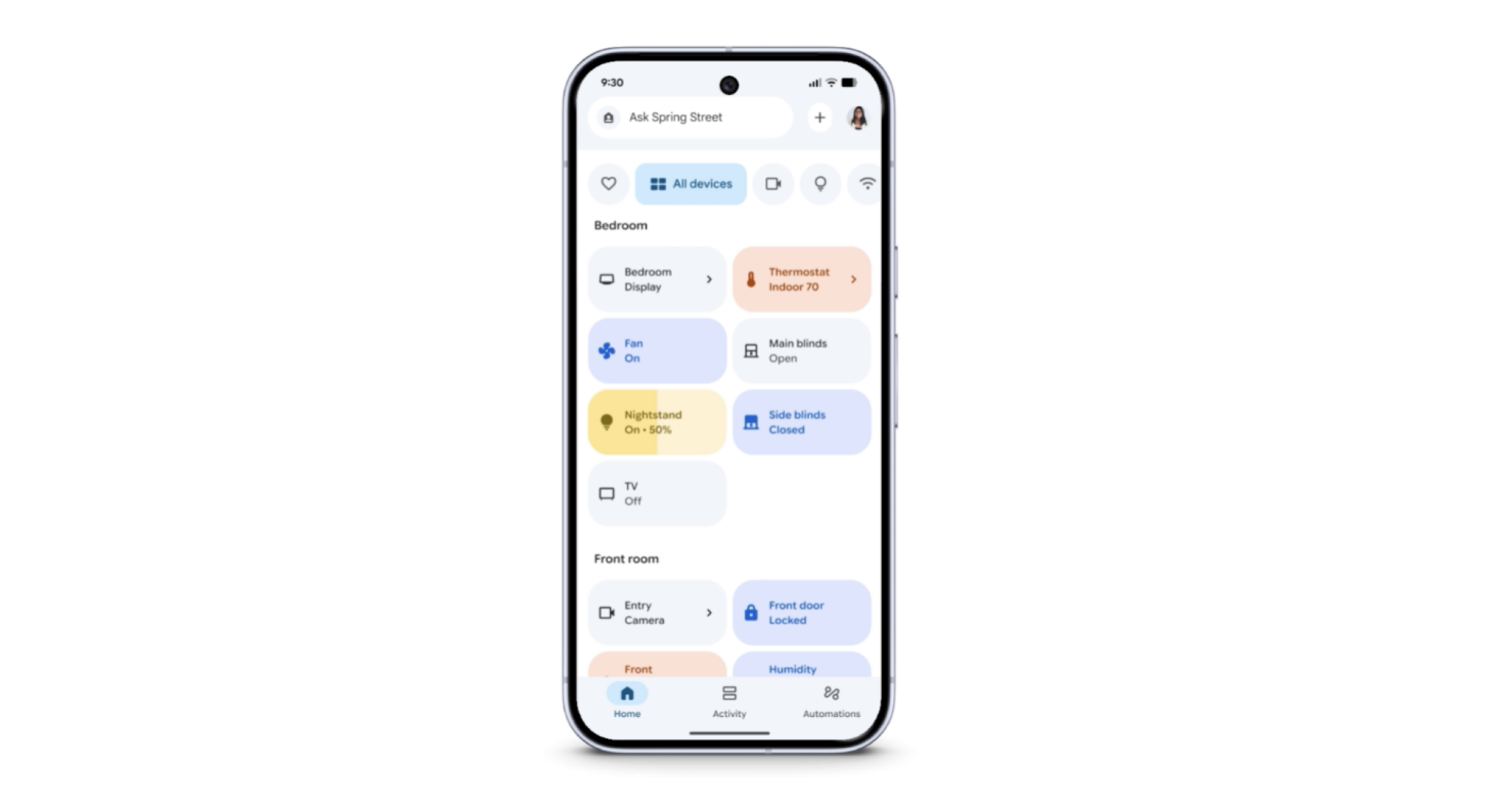
Tying all these updates together is the overhauled Google Home app, which reportedly has over 100 new features and performance improvements. Google says there were three goals in mind with this particular update: “Make it faster, more reliable, and complete.”
To that first point, the app should perform quite well, if the company is to be believed. Google claims its new Home app is over 70% faster on some Android devices than before, with crashes down by almost 80%, while smart camera live views supposedly load 30% faster with 40% fewer playback failures.
The new design comes with three main tabs: There’s the Home tab, which is where you see all of the controls for your smart home devices. Within this tab, there are swipeable menus for things like Favorites and devices. Next, there’s the Activity tab, which contains your home’s activity history. You can see when a routine was started, when motion was detected on a camera, and when a light was turned off. Finally, there’s the Automations tab: You can see which automations are coming up, access your entire automations collection, and create new automations as well.
Google has also integrated “the best” of the Nest app into the new Home app. While the dedicated Nest app is still available, Google clearly intends for Nest functionality to live here long-term. That includes support for Nest Thermostats from 2015 on, as well as Nest Protect smoke and CO emergency alerts and Nest x Yale Lock passcode management. Google says the experience of controlling previous Nest devices is also enhanced in the new app, with higher frame rates and faster loading times.
Finally, there’s “Ask Home,” a new Gemini-powered feature that aims to make it easy to find any element of your smart home. For example, Google says you can type things like “lights” or “living room” to find deices and automations related to those queries. You can look up clips from your smart cameras, stack multiple smart home commands together, or create an automation with natural language.
Google says all of these changes are rolling out today, Wednesday, Oct. 1 around the globe.
The second-gen Apple Watch SE drops to a record-low price ahead of Prime Day
If, like me, you’re wondering how it could possibly be October already, perhaps you need a watch. Probably one with a calendar function. Strangely enough, there are some solid deals on several Apple Watch models right now ahead of Amazon’s Prime Big Deal Days event. The second-gen Apple Watch SE with LTE connectivity has dropped to $189, which is a discount of $110 or 37 percent.
That’s a new record low price for this 40mm variant with a small/medium band. The discount applies to versions with an ink sport loop and denim sport band.
It’s worth bearing in mind that this deal is for the previous-gen model, which Apple released in 2022. The company started shipping the latest Apple Watch SE in September. That starts at $240 for a GPS and Wi-Fi model without LTE connectivity. The third-gen SE 3 is now our pick for the best budget Apple Watch. However, if you’re looking for a cheaper option for fitness tracking, at-a-glance notifications and, perhaps, quick access to a calendar, the second-gen SE is worth considering.
Several variants of the Apple Watch Series 10 are on sale on Amazon as well. This is last year’s version of the smartwatch, but it’s still plenty capable and it supports some of the same new features as the Series 11, such as sleep apnea detection and sleep scoring. You can pick one up for as little as $329.
This article originally appeared on Engadget at https://www.engadget.com/deals/the-second-gen-apple-watch-se-drops-to-a-record-low-price-ahead-of-prime-day-162845138.html?src=rss
Taiwan rejects Trump’s demand to shift 50% of chip manufacturing into US
Taiwan has no plans to move half its chip production into the US, Vice Premier Cheng Li-chiun confirmed, quickly pushing back on seemingly false claims that the US had raised the condition during recent trade talks.
US Commerce Secretary Howard Lutnick had suggested that Taiwan was currently mulling moving half its semiconductor supply chain to the US in exchange for “some kind of security guarantee,” as Taiwan faces the ongoing threat of a potential Chinese invasion. Trump has maintained since taking office that reshoring of semiconductor supply chains is critical for economic and national security, and Lutnick indicated that Taiwan should agree to the unusual terms because it needs the US for protection.
But speaking Wednesday, Cheng said that while “certain progress” has been made in trade talks, Taiwan has not only made “no such commitment” but that “this issue was not discussed in this round of negotiation, and we will not agree to such a condition,” Bloomberg reported.
Holy Carp! Wee Beastie’s 4.75L Mini Fishtank Gaming PC Packs An RTX 4070 GPU
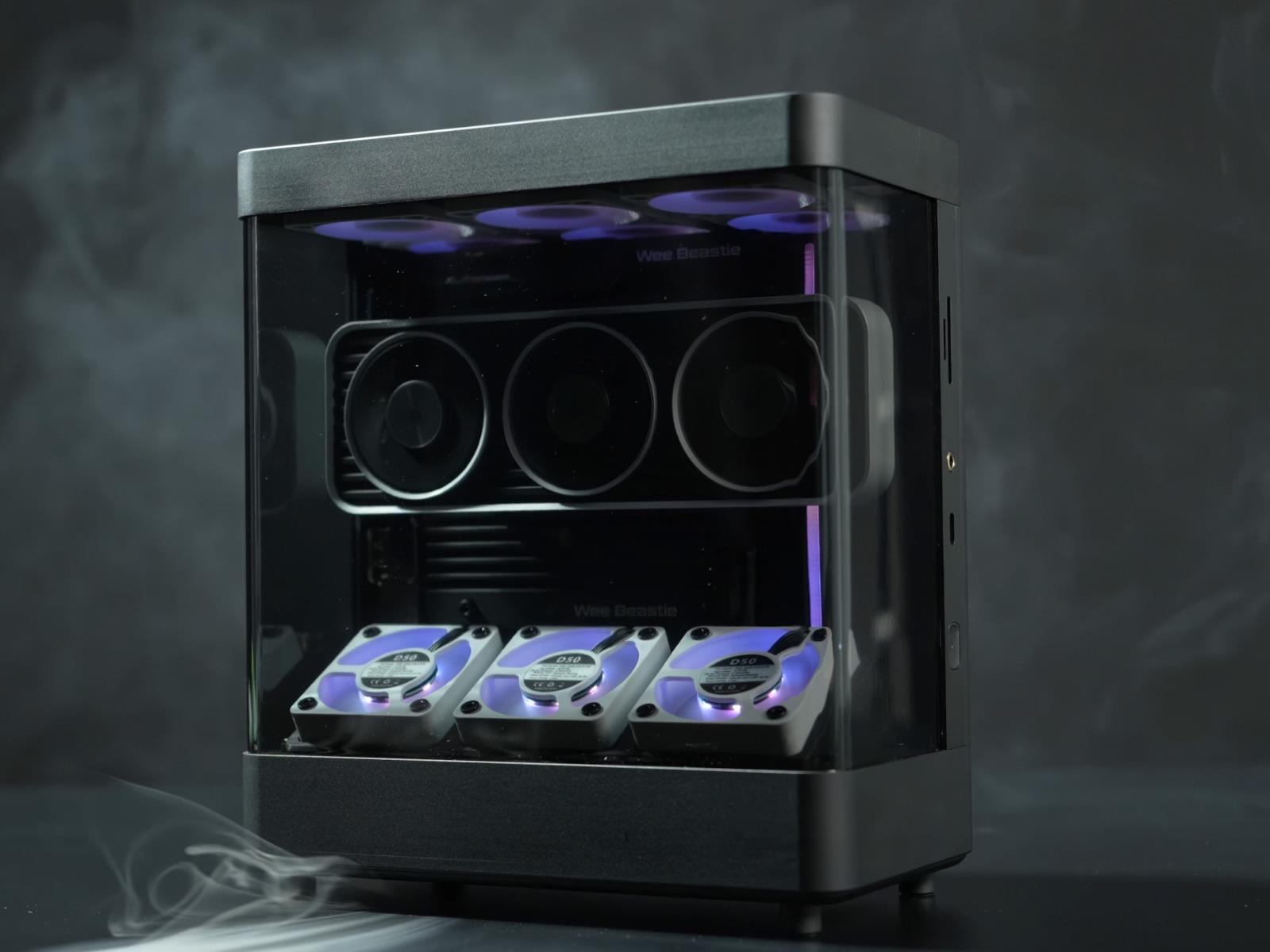
A new and unique crowdfunded mini PC project is making waves thanks to its desktop-class components and fishtank-style design—meet the Wee Beastie Super Mini Gaming PC. Its “Super Mini” fishtank design comes in at a footprint of just 4.75 liters, or total dimensions of 200 x 110 x 217 millimeters. That’s pretty compact (though not as small
Nadella Appoints New CEO To Run Microsoft’s Biggest Businesses
Microsoft is promoting Judson Althoff, currently executive vice president and chief commercial officer at Microsoft, to a new role as CEO of its commercial business. From a report: It’s the latest shakeup inside the company, as Microsoft navigates what CEO Satya Nadella calls a “tectonic AI platform shift.” It’s also a move that will allow Nadella to focus on more technical work at Microsoft, while still remaining overall CEO.
In an internal memo to employees today, Nadella announced Althoff’s promotion and said it’s linked with the need for Microsoft to reinvent itself in the AI era and “bring together sales, marketing, operations, and engineering to drive growth and strengthen our position as the partner of choice for AI transformation.” Althoff has led Microsoft’s global sales organization for the past nine years, helping the company build out its Microsoft Customer and Partner Solutions (MCAPS) division. He will now also be responsible for the operations and marketing teams that help sell Microsoft’s software and services to businesses, but not the engineering teams that help build them.


Read more of this story at Slashdot.
Microsoft 365 Premium aims to deliver more AI value than ChatGPT Plus
Microsoft is adding another subscription plan to its already confusing list of offerings. The new Microsoft 365 Premium plan, which costs $20 a month, bundles the company’s standard Office productivity suite together with access to OpenAI’s latest models and extended AI usage limits.
Microsoft positions it as a more valuable subscription than OpenAI’s ChatGPT Plus, which also costs $20 a month and doesn’t have the benefit of Office apps or the 1TB of OneDrive storage you get with all Microsoft 365 subscriptions. (That’s certainly an odd way to treat a close partner.)
Thankfully, Microsoft isn’t touching the pricing of its $10-a-month MS 365 Personal plan, or the $13 monthly MS 365 Family subscription — for now, anyway. The company just announced today that it’s pushing its GamePass Ultimate subscription to $30-a-month, much to the chagrin of gamers everywhere.
In a way, the Microsoft 365 Premium plan simplifies Microsoft’s offerings a bit. If you had one of the cheaper MS 365 plans, you’d still need to pay another $20 a month to get access to higher AI usage limits with the Copilot Pro subscription. Microsoft hasn’t made any updates about what’s happening with Copilot Pro, but it seems redundant and overpriced now that MS 365 Premium is available.
According to the company, Microsoft 365 Premium will get you access to GPT-5 and 4o, as well as AI agents including “Actions, Researcher and Analyst.” That’s directly comparable to OpenAI’s plan, which uses ChatGPT Agent’s instead of Microsoft’s. MS 365 Premium users will also be able to test new AI features as they’re available, but they won’t have access to OpenAI’s custom GPTs or Sora video generation.
This article originally appeared on Engadget at https://www.engadget.com/ai/microsoft-365-premium-aims-to-deliver-more-ai-value-than-chatgpt-plus-160008060.html?src=rss
UK once again demands backdoor to Apple’s encrypted cloud storage
The UK government has issued a new order to Apple to create a backdoor into its cloud storage service, this time targeting only British users’ data, despite US claims that Britain had abandoned all attempts to break the tech giant’s encryption.
The UK Home Office demanded in early September that Apple create a means to allow officials access to encrypted cloud backups, but stipulated that the order applied only to British citizens’ data, according to people briefed on the matter.
A previous technical capability notice (TCN) issued in January sought global access to encrypted user data. That move sparked a diplomatic clash between the UK and US governments and threatened to derail the two nations’ efforts to secure a trade agreement.
Meta will soon use AI chats for ad targeting because of course it will
Meta will start scraping conversations with AI chatbots to gather data for the purpose of ad targeting. The company says this data will be used to “personalize the content and ads” that people see across apps like Facebook and Instagram.
The “feature” goes into effect on December 16 and Meta will start sending out in-product notifications and emails about the move on October 7. The company says this change is coming to “most regions” throughout the world, but the launch won’t impact the EU and South Korea at first.
Meta
Meta gives an example of a user talking with an AI chatbot about hiking and then seeing ads about, you guessed it, hiking. “As a result, you might start seeing recommendations for hiking groups, posts from friends about trails or ads for hiking boots,” it wrote in a blog post.
“People’s interactions simply are going to be another piece of the input that will inform the personalization of feeds and ads,” Christy Harris, privacy policy manager at Meta, told Reuters.
This is the same type of ad targeting that has followed us around the internet for ages, but one-on-one conversations have typically been excluded from this sort of thing. This is just another reminder that AI chatbots are not your friends.
There will be no way to opt out of this, according to reporting by The Wall Street Journal. If you talk to a Meta chatbot, it’ll be scraping. The company notes that the chatbots will not scrape data pertaining to “topics such as their religious views, sexual orientation, political views, health, racial or ethnic origin, philosophical beliefs or trade union membership.” I’d recommend not discussing those things with an AI chatbot no matter what Meta says.
This article originally appeared on Engadget at https://www.engadget.com/ai/meta-will-soon-use-ai-chats-for-ad-targeting-because-of-course-it-will-153319626.html?src=rss
My Favorite Amazon Deal of the Day: Amazon Echo Buds With ANC
We may earn a commission from links on this page. Deal pricing and availability subject to change after time of publication.
Did you know you can customize Google to filter out garbage? Take these steps for better search results, including adding my work at Lifehacker as a preferred source.
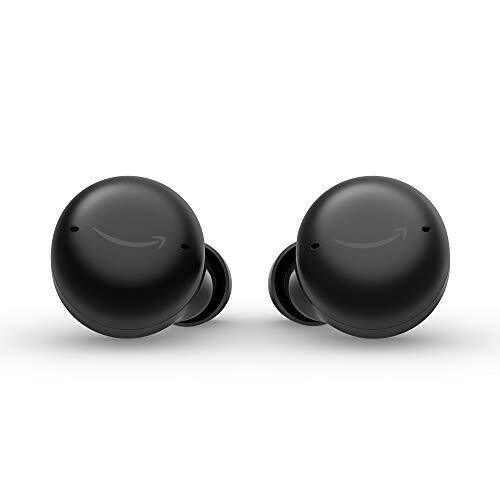
As we get closer to the big sales from Walmart, Target, and Best Buy that October Prime Day brings, early deals start popping up. Right now, you can find many early deals on Amazon and Amazon-owned brands, many of which are matching Prime Day prices (and you don’t need to be a Prime Member to take advantage of them). The Active Noise Canceling (ANC) Amazon Echo Buds are one of the best earbud deals right now, currently $34.99 (originally $119.99) after a 71% discount, the lowest price it has ever been, according to price-tracking tools.
(2021 release, 2nd gen) | Wired charging case | Black
Amazon Echo Buds with Active Noise Cancellation
$34.99
at Amazon
$119.99
Save $85.00
Save $85.00
$34.99
at Amazon
$119.99
Save $85.00
Save $85.00
The best and most distinguishing feature of these ANC earbuds is the hands-free voice-assistant control. With Alexa, Siri, or Google Assistant on your phone, you’ll be able to stream music, podcasts, or audiobooks hands-free by just asking your virtual assistant. You can also make calls, set reminders, skip songs, and do basically everything else you can do with a voice assistant.
These Echo Buds also have a multipoint pairing feature that can connect to two devices at the same time and seamlessly transition to whichever is playing media. You’ll get up to five hours of battery and an additional 15 hours from the case (whether it’s wireless or not). They’re also rated IPX4 for water resistance. You can read the full PCMag “excellent” review here to learn more about their specs and features.
These earphones were eclipsed by the third-generation Echo Buds in 2023, which are a more budget-friendly version without ANC. Both are good headphones, but for just $10 more, it’s worth getting the version with ANC, unless you’re just trying to spend the least amount possible.
Our Best Editor-Vetted Early Prime Day Deals Right Now
Blink Outdoor 4 XR + Mini 2 — Wireless and plug-in security cameras, motion detection, extended range. Sync Module XR included — 2 camera system + Mini 2 (Black)
—
$74.99
(List Price $219.98)
Kindle Essentials Bundle including Kindle (2024 release) – Black, Fabric Cover – Matcha, and Power Adapter
—
$117.97
(List Price $161.97)
Deals are selected by our commerce team
China’s K-visa Plans Spark Worries of a Talent Flood
An anonymous reader shares a report: Immigration anxieties and a challenging job market have sparked an online backlash over China’s latest attempt at attracting global talent — a new visa program announced in August. The program, which was rolled out on Wednesday with the aim of attracting foreign professionals, will also test how China balances its immigration policy with its pursuit of technological ambitions.
Under the new rules, young graduates — in the fields of science, technology, engineering and mathematics or STEM — no longer need backing from a local employer and can enjoy more flexibility in terms for entry frequency and duration of stay. The keyword “K-visa” — as China’s new visa category is called — was among the top searches on social media site Weibo for days, before chatter about National Day traffic jams pushed it off the charts as millions hit the road for a week-long holiday.
Chinese social media users argue that the new visa tilts the playing field toward foreign graduates at the expense of those educated in China. Others on Weibo warned that without employer sponsorship, the program could invite fraudulent applications and open the door to a surge in arrivals from developing countries, piling pressure on an already strained labor market.


Read more of this story at Slashdot.
How automakers are reacting to the end of the $7,500 EV tax credit
Just after midnight this morning, in addition to getting a federal government shutdown, we also lost all federal tax credits for new electric vehicles, used electric vehicles, and commercial electric vehicles.
Sadly, this was not a surprise. During last year’s election, the Trump campaign made no secret of its disgust toward clean vehicles (and clean energy in general), and it promised to end subsidies meant to encourage Americans to switch from internal combustion engines to EVs. Once in power, the Republicans moved quickly to make this happen.
Federal clean vehicle incentives had only recently been revamped in then-US President Joe Biden’s massive investment in clean technologies as part of the Inflation Reduction Act of 2022. To qualify for the $7,500 tax credit, a new EV had to have its final assembly in North America, and certain percentages of its battery content needed to be domestically sourced.
Alienware 16 Area-51 review: A fully retooled gaming mothership
Alienware is at its best when it makes no-holds-barred gaming machines that are big on style and performance. By reviving an iconic nameplate and combining it with an all-new design packing some seriously intergalactic vibes, the Alienware 16 Area-51 laptop is just that. Sure, it’s so big and heavy that you won’t want to move it around very often. And battery life be damned, because if you aren’t plugged in, you probably aren’t pushing those pixels hard enough. But if you’re in the market for a classic desktop-replacement gaming notebook with flagship specs and an unmistakable aesthetic, this rig represents a beastly return to form.
Design: A revamped spaceship
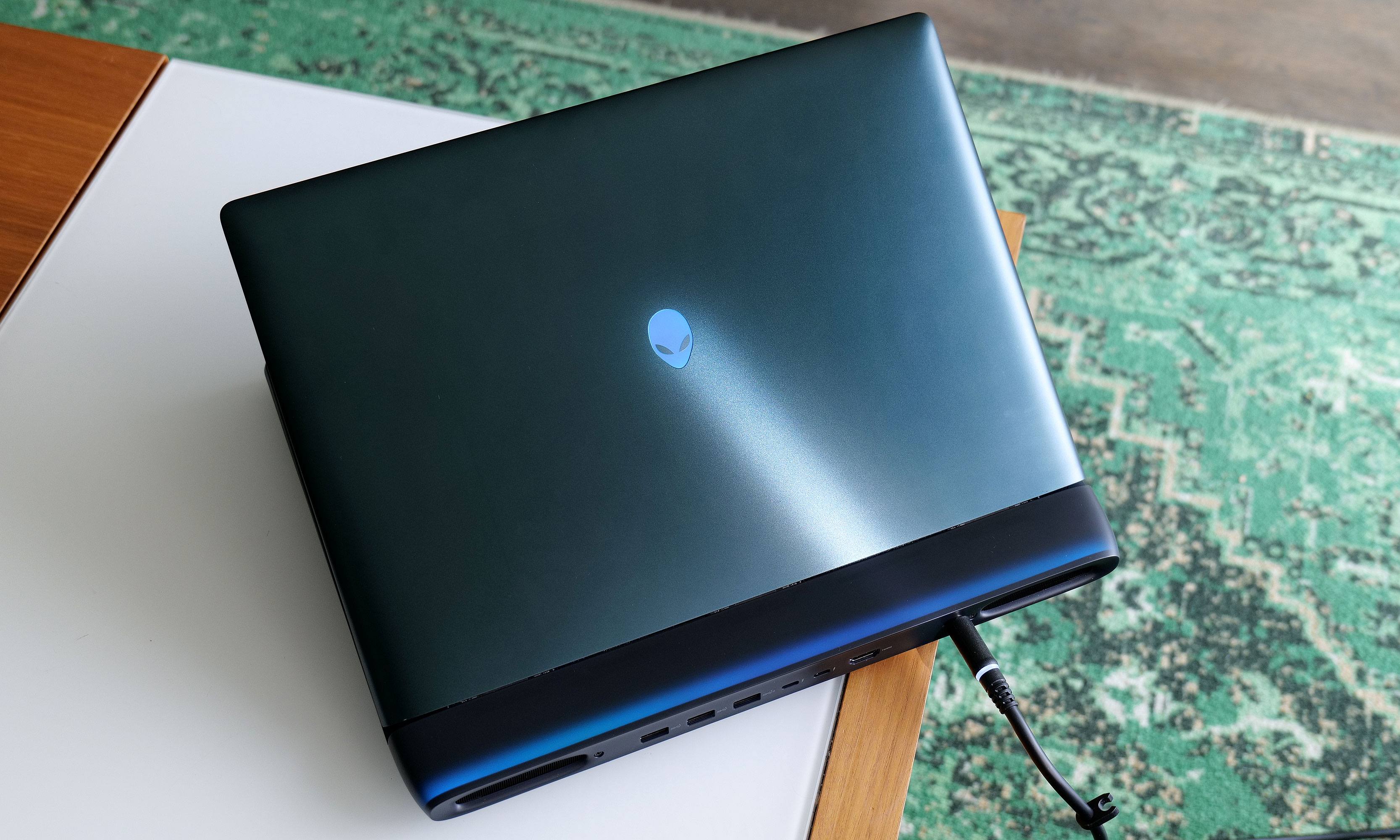
Alienware’s industrial design is so far out there that its systems have almost become a shorthand for gamer culture in movies and TV. But for this generation, I think the company has done a great job of creating something unique that’s also a bit more sophisticated than before. To start, there’s Alienware’s “Liquid Teal” paint job. It’s the only available color and in person, it looks more like the kind of deep emerald green you’d see on a car due to the way it shifts and shimmers depending on the light. As always, there’s Alienware’s classic logo in the middle of the lid, complete with customizable lighting. On the inside, there are nice touches like RGB-lit fans, punchy up-firing speakers and a clicky mechanical keyboard with deep travel that reminds you that if you aren’t using this system to frag some enemies every now and then, you’re probably doing it wrong.
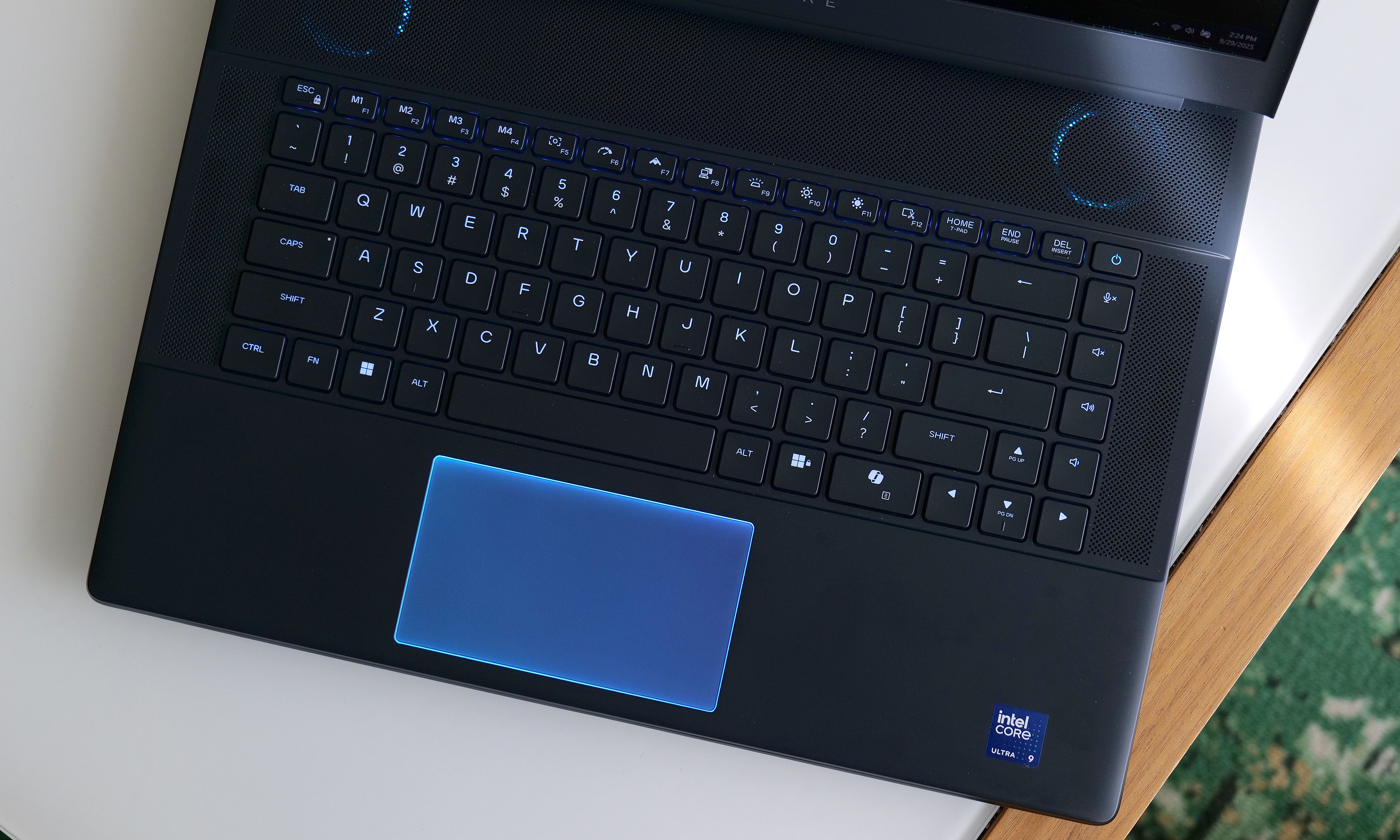
Sam Rutherford for Engadget
My favorite design element is the little window on the bottom of the laptop. At first, this seems like overkill, because just like men’s shoes, how often do you really look at the bottom of a PC? But if desktop PCs can have glass panels that show off the insides of the machines, why not laptops too? More importantly, Alienware’s raised Cryo Chamber (that’s its technical name) improves thermals thanks to increased airflow and a hidden exhaust that helps move heat away from critical components like the GPU. Even so, the vent’s placement means you’re still not going to want to use this on your lap for prolonged periods (especially while gaming). But as a feature that would normally be purely functional, Alienware’s solution is clever and stylish.
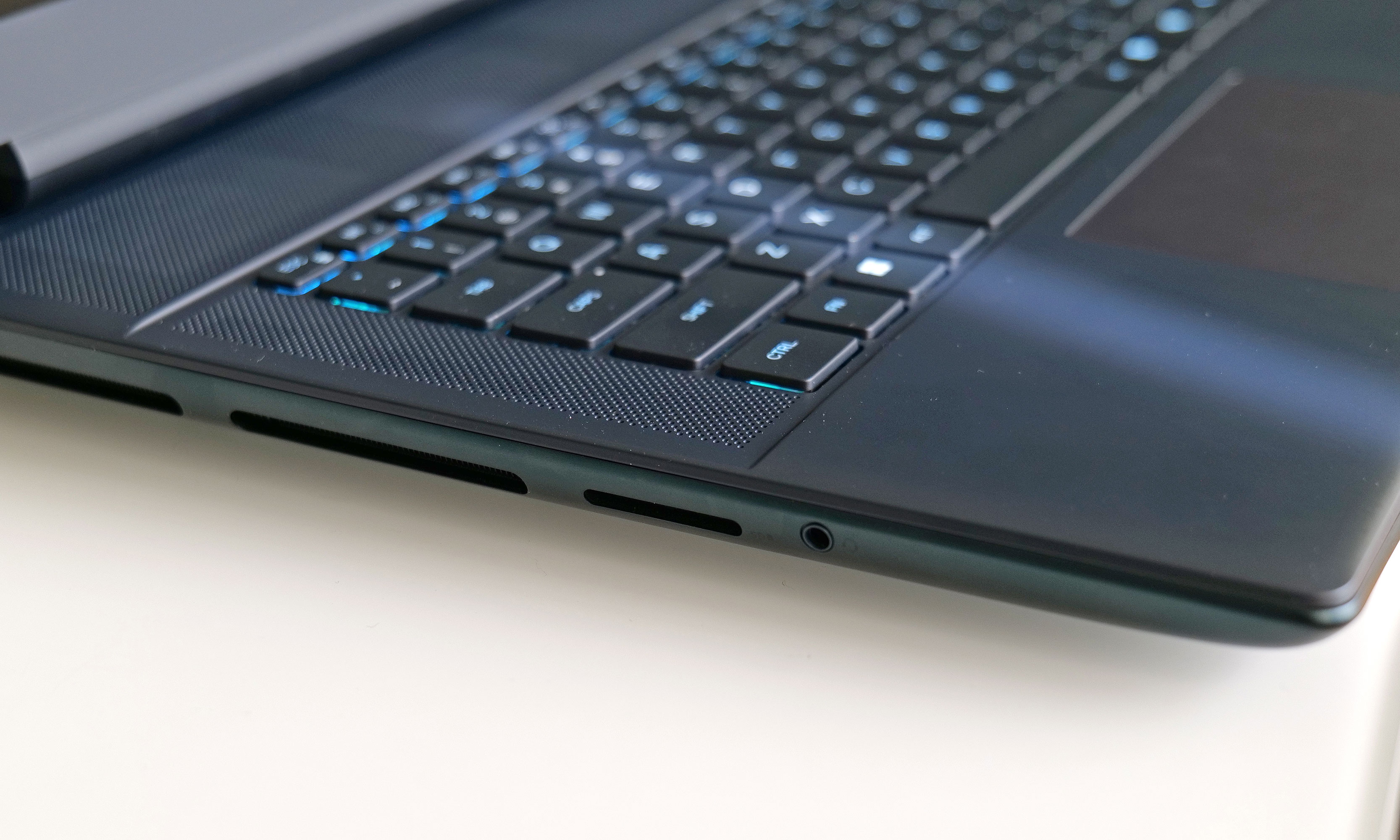
Sam Rutherford for Engadget
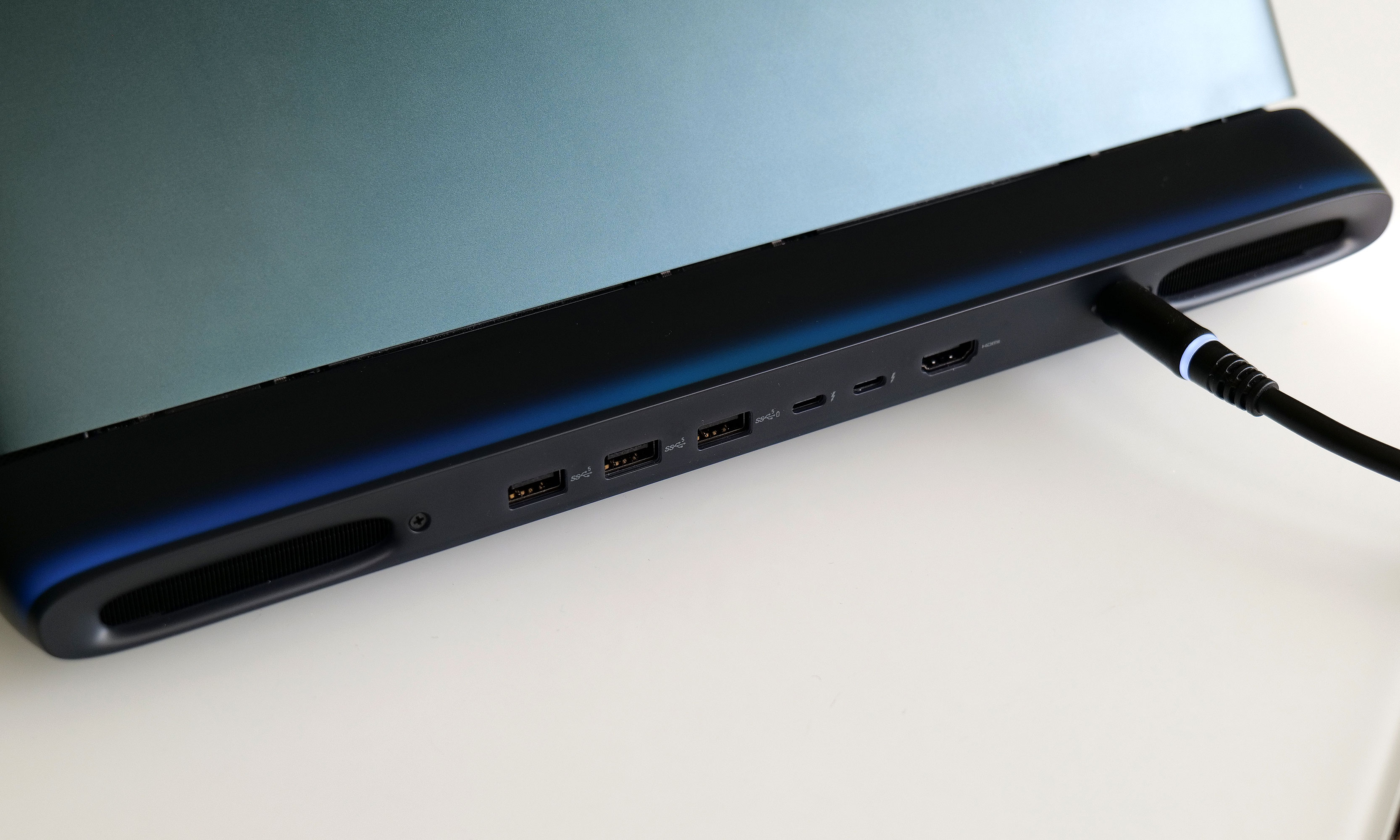
Of course, the downside to adding extra glass to an already hefty notebook is that it makes this thing even less travel-friendly. Weighing 7.5 pounds, the Alienware 16 Area-51 is actually closer to a typical 18-inch notebook like a Dell 18 Pro Max (7.2 pounds) than a similarly-sized non-gaming machine. On top of that, while the Area-51 offers a wealth of connectivity options (three USB-A, two USB-C and HDMI 2.1), most of its ports are in the back. That’s great for keeping cables tidy and out of the way, but they are a bit harder to reach, which reinforces the notion that you won’t be moving this PC around very much. I just wish Alienware had made room for a single USB-C port somewhere on either side. Having a full-size SD card reader and 3.5mm audio on the left is super handy for quickly transferring media or plugging in headphones, but it would have been nice to have one more spot for accessories like thumb drives so you could avoid fumbling around in the back.
Display: Bright and fast, but more choice would be nice
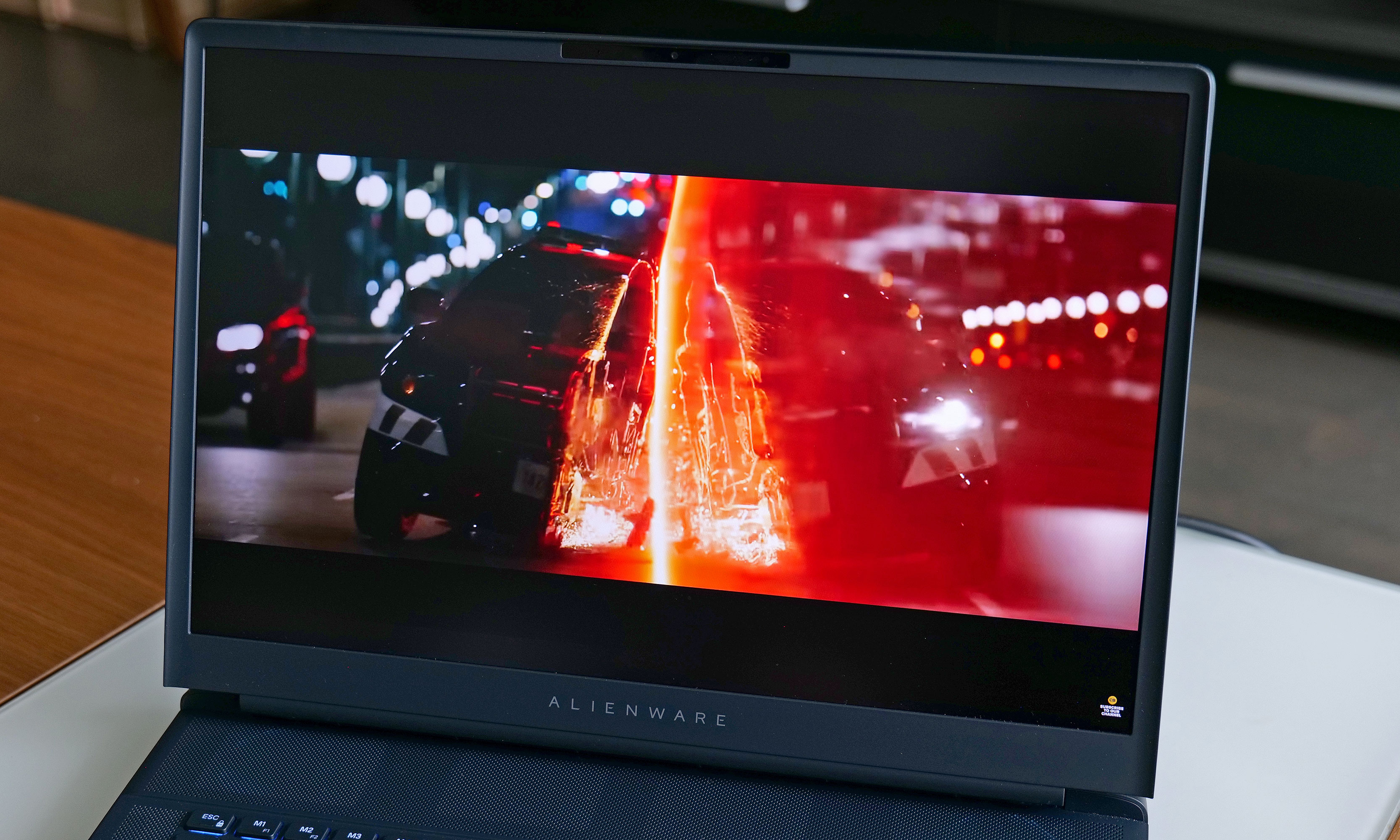
Sam Rutherford for Engadget
The Alienware 16 Area-51 packs a 2,560 x 1,600 display with a 240Hz refresh rate, G-Sync support and 500 nits of brightness. In a vacuum, it’s a really solid panel. It has a matte coating to reduce reflections while still producing vibrant colors that look good even in sunny rooms. My only gripe is that for a flagship system, I would have liked to see some other display options.
For demanding gamers, or people planning to use the system for photo or video editing, a 4K screen upgrade (preferably an OLED one) would be a great option. Alternatively, with the Area-51 capable of accommodating up to an RTX 5090 GPU, a panel with a 300Hz or higher refresh rate could have been a nice choice for the hardcore competitive crowd. And sadly, even if you feel like upgrading to the 16-inch model’s bigger brother, there aren’t any additional display options available for that version either.
Performance: More cooling, more speed
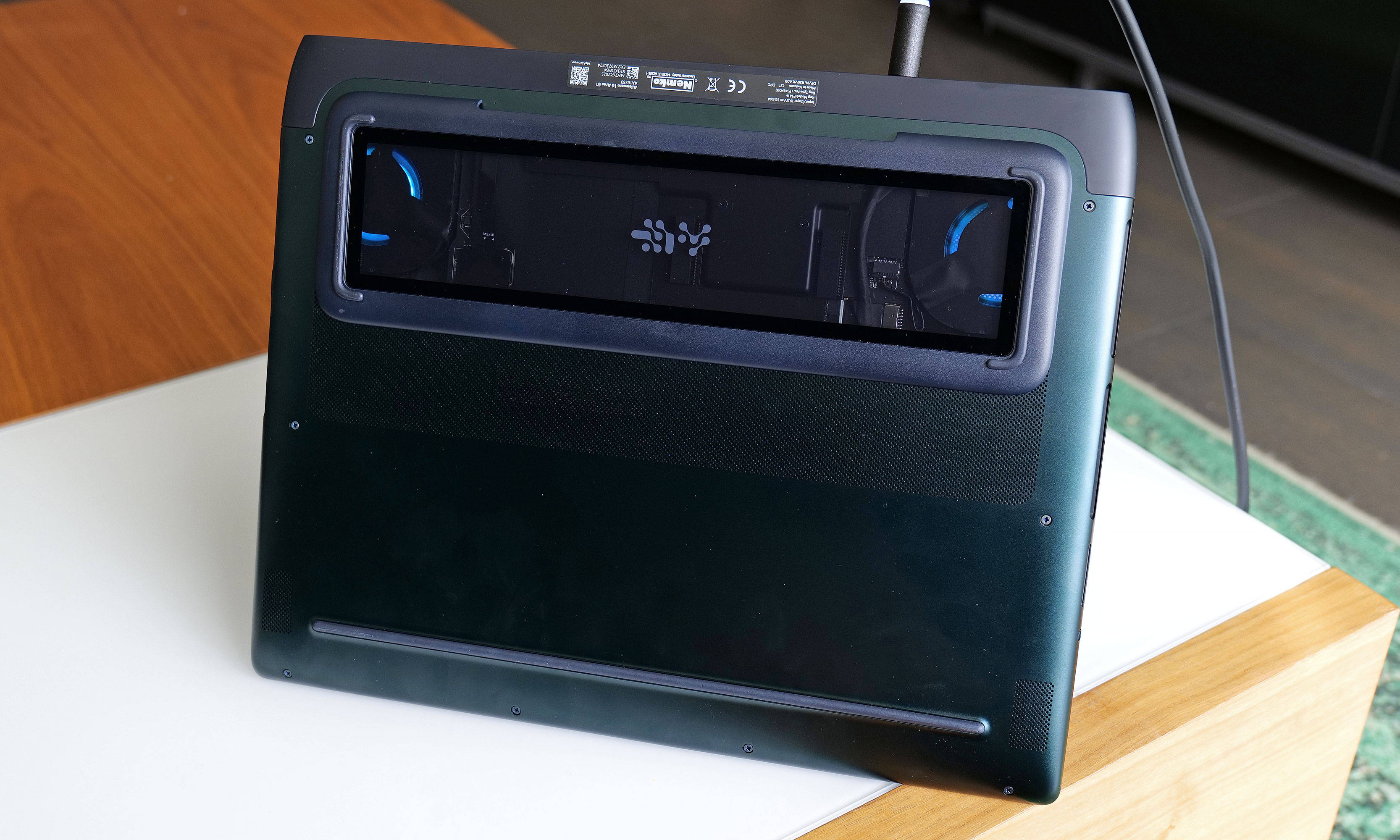
Sam Rutherford for Engadget
Our $2,800 review unit features an Intel Core Ultra 9 275HX CPU with 24 cores, 32GB of RAM, 2TB of SSD storage and an NVIDIA RTX 5080 GPU. Unsurprisingly, a loaded system like this had no issues handling games like Cyberpunk 2077. Even when using Ultra graphics presets at 1080p with ray tracing turned on, the Area-51 still hit 90 fps. Meanwhile, in Control, the Alienware fared even better at the same resolution and Epic settings when it reached 154 fps.
Thankfully, if you don’t have nearly $3,000 to burn, the Area-51 is rather configurable. A base model starts at a more affordable $2,000 with an Intel Core Ultra 7 255HX chip, 16GB of RAM and an RTX 5060. On the other hand, if you want all-out performance, you can load this thing up with an RTX 5090, but doing so currently starts at $3,550.
Battery life: Don’t leave home without your power cord
Sam Rutherford for Engadget
Peter Parker’s beloved Uncle Ben once said “With great power comes great energy draw” (or something like that), and the Area-51 is a perfect example of that. On PCMark 10’s Modern Office battery rundown test, Alienware’s laptop only lasted four hours and thirteen minutes. That’s more than three hours less than what we got from its predecessor — the m16 R2 (7:51) — and five hours less than last year’s ASUS ROG Zephyrus G16 (9:17). When I retested the ASUS only using its GPU (instead of automatically switching to onboard graphics), its time of 3:08 was worse. So when it comes to power-hungry portable gaming machines like these, if you plan on using them away from an outlet on a regular basis, you’d better make sure you have a portable charging solution on hand.
Wrap-up
Sam Rutherford for Engadget
Even though the Alienware 16 Area-51 might not be as portable as some of its rivals, it’s got a lot to offer. There’s a striking design, a nice screen (though more options would be nice), tons of ports and class-leading performance with plenty of configurability so you can dial in its specs exactly how you like. Granted, Alienware’s attention-grabbing space-age aesthetics might not be for folks who aren’t ready to be beamed up to the mothership. But aside from its short battery life and high price for well-equipped models, this system delivers pretty much everything you want from a flagship gaming laptop.
This article originally appeared on Engadget at https://www.engadget.com/computing/laptops/alienware-16-area-51-review-a-fully-retooled-gaming-mothership-150000871.html?src=rss
Oura Rings Finally Get a Charging Case
We may earn a commission from links on this page.
Oura has finally answered my biggest (yet perhaps pettiest) complaint about its iconic smart ring—it’s now getting a battery-powered charging case so you can top up the battery when you’re away from your home. There are also new ring colors available, and finally, multi-ring support so you can switch between rings.
In addition, Oura has announced Health Panels, a feature that lets you book a blood draw at a Quest lab and view your results in the Oura app. Whoop recently announced a similar feature, and Ultrahuman launched its Blood Vision earlier this year.
Why I’m excited for the charging case
In all the time that I’ve been using Oura rings—since generation 2—the charger has worked the same way: You have a little circular stand that lives on your nightstand, and you set the ring on top of it, fitting it around a little cylinder shape that sticks up from the base. I’ve never loved this format; it’s too easy to send the ring flying if you catch your foot on the cord in the dark. It’s also not the most convenient for travel.
Now, however, the Oura ring has a charging case. The case holds about five charges’ worth of battery, so you can top up the charge on your ring by popping it into the case, then closing the case and sticking it in your pocket. Or gym bag. (Weightlifting workouts are my favorite time to charge the ring.) Traveling with the charger is now simple, and you don’t have to worry about losing the ring if the charger gets knocked over.
Now for the bad news: This puppy is $99, and it’s a separate add-on; you can’t get it in place of the nightstand charger when buying a new ring.
Like the nightstand chargers, it’s specific to the size of your ring. For example, you need a size 8 charger for a size 8 ring. The new charging case doesn’t seem to be available on Oura’s website yet, but it should be coming soon. (If you can’t wait, or want to save a few bucks, I found this third-party case that holds your nightstand charger—either generation 3 or 4. It’s not as sleek as the official one, though.)
You can now swap between rings
Today Oura announced a new collection of ceramic rings in four different colors: white, navy, pastel green, and pink. The new rings have the same internals as the metallic Ring 4, so this isn’t a new generation of ring, just a new appearance. (Oura also notes that the ceramic rings should be more resistant to scratches, and each one comes with a polishing pad to keep its shine.) All colors are $499, the same price as the gold and rose gold finishes of the regular Ring 4.
With so many color options, Oura seems to hope existing members will splurge on a second ring. The company is rolling out multi-ring support for the app, another feature I’m surprised they didn’t have before. (When I’ve tested the gen 3 and 4 rings to compare, I’ve had to completely reset my ring to switch over, or else use two different accounts.) Oura says you’ll need to select in the app which one you’re wearing, so it’s not quite as seamless as the way Garmin or Apple handles multiple devices. (Garmin has me choose a “priority device” and then I can switch at will; Apple just sets you free to swap as you like, and it does its best).
If you are done with your old ring after upgrading, Oura now has a ring recycling service that gives you a shipping label to send back your old ring. Any Oura ring can be recycled through this program, including old or broken ones. (You should factory-reset the ring first.) Rings you recycle won’t be eligible for returns or refunds.
EXT4, EROFS & NTFS3 File-System Drivers Ready With Improvements For Linux 6.18
In addition to XFS enabling online fsck by default, Bcachefs being stripped from the mainline Linux kernel, and Btrfs improvements making for a notable first few days of the Linux 6.18 window, there’s more. The EXT4, EROFS, and NTFS3 drivers are bringing the latest batch of file-system changes for Linux 6.18…
Microsoft jacks the price of Game Pass Ultimate up to $30 a month
Microsoft has announced some major changes for Game Pass. It’s rebranding some of the tiers, which should make it a little easier to keep tabs on what games and features are available on each.
However, there are some painful price increases here. The high-end plan, Game Pass Ultimate now costs $30 per month. That’s a 50 percent price increase from the previous $20 per month, and there’s no annual or quarterly option available to make that sting less.
That means the price of a Game Pass Ultimate membership has nearly doubled in 15 months. Microsoft previously raised the price from $17 to $20 in July 2024. The latest change now means that, at $360 per year, Game Pass Ultimate is now more than twice as expensive as PlayStation Plus Premium, which is currently $160 on an annual plan.
Microsoft recently announced a price increase for its Xbox Series X/S consoles as well. The systems will be more expensive to buy in the US starting this Friday. Also, pre-orders for the ROG Xbox Ally handheld just went live, with Microsoft confirming that the higher-end model would cost $1,000. It’s getting really expensive to be an Xbox fan, folks.
This story is developing; refresh for updates.
This article originally appeared on Engadget at https://www.engadget.com/microsoft-jacks-the-price-of-game-pass-ultimate-up-to-30-a-month-142441307.html?src=rss