ICEBlock, an app designed to inform users of reported sightings of Immigration and Customs Enforcement (ICE) agents within a 5-mile radius, has been removed from the Apple App Store. The app rose to prominence during the immigration raids that took place in several cities earlier this year. Apple made the move to ban the app after being pressured
With the AI boom, construction of new data centers has skyrocketed, and not without consequence — some communities that count these facilities as neighbors are now facing water shortages and strained power supplies. While tech’s data center footprint has been growing for decades, generative AI has seemingly shifted the impacts of these operations toward the catastrophic. What exactly makes these new data centers such a burden on the environment and existing infrastructure, and is there anything we can do to fix it?
Chips
The industry believes AI will work its way into every corner of our lives, and so needs to build sufficient capacity to address that anticipated demand. But the hardware used to make AI work is so much more resource-intensive than standard cloud computing facilities that it requires a dramatic shift in how data centers are engineered.
Typically the most important part of a computer is its “brain,” the Central Processing Unit (CPU). It’s designed to compute a wide variety of tasks, tackling them one at a time. Imagine a CPU as a one-lane motorway in which every vehicle, no matter the size, can get from A to B at extraordinary speed. What AI relies on instead are Graphics Processing Units (GPU), which are clusters of smaller, more specialized processors all running in parallel. In the example, a GPU is a thousand-lane motorway with a speed limit of just 30 mph. Both try to get a huge number of figurative vehicles to their destination in a short amount of time, but they take diametrically opposite approaches to solving that problem.
Phil Burr is Head of Product at Lumai, a British company looking to replace traditional GPUs with optical processors. “In AI, you repeatedly perform similar operations,” he explained, “and you can do that in parallel across the data set.” This gives GPUs an advantage over CPUs in large but fundamentally repetitive tasks, like graphics, executing AI models and crypto mining. “You can process a large amount of data very quickly, but it’s doing the same amount of processing each time,” he said.
In the same way that thousand-lane highway would be pretty wasteful, the more powerful GPUs get, the more energy hungry they become. “In the past, as [CPUs evolved] you could get a lot more transistors on a device, but the overall power [consumption] remained about the same,” Burr said. They’re also equipped with “specialized units that do [specific] work faster so the chip can return to idle sooner.” By comparison, “every iteration of a GPU has more and more transistors, but the power jumps up every time because getting gains from those processes is hard.” Not only are they physically larger — which results in higher power demands — but they “generally activate all of the processing units at once,” Burr said.
In 2024, the Lawrence Berkeley National Laboratory published a congressionally mandated report into the energy consumption of data centers. The report identified a sharp increase in the amount of electricity data centers consumed as GPUs became more prevalent. Power use from 2014 to 2016 was stable at around 60 TWh, but started climbing in 2018, to 76 TWh, and leaping to 176 TWh by 2023. In just five years, data center energy use more than doubled from 1.9 percent of the US’ total, to nearly 4.4 percent — with that figure projected to reach up to 12 percent by the start of the 2030s.
Heat
Like a lightbulb filament, as electricity moves through the silicon of computer chips, it encounters resistance, generating heat. Extending that power efficiency metaphor from earlier, CPUs are closer to modern LEDs here, while GPUs, like old incandescent bulbs, lose a huge amount of their power to resistance. The newest generation of AI data centers are filled with rack after rack of them, depending on the owner’s needs and budget, each one kicking out what Burr described as “a massive amount of heat.”
Heat isn’t just an unwelcome byproduct: if chips aren’t kept cool, they’ll experience performance and longevity issues. The American Society of Heating, Refrigerating and Air Conditioning Engineers (ASHRAE) publishes guidelines for data center operators. It advocates server rooms should be kept between 18 to 27 degrees celsius (64.4 to 80.6 degrees Fahrenheit). Given the sheer volume of heat GPUs kick out, maintaining that temperature requires some intensive engineering, and a lot of energy.
The majority of data centers use a handful of methods to keep their hardware within the optimal temperature. One of the oldest ways to maximize the efficiency of air conditioning is a technique of hot and cold aisle containment. Essentially, cold air is pushed through the server racks to keep them cool, while the hot air those servers expel is drawn out to be cooled and recirculated.
Many data centers, especially in the US, rely on the cooling effect that occurs as water changes from a liquid to a gas. This is done by drawing hot air through a wet medium to facilitate evaporation and blowing the resulting cooled air into the server room, in a method known as direct evaporative cooling. There’s also indirect evaporative cooling, which works similarly but adds a heat exchanger — a device that’s used to transfer heat between different mediums. In this type of setup, the heat from the warm air is transferred and cooled separately from the server room to avoid raising the humidity levels indoors.
Due in part to their cooling needs, data centers have a tremendous water footprint. The Lawrence Berkeley report found that, in 2014, US-based data centers consumed 21.2 billion liters of water. By 2018, however, that figure had leapt to 66 billion liters, much of which was attributed to what it collectively terms “hyperscale” facilities, which include AI-focused operations. In 2023, traditional US data centers reportedly consumed 10.56 billion liters of water while AI facilities used around 55.4 billion liters. The report’s projections believe that by 2028, AI data centers will likely consume as much as 124 billion liters of water.
“Collectively, data centers are among the top-ten water consuming industrial or commercial industries in the US,” according to a 2021 study published in the journal Environmental Research Letters. About one-fifth of these data centers use water from stressed watersheds, i.e. areas where the demand for water may be greater than the natural supply.
Most of the water consumed by data centers evaporates and won’t be immediately replenished, while the rest goes to wastewater treatment plants. As a trio of academics explained in an op-ed for The Dallas Morning News, data centers are “effectively removing [drinking water] from the local water cycle.” Water used in the cooling process is typically treated with chemicals such as corrosion inhibitors and biocides, which prevent bacterial growth. The resulting wastewater often contains pollutants, so it can’t be recycled for human consumption or agriculture.
And data centers’ water use goes well beyond cooling. A much bigger portion of their water footprint can be attributed to indirect uses, mainly through electricity generated by power plants but also through wastewater utilities. These account for about three-fourths of a data center’s water footprint, the study notes. Power plants use water in a number of ways, primarily for cooling and to produce the steam needed to spin their electricity-generating turbines. According to the authors, 1 megawatt-hour of energy consumed by data centers in the US on average requires 7.1 cubic meters of water.
“Data centers are indirectly dependent on water from every state in the contiguous US, much of which is sourced from power plants drawing water from subbasins in the eastern and western coastal states,” the authors explain. To adequately address the water issue, energy consumption must be reigned in too.
Exploring the alternatives
One major approach to reduce the massive water footprint of these systems is to use closed-loop liquid cooling. This is already ubiquitous on a smaller scale in high-end PCs, where heat-generating components, such as the CPU and GPU, have large heat exchangers that a liquid is pumped through. The liquid draws away the heat, and then has to be cooled down via another heat exchanger, or a refrigeration unit, before being recirculated.
Liquid cooling is becoming more and more common, especially in AI data centers, given the heat that GPUs generate. With the exception of mechanical issues, like leaking, and the water needed to operate the facility more generally, closed-loop systems do not experience water loss and so make more reasonable demands on local water resources. Direct-to-chip liquid cooling drastically cuts a data center’s potential water use, and more efficiently removes heat than traditional air-cooling systems. In recent years, companies including Google, NVIDIA and Microsoft have been championing liquid cooling systems as a more sustainable way forward. And researchers are looking into ways to employ this approach on an even more granular level to tackle the heat right at the source.
Whereas cold plates (metal slabs with tubing or internal channels for coolant to flow through) are commonly used in liquid cooling systems to transfer heat away from the electronics, Microsoft has been testing a microfluidics-based cooling system in which liquid coolant travels through tiny channels on the back of the chip itself. In the lab, this system performed “up to three times better than cold plates at removing heat,” and the company said it “can effectively cool a server running core services for a simulated Teams meeting.” A blog post about the findings noted, “microfluidics also reduced the maximum temperature rise of the silicon inside a GPU by 65 percent, though this will vary by the type of chip.”
Another option is “free” cooling, or making use of the natural environmental conditions at the data center site to cool the operation. Air-based free cooling utilizes the outdoor air in cold locales, while water-based free cooling relies on cold water sources such as seawater. Some facilities couple this with rainwater harvesting for their other water needs, like humidification.
A map of Start Campus
Start Campus
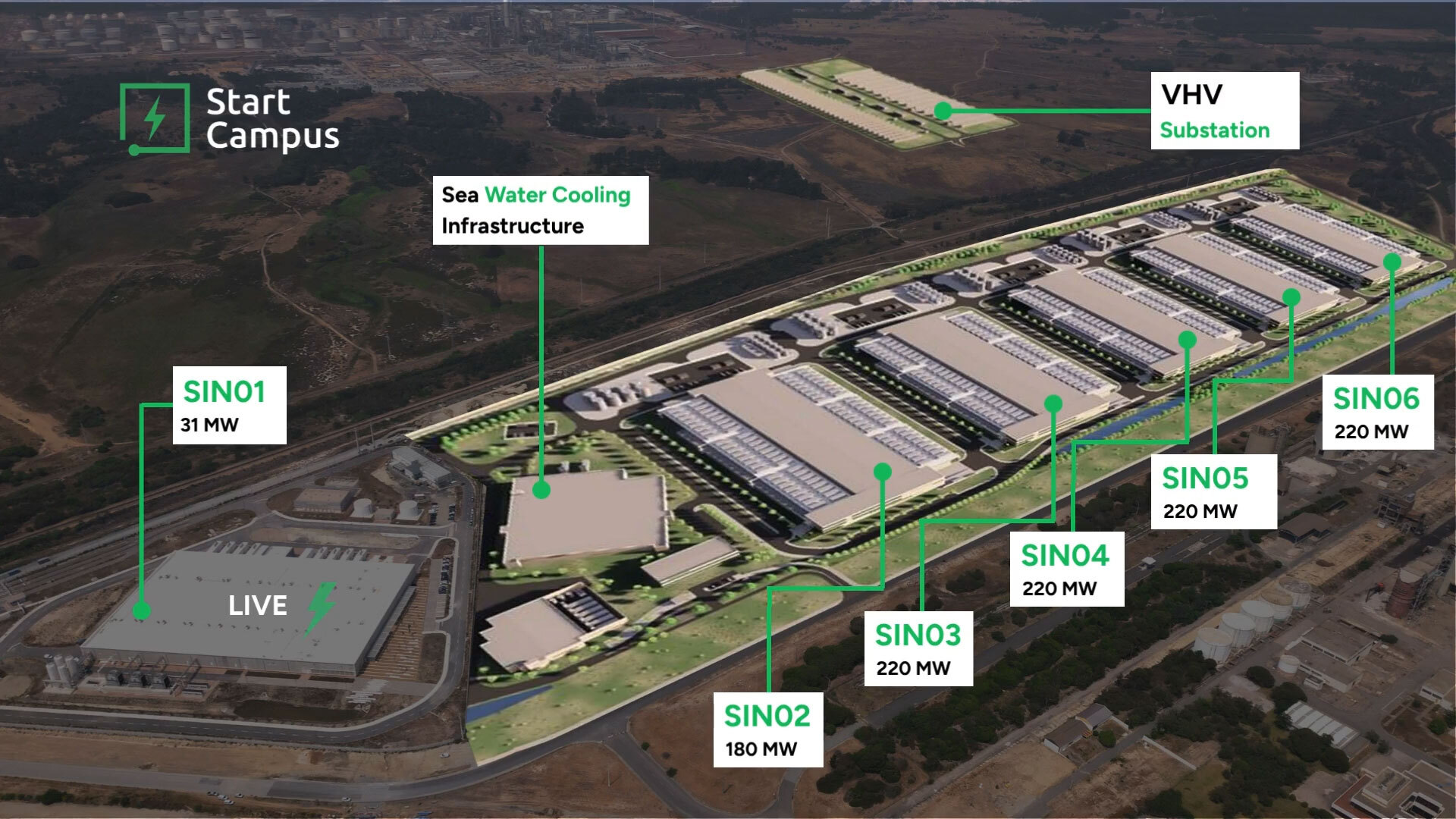
Start Campus, a data center project in Portugal, is located on the site of an old coal-fired power station and will use much of its old infrastructure. Rather than simply employ a closed-loop, the high temperatures will require the closed-loop system to interact with an open loop. When the campus is fully operational, its heat will be passed onto around 1.4 million cubic tons of seawater per day. Omer Wilson, CMO at Start Campus, said that by the time the water has returned to its source, its temperature will be the same as the surrounding sea. Start Campus has also pledged that there will be no meaningful water loss from this process.
There is another novel cooling method, immersion, in which computing equipment is — you guessed it — immersed in a non-conductive liquid suitable to draw heat. Wilson described it as a relatively niche approach, used in some crypto mining applications, but not used by industrial-scale facilities.
To keep with both energy and cooling needs, some researchers say the industry must look to renewable resources. “Directly connecting data center facilities to wind and solar energy sources ensures that water and carbon footprints are minimized,” wrote the authors of the aforementioned Environmental Research study. Even purchasing renewable energy certificates — which each represent one megawatt-hour of electricity generated from a renewable source and delivered to the grid — could help shift the grid toward these sources over time, they added. “Data center workloads can be migrated between data centers to align with the portion of the grid where renewable electricity supplies exceed instantaneous demand.”
Geothermal resources have begun to look especially promising. According to a recent report by the Rhodium Group, geothermal energy could meet up to 64 percent of data center’s projected power demand growth in the US “by the early 2030s.” In the Western US, geothermal could meet 100 percent of demand growth in areas such as Phoenix, Dallas-Fort Worth and Las Vegas.
For cooling, geothermal heat pumps can be used to “leverage the consistently cool temperatures” found hundreds of feet beneath the surface. Or, in locations where there are shallow aquifers present, data centers can make use of geothermal absorption chillers. These rely on the low-grade heat at shallower depths “to drive a chemical reaction that produces water vapor,” the report explains. “This water vapor cools as it is run through a condenser and cools the IT components of a data center using evaporation.”
Iron Mountain Data Centers operates a geothermally cooled data center in Boyers, Pennsylvania at the site of an old limestone mine. A 35-acre underground reservoir provides a year-round supply of cool water. Geothermal may not be a widespread solution just yet, but it’s catching on. In 2024, Meta announced a partnership with Sage Geosystems to supply its data centers with up to 150 megawatts (MW) of geothermal power starting in 2027.
Beyond the hardware
While novel cooling methods will undoubtedly help curb some of the AI data centers’ excessive resource demands, the first step to meaningful change is transparency, according to Vijay Gadepally, a senior scientist at MIT’s Lincoln Laboratory Supercomputing Center. AI companies need to be upfront about the emissions and resource use associated with their operations to give people a clear view of their footprints.
Then there is the hardware to consider. Incorporating more intelligent chip design — i.e. processors with better performance characteristics — could go a long way toward making data centers more sustainable. “That’s a huge area of innovation right now,” Gadepally said. And large data centers are often “running underutilized,” with a lot of power that isn’t being allocated efficiently. Rather than leaning into the push to build more such facilities, the industry should first make better use of existing data centers’ capacities.
Similarly, many of today’s AI models are vastly overpowered for the tasks they’re being given. The current approach is “like cutting a hamburger with a chainsaw,” Gadepally said. “Does it work? Sure… but it definitely is overkill.” This doesn’t need to be the case. “We have found in many instances that you can use a smaller but tuned model, to achieve similar performance to a much larger model,” Gadepally said, noting that this is especially true for new “agentic” systems. “You’re often trying thousands of different parameters, or different combinations of things to discover which is the best one, and by being a little bit more intelligent, we could dismiss or essentially terminate a lot of the workloads or a lot of those combinations that weren’t getting you towards the right answer.”
Each of those unnecessary parameters isn’t just a computational dead end, it’s another nudge towards rolling blackouts, less potable water and rising utility costs to surrounding communities. As Gadepally said, “We’re just building bigger and bigger without thinking about, ‘Do we actually need it?'”
This article originally appeared on Engadget at https://www.engadget.com/why-do-ai-data-centers-use-so-many-resources-171500010.html?src=rss
GL.iNet has introduced the Comet PoE (GL-RM1PE), a compact remote KVM device for server management, industrial systems, NVR setups, and HomeLab use. It supports 4K@30 FPS remote display, two-way audio, PoE for simplified deployment, and includes onboard storage with self-hosted cloud support. The Comet PoE is equipped with a quad-core ARM Cortex-A53 processor, paired with […]
When you’re looking to top off your iPhone’s battery, you might not think much about the actual plug you’re using. The thing is, it actually matters quite a bit, especially if you care about charging speeds. But even knowing that, you might take a look at Apple’s newest power adapter and think “$40? Without a cable? No way.”
It’s certainly a steep price for a power adapter, especially as you can find other options for literally half the price. But there’s something interesting about this particular charger. It might not necessarily be worth $40, but there’s a reason it’s not cheap: This thing might be the only power adapter you need in your tech tool box.
Dynamic power output
As you can see from the product listing, Apple’s power adapter is advertised as a 40W charger. However, it is also advertised as being able to deliver up to 60W. You don’t typically see that from a power adapter, as the wattage you see is the wattage you usually get.
As CNET’s Bridget Carey explains, this is made possible through some clever engineering. The power adapter will start by offering the maximum charging output your device in question can take in, up to 60W. iPhones can’t accept 60W of charging, for example, but MacBooks can: So this 40W power adapter can actually deliver 60W of power when connected to something like your MacBook—at first. Since the power adapter isn’t actually a true 60W charger, it can’t sustain that power output for long periods of time. As such, it pulls back the power draw over time.
In practical terms, it means you can get an initial 60W charge on a device that can accept it, which can help charge your larger devices faster at the start. Rather than bring a power adapter for your iPhone, and a larger one for your MacBook, or tote a huge power adapter for both, you get a compact power adapter that can offer the best of both worlds.
There’s also a reason Apple chose 40W for this power adapter’s “standard” output. The new iPhone 17 series has the quickest charging speeds of any iPhone device so far, charging up to 50% in just 20 minutes. (The exception is the iPhone 17 Air, which can charge to 50% in 30 minutes.) However, you need the right power adapter to take advantage of these charging speeds—at least 40W. (Again, the iPhone 17 Air is the exception, as it can charge to 50% in 30 minutes with 20W or higher.)
That’s really the perk of this dynamic power adapter. It’s powerful enough to offer the fastest charging speeds for your iPhone 17, while also offering a power boost to give something like a MacBook a faster charge, at least for a little while. That being said, there are plenty of power adapter options out there, including ones that offer outputs in the 60W range. No matter what power adapter you end up going with, just keep two things in mind: the maximum power output of the adapter itself, but also your charging cable. If your cable can’t support the wattage, it doesn’t matter how large the adapter is.
Among chip nerds, Jim Keller is a name that needs no introduction, but if you aren’t familiar, he’s a veteran from the days of Digital Equipment Corporation. He contributed directly to the DEC Alpha, the AMD K7 and K8 cores powering the Athlon and original Opteron, and then later came back to AMD to direct the design of Zen, before making
It’s been quite the week for Xbox news. A lot of people are still coming to terms with Microsoft’s veritable gut-punch of an announcement that the price of a Game Pass Ultimate subscription is about to soar by 50 percent. And if that has already pushed you into washing your hands with Xbox altogether, it looks like Microsoft may soon attempt to tempt you back by giving away its cloud gaming service for free. That is, an extremely limited version of it, with ads.
According to The Verge, Microsoft is preparing to announce an ad-supported version of Xbox Cloud Gaming, which finally exited beta this week. Sources said to be familiar with Microsoft’s strategy told The Verge that game streaming with ads is already being tested internally with employees. You’ll reportedly be able to play select games that you own as well as a selection of Xbox Retro Classics titles. Microsoft will also offer Free Play Days games, an initiative that already lets Xbox users try games over a weekend. All of this will be possible without a paid Game Pass subscription.
But the inevitable catch, beyond the restricted catalogue of available games, is that you could have to watch up to several minutes of ad content before getting into a game, and it sounds like there are a number of time-based restrictions as well. It’s currently being tested with a one-hour time limit, up to five times per month, though that could change come launch.
Microsoft could launch its ad-supported Xbox Cloud Gaming tier in beta soon, and it will reportedly be available on PC, Xbox, handheld devices and on browsers. What isn’t clear is what streaming quality will be offered on the free version. Xbox Cloud Gaming’s recently-unlocked 1440p option is going to be exclusive to Game Pass Ultimate, with Microsoft saving the “best quality” streaming for its most expensive plan. You’ll be capped at 1080p on the Premium and Essential tiers.
All three paid Game Pass tiers include unlimited cloud gaming, but wait times get longer the further down you go. It’s fair to assume that any free cloud service not tied to Game Pass will be hit with longer wait times, though perhaps the enforced ads would hide those pretty well anyway.
This article originally appeared on Engadget at https://www.engadget.com/gaming/xbox/a-free-ad-supported-xbox-cloud-gaming-option-might-be-on-the-way-165739468.html?src=rss
Air pollution increases the likelihood of people becoming frail in middle and old age, according to an international review of studies. The Guardian: The review team found 10 studies that looked at outdoor air pollution and frailty. The people studied came from 11 countries including China, the UK, Sweden, South Africa and Mexico. Two of the studies showed that men were more vulnerable than woman, with a stronger association between particle pollution and frailty. The risk of frailty increased with outdoor particle pollution. For the UK, this could mean about 10-20% of frailty cases are attributable to air pollution.
Exposure to secondhand smoking was the environmental factor that presented the greatest risk of frailty. The risk of frailty was increased by about 60% for people who breathed other people’s smoke at home. Using solid fuels for cooking or home heating also carried an extra risk of frailty. This was about half the risk of living with a smoker, based on studies from six countries.
The sound changes were merged this week for the pngoing Linux 6.18 merge window. There is some interesting new API additions as well as new audio hardware support and enhancements to existing sound drivers…
Pew Research: Public awareness of legal sports betting has grown in recent years — and so has the perception that it is a bad thing for society and sports, according to a new Pew Research Center survey. Today, 43% of U.S. adults say the fact that sports betting is now legal in much of the country is a bad thing for society. That’s up from 34% in 2022. And 40% of adults now say it’s a bad thing for sports, up from 33%.
Despite these increasingly critical views of legal sports betting, many Americans continue to say it has neither a bad nor good impact on society and on sports. Fewer than one-in-five see positive impacts. Meanwhile, the share of Americans who have bet money on sports in the past year has not changed much since 2022.
Today, 22% of adults say they’ve personally bet money on sports in the past year. That’s a slight uptick from 19% three years ago. This figure includes betting in any of three ways:
1. With friends or family, such as in a private betting pool, fantasy league or casual bet
2. Online with a betting app, sportsbook or casino
3. In person at a casino, racetrack or betting kiosk Further reading: Filipinos Are Addicted to Online Gambling. So Is Their Government.
Much has been said about Comet, Perplexity’s web browser, not just because of its AI features, but also because of its paywall. Early access was initially reserved to a waitlist of Perplexity Max users, a subscription that costs $200 per month, before Perplexity opened up access to Perplexity Pro users, who only need to pay $20 per month. Still, seeing as most web browsers are free to use, I imagine most people still shied away from trying Comet because of the price.
If that sounds like you, there’s good news. On Friday, Perplexity made Comet available to anyone who wants to try it for free. You don’t need to subscribe to any Perplexity plan, nor do you even need a Perplexity account—though the company has some features tied to those who sign in. Comet is built on Chromium, so if you’re coming from Chrome, or another Chromium browser like Edge, you’ll be able to jump right in.
Installing Comet is as easy as any other web browser: just head to Perplexity’s website, and choose “Download Comet.” Even setting up the browser feels familiar, as you can import another Chrome profile, choose a profile pic, and set a name. But of course, the real advertised advantage here is the AI assistant. Like other AI-powered browsers, Comet has a built-in chatbot you can talk to about whatever it is you want—particularly the web pages you happen to be browsing. But Comet’s AI is agentic, which means you can ask the AI to do things for you.
If you ask it to take you to a specific website, it will (though I’m not sure that’s any faster than simply typing in the site by hand). If you ask it to open a specific link on the page, you can see the bot take over the page, and choose the URL you asked for. For example, I asked the assistant to open Lifehacker, then asked it to click on our article “How to Browse the Dark Web.” It did both of these things, and even offered a summary of the dark web piece.
But Perplexity says you can also request more complex tasks: According to the company, the assistant can draft emails on your behalf, build websites, make purchases, create citations, add to your calendar. There’s even a voice mode, as with other AI bots like ChatGPT or Gemini, so you can talk to the browser if you want to.
I’m still not sold on the idea that injecting agentic AI into my web browser is what I need to better experience the internet. Maybe I need to spend some time with Comet to experience that “future.” But seeing how often the tech still makes mistakes—not the mention the untapped security risks—I’m not sure I want to hand off all of my browsing tasks to AI just yet. Still, if you’re interested, you can give it a go without spending a dime.
No automaker has matched Tesla’s ability to deliver over-the-air software updates despite years of effort and billions in spending. Tesla introduced the technology in 2012 and issued 42 updates within six months, Jean-Marie Lapeyre, Capgemini’s chief technology officer for automotive, told WIRED. Other automakers ship updates “maybe once a year,” Lapeyre said.
General Motors actually introduced OTA functionality first in 2010, two years before Tesla, but limited it to the OnStar telematics system. Traditional automakers treat software as one bolt-on component among many. Tesla and other digital-native brands like Rivian, Lucid and Chinese companies including BYD and Xpeng treat it as central. There are now 69 million OTA-capable vehicles in the United States, S&P Global estimates. More than 13 million vehicles were recalled in 2024 due to software-related issues, a 35 percent increase over the prior year. OTA updates cost automakers $66.50 per vehicle for each gigabyte of data, Harman Automotive estimates.
Over the years, racing sims have come a long way. Gaming PCs and consoles have become more powerful, physics and tire models have become more accurate, and after COVID, it seems like nearly everyone has a sim rig setup at home. Sim racing has even become an accepted route into the world of real-life motorsport (not to be confused with the Indy Racing League).
But what if you aren’t looking to become the next Max Verstappen? What if you miss the more carefree days of old, where the fidelity wasn’t quite so high, nor were the stakes? Rally Arcade Classics is worth a look.
Developed by NET2KGAMES, you might think of RAC as a spiritual successor to legendary titles like Sega Rally and Colin McRae Rally. Forget about the Nürburgring or even street circuits laid out in famous cities you might have visited; instead, this game is about point-to-point racing against the clock—mostly—across landscapes that long-time World Rally Championship fans will remember.
Microsoft caused quite firestorm on social media when it announced a significant price increase for its Xbox Game Pass Ultimate subscription tier. Effective immediately, the new cost is $29.99 per month, marking a 50% jump compared to the old $19.99 per month rate. There are some additional perks that come with the revamped program, but if
Despite its name, the Robot
Operating System (ROS) is not an operating system; it is
a software development kit (SDK) that provides building blocks for
robotic applications. One of the main goals of ROS is to present a
common API that abstracts away the details of particular hardware
drivers or algorithms to make development easier; developers can focus
on what a robot should do rather than the low-level details of
specific controllers. The latest release of ROS, Kilted
Kaiju, features improvements to the middleware layer that is used
to deliver data between components.
Apple’s “Pro” iPhones usually look and feel a lot like the regular ones, just with some added features stacked on top. They’ve historically had better screens and more flexible cameras, and there has always been a Max option for people who really wanted to blur the lines between a big phone and a small tablet (Apple’s commitment to the cheaper “iPhone Plus” idea has been less steadfast). But the qualitative experience of holding and using one wasn’t all that different compared to the basic aluminum iPhone.
This year’s iPhone 17 Pro looks and feels like more of a departure from the basic iPhone, thanks to a new design that prioritizes function over form. It’s as though Apple anticipated the main complaints about the iPhone Air—why would I want a phone with worse battery and fewer cameras, why don’t they just make the phone thicker so they can fit in more things—and made a version of the iPhone that they could point to and say, “We already make that phone—it’s that one over there.”
Because the regular iPhone 17 is so good, and because it uses the same 6.3-inch OLED ProMotion screen, I think the iPhone 17 Pro is playing to a narrower audience than usual this year. But Apple’s changes and additions are also tailor-made to serve that audience. In other words, fewer people even need to consider the iPhone Pro this time around, but there’s a lot to like here for actual “pros” and people who demand a lot from their phones.
Fermenting milk to make yogurt, cheeses, or kefir is an ancient practice, and different cultures have their own traditional methods, often preserved in oral histories. The forests of Bulgaria and Turkey have an abundance of red wood ants, for instance, so a time-honored Bulgarian yogurt-making practice involves dropping a few live ants (or crushed-up ant eggs) into the milk to jump-start fermentation. Scientists have now figured out why the ants are so effective in making edible yogurt, according to a paper published in the journal iScience. The authors even collaborated with chefs to create modern recipes using ant yogurt.
“Today’s yogurts are typically made with just two bacterial strains,” said co-author Leonie Jahn from the Technical University of Denmark. “If you look at traditional yogurt, you have much bigger biodiversity, varying based on location, households, and season. That brings more flavors, textures, and personality.”
If you want to study traditional culinary methods, it helps to go where those traditions emerged, since the locals likely still retain memories and oral histories of said culinary methods—in this case, Nova Mahala, Bulgaria, where co-author Sevgi Mutlu Sirakova’s family still lives. To recreate the region’s ant yogurt, the team followed instructions from Sirakova’s uncle. They used fresh raw cow milk, warmed until scalding, “such that it could ‘bite your pinkie finger,'” per the authors. Four live red wood ants were then collected from a local colony and added to the milk.
Indonesia has suspended TikTok’s operational registration status in the country, alleging that the social media platform did not fully co-operate with a request to share its data during nationwide protests in August. In a statement, Alexander Sabar, an official from Indonesia’s digital and communications ministry, said TikTok had violated national laws by only providing partial data while the protests were ongoing between August 23 and 30.
Sabar said TikTok was given until September 23 to hand over its data related to traffic, streaming and monetization, after it emerged that some accounts with links to online gambling may have profited from TikTok livestreams during the protests. All forms of gambling are illegal under Indonesian law. TikTok reportedly said that it couldn’t provide all of the requested data due to internal policy. The app has now been temporarily suspended, although Bloomberg claims that TikTok remains accessible in the country for now.
Anger about the state of Indonesia’s economy, widespread police brutality and a number of government policies sparked August’s violent protests. TikTok voluntarily suspended its live feature for a number of days during the unrest in an attempt to keep the platform a “safe and civil space.” The app has over 100 million users in the country.
Sabar gave no indication as to how long the ban will last. As reported by Reuters, a spokesperson for TikTok said the company respects the laws of the countries it operates in, and added that it’s working with the digital ministry to find a resolution.
This article originally appeared on Engadget at https://www.engadget.com/big-tech/indonesia-suspends-tiktoks-operating-licence-for-allegedly-withholding-data-145134189.html?src=rss
The Cybersecurity Information Sharing Act expired on Wednesday when the federal government shut down. The law had provided legal protections since 2015 for organizations to share cyber threat intelligence with federal agencies. Without these protections, private sector companies that control most U.S. critical infrastructure face potential legal risks when sharing information about threats. Sen. Gary Peters called the lapse “an open invitation to cybercriminals and hostile actors to attack our economy and our critical infrastructure.”
The intelligence sharing enabled by CISA 2015 helped expose Chinese campaigns including Volt Typhoon in 2023 and Salt Typhoon last year. Several cybersecurity firms pledged to continue sharing threat data despite the law’s expiration. Halcyon and CrowdStrike confirmed they would maintain information sharing. Palo Alto Networks said it remained committed to public-private partnerships but did not specify whether it would continue sharing threat data. Multiple bipartisan reauthorization efforts failed before the shutdown. The House Homeland Security Committee had approved a 10-year extension last month.
Amazon’s fall edition of Prime Day is right around the corner, but you can already get some great deals on popular products like the Apple AirTag. Right now, a four-pack of Apple AirTags is $75, 25 percent off the regular price. If you’re an Apple user, then the AirTag is the best Bluetooth tracker on the market for you.
You can put these little discs in your wallet, in a backpack or in your luggage while you’re traveling. Your AirTag’s location will show up in your Find My app, powered by the vast network of iPhones, iPads and other compatible devices that receive the AirTag’s Bluetooth signal. Keep in mind these only work when close enough to participating devices to be located.
You can attach AirTags to just about anything thanks to an abundance of available accessories. Their built-in speakers can play a tone, triggered from your iPhone, to help you find them when the object they’re affixed to is lost. On iPhone 11 and newer models, you can take advantage of the AirTag’s Ultra Wideband capability and have your phone lead you right to your AirTag, complete with directional arrows on your iPhone screen.
This article originally appeared on Engadget at https://www.engadget.com/deals/a-four-pack-of-apple-airtags-is-25-percent-off-ahead-of-prime-day-143112321.html?src=rss