Some Spotify video podcasts are coming to Netflix

Spotify is taking the video versions of some of its podcasts to another platform entirely: Netflix. Starting in the US in early 2026 (with more markets and shows to follow), Netflix will start offering sports, culture, lifestyle and true crime podcasts that Spotify Studios and The Ringer produce.

Nine sports podcasts will be available at the jump, including The Bill Simmons Podcast, The Zach Lowe Show, Fairway Rollin’ and The Ringer’s F1, fantasy football, NFL and NBA shows. Other video podcasts that are coming to Netflix include The Rewatchables, The Recipe Club, Dissect, Conspiracy Theories and Serial Killers.

Netflix sees these podcasts as complementary to its current offerings (The Ringer F1 Show, for instance, will sit neatly alongside Drive to Survive). Of course, for Spotify, this is a way to get more eyeballs and eardrums on its original programming.

With TV viewing becoming a bigger priority for YouTube over the last few years, this seems like a way for Netflix to bite back in the battle for consumer attention, given the prevalence of video podcasts on Google’s platform. Many people use streaming services for background comfort sound, and turning to podcasts or talk-radio style formats (something Disney+ also offers with The Rich Eisen Show on weekdays) may be a way for them to do that after pulling the plug on cable and broadcast TV.

This article originally appeared on Engadget at https://www.engadget.com/entertainment/streaming/some-spotify-video-podcasts-are-coming-to-netflix-180000074.html?src=rss

The company Discord blamed for its recent breach says it wasn’t hacked

Customer service support company 5CA has released a statement contradicting claims by Discord that it was the victim of a hack last month. On October 3, Discord disclosed a data breach that the company says included a “small number” of government IDs like driver’s licenses and passports, which some users had submitted to verify their ages. Days later the company updated its statement to name 5CA as the target of the hack, which Discord contracts as part of its customer service efforts. It also disclosed that the “small number” of government IDs encompasses roughly 70,000 users.

“We are aware of media reports naming 5CA as the cause of a data breach involving one of our clients. Contrary to these reports, we can confirm that none of 5CA’s systems were involved, and 5CA has not handled any government-issued IDs for this client. All our platforms and systems remain secure, and client data continues to be protected under strict data protection and security controls,” the company’s statement reads in part. The company goes on to explicitly state “the incident occurred outside of our systems and that 5CA was not hacked.”

5CA says that a preliminary investigation showed that the incident may have been the result of “human error,” though it offers no details as to what exactly that implies. Discord has not yet responded to the company’s claims.

This article originally appeared on Engadget at https://www.engadget.com/cybersecurity/the-company-discord-blamed-for-its-recent-breach-says-it-wasnt-hacked-175536278.html?src=rss

YouTube rolls out its redesigned video playerglobally

YouTube is bringing a wave of quality of life improvements to its platform. These visual updates and new features will roll out globally starting this week.

The main update to YouTube is a redesigned video player that has made the icons and UI elements to obscure less content. This new player design will appear on mobile, web and TV devices. Some users have had access to this feature for about a month, so it may not be brand new to everyone. The seek feature where a viewer can double-tap to skip has also been updated in a way that YouTube says is “more modern and less intrusive” and transitions between tabs have also been upgraded on mobile.

For those of you who spend a lot of time in the comments, you’ll see a new threaded approach to replies. This update aims “to provide a more focused reading experience within the replies panel.” The process of adding videos to playlists and the Watch Later queue has also been simplified and adjusted to be a “smoother and more visual” experience. Finally, some content will start displaying little animations when you hit the like button. The blog post gives music videos and sports videos as examples of where users may start seeing the flashier visual.

This article originally appeared on Engadget at https://www.engadget.com/entertainment/youtube/youtube-rolls-out-its-redesigned-video-player-globally-174609883.html?src=rss

X experiments with showing more information about profiles to fight inauthentic engagement

X has long been a hotbed for fake accounts, bots and other scammy behavior. Many of those dynamics have been exacerbated by the rise of paid verification, which boosts the visibility of anyone who pays for a subscription. Now, the company is running a small experiment that could help users better identify potentially suspicious accounts.

The service is starting to test a new “about this account” feature that will provide details about when an account joined the platform, where the person running it is based, how many times the username has been changed and how the account is connected to X. The feature is a lot like the “page transparency” information on Facebook, which provides similar details about when a given page was created and where the people running it are based. 

“When you read content on X, you should be able to verify its authenticity,” X’s head of product, Nikita Bier, shared in a post about the change. “This is critical to getting a pulse on important issues happening in the world.” 

If fully rolled out, this type of feature could help people on X understand a lot of common scams and other deceptive behavior on the platform. For example, scammers often change the handle of a recently compromised account in order to trick an account’s existing followers. And understanding the location of an account could help users root out people lying about their identity. 

However, it sounds like it could be some time before the feature is implemented in a way that could be broadly useful. Bier said that initially X will show this info on “a handful of profiles of X team members” — most of whom already have an official “X” badge on their profiles — in order to get feedback on the change.

This article originally appeared on Engadget at https://www.engadget.com/social-media/x-experiments-with-showing-more-information-about-profiles-to-fight-inauthentic-engagement-172500501.html?src=rss

California Cracks Down on ‘Predatory’ Early Cancellation Fees

California has enacted new legislation that aims to limit companies from charging consumers “exorbitant” fees to cancel fixed-term contracts. From a report: Assembly Bill 483 was signed into law by California Gov. Gavin Newsom on Friday, placing transparency requirements and fee limits on early terminations for installment contracts — plans that allow consumers to make recurring payments for goods and services over a specified duration.

This includes services that lure consumers into signing annual contracts by allowing them to pay in installments that appear similar to rolling monthly subscriptions, but with hefty cancellation fees for not locking in for the full year. The bill bans companies from hiding early termination fee disclosures within fine print or obscured hyperlinks, and limits the total fee amount to a maximum of 30 percent of the total contract cost. The goal is to make it easier for Californians to take these fees into account when comparing between services, and lessen the financial burden if they need to end their contract early.


Read more of this story at Slashdot.

SteelSeries’ updated Nova 7 gaming headset offers much better battery life

SteelSeries just released a refresh of its popular Arctis Nova 7 midrange gaming headset. The Nova 7 Gen 2 offers significantly improved battery life, with an increase of around 40 percent when compared to the original version. This translates to 54 hours of use per charge, which is a mighty fine metric. There’s quick-charging that can provide six more hours of use in 15 minutes at the outlet. 

It charges via USB-C and can simultaneously play audio from both a 2.4GHz wireless connection and Bluetooth audio. This means that users can mix and match audio sources, which comes in handy when gaming. The headset connects wirelessly to all major gaming consoles, in addition to PCs and phones.

The Arctis Nova 7 Gen 2 integrates with the company’s mobile app. This offers more than 200 presets for specific games, all of which adjust the EQ to match what’s being played. On PC, the presets will automatically adjust depending on the game.

These are headphones intended for gaming, so they also include a noise-cancelling microphone. This little boom mic can be hidden within the headset and disabled when using a standalone microphone.

As for aesthetics, the Nova 7 looks a lot like the company’s high-end headsets. It’s available in three colors, including black, white and magenta. The headset is available to purchase right now and costs $200. It does lack a few features included with its higher-priced cousins, like the swappable battery system and active noise cancellation.

This article originally appeared on Engadget at https://www.engadget.com/audio/headphones/steelseries-updated-nova-7-gaming-headset-offers-much-better-battery-life-171435527.html?src=rss

OpenAI unveils “wellness” council; suicide prevention expert not included

Ever since a lawsuit accused ChatGPT of becoming a teen’s “suicide coach,” OpenAI has been scrambling to make its chatbot safer. Today, the AI firm unveiled the experts it hired to help make ChatGPT a healthier option for all users.

In a press release, OpenAI explained its Expert Council on Wellness and AI started taking form after OpenAI began informally consulting with experts on parental controls earlier this year. Now it’s been formalized, bringing together eight “leading researchers and experts with decades of experience studying how technology affects our emotions, motivation, and mental health” to help steer ChatGPT updates.

One priority was finding “several council members with backgrounds in understanding how to build technology that supports healthy youth development,” OpenAI said, “because teens use ChatGPT differently than adults.”

Read full article

Comments

How to Fix Randomly Crashing Apps on Your Pixel 10

If you’ve been experiencing random crashes on your Pixel 10 smartphone, you’re not alone. Over the weekend, multiple Reddit users complained that their Pixel 10 phones, which only just hit the market in August, were already facing severe slowdowns and frequent crashes while trying to load apps. Worse yet, the problem seemed to persist across all apps and models of the phone, leaving users with little they could actually do on their new devices.

“If an app does open and load it won’t let me touch anything and it crashes,” user cdriese said, with a number of others sharing a similar sentiment.

The unfortunate news took me as a bit of a surprise, since I experienced no such issues while reviewing the Pixel 10 and Pixel 10 Pro at launch, both of which I quite liked. But the problem, it seems, only popped up recently.

Multiple users across Reddit pointed to October 10’s Google Play Services update as the culprit here, with some saying that uninstalling the update fixed the problem for them. “My running theory is that the October play services update is clashing with the September Android OS update in some way,” said user PuzzleHeadedSquid, adding that they have had no crashes since uninstalling the Play Services update. Sure enough, when I loaded my phone with both the September Android OS update and the initial October play services updates installed, I also started to have issues.

In a way, though, that’s still a relief. Your new hardware isn’t broken already—but uninstalling the new Play Services update introduces its own headaches. Luckily, as of this morning, there’s another solution, and it’s pretty simple.

If you’re experiencing crashing apps on your Pixel 10, here’s what you can do.

The official fix

Random Reddit users weren’t the only folks experiencing this problem. Android Police founder Artem Russakovskii also called out the problem in an October 12 X post, saying his Pixel 10 Pro XL had been “kneecapped” by it.


This Tweet is currently unavailable. It might be loading or has been removed.

Luckily, as a member of the press, he had a bit more resources at his disposal for fixing this bug than the average Redditor. Over the course of the weekend, Russakovskii quickly got in touch with his contacts at Google, who he says scrambled multiple teams to address the issue and has since issued a server-side fix.

Theoretically, that means a simple restart should bring your phone back to normal, although if the problem persists, you’ll also want to make sure you’re running the most recent Google Play services build (which you can check under Settings > Apps > Google Play services > App details), then do another restart.

It’s a pretty quick turnaround on a fix, and doesn’t require much on your part, but if you’ve temporarily shelved your Pixel, it’s worth booting it back up again to see if you’re still having issues.

The unofficial fix

That said, it’s possible Google’s engineers still might have missed something. If you still find yourself having issues loading apps, you can use the community method of uninstalling the October Play Services update instead. This will log you out of your Google accounts, however, and won’t include Google’s official fix, so I’d only recommend it in an emergency.

That said, if you’re at the point of pulling your hair out, you can navigate to Settings > Apps > Google Play services > App details and tap “Remove updates” to start the process. Just be sure to have your Google passwords (or passkeys!) memorized first.

First, though, try hitting the “Update” button next to it instead, then restarting your phone. That’s what I did, after initially running my testing without this morning’s update, and my apps are now as snappy as ever.

Nvidia sells tiny new computer that puts big AI on your desktop

On Tuesday, Nvidia announced it will begin taking orders for the DGX Spark, a $4,000 desktop AI computer that wraps one petaflop of computing performance and 128GB of unified memory into a form factor small enough to sit on a desk. Its biggest selling point is likely its large integrated memory that can run larger AI models than consumer GPUs.

Nvidia will begin taking orders for the DGX Spark on Wednesday, October 15, through its website, with systems also available from manufacturing partners and select US retail stores.

The DGX Spark, which Nvidia previewed as “Project DIGITS” in January and formally named in May, represents Nvidia’s attempt to create a new category of desktop computer workstation specifically for AI development.

Read full article

Comments

Satellites Are Leaking the World’s Secrets: Calls, Texts, Military and Corporate Data

Researchers at UC San Diego and the University of Maryland have found that roughly half of geostationary satellite signals transmit sensitive data without encryption. The team spent three years using an $800 satellite receiver on a university rooftop in San Diego to intercept communications from satellites visible from their location. They collected phone calls and text messages from more than 2,700 T-Mobile users in just nine hours of recording.

The researchers also obtained data from airline passengers using in-flight Wi-Fi, communications from electric utilities and offshore oil and gas platforms, and US and Mexican military communications that revealed personnel locations and equipment details. The exposed data resulted from telecommunications companies using satellites to relay signals from remote cell towers to their core networks.

The researchers examined only about 15% of global satellite transponder communications and presented their findings at an Association for Computing Machinery conference in Taiwan this week. Most companies warned by the researchers have encrypted their satellite transmissions, but some US critical infrastructure owners have not yet added encryption.


Read more of this story at Slashdot.

The Right Way to Video Your Lifts at the Gym

We may earn a commission from links on this page.

I used to feel awkward and self conscious pointing a camera at myself at the gym. My thoughts went something like: I’m no selfie-obsessed influencer. What are people thinking of me? But I’ve had a change of heart: I now whip out my pocket-sized tripod to video myself at least once every workout, and my lifts are better for it.

If you lift at a gym, you’ve probably noticed people are filming their lifts more often these days. While some of them may be obnoxious TikTokers (and we’ll talk about etiquette below), there are lots of good reasons to want to document what you’re doing on video. You can evaluate your effort and technique, share the videos with a coach, or use the videos as a way of sharing your training with friends and internet gym buddies.

The benefits of taking video of your lifts

Before we get into how, let’s talk about why. There are very good reasons to film yourself lifting.

Checking your form

If I’m working out alone, I video because I’m seeking some of the feedback I would otherwise get from an in-person coach. But even when my coach is right there, I still take video of my heaviest or most important lifts of the day. I can match the feedback he gives me (good or bad) to what I see in the video. I also have a record of the day’s lifts that I’ll be able to look back on later.

Better feedback than a mirror

It’s also good to learn to use video for technique adjustments rather than looking in a mirror. While a mirror is fine for, say, bicep curls or lateral raises, you’ll want to learn to lift without one if you have any interest in powerlifting, weightlifting, or crossfit (and those gyms almost never have mirrors.) Twisting your head to look at yourself can mess up your body position, and paying attention to how you look in the mirror can interrupt your focus. Not to mention, your perspective in a mirror changes as your body moves. You’re not actually getting an accurate view of your squat depth with a mirror, but a good video will tell you the truth.

Gauging effort

A video also helps you gauge how you’re really feeling. Time slows down when you’re struggling: if a pullup takes more than a split second, it feels like hours. I pull, I struggle, I move barely a millimeter. Sometimes I’ll give up, or nearly give up, because it feels like I just can’t possibly complete the move. But then I’ll look at the video and see that my perceived hours of struggle were just a momentary slowdown on a rep that ends up being totally solid.

Even for something as subjective as RPE (rating your “perceived exertion”), video helps. I remember, years ago, getting feedback from my online coaches that my “RPE 8” deadlifts looked too easy. So I looked at other people’s RPE 8 deadlifts, and there was a clear difference in effort. Comparing my videos to theirs helped me dial in the effort level I was really going for.

How to take a good lifting video

Whether the videos are for you, for your coach, or just to show off for the ’gram, they’ll be most useful if you can get a good view of yourself.

Use a tripod

Leaning your phone against something on the floor may work in a pinch, but you can’t actually see much from a badly distorted video taken from a worm’s-eye view. (If there’s a bench or chair available, put your water bottle on the bench and lean your phone against it.) I’ll say more about equipment below, but a selfie stick tripod like this one is an easy option. It extends to about waist height and can stand by itself on the gym floor. It also collapses small enough to fit in your gym bag or even your sweatshirt pocket.

And, yes, you do want to put your phone on on some kind of object (tripod or otherwise) rather than having a friend hold the phone. Hand-held videos tend to be harder to watch. If the person walks around you or adjusts the zoom while you’re lifting, that’s incredibly distracting and often cuts off important information. Even if they just stand still, there’s often still enough movement to be a problem.

Shoot at a 3/4 angle

It’s tempting to take video from the side or from directly in front of you, but crucial information will be missing. A side view of your squat might show whether your thighs go parallel to the floor, but it won’t show whether your knees are caving in. For most lifts, a 3/4 view—not exactly from the side or the front, but somewhere in between—will give the most useful information.

For similar reasons, you’ll want to get your entire body in the frame. Especially if you’re showing your video to a coach or friend for a form check, they’ll want to see everything that might affect your lift—including, for example, your feet.

Check the lighting and position before you start

I use the forward-facing camera so that as soon as I step into frame, I can glance over and see that I’ve set everything up correctly. If there’s a window behind you and you’re backlit, or if you’re halfway off camera, fix it before you start your lift.

But once you begin, ignore the camera. Do your lift as you normally would—look in the mirror only if that’s what you always do—and then don’t look at the camera again until after you complete the lift.

Trim your dang videos

Nobody wants to watch 30 seconds of you adjusting the camera and psyching yourself up for your lift. Even if the video is just for yourself, you probably don’t want to watch that either.

You need to take a few minutes’ rest between sets anyway, so use that time to trim your videos. On iPhone, just begin watching the video, hit pause, and then hit Edit. You can trim the start and end of the video right from that screen, and then choose whether to overwrite the original file or save the trimmed version as its own copy. (Choose the new file if you think you might want to refer to your setup later; otherwise, trimming the original is fine.)

My favorite tripods and equipment

As I mentioned above, a selfie stick tripod is super convenient at the gym. It fits in your bag or pocket, and you can easily fold it up when you’re not using it. The one at that link is the kind I’ve used most commonly over the years. I usually get a year or two of use out of one of those before something breaks, usually the mechanism that holds the phone.

That’s why I’ve recently switched to tripods that have a MagSafe style mount, like this one. If your phone has this type of magnet in the back, your life gets so much easier. Just snap your phone onto the magnet and it stays—no adjusting for the width or thickness of the phone.

I have not used a water bottle with a magnetic mount, even though every time I see them advertised I think “oh, that’s clever.” If I have a water bottle, I can lean my phone against it, no special device needed. A water bottle still needs something to bring it up to an appropriate height (like a chair or bench) so it’s not really a replacement for a floor tripod.

I do have a phone holder that can magnet onto a nearby machine or squat rack, but I have mixed feelings about it. If you can find a squat rack that’s positioned the perfect distance away from where you’re working out, and nobody is using it, great. (Make sure the phone holder is one you can angle toward you, not just a flat magnet.) But usually there’s nothing in quite the right place, and you’re left with a worse angle than if you were using the bench-and-water-bottle trick. I use mine in my home gym, where I have a metal post in a convenient spot. I don’t find it useful when I go to a commercial gym.

Gym etiquette when taking video

To answer the questions I know you have in mind: Yes, it is OK to film your lifts in a gym (unless the gym has a rule specifically forbidding it, of course). And no, people won’t think you’re weird—as long as you make sure to do so politely and respectfully. Here’s how.

Keep others out of frame

As much as possible, position your camera so that other people aren’t in the video (or at least not their faces). You definitely shouldn’t post a video publicly with other people in it, but even if the video is for your private use, people may notice that they’re on camera and feel weird about it.

Stay out of the way

Don’t place your tripod in a busy walkway, or anywhere else you’d be getting in others’ way. If you want to use an unoccupied bench to prop up your phone, that’s OK—for a moment. Don’t leave it there for your whole workout. And consider, again, using a tripod: A phone on the ground is a lot easier to miss, and accidentally trip over, than a tripod that’s pretty obviously in somebody’s walking path.

Using the gym takes precedence over filming

We’ve all seen those TikToks where somebody gets mad at a passer-by for walking into the frame. I’m convinced that most of those videos are faked (outrage gets engagement), but obviously you do not want to be that person. Working out in a space takes precedence over using your camera there. That said, if the place is busy, just communicate like a normal human being. I train at a gym where people commonly film themselves, and everybody is very friendly about making space for each other. Someone might even offer to share their tripod.

Posedla’s Smiling Butt Kit could see saddle pain banished forever

Posedla might be a saddle brand you haven’t heard of yet, but that could be about to change.

Its 3D-printed saddle service enables riders to get the perfect saddle for them, by taking an imprint of their sit bones.

The service is called the ‘Smiling Butt Kit’, whereby you sit on a pad to create an impression, which is then posted off to Posedla. The resulting measurements are used to produce a custom-shaped saddle for your specific use case – be it road, gravel, MTB or even time trialling.

On top of this, Posedla enables you to customise the spec of its saddles, including rail choice, width and foam density – and even personalisation.

Interested? So were we – so Ollie Smith has given it a try on your behalf to see how the process works. 

Beijing Issues Documents Without Word Format Amid US Tensions

An anonymous reader shares a report: China’s expansion of its rare earth export controls appeared to mark another escalation in the US-China trade war last week. But the announcements were also significant in another way: unusually, the documents could not be opened using American word processing software.

For the first time, China’s Ministry of Commerce issued a slew of documents that could be directly accessed only through WPS Office — China’s answer to Microsoft Office — as Beijing continues its tech self-reliance drive. Developed by the Beijing-based software company Kingsoft, WPS Office uses a different coding structure to Microsoft Office, meaning WPS text files cannot be opened directly in Word without conversion. Previously, the ministry primarily released text documents in Microsoft Word format.


Read more of this story at Slashdot.

What to Do Now That Microsoft No Longer Supports Windows 10

Did you know you can customize Google to filter out garbage? Take these steps for better search results, including adding my work at Lifehacker as a preferred source.


It’s official: As of Tuesday, Oct. 14, Microsoft no longer supports Windows 10. That said, if you powered on your Windows 10 PC this morning, only to read headlines suggesting the end of Windows 10, you might be a bit confused. Your computer still works, after all. So what’s really going on here?

What Windows 10 end of life really means

As it might now be evident, Microsoft ending support for Windows 10 doesn’t mean the company has shut down the OS for good. Any devices still running Windows 10 will continue to run—and, in fact, much in the same way as they previously have. You probably won’t notice any difference between Windows 10 on Oct. 14 vs. Oct. 13.

The issue isn’t that Windows 10 won’t work going forward; rather, it’s that Microsoft will no longer issue security updates to Windows 10 users by default. That means the next time someone discovers a security vulnerability with this OS—no matter how big or small it may be—Microsoft will not send a patch to most Windows 10 users.

The risk of using Windows 10 going forward starts small, and escalates quickly. It’s only day one of Windows 10’s end of life, which means there’s little risk in using the OS today. However, over time, more and more security vulnerabilities will surface. Soon enough, there will be a real danger in using a Windows 10 PC that is connected to the internet. All it takes is clicking one malicious link in a spam email, or downloading malware disguised as legitimate software, for hackers to strike.

Windows 10 extended security updates

Here’s the thing, though: Between users who can’t or don’t want to update to Windows 11, as well as organizations that rely on Windows 10 to run specific programs and services, there are still a lot of Windows 10 machines out there. If you’re running Windows 10, you aren’t alone—some estimates put the OS’ market share at 40.5% of all Windows machines. Sure, there are more PCs out there running Windows 11, but there could be roughly half a billion users that just lost official support from Microsoft.

Microsoft knows this, which is why this “end of life” isn’t really the end for Windows 10. The company offers Windows 10 users the option of enrolling in Extended Security Updates, or ESU. Under the ESU program, you’ll still receive critical security patches, even when using Windows 10. It does feel like Microsoft is soft launching Windows 10’s demise, but at least all Windows 10 users have an option to continue using the OS securely.

However, you can’t just expect Microsoft to automatically enroll your PC in the ESU program. You have one of three options here, two of which are free:

  1. Pay a one-time $30 fee.

  2. Opt into Windows Backup to sync your PC to the cloud.

  3. Redeem 1,000 Microsoft Rewards points.

You’ll find these options your PC after updating to the latest possible version. From here, head to Settings > Windows Update, and look out for the “Windows 10 support ends in October 2025” and “Enroll in Extended Security Updates to help keep your device secure” options.

Be warned, however, that Microsoft does not see this as a long-term solution. This is still part of the Windows 10 end of life plan, after all. The ESU program only lasts from Oct. 15 of this year through Oct. 13, 2026. After that date, Microsoft will stop issuing Windows 10 security updates for good. In addition, you will only receive security patches: no features, design changes, or tech support.

Updating to Windows 11

Whether it’s today or Oct. 13 of next year, it won’t be safe to run Windows 10 on an internet-connected PC without these security patches. As such, your only option for using Windows in the future is by upgrading to an OS Microsoft actively supports. At this time, that means Windows 11.

That doesn’t necessarily mean buying a new PC though, as Windows 11 might be compatible with your current machine. Here’s are the minimum hardware requirements, as noted by Microsoft:

  • Processor: 1 GHz or faster with at least two cores on a 64-bit chip

  • Memory: 4GB or more

  • Storage: 64GB or more

  • Graphics card: Compatible with DirectX 12 or later, with a WDDM 2.0 driver

  • TPM: Trusted Platform Module version 2.0

  • Display: 720p or higher, nine inches or larger, with 8 bits per color channel

Your Windows 10 PC must also be running Windows 10 version 2004 or later, and you’ll need to at least be running the Sept. 14, 2021 security update.

While many of these requirements seem pretty basic, the one that trips up many otherwise capable machines is TPM 2.0. This is a security standard that can help prevent modern cyberattacks on Windows, so it’s great to have. However, if you have a PC older than 2016, it might not have TPM 2.0. Your computer might very well be capable of running Windows 11, but Microsoft won’t endorse it if you don’t have this security hardware in place.

Even still, you can go around Microsoft to install Windows 11 on an unsupported PC. Just note Microsoft does not approve of this, and may even stop supporting your PC if you choose this route—defeating the purpose of upgrading from Windows 10 in the process.

With three years until the LA Olympic Games, British Cycling has just renewed one of its most high-tech partnerships

Preparations are underway for the 2028 LA Olympic Games, with British Cycling renewing its partnership with Renishaw, one of its most high-tech collaborators.

This will be the third Olympic cycle in which British Cycling has worked with the British manufacturing company, after the two organisations joined forces ahead of the 2020 Tokyo Games.

Now, with the next Games only three years away, British Cycling says it will work with Renishaw on a “new wave of technical developments”, focusing on aerodynamics, mechanical optimisation and strength-to-weight engineering for the track. 

“We have built a strong partnership with Renishaw over the past two cycles, and that trust is critical as we head into LA,” says Stephen Park CBE, the performance director for the Great Britain cycling team. 

“The team’s engineering insight and capabilities help us stay ahead of the competition and this makes a real difference when it comes to winning on the world stage,” Park adds. 

Ben Collins, Renishaw’s lead additive manufacture engineer, says: “This is the point where we start rethinking what’s possible. In these early stages, we are not just tweaking existing designs – we are challenging ideas, experimenting with form and function and asking how engineering can once again move the needle for the Great Britain Cycling Team.” 

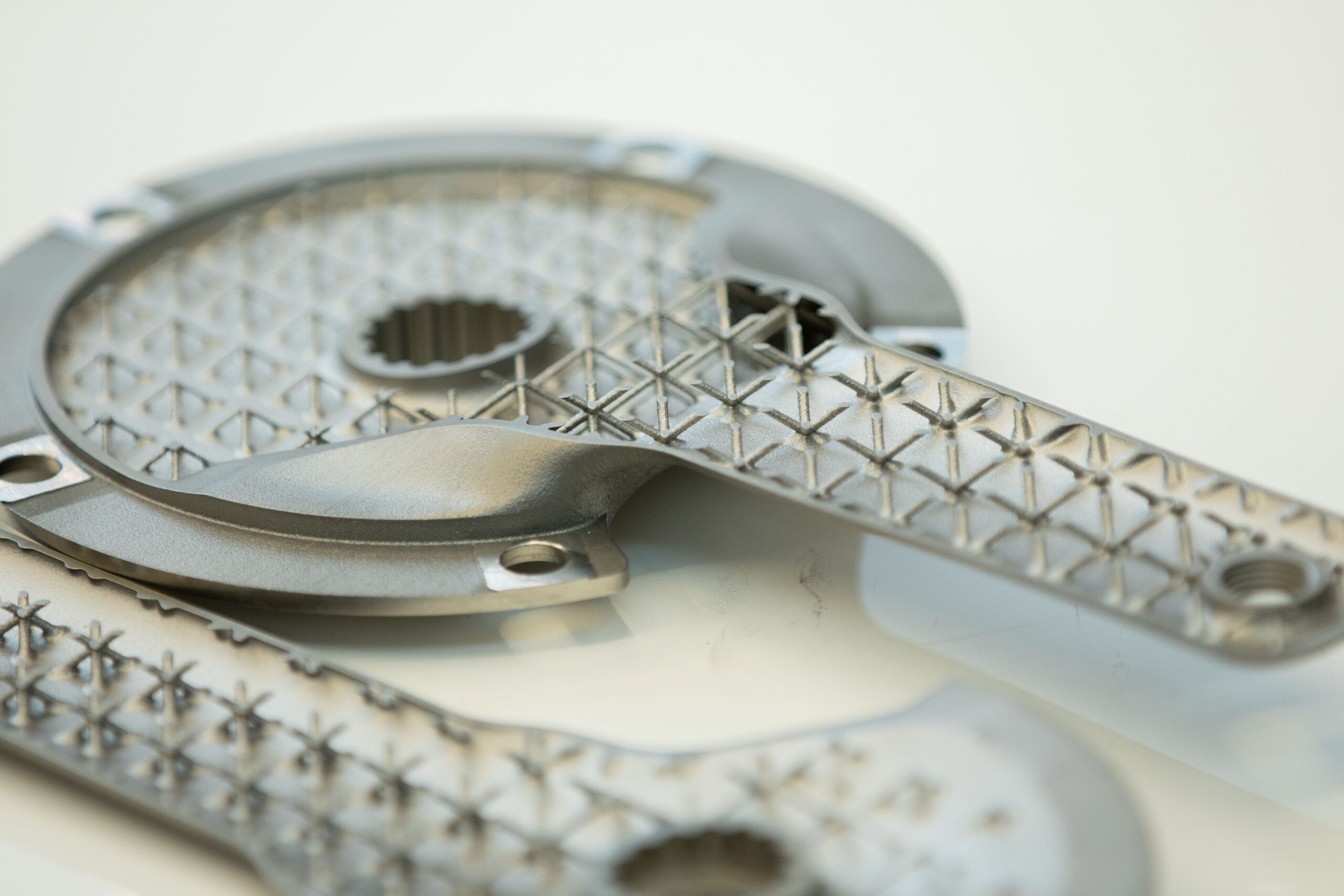
Renishaw 3D-printed crankset for Team GB
Renishaw’s 3D-printed parts for Team GB. Scott Windsor / Our Media

For the Paris 2024 Games, Renishaw supplied Team GB with more than 1,000 precision components across 32 track bikes. This included 3D-printed titanium cranks and the striking split seatpost, which allows air to flow directly through the centre of the bike. 

Following an initial research phase, Renishaw will manufacture a series of low-volume production runs for the newly developed parts and components.

“This enables rapid iteration and ensures every component meets performance demands and delivers uniformity and reliability at competition level,” British Cycling says. 

Last year, we had an up-close and personal look at Team GB’s hyper-expensive Olympic track bike, which featured Renishaw’s cranks and seatpost. Dr Oliver Caddy, lead project engineer at British Cycling, said that creating the parts using additive manufacturing enabled the team to customise seatposts and cranksets for each rider.

Matthew Richardson 200m record attempt.
Matthew Richardson set a new 200m flying start world record in August using Renishaw components. Serhat Cetinkaya / Getty Images

We also spoke to Caddy about Matthew Richardson’s custom Hope HB.T track bike for his 200m flying start world record. Caddy said the Renishaw cranks were the best-performing cranks Team GB had “ever had”, but he divulged they were working with Renishaw to create a new version of the crank that will include a power meter. 

This could be a hint of the kind of developments we’ll see from British Cycling and Renishaw’s renewed partnership – but there is a bigger question for Team GB right now. 

The UCI recently announced a range of tech regulations that will limit the internal fork width of road bikes from next year and track bikes from 2027, outlawing Hope’s track bike due to its wide fork and seatstays. 

In September, cycling’s governing body also announced that it will cap the price of track bikes and equipment at the LA Games, which will help curb the spiralling costs of track bikes and equipment. 

As it stands, we don’t know what the price caps will be. But it might jeopardise some of Renishaw and Team GB’s groundbreaking work. 

Spotify’s managed accounts will help keep your kids from wrecking your music taste profile

Spotify has introduced a new “managed accounts” feature aimed at younger listeners. Initially piloted last year and launching in seven new markets, including the US, today, it allows parents and guardians with a Spotify Premium Family plan to allocate their children a dedicated profile with their own personalized recommendations and custom playlists.

The idea is that the adults can filter out explicit content, limit the playback of certain artists and hide video playback features, including Canvas, should they want to. Users on this profile can’t use interactivity features like Messages either. 

Perhaps most importantly of all for some, a managed account also ensures that your personal Wrapped results at the end of the year aren’t dominated by whatever TikTok-viral songs the kids have been obsessively playing on repeat for months — and they won’t mess with your Discover Weekly algorithm either. Spotify’s ‘Exclude from your Taste Profile’ feature already offers a way of keeping the nonsense your kids might be listening to away from your own recommended content, but this feels like a cleaner option for families.

Standard Spotify Premium features like daylist and the aforementioned Discover Weekly remain available to someone using a managed account, making it a better option for kids becoming interested in music (they may even have gotten hooked on a band you’ve been listening to in the car) than the Spotify Kids app, which is very much designed for the ‘Baby Shark‘ devotees. It’s probably helpful to think of a managed account as a bridge between that and an unrestricted Premium account where all the music in the world is at your fingertips.

To set up a managed account, the plan owner has to go into their account settings within the Spotify app and select “Add a Member,” followed by selecting “Add a listener aged under 13.” The app will provide further instructions from there. As a reminder, a Spotify Premium Family plan is required to set up a managed account. This currently costs $20 per month.

This article originally appeared on Engadget at https://www.engadget.com/entertainment/music/spotifys-managed-accounts-will-help-keep-your-kids-from-wrecking-your-music-taste-profile-154406843.html?src=rss