
DietPi 10.2 adds Immich, Immich Machine Learning, uv, and RustDesk Client, alongside tool improvements, configuration updates, and multiple bug fixes.
Category Archives: Unfiltered RSS
Apple Just Announced WWDC 2026
WWDC 2026 is rapidly approaching. While Apple has a number of events throughout any given year, WWDC is one of two Apple keynotes that the tech community actively anticipates (the other being the iPhone fall event). This is Apple’s chance to show off all of the software updates its been working on since the last WWDC—and all the features that come with them. This year, that likely means iOS 27, iPadOS 27, macOS 27, and watchOS 27.
When is WWDC 2026?
Apple announced on Monday that WWDC 2026 will kick off on Monday, June 8 and run through Friday, June 12. If you’re used to watching a single keynote from past WWDCs, seeing that this year’s event runs multiple days might come as a surprise. But WWDC isn’t just the one announcement; instead, this is Apple’s “Worldwide Developer Conference,” which typically runs through the week. While the big keynote kickstarts the conference, the rest of the week is full of presentations about topics that concern Apple developers.
But if you’re not an Apple developer, the only day you really care about is June 8. That’s when Apple will reveal all its software news. That keynote starts at 10 a.m. PT (1 p.m. ET). While details are currently sparse, expect the presentation to run from 60 to 90 minutes. Apple says the keynote will be available to stream on the Apple Developer app, Apple’s website, as well as the company’s official YouTube channel. Viewers in China can tune in on the Apple Developer bilibili channel.
What do we expect from WWDC 2026?
As mentioned above, WWDC will be all about Apple’s latest batch of major updates. Last year was the first year the company ran with the “26” naming scheme, and this year will likely be no different—save for the number going up to 27.
When it comes to iOS 27, there are two big changes to note. First is Apple’s long-waited AI upgrade for Siri. The company first announced these changes back in 2024 for iOS 18, advertising a contextually-aware Siri that was much smarter than the assistant we currently know. Imagine asking Siri when your friend’s flight gets in, and having the bot know to dig through your emails to find their flight itinerary, or asking it to edit and send an image to a family member, all without you having to do a thing yourself. That was Apple’s vision for Siri two years ago; that vision has yet to materialize. The rumors suggest we’ll have it once we update to iOS 27, however, so we’ll just have to wait and see what Apple announces in June.
iOS 27’s other big feature, however, might not be a feature at all. Apple may take this update cycle to work on bug fixes and stability updates, rather than flashy new features. I’m all for that: While iOS 26 has been a relatively smooth experience for me, I’ve seen quite a number of complaints from users online, especially regarding the keyboard. Apple actually issued a fix for that with iOS 26.4, but I think it’s always smart to use the same resources you would building new features on smoothing out rough edges. macOS Tahoe also received its fair share of criticism: In fact, I wouldn’t install it on my M1 iMac until macOS 26.3, which seemed to be a bit more stable than previous versions.
XMMS Codebase Brought Back To Life By AI With GTK4 + GStreamer/PipeWire Port
Longtime Linux desktop users will likely remember the glorious days of the XMMS music player inspired by Winamp. It’s been about two decades since the last official release but thanks to AI there is now a modern port of the codebase to GTK4 and GStreamer/PipeWire…
Republicans in Congress add $250 annual federal EV tax to transport bill
They might be better than gas-powered cars in most conceivable ways, but electric vehicle sales are having an undeniably hard time right now. The cause is no mystery: since January 2025 the US government has been actively hostile to the idea of energy efficiency and in the intervening months has taken an axe to fuel efficiency regulations, prosecuting polluters, and the consumer-facing tax credit.
That last one had the effect of bringing forward sales from people who needed an EV and knew the credit was expiring at the end of last September, leading to a rosy-looking Q3 2025 followed by a rather bad Q4. Things got even worse this year—in January just 5.1 percent of all new vehicles sold were EVs, compared to 8.3 percent in January 2025. But the government’s antipathy toward EVs isn’t done yet. House Transportation and Infrastructure Committee Chair Sam Graves (R-Mo.) wants to include an annual $250 tax on EV drivers—hybrids would also pay $100 a year—in an upcoming bill.
This is the second time Graves has tried to tax drivers of more efficient vehicles; last year the committee under Graves wanted to include an escalating EV tax, starting at $200 annually, into the budget but was unsuccessful.
As teens await sentencing for nudifying girls, parents aim to sue school
Two teens behind one of the earliest US high school deepfake scandals will be sentenced this week, but the case is unlikely to resolve families’ concerns about the school’s significantly delayed response.
Earlier this month, the 16-year-old boys admitted to using AI tools to “nudify” images of 48 female classmates at Lancaster Country Day School in Pennsylvania, along with 12 other young female acquaintances.
The incident could have been caught early, after the school learned of the images following an anonymous report to a state-run tipline. But officials—who at the time weren’t legally required to act—failed to notify parents or police for six months, as the number of victims continued to grow. In total, the boys created at least 347 AI-generated sexualized images and videos before they were stopped.
Apple’s WWDC 2026 is set for June 8-12
Apple announced that this year’s Worldwide Developers Conference (WWDC) will take place from June 8-12. The company tends to be consistent with event timing, so it’s no surprise that CEO Tim Cook will take the stage for the keynote on June 8, most likely at 1PM ET.
Much of WWDC will take place online and will be free to attend, though there will be an in-person component for select developers, students and media at Apple Park in Cupertino, California. You’ll be able to take in WWDC via the Apple Developer app, website and YouTube channel. It will also be available in China on the Apple Developer Bilibili channel.
What should we expect this time around? This is a software-focused event and all indications point toward a reveal of the upcoming “27” operating systems. This would include iOS 27, iPadOS 27, macOS 27, visionOS 27, watchOS 27 and macOS 27.
We don’t know for certain what new features these operating system updates will bring to the table, with Bloomberg’s Mark Gurman suggesting that WWDC will be “a fairly muted affair this year.” Rumors have indicated that iOS 27 will deliver much-needed improvements to Apple Intelligence along with the delayed Siri overhaul. Reports also suggest the presence of split-pane multitasking, a redesigned Health app and a new battery management system for iPhones.
In any event, we don’t have that long to wait. Engadget will be on hand to report on all of the announcements and reveals.
This article originally appeared on Engadget at https://www.engadget.com/apps/apples-wwdc-2026-is-set-for-june-8-12-171359493.html?src=rss
OpenSSF Welcomes New Members as SLSA, Gemara, and AI Security Efforts Mature
At Amsterdam’s SecurityCon Europe, the Linux Foundation’s OpenSSF adds new members and showcases progress on SLSA, Gemara, and AI security.
The post OpenSSF Welcomes New Members as SLSA, Gemara, and AI Security Efforts Mature appeared first on FOSS Force.
Crimson Desert Walks Back Launch Misstep With Incoming Intel Arc GPU Support

You might recall just a few days ago when, immediately after the launch of hotly-anticipated open world RPG Crimson Desert, it was discovered that it simply would not launch on Intel Arc GPUs, throwing up an error message saying that the graphics card was not supported. An error message that looked like this:
The original error message
Walmart: ChatGPT Checkout Converted 3x Worse Than Website
Walmart found that purchases made directly inside ChatGPT converted at only one-third the rate of traditional website checkouts, leading it to abandon OpenAI’s Instant Checkout in favor of routing users through its own platform. Search Engine Land reports: Starting in November, Walmart offered about 200,000 products through OpenAI’s Instant Checkout. Users could complete purchases inside ChatGPT without visiting Walmart’s site. Daniel Danker, Walmart’s EVP of product and design, said those in-chat purchases converted at one-third the rate of click-out transactions. He called the experience “unsatisfying” and confirmed Walmart is moving away from it.
Instant Checkout was designed to let users complete purchases directly inside ChatGPT without visiting a retailer’s website. However, earlier this month, OpenAI confirmed it was phasing out Instant Checkout in favor of app-based checkout handled by merchants. Walmart will embed its own chatbot, Sparky, inside ChatGPT. Users will log into Walmart, sync carts across platforms, and complete purchases within Walmart’s system. A similar integration is coming to Google Gemini next month. In other Walmart-related news, the retailer announced plans to roll out “digital price tags” to all U.S. stores by the end of the year.


Read more of this story at Slashdot.
Polymarket is cracking down on insider trading with updated rules
Polymarket announced that it’s taking insider trading more seriously. Seen in its latest press release, the prediction market updated its market integrity rules, specifically those concerning insider trading and market manipulation. While Polymarket is taking the initiative to update its rules, it’s likely a response to the rise in suspicious bets, whether it’s about the US capture of Nicolás Maduro or the release of a new product from OpenAI.
As first reported on by Bloomberg, Polymarket is targeting three specific forms of trading activity. First off, users aren’t allowed to trade on “stolen confidential information,” or any behind-the-scenes knowledge about an outcome that people wouldn’t otherwise have access to. As an extension, Polymarket traders are also prohibited from taking advantage of “illegal tips,” which means that even if someone else has access to confidential information and passes it along, you still can’t trade on it. Lastly, anyone who has a “position of authority or influence sufficient to affect the outcome of the underlying event,” isn’t allowed to trade on said event.
Users can expect more surveillance and enforcement around these new rules, too. Polymarket explained that if it or its users find “unusual or potentially questionable trading activity,” the platform would conduct a review and if necessary, ban the wallet address, refer the issue to law enforcement or impose “monetary penalties.” If you’re curious what the punishment for insider trading on these prediction markets looks like, a recent case saw MrBeast’s video editor suspended for two years from the platform and fined five times the amount of his initial trade size after Kalshi concluded its investigation.
This article originally appeared on Engadget at https://www.engadget.com/big-tech/polymarket-is-cracking-down-on-insider-trading-with-updated-rules-163928655.html?src=rss
Billionaire OnlyFans owner Leonid Radvinsky has died from cancer at 43
Leonid Radvinsky, the billionaire owner of OnlyFans, has died. He passed “peacefully after a long battle with cancer” at age 43, according to a statement from the platform published by Forbes. He was born in Ukraine, but grew up in Chicago.
Radvinsky didn’t create OnlyFans. He purchased it back in 2018, though is largely credited with transforming it from a niche website to a gigantic porn empire. The platform became so huge that reports have indicated that Radvinsky personally made nearly $2 million every day in 2024. His net worth at the time of his death grew to $4.7 billion, which had more than doubled since 2021.
Leonid Radvinsky, the owner of OnlyFans, has died at 43 after a battle with cancer.
“We are deeply saddened to announce the death of Leo Radvinsky,” an OnlyFans spokesperson said in a statement to Variety. “Leo passed away peacefully after a long battle with cancer. His family… pic.twitter.com/xJetAcTZmU
— Variety (@Variety) March 23, 2026
It has been reported that he was in talks to sell OnlyFans in a deal valued at $8 billion. It’s long-been rumored that he bought a controlling stake in the platform for around $30 million back in 2018, though that number has never been officially confirmed.
Radvinsky was famously secretive and avoided giving interviews, but his history is not without controversy. He built his fortune with websites that were much shadier than OnlyFans. Radvinsky founded a similar site called MyFreeCams back in 2004 when he was in college, which has been involved in numerous scandals.
He also founded a website called Cybertania, which provided links to various pornograpy sites. Some of these links claimed to direct users to illegal content involving children and animals.
Forbes did a deep dive into this and found that the site didn’t actually lead to the offending content, but it’s still likely that Radvinsky and the platform made money by getting people to click on the links. Records also indicate that Radvinsky held domain names like “websyoungest.com” and “aretheylegal.com” until 2014. It’s currently unknown what those sites hosted.
He’s also been sued for everything from spamming users to impersonating large companies like Microsoft and Amazon to direct traffic to his pornography sites. These cases were all settled outside of court for undisclosed sums of money.
This article originally appeared on Engadget at https://www.engadget.com/big-tech/billionaire-onlyfans-owner-leonid-radvinsky-has-died-from-cancer-at-43-163211324.html?src=rss
OnlyFans Owner Dies At 43
Computershack shares a report from NBC News: Leonid Radvinsky, the owner of adult-content platform OnlyFans, has died of cancer at the age of 43, the company said in a statement on Monday. “We are deeply saddened to announce the death of Leo Radvinsky. Leo passed away peacefully after a long battle with cancer,” an OnlyFans spokesperson said. “His family have requested privacy at this difficult time.”
Radvinsky, a Ukrainian-American entrepreneur, acquired Fenix International Limited, the parent company of OnlyFans, in 2018 and served as its director and majority shareholder. He also runs Leo, a venture capital fund he founded in 2009 that focuses primarily on investments in technology companies. According to Reuters, OnlyFans is valued at around $5.5 billion, including debt.


Read more of this story at Slashdot.
Tadej Pogačar’s historic Milan-San Remo win in 7 incredible numbers
Tadej Pogačar added the fourth of five Monuments to his one-day race tally this weekend, leaving only Paris-Roubaix remaining to finish the set.
Should he win Paris-Roubaix, Pogačar would become only the fourth rider – behind the Belgians Eddy Merckx, Roger De Vlaeminck and Rik Van Looy – to complete the feat, with all three of those winning between 1958 and 1979. There’s even talk of Pogačar becoming the first rider to win all five Monuments in one year.
Pogačar has already won Strade Bianche in 2026 and seems to be in unstoppable form again this year. But what does it take to win road cycling’s longest race? Here are the key numbers that underpinned Pogačar‘s 2026 Milan-San Remo win.
45.5

Pogačar covered the race’s 298km at an average speed of 45.5km, finishing after 6hrs 35mins 49secs in the saddle. That’s a little slower than Mathieu van der Poel’s average of 47.70km/h for the 2024 Paris-Roubaix. But Milan-San Remo has over 2,000m of ascent en route, including the Passo del Turchino and the five climbs in the final 50km.
79.9
Pogačar‘s maximum speed during the race was 79.9km/h, according to Strava, recorded on the run-in to the Cipressa climb. His maximum cadence shown on Strava was 129rpm, apparently on the same stretch of road.
8.49

Pogačar‘s time to the top of the Cipressa, the penultimate climb of the race and the longest in the finale, was 8mins 49secs. This beat by a few seconds his time in last year’s race, when he set a time of 8mins 57secs, before finishing third behind van der Poel and Filippo Ganna.
It was all the more impressive, considering Pogačar had started towards the back of the field, having crashed along with others as he approached the base of the climb.
According to Strava, Pogačar also recorded the third fastest time ever on the 6.84km ascent and descent of the Poggio, the last climb before the finish, where he was bested by Matej Mohorič in 2024.
5
The number of times Pogačar has ridden Milan-San Remo. His first Milan-San Remo was in 2022, when he finished fifth, having been out-descended by Mohorič with his dropper seatpost.
He was back in 2023, finishing fourth in a race won by van der Poel. The next year, Pogačar was up to third, behind Jasper Philipsen and Michael Matthews, then third again in 2025.
It’s only at the fifth attempt, this year, that Pogačar has added this fourth Monument to his tally, leaving him only a win in Paris-Roubaix needed to have completed all five. We reckon he might win all five this year, becoming the first rider to do so.
35

Pogačar beat Tom Pidcock by around 35cm in the final two-up sprint to the line. Although Pidcock won the unofficial sixth Monument, Strade Bianche, in 2023, he’s yet to garner a Monument win. Pogačar was only four seconds ahead of the charging bunch, led in by Wout van Aert.
415
Pogačar‘s estimated FTP in watts is 415. The actual numbers are kept a close secret within his UAE Team Emirates-XRG team, but this is a value that’s been estimated based on ride data shared in 2024. That gives him a power-to-weight figure close to 7W/kg and he can keep up 340 watts on a five-hour zone two training ride. His resting heart rate? That’s around 37.
3,898
The number of calories Pogačar burned during the race, as estimated by Strava. According to Mark Zuckerberg, founder of Facebook, he was matching that number in 2023. Maybe he should take to the start line next year…
A bit of good news: It’s possible to turn around a groundwater crisis
Generally, when you hear “water use” and “sustainability,” you expect those words to be followed by some bad news. Humanity’s enduring ability to ignore the math of declining water supplies is almost impressive. But there are cases where actions have successfully reversed our loss of water resources. A new paper in Science by Scott Jasechko of the University of California, Santa Barbara, examines documented cases of groundwater recovery around the world to identify which strategies have worked.
Groundwater is invaluable for many reasons. For one, it’s (usually) cleaner than surface water. It’s also right under your feet and often close enough to the surface that it doesn’t take much energy to pump it up. And there’s loads of it down there, no matter the season. Because of this, humans use a lot of it for drinking water, agriculture, and every other use you can think of.
Unfortunately, in many places, the rate of groundwater use has grown to exceed the rate at which precipitation soaks into the ground to replenish it.
[$] Tracking when BPF programs may sleep
BPF programs can run in both sleepable and non-sleepable (atomic) contexts.
Currently, sleepable BPF programs are not allowed to enter an atomic context.
Puranjay Mohan has a
new patch set that changes that. The patch set would let BPF programs called
in sleepable contexts temporarily acquire locks that cause the programs to
transition to an atomic context. BPF maintainer Alexei
Starovoitov objected to parts of the implementation, however, so acceptance of
the patch depends on whether Mohan is willing and able to straighten it out.
Uber’s Deal Blitz To Stop a Robotaxi Monopoly
Uber is aggressively partnering with multiple robotaxi companies to avoid a future dominated by Waymo or Tesla. The ride-hailing giant has struck deals with at least a dozen autonomous vehicle players in recent years. Just last week, it announced a $1.25 billion partnership with Rivian, with plans to deploy up to 50,000 driverless vehicles over the next decade. Business Insider reports: Uber announced three new robotaxi partnerships in the past few weeks with Zoox, Wayve-Nissan, and Rivian. In less than half a decade, the company has secured at least a dozen deals, including with WeRide, AVride, May Mobility, Momenta, Pony.AI, Wayve, Baidu’s Apollo Go, Motional, and Lucid-Nuro. Still, less than a half-dozen of Uber’s partners have deployed fully driverless, paid robotaxi operations, and only one, Waymo, operates in the US. Uber has a joint deployment with Waymo in Atlanta, Austin, and Phoenix, but in other cities, Waymo is a competitor.
Uber’s partnership spree is less about seeking the singular, dominant player of autonomous driving. Instead, analysts told Business Insider that Uber is ensuring multiple vendors can participate in the expensive business of robotaxis — fending off the real risk of a Waymo or Tesla scaling on its own — and giving itself a stake in the robotaxi economy by being the aggregator of choice. “The more diversified the supplier base, the better for the network in the middle, which is Uber,” Mark Mahaney, an Uber analyst for Evercore ISI, told Business Insider.


Read more of this story at Slashdot.
LG Sound Suite review: Dolby Atmos FlexConnect in a powerful package
The premise seems simple enough. LG promises that you can set its Sound Suite speakers anywhere and Dolby’s home theater tech will make them perform well. The soundbar, subwoofer and speakers don’t have to go in prescribed locations for the best results, which means you can place them where you need to and move them as you see fit. Of course, this all hinges on the reliability of the underlying tech and LG’s ability to make individual speakers that actually sound good.
Like most premium soundbars and complete home theater setups these days, a complete Sound Suite collection is expensive. The centerpiece alone, a soundbar that most people will want in their customizable configuration, is $1,000. However, if you have a recent LG TV, or are planning to buy a 2026 model when those arrive, there’s no better option for boosting your living room entertainment experience.
The components of the LG Sound Suite
There are four different devices that make up the Sound Suite. The centerpiece is the H7 soundbar ($1,000), which is the first one that works with Dolby Atmos FlexConnect (DAFC) technology. Then there’s the 8-inch W7 subwoofer ($600) and the M5 and M7 speakers ($250 and $400). LG allows you to pick and choose between these products to build a home theater set up that suits your needs — up to four speakers and one subwoofer. The only real caveat is that you need the H7 soundbar or a recent LG TV (2025 OLED G5, C5, CS5 and QNED 9M, or an upcoming 2026 model) to serve as the primary device for Sound Suite to work. That’s because the underlying tech requires LG’s alpha 11 Gen 3 AI processor, which is inside the soundbar and the company’s newer TVs.
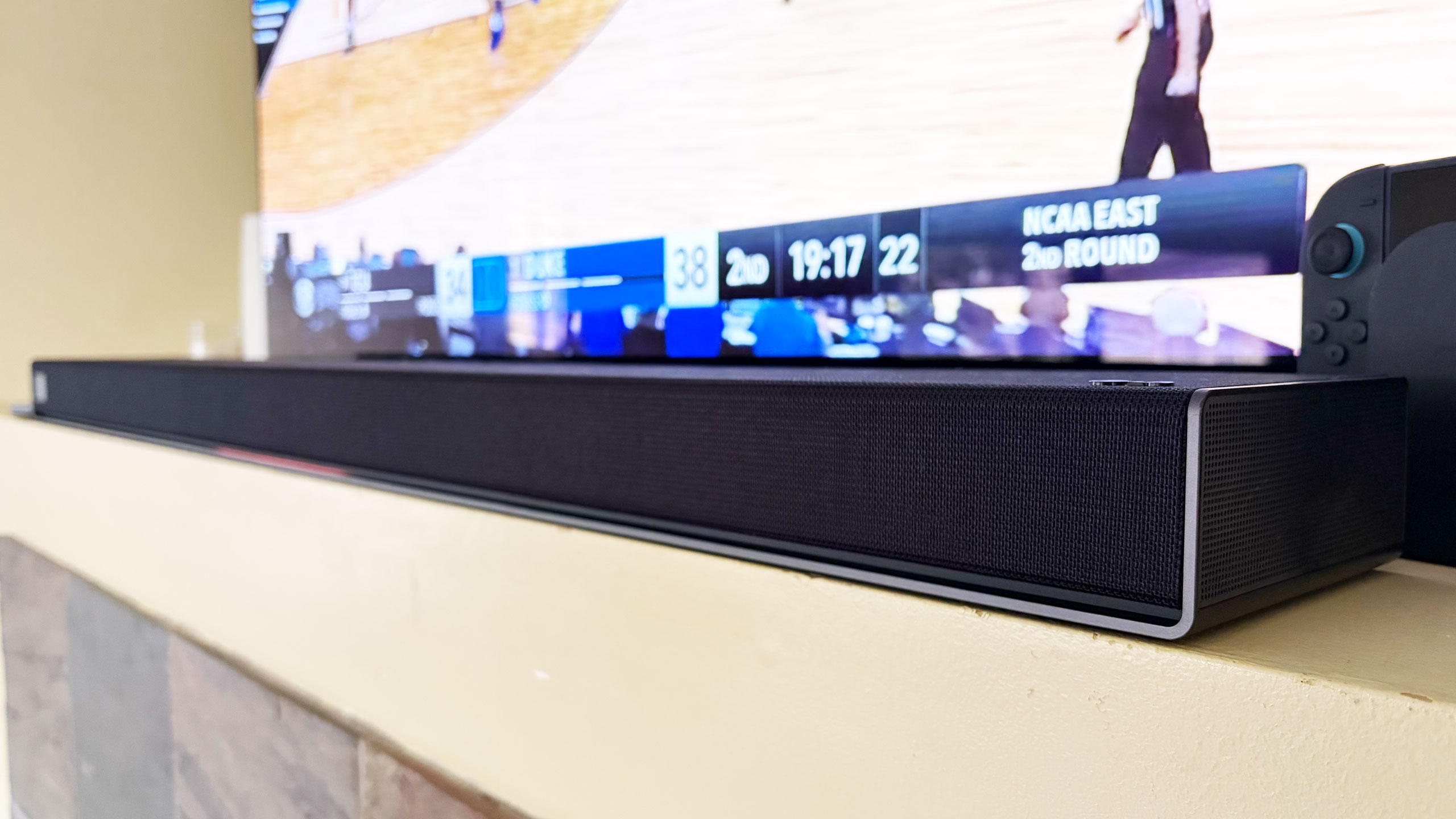
The H7 houses a dozen Peerless drivers comprising front, side and up-firing units. There’s also four woofers and eight passive radiators for bass and low-frequency audio. The soundbar has a pretty basic design, plain enough to sit in front of an LG OLED (or other premium TV) without being a distraction, and short enough not to block it. Both Bluetooth and Wi-Fi are available here, so AirPlay 2, Google Cast, Spotify Connect and Tidal Connect are all supported.
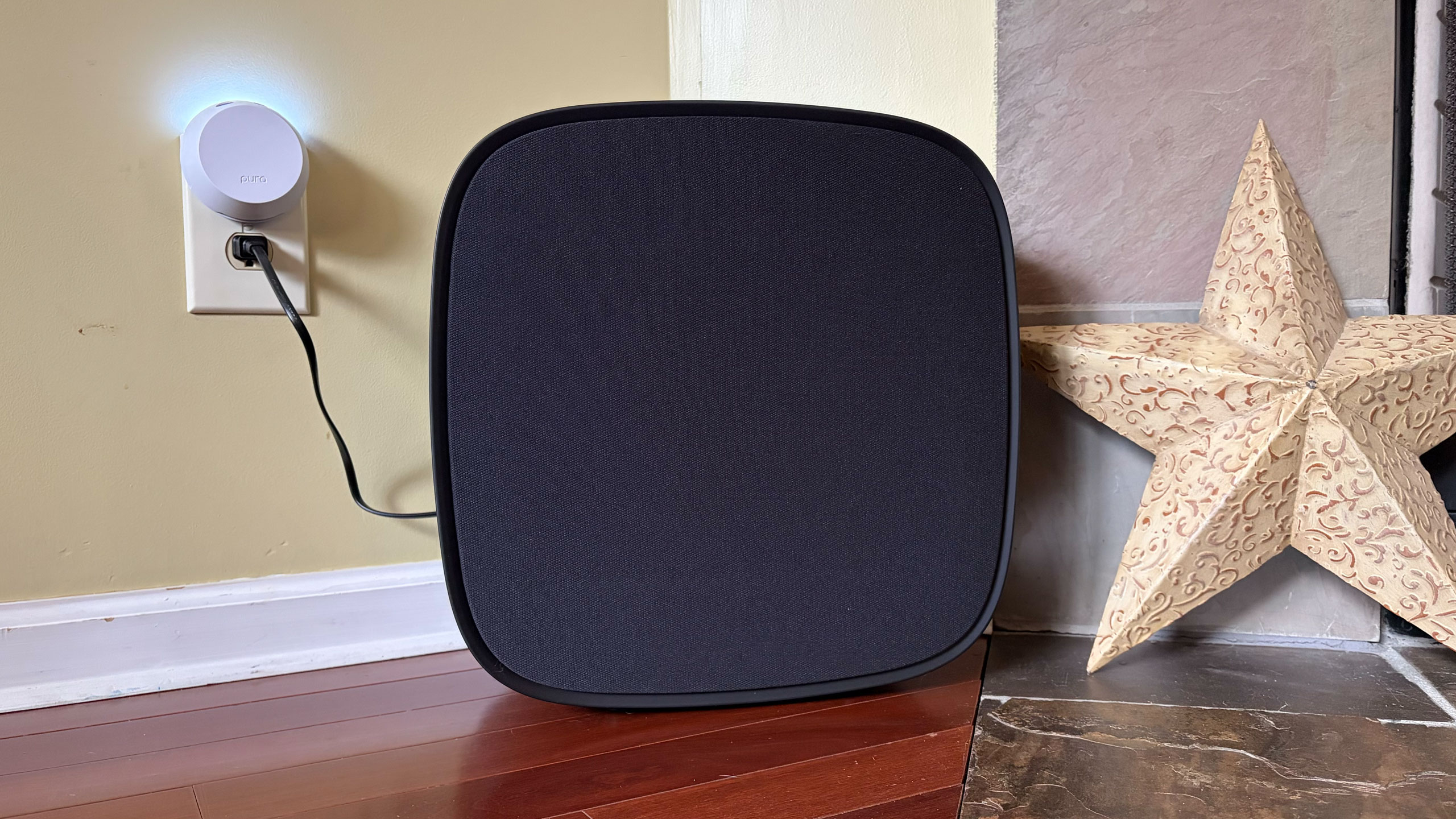
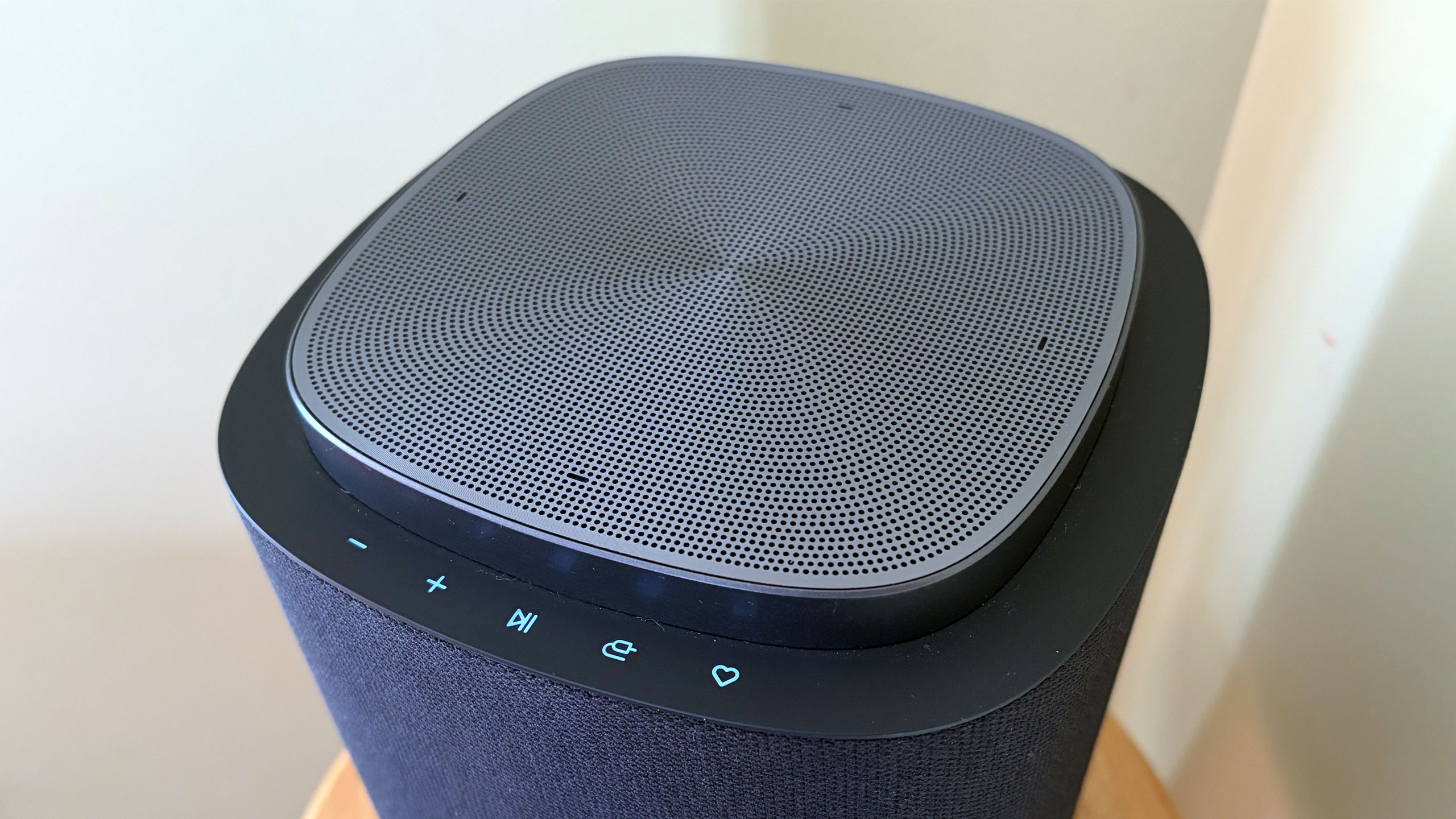
The W7 wireless sub has an 8-inch woofer that gets really boomy at times. It’s quite large at 16.1 x 16.3 x 7.6 inches, but you can use it standing up vertically or laying down horizontally — whichever orientation fits your needs or available space. The M5 and M7 speakers offer basically the same features, including AirPlay and Cast, and can be used either by themselves, as a stereo pair, as a four-speaker array or as rear satellite speakers with the H7 soundbar. The main difference is the M7 has two full-range drivers, one up-firing driver and a woofer while the M5 only has a tweeter, an up-firing driver and a woofer.
What is Dolby Atmos FlexConnect?
FlexConnect is a home theater audio technology that Dolby announced in 2023. It was available on TCL’s Z100 speakers last year, but LG’s Sound Suite marks the first time the feature has been available on a more robust living room product that includes a soundbar. FlexConnect allows you to position speakers anywhere in a room without sacrificing audio performance. The tech uses a TV or soundbar as the lead device to locate speakers so it can tune the sound to match their positioning. The system can also quickly adapt when you move a speaker — maybe for a party or other special occasion.
FlexConnect works as advertised, but there is one caveat that should’ve been obvious, although I didn’t anticipate it. Every time you add or remove speakers from a DAFC group, you’ll need to recalibrate the system, which includes the software playing sounds from the speakers so that the TV or soundbar can locate them and Dolby’s tech adjusts their output. It doesn’t take long, but there is audible noise from each unit in the group, so you’ll want to factor in that time — and potential annoyance for anyone else in the house.
Other Sound Suite features
Billy Steele for Engadget
Sound Suite offers some of the same features as LG’s other home theater products. Those include Night Mode, Room Calibration Pro, AI Sound Pro+ real-time audio upscaling and Clear Voice Pro+ for enhanced dialogue. For the Sound Suite, LG has also introduced Sound Follow, a feature that allows you to adjust the “sweet spot” for the system based on where you’re sitting.
Once you set your current position with a tap in the ThinQ app, Sound Follow is supposed to change the levels and tuning accordingly. I’m not entirely sure this was working on my system. Unlike my demo at CES, the seating position on the FlexConnect layout in the app was never updated. And while the UI seemed to indicate the change was made when I tapped the buttons, I couldn’t hear any difference in the audio. I asked LG for more information to ensure Sound Follow is functioning properly.
A word about setup
Like most soundbars and speakers these days, you have to use an app to get them all connected and properly set up. And like Samsung, LG makes you do that through the same app that handles all of its connected devices — including appliances. Once you unbox and plug in the Sound Suite speakers, you add them in the ThinQ app as a new home theater arrangement. The software shows you which speakers are available to use and allows you to select which ones you want in the initial Dolby Atmos FlexConnect grouping.
The app will ask you to set the distance between the soundbar and your primary seating area before running the sound optimization (tuning) process. ThinQ will display the speaker layout and you can edit the DAFC group at any time. If you move a speaker though, you’ll need to run the optimization again for the best audio performance. And if you’re using an LG TV as the lead device, all of this is sorted onscreen rather than in the app.
Overall, the process is pretty straightforward, although I encountered some pretty significant connectivity issues that were very frustrating. I review soundbars and speakers regularly, so I’m familiar with the process of using an app to connect devices to my home Wi-Fi in order to get them up and running. With the H7, it took a few days to get it connected, which meant I could only use the soundbar with the audio options available on LG C5’s menu and wasn’t able to set up a larger Sound Suite configuration. After several router and soundbar reboots, I was finally able to get the H7 to connect and become available to finish the install. I’ve never had this problem before, so perhaps LG did something different with the Wi-Fi components here.
Billy Steele for Engadget
When I was adding the M7 speakers to my DAFC setup, I had no issues connecting them to Wi-Fi initially. However, I did have trouble adding them to the FlexConnect group, which required each piece of the Sound Suite playing an audio calibration clip. Repeatedly, the ThinQ app told me there was a connection issue with one of the M7s, although eventually they all somehow got added anyway. I also had trouble removing speakers from the arrangement. Even though the app said sound was only coming from the H7 soundbar, one of the two M7 speakers was still connected and emitting sound when I didn’t want it to. For some reason, this only happened when playing music over AirPlay — TV audio over HDMI eARC always functioned as intended.
If you’re using the TV as the lead device, you do all of the setup on the screen. I found this method to be more straightforward and reliable, although it blasted the calibration sounds at a deafening volume. There is a big issue though: Once connected to the TV as a DAFC setup, the speaker settings weren’t available in either the ThinQ app or on-screen menus. This meant I was stuck in standard mode, with things like AI Sound Pro+ inaccessible. I asked LG for more info on this because it greatly impacts the overall experience.
Which configuration sounds best?
Before I get into describing the various Sound Suite configurations, I need to make an important note about the limitations for the possible setups. LG only allows a maximum of five speakers in any Sound Suite arrangement, but you can mix and match however you want. Just remember if you don’t opt for the H7 soundbar, you’ll need a compatible LG TV as the lead device for FlexConnect to work.
You can also use the M5 and M7 as standalone speakers in another room and swap them in and out of your living room or home theater setup as needed. In the multi-room scenario, Sound Suite speakers function much like a Sonos system would, and the M7 is more than capable of being a standalone music speaker with plenty of detail and decent bass. I wasn’t able to test the M5, so I can’t vouch for that one. Keep in mind that if you opt for the M5 or the M7 for your living room, you’ll need at least two of either one to use FlexConnect with your LG TV.
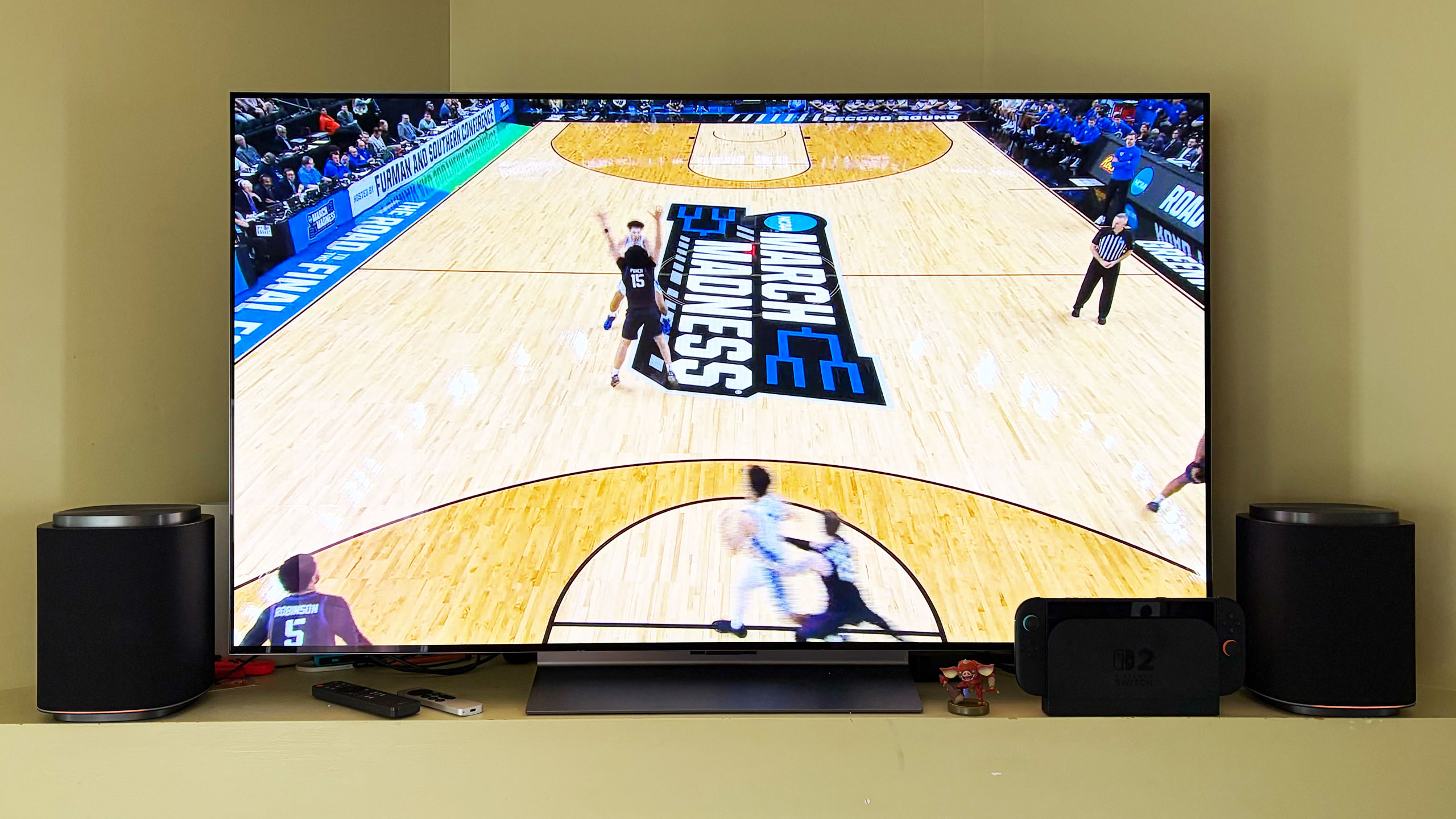
After testing multiple configurations of the Sound Suite, I think the combination of the H7 soundbar, W7 subwoofer and two M7s is the ideal arrangement. I’ll hedge that a bit as I prefer to disable the M7s in the rear of the room when watching live TV — especially sports — as the same audio coming from the soundbar and those speakers didn’t really enhance the experience. Plus, arena noise seemed overly echo-y and off-putting. This setup is well-suited for streaming TV shows and movies, things where Dolby Atmos, or at least LG’s spatial upscaling, is at the height of its powers.
Billy Steele for Engadget
In this setup with the H7 as the lead, you get Sound Suite in its most immersive form. I always use Netflix’s Drive to Survive as my first test of a new home theater system, and LG’s lineup handled it like a champ. You get excellent directional audio, which makes the cars sound like they’re zooming around your living room. And the in-car shots are so enveloping, it’s like you’re sitting right behind the driver. This configuration also works well for music, though I preferred to use either one of the M7 speakers or the soundbar/sub duo rather than the whole shebang.
My second favorite setup is four M7s. Once again, this configuration requires an LG TV as the lead device, but if you have that, you can definitely save some room in front of your television with separate front speakers. Unfortunately, you can’t use a subwoofer too because if you’re using a TV to power the speakers, you can only add up to four. That’s a real bummer, but the TV speakers will be used as a center channel (dialogue) boost, so it’s not a complete waste. However, this arrangement would benefit from more bass.
The four-speaker setup could be particularly beneficial for people who mount their TVs on the wall and don’t want a soundbar underneath. And, again, FlexConnect allows you to put the speakers anywhere, not necessarily flanking your TV. You also get the option of moving these smaller speakers around when you need to — something you can’t really do with a soundbar. The only sacrifice I noticed audio-wise is that two M7s in the front doesn’t offer the same overhead sensation for Atmos content as the H7’s up-firing drivers.
If you’re just using four M7 speakers for home theater duties, you’ll enjoy the immersive audio these Sound Suite speakers will provide. There’s lots of directional sounds with Atmos content, and there’s plenty of subtle detail that comes through on movies and shows. However, for live sports, this arrangement pulls commentary audio from the TV speakers and puts much of the arena/stadium noise in the rear M7s, which makes it difficult to hear the announcers at times. This is one area where the inability to adjust the audio settings really hampers the experience.
If you’re hoping to invest in something that can pull double duty for music, I prefer one or two M7s for that purpose. And while there’s decent low-end thump, streaming your favorite tunes is where you’ll notice the absence of that W7 subwoofer.
The competition
Billy Steele for Engadget
If you’re looking for alternatives to LG’s Sound Suite, you have to make some sacrifices. The only other option right now that offers Dolby Atmos FlexConnect is the TCL Z100 speaker. Obviously, you’ll need multiples of this $300 device, and you’ll probably want to add the $350 subwoofer, too. Like the LG M7, you’ll need a compatible TCL TV to serve as the lead device for FlexConnect (a QM6K, QM7K, QM8K, QM9K or X11L model). I haven’t tested these 1.1.1-channel units, so I can’t provide a direct comparison to the Sound Suite’s M5 or M7.
For those who can live without FlexConnect, Samsung’s Q990 series is consistently the best all-in-one setup you can buy. I haven’t reviewed one since 2024 because the company has been keen on shipping new models with minimal updates, which means the hardware and most of the features remain the same. The HW-Q990H will be the latest installment when it arrives later this year, with the biggest differentiator being a new dialogue boost called Sound Elevation.
While the Q990 always comes with rear speakers and a subwoofer alongside a powerful soundbar, some features will only be available if you also have a Samsung TV. One of those is Q-Symphony, which utilizes TV speakers alongside the Q990’s drivers for more detailed and immersive sound. For the entire Q990 package, you’re looking at $2,000 — $100 less than the comparable Sound Suite arrangement of the H7 soundbar, two M5 speakers and a W7 sub.
Wrap-up
There’s no denying that LG has created a powerful and immersive living room experience with its Sound Suite lineup. I also like that the company allows customers to decide what they need without sacrificing the main draw of FlexConnect. While I did experience some setup and software issues, those are things LG can iron out over time — Sound Suite is still brand new, after all. I would like to see the company offer some discounted bundles and continue to add more audio features over time to justify the hefty investment. If you’ve got a couple grand to spend, especially if you have a recent LG TV, Sound Suite will be your best option for building out a home theater setup.
This article originally appeared on Engadget at https://www.engadget.com/audio/speakers/lg-sound-suite-review-dolby-atmos-flexconnect-in-a-powerful-package-160000544.html?src=rss
How to Use Almost Any Computer Without Leaving a Trace
We may earn a commission from links on this page.
Almost everything we do digitally leaves a trace of some kind, and while it can be useful to look back on this past activity—when trying to remember where that great coffee shop you stumbled across is, perhaps—this continual logging and tracking doesn’t really align with best privacy and security practices.
Meet Tails (The Amnesic Incognito Live System), a Linux distro based on Debian that maximizes user security and privacy. It can run from a USB drive, which means you’re able to plug it into any laptop or desktop with a free port (Mac or PC) and take it away again when you’re done, with nothing left behind on the computer you borrowed. Tails also comes with anonymous internet browsing built in as standard, through the Tor browser and the Tor network that reroutes your online activity across several private web nodes. No one can tell who you are or where you are, and you can get online without all the tracking and monitoring that’s usually associated with opening up a browser.
It’s perfect for hiding who you are online, and for dialing up your privacy and security protections to the absolute maximum—not to mention getting around state-level censorship, if that applies to you. Here’s what you need to know, and how to get started.
What you get with Tails
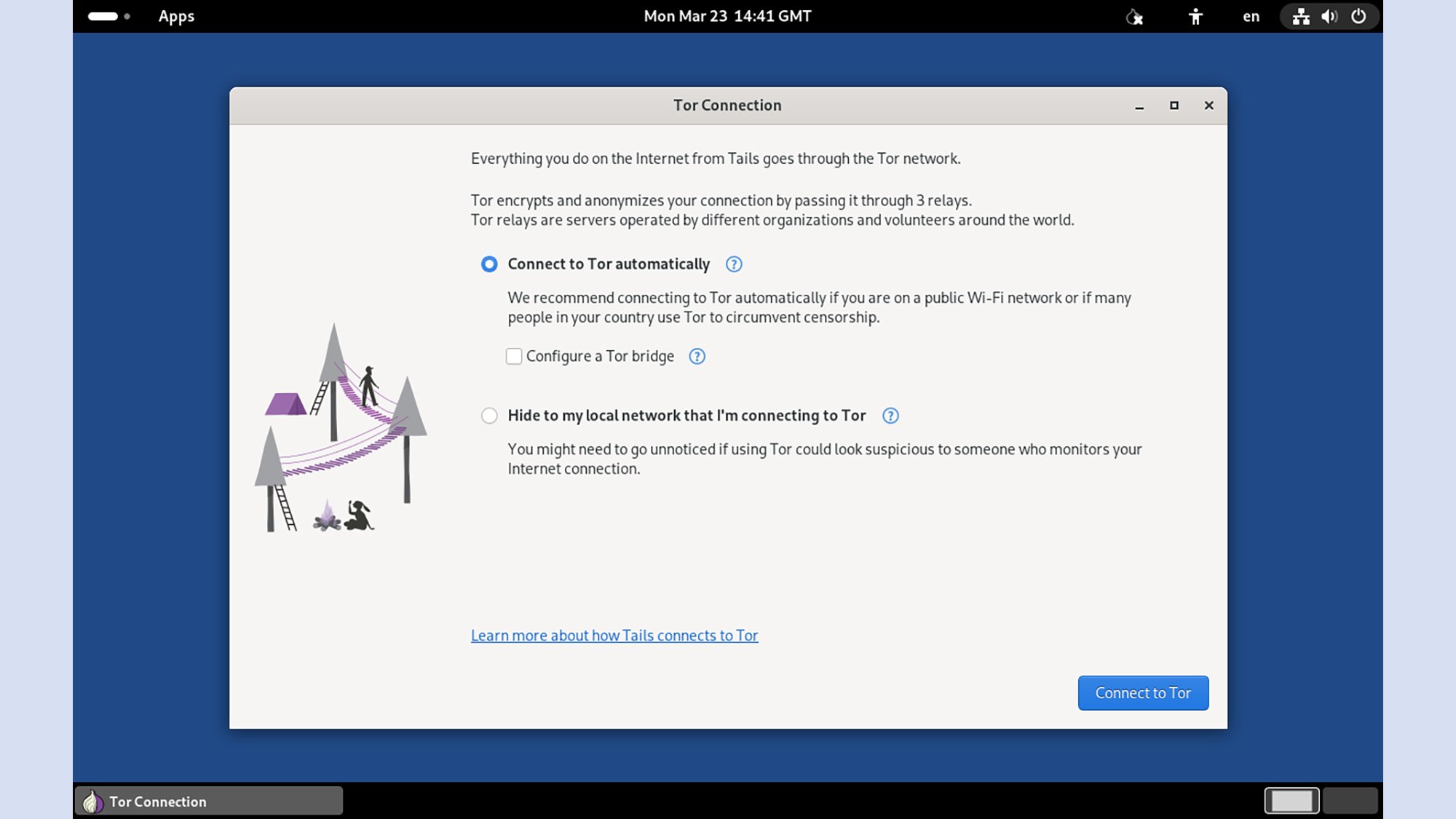
Tails will connect you to the Tor network right away.
Credit: Lifehacker
Credit: Lifehacker
Tails includes everything you need to get your computing done, as is the case with most Linux distros: You’ve got the Tor Browser on there, office applications courtesy of LibreOffice, image editing with GIMP, graphic design with Inkscape, and a variety of audio and video utilities too.
As soon as you start up the operating system from your USB drive for the first time, you’ll be prompted to get online through the Tor network. This reroutes your browsing through several different relay points, so it’s very difficult for websites to tell who you are or where you’re from (unless you start logging into them, of course). It also keeps your browsing hidden from your internet service provider, law enforcement agencies, and anyone else who might be tempted to take a peek. To make sure you’re running Tails and the Tor Browser with as much security protection as possible, check out our tips for browsing the dark web.
One big difference with Tails is that you can’t actually save anything by default—it’s one of the ways the operating system prioritizes privacy and security. If you do want a space on the USB drive to save files permanently, you need to specifically create it: Click Apps > Tails > Persistent Storage and then follow the instructions. When you’re done, you can just click the power button (top right), choose Power Off, unplug the USB drive and be on your way.
How to start using Tails
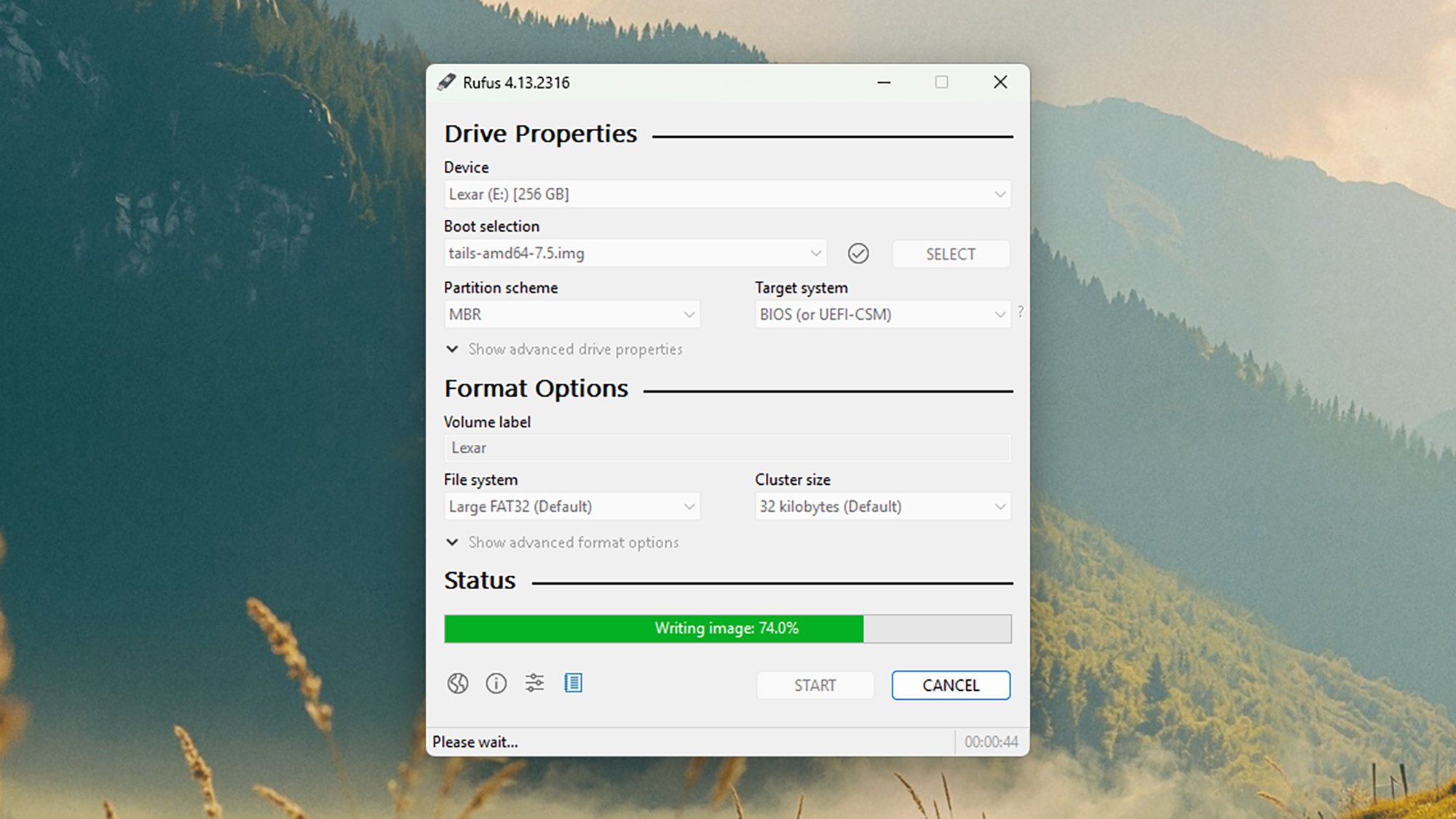
Using Rufus to create a Tails USB stick.
Credit: Lifehacker
Credit: Lifehacker
To get started, head over to Tails’ website, follow the Install Tails link, then click Download Tails only (for USB sticks). This gives you a file roughly 2GB in size, which you need to put on a USB drive. This drive must have a capacity of 8GB or higher, and can’t have anything else on it (anything already saved on the USB drive storage will be wiped when you add Tails).
For actually putting the operating system image on your USB drive, Tails recommends Rufus for Windows and Etcher for macOS. Both tools are simple to use and free: All you have to do is point these programs towards your Tails download, and your USB drive, and they’ll do the rest.
In the case of Rufus, the Device drop-down menu is where you pick your USB drive. From here, click Select to point the app towards the Tails file. You can leave the other settings on the program interface as they are, and click Start to create your bootable USB drive, which should only take a minute or two.
You’re then ready to boot from the USB drive, either on your own computer or someone else’s. This should work on most systems, with the exception of Macs that use Apple Silicon. The Tails team is busy trying to add compatibility for newer Macs, but it’s not completed yet, so you’ll mainly be looking for Windows PCs to boot from.
The specifics of how you do this depends on the computer you’re using, but typically you’ll need to hit a key like F8 as the computer boots up to pick the Tails USB drive rather than the main hard drive system—instructions for this may well appear on screen during start up, but if you’re unsure, consult the documentation that came with the laptop or desktop, or check online.
Sony’s Lead PS5 Architect Discusses Frame Generation Plans For PlayStation

Sony’s lead systems architect, Mark Cerny, has confirmed that AI-powered frame generation is indeed on the roadmap for PlayStation hardware, stressing that the feature isn’t yet ready for prime time in 2026. While the PlayStation 5 Pro recently introduced a PlayStation Spectral Super Resolution (PSSR) 2 upscaler that gave the APU a chance
Intel FRED Can Yield Greater Performance – FRED Benchmarks On Panther Lake
With Intel’s new Core Ultra Series 3 “Panther Lake” laptop SoCs, the Xe3-based Arc B390 graphics and much improved CPU performance capture much of the spotlight. One new capability with Panther Lake that isn’t featured as much though is the new FRED capability with Flexible Return and Event Delivery. Today’s Intel Panther Lake testing is looking at the very interesting performance impact of FRED on Linux.