Anthropic Aims To Nearly Triple Annualized Revenue In 2026

Anthropic is projecting its annualized revenue run rate to soar from roughly $7 billion today to as much as $26 billion in 2026, driven by rapid enterprise adoption of its Claude AI models. Reuters reports: Anthropic debuted a new version of its cheapest AI model, Haiku, on Wednesday, as part of a broader effort to appeal to companies that are looking for capable AI systems that are dramatically cheaper than its more advanced models. The Haiku 4.5 model sells for about one-third the price of Sonnet 4, one of its medium-sized models.

The revenue projections underscore continued strong demand for generative AI tools among businesses and help explain investor enthusiasm, even as AI spending, especially in infrastructure buildout, comes under scrutiny. Some people worry the level of investment might be unsustainable. Fueling the expansion is the uptake of enterprise products, which are built for organizations. Anthropic has more than 300,000 business and enterprise customers, which account for about 80% of its revenue.


Read more of this story at Slashdot.

PayPal’s blockchain partner accidentally minted $300 trillion in stablecoins

In an embarrassing error, PayPal blockchain partner Paxos accidentally minted 300 trillion of the PYUSD token today. PayPal’s stablecoin, which it debuted in 2023, is supposed to be redeemable at a 1:1 rate for US dollars. $300 trillion is more than double the entire world’s current GDP of $117 trillion. In short, that’s a really bad mistake from Paxos.

At least the action did appear to be a mistake. Paxos acknowledged the issue in a post on X, assuring clients that their funds are secure and stating that it burned the excess reserves of stablecoins. The company claimed that “this was an internal technical error.” Maybe so, but internal technical errors can still wreak havoc pretty quickly when it comes to finance, especially in the fantasy worlds of blockchain and crypto. Thanks to the appropriately named Web3 is Going Just Great for picking up on this story.

This article originally appeared on Engadget at https://www.engadget.com/cybersecurity/paypals-blockchain-partner-accidentally-minted-300-trillion-in-stablecoins-224017538.html?src=rss

F5 Says Hackers Stole Undisclosed BIG-IP Flaws, Source Code

An anonymous reader quotes a report from BleepingComputer: U.S. cybersecurity company F5 disclosed that nation-state hackers breached its systems and stole undisclosed BIG-IP security vulnerabilities and source code. The company states that it first became aware of the breach on August 9, 2025, with its investigations revealing that the attackers had gained long-term access to its system, including the company’s BIG-IP product development environment and engineering knowledge management platform.

F5 is a Fortune 500 tech giant specializing in cybersecurity, cloud management, and application delivery networking (ADN) applications. The company has 23,000 customers in 170 countries, and 48 of the Fortune 50 entities use its products. BIG-IP is the firm’s flagship product used for application delivery and traffic management by many large enterprises worldwide. […]

F5 is still reviewing which customers had their configuration or implementation details stolen and will contact them with guidance. To help customers secure their F5 environments against risks stemming from the breach, the company released updates for BIG-IP, F5OS, BIG-IP Next for Kubernetes, BIG-IQ, and APM clients. Despite any evidence “of undisclosed critical or remote code execution vulnerabilities,” the company urges customers to prioritize installing the new BIG-IP software updates.


Read more of this story at Slashdot.

Google’s Veo 3.1 is better at generating videos from images

Google has released a new update to its Veo AI video generation model that should make it do a better job of sticking to prompts and converting images into videos. Veo 3.1 is available to try today through Google’s Gemini API and is now also powering the company’s Flow video editor.

Veo 3.1 builds on the new capabilities Google introduced with launch of Veo 3 at Google I/O 2025. The new model offers better “prompt adherence,” according to Google, and should have an easier time creating videos based on the image “ingredients” you upload alongside your written prompt. Veo 3.1 also makes it possible to convert images to video and generate audio at the same time, a capability that wasn’t available with Veo 3. 

In Flow, Veo 3.1 supports at least a new feature that gives you finer control over the videos you generate. With what Google calls “Frame to Video,” Flow lets you upload a first and last frame, and then generates the video in-between. Adobe Firefly, which is powered by Veo 3, offers a similar feature, but Flow will be able to pull it off and create audio at the same time. Those added audio skills will also apply to the video editor’s ability to extend clips and insert objects into existing footage, too.

Based on the samples Google’s shared, videos generated with Veo 3.1 still have an uncanny quality that seems to vary greatly depending on the prompt and subject. Even if it’s missing some of the realism of OpenAI’s Sora 2, though, the company’s decision to try and make Veo more useful to people who actually work with video rather than a source of social media spam is a welcome move.

This article originally appeared on Engadget at https://www.engadget.com/ai/googles-veo-31-is-better-at-generating-videos-from-images-220829129.html?src=rss

I Tried the New LE Bluetooth Audio on the Sony WH-1000XM6 Headphones

We may earn a commission from links on this page.

Did you know you can customize Google to filter out garbage? Take these steps for better search results, including adding my work at Lifehacker as a preferred source.


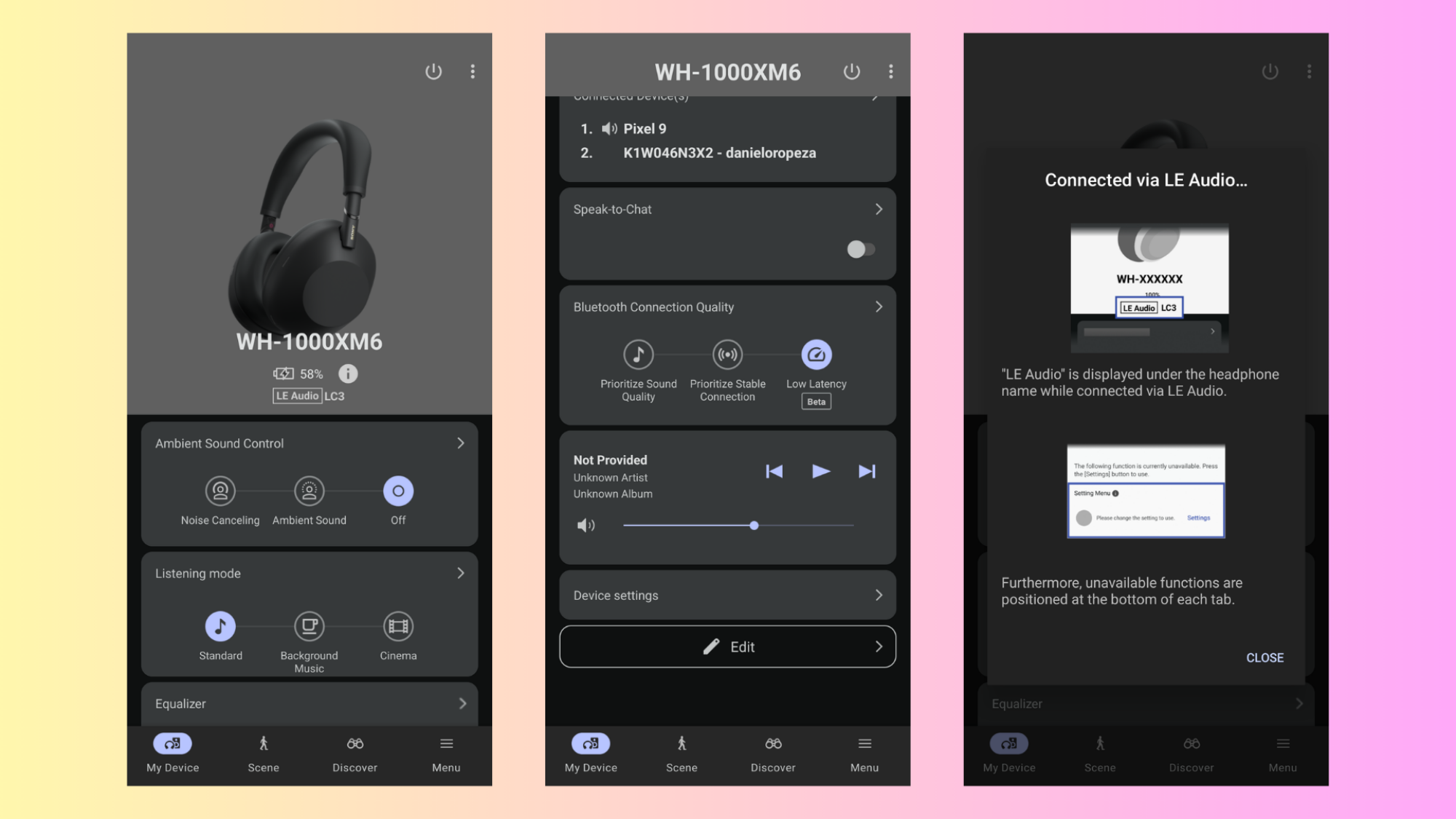
The new Sony WH-1000XM6 are the best premium headphones of 2025, and they keep getting better. One of my favorite features is its LE Audio Bluetooth compatibility, which is a newer Bluetooth type that uses less energy and supports better audio quality.

If you’ve tried to use LE Bluetooth in the past on your XM6 headphones, you might’ve noticed some features were missing, like head tracking, Find My Device, Gemini Live, and Audio Sharing with Fast Pair. Well, that’s no longer the case: The latest update to the Sound Connect app allows you to take advantage of all of these features while using the LE Audio technology.

Screenshot of the SOund Connect app
Left: LE Audio (LC3) Codec, Middle: Low Latency Bluetooth, Right: Pop up message for LE Adudio
Credit: Daniel Oropeza

How to make sure you get the update

While I’m a fan of the headphones, I can’t say I feel the same way about Sony’s companion app. It’s confusing and not user-friendly (and I’ve been using the app for years). The update was not easy to download, nor was it easy to know when it was done. But eventually, a message did pop up on my app asking me if I wanted the latest 3.0.0 update.

You can check if you already have it by clicking the three dots on the top right corner of the main menu and selecting “WH-1000XM6 Version.” Once you download it, you will need to do a hard connection reset between your phone and headphones for the update to kick in. Select the forget device on the XM6 from your Bluetooth settings and connect it again. Once you do all of that, you should be ready.

How LE Audio performs with the new features

It’s hard to say the LE Audio codec (LC3) sounds any better than it did before without a side-to-side comparison, but I can tell you that it sounds great. The audio is exactly what I would expect from arguably the best headphones of 2025.

The head tracking, which creates an all-around spatial sound quality, worked great as well. I took walks around my neighborhood and could hear conversations neighbors half a block away were having in their driveway.

When it comes to voice assistants and Gemini Live, your mileage may vary. From my experience, the mics on the WH-1000XM6 can be a bit sensitive, where long-winded answers from Gemini Live were cut off prematurely from noise around me. I did most of my testing while walking around my block and working from home (my wife also works from home, and we have a noisy dog). But this might be more about Gemini Live than the LE audio performance. Outside of those instances, the feature worked like I’d expect.

I can say I’ve noticed my sessions on the XM6 have lasted longer than before, which is one of the biggest advantages of using LE Audio. While the Low Latency feature is still in beta, it’s already meeting the high standards of the XM6.

Army general says he’s using AI to improve “decision-making”

Last month, OpenAI published a usage study showing that nearly 15 percent of work-related conversations on ChatGPT had to deal with “making decisions and solving problems.” Now comes word that at least one high-level member of the US military is using LLMs for the same purpose.

At the Association of the US Army Conference in Washington, DC, this week, Maj. Gen. William “Hank” Taylor reportedly said that “Chat and I are really close lately,” using a distressingly familiar diminutive nickname to refer to an unspecified AI chatbot. “AI is one thing that, as a commander, it’s been very, very interesting for me.”

Military-focused news site DefenseScoop reports that Taylor told a roundtable group of reporters that he and the Eighth Army he commands out of South Korea are “regularly using” AI to modernize their predictive analysis for logistical planning and operational purposes. That is helpful for paperwork tasks like “just being able to write our weekly reports and things,” Taylor said, but it also aids in informing their overall direction.

Read full article

Comments

How to Decide Between Noom and MyFitnessPal

We may earn a commission from links on this page.

Did you know you can customize Google to filter out garbage? Take these steps for better search results, including adding my work at Lifehacker as a preferred source.


Despite some strong language I’ve used in the past, I don’t believe that weight loss apps are inherently evil. At the same time, you’re putting a whole lot of trust into this kind of app, and that can go poorly. You’re depending on it to tell you how many calories you need, to accurately tell you how many calories you’re eating and burning, to calculate how many calories you need in the first place, and to effectively motivate you toward healthy goals so you can see healthy results. You’re trusting an app to be a calculator, a coach, and a confidante. So, how do you decide which weight loss app is the right one for you?

Both Noom and MyFitnessPal are heavyweights in the fitness tracking arena. I’ve used both over the years to various results, and I can confidently report firsthand the pros and cons of each. Here’s what to know to decide which app deserves a place on your home screen, depending on how exactly you want to reach your goals.

Different weight loss philosophies

MyFitnessPal is the household name of calorie-counting apps, and it’s certainly designed to have mass appeal. It’s essentially a sophisticated food diary that helps you stay within your calorie budget through pretty straightforward tracking. There’s no hand-holding or psychological deep dives—just data, goals, and accountability through numbers.

Noom, on the other hand, positions itself as a psychology-based weight loss program that aims to change your relationship with food through behavioral science, daily lessons, and cognitive strategies. The idea here is to be less about restriction and more about understanding why you eat what you eat. If you’re someone who has always struggled with an overly simplistic “calories in, calories out” approach to weight loss, then Noom’s philosophy is a blessing. Then again, how “anti-diet” can a diet app really be? Let’s keep digging in.

Pricing

If your deciding factor is less about your philosophy and more about your wallet, here’s what to know. 

MyFitnessPal offers a genuinely functional free version that includes basic food tracking, exercise logging, and access to its massive food database. If you’re willing to live without some bells and whistles, you can use MyFitnessPal indefinitely without paying a dime. The Premium version costs $79.99 per year or $19.99 per month, which gets you features like barcode scanning, meal scanning, custom macros, intermittent fasting tracking, and an ad-free experience. There’s another tier, Premium+, for $99.99 per year or $24.99 per month, where you get everything in Premium plus a meal planner.

Noom takes a subscription-only approach with no free version beyond a 14-day trial period. Pricing varies based on commitment length, typically starting around $42-70 per month for shorter subscriptions, with the 12-month plan bringing the monthly cost down to approximately $17.42 per month. The most common entry point is a four-month subscription at $169 (about $42.25/month).

Winner: MyFitnessPal for budget-conscious users; Noom’s lowest monthly rate requires a long-term commitment.

User interface

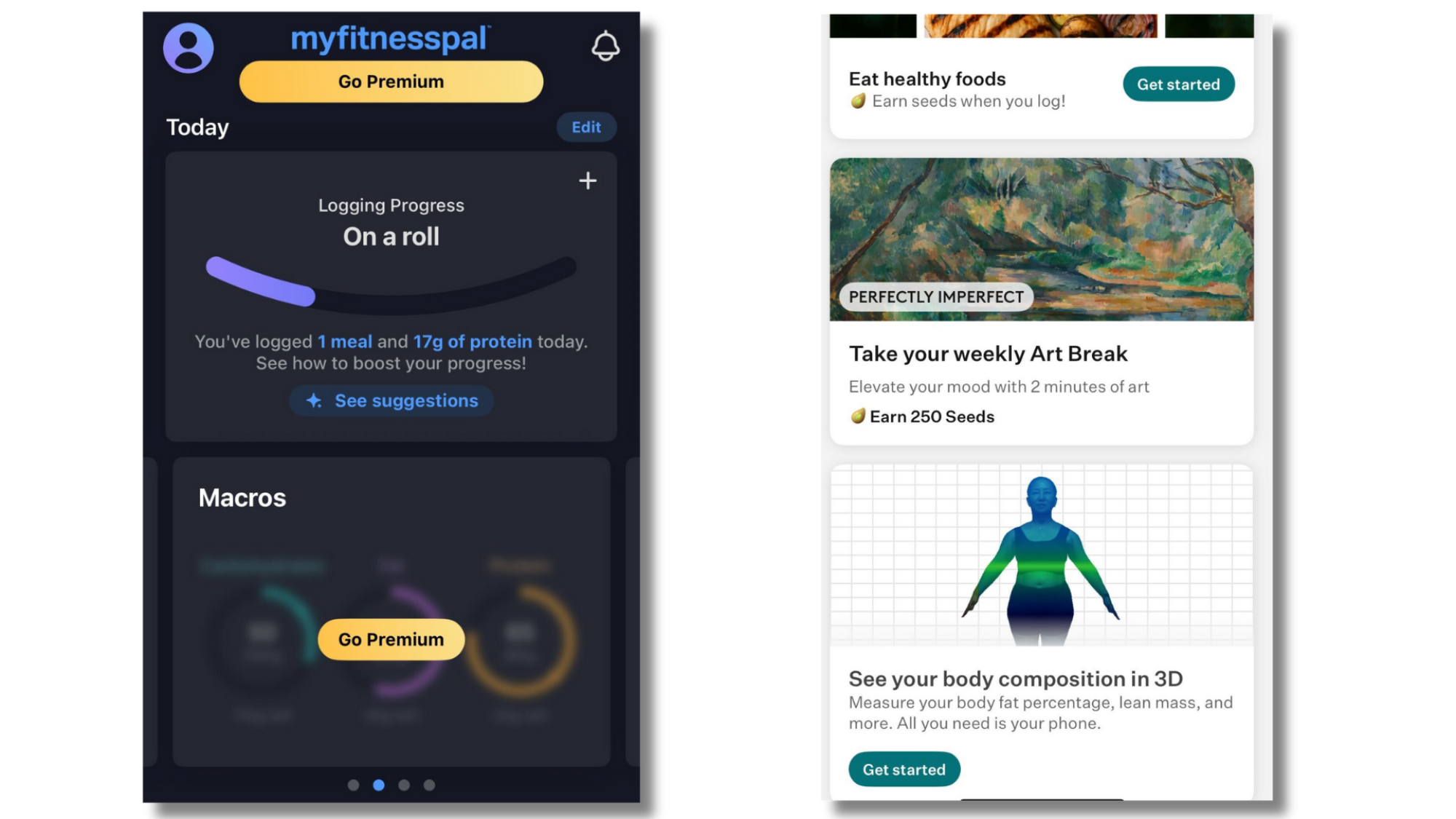
MyFitnessPal features a clean, straightforward interface focused on data entry. The home screen displays your calorie budget, macronutrients, and a simple diary for logging meals and exercise. It’s efficient and no-nonsense—perfect if you want to log your lunch and move on with your day. However, I can see why some users find it clinical and uninspiring, to say the least.

Noom offers a more colorful, engaging interface with multiple sections including food logging, lessons, group chat, and progress tracking. The app uses its signature color-coding system (green, yellow, red) to categorize foods based on calorie density. While this makes the app feel more interactive, and perhaps even game-like, it also means more screen time. Noom acknowledges you’ll spend about 15 minutes per day in the app, and there are plenty of animations to keep you around. Some users might find this engaging; I find it insidious. Remember, Noom doesn’t actually transcend the classic “calories = bad” formula here. It just color-codes it.

Here’s a screenshot of MyFitnessPal on the left and Noom on the right; you can pretty quickly see which one is more straightforward calorie-tracking, and which one is more about “psychology.” 

Noom versus MyFitnessPal

Credit: Meredith Dietz

Winner: MyFitnessPal for quick loggers; Noom for those who want an engaging daily experience.

Food database and logging accuracy

MyFitnessPal has an extensive food database, with a huge caveat. This database is largely user-generated, which is both a blessing and a curse—you can find virtually anything, but accuracy can vary wildly. Premium users get barcode scanning and meal scanning features for faster logging.

Noom claims a database of 3.7+ million food items, though users frequently report accuracy issues. The app focuses more on its color-coding system than precise nutritional breakdowns. While you can scan barcodes and log food, the database isn’t as robust or reliable as MyFitnessPal’s according to user reports.

Winner: MyFitnessPal.

Recipe logging and meal planning

MyFitnessPal allows you to create custom recipes and save your favorite meals for quick logging. You can input all ingredients, specify servings, and the app calculates nutritional information per serving. It’s a beloved feature for home cooks. The Premium version offers curated meal plans.

Noom allows recipe creation, but the feature isn’t as refined or user-friendly as MyFitnessPal’s. Again, Noom focuses less on meal planning specifics and more on teaching you to make better choices instinctively through educational content.

Winner: MyFitnessPal.

Education and behavior change

MyFitnessPal is the world’s default calorie tracker. It provides basic nutritional insights and tracks your progress over time, but it doesn’t offer structured education or behavioral coaching. You’re expected to know what to do with the data you’re collecting.

This is where Noom differentiates itself with claims of being more than just a diet app. It’s built around daily psychology-based lessons that teach you about nutrition, habit formation, emotional eating, and cognitive behavioral techniques. You’ll complete a 10-minute quiz at the start to personalize your program, then receive articles and interactive content daily. It might not be for me, but I personally know many users find this educational approach more sustainable than simple calorie counting. Depending on your subscription, you may also get access to a personal coach and group support.

Winner: Noom.

Exercise tracking and integration

MyFitnessPal easily syncs with fitness apps and wearables (Fitbit, Apple Health, Garmin, Strava, etc.) and adjusts your calorie budget based on activity. You can manually log workouts or let your devices do the work.

Noom includes basic exercise tracking and syncs with some popular apps and devices, but it’s not the app’s primary focus. Noom encourages physical activity but emphasizes that weight loss is primarily driven by food choices.

Winner: MyFitnessPal.

Community and support

MyFitnessPal offers community forums where users can connect, share tips, and support each other. It’s a helpful resource, but feels somewhat disconnected from the core app experience.

Noom integrates community support directly into the app through group chats where you can interact with others on similar timelines. Higher-tier subscriptions include one-on-one coaching, which can provide personalized guidance and accountability.

Winner: Noom for integrated support; MyFitnessPal for self-directed community seekers.

The bottom line

There’s no universal winner here—it depends entirely on your needs, budget, and learning style.

Choose MyFitnessPal if you want a free or budget-friendly option, already understand nutrition basics, and prefer straightforward calorie tracking. It’s perfect for people who are self-motivated, enjoy analyzing data, and want freedom without forced education.

Choose Noom if you’re seeking more than just a food diary—if you want to understand the psychology behind your eating habits and build lasting behavior change. Yes, it’s significantly more expensive, but if you haven’t had success with traditional calorie counting, you’re paying for structured education, coaching options, and a comprehensive program rather than just a tracking tool.

For many people, the decision comes down to this: Do you need someone to teach you how to fish, or do you already know how and just need a good fishing rod? MyFitnessPal is the rod. Noom is the fishing instructor who’ll teach you techniques and check in on your progress.

TiVo Has Officially Discontinued Its DVRs

Did you know you can customize Google to filter out garbage? Take these steps for better search results, including adding my work at Lifehacker as a preferred source.


It’s the end of an era: TiVo no longer manufactures or sells the DVRs that made the company a household name. If you still have one, the company will continue to support it, but don’t go looking for one: TiVo as we know it is effectively over.

TiVo didn’t make a big deal about this discontinuation, however. As it happens, Luke Bouma of Cord Cutter News was the first to spot the development. Earlier this month, Bouma reported that TiVo Corporation had silently ended its DVR line, removing all references to the devices on its website. Following Bouma’s reporting, TiVo’s parent company, Xperi, confirmed the news.

In a statement to PCMag, an Xperi spokesperson said: “I can confirmed that as of [Oct.] 1, 2025, TiVo stopped selling physical DVR products, including hardware and accessories, both online and through agents…TiVo no longer manufacturers hardware, and our remaining inventory is now depleted, though we will continue to offer support for the products going forward.”

TiVo isn’t gone entirely. The brand now develops both TiVo OS, a smart TV operating system similar to Roku OS or Fire OS, as well as DTS AutoStage Video Service, an entertainment service developed for cars. But it is no longer a DVR manufacturer or seller, which might shock a time traveler from the early 2000s.

The TiVo effect

Tech comes and goes, but if you weren’t watching TV in the late ’90s and early 2000s, you might not know how monumental TiVo really was. The company launched its first DVRs in 1999 and introduced the market to features like one-touch simple recording, a hard drive to save multiple recordings at once, and, perhaps most notably, the ability to “pause” live TV and fast forward through commercials. The DVR offered viewers so much more than a simple VCR could, which only allowed for linear recording to single cassettes. TiVo could record live video from any input, including analog, cable, or satellite, which offered users flexibility in the content they recorded.

Before TiVo, if you missed the start of a show, you simply had to deal with it and try to jump in as best as you could—assuming you didn’t set a VCR to record it, of course. If you had a TiVo, however, you could simply rewind to the start of the program, and, when you reached a commercial break, skip ahead back to the show—until you caught up with the live broadcast.

TiVo disrupted the way consumers watched TV, and we’re likely seeing the ramifications of that today. The market adapted, and cable companies started offering their own DVRs with cloud-based recording as opposed to hard drive recording. Streaming services built on that momentum: Viewers were already getting used to watching shows whenever it suited them, so why not get ahead of the game, and offer all shows on-demand at any time? There’s no need to choose which programs to record: Everything is available at any time.

Like other early technology pioneers that fell behind with time, TiVo struggled through the streaming age it arguably helped create. The company hasn’t released a DVR since 2019, when it launched the TiVo Edge. That DVR had support for modern features, like 4K Dolby Vision HDR, Dolby Atmos sound, and access to major streaming apps, in addition to recording live TV. It then tried to break into the streaming device market with the TiVo Stream 4K, but the competition was too fierce to make an impact.

In a twist of irony, as TiVo discontinues its DVRs, streaming services are turning to ad-supported plans with increasing frequency. TiVo changed the game by letting us skip ads, and streaming originally omitted the ads entirely. But more and more customers are comfortable paying less to deal with commercials. We’ve come full circle in a way.

TiVo’s time might be at an end, but its impact lives on. What Skype did for video calls, TiVo did for TV. I’ll be thinking about that the next time I boot up something to watch on Netflix or Hulu.

Indie darling 1000xResist heads to Xbox and PlayStation on November 4

Heads up, indie game fans: 1000xResist will arrive on Xbox Series X/S and PlayStation 5 on November 4. The title, which is already out for PC and Nintendo Switch, will also be available through Xbox Game Pass on the same date. The game is also adding more localization support, bringing Brazilian Portuguese, French and Korean languages, so more players around the world can experience the story. 

And the story is the highlight of 1000xResist. This was an indie hit from 2024 that won a lot of fans for its innovative and branching story of a future timeline where the remaining members of humanity live underground in the aftermath of an alien invasion. The project from developer Sunset Visitor also picked up nominations for both the Hugo Awards and Nebula Awards, as well as winning a Peabody last year. Sometimes you’ll want to take award winners with a grain (or a pound) of salt, but the industry and players alike have lauded the game’s sci-fi storytelling chops.

This article originally appeared on Engadget at https://www.engadget.com/indie-darling-1000xresist-heads-to-xbox-and-playstation-on-november-4-212654512.html?src=rss

Google Will Let Friends Help You Recover an Account

Google is introducing new recovery tools that aim to make it less frustrating to regain access when you’re locked out of your account. The Verge: Instead of answering security questions or entering a recovery email address, Google’s new security features allow account holders to verify their identity using a linked mobile number, or trusted friends or family members.

The Recovery Contacts feature enables users to designate people to confirm their identity in order to regain access to accounts after getting hacked or losing their password or passkey. Google didn’t specify how the verification process works, but says the feature provides “a simple and secure way to regain access when standard recovery methods fail.” Recovery Contacts is available for eligible personal Google accounts, and can be found under the Security option in the account settings.


Read more of this story at Slashdot.

Razer’s new Kiyo V2 webcams offer 4K streaming with HDR

Razer is updating its lineup of creator-focused webcams with two new models, the Razer Kiyo V2 and Razer Kiyo V2 X. The webcams offer new AI-powered features and 4K streaming at a more affordable price than the company’s Kiyo Pro webcams.

The $100 Kiyo V2 X is capable of capturing 720p video at either 60 or 30 frames per second, 1080p video at 24, 30 or 60 frames per second and 1440p video at 60 frames per second. Like some of Razer’s other webcams, the Kiyo V2 X has a wide, 83-degree field of view that can be customized with the company’s Synapse software. The webcam doesn’t have the AI-powered features of the V2, but you do get all the basics, like auto-focus, a privacy shutter and a built-in microphone.

For about $50 more, the Kiyo V2 offers higher-quality capture and a few more automated features. The $150 webcam uses an 8.3MP Sony STARVIS image sensor and can capture true 4K HDR footage at 30 frames per second. The V2 also has a slightly wider field of view than the V2 X, at 93 degrees to the V2 X’s 83 degrees. Razer is using that extra wiggle room to offer auto-framing — similar to Apple’s Center Stage feature — through an integration with Reincubate’s Camo Studio software. The Kiyo V2 can keep you in frame, remove your background and offer “adaptive lighting correction,” all with the new software improvements Razer and Reincubate are adding.

While both webcams are pitched as creator tools, the basic features Razer is offering and the prices its offering them at easily make the Kiyo V2 and V2 X worth considering. At $150, the Kiyo V2 is only slightly more expensive than Engadget’s favorite webcam and should, if Razer’s claims are true, offer even better video performance.

Razer says you can purchase the Kiyo V2 X and Kiyo V2 today, for $100 and $150, respectively.

This article originally appeared on Engadget at https://www.engadget.com/computing/accessories/razers-new-kiyo-v2-webcams-offer-4k-streaming-with-hdr-211411212.html?src=rss

Reddit Cofounder Says ‘Much of the Internet is Now Dead’

Alexis Ohanian, who helped build Reddit, says much of the internet has become dominated by bots and AI. Speaking on the podcast TBPN, he described the internet as increasingly “quasi-AI” and filled with what he called “LinkedIn slop.” Ohanian referenced dead internet theory, the assertion that bot activity exceeds human activity on the web. In September, Sam Altman, OpenAI’s CEO, posted that while he had not taken the theory seriously, he now sees “a lot of LLM-run twitter accounts.”


Read more of this story at Slashdot.

Apple will sell PS VR2 Sense controllers separately for $250 next month

Tucked away in Apple’s announcement of a second-generation Vision Pro was news on the controller front. First, we already knew that, with visionOS 26, Apple’s headset supports PlayStation VR2 Sense controllers. But now you can get them without Sony’s headset.

The Apple Store will soon begin selling the PS VR2 Sense controllers for $250. (Cue spit take.) The $400 PS VR2 headset bundle was previously the only way to buy them new. Maybe when you can justify spending $3,499 on Apple’s reality machine, $250 for the controllers is reasonable.

A person wearing Apple's Vision Pro headset looks at a virtual panorama of a city in clouds.
The second-generation Vision Pro
Apple

Apple says Sony’s controllers open the door to more immersive gameplay on the Vision Pro. They support six degrees of freedom motion tracking (any direction you move or rotate), finger touch detection and rumble support.

Apple’s second-gen Vision Pro is more powerful with the new M5 chip. It also includes a Dual Knit Band, which adds a top strap for increased stability and comfort. You’ll be able to buy the PS VR2 Sense controllers from the Apple Store on November 11.

This article originally appeared on Engadget at https://www.engadget.com/wearables/apple-will-sell-ps-vr2-sense-controllers-separately-for-250-next-month-203602932.html?src=rss

Rice weevil on a grain of rice wins 2025 Nikon Small World contest

A stunning image of a rice weevil on a single grain of rice has won the 2025 Nikon Small World photomicrography contest, yielding valuable insight into the structure and behavior of—and providing a fresh perspective on—this well-known agricultural pest. The image was taken by Zhang You of Yunnan, China. Another of You’s photographs placed 15th in this year’s contest.

“It pays to dive deep into entomology: understanding insects’ behaviors and mastering lighting,” You said in a statement. “A standout work blends artistry with scientific rigor, capturing the very essence, energy, and spirit of these creatures.”

There was an element of luck in creating his winning image, too. “I had observed rice weevils in grains before, but never one with its wings spread,” You said. “This one was naturally preserved on a windowsill, perhaps in a final attempt to escape. Its tiny size makes manually preparing spread-wing specimens extremely difficult, so encountering it was both serendipitous and inspiring.”

Read full article

Comments

Roku Hid Some Good News in an AI Update No One Wants

Did you know you can customize Google to filter out garbage? Take these steps for better search results, including adding my work at Lifehacker as a preferred source.


It’s 2025, so every piece of tech needs to have some kind of AI integration—even Roku, apparently. On Wednesday, Roku announced a number of new features and changes coming to its many streaming devices, but headlines zeroed in on one announcement in particular: the company’s new AI assistant. The assistant, which will be a part of the existing Roku Voice feature, lets you ask the streaming device questions about shows and movies, including the characters and actors that are in them. You could ask the assistant whether a particular movie is appropriate for kids, or recommendations for other movies that feature the actor starring in the one you’re watching.

The company says Roku Voice is powered by both “in-house and commercial generative AI and LLM technology.” That seems to indicate that some of the processing here is designed by Roku’s own AI tech, while the rest is outsourced to at least one other company. As such, you should assume your AI requests are not private, and may be fed through both Roku and third-party servers. When CNET reached out for clarification around user privacy, a spokesperson for the company simply said “We follow Roku’s published privacy policy and viewer settings.” The policy has not been updated yet to reflect the AI technology, however.

Maybe Roku’s assistant will turn out to be a useful tool, but even as someone without a Roku device, it’s not something I’d be interested in. If I want to know whether a piece of content is appropriate for kids, I wouldn’t trust an AI summary to tell me—especially given the frequency for AI models to just make things up. Personally, I’d watch the content myself first—or, at the very least, do my own research. The internet is right there, after all. It’s about as fast to look up an actor’s IMDB page to see other movies they’ve starred in, complete with user reviews, synopsis, and—wouldn’t you know—even parental recommendations, as it is to ask an AI assistant the same questions.

Roku has other interesting updates

The thing is, the AI assistant is the least interesting update the company has for customers going forward. Scanning the news, the thing that stood out to me most was the expansion of support for Bluetooth headphones for more devices. Now, Streaming Stick and Streaming Stick Plus users can connect their wireless headphones directly to their Roku devices, rather than pairing through the app. This was something previously exclusive to larger Roku devices as Roku TVs. Whether you live with other people, and want to watch your content without disturbing them, or prefer the experience of watching shows and movies through your headphones as opposed to relying on your TV’s speakers, having the option to connect to Bluetooth headphones for streaming is such a plus.

There are other changes coming as well. When you watch trailers on a Roku device, you’ll see a new “What to watch” option, which can take you to different apps and services that host the show or movie. The search bar is also coming to What to Watch and Live TV Zone, while Live TV Channel Guide will get the search bar sometime in the near future. Even the mobile app is getting a refresh. Now, when you swipe up, you’ll see options for Find My Remote, closed captions, the sleep timer, and trivia. In addition, you’ll be able to rate content with either like or dislike options.

Finally, Roku is adding support for live sport scores that pop up on title cards for each game. You can also set reminders to alert you when certain sports matches are starting.

Once unthinkable, NASA and Lockheed now consider launching Orion on other rockets

The Orion spacecraft and Space Launch System rocket have been attached at the hip for the better part of two decades. The big rocket lifts, the smaller spacecraft flies, and Congress keeps the money rolling in.

But now there are signs that the twain may, in the not too distant future, split.

This is because Lockheed Martin has begun to pivot toward a future in which the Orion spacecraft—thanks to increasing reusability, a focus on cost, and openness to flying on different rockets—fits into commercial space applications. In interviews, company officials said that if NASA wanted to buy Orion missions as a “service,” rather than owning and operating the spacecraft, they were ready to work with the space agency.

Read full article

Comments

Honor is making a smartphone with a fold-out camera

Device maker Honor has revealed that one of its upcoming smartphones will offer an unusual design choice. While many manufacturers push to have more numerous and powerful cameras in their products, the Chinese company will put the camera for its new phone on a pop-out mechanical arm. According to CNBC, the design of this so-called “robot phone” is meant to showcase Honor’s AI capabilities as the company makes a $10 billion investment in artificial intelligence over the next five years. Honor hasn’t shared too much about this product, but will likely have more details during next year’s Mobile World Congress.

Honor has experimented with unusual form factors before, including a surreally thin foldable smartphone and a laptop with a detachable webcam, and we’ve even seen a similar concept of a pop-up camera several years back in products like the OnePlus 7 Pro phone. The idea to swing out a camera could offer some interesting options for image and video capture, but it’s also a prime place for mechanical failures and high manufacturing costs.

This article originally appeared on Engadget at https://www.engadget.com/mobile/smartphones/honor-is-making-a-smartphone-with-a-fold-out-camera-201555268.html?src=rss

Thousands of customers imperiled after nation-state ransacks F5’s network

Thousands of networks—many of them operated by the US government and Fortune 500 companies—face an “imminent threat” of being breached by a nation-state hacking group following the breach of a major maker of software, the federal government warned Wednesday.

F5, a Seattle-based maker of networking software, disclosed the breach on Wednesday. F5 said a “sophisticated” threat group working for an undisclosed nation-state government had surreptitiously and persistently dwelled in its network over a “long-term.” Security researchers who have responded to similar intrusions in the past took the language to mean the hackers were inside the F5 network for years.

Unprecedented

During that time, F5 said, the hackers took control of the network segment the company uses to create and distribute updates for BIG IP, a line of server appliances that F5 says is used by 48 of the world’s top 50 corporations. Wednesday’s disclosure went on to say the threat group downloaded proprietary BIG-IP source code information about vulnerabilities that had been privately discovered but not yet patched. The hackers also obtained configuration settings that some customers used inside their networks.

Read full article

Comments

US Falls Out of Top 10 on List of the World’s Most Powerful Passports

The U.S. passport has fallen out of the top 10 most powerful passports globally for the first time in 20 years in the latest edition of the Henley Passport Index, which ranks nations based on the number of destinations a traveler can visit without needing a visa. From a report: The U.S. ranking is on a steep downward trend, with the U.S. passport now in 12th spot, tied with Malaysia, having already fallen from seventh place last year to 10th place in July. A decade ago, the U.S. passport topped the index.

Christian H. Kaelin, chairman of Henley & Partners and creator of the index, said in a news release on Tuesday that the declining strength of the U.S. passport signaled a “fundamental shift in global mobility and soft power dynamics.” Kaelin added: “Nations that embrace openness and cooperation are surging ahead, while those resting on past privilege are being left behind.”


Read more of this story at Slashdot.