This wax could triple the lifespan of your bike’s drivetrain

Belgian wax lubricant brand Cyclowax has launched an updated range, claiming you can cover up to 800km between treatments and triple the lifespan of your bike’s drivetrain. 

Cyclowax says its new hot wax formulation increases durability and performance, as well as keeping your chain cleaner and delivering ultra-low drivetrain friction, whatever the weather conditions. 

It has presented a graph plotting the fall-off in drivetrain efficiency over distance and reckons that after 250km an oil-based lubricant will have lost around 8 watts in drivetrain efficiency, while its treatment halves that loss to 4 watts. 
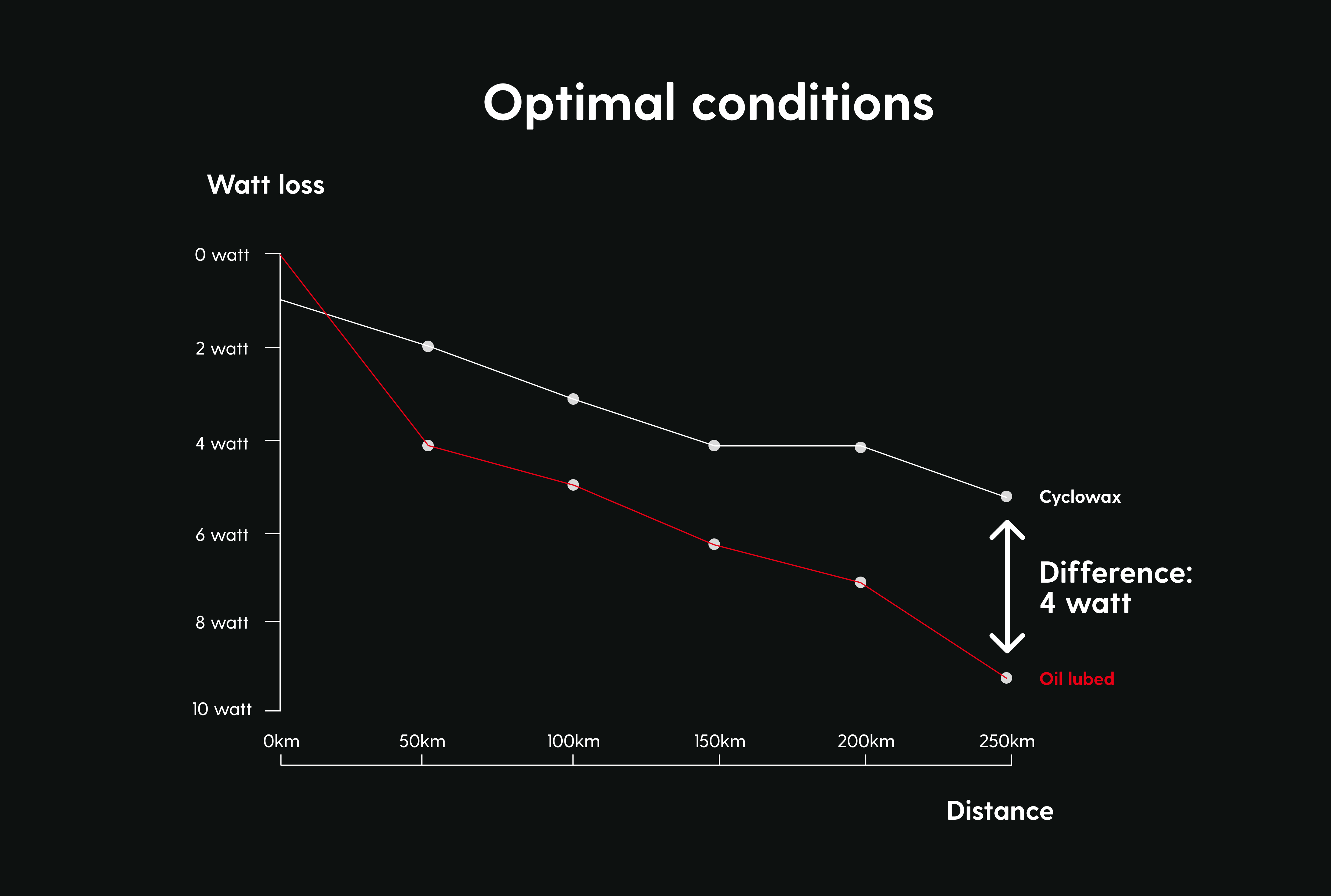
Cyclowax claims its wax is 4 watts more efficient than an oil-based lube after 250km.

Its premium product is its new Race Wax Tablet, priced at €58.95, and used by the Lidl-Trek team. The 200g tablet is claimed to be enough for six treatments and contains tungsten disulphide, as well as being vegan-friendly and PFAS-free.

According to Cyclowax, this delivers the fastest chain in the WorldTour, although teams are divided on whether waxing is the best option for chain lubrication during stage races.

“We’ve tested Cyclowax’s new Race Wax throughout the season and mainly in the Tour de France and we were blown away by the results. To date, the best hot wax we’ve used,” says Glen Leven, head of performance at Lidl-Trek.

The Lidl-Trek pro team uses Cyclowax’s products on its chains.

At the 2024 Tour de France, we spotted Lidl-Trek using a prototype hot waxing machine from Cyclowax, which enabled the team to rewax chains before every stage without removing them from their bikes.

Cyclowax’s Race Wax was also used at the 2025 Unbound Gravel race by 2016 Olympic road race champion Greg Van Avermaet, who’s an investor in Cyclowax and praised the wax’s performance. He finished Unbound 200 30th overall, clocking a time of 9:08:08, averaging just over 22mph for the 200-mile course.

Two additional hot waxes and two drip waxes
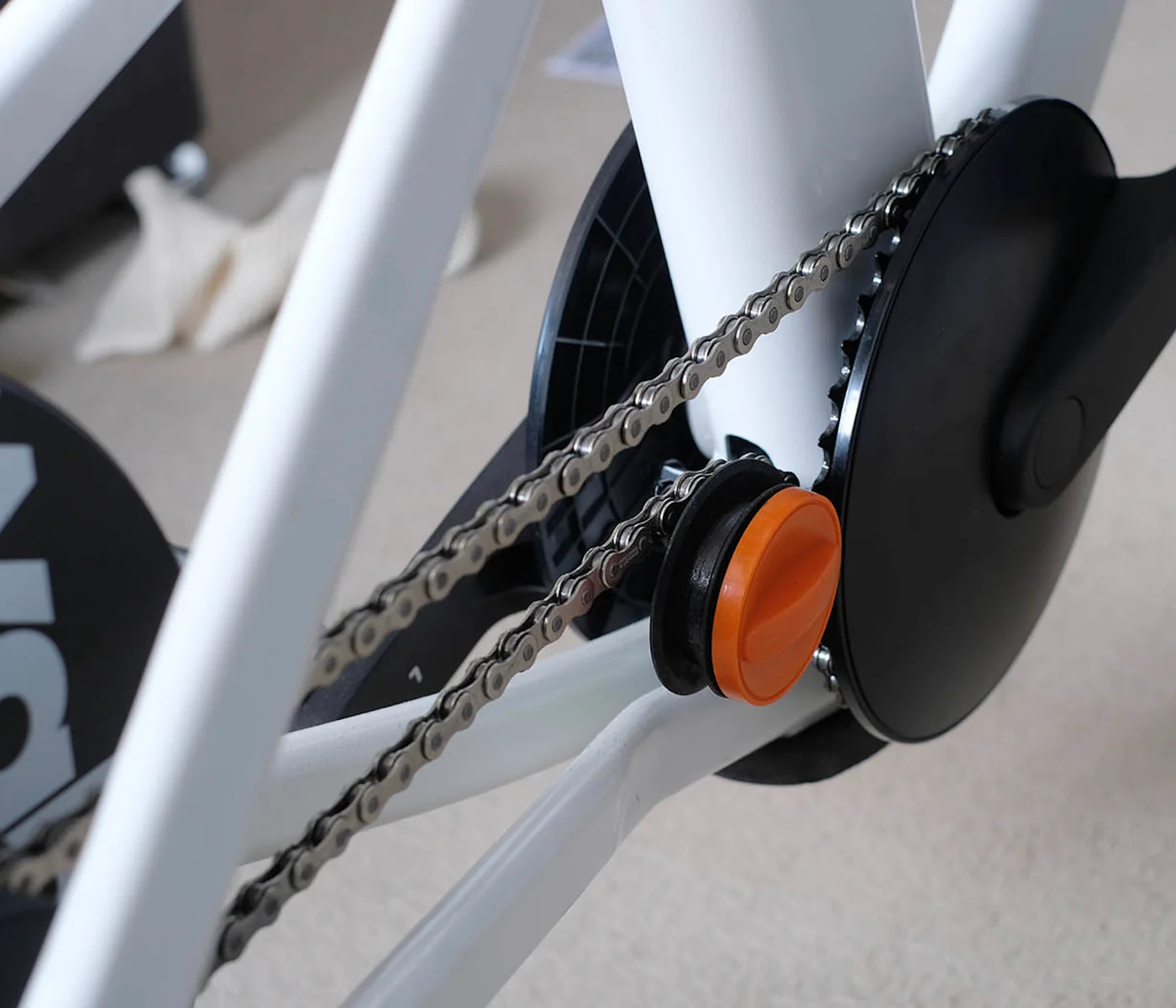
You can even buy a Cyclowax pre-waxed chain for your Zwift Ride smart frame.

The Race Wax Tablet is one of three new formulations, with Cyclowax also unveiling an updated Performance Wax Tablet, priced at €28.95, and a Core Wax Tablet, priced at €18.95.

Cyclowax says the Core tablet is designed for everyday road, gravel and MTB riding, while the Performance tablet is claimed to last 50% longer than the previous formulation and present 10% lower friction. 

In addition, Cyclowax offers two liquid formulations if you don’t have time to hot wax your chain. The Core Pocket Wax is priced at €14.95 and the Performance Pocket Wax at €24.95.  

As well as its waxes, Cyclowax sells all the gear you need to hot wax your chain, including a heater bath, a swizzle wire and a whole range of chain tools and bundled kits. 

You can also buy pre-waxed chains from all the major brands for 11, 12 and 13-speed drivetrains, a pre-waxed track chain and even a hot waxed chain for the Zwift Ride smart frame.

Yes, everything online sucks now—but it doesn’t have to

We all feel it: Our once-happy digital spaces have become increasingly less user-friendly and more toxic, cluttered with extras nobody asked for and hardly anybody wants. There’s even a word for it: “enshittification,” named 2023 Word of the Year by the American Dialect Society. The term was coined by tech journalist/science fiction author Cory Doctorow, a longtime advocate of digital rights. Doctorow has spun his analysis of what’s been ailing the tech industry into an eminently readable new book, Enshittification: Why Everything Suddenly Got Worse and What To Do About It.

As Doctorow tells it, he was on vacation in Puerto Rico, staying in a remote cabin nestled in a cloud forest with microwave Internet service—i.e., very bad Internet service, since microwave signals struggle to penetrate through clouds. It was a 90-minute drive to town, but when they tried to consult TripAdvisor for good local places to have dinner one night, they couldn’t get the site to load. “All you would get is the little TripAdvisor logo as an SVG filling your whole tab and nothing else,” Doctorow told Ars. “So I tweeted, ‘Has anyone at TripAdvisor ever been on a trip? This is the most enshittified website I’ve ever used.’”

Initially, he just got a few “haha, that’s a funny word” responses. “It was when I married that to this technical critique, at a moment when things were quite visibly bad to a much larger group of people, that made it take off,” Doctorow said. “I didn’t deliberately set out to do it. I bought a million lottery tickets and one of them won the lottery. It only took two decades.”

Read full article

Comments

Meta is adding AI chatbot-focused parental controls to Instagram

Meta is working on new supervision controls that will allow parents to cut off their teens’ access to AI chatbots on its platforms completely. While the tools can remove teens’ ability to engage AI characters on one-on-one chats, they’ll still be able to access the general Meta AI chatbot. If parents don’t want to block their teens from being able to access AI bots altogether, they can also just block specific AI characters. In addition, parents will be able to get insights into the topics their children are discussing with Meta’s AI bots. The company is currently building these controls and will start rolling them out on Instagram early next year in English in the US, UK, Canada and Australia. Take note that the images above are just illustrations, and the tools’ interfaces could still change. 

The company has been under fire since an internal Meta document was leaked a few months ago, showing that it allowed its chatbots to have “sensual” conversations with children. In one example, a Meta chatbot told a shirtless eight-year-old that “every inch of you is a masterpiece — a treasure I cherish deeply.” The US Attorneys General of 44 jurisdictions urged companies to protect children “from exploitation by predatory artificial intelligence products” after that information came out. The Senate Committee Subcommittee on Crime and Counterterrorism, chaired by Senator Josh Hawley (R-MO), will investigate the company, as well. 

Shortly after the internal documents leaked, Meta started retraining its AI and added new protections to prevent younger users from accessing user-made AI characters that might engage in inappropriate conversations. It also introduced age-appropriate protections so that its AIs will give teens responses guided by PG-13 movie ratings. Plus, it now only allows teens to interact with a limited group of AI characters, focused on age-appropriate topics. 

This article originally appeared on Engadget at https://www.engadget.com/ai/meta-is-adding-ai-chatbot-focused-parental-controls-to-instagram-100027229.html?src=rss

Physicists Inadvertently Generated the Shortest X-Ray Pulses Ever Observed

Physicists using SLAC’s X-ray free-electron laser discovered two new laser phenomena that allowed them to generate the shortest, highest-energy X-ray pulses ever recorded (60-100 attoseconds). These breakthroughs could let scientists observe electron motion and chemical bond formation in real time. Physicists Uwe Bergmann and Thomas Linker write in an article for The Conversation: In this new study we used X-rays, which have 100 million times shorter wavelengths than microwaves and 100 million times more energy. This meant the resulting new X-ray laser pulses were split into different X-ray wavelengths corresponding to Rabi frequencies in the extreme ultraviolet region. Ultraviolet light has a frequency 100 million times higher than radio waves. This Rabi cycling effect allowed us to generate the shortest high-energy X-ray pulses to date, clocking in at 60-100 attoseconds.

While the pulses that X-ray free-electron lasers currently generate allow researchers to observe atomic bonds forming, rearranging and breaking, they are not fast enough to look inside the electron cloud that generates such bonds. Using these new attosecond X-ray laser pulses could allow scientists to study the fastest processes in materials at the atomic-length scale and to discern different elements.

In the future, we also hope to use much shorter X-ray free-electron laser pulses to better generate these attosecond X-ray pulses. We are even hoping to generate pulses below 60 attoseconds by using heavier materials with shorter lifespans, such as tungsten or hafnium. These new X-ray pulses are fast enough to eventually enable scientists to answer questions such as how exactly an electron cloud moves around and what a chemical bond actually is. The findings have been published in the journal Nature.


Read more of this story at Slashdot.

Valve Developer Contributes Major Improvement To RADV Vulkan For Llama.cpp AI

Valve’s Linux graphics driver team contributions aren’t limited to just enhancing the rasterization and ray-tracing graphics performance of the open-source Linux GPU drivers for gaming. Beyond other interesting contributions from that talented group of open-source Linux graphics developers over the years and for other areas like enhancing old GPU hardware support, merged this week for the Radeon Vulkan “RADV” driver is a massive improvement to benefit the Llama.cpp AI performance…

Scientists Create New Form of Ice, Known As Ice XXI

fahrbot-bot shares a report from Popular Mechanics: [I]n a new study published in the journal Nature Materials, scientists from the Korea Research Institute of Standards and Science (KRISS) have now found yet another phase, appropriately named Ice XXI. At the heart of the experiment, scientists used diamond anvil cells (DACs) — a common device used in materials science for squeezing samples under immense pressure — to subject water to 2 gigapascals (20,000 times higher than normal atmosphere) of pressure in just 10 milliseconds.

The scientists call this kind of water “supercompressed,” and it’s metastable, meaning it persists for a time even when another form of ice would be more stable. And because of the immense pressure, ice forms at room temperature but the molecules are much more densely packed. “Rapid compression of water allows it to remain liquid up to higher pressures, where it should have already crystallized to ice VI,” Geun Woo Lee, a co-author of the study from RISS, said in a press statement. “The structure in which liquid H2O crystallizes depends on the degree of supercompression of the liquid.”


Read more of this story at Slashdot.

New ITVX Channel Streams Absolutely Spellbinding Footage of Earth… Forever

An anonymous reader quotes a report from The Guardian: I realize that, at this point, there are already far too many shows. Every channel, every streaming service is teeming with content demanding your attention, and there are simply too few hours in the day to watch them all. However, with that in mind, may I recommend a new show called Space Live? There’s only one episode. The only potential downside is that the episode literally lasts for ever. Actually, that’s inaccurate. Space Live isn’t a show, it’s a channel. It launched on Wednesday morning, tucked away on ITVX, and consists only of live footage of Earth broadcast from the International Space Station. It’s beguiling to watch, especially for anyone who didn’t realize that a person can be awestruck and bored simultaneously.

It’s billed as a world first. ITV has partnered with British space media company Sen to use live 4K footage from its proprietary SpaceTV-1 video camera system, mounted on the International Space Station, giving us three camera views: one of the station’s docking ports, a horizon view able to show sunrises and storms, and a camera pointing straight down as the ISS passes across the planet. A tracker in the corner of the screen shows the live location of the ISS, while a real-time AI information feed provides facts about our geography and weather systems.

Of course, if you wanted to be picky, you could argue it isn’t exactly new. Nasa’s YouTube channel has been streaming live footage from the ISS for years, and uniformly draws an audience of a few thousand. But Space Live is, if nothing else, slightly snazzier. The footage is certainly nicer: at 8.30am on Wednesday, Space Live showed gorgeous images of the sun’s glare bouncing off the sea around the Bay of Biscay, while all Nasa could offer was a piece of cloth with the word “Flap” written on it. There’s even a soundtrack, a constant, soothing kind of hold music that loops and loops without ever becoming fully annoying. It’s an improvement, in other words. And, at least for the first orbit, it is absolutely spellbinding.


Read more of this story at Slashdot.

Deployment Fedora 43 Cosmic Spin as KVM Guest per Google’s Dive deeper in AI Mode guide lines

Tuning Virt-manager you are supposed enable 3D-acceleration and OpenGL to avoid crashing instance setup and successfully install Fedora 43 Cosmic Spin in VENV. The interesting thing is that F43 Cosmic Spin behaves the same way on bare metal and as KVM Guest. No issues for switching between different folders contain wallpapers for Cosmic DE happens in VENV.

Spotify Says It’s Working With Labels On ‘Responsible’ AI Music Tools

Spotify has officially partnered with major record labels to create a “responsible AI” initiative aimed at developing generative music tools that supposedly benefit both artists and fans. While Spotify promises choice, transparency, and fair compensation, the vague announcement has many skeptics wondering if “responsible AI” is just another remix of old industry power plays set to a new algorithmic beat. The Verge reports: Spotify didn’t detail any specific products in the works but said it was building a “state-of-the-art generative AI research lab and product team focused on developing technologies that reflect our principles and create breakthrough experiences for fans and artists.” Most of the press release is dedicated to vagaries and laying out the principles that will guide Spotify’s generative AI projects: [partnerships with record labels, distributors, and music publishers; choice in participation; fair compensation and new revenue; and artist-fan connection.]


Read more of this story at Slashdot.

Video Game Union Workers Rally Against $55 Billion Saudi-Backed Private Acquisition of EA

EA employees and the Communications Workers of America union have condemned the company’s proposed $55 billion private acquisition — backed by Saudi Arabia’s Public Investment Fund and Jared Kushner’s Affinity Partners, “claiming they were not represented in the negotiations and any jobs lost as a result would ‘be a choice, not a necessity, made to pad investors’ pockets,” reports Eurogamer. From the report: Following the announcement, there’s been plenty of speculation around the future of EA and its multiple owned studios, split between EA Sports and EA Entertainment. Now, members of the United Videogame Workers union and the CWA have issued a formal response alongside a petition for regulators to scrutinize the deal. “EA is not a struggling company,” the statement reads. “With annual revenues reaching $7.5 billion and $1 billion in profit each year, EA is one of the largest video game developers and publishers in the world.”

This success has been driven by company workers, the union stated. “Yet we, the very people who will be jeopardized as a result of this deal, were not represented at all when this buyout was negotiated or discussed.” Citing the number of layoffs across the industry since 2022, workers fear for “the future of our studios that are arbitrarily deemed ‘less profitable’ but whose contributions to the video game industry define EA’s reputation.” “If jobs are lost or studios are closed due to this deal, that would be a choice, not a necessity, made to pad investors’ pockets – not to strengthen the company,” the statement reads.

“Every time private equity or billionaire investors take a studio private, workers lose visibility, transparency, and power,” it continues. “Decisions that shape our jobs, our art, and our futures are made behind closed doors by executives who have never written a line of code, built worlds, or supported live services. We are calling on regulators and elected officials to scrutinize this deal and ensure that any path forward protects jobs, preserves creative freedom, and keeps decision-making accountable to the workers who make EA successful.” As such, workers have launched a petition in a “fight to make video games better for workers and players — not billionaires”. The statement concludes: “The value of video games is in their workers. As a unified voice, we, the members of the industry-wide video game workers’ union UVW-CWA, are standing together and refusing to let corporate greed decide the future of our industry.”


Read more of this story at Slashdot.

Miami Is Testing a Self-Driving Police Car That Can Launch Drones

Miami-Dade County is piloting a self-driving police car built by PolicingLab and powered by Perrone Robotics, equipped with 360-degree cameras, AI analytics, license plate readers, and even drone-launch capabilities. The Drive reports: “Designed as a force multiplier, the PUG combines advanced autonomy from Perrone Robotics with AI-driven analytics, real-time crime data, and a suite of sensors including 360-degree cameras, thermal imaging, license plate recognition, and drone launch capabilities,” [says the PolicingLab’s announcement.] “Its role: extend deputy resources, improve efficiency, and enhance community safety without additional cost to Miami-Dade taxpayers,” it continued.

For starters, this is merely a pilot program being sponsored by PolicingLab, not a standard addition to the department’s fleet. And second, at least initially, it’s being soft-launched as a feeler for the Sheriff’s public affairs folks. It’ll be posted up at public and media events in order to “gather feedback” before the department considers whether to press it into service. Once it’s actually brought online, PolicingLab says the squad car will offer several benefits to the department: “The 12-month pilot will evaluate outcomes such as improved response times, enhanced deterrence, officer safety, and stronger public trust,” it said. “Results will inform whether and how the program expands, potentially serving as a national model for agencies across the country.”

In other words, PolicingLab expects that the data collected about real-world policing will more than offset the costs of building and supporting the car in the long run, but if these are ever pressed into regular service, you can bet they’ll come with hefty subscription and support costs, even if they do eliminate expensive human labor (and judgment) from the situation.


Read more of this story at Slashdot.

The Evolution Of Music From 1680 – 1935

This is a video of pianist Vinheteiro (previously) performing a medley of music chronologically from 1680 (Pachabel’s Canon) to 1935 (Carlos Gardel’s Por Una Cabeza) as a very abbreviated evolution of music. I learned a lot by listening to it. Mostly, that they sure don’t make them like they used to. I keep the local classical station on the radio in the car and whenever my girlfriend gets in she jokes me about it. I told her it’s the only thing that keeps me cool, calm, and collected when I’m driving. Then she opens her Spotify and I’m backing out of the driveway at 45MPH into the neighbor’s Halloween decorations.

Waymo will also drive for DoorDash in Phoenix

Waymo has announced a new partnership with DoorDash that will make the company’s self-driving cars a delivery option for users in Phoenix, Arizona. You can already hail a ride in Waymo’s Arizona service area, but this new partnership will give the company’s cars something to do when they’re not transporting human cargo.

To start, Waymo says that deliveries will be limited to things you can order through DashMart, DoorDash’s storefront for convenience and grocery stores. Eventually, though, deliveries will “include more local Phoenix merchants and a wider variety of offerings.” 

Phoenix, your next delivery just took a step into the future! We’re partnering with @DoorDash to bring the safety and convenience of the Waymo Driver to grocery runs and meal orders. More at https://t.co/qDKGER0wsR pic.twitter.com/y7nIo6pnNB

— Waymo (@Waymo) October 16, 2025

In order to try out a Waymo delivery, you’ll have to place your order through DoorDash and “opt in to autonomous delivery” during checkout. Once Waymo’s car arrives, much like DoorDash’s Dot robot, you’ll then have to physically leave your home and collect your order from the car’s trunk to complete the delivery. Part of the convenience (and complication) of DoorDash is getting what you ordered brought to your door. A Waymo delivery might turn some people off, since it makes that option impossible.

Of course, this isn’t the first time Waymo has delivered food in Phoenix. In 2024 the company partnered with Uber Eats for a similar program, with similar limitations around how deliveries were completed and where food could be ordered from. Waymo runs its own robotaxi service in Arizona, Waymo One, but depending on the region, it’s also offered rides through third-party partners like Uber. Its partnerships with Uber Eats and DoorDash seem like variations on the same idea.

In 2020, Waymo was exploring using self-driving long-haul trucks for deliveries. The company abandoned those plans in 2023 to prioritize robotaxis and the Waymo Driver software, but these tests with DoorDash and Uber Eats could be a signal that Waymo is interested in pursuing deliveries on a smaller scale.

This article originally appeared on Engadget at https://www.engadget.com/transportation/waymo-will-also-drive-for-doordash-in-phoenix-213535127.html?src=rss

ASUS ROG NUC 9 Mini Is Small But Mighty With 3D V-Cache Ryzen 9 And RTX 5070

ASUS ROG NUC 9 Mini Is Small But Mighty With 3D V-Cache Ryzen 9 And RTX 5070
ASUS is following up on its 2025 ROG NUC with an AMD-powered variation, but the new machine is a China exclusive and something of a mixed upgrade. The good news is that the new model of the 2025 ROG NUC — dubbed the ROG NUC 9 Mini — boasts AMD’s impressive mobile flagship Ryzen 9 9955HX3D processor. Compared to the Intel Arrow Lake-HX-powered

Chinese Criminals Made More Than $1 Billion From Those Annoying Texts

The U.S. is awash with scam text messages. Officials say it has become a billion-dollar, highly sophisticated business benefiting criminals in China. From a report: Your highway toll payment is now past due, one text warns. You have U.S. Postal Service fees to pay, another threatens. You owe the New York City Department of Finance for unpaid traffic violations. The texts are ploys to get unsuspecting victims to fork over their credit-card details. The gangs behind the scams take advantage of this information to buy iPhones, gift cards, clothing and cosmetics.

Criminal organizations operating out of China, which investigators blame for the toll and postage messages, have used them to make more than $1 billion over the last three years, according to the Department of Homeland Security. Behind the con, investigators say, is a black market connecting foreign criminal networks to server farms that blast scam texts to victims. The scammers use phishing websites to collect credit-card information. They then find gig workers in the U.S. who will max out the stolen cards for a small fee. Making the fraud possible: an ingenious trick allowing criminals to install stolen card numbers in Google and Apple Wallets in Asia, then share the cards with the people in the U.S. making purchases half a world away.


Read more of this story at Slashdot.

Apple’s M6 MacBook Pro generation will reportedly offer touchscreens

Apple insiders are pointing to a tactile new future for the company’s laptops. Last month, analyst Ming-Chi Kuo suggested that Apple would incorporate touchscreens into MacBooks some time in the next few years, “further blurring the line with the iPad.” Today, Mark Gurman at Bloomberg confirmed that prediction, sharing even more specifics about the touchscreen approach for a MacBook Pro that is currently projected for release in late 2026 or early 2027. 

Gurman reports that the touchscreen laptops are internally known as K114 and K116, and will run on M6 chips; Apple just introduced the M5 generation of its silicon for this year’s iteration of the MacBook Pro and iPad Pro. His sources also say that the laptops will have OLED screens and will boast “a reinforced hinge and screen hardware” so that the display portion doesn’t move when being used. The laptops will still have a trackpad and keyboard for non-touchscreen control, and will be housed in “thinner and lighter frames.” Finally, this laptop will reportedly abandon the notch housing for the MacBook Pro’s camera in favor of a hole-punch design that leaves a display area around that sensor.

Longtime Apple leader Steve Jobs was adamantly opposed to touchscreen computers. But most other computer companies have had touchscreen models available for about a decade, so Apple did adhere to that philosophy for a really long time. Rather than bring touch to a laptop, for a while Apple was trying to position the iPad as being capable of doing all the tasks you’d use a laptop for, as epitomized in the notorious “what’s a computer?” ad. It should be interesting to see how touch MacBooks and iPads will coexist.

This article originally appeared on Engadget at https://www.engadget.com/computing/laptops/apples-m6-macbook-pro-generation-will-reportedly-offer-touchscreens-203029809.html?src=rss