
After several years of development, SuperTuxKart 1.5 has been officially released today for this free, open-source, and cross-platform kart racing game, a major update that brings new features and improvements.
Category Archives: Unfiltered RSS
X Is Changing How It Displays Articles
If you use the X app on iPhone, there’s a good chance any links you open today will look different than they did yesterday. That’s because the platform is trying to up engagement on posts with links in them, by keeping the like, comment, repost, favorite, and share buttons active in a new footer even when you click through to an outside article.
When you click on a link in X, it doesn’t actually navigate away from the app, but instead uses a special version of either Chrome (on Android) or Safari (on iPhone) to open the article within X. That hasn’t changed. But what has is that, on iPhone, you’ll now continue to see interactable elements at the bottom of the page, with buttons you can press to engage directly with X while reading. Also, when you first access a link or scroll up, you’ll even see part of the original social media post that drove you there above those buttons. These elements will remain even if you click another link in the article you’re reading.
It’s a small change despite maybe looking a little busy, but it points to a potential fix for a major problem. According to X head of product Nikita Bier, the idea is to try to increase traffic for posts with links in them, by making it easier for users to engage with them even after clicking through.
This Tweet is currently unavailable. It might be loading or has been removed.
A lot of controversy has been made about X posts that include links getting less traffic than those that don’t, especially after the platform was acquired by current owner Elon Musk. While the site hasn’t admitted to it directly, SEO experts have recently started warning users to avoid putting links in their traffic, claiming that X now deprioritizes posts with links on them, as they keep people away from their timelines. Musk has also made comments that some have accused of implying this to be the case.
Bier, however, refuted this while debuting the new interface for opening links on iOS, instead saying “links are not deboosted,” and implying that the lack of interactable timeline elements on them simply leads to less engagement naturally, something the new change is trying to fix.
For instance, the old method of opening links could potentially draw you away from the site and interrupt any intention you had to reply to the original social media post or share it to your own audience. Bier said this is what led to posts getting lower reach, and that the new footer should help them “get better signal.”
But at the same time, it’s clear that the new approach has benefits for X as well, since it gives users easier avenues to navigate away from external articles and back to their timelines, where they can drive engagement on other posts and see ads.
But regardless of whether X manually deprioritizes posts with links, or if the motivations for the change are selfish, the fact that changes like this are even being made means the platform might finally start trying to make linking in posts more viable. That could be a huge boon for users like myself, who have historically used X (and Twitter before it) to help drive traffic to our posts. Whatever the reason this stopped working, it would be helpful for those who rely on it if it were fixed.
That said, there’s a chance you might not be seeing the new interface at all, or that if you are, you might not like it. Luckily, if that sounds like you, you’re not out of options.
X Links only look different on iPhone, for now
In the post announcing the change, Bier mentioned that the “new link experience” is only in testing, and that it’s only on iOS at the moment. That means that, while I do currently see it on posts I’m opening with my iPhone 15 Pro, you might not. On my Pixel 10, I’m still getting the old interface, and even on iPhone, it doesn’t seem to be affecting all users. My husband, for instance, is not seeing the footer on his iPhone 17 Pro.
That’s great news if you don’t like the look of the new footer, although if you would like to try it out, I unfortunately don’t have much advice at the moment. It seems only some users have access to it right now.
However, if you are seeing the new footer but you would prefer not to, there are two steps you can take to get rid of it.
How to open X links without the new footer
Credit: Michelle Ehrhardt
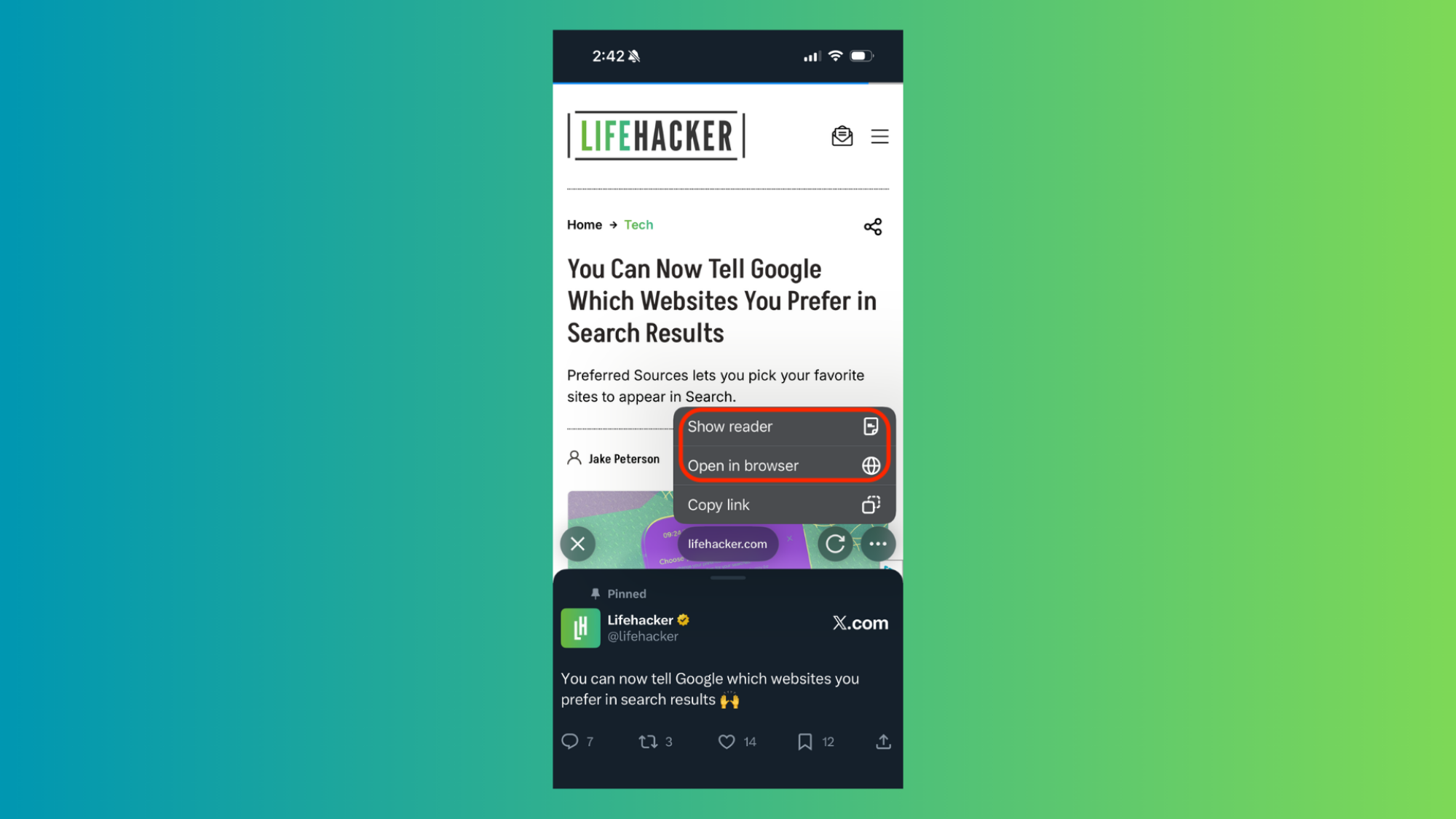
The change to how X links work is server-side, so downgrading your app or avoiding an update won’t save you here. Instead, to get rid of the footer from links you open in X, you’ll need to first open the link, then hit the three-dots button just above the footer on the right-hand side.
From there, you’ve got two options. First, to open the page with its formatting intact but no footer, tap “Open in browser.” This will open the link in your default browser, but also take you to that browser’s app instead, meaning you’ll have to find your way back to the X app if you want to keep scrolling once you’re done reading.
To stay in the X app, you can take advantage of Safari’s reader mode, which will still be available to you even if Chrome or another app is your default browser. In the same three-dot menu, simply tap “Show Reader” instead, and you’ll see a plain version of the link with all website formatting stripped out, including the X app’s new footer, all without having to move to a new app. To return to the normal view, just tap the X button in the top left corner. Then, to go back to your X timeline, either grab the footer and scroll up, or tap the X button just above the footer on the left-hand side.
Google To Let ‘Superfans’ Test In-Development Pixel Phones
Google plans to let Pixel smartphone enthusiasts test out the company’s next handset ahead of its public introduction. From a report: Google has invited members of its “Superfans” group to apply to test future Pixel hardware, asking entrants to profess their knowledge and passion for the brand in hopes of being able to beta test forthcoming products.
Consumer tech companies often let small groups of customers try out unreleased products under strict secrecy to gather feedback during development. But it’s incredibly rare for a company of Google’s size to do it with something as high-profile as the Pixel lineup.
The search giant will select 15 people from the pool of entrants, and winners must all sign a non-disclosure agreement to receive devices, according to official rules for the contest reviewed by Bloomberg News. “The Trusted Tester program is an opportunity to provide feedback and help shape a Pixel phone currently in development,” the document reads.


Read more of this story at Slashdot.
Do animals fall for optical illusions? It’s complicated.
Chances are you’ve encountered some version of the “Ebbinghaus illusion,” in which a central circle appears to be smaller when encircled by larger circles and seems larger when surrounded by smaller circles. It’s an example of context-dependent size perception. But is this unique to humans or are some animals susceptible as well? According to a new paper published in the journal Frontiers in Psychology, it might depend on the specific sensory environment, since the illusion relies on contextual clues to be effective.
Prior research has produced mixed results on the question of animals and their susceptibility to optical illusions, per the authors. Dolphins, chicks, and redtail splitfins seem to be susceptible, for example, while pigeons, baboons, and gray bamboo snakes are not.
Perhaps the best-known example is cats’ undeniable love of boxes and squares—the “if it fits, I sits” phenomenon documented all over the Internet. This behavior is generally attributed to the fact that cats feel safer when squeezed into small spaces, but it also tells us something about feline visual perception. Both a 1988 study and a 2021 study concluded that cats are susceptible to the Kanizsa square illusion, suggesting that they perceive subjective contours much like humans.
Watch Battlefield 6 Run On A CPU Liquid Cooler’s Miniscule 2.1-Inch Display
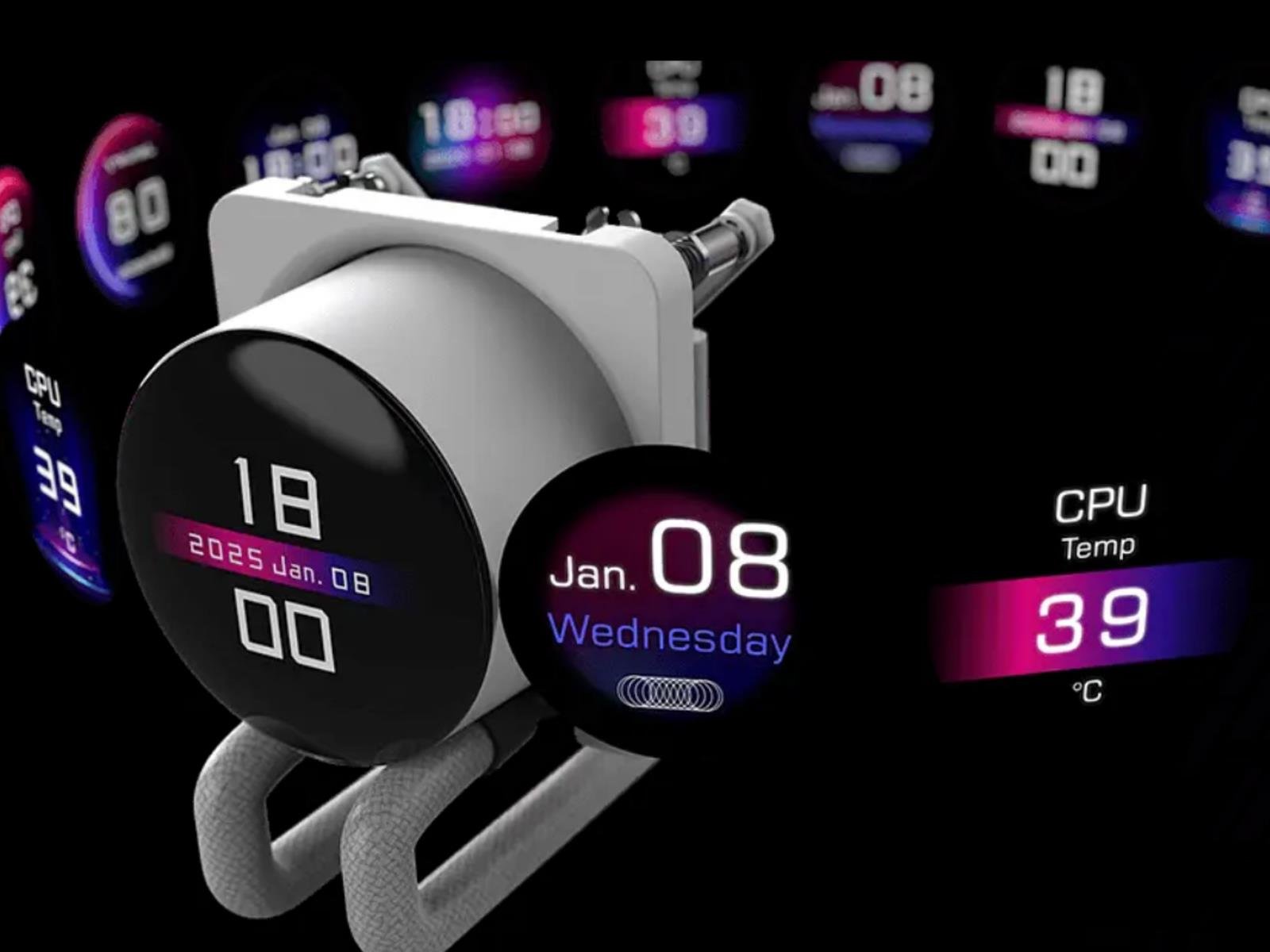
Fancy all-in-one (AIO) CPU liquid coolers with integrated displays are a favorite of PC builders looking to add a bit of flair to their rigs. Most opt for the utilitarian route and use it as way to keep tabs on CPU temperatures or other system statistics, while others deploy memes or anime clips. Then there’s those who take things to the next
All Things Open Has More in Store for 2025, Including an Added Measure of AI
The ATO 2025 conference may be in the books, but the organization has more events planned before year’s end—and new events are already on its 2026 dance card.
The post All Things Open Has More in Store for 2025, Including an Added Measure of AI appeared first on FOSS Force.
How to watch Samsung unveil its Android XR headset
Samsung is set to officially reveal its long-anticipated Android extended reality (XR) headset, which has been codenamed Project Moohan. The company has scheduled a livestream event for October 21 at 10PM ET.
The event will be streamed live via the company’s YouTube page and on the official Samsung Newsroom site. We don’t know how long the stream will be, but Samsung promises that Project Moohan will open up the “true potential” of mixed-reality devices.
This isn’t just a reveal for a mixed-reality headset. Moohan is the very first device that uses Google’s new Android XR operating system, which has been specifically designed for XR, VR and AR devices like glasses and headsets. We’ll finally get to see what all the fuss is about and what kind of new tools the OS brings to the table.
Samsung says that this technology “seamlessly blends everyday utility with immersive new experiences.” Hopefully we’ll get a look at both everyday utility and immersive new experiences during the livestream.
We don’t have official specs about the headset itself, but there have been plenty of leaks and rumors that will be confirmed or refuted during the stream. Leaks have suggested it includes a high-end display, advanced tracking and Gemini integration. These same leaks indicate a potential price tag of $1,800 to $2,800, making it more of a rival to the Apple Vision Pro than Meta’s new Ray-Ban Display glasses.
This article originally appeared on Engadget at https://www.engadget.com/ar-vr/how-to-watch-samsung-unveil-its-android-xr-headset-184820772.html?src=rss
OpenAI’s ‘Embarrassing’ Math
An anonymous reader writes: “Hoisted by their own GPTards.” That’s how Meta’s Chief AI Scientist Yann LeCun described the blowback after OpenAI researchers did a victory lap over GPT-5’s supposed math breakthroughs. Google DeepMind CEO Demis Hassabis added, “this is embarrassing.” The Decoder reports that in a since-deleted tweet, OpenAI VP Kevin Weil declared that “GPT-5 found solutions to 10 (!) previously unsolved Erdos problems and made progress on 11 others.” (“Erdos problems” are famous conjectures posed by mathematician Paul Erdos.)
However, mathematician Thomas Bloom, who maintains the Erdos Problems website, said Weil’s post was “a dramatic misrepresentation” — while these problems were indeed listed as “open” on Bloom’s website, he said that only means, “I personally am unaware of a paper which solves it.” In other words, it’s not accurate to claim GPT-5 was able to solve previously unsolved problems. Instead, Bloom wrote, “GPT-5 found references, which solved these problems, that I personally was unaware of.”


Read more of this story at Slashdot.
How Grand Theft Auto Legend’s New Studio Blew $270 Million On A Flop

Up until Grand Theft Auto V, the ‘GTA’ series had one main producer: a man named Leslie Benzies. He was renowned for his work directing the development and marketing of the flagship AAA open world series, but left Rockstar in 2016, demanding royalties for the success of GTA V as he left to assemble Build a Rocket Boy. A new game development
KosmicKrisp Vulkan To Apple Metal Driver Merged For Mesa 26.0
LunarG in August announced KosmicKrisp as a Vulkan-to-Metal driver for a better Vulkan API experience on Apple macOS devices compared to the likes of using MoltenVK as another Vulkan-on-Metal adaptation. As of today the KosmicKrisp driver for Vulkan 1.3 on Apple devices is now in the Mesa 26.0 codebase…
SpaceX launches 10,000th Starlink satellite, with no sign of slowing down
Two Falcon 9 rockets lifted off from spaceports in Florida and California on Sunday afternoon, adding 56 more satellites to SpaceX’s Starlink broadband network.
The second of these two launches—originating from Vandenberg Space Force Base, California—propelled SpaceX’s Starlink program past a notable milestone. With the satellites added to the constellation Sunday, the company has delivered more than 10,000 mass-produced Starlink spacecraft to low-Earth orbit.
The exact figure stands at 10,006 satellites, according to a tabulation by Jonathan McDowell, an astrophysicist who expertly tracks comings and goings between Earth and space. This number includes dozens of Starlink demo satellites, but not the dummy spacecraft carried on SpaceX’s recent Starship test flights.
Samsung Galaxy S25 FE review: Iterative to a fault
Five years after the release of the Galaxy S20 FE, Samsung has settled into a predictable pattern with its “Fan Edition” line of phones. Each new phone doesn’t offer much new or different from its immediate predecessor, with the company opting to offer iterative updates instead.
That might have been fine before, but with the arrival of the Nothing Phone 3a Pro and Pixel 10 — devices that changed the value proposition in their respective categories — the S25 FE feels woefully out of touch with a market that’s changing to meet people’s demands. There’s not much here that makes the new Galaxy S25 FE stand out, and any “upgrades” aren’t substantive.
Hardware and display
Igor Bonifacic for Engadget
When I first took the S25 FE out of the box, I thought Samsung had played a cruel trick on me. The phone looks identical to its predecessor, sporting the same brushed aluminum frame that’s been the company’s go-to for years now. I had to dig the S24 FE out of my gadgets drawer to compare the two phones before I confirmed they were in fact different devices.
The physical differences are minor. Samsung has tweaked the dimensions of the new phone, making it slightly shorter, wider and thinner. Specifically, the S25 FE measures in at 6.35 x 3.02 x 0.29 inches, while its predecessor was 6.38 x 3.04 x 0.31 inches. The new phone is also protected by Samsung’s “enhanced Armor” aluminum frame.
More noticeable is that the S25 FE is lighter than last year’s model, coming in at 6.7 ounces, down from 7.51 ounces. This is despite the fact the new device has a higher-capacity 4,900mAh battery. Together, these changes don’t make the S25 FE easier to hold if you have small hands (just ask my girlfriend), but it does feel better balanced than its predecessor. One issue with the size of the S25 FE is the placement of the in-display fingerprint sensor. It’s right at the bottom of the screen. I found this made it awkward to unlock the phone with my thumb — and I’m someone with big hands.
Another slight difference is the finish on the back of the phone. This time around, Samsung has gone with a matte coating, instead of the glossy finish it used on the S24 FE. It’s a welcome change since it makes the new model less prone to smudging and attracting fingerprints. I just wish Samsung had decided to offer the S25 FE in more fun colors. At release, it’s available in four colorways: white, icy blue, jet black and navy (pictured). So, if you don’t like blue, I’m sorry.
Amid the slight design tweaks, Samsung has gone with the same screen it did last year. The S25 FE has a 6.7-inch AMOLED display, with a panel that offers a 120Hz refresh rate and 1080p resolution. The S24 FE’s vibrant screen was one of the best parts of last year’s model, and it’s the same with S25 FE. It’s easy to see the screen in bright sunlight, thanks to the fact it can push 1,900 nits of peak brightness. It’s also vibrant, and with HDR10 support included, great for watching videos on YouTube, Netflix and elsewhere.
Cameras
Igor Bonifacic for Engadget
Samsung made a single tweak to the Galaxy S25 FE’s camera hardware. Like last year’s model, the new phone has a 50-megapixel main camera with optical image stabilization (OIS) and a fast f/1.8 aperture lens. Once again, it also has an 8MP telephoto camera with a 3x optical zoom and a 12MP ultrawide angle that offers a 123-degree field of view.
The one addition is a higher resolution 12MP front-facing camera with a faster f/2.2 aperture lens. For selfies, the S24 FE made do with a 10MP sensor and f/2.4 lens. If the new front-facing camera included phase detection autofocus (PDAF), it would be the same one that’s available on the Galaxy S25. Unfortunately, it doesn’t and that’s a shame because PDAF greatly increases the likelihood your photos will come out sharp and in focus.
It’s also a shame Samsung decided not to update the FE’s telephoto camera. Before the Nothing 3a Pro, that was one of the features that made the S24 FE stand out in its price range. In 2025, however, the S25 FE’s telephoto feels outdated. It doesn’t offer the 5x optical zoom of the Pixel 10 nor the 50MP of resolution and periscope zoom you get with the 3a Pro. Coming from the former, the FE’s telephoto camera felt limiting. With only 8MP of resolution, trying to snap a photo at anything beyond 5x zoom was pointless; it would just turn out a blurry mess.
As for FE’s other cameras, they’re decent if uninspiring. The 50MP camera is the best of the bunch, capable of capturing detailed, good-looking photos even in low light. The ultrawide, meanwhile, is mostly forgettable. It does an okay job of capturing big scenes, but it’s lacking in dynamic range and detail. The selfie camera is a noticeable upgrade from the one that came with last year’s model, and produces pleasing photos that are on par with what you can expect from the S25’s front-facing camera.
Otherwise, snapping pictures with the S25 FE feels like using a flagship phone from a few years ago. The one thing that saves it from being a complete blast from the past is the inclusion of Samsung’s generative photo editing software, which you can use to remove distracting objects from photos. Of the AI photo apps I’ve tested, Samsung’s is among the best at editing out objects without smearing the background. You can also use the generative edit to add things to a photo, but as you might expect, this doesn’t work as well as removing them.
Performance and battery life
Igor Bonifacic for Engadget
On paper, the S25 FE should offer better performance than its predecessor, thanks to Samsung’s decision to equip the phone with its Exynos 2400 chipset over the cut-down Exynos 2400e it used on last year’s model. In practice the two are about on par with one another. On Geekbench’s processor test, the Exynos 2400 delivered a 2,144 single-core score and a 7,059 multi-core score. That’s not much better than the 2,140 and 6,690 I recorded last fall on the S24 FE.
Still, it’s a more impressive showing than either the Pixel 9a and Nothing 3a Pro had when my colleague Sam Rutherford and I put their Tensor G4 and Snapdragon 7s Gen 3 chips through Geekbench earlier this year. For comparison, the former delivered a modest 1,665 on single-core performance and 4,294 on multi-core performance. The latter scored an even less impressive 1,115 and 3,082 respectively.
In real-world use, the Exynos 2400 feels snappy. Scrolling is fast and fluid, as is opening apps and switching between them. Gaming performance is also impressive, with the chip able to handle the 60 fps modes in graphically demanding games like Diablo Immortal and League of Legends: Wild Rift without dropping frames.
Last year, Samsung said it redesigned the S24 FE’s vapor chamber to make it bigger and improve cooling. With the S25 FE, that component is an additional 10 percent larger. However, if the new vapor chamber made a difference to the phone’s thermals, I had a hard time telling. Both the S25 FE and S24 FE got warm after about 15 to 20 minutes of gaming. The new phone never got hot to the point I couldn’t hold it anymore, but it also didn’t feel noticeably cooler than the S24 FE running the same games.
As mentioned at the top, the S25 FE has a larger 4,900mAh battery. That’s about four percent more capacity than the S24 FE offered. As a result, any difference in battery life is minimal. I’m sure there are some scenarios the S25 FE may last longer than its predecessor, but in my testing the two phones were equal in terms of longevity. With three to four hours of active screentime, I managed to get a full day of battery life from the S25 FE, with enough power left over to get the phone through the night before charging it in the morning. That’s similar to the experience I had last year.
Speaking of charging, the S24 FE, with a 25 watt wired limit, was painfully slow at it. Going into this review, my hope was the S25 FE would do better and I had good reason to be hopeful. Samsung lists the new phone as capable of charging at 45 watts. However, in my testing the S25 FE was only slightly faster than its predecessor. Plugged into a 130 watt Razer GaN charger, it took the phone about an hour and 14 minutes to charge to full from a battery at 10 percent life. When I replicated that same test with a 25 watt charger, it took the S25 FE just over an hour-and-a-half to charge back up.
Either way, if battery life is important to you, the Nothing 3a Pro and Pixel 9a are better bets. Both come with bigger batteries (5,000 and 5,100mAh, respectively), and with the former, you also get 50 watt charging.
Software
Igor Bonifacic for Engadget
The S25 FE ships with Android 16 and Samsung’s One UI 8 out of the box. Samsung has promised to support the phone with at least seven generations of platform updates, so it should stay current with Google’s yearly release schedule up until at least Android 23 in 2032. Notably, this means the S25 FE may end up on a more recent version of Android than the S25, S25 Edge and S25 Ultra, all of which released with Android 15.
With One UI 8, the S25 FE has access to all of the latest AI features from both Samsung and Google. Some of these tools are useful; others replicate functionality that has been present in Android for a long time. For example, Google’s Circle to Search is great. It makes it easy to do a visual search of anything on the phone’s screen. On the other hand, I could do without Samsung’s Now Brief, which offers much of the same utility you’ll find on Android’s Discover page (a feature that comes standard on every Android phone).
Each S25 FE also comes with six months of free access to Google AI Pro. Normally priced at $20 per month, the service gives you access to some of the company’s best models, including Gemini 2.5 Pro, inside of the Gemini app. Within Flow, Google’s AI filmmaking app, you also get limited access to Veo 3.1, Google’s latest video generation system. Some other perks include 2TB of cloud storage and higher rate limits when using NotebookLM.
Wrap-up
Igor Bonifacic for Engadget
With changes that amount to window dressing, I can’t recommend anyone buy the S25 FE at full price. There’s just enough here to justify spending $650 on a phone that is barely an upgrade over its predecessor. If you’re a Samsung fan, I’m sure the S25 FE will be frequently discounted, but why reward the company for a lazy effort? Besides, the S25, following a $200 discount for Prime Day, was only $10 more than the FE earlier this month.
Over the past few years, Google and Nothing have shown midrange phones don’t need to be boring, iterative affairs. For Samsung, I think it’s time to rethink its FE strategy. If these phones offered something different — say actual fan favorite features like a headphone jack — there could be compelling reasons to recommend them. But as things stand, there’s just no reason to buy a new FE phone when the company’s flagships see steep price discounts within months of their release.
This article originally appeared on Engadget at https://www.engadget.com/mobile/smartphones/samsung-galaxy-s25-fe-review-iterative-to-a-fault-183026577.html?src=rss
AMD Announces “ROCm 7.9” As Technology Preview Paired With TheRock Build System
AMD is hosting an AI Day out in San Francisco today and as part of those festivities today they announced the ROCm Core SDK 7.9 SDK paired with TheRock build and release infrastructure system they have been crafting…
The Sims Mobile is Shutting Down Next Year
The Sims is in a period of transition — and as part of that, the ongoing mobile version will be shutting down in a few months. From a report: EA announced that today’s update for The Sims Mobile will be its last, and that on January 20th, 2026 the game “will no longer be accessible to play and will be sunset.” The mobile iteration of the franchise first launched in 2018, and has seen more than 50 updates since then. EA says that starting today players will no longer be able to spend real money in the game, and that it will be delisted on both iOS and Android tomorrow before the servers shut down completely next year, making it entirely unplayable.


Read more of this story at Slashdot.
How to Sign Up to Test Oura’s New Blood Pressure Feature
We may earn a commission from links on this page.
The Apple Watch’s hypertension notifications may soon have a competitor. Oura, maker of smart rings, is planning to pursue FDA clearance for their own warning feature for high blood pressure. Oura members can sign up for a study soon in the Oura app.
Hypertension, or high blood pressure, can lead to problems with your heart and blood vessels over time. That’s why medical professionals measure it at office visits and why people who have high blood pressure may take medications or use diet and exercise to try to control it.
What Oura is planning for its blood pressure feature
Oura said in a press release that the feature will be called a “blood pressure profile” and will only require the Oura ring itself, no blood pressure cuff needed. The app will not report your actual blood pressure, but it will let users know if they nave “no signs,” “moderate signs,” or “major signs” of hypertension. People who register major signs would be advised to follow up with a medical professional.
How to join Oura’s blood pressure study
Oura says that it has received approval from an institutional review board (IRB) to do a study with Oura members. (They have not named the institution they’re partnering with.) Oura says that people who sign up for the study will be asked to fill out a questionnaire about their family history, medications, and lifestyle habits. Oura will use these answers along with data from the Oura ring. You can read more about the study on Oura’s website here.
Oura says the study is now available in the Oura Labs section of the app. (I don’t see it in mine, but I have to assume it will be there soon.) To find Oura Labs, tap the menu icon in the top left corner of the app, then tap Oura Labs. This screen shows experimental features and has links to studies that members can sign up for.
Members who are eligible for the study include those who are 22 or older, based in the U.S., using the English language version of the app, and using a gen 3 or 4 Oura ring. Members who are pregnant, less than 12 weeks postpartum, or who have cardiac implants like pacemakers are not eligible for the study.
Anthropic brings Claude Code to iOS and the web
At the end of February, Anthropic announced Claude Code. In the eight months since then, the coding agent has arguably become the company’s most important product, helping it carve out a niche for itself in the highly competitive AI market. Now, Anthropic is making it easier for developers to use Claude Code in more places with a new web interface for accessing the agent.
To get started, you’ll need connect Claude to your GitHub repositories. From there, the process of using the agent is the same as if it had direct terminal access. Describe what you need from it, and the agent will take it from there. Claude will provide progress updates while it works, and you can even steer it in real-time with additional prompts. Through the web interface, it’s also possible to assign Claude multiple coding tasks to run in parallel.
“Every Claude Code task runs in an isolated sandbox environment with network and filesystem restrictions. Git interactions are handled through a secure proxy service that ensures Claude can only access authorized repositories — helping keep your code and credentials protected throughout the entire workflow,” said Anthropic.
In addition to making Claude Code available on the web, Anthropic is releasing a preview of the agent inside of its iOS app. The company warns the integration is early, and that it hopes “to quickly refine the mobile experience based on your feedback.”
Pro and Max users can start using Claude Code on the web today. Anthropic notes any cloud sessions share the same rate limits with all other Claude Code usage.
This article originally appeared on Engadget at https://www.engadget.com/ai/anthropic-brings-claude-code-to-ios-and-the-web-180023611.html?src=rss
Musk’s $1 trillion Tesla pay plan draws some protest ahead of likely approval
Tesla shareholders should reject a compensation plan that could pay Elon Musk more than $1 trillion over the next decade, proxy advisory firm Institutional Shareholder Services (ISS) said in a report Friday.
The plan is designed “to retain Musk and keep his time and attention on Tesla instead of his other business ventures,” but “there are no prescriptive elements within the award to ensure his focus and time remain on Tesla as opposed to his other ventures, undermining the award’s primary rationale,” the advisory firm said in a report for its clients.
The “astronomical grant value” awarded to Musk could dilute value for other shareholders “due to the extreme value and number of shares being granted,” and it is questionable whether the award “is necessary or appropriate to further align his interests [with Tesla] when he currently holds a 19.8 percent ownership stake in the company,” ISS said.
Accidental Rainbow-On-A-Chip Discovery Could Tame AI’s Soaring Energy Demands
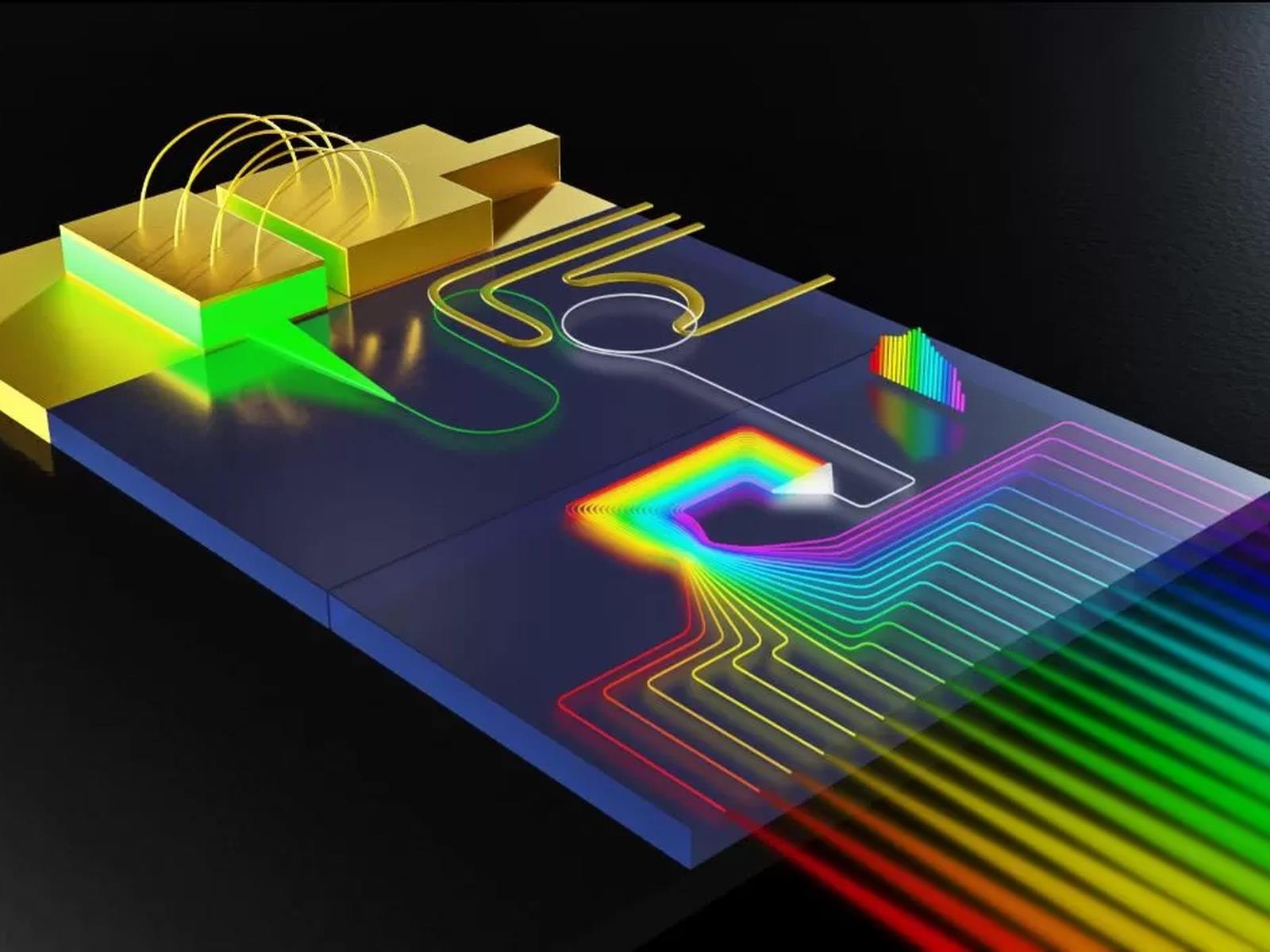
A team of Columbia University engineers may have stumbled on a key to cooling the AI industry’s energy fever. While trying to boost the power of chips for LiDAR—laser-based sensing used most notably in self-driving cars—the researchers noticed something strange. “As we sent more and more power through the chip, we noticed that it was creating
EA will shut down The Sims Mobile in January
The Sims Mobile is going away as EA will shut it down on January 20, nearly eight years after its debut in March 2018. An update that went live on Monday is the final one and the company is delisting the game on October 21. Since the game requires online servers (game progress is stored there), it’ll no longer be possible to play The Sims Mobile in three months’ time.
“The Sims Mobile and The Sims community as a whole are full of creativity, kindness, and imagination,” EA said in a blog post. “You’ve amazed us with your stories, builds, and Sims. We’re proud to have shared this journey with you, and as a token of our appreciation, we’ve prepared a few surprises as we head into TSM’s final chapter.”
EA will run 14 events, including limited-time quests and treasure hunts, in The Sims Mobile over the next few months. It’s no longer possible to spend any real money in the game, though players can use their existing in-game currency. As of today, players also have unlimited energy, which “should make it easier to complete projects and enjoy the last few months of play,” EA said. On January 6, EA will unlock all of the Build Mode and Create A Sim items so players can fully customize their homes and sims’ looks for a couple of weeks before the grim reaper shows up for The Sims Mobile.
Back in 2022, EA and Sims studio Maxis announced Project Rene, a game that will run across multiple platforms, including mobile. So it’s maybe not too surprising that the company wants to focus its Sims mobile efforts there.
In any case, the shutdown stinks, especially for those who have spent money on The Sims Mobile as well as for the sake of game preservation. The decision to scuttle the game won’t exactly allay concerns that fans of the series, which has a significant LGBTQ+ fanbase, have about the future of The Sims if and when the planned sale of EA to a group that includes Saudi Arabia’s Public Investment Fund goes through.
This article originally appeared on Engadget at https://www.engadget.com/gaming/ea-will-shut-down-the-sims-mobile-in-january-173958279.html?src=rss
China Accuses NSA of Hacking National Timekeeping Agency
China says it has uncovered what it describes as irrefutable evidence of American government cyber attacks targeting the National Time Service Center. The Ministry of State Security said the National Security Agency exploited vulnerabilities in employees’ mobile phones beginning March 25, 2022, and later used stolen login credentials to access the center’s computers starting April 18, 2023.
The facility in Xi’an provides high-precision timekeeping service for the government, civil society, and various industries. It also supplies data used to calculate international standard time. Chinese authorities said investigators found that private servers worldwide were employed to conceal the attacks’ origin. The accusations emerge against a backdrop of mutual cyber-espionage claims between Washington and Beijing. Western governments and companies have repeatedly blamed Chinese hackers for intrusions in recent years.


Read more of this story at Slashdot.