The last 12 months have been pretty depressing for anyone invested in the long-term future of Xbox and the general health of the games industry. Back in May, Microsoft laid off 3 percent of its global workforce, with the company’s gaming division being one of the big casualties, and a number of upcoming titles were subsequently canceled. It painted a picture of a brand in crisis, but according to a new report, Microsoft has been setting its gaming division unrealistic profit targets for several years.
Sources told Bloomberg that in 2023, Microsoft implemented an “across-the-board goal” of 30 percent profit margins, which the report says Microsoft calls “accountability margins” internally. As Bloomberg’s Jason Schreier reports, this target, which was set by Microsoft’s Chief Financial Officer Amy Hood in fall 2023, is well above the recent industry average of 17-22 percent quoted by S&P Global Market Intelligence. Schreier adds that Xbox’s own average in the last six years is between 10 and 20 percent.
S&P Global analyst Neil Barbour told Bloomberg that Microsoft’s 30 percent target is the kind of margin “usually reserved for a publisher that is really nailing it.” This is despite its gaming division only landing at 12 percent in the first nine months of 2022, as quoted in the report.
A Microsoft spokesperson told Bloomberg that it views individual games and projects differently with regards to what constitutes success, adding that it sometimes has to making tough decisions, including ending development on games, so it can shift its resources toward the projects that are “more aligned with our direction and priorities.”
The new profit targets were introduced in the same year that Microsoft finally completed its $68.7 billion acquisition of Activision Blizzard, landing it hugely popular franchises such as Call of Duty and Diablo. Back in 2020 it acquired ZeniMax, the parent company of Bethesda, which means that long-running series like The Elder Scrolls and Fallout also now sit under the umbrella of Xbox’s gaming division.
Since 2018, Microsoft has been putting all of its first-party releases on Game Pass from day one, but this model has contributed to games failing to hit their 30 percent profit margin targets, according to Bloomberg’s sources. Xbox does offer developers a credit it calls “member-weighted value,” which takes into consideration factors such as the collective number of hours Game Pass subscribers have spent in a game, although this formula tends to benefit multiplayer titles the most. Going forward, Bloomberg’s sources said Microsoft is likely to favor funding games with cheap development costs and proven revenue-generators over riskier projects.
Xbox has been successful in bringing some of its first-party games to other platforms, including its primary rival in Sony’s PS5, with major titles such as Forza Horizon 5and Indiana Jones and the Great Circlemaking the jump in the last 12 months. In the wake of Microsoft raising the price of Xbox consoles in the US last month, the second time it has done so in 2025, it also slapped Game Pass Ultimate with a 50 percent subscription fee hike at the start of October. This week the company increased the cost of Xbox dev kits by $500.
This article originally appeared on Engadget at https://www.engadget.com/gaming/xbox/microsoft-reportedly-ordered-its-xbox-division-to-boost-profits-to-an-unrealistic-level-150210398.html?src=rss
Breaches are an unfortunate reality of the digital era. Chances are, some of the companies you trust your data to are going to get hacked, and sensitive information stored on those servers is going to leak. If you’ve been online for a long time, that means quite a bit of your data is floating around various corners of the internet.
While there isn’t one centralized database for all the stolen credentials on the web, one researcher has compiled quite a large database, that you can check to see if your email address is affected.
183 million email addresses
Cybersecurity researcher Synthient has compiled a massive database of stolen credentials from sources across the internet, amounting to 3.5 terabytes of data. (That’s 3,584 gigabytes). The vast majority of this data—91% of it—has been noted by other researchers already. But because the database is so huge, the 9% that’s new represents a large pool of credentials we haven’t seen before.
The database itself contains 183 million unique email addresses, along with both the websites they were attached to, as well as the passwords used to log into them. According to security researcher and blogger Troy Hunt, 9% of that figure represents 16.47 million credentials that have never been reported in any previous data breach. Hunt reached out to “a bunch” of his subscribers to see whether any of them could find their credentials in this database. One subscriber verified that the database contained a password that they did previously use with their Gmail account, while another confirmed the database contained websites they frequently visited.
At this time, there’s no reason to believe the database isn’t legitimate. These 183 million email addresses—and their associated websites and passwords—are just floating around the internet, while over 16 million of them have never been seen before. Yours could be among them.
How to check if your credentials are in this database
The entire database of 183 million email addresses has been uploaded to Have I Been Pwned. The site catalogues websites that have experienced data breaches, as well as the accounts that were involved. All you need to do is enter your email address in the provided field, and Have I Been Pwned will check it against its database to see whether the address has been involved in any known breaches.
As such, if your email address is included in this latest database, it’ll show up here. It doesn’t look like any of my personal email addresses are in this database, but they’ve been included in plenty of other breaches.
Apple is all about its iPhone 17 lineup these days (and iPhone Air), but if you’re willing to jump back a couple of generations, you can score a still-capable iOS handset for a comparatively affordable price. The phone in question is the iPhone 15, and it’s up for grabs for just under $500 right now, provided you’re fine with a few caveats.
New version includes multithreaded TCP/IP and Raspberry Pi 5 supportThe 59th version of the OpenBSD operating system is here, six months after 7.7, with multiple improvements in various areas.…
Besides the early fallout of switching to Rust Coreutils on Ubuntu 25.10 causing some breakage, a more pressing issue has been discovered: Ubuntu 25.10’s unattended upgrades functionality for automatic security updates is currently broken due to a Rust Coreutils bug…
If you’re in the market for a budget-friendly home security camera (or even several), the Blink Mini 2 may be worth considering. A two-pack of the cameras is on sale at Amazon as the bundle has dropped from $70 to $28.
That’s a discount of 60 percent, which is certainly nothing to shake at. This is also a better price than the $35 we saw for the cameras during Prime Day. Amazon recently revealed a newer version of the Blink Mini that records 2K footage, but the 1080p Blink Mini 2 can still get the job done.
The Blink Mini 2 is our pick for the best budget security camera. It’s easy to set up and it integrates neatly into the Alexa smart home ecosystem. While you need a Blink Subscription for cloud storage ($3 for one camera, $10 for as many as you like), you can pick up a Sync Module 2 or Sync Module XR to store Blink Mini 2 footage locally. A Blink Subscription also enables specialized detection and alerts (e.g. for people and pets) and features like periodic photo captures.
The Blink Mini 2 is weather resistant, though you’ll need an adapter to use it outdoors. Additionally, you can use the Mini 2 as a plug-in chime that sounds when someone presses a Blink Video Doorbell.
This article originally appeared on Engadget at https://www.engadget.com/deals/a-two-pack-of-blink-mini-2-cameras-is-60-percent-off-right-now-144258368.html?src=rss
Millions of tons of discarded electronics from the United States are being shipped overseas, much of it to developing countries in Southeast Asia unprepared to safely handle hazardous waste, according to a new report by an environmental watchdog. AP: The Seattle-based Basel Action Network, or BAN, said a two-year investigation found at least 10 U.S. companies exporting used electronics to Asia and the Middle East, in what it says is a “hidden tsunami” of electronic waste. “This new, almost invisible tsunami of e-waste, is taking place … padding already lucrative profit margins of the electronics recycling sector while allowing a major portion of the American public’s and corporate IT equipment to be surreptitiously exported to and processed under harmful conditions in Southeast Asia,” the report said.
Electronic waste, or e-waste, includes discarded devices like phones and computers containing both valuable materials and toxic metals like lead, cadmium and mercury. As gadgets are replaced faster, global e-waste is growing five times quicker than it’s formally recycled. The world produced a record 62 million metric tons in 2022. That’s expected to climb to 82 million by 2030, according to the United Nations’ International Telecommunication Union and its research arm, UNITAR.
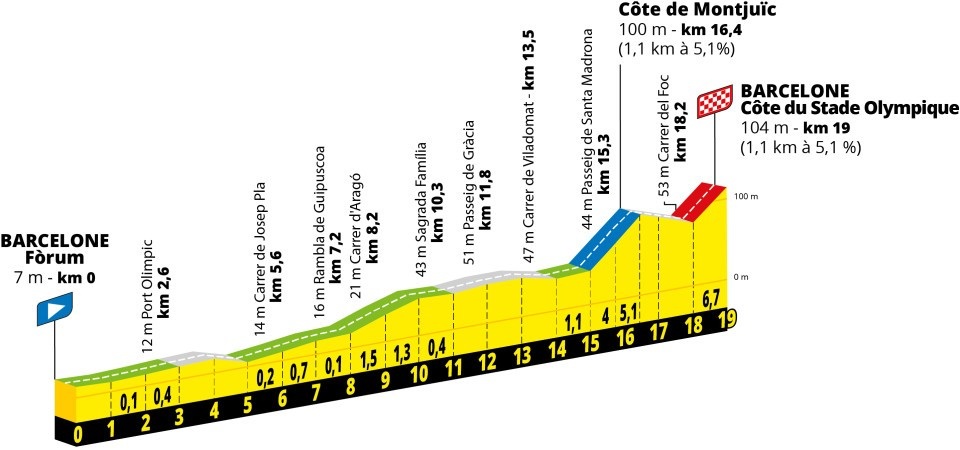
For the first time since 1971, the Tour de France will start with a team time trial, this time of 19km in Barcelona. It will cover 3,333km with 54,450m of climbing before finishing in Paris.
Once again, the final stage in Paris will include the climb to Montmartre to spice up the final laps of the Champs-Elysees.
But the highlight must be the two ascents to summit finishes on the iconic Alpe d’Huez on Stage 19 and Stage 20, with the latter throwing in the Col de la Croix de Fer, Col de la Télégraphe and the Col du Galibier for good measure in a stage with 5,600m of climbing.
In the interim, the Tour will visit the Pyrenees, the Massif Central, the Vosges and the Alps, with new climbs in all four French mountain ranges. There’s a 26km individual time trial along the shores of Lake Geneva on Stage 16, too.
Here’s a stage-by-stage guide to how the 2026 Tour de France route will unfold.
The opening team time trial won’t be easy, with the climbs up to the Olympic stadium testing the teams’ ability to stay together on the climbs. Individual finish times will be taken, so riders will want to stay with their teammates.
Stage 2: Tarragona to Barcelona
Sunday 5 July
182km
The second-stage start in Tarragona marks the furthest south that the Tour has ever travelled, while the stage finish is one for the puncheurs.
Tour boss Christian Prudhomme points out that the last three winners on the final climb of Montjuic in Barcelona, when it has featured in the Tour of Catalonia, were Primož Roglič (2025), Tadej Pogačar (2024) and Remco Evenepoel (2023). However, the Tour’s GC contenders may want to lay low this time for what’s in store.
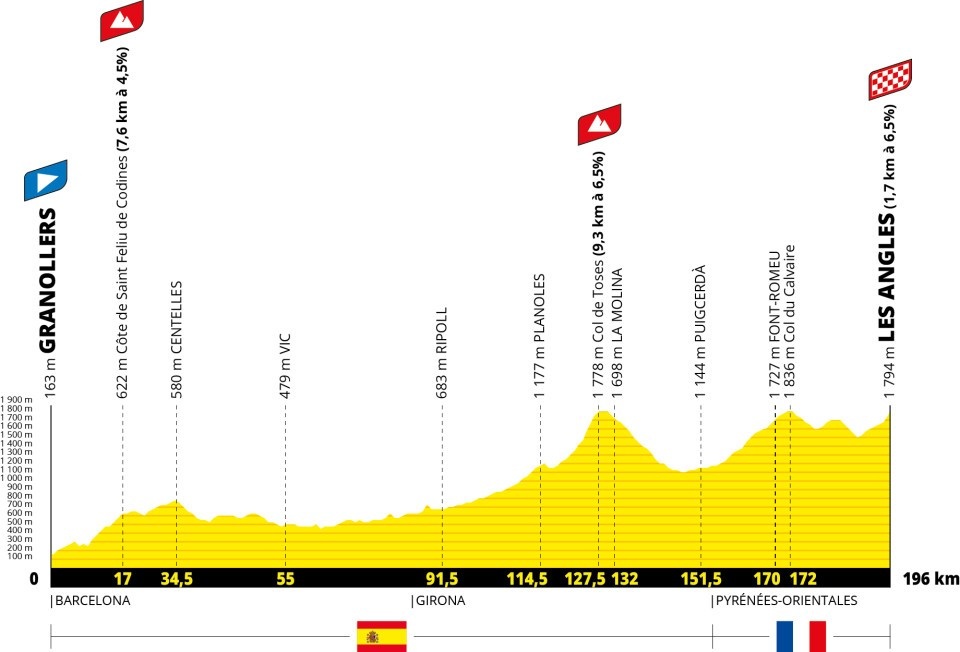
Stage 3: Granollers to Les Angles
Monday 6 July
196km
With Barcelona’s proximity to the Pyrenees, it’s no surprise that the Tour has headed straight there. There’s 3,950m of elevation gain, although Prudhomme reckons this is more a stage for a breakaway, with GC hopefuls again keeping their powder dry.
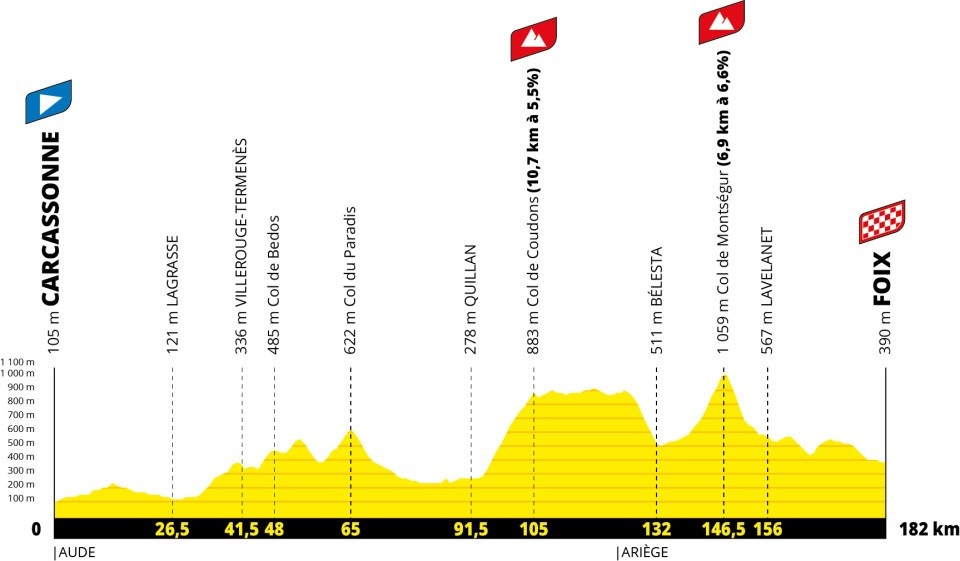
Stage 4: Carcassonne to Foix
Tuesday 7 July
182km
This could be another day for a breakaway, according to Prudhomme, although he reckons it could be chased down by the sprinters who have survived the hills on the approach to the finish.
Stage 5: Lannemezan to Pau
Wednesday 8 July
158km
Prudhomme thinks this is the first stage marked out for a bunch sprint. It comes unusually late, with most Tours offering something for the sprinters earlier on the parcours.
Stage 6: Pau to Gavarnie-Gedre
Thursday 9 July
186km
The last stage in the Pyrenees is also the most demanding, with the Col d’Aspin and Col du Tourmalet both featuring. Prudhomme reckons this could provide the first big GC battle or, if they again decide to hold their fire with 40km still to ride after the Tourmalet, a climbers’ breakaway.
Stage 7: Hagetmau to Bordeaux
Friday 10 July
175km
Another stage for a breakaway/sprint battle, as it passes through the forests of the Landes. It’s most likely to end in a sprint finale on the banks of the Garonne river, though.
Stage 8: Périgueux to Bergerac
Saturday 11 July
182km
It’s two potential sprint stages in a row, with only 1,150m of elevation gain today as the Tour passes along the Dordogne river.
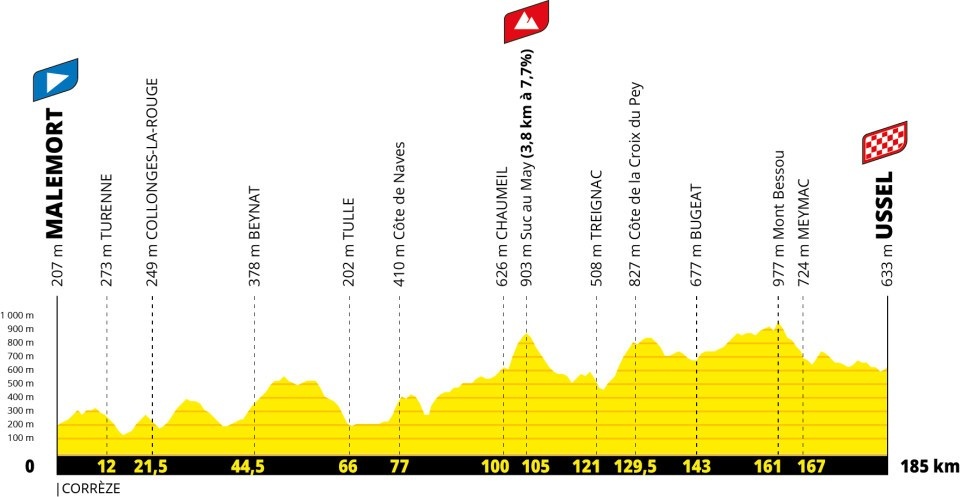
Stage 9: Malemort to Ussel
Sunday 12 July
185km
The sprinters will have to return to the autobus on this stage, with its two major climbs in 3,300m of elevation gain. Prudhomme marks out the climb of the Suc au May as the point at which a selection might be made.
Rest day
Monday 13 July
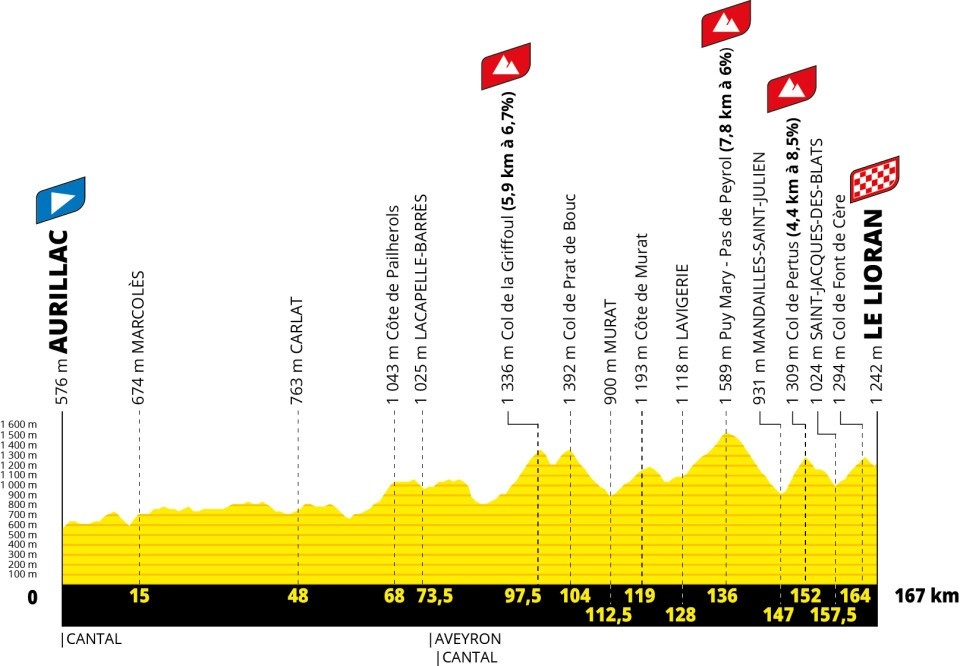
Stage 10: Aurillac to Le Lioran
Tuesday 14 July
167km
Bastille Day is another climbers’ day, with the Col de la Griffoul, the Pas de Peyrol, the Col de Pertus and the final climb to the ski station at Le Lioran. It may be one for a breakaway, rather than a GC battle, though.
Stage 11: Vichy to Nevers
15 July
161km
Prudhomme reckons this is another sprinters’ day, with the odds not in favour of a breakaway surviving. It’s the first visit by the Tour to the home of Look bikes since 2003.
Stage 12: Circuit Magny-Cours to Chalon-sur-Saône
Thursday 16 July
181km
Helping to assuage the sprinters after their meagre start to the race, this looks like another bunch finish, as the race heads into the vineyards. Chalon-sur-Saône was also the site of Great Britain’s first Tour stage win, when the late Brian Robinson took the stage solo back in 1959.
Stage 13: Dole to Belfort
Friday 17 July
205km
The longest stage of the 2026 Tour takes in the Ballon d’Alsace, before its downhill run to the finish in Belfort.
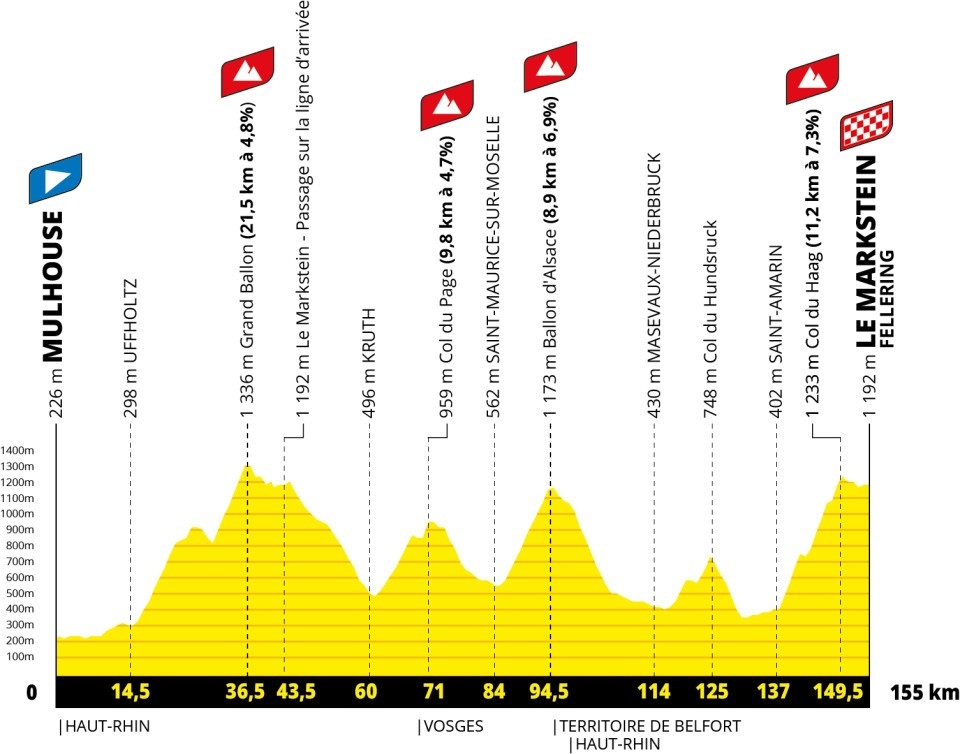
Stage 14: Mulhouse to Le Markstein Fellering
Saturday 18 July
155km
A double loop through the Vosges sees the Tour cross the Grand Ballon before the finish line at Le Markstein for the first time. The second loop includes the Col du Haag, an 11.2km-long bike path with an average gradient of 7.3%. Prudhomme picks it out as a highlight of the 2026 Tour route, where major gaps could emerge.
Stage 15: Champagnole to Plateau de Solaison
Sunday 19 July
184km
The Tour heads to the Alps to start its journey through its final mountain range, with this stage marked out by Prudhomme as likely to be the start of the final GC shake-out. With the final climb of 11.3km to the summit finish averaging 9.1%, it should draw out the gaps to the final winner.
Rest day
Monday 20 July
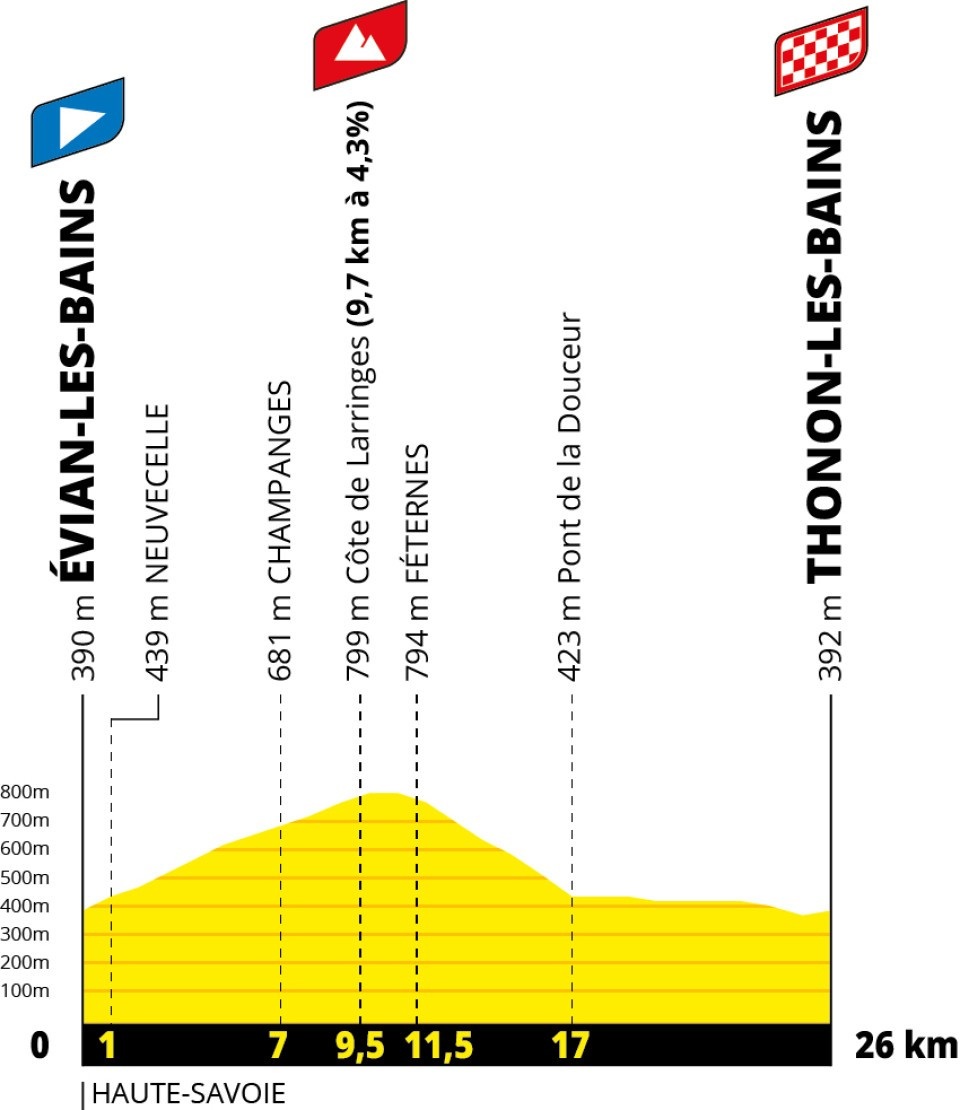
Stage 16: Evian-les-Bains to Thonon-les-Bains
Tuesday 21 July
26km ITT
The only individual time trial in the 2026 Tour offers a mix of climb, descent and flat roll-in to the finish along the shores of Lake Geneva.
Stage 17: Chambery to Voiron
Wednesday 22 July
175km
Prudhomme reckons the climbs on today’s route shouldn’t be enough to stop the sprinters from contesting the finish – if they’ve survived the climbing stages up until now.
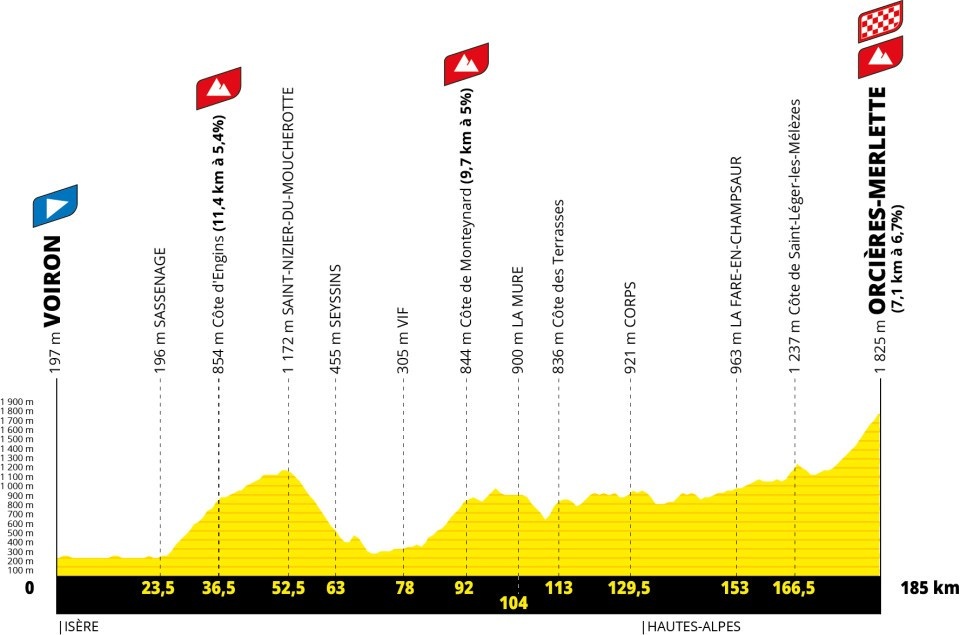
Stage 18: Voiron to Orcieres-Merlette
Thursday 23 July
185km
With what’s to come on the final two days in the Alps, Prudhomme has marked this stage as one for a battle between the climbers, rather than the GC contenders, but don’t rule out Pogačar proving a point.
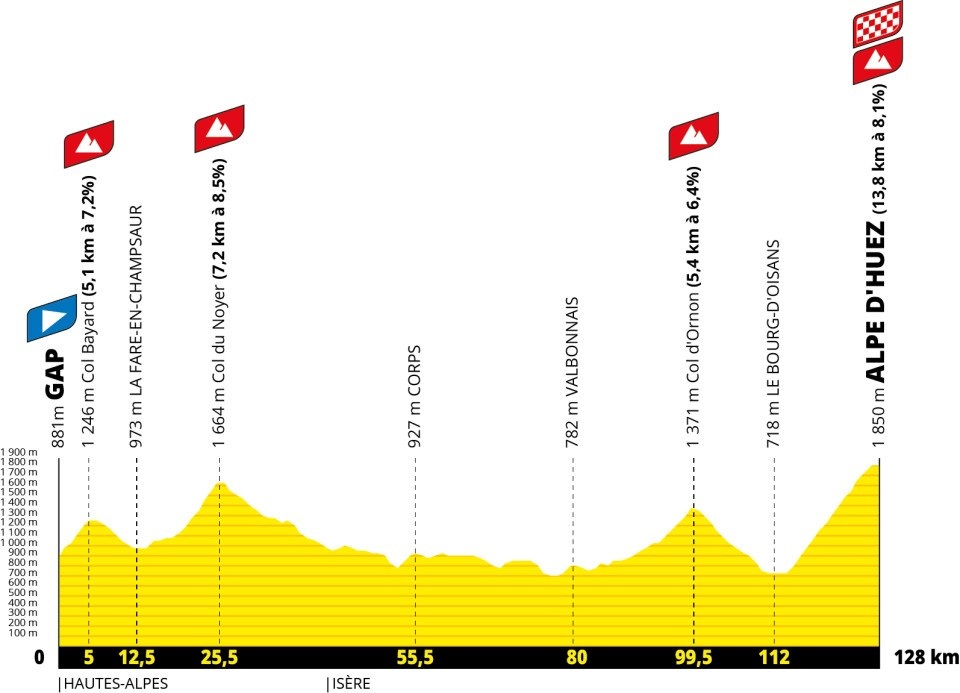
Stage 19: Gap to Alpe d’Huez
Friday 24 July
128km
Yep, we’re into the finale now, with the first of two days finishing on Alpe d’Huez. There are three climbs before the Alpe, though, which may again tempt the climbers to show their mettle.
Stage 20: Le Bourg d’Oisans to Alpe d’Huez
Saturday 25 July
171km
With 5,600m of elevation gain, the penultimate and queen stage of the 2026 Tour takes in three iconic Tour climbs before it has even reached the foot of Alpe d’Huez, which is taken via the Col de Sarenne, a route that has only ever been used in the 2013 Tour, and then as a descent.
Stage 21: Thoiry to Paris
Sunday 26 July
130km
It may have taken the 2024 Olympics to discover the Rue Lepic climb to Montmartre, but the Tour is back for a second time in 2026, taking on the climb three times. But whereas Wout van Aert had a short run from the climb to the finish line in 2025, in 2026 the last ascent is 15km from the line, which Prudhomme reckons will put the final stage in the balance between a puncheur and the sprinters.
The Spectre class of hardware vulnerabilities truly is a gift that keeps on
giving. New variants are still being discovered in current CPUs nearly
eight years after the disclosure of this
problem, and developers are still working to minimize the performance costs
that come from defending against it. The masked user-space access
mechanism is a case in point: it reduces the cost of defending against some
speculative attacks, but it brought some challenges of its own that are
only now being addressed.
In the high-stakes, multi-billion-dollar battle for global semiconductor one-upmanship, Tesla CEO Elon Musk has jumped in as a middle person by employing both of the world’s leading chip foundries—Samsung Foundry and TSMC (Taiwan Semiconductor Manufacturing Co.) to produce its critical, next-gen AI chip, the AI5.
The past number of months has seen a lot of work by Intel Linux kernel engineers on cache-aware scheduling / load balancing for helping modern CPUs that have multiple caches. With cache aware scheduling, tasks that will likely share resources could be aggregated into the same cache domain to enjoy better cache locality. With the cache aware scheduling patches recently updated and now working past the “request for comments” stage, I was eager to try out these new patches. Especially with a 44% time reduction reported for one of the benchmarks, I was eager to run some tests and the first of those results are being shared today.
Canonical’s new push for their Snap app packaging/sandboxed format on Ubuntu Linux is for AI large language models (LLMs). Making it more interesting though is that they are working to deliver silicon-optimized AI LLMs for your hardware and to make it easily deployable for Ubuntu sers…
Maxi Boch isn’t done with Baby Steps. Boch has enjoyed a productive career in game development and she knows how it feels to be creatively finished with a project. She experienced it at various points with Rock Band, Dance Central, Fantasia: Music Evolved and Ape Out, but on Baby Steps’ launch day, done was not the vibe.
“I’ve been in the industry for a long time; I shipped broken strumbars for Rock Band,” Boch told Engadget. “I know that things change over time in this world, and it’s not to say that Baby Steps is not done. It’s done. But whether I’m done with Baby Steps, this is a different story.”
To make a long one short: Boch’s collaborators, Bennett Foddy and Gabe Cuzzillo, were ready and excited to ship the game before she was, and so they did. Baby Steps hit PC and PlayStation 5 on September 23, 2025 (following one strategic delay to avoid the Hollow Knight: Silksong release window).
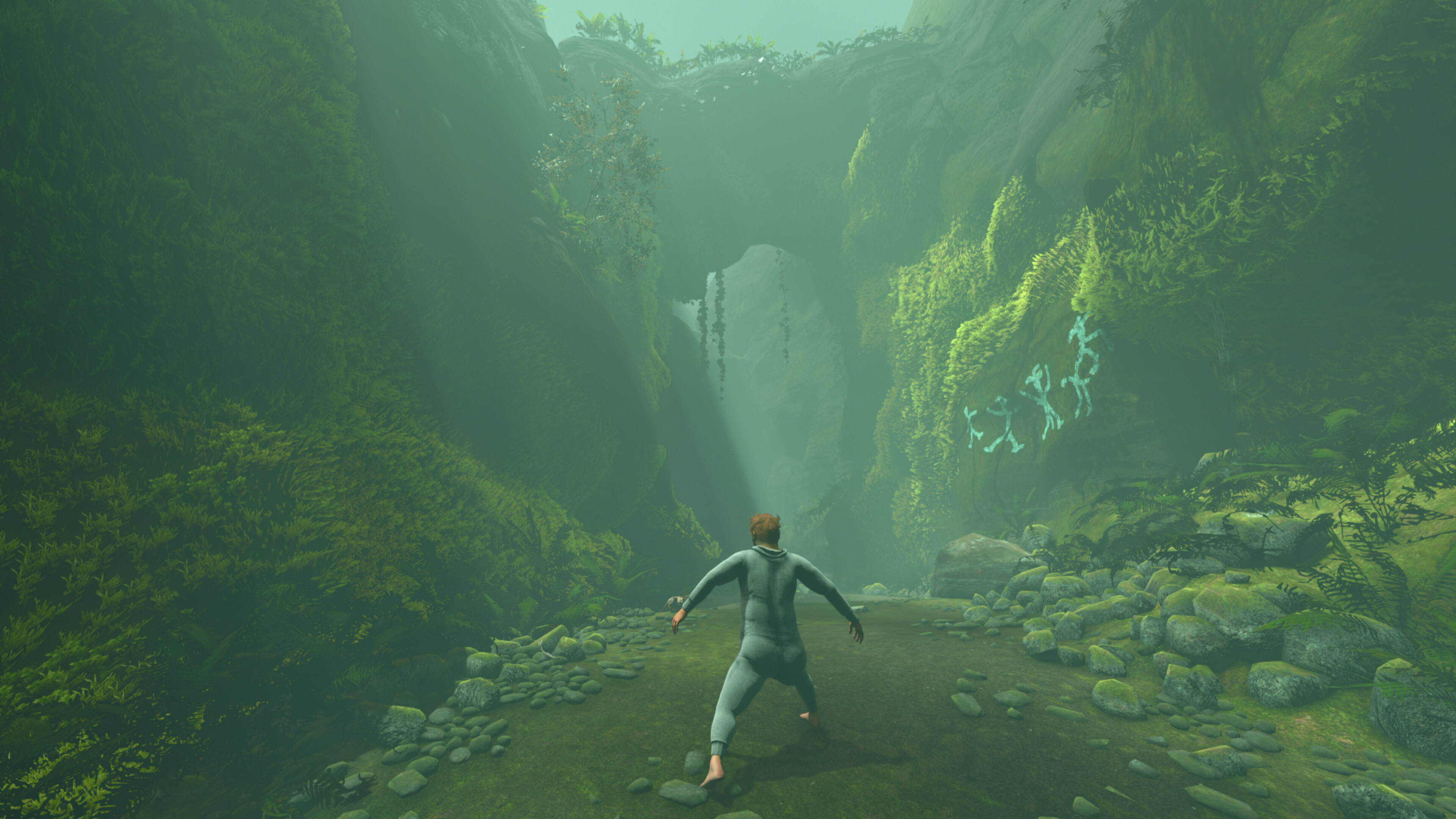
From the player’s side, Baby Steps feels like a finely honed experience. It’s a walking simulator that follows Nate, a manchild in a gray onesie, as he attempts to scale a mountain and symbolically escape his parents’ basement. The player controls Nate’s legs individually, lifting each knee and carefully placing one foot in front of the other, learning how to walk in the very literal sense. Baby Steps succeeds because of its mechanical precision, but it excels because of its irreverent tone, magically surreal setting and AAA levels of polish. The mountain is a mix of childhood memories and adult anxieties represented by giant chess pieces, rude graffiti, and a crew of drinking, smoking, anthropomorphic donkeys who wander the cliffs with their dicks swinging free. Improvised dialogue between Nate and the NPCs turns each cutscene into a comedy sketch, but his journey also includes shocking revelations of existential numbness.
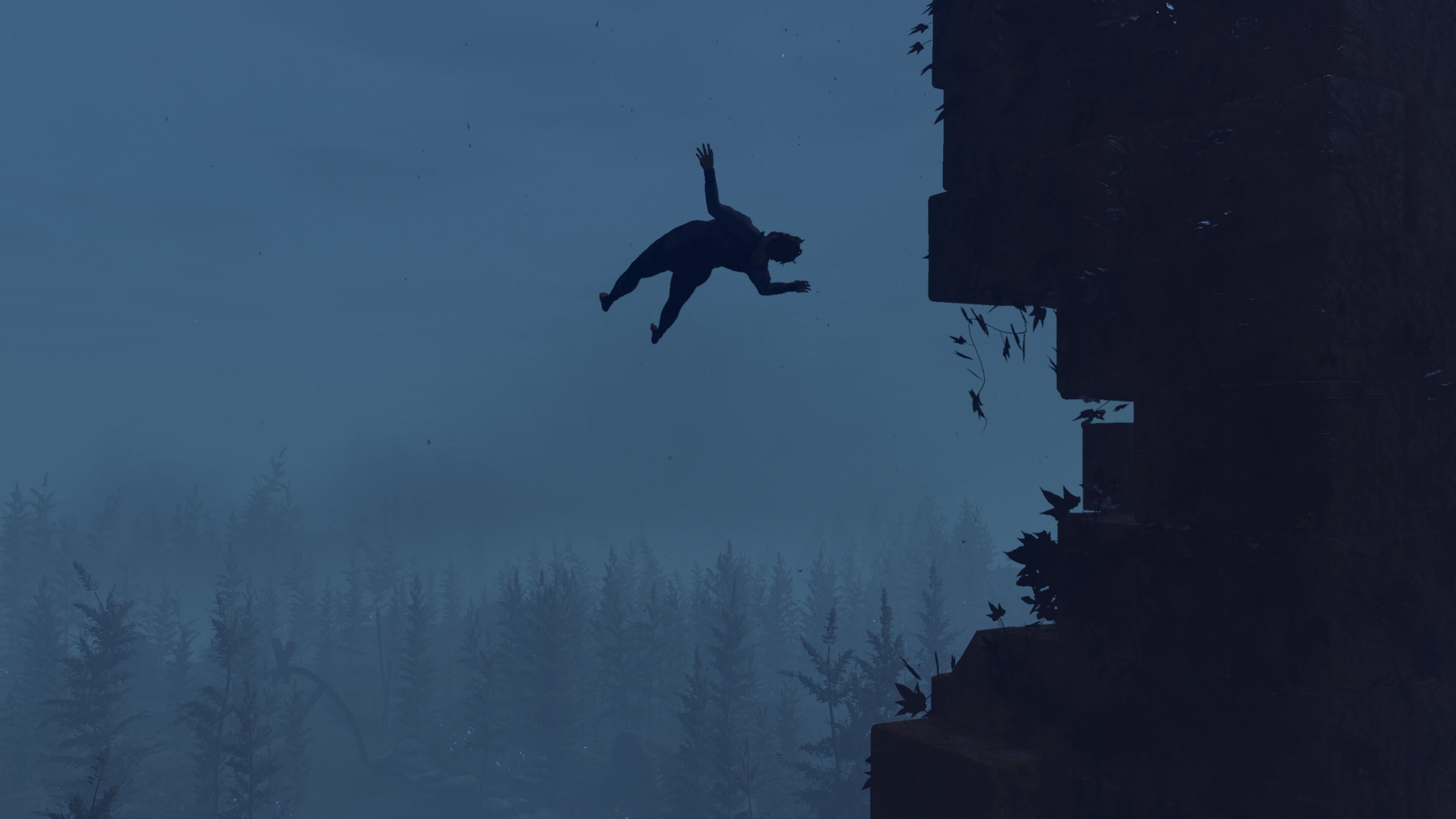
In Baby Steps, falling is just as much of a mechanic as walking. You will fall — dramatically, drastically, down crevasses that took hours to climb — and Nate will bounce and slide and eventually just lay there, mumbling to himself while his onesie fills with mud. And then you’ll pick him back up and start walking again. You’ll settle his steps into a soothing cadence. You’ll marvel at the way his sweat slowly saturates the material at the base of his spine, just above his bulbous butt. You’ll try to skip a cutscene and realize that in order to do so, you need to play a minigame with the X prompt. You’ll learn how to run. And somewhere along the way, you’ll remember what it feels like to just enjoy play.
Baby Steps
Devolver Digital
As a former marching band member, I appreciate the sense of rhythm that’s built into Baby Steps, spurred by the animal sounds and natural-world musical cues that are tied to Nate’s footfall in specific areas. This is Boch’s area of expertise, and also the main reason she doesn’t feel finished with the game. Boch and her collaborators ended up using a slapdash mosaic of audio middleware and low-level software for Baby Steps, and a series of late-stage issues infused all of the songs in the game with incorrect samples. On launch day, the music and audio cues weren’t reacting as intended when Nate stepped, stumbled and fell.
On September 23, the day that Baby Steps came out, Boch and I talked for an hour about its development process. Our conversation gently circled the topic of perseverance, the game’s core theme, but we only directly acknowledged it at minute 59. It’s not something you need to scream or repeat — tenacity is the obvious message in a game about climbing a mountain on wobbly feet — but it was fascinating to learn why Boch in particular was inspired to build a game about endurance.
Making Baby Steps
Boch, Foddy and Cuzzillo started working on Baby Steps right after they released Ape Out and cemented their names in the annals of frenetic, bloody and slightly silly indie history. Foddy was already known as the creator of QWOP, GIRP and Getting Over It, and Boch as the rhythmic and hardware mastermind behind the largest AAA music games of the mid-2000s. The trio worked out of Boch and Foddy’s shared office at the NYU Game Center, where they were instructors and Cuzzillo was finishing up a graduate degree with Ape Out as his final project. They began prototyping Baby Steps around March 2019.
“At that point, I also started manifesting more symptoms of my chronic illness, and so I was in the midst of a period of an attempt at really intense reconditioning, which ultimately failed,” Boch said. “But when that period was over, I joined up with the crew again.”
Boch lives with a trifecta of chronic illnesses: Ehlers-Danlos Syndrome, Postural Orthostatic Tachycardia Syndrome and Mast Cell Activation Syndrome. EDS is a connective tissue disorder that affects the entire body, and it can cause hypermobility, fatigue, vision issues, fragile skin and an increased risk of vascular ruptures. People with POTS experience an abnormally large increase in heart rate when changing posture, and MCAS is a disorder that releases excessive amounts of histamine and similar chemicals in the body, causing random and potentially life-threatening allergic reactions. It’s common for people with one of these diagnoses to also receive the others.
“It’s been an incredible challenge,” Boch said. “I think, easily, the hardest thing I’ve had to deal with in my life. I think there’s something very singular about each one of us, the three core members of this crew, and part of that is our ability to work fluidly across disciplines and the like. But another part of it is just a level of stick-to-it-iveness that my body has handily rejected, and so I’m in a fight with it all the time.”
Baby Steps
Devolver Digital
Boch has an arsenal of specialized tools to help her create games, including ergonomic (and very expensive) keyboards and a pair of glasses that act as a mouse.
“I have found that most of what game development is about and is oriented around is kind of hostile to those of us with poor fine-motor skills, and it’s an odd thing to be experiencing alongside the making of a thing that is stridently difficult,” Boch said. “There’s odd moments in it, where I have been going through physical therapy processes to retrain my actual walking, alongside working on this thing that is deconstructing walking. A very odd subset of feelings.”
Boch said the hardest thing for her to contend with is the moment-to-moment unpredictability of her health. But by the fall of 2019, she was back in the office with Cuzzillo and Foddy, iterating on the ideas that would eventually become Baby Steps. Cuzzillo and Foddy were feeling slightly discouraged at this point: They were four or five ideas deep, messing around with a competitive, real-time strategy game or a SimCity type of experience, but nothing was quite right. Boch encouraged them to return to their ridiculous, mechanically-driven roots.
“I think it started to become a lot clearer in everyone’s mind when it started to take on aspects of Bennett’s work,” Boch said. “The first handful of years of Baby Steps’ development, we were all playing various sorts of roles. The work of VO direction, recording and narrative development was something we were all working on together. Some of the foundational narrative premise things are concepts that I brought to the table as ways to try and prop up some world around this character. Lots of tools building and infrastructural work and all of the foundational stuff that makes it possible for a team that’s so tiny to make a thing that’s so strong.”
The Baby Steps crew shared a house in upstate New York during the first winter of the pandemic in 2020. They hiked together and worked on the game at one big folding table, enjoying the mountain air with their partners and each other. There were no strict roles on the game development side, with Boch, Cuzzillo and Foddy contributing to all aspects at once, including voice work.
“Over time, there are aspects of the narrative development that became increasingly more personal to my collaborators,” Boch said. “And they started to feel more comfortable in a director-less environment in terms of coaxing naturalistic performances out of themselves, and so that work became more disjointed.”
By the time they were recording voices and finding characters through improvisation in the sound booth, Boch happened to be in the early stages of transitioning. Vocal training and voice acting are a tricky mix, it turns out.
“I kind of recognized what it was going to take to be doing voiceover performance myself in the midst of my early transition, and I made the call that it was not the right activity for me,” Boch said. “So my characters were cut — it was like one or two — and I endeavored to strike up some novel collaborations on the audio side.”
For the past year and half in particular, Boch has been focused on all things audio in Baby Steps, as well as overseeing big-picture production tasks. She brought on a collaborator from the world of hardcore techno music, Jack Schlesinger, and he primarily handled system architecture details while Boch dealt with creative aspects. DJ Ashe Kilbourne and harpist Emily Hopkins rounded out the list of audio contributors. When she was able, Boch took an improvised sound kit into the wild and collected nature noises, and the team stitched together a reactive audio system using middleware and leftover bits of software from the Harmonix days.
When Baby Steps’ dynamic audio kicks in, and the boops, chirps and thunks start layering on top of one another as Nate waddles along, it adds a delicious sense of hypnosis to the game. Unfortunately, the audio systems fell apart in the final weeks before launch. The VO was fine, but many of the sounds and beats weren’t populating in the right places at the proper times, and Boch’s vision wasn’t being clearly communicated day-one.
“The foundations of game audio tooling are terrible,” Boch said. She continued, “The world of game audio, from my perspective, is a bunch of people who are sitting on top of a bunch of work they’ve done to write drivers to talk to consoles, and a bunch of work they’ve done to forge relationships with console manufacturers so that their audio technology will be licensed by the two major engines. But they’re both trash. I will not endorse either one, and I will not say that either one is capable of doing the kind of work that I need done.”
Since launch, the Baby Steps audio team has released patches addressing the sampling issues and adjusting dynamic audio cues across the game. An imminent update will introduce animals singing along with the songs, outdoor and indoor reverb simulations across all sounds, and other fixes. Boch has additional updates and surprises planned, including a Baby Steps Fi Beats livestream to showcase the game’s music on YouTube. By November, the audio team will be focused on composing.
Baby Steps is only going to get more immersive as the audio improvements roll out. And if you listen closely, you’ll be able to hear Boch voicing a few small roles throughout the game.
“I play, like, a baby and a hypothetical gay partner for Nate and a bunch of other random characters,” Boch said. “There’s some cosmic sadness on my part, that the timing worked out in exactly the ways that it did. But I don’t know, it’s the cards you’re dealt. It’s important to do the thing that’s true to you.”
One glaring truth that shook out during the Baby Steps development process was the supremely close and infectious bond between Cuzzillo and Foddy. The game’s dialogue and cutscenes are composed of off-the-cuff conversations and rambling inside jokes between Cuzzillo and Foddy, and each of these moments is delightful in a chaotic kind of way. Like a classic comedy duo, these developers share an undeniable resonance. They’re even born on the same day and they have older brothers with the same birthday, two facts that Boch finds adorable.
“I’m not a horoscope person at all, but they have a kind of cosmic level of synchronicity that they both acknowledge, but also are a little bit like, ‘What, this?’” Boch said. “They have plenty that they disagree about and plenty that they bicker about, but there’s something about their orientations toward the world that’s perplexing and generative. They are immensely talented folks.”
Taking Baby Steps
In the end, Cuzzillo and Foddy felt finished with Baby Steps before Boch. She didn’t want to hold their joy hostage, so the audio team made it work and they shipped the game on September 23, 2025, published by Devolver Digital.
“That kind of dream-deferred shit is emotional torture, and so I had no interest in putting them through that, they had no interest in going through that,” Boch said. “It makes sense to me to be landing in the place that we are.”
Baby Steps
Devolver Digital
I caught up with Boch three weeks after Baby Steps’ release date to see if she was feeling more done, now that the launch-day dust had settled. She said it was a hard question.
“There is so much more that I am interested in exploring, and so much more that I have set up in terms of pins to knock down,” she said. “I think this is a struggle that highlights the inherent tension of trying to make art at this boundary between a fine art practice and a commercial art practice. I think that for the sake of the work, and for the sake of me and my team as artists, the tech I have built deserves to continue to be refined in a different context, one wherein sound is more paramount. That’s where we’re headed.”
This is a tease of what’s next for Boch, even though she’s still finishing up Baby Steps. She’s planning on leaving NYU, spurred by the unpredictability of her health, but she’s not done making games. Her next one will be more personal.
“It’s important to me to share what I’m doing with people,” Boch said in September. “I think that there is not enough in the world of games that puts audio at its very center. I think that my personal ambitions and future ambitions are definitely leaning more in that direction by the day. I had a long time of needing to get some space from interactive audio as The Thing. Where my winds are blowing is in that direction.”
Baby Steps exists in its current form because Boch and her teammates were able to adapt and endure. They were honest about what was working, what wasn’t and what could, and they leaned into the aspects that felt the most natural to them. Boch in particular set aside her ego, listened to her body, and took things day by day. You know, baby steps.
“The process of transition is one that involves an enormous amount of self-reflection and a growing sense of self knowledge,” Boch said. “Ultimately, that process for me was kind of orthogonal to the storytelling of Baby Steps. There’s a lot that comes from lived experience, and from commiserating and sharing that lived experience between Bennett and Gabe, and you can see that very clearly in the work. There’s also just ways in which that process was illuminating to me in terms of inherent differences. There’s an aspect of it that came alongside the necessity of slowing down, and then the subsequent necessity of staying inside that hit with my chronic illness and then Covid. There was a way in which I was more with myself at that moment than I’ve ever been.”
This article originally appeared on Engadget at https://www.engadget.com/baby-steps-isnt-done-with-maxi-boch-140000613.html?src=rss
Microsoft has set a 30% profit margin goal for its Xbox gaming division, Bloomberg reported Thursday, well above the video game industry’s average of 17% to 22%. The target, implemented in fall 2023 by CFO Amy Hood, represents a sharp departure from Xbox’s previous approach of allowing developers to focus on making quality games without specific financial constraints. Xbox historically maintained profit margins between 10% and 20% and reported a 12% margin for the first nine months of Microsoft’s 2022 fiscal year.
The division has responded by canceling several projects that had been in development for more than seven years, including Everwild, Perfect Dark and Project Blackbird. It has also eliminated thousands of jobs and raised prices. In 2024, Xbox began releasing most of its games on rival Nintendo and Sony platforms. The heightened scrutiny comes as Microsoft prioritizes investment in generative AI while overseeing a gaming division that has struggled despite spending $76.5 billion on acquisitions.
We may earn a commission from links on this page. Deal pricing and availability subject to change after time of publication.
If you’re in the market for a new mesh router that’s smart-home ready and has a minimalist appearance, the Google Nest Wifi Pro is currently down to $121.14 (originally $199.99). At a nearly 40% discount, this system offers comprehensive, high-speed coverage for anyone dealing with dead spots or spotty wifi.
The Nest WiFi Pro supports tri-band Wi-Fi 6E, providing a speedy connection and good range that’s sufficient for streaming and gaming. It also has a built-in Thread radio and Matter support, ensuring compatibility with smart-home devices across brands. According to this PCMag review, setup is easy, especially for those who are already in the Google ecosystem. It excels in apartments and single-story homes, and for people with homes up to 3,500 square feet, it provides consistent coverage. It’s compact and modern in appearance, which may be important to you if your router is placed in a visible space.
It supports both wired and wireless security with WPA3 encryption, but it doesn’t come with anti-malware software. PCMag notes that there are built-in parental controls that let you apply Restricted Access rules to some devices with Google’s SafeSearch filtering tech.
That said, it has limited wired connectivity with just two networking ports, neither of which is rated for higher than 1 Gbps. If your internet plan is greater than that or you need lots of local wired transfers, this may not be the ideal choice. It also has fewer advanced settings than other routers with full web interfaces, and while it is fast, it’s not the fastest in its class compared to competitors like the Eero Pro 6E.
If you don’t have a very large home or need a system with multi-gig capability, the Nest Wifi Pro is an easy-to-use, auto-optimized mesh router with a high capacity that will perform well for most homes.
PC shipments across the globe grew a sizable 8.1% year-over-year in the third quarter of the 2025, driven in large part by a rash of upgrades ahead of Microsoft ending free support for Windows 10, according to Counterpoint Research. Oddly enough, “evolving U.S. import tariff polices” also played a role in PC shipments experiencing healthy
We’ve got a new international trailer for Predator: Badlands, the latest installment in a popular franchise that’s been around since 1987. It’s directed by Dan Trachtenberg, who is very familiar with the franchise, having also directed 2022’s highly acclaimed standalone Predator movie Prey.
In April, Twentieth Century Studios released the first teaser, which involved multiple predators fighting or threatening one another, Elle Fanning looking very strange and cool as an android, and glimpses of new monsters and the alien world the movie focuses on. And the film was featured prominently at San Diego Comic Con this summer. But it hasn’t quite wormed its way into the cultural zeitgeist for fall releases. Perhaps this latest trailer will boost its profile.
This is a standalone film in the franchise, with a particular focus on the culture of the Predator species; in fact, the same conlanger who created the Na’Vi language for James Cameron’s Avatar franchise also created a written and verbal language for the Predators. (We hear a bit of the dialogue in the new trailer.) And this time around, the primary Predator is actually the film’s protagonist rather than an adversary. Per the official premise: “Set in the future on a deadly remote planet, Predator: Badlands follows a young Predator outcast (Dimitrius Schuster-Koloamatangi) who finds an unlikely ally in Thia (Elle Fanning) as he embarks on a treacherous journey in search of the ultimate adversary.”
Porsche’s new boss was a sceptic of battery motors for luxury vehicles long before he was picked to lead the revival of the petrol engine at the German sports car group.
“The technology isn’t ready,” Michael Leiters told the Financial Times late last year while still in his old job as chief executive of British supercar manufacturer McLaren. Electric vehicles lacked the emotional thrill of noisy engines and were quicker to lose their value, he said.
Leiters will take over at Porsche in January at a critical juncture for the Stuttgart-based company, as it tempers its electric ambitions and ploughs new investment into petrol engine models in an attempt to turn its fortunes around.
The AlmaLinux project has announced
that the upcoming 10.1 release will include support for
Btrfs:
Btrfs support encompasses both kernel and userspace enablement, and
it is now possible to install AlmaLinux OS with a Btrfs filesystem
from the very beginning. Initial enablement was scoped to the
installer and storage management stack, and broader support within the
AlmaLinux software collection for Btrfs features is forthcoming.
Btrfs support in AlmaLinux OS did not happen in isolation. This was
proposed and scoped in RFC 0005, and has been built upon prior efforts
by the Fedora
Btrfs SIG in Fedora Linux and the CentOS Hyperscale SIG
in CentOS Stream.
AlmaLinux OS is designed to be binary compatible with Red Hat
Enterprise Linux (RHEL); Btrfs, however, has never been supported in
RHEL. A technology preview of Btrfs in RHEL 6 and 7 ended with the
filesystem being dropped from RHEL 8 and
onward. AlmaLinux OS 10.1 is currently
in beta.
Tesla said it “achieved record vehicle deliveries globally” for the third quarter of 2025 with a total of 497,099 vehicles delivered. It also reported a record-breaking revenue of $28.1 billion, which is 12 percent higher than the same quarter in 2024. Tesla’s net income, however, slid by 37 percent year-over-year, due to several factors, namely lower EV prices, an increase in spending on AI and other R&D projects, and of course, tariffs. Vaibhav Taneja, the automaker’s finance chief, said during the earnings call that tariffs on imported car parts and raw materials cost the company more than $400 million in the third quarter. Taneja added that he expects research and development spending to continue to grow.
During the call, Tesla CEO Elon Musk said that he expects the company to deploy its first robotaxis with no drivers behind the wheel by the end of this year, starting with some parts of Austin. If you’ll recall, Tesla launched its first robotaxi rides in Austin, Texas back in June. There have been several reports of the robotaxis running into issues since then, including an instance wherein one drove into a parked car. Musk said Tesla was “obviously being very cautious about the deployment,” but that he expects his company to be operating fully driverless vehicles in eight to ten new states before 2025 ends.
Musk revealed, as well, that Tesla’s homegrown AI5 artificial intelligence chip will be manufactured both by Samsung in Texas and by TSMC in Arizona. Tesla is apparently aiming to manufacture more than it needs for its electric vehicles and upcoming Optimus robots so that it can use the excess units in its data centers. He clarified that Tesla isn’t going to stop using NVIDIA chips, but that it will continue using them in combination with AI5.
This article originally appeared on Engadget at https://www.engadget.com/transportation/evs/teslas-profits-plunge-despite-record-revenue-and-deliveries-133004231.html?src=rss