If you’re moving on to a new Apple Watch, selling your current one or fixing some software hiccups, you’ll probably need to disconnect it from your iPhone. Apple calls this unpairing; it’s the step that wipes your watch, breaks the connection to your phone and removes Activation Lock so the next person can use it. The good news is that unpairing is straightforward whether you have your iPhone nearby or not. Here’s how it works, along with why you might want to disconnect your watch in the first place.
How to disconnect Apple Watch using your iPhone
The simplest way to unpair your Apple Watch is through your iPhone.
Keep your iPhone and Apple Watch close together.
Open the Apple Watch app on your iPhone.
Navigate to the My Watch tab, then All Watches at the top.
Tap the info button next to the watch you want to disconnect.
Select Unpair Apple Watch, then select Unpair [your Apple Watch name].
If you have a cellular model, choose whether to keep or remove your cellular plan. Remove it if you’re selling or giving away the watch. Keep it if you plan to pair it again later
Enter your Apple Account password when asked to turn off Activation Lock, then select Unpair.
Your iPhone will create a backup before erasing the watch. When you set up a new Apple Watch, you can choose to restore from that backup and carry on with your data and settings intact.
How to disconnect Apple Watch without your iPhone
If you don’t have your paired iPhone with you, you can still reset your Apple Watch directly. This will wipe your data, but won’t create a backup and Activation Lock will remain, so keep that in mind if you want to save your information.
On your Apple Watch, open Settings.
Select General, then scroll down and select Reset.
Select Erase All Content and Settings.
Enter your passcode if prompted.
For cellular models, choose whether to keep or remove your plan.
Your watch will erase itself and restart as if it were brand new.
Why you should disconnect your Apple Watch
There are a few reasons you might want to unpair your Apple Watch. Maybe you’re upgrading to a new model and need to start fresh. Maybe you’re trading it in, selling it or handing it down to someone else. You might also need to disconnect your watch if you’re troubleshooting. Sometimes a clean reset is the easiest way to fix syncing issues, missed notifications or fitness data that isn’t updating.
Whatever the reason, unpairing keeps your data safe, makes sure a backup is stored and disables Activation Lock. That last step is important because if you skip it, the next owner won’t be able to use the watch.
What happens to your data when you disconnect your Apple Watch?
When you unpair your Apple Watch using your iPhone, the watch creates a backup that includes app data, settings and most health and fitness information. This backup is stored on your iPhone and will transfer to iCloud if you have backups turned on. That makes it easy to restore everything on a new watch.
If you reset from the watch without your iPhone, a backup is not created. Your data will be erased and the watch will be wiped clean, but Activation Lock remains.
Activation Lock is tied to your Apple Account and helps keep your watch secure if it’s lost or stolen. It turns on automatically when you pair your watch with your iPhone. That’s why unpairing isn’t the same as a simple reset. You need the Apple Account and password associated with the watch to turn off Activation Lock.
This article originally appeared on Engadget at https://www.engadget.com/wearables/how-to-unpair-your-apple-watch-from-your-iphone-120052222.html?src=rss
For millennia, some of the world’s largest filter-feeding whales, including humpbacks, fin whales, and blue whales, have undertaken some of the longest migrations on earth to travel between their warm breeding grounds in the tropics to nutrient-rich feeding destinations in the poles each year.
“Nature has finely tuned these journeys, guided by memory and environmental cues that tell whales when to move and where to go,” said Trisha Atwood, an ecologist and associate professor at Utah State University’s Quinney College of Agriculture and Natural Resources. But, she said, climate change is “scrambling these signals,” forcing the marine mammals to veer off course. And they’re not alone.
Earlier this year, Atwood joined more than 70 other scientists to discuss the global impacts of climate change on migratory species in a workshop convened by the United Nations Convention on the Conservation of Migratory Species of Wild Animals. The organization monitors and protects more than 1,000 species that cross borders in search of food, mates, and favorable conditions to nurture their offspring.
NVIDIA is taking the open-source and upstream “Nova” kernel graphics driver quite seriously for their hardware. Hitting the mailing lists on Friday night were initial patches in beginning to make preparations toward “next-gen GPU” support. Digging into the comments, it’s indeed for post-Blackwell GPUs…
The Servo open-source browser engine is out with their September 2025 development highlights. This Rust-based browser engine originally started by Mozilla continues making steady progress as well as to the “servoshell” demo/example browser implementation…
Plasma 6.5 debuted this week that KDE developers and users have been celebrating. But it’s already on to working out fixes for Plasma 6.5.1 as well as new feature activity toward Plasma 6.6…
Electronic Arts (EA) has partnered with Stability AI, creator of Stable Diffusion, to co-develop generative AI tools aimed at accelerating game development. “I use the term smarter paintbrushes,” Steve Kestell, Head of Technical Art for EA SPORTS said in the announcement. “We are giving our creatives the tools to express what they want.” Engadget reports: To start, the “smarter paintbrushes” EA and Stability AI are building are concentrated on generating textures and in-game assets. EA hopes to create “Physically Based Rendering materials” with new tools “that generate 2D textures that maintain exact color and light accuracy across any environment.” The company also describes using AI to “pre-visualize entire 3D environments from a series of intentional prompts, allowing artists to creatively direct the generation of game content.”
Electric mountain bikes are ruining mountain biking by impacting our personal relationships with effort and reward.
Traditional arguments against eMTBs centre on jeopardising trail and land access rights, abuses of in-built, country-specific speed limits and tearing up the trails with excessive erosion, among plenty of other legitimate concerns.
I agree with those frequently aired arguments – anything that puts our sport, and anyone’s right to go out and make the most of the countryside at risk, isn’t positive.
But I think the real reason eMTBs are ruining mountain biking is a deeply personal one.
It’s a reason any long-standing cyclist – who’s been around way before ebikes zipped up and down our hills and mountains – can surely identify with.
Heck, even those new to our sport can understand and appreciate how there’s no such thing as a free lunch.
Do ebikes preclude type two fun? Scott Windsor / Our Media
Type one fun – the descents, a jump line, freewheeling to the bottom of the hill – was, in the past, only made possible by copious amounts of type two fun.
The long, slow, grinding, sweat-inducing winch to the descent’s start makes that very fling with gravity even better, even more fun and rewarding.
But here’s the kicker, that type two fun with its grimace-making effort of burying yourself is, in retrospect, also highly rewarding and enjoyable.
Electric mountain bikes are disrupting our relationships with these two core ingredients of mountain biking like never before, and we’re much worse off for it.
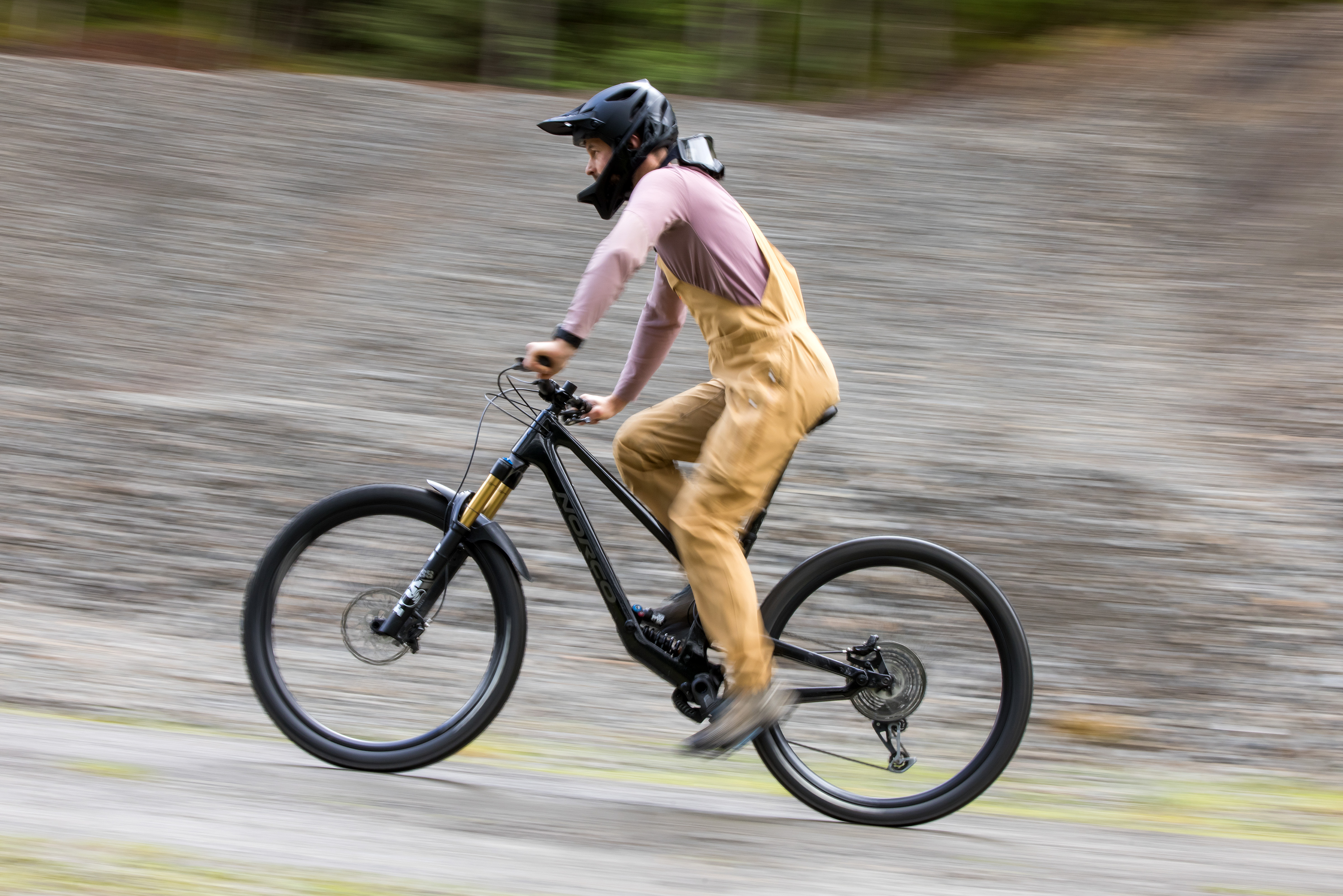
That’s the face of someone – me – who loves riding their ebike. Tommy Wilkinson / Santa Cruz Bicycles
Before I go on, there needs to be an acknowledgement that eMTBs – and what they enable people to do – are excellent.
For people with a disability, people looking to start their fitness journey, people who don’t have much free time to ride, those coming back from an injury, or anyone else for that matter, they’re such a great tool, facilitator and enabler.
Even as an able-bodied, relatively fit guy who tests bikes as a job, I love riding mine, and there are plenty of people like me who love riding theirs.
Whether that’s for a lunchtime blast, an all-day epic or just a regular ride, ebikes are wicked.
I’m not singling anyone out, I’m not judging you for your choices or what you ride, but I still believe my point stands.
Please, sir, I want some more. Scott Windsor / Our Media
When eating out, or even at home, have you ever finished a dish that’s supposed to be a main meal and thought, ‘that was a nice starter, I wonder what’s for dinner’?
You leave unsatiated, hungry for more, dissatisfied with the quantity – cheated even – regardless of whether the food ticked all your other boxes.
In my eyes, ebiking is cycling’s equivalent of a lacklustre lunch.
More frequently than not, at the end of an eMTB ride, I’ve been left feeling slightly hollow, disappointed and unfulfilled.
Those rides have been long enough, they’ve had enough elevation gain and descent, and were tremendous fun, but the relationship between how much effort I’ve been putting in and the amount of sweet downhill reward isn’t in balance.
That same feeling of mild disappointment you get when you’ve not been given enough food lingers after an eMTB ride.
But it wasn’t while riding ebikes that this occurred to me.
Buzz kill
Pedal up or take the lift? I know which one I now prefer. Andy Lloyd / Our Media
The penny dropped when experiencing the balance of effort versus reward at its most stark while riding chairlifts and bike parks in the Alps earlier this year.
After casually racking up more than 6,000m of ascent and descent in one afternoon riding laps on what can only be described as some of the best trails in the world, I expected to have an afterglow; a buzzing, elated feeling I could relive and ride through the evening’s lull until the next morning’s fix.
But the feeling didn’t come.
I was flat, unfulfilled, my appetite unquenched by the repeated laps.
The next day, rather than buying another lift pass, I decided to pedal to the chairlift’s summit instead of slouching on the soft, padded and comfortable lift.
One lap was only 600 metres of elevation change, and the pedal – while not taking that long – set the tone for the ride.
Winching to the trail’s start under your own power feels very rewarding. Ian Linton / Our Media
On the way up, I decided to see how long I could hold certain power outputs for, I drifted off and thought about the mountains, I enjoyed the cowbells, I appreciated the morning sun and dew on the grass, and I pondered the lines I was going to take on the descent.
I got to the top of the mountain sweaty, energised and ready to savour every last turn, braking bump, root and rock on my way back down.
Earning something precious – created by the relationship between the climb and descent – added so much value to my lowly, single downhill run.
Pedalling to the top of the track made that run infinitely better than the 10 I did the afternoon before.
Back to ebikes
Do you need to earn your descents with hours of sweaty effort? I think so. Tommy Wilkinson / Santa Cruz Bicycles
While I’ll admit chairlifts and ebikes don’t have a great deal in common, taking the example of effort versus reward to its extremes helped me grasp what was going on.
On the chairlift, you’re sat fully stationary, free to snack, scroll or do whatever you please, while on the ebike you’ve got to be engaged, pedal, steer, brake and exercise.
But I realised that same hollow feeling I’d been experiencing at the end of ebike rides was the same I got from lapping the chairlift all day.
It was a eureka moment – the disruption between my effort input and my reward output was messing with my head and causing a disconnect.
Electric mountain bikes are preventing me from accessing the pleasure only the purest all-out efforts seem to be able to unlock.
Don’t be angry
Would this be an impossible climb on a regular bike? Ian Linton / Our Media
I’ve said it before, but I’ll reiterate it again.
You can still bury yourself on an ebike.
You can max out your heart rate, you can burn as many calories as you want, and you can certainly get stronger, fitter and become a way better rider with one.
You can also put in the same amount of effort as you would on your pedal bike, but go twice as fast or twice as far.
But don’t be angry if I call you out – how many people are using their ebikes like this?
How many of you are going as hard as you can – in the same way you would on your non-assisted bike – on your eMTB?
How often do you sit on your ebike’s speed limiter and keep pushing? Dave Mackison / SRAM
From personal experience, I’m going to bet confidently that very few are, me included.
Hitting the bike’s speed limiter feels like ramming headlong into a brick wall while maxing out the motor’s cadence window, so when support drops off it’s also demoralising.
There’s no incentive to push just that bit extra, to lift yourself truly out of your comfort zone as you would on your regular bike because your ebike doesn’t give you that instant, torquey, powerful dopamine hit when you do.
Recalibration
This feels much harder after you’ve been riding ebikes a lot. Mountain Bike Connection Winter / Rupert Fowler
The next time you head out on your regular bike, it takes a while to recalibrate – I frequently asked myself, ‘why isn’t this climb easier, or worse yet, already over?’. That is, until I came to terms with the impending slog.
Our perceptions of the amount of effort needed to get to the top of a favourite trail versus how much effort is required are totally out of whack.
It’s easy to see how people get stuck riding only ebikes.
They begin doubting whether they can make it up the climb on their non-electric bike and they question whether they’d be able to do more than one or two climbs and descents in a day.
Along with the other – very good – reasons for riding only ebikes, people get stuck, hooked on that gentle glide to the trail’s top.
eMTBs are ruining mountain biking
Stoked. Dave Trumpore / Fox
There’s no substitute for your regular bike, for pushing yourself, for going that little bit harder, for longer.
And, most importantly, for earning that sweet reward on the way back down after hours of hard, all-out effort.
The dichotomous relationship between time spent going up and down, and the amount of fun they both bring to the equation isn’t mathematically sound, but it’s the reason I and many others love this sport.
The effort makes the reward – no matter how small – that bit more worth it.
China’s private space company LandSpace has completed a key static fire test of its Zhuque-3 (ZQ-3) reusable rocket — a stainless-steel, methane-fueled launcher modeled after SpaceX’s Starship. Universe Today reports: The latest milestone took place on Monday, Oct. 22nd at the Dongfeng commercial space innovation pilot zone (where the JSLC is located). It involved another static fire test, where the rocket was fully-fueled but remained fixed to the launch pad while the engines were fired. This kind of testing is a crucial prelaunch trial (what NASA refers to as a “wet dress rehearsal”), and places the company and China another step closer to making an inaugural flight test, which is expected to happen by the fourth quarter of 2025.
In traditional Chinese, Zhuque is the name of the Vermillion Bird that represents fire, the south, and summer, and is one of the four Symbols of the Chinese constellations. Like the Starship, the Zhuque-3 is composed of stainless steel and relies on a combination of liquid methane (LCH4) and liquid oxygen (LOX) propellant. The rocket will be powered by nine Tianque-12A (TQ-12A) engines and will measure 65.9 m (216 ft) tall and weigh 550,000 kg (1,210,000 lb). It’s payload capacity will be significantly less than the Starship: 11,800 kg (26,000 lbs) in its expendable mode, and 8,000 kg (18,000 lbs) for the recoverable version. This is closer in payload capacity to the Falcon 9, which is capable of delivering 22,800 kg (50,265 lbs) to Low Earth Orbit (LEO).
In time, the company hopes to transition to the larger Zhuque-3E, which will be 76.2 m (250 ft) tall and powered by nine TQ-12B engines, and will be capable of delivering to 21,000 kg (46,000 lb) in its expandable mode and 18,300 kg (40,300 lb) recoverable. The long term goal is to create a reusable system that can rival the Falcon rocket family, bringing the country closer to its goal of achieving parity with NASA.
An anonymous reader quotes a report from CNN: Iceland’s frozen, inhospitable winters have long protected it from mosquitoes, but that may be changing. This week, scientists announced the discovery of three mosquitoes — marking the country’s first confirmed finding of these insects in the wild. Mosquitoes are found almost everywhere in the world, with the exception of Antarctica and, until very recently, Iceland, due to their extreme cold.
The mosquitoes were discovered by Bjorn Hjaltason in Kioafell, Kjos, in western Iceland about 20 miles north of the capital Reykjavik. “At dusk on October 16, I caught sight of a strange fly,” Hjaltason posted in a Facebook group about insects, according to reports in the Icelandic media. “I immediately suspected what was going on and quickly collected the fly,” he added.
He contacted Matthias Alfreosson, an entomologist at the Natural Science Institute of Iceland, who drove out to Hjaltason’s house the next day. They captured three in total, two females and a male. Alfreosson identified them as mosquitoes from the Culiseta annulata species. A single mosquito from a different species was discovered many years ago on an airplane at the country’s Keflavik International Airport, Alfreosson told CNN, but this “is the first record of mosquitoes occurring in the natural environment in Iceland.” Further monitoring will be needed in the spring to see whether the species can survive the winter and “truly become established in Iceland,” Alfreosson said. He said he’s not sure climate change played a role in the discovery but “warming temperatures are likely to enhance the potential for other mosquito species to establish in Iceland, if they arrive.”
Texas’s electricity demand has surged to record highs in 2025 but renewable energy is meeting the challenge. According to new data from the Energy Information Administration, solar output has quadrupled since 2021, wind continues steady growth, and battery storage is increasingly stabilizing the grid during evening peaks. Electrek reports: ERCOT, which supplies power to about 90% of the state, saw demand jump 5% year-over-year to 372 terawatt hours (TWh) — a 23% increase since 2021. No other major US grid has grown faster over the past year. […] The biggest growth story in Texas power generation is solar. Utility-scale solar plants produced 45 TWh from January through September, up 50% from 2024 and nearly four times what they generated in 2021 (11 TWh). Wind power also continued to climb, producing 87 TWh through September — a 4% increase from last year and 36% more than in 2021.
Together, wind and solar supplied 36% of ERCOT’s total electricity over those nine months. Solar, in particular, has transformed Texas’s daytime energy mix. From June to September, ERCOT solar farms generated an average of 24 gigawatts (GW) between noon and 1 pm — double the midday output from 2023. That growth has pushed down natural gas use at midday from 50% of the mix in 2023 to 37% this year. The report notes that while natural gas is still Texas’s dominant power source, it isn’t growing like it used to. “Gas comprised 43% of ERCOT’s generation mix during the first nine months of 2025, down from 47% in the first nine months of 2023 and 2024,” reports Electrek.
alternative_right shares a report from France 24: [Sweden’s] latest contribution to the war effort is Glimt, an innovative project launched by the Swedish Defence Research Agency (FOI) earlier this year. Glimt is an open platform that relies on the theory of “crowd forecasting”: a method of making predictions based on surveying a large and diverse group of people and taking an average. “Glimt” is a Swedish word for “a glimpse” or “a sudden insight.” The theory posits that the average of all collected predictions produces correct results with “uncanny accuracy,” according to the Glimt website. Such “collective intelligence” is used today for everything from election results to extreme weather events, Glimt said. […]
Group forecasting allows for a broad collection of information while avoiding the cognitive bias that often characterizes intelligence services. Each forecaster collects and analyses the available information differently to reach the most probable scenario and can add a short comment to explain their reasoning. The platform also encourages discussion between members so they can compare arguments and alter their positions. Available in Swedish, French and English, the platform currently has 20,000 registered users; each question attracts an average of 500 forecasters. Their predictions are later sent to statistical algorithms that cross-reference data, particularly the relevance of the answers they provided. The most reliable users will have a stronger influence on the results; this reinforces the reliability of collective intelligence. “We used this method and research, and we suggested to the Ukrainians that it could improve their understanding of the world and its evolution,” said Ivar Ekman, an analyst for the Swedish Defence Research Agency and program director for Glimt. “If you have a large group of people, you can achieve great accuracy in assessing future events. Research has shown that professional analysts don’t necessarily have a better capacity in this domain than other people.”
Apple has begun shipping U.S.-made AI servers from a new factory in Houston, Texas — part of its $600 billion investment in American manufacturing and supply chains. CNBC reports: Apple Chief Operating Officer Sabih Khan said on Thursday that the servers will power the company’s Apple Intelligence and Private Cloud Compute services. Apple is using its own silicon in its Apple Intelligence servers. “Our teams have done an incredible job accelerating work to get the new Houston factory up and running ahead of schedule and we plan to continue expanding the facility to increase production next year,” Khan said in a statement. The Houston factory is on track to create thousands of jobs, Apple said. The Apple servers were previously manufactured overseas.
The uutils project announced tonight the release of Rust Coreutils 0.3, another step forward for this Rust version alternative to GNU Coreutils that has been attracting a lot of interest lately due to Ubuntu 25.10 now using it by default…
An anonymous reader quotes a report from Tom’s Guide: Microsoft Teams is about to deal a heavy blow to those who like to work from home for peace and quiet. In a new feature update rolling out December 2025, the platform will track a worker’s location using the office Wi-Fi, to see whether you’re actually there or not. From a boss’ perspective, this would eliminate any of that confusion as to where your team actually is. But for those people who have found their own sanctuary of peaceful productivity by working from home, consider this a warning that Teams is about to tattle on you. According to the Microsoft 365 roadmap: “When users connect to their organization’s Wi-Fi, Teams will automatically set their work location to reflect the building they are working in.” The location of that worker will apparently update automatically upon connecting.
It’s set to launch on Windows and macOS, with rollout starting at the end of this year. “This feature will be off by default,” notes Microsoft. But “tenant admins will decide whether to enable it and require end-users to opt-in.”
IBM announced that its quantum error-correction algorithm can now run in real time on standard AMD field-programmable gate array (FPGA) chips — a major step toward making quantum computing more practical and affordable. Reuters reports: In June, IBM said it had developed an algorithm to run alongside quantum chips that can address such errors. In a research paper seen by Reuters to be published on Monday, IBM will show it can run those algorithms in real time on a type of chip called a field programmable gate array manufactured by AMD.
Jay Gambetta, director of IBM research, said the work showed that IBM’s algorithm not only works in the real world, but can operate on a readily available AMD chip that is not “ridiculously expensive.” “Implementing it, and showing that the implementation is actually 10 times faster than what is needed, is a big deal,” Gambetta said in an interview. IBM has a multi-year plan to build a quantum computer called Starling by 2029. Gambetta said the algorithm work disclosed Friday was completed a year ahead of schedule.
Halo Studios (formerly 343 Industries) has announced Halo: Campaign Evolved, a full Unreal Engine 5 remake of the original Halo: Combat Evolved campaign, coming in 2026 for Xbox Series X, Windows PC, and — shockingly — PlayStation 5. “It’s really a new era — Halo is on PlayStation going forward,” Halo Studios community director Brian Jarrard said on a livestream today. Polygon reports: Halo: Campaign Evolved is a from-the-ground-up remake of the first Halo game’s campaign. It’s being built in Unreal Engine 5 — unlike previous Halo games, which have been developed with proprietary software. It aims to modernize the game without changing it on a fundamental level. […]
As signaled by the name, Campaign Evolved will not feature PvP multiplayer, as its focus is on the campaign (Combat Evolved had splitscreen competitive multiplayer modes). However, you’ll still be able to play Halo: Campaign Evolved with your buddies. It’ll support splitscreen two-player local co-op as well as four-player online. Most notably, it’ll support full crossplay and cross-progression.
Gameplay is being changed in ways that are more aligned with later entries in the series. Master Chief will be able to pick up and use enemy weapons that he couldn’t use until later Halo games, like the iconic Energy Sword. He’ll be able to pilot the Covenant Wraith tank in the original game for the first time, and can hijack vehicles (or get hijacked). Campaign Evolved is also implementing a sprint button, altering the way players can move about the battlefield. You can watch a reveal video for the game on YouTube.