Motorola has been consistently offering solid budget smartphone offerings, and the company back with new refreshes to its Moto G and Moto G Play for 2026. The latest versions offer some incremental tech upgrades and a couple lovely new color options for the aesthetic upgrades.
These smartphones both sport 6.7-inch displays with 120Hz and peak brightness of 1,000 nits. The Moto G boasts a 50MP camera as well as a 32MP front camera for selfies, while the Moto G Play has 32MP for its main camera and 8MP for the front camera. Both devices’ photography is backed by quad pixel technology to provide detailed image capture in a variety of lighting conditions. These two phones have a 5,200mAh battery and adds some quick-charging options: 30W for the Moto G and 18W for the Moto G Play. On the durability front, the Moto G is still using Gorilla Glass 3 and boasts an IP52 water resistance rating, as the 2025 model did, and the same will also be available in the Moto G Play model.
Both phones are getting some Pantone color options in leather-inspired finishes. The Moto G will have a gray color called Slipstream or the purple of Cattleya Orchid, while the Moto G Play comes in Pantone Tapestry blue.
Moto G will continue to retail starting at $200 and will be available directly from Motorola starting on December 11, followed by Amazon and Best Buy availability on January 15. The Moto G Play will be available online from Motorola, Best Buy and Amazon on November 13 for $170; the model will arrive in stores some time in the coming months.
This article originally appeared on Engadget at https://www.engadget.com/mobile/smartphones/motorola-introduces-its-latest-takes-on-the-moto-g-and-moto-g-play-phones-140000620.html?src=rss
We may earn a commission from links on this page. Deal pricing and availability subject to change after time of publication.
The Bose Ultra Open Earbuds take a sharp turn from the brand’s usual noise-canceling dominance. Instead of sealing you off from the world, they sit outside your ears, letting in ambient sound while still delivering rich, detailed audio. Priced at $199 (down from its original $299), this is their lowest price yet (according to price trackers), and they cater to people who prefer awareness over isolation. Think cyclists, runners, or anyone who doesn’t want to miss the honk of a car while listening to music.
The fit takes a minute to figure out. The silicone band adds just enough tension to keep them in place, but how you clip them changes the sound more than you’d expect. Too high and it gets tinny; too low and you lose stereo balance. Once you find the alignment, though, they stay put through walks or light workouts and handle sweat or drizzle without a fuss, thanks to their IPX4 rating.
Sound-wise, Bose mostly nails what’s hard to get right in open audio: clarity. The Ultra Opens avoid the hollow sound that plagues similar models, keeping vocals crisp and highs bright. The low mids have a pleasing warmth, though the deep bass doesn’t hit with much punch. You’ll notice that most in EDM or hip-hop, where the kick feels restrained. Still, for casual listening, podcasts, and calls, the balanced tuning works. Also, they use Bluetooth 5.3 and support AAC, AptX Adaptive, and SBC codecs, which means Android users get slightly better audio quality than iPhone users.
Volume holds steady even outdoors, and there’s minimal distortion at full blast—per this PCMag review, the earbuds sound their best around 70 percent volume, delivering a full, detailed mix while still keeping you aware of what’s happening around you. If you prefer a more low-end presence, the adjustable EQ in the Bose app lets you tweak the sound. Battery life holds up nicely, too, around 7.5 hours on a charge and about 27 hours with the case. That said, wireless charging isn’t built in, though there’s a separate case for that if you prefer it over the USB-C setup.
Q36.5’s latest announcement might come as a surprise. The Italian cycling clothing brand hasn’t revealed a new winter jacket or jersey. Instead, it announced today that it is releasing a new set of pedals made in collaboration with the power meter manufacturer SRM.
And that’s where the second surprise comes in. The new release is not a power meter pedal system; it’s a design that reduces stack height.
Q36.5 founder Luigi Bergamo is said to have discovered the advantages of a low stack height while testing the setup with an ultra-thin sole construction and a specific cleat attachment system.
Bergamo asked Ulrich Schoberer, founder of SRM, if it would be possible to design pedals that reduced stack height even further than the best road bike pedals.
Following a few further conversations, and just over six months later, Schoberer is said to have presented Bergamo with a working prototype.
The new pedals will only be available with Q36.5’s Unique Pro Shoes. Q36.5
It’s generally considered that the lower the stack height – the distance between the centre of the axle and the top of the pedal body – the higher your pedalling efficiency. This means a low stack height can be better, although a reduced stack height isn’t going to lead to a big jump in performance.
Q36.5 says its new pedals will be available exclusively with its Unique Pro Shoes. “The new game-changing pedal and shoe system reduces pedaling stack height by over 8mm relative to existing systems, offering the most direct and efficient power transfer on the market,” Q36.5 claims.
However, the brand hasn’t provided a specific stack-height measurement.
Typically, the best road bike pedals have a stack height of between 8mm and 12mm, with some power meters having a slightly higher stack.
It appears that the pedals will be available in a range of colours. Q36.5
The complete stack height of a pedal system also includes the cleat. This means the most popular clipless pedal systems for the road typically have a system height of around 15mm.
The Wahoo Speedplay pedals have a stack height that is lower than other big brands, at either 8.5mm or 11.5mm, depending on your setup.
The road pedal with the lowest stack height is the Ekoi PW8. It has a stack height of 8mm, but it requires a specialist shoe made by Ekoi and costing £450.
If Q36.5 is reducing stack height by more than 8mm compared to existing systems, it’s likely we’ll see a figure in a similar ballpark to Wahoo and Ekoi’s pedals.
But we’ll have to wait until December for a final answer – and to find out the price.
Nintendo is raising its Switch 2 sales forecast by millions of units after the second-generation handheld set an historic pace in console sales with 10.36 million systems sold in the first four months. For context, the first generation Switch, which ranks as a massive success in its own right, sold less than half as many units in its first
Version
1.0 of the Capability Hardware Extension to RISC-V for IoT
(CHERIoT) specification has been released. CHERIoT is a
hardware-software system for secure embedded devices, and the
specification provides a full description of the ISA and its intended
use by CHERIoT
RTOS. David Chisnall has written a blog
post about the release that explains its significance as well as plans
for CHERIoT 2.0 and beyond:
The last change that we made to the ISA was in December 2024, so we
are confident that this is a stable release that we can support in
hardware for a long time. This specification was implemented by the
1.0 release of CHERIoT Ibex and by CHERIoT Kudu (which has not yet had
an official release). These two implementations demonstrate that the
ISA scales from three-stage single-issue pipelines to six-stage
dual-issue pipelines, roughly the same range of microarchitectures
supported by Arm’s M profile.
We at SCI have the first of our ICENI chips, which use the CHERIoT
Ibex core, on the way back from the fab now and will be scaling up to
mass production in the new year. I am not allowed to speak for other
folks building CHERIoT silicon, but I expect 2026 to be an exciting
year for the CHERIoT project!
AMD’s RDSEED issue with Zen 5 processors that is in the process of being addressed with microcode/BIOS updates is in the interim causing headaches for Arch Linux powered CachyOS that provides optimized binaries for these latest Ryzen processors…
Apple dropped the “plus” from its streaming service’s name in October, because the company typically uses the plus sign for free services with paid versions, such as iCloud+. Now, the company has released a new intro bumper and soundmark for its TV service. Apple has uploaded a five-second video showing its streaming service’s new logo appearing in a hazy multi-colored animation before it shifts into focus at the center of the screen. Playing in the background is a soundmark, or as its composer calls it, a “mnemonic.”
The soundmark will appear before every show and every episode in a series, according its composer Finneas, whom you may know as Billie Eilish’s brother and frequent collaborator. “The things that I think of as real classic mnemonics are NBC — you can hear that in your head — or HBO has its static,” he told Variety. Netflix’s “tudum” sound is pretty iconic, as well. Only time can tell if Apple’s will have the same impact. He explained that the five-second version Apple released as a video will be played before every movie and in between the episodes of a show, so you’re bound to hear it multiple times if you’re bingeing a series. Apple also made a one-second version of the intro for trailers and a 12-second one for anything released in theaters, such as Killers of the Flower Moon.
Finneas said that he was approached by Apple’s Head of Music, David Taylor, who apparently told him that the company was “simplifying” the service. Removing the “plus” from its name was just the beginning. In addition, Apple has also debuted a new logo for Apple One, a subscription option that bundles multiple Apple services, including Apple Music, TV and iCloud+, into a lower-priced monthly plan. The new logo uses a textured multi-colored Apple illustration.
This article originally appeared on Engadget at https://www.engadget.com/entertainment/streaming/apple-tv-has-a-new-intro-bumper-and-soundmark-140016449.html?src=rss
Nintendo has boosted its Switch 2 sales forecast for the current fiscal year, meaning it could top first year sales of the original Switch. The gaming giant expects to sell 19 million Switch 2s by March 31, 2026, up 26.7 percent from its original forecast of 15 million units. That follows a previous report that Nintendo had asked suppliers to build 25 million Switch 2s by the end of March next year.
In its second quarter ending September 30th, Nintendo sold 4.54 million Switch 2s and has moved 10.36 million units since launch. However, the company’s Q3 sales through the holiday season can often double Q2 sales, as they did multiple times with the Switch.
The original Switch sold 17.79 million units in its first 13 months, so the Switch 2 could exceed that over a shorter time frame. Nintendo reportedly requested a production boost as it believed the console will continue its torrid sales pace through the holiday season. It also expects to sell 4 million Switches for the fiscal year, down a touch from its previous forecast.
Nintendo is optimistic about software too, projecting sales of 48 million units for Switch 2 by March 31, up 3 million from its earlier forecast. It also expects to sell 125 million Switch games (which can also be played on the Switch 2) for this fiscal year, rather than 105 million as it previously predicted.
This quarter, the company moved 11.95 million Switch 2 games, with Mario Kart World and Donkey Kong Bonanza among the best sellers. Pokémon Legends: Z-A started shipping on October 16th, which could help lift game sales for Q3.
With console and game sales ahead of expectations, Nintendo’s earnings looked pretty rosy for its second fiscal quarter ended September 30th. The company saw 527.2 billion yen in revenue ($3.7 billion) and 102.9 billion yen in profit, both considerably higher than expected.
This article originally appeared on Engadget at https://www.engadget.com/gaming/nintendo/nintendo-expects-to-sell-way-more-switch-2s-than-it-thought-130048295.html?src=rss
An anonymous reader quotes a report from TechCrunch: U.S. prosecutors have charged two rogue employees of a cybersecurity company that specializes in negotiating ransom payments to hackers on behalf of their victims with carrying out ransomware attacks of their own. Last month, the Department of Justice indicted Kevin Tyler Martin and another unnamed employee, who both worked as ransomware negotiators at DigitalMint, with three counts of computer hacking and extortion related to a series of attempted ransomware attacks against at least five U.S.-based companies.
Prosecutors also charged a third individual, Ryan Clifford Goldberg, a former incident response manager at cybersecurity giant Sygnia, as part of the scheme. The three are accused of hacking into companies, stealing their sensitive data, and deploying ransomware developed by the ALPHV/BlackCat group. […] According to an FBI affidavit filed in September, the rogue employees received more than $1.2 million in ransom payments from one victim, a medical device maker in Florida. They also targeted several other companies, including a Virginia-based drone maker and a Maryland-headquartered pharmaceutical company.
Memory safety trumps retro computing: Alpha, PA-RISC, m68k, SH4 face the chop in 2026Debian’s APT package manager will have a “hard requirement” on Rust from May 2026. This move may make some rather big waves.…
Elon Musk told Joe Rogan on his podcast he hopes to unveil a flying car “before the end of the year.” It was an interesting announcement to make, as Rogan also asked Musk about the long-delayed second-gen Tesla Roadster. Tesla unveiled a new Roadster in 2017 and had plans to start deliveries in 2020, but production was delayed several times.
Avoiding that conversation, the Tesla CEO suddenly started talking about wanting the vehicle to fly. After vague answers and musing, he eventually said: “My friend Peter Thiel once reflected that the future was supposed to have flying cars, but we don’t have flying cars.”
He claimed the vehicle Tesla is supposedly working on contains “crazy, crazy technology.” Musk said he wasn’t sure it’s technically a car but that “it looks like a car.”
Musk has been talking about flying cars since 2014. Given his optimistic take on development timelines, that’s a good 10 years of talk so far. Give it perhaps another 10?
The business of viral Facebook content is lucrative, but often volatile.
Engadget
Creator Mel Bouzad is suing Meta for over $115,000 on his and other creators’ behalf. He alleges that Meta’s broken AI and vague “monetization policy violations” led to the wrongful demonetization of high-earning pages and the withholding of tens of thousands of dollars in payments. Can multiple small claims court fights force Meta to provide human support and fix its system? Read the full story on the volatile world of viral content.
SpaceX could build up to 600 satellites for a new defense system.
SpaceX will reportedly receive a $2 billion contract to develop satellites for the US government, according to sources talking to The Wall Street Journal. SpaceX will reportedly be tasked with developing up to 600 satellites that can track missiles and aircraft and will be used for President Trump’s proposed Golden Dome project.
The president introduced the project earlier this year as an anti-missile defense system, designed to intercept missile attacks before they reach their target.
Apple surprised many by announcing an upgraded Vision Pro with its latest M5 chip. It’s still largely the same device. The revamped Apple Vision Pro is faster and more comfortable than the original, but its limited ecosystem still makes it better suited to developers than consumers.
This article originally appeared on Engadget at https://www.engadget.com/general/the-morning-after-musk-talks-flying-teslas-on-joe-rogans-show-120438841.html?src=rss
Wild 0.7 released on Monday as the newest feature release for this very fast linker for Linux systems competing with Mold on x86_64 / ARM64 / RISC-V devices…
Back in August was the announcement of LLM-Scaler as part of Project Battlematrix. LLM-Scaler is a new Intel software project to provide optimized AI inference capabilities on Intel graphics hardware. A new beta release of LLM-Scaler “llm-scaler-vllm” is now available with expanded LLM model coverage…
The libinput input handling library for the Linux desktop on both Wayland and X.Org based systems is rolling out Lua plug-in support. Out today is libinput 1.30-rc1 with the initial infrastructure for supporting plug-ins written in the Lua scripting language…
LAS VEGAS—About 100 miles from Las Vegas, at the northern end of the Mojave Desert, you’ll find a pretty large pile of sand. The Dumont Dunes formed thousands of years ago as sand from recently dried-up lakes blew in on the wind through gaps in the mountains. We’re talking real Lawrence of Arabia stuff—some dunes hundreds of feet high, and a large amount of it is run as a recreational area by the Bureau of Land Management for activities that include a bit of off-roading.
Which is why we found a trailer full of Mercedes-Benz engineers and some preproduction prototype electric GLCs at work out there. When we last saw the next GLC, it was earlier this year at a German test track, wearing one of those black-and-white digital camouflage wraps that obscure the finer details of a new design. The automaker is dealing with the finishing touches ahead of the model going into production next year. The hardware is signed off on, but there’s plenty of code to tweak and calibrations to perform, including making sure that even when the terrain gets loose, the handling won’t.
While I’m sure that the vast majority of GLC customers’ experience with rough surfaces won’t extend past the odd, particularly bad pothole, the car is being engineered to cope with much more. When fitted with the optional air suspension, the ground clearance can increase to up to 8.1 inches (206 mm) at low speed and 7.2 inches (183 mm) even up to highway speed, as long as the car is in the more extreme of the two Terrain modes. That allows for approach and departure angles as much as 21.4 degrees (approach) and 22.6 degrees (departure).
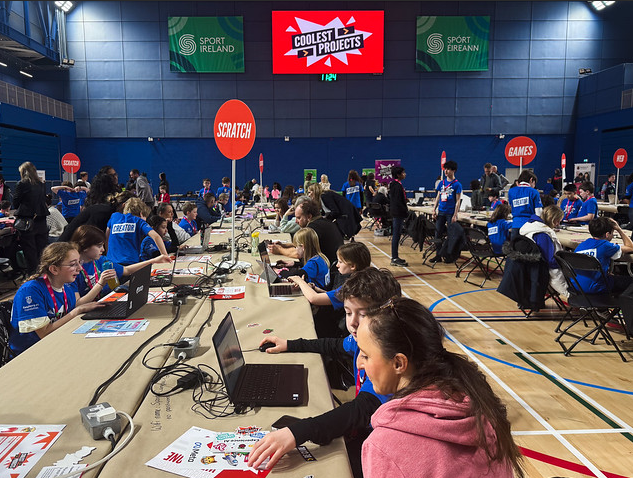
Coolest Projects is all about celebrating young digital creators and the brilliant things they make with technology. This year, we’ve seen just how much taking part can boost young people’s confidence, creativity, and sense of belonging. Today, we’re sharing the impact of Coolest Projects 2025 and looking ahead to what’s next for 2026.
Young creators at the Coolest Projects Ireland 2025 event.
This year saw significant growth in in-person events, with a record number of young people sharing their creations face-to-face. Across the UK and Ireland, more than 200 young people showcased their projects to judges, families, and peers. Attendance at the UK event grew significantly compared to 2024, reflecting the strong enthusiasm for digital making, while the Ireland event continued to attract a dedicated community of young creators. This enthusiasm shows how much young people value being part of a creative, supportive community that helps them share ideas and develop their skills.
The Coolest Projects 2025 participant map.
We were equally delighted to run Coolest Projects USA again, where young people embraced the chance to connect, share their work, and draw inspiration from one another. We also saw strong interest in the new AI category, with notable uptake at the UK and US events.
Participation by girls in the online showcase kept growing in 2025: 51% of entrants identified as female, up from 47% last year. We’re excited to build on this momentum and inspire even more girls to share their creations in 2026. We’ll continue encouraging participation by girls across all categories and broaden local promotion, especially where new in-person events are launching, to help maintain gender balance.
Online showcase: Confidence, skills, and inspiration
To understand Coolest Projects’ impact, we gathered survey and interview feedback from young creators, mentors, and event attendees across both the online showcase and in-person events.
This year’s online surveys and interviews indicate that Coolest Projects continues to be a powerful driver of confidence and skills:
72% of young people and 100% of mentors agreed that participating increased confidence in coding and digital making
89% of young people reported improved coding and digital making skills
83% of young people (and 100% of mentors) said they felt inspired to continue with computing and digital making after taking part
Young people and mentors told us that the online gallery plays a crucial role in sparking ideas and motivation:
“Kids definitely were excited in knowing their project might be seen by other kids around the world and displayed publicly online, so it’s truly a way for them to feel recognised. It definitely motivated them too.” – Mentor, South Africa
Coolest Projects truly offers a global setting like no other, giving young people the chance to see ideas from across the world and feel part of an inspiring international community.
In-person events: community and belonging
Creators told us how special it felt to be surrounded by peers who love making with technology. They valued sharing their projects, meeting like-minded people, and getting ideas from others:
“I think it’s really interesting seeing a lot of other children that understand programming and want to get better at it.” – Young creator, Coolest Projects USA
Young creators at the Coolest Projects India 2025 event.
Survey data echoes this: 74% of young people said Coolest Projects helped them feel they belong in computing. Many also highlighted the wider skills they developed, from problem solving and creativity to communication and teamwork:
“We [my friends and I] thought it was a really great opportunity and idea to make a project that we could all work on together and it’s been really awesome getting to know these girls and working together, fixing whatever code that we made wrong, debugging, you know…. We’d come together once a week to work on this project. So, I honestly got to learn a lot from them, watching them and how they code because they’re a little more advanced than I am. But, you know, that just means I get to learn more. So, you get to learn skills and support each other. It’s been awesome…” – Young creator, Coolest Projects USA
Young people returning for another year described how they stretched themselves, from advanced Scratch techniques to experimenting with AI and robotics. They also said hands-on project work is better than passive learning every time.
“…It’s the journey on which I go through to create the robot. And through that journey, I seem to learn much more than say if I were to watch a YouTube video and not do anything practical with it. I learn much more if I physically get hands-on with robotics encoding.” – Young creator, Coolest Projects UK
Alongside the projects on show, young people loved the interactive activities at events (with shout outs for VR and our escape room in the UK), and appreciated the friendly, approachable judges and smooth event setup. A new group registration system also made it much easier for mentors to enter multiple projects.
Dates for Coolest Projects 2026
We’re thrilled that so many young people around the world took part this year, and we can’t wait to welcome even more creators in 2026.
“Make it [the event] bigger so more people can come.” – Young creator, Coolest Projects USA
The Coolest Projects online showcase is open to any young person up to age 18, anywhere in the world. Registration will open on 14 January 2026. We’ll host a celebratory livestream on 24 June 2026.
Coolest Projects in-person events will also be popping up around the world. In-person events are open to everyone up to age 18 in the host country. Family and friends are very welcome to come along too.
It’s never too early to start making and saving your digital projects for next year’s showcase. Whether you’re into AI, games, web, hardware, or Scratch, there’s a place for your ideas at Coolest Projects.
Start by:
Checking out the judges’ favourites in the online gallery to spark ideas
Starting a project with a friend, your family, or a club, and sharing your progress
We can’t wait to see what the world’s young tech creators will make next!
Longtime Slashdot reader sinij shares a report from Car and Driver: Sales of electric vehicles surged in September as shoppers rushed to take advantage of the $7500 federal EV tax credit before it disappeared at the end of the month. With the government subsidies now gone, EV sales were expected to take a hit in October. While only a few automakers still report sales on a monthly basis, the results we do have do not paint a rosy picture for EVs in a post-tax credit world.
The Korean automakers were hit particularly hard by the loss of the tax credit. The Hyundai Ioniq 5, which was the fifth-best-selling EV through the third quarter of this year, experienced a 63 percent drop, moving 1642 units in October 2025, down from 4498 in 2024. Its platform-mates saw similar declines. The Kia EV6 moved just 508 units, down 71 percent versus the same month the year before, while the luxurious Genesis GV60 only found 93 buyers, a 54 percent slide year over year. Things were even worse at Honda. While the Acura ZDX was recently discontinued after just a single model year, the related Honda Prologue remains on sale but registered just 806 units, down 81 percent from 4130 sales in October 2024. […]
Obviously, this isn’t the full picture, as several major players — including General Motors, Toyota, Nissan, and Volkswagen — only release sales reports on a quarterly basis, and others, such as Tesla and Rivian, don’t break out individual sales at all. But with four of the top 10 bestselling EVs through Q3 all showing noteworthy declines in October, it spells trouble for the EV market at large. The end-of-year sales figures will provide a much clearer picture of whether October was just a blip or the start of a much more widespread problem for EV sales.
The Devuan developers announced the release of Devuan GNU/Linux 6.0 “Daedalus” distribution as a 100% derivative of the Debian GNU/Linux operating system without systemd and related components.
The Marin Lombard E is no longer a commuter bike for city slickers, instead a do-it-all electrically assisted rig built to tackle urban streets, dirt roads and the occasional cheeky path into the woods.
The Lombard has morphed from a commuter bike into an electric gravel bike, equipped with a 400Wh battery and Bosch’s SX motor, along with wide gravel tyre clearances and relaxed geometry, to boost its utility beyond the 9-to-5.
The Lombard E comes in two models, with one enjoying a more tarmac-focused build and the other with an eye on more challenging terrain.
There’s plenty of scope to add luggage and bottles to the Lombard. Andy Lloyd / Marin
Marin says the Lombard E is “a multi-surface drop bar dream machine that laughs at terrain changes”, which gives us a taste of what the brand believes the two bikes can do.
Both bikes have room for wide 50c tubeless tyres to help smooth the way, and a geometry that’s relaxed rather than racy.
Combined, this should result in a ride that’s suitable for a huge range of applications, boosted by both frame and fork luggage-carrying mounts.
Both models are based around the same Series 4 Beyond Road alloy frame, which has a dropped top tube for improved standover height and skinny stays to add an element of compliance to the frame.
There’s a pair of bottle bosses, while the Universal Derailleur Hanger provides plenty of drivetrain future-proofing.
At the front, a carbon fork is used on both models to help take the sting out of the trail.
Bosch’s Performance SX motor drives the Lombard E bikes. Andy Lloyd / Marin
The Bosch SX Sprint ebike motor is powered via a 400Wh battery in the down tube. A Fidlock locking mechanism secures the cover on the underside of the down tube, from which the battery can be dropped for charging in the house if required.
The top tube holds the basic Bosch System Controller, with five bars denoting battery levels and coloured LEDs showing which of the four ride modes is engaged.
A simple switch on the bar enables easy toggling between modes.
The Lombard E1’s drop-bar cockpit. Andy Lloyd / Marin
The Bosch Performance SX motor offers 60Nm of torque with 600W of maximum power and up to 400% assistance – it can give out up to four times the power that you apply via the cranks.
The included Sprint mode is targeted at e-gravel riders, offering a more dynamic feel to its power delivery. It gives up to 280% assistance and is built for steep climbs and fast sprints.
Choose your ride
The Marin Lombard E1 out in nature. Andy Lloyd / Marin
Two models are available, the Lombard E1 and the Lombard E2.
The Lombard E1 is the base model, coming with slicker file-treaded tyres and designed for a more urban audience.
The Series 4 aluminium frame is fronted by the carbon fork, while Shimano provides both the GRX-level 12-speed 1x drivetrain and hydraulic brakes.
The Lombard E1 is priced at £3,399 / $4,299 / €3,899 / CAD$4,999
Marin’s dirt-ready Lombard E2 gravel bike. Marin
The Marin Lombard E2 is built for the more adventurous rider.
The Vee Tire Co Quickstyk tyres have a more pronounced tread for better off-road grip. In addition, there’s a Trans-X gravel dropper post in the seat tube to help get the saddle out of the way when tackling more technical paths.
Shimano provides its GRX wireless Di2 12-speed groupset.
The Lombard E2 is priced at £3,999 / $5,299 / €4,699 / CAD$5,999.