Sony made an official 240Hz PlayStation monitor with a built-in DualSense charging hook

Sony had some new hardware to reveal during its State of Play Japan showcase on Tuesday. Along with a refreshed Japanese-only PS5 Digital Edition, the company unveiled an official PlayStation monitor that you can also hook your PC up to. It’s a 27-inch QHD display with a 240Hz refresh rate and support for HDR and variable refresh rate. However, the refresh rate is limited to 120Hz when you’re playing PS5 games.

What’s more, the monitor has a charging hook. It folds down from the rear of the display and you can place your DualSense controller on it, so you’re ready to play whenever the mood strikes. The monitor will be available in the US and Japan sometime next year. Sony hasn’t revealed how much it will cost.

The monitor follows the Pulse Elevate portable desktop speakers that Sony announced back in September. These will work with PC, Mac, PlayStation 5 and PlayStation Portal and are set to arrive in 2026 as well.

The new hardware seems to be part of the company’s push to become more of a player in PC gaming. For instance, the company recently made it possible to pair a DualSense controller with more than one device at a time, making it easier to switch the connection from a PS5 to a PC and vice-versa.

This article originally appeared on Engadget at https://www.engadget.com/gaming/playstation/sony-made-an-official-240hz-playstation-monitor-with-a-built-in-dualsense-charging-hook-230659339.html?src=rss

Engicam Showcases Computer Vision AI Kit Based on Renesas RZ/V2H Platform

Engicam has showcased the TIA RZ/V2H System-on-Module and its companion AI.DEV RZ/V2H development kit, both built around Renesas’ RZ/V2H processor. The module targets embedded applications in machine vision, autonomous robotics, and industrial automation, offering onboard AI acceleration and GPU capabilities optimized for real-time processing and advanced imaging. The TIA RZ/V2H module integrates a Renesas RZ/V2H […]

PS5 Has Now Officially Outsold Every Xbox Console Ever Released

Sony reported that PlayStation 5 sales have reached 84.2 million units, officially surpassing every Xbox console ever released. IGN reports: The PlayStation 5 is now up to 84.2 million copies sold after shifting an additional 3.9 million units during the three-month period ending September 30, Sony has announced. That’s a slight increase on the 3.8 million PS5 units Sony sold during the same quarter last year, but it’s an impressive result given the price of the console has actually gone up over the course of this generation, rather than come down. […]

As an aside, unlike Sony, Microsoft does not make Xbox Series X and S sales figures public, but analysts have suggested the combined Xbox Series effort is being outsold by the PS5 by at least a factor of 2:1. The more appropriate comparison for the PS5 then, is with its predecessor, the PlayStation 4. Five years into the current console generation, the PS5 is slightly behind the PS4 (the PS4 sold-in to retailers more than 86.1 million units after five years on sale). But Sony has said this console generation is its most financially successful ever, with sales surpassing those made during the reign of all previous Sony consoles.


Read more of this story at Slashdot.

Attempting To Shave With A Laser

Inspired by a Kickstarter for a laser razor that never materialized, Youtuber Allen Pan decided to attempt making one himself. The results? Less than impressive. The 5W laser manages to burn through a single hair in several seconds, making it incredibly impractical for anybody with more than 2-4 hairs to shave. Homer Simpson it could work for. I think the problem here is not using nearly a powerful enough laser. 5W? How about 500W? Shave once and you’d never have to shave again! Or be able to.

AMD’s Updated CPU Roadmap Confirms Zen 6 For 2026, Reveals First Zen 7 Details

AMD's Updated CPU Roadmap Confirms Zen 6 For 2026, Reveals First Zen 7 Details
Lest there be any doubt, AMD is already working on what comes next after Zen 6, which an updated CPU roadmap revealed at its Financial Analyst Day event remains on track to launch next year. The event is focused more on the business side of the equation, but there are still some high level details to be gleaned, including that Zen 7 is official.

We’ve

sudo-rs Affected By Multiple Security Vulnerabilities – Impacting Ubuntu 25.10

The Ubuntu 25.10 transition to using some Rust system utilities continues proving quite rocky. Beyond some early performance issues with Rust Coreutils, breakage for some executables, and broken unattended upgrades due to a Rust Coreutils bug, it’s also sudo-rs now causing Ubuntu developers some headaches. There are two moderate security issues affecting sudo-rs, the Rust version of sudo being used by Ubuntu 25.10…

What People Are Getting Wrong This Week: Kim Kardashian Debunks Psychics

In a culture overwhelmed with ridiculous beliefs, an unlikely hero of rationality has emerged: reality star Kim Kardashian. Kim raised a healthy amount of skepticism of psychics in a recent TikTok video: In case you don’t follow the ins-and-outs of reality stars, Kim K.’s recent life cycle/plot development sees her trying to become a lawyer. She’s been taking an apprenticeship in the industry and presumably studying hard. She also consulted psychics, who read tea leaves or whatever and concluded that she would pass the California bar exam. Except, sadly, she did not. 

“Psychics are full pathological liars” —Kim Kardashian

“All of the fucking psychics that we have met with, and that we’re obsessed with, are all fucking full of shit,” Kardashian said to her 10 million TikTok followers. “They all collectively, maybe four of them, told me I’m going to pass the bar. So they’re all full pathological liars. Don’t believe anything they say.”

According to a 2024 survey, about 20% of Americans love The Kardashians, and about 26% of Americans believe in clairvoyance. I have nothing but vibes to back this up, but I bet the circles for “Kardashian fan” and “believer in psychics” in the American Venn diagram have a lot of overlap. Kardashian isn’t preaching to the skeptics; she’s talking to the true believers, as she once was.

Kardashian has personal credibility here, given her long history of talking to mediums and psychics, and there’s something extra convincing about someone with skin in the game. This wasn’t some meaningless test for Kim Kardashian; she was asking about something that was important to her, and she wasn’t doing it from a skeptical point of view.

Where Kim Kardashian’s psychics went wrong

A savvy psychic tries to avoid making predictions that can be proven true or false. A medium might say, “Your Dad is up in heaven, and he’s super proud of you,” but if they want to stay in business, they won’t say, “Your Dad says the stock certificates are in the attic in the green trunk,” because when you check the trunk—if there even is a trunk or an attic—the jig is up. 

Without knowing it, Kardashian put her psychics in a bind. By asking point blank whether she was going to pass the bar or not, Kardashian forced a binary decision. It’s understandable they unanimously landed on “you’ll pass,” because that’s what she wanted hear. “The fates are unclear at this time!” is too wishy-washy, and “You’re going to fail, girl,” would likely get you disinvited to the mansion. But I am surprised no one went with, “I can’t tell the time frame, specifically, but you will become a lawyer in the future.” That’s what I would have said. (I’m available for psychic readings.)

Now if you’ll excuse me, I’m going back to being unaware of anything Kim Kardashian does.

Bird Casually Eating Beehive While Bees Go Nuts

This is a video of a honey buzzard eating the larvae out of a beehive while all the bees panic and attack. The birds have specialized shield feathers around their faces to help prevent stings. This video reminds me a lot of myself while I’m eating the entire pumpkin pie at Thanksgiving. I’m just in the zone, you know? My brother and cousins might be stabbing me with forks, bu I don’t feel it. Also, I’m sorry if you’re a bee watching this, I know this has to be hard.

OpenAI Used Song Lyrics In Violation of Copyright Laws, German Court Says

A Munich court ruled that OpenAI violated German copyright law by training its models on lyrics from nine songs and allowing ChatGPT to reproduce them. OpenAI now faces damages as it considers an appeal. Reuters reports: The regional court in Munich found that the company trained its AI on protected content from nine German songs, including Groenemeyer’s hits “Maenner” and “Bochum.” The case was brought by German music rights society GEMA, whose members include composers, lyricists and publishers, in another sign of artists around the world fighting back against data scraping by AI.

Presiding judge Elke Schwager ordered OpenAI to pay damages for the use of copyrighted material, without disclosing a figure.
GEMA legal advisor Kai Welp said GEMA hoped discussions could now take place with OpenAI on how copyright holders can be remunerated. OpenAI had argued that its language models did not store or copy specific training data but, rather, reflected what they had learned based on the entire training data set.

Since the output would only be generated as a result of user inputs known as prompts, it was not the defendants, but the respective user who would be liable for it, OpenAI had argued. However, the court found that both the memorization in the language models and the reproduction of the song lyrics in the chatbot’s outputs constitute infringements of copyright exploitation rights, according to a statement on the ruling.


Read more of this story at Slashdot.

Google Play Policy Change Puts Android Devs On Notice Over Battery Drain

Google Play Policy Change Puts Android Devs On Notice Over Battery Drain
Android apps will soon be facing penalties for excess battery drain on the Play Store, but developers will be made aware of these issues and have time to fix them before they are penalized, per Google’s latest Android Developers Blog post. This effort follows last year’s addition of a beta metric to Android vitals dubbed “excessive partial

The Google Play Store Wants to Help Preserve Your Battery

If there’s one thing all of us smartphone owners have in common, it’s that our devices rarely have enough battery life. Some phones are better than others, especially when paired with battery-saving settings, but in general, it’s a universal anxiety to feel like your phone might die before you reach a charger again.

There are many reasons your smartphone’s battery might drain fast, but some of the likeliest culprits are poorly-designed apps. Some of these programs use too much processing power when you’re actively using them, while others needlessly run in the background. You can always check your device’s battery stats to see which apps are the worst offenders, but what if you know know an app was a battery anchor before downloading it in the first place?

The Play Store’s new battery warnings

As of March 1, 2026, that will be the new reality. In just a few months, when you tap on an app in the Play Store, you might see a new alert that wasn’t there before. Underneath the usual details, like the app’s name, developer, reviews, and rating, you’ll see a red warning, stating something to the effect of, “This app may use more battery than expected due to high background activity.” I don’t know about you, but that would get me thinking twice about downloading it.

According to the Android Developer Blog, this has been in the works for some time. In partnership with Samsung, the company rolled out a new metric in beta earlier this year called “excessive partial wake locks,” which aimed to reveal to developers when their apps “excessively” wake the display. Following this beta program, Google says it refined the algorithm it uses to calculate this rating, and has now rolled out the metric to all developers.

Going forward, if an app wakes the screen for a total of two hours in any given 24 hour period, Google will note it as excessive. If 5% of an app’s user sessions are excessive over a 28 day period, it crosses the “bad behavior threshold.” This can result in a number of different consequences for the app: Google may first pull it from discovery surfaces in the Play Store. That could seriously impact an app’s total installs, as users won’t find it without searching for the app directly. Of course, Google may also affix the app’s Play Store page with the aforementioned battery alert, which will also discourage users from downloading it.

The onus is now on app developers to correct this “bad behavior” in their apps by March of next year. Hopefully, any battery hogs on your smartphone will be fixed in the next few months, but if not, keep an eye on their Play Store pages. If you see this alert, you might want to uninstall the app entirely.

This isn’t the first time the Play Store rolled out a feature to root out bad apps. Last year, the marketplace launched live threat detection to highlight apps that might be spreading malware. The Play Store has also tested alerts that would warn you about apps that are frequently uninstalled, or that have a significantly lower active user count than competitor apps.

Threads is adding features for creators to promote their podcasts

Threads is working on new features that could make the text-based social network a bit more audio-friendly. Starting today, Threads is rolling out some new features for sharing podcasts and podcast episodes. Creators have the option to add the link to their show to their bio page; after that, their posts with show and episode links will appear with an audio preview. Non-hosts will also start to see the new previews when they post links to their favorite shows.  

For starters, the rollout is only supporting Spotify shows. Connor Hayes, who heads up Threads and also posted about the new feature, said in a reply to another user that Apple Podcasts will also eventually receive support. The previews are going live today and will become available to all users over the coming weeks.

In theory, this feature could help attract new listeners. However, Threads doesn’t have a strong success rate when it comes to its users clicking on links. It should be interesting to see if the audiovisual addition makes it any more appealing for people to visit podcast pages.

This article originally appeared on Engadget at https://www.engadget.com/threads-is-adding-features-for-creators-to-promote-their-podcasts-215711793.html?src=rss

Google says new cloud-based “Private AI Compute” is just as secure as local processing

Google’s current mission is to weave generative AI into as many products as it can, getting everyone accustomed to, and maybe even dependent on, working with confabulatory robots. That means it needs to feed the bots a lot of your data, and that’s getting easier with the company’s new Private AI Compute. Google claims its new secure cloud environment will power better AI experiences without sacrificing your privacy.

The pitch sounds a lot like Apple’s Private Cloud Compute. Google’s Private AI Compute runs on “one seamless Google stack” powered by the company’s custom Tensor Processing Units (TPUs). These chips have integrated secure elements, and the new system allows devices to connect directly to the protected space via an encrypted link.

Google’s TPUs rely on an AMD-based Trusted Execution Environment (TEE) that encrypts and isolates memory from the host. Theoretically, that means no one else—not even Google itself—can access your data. Google says independent analysis by NCC Group shows that Private AI Compute meets its strict privacy guidelines.

Read full article

Comments

Update Windows ASAP to Patch Another Zero-Day Vulnerability

If you’re a Windows user, this is your monthly reminder to ensure you install all available security updates. Microsoft’s November Patch Tuesday release fixes one zero-day vulnerability that has been actively exploited in the wild, with 63 flaws patched in total.

As reported by Bleeping Computer, the November Patch Tuesday update addresses 29 elevation of privilege vulnerabilities, 2 security feature bypass vulnerabilities, 16 remote code execution vulnerabilities, 11 information disclosure vulnerabilities, 2 denial of service vulnerabilities, and 3 spoofing vulnerabilities. (Note that these figures do not include patches for Microsoft Edge and Mariner.)

In addition to the zero-day, four of the vulnerabilities being addressed—two remote code execution bugs and one each of the elevation of privilege and information disclosure flaws—are labeled “critical.”

Patch fixes one zero-day threat

All security updates are important to install as soon as possible, but especially those that patch zero-days, which are vulnerabilities that are actively exploited or publicly exposed before the developer makes an official fix available.

Without this month’s patch, Windows users are vulnerable to CVE-2025-62215, an elevation of privilege flaw in the Windows Kernel. The bug allows threat actors to gain system privileges upon winning a “race condition,” or improper synchronization in Windows Kernel.

The vulnerability was identified by the Microsoft Threat Intelligence Center (MSTIC) and the Microsoft Security Response Center (MSRC), though no additional details about exploitation have been made public.

Other updates for Windows users

Windows 11 users will also see the rollout of the upgraded Start menu alongside Patch Tuesday updates—the new interface is scrollable with app categories and adapts to the size of your screen. Other changes include an redesigned battery icon and improved features for File Explorer, Voice Access, and Click to Do.

As of last month’s Patch Tuesday, Microsoft has ended support for Windows 10, though users who have enrolled in Extended Security Updates (ESU) will continue to get security patches through Oct. 13, 2026.

Ryanair tries forcing app downloads by eliminating paper boarding passes

Ryanair is trying to force users to download its mobile app by eliminating paper boarding passes, starting on November 12.

As announced in February and subsequently delayed from earlier start dates, Europe’s biggest airline is moving to digital-only boarding passes, meaning customers will no longer be able to print physical ones. In order to access their boarding passes, Ryanair flyers will have to download Ryanair’s app.

“Almost 100 percent of passengers have smartphones, and we want to move everybody onto that smartphone technology,” Ryanair CEO Michael O’Leary said recently on The Independent’s daily travel podcast.

Read full article

Comments

All My Favorite At-Home Workout Tools for Less Than $25

We may earn a commission from links on this page.

I have bittersweet news that is mostly sweet: Soon, I will have a Tonal, one of those ultra-modern tablets that attaches to your wall and uses magnets to create resistance that mimics the use of a cable machine at the gym. I’m getting it so I can review it for you, which is good news for us all, but it’s going to render a lot of my other at-home workout equipment useless for a while, so I want to take some time to memorialize the inexpensive tools I have accumulated that make even the most basic yoga on my living room floor a better experience.

While I am pumped to have the Tonal, which costs about $4,000 depending on which sales may or may not be running, the truth is I got a lot accomplished with personal workout equipment that all cost less than $25. Here’s what I think you should get if you’re trying to level up at your exercise from home, like I’ve been trying to.

Pilates tools have been most useful

It’s no secret that I am a diehard Peloton fan and use my Bike and the company’s app every single day. It just has so much to do, from walking to running to stretching to yoga. I’ve thoroughly enjoyed working my way through every class category, but in the end, we are all creatures of habit and inevitably return to what we like best. For me, that’s Pilates. I go to fancy reformer studios around Manhattan, take mat Pilates class at my gym, and, naturally, follow guided Pilates classes through my Peloton app and even on platforms like YouTube. It is entirely possible to find and complete classes that don’t involve any equipment, but I find those boring.

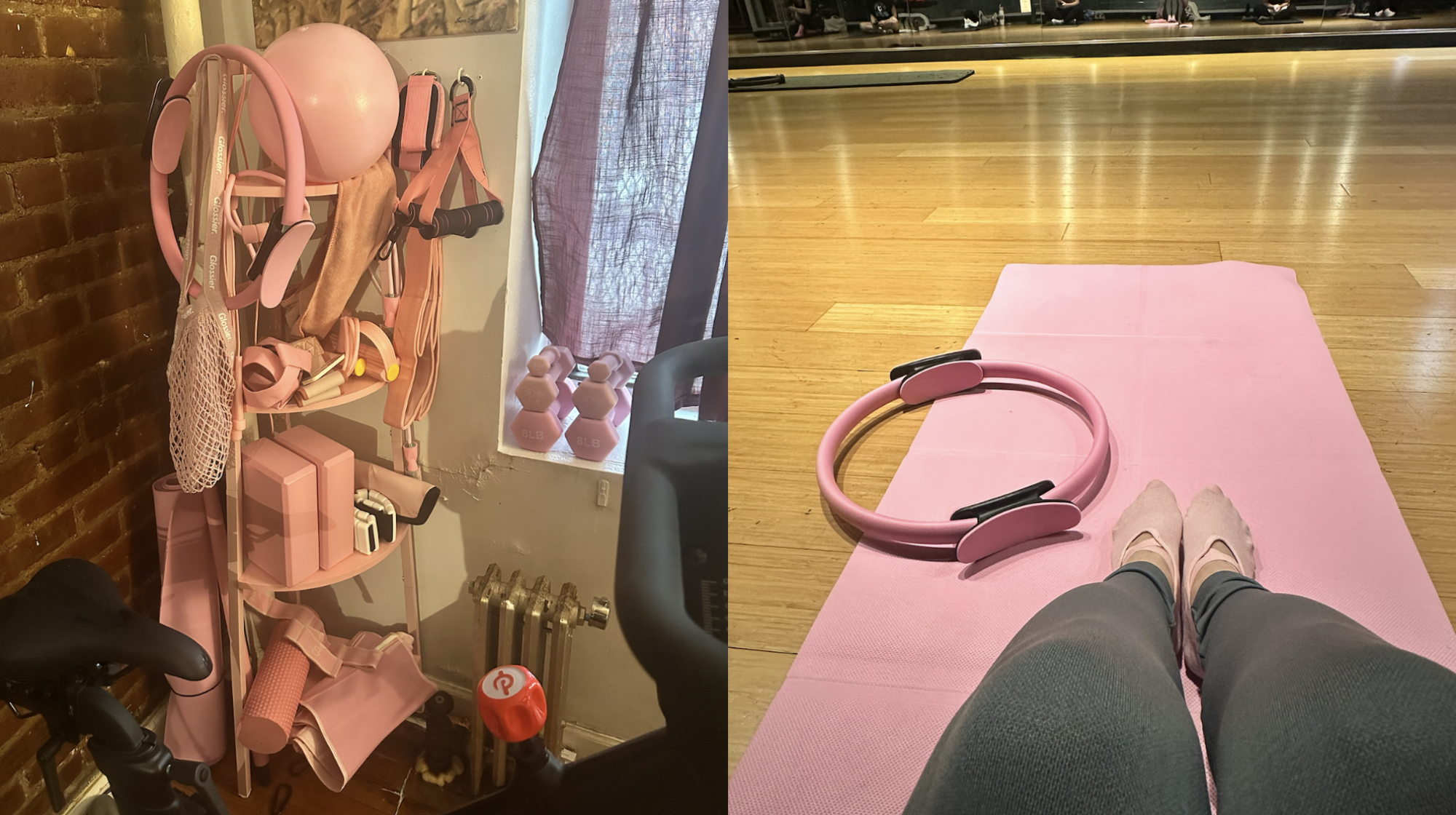
Thus, the best purchases I’ve made toward my little at-home exercise station have been my Pilates accessories. First up, I got a cushy mat. If you are into yoga or Pilates, you know that there are pros and cons to a squishier, thicker mat. The main pro—that it doesn’t hurt my butt or knees to do exercises on the floor—outweighs the cons, like the fact that I have to be slightly more careful and brace myself just a bit more to stay stable on the less sturdy surface. If stability is an issue for you, you might want a thinner mat, but I got this thick one, which is about $16.

The real success came when I got a Pilates hoop and ball.

These were not entirely necessary, of course; you can do a perfectly adequate workout without them. Moreover, I went cheap—like really cheap—so I ended up having to blow up the ball with a straw and attach the grip pads to the hoop myself. Not the end of the world, but not as luxurious as I like my Pilates-related activities to be, either. That said, these did make my non-home Pilates activities better. I have brought them with me to mat Pilates in addition to using them along with Peloton and YouTube workouts, meaning I don’t have to use the balls, hoops, or mats anyone else has sweated on.

The mat is multi-purpose, too. I use it when I do strength training and when I do at-home yoga. I also picked up some yoga blocks, which have helped me when I’m on my own in addition to when I take classes in a studio or the gym. Here, I hesitate to recommend my cheapies fully, though. Unlike some blocks I’ve used at the studio, mine aren’t very dense or textured. They’re a bit flat, light, and almost slippery. I did, in fact, fall off one during a hot yoga session at a new studio a few weeks back. I chalk this up mostly to operator error because I’m simply not a graceful person and that goes double when I’m covered in sweat, but I do think if I had some higher-quality blocks, it might not have happened. Keep that in mind when going cheap, though I’ll say I haven’t had any other issues with my inexpensive goods.

The secret home gym holy grail

I have gotten a lot of other weird, single-use, and niche home workout products and I won’t lie: I don’t really touch them. I got this resistance band/squat bar combo, for instance, and it’s sat idle for months because it just could never replicate what I’m able to access in the gym or even by using dumbbells at home.

On the other hand, dumbbells seemed inaccessible to me for home use for a while because, as you can see, I am a cheap person and the higher the weight gets, the higher the price goes with it—at least at Target or on Amazon. Unwilling to pay more than $25, I assumed I’d be capped out at five-pound weights forever and only ever use dumbbells at the gym. But then, by pure chance, I found myself in a Five Below last week.

Reader, they have dumbbells. Do they ever have dumbbells. There are dumbbells and kettlebells up to 10 pounds and each is $10 or less. They also have resistance bands, lifting gloves, wrist weights, an ill-advised “thigh trainer,” and more, all at that same price point or below. If you’re looking to add a bit of spice to your home workout setup, get to Five Below because nothing there will break the bank.

Why this works

I try to get to the gym or a boutique studio at least four times per week, but that requires a lot of motivation and planning—which working out at home requires even more of, in my opinion, so when I do that, I need to buckle down and force myself. You’d think it would be easier, since I don’t have to go anywhere, but it’s harder because I can simply choose to stay on my couch. Having access to equipment that can enhance my time working out at home motivates me and makes the process of setting up, finding a video to follow, and actually completing some exercises feel more worth it. It wasn’t expensive to build my arsenal, but if it had been, it still would have been worth it.

Gym equipment
Covered at home or at the gym.
Credit: Lindsey Ellefson

And, yes, all my exercise equipment is pink. I’ll do me; you do you.

Nintendo and Lego tease a Legend of Zelda: Ocarina of Time set

Lego has a long history of geek and gaming crossovers. We’ve seen recent sets for Star Wars and Star Trek, while past collaborations include everything from Super Mario Bros. to Minecraft. The latest blocky tie-in is a classic: The Legend of Zelda: Ocarina of Time, as teased on social network X by Nintendo of America with the caption “Do you realize who you’re dealing with?”

�Do you realize who you’re dealing with?#LEGOTheLegendofZelda pic.twitter.com/NCl84ydZ3a

— Nintendo of America (@NintendoAmerica) November 11, 2025

The short video clip recreates a scene from the game, with a minifig of Link armed with his Hylian shield and Master Sword beside a tiny floating Navi fairy. (Presumably Lego Navi will not interrupt you with “Hey! Listen!” every five minutes, but maybe the company is striving for total accuracy.) A blurry Zelda minifig stands behind them, and the heroes stare upward at the looming shadow of what must be a Ganon character. Whether the villain is a minifig of his own or a larger-than-life constructed model remains to be seen. The set won’t be released until 2026, but most likely either Lego or Nintendo will reveal more details ahead of the launch date. 

This isn’t the first time Hyrule is getting the Lego treatment. The brands’ debut Legend of Zelda collab was a set of the Great Deku Tree that came out last year, and it could be built as either the wise arboreal being from Ocarina of Time or from Breath of the Wild.

This article originally appeared on Engadget at https://www.engadget.com/entertainment/nintendo-and-lego-tease-a-legend-of-zelda-ocarina-of-time-set-201500150.html?src=rss