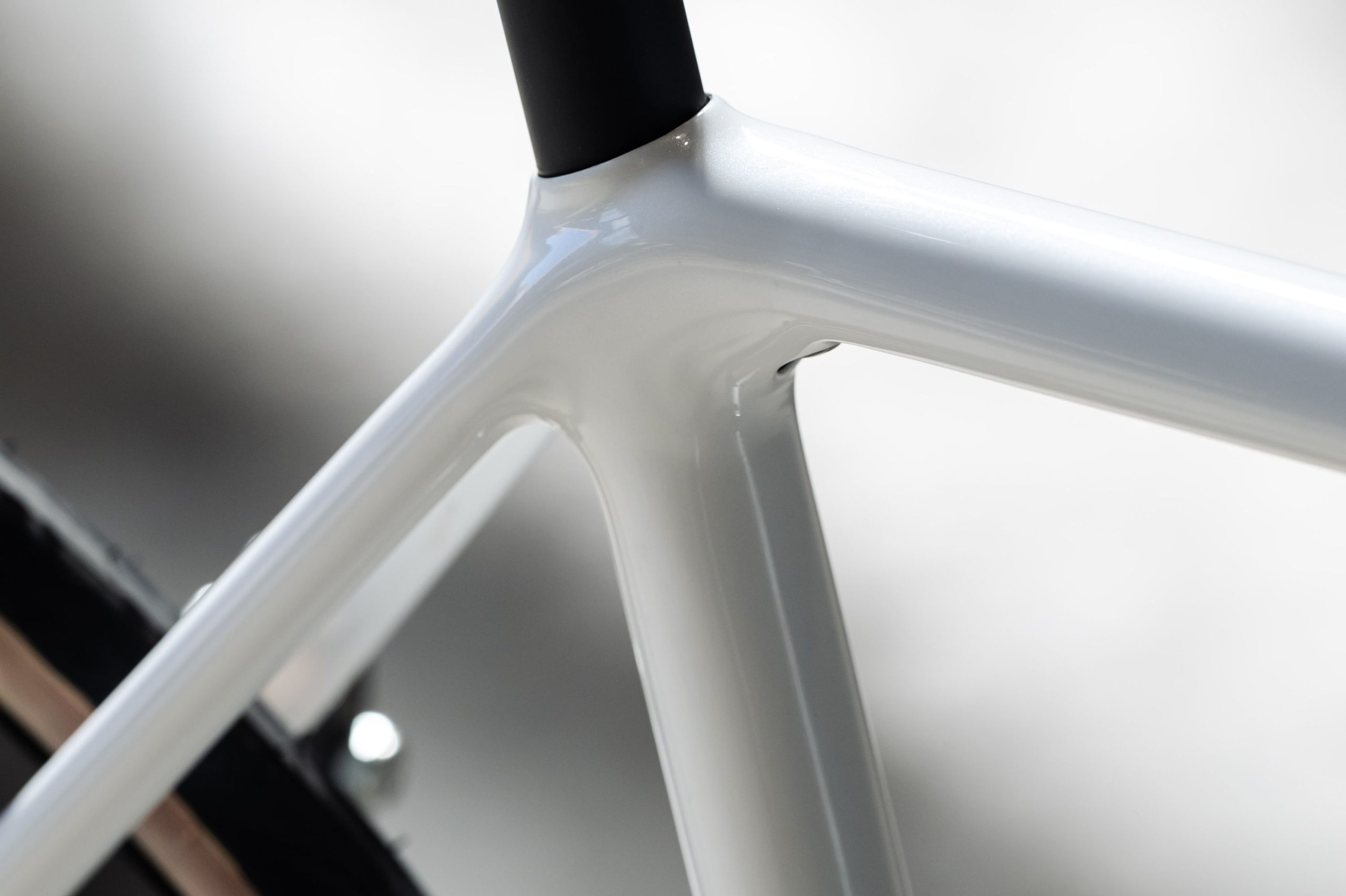
Curve Cycling’s CarboKev blends carbon and titanium with drool-worthy results (and a huge price tag)

Curve Cycling, based out of Melbourne, Australia, has announced its latest gravel bike frameset – the CarboKev – made from a mix of titanium and carbon, with the carbon tubes bonded to 3D-printed titanium lugs. 

Curve Cycling claims the use of titanium-lugged carbon tubes, in place the all-titanium tubes it commonly uses, results in lower weight and greater frame stiffness, along with long-distance comfort and precise handling.

The claimed weight of the CarboKev is 250g less than the brand’s all-titanium Big Kev gravel bike.
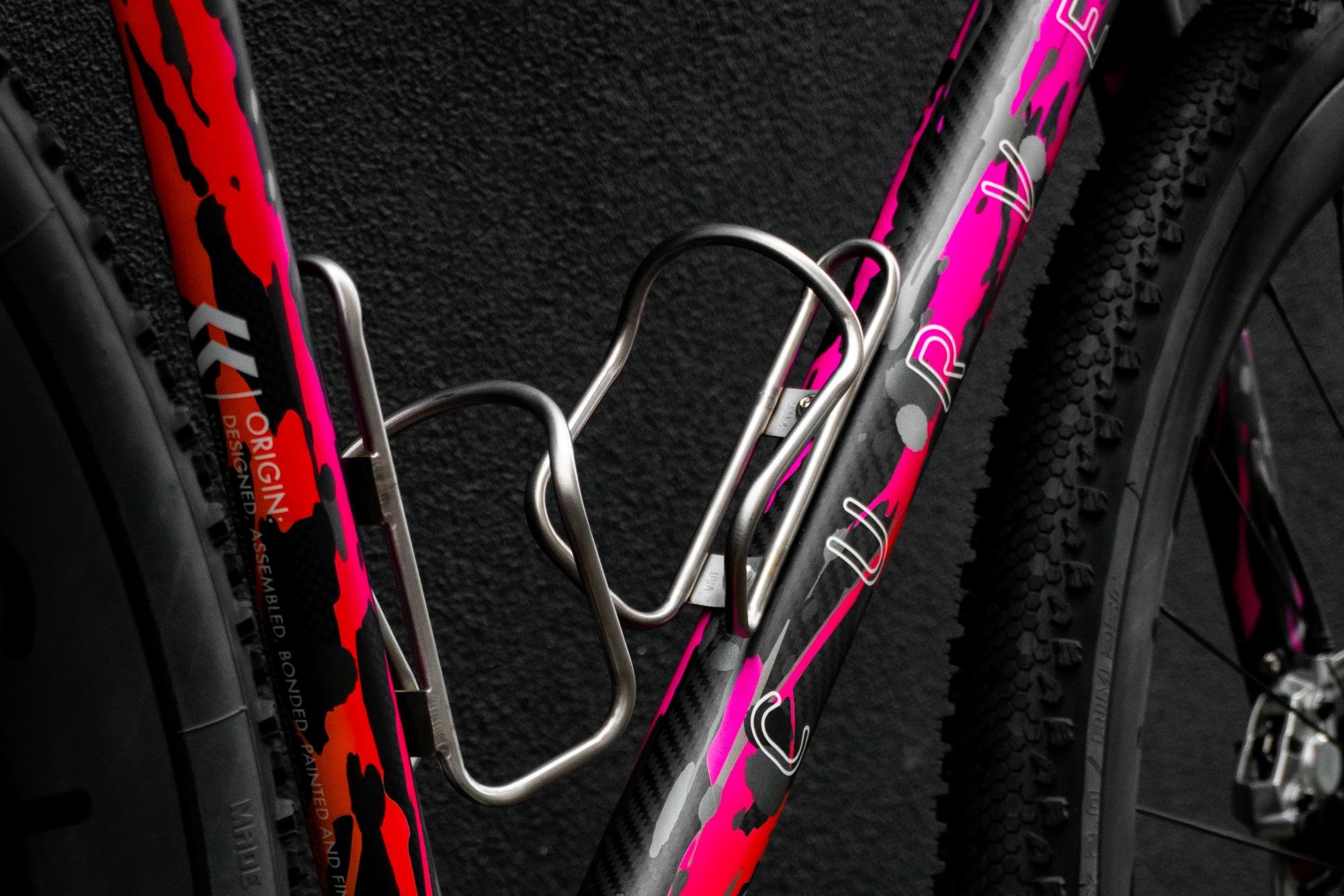
The CarboKev’s down tube and chainstays are carbon for power transfer.

According to Jimmy Rostlund, Curve Cycling’s technical lead: “With CarboKev we iterated every lug profile, wall thickness and bond length. 3D-printed titanium lets us place material exactly where the stresses demand it; bonded carbon lets us tune the ride in ways a single material can’t.”

The CarboKev’s carbon down tube and chainstays are claimed to provide a stiff spine for power transfer and accurate steering. Meanwhile, the titanium top tube and skinny titanium seatstays are designed to provide vertical compliance to reduce fatigue.
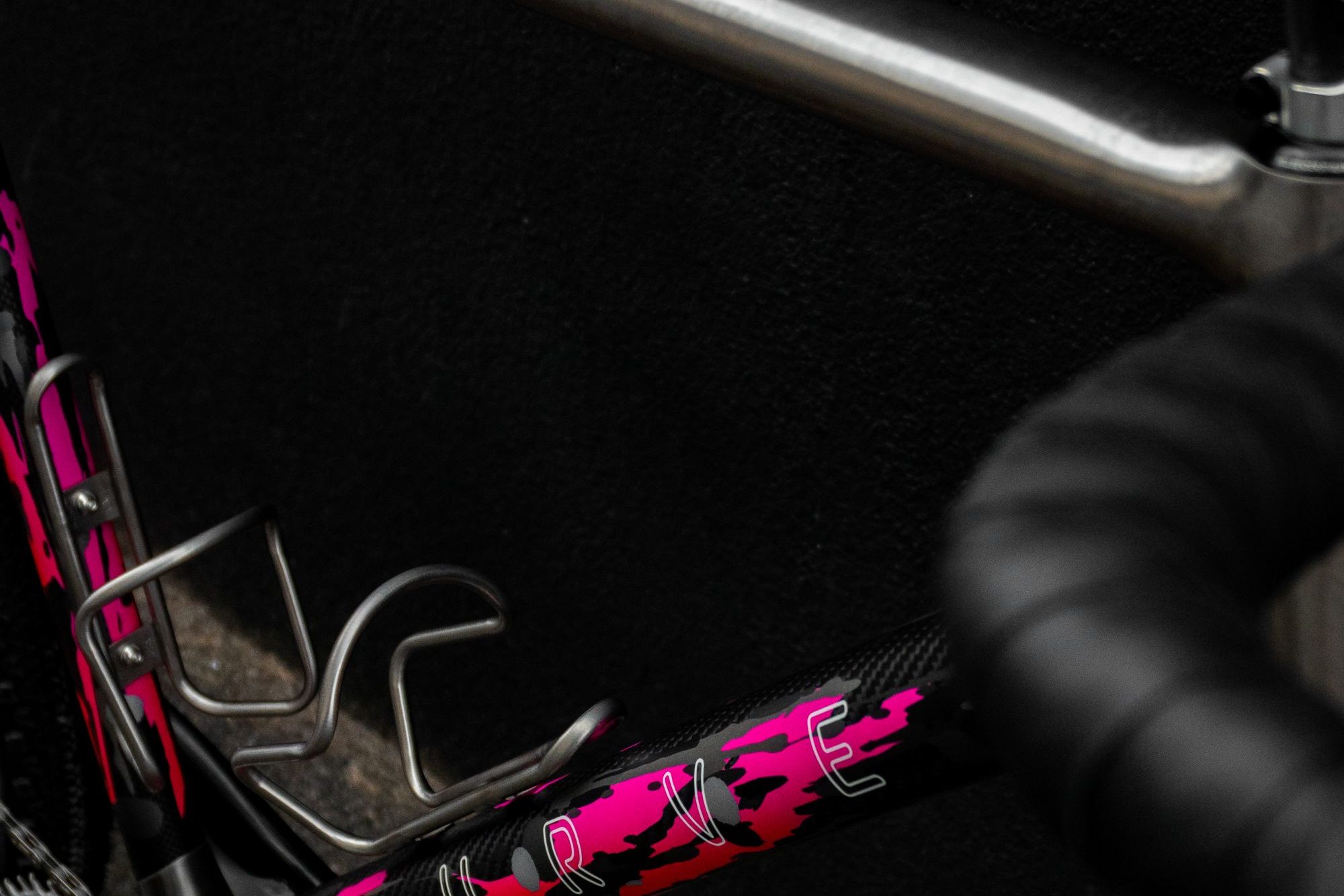
The head tube, top tube, seat tube and seatstays are titanium.

Curve Cycling isn’t the only brand to have launched a carbon/titanium hybrid recently. UK-based J.Laverack has just announced its AM64 upgrade for a range of its bikes, which subs in a carbon seat tube in place of titanium to reduce weight and increase compliance.

Big tyre clearance and big price tag
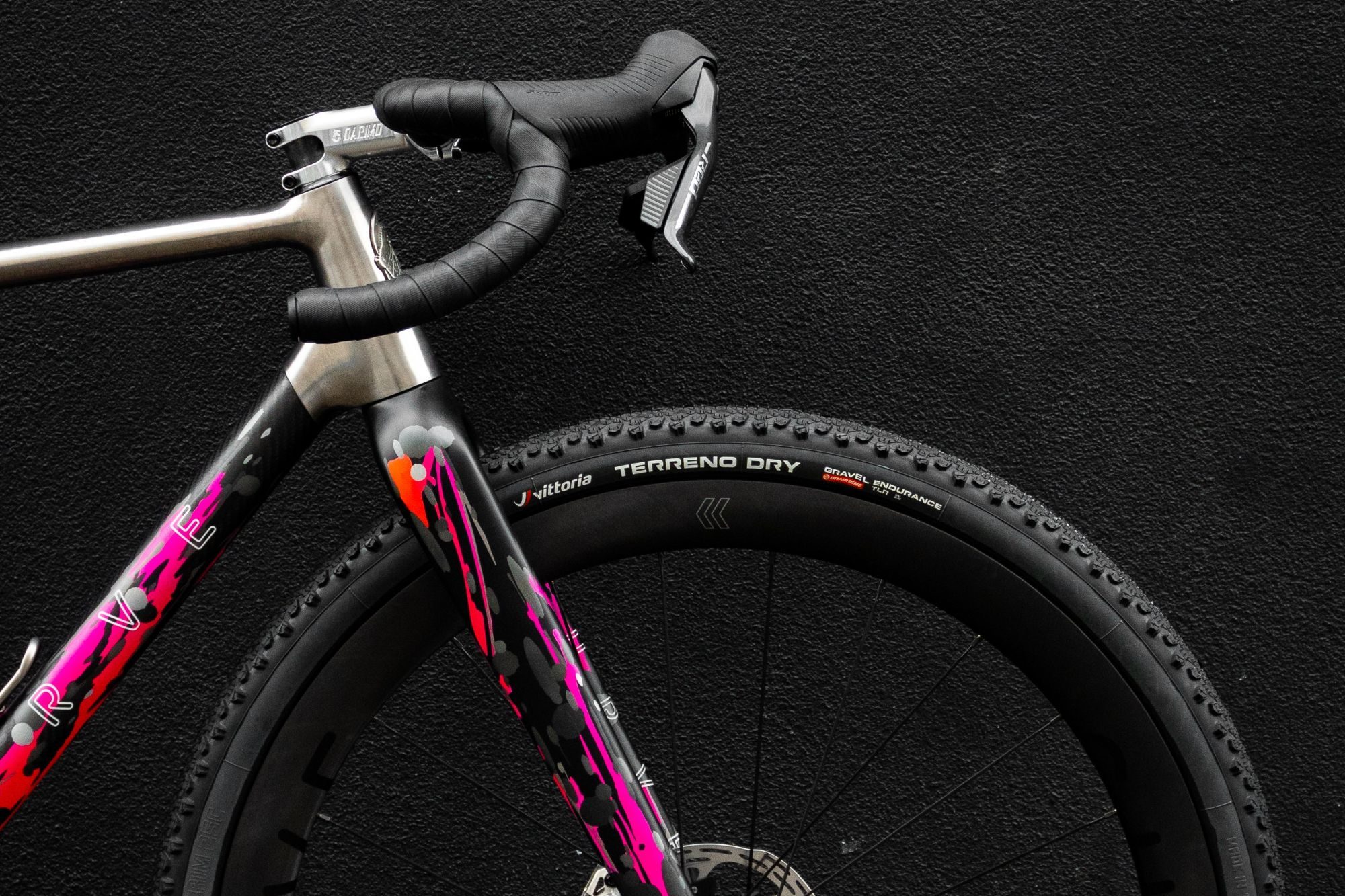
The 2.2-inch tyre clearance follows the trend to wider tyres on gravel bikes.

The CarboKev frame can handle 29-inch tyres up to 2.2 inches (56mm) wide, dialling into gravel’s hottest trend. It’s designed to be paired with Curve’s Race 415i carbon fork and Race Carbon Walmer bars, which are yet to be launched individually and have a 400mm width.

The CarboKev is hand-built in Melbourne, with the carbon tubes sourced from New Zealand, while the titanium lugs and other parts are made in China.

Curve Cycling says bringing frame alignment and fabrication in-house is a major advance in its manufacturing capabilities, though.

With its small volume manufacturing, Curve Cycling says it lets purchasers choose their optimum sizing. Although it shows seven available sizes in its geometry chart, the frame can be custom-fitted to the rider, who can also choose options such as an integrated seatpost. 

Curve Cycling CarboKev availability and pricing
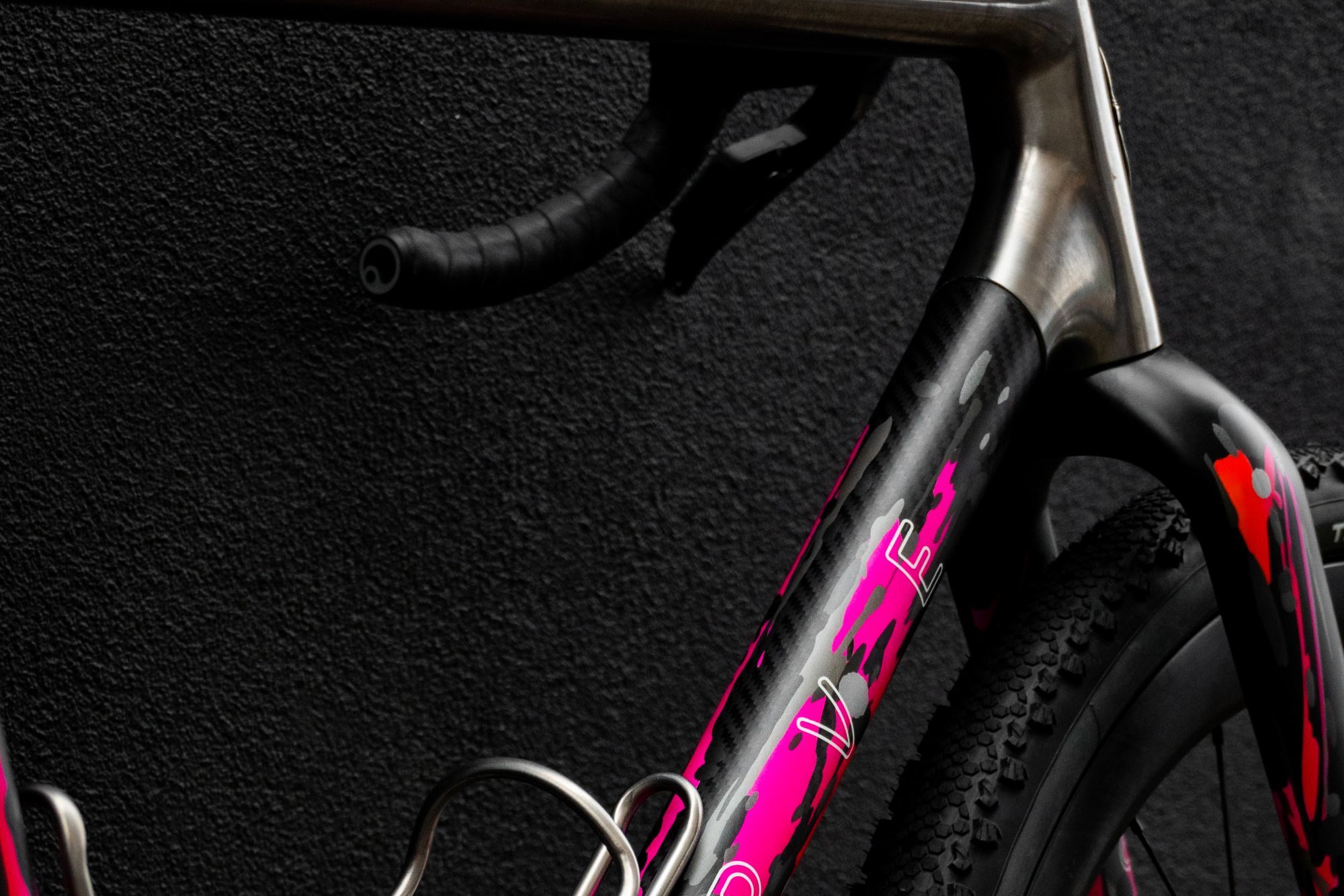
The CarboKev Splatter paintwork is standard, with custom colours an extra-cost option.

The CarboKev can be purchased frameset-only or as a frameset package with bars, seatpost, and fork.

There’s a standard CarboKev Splatter Art colour, with a selection of colour options, plus custom paint options at an extra cost.

The full build is equipped with SRAM Red XPLR AXS, Curve G5T [G] Carbon gravel wheels built on DT Swiss 180 hubs, and Curve’s new Walmer bars. 

Purchasers need to be patient though, with Curve Cycling estimating a 10 to 12 month lead-time, dependent on spec. 

They also need deep pockets, with the frameset priced at AU$12,000 (before tax) and the frameset package AU$12,727.27 (also before tax). 

Choose the complete SRAM Red XPLR AXS build and you’re looking at AU$26,363.64 plus tax, or AU$29,000 with Australian sales tax. That’s around £14,000 / US$19,000. 

Reddit Cofounder Had a Bad Feeling About Giving Data To Sam Altman

Reddit cofounder Alexis Ohanian said he had serious doubts a decade ago about sharing the platform’s data with Sam Altman. Ohanian recounted on the “Brew Markets” podcast that between 2015 and 2016, Altman asked Reddit to let him “aggressively scrape” the site’s content. Altman had recently helped Reddit raise $50 million in a Series B round and was launching OpenAI as a nonprofit.

Ohanian described Altman as “very smart” and “incredibly cunning” but questioned whether he was “the most philanthropically minded guy.” The Reddit cofounder said he “felt in my bones” the company should refuse the request and debated internally about it against Steve Huffman. Ohanian said he “lost that debate.” Reddit and OpenAI announced a formal licensing deal in 2024.


Read more of this story at Slashdot.

What RCS Messaging Between iOS and Android Can and Can’t Do (Yet)

Apple brought RCS (Rich Communication Services) messaging to the iPhone with iOS 18 last year, giving green-bubble users access to more features and functions. But what exactly is possible with RCS on the iPhone, and what is still exclusive to iMessage users? Are Android RCS users now fully integrated into chats in the iOS Messages app or not?

I’ll lay out exactly what you can do in RCS chats between iPhones and Android phones, and explain which features are still missing—and when you might be able to get them. If you’ve got contacts on other mobile platforms, this should help you understand more about what the experience is like from their end.

To use RCS, you must have a carrier that supports it (most now do). On an iPhone, open Settings, then choose Apps > Messages > RCS Messaging to enable it. In Google Messages on Android, tap your profile picture (top right), then choose Messages settings and RCS chats to turn on the feature.

RCS on iOS and Android: what you can do

Ever since iOS 18, RCS messaging has officially been supported in the iOS Messages app—specifically, via the RCS Universal Profile 2.4. This brings green bubble Android users closer to parity with iMessage users, though some features only work in one direction, and some features only work in one-to-one conversations and not group chats.

One notable upgrade is support for high-resolution photos and videos, which should work seamlessly across all your RCS-enabled conversations, with no more issues around compression or transfer. Web links look better as well, because you’ll get a proper preview shown on both Android and iOS, and you can share current locations too (though only as a static pin, not a live and updating one).

RCS links
Web links now look much better between iOS and Android.
Credit: Lifehacker

Typing indicators and read receipts are supported in both directions, assuming you’ve got them enabled on your devices. However, they don’t work in group chats—RCS users on Android can now join group chats, but the experience can be buggy based on reports, and you lose the typing indicators and the read receipts.

Emoji reactions are now supported, up to a point—but based on my testing, these only work from iPhone to Android. If you try and send an emoji reaction in the other direction, iPhone users will just get a separate text showing the emoji (it won’t appear as a bubble on top of the original message).

RCS on iOS and Android: what you can’t do (yet)

If you look at everything you can do in iMessage (with other iMessage users) and Google Messages (with other Android RCS users), you’ll realize there’s a long way to go when it comes to cross-platform support. For example, at the moment you can’t unsend messages, or reply inline in a thread, either from Android to iPhone or iPhone to Android.

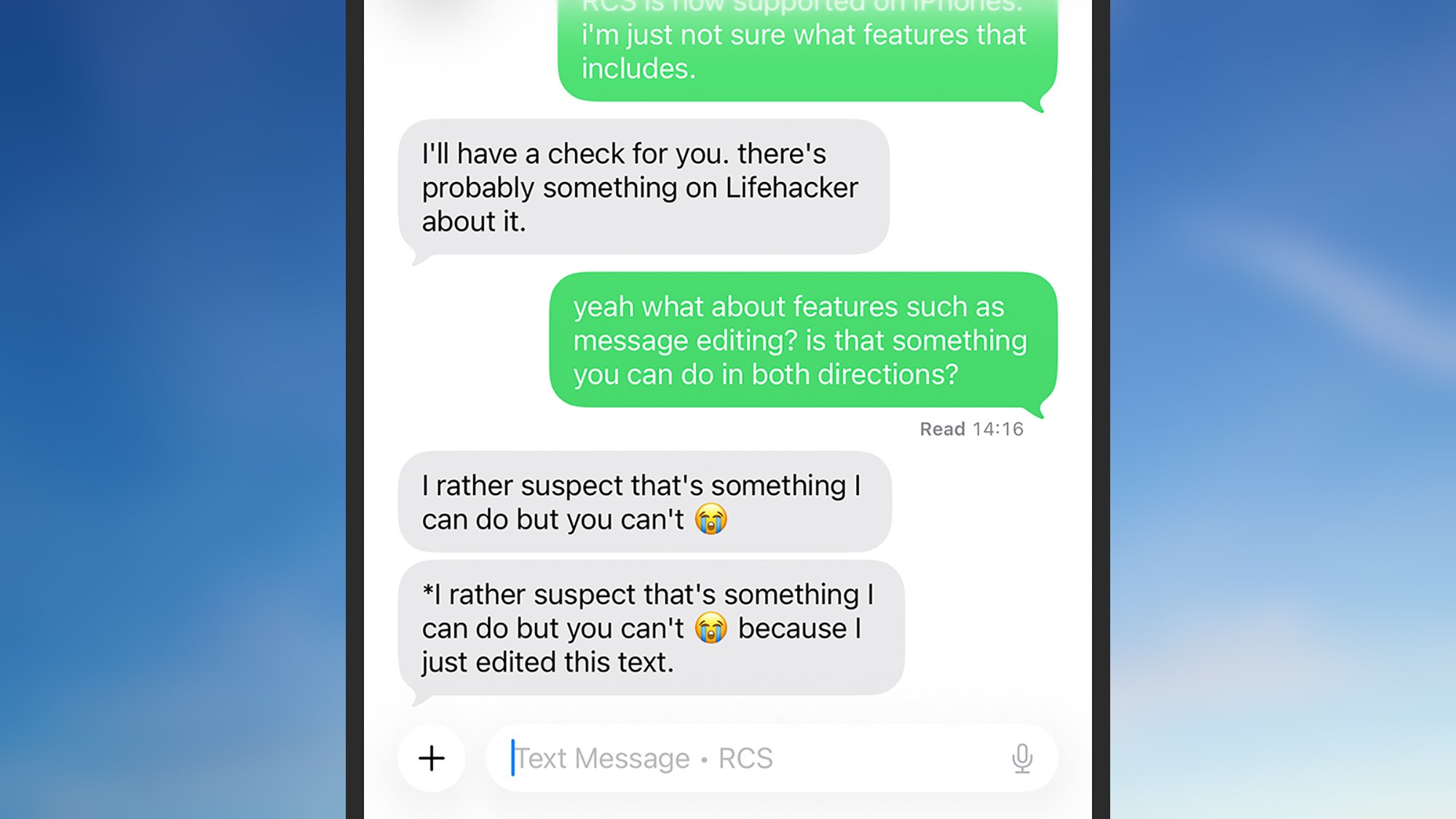
You can edit messages, but only if you’re an Android user messaging an iPhone user—and with the caveat that the iPhone user gets two texts (the original message and the edited message, which rather defeats the point). The ability to edit messages on an iPhone simply doesn’t appear in an RCS conversation.

RCS editing
Message editing is something that doesn’t quite work yet.
Credit: Lifehacker

Another missing feature is end-to-end encryption for your chats and files shared in them. Apple has promised that support for this in RCS conversations is on the way, though it hasn’t shown up yet—not even in iOS 26. This should give you pause when it comes to sharing sensitive information in these chats.

Full end-to-end encryption is part of the RCS Universal Profile 3.0, which Google is testing in beta and which Apple has yet to adopt. Once this next update finally makes its way to iPhones and Android devices, interoperability will be leveled up again—it should, in theory, bring with it full support for message editing, emoji reactions, and inline replies. Until then, it’s something of a half-baked implementation, especially for group chats.

New Moots Scrambler ticks every 2026 gravel-trends box – and it looks amazing

Moots has unveiled its new Scrambler, a gravel bike rooted firmly in Moots’ tradition of premium craftsmanship that incorporates a blend of gravel trends and mountain bike technology.

The US brand says its goal with the Scrambler was to create a rugged-terrain ready adventure bike.

Prices for complete bikes start at £8,350 / $9,499 / €9,060, with a frame-only option from £4,750 / $5,399 / €4,660.

MTB-influenced design

Moots Scrambler
The Moots Scrambler, here in the limited-edition Topo finish, is a traditionally crafted titanium bike with modern geometry. Warren Rossiter / OurMedia

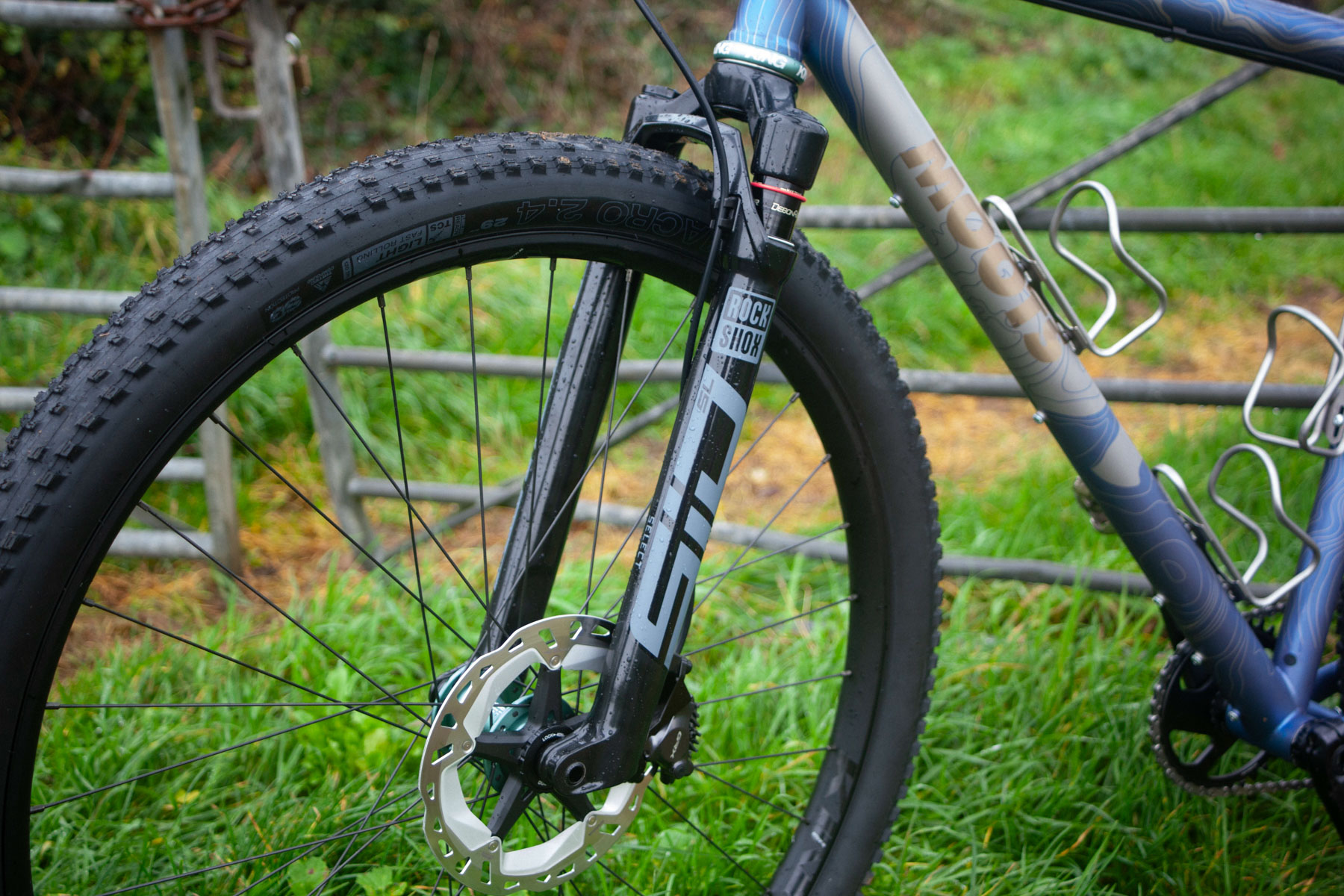
The Scrambler’s frame is designed to utilise a 100mm-travel fork.

I’d have expected Moots to use a gravel fork, such as the recently announced long-travel RockShox Rudy XL.

Moots, however, has chosen to use Boost spacing from the mountain bike world to maximise the Scrambler’s tyre clearance. This has seen it opt for RockShox’s lightweight SID SL.

Boost spacing means class-leading tyre clearance of 2.4in / 60mm.

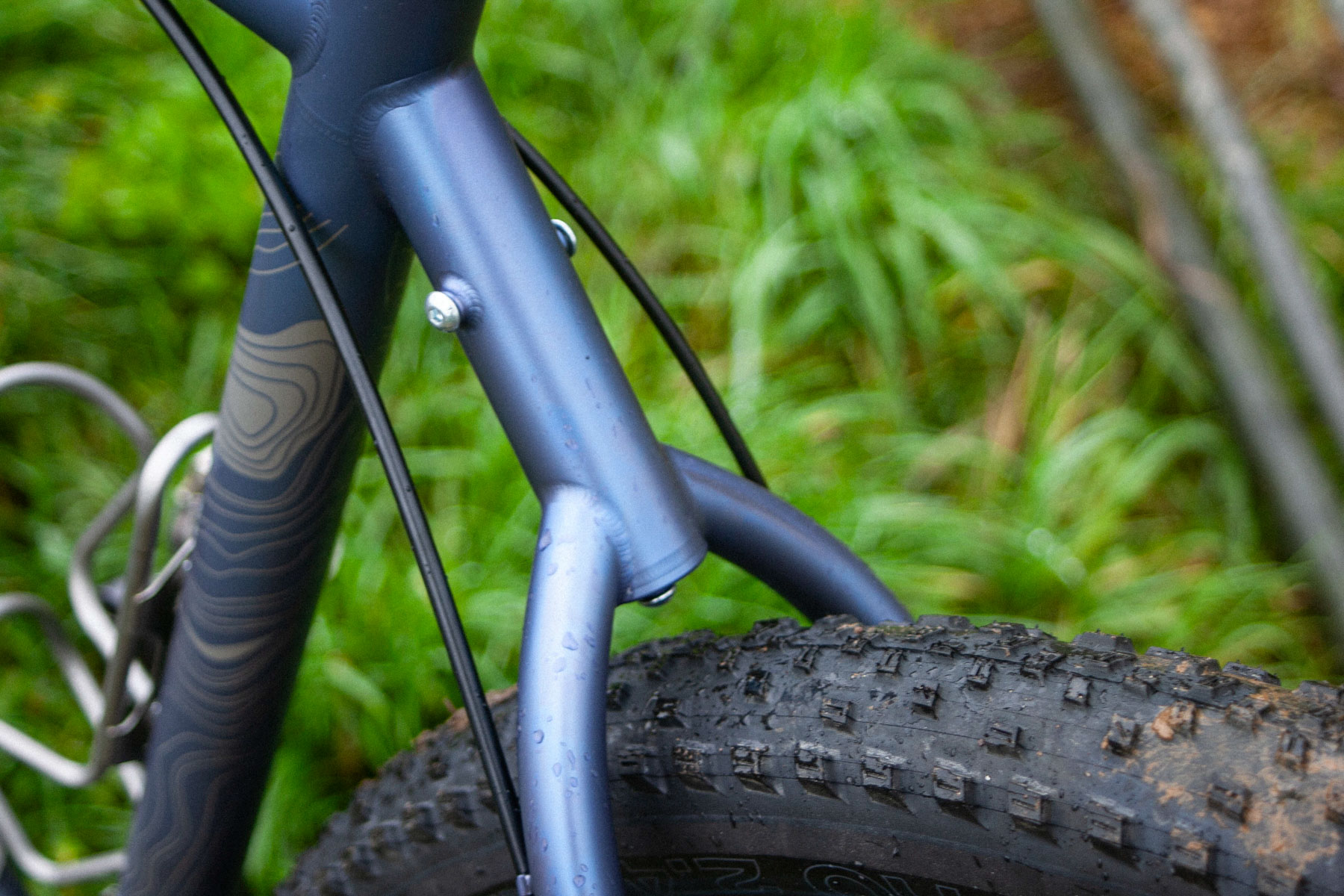
The frame’s back end uses Moots’ iconic wishbone seatstay design, with a tubeset derived from the Moots Routt 45 offering inherent compliance for all-day comfort.

The Boost dropout spacing is complemented by a UDH driveside dropout.

Moots Scrambler fork
The RockShox SID SL provides 100mm of travel, and the Boost spacing allows for 2.4in tyres. Warren Rossiter / OurMedia

The front triangle uses a new tubeset that’s double butted for similar performance to the Moots MXC mountain bike.

The adventure-ready design has three water bottle mounts within the front triangle, with further mounts under the top tube for a frame bag and under the down tube for further water-carrying capacity. Up top, there are bento box mounts, and there are rear-rack eyelets for further portage.

If you want to build a sportier bike, there’s stealth routing for a dropper post, and the Scrambler comes equipped with a stock Shimano left-hand lever to actuate the post.

Gravel geometry with mountain bike rolling stock

Moots Scrambler rear wishbone stays
Moots’ signature wishbone stays, with fender and rack mounts included. Warren Rossiter / OurMedia

The frame sticks close to current gravel bike geometry norms, with a tall stack, mid-length reach and a relaxed head angle, yet a steep seat angle.

It’s not as extreme as some trail-focused gravel bikes, such as the Nukeproof Digger, but the inclusion of 29in wheels and massive tyres should give the Scrambler plenty of extreme-terrain ability.

Size S M L XL
Effective top tube (cm) 53cm 56cm 58cm 60cm
Seat tube (cm) 43.18 50.8 55.88 58.42
Head tube (cm) 10 12 14 14
Head angle 70 70 70 70
Seat angle 74.5 74.25 73.75 73.75
BB Drop (MM) 70 70 70 70
Chainstay length (cm) 44.4 44.4 44.4 44.4
Stand over (in) 28.9in 28.9in 34.1in 34.9in
Stack (MM) 626 645 654 664
Reach (MM) 354 375 389 404


Edit Table

Limited production and mechanical gears

Moots Scrambler
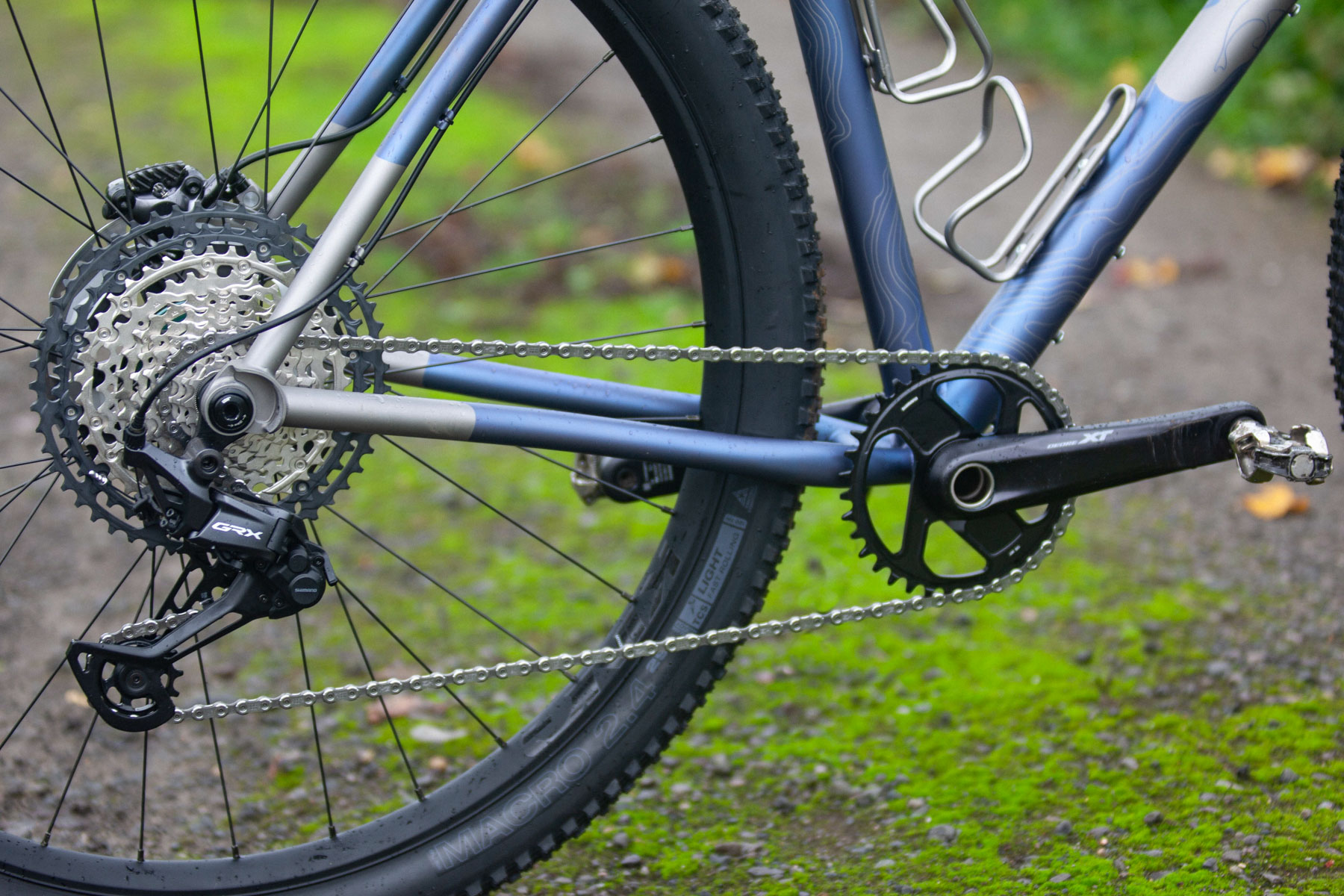
A mechanical drivetrain with external cable routing is a bold choice. Warren Rossiter / OurMedia

Moots tells us the Scrambler isn’t going to be around forever, with complete bikes and framesets only available until the end of January 2026.

It’s a bold move from Moots to offer the Scrambler only with a single, mechanical drivetrain. Instead of opting for electronic SRAM AXS or Shimano Di2, it’s a mullet drivetrain that combines Shimano’s mechanical GRX shifters with an XT 36t/170mm crankset, GRX rear derailleur and XT 10-51 cassette.

The Scrambler’s adventurous outlook makes it a sensible choice to go with a mechanical drivetrain and external cable routing, enabling trailside repairs when you’re miles from civilisation.

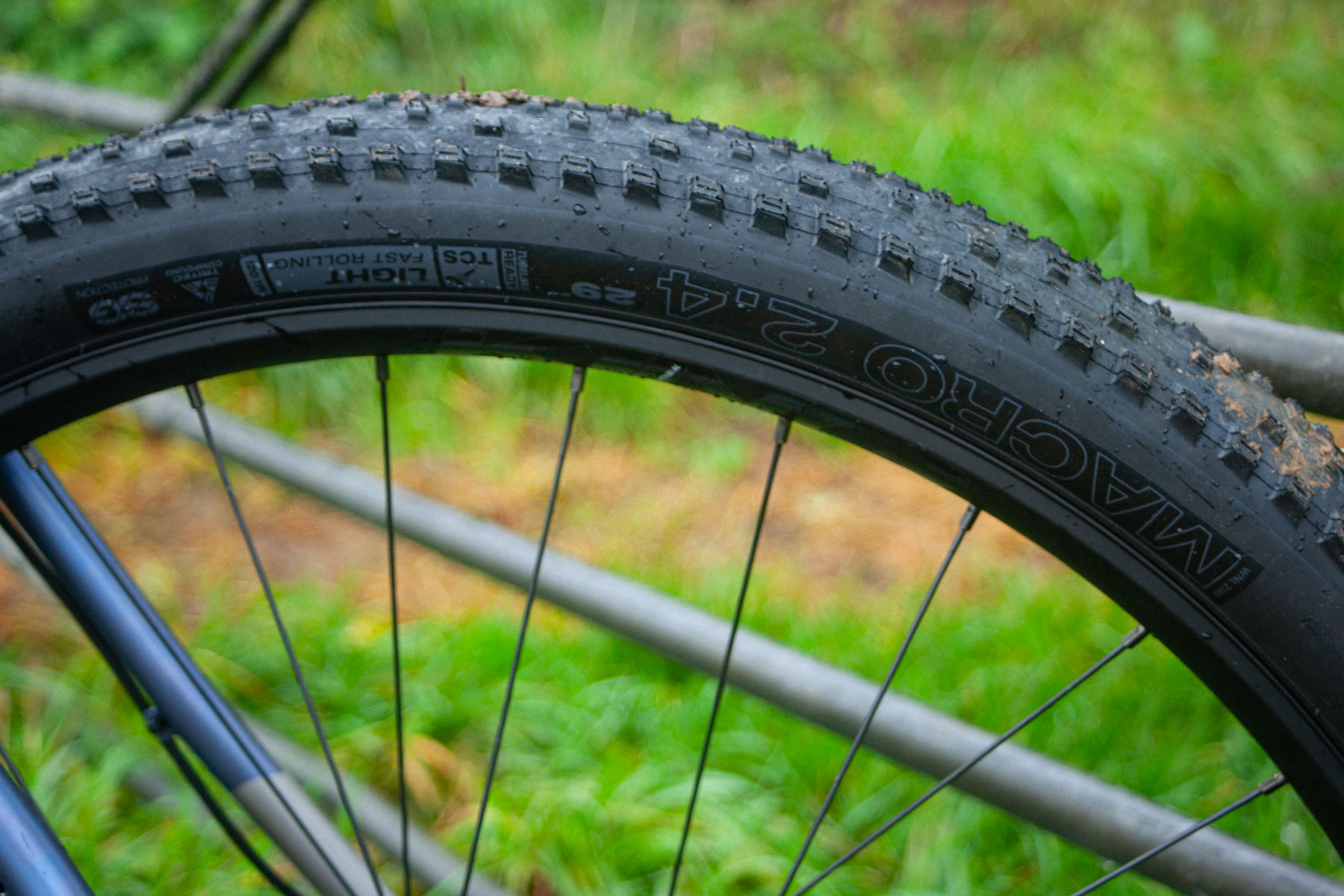
WTB's Macro 2.4 inch tyres
WTB’s Macro 2.4in tyres fit in the Scrambler’s frame. Warren Rossiter / OurMedia

Completing the build are Chris King MTN30 AL 29in Boost wheels, shod with WTB Macro 2.4in tyres. The bike is finished with an in-house Moots titanium seatpost and stem, featuring colour-matched finishes to coordinate with the customer’s chosen Chris King headset colour.

Moots Scrambler
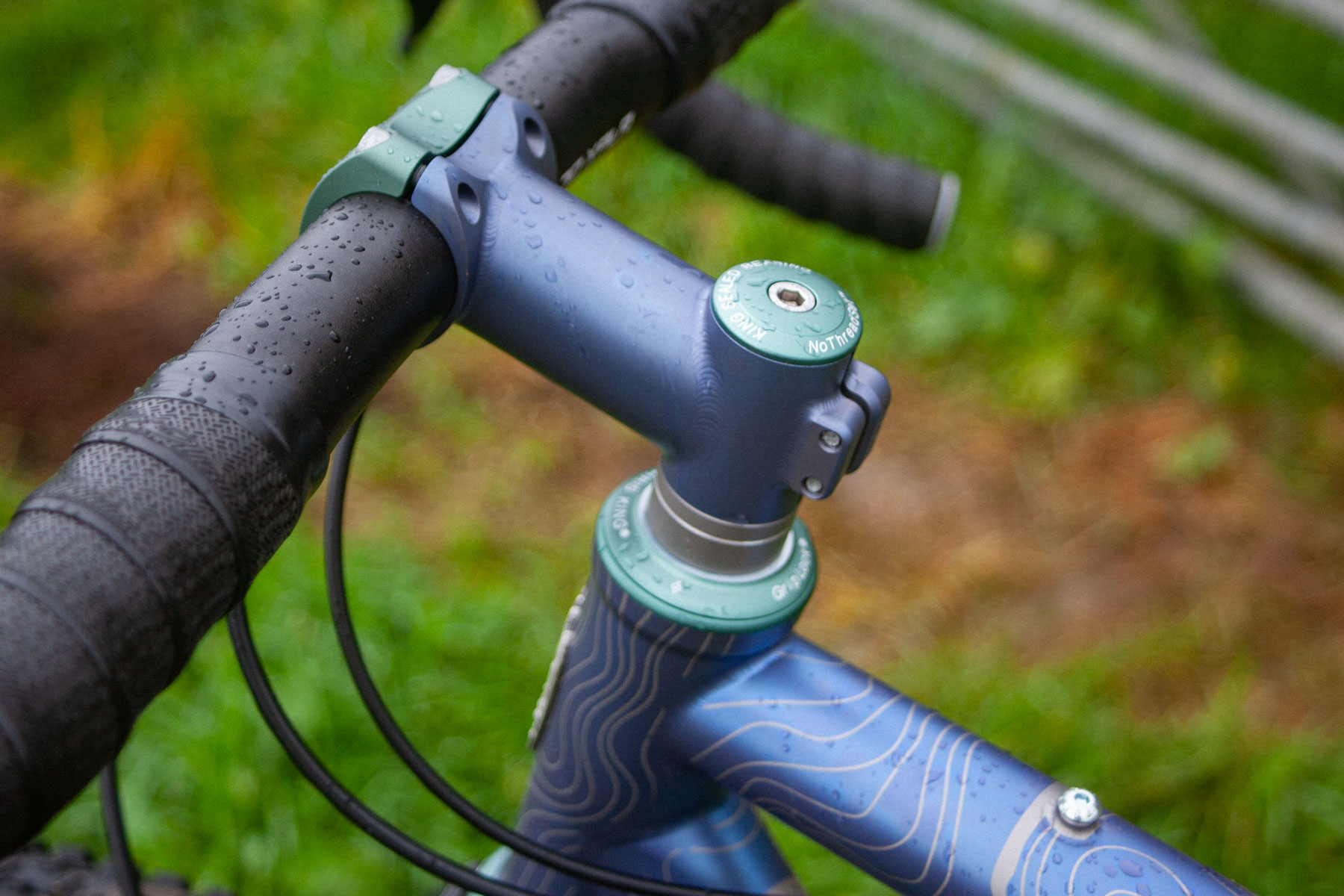
The Moots Scrambler’s titanium stem is colour-matched to the Chris King headset and Topo finish. Warren Rossiter / OurMedia

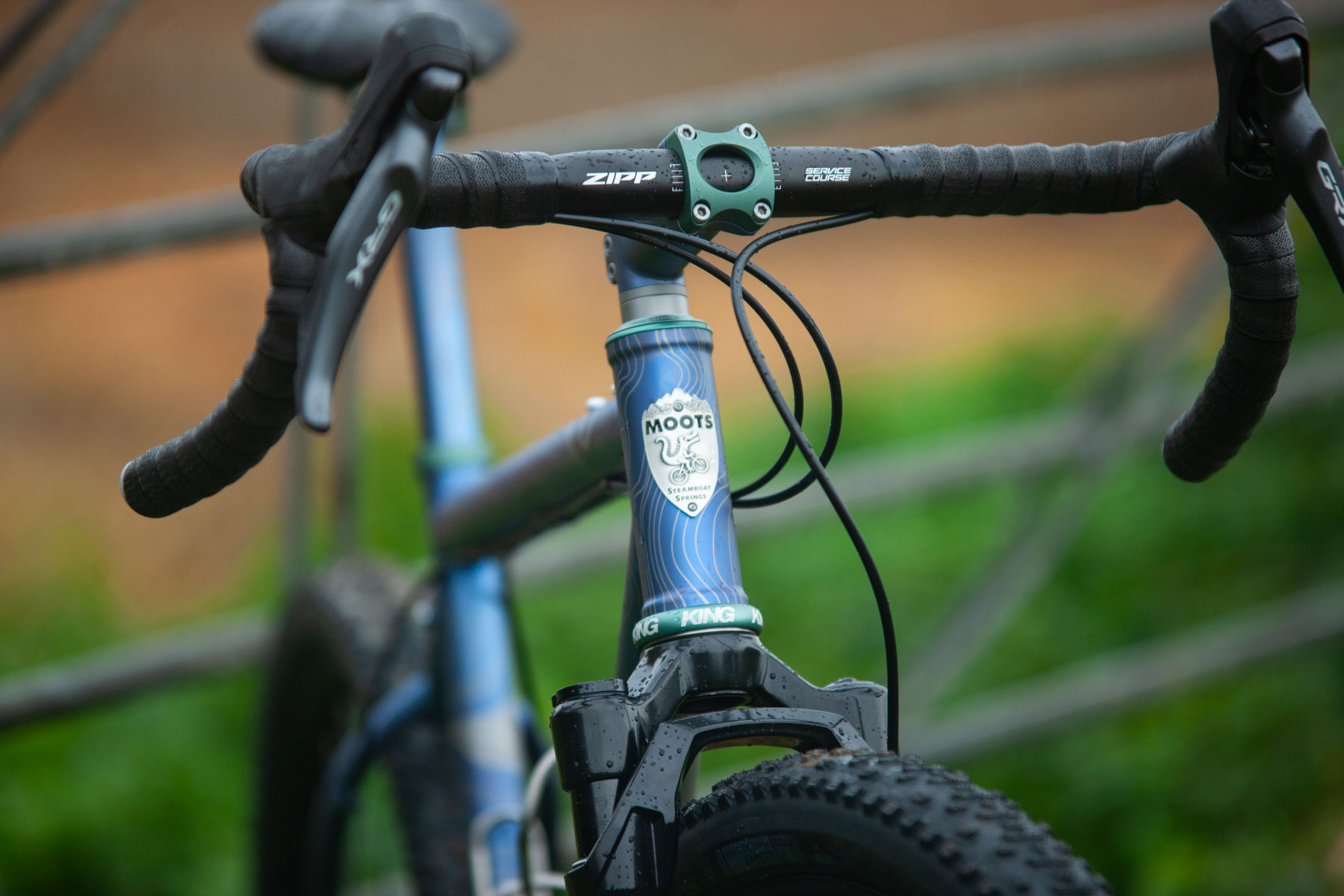
The Scrambler is available in a raw brushed-titanium finish or the stunning ‘Topo’ anodised finish seen here. The ‘Topo’ finish extends to the hand-crafted Moots titanium stem and seatpost, and there’s a custom Chris King headset to match.

I can’t help but think these Topo models are set to become a collector’s item.

Moots Scrambler build and pricing details

Moots Scrambler
The stem faceplate is matched to the Chris King headset. Warren Rossiter / OurMedia

The Scrambler is available in a single build option or as a frame only.

Specification highlights

  • Shimano GRX RX22 x XT M8100 drivetrain
  • RockShox SID SL Select 10mm fork
  • Chris King MTN30 AL 29in Boost wheelset
  • Moots titanium stem and seatpost
  • 3x Moots titanium bottle cages
  • Zipp XPLR Service Course handlebar

The complete bike is priced at $9,499 / £8,350 / €9,060, with the frame-only option starting from $5,399 / £4,750 / €4,660. You can upgrade the finish to either Moots’ premium polished and brushed finish or the very limited-edition ‘Topo’ finish seen here.

USA RRP

  • Frame-only brushed: $5,399
  • Frame-only signature: $6,399
  • Frame-only Topo: $6,899
  • Complete brushed: $9,499
  • Complete signature: $10,499
  • Complete Topo: $10,999

UK RRP

  • Frame-only brushed: £4,750
  • Frame-only signature: £5,970
  • Frame-only Topo: £6,475
  • Complete brushed: £8,350
  • Complete signature: £9,425
  • Complete Topo: £9,850

EU MSRP

  • Frame-only brushed: €4,660
  • Frame-only signature: €5,520
  • Frame-only Topo: €5,955
  • Complete brushed: €8,195
  • Complete signature: €9,060
  • Complete Topo: €9,490

Samsung Galaxy Z TriFold Gets A Holiday Launch As Specs & Pricing Leak

Samsung Galaxy Z TriFold Gets A Holiday Launch As Specs & Pricing Leak
Samsung is raring to unleash the Galaxy Z TriFold smartphone/tablet sooner than some expected. Sources close to the company indicate that this twice-folding, ultra-premium device is set to debut on December 5. With an expected price tag of approximately $3,000 (around 4.4 million Korean won) to start, the TriFold is less of a product for the

GeForce RTX 5070 Ti Price Drops Below MSRP Ahead Of Black Friday

GeForce RTX 5070 Ti Price Drops Below MSRP Ahead Of Black Friday
It took a while, but you can finally snag a GeForce RTX 5070 Ti graphics card by one of NVIDIA’s add-in board (AIB) partners for less than NVIDiA’s baseline MSRP. MSI is the the one serving up the deal, through Newegg, though the only caveat is that you have to jump through a mail-in-rebate hoop. We know, we know—that’s not idea, but even

The Incredible Evolution Of AMD EPYC HPC Performance Shown In The Azure Cloud

Last week the Microsoft Azure HBv5 instances reached general availability as powered by the custom EPYC 9V64H CPUs with HBM3 memory. These very interesting EPYC processors for memory bandwidth intensive workloads were announced last year while have finally reached GA with jaw-dropping results for software able to take advantage of the 6.7 TB/s memory bandwidth thanks to the HBM memory. The Azure HBv5 benchmarks last week showed how they compare to prior generation HBv4 instances while this article is taking things further and putting the performance into perspective against the older HBv2 and HBv3 instances.

Sony’s latest Horizon spin-off is an MMORPG for PC and mobile, but not PS5

An MMO based on Sony’s Horizon series is on the way. However, Horizon Steel Frontiers is not coming to PS5, at least not initially. It’s a mobile-first game that’s also coming to PC, in another example of Sony Interactive Entertainment expanding beyond its core PlayStation console business.

NCSoft, the MMO developer and publisher behind the likes of the Guild Wars series and Throne and Liberty, is taking the lead on Horizon Steel Frontiers. It’s working on the game alongside original Horizon developer Guerrilla Games and Sony.

Horizon Steel Frontiers is said to build on the fun robot dinosaur hunting action of Horizon Zero Dawn and Horizon Forbidden West with greater player freedom, “deeply customizable combat” and other advanced MMORPG systems. You’ll be able to undertake “large-scale raids” with other players. You’ll likely end up competing with other players for resources too.

You’ll create your own character, who belongs to a tribe of your choosing. Just like in the main games, status effects are a key component of combat. You’ll also be able to grapple onto giant machines, chip parts of them off and use weapons that robot enemies drop against them. In a neat touch, you can carry these weapons on your mount and use them in your next fight. Horizon Steel Frontiers has Tallnecks too, so I’m happy about that.

The action is set in a region called the Deadlands, which is inspired by New Mexico and Arizona, and you’ll share this part of the Horizon world with “thousands of other players,” according to Guerrilla studio director Jan-Bart Van Beek. As with the series’ core games, the story here concerns finding a balance between humanity, technology and nature.

Guerrilla said back in 2022 that it was working on more “epic solo adventures for Aloy” (the protagonist of the mainline entries) and it’s said to be making its own Horizon multiplayer game. This MMO isn’t the first Horizon spin-off either. Lego Horizon Adventures, from Guerilla Games and Studio Gobo, arrived a year ago. Co-op is a key aspect of that game, so that’s a multiplayer title too.

Handing development of Horizon Steel Frontiers to a studio with vast experience in the MMO genre is a smart move on Sony’s part. The company pivoted a few years back to focus heavily on live-service games, but that strategy hasn’t panned out so well. Sure, Helldivers 2 has been a major hit, but Concord was an utter disaster. An attempt to make a multiplayer game in the world of The Last of Us didn’t work out. Sony’s acquisition of Bungie hasn’t gone as smoothly as expected either. The company said this week it wrote down the value of Bungie’s assets by $204 million amid Destiny 2‘s struggles, putting even more pressure on the upcoming Marathon to succeed.

Sony and NCSoft have not yet revealed a release date for Horizon Steel Frontiers. In any case, Horizon is one of Sony’s most popular franchises and it should make for strong fodder for an MMO. The action in the gameplay trailer looks as slick as you’d expect from this series and taking down robot dinos with friends in Monster Hunter-style action could be a lot of fun. It’s probably a good thing that you’re not playing as Aloy here, given how annoyingly reluctant she is to accept help from would-be allies in her own games.

This article originally appeared on Engadget at https://www.engadget.com/gaming/playstation/sonys-latest-horizon-spin-off-is-an-mmorpg-for-pc-and-mobile-but-not-ps5-153532860.html?src=rss

Waymo to roll out driverless taxis on highways in three US cities

Waymo is set to expand its self-driving taxi service onto highways in three US cities on Wednesday, an advance for the venture owned by Google’s parent company that raises the stakes on safety.

The company said it would add the high-speed roads to its routes in Los Angeles, Phoenix, and San Francisco, allowing Waymo cars to ferry passengers to more destinations including San Jose International Airport.

Waymo’s rollout on highways marks a significant step for the robotaxi operator as it aims to encourage the mass adoption of driverless vehicles. It is the first time a company will carry out paid driverless services on the highway without a driver behind the wheel.

Read full article

Comments

This New Hotel Reservation Scam Is Fooling People Who Use Sites Like Booking.com

If you’ve booked a hotel through a platform like Booking.com or Expedia, beware any communication that directs you to confirm your payment details to hold your reservation. Threat actors are targeting the hospitality industry with a phishing campaign designed to steal from travelers.

As outlined by security firm Sekoia.io and reported by The Hacker News, the scheme is referred to as “I Paid Twice” because hotel customers are eventually conned into handing over their banking information. Scammers contact guests via WhatsApp or email about their booking, saying that they need to verify their payment or risk cancellation. The link goes to a fake landing page that looks like Booking.com or Expedia, where victims are prompted to provide card information.

This isn’t the first scam to target Booking.com: Scammers have previously spoofed the site to spread malware directly to users via both fake CAPTCHAs and homograph attacks, which exploit similar characters in the URL to redirect to a malicious website.

How the Booking.com ClickFix scam works

This multi-step campaign actually begins when hackers target hotels themselves with ClickFix attacks, a type of social engineering attack designed to trick users into downloading malware via fake error messages or CAPTCHA forms. (I’ve covered a handful of ClickFix schemes, such as those spread via AI-generated instructional videos on TikTok and expired invite links on Discord.)

The scam runs as follows: Hotel managers receive emails from compromised accounts with phishing links that redirect to a supposed reCAPTCHA page. This is the ClickFix component, as targets are instructed to complete the challenge to “ensure the security of your connection.” A couple of redirects lead to the user copy and execute a PowerShell command that downloads a Remote Access Trojan (like PureRAT) to their device.

Once the malware has been delivered, it allows threat actors remote access, including control of the mouse and keyboard, data exfiltration, command execution, file uploads and downloads, keylogging, and webcam and microphone capture. Hackers are then able to steal admin credentials to gain access to booking platforms and send the aforementioned phishing emails to hotel guests—or they can sell the information to other cybercriminals.

Don’t fall for the hotel booking scam

You can’t control whether a hotel manager unwittingly hands over access to your booking information. But you can avoid further compromising your personal and financial data by staying vigilant to any unexpected communication about your reservation. A reputable hotel probably won’t contact you via a booking platform (nor will the platform itself) to demand payment for holding a reservation you’ve already confirmed.

This sense of urgency is meant to trick you into acting quickly, so if you’re not sure what’s going on, call the hotel directly using the number on their official website (not from the email or WhatsApp message). Don’t click any links, and don’t enter any information unless you have confirmed that you are on a legitimate booking platform or hotel website.

France Fully Lifts Travel Ban on Telegram Founder Durov

An anonymous reader shares a report: France has lifted its travel ban on Telegram founder Pavel Durov, who is under investigation over illegal content on his messaging app, judicial sources close to the case said Thursday. The entrepreneur, 41, was detained in Paris in 2024 and is under formal investigation by French authorities over the platform’s alleged complicity in criminal activity. Durov, who was initially banned from leaving France, had his judicial control relaxed in July, allowing him to reside in the United Arab Emirates, where Telegram is based, for a maximum of two weeks at a time.


Read more of this story at Slashdot.

Debunking myths about space science with Astro Pi impact evidence

The European Astro Pi Challenge is a collaboration between ESA, the national European Space Education Resource Offices, and the Raspberry Pi Foundation. The 2025/26 challenge, which is currently open for registration, marks 10 years of incredible opportunities for young people to send their code into space.

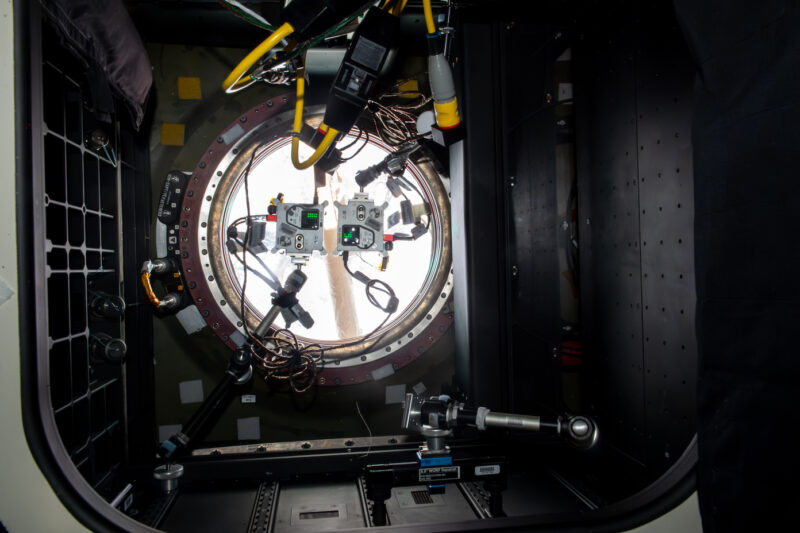
The Astro Pi computers inside the International Space Station.
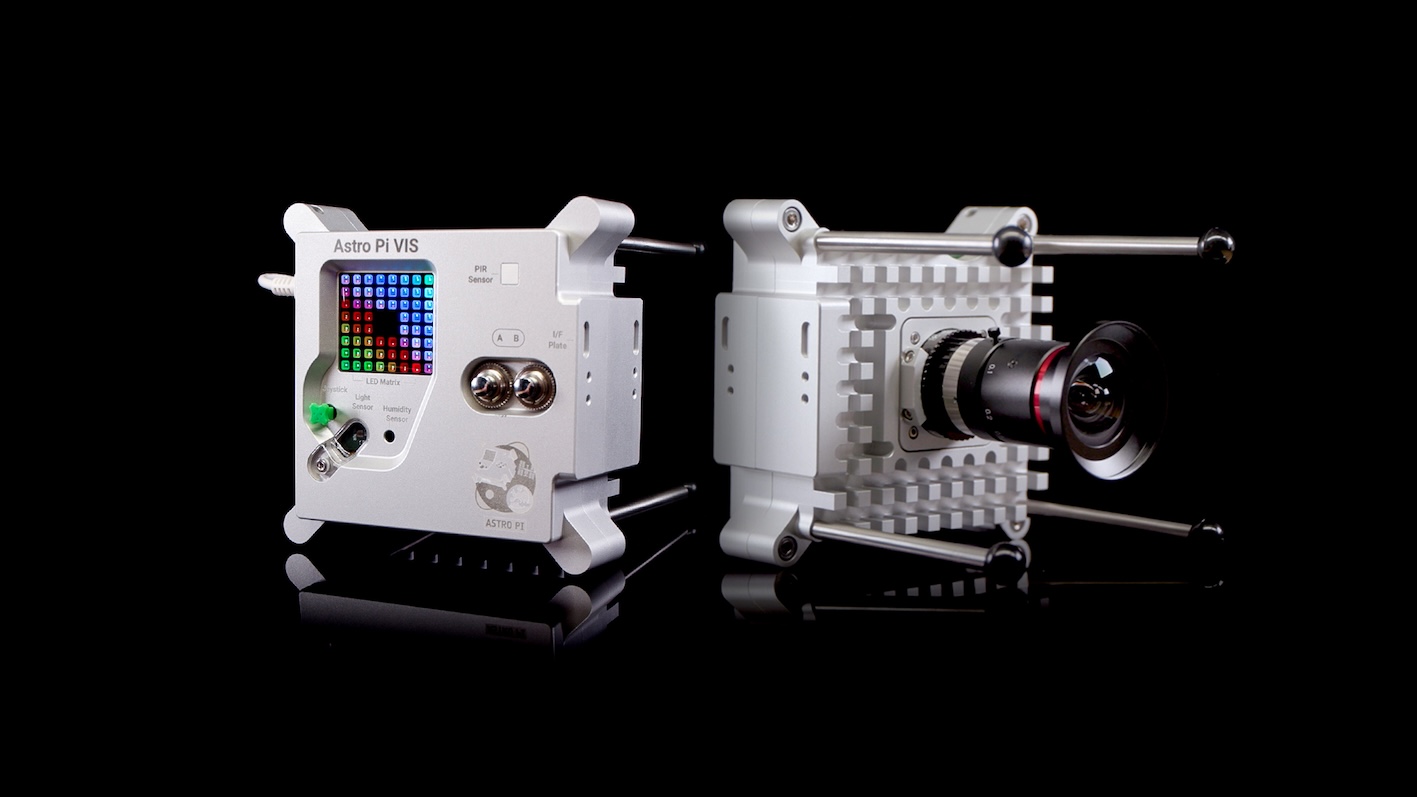
The Astro Pi computers inside the International Space Station, where young people’s programs run.

In this blog post, we are pleased to share the Astro Pi 2024/25 impact report, where we look at ways in which the Astro Pi Challenge is bringing value to the lives of many young people and mentors, based on survey responses and interviews. Along the way, we’ll debunk some myths about space science.

How Astro Pi makes space science accessible

Here at the Raspberry Pi Foundation, we’ve heard a few myths about space science and coding, and how daunting it can be to write a computer program, let alone one that can run in space. We can’t let these myths stand — instead we’re going to debunk them, equipped with evidence we’ve collected about the 2024/25 Astro Pi Challenge and previous challenge rounds.

A young person takes part in Astro Pi Mission Zero.

Read on for some astronomical facts from our latest impact report, and get ready to help young people in your community send their code into space.

Myth 1: You have to be a rocket scientist to send things into space

Not true! In the Astro Pi Challenge 2024/25, young people created over 17,800 computer programs that ran on board the International Space Station (ISS). Teams of young people aged between 8 and 19 took part in the challenge in a range of settings, including schools, Code Clubs, libraries, and community youth groups. They wrote short programs in Python, which were then sent to run on special Raspberry Pi computers, called Astro Pis, in the Columbus module of the ISS. 

The Astro Pi computers.
The Astro Pi computers up close.

Since the first Astro Pis arrived on the ISS in 2015, over 160,000 young people have had their code run in space. To celebrate their achievements, they each received certificates with the exact time and location of the ISS when their programs ran.

“We want our code to run in space! We are fascinated by discovery and the opportunity to contribute to a real science experiment on the ISS.” – Mission Space Lab mentor

Myth 2: Only experienced programmers can write code for the International Space Station

Not true! The Astro Pi Challenge is made up of two missions, Mission Zero and Mission Space Lab, and Mission Zero is perfect for young people who are new to text-based coding. With the help of step-by-step project instructions, young people write a short Python program to display personalised pixel art on board the ISS, using data from a sensor on one of the Astro Pi computers in their image.

Young people writing Mission Zero programs.

In fact, Mission Zero mentors find that the low-stakes nature of the activity coupled with the real-world connection to space create an ideal learning environment. 83% of Mission Zero 2024/25 mentors told us that participation increased young people’s skills and confidence in computing and digital making, and 78% believed that young people were likely to participate in other computing or digital making challenges in the future.

“They [young people] come from complicated environments and sometimes their confidence is very low. They don’t believe in themselves and this [Mission Zero] really empowers them.” – Mission Zero mentor

Myth 3: Learning to write code for the ISS only involves technical skills

Not true! Mission Zero engages young people in thinking creatively as they plan their artwork, and Mission Space Lab involves working in teams to write a computer program to solve a scientific task in space, combining teamwork, problem-solving, and knowledge from other scientific domains. While 100% of mentors whose teams successfully completed Mission Space Lab in 2024/25 agreed that participation improved young people’s skills in computing and digital making, 91% also confirmed that it increased young people’s confidence in these areas, and 91% told us that it increased young people’s understanding of STEM concepts. 

The impact likely goes beyond building skills. Mentors from both Astro Pi 2024/25 missions told us that the challenge made young people feel connected to a wider community of learners around the world, and the excitement of the challenge also extended to the mentors themselves, as well as other adults in their community.

“Mission Zero is a way of connecting not only to a worldwide group of learners, but also to explorers, future scientists, and future astronauts. To see them as part of a larger community and not just an activity or assignment that they have to do in class.” – Mission Zero mentor

Images of Earth taken aboard the ISS by a Mission Space Lab team.
An image sequence captured by team TheNinja during their Mission Space Lab experiment

Thank you to everyone who continues to make the Astro Pi Challenge a success. To find out more about the ways in which the challenge impacts young people, read the full Astro Pi 2024/25 impact report:

If you would like to find out more about how you and your creators can participate in this year’s European Astro Pi Challenge, read our launch blog post.

The post Debunking myths about space science with Astro Pi impact evidence appeared first on Raspberry Pi Foundation.

Black Holes Defy Stellar Laws With Impossible Mergers & Scientists Finally Know How

Black Holes Defy Stellar Laws With Impossible Mergers & Scientists Finally Know How
Seven billion light-years away, an astronomical event in 2023 sent a buzz through the astrophysics community. Gravitational wave detectors registered the merger of two black holes (a collision designated GW231123). The detection itself was not unusual, but the characteristics of the merging objects were. Both black holes were colossal, boasting

What would a “simplified” Starship plan for the Moon actually look like?

In what will likely be his most consequential act as NASA’s interim leader, Sean Duffy said last month that the space agency was “opening up” its competition to develop a lunar lander that will put humans on the surface of the Moon.

As part of this move, Duffy asked NASA’s current lunar lander contractors, SpaceX and Blue Origin, for more nimble plans. Neither has specified those plans publicly, but a recent update from SpaceX referenced a “simplified” version of the Starship system it’s building to help NASA return humans to the Moon.

“Since the contract was awarded, we have been consistently responsive to NASA as requirements for Artemis III have changed and have shared ideas on how to simplify the mission to align with national priorities,” the company said. “In response to the latest calls, we’ve shared and are formally assessing a simplified mission architecture and concept of operations that we believe will result in a faster return to the Moon while simultaneously improving crew safety.”

Read full article

Comments

“Faster than a Specialized Tarmac” – Cinelli launches the Aeroscoop aero road bike with distinctive split seatstay design

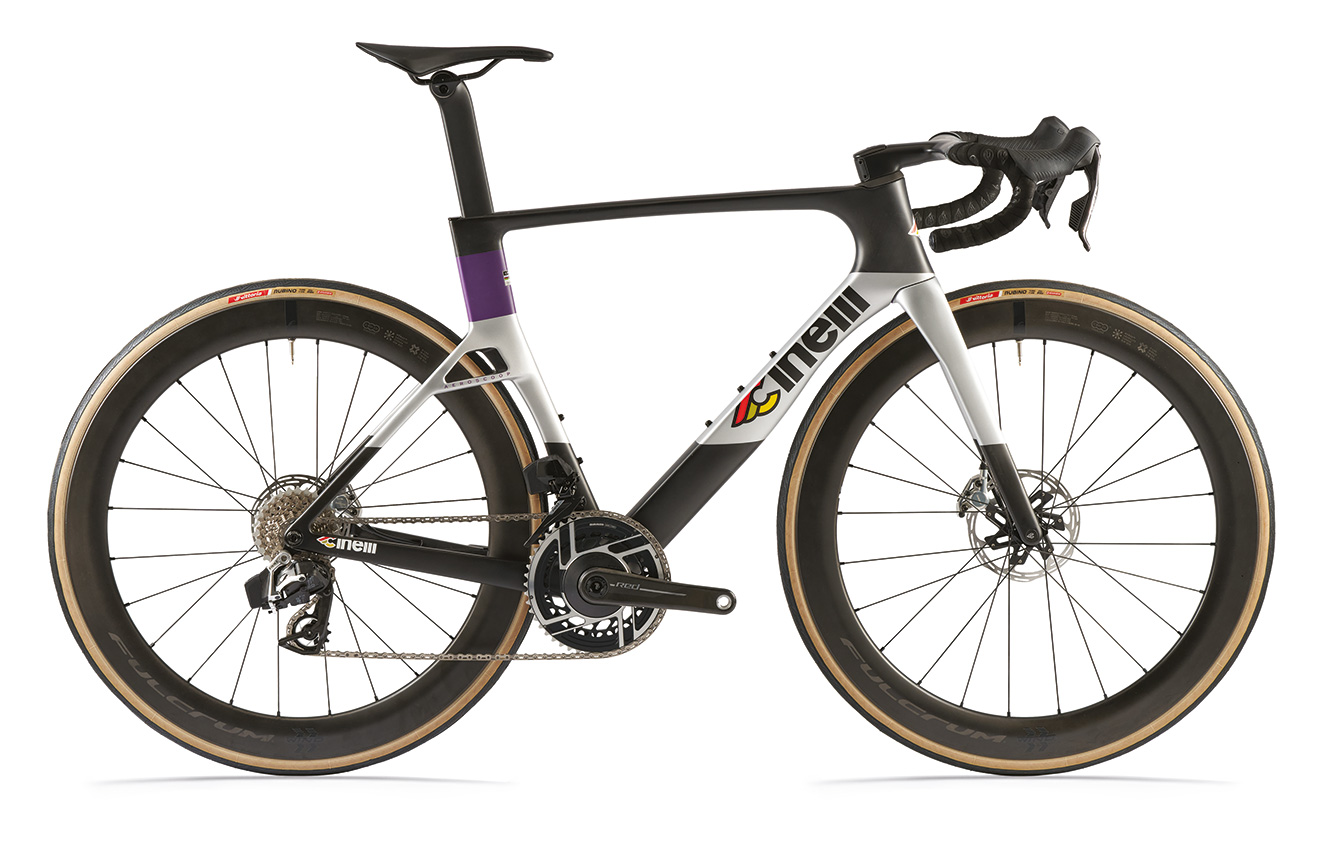
Cinelli has launched two new bikes: the Aeroscoop is a carbon aero road bike designed for pro-level racing, while the Speciale Corsa XCR is a stainless steel road bike with premium specs and pricing. 

Cinelli claims the Aeroscoop is one of the fastest aero bikes tested by Tour magazine, while also boasting a sub-7kg claimed weight in the top-spec builds. Full bike prices start at £5,299.

Meanwhile, full builds of the Speciale Corsa XCR, built in Milan, weigh from a claimed 8.1kg, with prices starting at a princely €12,500. 

Cinelli Aeroscoop

Aeroscoop full builds can weigh less than 7kg.

The Aeroscoop has been designed to meet the need for a lightweight aero race bike for Cinelli’s sponsored MBH Bank Colpack Ballan CSB UCI Continental cycling team.

Kitted out with SRAM Red AXS and Fulcrum Wind 57 wheels, Cinelli says the Aeroscoop weighs a claimed 6.98kg.

Although the Aeroscoop is a departure from the brand’s focus on metal frames, Cinelli says the design builds on its Pressure 2 race bike. Cinelli says it’s stiffened up the bottom bracket area in the Aeroscoop, while increasing compliance at the head tube for better handling through corners. Tyre clearance is 34mm.

Cinelli describes the geometry as ‘pure racing’, promoting an aggressive position and balanced handling.

At the same time, Cinelli has reduced the frame and fork weight from the Pressure 2 to bring the frame weight down to 950g and the fork weight to 370g for a size M.

Cinelli Aeroscoop aero road bike
The distinctive seatstay design is claimed to channel airflow around the rear wheel.

A distinctive feature of the Aeroscoop is the split heads to the seatstays, where they meet the seat tube. Looking like a cross between the Pinarello Dogma X and the Trek Madone, the design is claimed to guide airflow and reduce turbulence at the frame-to-wheel interface.

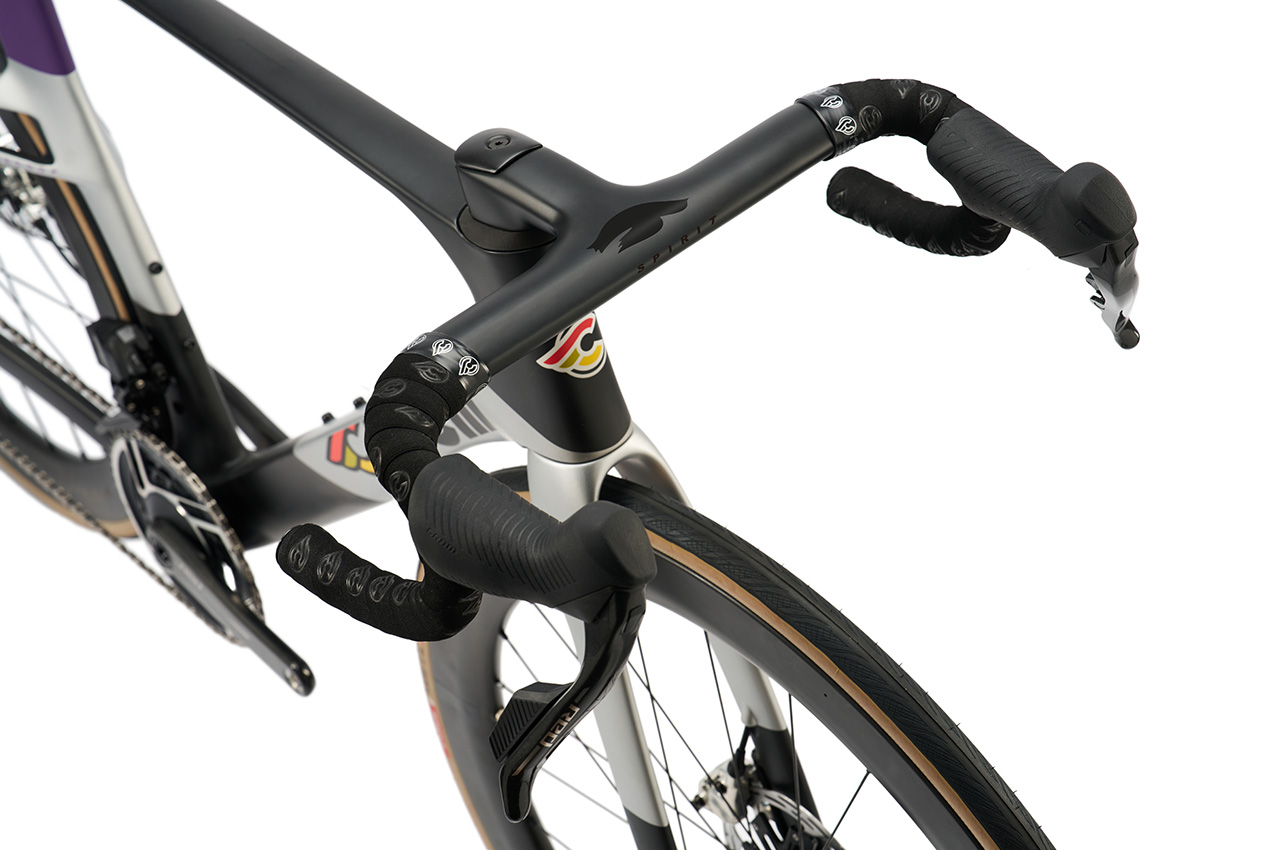
Additional aero benefits come from a 4% reduction in the Aeroscoop’s frontal area, Cinelli claims, alongside a small decrease in the head tube width. There’s also a revised down tube shape that shields the bottles and cages, and a smoother transition between frame and fork.

Cinelli says that in independent wind tunnel tests conducted by Germany’s Tour magazine, the Aeroscoop was one of the top ten aero bikes it has tested, with a normalised drag figure of 205 watts at 45km/h. Cinelli claims that the results are better than those Tour found for the Specialized Tarmac SL8 with identical wheels, in a 0-degree headwind.

Cinelli Aeroscoop specs and prices

The new Columbus flared bars are claimed to contribute to a 4% decrease in the Aeroscoop’s frontal area over the Pressure 2.

Prices for the Cinelli Aeroscoop start at £5,299 / €6,000. There’s a frameset-only option available for £3,999 / €4,500. You can also ride the Aeroscoop virtually on Rouvy. 

Sizes available are from XS to XL.

Cinelli Aeroscoop Super Record WRL 13s

  • Groupset: Campagnolo Super Record 13 52/36t, 11-32t
  • Wheelset: Fulcrum Wind 57
  • Tyres: Vittoria Rubino 28mm
  • Saddle: Fizik Antares R7
  • Price: €10,700

Cinelli Aeroscoop Red eTap AXS

  • Groupset: SRAM Red AXS 48/35t, 10-30t
  • Wheelset: Fulcrum Wind 57
  • Tyres: Vittoria Rubino 28mm
  • Saddle: Fizik Antares R7
  • Price: €10,700

Cinelli Aeroscoop Dura-Ace Disc Di2

  • Groupset: Shimano Dura-Ace 52/36t, 11-30t
  • Wheelset: Fulcrum Wind 57
  • Tyres: Vittoria Rubino 28mm
  • Saddle: Fizik Antares R7
  • Price: €9,900

Cinelli Aeroscoop Ultegra Disc Di2

  • Groupset: Shimano Ultegra 52/36t, 11-30t
  • Wheelset: Fulcrum Soniq AL
  • Tyres: Vittoria Zaffiro Pro 28mm
  • Saddle: Fizik Antares R7
  • Price: €6,900

Cinelli Aeroscoop 105 Disc Di2

  • Groupset: Shimano 105 Di2 52/36t, 11-34t
  • Wheelset: Fulcrum Soniq AL
  • Tyres: Vittoria Zaffiro Pro 28mm
  • Saddle: Fizik Antares R7
  • Price: €6,000

Cinelli Speciale Corsa XCR

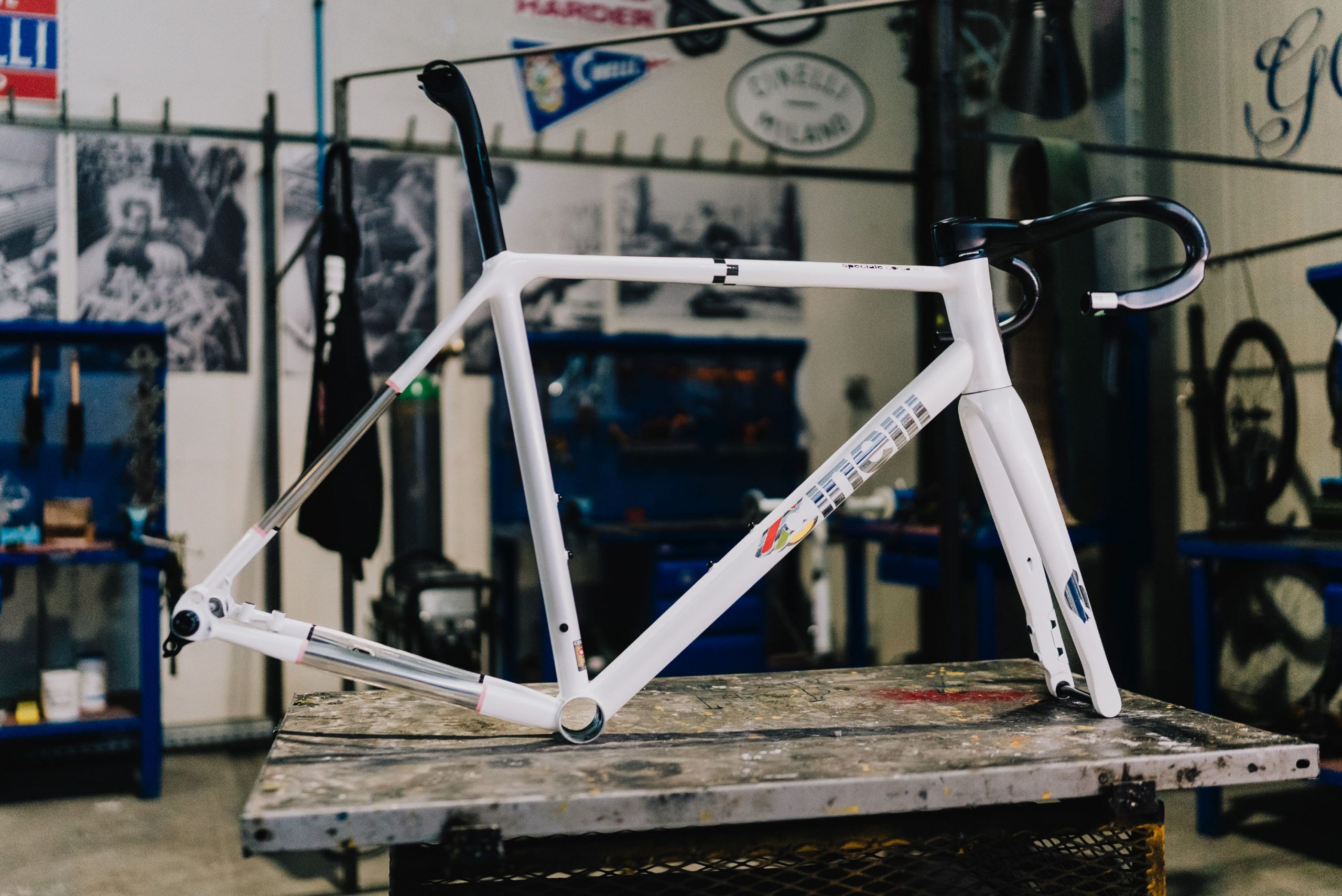
This is the new Cinelli Speciale Corsa XCR. Michela Pedranti

Alongside the Aeroscoop, Cinelli has launched the Speciale Corsa XCR. It’s more in line with Cinelli’s traditional specialism and is handmade in Milan from XCR stainless steel from Cinelli’s sister brand, Columbus.

The triple-butted, cold-drawn steel tubing is TIG-welded, with brazed junctions into 3D-printed hidden lugs at the seat cluster and the head tube-to-top tube joint.

The stainless steel tubing is brazed into 3D-printed internal lugs at the seat cluster and head tube. Michela Pedranti

Modern features include full internal routing through the newly designed Columbus Spirit integrated cockpit. It’s built for electronic groupsets only and has a UDH rear derailleur hanger.

There’s 32mm tyre clearance and a 1,990g claimed frame weight, with the Columbus Trittico carbon fork adding 392g. The SRAM Red AXS build has an 8.1kg claimed weight.

Cinelli Speciale Corsa XCR specs and prices

The premium builds include top-spec groupsets from Shimano, SRAM and Campagnolo, and DT Swiss ACR 1100 wheels. Michela Pedranti

The Speciale Corsa XCR is available in the same XS to XL sizes as the Aeroscoop. There are three top-tier specs, as well as a frameset-only option priced at £5,000 / €5,000.

Cinelli Speciale Corsa XCR Super Record WRL 13s

  • Groupset: Campagnolo Super Record 13 52/36t, 11-32t
  • Wheelset: DT Swiss ARC 1100 Dicut 55mm
  • Tyres: Vittoria Corsa Pro 30mm
  • Saddle: Fizik Antares R7
  • Price: €13,500

Cinelli Speciale Corsa XCR Red eTap AXS

  • Groupset: SRAM Red AXS  48/35t, 10-30t
  • Wheelset: DT Swiss ARC 1100 Dicut 55mm
  • Tyres: Vittoria Corsa Pro 30mm
  • Saddle: Fizik Antares R7
  • Price: €13,000

Cinelli Speciale Corsa XCR Dura-Ace Disc Di2

  • Groupset: Shimano Dura-Ace  52/36t, 11-30t
  • Wheelset: DT Swiss ARC 1100 Dicut 55mm
  • Tyres: Vittoria Corsa Pro 30mm
  • Saddle: Fizik Antares R7
  • Price: €12,500

Windows Boss Ignites Angry Revolt Over Agentic OS As AI Fatigue Sets In

Windows Boss Ignites Angry Revolt Over Agentic OS As AI Fatigue Sets In
Ahead of Microsoft’s next Ignite event, which kicks off in San Francisco (and online) next Tuesday, November 18, the company’s president of Windows and Devices shared a message on X about the direction Windows is headed it didn’t land particularly well. Just the opposite, it sparked an angry backlash that is a clear indication of AI fatigue.

In

Valve confirms that it has stopped making the Index VR headset

In case you missed it, Valve announced a load of new hardware this week, including a second stab at the Steam Machine, a Steam controller, and a long-rumored new VR headset called the Steam Frame. But in with the new often means out with the old, and perhaps inevitably, the company has confirmed that its previous headset, the Valve Index, is no more.

Valve’s Lawrence Yang told The Verge that it’s “no longer manufacturing” the Index, which we called “the best desktop VR yet” when it launched in 2019. The Index arrived around the same time as the Oculus Quest and its promise of an affordable all-in-one future for VR. By contrast, the Valve Index was very much still a high-end tethered device for the hardcore enthusiasts, with a price tag that reflected that.

We don’t know how much the Steam Frame will cost yet, but it definitely sounds like Valve is making a play for the more casual VR crowd here too, as well as those who want to play demanding 3D titles. You can stream flatscreen and VR games from your PC or Steam Machine using a wireless adapter, but the Steam Frame is also a standalone device like the Meta Quest 3, backed by a built-in Snapdragon 8 Gen 3 chipset and 16GB of RAM. Valve is supporting Android games too, seemingly a move to entice VR developers to bring their Quest games over to Steam.

In order to track your movements in virtual space, the Valve Index relied on external lighthouse base stations, which meant you had to go through a more than a little laborious setup process to play roomscale VR games. Consumer VR has moved towards built-in sensors since then, and it sounds like Valve wants to leave its lighthouses in the past too, with the company confirming to The Verge that they won’t be supported on the Steam Frame. The new headset instead has four high-res monochrome cameras for inside-out tracking, as well as infrared LEDs on the outside that help with tracking in darker environments.

This article originally appeared on Engadget at https://www.engadget.com/ar-vr/valve-confirms-that-it-has-stopped-making-the-index-vr-headset-150324456.html?src=rss

This Hisense 65″ Mini-LED TV Is $300 Off Right Now

We may earn a commission from links on this page. Deal pricing and availability subject to change after time of publication.

The 65-inch Hisense U65QF TV is now selling for $547.99, marked down from $847.99, and price trackers confirm this is its lowest recorded price.

It’s a solid drop for a TV that is also PCMag’s Editors’ Choice pick, praised in an “outstanding” review as “a bright, beautiful TV at a budget-friendly price.” That summary fits. The TV’s mini-LED backlight is the first thing that stands out. It gets bright (crossing the 1,000-nit mark), which you feel immediately when you watch something mastered for Dolby Vision or HDR10. Scenes with high contrast, like night shots filled with neon signs, look sharp and bold, though you’ll notice some light bloom in those high-contrast edges. Still, for a 65-inch model at this price, the picture feels more vibrant than last year’s Hisense U6N, which already had a solid reputation. If you’re looking for something bigger, the 75-inch and 85-inch versions are also priced under $1,000 at the moment.

The U65QF handles motion in a way that makes day-to-day viewing feel easy, whether you’re watching a late-night movie or catching a weekend match. The 144Hz refresh rate keeps fast scenes clean, so car chases, quick pans, and rapid game replays don’t break into blur. That same responsiveness carries into gaming. AMD FreeSync Premium Pro keeps the picture stable when frame rates dip, and the input lag—4.6ms at 1080p/120 and 13.1ms at 4K/60—helps the TV respond as soon as you do. The panel’s brightness also plays a big role. Highlights stay strong without washing out shadows, and the screen holds its color well even when you’re off to the side, giving it better viewing angles than you’d expect from a budget TV.

Hisense does shift direction on the software side, moving from Google TV to Amazon’s Fire TV, and that change shapes the experience noticeably. Fire TV is familiar, smooth, and supports every major streaming app, but the interface leans heavily on ads. The platform still covers the basics well, offering AirPlay for Apple devices, though the lack of Google Cast means Android users lose an easy streaming option they may be used to. Alexa remains part of the setup and handles voice commands without trouble, but the absence of hands-free microphones means you’ll still rely on the remote’s mic button each time. It’s a workable setup, just not as flexible as before.


Our Best Editor-Vetted Tech Deals Right Now


Apple AirPods 4 Wireless Earbuds


—
$84.99

(List Price $129.00)


Apple Watch Series 10


—
$309.99

(List Price $429.00)


Amazon Fire HD 10 (2023)


—
$69.99

(List Price $139.99)


Sony WH-1000XM5


—
$328.00

(List Price $399.99)


Amazon Fire TV Stick 4K Plus


—
$24.99

(List Price $49.99)

Deals are selected by our commerce team

[$] Another Fedora Flatpak discussion

Many distributions provide support out of the proverbial box for
Flatpak packages, but Fedora is unusual in that it also provides, and
defaults, to its own repository of Fedora-built Flatpaks. This has been
a source of confusion for Fedora users, who expect to get the Flatpak
built by the original developers and hosted on Flathub. It has also been a source
of conflict with upstream projects, because users complain of bugs in
Flatpak packages they are not responsible for. The situation has also frustrated some
Fedora developers, who would prefer to offer put Flathub’s offerings
first. A new complaint that Fedora has apparently used manifests
from Flathub to build the packages for Fedora—without giving credit to
the original authors—has spurred discussions about Fedora’s
Flatpaks once again. While no concrete changes are on the table, yet,
there may be some movement toward addressing persistent complaints.