Mozilla Launches AI Window for Firefox

Mozilla announced on Thursday that it is building an AI Window for Firefox, a new opt-in browsing mode that will let users interact with an AI assistant and chatbot. The feature will become one of three browsing experiences in Firefox alongside the existing classic and private windows. Users will be able to select which AI model they want to use in the AI Window, according to a post on the Mozilla Connect forum.

The company opened a waitlist for users who want to receive updates and be among the first to test the feature. Mozilla described the AI Window as an “intelligent and user-controlled space” that it is developing in the open through community feedback. Users who try the feature and decide against it can switch it off entirely.


Read more of this story at Slashdot.

Red Dead Redemption is coming to mobile for Netflix subscribers

Red Dead Redemption will finally be available on mobile devices, but only for Netflix subscribers. This was discovered by prolific news source and deals curator Wario64, who also revealed a release date of December 4. The game will be free to play on both iOS and Android devices and will include the zombie-centric DLC Undead Nightmare.

Red Dead Redemption coming to Netflix on Dec 4th
iOS https://t.co/gXKy5edObR
Android https://t.co/eg6RhKhsAt https://t.co/7JJPR7nx6W pic.twitter.com/W07ZrVhXhl

— Wario64 (@Wario64) November 13, 2025

That same leaker has also discovered an ESRB website with ratings for the PS5, Xbox Series X/S and the Switch 2, so it’s likely that Rockstar’s open world western is heading to current-gen platforms. We don’t have a release date for these ports. It’s already available for the PS4 and the original Switch.

It’s worth reiterating that this is the first Red Dead Redemption from 2010, and not the sequel. It’s still a great game, despite not quite reaching the highs of Red Dead Redemption 2.

This is just the latest team-up between Netflix and Rockstar. Grand Theft Auto: The Trilogy – The Definitive Edition became available on Android and iOS for Netflix subscribers back in 2023.

This article originally appeared on Engadget at https://www.engadget.com/gaming/red-dead-redemption-is-coming-to-mobile-for-netflix-subscribers-180557451.html?src=rss

Google’s AI Mode Can Now Work Like a Virtual Sales Associate

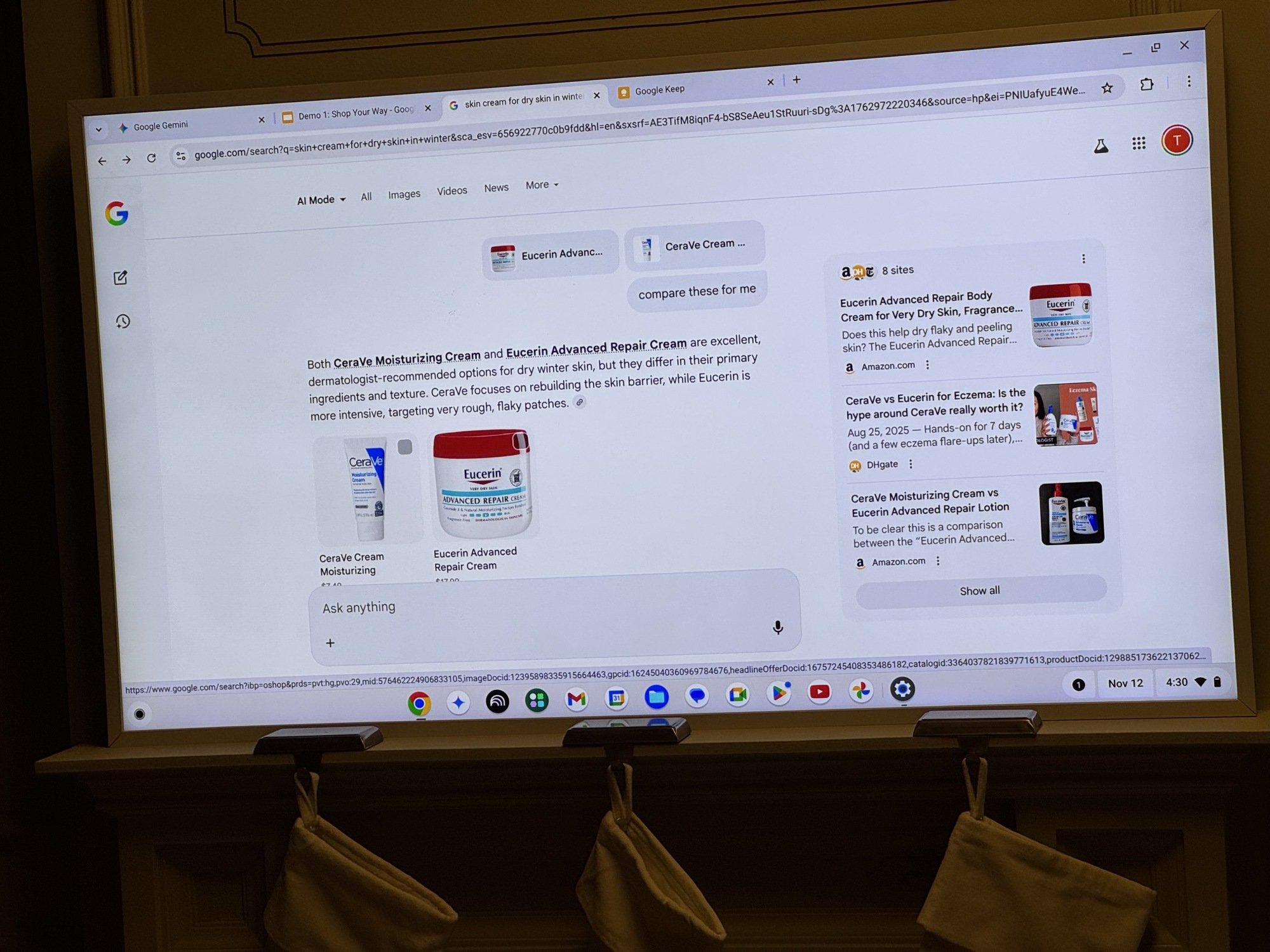
Google really wants you to use its AI to help you do your holiday shopping, and to that end, it’s finally letting AI Mode and Gemini directly link you to products. The new feature is powered by Google’s “Shopping Graph,” a list of 50 billion products that also informs Google’s Shopping tab, and it’s available to everyone on both desktop and mobile starting today.

Here’s how it works: In Google search’s AI Mode or the Gemini app/website, you can ask a question or send a prompt about a physical product, like “Help me find an espresso maker that has a steam wand, is affordable, and is good for beginners.” If the AI can find relevant product information in the Shopping Graph, it’ll then give you a short writeup and pop up a few product suggestions along with shopping information, like pricing and user reviews. Clicking on any of these tiles will then open a sidebar with sites where you can purchase the item.

Google Shopping information in AI Mode on desktop

Credit: Michelle Ehrhardt

Essentially, it’s like using Google’s Shopping tab, but with a virtual shopping assistant (or, let’s be real, a salesperson) you can turn to for more context about what you’re seeing. Some queries will even let you click a checkbox on their product tiles so you can mark off to ask follow-up questions. For instance, you could check off two product tiles and ask the AI to compare them, or ask which is cheaper or has better reviews.

According to Google representatives at a press event, the company is hoping this will make it easier for shoppers to buy gifts for friends or relatives that are traditionally hard to shop for, and that it will make shopping easier by letting people search using natural language.

My hands-on experience

When I tested out this new tool, it generally worked out, but I did encounter a few hiccups. The biggest was that it was hard to get the AI to recognize certain products as topics it could surface tiles for. For instance, asking for “Popular Nintendo Switch games under $60” just gave me a list of games, but no links to purchase them. I assume this is because the AI thought I was simply asking for general advice about what to play instead of shopping, but no amount of rewording would prompt the tool to show me product tiles, even when I explicitly asked for them.

I also ran into problems when it came to natural language searches. At the aforementioned press event, Google gave journalists example questions to ask the AI in order to try the new feature, but I found only the questions that called out specific types of products would give me tiles to click on.

For instance, a question like “Give me Christmas gift ideas for my sister who loves knitting and reading” wouldn’t trigger the new feature, but “show me ottomans that can be used as coffee tables” would. Even the example Google used in its blog announcing the feature wouldn’t work for me—asking for Christmas gift ideas for a college student who likes to run gave me generic answers like “running shoes” and “moisture-wicking socks,” but didn’t show any specific examples that I could buy.

That shouldn’t stop you from getting gift ideas from the AI, but it does mean that when you’re ready to buy, you’ll want to ask a fresh question that asks for a specific type of product, rather than ideas for a specific person. It’s a bit of an extra step for something that’s supposed to take the guesswork out of the buying process.

With those caveats in place, I still see most users still sticking to the regular shopping tab, where they can be sure they’ll get product links every time. But Google’s hoping that integrating shopping into AI Mode will eventually give users the best of both worlds, allowing them to make more specific searches than they could without AI, and also allowing the AI to call on training data the shopping tab doesn’t have access to, like Reddit posts and website reviews.

Now I just need to find a way to convince my family that all my thoughtful gift ideas didn’t just come from a robot.

Google will let Android power users bypass upcoming sideloading restrictions

Google recently decided that the freedom afforded by Android was a bit too much and announced developer verification, a system that will require developers outside the Google Play platform to register with Google. Users and developers didn’t accept Google’s rationale and have been complaining loudly. As Google begins early access testing, it has conceded that “experienced users” should have an escape hatch.

According to Google, online scam and malware campaigns are getting more aggressive, and there’s real harm being done in spite of the platform’s sideloading scare screens. Google says it’s common for scammers to use social engineering to create a false sense of urgency, prompting users to bypass Android’s built-in protections to install malicious apps.

Google’s solution to this problem, as announced several months ago, is to force everyone making apps to verify their identities. Unverified apps won’t install on any Google-certified device once verification rolls out. Without this, the company claims malware creators can endlessly create new apps to scam people. However, the centralized nature of verification threatened to introduce numerous headaches into a process that used to be straightforward for power users.

Read full article

Comments

Proton Might Recycle Abandoned Email Addresses

BrianFagioli writes: Popular privacy firm Proton is floating a plan on Reddit that should unsettle anyone who values privacy, writes Nerds.xyz. The company is considering recycling abandoned email addresses that were originally created by bots a decade ago. These addresses were never used, yet many of them are extremely common names that have silently collected misdirected emails, password reset attempts, and even entries in breach datasets. Handing those addresses to new owners today would mean that sensitive messages intended for completely different people could start landing in a stranger’s inbox overnight.

Proton says it’s just gathering feedback, but the fact that this made it far enough to ask the community is troubling. Releasing these long-abandoned addresses would create confusion, risk exposure of personal data, and undermine the trust users place in a privacy focused provider. It’s hard to see how Proton could justify taking a gamble with other people’s digital identities like this.


Read more of this story at Slashdot.

Six of the Best YouTube Channels for Running Workouts

Approximately every five to seven months, I am possessed by a desire to “see if I like running.” I suit up in activewear and my best shoes, jury-rig my apartment keys into the hair tie holding up my ponytail, and optimistically set off down Manhattan’s FDR Drive. After some time, the results of my experiment are clear: I still hate running and remain convinced anyone who says it’s “euphoric” or “relaxing” is a Nike-sponsored liar.

Some things do impact the enjoyability of running, however, like listening to guided runs. Peloton’s guided runs have increased my likelihood to get (and stay) on the treadmill in the gym, for instance, and I have been choosing running over cycling as my cardio far more often than I did before discovering that section on the Peloton app. Baby steps—or, rather, baby strides.

If you feel like I do about running, guided runs are the way to go. Peloton and other running apps can be pricy, so I found some great guided run channels for free on YouTube. The only thing better than a little help is a little free help.

Get Fit Done: for straightforward motivation

Get Fit Done is a small but mighty channel with 12,000 subscribers that, unlike a lot of others I used, requires almost no fiddling around to find the guided runs. GFD has compiled a bunch into a playlist.

They’re about 30 minutes, use popular songs, and guide you through the entire half hour clearly. A narrator tells you when to speed up and slow down, gives you a few tips here and there, but also shuts up so you can hear the music, which I appreciate. The audio quality on the narration isn’t incredible, but you can hear it just fine. This is my favorite one because it’s straightforward and no-nonsense while still being fun and motivational. Bonus: The channel also includes other kinds of videos, like guided cycling workouts. I love a good YouTube spin class and these are up there with my other favorites in terms of quality.

müüv: for getting technical

When you follow along with müüv, which has just under 4,000 subscribers, you’ll notice there’s no music or anything. It’s just pure instruction, which is great if you want to focus only on your running or listen to your own music (though you’d need two devices for that, so this is best for when you’re on a treadmill).

Certified trainers take you through interval walks and runs of varying lengths, plus there are also cycling and other kinds of exercises available. With these, the goal isn’t getting lost in music; rather, you’re following an expert-led plan that keeps you on track with your progressive running goals.

The Run Experience: for scenery and guidance

Everyone responds differently to different motivators, so even though I’m not someone who enjoys virtual scenic cardio sessions, I know plenty of people do; the scenic rides on Peloton are massively popular. You can replicate that experience with running by following along with The Run Experience, where coaches take you on a jog through beautiful scenery, giving guidance, tips, and motivation along the way.

With nearly 700,000 subscribers, this is one of the more popular ones I found. Generally speaking, the videos are probably better suited to be played on your iPad while you jog on a treadmill, so you can focus on the footage, but even if you’re running it on your phone while you hit the pavement, you still get the benefit of being guided through your intervals by a running coach.

EatMoveRest: for great production

Does a video need amazing production and top audio quality to deliver useful fitness information? No, but it’s nice, which is why I like EatMoveRest. The guided runs are designed for treadmill use but can be taken outside and the video and audio are crisp, so you can hear and see precisely what you need to be doing. With 174,000 subscribers, this channel is well-rounded. You get a variety of workouts, recipes and food tips, and even some family vlogs, if you’re into that kind of thing.

Virtual Running Videos: for pure scenery

Maybe you don’t want any guidance, any words, or any music. Maybe, you just want to zone out and pretend you’re on a mountainside or jogging by the river when you’re actually in your crowded gym. If that’s you, I recommend Virtual Running Videos, the aptly named channel with a little under 100,000 subscribers.

They are typically about 45 minutes to an hour long, but you can go as long as you want because there’s no guidance on intervals or anything like that. You get to go at your own pace, which might be best for you if you’re just starting out or having an active rest day.

IBX Running: for quick hits

Many of the channels above are full of 30- or 45-minute runs, but what about when you only have a few minutes or you just want a running warmup before you get to other exercises? IBX Running, with about 60,000 subscribers, can help you out.

With videos for beginners, HIIT routines, endurance runs, and more, this channel has it all, but it also offers these up in varying degrees of time. Why not hop on the treadmill for a 10-minute HIIT run? If you want or need, there are longer ones, too, making this a solid one-stop shop.

How YouTube TV subscribers can get their $20 credit while Disney’s ESPN and ABC remain off the air

The YouTube TV logo appears on the screen of a smartphone placed on a laptop keyboard illuminated by red light. YouTube TV loses all Disney channels on October 31 after negotiations over pricing break down. 10 million users are currently affected in Creteil, France, on November 7, 2025. (Photo Illustration by Samuel Boivin/NurPhoto via Getty Images)
Don’t forget to claim your $20 credit from YouTube. (Getty Images)
NurPhoto via Getty Images

If you’re a YouTube TV subscriber who relies on ESPN for football games, or maybe you never miss an episode of Dancing with the Stars (which airs on ABC), you’re probably getting frustrated with the ongoing Disney feud. The two channels, along with other Disney-owned channels like Freeform and FX, have been off air since October 30, which is just over two weeks.

While no resolution has been reached yet, the two large streaming companies are still negotiating the new pricing terms. One analyst has estimated that Disney is losing upwards of $4 million per day while the holdout continues. “We’re ready to go as long as they want to,” said Disney’s CFO Hugh Johnston on CNBC while discussing the company’s quarterly earnings. Disney, of course, is trying to maximize the fees it gets for its channels, while YouTube claims Disney is “proposing costly economic terms,” which could result in higher subscription prices.

But there’s good news: YouTube has made good on its promise to offer a $20 credit to subscribers — you should’ve received an email from YouTube about it. However, it’s not automatic so you’ll need to claim it first — here’s how to do it.

How to get your $20 credit from YouTube TV

YouTube TV already costs you at least $83 a month, so take advantage of the $20 credit while you can. Here’s what you need to do.

  1. Open YouTube TV in a web browser and go to your Membership Settings in the upper-right corner.

  2. Go to the bottom of the menu and click Updates.

  3. Click “Claim credit” on the Updates screen.

  4. You should see a confirmation screen showing you’ve claimed the credit. It will be applied to your next bill, likely in December.

Here’s what your screen should look like when claiming the $20 credit. (Screenshots by Engadget)

How to pause or cancel YouTube TV

If the two can’t reach an agreement, you may be looking to cancel your YouTube TV subscription (or at least pause it until there’s a resolution). Here’s how to do it.

  1. Open YouTube TV in a web browser and go to your Membership Settings.

  2. Click Membership.

  3. Click Manage.

  4. Click Cancel Membership, and then click Cancel to confirm.

In the same settings, you can also pause your subscription until YouTube cuts a deal with Disney. Go to Settings > Membership > select the number of weeks you want to pause your subscription, and then click Pause.

That’ll at least give you more time to decide whether it’s worth keeping your account or closing it out.

What are my alternatives to YouTube TV?

Your $20 credit just goes to your next YouTube TV bill. But if you view that as “$20 more to spend on streaming this month,” you can put that budget towards some fairly straightforward workarounds, including ESPN’s new standalone service, Fubo (a YouTube TV competitor) and several more. Check out the best ways to watch ESPN and ABC during the YouTube TV blackout for more.

This article originally appeared on Engadget at https://www.engadget.com/entertainment/streaming/how-youtube-tv-subscribers-can-get-their-20-credit-while-disneys-espn-and-abc-remain-off-the-air-172824463.html?src=rss

Meta is trying to make Facebook Marketplace a social shopping experience

Meta is revamping Facebook Marketplace in an effort to make it more appealing to “young adults” on the platform. The updates includes new collaborative shopping features, as well as AI-generated suggestions and “insights” about specific listings. 

Now, would-be buyers can create Pinterest-like “collections” of Marketplace listings and invite friends to join. These collections can then be shared elsewhere on Facebook or on WhatsApp and Messenger. People will also be able to invite their Facebook friends to join messages with sellers, which Meta says will make it “easier to coordinate pickup, negotiate prices, and get answers to your questions.” Facebook is also making Marketplace listings themselves more social, with the ability to add comments and reactions. And while I’m not sure many Facebook users are clamoring for this, it seems like it could seriously up the meme potential for accounts like @insanefbmarketplace. 

Meta will provide AI-generated insights about vehicles listed on Marketplace.
Meta

And, because it’s 2025 and AI is in just about every other part of Facebook, the company is also adding “AI insights” to listings. This will allow Meta AI to offer up suggestions for questions to ask sellers about the items they’ve listed. (Importantly, though, it looks like the default first-message suggestion is still a variation of “is this still available,” which I’ve always found to be one of the more annoying quirks of using Marketplace.) The company is also experimenting with vehicle-specific “insights” from Meta AI as car shopping is apparently one of the most popular use cases for Marketplace among younger adults. 

All of the updates are part of Meta’s years-long mission to make Facebook cool — or, at least, useful — for “young adults.” And the company has long touted Marketplace as one of the more popular features among that demographic. The company has also experimented with local events, a friends-only feed and bringing back the Facebook “poke.” 

This article originally appeared on Engadget at https://www.engadget.com/social-media/meta-is-trying-to-make-facebook-marketplace-a-social-shopping-experience-170000682.html?src=rss

Google adds Deep Research capabilities to NotebookLM

At the end of 2024, Google was one of the first companies to start offering a Deep Research tool through its AI chatbot. Now, nearly a full year later, the company is bringing that same capability to NotebookLM. Like its Gemini counterpart, the tool allows you to task the app with generating an extensive report on a single topic. When you queue a Deep Research task, NotebookLM will browse hundreds of websites on your behalf before it starts writing up its findings. 

The entire process can take a few minutes, but at the end you’ll have a multi-page report to read. As the model works in the background, you can instruct it to seek out specific online sources. NotebookLM will also recommend articles, papers and websites that might be relevant to your query. Once its findings are ready, you can use any of NotebookLM’s capabilities to generate insights on the content.

With today’s update, Google is also adding to the variety of sources NotebookLM can access. Now the app can pull data from Google Sheets, Microsoft Word documents and PDFs you’ve uploaded to Google Drive. It’s now also possible to add Google Drive files just by copying over the URL. Google says all of today’s enhancements should roll out to users within a week. The timing of the update is fortuitous given the company recently gave NotebookLM the capability to generate flashcards and quizzes.   

This article originally appeared on Engadget at https://www.engadget.com/ai/google-adds-deep-research-capabilities-to-notebooklm-170000817.html?src=rss

Valve’s trio of hardware announcements revived my Half-Life 3 fever dream

Yesterday, Valve announced three (3) hardware products: a Steam Machine console, an accompanying Steam Controller and the long-rumored Steam Frame VR headset. This hardware, along with the excellent Steam Deck, gives Valve a pretty comprehensive way to get people playing games wherever they want, on any sort of screen. And, of course, the games are what this is all about. Steam’s catalog is impossibly vast, encompassing every genre you can imagine — but there’s still one crucial title missing from the thousands of games available.

I am, of course, talking about Half-Life 3.

I swore back in 2017 that I’d stop beating this dead horse, but Valve sucked me back in with the utterly unexpected, excellent, VR-only Half-Life: Alyx prequel. At the very least, it was a sign that the Half-Life universe wasn’t dead and buried in Valve’s mind, despite the fact that it had lain dormant with an unresolved cliffhanger for more than a dozen years.

At the time, Valve indicated it was interested in moving forward with more games in the series, though I wouldn’t have been surprised if the company just dropped things again. But, a big push into hardware that is significantly more powerful than the Steam Deck feels like another perfect opportunity to make Half-Life 3 happen.

And there have actually been a few more concrete bread crumbs to follow over the last year or so indicating Valve might finally be returning to the Half-Life story. It started with the 20th anniversary of Half-Life 2, when Valve dropped a major update for the game. “Every map in Half-Life 2 has been looked over by Valve level designers to fix longstanding bugs, restore content and features lost to time, and improve the quality of a few things like lightmap resolution and fog,” the developer wrote. Along with some developer commentary, a documentary and the inclusion of the two episodic follow-up games, this was a pretty substantial update for such an old game.

At the end of last year, YouTuber Gabe Follower dropped some details on a potential Half-Life 3 coming soon. Follower had previously called the release of Counter-Strike 2, lending some credibility to his findings. To make a long story short, Follower claimed a Valve project internally titled “HLX” had reached the play-testing stage. That didn’t necessarily mean a launch was imminent, but at the very least the game was advancing in development.

Another less consequential but fun tidbit dropped around the same time: actor Michael Shapiro (who voiced the infamous G-Man in the Half-Life series) posted a New Years’ message where he spoke in the G-Man’s strange accent and said he’d see viewers in the year to come. Not coincidentally, he also did this in 2020 prior to the Half-Life: Alyx launch. The game had already been announced when he posted that message, but it’s still an intriguing tease. 

The timing couldn’t be better, either. The Game Awards are less than a month away, and that extravaganza is about the biggest platform you could ask for if you’re announcing a big new title. Not that Valve really needs the stage — they could just drop a trailer on YouTube and the gaming world would take care of the rest.

But as a companion piece to the company’s renewed hardware ambitions? The synergy would be too good to pass up. After all, the Valve Index VR headset launched just a short time before Half-Life: Alyx was announced, and anyone who had purchased it got the game for free. A theoretical Half-Life 3 isn’t quite the same, as there’s no chance the game will require the official Steam Machine. But it would still make a heck of a launch title to help drive interest in the company’s new devices. 

As for me, I’m not letting myself get too excited here. I remember in 2013, when Valve introduced the first Steam Machines initiative and its first attempt at a controller, I assumed it would be a perfect time to announce Half-Life 3. That clearly did not happen. But I’d be lying if I said I wasn’t a little bit hopeful this time around. There’s enough smoke to make me think that the fire is real; it’s hopefully time to wake up and smell the ashes. 

This article originally appeared on Engadget at https://www.engadget.com/gaming/pc/valves-trio-of-hardware-announcements-revived-my-half-life-3-fever-dream-170000561.html?src=rss

Tachyum Claims Its 1024 Core, 6GHz Prodigy AI Chip Crushes NVIDIA’s Rubin Ultra

Tachyum Claims Its 1024 Core, 6GHz Prodigy AI Chip Crushes NVIDIA's Rubin Ultra
Tachyum is back with another round of astonishing promises. The startup, which was founded in 2016 and still yet to ship a single chip, has unveiled the latest revision of its Prodigy processor design, now targeted at 2nm, which it says delivers up to 21× higher AI rack performance than NVIDIA’s future Rubin Ultra platform. The catch? Neither

Possible Setback For Linux x86_64 Laptops: Prominent Developer Joins Qualcomm

Back in early September we reported on a Linux hardware enablement leader planning to leave Red Hat. Hans de Goede has been a longtime contributor to improving Intel/AMD Linux desktop/laptop hardware support and in fact an x86 platform drivers subsystem maintainer. We now found out where this lead Linux x86 driver developer ended up: Qualcomm…

Verizon To Cut About 15,000 Jobs

Verizon is planning to cut roughly 15,000 jobs, looking to reduce costs as it contends with increased competition for wireless service and home internet, according to WSJ, which cites people familiar with the matter. From the report: The cuts, the largest ever for the carrier, are set to take place in the next week, the people said. The majority of the reduction is expected to be made through layoffs. Verizon also plans to transition about 200 stores into franchised operations, which will shift employees off its payroll.

Verizon, the largest U.S. telecommunications provider by subscriber base, faces a fierce battle for both wireless and home internet customers. It has lost crucial postpaid phone subscribers for three consecutive quarters. Last month, Verizon named its lead independent director Daniel Schulman as its new chief executive officer. Schulman, a former CEO of PayPal and Virgin Mobile USA, has said he would aggressively reduce the company’s entire cost base and take steps to reverse the customer losses.


Read more of this story at Slashdot.

Valve says it’s still waiting for better chips to power Steam Deck 2

Yesterday’s announcement of new living room and VR hardware from Valve obviously has many gamers clamoring for any news of a more powerful version of the nearly 4-year-old Steam Deck. In a new interview with IGN, though, Valve Software Engineer Pierre-Loup Griffais says that portable gaming silicon still hasn’t advanced enough to justify brand-new benchmark hardware.

“The thing we’re making sure of is that it’s a worthwhile enough performance upgrade [for a Steam Deck 2] to make sense as a standalone product,” Griffais told IGN. “We’re not interested in getting to a point where it’s 20 or 30 or even 50 percent more performance at the same battery life. We want something a little bit more demarcated than that.”

“So we’ve been working back from silicon advancements and architectural improvements, and I think we have a pretty good idea of what the next version of Steam Deck is going to be, but right now there’s no offerings in that landscape, in the SoC [System on a Chip] landscape, that we think would truly be a next-gen performance Steam Deck,” Griffais continued.

Read full article

Comments

Dbrand’s Companion Cube is the perfect partner for your future Steam Machine

Valve’s second attempt at a console-like gaming PC for your living room is hopefully going to be a triumph worthy of plenty of cake, with or without fun accessories. But if you really want to make the Steam Machine feel extra special when it arrives in early 2026, you’re going to want to dress it up in Dbrand’s Companion Cube skin.

A tribute to the iconic Weighted Companion Cube from Valve’s beloved Portal series, it’s such a fitting design that I sort of wonder if the company is kicking itself for not making something similar for its cube-shaped compact PC. Of course, putting your Steam Machine inside this will ensure it stands out from the other consoles occupying your TV unit, which is the opposite effect that the standard design is going to have. While it does have a customizable front plate and an LED light strip, the default all-black colorway could hardly be less attention-grabbing.

In case you missed yesterday’s announcement, the Steam Machine is a Linux-based mini PC that runs SteamOS and is designed to be plugged into your TV, like a console. Valve says it’s roughly six times more powerful than a Steam Deck and is capable of supporting 4K/60fps gaming with FSR. You can also use it to stream VR games to the new Stream Frame headset, while the Steam Controller, with its distinctive trackpads, allows you to play your Steam games wirelessly.

Given that we don’t yet have a release date or price for the Steam Machine, Dbrand’s accessory doesn’t have either of those yet either, but it is coming in 2026. And I’m fairly confident that isn’t a lie…

This article originally appeared on Engadget at https://www.engadget.com/gaming/pc/dbrands-companion-cube-is-the-perfect-partner-for-your-future-steam-machine-161634417.html?src=rss

Fallout’s new season two trailer is filled with quick nods to the source material

We are about a month away from the premiere of Fallout season two on Prime Video. The streaming gods have blessed us with a beefy two-minute trailer that’s packed with “blink and you’ll miss it” Easter eggs and nods to the source material.

This is the first real-deal trailer for the upcoming season, though we did get a teaser back in August. It checks in on every major character from the first season and, of course, is absolutely littered with New Vegas stuff. The first batch of episodes ended with an acknowledgment that the show would be visiting the iconic location and this trailer further proves that.

There are new actors coming to the show, many of which are featured here. Justin Theroux is playing Mr. House, a fan favorite character from the games who was originally voiced by the late, great René Auberjonois. Kumail Nanjiani shows up, and so does Macaulay Culkin. Ron Perlman can also be heard speaking during the trailer, and he did all of the opening narrations for the Fallout games.

We have no idea what will happen this season, as the show is set in the Fallout universe but is telling its own story. The first season took the world by storm, given that nobody really expected it to be quite that good. The new batch of episodes begin on December 17, but this is a weekly release schedule. There will be no Netflix-style drop here.

This article originally appeared on Engadget at https://www.engadget.com/entertainment/tv-movies/fallouts-new-season-two-trailer-is-filled-with-quick-nods-to-the-source-material-161533128.html?src=rss

Tracking the winds that have turned Mars into a planet of dust

Mars is cold, parched, and extremely dusty. Powerful gusts of wind kick up literal tons of reddish dust that often takes the form of whorls known as dust devils. These winds also shroud the planet in dust by lifting material from the surface and blowing it into the atmosphere (what little Mars has left of an atmosphere), sometimes creating dust storms that rage for days.

Researcher Valentin Bickel wanted to know just how intense winds can be on the red planet. Using data obtained by the Mars camera CaSSIS (Color and Stereo Surface Imaging System), the ExoMars Trace Gas Orbiter, and stereo camera HRSC (High Resolution Stereo Camera) on board ESA orbiter Mars Express, he and his team used deep learning to analyze stereo images that were taken seconds apart at the same location. These images can track the motion of dust devils, and the researchers use them to infer how the winds behind the dust devils move and lift dust from the surface. That dust goes on to have a big influence on the Martian weather.

Bickel, of the Center for Space and Habitability at the University of Bern, noticed that the tumultuous Martian winds are even faster than previous observations had made them out to be. They carry more dust than was previously thought. “Our observations show that strong near-surface winds are abundant on Mars and play an important role in atmospheric dust sourcing, directly informing more accurate models of Mars’ atmosphere, weather, and climate,” the researchers said in a study recently published in Science Advances.

Read full article

Comments