
Following the recent patch proposal for moving AMD GCN 1.1 generation GPUs over to the AMDGPU Linux driver by default in place of the legacy Radeon driver, a similar patch has now been proposed for the GCN 1.0 graphics processors. AMD GCN 1.0/1.1 GPUs are at parity with the AMDGPU driver to the Radeon driver while needing this newer kernel driver for enjoying RADV Vulkan support, better performance, and overall a better experience…
Category Archives: Unfiltered RSS
Chinese Hackers Used Anthropic’s AI To Automate Cyberattacks
China’s state-sponsored hackers used AI technology from Anthropic to automate break-ins of major corporations and foreign governments during a September hacking campaign, the company said Thursday. From a report: The effort focused on dozens of targets and involved a level of automation that Anthropic’s cybersecurity investigators had not previously seen, according to Jacob Klein, the company’s head of threat intelligence.
Hackers have been using AI for years now to conduct individual tasks such as crafting phishing emails or scanning the internet for vulnerable systems, but in this instance 80% to 90% of the attack was automated, with humans only intervening in a handful of decision points, Klein said.
The hackers conducted their attacks “literally with the click of a button, and then with minimal human interaction,” Klein said. Anthropic disrupted the campaigns and blocked the hackers’ accounts, but not before as many as four intrusions were successful. In one case, the hackers directed Anthropic’s Claude AI tools to query internal databases and extract data independently.


Read more of this story at Slashdot.
Google Is Rolling Out ‘Agentic Checkout’ to Make Your Purchases for You
Shopping online? Google wants you to trust AI to click the buy button for you. Rolling out today, Google’s new “agentic checkout” adds onto the company’s existing price-tracking feature, so it’s not something you’ll see all the time. Instead, when you get a price drop notification on an object you’ve been tracking, you might now see a new “buy for me” button that will send all the necessary information to the store’s website and make the final purchase for you.
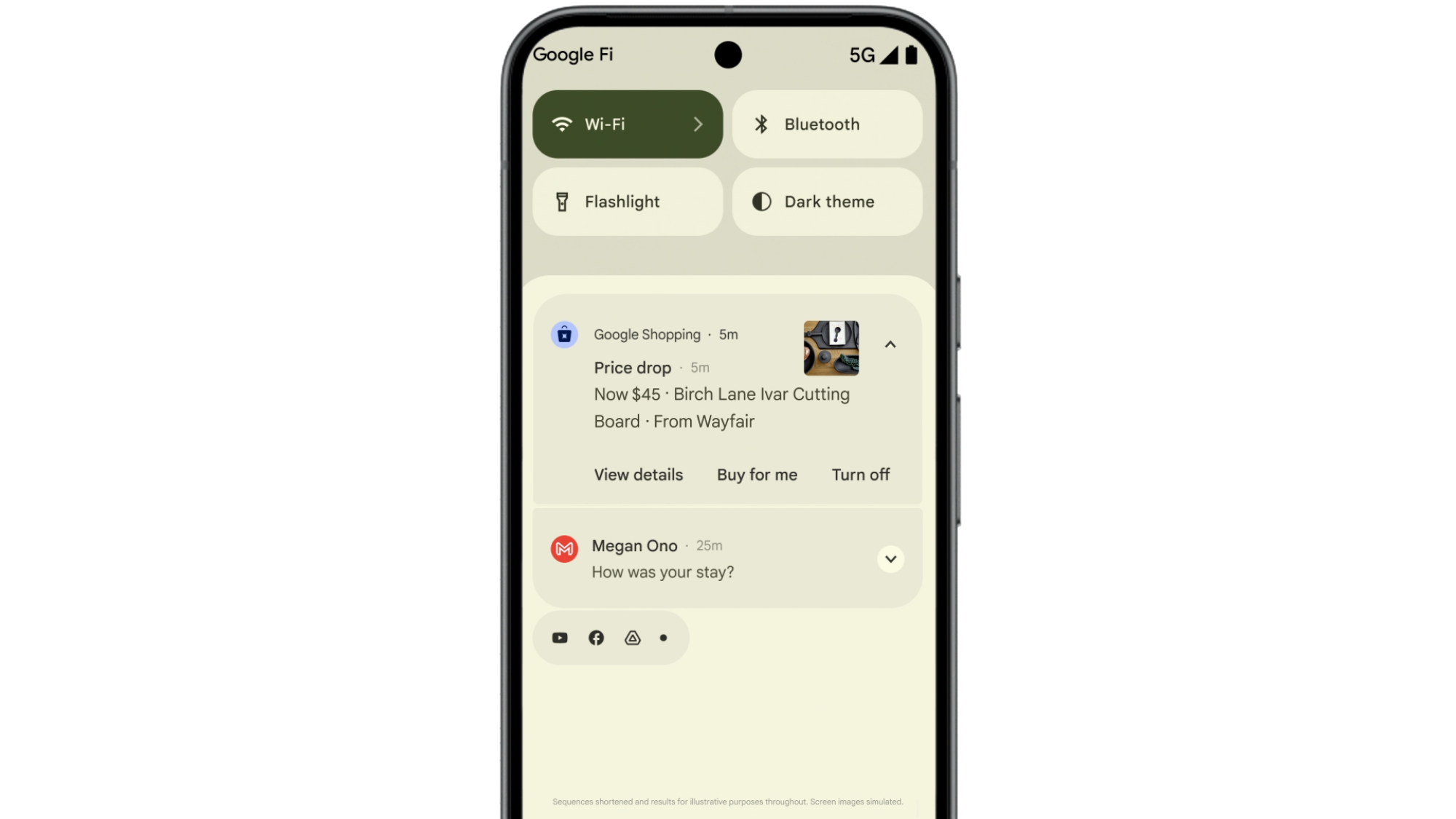
Credit: Google
Google says the AI will always ask your permission before starting agentic checkout, and will only go through with the purchase after you’ve confirmed all your shipping and payment details (which it will either pull from your Google Pay details, or directly ask you for). The price you’ll see also isn’t informed by AI, but rather by Google’s Shopping Graph, the same information that powers Google Search’s Shopping tab. That means it’ll come directly from the store you’ll be buying from, although while Google does promise it’ll surface the most relevant offers for you, just trusting whatever the notification says will take away your ability to manually comparison shop. Once the AI has made your purchase for you, you should see all the usual confirmation emails hit whatever inbox you told the AI to link with your purchase.
It all makes sense in theory—you’re essentially being given a link to a product, and then telling the AI to go to that link and fill out the checkout form for you. That should cut down on hallucination concerns, assuming you’re happy with the link you’re buying from. The catch is that every website’s checkout form is a little different, so Google’s starting with just a few stores for now, to cut down on the chance for errors. That means you’ll only be able to try agentic checkout when buying from Wayfair, Chewy, Quince, and “select Shopify merchants” for now, but Google says there will be “many more [stores] coming soon.”
While agentic checkout does take what can be a lengthy process down to a single click for buyers, the real use case here might be for sellers. Ensuring people actually click through to your store from a price drop notification can be a pain, and letting customers buy straight from the notification with a single button could make impulse purchases a bit more likely. If you notice yourself about to buy something just because a shiny new button is there, maybe take a beat before tapping it and consider whether you still want it or if you want to check other options yourself first.
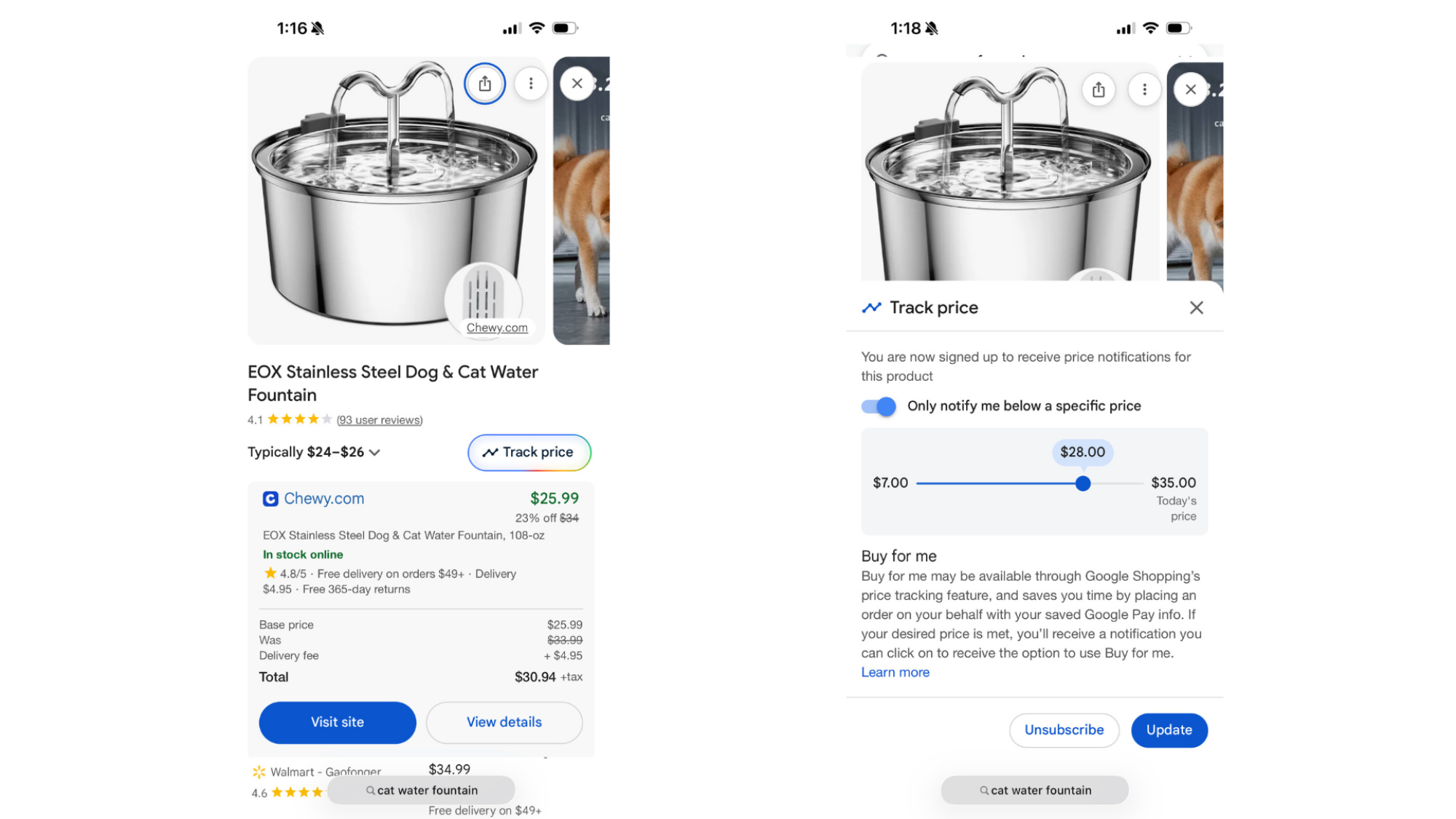
Credit: Michelle Ehrhardt
If you want to try out agentic checkout for yourself, you’ll first need to start tracking a product’s price, and ensure it’s something Wayfair, Chewy, or another participating retailer would sell. To do this, head to the Google Shopping tab, search for either a specific product or a broader product category, and scroll until you find a product card you want to track. Click through and hit the “Track price button.” Here, choose a target price as well as options like size or color, and click “Update” in the bottom right corner. You’ll now get a notification when a listing matches the parameters you set, and if the link Google found is from a participating store, you’ll be able to use the “Buy for me” button. Click or tap it to ensure your details are correct, then tap “Buy for me with GPay” at the bottom of the screen. You’ll get a progress bar showing when your purchase has been submitted and confirmed, and the page will tell you where to expect your confirmation email. You’ll also get a Buy for me reference ID you can take to Google support, in case you run into any issues.
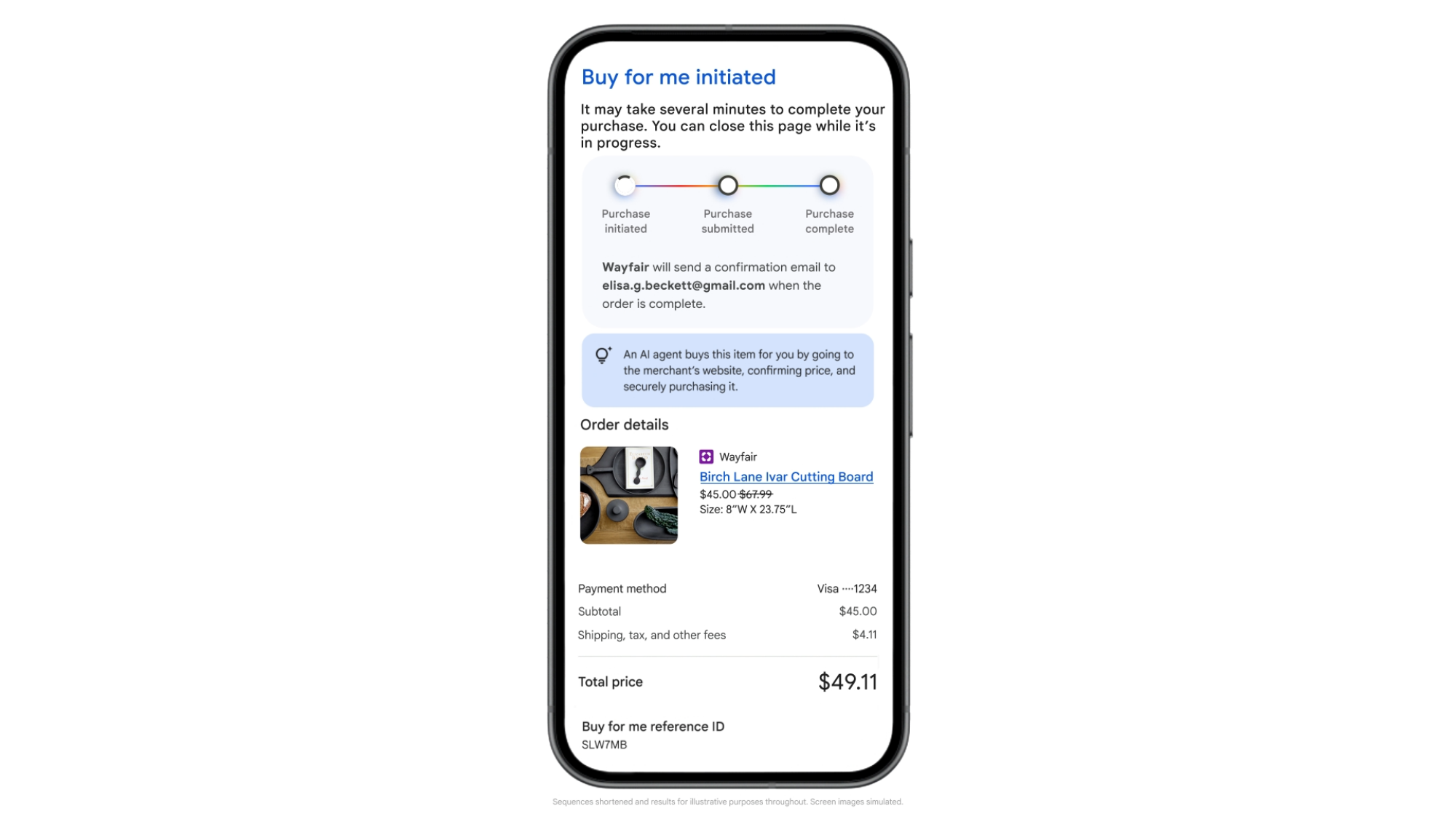
Credit: Google
Unfortunately, it seems like there’s still a few features Google needs to work on here before the AI can do everything a human can. A Google spokesperson told me that agentic checkout currently can’t take factors like loyalty programs into account, so if you want to buy the product from a specific store account to get credit for it, you’ll still need to make your purchase manually.
If you’re buying a lot, it could be a time saver, but as for now, those caveats and the limited selection of stores means you’ll probably still have to complete checkout yourself on most purchases right now.
Tesla is reportedly testing Apple CarPlay in its vehicles
Tesla may finally be capitulating to the calls of iPhone users wanting what practically every other major automaker offers them, Apple CarPlay. Bloomberg is reporting that the EV giant is working to add Apple’s car infotainment integration to its vehicles, according to the outlet’s sources. The feature has reportedly begun internal testing and could be ready for release in the coming months. Of course, development and testing of the feature is not a guarantee that it sees the light of day.
An about-face of this magnitude would be truly surprising given Tesla’s years of steadfast commitment to its own infotainment solution, which doesn’t require connecting a smartphone. In the past, there has been a somewhat frosty relationship between Tesla CEO Elon Musk and the iPhone maker. Musk once said that he offered to sell Tesla to Apple when the Model 3 program almost bankrupted the company, but said Tim Cook refused to take the meeting. Apple had also previously poached key Tesla employees for its failed Apple Car project.
Tesla will reportedly be including CarPlay in a separate window within its existing software interface, ensuring it won’t be fully replacing the existing Tesla system. Bloomberg also reported that Tesla would be using the standard version of CarPlay, as opposed to the newer CarPlay Ultra that integrates with the vehicle’s instrument cluster.
This would be an interesting time to jump on the bandwagon as Apple CarPlay may be just past its peak. GM recently announced it would be phasing out support for both CarPlay and Android Auto in favor of a system built around Gemini, which seems to go directly against the popularity of the platform. Ford’s CEO recently expressed disappointment in Apple’s latest beefed up version of the tool. Tesla did not respond to requests for comment on the report, and at the time of publication Elon Musk has not commented either.
This article originally appeared on Engadget at https://www.engadget.com/transportation/evs/tesla-is-reportedly-testing-apple-carplay-in-its-vehicles-192505635.html?src=rss
Android’s New Sideloading Loophole Lets Power Users Install Unverified Apps

Arguably the main reason Android can challenge Apple’s iPhone ecosystem is Google’s decision to keep it an open platform. However, this stance is shifting, as the company attempted to tighten its grip on the mobile operating system by making sideloading largely a thing of the past. Thankfully, Google has decided to leave the door open, even
This Roomba robot vacuum is on sale for only $150 for Black Friday
You can already get a solid deal on a Roomba robot vacuum a couple of weeks before Black Friday kicks off in earnest. iRobot’s entry-level Roomba 104 Vac robot vacuum is available for 40 percent off right now, taking its normal $250 price to a record low of $150.
In iRobot’s lineup of robot vacuums, the Roomba 104 sits on the low end, adept at vacuuming up dust and hair, but without the mopping ability of its more expensive Max, Plus or Combo counterparts. The Roomba 104 Vac makes for a great first robot vacuum all the same, though, because of its four levels of powerful suction, and easy-to-use app. Like iRobot’s other vacuums, the Roomba 104 maps and navigates your home with LiDAR, which helps it avoid obstacles. And using the Roomba Home app, you can schedule it to clean specific rooms, and even spot-clean particularly dirty spots.
An earlier version of the Roomba Vac is Engadget’s favorite budget robot vacuum, and you’ll get the same great performance out of the newer Roomba 104 Vac. That includes a specialized brush for cleaning the hard-to-reach corners of your home, and also a charging dock that the vacuum can automatically return to once it’s down charging.
This sale on Roomba vacuums comes at an admittedly difficult time for iRobot at large, with the company dealing with a serious financial shortfall as of its last earning statement. Regardless of what happens to iRobot, though, the Roomba 104 Vac’s offline mode should mean that it can clean your home and charge itself without the need of an app or an internet connection.
This article originally appeared on Engadget at https://www.engadget.com/home/smart-home/this-roomba-robot-vacuum-is-on-sale-for-only-150-for-black-friday-191506560.html?src=rss
Vampire Survivors VR asks what if the bullet hell was on your face?
During my many hours playing Vampire Survivors I often wondered what it would feel like to have the absolutely insane bullet hell action extremely close to my eyeballs. Now my dream is being fulfilled, as there’s a VR port for Meta Quest headsets.
The appropriately-named Vampire Survivors VR costs $10 and is available for the Meta Quest 2, 3, 3S and Pro. This isn’t a game that puts you in the middle of the action, as you won’t have to duck and weave around the living room to avoid incoming hordes. Rather, it gives you a top-down view of the stage and you use a controller to navigate as you would on any other platform. This kind of tactic has worked in the past with VR titles like Demeo.
It can be played seated or standing, which isn’t true of all VR games. Also, this is a standalone version and there’s no cross-buy with other platforms. That means that save files don’t carry over. That’s a bummer, but I guess it makes sense given the uniqueness of VR. Developer Poncle has not revealed if this version will feature online co-op, which was recently announced as coming soon to the PC and console builds.
As for DLC, Vampire Survivors VR includes the base game and the Legacy of the Moonspell and Tides of the Foscari expansions. We don’t have any information regarding the status of other expansions like the cool Castlevania one or the utterly bizarre Balatro tie-in.
Vampire Survivors VR is available right now, for those willing to risk a massive headache and perhaps a spot of nausea. Poncle currently has no plans to develop it for other VR platforms, like Steam VR or Pico.
This article originally appeared on Engadget at https://www.engadget.com/ar-vr/vampire-survivors-vr-asks-what-if-the-bullet-hell-was-on-your-face-190749256.html?src=rss
Apple halves App Store fees for mini apps
Apple has introduced a new plan for developers who offer mini-apps that could see the commission rate cut in half. Under the App Store Mini Apps Partner Program, devs would pay a reduced rate of 15 percent, compared to the current 30 percent, on qualifying in-app purchases. Apple has a bunch of more detailed explanations and an FAQ about how the partner program will work and what mini apps are eligible.
Apple’s fee structure has been an ongoing subject of debate, and the company has faced global pressure from regulators to change its commission policies to prove it isn’t engaged in monopolistic, anti-competitive practices. We’ve already seen some changes at Apple this year, as its legal saga with Epic Games wound towards a conclusion and some of the App Store guidelines were changed to allow for external payment options.
This article originally appeared on Engadget at https://www.engadget.com/big-tech/apple-halves-app-store-fees-for-mini-apps-190251153.html?src=rss
Tiny Race Series – November 15 Routes – Tour de Worlds
See zwiftinsider.com/tiny for current Tiny Race details.
Robinhood Offers To Bring Cash To Your Doorstep, for a Fee
An anonymous reader shares a report: Robinhood Markets is betting its Gen Z and millennial clientele are as eager to send out for delivery of a wad of cash as they are to order pizza or a pint of ice cream.
The brokerage is joining with food-and-drink delivery app Gopuff to allow customers to withdraw cash from their Robinhood bank accounts and have it brought right to their door. For a $6.99 delivery fee — or $2.99 if they have more than $100,000 in assets across their Robinhood accounts — users can skip the ATM and have money delivered in a sealed paper bag while they are at home.
It is a new feature that Robinhood first teased in March, when Chief Executive Vlad Tenev unveiled the company’s plans to roll out many traditional and — as with its cash-delivery service — unconventional banking services.


Read more of this story at Slashdot.
Disney+ may start hosting user-generated AI videos
During Disney’s latest earnings call, CEO Bob Iger spoke about next steps for the Disney+ streaming service, and he noted that the entertainment giant has had “productive conversations” with potential AI partners. According to The Hollywood Reporter, Disney+ might soon play host to user-generated short-form AI videos.
“The other thing that we’re really excited about, that AI is going to give us the ability to do, is to provide users of Disney+ with a much more engaged experience, including the ability for them to create user-generated content and to consume user generated content — mostly short-form — from others,” Iger said. He didn’t specify which companies Disney has been in talks with or offer any particularly timeline for the arrival of gen-AI features.
There are already a bunch of ways for people to make and share AI slop videos, so this isn’t a new concept he’s touting. But it is a surprising direction for Disney, which has long been hawkish about protecting both its image and its IP. The company has already made legal moves against multiple different AI platforms, including a cease and desist sent to Character.AI and copyright infringement lawsuits against Midjourney and Hailuo. Iger said he hoped any partnership would “reflect our need to protect the IP,” and it would almost certainly be a lucrative deal for Disney. But even within the confines of its own platform, this is still quite an about-face for the company to now encourage gen-AI creations of familiar characters.
This article originally appeared on Engadget at https://www.engadget.com/entertainment/streaming/disney-may-start-hosting-user-generated-ai-videos-185000745.html?src=rss
Arduino Nesso N1 Debuts as a Compact RISC-V IoT Controller with Wi-Fi 6, Thread, and LoRa Connectivity
Arduino has released the Nesso N1, a compact IoT controller developed with M5Stack and built around the ESP32-C6. The device integrates a touch display, onboard sensors, and multiple wireless protocols inside a small enclosure aimed at rapid prototyping and portable embedded applications. The system is built around Espressif’s ESP32-C6 microcontroller, a single-core 32-bit RISC-V processor […]
Privilege escalation in LightDM Greeter by KDE (SUSE Security Team Blog)
The SUSE Security Team has published an in-depth
article on its findings after reviewing a D-Bus service contained
in LightDM
Greeter by KDE (the lightdm-kde-greeter package)
for addition to openSUSE Tumbleweed. The team found a privilege
escalation from the lightdm service user to root, as
well as other attack vectors in the service:
In agreement with upstream, we assigned CVE-2025-62876 to track the
lightdm service user to root privilege escalation aspect described in
this report. The severity of the issue is low, since it only affects
defense-in-depth (if the lightdm service user were compromised) and
the problematic logic can only be reached and exploited if triggered
interactively by a privileged user.
The fixes are contained in the 6.0.4
release of the project.
Something funky is going on at Ubisoft
It’s been clear for some time that all is not well at Ubisoft. Between games not meeting the company’s sales expectations, studio closures, downsizing elsewhere and sexual misconduct issues, it’s been a rocky past several years for the company.
But now it seems something else may be going on at the publisher. Just before it was set to hold a call with investors on Thursday, Ubisoft said it was delaying its half-year earnings report and halting trading of its shares. It has asked Euronext — the European stock market on which its shares are listed — to halt trading from November 14 until it publishes its earnings results “in the coming days.”
This could mean any number of things. Other companies have delayed earnings reports due to things like accounting issues. But halting trading of the company’s shares could portend major news, such as a sale or Ubisoft becoming a private entity again. Engadget has contacted Ubisoft for comment.
It was reported late last year that the founders of Ubisoft were looking to take the company private with the help of Tencent. That hasn’t transpired as yet, but Ubisoft (with the help of a Tencent investment) did this year form a new subsidiary called Vantage Studios. That is now overseeing Assassin’s Creed, Far Cry and Rainbow Six — three of Ubisoft’s most important franchises.
This article originally appeared on Engadget at https://www.engadget.com/gaming/something-funky-is-going-on-at-ubisoft-184058990.html?src=rss
Millions Of Dell PCs At Risk From High-Impact DDPM Exploit, Patch ASAP

Dell has just released a notice to users of its Dell Display and Peripheral Manager (DDPM) software, prompting them to update the software ASAP. Users of the software, which is preinstalled on most Dell business systems but available to all Windows users of Dell peripherals, are advised to update to at least version 2.1.2.12 to get a new patch
Civil war is brewing in the wasteland in Fallout S2 trailer
We got our first glimpse of the much-anticipated second season of Fallout (adapted from the popular video game franchise) in August when Prime Video released an extended teaser. We now have the official trailer, with all the deadpan humor, explosions, and mutant atrocities one could hope for—including ghoulish Elvis impersonators in New Vegas.
(Spoilers for S1 below.)
As previously reported, in S1, we met Lucy MacLean (Ella Purnell), a young woman whose vault is raided by surface dwellers. The raiders kill many vault residents and kidnap her father, Hank (Kyle MacLachlan), so the sheltered Lucy sets out on a quest to find him. Life on the surface is pretty brutal, but Lucy learns fast. Along the way, she finds an ally (and love interest) in Maximus (Aaron Moten), a squire masquerading as a knight of the Brotherhood of Steel. And she runs afoul of a gunslinger and bounty hunter known as the Ghoul (Walton Goggins), a former Hollywood actor named Cooper Howard who survived the original nuclear blast, but radiation exposure turned him into, well, a ghoul.
Thunderbird 145 released
Version
145 of the Thunderbird email client has been released. Notable
changes in this release include enabling DNS over HTTPS, support for
Microsoft Exchange via Exchange Web Services, and quite a few bug
fixes. As of 145, the project is no longer shipping 32-bit binaries
for Linux on x86.
ASUS Issues PC Price Hike Warning Amid DRAM & NAND Shortage

During an online investor conference, ASUS co-CEO Shubin Hu has stated that the rise of DRAM prices is a problem for everyone across the PC industry, and that it is spurred by a combination of two factors: the massive increase in demand for RAM to fuel AI servers, and limited DRAM production increases over the past few years despite that growth.
After years of saying no, Tesla reportedly adding Apple CarPlay to its cars
Apple CarPlay, the interface that lets you cast your phone to your car’s infotainment screen, may finally be coming to Tesla’s electric vehicles. CarPlay is nearly a decade old at this point, and it has become so popular that almost half of car buyers have said they won’t consider a car without the feature, and the overwhelming majority of automakers have included CarPlay in their vehicles.
Until now, that hasn’t included Tesla. CEO Elon Musk doesn’t appear to have opined on the omission, though he has frequently criticized Apple. In the past, Musk has said the goal of Tesla infotainment is to be “the most amount of fun you can have in a car.” Tesla has regularly added purile features like fart noises to the system, and it has also integrated video games that drivers can play while they charge.
For customers who want to stream music, Tesla has instead offered Spotify, Tidal, and even Apple Music apps.
TikTok’s new ‘bulletin board’ feature lets creators send updates to their fans’ inboxes
TikTok introduced a new “bulletin board” feature for creators that allows them to blast out updates directly to their followers’ inboxes. The idea is similar to broadcast channels on Instagram or Telegram’s one-way messaging feature.
People who opt to join a creator’s bulletin board will receive updates in their TikTok inbox. Updates can include text, links, polls or photos; as well as other TikTok posts or lives. Followers who join a board can react to messages but won’t be able to comment or reply like a typical DM or post. According to TikTok, the feature could be especially useful for musicians and artists, as it allows them to share new songs and give fans a way to “pre-save” an upcoming release.
For creators with a large following, having a bulletin board could help streamline their ability to interact with fans without having to wade through an overloaded inbox or post separate video updates. It also gives them a way to get their work (including links to non-TikTok content) in front of their biggest fans without relying on the whims of the app’s recommendation algorithm.
Bulletin Board is available now to all creators over the age of 18 with 50,000 or more followers. TikTok users can find and join bulletin boards on creators’ profiles.
This article originally appeared on Engadget at https://www.engadget.com/social-media/tiktoks-new-bulletin-board-feature-lets-creators-send-updates-to-their-fans-inboxes-181000448.html?src=rss