Zwift Camp: Build – Stage 2 Walkthrough

Zwift Camp: Build is now underway. This is a 5-stage route-based workout series, with each stage lasting one week and focusing on developing power over a specific time interval.

My plan is to do each of the five workouts before their weeks begin, so I can write a post unpacking the workout and delivering some tips along the way. This post covers Stage 2’s anaerobic workout on France’s Bon Voyage. Let’s dive in!

I pulled the 7-Eleven bike out for this ride in France

Stage 2 Walkthrough: Anaerobic Capacity (~1 minute)

The second stage of Zwift Camp: Build focuses on what you might call “long sprint power,” with efforts lasting 20-60 seconds. To do so, you’ll ride a lap of France’s Bon Voyage route (31.4km, 155m).

Here’s a profile of the route, not including the lead-in. As you can see, there are 9 sprints on the route itself. But watch out! You’ve got one more on the lead-in, for a total of 10.
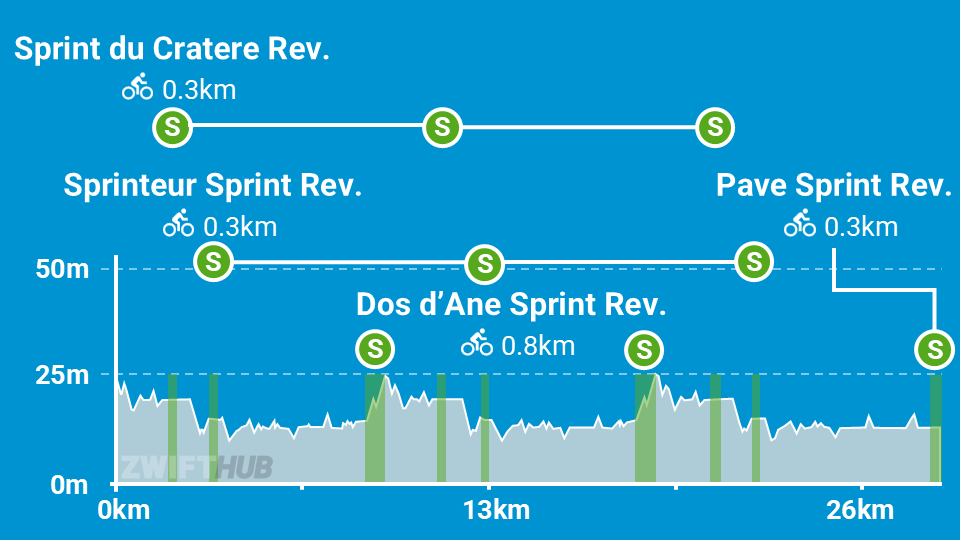
The sprints you’ll hit are thus:

  1. Dos d’Âne Sprint Reverse (0.75km, 1.7%) – at the end of the lead-in
  2. Sprint du Cratère (0.3km, 0.1%)
  3. Sprinteur Sprint Reverse (0.25km, 0%)
  4. Dos d’Âne Sprint Reverse (0.75km, 1.4%)
  5. Sprint du Cratère (0.3km, 0%)
  6. Sprinteur Sprint Reverse (.25km, -1.8%)
  7. Dos d’Âne Sprint Reverse (0.75km, 1.4%)
  8. Sprint du Cratère (0.3km, 0%)
  9. Sprinteur Sprint Reverse (.25km, -1.8%)
  10. Pavé Sprint Reverse (0.33km, 0%)

Executing the workout is simple enough: just hit every sprint segment hard. (I said simple, not easy!) 10 sprints is a lot, especially when three of them are 1-minute efforts. So expect some suffering.

I went into the workout with semi-tired legs, but figured I could put in a decent effort because I thought we would only be doing three 1-minute efforts, based on the event description.

Unfortunately for me, this workout had more sprints than anticipated. But lucky for you, now that you’re reading this, you know what you’re getting yourself into!

My first sprint, Dos d’Âne Sprint Reverse, began 2.4km into the event. It was a little off, for a few reasons:

  • It wasn’t clear to me from the on-screen instructions that I was supposed to sprint at the line. (The messaging before most of the subsequent sprints makes this more clear, but this first one did not.)
  • When I went to turn my Wahoo Headwind fan up partway through the sprint, the fan turned completely off! So I had to fumble around with that.
  • My legs clearly needed this to be a recovery day.
  • The sprint was longer than anticipated, taking me 74 seconds to complete.

It wasn’t until 4.5km into the ride that a message popped up telling me the next sprint was coming up – Sprint du Cratère – and that I was supposed to sprint on it. That’s when I realized I would be sprinting on every segment on this route. Uh oh. I picked a bad day to have bad legs!

I sprinted rather halfheartedly my first time over Cratère, but the game was very impressed:
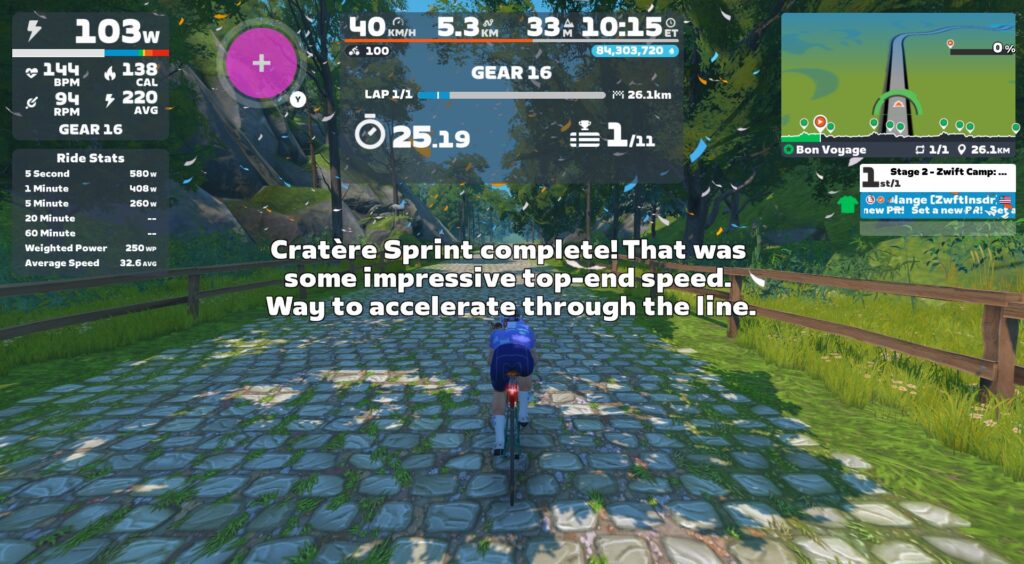
Wouldn’t it be cool if Zwift had some intelligence built into these messages, so the response reflected your actual performance? Maybe with a “Snark Slider” in Settings so we could determine how acerbic our coach was. My screen should have said something more like:
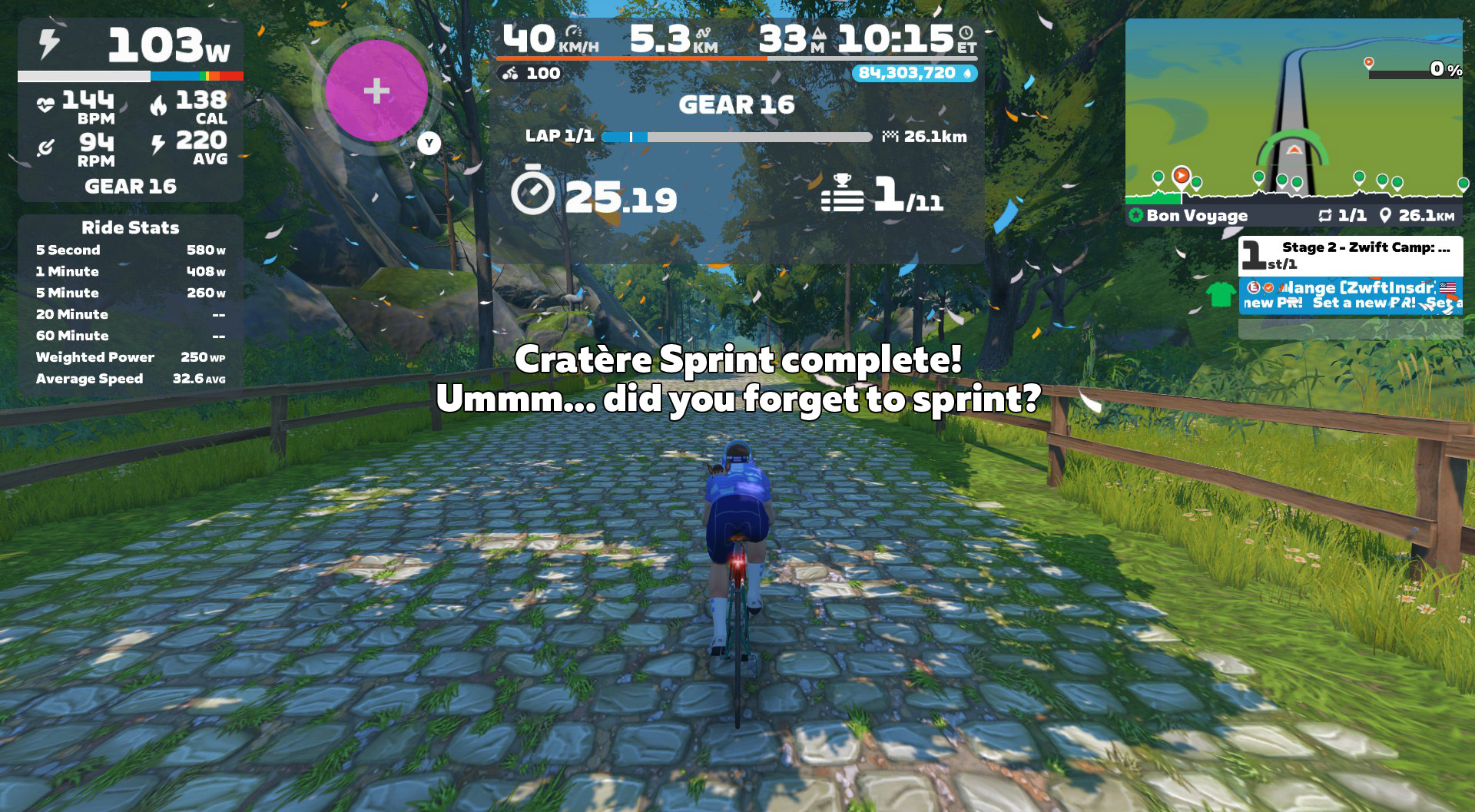
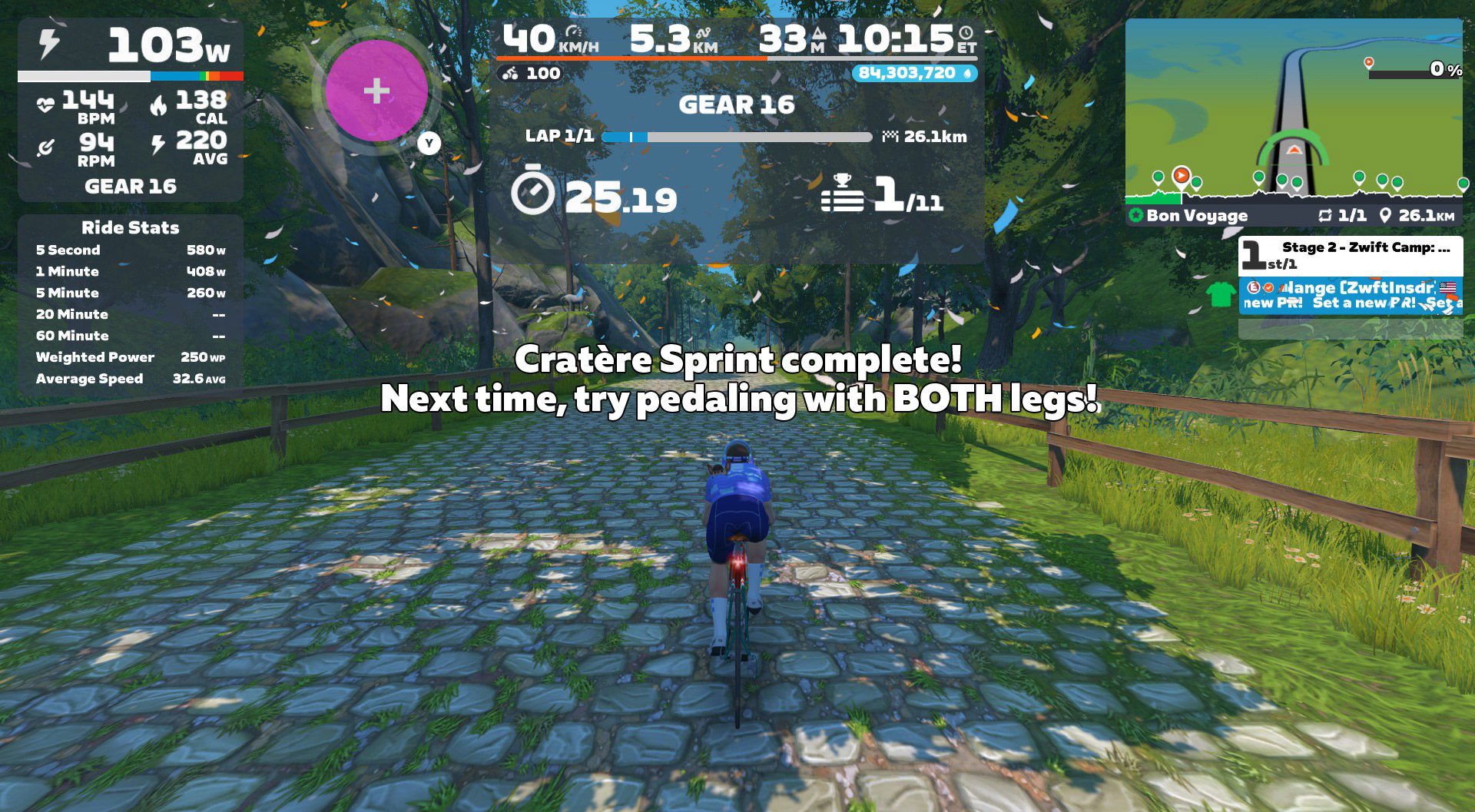
This route uses some of the newer HUD features I mentioned in stage 1’s writeup, showing the Ride Stats panel as well as the Lap Splits.

Like stage 1, Ride Stats was more useful than Lap Splits. I appreciated seeing the 1-minute power field on Ride Stats, as that gave me something to chase. But Lap Splits? Totally useless for this workout, because of how the route is laid out and how the Splits were used. (More on this topic in the Suggestion Box below.)

On-screen messaging does a good job of telling you when the next sprint is about to arrive, plus you can see the finish lines approaching on the mini-map profile.

There isn’t much more to say about this workout from an execution standpoint: just sprint hard at every sprint segment, and rest in between.

Again, same warning as stage 1:if you ride this in a group event, it may be harder to dial it down and spin between sprints. But you’ll definitely want to do so, if you want to have the energy for maximal sprint efforts.

HoloReplay Bug

I found Zwift’s HoloReplay to be helpful as a motivator on the sprints, but the same bug is in this workout as in stage 1, causing two different ghosts to appear, instead of just my previous effort. (More on this in the Suggestion Box below.)

Watch My Video

More On Anaerobic Power

A few interesting things about the anaerobic energy system that stage 2 focuses on (read much more on this excellent TrainerRoad post):

  • Anaerobic capacity is typically measured with a 30-second sprint test
  • Unlike the neuromuscular system from stage 1, the anaerobic system is highly responsive to training
  • Strong anaerobic performance is particularly useful in “spiky” cycling disciplines like cyclocross, crits, and MTB racing

Anaerobic Training Tips
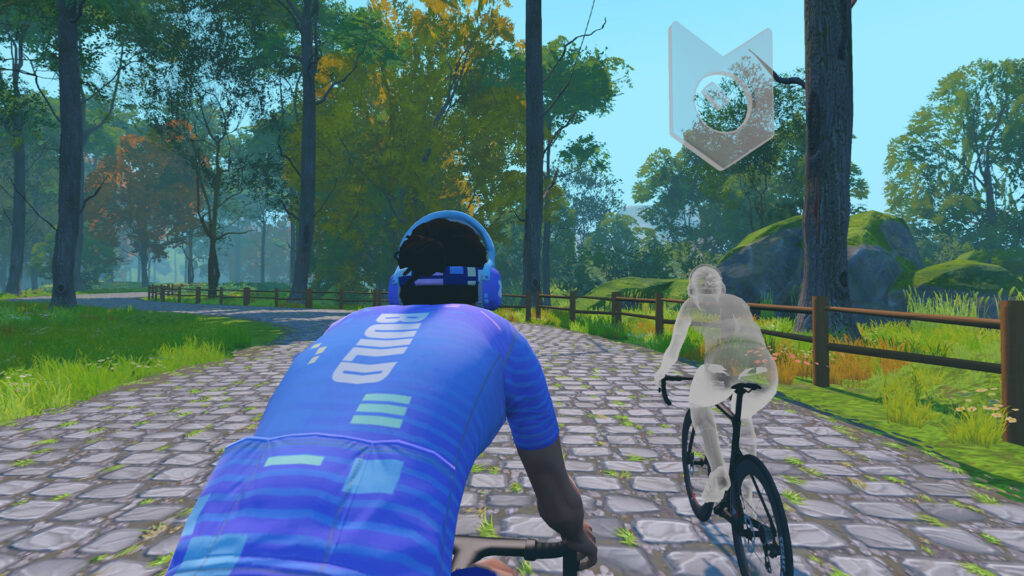
The anaerobic system is very adaptable to training, so if you find this is an area you’d like to focus on, you can execute stage 2’s workout more than once! You can also try making your own workout, or using workouts from Zwift’s library.

One classic anaerobic workout is called “Thirty Thirties”. 30 seconds on, 30 seconds off. Repeat this 5-10x, rest for a few minutes, then repeat it again. Do 2 or 3 sets. Fit riders can typically do 3 sets of 10 30-30s. You can do the 30-second hard efforts as free ride segments in a workout, or set them to 130-150% of your FTP if you like ERG mode. You can even do this during a free ride, simply using the game clock as your timekeeper. It’s a simple yet effective workout.

Three tips to maximize your anaerobic workouts:

  • Fuel properly: Anaerobic work is almost entirely glycolytic, which means it’s fueled by sugar. If you don’t have glycogen stored up to fuel the workout, you won’t be able to put in repeated full efforts in your anaerobic zone.
  • Go in recovered: If you’re dealing with residual muscle fatigue from yesterday’s workout or tiredness from a poor night’s sleep, you’ll have a really hard time executing a quality anaerobic workout. These efforts are sharp, hard, and repeated. They take focus and mental (as well as physical) energy.
  • Set accurate targets: if you’re doing these as an ERG workout, make sure your FTP is accurate and your targets are realistic (130-150% of FTP is normal). As with all ERG workouts, an inaccurate FTP means you won’t be training the systems you thought you were training. And nobody’s got time for that!

Suggestion Box

The second workout of Zwift Camp: Build would have gone better if I’d known, going in, that there would be 10 sprints. I would have gone easier the day before, knowing I needed more in the tank.

Here are my suggestions for improvements Zwift could make to stage 2:

  • No Lap Splits: This route is basically two laps of a circuit, plus a lead-in at the start, and a “lead-out” at the end. So at best, you could time two “laps”. But the way it’s set up, the first lap isn’t auto-triggered until the second time through the Dos d’Âne Sprint, meaning the first lap’s time includes the lead-in. That means you can’t compare it to the second lap’s time… which makes the Splits timers useless for this workout.
  • Fix HoloReplays: It’s clear that Zwift has hard-coded the HoloReplay functionality into these events, because changing my settings doesn’t seem to make a difference! It wasn’t a big deal for me, and the ghosts still motivated me to push hard. But Zwift should fix these events so they automatically show HoloReplays (just one ghost of your previous effort) for everyone.
  • Improve the event description: I already mentioned this for stage 1, but stage 2 is a perfect example of how a simple line or two in the event description would clarify what people are signing up for. (Also, the description of stage 2 says “Target Effort: Three 1-Minute Efforts”. But the actual event has you sprinting 10 efforts of various lengths.)
  • In-game messages that are realistic: OK, this is sort of silly and a major stretch goal at best. But it sure would be cool if the game could respond accurately to my actual efforts on the segments. It has the data necessary to do so. Just hook it up to ChatGPT and let ‘er rip!

Sign Up For Stage 2

Sign up for stage 2 events in-game, in the Companion app, or go to zwift.com/events/tag/zwiftcampbuild2025wo2.

Questions or Comments?

Have you done this workout yet? Share your thoughts below, or any questions you may have heading into the workout.

For the Steam Machine to change PC gaming, Valve must solve Linux’s anti-cheat problem

Following months of rumors, Valve finally announced the new Steam Machine earlier this week. And while I might question the company’s decision to ship a system with only 8GB of VRAM in 2026, I believe the “Gabecube” will do more for PC gaming than anything Microsoft has done in the last decade. 

With SteamOS and Linux, Valve has polished away many of the things that make PC gaming unapproachable to some people. Want to set a frame limit to extend your Steam Deck’s battery life? It’s an easy-to-find option in the Performance overlay, not something you need to dig through multiple menus to find. Want to suspend a game? That’s possible on SteamOS.

And now with the Steam Machine, Valve is poised to bring the fun of PC gaming to an entirely new audience: home console gamers. Even though I don’t plan to buy one, selfishly I hope it’s a runaway success. Like a lot of PC gamers I imagine, I’m ready to leave Windows behind. Over the last few years, Microsoft has proven to be a poor steward of the platform. The company seems more interested in pushing AI features few care for, rather than solving the issues that have plagued Windows for years. After all, it was only recently that Microsoft said it would tackle shader stutter, a problem that has plagued many recent AAA games. Worse yet, that solution may take years to fully implement. 

I want the Steam Machine to be the revolution that brings SteamOS to desktop PCs, but before that can happen, Valve must solve Linux’s cheating problem. Right now, the Steam Deck covers two of the three pillars of PC gaming: indies and singleplayer AAA games. For some people, that’s enough, but it leaves out a huge section of the PC market. Nearly four years after its release, you can’t play some of the most popular competitive games, and it’s all because of how easy it is to make cheating software for Linux-based operating systems.

In a 2024 interview with The Verge, Riot’s Phillip Koskinas summarized the issue concisely. “You can freely manipulate the kernel, and there’s no user mode calls to attest that it’s even genuine,” he told the outlet. “You could make a Linux distribution that’s purpose-built for cheating and we’d be smoked.”

When Valve released the Steam Deck at the start of 2022, there was some hope games like Fortnite and Rainbow Six Siege would eventually be playable on the handheld, and for a while things looked positive. Toward the end of 2021, Valve announced Proton compatibility with BattlEye. A few months later, the company did the same for Epic’s Easy Anti-Cheat. There’s also Valve’s in-house solution, VAC, which is fully supported and means the company’s own games, including Counter-Strike 2 and Dota 2, are playable on Steam Deck.   

However, despite Valve’s support for some of the most popular anti-cheat solutions on the market, many studios chose not to bring their competitive games to SteamOS, citing cheating concerns. Some notable examples include Fortnite, Valorant and PUBG. Those games have never been playable on Steam Deck. In fact, last fall EA withdrew Linux and Steam Deck support for Apex Legends, one of the few competitive shooters you could play on Valve’s handheld. 

“In our efforts to combat cheating in Apex, we’ve identified Linux OS as being a path for a variety of impactful exploits and cheats. As a result, we’ve decided to block Linux OS access to the game,” the company said at the time. “We believe the decision will meaningfully reduce instances of cheating in our game.” 

For EA, Riot, Epic and developers of other popular competitive games, the issue is two-fold: Cheating software is harder to detect when it’s used on Linux. More importantly, for many of them there aren’t enough Linux players to justify the resources needed to secure their games for every Linux distribution. For example, when Riot made its Vanguard software a requirement to play League of Legends in 2024, the studio said there were just over 800 daily users playing the game on Linux. For context, millions of people League every day. Put another way, it’s a chicken and egg problem. 

The Steam Machine represents an opportunity for Valve. According to Are We Anti-Cheat Yet, a crowd-sourced database listing games that require anti-cheat software and whether they work through Linux or Valve’s Proton compatibility layer, 682 games don’t work for one reason or another. That means more than half of the 1,136 games that require anti-cheat software can’t be played on SteamOS. 

With the nature of Linux being what it is, it’s unlikely Valve could make even the most popular kernel-level anti-cheat apps work across every Linux distribution, and based on the company’s approach, it doesn’t have an interest in doing that. However, if Valve made a better sandbox for developers to secure their games, we could absolutely see a SteamOS version of Valorant, for instance.     

Studios will go where their players are. The Steam Deck has proven that. And if the Steam Machine becomes popular enough to warrant companies like EA to bring their games to SteamOS and Linux, the PC gaming landscape will suddenly be very different. 

This article originally appeared on Engadget at https://www.engadget.com/gaming/pc/for-the-steam-machine-to-change-pc-gaming-valve-must-solve-linuxs-anti-cheat-problem-130000088.html?src=rss

Sony’s WH-1000XM5 headphones are $152 off for Black Friday

Sony’s still excellent WH-1000XM5 wireless headphones are down to $250 for Black Friday. That’s $150 off the list price and equal to the all-time low (give or take a single cent) we saw on Prime Day. They may no longer be Sony’s flagship noise-canceling headphones, but if the WH-1000XM6 are out of your price range, these former Engadget favorites are well worth considering at this heavily reduced price.

We awarded the WH-1000XM5 a score of 95 in our 2022 review, praising the supremely comfortable redesign, sound quality and powerful ANC. Battery life is also very respectable at 30 hours. We found the punchy bass an improvement over their predecessors, and the overall sound deeper and more immersive than the M4 headphones. As for noise-canceling, Sony’s decision to double the number of microphones and processors used for ANC means an improvement in blocking higher frequency sounds, such as human voices. They aren’t entirely baby scream-proof, but then few headphones are.

Naturally, the WH-1000XM6 that this year replaced the M5 as Sony’s flagship model offers even better sound quality and noise cancellation, while remaining extremely comfortable throughout long listening sessions. But they’re also a lot more expensive at $450, and if you’re deal-hunting this Black Friday, the WH-1000XM5 headphones are the ones to go for.

This article originally appeared on Engadget at https://www.engadget.com/deals/sonys-wh-1000xm5-headphones-are-152-off-for-black-friday-124434564.html?src=rss

How Should the Linux Kernel Handle AI-Generated Contributions?

Linux kernel maintainers “are grappling with how to integrate AI-generated contributions without compromising the project’s integrity,” reports WebProNews:

The latest push comes from a proposal by Sasha Levin, a prominent kernel developer at NVIDIA, who has outlined guidelines for tool-generated submissions. Posted to the kernel mailing list, these guidelines aim to standardize how AI-assisted patches are handled. According to Phoronix, the v3 iteration of the proposal [posted by Intel engineer Dave Hansen] emphasizes transparency and accountability, requiring developers to disclose AI involvement in their contributions. This move reflects broader industry concerns about the quality and copyright implications of machine-generated code.

Linus Torvalds, the creator of Linux, has weighed in on the debate, advocating for treating AI tools no differently than traditional coding aids. As reported by heise online, Torvalds sees no need for special copyright treatment for AI contributions, stating that they should be viewed as extensions of the developer’s work. This perspective aligns with the kernel’s pragmatic approach to innovation. The proposal, initially put forward by Levin in July 2025, includes a ‘Co-developed-by’ tag for AI-assisted patches, ensuring credit and traceability. OSTechNix details how tools like GitHub Copilot and Claude are specifically addressed, with configurations to guide their use in kernel development… ZDNET warns that without official policy, AI could ‘creep’ into the kernel and cause chaos…

The New Stack provides insight into how AI is already assisting kernel maintainers with mundane tasks. According to The New Stack, large language models (LLMs) are being used like ‘novice interns’ for drudgery work, freeing up experienced developers for complex problems… The Linux kernel’s approach could set precedents for other open-source projects. With AI integration accelerating, projects like those in the Linux Foundation are watching closely… Recent kernel releases, such as 6.17.7, include performance improvements that indirectly support AI applications, as noted in Linux Compatible.


Read more of this story at Slashdot.

Jeff Bezos will head a new engineering-focused AI startup called Project Prometheus

Jeff Bezos is spearheading a new AI started called Project Prometheus, focused on his current interests in space and engineering, The New York Times reports. The company, which has yet to be made public, will reportedly have $6.2 billion in funding. Part of that sum will come from Bezos, who will act as co-CEO. 

Project Prometheus will reportedly focus on creating AI systems that gain knowledge from the physical world, rather than just processing digital information, like AI chatbots. In particular, the company will reportedly explore how AI can support engineering and manufacturing in areas such as vehicles and space technology. Bezos founded space technology company Blue Origin more than two decades ago. The company’s New Glenn rocket had a successful second flight last week. 

He is joined by Vik Bajaj as co-founder and co-CEO. Bajaj is a physicist and chemist who worked on projects at Google X including Wing and what became Waymo. In 2018, he co-founded Foresite Labs, which supports entrepreneurs in the fields of AI and data science. Bajaj is still named as CEO of Foresite Labs on the company’s website and his LinkedIn page — the latter of which also shows his new titles at Project Prometheus. Bajaj lists his involvement in the new company as starting this month and puts San Francisco, London and Zurich as its locations. 

On its bare LinkedIn page, Project Prometheus’ overview states only “AI for the physical economy.” It also lists itself as a “Technology, Information and Internet” company with 51-200 employees. According to The New York Times, Project Prometheus has hired nearly 100 people, with some employees coming from fellow AI companies like OpenAI and DeepMind. 

This article originally appeared on Engadget at https://www.engadget.com/ai/jeff-bezos-will-head-a-new-engineering-focused-ai-startup-called-project-prometheus-122115977.html?src=rss

I’ve already been using a “Steam Machine” for months, and I think it’s great

Valve’s second big foray into first-party PC hardware isn’t a sequel to the much-imitated Steam Deck portable, but rather a desktop computer called the Steam Machine. And while it could go on your desk, Valve clearly intends for it to fit in an entertainment center under a TV—next to, or perhaps even instead of, a game console like the Xbox or PlayStation 5.

I am pretty sure this idea could work, and it’s because I’ve already been experimenting with what is essentially a “Steam Machine” underneath my own TV for months, starting in May when Valve began making it possible to install SteamOS on certain kinds of generic PC hardware.

Depending on what it costs—and we can only guess what it will cost—the Steam Machine could be a good fit for people who just want to plug a more powerful version of the Steam Deck experience into their TVs. But for people who like tinkering or who, like me, have been messing with miniature TV-connecting gaming PCs for years and are simply tired of trying to make Windows workable, the future promised by the Steam Machine is already here.

Read full article

Comments

YT Industries relaunches and promises to fulfil back orders after founder saves it from administration

YT Industries has relaunched today under new ownership. The well-regarded German mountain bike brand went into self-administration in July.

However, CEO and founder Markus Flossmann purchased the brand and its assets in September. Since then, his team have been working on the relaunch and fulfilling orders from before YT collapsed. 

The relaunch sees almost all of YT’s bike range back in stock, and expected to be available to buy online in the UK and EU over the next few weeks. US availability will be a little later, with new products to follow.

CEO and founder Markus Flossmann has bought back YT and is relaunching the brand.

“Back to the roots. This isn’t a marketing slogan, it’s a promise,” says Flossmann. “We’re focusing again on what made YT strong: uncompromising bikes, fair prices, and genuine passion for the sport. Rough, real, and authentic.” 

Although YT has reduced its staffing, it says it has kept the core of the previous team. YT states it’s also focusing on developing a wider global service network, particularly in the USA and UK, to improve service quality and accessibility.

Outstanding orders fulfilled

YT Decoy SN MX Core 4 full suspension mountain ebike
YT expects to have its complete range, including the Decoy, available again. Scott Windsor / Our Media

When YT Industries folded, it left a number of outstanding orders, but Flossmann says fulfilling these or organising a refund has been a priority.

“This is my personal top priority. Every customer who placed their trust in YT will receive what they paid for. That’s always been my promise,” he states. “For us, this is far more than just an administrative process. It’s about trust, responsibility, and credibility.” 

If you were affected and your order hasn’t been resolved, there’s a dedicated support email address you can use to contact YT’s customer services: stormsurvivor@yt-industries.com.

NVK’s Cooperative Matrix Support Proving Competitive With Official NVIDIA Driver

Karol Herbst at Red Hat who has been a longtime open-source NVIDIA driver contributor as well as Rusticl developer presented at XDC2025 on the NVK Vulkan driver’s cooperatrive matrix extension support. It turns out this Vulkan extension for machine learning / AI is proving fairly competitive with the open-source NVK driver compared to NVIDIA’s official driver stack…

Unipi Edge E410, E411, and E413 Controllers Built on Raspberry Pi CM4

Unipi has introduced the Edge E410, E411, and E413 controllers, a family of DIN-rail industrial devices based on the Raspberry Pi Compute Module 4. The systems combine PLC, RTU, IPC, and gateway functionality in a compact chassis targeting building automation, HVAC control, energy management, and industrial monitoring. All three models use the quad-core Arm Cortex-A72 […]

Bitcoin Erases Year’s Gain as Crypto Bear Market Deepens

655″Just a little more than a month after reaching an all-time high, Bitcoin has erased the more than 30% gain registered since the start of the year…” reports Bloomberg:

The dominant cryptocurrency fell below US$93,714 on Sunday, pushing the price beneath the closing level reached at the end of last year, when financial markets were rallying following President Donald Trump’s election victory. Bitcoin soared to a record US$126,251 on Oct 6, only to begin tumbling four days later after unexpected comments on tariffs by Trump sent markets into a tailspin worldwide. “The general market is risk-off,” said Matthew Hougan, the San Francisco-based chief investment officer for Bitwise Asset Management. “Crypto was the canary in the coal mine for that, it was the first to flinch.”

Over the past month, many of the biggest buyers — from exchange-traded fund allocators to corporate treasuries — have quietly stepped back, depriving the market of the flow-driven support that helped propel the token to records earlier this year. For much of the year, institutions were the backbone of Bitcoin’s legitimacy and its price. ETFs as a cohort took in more than US$25 billion, according to Bloomberg data, pushing assets as high as roughly US$169 billion. Their steady allocation flows helped reframe the asset as a portfolio diversifier — a hedge against inflation, monetary debasement and political disarray. But that narrative — always tenuous — is fraying afresh, leaving the market exposed to something quieter but no less destabilising: disengagement. “The selloff is a confluence of profit-taking by LTHs, institutional outflows, macro uncertainty, and leveraged longs getting wiped out,” said Jake Kennis, senior research analyst at Nansen. “What is clear is that the market has temporarily chosen a downward direction after a long period of consolidation/ranging…”

Boom and bust cycles have been a constant since Bitcoin burst into the mainstream consciousness with a more than 13,000% surge in 2017, only to be followed by a plunge of almost 75% the following year… Bitcoin has whipsawed investors through the year, dropping to as low as US$74,400 in April as Trump unveiled his tariffs, before rebounding to record highs ahead of the latest retreat… The market downturn has been even tougher on smaller, less liquid tokens that traders often gravitate toward because of their higher volatility and typical outperformance during rallies. A MarketVector index tracking the bottom half of the largest 100 digital assets is down around 60% this year.


Read more of this story at Slashdot.

More Tech Moguls Want to Build Data Centers in Outer Space

“To be clear, the current economics of space-based data centers don’t make sense,” writes the Wall Street Journal.

“But they could in the future, perhaps as soon as a decade or so from now, according to an analysis by Phil Metzger, a research professor at the University of Central Florida and formerly of the National Aeronautics and Space Administration.”

“Space enthusiasts (comme moi) have long sought a business case to enable human migration beyond our home world,” he posted on X amid the new hype. “I think AI servers in space is the first real business case that will lead to many more….”

The argument essentially boils down to the belief that AI’s needs are eventually going to grow so great that we need to move to outer space. There the sun’s power can be more efficiently harvested. In space, the sun’s rays can be direct and constant for solar panels to collect — no clouds, no rainstorms, no nighttime. Demands for cooling could also be cut because of the vacuum of space. Plus, there aren’t those pesky regulations that executives like to complain about, slowing construction of new power plants to meet the data-center needs. In space, no one can hear the Nimbys scream.
“We will be able to beat the cost of terrestrial data centers in space in the next couple of decades,” Bezos said at a tech conference last month. “Space will end up being one of the places that keeps making Earth better.”

It’s still early days. At Alphabet, Google’s plans sound almost conservative. The search-engine company in recent days announced Project Suncatcher, which it describes as a moonshot project to scale machine learning in space. It plans to launch two prototype satellites by early 2027 to test its hardware in orbit. “Like any moonshot, it’s going to require us to solve a lot of complex engineering challenges,” Pichai posted on social media. Nvidia, too, has announced a partnership with startup Starcloud to work on space-based data centers. Not to be outdone, Elon Musk has been painting his own updated vision for the heavens… in recent weeks he has been talking more about how he can use his spaceships to deploy new versions of his solar-powered Starlink satellites equipped with high-speed lasers to build out in-space data centers.

On Friday, Musk further reiterated how those AI satellites would be able to generate 100 gigawatts of annual solar power — or, what he said, would be roughly a quarter of what the U.S. consumes on average in a year. “We have a plan mapped out to do it,” he told investor Ron Baron during an event. “It gets crazy.” Previously, he has suggested he was four to five years away from that ability. He’s also touted even wilder ideas, saying on X that 100 terawatts a year “is possible from a lunar base producing solar-powered AI satellites locally and accelerating them to escape velocity with a mass driver.” Simply put, he’s suggesting a moon base will crank out satellites and throw them into orbit with a catapult. And those satellites’ solar panels would generate 100,000 gigawatts a year. “I think we’ll see intelligence continue to scale all the way up to where…most of the power of the sun is harnessed for compute,” Musk told a tech conference in September.


Read more of this story at Slashdot.

Microsoft Executives Discuss How AI Will Change Windows, Programming — and Society

“Windows is evolving into an agentic OS,” Microsoft’s president of Windows Pavan Davuluri posted on X.com, “connecting devices, cloud, and AI to unlock intelligent productivity and secure work anywhere.”

But former Uber software engineer and engineering manager Gergely Orosz was unimpressed. “Can’t see any reason for software engineers to choose Windows with this weird direction they are doubling down on. So odd because Microsoft has building dev tools in their DNA… their OS doesn’t look like anything a builder who wants OS control could choose. Mac or Linux it is for devs.”

Davuluri “has since disabled replies on his original post…” notes the blog Windows Central, “which some people viewed as an attempt to shut out negative feedback.” But he also replied to that comment…

Davuluri says “we care deeply about developers. We know we have work to do on the experience, both on the everyday usability, from inconsistent dialogs to power user experiences. When we meet as a team, we discuss these pain points and others in detail, because we want developers to choose Windows…” The good news is Davuluri has confirmed that Microsoft is listening, and is aware of the backlash it’s receiving over the company’s obsession with AI in Windows 11. That doesn’t mean the company is going to stop with adding AI to Windows, but it does mean we can also expect Microsoft to focus on the other things that matter too, such as stability and power user enhancements.

Elsewhere on X.com, Microsoft CEO Satya Nadella shared his own thoughts on “the net benefit of the AI platform wave .” The Times of India reports:

Nadella said tech companies should focus on building AI systems that create more value for the people and businesses using them, not just for the companies that make the technology. He cited Bill Gates to emphasize the same: “A platform is when the economic value of everybody that uses it exceeds the value of the company that creates it.”Tesla CEO Elon Musk responded to Nadella’s post with a facepalm emoji.

Nadella said this idea matters even more during the current AI boom, where many firms risk giving away too much of their own value to big tech platforms. “The real question is how to empower every company out there to build their own AI-native capabilities,” he wrote. Nadella says Microsoft’s partnership with OpenAI is an example of zero-sum mindset industry… [He also cited Microsoft’s “work to bring AMD into the fleet.”]

More from Satya Nadella’s post:

Thanks to AI, the [coding] category itself has expanded and may ultimately become one of the largest software categories. I don’t ever recall any analyst ever asking me about how much revenue Visual Studio makes! But now everyone is excited about AI coding tools. This is another aspect of positive sum, when the category itself is redefined and the pie becomes 10x what it was! With GitHub Copilot we compete for our share and with GitHub and Agent HQ we also provide a platform for others.

Of course, the real test of this era won’t be when another tech company breaks a valuation record. It will be when the overall economy and society themselves reach new heights. When a pharma company uses AI in silico to bring a new therapy to market in one year instead of twelve. When a manufacturer uses AI to redesign a supply chain overnight. When a teacher personalizes lessons for every student. When a farmer predicts and prevents crop failure.That’s when we’ll know the system is working.

Let us move beyond zero-sum thinking and the winner-take-all hype and focus instead on building broad capabilities that harness the power of this technology to achieve local success in each firm, which then leads to broad economic growth and societal benefits.
And every firm needs to make sure they have control of their own destiny and sovereignty vs just a press release with a Tech/AI company or worse leak all their value through what may seem like a partnership, except it’s extractive in terms of value exchange in the long run.


Read more of this story at Slashdot.

Chinese Astronauts Return From Their Space Station After Delay Blamed on Space Debris Damage

“Three Chinese astronauts returned from their nation’s space station Friday,” reports the Associated Press, “after more than a week’s delay because the return capsule they had planned to use was damaged, likely from being hit by space debris.”

The team left their Shenzhou-20 spacecraft in orbit and came back using the recently arrived Shenzhou-21, which had ferried a three-person replacement crew to the station, China’s Manned Space Agency said.
The original return plan was scrapped because a window in the Shenzhou-20 capsule had tiny cracks, most likely caused by impact from space debris, the space agency said Friday… Their return was delayed for nine days, and their 204-day stay in space was the longest for any astronaut at China’s space station…

China developed the Tiangong space station after the country was excluded from the International Space Station over U.S. national security concerns. China’s space program is controlled by its military.


Read more of this story at Slashdot.

Rust in Android: More Memory Safety, Fewer Revisions, Fewer Rollbacks, Shorter Reviews

Android’s security team published a blog post this week about their experience using Rust. Its title? “Move fast and fix things.”

Last year, we wrote about why a memory safety strategy that focuses on vulnerability prevention in new code quickly yields durable and compounding gains. This year we look at how this approach isn’t just fixing things, but helping us move faster.

The 2025 data continues to validate the approach, with memory safety vulnerabilities falling below 20% of total vulnerabilities for the first time. We adopted Rust for its security and are seeing a 1000x reduction in memory safety vulnerability density compared to Android’s C and C++ code. But the biggest surprise was Rust’s impact on software delivery. With Rust changes having a 4x lower rollback rate and spending 25% less time in code review, the safer path is now also the faster one… Data shows that Rust code requires fewer revisions. This trend has been consistent since 2023. Rust changes of a similar size need about 20% fewer revisions than their C++ counterparts… In a self-reported survey from 2022, Google software engineers reported that Rust is both easier to review and more likely to be correct. The hard data on rollback rates and review times validates those impressions.

Historically, security improvements often came at a cost. More security meant more process, slower performance, or delayed features, forcing trade-offs between security and other product goals. The shift to Rust is different: we are significantly improving security and key development efficiency and product stability metrics.

With Rust support now mature for building Android system services and libraries, we are focused on bringing its security and productivity advantages elsewhere. Android’s 6.12 Linux kernel is our first kernel with Rust support enabled and our first production Rust driver. More exciting projects are underway, such as our ongoing collaboration with Arm and Collabora on a Rust-based kernel-mode GPU driver. [They’ve also been deploying Rust in firmware for years, and Rust “is ensuring memory safety from the ground up in several security-critical Google applications,” including Chromium’s parsers for PNG, JSON, and web fonts.]

2025 was the first year more lines of Rust code were added to Android than lines of C++ code…


Read more of this story at Slashdot.