Meta Plans New AI-Powered ‘Morning Brief’ Drawn From Facebook and ‘External Sources’

Meta “is testing a new product that would give Facebook users a personalized daily briefing powered by the company’s generative AI technology” reports the Washington Post. They cite records they’ve reviwed showing that Meta “would analyze Facebook content and external sources to push custom updates to its users.”

The company plans to test the product with a small group of Facebook users in select cities such as New York and San Francisco, according to a person familiar with the project who spoke on the condition of anonymity to discuss private company matters…

Meta’s foray into pushing updates for consumers follows years of controversy over its relationship with publishers. The tech company has waffled between prominently featuring content from mainstream news sources on Facebook to pulling news links altogether as regulators pushed the tech giant to pay publishers for content on its platforms. More recently, publishers have sued Meta, alleging it infringed on their copyrighted works to train its AI models.


Read more of this story at Slashdot.

Are Astronomers Wrong About Dark Energy?

An anonymous reader shared this report from CNN:

The universe’s expansion might not be accelerating but slowing down, a new study suggests. If confirmed, the finding would upend decades of established astronomical assumptions and rewrite our understanding of dark energy, the elusive force that counters the inward pull of gravity in our universe…

Last year, a consortium of hundreds of researchers using data from the Dark Energy Spectroscopic Instrument (DESI) in Arizona, developed the largest ever 3D map of the universe. The observations hinted at the fact that dark energy may be weakening over time, indicating that the universe’s rate of expansion could eventually slow. Now, a study published November 6 in the journal Monthly Notices of the Royal Astronomical Society provides further evidence that dark energy might not be pushing on the universe with the same strength it used to. The DESI project’s findings last year represented “a major, major paradigm change … and our result, in some sense, agrees well with that,” said Young-Wook Lee, a professor of astrophysics at Yonsei University in South Korea and lead researcher for the new study….

To reach their conclusions, the researchers analyzed a sample of 300 galaxies containing Type 1a supernovas and posited that the dimming of distant exploding stars was not only due to their moving farther away from Earth, but also due to the progenitor star’s age… [Study coauthor Junhyuk Son, a doctoral candidate of astronomy at Yonsei University, said] “we found that their luminosity actually depends on the age of the stars that produce them — younger progenitors yield slightly dimmer supernovae, while older ones are brighter.” Son said the team has a high statistical confidence — 99.99% — about this age-brightness relation, allowing them to use Type 1a supernovas more accurately than before to assess the universe’s expansion… Eventually, if the expansion continues to slow down, the universe could begin to contract, ending in what astronomers imagine may be the opposite of the big bang — the big crunch. “That is certainly a possibility,” Lee said. “Even two years ago, the Big Crunch was out of the question. But we need more work to see whether it could actually happen.”

The new research proposes a radical revision of accepted knowledge, so, understandably, it is being met with skepticism. “This study rests on a flawed premise,” Adam Riess, a professor of physics and astronomy at the Johns Hopkins University and one of the recipients of the 2011 Nobel Prize in physics, said in an email. “It suggests supernovae have aged with the Universe, yet observations show the opposite — today’s supernovae occur where young stars form. The same idea was proposed years ago and refuted then, and there appears to be nothing new in this version.” Lee, however, said Riess’ claim is incorrect. “Even in the present-day Universe, Type Ia supernovae are found just as frequently in old, quiescent elliptical galaxies as in young, star-forming ones — which clearly shows that this comment is mistaken. The so-called paper that ‘refuted’ our earlier result relied on deeply flawed data with enormous uncertainties,” he said, adding that the age-brightness correlation has been independently confirmed by two separate teams in the United States and China… “Extraordinary claims require extraordinary evidence,” Dragan Huterer, a professor of physics at the University of Michigan in Ann Arbor, said in an email, noting that he does not feel the new research “rises to the threshold to overturn the currently favored model….”

The new Vera C. Rubin Observatory, which started operating this year, is set to help settle the debate with the early 2026 launch of the Legacy Survey of Space and Time, an ultrawide and ultra-high-definition time-lapse record of the universe made by scanning the entire sky every few nights over 10 years to capture a compilation of asteroids and comets, exploding stars, and distant galaxies as they change.


Read more of this story at Slashdot.

Intel Panther Lake-H Benchmarks And Engineering Sample Sneak Peek

Intel Panther Lake-H Benchmarks And Engineering Sample Sneak Peek
Benchmarks of an Intel Panther Lake-H engineering sample have leaked on X/Twitter, and the results have spurred some interesting debate. Before proceeding, though, it’s important to clarify the nature of engineering sample hardware and how it usually does not reflect the performance of final hardware. This is especially apparent with the ES

Britain Sets New Record, Generating Enough Wind Power for 22 Million Homes

An anonymous reader shared this report from Sky News:

A new wind record has been set for Britain, with enough electricity generated from turbines to power 22 million homes, the system operator has said.

The mark of 22,711 megawatts (MW) was set at 7.30pm on 11 November… enough to keep around three-quarters of British homes powered, the National Energy System Operator (Neso) said. The country had experienced windy conditions, particularly in the north of England and Scotland…

Neso has predicted that Britain could hit another milestone in the months ahead by running the electricity grid for a period entirely with zero carbon power, renewables and nuclear… Neso said wind power is now the largest source of electricity generation for the UK, and the government wants to generate almost all of the UK’s electricity from low-carbon sources by 2030.

“Wind accounted for 55.7 per cent of Britain’s electricity mix at the time…” reports The Times:

Gas provided only 12.5 per cent of the mix, with 11.3 per cent coming from imports over subsea power cables, 8 per cent from nuclear reactors, 8 per cent from biomass plants, 1.4 per cent from hydroelectric plants and 1.1 per cent from storage.

Britain has about 32 gigawatts of wind farms installed, approximately half of that onshore and half offshore, according to the Wind Energy Database from the wind industry body Renewable UK. That includes five of the world’s biggest offshore wind farms. The government is seeking to double onshore wind and quadruple offshore wind power by 2030 as part of its plan for clean energy….

Jane Cooper, deputy chief executive of Renewable UK, said: “On a cold, dark November evening, wind was generating enough electricity to power 80 per cent of British homes when we needed it most.


Read more of this story at Slashdot.

8 Smart Devices That Are Revolutionizing Home Entertainment In 2025

8 Smart Devices That Are Revolutionizing Home Entertainment In 2025
As Amazon kicks off its extended Black Friday Week, a wave of smart entertainment gear is showing off just how far home technology has come in 2025. Screens are bigger, audio is sharper, connectivity is faster, and even the lighting behind your TV can react dynamically to whatever you’re watching. Whether you’re trying to streamline your daily

A decision about breaking up Google’s adtech monopoly is on the horizon

Google made its final arguments in a longstanding case against the US Department of Justice on whether it has to split up its ad tech practices. However, the judge presiding over the case may be looking to wrap up the case before Google has a chance to appeal, according to a report from Reuters. 

On Friday, both sides made their closing statements in the lawsuit where the Justice Department accused the tech giant of illegally monopolizing the ad tech market. While the US District Court Judge Leonie Brinkema ruled in April that Google held a monopoly in the online adtech space, the judge recently asked the Justice Department how quickly an anticompetitive measure could go into effect, adding that “time is of the essence.”

Google’s attorney, Karen Dunn, argued that forcing Google to sell its advertising tech subsidiary would be extreme and hurt customers in the process, according to the report. Google is also reportedly planning to appeal the latest decision. According to Reuters, Brinkema noted that any sort of remedy “most likely would not be as easily enforceable while an appeal is pending,” meaning that Google could delay the forced sale until the appeal is concluded. At the same time, Google is facing a $3.5 billion fine for violating the European Union’s antitrust laws within the adtech industry.

This article originally appeared on Engadget at https://www.engadget.com/big-tech/a-decision-about-breaking-up-googles-adtech-monopoly-is-on-the-horizon-184409011.html?src=rss

Analyzing 47,000 ChatGPT Conversations Shows Echo Chambers, Sensitive Data – and Unpredictable Medical Advice

For nearly three years OpenAI has touted ChatGPT as a “revolutionary” (and work-transforming) productivity tool, reports the Washington Post.

But after analyzing 47,000 ChatGPT conversations, the Post found that users “are overwhelmingly turning to the chatbot for advice and companionship, not productivity tasks.”

The Post analyzed a collection of thousands of publicly shared ChatGPT conversations from June 2024 to August 2025. While ChatGPT conversations are private by default, the conversations analyzed were made public by users who created shareable links to their chats that were later preserved in the Internet Archive and downloaded by The Post. It is possible that some people didn’t know their conversations would become publicly preserved online. This unique data gives us a glimpse into an otherwise black box…

Overall, about 10 percent of the chats appeared to show people talking about their emotions, role-playing, or seeking social interactions with the chatbot. Some users shared highly private and sensitive information with the chatbot, such as information about their family in the course of seeking legal advice. People also sent ChatGPT hundreds of unique email addresses and dozens of phone numbers in the conversations… Lee Rainie, director of the Imagining the Digital Future Center at Elon University, said that it appears ChatGPT “is trained to further or deepen the relationship.” In some of the conversations analyzed, the chatbot matched users’ viewpoints and created a personalized echo chamber, sometimes endorsing falsehoods and conspiracy theories.

Four of ChatGPT’s answers about health problems got a failing score from a chair of medicine at the University of California San, Francisco, the Post points out. But four other answers earned a perfect score.


Read more of this story at Slashdot.

Microsoft isn’t releasing a diversity report for 2025

Microsoft will not release a diversity and inclusion report for 2025 like it has been doing every year since 2019, Stephen Totilo from Game File has reported. Totilo asked the company if it was skipping this year after it failed to publish a report from October to early November like it had done so the previous years. “We are not doing a traditional report this year as we’ve evolved beyond that to formats that are more dynamic and accessible — stories, videos, and insights that show inclusion in action,” said Microsoft’s chief communications officer, Frank Shaw, in a statement. “Our mission and commitment to our culture and values remain unchanged: empowering every person and organization to achieve more.”

As Totilo notes, the Trump administration made it very clear early on that it was against government and corporate diversity, equality and inclusion programs. Trump signed executive orders directing government agencies to roll back DEI initiatives and encouraged the private sector to do the same. Meta reportedly ended its DEI programs earlier this year, while Google reportedly announced that it will “no longer set hiring targets to improve representation in its workforce.”

Totilo previously reported that Microsoft didn’t mention anything about its diversity programs in two shareholder reports for 2025, signifying that the company wasn’t highlighting its DEI initiatives anymore like it did the previous years. Based on its statement, Microsoft isn’t completely dropping its DEI efforts. Without a report, however, we can’t keep an eye on its progress when it comes to things like pay equality and workforce diversity.

This article originally appeared on Engadget at https://www.engadget.com/big-tech/microsoft-isnt-releasing-a-diversity-report-for-2025-180000401.html?src=rss

780,000 Windows Users Downloaded Linux Distro Zorin OS in the Last 5 Weeks

In October Zorin OS claimed it had 100,000 downloads in a little over two days in the days following Microsoft’s end of support for Windows 10.

And one month later, Zorin OS developers now claim that 780,000 people downloaded it from a Windows computer in the space of a month, according to the tech news site XDA Developers.

In a post on the Zorin blog, the developers of the operating system Zorin OS 18 announced that they’ve managed to accrue one million downloads of the operating system in a single month [since its launch on October 14]. While this is plenty impressive by itself, the developers go on to reveal that, out of that million, 78% of the downloads came from a Windows machine. That means that at least 780,000 people on Windows gave Zorin OS 18 a download…

[I]t’s easy to see why: the developers put a heavy emphasis on making their system the perfect home for ex-Windows users.


Read more of this story at Slashdot.

Waymo gets California DMV’s approval to test robotaxis in more areas

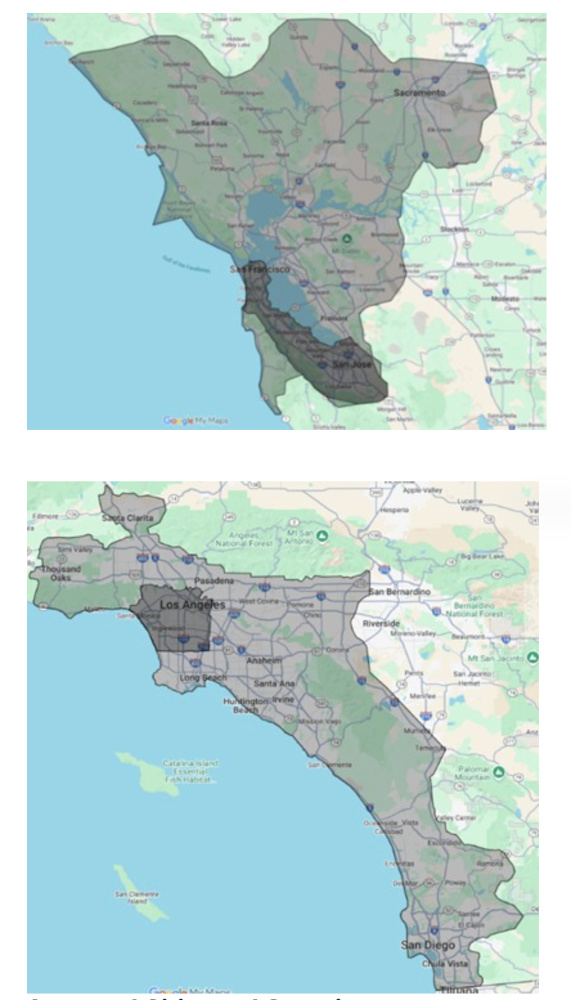
The California DMV has approved Waymo’s request to conduct driverless testing and to deploy its robotaxis in more locations in the state. As CBS News reports, Waymo now has the permission to operate across the whole Bay Area, Sacramento and most of Southern California up to the border of Mexico. It’s a huge expansion, based on the maps the state DMV has provided. In the images below, you’ll see Waymo’s old areas shaded in a darker color, while the locations with a lighter shade indicate areas added in the expansion.

Waymo's new operation map in California.
Waymo’s new operation map in California.
California DMV

“We’re officially authorized to drive fully autonomously across more of the Golden State,” Waymo said in an announcement on X. It didn’t say when it’ll start testing and offering rides to the public in the new areas, but it said the company’s “next stop” in California after this is San Diego. Waymo will start offering rides in the city sometime in mid-2026. It will also deploy robotaxis in Las Vegas, including the Strip with plans to expand to the airport, and Detroit next year. In addition, it recently announced that it’s coming to Miami, Dallas, Houston, San Antonio and Orlando in 2026.

On the Waymo and San Francisco subreddits, people pointed out that Waymo robotaxis could become a hit in Wine Country. People could call them for transportation, for instance, if they’re doing wine tasting.

This article originally appeared on Engadget at https://www.engadget.com/transportation/waymo-gets-california-dmvs-approval-to-test-robotaxis-in-more-areas-170000104.html?src=rss

Physicists Reveal a New Quantum State Where Electrons Run Wild

ScienceDaily reports:

Electrons can freeze into strange geometric crystals and then melt back into liquid-like motion under the right quantum conditions. Researchers identified how to tune these transitions and even discovered a bizarre “pinball” state where some electrons stay locked in place while others dart around freely. Their simulations help explain how these phases form and how they might be harnessed for advanced quantum technologies…

When electrons settle into these rigid arrangements, the material undergoes a shift in its state of matter and stops conducting electricity. Instead of acting like a metal, it behaves as an insulator. This unusual behavior provides scientists with valuable insight into how electrons interact and has opened the door to advances in quantum computing, high-performance superconductors used in energy and medical imaging, innovative lighting systems, and extremely precise atomic clocks… [Florida State University assistant professor Cyprian Lewandowski said] “Here, it turns out there are other quantum knobs we can play with to manipulate states of matter, which can lead to impressive advances in experimental research.”


Read more of this story at Slashdot.

X rolls out ‘About this account’ feature that displays a profile’s country of origin and more

You’ll soon be able to see more information about X accounts, including where they’re based and how many times they’ve changed their usernames. X is rolling out a new feature called “About this account” that displays more information about user accounts. Not only will it display the country a user is located in and username changes, the feature will also make public which country the account was created in and whether it’s connected via the web or a specific app store.

X began testing this feature out last month, but more recently, users have been posting screenshots of the new feature being rolled out. X is following in the footsteps of other social media platforms, as already seen with Facebook’s Page transparency and Instagram’s own About this account. As detailed by Nikita Bier, X’s head of product, the upcoming “About this account” feature is meant to verify the authenticity of content posted on X.

You can currently see your own info by clicking on the “Joined” button underneath your X bio, but you may not be able to see others’ info yet since the feature is still being rolled out. In your own profile, you can choose to display either your country or region/continent, with the exact country being the default option. Bier previously said that there will be “privacy toggles,” which will be highlighted on your profile if you opt in. On top of that, users accessing X through a VPN may have a disclaimer on their profile that says, “Country or region may not be accurate,” as spotted by some internet sleuths.

This article originally appeared on Engadget at https://www.engadget.com/social-media/x-rolls-out-about-this-account-feature-that-displays-a-profiles-country-of-origin-and-more-160617187.html?src=rss

Apple’s Latest M5 iPad Pro Is Now $100 Off For Black Friday Blowouts

Apple’s Latest M5 iPad Pro Is Now $100 Off For Black Friday Blowouts
One of these days, Apple will finally get around to releasing a MacBook with a touchscreen display. Today is not that day, and barring a surprise late release, 2025 is not the year it will happen (rumor has it, a MacBook with a touchscreen OLED won’t come out until 2027). So if you need touch support in Apple’s ecosystem, the iPad Pro is still

Tiny ‘Micro-Robots’ in your Bloodstream Could Deliver Drugs with Greater Precision

The Washington Post reports:

Scientists in Switzerland have created a robot the size of a grain of sand that is controlled by magnets and can deliver drugs to a precise location in the human body, a breakthrough aimed at reducing the severe side effects that stop many medicines from advancing in clinical trials… “I think surgeons are going to look at this,” [said Bradley J. Nelson, an author of the paper in Science describing the discovery and a professor of robotics and intelligent systems at ETH Zurich]. I’m sure they’re going to have a lot of ideas on how to use” the microrobot. The capsule, which is steered by magnets, might also be useful in treating aneurysms, very aggressive brain cancers, and abnormal connections between arteries and veins known as arteriovenous malformations, Nelson said. The capsules have been tested successfully in pigs, which have similar vasculature to humans, and in silicone models of the blood vessels in humans and animals… Nelson said drug-ferrying microrobots of this kind may be three to five years from being tested in clinical trials.

The problem faced by many drugs under development is that they spread throughout the body instead of going only to the area in need… A major cause of side effects in patients is medications traveling to parts of the body that don’t need them. The capsules developed in Switzerland, however, can be maneuvered into precise locations by a surgeon using a tool not that different from a PlayStation controller. The navigation system involves six electromagnetic coils positioned around the patient, each about 8 to 10 inches in diameter… The capsules are made of materials that have been found safe for people in other medical tools…

When the capsule reaches its destination in the body, “we can trigger the capsule to dissolve,” Nelson said.


Read more of this story at Slashdot.