A new study published in Communications Earth & Environment has reconstructed the climate conditions of the ancient Indus River Valley civilization between 3000 and 1000 B.C., finding that four intense droughts — each lasting more than 85 years — likely drove the gradual decline of one of the world’s earliest advanced societies.
The research team, led by Hiren Solanki at the Indian Institute of Technology, Gandhinagar, combined paleoclimate data from cave formations and lake records with computer models to determine that the region shifted from wetter-than-present monsoon conditions to prolonged dry spells as the tropical Pacific Ocean warmed. The third drought, peaking around 1733 B.C., proved the most severe: it lasted 164 years, reduced annual rainfall by 13%, and affected nearly the entire region.
Overall temperatures rose by 0.5 degrees Celsius and rainfall dropped between 10 and 20%. These changes shrank lakes and rivers, dried soils, and made agriculture increasingly difficult in areas away from major waterways. Harappan settlements progressively relocated eastward toward the Indus River over roughly 2,000 years. The civilization’s long survival under repeated climate stress — through crop switching, trade diversification, and settlement relocation — offers lessons for modern communities facing environmental pressures, the researchers said.
AV Linux 25 multimedia production distro has been released as a major version derived from the latest MX Linux release and introducing various new features and enhancements.
The bitter standoff between Dutch chipmaker Nexperia — which supplies basic chips crucial to 49% of European automakers, over 85% of medical device companies, and the entire defense industry — and its Chinese parent company Wingtech escalated on Friday when both Wingtech and Nexperia’s Chinese unit accused the Dutch business of secretly building a supply chain that would cut China out entirely. The accusations came one day after Nexperia’s Dutch headquarters published an open letter claiming it had repeatedly tried and failed to contact its Chinese unit.
Nexperia China demanded the Dutch side halt its overseas expansion plans, specifically a $300 million investment in a Malaysian plant, and alleged an internal company target to source 90% of production outside China by mid-2026. The Chinese unit also accused its European counterparts of deleting employee email accounts and cutting off access to IT systems. The dispute traces back to September when the Dutch government invoked a Cold War-era law to seize control of Nexperia on economic security grounds.
An Amsterdam court subsequently stripped Wingtech of its ownership rights. Beijing retaliated by halting exports of finished Nexperia chips on October 4, triggering warnings of production shutdowns from automakers including Nissan and Bosch. Export curbs were relaxed in early November, and the Dutch government suspended its intervention last week following talks, but the court ruling remains in force. Wingtech warned that supply disruptions could return if the control issue remains unresolved.
LILYGO has introduced the T-Lora Dual LR, a compact board that integrates an ESP32-S3R8 microcontroller with two LR1121 transceivers, combining Wi-Fi, Bluetooth LE, and LoRa across sub-GHz and 2.4 GHz bands. The module uses the ESP32-S3R8 as its main processor. It features a dual-core LX7 architecture and includes integrated wireless connectivity for Wi-Fi 802.11 b/g/n […]
Australia warned it’s in danger of missing its 2035 climate targets without deeper pollution cuts, which in turn threatens the nation’s ambitions to reach net zero by mid-century. From a report: Emissions are set to fall 48% by 2035 from 2005 levels based on current projections [non-paywalled source], the government said in a report on Thursday. That’s short of an official pledge to cut greenhouse gases between 62% and 70%. The forecast doesn’t take into account new action planned under the nation’s Net Zero Plan. Still, the targets remain achievable and officials plan to take additional measures to meet them, Minister for Climate Change and Energy Chris Bowen said in a speech to parliament.
Rumors indicate that amidst the ongoing DRAM shortage, and resulting price hikes, NVIDIA may stop bundling its GPUs with VRAM for its AIB (Add-In Board) partners. This rumor originates from Golden Pig Upgrade Pack on Chinese social media platform Weibo, and if true, could prove troublesome for some of NVIDIA’s smaller board partners. Rumors
Wine 10.20 is out as the newest bi-weekly development release of this open-source software enabling Windows applications and games to run on Linux. This is also with Wine 11.0 stable quickly approaching…
Putting together a photo album is a sweet way to share memories with loved ones, and a digital frame lets you package those feelings in a device that can be constantly updated with new pictures. Aura makes some of the best frames we’ve tested, and for Black Friday you can get our favorite digital picture frame the company makes for $139. That’s $40 off the normal $179 price of the Aura 10.1″ Carver Mat Frame, and one of the lowest prices we’ve seen the frame hit this year.
The Aura Carver Mat has a 10.1-inch display that’s bright and high-resolution enough to show off a rotating collection of photos and videos without worrying about glare. The display is designed to be used in landscape orientation, and Aura’s software can intelligently pair portrait photos together so the screen isn’t left with awkward negative space.
Better yet, actually getting photos on the frame is a breeze. You can add whatever photos or videos you choose through a handy smartphone app, and even organize photos in albums if you want them to be displayed together. By default, the Aura Carver will shuffle through what you’ve uploaded, but you can also manually swipe through photos via a touch panel at the top of the frame if there’s something particular you want to display.
In terms of quality and ease-of-use, the Aura 10.1-inch Carver Mat Frame is the top pick in our list of the best digital picture frames for a reason. Parents and grandparents find it kind of magical to have a frame that you can randomly update with new photos, and of the Black Friday deals we’ve spotted this year, it’s a guaranteed crowd-pleaser.
This article originally appeared on Engadget at https://www.engadget.com/home/smart-home/our-favorite-aura-digital-photo-frame-is-40-off-for-black-friday-202715971.html?src=rss
Valve’s Steam Machine, affectionately nicknamed the “GabeCube” after Valve founder Gabe Newell and Nintendo’s similarly-shaped GameCube console from the early 2000s, is launching early next year at an as-yet unannounced price. Judging by the specs, we were laying down our bets on $699 USD for the 512GB model, and perhaps $749 or $799 for the
Singapore has claimed the top spot in the 2025 Global Talent Competitiveness Index for the first time, displacing Switzerland from a position the European nation had held since the ranking’s inception in 2013. The index, produced by business school INSEAD and the Portulans Institute, measured 135 economies across 77 indicators spanning soft skills, AI talent concentration, and formal education systems. The city-state ranked first globally in formal education and what the report calls “Generalist Adaptive Skills,” a category covering soft skills, digital literacy, and innovation-oriented thinking.
A key factor in Singapore’s rise was a seven-place jump in talent retention, moving from 38th to 31st. The United States fell from third place in 2023 to ninth this year, its weakest showing in 12 years, due to declines in openness and lifelong learning metrics. High-income European countries continue to dominate the top ten, holding seven positions.
It’s Black Friday 2025, and we’ve sifted through the chaff in order to find the best gaming monitor deals currently available. High-refresh rate monitors are now dominated by OLED panels, which are superb in terms of image quality but have historically been quite expensive, so deep Black Friday discounts are very welcome. We didn’t focus solely
We may earn a commission from links on this page. Deal pricing and availability subject to change after time of publication.
Black Friday sales officially start Friday, November 28, and run through Cyber Monday, December 1, and Lifehacker is sharing the best sales based on product reviews, comparisons, and price-tracking tools before it’s over.
Follow our live blog to stay up-to-date on the best sales we find.
Browse our editors’ picks for a curated list of our favorite sales on laptops, fitness tech, appliances, and more.
Sales are accurate at the time of publication, but prices and inventory are always subject to change.
Thanksgiving is a week away, but Black Friday sales are already here. This year, Amazon’s Black Friday deal event is taking place from Nov. 20-28, and Lifehacker will be here with all the best deals throughout the mega-sale. Right now, one of them is on my absolute favorite headphones for running—the Shokz OpenRun Pro 2. They’re currently $124.95, a 31% discount off their list price of $179.95.
If you’re unfamiliar with the world of bone conduction headphones (BCH), let me try to convert you. I love noise-cancelling tech when I’m in the gym, sure. But when I’m exercising outside, I’m grateful for BCH technology to keep my ears open to traffic, other runners, and reckless cyclists—all without sacrificing audio quality. As my colleague Daniel Oropeza reviews in-depth here, the Shokz OpenRun Pro 2 are the best set of BCHs that either of us have ever tried.
With these Shokz, I’ve experienced little to no ear fatigue, even during 20+ mile runs. I’ve worn these headphones for over a year now, through humid summer runs and unexpected downpours, and they’re holding up great. Most important for me, their battery life holds up, lasting even my longest training runs. Even if I forget to charge the night before a run, a quick five-minute charge gives me around 1.5 hours of listening time. Shokz is a go-to brand for a reason, and this 31% discount could be the nudge you need to snag the OpenRun Pro 2 headphones for yourself.
If you’re still shopping around, I recommend checking out guides like our live blog, where we use price trackers to make sure you’re really getting the best deals this Black Friday. And if you have an Amazon Prime membership, make the most of it.
How long do Black Friday deals really last?
Black Friday sales officially begin Friday, November 28, 2025, and sales run throughout “Cyber Week,” the five-day period that runs from Thanksgiving through Cyber Monday, December 1, 2025. But Black Friday and Cyber Monday dates have expanded as retailers compete for customers. Expect sales to wind down by December 3, 2025.
Are Black Friday deals worth it?
In short, yes, Black Friday still offers discounts that can be rare throughout the rest of the year. If there’s something you want to buy, or you’re shopping for gifts, it’s a good time to look for discounts on what you need, especially tech sales, home improvement supplies, and fitness tech. Of course, if you need to save money, the best way to save is to not buy anything.
Are Cyber Monday deals better than Black Friday?
Black Friday used to be bigger for major retailers and more expensive tech and appliances, while Cyber Monday was for cheaper tech and gave smaller businesses a chance to compete online. Nowadays, though, distinction is almost meaningless. Every major retailer will offer sales on both days, and the smart move is to know what you want, use price trackers or refer to guides like our live blog that use price trackers for you, and don’t stress over finding the perfect timing.
Our Best Editor-Vetted Black Friday Deals Right Now
As some additional enticing Linux kernel patches posted this week for review, an updated patch series is working to optimize code generation during context switching…
This week, we took on the new Watts the Limit route in NYC for the second TTT of Zwift Racing League 2025/26. It was a bit of a wild route due to the crazy ramps in and out of the subway, and I didn’t make things any smoother by accidentally sapping my legs in a heat training session the day before.
But I’m getting ahead of myself. Read on to see how our race unfolded!
Heat Training vs Recovery
Let’s start this story a day before the race, when I decided to do a heat training use the CORE sensor. You can watch the whole session here, but I’ll summarize it by saying it turned into a harder effort than I’d planned. But by the time I realized I was probably overdoing it, I was nearly done with Off the MAAP stage 1, and didn’t want to pull the plug. Because I’m not DNFer!
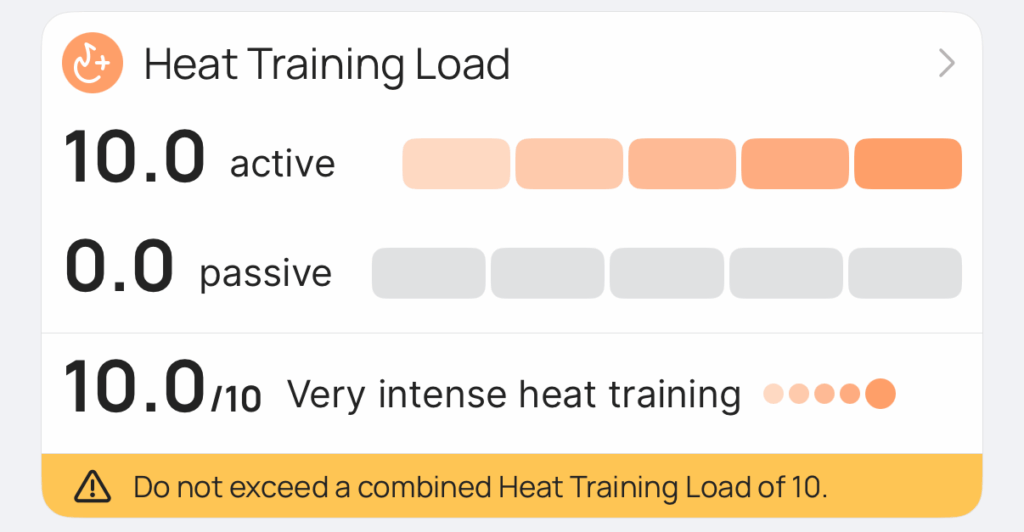
My mistake was confirmed when I pulled up the CORE app and saw this in my activity summary:
Still, I didn’t feel particularly tired after the effort. I’d only ridden zone 2 power after all. So I just tried to make sure I rehydrated and got rest heading into ZRL day.
Planning Our Race
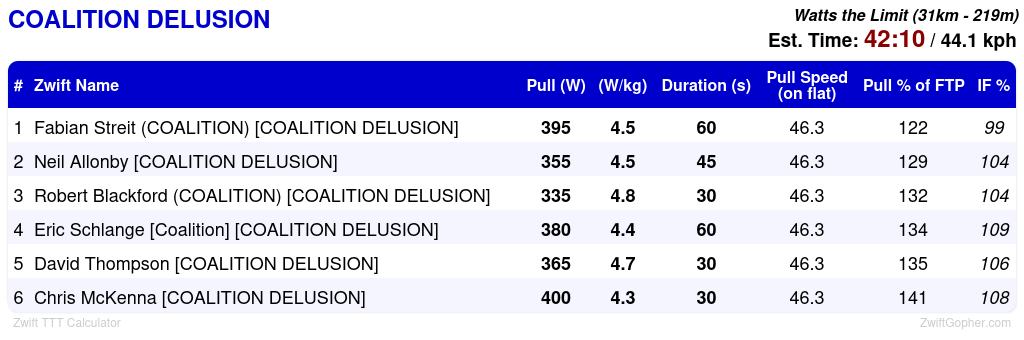
Heading into the race, my team (Coalition Delusion) was chatting about all things course and strategy as usual. Since these were fairly new roads in New York, none of us had raced them as a TTT yet. Captain Neil had our pull order worked out, with a bit of help from the Zwift TTT Calculator:
The big question for everyone was the escalators. I had already done some testing to confirm that going up the escalators would prove tricky for teams of varying weights, since the escalators slow heavy riders much more than light riders.
Then Zwift made things even more interesting by releasing a drafting fix the day before the race, which particularly affected the ride experience on steep inclines and declines. How would this change the escalators? There really wasn’t time to try it out. We would learn as we went!
The Race
We took off from the Central Park start pens, and quickly got into formation. Like most TTT squads, our goal is to “line it out” – to hold a 6-rider formation, rotating pulls on the front. It’s absolutely the most efficient way to race a team time trial, and it really is a cool feeling when your whole squad is dialed in and riding as one.
As each rider finished their planned pulls, they would announce on Discord that they were pulling off. Then the next rider would call out how long they’re going, and the on-deck rider would acknowledge that they knew they were there next. We were doing our best to communicate clearly, since we didn’t have a dedicated (non-riding) DS to direct us today.
Calling an Audible
I was supposed to take 60-second pulls, but after my first one (3 minutes into the race) I was already questioning whether that would be possible! It’s not hard to do the math: this would be a ~41-minute race, and the team of 6 would rate through in just under 4 minutes. That meant I had at least 10 pulls to make, and possibly more if we lost a rider or two.
I decided I would need to do some shorter pulls to make sure I didn’t blow up on the back half of the course.
Escalator Madness
We hit our first downramp into the subways as I was dropping back from taking my first pull, and I didn’t time things well at all. First, the team flew past me faster than I’d anticipated, which left me a 3 meters off the back as we hit the ramp. I stopped pedaling at the ramp, figuring I would get sucked back into the team via the new, stronger draft… but instead, they rocketed ahead, and I soon found myself 20-30 meters off the back!
Nobody wants to see this view in a TTT:
My teammates were quite animated in Discord, surprised by the high speeds and churn caused by the downramp. It was pandemonium, but I hammered to get back in the wheels – you have to react quickly in these situations – and we slid back into formation.
A couple of minutes later, we had our first escalator up and out of the subway. We handled this one much better, with everyone lifting their efforts and our team at least staying tightly packed over the top.
Hammer up the escalator, keep the power high to accelerate once it flattens out, then return to formation. That would be our general approach on the next 5 escalators.
Feeling Weak, Feeling Strong
On my next pull, I only did a 30-second effort. Pushing at what I felt was the typical VO2 max power (~370W) where I take my pulls, the numbers on screen showed 30-40W below my target. Yikes. Clearly, yesterday’s heat session had sapped me.
At the same time, I wasn’t on my limit. This is thanks to being on a B development squad, which means we’re all mid-pack B riders and not a bunch of super-B’s! So I could still contribute to the team in a meaningful way, despite not being on top form. The race began to feel like a tug-of-war between me struggling to pull at my target power, and me feeling strong and perfectly capable in the draft.
At the 9:15 mark, I noticed a gap forming between the two front riders and the four of us behind. (This sort of thing happens to some extent in pretty much every TTT race, and it’s usually triggered by a rider who is dropping back after taking their pull. If that rider drops back too slowly, and someone ends up getting stuck behind that rider, a gap will quickly open up.)
I saw such a gap forming, so I announced I was heading forward to full the gap, and for Robert, the rider whose wheel I would normally sit on in our formation, to let me know when he wanted to come around me to get back into formation. It worked just as planned: the gap was closed quickly, with just a bit of extra work on my part. Let’s roll!
Logging the Miles
The course continued to unfold before us, and we worked together to keep speeds high and ride efficiently. This was far from a flat, steady route! Instead, it was rather polarized, thanks to the six escalators, six steep downramps, and two crossings of the Manhattan Bridge. In between these dramatic sections the course was quite flat, so we were repeatedly transitioning from easy flat roads to major pitch changes and back.
But we were moving well, and Sauce showed us a few seconds up on the teams visible to us: two ahead and one behind – as we made the turnaround at Grand Army Plaza.
No HR
At 16.1km, I noticed my heart rate wasn’t showing in the HUD anymore. Crap. I tried pushing the button to turn it on again, but that didn’t work. It never does, with the Schosche monitor. When it’s dead, it’s dead! Should have charged it beforehand. I just hoped I’d been showing HR long enough that WTRL wouldn’t DQ my effort for the event.
Chris Skips
At 19.1km, Chris said he would need to skip a pull. As a C-cat rider who had been sick in the day leading up to the race, we wouldn’t begrudge him sitting in the wheels for a while! So he slid to the back of the formation, becoming the “bookend” of the group as we started the return climb to the Manhattan Bridge sprint arch.
Back to 1-Minute Pulls
With 8.7km left in the race, I rotated to the front and called out a 1-minute pull. The race wasn’t easy by any measure, but I also felt like I had the legs to do a few hard 60-second efforts before it ended, and the team could use the extra break with Chris unable to pull for now.
(I should mention Fabian here, our strongest rider, who took consistent and strong 1-minute pulls throughout the race. Every team needs a Fabian!)
We hit the downramp into City Hall Station while I was on the front, and while I sort of automatically eased up on the power due to the drop in resistance, the rest of my team slingshotted from my draft and came around me as we hit the flat road at the bottom! We would then have to quickly reorganize into formation while speeds were still high.
This is how the downramps seemed to unfold each time. It may not have been the fastest possible way to attack these ramps, but it was efficient, and we were still putting time into the other teams. The front rider seemingly couldn’t push hard enough to stay ahead on these downramps, as the chasing riders were still putting out power and the newly strengthened draft wanted to slingshot everyone ahead. It was all a bit chaotic, but at least it was fast chaos.
The Finish
We hammered up the final escalator, the longest of the course, and now just 3km were left in the race. The formation was getting a bit jumbled, as often happens near the end of these races.
Chris was still holding on like a boss and volunteered to take a suicide pull to make one last contribution to the team. “Let’s go,” he said with 700 meters left. And he hammered on the front, emptying his tank as we hit the little kicker heading into the finishing sprint.
I hammered up that sprint and tried to keep the power up, as I saw I was the front rider. That always pushes me to give it all, as I know everyone behind is behind helped by my draft!
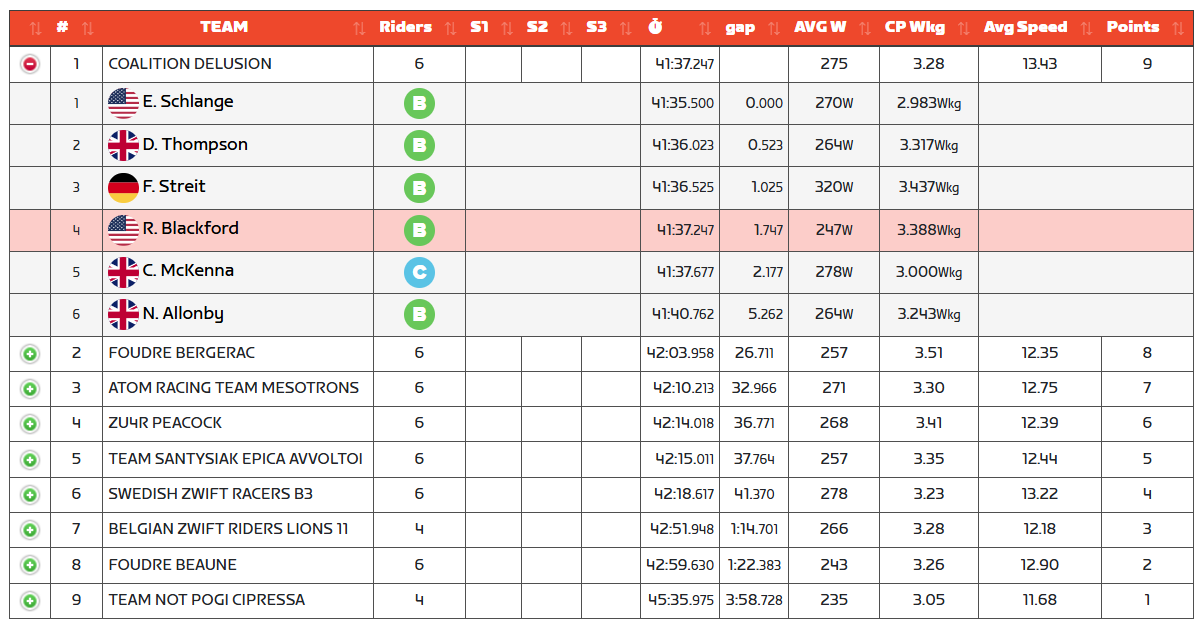
We won by a good margin, beating the next-best team by over 26 seconds:
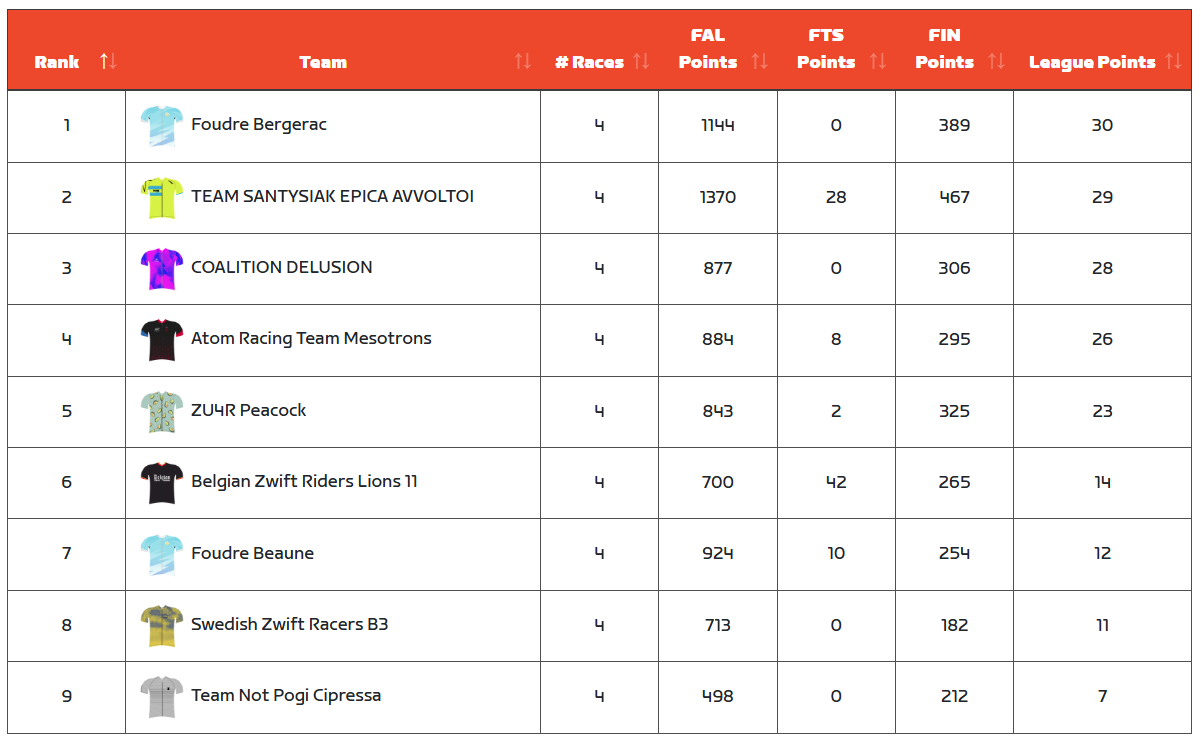
The problem is, we didn’t do well in races 2 and 3, due to their mountainous nature. So we currently sit in 3rd place overall. But the top of the division is competitive!
Clearly, Coalition Delusion does well with the TTT format. Next week’s punchy points race on Glasgow Crit Circuit will be interesting, to say the least. There’s still potential to improve our overall ranking, but given the last two races of Round 2, it won’t be easy.
One takeaway from this week: I definitely won’t be doing a heat training the day before next week’s race.
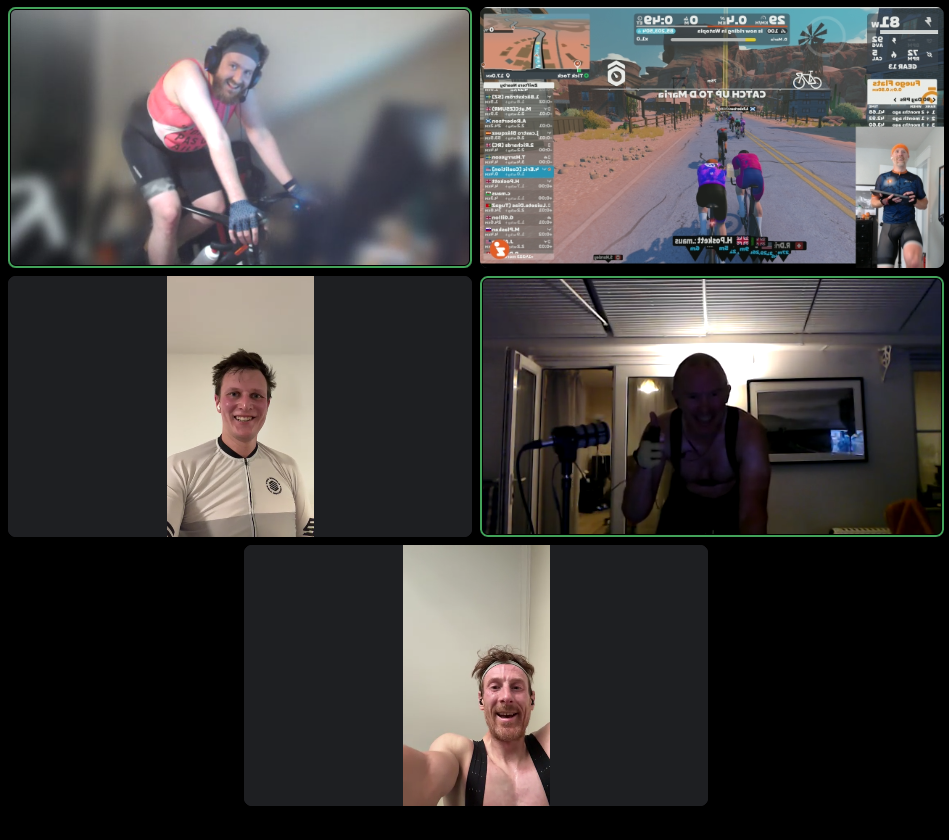
We finished our ride with the customary team shot:
European leaders have spent years warning that the continent risked falling behind the U.S., China and Russia in the global contest for economic, technological and military dominance, and officials now believe they have reached that point.
The mood darkened over the summer when Europe found itself on the sidelines as Washington and Beijing negotiated a reset of global trade rules, and turned bleak this month when the White House presented a Ukraine cease-fire plan without consulting European capitals. In July, the EU accepted a trade deal allowing the U.S. to impose 15% tariffs without retaliation.
President Trump ignored European calls to pressure Moscow before meeting Vladimir Putin in Alaska in August, telling reporters “this is not to do with Europe, Europe’s not telling me what to do.” Germany has eased its debt brake to pour $580 billion into a decade-long rearmament program, and the EU has set a 2030 rearmament goal — defense spending across the region is set to exceed $560 billion this year, double what it was a decade ago. “Battle lines for a new world order, based on power, are being drawn right now,” European Commission President Ursula von der Leyen said in September. “A new Europe must emerge.”
Apple’s Podcasts app on both iOS and Mac has been exhibiting strange behavior for months, spontaneously launching and presenting users with obscure religion, spirituality and education podcasts they never subscribed to — and at least one of these podcasts contains a link attempting a cross-site scripting attack, 404 Media reports. Joseph Cox, a journalist at the outlet, documented the issue after repeatedly finding his Mac had launched the Podcasts app on its own, presenting bizarre podcasts with titles containing garbled code, external URLs to Spotify and Google Play, and in one case, what appears to be XSS attack code embedded directly in the podcast title itself.
Patrick Wardle, a macOS security expert and creator of Objective-See, confirmed he could replicate similar behavior: simply visiting a website can trigger the Podcasts app to open and load an attacker-chosen podcast without any user prompt or approval. Wardle said this creates “a very effective delivery mechanism” if a vulnerability exists in the Podcasts app, and the level of probing suggests adversaries are actively evaluating it as a potential target. The XSS-attempting podcast dates from around 2019. A recent review in the app asked “How does Apple allow this attempted XSS attack?”
Asked for comment five times by 404 Media, Apple did not respond.
Welcome to our latest roundup of what’s going on in the indie game space. Even though it’s a truncated week in the US with the long holiday weekend, there’s still been a spate of new releases and news on upcoming games. There’ll be plenty more over the next couple of weeks too, with The Game Awards, Day of the Devs and several other showcases in the pipeline.
In the spirit of the season, one thing I’m thankful for is indie studios being able to make the games they want despite external pressures. We’ve seen both extremes of that in recent months. This week, the team at Santa Ragione said it respects players enough to release its latest game, Horses, as intended. However, Valve has blocked the horror title from Steam in what seems to be quite a messy case. As a result of not being able to sell Horses on the biggest PC games storefront, Santa Ragione said it’s at risk of closure.
On the other end of the scale, Team Cherry was able to take all the time in the world to make Hollow Knight: Silksong because of the success of its previous game, which has sold more than 15 million copies. Although Hollow Knight fans spent years clamoring for updates on Silksong, the small team had the financial freedom to spend as long as it wanted crafting and polishing the sequel. The devs were able to just keep their heads down and do that until Team Cherry announced a release date just two weeks in advance.
Those are two very different stories. Still, they both resulted in fully realized games based on seemingly uncompromised visions.
New releases
A.I.L.A — from Pulsatrix Studios and publisher Fireshine Games — has a decent-enough concept. It’s a first-person horror title in which you take on the role of a VR game tester. The games that the protagonist plays are crafted by an AI (which, by itself, is a horrifying prospect) and adjusted based on your feedback. In a stunning development, the AI begins to tap into your character’s deepest fears and blur the virtual and real worlds. It sounds like a blurb for an airport novel, but it’s a solid-enough foundation on which to base a game.
The structure of A.I.L.A allows for Pulsatrix to craft a few distinct experiences in various horror subgenres within a larger game. You’ll encounter a cult, zombies, aliens, creepy mannequins, puzzles and more as you play through chapters rooted in the likes of psychological horror and survival horror. There are a lot of ideas packaged together here. I’ve played a chunk A.I.L.A and it’s okay so far, even if it does feel a bit like a tribute band playing the hits of yesteryear. A.I.L.A is out now on Steam (usually $30, but there’s a 20 percent discount until December 9), PlayStation 5 and Xbox Series X/S.
If you can’t get enough of fairly lengthy open-world action RPGs, Of Ash And Steel might be one for you to sink your teeth into. Fire & Frost and publisher tinyBuild claim there’s over 45 hours worth of main story material to dig into here.
One interesting thing about Of Ash And Steel is that there are no quest markers. Exploration is a major factor and you can mark locations on your map. Otherwise, you’ll need to pay attention to things like what other characters are saying to figure out where to go. Also, the trailer’s final shot shows a pair of titans that seem ready to battle, and that has me intrigued too.
Of Ash And Steel typically costs $30. There’s a 20 percent discount until December 8 on Steam and GOG.
Young Suns is the latest project from Ko_Op (Goodbye Volcano High). When the team announced the game this week, it immediately became available on all Game Pass tiers as a game preview on Xbox Series X/S, PC and Xbox Cloud. If you’d prefer to buy it outright, you can also do that for $20.
This is (appropriately enough) a co-op life sim for up to four players. The team readily admits that Young Suns is still in development and that means some features and quest content aren’t available in the current version of the game. However, as game director Graeme Lennon wrote in an Xbox Wire post, “The game is playable and fun for its intended pattern of play: checking in for an hour or two daily, slowly building up your perfect ship-home and making new friends.”
The game is set on Jupiter and you can explore space stations, planetoids and ruins. You can collect resources and other items to help upgrade your ship/home. There are 30 characters (more are on the way), and most have “over two months of unique daily chat content.” Young Suns is also coming to Steam down the line.
Dinopunk: The Cacops Adventure is the first of two dinosaur games in this week’s roundup. This one is an adorable-looking retro platformer from The Dude Games and publisher Meridiem. It’s said to pay tribute to classic games like Wonder Boy, Alex Kidd and Contra.
As an amphibian dinosaur, you can collect special items to upgrade your attacks. There are arcade-style minigames as well. My favorite thing from the trailer, though, is a boss called Gatling Saurus. Love it. Dinopunk: The Cacops Adventure is out now on Steam. It usually costs $8, but there’s a 10 percent discount until December 1.
Upcoming
Ferocious is a very different kind of dinosaur game. This one is a first-person shooter from OMYOG and tinyBuild in which you have a device that allows you to communicate with and control dinos. Sending a rampaging triceratops into combat or riding on the back of one looks pretty fun. You can even take charge of a T. rex.
The gist is that an evil corporation is out to change the world in its favor with the help of these prehistoric reptiles, and it’s up to you to stop this cabal. Ferocious will hit Steam on December 4 for $25.
Engadget’s UK bureau chief Mat Smith got to try out There Are No Ghosts at the Grand back at Gamescom, and now you can check it out too. Friday Sundae has released a demo for the odd-looking “spooky, cozy musical mystery” on Steam.
After you inherit a rundown hotel, you have 30 days to fix it up using talking power tools (such as a furniture cannon)… or else. At night, you’ll have to fend off ghosts. Maybe the title of this game is a bit of a misdirect!
There Are No Ghosts at the Grand seems a bit strange, but I’m on board with it. It’s coming to PC and Xbox Series X/S next year and it will be a day-one addition to Game Pass. It will hit other platforms later.
This article originally appeared on Engadget at https://www.engadget.com/gaming/ai-horror-a-dinosaur-platformer-and-other-new-indie-games-worth-checking-out-180000059.html?src=rss
We may earn a commission from links on this page. Deal pricing and availability subject to change after time of publication.
Black Friday sales officially start Friday, November 28, and run through Cyber Monday, December 1, and Lifehacker is sharing the best sales based on product reviews, comparisons, and price-tracking tools before it’s over.
Follow our live blog to stay up-to-date on the best sales we find.
Browse our editors’ picks for a curated list of our favorite sales on laptops, fitness tech, appliances, and more.
While I would never suggest streaming hasn’t been great for the true cinephiles out there—if I can think of a film, there’s a very good chance there’s a way I can start watching it within seconds, even if I have to pay for a rental or buy a digital copy—the major streaming services haven’t always done right by film fans. While Netflix grows increasingly uninterested in hosting anything that isn’t a Netflix exclusive, the likes of Warner Bros. and Paramount are removing many classics from their streaming services to emphasize newer “content.”
But all is not lost—if you look beyond the major media corporations, there are great niche streaming options out there for film freaks. And right now, annual subscriptions to two of the very best are heavily discounted for Black Friday.
The Criterion Channel and MUBI are indispensable for film fans
I’ve written before about my love for The Criterion Channel, the streaming offshoot of The Criterion Collection, a boutique media label that has spent more than four decades cultivating a reputation as the ultimate tastemaker for movie obsessives, releasing top shelf home video editions of “important classic and contemporary films” spanning the last century and the entire world. In 2019 Criterion launched The Criterion Channel, which brings the same selective film snob ethos to a monthly streaming service.
It’s hard to choose between the two streaming services, because they have such a different focus: The Criterion Channel is essential if you’re interested in developing a broad knowledge of classic cinema, with an ever-changing catalog spanning decades, while MUBI tends to be focused on more recent but also more obscure films from around the globe.
So why choose?
Both are $75 for Black Friday
Usually a subscription to The Criterion Channel will run you $100/year (or $11/month), while MUBI is a bit pricier at $120/year (or $15/month). As I try to keep my monthly streaming budget to a reasonable level, I usually limit myself to one of these, but thanks to their concurrent Black Friday sales, I’m going all out in 2026.
Right now, you can get a year of either service for a cool $75, or $6.25 per month annualized. That means you can get both for $12.50, or $6 less than the cost of a month of HBO Max without ads.
From now through Dec. 1, MUBI’s deal is $75 for an annual subscription, with the deal accessible directly from its homepage (though note that you’ll auto-renew next year at the usual $120 price). The deal is open to all new and past subscribers.
Also through Dec. 1, The Criterion Channel is also $75, but you’ll need to use the code BLACKFRIDAY25 at checkout. Your subscription will start after a 7-day free trial, and will auto-renew next year at the usual $100 rate. One caveat: This deal is for your “first year,” so if you’re a current or former subscriber, you’re out of luck unless you want to create a new account with a different email and credit card, and sacrifice your watch history.
Whichever option you choose (again, I suggest going big and getting both if you can swing it), you’ll have a great year of movie-watching ahead of you.
What stores have the best sales on Black Friday?
Nowadays, both large retailers and small businesses compete for Black Friday shoppers, so you can expect practically every store to run sales through Monday, December 1, 2025. The “best” sales depend on your needs, but in general, the biggest discounts tend to come from larger retailers that can afford lower prices: think places like Amazon, Walmart, Target, Best Buy, and Home Depot. You can find all the best sales from major retailers on our live blog.
Are Black Friday deals worth it?
In short, yes, Black Friday still offers discounts that can be rare throughout the rest of the year. If there’s something you want to buy, or you’re shopping for gifts, it’s a good time to look for discounts on what you need, especially tech sales, home improvement supplies, and fitness tech. Of course, if you need to save money, the best way to save is to not buy anything.
Are Cyber Monday deals better than Black Friday?
Black Friday used to be bigger for major retailers and more expensive tech and appliances, while Cyber Monday was for cheaper tech and gave smaller businesses a chance to compete online. Nowadays, though, the distinction is almost meaningless. Every major retailer will offer sales on both days, and the smart move is to know what you want, use price trackers or refer to guides like our live blog that use price trackers for you, and don’t stress over finding the perfect timing.