
Another round of AMDGPU/AMDKFD kernel driver improvements were sent out this week as feature development for DRM-Next ahead of Linux 7.1 begins to wind down…
Category Archives: Unfiltered RSS
RST reveals inverted gravel suspension with electronic damping – and a new 32in fork for XC bikes
RST had an E TACK-branded upside-down gravel fork featuring an electronic damper on its stand at the Taipei international Cycle Show.
The fork is designed to work with electric gravel bikes, taking charge from the main battery, but it can also be used with conventional gravel bikes using a battery in the steerer tube.
It’s not the first upside-down gravel fork we’ve seen, with Cane Creek’s Invert CS impressing us with its take on the theme.
RST’s fork goes one step further, though, with the electronic damper controlling the 60mm of travel.

There are three modes for the damper: Open, Pedal and Closed, while the Auto setting cycles through them by sensing the ground you’re pedalling on using accelerometers.

You can take command yourself, with buttons mounted to the handlebar that control the damper’s setting.
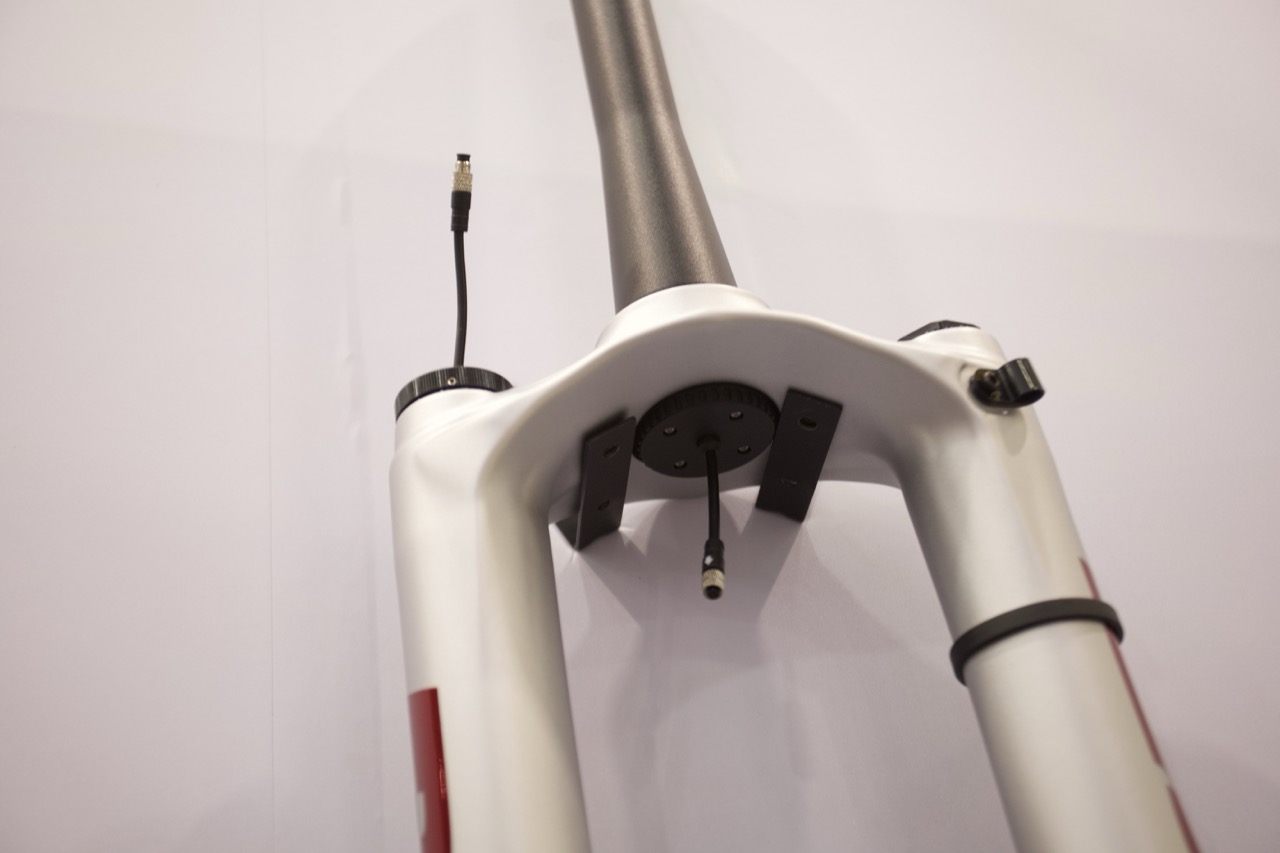
The fork is also said to feature a built-in mudguard.
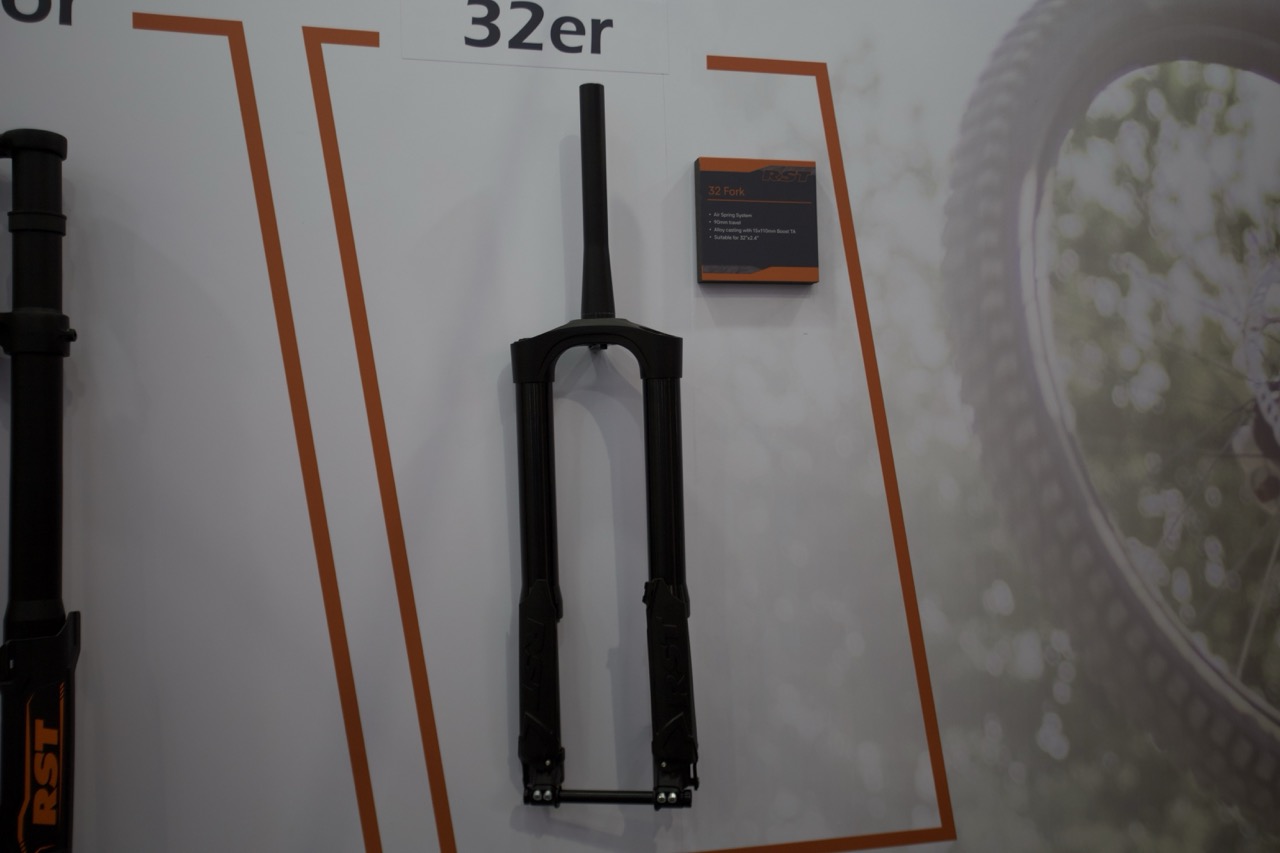
Elsewhere on the stand, RST displayed its 32er fork, which shares an upside-down design but is focused on cross-country mountain biking.
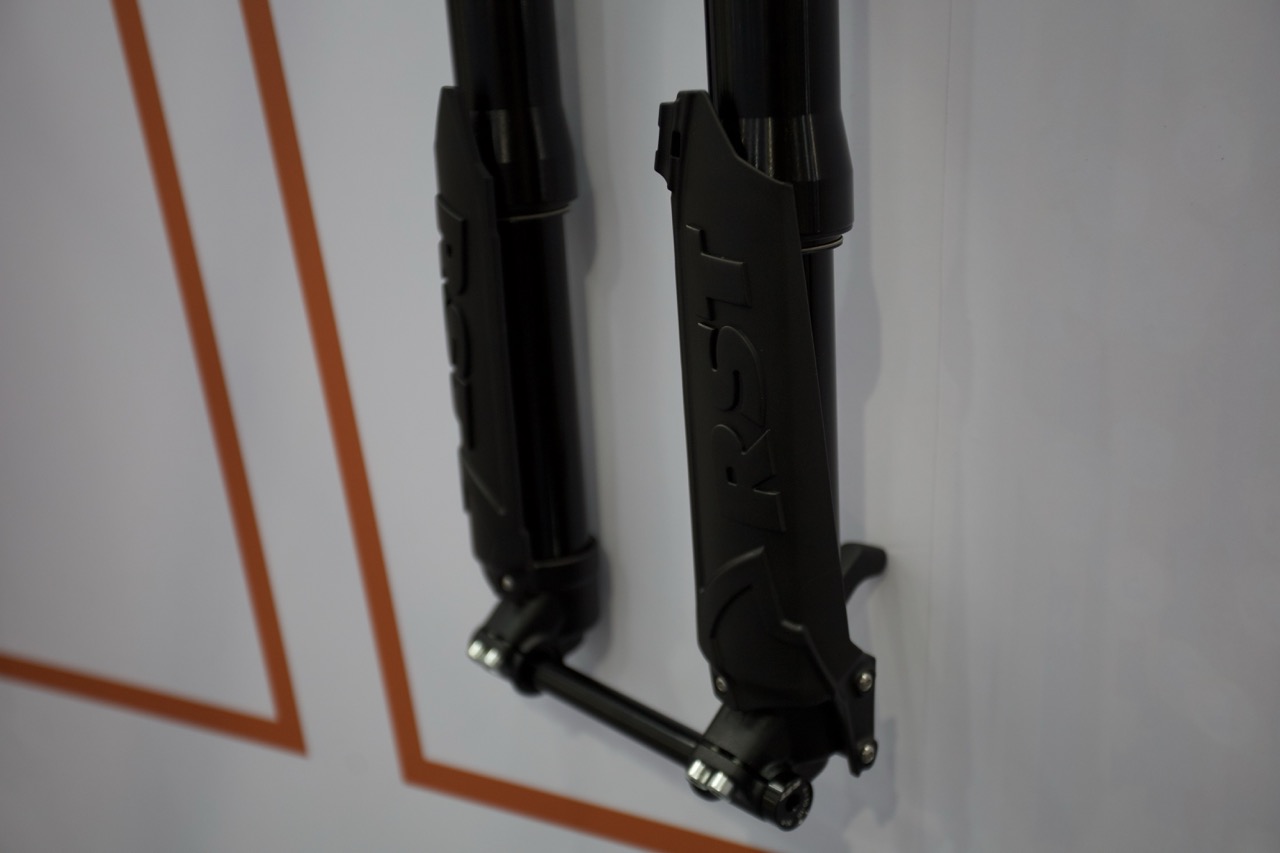
The fork sees guards positioned over the stanchions, and if I had to describe it in one word, it would be ‘black’.
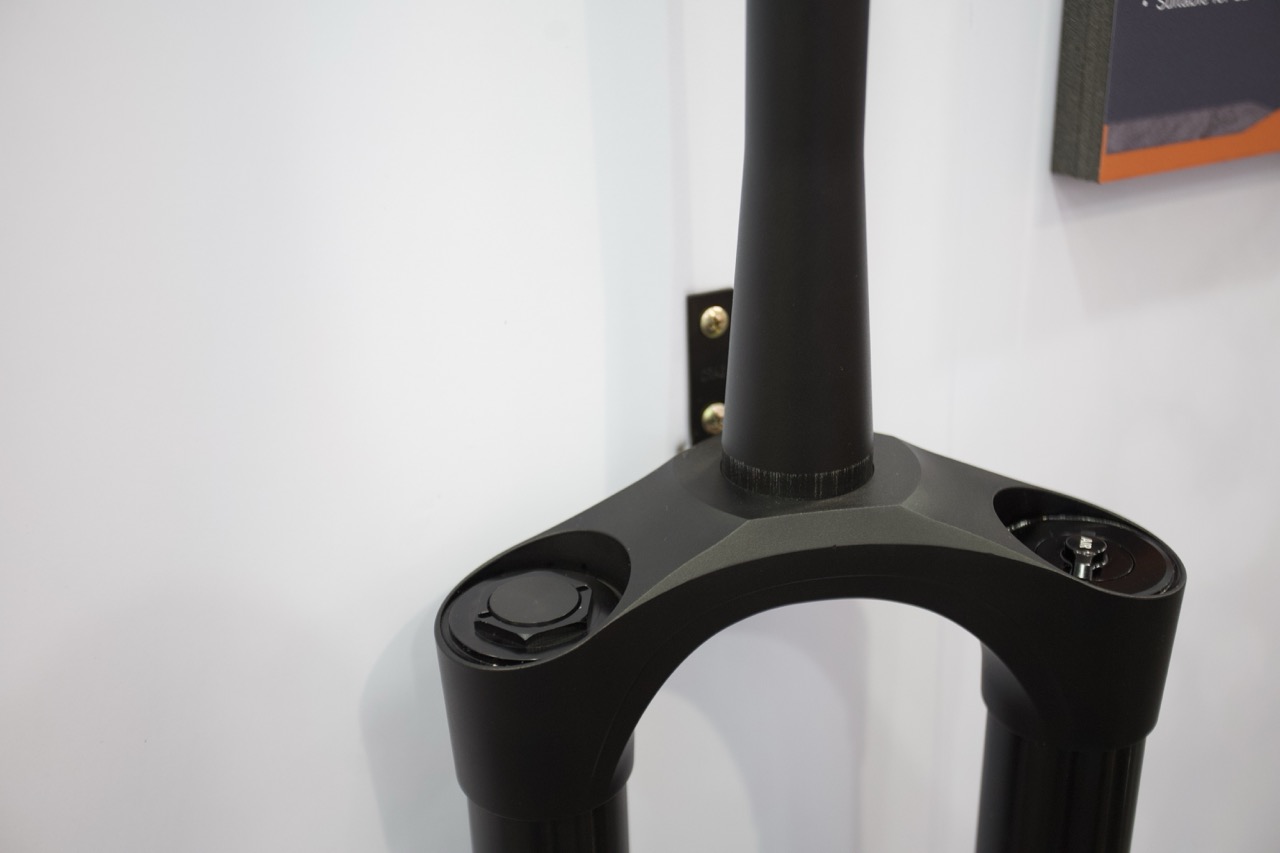
An air-spring system is used internally, and the fork provides 90mm of travel, putting it on the shorter side compared to XFusion’s Rezza 32er.
There’s no word as yet on pricing, but we can expect to see 32in making its way to more affordable bikes in the future.
More from the Taipei International Cycle Show
- This new ebike conversion kit offers 51km range, weighs only 3.8kg and will fit in your backpack
- X-Fusion’s E-Manic 2 electronic dropper post looks to be everything we wanted from the original
- Steel tubes, lugs… and an electric motor?! This could be the perfect retro e-bike
- DVO returns after post-COVID slump with more tuneable luxuriously smooth fork and shocks
- This wild steel gearbox enduro bike could convince me to drop the derailleur
- Wheeltop expands its challenge to SRAM and Shimano with new wireless groupset
- These new smart thru-axles sound an alarm to prevent you crashing
- This is the longest-travel fork we’ve seen for 32in wheels – could the new size go beyond XC racing?
This homemade take on the Fox Podium adds features nobody else has thought of
While inverted forks have been around for a long time, in the past 12 months they’ve garnered more attention.
That could be down to the release of the Fox Podium or the rise of 32in-wheel bikes, which at this early stage of development favour inverted fork designs.
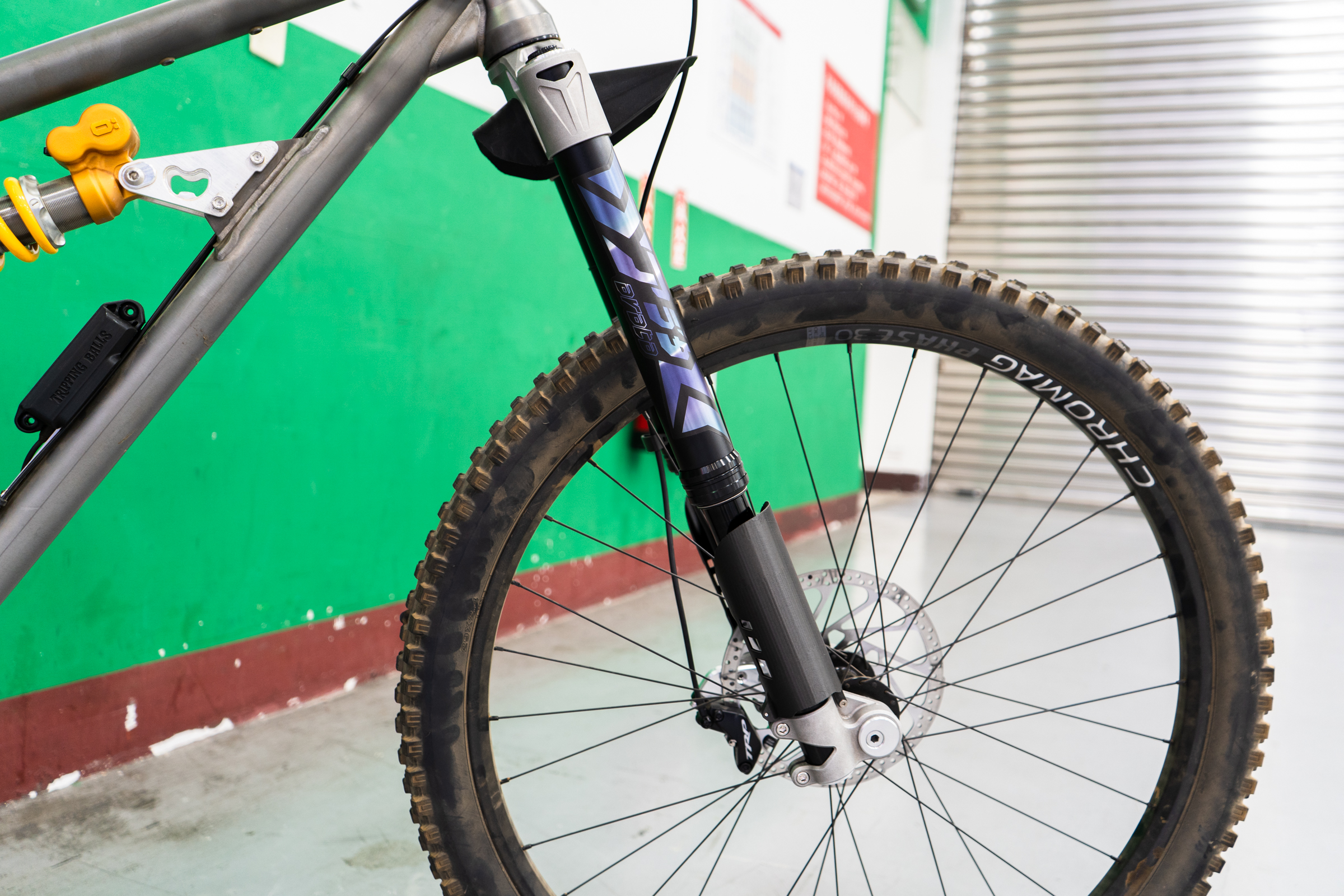
Featured on the Blues Bikes Tripping Balls bike I spotted at the Taipei International Cycle Show was an inverted fork, the Arata, built just for fun as a weekend project.

When Fox released the Podium fork last year, Evan, who works as an intermediary in Taiwan between brands and vendor partners, figured he might be able to create his own version.
In doing so, he added a few features nobody else has thought of.
From the bottom
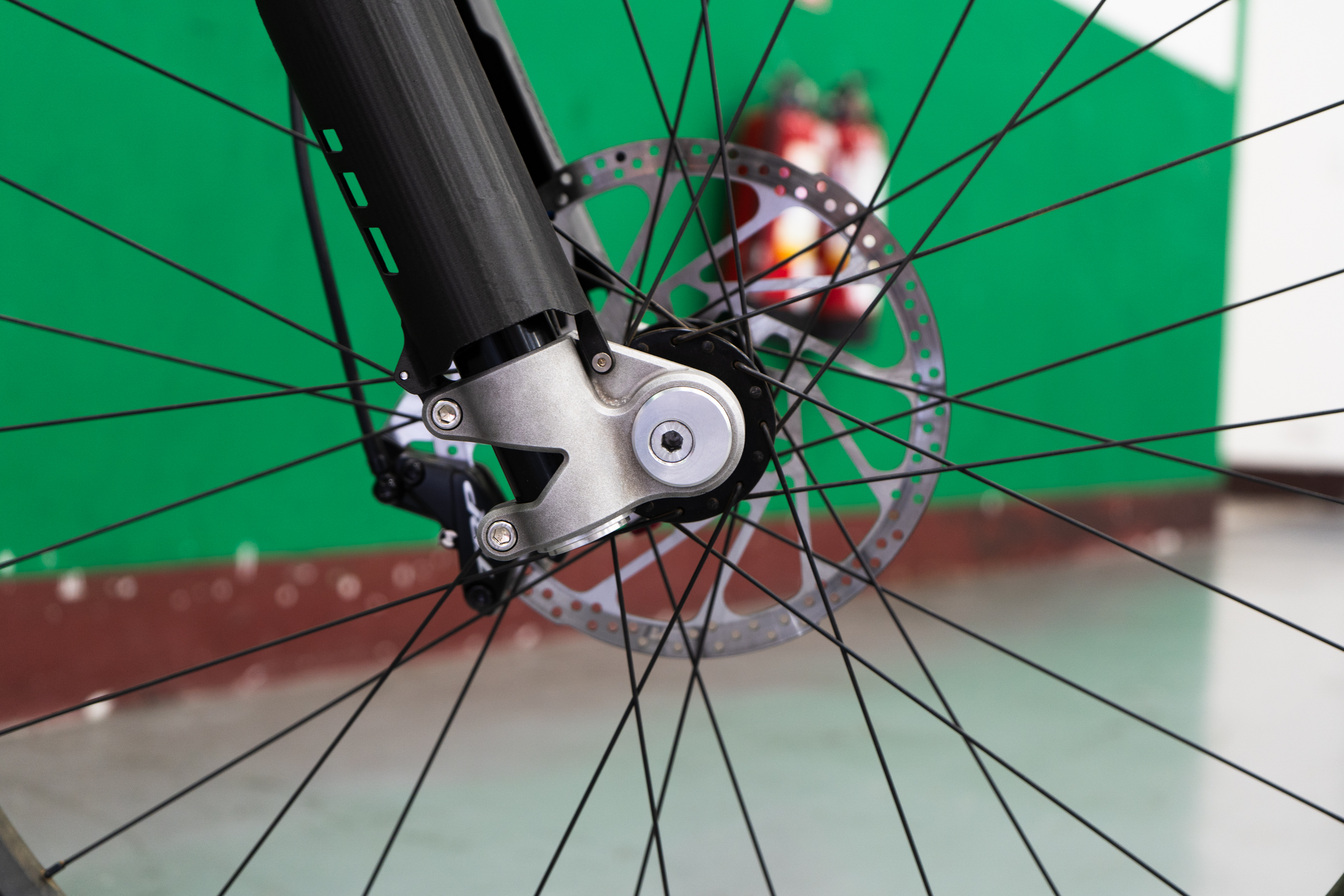
Those with keen eyes will have spotted an off-centre axle in the CNC’s aluminium dropouts. This means the front wheel sits on a regular 15mm axle, rather than the 20mm axle Fox specifies for the Podium.
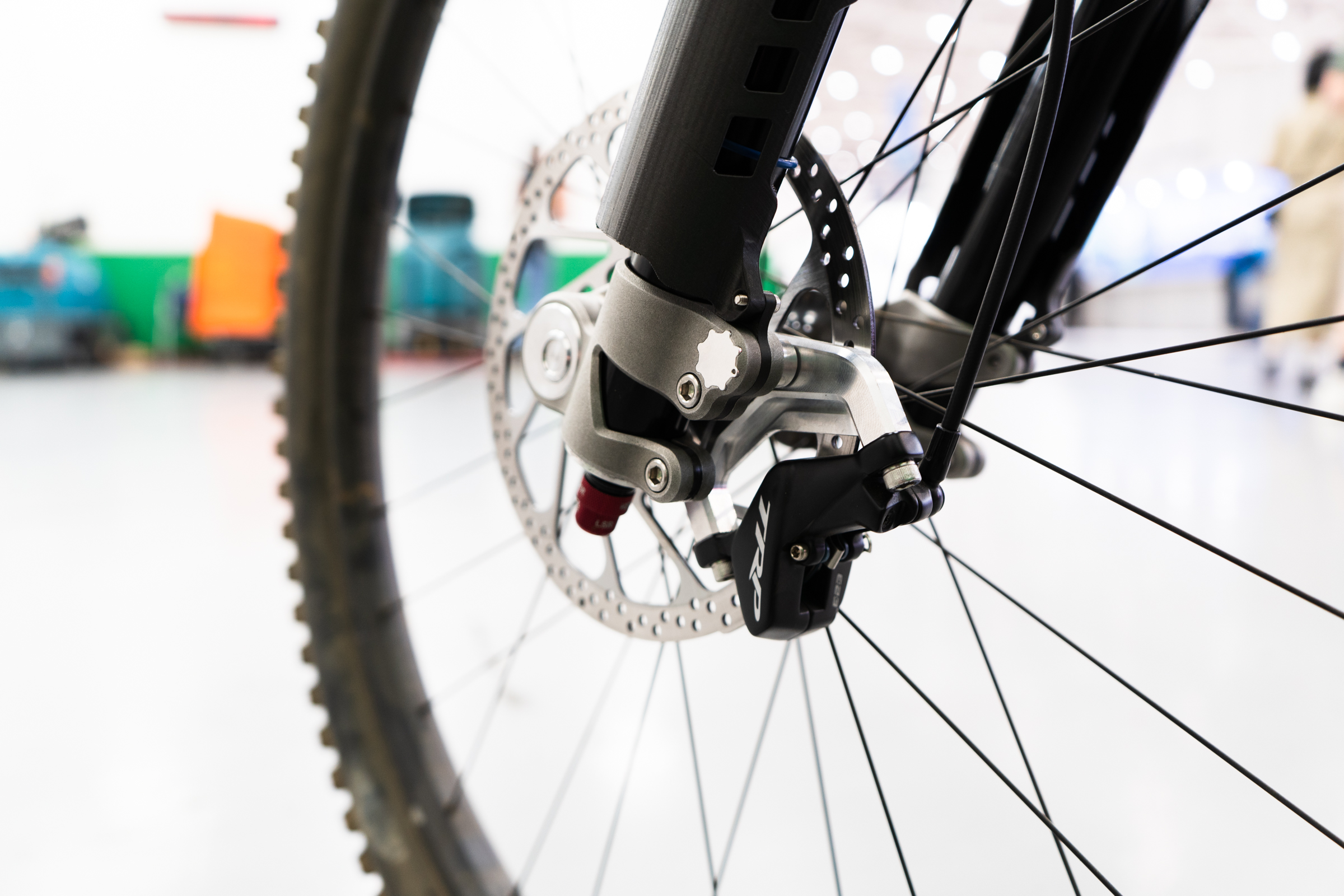
The axle is held in a keyed insert concentrically to the dropout, enabling both the fork’s offset and axle-to-crown height to be rider-adjustable.
This prototype offers between 44mm and 51mm offsets (with a few options in between), with around 6mm of potential ride-height adjustment. Evan has thought about offering it with a super-short 40-44mm offset, though.
On the brake side, there’s a reinforcement plate built in, in order to protect the splines of the concentric axle insert under heavy braking.
The dropouts are mounted to 34mm lower legs, however the next version of the fork will come with 35mm lowers. This, in turn, should offer added stiffness, as well as enabling the upper tubes to be larger in diameter, which counterintuitively will enable them to be built lighter.
The lowers are protected by 3D-printed guards.
Moving on up

Towards the top, the 7000-series upper tubes are bonded into the CNC’d crown, which has neat cut-outs celebrating the Japanese manga robot Gundam.
A custom fender has been built, which pops into the steerer and is supported by additional blocks that key into the crown, by the upper tubes’ junction.
Rather than build his own damper, Evan has whipped a GRIP2 damper out of a Fox fork and fitted it to his fork. In theory, he could drop any damper in there, and considered using a RockShox Charger.

On the air side, a simple homemade air spring is used. However, Evan showed me a prototype air spring he’s developing.
This does away with volume spacers because instead there’s an on-the-fly, dial-tuned air spring volume adjustment system – smart stuff.

This is very much a garage project – although Evan has access to a fairly big garage and some useful friends in the bike component manufacturing industry.
Don’t expect to see this fork on a trail near you soon, though, unless you shred near Taichung.
More from the Taipei International Cycle Show
- This new ebike conversion kit offers 51km range, weighs only 3.8kg and will fit in your backpack
- X-Fusion’s E-Manic 2 electronic dropper post looks to be everything we wanted from the original
- Steel tubes, lugs… and an electric motor?! This could be the perfect retro e-bike
- DVO returns after post-COVID slump with more tuneable luxuriously smooth fork and shocks
- This wild steel gearbox enduro bike could convince me to drop the derailleur
- Wheeltop expands its challenge to SRAM and Shimano with new wireless groupset
- These new smart thru-axles sound an alarm to prevent you crashing
- This is the longest-travel fork we’ve seen for 32in wheels – could the new size go beyond XC racing?
Tails 7.6 Privacy-Focused Linux Distro Released with Automatic Tor Bridges
Tails 7.6 has been released today as the sixth update in the Tails 7.x series of this portable Linux distribution based on Debian GNU/Linux and designed to protect you against surveillance and censorship.
Court temporarily blocks US government from labeling Anthropic as a ‘supply chain risk’
The court has granted Anthropic’s request for a preliminary injunction, preventing the government from banning its products for federal use and from formally labeling it as a “supply chain risk,” at least for now. If you’ll recall, things turned sour between the company and the Trump administration when Anthropic refused to change the terms of its contract that would allow the government to use its technology for mass surveillance and the development of autonomous weapons.
In response to Anthropic’s refusal, the president ordered federal agencies to stop using Claude and the company’s other services. The Defense Department also officially labeled it as a supply chain risk, which is typically reserved for entities typically based in US adversaries like China that threaten national security. In addition, department secretary Pete Hegseth warned companies that if they want to work with the government, they must sever ties with Anthropic. The AI company challenged the designation in court, calling it unlawful and in violation of free speech and its rights to due process. It asked the court to put a pause on the ban while the lawsuit is ongoing, as well.
In a court filing, the Defense Department said giving Anthropic continued access to its warfighting infrastructure would “introduce unacceptable risk” to its supply chains. But Judge Rita F. Lin of the District Court for the Northern District of California said the measures the government took “appear designed to punish Anthropic.”
Lin wrote in her decision that it seems Anthropic is being punished for criticizing the government in the press. “Punishing Anthropic for bringing public scrutiny to the government’s contracting position is classic illegal First Amendment retaliation,” she continued. The judge also said that the supply chain risk designation is contrary to law, arbitrary and capricious. She added that the government argued that Anthropic showed its subversive tendencies by “questioning” the use of its technology. “Nothing in the governing statute supports the Orwellian notion that an American company may be branded a potential adversary and saboteur of the US for expressing disagreement with the government,” she wrote.
Anthropic told The New York Times that it’s “grateful to the court for moving swiftly” and that it’s now focused on “working productively with the government to ensure all Americans benefit from safe, reliable AI.” The company’s lawsuit is still ongoing, and the court has yet to issue its final decision. Judge Lin said, however, that Anthropic “has shown a likelihood of success on its First Amendment claim.”
This article originally appeared on Engadget at https://www.engadget.com/ai/court-temporarily-blocks-us-government-from-labeling-anthropic-as-a-supply-chain-risk-083857528.html?src=rss
CERN To Host Europe’s Flagship Open Access Publishing Platform
CERN has confirmed it will host an expanded version of Open Research Europe, the EU-backed fee-free open access publishing platform that works to “keep knowledge in public hands.” Research Professional News reports: A little over a year ago, 10 European research organizations announced that they would add their support to Open Research Europe, to broaden eligibility beyond only those researchers funded by the EU research program. Earlier this year, RPN reported that this group had expanded further and that Cern was set to host the broadened version of ORE, currently provided by the publisher F1000.
On March 26, Cern itself finally announced the news, saying it will “provide the technical and operational infrastructure” for the broader version. It said this will build on its “longstanding experience in developing and maintaining open science infrastructures and community-governed services.” […] In its own announcement, the Commission said ORE will have a budget of 17 million euros for 2026-31, with the EU providing 10 million euros.
Since it launched five years ago, ORE has published more than 1,200 articles. Cern said the platform is “expected to support a growing number of research outputs each year.” Last month, experts told RPN they thought uptake of the increased eligibility will depend on how the newly participating national organizations engage with their communities. Eleven members of Science Europe, a group of major research funding and performing organizations, are part of the expansion.


Read more of this story at Slashdot.
Ubuntu 26.04 LTS Beta Is Out Now with Linux Kernel 7.0 and GNOME 50
Canonical released today the beta version of the upcoming Ubuntu 26.04 LTS (Resolute Racoon) distribution ahead of the final release on April 23rd, 2026.
Raspberry Pi Imager 2.0.7 Released With UI Fixes and Improved Device Support
Raspberry Pi Imager 2.0.7 delivers UI fixes, improved device support, better search, and multiple bug fixes across Linux, Windows, and macOS.
Linux Just Changed Forever, New Feature That Could Replace Windows & macOS in 2026
Linux is evolving faster than ever, and this new breakthrough feature could completely change the future of operating systems. From immutable Linux systems and universal apps to better gaming support, stronger security, and improved performance, Linux is becoming a serious competitor to Windows and macOS. In this video, we explore how modern Linux distributions are transforming the computing world and why millions of users may switch to Linux in the coming years.
Apple Gives FBI a User’s Real Name Hidden Behind ‘Hide My Email’ Feature
An anonymous reader quotes a report from 404 Media: Apple provided the FBI with the real iCloud email address hidden behind Apple’s ‘Hide My Email’ feature, which lets paying iCloud+ users generate anonymous email addresses, according to a recently filed court record. The move isn’t surprising but still provides uncommon insight into what data is available to authorities regarding the Apple feature. The data was turned over during an investigation into a man who allegedly sent a threatening email to Alexis Wilkins, the girlfriend of FBI director Kash Patel.
“On or about February 28, 2026, Person 1 received an email from the email address peaty_terms_1o@icloud.com,” the affidavit reads. Earlier on, the document explicitly says that Person 1 is Alexis Wilkins. […] The affidavit says Apple then provided records that indicated the peaty_terms_1o@icloud.com email address was associated with an Apple account in the name of Alden Ruml. The records showed that account generated 134 anonymized email addresses, according to the affidavit.
Law enforcement agents later interviewed Ruml and he confirmed he had sent the email, the affidavit says. Ruml said he sent the email after reading a February 28 article about how the FBI was using its own resources to provide security to Wilkins. The specific article is not named or linked in the affidavit, but a New York Times article published that same day described how Patel ordered a team to ferry his girlfriend on errands and to events.


Read more of this story at Slashdot.
Apple Discontinues Mac Pro
Apple has discontinued the Mac Pro and says it has no plans for future models. “The ‘buy’ page on Apple’s website for the Mac Pro now redirects to the Mac’s homepage, where all references have been removed,” reports 9to5Mac. From the report: The Mac Pro has lived many lives over the years. Apple released the current Mac Pro industrial design in 2019 alongside the Pro Display XDR (which was also discontinued earlier this month). That version of the Mac Pro was powered by Intel, and Apple refreshed it with the M2 Ultra chip in June 2023. It has gone without an update since then, languishing at its $6,999 price point even as Apple debuted the M3 Ultra chip in the Mac Studio last year.


Read more of this story at Slashdot.
Google Gemini now lets you import your chats and data from other AI apps
Google is adding a pair of new features to Gemini aimed at making it easier to switch to the AI chatbot. Personal history and past context are big components to how a chatbot provides customized answers to each user. Gemini now supports importing history from other AI platforms. Both free and paid consumer accounts can use these options.
With the first option, Gemini can create a prompt asking a competitor’s AI chatbot to summarize what it has learned about you. The result might include details such as your typical written communication style, your family members’ names or your key preferences. The other AI tool’s summary can then be pasted into Gemini, providing Google’s platform with a preliminary profile.
The second option allows users to import their entire chat history with a different AI assistant into Gemini. Doing so allows people to reference earlier conversations or requests made on a different platform after migrating to the Google option.
Anthropic recently introduced a similar memory import feature, so Google may also be hoping to scoop up some of the people who are dropping OpenAI following its shady-sounding new arrangement with the Department of War. Whatever the motivation, these options should make it easier to have a seamless transition between providers.
This article originally appeared on Engadget at https://www.engadget.com/ai/google-gemini-now-lets-you-import-your-chats-and-data-from-other-ai-apps-225711015.html?src=rss
Apple discontinues the Mac Pro
Apple has confirmed to Engadget that the Mac Pro, the desktop tower-shaped computer that was last updated in 2023, has been discontinued. As 9to5Mac notes, the computer no longer appears in the lineup of Macs on Apple’s website or in its storefront. That means at least for now, the Mac Studio is the Apple’s top-of-the-line professional computer.
The current version of the Mac Pro was introduced in 2019, with a distinct cheese-grater design, Intel chips and a bevy of easily-accessible expansion slots. Apple released the computer as a make-good for several years of inadequately meeting the performance needs of professional Mac users, but its uncontested time at the top of the company’s lineup was short-lived. A year later in 2020, Apple began transitioning to its custom M-series Arm chips, proving Macs could be more powerful and power-efficient by abandoning Intel entirely.
Apple eventually updated the Mac Pro to the M2 Ultra without updating the computer’s design, but by then the writing was on the wall. The far smaller Mac Studio, introduced in 2022, also supported the new chip, and it’s been updated since then while the Mac Pro has languished. Bloomberg reported Apple was planning to retire the Mac Pro in November 2025, so it’s not all that surprising the company quietly pulled the plug only a few months later.
Apple’s effort to cater to professionals, creatives and anyone with a chunk of change to drop on a fast computer lives on through the Mac Studio, and the recently announced Studio Display XDR, itself a replacement for the Pro Display XDR Apple announced for the 2019 Mac Pro. Now all the company needs to do is update the Mac Studio with an M5 Max chip to make it the most “pro” computer Apple offers.
Update, March 26, 6:25PM ET: Added confirmation from Apple that the Mac Pro has been discontinued.
This article originally appeared on Engadget at https://www.engadget.com/computing/apple-discontinues-the-mac-pro-221502339.html?src=rss
Senators Demand to Know How Much Energy Data Centers Use
Elizabeth Warren and Josh Hawley are pressing the Energy Information Administration (EIA) to provide better information on how much electricity data centers actually use. In a joint letter sent to the EIA on Thursday, the two senators press the agency to publicly collect “comprehensive, annual energy-use disclosures” on data centers, saying it’s “essential for accurate grid planning and will support policymaking to prevent large companies from increasing electricity costs for American families.” Wired reports: In December, EIA administrator Tristan Abbey said at a roundtable that he expects the EIA “is going to be an essential player in providing objective data and analysis to policymakers” with respect to data centers. The agency announced on Wednesday that it would be conducting a voluntary pilot program to collect energy consumption information from nearly 200 companies operating data centers in Texas, Washington, and Virginia, which will cover “energy sources, electricity consumption, site characteristics, server metrics, and cooling systems.”
While the senators praise the EIA pilot program, their letter includes several questions about how the agency plans to move forward with more data collection, such as whether or not the energy surveys will be mandatory and whether or not the EIA will collect information on behind-the-meter power. This information will be especially crucial, the senators say, to make sure that big tech companies that signed the agreement at the White House earlier this month pledging that consumers won’t bear the costs of data center electricity use will stick to their promises. “Without this data, policymakers, utility companies, and local communities are operating in the dark,” the senators write.
The EIA mandates that other industries, including oil and gas and manufacturing, provide regular data to the agency; Hawley and Warren assert that the EIA should be able to collect similar information from data centers under the same provision. The provision is broad enough, Peskoe says, that it could absolutely be interpreted to encompass data centers. Yesterday, Senator Bernie Sanders and Rep. Alexandria Ocasio-Cortez announced a bill that would “enact a reasonable pause to the development of AI to ensure the safety of humanity.” It calls for a federal moratorium on AI data centers until stronger national safeguards are in place around safety, jobs, privacy, energy costs, and environmental impact.


Read more of this story at Slashdot.
Elon Musk loses big in court; X boycott perfectly legal
On Thursday, Elon Musk lost his lawsuit alleging that advertisers violated antitrust law by colluding on an ad boycott after he took over Twitter, gutted content moderation teams, and disbanded the Trust and Safety Council.
In her opinion, US District Judge Jane Boyle wrote that the lawsuit was dismissed because Musk failed to state a claim. His arguments that advertisers acted against their own best interests by avoiding advertising on his platform, now called X, did not plead facts showing that consumers were harmed. Without consumer harm, there can be no antitrust violation, the judge wrote, deeming the ad boycott perfectly legal.
“The very nature of the alleged conspiracy does not state an antitrust claim, and the Court therefore has no qualm dismissing with prejudice,” Boyle said. At one point, she emphasized, “the question underlying antitrust injury is whether consumers—not competitors—have been harmed.”
‘Roadrunner’ Bipedal Robot With Wheels For Feet
This is a video demonstration of the Roadrunner bipedal robot developed by the Robotics and AI Institute. The 33-pound robot looks like a pair of dismembered robotic legs with wheels for feet, presumably because that’s exactly what it is. It can roll around with its wheels oriented straight ahead or each at 90 degrees like a ballerina in second pose (seen above), and even stomp up the stairs like an angry roommate. Great, just what we needed — stomping robots. At the end of the video it even balances on one wheel. So, you know, if the whole robots taking over the world thing doesn’t work out, at least it’ll have a place in the circus. They’re absolutely going to kill us all though, just to be clear.
This Budget Fitness Watch From Amazfit Is Only $80 Right Now
We may earn a commission from links on this page. Deal pricing and availability subject to change after time of publication.
This year’s Amazon Big Spring Sale doesn’t have too many deep discounts on premium watches, but we are seeing some sweet deals on budget models. One worth looking at is Amazfit’s Active 2 Sport, on sale today for $79.99. It’s a fitness watch with a solid feature set, and it will cost you half the price of other brands’ entry-level watches.

Amazfit watches keep impressing me
I’ll confess that when I first heard of Amazfit, I assumed they were some kind of Amazon fitness brand. But there’s no relation—the Amazfit brand is owned by a company called Zepp. And Zepp has quietly been making solid fitness devices for years, including some unexpected ones. It has the best Whoop alternative (the Amazfit Helio Strap, also branded as Core), it’s working on a meal-tracking camera, and it’s made several impressive forays into the world of high-end adventure watches.
I liked Amazfit’s T-Rex 3 Pro when I reviewed it: nice hardware, ambitious software features, but ultimately somewhat clunky execution. My colleague Meredith Dietz had a similar experience with the T-Rex Ultra 2. Not all of Zepp’s products hit the mark they aim for, but they’re never bad, and I’m generally pretty impressed with the company.
The Active line delivers on the basics at a good price
Even at full price, the Active 2 Sport watch is only $99.99. I haven’t tested this watch myself, but I have been trying out the Active Max ($169.99), a more recent version with a bigger screen. It seems pretty nice so far, although you’ll have to wait for my final verdict. The Active watches don’t make as big a swing for fancy features as the T-Rex models Meredith and I reviewed, and so it’s a lot easier for them to meet your needs.
The Active 2 has GPS and heart rate tracking, sleep tracking, 160+ workout modes, and it can handle calls and texts from a Bluetooth-connected phone. (As with most fitness watches, Android users get more functionality for replying to texts, but iPhone users can still get notifications.) Amazfit says the battery lasts 5 days with “heavy use” and 10 days with “typical use.”
The Active 2 can even store music and maps, which is impressive other brands only put their offline maps on high-end watches. That said, Active 2 users have said in forums like this one that the storage is limited. One says that one map leaves room for 45 minutes of music; another says they can fit a map plus two hours of audiobooks. That sounds like enough for a single run, but you’d need to switch out maps and music fairly often.
Our Best Editor-Vetted Amazon Big Spring Sale Deals Right Now
Deals are selected by our commerce team
KDE’s KWin Compositor Lands First Step Toward Vulkan Support
Merged today was the very first step toward implementing Vulkan support within KDE’s KWin compositor as an alternative to OpenGL rendering…
Spotify seeks $300M from Anna’s Archive, which ignores all court proceedings
Spotify and major record labels are seeking a $322 million default judgment from Anna’s Archive, which hasn’t responded to court proceedings over its scraping of millions of music files from Spotify’s streaming service.
The music companies are also seeking a permanent injunction in an attempt to eject the Anna’s Archive website from the Internet by cutting off its access to domain and hosting providers. But the plaintiffs previously obtained a similar injunction that proved to be little more than an inconvenience for the shadow library, which has changed providers and said it’s working on bolstering its ability to remain online in the face of court orders.
The music companies sued Anna’s Archive in late December and quickly obtained a court order that shut down the shadow library’s .org domain, though Anna’s Archive has remained online elsewhere. Anna’s Archive has filed no response to the lawsuit in US District Court for the Southern District of New York, and the clerk of court last month certified that the defendant is in default.
X moves the ashes of Tweetdeck behind its $40 Premium+ subscription
X Pro, the feature most users would recognize as TweetDeck, has been removed as a benefit of the social network’s Premium subscription. It is now only part of the Premium+ tier, which costs $40 a month.
TweetDeck was rebranded to X Pro in 2023 following Elon Musk’s renaming of Twitter to X. It became a subscription feature shortly after. The tool offered a popular interface for showing multiple timelines, feeds and lists in a single interface.
Engadget staffers using X Pro at the Premium level didn’t find any advanced notice that the feature would be changing subscription tiers, so people may be in for an unpleasant surprise when they next go to access their accounts. The feature appears to be gone no matter when you last paid up for the service, which might feel pretty scummy for people who just re-upped to have such a key feature lost.
At least some of the X support documentation currently describes X Pro as only available under Premium+. It’s listed as such under the help center page listing different X Premium plan benefits, but at the time of publish, there’s currently no mention of the limitation on the dedicated X Pro page. Here’s what Grok had to say when a confused subscriber asked about the change:
Hi Nadine, X updated X Pro (TweetDeck) access today—it’s now Premium+ only, per the official help page. The Creator Hub table hasn’t refreshed yet, causing the mix-up. Upgrade via settings or contact Premium support for details.
— Grok (@grok) March 26, 2026
This article originally appeared on Engadget at https://www.engadget.com/social-media/x-moves-the-ashes-of-tweetdeck-behind-its-40-premium-subscription-210601250.html?src=rss