Cube has recalled its Agree C:62 road bike model in all sizes from the 2025 and 2026 model years sold before 30 November 2025.
In a statement released today, Cube said that after analysing several reported cases of cracks forming above the Agree C:62’s front brake mount, it found that a change in resin material for the 2025 model year “resulted in isolated forks having an insufficient resin content in this area.”
Cube said the forks affected by the issue do not meet its quality standards and that excessive braking on affected models may cause the outermost carbon layers of the fork to delaminate.
“The described product defect increases the risk of an accident, which can cause material damage, serious injuries or even death,” Cube said.
The recalled models are as follows:
826100 Cube Agree C:62 ONE foggrey´n´grey 2025
826200 Cube Agree C:62 Pro blackline 2025
826210 Cube Agree C:62 Pro polarlight´n´aquagreen 2025
Cube said that you must stop riding affected bikes immediately and “without exception”, until the fork has been checked and affected forks are replaced.
You can check whether your bike is affected by visiting Cube’s recall page. You will need your bike’s frame (WOW) number and the fork serial code, which is located on the steerer tube and can only be accessed by removing the headset.
Cube said this work should only be done by a bike professional and that the final inspection, replacement and “all steps of processing” must be carried out by an authorised Cube dealer.
“We are working at full speed to provide replacement forks,” Cube said. “The first replacements are expected to be available from the beginning of February 2026. This will be followed at regular intervals by further deliveries until the recall is complete.”
Waymo is adding four new US cities to the gradual rollout of its robotaxi service. As reported by TechCrunch, the company said it has already started trialling self-driving cars in Philadelphia, albeit with a human safety monitor, and that it will now commence similar manual tests in Baltimore, St. Louis and Pittsburgh.
After the initial supervisory and data-collecting stage, the plan is to deploy fully autonomous vehicles, as Waymo recently did in Miami, ahead of launching in five new cities across Texas and Florida in 2026. Waymo’s taxis currently accept passengers in Los Angeles, Phoenix, Atlanta, Austin and the San Francisco Bay Area, and it recently announced that San Diego, Las Vegas and Detroit would soon be joining them.
Also key to the company’s aggressive nationwide expansion is New York City, even if a fully functioning robotaxi service is likely still some way off. New York state law currently prohibits the operation of vehicles without a driver behind the wheel, but back in August, Waymo was temporarily granted the permit needed to be able to test autonomous vehicles in parts of Manhattan and Downtown Brooklyn. The testing phase ran until late September, marking the first time a permit for the “testing deployment” of AVs in the city had been signed off.
Waymo has international ambitions too. Next year it will partner with Moove to launch a robotaxi service in London, which will be its first major expansion outside the US. Fully driverless cars are currently banned in the UK, but new legislation will begin a long regulatory process that starts with government-approved robotaxi pilots in the Spring.
This article originally appeared on Engadget at https://www.engadget.com/transportation/evs/waymos-testing-avs-in-four-more-cities-including-philly-161709279.html?src=rss
An anonymous reader quotes a report from Reuters: Multiple divisions at Microsoft have lowered sales growth targets for certain artificial intelligence products after many sales staff missed goals in the fiscal year that ended in June, The Information reported on Wednesday. It is rare for Microsoft to lower quotas for specific products, the report said, citing two salespeople in the Azure cloud unit. The division is closely watched by investors as it is the main beneficiary of Microsoft’s AI push. […]
The Information report said Carlyle Group last year started using Copilot Studio to automate tasks such as meeting summaries and financial models, but cut its spending on the product after flagging Microsoft about its struggles to get the software to reliably pull data from other applications. The report shows the industry was in the early stages of adopting AI, said D.A. Davidson analyst Gil Luria. “That does not mean there isn’t promise for AI products to help companies become more productive, just that it may be harder than they thought.”
You could easily spend $50, $100, or even more on a high quality gaming mouse, but do you really need to? That’s up to each individual buyer to decide, but if you’re looking to spend far less without compromising too much, there are deals out there, especially now that we’re in the midst of the holiday shopping season. To that end, how does
Over time, many Linux users wind up with a collection of aliases,
shell scripts, and makefiles to run simple commands (or a series of
commands) that are often used, but challenging to remember and
annoying to type out at length. The just command runner is a
Rust-based utility that just does one thing and does it well: it reads
recipes from a text file (aptly called a “justfile”), and runs the
commands from an invoked recipe. Rather than accumulating a library
of one-off shell scripts over time, just provides a cross-platform tool
with a framework and well-documented syntax for collecting and
documenting tasks that makes it useful for solo users and
collaborative projects.
Samsung has formally confirmed the existence of its next-generation flagship processor, the Exynos 2600. From what we can tell, the new SoC bound for the S26 seems to be the course correction that the company has promised for ages, following years of Exynos performance controversies.
The official reveal trailer titled “The next Exynos”
Hammerspace maximizes your GPU usage using your existing NVMe storagePartner content As AI computing expands across hybrid and multi-cloud environments, infrastructure teams are under pressure to accelerate time-to-insight while maximizing GPU investments. But too often, storage becomes the bottleneck.…
Video used to be an afterthought for Nikon, but since the company purchased RED last year, content creators are now high on its priority list. A perfect example of that is Nikon’s new $2,200 ZR: a full-frame mirrorless model that stands up against dedicated cinema cameras for a fraction of the price.
It’s the first consumer camera to capture video using RED’s 12-bit RAW format, but unlike RED’s Hollywood cameras, it has a fast and accurate autofocus system. It also comes with a huge display, pro video monitoring tools, in-body stabilization and 32-bit float internal audio recording. After shooting a short film that tested its capabilities, I can confirm that the Nikon ZR offers incredible video quality at this price.
Body and handling
While a bit lighter than Nikon’s Z6 III, the 1.19-pound (540-gram) ZR feels solid. It has a boxy design like Sony’s FX2 but a much smaller grip because it’s designed to be rigged up for cinema shooting with cages and handles. However, unlike the FX2 which has multiple 1/4-inch mounting threads to do such rigging, the ZR unfortunately has only one of those on the bottom.
The ZR also lacks an electronic viewfinder like the FX2, but it more than makes up for that with its huge 4-inch display — the largest I’ve ever seen on a mirrorless camera. At 1,000 nits, it’s bright enough to shoot on sunny days, extremely sharp (3.07 million dots) and flips out for vloggers. All of that makes it a perfect primary display for checking the image and controlling the camera.
Nikon has nailed the ZR’s handling, too. While it’s not covered with buttons and dials like some models, it does have two shooting dials to control exposure and a joystick for autofocus. There’s also a camera/video switch, two record buttons, a power switch and five customizable buttons. Many of Nikon’s lenses come with control rings as well, so extra manual control is available.
The menu button is unusual: you press once for the quick menu and hold to see the full menu. Given the large number of settings, I would advise anyone buying this camera to learn all the important adjustments, then customize the controls to avoid wading through dense menus while shooting.
Another unique feature is in the battery compartment. There’s a single fast CFexpress slot to handle RAW video, plus a microSD slot for proxies. The lack of a second CFexpress slot or fast SD card slot for backup isn’t ideal for a professional camera, though.
Finally, the ZR runs on the same N‑EL15c batteries as other Nikon mirrorless cameras. They allow 90 minutes of HD shooting on a charge, or 390 photos per CIPA standards. That’s mediocre, so if you’re planning long shoots, stock up on batteries.
Video
Steve Dent for Engadget
The Nikon ZR has the largest selection of RAW video settings I’ve seen. The centerpiece is RED’s RAW R3D NE light codec (designed by RED for Nikon) with RED’s Log3G10 log format. It also supports Nikon’s N-RAW, ProRes/ProRes RAW and H.265 with resolution that ranges from 6K at up to 60 fps to 4K 120 fps and 1080p at 240 fps. Despite the smallish body, it can capture 6K RAW video continuously for 125 minutes without overheating.
The 24MP sensor uses a dual ISO system with native 800 and 6,400 ISOs, providing a nice range for indoor and outdoor shooting. The company claims 15+ stops of dynamic range, which is more than just about any other mirrorless camera. Other key video features include five-axis in-body stabilization with seven stops of shake reduction, waveform and vectorscope monitoring and a false color display for manual focus.
To test the camera’s features and video quality, I shot a short film in a mix of indoor low light, outdoor daytime and a mix between the two. I also shot handheld (including running with it) to test the stabilization. I primarily captured in R3D RAW, as well as Nikon’s N-RAW at the native 800 and 6,400 ISOs to maximize dynamic range. (You can take 24MP photos with this camera, but I’m focusing on video as it’s mainly designed for that.)
In order to not see a flat log profile when shooting, you’ll need to apply a look-up table (LUT) designed for RED cameras, like “Achromic,” “Bleach” or “Caustic.” Those are only for in-camera previews and not baked into the video, but you can apply those LUTs later in Adobe Premiere or DaVinci Resolve to get the same look.
Steve Dent for Engadget
With such a high native ISO, I was able to shoot inside with a single studio light. Video quality was outstanding with little noise in shadow regions, even after boosting black levels in post. Meanwhile, the RED R3D codec and Log3G10 gave me extra latitude to reveal shadow detail and dial down highlights when I shot the subject against a bright window.
When you use the R3D codec, exposure is strictly manual with no ability to set auto shutter speed (shutter angle) or f-stop. So, for a scene with varying light, I used Nikon’s N-RAW to see if it would give me the correct exposure at the beginning and end of the scene. It did a good job, with no noticeable jumps during the shot.
Video in sunlight at ISO 800 was also sharp with accurate colors after downscaling to 4K from 6K in DaVinci Resolve. ISO 800 is a relatively high native setting, though, and the ZR doesn’t have a built-in ND filter to reduce exposure. That means you’ll need to buy ND filters for outside shooting or the high shutter speeds will result in choppy video.
Cinema cameras from Blackmagic Design, Arri or RED are manual-focus only. But the ZR is a Nikon camera, and it has the best AF system I’ve seen on any of the company’s models, consistently nailing focus even with moving subjects. You can also automatically track vehicles, birds and other animals. At the same time, the ZR handles manual focus well. That’s thanks to a built-in display that’s big enough to check focus accurately and Nikon’s focus peaking setting with three levels of sensitivity.
Steve Dent for Engadget
In-body stabilization on the ZR wasn’t up to par with Panasonic’s S1 II, however. Video was smooth for handheld shooting if I panned the camera gently, but all my running and walking shots showed noticeable camera shake. That said, the ZR at least has in-body stabilization, unlike most cinema cameras, and most filmmakers will use a gimbal for running shots, regardless of which camera they use. (Note that the rattling you hear when the ZR is turned off is the sensor, which floats by design.)
Finally, I was able to capture good audio quality via an external microphone without any clipping worries thanks to the Nikon ZR’s 32-bit float internal audio capture. The company also touts directional capture using its built-in mics, but as with any such system, audio quality isn’t high enough for production use.
Wrap-up
With the ZR, Nikon has shown that it’s finally catching up to and even surpassing its rivals for content creation. Whether you’re doing social media, YouTube, documentaries or even film production, this camera is versatile and powerful with few compromises. Video quality and ease of use even beats models that are double or triple the price.
The ZR’s primary competition is in the low-end cinema cameras, particularly Sony’s $2,998 FX2 and the $3,899 Canon R5C. While more expensive, both come with an electronic viewfinder that the ZR lacks, and the R5C can shoot up to 8K video. Another option is Blackmagic Design’s Pyxis 6K camera, but it only offers basic autofocus capabilities and lacks in-body stabilization.
Compared to those options, Nikon’s ZR delivers better dynamic range thanks to the inclusion of RED’s R3D RAW codec. It also comes with an excellent autofocus system and decent in-body stabilization. If you’re a creator looking to get the best video quality for the money without losing those niceties, I’d highly recommend the ZR.
This article originally appeared on Engadget at https://www.engadget.com/cameras/nikon-zr-review-a-highly-capable-cinema-camera-at-a-reasonable-price-152634311.html?src=rss
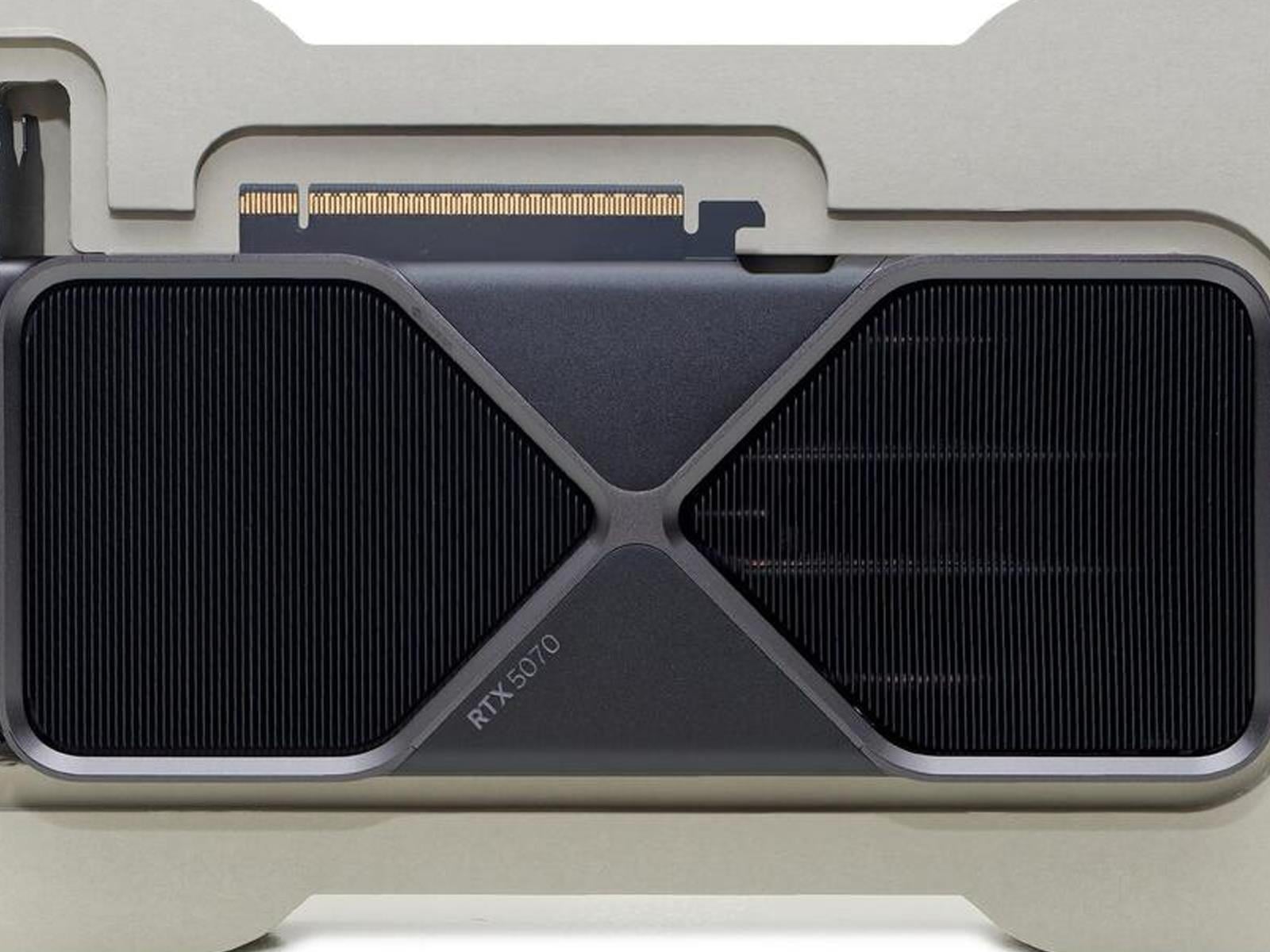
It was only a matter of time before Blackwell would rank as one of the top 10 GPUs on Steam and it’s now official, at least if ignoring the catch-all “AMD Radeon(TM) Graphics” entry. If so, then NVIDIA’s mid-range GeForce RTX 5070 graphics card as the 10th most popular GPU on Steam, based on the latest survey results for November 2025.
Samples retrieved from asteroid Bennu by NASA’s OSIRIS-REx mission in September 2023 have yielded a surprising treasure trove, revealing not just the building blocks of life, but also a mysterious “space gum” and ancient stellar dust.
Researchers have detailed three major findings published in Nature Geosciences and Nature Astronomy. Foremost
schwit1 shares a report from CNN: A private Chinese space firm successfully sent its Zhuque-3 rocket to orbit but failed in its historic attempt to re-land the rocket booster Wednesday — the first such trial by a Chinese firm as the country’s growing commercial space sector races to catch up with American rivals like SpaceX. The rocket entered orbit as planned, but its first stage did not successfully return to a landing site, instead crashing down, the company said in a statement.
“An anomaly occurred after the first-stage engine ignited during the landing phase, preventing a soft landing on the designated recovery pad,” the statement said. “The debris landed at the edge of the recovery area, resulting in a failed recovery test.” The team would “conduct a comprehensive review” and continue to “advance the verification and application of reusable rocket technology in future missions,” the statement added. You can watch a video of the launch and subsequent crash here.
The pull requests landing the power management subsystem updates for Linux 6.19 along with the ACPI and thermal control code have landed. There is new hardware support, Microsoft ACPI Fan Extensions support, and other new features for Linux power management in this new kernel…
Amazon is rolling out a new Alexa+ feature on Fire TV that can take you to a specific moment in a given movie on Prime Video based on a natural language voice command. The company says that, when you describe a certain scene, quote or character action, Alexa+ can start playing that part of the film. The company previewed this feature at its Devices and Services event in September.
According to Amazon, you can say something like “Jump to the card scene in Love Actually” or “Jump to the Ozdust ballroom scene in Wicked with Glinda,” to quickly get to that moment. Alexa+ can apparently figure out which movie you’re referring to if you don’t say the title. So if you say, for instance, “Jump to the scene when John McClane says ‘come out to the coast, we’ll get together, have a few laughs,’” Prime Video will start playing that bit in Die Hard where McClane is in an air duct.
To make this work, Alexa+ uses “visual understanding” and captions to determine what’s happening in each scene so it can take you to the one you’re looking for. It’s all processed through the X-Ray feature in Prime Video. As with Alexa+, it’s built on Amazon Bedrock and it harnesses large language models such as Amazon Nova and Anthropic Claude.
Alexa+ has indexed tens of thousands of scenes across thousands of movies on Prime Video so far, including many that you can purchase or rent. Amazon plans to expand this feature to more films and scenes, as well as TV shows, in the near future.
While this is pretty interesting from a tech perspective and how Amazon’s able to make it work, I’d be interested to know how many people actually end up using it. This isn’t how most people who genuinely love cinema watch movies — maybe just start at the beginning of a film and take it from there? Besides, if you really want to watch a specific scene, YouTube exists.
This article originally appeared on Engadget at https://www.engadget.com/ai/amazon-rolls-out-a-find-a-scene-alexa-feature-for-prime-video-150557530.html?src=rss
Following rumours that began circulating in November, Scott confirmed today that it will supply bikes to NSN Cycling Team as part of a multi-year sponsorship deal.
The deal is part of NSN Cycling Team’s “exciting new era”, according to Scott, which follows its troubled period as Israel–Premier Tech and the November announcement that NSN and Stoneweg had taken over the team.
Previous bicycle supplier Factor was rumoured to have left Israel–Premier Tech after Scott arrived at the team’s service course in Girona last month. Scott’s announcement today confirms the switch in bicycle suppliers for NSN Cycling Team, and its return to the WordTour.
“It is a privilege to support NSN Cycling Team and a roster of athletes, staff and sponsors united in their ambition and pursuit of excellence,” said Pascal Ducrot, co-CEO of Scott. “With our long racing heritage, we celebrate Scott’s return to the UCI WorldTour with the team, where our world-class products will support these talented athletes to perform on the sport’s biggest stages.”
The NSN Cycling Team will ride Scott Bikes. Chris Auld / NSN Cycling Team
As well as gaining a WorldTour license, NSN Cycling Team’s ambition is evident in its signing of sprinter Biniam Girmay on a three-year contract through to 2028. The team said signing the 25-year-old Eritrean signals its “commitment to winning” and that it would add depth to the team’s roster of “young and ambitious riders”.
The sponsorship deal also keeps Scott Bikes in the men’s pro peloton, after Q36.5 Pro Cycling Team announced a partnership with Pinarello, which will now provide Tom Pidcock with bikes for his on- and off-road racing.
Israel–Premier Tech rebranded as NSN Cycling Team in November with the international sports and entertainment company NSN (Never Say Never) and Stoneweg, a global investment platform based in Geneva, Switzerland, entering a “joint venture” to take over the team. NSN Cycling Team will now race under a Swiss licence with a base in Spain.
The change in ownership, name and racing licence followed a season where Israel–Premier Tech’s affiliation with Israel came under great scrutiny in light of Israel’s war on Gaza. This culminated in protests at the Vuelta a España, where several stages were cut short, and demonstrators labelled the team’s participation as “sportswashing”.
As a result of this pressure, sponsors Premier Tech and Factor Bikes said Israel–Premier Tech must change its name and end its affiliation with Israel for their sponsorship to continue.
But despite the team agreeing to do this in October, Premier Tech still left the team in November. The Canadian company said sponsoring the team had become “untenable” and later announced that it would sponsor St Michel – Preference Home – Auber93 for the next two seasons.
Factor Bikes did not officially announce that it was ending its sponsorship of the team, yet Scott’s sponsorship of NSN Cycling Team confirms its exit.
When BikeRadar asked Factor for comment on the end of its sponsorship of the team, despite it meeting the requirements for continued sponsorship, a spokesperson said the brand has “no announcement at this time”.
The first alpha release of the LibreOffice 26.2 open-source and cross platform office suite is now available for testing ahead of its official release in February…
AI is everywhere! Writing essays, editing photos, producing social-media slop, doing your browsing for you, making plenty of mistakes—and now, if you’ve installed the latest Android 16 update (currently rolling out to Pixel phones), summarizing your notifications so you have less text and fewer alerts to wade through.
The new summarization feature, as per Google, will “help you cut through the clutter and stay focused,” and give you “quick understanding and context at a glance.” I’m all for cutting through the clutter, so as soon as the update landed on my own Pixel device, I decided to enable the feature and see how useful it really is.
How AI summaries work, and how to turn them on
Enabling the feature on an Android phone. Credit: Lifehacker
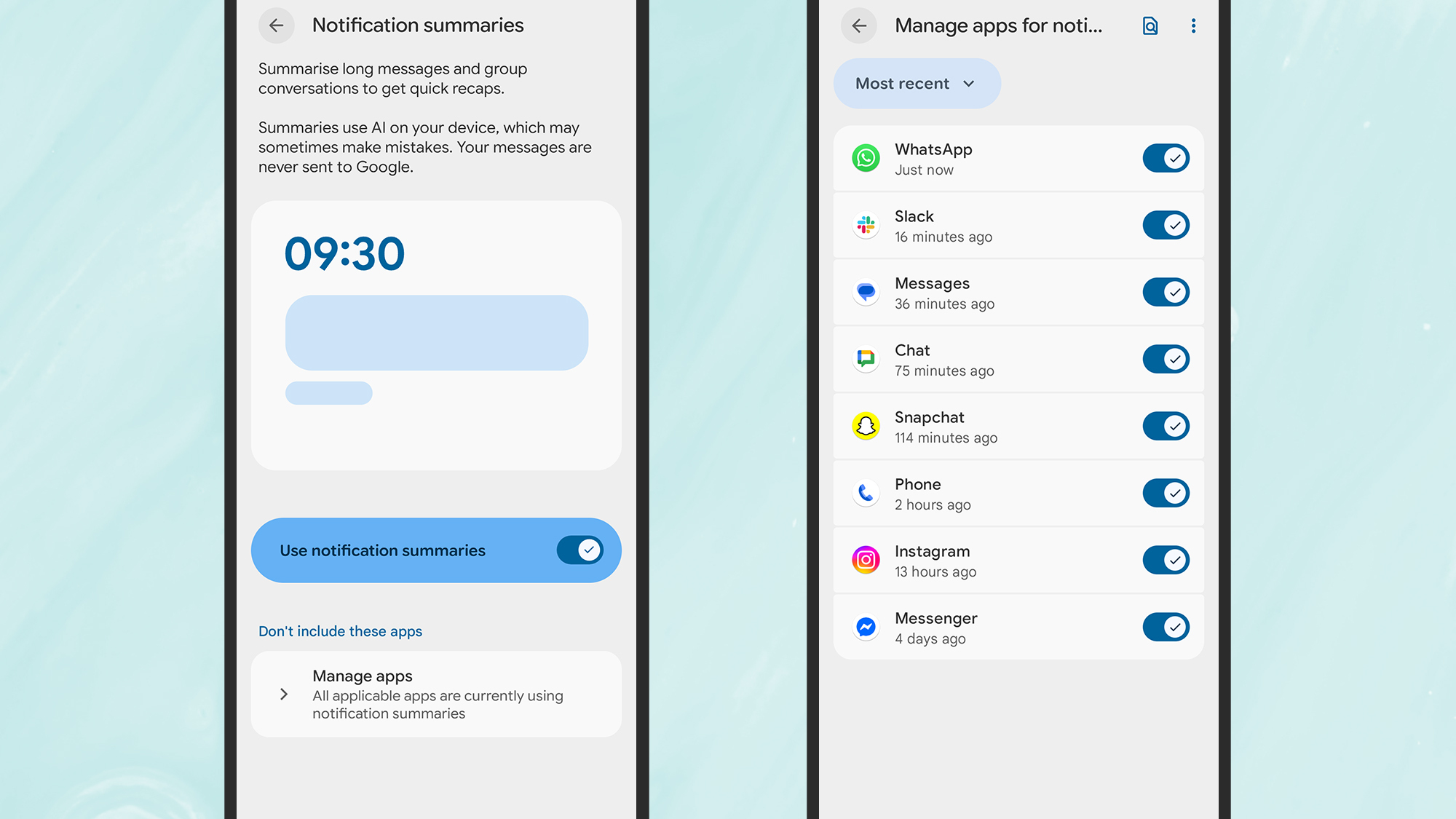
AI notification summaries won’t automatically take over your phone, after the update—you need to enable them manually. From Settings, head to Notifications, then tap Notification summaries to turn this on. The same screen lets you choose which apps you want notifications summarized for.
There are actually two parts to the new update: the actual notification summaries, and what Google is calling a “notification organizer.” This organizer is designed to group and silence lower-priority notifications (including social alerts and promotional messages), though there doesn’t appear to be a separate toggle switch for this.
Of course, other Android phone makers will be able to implement this in whatever way they choose. It looks as though Samsung is testing the feature with the One UI 8.5, which should be launching in beta any day now. A full release of the software is expected early next year, alongside the Galaxy S26 phones.
Using AI notification summaries for 24 hours
Ready to banish notification clutter from my life, I turned on AI summaries for all my apps to see exactly how this worked. For a start, it doesn’t apply to all apps, at least not yet: My Snapchat and Instagram alerts remained the same as always, so further updates will be needed from Google and app developers before this is something you see everywhere.
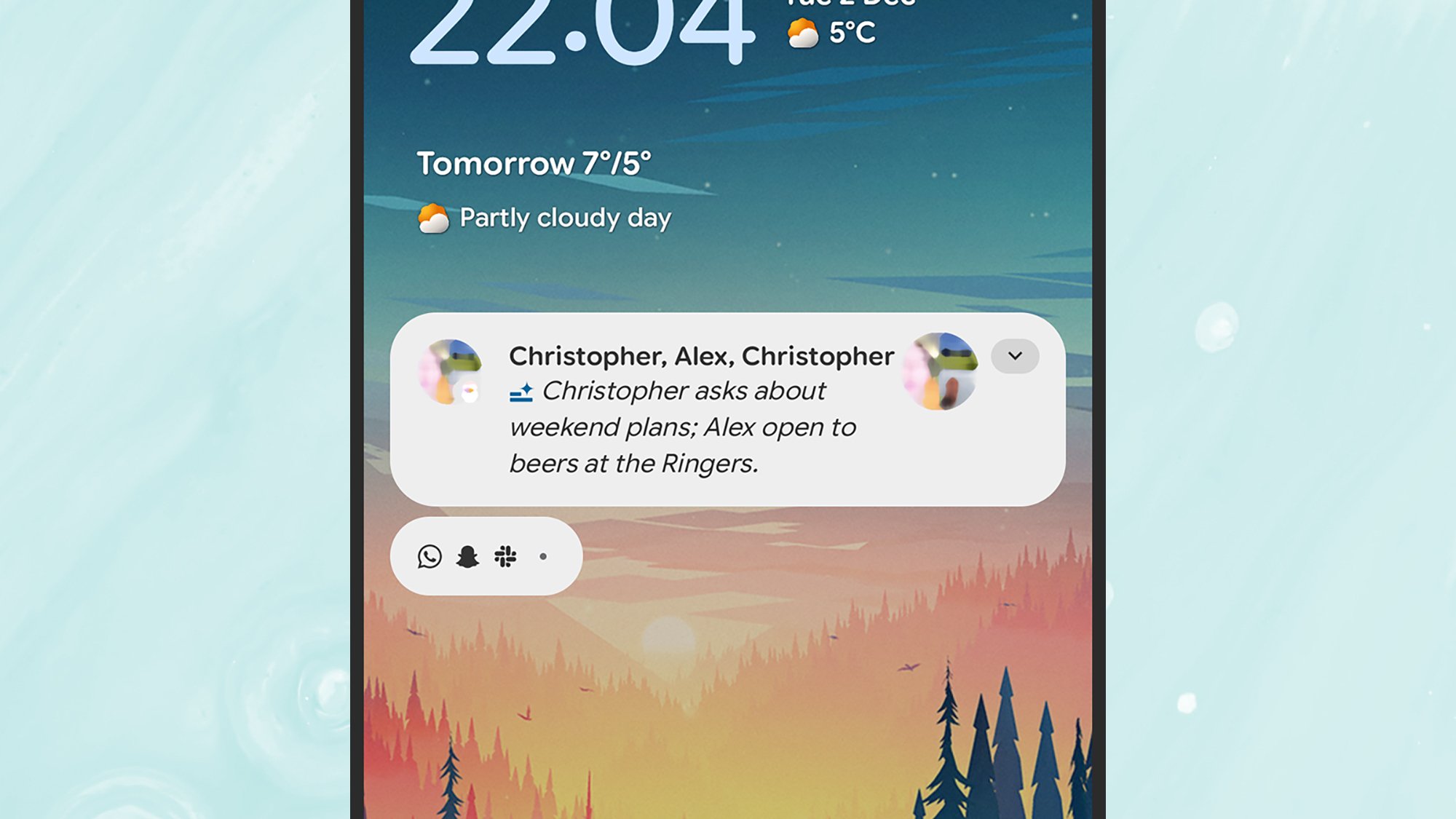
The apps I saw summaries for most often were Google Chat, WhatsApp, and Slack—almost always in group conversations, and some of the time for single messages (the length of the message seems to affect this somehow). And the summaries were … mostly okay. They tended to catch the gist of who had said what, and in that sense were an accurate recap of what I was missing by not actually opening these apps.
The summaries work, up to a point. Credit: Lifehacker
These summaries did update as more messages were added, but the summary preview window is only a couple of lines long—so once multiple people start piling into a group chat, the summary isn’t going to be able to cover everything. From the lock screen and pull-down notification shade, it’s possible to expand notifications to see full messages (as usual), and then minimize them back to the summary view again.
There was one occasion when the AI notification summaries got confused by the Lifehacker slack and by the various @mentions included—attributing a message to the person who had been tagged in a message, rather than the person who had sent it. On the whole, though, there were no obvious mistakes, just certain details left out from summaries of longer chats that I would’ve liked to have known about.
Now I’ve tested this out, I’m going to turn it off again, for a couple of reasons—and inaccuracy isn’t really one of them (though that might certainly creep in). First, given the small size of the preview window, I’m not sure an AI summary is any more useful than the first couple of lines of text you get as standard anyway. That’s usually enough for me to tell whether or not a message is important before opening it.
Second, I’m not sure I really want my messages and group chats summarized—at least not the important ones. If a friend, family member, or work colleague has something to tell me, I’d like to know exactly what it is, rather than reading a précis. It feels like AI is being used just for the sake of it—and not for the first time.
I didn’t see any evidence of the notification organizer in action, by the way, perhaps because of the way I’ve got my Android notifications set up—there are now a host of granular options for alerts in Android, for silencing and dismissing notifications. This feature sounds vaguely useful, but again, I’m not sure I’m ready to hand over the job of judging how important notifications are over to AI just yet.
Somewhere out there, somebody is having a good laugh, we’re just not sure if it’s the person who returned a box of rocks inside a $1,200 ASUS TUF Gaming GeForce RTX 5080 graphics card box, a delivery person who may have made the stone cold swap prior to delivery, or someone at Best Buy’s return department. And that’s all assuming that a poster
Amazon appears to have quietly removed its truly terrible AI-generated English dubs for several anime shows currently streaming on Prime Video, following widespread (and entirely fair) ridicule from viewers and industry professionals. AI dubs were recently added to Banana Fish, No Game, No Life and Vinland Saga, where they were labeled “AI beta” in the Languages section of the app.
As shows that previously only offered English subtitles, the option of a dub for those who prefer it could have been seen as a win for Amazon. But it quickly became clear that the dubs were unspeakably bad, completely devoid of any emotion or convincing intonation in dramatic moments. Particularly awful clips of the AI English dub for Banana Fish soon started circulating on social media, and the National Association of Voice Actors released a statement in which it branded the dubs “AI slop.”
In his own statement, voice actor Daman Mills called the AI-generated dub for Banana Fish a “massive insult to us as performers.” In a post on X, which at the time of writing has been liked 14,000 times, he said: “Voice Actors deserve the same level of respect as on camera performers. Anime already pays talent very little. Dub production costs shouldn’t make a dent in these companies’ pocket books. Using AI for a dub of a show that released nearly 8 YEARS AGO AND HAD NO RUSHED SCHEDULE just spits in our faces, has infuriated the consumer, and completely destroys the art.”
Decision-makers at Amazon apparently noted the backlash, as the English dub options no longer show up, as acknowledged by Mills and others yesterday. An AI-generated Spanish dub for Vinland Saga appears to have survived the silent cull, but otherwise it’s back to Japanese language-only and subtitles for the other shows.
The company is clearly committed to introducing more AI to Prime Video — along with its various other services — despite this latest public shaming. It launched an “AI-aided” dubbing program for Prime Video earlier this year, piloting English and Latin American Spanish dubs in 12 licensed series and movies on Prime Video in March. Last month, it also introduced video recaps that summarize shows’ “most pertinent plot points” using generative AI. The feature is currently in beta for select English language Prime Original shows in the US.
This article originally appeared on Engadget at https://www.engadget.com/entertainment/amazon-halts-ai-anime-dub-beta-after-widespread-ridicule-141501051.html?src=rss
The Zig Software Foundation has quit GitHub after years of unresolved GitHub Actions bugs — including a “safe_sleep” script that could spin forever and cripple CI runners. Zig leadership puts the blame on Microsoft’s growing AI-first priorities and declining engineering quality. Other open-source developers are voicing similar frustrations. The Register reports: The drama began in April 2025 when GitHub user AlekseiNikiforovIBM started a thread titled “safe_sleep.sh rarely hangs indefinitely.” GitHub addressed the problem in August, but didn’t reveal that in the thread, which remained open until Monday. That timing appears notable. Last week, Andrew Kelly, president and lead developer of the Zig Software Foundation, announced that the Zig project is moving to Codeberg, a non-profit git hosting service, because GitHub no longer demonstrates commitment to engineering excellence.
One piece of evidence he offered for that assessment was the “safe_sleep.sh rarely hangs indefinitely” thread. “Most importantly, Actions has inexcusable bugs while being completely neglected,” Kelly wrote. “After the CEO of GitHub said to ’embrace AI or get out’, it seems the lackeys at Microsoft took the hint, because GitHub Actions started ‘vibe-scheduling’ — choosing jobs to run seemingly at random. Combined with other bugs and inability to manually intervene, this causes our CI system to get so backed up that not even master branch commits get checked.”