It feels like each passing day brings with it a new leak or rumored related to Intel’s upcoming Arrow Lake-S Refresh processors. That’s not actually the case, of course, but the leaks are starting to pile up, the latest of which is a benchmark run. The chip in question is an unannounced (and obviously not-yet-released) Core Ultra 7 270K Plus
Tech giants including Meta, Alphabet, Microsoft and Amazon have all extended the estimated useful lives of their servers and AI equipment over the past five years, sparking a debate among investors about whether these accounting changes are artificially inflating profits. Meta this year increased its depreciation timeline for most servers and network assets to 5.5 years, up from four to five years previously and as little as three years in 2020. The company said the change reduced its depreciation expense by $2.3 billion for the first nine months of 2025. Alphabet and Microsoft now use six-year periods, up from three in 2020. Amazon extended to six years by 2024 but cut back to five years this year for some servers and networking equipment.
Michael Burry, the investor portrayed in “The Big Short,” called extending useful lives “one of the more common frauds of the modern era” in an article last month. Meta’s total depreciation expense for the nine-month period was almost $13 billion against pretax profit exceeding $60 billion.
Paramount has been none too pleased about Netflix striking an $82.7 billion deal to buy much of Warner Bros. Discovery (WBD). Now, Paramount is making a hostile takeover bid for WBD. It’s making its pitch directly to WBD shareholders with an all-cash offer of $30 per share that expires on January 8.
Late last week, the WBD board unanimously accepted Netflix’s offer of $27.75 per share. That breaks down to $23.25 per share in cash and another $4.50 per share in Netflix stock. Netflix’s overall bid is valued at $82.7 billion, while Paramount’s totals $108.4 billion.
There’s a key difference when it comes to the Paramount offer, as it’s for all of WBD. The latter is scheduled to split into two companies next year. Netflix only wants the Streaming and Studios side of WBD’s business, which includes HBO Max and the Warner Bros. film, TV and game studios.
Paramount is after the whole shebang, including WBD’s cable channels (Global Networks). “WBD’s Board of Directors recommendation of the Netflix transaction over Paramount’s offer is based on an illusory prospective valuation of Global Networks that is unsupported by the business fundamentals and encumbered by high levels of financial leverage assigned to the entity,” Paramount said in a press release on Monday.
As of the end of September, WBD was carrying $34.5 billion of gross debt. It planned to saddle the Global Networks company (aka Discovery Global) with most of that. The Paramount offer includes financing from the Ellison family and RedBird Capital, but it would be taking on more debt to secure a deal for WBD. The bid includes “$54 billion of debt commitments from Bank of America, Citi and Apollo” (Engadget’s parent company).
In a letter sent to WBD CEO David Zazlav before the company accepted Netflix’s offer, Paramount questioned the “fairness and adequacy” of the sale process. It asked whether WBD was acting in the best interest of shareholders after the management team allegedly appeared to favor the Netflix offer.
“Despite Paramount submitting six proposals over the course of 12 weeks, WBD never engaged meaningfully with these proposals which we believe deliver the best outcome for WBD shareholders,” Paramount said. “Paramount has now taken its offer directly to WBD shareholders and its Board of Directors to ensure they have the opportunity to pursue this clearly superior alternative.”
Paramount — which Skydance bought for $8 billion this year — also claims that its offer is likely to face less regulatory scrutiny than the Netflix offer, which wouldn’t close until sometime after WBD splits in two later in 2026. According to CNBC, Paramount executives believe that the company’s smaller size and cozy relationship with the Trump administration will help streamline the regulatory process. Over the weekend, President Donald Trump said that Netflix’s bid for WBD has “got to go through a process, and we’ll see what happens. But it is a big market share. It could be a problem.”
This article originally appeared on Engadget at https://www.engadget.com/big-tech/paramount-makes-a-108-billion-hostile-takeover-bid-for-warner-bros-discovery-152248473.html?src=rss
Samsung has kicked off the One UI 8.5 beta program and, with it, promises “next-level ease of use” across Galaxy S25 devices (for now). Built on Android 16 QPR2, the latest Samsung mobile skin intends on bringing a unified and intelligent mobile experience, focusing intensely on productivity, system performance, and security.
A popular power bank sold exclusively at Amazon is being recalled after over a dozen reports of the problematic unit overheating. In 11 of those reported incidents (out of 15), affected units caught fire, resulting in three minor burn injuries and over $380,000 in property damage. Suffice to say, if you own an affected power bank, stop using
Meta has agreed to make changes to its “pay or consent” business model in the EU, seeking to agree to a deal that avoids further regulatory fines at a time when the bloc’s digital rule book is drawing anger from US authorities.
On Tuesday, the European Commission announced that the social media giant had offered users an alternative choice of Facebook and Instagram services that would show them fewer personalized advertisements.
The offer follows an EU investigation into Meta’s policy of requiring users either to consent to data tracking or pay for an ad-free service. The Financial Times reported on optimism that an agreement could be reached between the parties in October.
While just half-way through the Linux 6.19 merge window, over the weekend I began running some benchmarks of the current Linux 6.19 Git state compared to Linux 6.18 LTS stable. There are some minor performance improvements to note in a few of the tests on the first system I tested but also some regressions at this very early pre-RC1 state of the Linux 6.19 kernel…
Rapha has published its 2025 impact report, with headlines including the brand’s increased use of recycled polyester in its garments, for the first time using more recycled than virgin fibres in 2024. It aims to increase that figure to 80% by 2030.
Rapha already offers crash repairs and has launched a trade-in programme, Rapha ReRoute, for its clothing in the US, which it plans to extend to the UK, then more countries in Europe.
Other notable advances include the use of renewable energy to power its offices and 59% of its 22 clubhouses worldwide.
Lower impact supply chain
Rapha CEO Fran Millar says the brand is working closely with its suppliers to cut emissions and waste. Tom Griffiths / Rapha
It’s been pointed out previously that, although cycling produces few emissions, the whole supply chain, and end-of-life disposal of bikes and cycling paraphernalia, is far from green.
The annual Climate Action Pulse Check published by Shift Cycling Culture, a pan-industry body, reports that 85% of its members consider reduction of climate impact as part of their product design and development.
But according to Rapha CEO, Fran Millar: “We have become the first cycling apparel brand to set a Science Based Target, committing to reduce greenhouse gas emissions across our operations and supply chain. This means working closely with our suppliers to cut emissions, extending the life of our products through circularity initiatives, and increasing our use of sustainable materials.”
At the top level, Rapha’s climate actions are targeting an 88% reduction in its own greenhouse gas emissions by 2030, with a further 45% reduction from its supply chain, which is its main source of emissions. It says it has already achieved a 35.6% reduction in the former and a 24% reduction in the latter since 2022, although with more products produced in 2024, its emissions have increased slightly from 2023.
Rapha says it’s also aiming to reduce waste from excess fabrics to 0.5% of its total and reduce the environmental impact of its packaging, both for transport and at individual item level. It says this is minimal, though, relative to its product production, which it calculates produced 11,035 tonnes of carbon dioxide equivalent in 2024, 98% of its total.
Rapha’s impact report covers a wide range of measures, not just clothing production. Scott Windsor / Our Media
Alongside the above headlines, Rapha has set itself a range of targets for its impact, covering everything from supplier social and environmental performance to the removal of PFC forever chemicals from its clothes’ DWR coatings and the reduction in water consumption in production.
“We see sustainability as more than reducing our carbon footprint. It’s about protecting the rights of the people who make our products, and safeguarding the landscapes we ride through. It’s about changing the way we live, and opening cycling up to more people from every walk of life. It’s about leaving no one behind,” says Millar.
Among its other initiatives, Rapha has taken steps to eliminate its gender pay gap. In 2018, this stood at 18%, while by 2024, women on average earned 2.3% more than men at Rapha.
A further initiative aims to ensure all workers at the (non-Rapha owned) factories where its products are put together, principally in Vietnam, China, Portugal and Indonesia, receive a living wage and have representation mechanisms.
Amazon’s budget Blink smart home brand is adding AI-generated video descriptions as a new benefit for subscribers. Blink Video Descriptions are text descriptions of the motion doorbells and cameras capture, and they’ll be available in beta starting today, November 17.
Not unlike Ring Video Descriptions, a feature offered on Amazon’s other smart home brand, Blink’s AI-generated descriptions are supposed to be a concise way to check out what’s happening in and around your home. Any kind of motion can produce a video clip and a notification in the Blink app, but video descriptions should help weed out which ones are worth watching and worrying about.
Blink says Video Descriptions will be supported on all existing Blink doorbells and cameras, provided you’re paying to be a Blink subscriber for at least $4 a month or $40 a year. That means if you’ve scooped up one of the new Blink 2K+, Blink Outdoor 2K+ or Blink Arc cameras, you’ll be able to take advantage of the feature.
Blink Video Descriptions start rolling out to subscribers today in beta, though not in Illinois, possibly due to the state’s Biometric Information Privacy Act.
This article originally appeared on Engadget at https://www.engadget.com/home/smart-home/blink-budget-security-cameras-will-support-ai-powered-video-descriptions-143000725.html?src=rss
Paramount Skydance is launching a hostile bid to buy Warner Bros. Discovery after it lost out to Netflix in a months-long bidding war for the legacy assets, the company said Monday. CNBC: Paramount will go straight to WBD shareholders with an all-cash, $30-per-share offer. That’s the same bid WBD rejected last week, according to people familiar with the bid who asked not to be named because the details were private. The offer is backstopped with equity financing from the Ellison family and the private-equity firm RedBird Capital and $54 billion of debt commitments from Bank of America, Citi and Apollo Global Management.
“We’re really here to finish what we started,” Ellison told CNBC’s “Squawk on the Street” Monday. “We put the company in play.” On Friday, Netflix announced a deal to acquire WBD’s studio and streaming assets for $72 billion. David Ellison-run Paramount had been bidding for the entirety of Warner Bros. Discovery, including those assets and the company’s TV networks like CNN and TNT Sports.
One of the new Linux engineering initiatives out of AMD is working to further enhance Linux performance on today’s large core count systems by introducing push-based load balancing…
Cyber Monday has come and gone, but you can still get a great deal on a smartwatch with the Google Pixel Watch 4 marked down to $300 from $350. At almost 15 percent off, this is the lowest we’ve ever seen it.
The Pixel Watch 4 was just released in October and is our smartwatch of choice for users with Pixel phones. In our hands-on review we scored it 86 out of 100, taking note of its fast recharge time, health and fitness tracking, repairable design and gorgeous display.
The curved display sits under a domed glass cover and sports an impressive 3,000 nits of peak brightness, well beyond the 2,000 nits max of the Apple Watch Series 11. This makes the Pixel Watch 4 about 50 percent brighter than the previous generation, and thanks to smaller bezels the display is about 10 percent bigger.
The new generation also adds dual-frequency GPS, updated processors and a custom haptic engine. It also boasts a more repairable design thanks to a case that can be easily unscrewed to replace the display or battery. We did find the gesture based raise-to-talk Gemini feature a little gimmicky, and users should note that the watch must be connected to the internet for Gemini to work.
Thanks to all this, we named the Pixel Watch 4 the best smartwatch for Android users. It’s as good a workout companion as a daily watch and offers peace of mind with emergency SOS via satellite. If you’re an Android user in the market for a smartwatch, this is one of the best deals available now.
This article originally appeared on Engadget at https://www.engadget.com/wearables/the-google-pixel-watch-4-is-cheaper-than-ever-right-now-141715083.html?src=rss
Affordable gaming is facing an existential threat from the rise of AI and the resulting insatiable demand for key components. This has led to a massive spike in PC DRAM prices, and storage solutions may not be far behind. The sliver lining is that we’re in the midst of the holiday shopping season, and with it comes what is perhaps one last
Prime Video dropped an extended teaser for the fifth and final season of The Boys—based on the comic book series of the same name by Garth Ennis and Darick Robertson—during CCXP in Sao Paulo, Brazil. And it looks like we’re getting nothing less than a full-on Supe-ocalypse as an all-powerful Homelander seeks revenge on The Boys.
(Spoilers for prior seasons of The Boys and S2 of Gen V below.)
Things were not looking good for our antiheroes after the S4 finale. They managed to thwart the assassination of newly elected US President Robert Singer, but new Vought CEO/evil Supe Sister Sage (Susan Heyward) essentially overthrew the election and installed Senator Steve Calhoun (David Andrews) as president. Calhoun declared martial law, and naturally Homelander (Antony “Give Him an Emmy Already” Starr) swore loyalty as his chief enforcer. Butcher (Karl Urban) and Annie (Erin Moriarty) escaped, but the rest of The Boys were rounded up and placed in re-education—er, “Freedom”—camps.
Amazon used its annual re:Invent cloud conference in Las Vegas to pitch a vision of the workplace where AI agents serve not as tools but as “co-workers” and “teammates,” even as the company proceeds with eliminating roughly 14,000 corporate jobs in its second major workforce reduction in recent years.
AWS CEO Matt Garman predicted on stage that autonomous “frontier agents” could represent 80 to 90% of enterprise AI value. Colleen Aubrey, senior vice president of applied AI solutions, described a future where companies manage “teams” of agents capable of working autonomously for hours or days while humans shift into supervisory roles. Amazon has already deployed agentic systems across tens of thousands of its own engineers to triage outages and propose fixes. The company calls these systems “teammates” rather than tools. CEO Andy Jassy has warned that AI would shrink Amazon’s workforce, though a spokesperson attributed the current cuts to “reducing bureaucracy” and “removing layers” rather than AI deployment.
Malicious extensions do occasionally find their way into the Chrome Web Store (and similar libraries in other browsers) by posing as legitimate add-ons. They are particularly difficult to catch when they are benign to begin with, only morphing into malware after gaining user trust.
That’s what happened with a number of extensions on Google Chrome and Microsoft Edge: researchers at Koi Security identified add-ons across both browsers that operated legitimately for several years before receiving malicious updates that allow hackers to surveil users and collect and exfiltrate sensitive data. The scheme, known as ShadyPanda, reached four million downloads and is still active on Edge.
Threat actors ran a similar campaign targeting Firefox earlier this year: They gained approval for benign extensions mimicking popular crypto wallets, accumulated downloads and positive reviews, and then injected the add-ons with malicious code capable of logging form field inputs, which they used to access and steal crypto assets.
Browser extensions can turn bad
As Koi Security outlines, ShadyPanda started out as an affiliate scam, with 145 extensions masquerading as wallpaper and productivity apps across the two browsers. The initial phase injected affiliate tracking codes and paid commissions with clicks to eBay, Amazon, and Booking.com and then evolved to hijack and manipulate search results before launching the five extensions in 2018 that would later be converted to malware.
Those add-ons were marked as Featured and Verified in Chrome—one, a cache cleaner known as Clean Master, accrued a 4.8 rating from thousands of reviews. The extensions were updated in 2024 to run malware that could check hourly for new instructions and maintain full browser access, feeding information to ShadyPanda’s servers. (These have since been removed from Chrome.)
Hackers launched an additional five extensions, including WeTab, to Edge in 2023. Two are comprehensive spyware, and all were still active as of Koi’s report.
How to find malicious extensions in Chrome and Edge
Unfortunately, malicious extensions are usually pretending to be something else, so a quick visual check of your installed extensions may not reveal a problem. In this case, Koi Security has a list of the extension IDs associated with the ShadyPanda campaign, and you’ll have to search for them one by one.
In Chrome, type chrome://extensions/ into your address bar and hit Enter. Toggle on Developer mode in the top-right corner to reveal the IDs for installed extensions. From here, you can copy and paste each ID into the search bar (Ctrl+F on your PC or Cmd+F on your Mac). If there are no results, your browser is safe. If you do find a malicious add-on, click the Remove button. In Edge, follow the same process from edge://extensions/.
While this campaign shows that extensions can be weaponized long after they’ve been installed, you should still follow best practices for vetting browser add-ons just as you would apps for your device. Check the name carefully, as fraudulent extensions often have names that are nearly identical to trustworthy ones. Review the description for any red flags, such as misspellings and unrelated images. If you see a lot of positive reviews in a short amount of time on a new extension, or if they seem to be reviewing something else entirely, proceed with caution. You can also do additional research, such as a search on Google or Reddit, to see if the extension is legit.
Sure, Black Friday and Cyber Monday have come and gone, but you can still find a last-minute deal on the best tech gifts. Take the Apple Watch Series 11, which has dropped to an all-time low of $299, from $399. The 25 percent discount is an even better deal than we saw on either of those sale holidays.
We gave the Apple Watch Series 11 a score of 90 when it came out in September. That’s thanks, in part, to an upgraded 24 hours of battery life — which lasted closer to a day and a half — compared to the 18 hours promised by the Series 10. It also features a thin, light design and a wrist flick gesture for everything from dismissing a notification to ending calls. Plus, it has Apple’s new hypertension tracker and comprehensive health monitoring.
This deal is available for the Apple Watch Series 11 with a 42mm case and a small to medium band. It also comes with just GPS capabilities and in three colorways: Jet Black aluminum case with Black sport band, Space Gray aluminum cause with Black sport band and Rose Gold aluminum case with Light Blush sport band.
Check out our coverage of the best Apple deals for more discounts, and follow @EngadgetDeals on X for the latest tech deals and buying advice.
This article originally appeared on Engadget at https://www.engadget.com/deals/apple-watch-series-11-drops-100-to-an-all-time-low-price-130006591.html?src=rss
Zwift Camp: Build is underway: a 5-stage route-based workout series, with each stage lasting one week and focusing on developing power over a specific time interval.
My plan is to do each of the five workouts before their weeks begin, so I can write a post unpacking the workout and delivering some tips along the way. This post covers Stage 5’s workout on Watopia’s Road to Sky route, which takes you up the massive Alpe du Zwift KOM. Let’s roll!
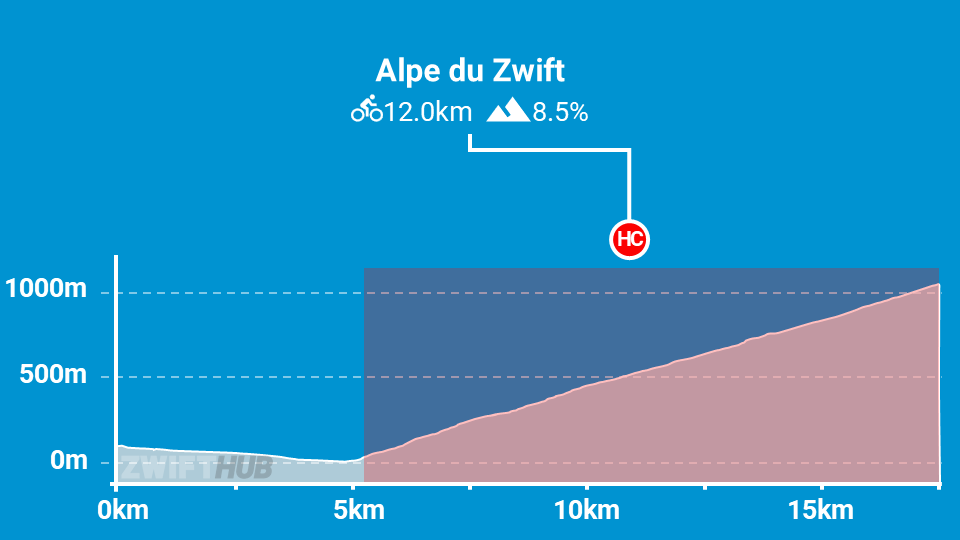
The fifth and final stage of Zwift Camp: Build is focused on “One 60-minute showdown,” according to the event description. We’re climbing Alpe du Zwift, a 12.2km, 8.5% climb modeled after France’s infamous Alpe d’Huez.
This is by far the longest effort in Zwift Camp: Build. We began this Camp with short sprints in Stage 1, went to longer sprints in Stage 2, then (sort of) VO2 power in Stage 3, followed by 10-20 minute power in Stage 4. Stage 5, for many riders, will be around a 1-hour interval, making it a true threshold effort.
Apart from the mental and physical challenge of a long threshold effort, the only tricky part here is pacing. You’ll do best if you know the wattage you’re aiming to hold on the climb, and this will also let you pick a pace partner to ride with.
The RoboPacers each have their own pens, with the faster bots leaving first. While everyone is visible on course, chances are very few riders from the slower groups will catch the faster ones ahead.
Here are the RoboPacer options:
A – 50 Minutes: 4 W/kg
B – 60 Minutes: 3.3 W/kg
C – 70 Minutes: 2.8 W/kg
D – 90 Minutes: 2.1 W/kg
E – 115 Minutes: 1.7 W/kg
The stage is built around Watopia’s Road to Sky route, which begins with an easy descent into the Mayan Jungle.
The bots go much slower during this warmup portion, so be sure to stay with your bot (it’ll be easy) if you want to start the Alpe climb next to them.
The route ends atop the Alpe, but you can keep pedaling and descend back to ground level afterward. You earned the distance!
Stage 5 Walkthrough
Once again, I was going into this ride with legs that were less than fresh. Luckily, Zwift had set up the RoboPacers in such a way that the B bot was perfect for what I could do in terms of a longer effort!
The B bot’s 60-minute climb pace, at 3.3 W/kg, seemed like it would pace me nicely on the early part of the climb. Then I figured I’d have a bit more left on the upper slopes, so I could push a bit harder, drop the bot, and negative split things overall.
After 9 minutes of easy warmup spining through the Jungle, we crossed the start line for Alpe du Zwift, the bot kicked up the effort, and we got to work:
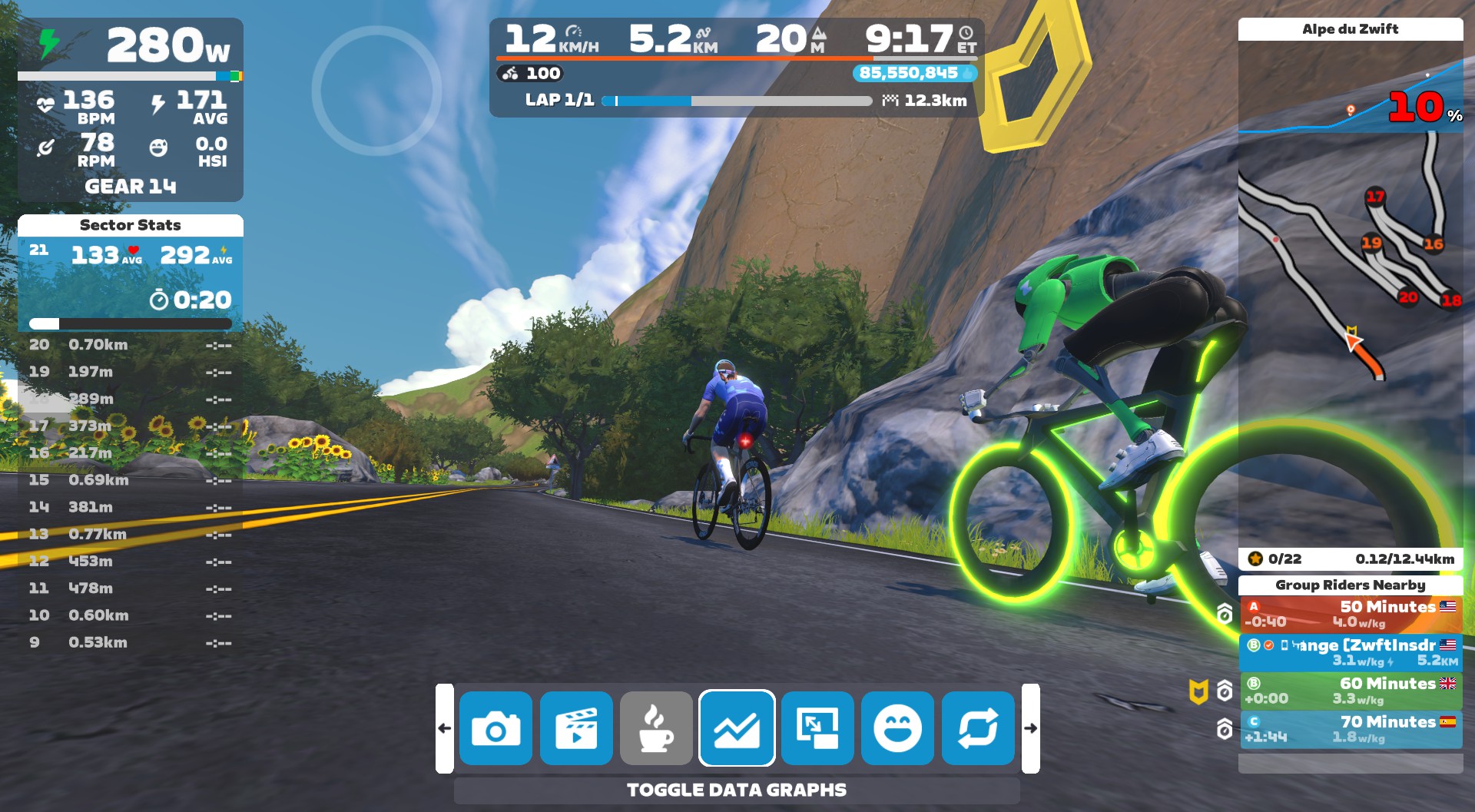
I settled into my target pace, finding the best gear and staying close to the bot.
After climbing for several minutes, I realized that this setup was working out really nicely. While the Sector Stats HUD on the left let me easily see my average power for each of the 21 sectors, the green bot and its big ol’ beacon made it easy to see if I was holding my target pace.
A warning, though: these bots are relentless, and if you ease up, you’ll get dropped!
Hairpin Note
The spot where you’ll notice the relentless nature of the RoboPacers the most is on the flatter gradients that often occur on the hairpins at the end of some sectors. When the road flattens, your power will naturally drop as trainer resistance drops. But the RoboPacer won’t change its output!
I found myself losing several meters to the bot on each flat section, until I began to consciously increase my power when I felt resistance ease.
Doing the Work
I stayed just a few meters ahead of the B bot for the first 15 sectors. I also opted not to steer, as the pace I was holding felt good and I didn’t need to gain further advantage on the unsuspecting robot. (Note: steering can reduce the overall length by around 500 meters, so it’s no small thing!) If you’re struggling to keep up with the bot, though, a few cut corners may be just the trick you need.
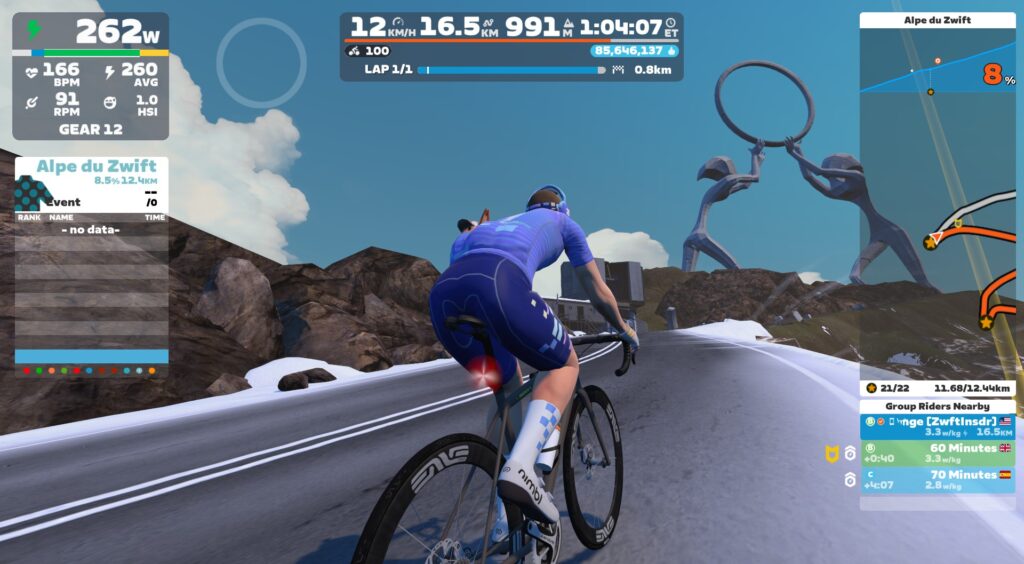
Nearing the finish, 40 seconds ahead of the bot
My heart rate had risen steadily from 140 at the bottom of the Alpe to 160 with 6 sectors to go. That’s when I decided to bump up my effort, drop the green robot, and sail to victory!
I went from averaging ~270W to ~280-285W, and began putting time into the bot. I kept pushing, getting my heart rate up to 170bpm as I crossed the finish line. My final climb time was 58:21, and the bot finished about 40 seconds behind me. (So it’s worth mentioning that the bot climb times are estimates only, probably accurate within a minute or so.)
Watch My Video
Results!
I received an automated email after finishing this stage, which included a link to a web-based results dashboard: zwift.com/zwift-camp-build/dashboard
Good to see Zwift getting this launched, even if it came a bit late.
Suggestion Box
I’ve been offering improvement suggestions to Zwift for each of these stages, and my suggestions for stage 5 would be the same as stage 4: add messaging, and improve the event description (read those suggestions in more detail here).
Apart from that, I want to take a moment to talk about the overall Zwift Camp: Build experience now that I’ve finished the final stage.
Overall, I’d say Zwift Camp: Build offers some good sessions for riders looking to challenge themselves with maximal efforts across particular time intervals. Three stages do this well:
Stage 1 with its 4 neuromuscular sprints on Glasgow’s Champion’s Sprint
Stage 4 for a suprathreshold effort on The Grade KOM
Stage 5 for a maximal threshold effort, assuming you can complete the Alpe in ~60 minutes or less
The other two stages fell short of what could have been. To be precise:
Stage 2 talked about targeting 1-minute power, but since the on-screen instructions had you sprinting every sprint segment (9 of them!), your 1-minute efforts were blunted.
Stage 3, on the cover, was about VO2 max efforts. But it had you do 3 back-to-back hard laps of the Volcano Circuit, which meant you couldn’t actually hold VO2 max power for more than perhaps 1 lap. It was actually more like a pacing exercise for stage 4.
Like I said in the intro to stage 1, this isn’t meant to be a workout program for an intermediate or experienced rider, and it won’t offer the periodized training of a true program.
It is, however, an easy way for beginners, or those new to structured training, to dip their toes into more structured approaches. Route-based workouts are a great way to do this, as they offer a welcome and needed alternative to the rigid structure of ERG workouts. So it’s good that Zwift is pushing in this direction.
As Zwift’s first serious foray into a route-based workout series, I’d say overall, Zwift Camp: Build feels like a step in the right direction.
But these workouts, and the overall program, could be much better. I’ve already written all my suggestions in previous posts, but I’ll summarize them by saying Zwift should:
Find routes that dial in the interval lengths more precisely;
Use the HUD effectively to aid the workout, and also;
Communicate clearly what each workout is about through the event titles, description text, and other marketing comms.
There’s a lot more to be said about the potential of route-based workouts in Zwift, but I’ll save that for an upcoming Pondering the Possibilities post.
America’s Energy Department runs a research lab in Idaho — and this week announced successful results from a ground-breaking experiment. “This is the first time in history that chloride-based molten salt fuel has been produced for a fast reactor,” says Bill Phillips, the lab’s technical lead for salt synthesis. He calls it “a major milestone for American innovation and a clear signal of our national commitment to advanced nuclear energy.”
Unlike traditional reactors that use solid fuel rods and water as a coolant, most molten salt reactors rely on liquid fuel — a mixture of salts containing fissile material. This design allows for higher operating temperatures, better fuel efficiency, and enhanced safety. It also opens the door to new applications, including compact nuclear systems for ships and remote installations.
“The Molten Chloride Fast Reactor represents a paradigm shift in the nuclear fuel cycle, and the Molten Chloride Reactor Experiment (MCRE) will directly inform the commercialization of that reactor,” said Jeff Latkowski, senior vice president of TerraPower and program director for the Molten Chloride Fast Reactor. “Working with world-leading organizations such as INL to successfully synthesize this unique new fuel demonstrates how real progress in Gen IV nuclear is being made together.”
“The implications for the maritime industry are significant,” said Don Wood, senior technical advisor for MCRE. “Molten salt reactors could provide ships with highly efficient, low-maintenance nuclear power, reducing emissions and enabling long-range, uninterrupted travel. The technology could spark the rise of a new nuclear sector — one that is mobile, scalable and globally transformative.
More details from America’s Energy Department:
MCRE will require a total of 72 to 75 batches of fuel salt to go critical, making it the largest fuel production effort at INL since the operations of Experimental Breeder Reactor-II more than 30 years ago. The full-scale demonstration of the new fuel salt synthesis line for MCRE was made possible by a breakthrough in 2024. After years of testing, the team found the right recipe to convert 95 percent of uranium metal feedstock into 18 kilograms of uranium chloride fuel salt in only a few hours — a process that previously took more than a week to complete…
After delivering the first batch of fuel salt this fall, the team anticipates delivering four additional batches by March of 2026. MCRE is anticipated to run in 2028 for approximately six months at INL in the Laboratory for Operation and Testing (LOTUS) in the United States test bed.
“With the first batch of fuel salt successfully created at INL, researchers will now conduct testing to better understand the physics of the process, with a goal of moving the process to a commercial scale over the next decade,” says Cowboy State Daily.
Thanks to long-time Slashdot reader schwit1 for sharing the article.
It’s time to admit, before God and the good readers of Ars Technica, that I have a problem. I love roguelikes. Reader, I can’t get enough of them. If there’s even a whisper of a hot new roguelike on Steam, I’m there. You may call them arcane, repetitive, or maddeningly difficult; I call them heaven.
The second best part of video games is taking a puny little character and, over 100 hours, transforming that adventurer into a god of destruction. The best thing about video games is doing the same thing in under an hour. Beat a combat encounter, get an upgrade. Enter a new area, choose a new item. Put together a build and watch it sing.
If you die—immediately ending your ascent and returning you to the beginning of the game—you’ll often make a pit stop at a home base to unlock new goodies to help you on your next run. (Some people distiguish between roguelikes and “roguelites,” with the latter including permanent, between-run upgrades. For simplicity’s sake, I’ll use “roguelike” as an umbrella term).