
Because time is moving at warp speed and Christmas is just 15 days away (despite my best efforts to slow it down so I have time to make meaningful gifts instead of grabbing a bunch of gift cards at the grocery store checkout like I’m going to do), this is a video from There I Ruined It (previously) of Christmas classic ‘Santa Claus Is Coming To Town’ mashed up with Radiohead’s ‘Creep’. I’m not gonna lie, it’s a banger. I just blasted it at max volume for my girlfriend but she stared daggers at me and told me to turn it off. To the song’s credit though, she was on an important business call.
Category Archives: Unfiltered RSS
NASA just lost contact with a Mars orbiter, and will soon lose another one
NASA has lost contact with one its three spacecraft orbiting Mars, the agency announced Tuesday. Meanwhile, a second Mars orbiter is perilously close to running out of fuel, and the third mission is running well past its warranty.
Ground teams last heard from the Mars Atmosphere and Volatile Evolution, or MAVEN, spacecraft on Saturday, December 6. “Telemetry from MAVEN had showed all subsystems working normally before it orbited behind the red planet,” NASA said in a short statement. “After the spacecraft emerged from behind Mars, NASA’s Deep Space Network did not observe a signal.”
NASA said mission controllers are “investigating the anomaly to address the situation. More information will be shared once it becomes available.”
Monado 25.1.0: Enabling tomorrow’s OpenXR experiences
Released as UnitedXR wraps up in Brussels, this latest update to the cross-platform Open-Source OpenXR runtime delivers major improvements across hand tracking, device support, and the core runtime infrastructure. Whether you are an XR platform maker, XR OEM, researcher, developer, or XR enthusiast, version 25.1.0 introduces new capabilities that make Monado even more reliable, more flexible, and better prepared for tomorrow’s XR experiences.
[$] LWN.net Weekly Edition for December 11, 2025
Inside this week’s LWN.net Weekly Edition:
- Front: Rust in CPython; Python frozendict; Bazzite; IETF post-quantum disagreement; Distrobox; 6.19 merge window; Leaving the TAB.
- Briefs: Let’s Encrypt retrospective; PKI infrastructure; Rust in kernel to stay; CNA series; Alpine 3.23.0; cmocka 2.0; Firefox 146; 2024 Free Software Awards; Quotes; …
- Announcements: Newsletters, conferences, security updates, patches, and more.
Google Faces Fines Over Google Play If It Doesn’t Make More Concessions
EU regulators say Google’s Play Store changes still don’t meet fairness rules and are preparing a potentially hefty 2026 fine unless Google makes deeper concessions. Reuters reports: Google Play has been in the European Commission’s crosshairs since March, with regulators singling out technical restrictions preventing app developers from steering users to other channels for cheaper offers. Another issue is the service fee charged by Google for facilitating an app developer’s initial acquisition of a new customer via Google Play which the regulator said goes beyond what is justified.
Tweaks to Google Play announced in August to make it easier for app developers to direct customers to other channels and choose a fee model are still falling short, the people said, with the EU antitrust regulator viewing Apple’s recent changes to its App Store as a benchmark. […] Google can still offer to make more changes before regulators impose a fine, likely in the first quarter of the next year, the people said, adding that the timing of any sanction can still change. “We continue to work closely with the European Commission in its ongoing investigation but have serious concerns that further changes would put Android and Play users at risk of malware, scams and data theft. Unlike iOS, Android is already open by design,” a Google spokesperson said.


Read more of this story at Slashdot.
Mewgenics, the next game from The Binding of Isaac’s developer, will arrive next February on PC
Indie game developer Edmund McMillen hosted a Reddit AMA today offering some more details about his upcoming game Mewgenics. For starters, the Steam release date for this turn-based cat-breeding RPG has been slightly delayed to February 10. The game was first announced all the way back in 2012 and had most recently been slated for a launch some time this year. Part of the long development cycle was so that McMillen could pause to launch Super Meat Boy Forever, the sequel to his Super Meat Boy platforming hit from 2010. Gamers may also know McMillen for The Binding of Isaac, which has had some notable crossovers with titles like Balatro in recent years.
Other tidbits from the AMA include the promise that McMillen already has DLC ideas, so expect to have additional content release after the base game is available. Although there doesn’t seem to be any lack of replayability in Mewgenics; McMillen said “I currently have 300+ hours across 2 saves and have only beaten the game on one save so far.” There is also a plan to have some console versions of the game, although likely not until much later next year at the soonest, the dev added.
This article originally appeared on Engadget at https://www.engadget.com/gaming/mewgenics-the-next-game-from-the-binding-of-isaacs-developer-will-arrive-next-february-on-pc-235740063.html?src=rss
Acrobat Performs A Series Of Hot Dog Tricks
This is a video of acrobat and glizzy performance artist Jacob Grégoire performing a series of hot dog tricks. Apparently Jacob is one of Peter Pan’s Lost Boys and never grew out of playing with his food. I respect that. Damn he make them wieners look good! I can’t even begin to guess how many mornings I’ve had a cold hot dog for breakfast, but I guarantee even a tenth of the answer would disgust you.
India Proposes Charging OpenAI, Google For Training AI On Copyrighted Content
An anonymous reader quotes a report from TechCrunch: On Tuesday, India’s Department for Promotion of Industry and Internal Trade released a proposed framework that would give AI companies access to all copyrighted works for training in exchange for paying royalties to a new collecting body composed of rights-holding organizations, with payments then distributed to creators. The proposal argues that this “mandatory blanket license” would lower compliance costs for AI firms while ensuring that writers, musicians, artists, and other rights holders are compensated when their work is scraped to train commercial models. […]
The eight-member committee, formed by the Indian government in late April, argues the system would avoid years of legal uncertainty while ensuring creators are compensated from the outset. Defending the system, the committee says in a 125-page submission (PDF) that a blanket license “aims to provide an easy access to content for AI developers reduce transaction costs [and] ensure fair compensation for rightsholders,” calling it the least burdensome way to manage large-scale AI training. The submission adds that the single collecting body would function as a “single window,” eliminating the need for individual negotiations and enabling royalties to flow to both registered and unregistered creators.


Read more of this story at Slashdot.
After years of resisting it, SpaceX now plans to go public. Why?
SpaceX is planning to raise tens of billions of dollars through an initial public offering next year, multiple outlets have reported, and Ars can confirm. This represents a major change in thinking from the world’s leading space company and its founder, Elon Musk.
The Wall Street Journal and The Information first reported about a possible IPO last Friday, and Bloomberg followed that up on Tuesday evening with a report suggesting the company would target a $1.5 trillion valuation. This would allow SpaceX to raise in excess of $30 billion.
This is an enormous amount of funding. The largest IPO in history occurred in 2019, when the state-owned Saudi Arabian oil company began public trading as Aramco and raised $29 billion. In terms of revenue, Aramco is a top-five company in the world.
Why RAM Prices Are Going Way, Way Up (and Why You Should Care)
We may earn a commission from links on this page.
RAM, also known as random-access memory (or just memory for short), is an important part of most electronics these days. It essentially allows programs to keep key information at the ready so they don’t have to dig through your storage (like your hard drive or solid state drive) to find it. RAM is in laptops, phones, tablets, gaming consoles, and even cars, and all apps rely on it at least a little bit.
Essentially, if your device has a computer in it, it probably comes with RAM equipped, or it’ll want you to install some before it’ll boot up. But that dependency has become a big problem recently. While RAM has historically been one of the cheaper components for home techies to buy, over the past few months, RAM has gotten much more expensive, going from an afterthought on many people’s budgets to something you have to save for.
There are a few reasons for that, but even if you’re not a hardcore PC builder and you’re not buying RAM outright, these price jumps could still affect you in the long term.
What happened?
Like with most tech shakeups these days, the big reason for the sudden explosion in RAM pricing is AI. Citing trade research firm TrendForce and Korean publication The Chosun Daily, Lifehacker sister site PCMag started reporting on shifting RAM prices in October, and it’s only gotten worse since.
According to these analysts and industry insiders, manufacturers have slowly been focusing more of their attention on RAM specifically meant for AI data centers, with Samsung and SK Hynix in particular prioritizing production of high bandwidth memory that consumer goods don’t use. Tom’s Hardware backed this up with its own reporting in October, saying that these companies have devoted what may be around 40% of global RAM output to a single AI project—OpenAI’s Stargate project. Those are two out of the three biggest RAM makers right now, and while all this was followed by a bombshell last week, the situation already didn’t look good as we entered fall, with a shortage beginning to affect consumer prices.
“This is insanity,” wrote one Reddit user in October, with more pessimism coming around Black Friday, when other users and even publications like other Lifehacker sister site Mashable noticed that some RAM was selling for as high as four-figures, during what was supposedly a sales season.
But the largest RAM price hikes hit at the start of December, following an announcement from the last remaining major RAM producer—Micron. The company, long known for its consumer-focused Crucial series, said it would be leaving the consumer RAM business in 2026 to focus on AI, bringing an end to Crucial’s 30-year history in the process. Since then, RAM prices across several products have jumped even higher, even as RAM producers report doubled profits over last year.
Essentially, as Gartner analyst Shrish Plant told The Verge, “If you are not a server customer, you will be considered a second priority for memory vendors.”
How expensive is RAM now?
While all computer component prices fluctuate, RAM has usually been among the cheaper ones, generally coming in under $100 for a respectable amount from a good brand, or closer to $150 for an upgrade. Those days, it seems, have gone out the window.
A streamer and TikToker I follow, Christian Divyne, recently posted that a RAM kit he bought in April for $90 is now over $400, and he’s not alone. I’ve seen this sentiment all over social media lately, so to check it myself, I went through PCMag’s list of the best RAM for gaming in 2025, and here are the price differences I found from August of 2025 to now.
-
G.Skill Trident Z5 RGB 32 GB DDR5-7200, was $110 in August, $360 now.
-
G.Skill Trident Z5 64 GB DDR5-6400 CL32, was $170 in August, $640 now.
-
G.Skill Ripjaws V 16 GB DDR4-3600, was $46 in August, $105 now.
While this is a small selection of RAM, it’s clear these higher prices are present across the whole industry. PCPartPicker, a popular site where PC building enthusiasts rate parts for their machines, currently says its highest rated RAM is $407, with competing memory often hitting similar highs. Essentially, it’s now difficult to find any RAM below $100, and most likely, you’ll need to pay two or three times more than you might have earlier in the year.
These price jumps are most apparent when buying RAM directly, which mostly affects PC builders, but others will likely feel the crunch soon.
How is more expensive RAM going to affect me?
So far, I’ve only focused on higher prices for people buying RAM outright, which mostly affects PC builders. But if you prefer to buy your tech pre-built, don’t assume that means you won’t end up paying more, too. Laptop, tablet, and phone makers all need to get RAM from somewhere, and as prices increase, they’ll also be affected.
Already, prices at companies like CyberPowerPC, which offers pre-built desktops, have gone up, and modular laptop maker Framework has announced that it will soon follow suit. Even Raspberry Pi, known for making cheap single board computers for home projects, was forced to raise prices on its most recent flagship, while calling out memory costs as the reason.
All of those products are aimed more at enthusiasts, sure, but consider them the canary in the coal mine. Leaker Moore’s Law is Dead recently suggested RAM prices could lead to another price hike for the Xbox, while Dell COO Jeff Clarke said in a recent earnings call that “the fact is, the cost basis is going up across all products.”
Some companies are doing their best to keep consumers from feeling the effects of the shortage. Bloomberg recently reported that Lenovo is currently stockpiling RAM to try to “strike a balance between price and availability” for consumers in 2026, while HP said it might limit the memory inside its devices, but could still end up having to raise prices.
In short, it’s a tough time to be buying tech, even if you’re more casual with your devices. And it might affect more than RAM, too—speaking to The Verge, Research VP at IDC Jeff Janukowicz suggested some companies might skimp on other components, like battery or display, to help avoid raising prices due to increased memory costs. He also suggested that more affordable devices, where corners have already been cut as much as possible, could end up seeing more price increases than others.
Will RAM prices go back to normal?
As Dell COO Jeff Clarke mentioned in that earnings call, this isn’t the first time RAM prices have fluctuated, but he did admit this particular bump is “unprecedented.” While I’d agree that’s true for memory, it does remind me of the graphics card price hikes that happened around the early 2020s.
Graphics card demand is still not a solved problem, as those components are also very useful for AI, but towards the start of the decade, it became very difficult for gamers to get their hands on GPUs, especially for close to MSRP. That was thanks to demand from cryptocurrency miners, which was high enough that Nvidia actually started making its cards worse at mining. Manufacturers reported thereafter that demand was drying up, largely in response to changes in how cryptocurrency works and lowered interest in cryptocurrency overall.
While the AI bubble hasn’t popped (yet), it’s possible RAM could follow a similar cycle if interest in AI starts to cool. Otherwise, it’ll be up to manufacturers to balance supply and demand.
Going back to Clarke’s comments, he said “I’d categorize it as demand is way ahead of supply.” On that note, while Micron is supposedly getting out of the consumer RAM game, Samsung and SK Hynix haven’t stayed silent on the issue.
As reported by Korean outlet Seoul Economic Daily, SK Hynix is planning to spend $500 billion to build new production plants, with the first set to open in 2027. The company also told The Verge that, concerning consumer products, it “is not considering to discontinue the related business.” So, supply could see a boost in coming years.
At the same time, it’s difficult to know for sure when the RAM shortage will clear up. Contrasting SK Hynix, Samsung recently said during an investor relations call (as translated by PCGamer and originally reported on by Tech Insight) that it won’t be “rapidly expanding facilities,” and will instead pursue a much harder to define plan of “maintaining long-term profitability.” Tech Insight took the opportunity to speculate that RAM prices could remain high through 2028.
In short, it’s clear that the market is still volatile, and that companies are still figuring out ways to address pricing. I can’t say for certain when RAM prices will drop again, but going on what those in the industry are saying, as well as similar issues with GPUs in the past, it seems like the key indicators here would be a reduced interest in AI, or increased production capacity.
What if I need to buy RAM now?
In the meantime, because so many electronics need RAM, you may find yourself needing to bite the bullet and buy during the shortage. If that’s the case, here are the best ways to buy RAM right now.
-
Buy prebuilt. While smaller prebuilt device manufacturers are already increasing prices, it’s clear that larger device makers like Lenovo are doing their best to keep their customers from feeling the shortage. Right now, Apple has yet to raise prices on MacBooks or the iPhone 17, and devices like the Pixel 10 and Microsoft Surface Laptop are actually on sale. Historically, buying a computer prebuilt instead of building it yourself has come at a premium, but during a component shortage, a large company is going to have more avenues to mitigate costs than you.
-
Use less RAM. While I wouldn’t suggest going for less than 8GB of RAM, most users shouldn’t need more than 16GB, even if they want to game. More headroom is good when you can get it, and while it’s been a good suggestion to err on the side of caution in the past, as prices get higher, it might be better to figure out the bare minimum you can skate by with for now.
-
Buy now, or choose to wait. This one sounds a bit contradictory, but basically, I wouldn’t expect RAM prices to normalize anytime soon. Take a look at your needs and figure out whether you need a new laptop, PC, phone, tablet, or game console anytime soon. If so, it might be worth going in on one now, before manufacturers like Dell, HP, or even Xbox have a chance to raise prices. If you think you can hold out for a few more years, though, it might be better off waiting to see how the situation plays out rather than trying to build during a shortage. Either way, make your decision soon, because you probably won’t want to be buying RAM as supply starts to shrink even further through 2026.
Qualcomm Acquires RISC-V Chip Designer Ventana Micro Systems
Qualcomm has acquired RISC-V startup Ventana to strengthen its CPU ambitions beyond mobile, “reinforcing its commitment and leadership in the development of the RISC-V standard and ecosystem,” the company said in a press release. CRN Magazine reports: The San Diego-based company said Ventana’s expertise in RISC-V, a free and open alternative to the Arm and x86 instruction set architectures, will enhance its CPU engineering capabilities and complement “existing efforts to develop custom Oryon CPU technology.” Financial terms of the deal were not disclosed.
Qualcomm, which has already been using RISC-V for some products outside the PC and server markets, said Ventana’s contributions will boost its “technology leadership in the AI era across all businesses,” indicating the broad impact expected by this acquisition. “We believe the RISC-V instruction set architecture has the potential to advance the frontier on CPU technology, enabling innovation across products,” Durga Malladi, executive vice president and general manager of technology planning, edge solutions and data center for Qualcomm, said in a statement. “The acquisition of Ventana Micro Systems marks a pivotal step in our journey to deliver industry-leading RISC-V-based CPU technology across products.”
Further reading: Qualcomm Is Buying Arduino, Releases New Raspberry Pi-Esque Arduino Board


Read more of this story at Slashdot.
The M5 MacBook Pro Just Got Its Biggest Discount Ever
We may earn a commission from links on this page. Deal pricing and availability subject to change after time of publication.
Apple released the latest 14-inch MacBook Pro with the powerful M5 chip this October, and ever since then, it has been steadily dropping in price—right now, it’s down to $1,349 (originally $1,599) for the base model. This new price is $50 cheaper than it was during Black Friday, when Lifehacker’s Senior Tech Editor Jake Peterson called it “a ridiculously good value.” At the time of this writing, Amazon is sold out of the base model, but it’s still available at Best Buy.

To be honest, this laptop is overkill for most people. The M4 MacBook Air is a more than capable laptop and will get the job done for under $800, but for those who need that extra oomph, like those who do media editing or complex programming, the MacBook Pro will be worth every penny. This is the first laptop Apple makes with the latest M5 chip, which offers significant upgrades in many aspects, like graphics performance compared to the M4.
In addition to performance improvements over the MacBook Air, the Pro model also has a fan, which the MacBook Airs don’t. This should help keep the machine’s temperature down and prevent performance hiccups.
This base model starts with a 10-core CPU and a 10-core GPU M5 chip, 16GB of RAM, and 512GB of storage. PCMag says this laptop is so powerful that you can play most games without issues in its “outstanding” review. If you’re looking for the one of the best laptops Apple has to offer, this is likely the best price you’ll see on it for some time.
Our Best Editor-Vetted Tech Deals Right Now
Deals are selected by our commerce team
Ubuntu Will Have Native AMD ROCm AI/ML and HPC Libraries In Next LTS Release
Longtime Slashdot reader MadCow42 writes: Canonical just announced that they’re packaging AMD’s ROCm libraries (for AIML and HPC with both data-center GPUs as well as desktop/laptop GPUs), directly into the Ubuntu Universe archive. You can run ROCm on Ubuntu today but you have to install it via a script from AMD and manually remove and reinstall for any upgrades or bug fixes. Having it in Ubuntu as a normal Debian package will make it much easier to install and also to maintain in the long run via normal apt tooling (‘apt upgrade’). This also means that ROCm can be an automatically-installed dependency for other packages, which doesn’t happen today.
And, interestingly, Canonical has committed to providing long-term-support for ROCm in Ubuntu — which is particularly exciting for edge and IoT devices that may have a long life in the field and need regular security patches and updates.


Read more of this story at Slashdot.
The NES game Jaws is getting a retro physical re-release on Switch and PS5
The year is 1987. Beverly Hills Cop II is the highest-grossing movie. “Walk Like an Egyptian” is the hottest song. The Iran-Contra scandal dominates American political headlines, while Konami’s Contra sucks up coins in arcades. But towering above them all is the watershed moment of Jaws arriving on the NES. (“This time there’s no escape!”, warned the box art.) Now, 38 years later, the 8-bit game is returning as a Limited Run Games physical re-release.
The retro release coincides with the Spielberg movie’s 50th anniversary. From December 19 to January 18, you can pre-order a physical copy for Switch and PS5.
It will be available in two physical editions: a standard (“Retro Edition”) one for $35, and a deluxe (“The Bigger Boat Edition”) one for $100. The latter adds an NES-inspired box, a physical CD of the game soundtrack, a keychain and — best of all — a pixelated shark lamp. Both versions include original and “enhanced” versions of the 1987 game.

Limited Run Games
The game is split mainly between a birds-eye view (where you pilot your boat around the map) and an underwater side view (where you harpoon the shit out of marine wildlife). Eventually, you’ll encounter Jaws. After several of these encounters, gradually diminishing his hit points, you’ll try to finish him off in a faux-3D perspective on the water’s surface. If you think this sounds like a minor variation of what you found in a handful of other licensed NES games from that era, you wouldn’t be wrong.
You can pre-order the Jaws re-release from Limited Run Games’ website, starting on December 19 at 10 AM ET. In the meantime, you can refresh your memory of the 8-bit game with the video below.
This article originally appeared on Engadget at https://www.engadget.com/gaming/the-nes-game-jaws-is-getting-a-retro-physical-re-release-on-switch-and-ps5-221052996.html?src=rss
Apple TV and Apple Music were down for some users
Apple Music and Apple TV were briefly down during outage, according to Apple’s System Status page. The outage was logged on Apple’s own system at around 2:53PM ET and affected both of the company’s streaming services, along with Apple TV’s Channels feature, until the company resolved the issue around 4:31PM ET.
On DownDetector, reports of issues with Apple TV and Apple Music first appeared right around 2:33PM ET, a little before Apple officially confirmed the outage on its own site. Only “some” users were affected by the outage, according to Apple, and anecdotally, multiple members of Engadget’s staff were still able to stream content while the services were reportedly out.
Engadget has reached out to Apple for more information on the outage and how many people were impacted. We’ll update this article if we hear back.
Apple relies on cloud services from third-party companies like Amazon, and is ultimately only as stable the data centers it’s paying for. In October 2025, the company was impacted by the same Amazon Web Services outage that took down services and apps like Alexa, Fortnite and Snapchat for hours.
Update, December 10, 5:09PM ET: Article and headline updated to reflect that the outage has been resolved.
This article originally appeared on Engadget at https://www.engadget.com/entertainment/streaming/apple-tv-and-apple-music-were-down-for-some-users-214425802.html?src=rss
Japan On Alert for ‘Megaquake’ After Magnitude 7.6 Shakes the Nation

“Please stay prepared to evacuate immediately if you feel any shaking, while continuing your socioeconomic activities.”
How (and Why) I Use My Garmin Running Watch to Track Rests During Strength Workouts
We may earn a commission from links on this page.
The strength training mode in Garmin watches like the Forerunner 570 is a little confusing at first, but once you get the hang of it, it’s incredibly useful in the gym. Garmin handles rest timers better than any other wearable I’ve tried, and when combined with a third-party app called LiftTrack, you can even track your volume and PRs. I’ll lead you through how I use this workout mode, and how it’s helped me do more work in less time in the gym.
How to find strength workouts in Garmin Connect
Credit: Garmin
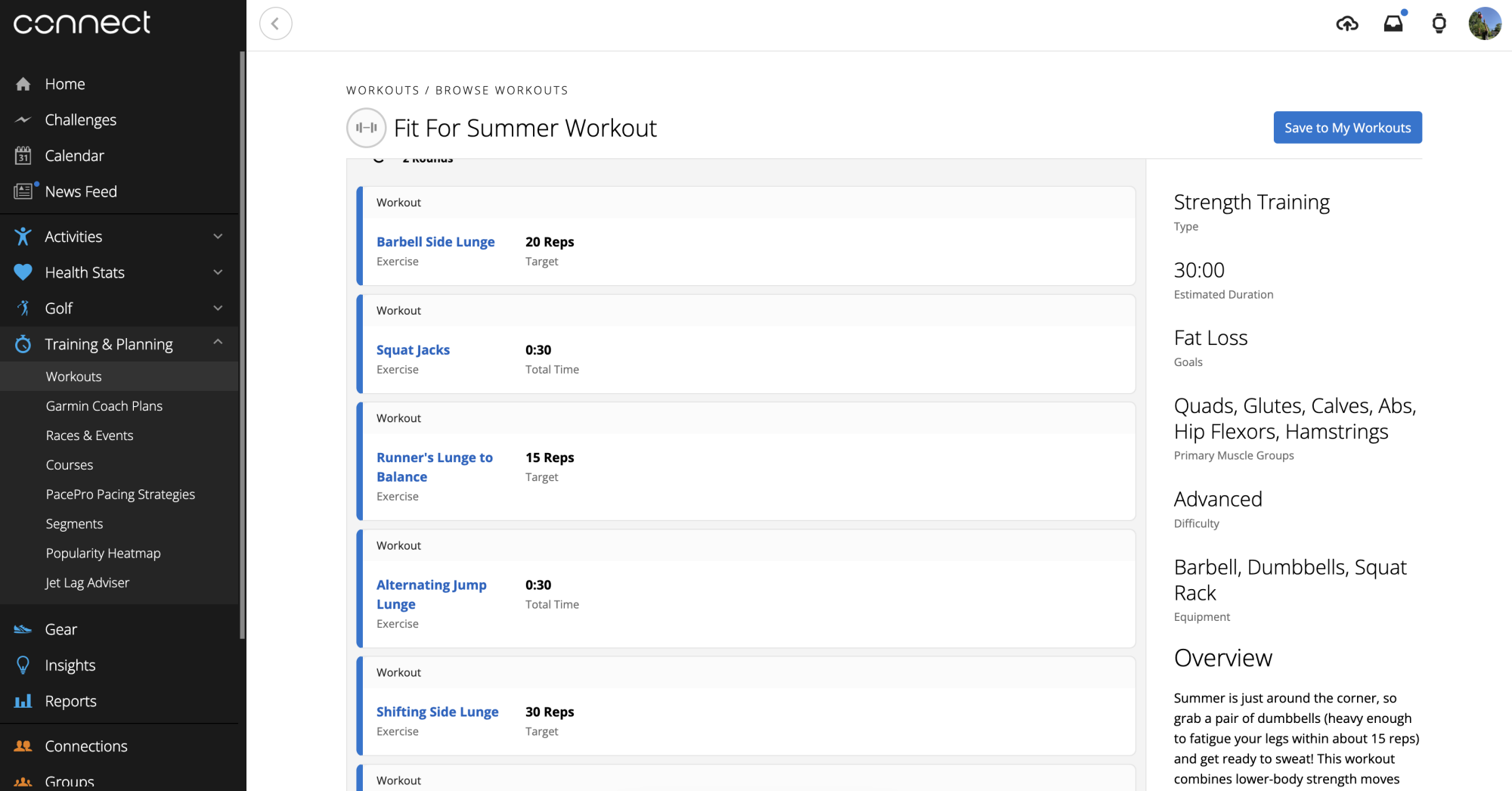
I’ll get into how to create workouts in a minute, but first I just want to let you know that there are some strength workouts already available for download, if you’d like to just select one and start doing it right now. Go to either your Garmin Connect app or to Garmin Connect on the web, tap Training & Planning, then Workouts, then Find a Workout.
You’ll be able to choose workouts from a library, and you can search by type (including weights, yoga, and bodyweight cardio). Most of the workouts are short, simple, and don’t use much equipment. If you’re experienced at strength training, you’ll probably want to create your own workouts or use the coach feature, but these will get you started in the meantime.
Credit: Garmin
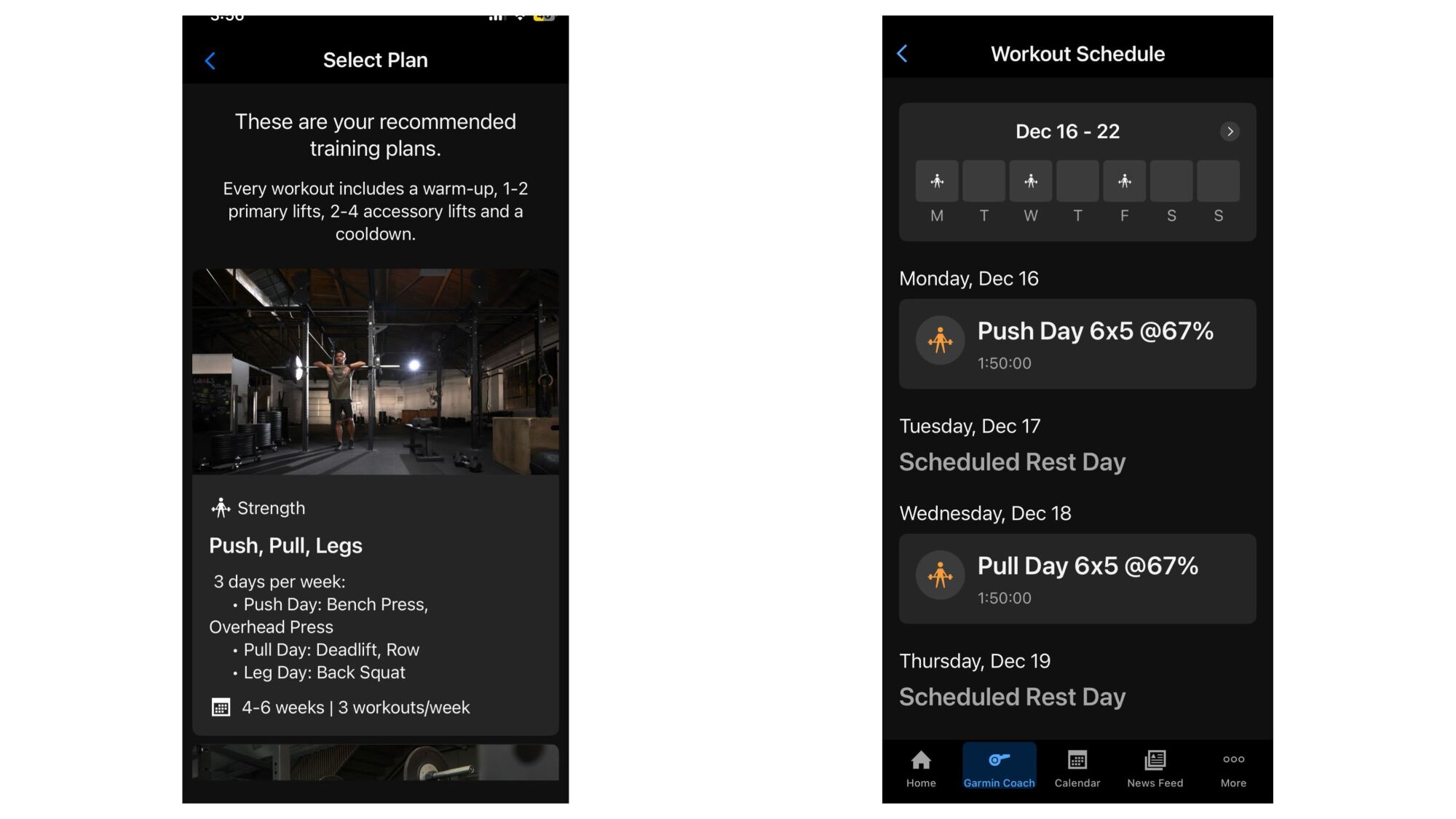
As for that coach feature, it works much like the adaptive running coach plans. You can read more here from Garmin, but basically you set it up by selecting Garmin Coach and telling it your goals and schedule. Workouts will then appear for you each day. The image above shows a Push/Pull/Legs workout programmed by Garmin Coach. It let me choose which workout happens on which day, had me set my max lifts as benchmarks (this program uses percentages), and even let me edit the workouts to swap exercises before finally putting them on my calendar.
How to create strength workouts in Garmin Connect
Credit: Beth Skwarecki/Garmin
I’m going to walk you through this step-by-step, because I was so confused the first time I tried to build a workout. Again, you can do this either on your phone or on the web. I usually end up creating my workouts on the phone, and it’s not hard once you get the hang of it. One tip, though: you can skip this whole process if you’re willing to install a third-party app. LiftTrack takes care of workout planning and syncs to your Garmin account, and you can read more about how to use that app here.
Go to the “More” menu on your phone (or the sidebar on web) and select Training & Planning, then Workouts, and then Create a Workout. From here, select Strength, and you’ll be given a skeleton of a workout with a warmup, cooldown, and one slot for an exercise.
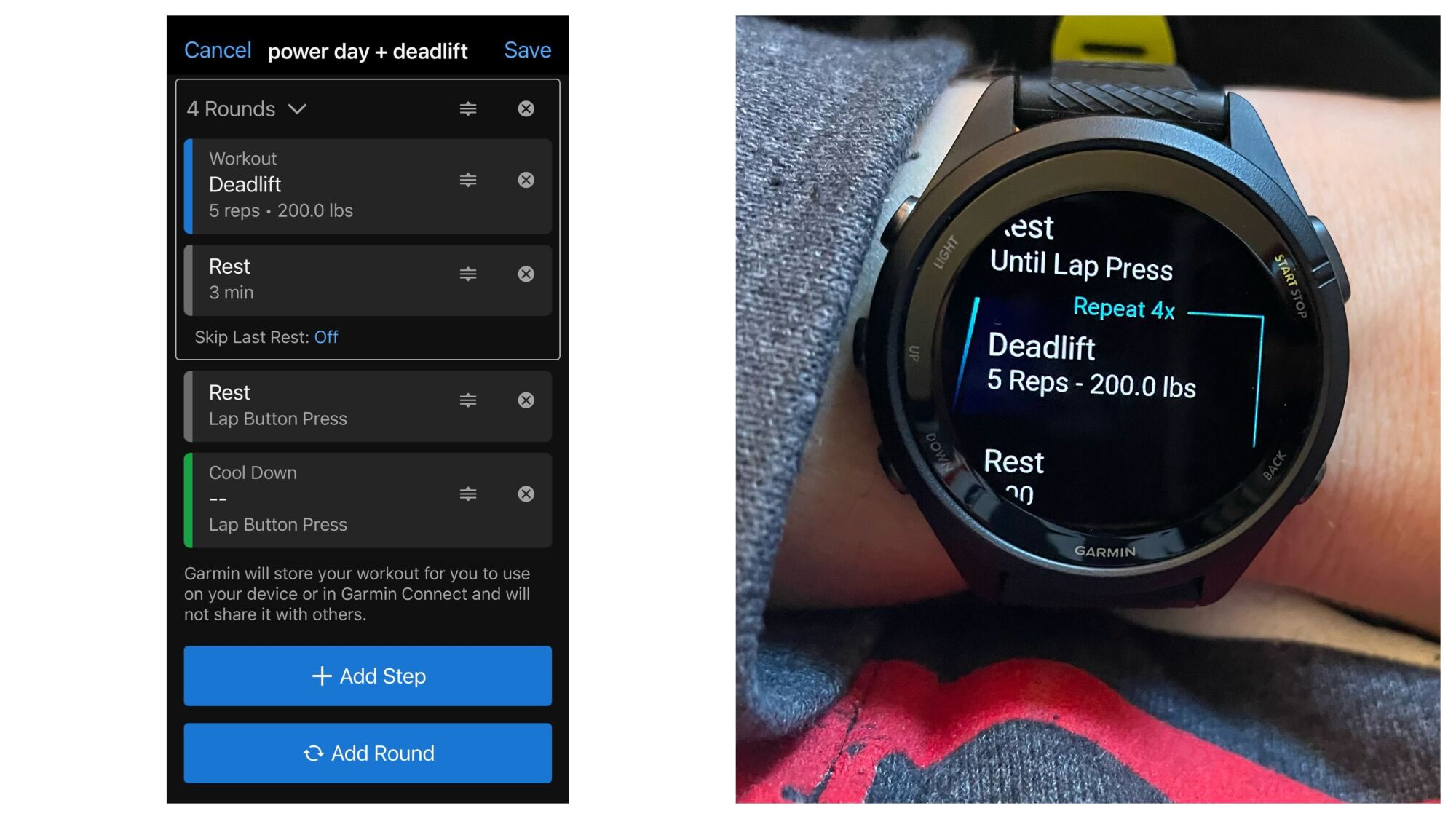
To start adding exercises, tap Add Round, which will give you a workout card and a recovery card, both in a little box that says “2 Rounds” at the top. Here’s what you do to turn this into a traditional sets-and-reps format (in this example, we want to do four sets of five deadlifts at 200 pounds):
-
Tap the card that says workout.
-
Select an exercise (deadlift), a weight (200 pounds), and a target type. In this case, the target type will be Reps (five). Hit the arrow on the top left of the screen to return to the main workout editing page.
-
For the recovery card, you’ll want to change that to Rest rather than Recovery. For that one, the target type should be Time. Let’s set it to three minutes. Return to the main workout screen again.
-
Now, tap the dropdown at the top of the round and set it to the number of sets you want to do (four). If your watch supports it, you can select Skip Last Recovery to avoid the final rest period.
-
Before you add another set, go to the bottom of the screen and tap Add Step. Change this new step to Rest (it will be outside of the repeat) and set the target to Lap Button Press.
Now you have a repeat that will give you four sets of five deadlifts with a three-minute rest timer in between. After you finish that, there will be a rest period that lasts until you press the lap button. This is to give you as much time as you need to find your equipment and set up for the next exercise. Continue adding repeats and steps as desired, and make sure to save the workout when you’re done.
How to send Garmin workouts to your watch
After creating a workout, it doesn’t automatically show up on your watch. You need to tap the “send to watch” icon that you’ll see on the top right of your screen when you’re looking at the workout.
You can also schedule a workout (which will automatically send it to your watch for the scheduled day) by using the three dots menu to add it to your calendar.
How to use a Garmin strength workout from your watch
There are a few ways to access the strength workouts, but here’s the easiest: When it’s gym time, hit the button that starts an activity, and rather than selecting Strength, scroll down until you find Workouts. Tap the one you want to do.
Pay attention here: You’ll need to select the workout, tell it you want to do the workout, and start the workout. (Just keep pressing the select button until the workout actually begins.)
The exact details of which buttons do what will vary from watch to watch, but on a Forerunner, your top right button starts and stops the workout, and your bottom right button is a lap button. (During a timed rest, you can press the lap button to skip to the end of that rest and start the next set.) From the top right button, you can also skip a group of sets (say, if the squat rack was busy, you can skip squats) and then use the same menu later to View Skipped and add it back in.

Why I like the strength training feature
I love using the strength workout feature for one main reason: the customizable timed rests. Rest is important in the gym because you’ll be able to lift more if you dial in the perfect rest time for each exercise. It’s easy to sit around scrolling on your phone between sets and realize too late that it’s been 10 minutes since you did your last deadlift. But when I program the workout as above, all I have to do is hit the lap button after my set. Three minutes later, my watch will buzz to let me know it’s time to do the next set.
Pro tip: Set your rest timer for the longest time you might want to rest between sets. If you’re aiming for three to five minutes, set it for five minutes. If you’re ready to go after three, just hit the lap button to skip the remainder of that rest.
You can also program exercises in other ways besides the traditional sets and reps. For example, set the Target Type to Time to do a five-minute density set. Or do EMOMs (every-minute-on-the-minute intervals) by putting just one card inside a repeat, and setting that card to a one-minute target time. You’ll get a beep at the top of each minute.
The Garmin strength features I don’t use
I don’t worry too much about the weights or reps in the app, to be honest. By default, the watch will ask you after each set how many reps you did and how heavy the weight was. I’ve turned that feature off, and I don’t even bother to set rep or weight targets in the app. I use the workouts for timing, not to log the details of my workout. (I have a notebook for that.)
I also haven’t found the automatic set detection or rep counting to be very useful. The watch is impressively good sometimes—how did it know I was doing pullups?!—but it’s just not good enough to be generally useful. It also doesn’t recognize a lot of the Olympic weightlifting exercises I do. And the rep counting? Sometimes OK, but more often useless. Again, I’d rather jot down my reps in that notebook than fiddle with selecting a number on my watch screen after each set.
Meta is reportedly working on a new AI model called ‘Avocado’ and it might not be open source
Mark Zuckerberg has for months publicly hinted that he is backing away from open-source AI models. Now, Meta’s latest AI pivot is starting to come into focus. The company is reportedly working on a new model, known inside of Meta as “Avocado,” which could mark a major shift away from its previous open-source approach to AI development.
Both CNBC and Bloomberg have reported on Meta’s plans surrounding “Avocado,” with both outlets saying the model “could” be proprietary rather than open-source. Avocado, which is due out sometime in 2026, is being worked on inside of “TBD,” a smaller group within Meta’s AI Superintelligence Labs that’s headed up by Chief AI Officer Alexandr Wang, who apparently favors closed models.
It’s not clear what Avocado could mean for Llama. Earlier this year, Zuckerberg said he expected Meta would “continue to be a leader” in open source but that it wouldn’t “open source everything that we do.” He’s also cited safety concerns as they relate to superintelligence. As both CNBC and Bloomberg note, Meta’s shift has also been driven by issues surrounding the release of Llama 4. The Llama 4 “Behemoth” model has been delayed for months; The New York Times reported earlier this year that Wang and other execs had “discussed abandoning” it altogether. And developers have reportedly been unimpressed with the Llama 4 models that are available.
There have been other shakeups within the ranks of Meta’s AI groups as Zuckerberg has spent billions of dollars building a team dedicated to superintelligence. The company laid off several hundred workers from its Fundamental Artificial Intelligence Research (FAIR) unit. And Meta veteran and Chief AI Scientist Yann LeCun, who has been a proponent for open-source and skeptical of LLMs, recently announced he was leaving the company.
That Meta may now be pursuing a closed AI model is a significant shift for Zuckerberg, who just last year said “fuck that” about closed platforms and penned a lengthy memo titled “Open Source AI is the Path Forward.” But the notoriously competitive CEO is also apparently intensely worried about falling behind OpenAI, Google and other rivals. Meta has said it expects to spend $600 billion over the next few years to fund its AI ambitions.
This article originally appeared on Engadget at https://www.engadget.com/ai/meta-is-reportedly-working-on-a-new-ai-model-called-avocado-and-it-might-not-be-open-source-215426778.html?src=rss
Adobe Integrates With ChatGPT
Adobe is integrating Photoshop, Express, and Acrobat directly into ChatGPT so users can edit photos, design graphics, and tweak PDFs through the chatbot. The Verge reports: The Adobe apps are free to use, and can be activated by typing the name of the app alongside an uploaded file and conversational instruction, such as “Adobe Photoshop, help me blur the background of this image.” ChatGPT users won’t have to specify the name of the app again during the same conversation to make additional changes. Depending on the instructions, Adobe’s apps may offer a selection of results to choose from, or provide a UI element that the user can manually control — such as Photoshop sliders for adjusting contrast and brightness.
The ChatGPT apps don’t provide the full functionality of Adobe’s desktop software. Adobe says the Photoshop app can edit specific sections of images, apply creative effects, and adjust image settings like brightness, contrast and exposure. Acrobat in ChatGPT can edit existing PDFs, compress and convert other documents into a PDF format, extract text or tables, and merge multiple files together.
The Adobe Express app allows ChatGPT users to both generate and edit designs, such as posters, invitations, and social media graphics. Everything in the design can be edited without leaving ChatGPT, from replacing text or images, to altering colors and animating specific sections. If ChatGPT users do want more granular control over a project they started in the chatbot, those photos, PDFs, and designs can be opened directly in Adobe’s native apps to pick up where they left off.


Read more of this story at Slashdot.
Apple TV and Apple Music are down for some users
Apple Music and Apple TV are experiencing an outage, according to Apple’s System Status page. The outage was logged on Apple’s own system at around 2:53PM ET, and is currently affecting both of the company’s streaming services, along with Apple TV’s Channels feature, which lets you subscribe to and watch other streaming services inside the Apple TV app.
Only “some” users are affected by the outage, according to Apple. Anecdotally, multiple members of Engadget’s staff were still able to stream content as usual. On DownDetector, reports of issues with Apple TV and Apple Music first appeared right around 2:33PM ET, a little before Apple officially confirmed the outage on its own site.
Developing…
This article originally appeared on Engadget at https://www.engadget.com/entertainment/streaming/apple-tv-and-apple-music-are-down-for-some-users-214425626.html?src=rss