The UK government has just announced multi-year funding for active travel in England outside London, worth £626m. Active Travel England, the agency responsible for allocation of active travel funds in England, says this is enough for 500 miles of new cycling and walking routes.
Active Travel England is headed by national active travel commissioner, Chris Boardman, who states: “The aim of Active Travel England is to give people more everyday choice in how they get around, by creating safe, accessible and welcoming streets.
“We are not just building infrastructure – together, we are creating communities: places where parents feel confident letting children travel independently, and where older people can reach local shops with ease. We are building life back into our streets.”
Piecemeal approach
The lack of consistent funding and measurable targets have been highlighted as deficiencies in the government’s approach. Steve Sayers / Our Media
But, as reported by The Guardian on 7 December, 50 organisations involved in transport and public health, including British Cycling and Cycling UK, have recently written to Heidi Alexander, the transport secretary, calling for specific targets to be set for active travel, claiming that proposals must “move from good intentions to a clear, long-term, fully deliverable national plan comparable to other strategic transport programmes”.
The letter highlights a frequent short-term and piecemeal approach to active travel and calls for a national strategy and joined-up routes to key destinations such as hospitals, schools and railway stations.
In November 2023, the Public Accounts Committee, which oversees government spending, reported disappointingly slow progress and that the government was not on track to meet its targets for active travel.
It further stated that the impact of the £2.3bn spent between 2016 and 2021, including £2bn of emergency funding during the Covid epidemic, was unclear and that a £233m reduction in funding for active travel made by the Treasury in March 2023 could adversely affect achievement of active-travel targets. The report cited, in particular, the lack of certainty for councils on available funding, late notice of allocations and its short-term availability.
Earlier this year, the Court of Appeal ruled that the Treasury’s March 2023 cut was unlawful, underlining the government’s short-termism in active travel funding.
Active travel rankings
Alongside the funding announcement, Active Travel England has published ‘active travel capability’ ratings for 2025, which show nine councils improving their ranking.
Councils are graded from 0 to 4. A 0 rating denotes no plan, while 4 shows:
“Established culture of active travel with successive increases in walking, wheeling and cycling, underpinned by a dense integrated network in place and highly supportive policies to give more people the choice to walk, wheel or cycle.”
Only 11 out of 80 local authorities are graded 3, denoting “very strong local leadership and organisational capability, comprehensive plans, and a significant network in place with a growing number of people choosing to walk, wheel and cycle”.
None has achieved level 4, although since 2023 no local authority has been graded 0 either.
You can read the full rankings and see how your council performs here.
Qualcomm is the undisputed sovereign of mobile connectivity. For over a decade, Snapdragon has been the heartbeat of the Android ecosystem, a technical marvel of efficiency and integration. Yet distinct from Qualcomm’s mobile triumphs, it has a haunting history of struggling to break out of its cellular silo. As the company pivots toward the lucrative AI cloud data center market, the writing is unfortunately already on the wall.
By analyzing the historical playbook of successful market disruption—and Qualcomm’s recent inability to execute it in the laptop space—it becomes clear that its data center effort is likely destined for the same underwhelming fate as its AI PC initiative.
The Playbook for Dethroning Giants
To understand why Qualcomm is struggling, we must first look at what success looks like. Displacing a dominant market leader is not about matching specifications; it is about changing the gravity of the ecosystem. History provides clear examples of how this is done, and in every case, it required a “killer app” available at launch.
When Microsoft decided to enter the console market, Sony’s PlayStation was an unstoppable juggernaut. Microsoft didn’t just ship a box with a hard drive; it secured Bungie and Halo: Combat Evolved. It understood that hardware is merely a stage for software. Without Halo, the Xbox would have likely been a footnote. Microsoft ensured that on day one, there was a compelling, exclusive reason to abandon the incumbent.
Apple followed a similar trajectory with the iPod and iPhone. The iPod was not the first MP3 player, but it was the first to launch with the iTunes ecosystem, solving the music acquisition problem that plagued early rivals. Later, the iPhone’s dominance wasn’t secured by the touchscreen alone, but by the rapid deployment of the App Store. Apple ensured that developers had a lucrative reason to populate its hardware with utility. In both cases, the “newcomer” didn’t just offer an alternative; it offered a complete, superior reality that the incumbent couldn’t immediately replicate.
The Transmeta Trap: The Danger of Premature Announcements
Conversely, the tech graveyard is littered with companies that ignored the importance of timing. The most pertinent warning for Qualcomm is the saga of Transmeta.
In the late 1990s, Transmeta promised to revolutionize computing with chips that were drastically more power-efficient than Intel’s, using software “code morphing” to translate x86 instructions. However, Transmeta made a fatal error: it announced its revolution far too early and generated years of hype before it had a shippable product or a verified ecosystem.
This premature celebration gave Intel the one thing a monopoly should never be gifted: time. Alerted to the threat of low-power computing, Intel pivoted, pouring resources into what eventually became the Centrino platform. By the time Transmeta finally shipped, Intel had neutralized the advantage. Qualcomm appears to be suffering from this same “announcement-itis,” telegraphing its punches at NVIDIA years before it can land them, giving the AI giant ample time to fortify its CUDA moat.
The AI PC Stumble: Failing the “Easy” Test
Qualcomm’s current struggle to gain traction with the “AI PC” and Copilot+ initiative is the smoking gun for future cloud struggles. This should have been the easy win, particularly if it had (which it didn’t) leveraged its connectivity advantage.
Consider the landscape: The modern laptop market is incredibly similar to the tablet market where Qualcomm already shines. The customers are identical; the person buying a high-end iPad Pro is the same demographic buying a Dell XPS or Surface Laptop. The channels are identical; these devices are sold in the same Best Buy aisles, the same carrier stores and arguably have the same supply chain logistics. Even the form factors—slabs of glass and metal with keyboards—are converging.
Despite these massive advantages and the “home court” feel of consumer electronics, Qualcomm’s AI PC launch has been fraught with compatibility issues and consumer apathy. It launched without a “Halo” moment. There was no single application that ran so much better on Snapdragon than on Intel/AMD that it forced a switch. Instead, users were asked to tolerate emulation layers and gaming incompatibilities for the sake of battery life—a trade-off the market has largely rejected.
If Qualcomm cannot leverage its massive mobile dominance to succeed in a market that is 90% identical to its core business, the prognosis for a market that is 100% different is grim.
The Data Center Cliff: A Different Beast Entirely
This brings us to the data center. If the AI PC was an adjacent neighborhood, the AI data center is a different planet.
The similarities that existed in the PC market—channels, customers, form factors—are non-existent here. Qualcomm cannot sell AI server chips at Verizon or Best Buy. The customers are not consumers, but hyperscalers like AWS, Google and Azure, along with CIOs of Fortune 500 companies. These buyers do not care about “all-day battery life.” They care about Total Cost of Ownership (TCO), software stability and developer velocity.
The barrier to entry here is not hardware; it is NVIDIA’s CUDA. CUDA is the operating system of AI. It is a fifteen-year-old fortress of libraries, tools and optimized kernels. For Qualcomm to win, it doesn’t just need a chip that is 10% faster or cheaper; it needs a software stack that allows a developer to switch from NVIDIA to Qualcomm with zero friction.
Currently, Qualcomm’s data center offering lacks this. It’s trying to sell a standalone hardware solution to a software problem. Just as it failed to ensure top-tier games ran perfectly on its AI PCs at launch, Qualcomm seemed unprepared to ensure that the sprawling landscape of AI frameworks runs flawlessly on its cloud silicon. It’s walking into the most hostile market in tech without a map.
What Qualcomm Must Learn to Survive
If Qualcomm hopes to break this losing streak, it must undergo a radical philosophical shift.
First, it must learn silence. Stop announcing “NVIDIA Killers” three years out. Develop in the dark, build the alliances and launch only when the strike can be fatal.
Second, Qualcomm must prioritize software over silicon. The reason the iPhone worked was the App Store; the reason Xbox worked was Halo. Qualcomm needs to pay developers, acquire software firms and build a library of optimized models that makes its hardware the only logical choice for specific workloads. It cannot rely on open-source goodwill to build its drivers.
Wrapping Up
Qualcomm is a titan of mobile, but its repeated inability to translate that success into adjacent markets points to a fundamental misunderstanding of how ecosystems are built. It’s attempting to replicate the “Transmeta” model—hype and hardware specs—rather than the “Xbox” model—ecosystem and killer apps. The AI PC was the test run, a relatively simple transition that Qualcomm is currently fumbling. The data center is the final boss, a market with zero leverage points for a mobile-first company. Unless Qualcomm can fundamentally alter its DNA to become a software-first ecosystem builder, its cloud efforts will likely dissolve into the same vaporware history as its predecessors.
Earlier in the year Microsoft proposed the “Hornet” Linux security module to provide signature verification capabilities for eBPF programs to provide for better system security. It’s been months since hearing anything more about it and not being merged, but yesterday they “reintroduced” it to the Linux kernel community…
Last month the Vulkan VK_EXT_present_timing extension was merged after 5+ years in development. VK_EXT_present_timing ended up debuting at the end of November within the Vulkan 1.4.335 spec update to much excitement for providing functionality to obtain information on the presentation engine’s display for accurate timing information and to assist in scheduling a present to happen no earlier than a desired time. This is a big win for helping avoid game stuttering and more while now the Mesa support for it is nearly complete and could be merged soon…
Following yesterday’s release of a new llm-scaler-omni beta there is now a new beta feature release of llm-scaler-vllm that provides the Intel-optimized version of vLLM within a Docker container that is set and ready to go for AI on modern Arc Graphics hardware. With today’s llm-scaler-vllm 1.2 beta release there is support for a variety of additional large language models (LLMs) and other improvements…
Tourists from Europe and other regions could be asked to provide a five-year social media history before given entry to the United States, according to a new proposal from the US Customs and Border Protection service (CBP). The new rule would affect visitors from countries who normally enjoy relatively easy entry to the US via the Electronic System for Travel Authorization (ESTA).
The new proposal cites an executive order issued by President Trump from January titled “Protecting the United States From Foreign Terrorists and Other National Security and Public Safety Threats.” In his first year in office, Trump has been hyper-focused on strengthening US borders and reducing what he calls illegal immigration.
The US state department will conduct “online presence” reviews for applicants and their dependents and require privacy settings on social media profiles to be made “public.” Applicants must list all the social media handles they’ve used over the last five years and if any information is omitted, it could lead to the denial of current and future visas. The CBP didn’t say what information they were looking for or what could be disqualifying.
On top of the social media information, CBP may require applicant’s telephone numbers and email addresses used over the last five and 10 years respectively, along with information about family members.
The new conditions are liable to increase ESTA wait times and drastically boost the cost of enforcing it. The CPB’s document suggests that an additional 5,598,115 man-hours would be required per year, or around 3,000 full-time jobs plus all the costs that entails. Right now, the ESTA application costs $40, allows people to visit the US for 90 days at a time and is valid for a two-year period.
The mandatory social media reporting and other requirements could discourage travelers. Some Australian tourists who were coming to the US for the upcoming World Cup have now said that they’ve abandoned those plans, according to The Guardian, with one person calling the new rules “horrifying.”
However, when asked if the proposal could lead to a tourism decline in the US, Trump said he wasn’t concerned. “No. We’re doing so well,” he told a reporter. “We want to make sure we’re not letting the wrong people come enter our country.”
The CPB emphasized that the new conditions were only a proposal for now. “Nothing has changed on this front for those coming to the United States [currently],” a spokesperson told the BBC. “This is not a final rule, it is simply the first step in starting a discussion to have new policy options to keep the American people safe.”
If implemented, the rule would affect people from 40 countries, including the UK, Ireland, France, Germany, Italy, Australia and Japan. The largest number of tourists to the US come from Canada and Mexico, accounting for nearly half of the total — however, visitors with passports from those two countries don’t require a visa or ESTA approval. Travel to the US was down three percent this year compared to 2024 as of August 2025, according to the National Travel and Tourism Office.
This article originally appeared on Engadget at https://www.engadget.com/social-media/us-could-demand-five-year-social-media-history-from-tourists-before-allowing-entry-102751243.html?src=rss
schwit1 shares a report from CBS News: perm from a donor who unknowingly carried a cancer-causing gene has been used to conceive nearly 200 babies across Europe, an investigation by 14 European public service broadcasters, including CBS News’ partner network BBC News, has revealed. Some children conceived using the sperm have already died from cancer, and the vast majority of those who inherited the gene will develop cancer in their lifetimes, geneticists said. The man carrying the gene passed screening checks before he became a donor at the European Sperm Bank when he was a student in 2005. His sperm has been used by women trying to conceive for 17 years across multiple countries.
The cancer-causing mutation occurred in the donor’s TP53 gene — which prevents cells in the body from turning cancerous — before his birth, according to the investigation. It causes Li Fraumeni syndrome, which gives affected people a 90% chance of developing cancers, particularly during childhood, as well as breast cancer in later life. Up to 20% of the donor’s sperm contained the mutated TP53 gene. Any children conceived with affected sperm will have the dangerous mutation in every cell of their body. The affected donor sperm was discovered when doctors seeing children with cancers linked to sperm donation raised concerns at this year’s European Society of Human Genetics.
At the time, 23 children with the genetic mutation had been discovered, out of 67 children linked to the donor. Ten of those children with the mutation had already been diagnosed with cancer. Freedom of Information requests submitted by journalists across multiple countries revealed at least 197 children were affected, though it is not known how many inherited the genetic mutation. More affected children could be discovered as more data becomes available.
We love hearing from members of the community and sharing the stories of amazing young people, volunteers, and educators who are using their passion for technology to create positive change in the world around them.
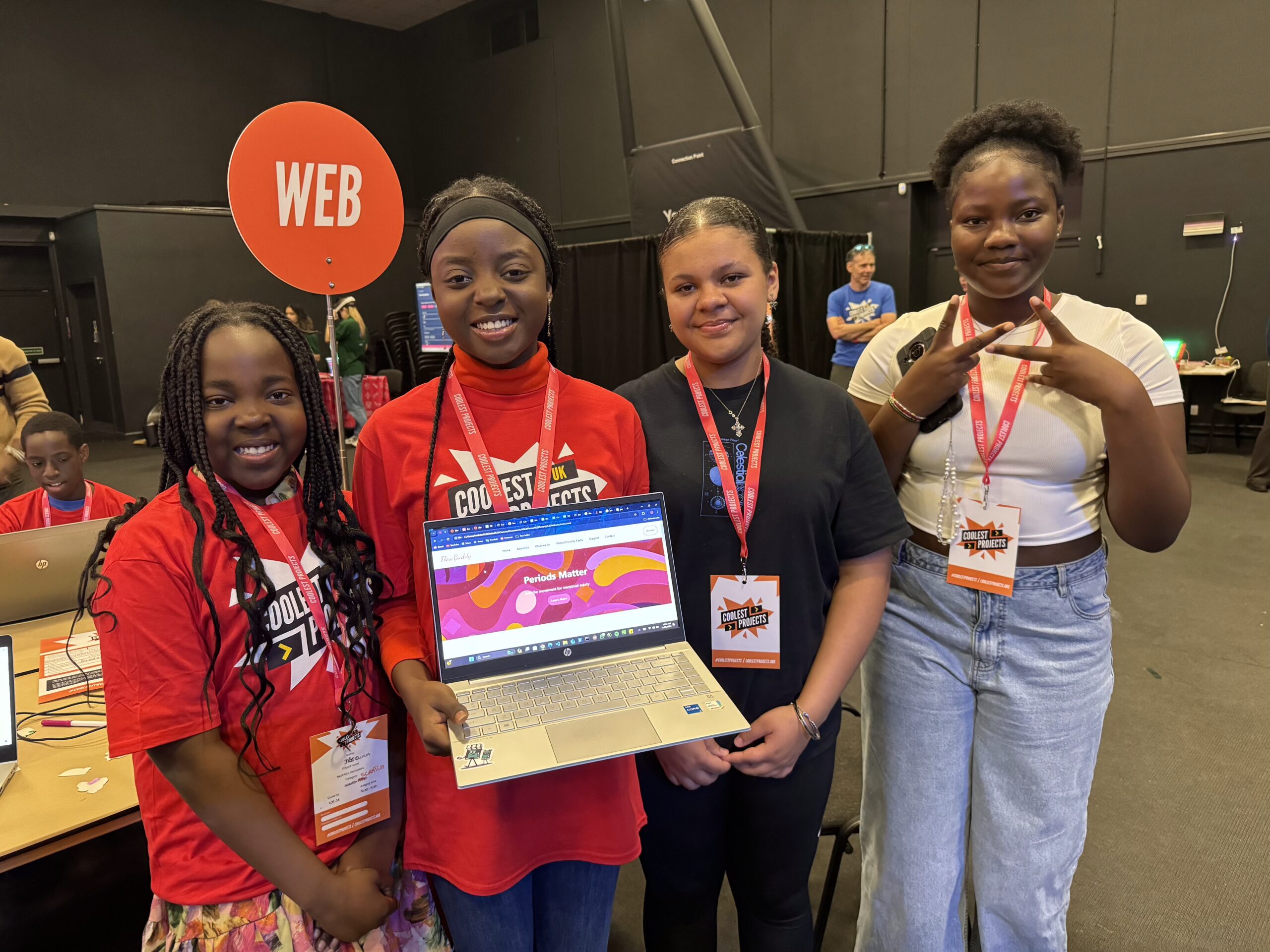
In our latest story, we’re meeting a group of inspiring young innovators from Belfast — Michelle, 15, Inilouwa, 18, Jedidiah, 14 — and Irioluwa, 11, who are using their creativity and technical skills to tackle an issue that impacts millions of young women across the UK: period poverty.
The power of community
The group first connected through Diverse Youth, a community space that gave them the chance to collaborate, learn, and grow.
At the youth centre, the girls were introduced to Code Club through mentor, and Jedidiah’s mum, Tiwa. When Tiwa offered them the opportunity to travel to Coolest Projects UK and showcase projects they had been working on, they knew they wanted to make something special…
Tackling taboo topics
The idea for Flow Body began when Inilouwa was inspired by her sister’s experience at school.
“So, for me, it was my sister actually, that really inspired this project because she would tell me, her school at the time, they run out of period products very frequently, so not a lot of girls could access it.”
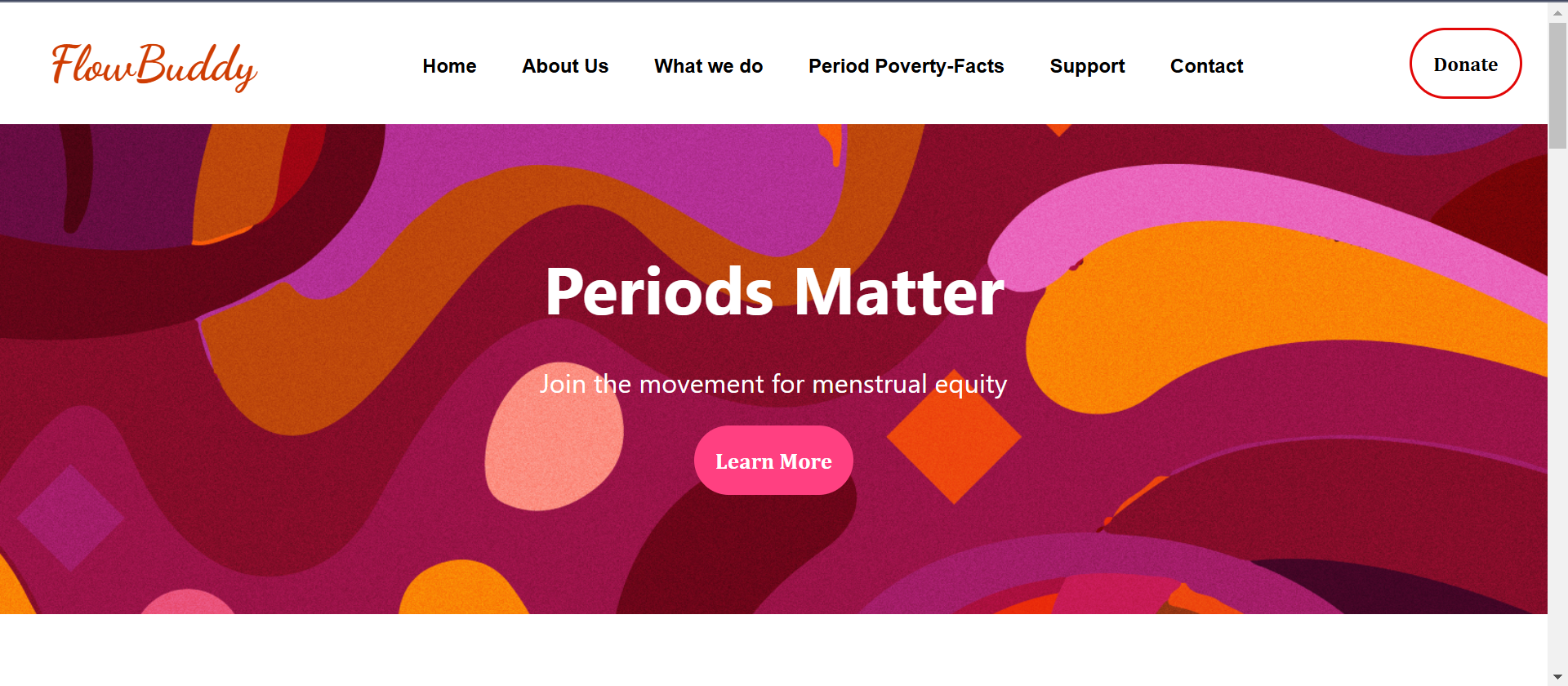
Wanting to make a difference, the team created Flow Body, a website connecting young women to period charities in the UK and providing reliable information about periods, puberty, and related health issues.
Playing to their strengths
The technical side of the project was led by Inilouwa, with the rest of her teammates supporting her with research and content creation.
“So, alongside Michelle, I researched the diseases and what can come from period poverty and how different people get by with the lack of period products around,” Jedidiah said.
Their research highlighted just how widespread period-related health issues are.
The team discovered that one of the biggest challenges is access to accurate information, given the stigma around discussing menstruation, and using technology to solve this issue seemed like the perfect fit to them.
Inilouwa explained, “Having that access to information that’s tailored to young women, to young parents, to everyone all across the board would be really helpful, you know, in order to make periods less of a strange topic to discuss.”
Celebrating teamwork
After taking home judges’ favourite in the web category, the girls could not recommend the experience enough. When asked what advice they would give to other young people thinking of taking the leap and entering Coolest Projects, the answer was simple…
“Do it. Don’t be afraid. Even if tech is not your thing, it’s not a lot of people’s things. But like you learn so much, you grow so much and it’s very fun. It is. It really is,” said Inilouwa.
If you are interested in getting involved in Coolest Projects, keep an eye on the website for exciting announcements for 2026 plans.
Want support on your coding journey? Find a Code Club near you to learn alongside a likeminded community.
One of the most widely deployed Linux kernels has officially reached the end of its lifecycle. The maintainers of the Linux kernel have confirmed that Linux 5.4, once a cornerstone of countless servers, desktops, and embedded devices, is now end-of-life (EOL). After years of long-term support, the branch has been retired and will no longer receive upstream fixes or security updates.
Factor has launched the new One aero race bike, claimed to be the “fastest UCI-legal road bike in the world”.
Formerly known as the ‘Prototype’, which made its racing debut under select Israel–Premier Tech riders at the 2025 Critérium du Dauphiné and Tour de France, the bike draws inspiration from track bike aerodynamics, and the latest rider position and equipment trends.
Factor also says it has exploited the latest UCI tech regulations, with wind-tunnel testing showing it to be up to 22 per cent faster than a Specialized Tarmac SL8 and around 15 per cent more efficient than a 2024 Cervélo S5.
However, while these claims are headline-making, Factor insists the main improvements for the rider are seen in the geometry and fit.
While aerodynamics make the headlines, Factor says the geometry is equally important. Factor
Factor says the One is designed around the latest rider-fit and component-choice trends, which results in a no-compromise system for racing speed.
David Millar, ex-racer and TV commentator installed this year as Factor’s brand director, explains that, since his racing days, bike design has continued to follow the same basic formula, with components changing to suit the rider.
“With the One, it’s different,” he says. “It’s designed with these adaptations in mind. Racers are choosing longer stems, inline seatposts and shorter cranks to improve their performance and efficiency.”
Millar uses the example of Mark Cavendish and Jonathan Milan – riders of opposing statures – whereby their bike-size needs are very different. However, with bike wheels currently at the fixed 29in / 700c size, a rider’s weight distribution and fit adaptations are very different with current ‘standard’ frame geometries.
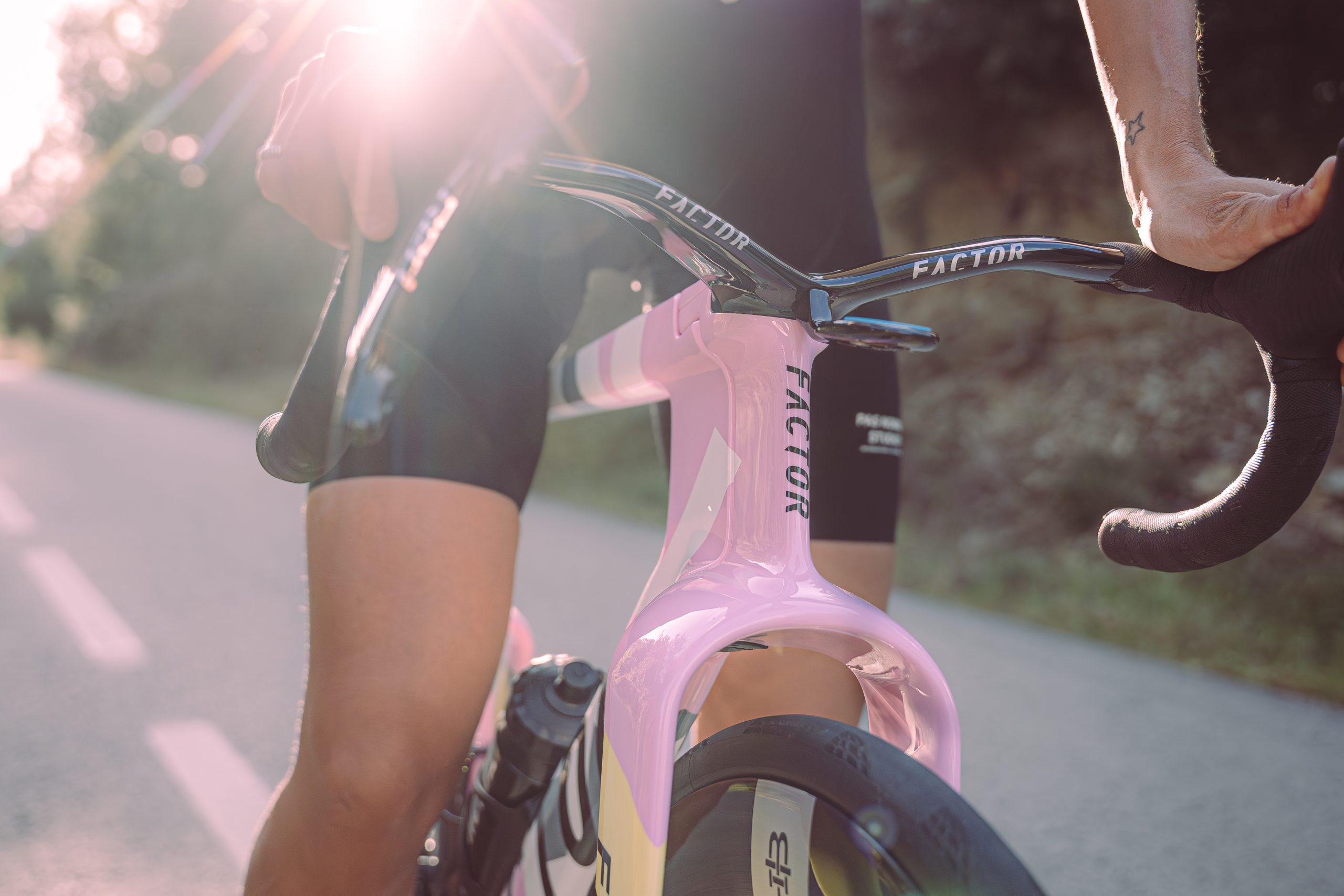
The frameset features a bayonet-style fork, featuring a ‘chin’ and very wide-arching fork legs. Factor
Millar says the One fixes this disparity, thanks to the frame’s longer effective reach compared to a typical layout. This is said to shorten the effective stem lengths riders will require by 20mm, while still getting the handlebar drops where needed.
The seat tube angle is also far steeper than typical, at around 76 degrees, which pitches the rider forward relative to the bottom bracket and opens the hip angle for more efficient power transfer through the cranks.
This means the rider’s effective saddle-mounting point is 25mm forward compared to the Ostro VAM, so a 30mm-setback seatpost yields a similar centred saddle position as an Ostro VAM with an inline seatpost (an inline post remains available for those who need or want one).
Rob Gitelis, Factor’s CEO, says it was former rider Alex Dowsett who first posited a bike designed for the job of breakaway and leadout efficiency – a Hanzo time trial bike for the road.
He claims the One’s design effectively meets that brief, while satisfying the UCI-mandated minimum setback of 0mm from the tip of the saddle to the bottom bracket centreline, and keeping the saddle rails supported properly.
Optimised handling geometry
Factor says it has rethought the geometry to meet rider needs, rather than riders needing to optimise around a bike design. Factor
Factor has also increased the bottom bracket drop – partly compensating for the use of wider tyres and the trend towards shorter crank lengths – which should provide more stable handling on descents.
This, in combination with the modified rider-weight distribution, is said to help avoid the tendency to overload the front wheel (thereby avoiding under-loading the rear wheel) and maintain traction.
The added confidence this drives should see riders adopt a more efficient and natural-feeling position when descending, improving overall speed. Millar (who is 1.92m tall) says he set a KOM on the descent of Els Angels near his home in Girona, Spain, aboard the One, without specifically setting out to do so.
Factor also claims the steep head tube angle is preferred by the vast majority of smaller riders it has worked with.
On typical smaller-size frames, head angles have needed to be slackened and fork rakes increased to preserve essential toe clearance, but this can lead to ‘front wheel flop’ – essentially, slow and unbalanced responses through the front end.
The cockpit is similar in overall design to the Colnago Y1Rs’, with a rising V-shape taking the place of a typical stem (Factor refers to this shape as a ‘gullwing’). The Cervelo S5 uses a similar design, just with a top bar in place.
Factor says the standard version of the handlebar is available in five sizes, equating to 110-150mm effective stem lengths, while sticking to 38cm-wide across all of those options (as narrow as the 2026 UCI regulations will allow).
There is also a ‘Hi-Rize’ version of the handlebar, in 110, 120 and 130mm effective lengths.
The fastest UCI-legal road bike in the world
Jake Stewart sprinted to victory on stage 5 of the 2025 Critérium du Dauphiné aboard a Factor One (at the time, known only as the ‘Prototype’). Getty Images
Factor isn’t shy about its claims around the One’s aerodynamic prowess, which it says have been proven in its own wind-tunnel tests and through third-party validation.
The most striking difference compared to a typical road bike is the wide-flaring fork legs, coupled with the deep effective head tube. The fork shoulders also feature a ‘chin’ protrusion to engage with the oncoming air sooner.
It’s worth noting that the One uses a bayonet fork layout, enabling the effective steering axis to remain in the typical place, while enabling the free-floating forward section to extend outwards.
Design details include an angled brake caliper and very steep seat tube angle. Factor
Naturally, there’s the custom handlebar in the mix, which features a ‘neutral’ section to preserve handling. But, all together, the front-extending design is said to enable the One to control airflow more effectively before it passes over the rest of the bike, while making it more stable in crosswinds, beyond the typical 15-degree drop-off Factor says it observed of competitor bikes.
The wide-stance fork legs are also designed to break laminar airflow, enabling the rider’s moving legs to pass through the disrupted flow more easily. Meanwhile, air is said to pass more efficiently between the fork legs and wheel-tyre system. Factor says the design “eliminate[s] tyre spillover turbulence”.
Factor also says it has oriented the fork-mounted brake mount at a slanted angle to help reduce drag caused by the caliper.
Scores on the doors
Despite its ostentatious looks and progressive design, the Factor One ticks the major compatibility boxes.
It can sport up to 34mm-wide tyres (although Factor says it’s aerodynamically optimised for 28mm rubber mounted to a 23mm-wide internal rim) and around 165-170mm crank lengths.
A frame is said to weigh 900g in a size 54cm, with the fork adding another 540g – unsurprisingly heavy given its size. Gitelis confirms that the frameset uses a mix of Toray 30T, 40T and 46T Toray carbon, plus pitch and Nippon graphite fibre.
The frameset uses CeramicSpeed bearings throughout, including a Solid Lubrication Technology headset, and is matched to Black Inc Sixty Two wheels.
NASA has lost contact with its MAVEN Mars orbiter after it passed behind Mars. When it remerged from behind the planet, the spacecraft never resumed communications. SpaceNews reports: MAVEN launched in November 2013 and entered orbit around Mars in September 2014. The spacecraft’s primary science mission is to study the planet’s upper atmosphere and interactions with the solar wind, including how the atmosphere escapes into space. That is intended to help scientists understand how the planet changes from early in its history, when it had a much thicker atmosphere and was warm enough to support liquid water on its surface.
MAVEN additionally serves as a communications relay, using a UHF antenna to link the Curiosity and Perseverance rovers on the Martian surface with the Deep Space Network. NASA’s Mars Odyssey and Mars Reconnaissance Orbiter spacecraft also serve as communications relays for the rovers, but are both significantly older than MAVEN. The spacecraft has suffered some technical problems in the past, notably with its inertial measurement units (IMUs) used for navigation. In 2022, MAVEN switched to an “all-stellar” navigation system to minimize the use of the IMUs.
MAVEN has enough propellant to maintain its orbit through at least the end of the decade. NASA’s fiscal year 2026 budget proposal, though, zeroed out funding for MAVEN, which cost $22.6 million to operate in 2024. MAVEN was one of several missions “operating well past the end of prime mission” the proposal would terminate, despite MAVEN’s role as a communications relay.
The Linux Mint team released today the Cinnamon 6.6 desktop environment, which will be the default in the upcoming Linux Mint 22.3 (Zena) release expected in late December 2025 or in early 2026.
An anonymous reader quotes a report from TechCrunch: Apple on Wednesday released its annual list of the most downloaded apps and games for the year. For the U.S. market, OpenAI’s ChatGPT topped the ranks of free iPhone apps (not including games) with the most installs in 2025. The AI app was followed by Threads, Google, TikTok, WhatsApp, Instagram, YouTube, Google Maps, Gmail, and Google’s Gemini. ChatGPT made it to No. 4 last year, but the top spot was taken by Chinese shopping app Temu. In 2023, the AI app didn’t make the top-10 list despite being released on the iPhone in May 2023 to a strong debut.
The big set of networking subsystem updates was recently merged for the ongoing Linux 6.19 merge window. There are some enticing core networking improvements like a big performance improvement for heavy transfer workloads, Bluetooth PAST enablement, and more. Plus a lot of wired and wireless networking driver activity and new hardware enablement…
Merged today to the Intel open-source “ANV” Vulkan driver in Mesa 26.0 is introducing a shader VMA allocator. Long story short this new allocator steps toward enabling Vulkan ray-tracing capture/replay support, which can come in hand for debugging issues with Vulkan ray-tracing on Intel graphics hardware under Linux and similarly to assist in optimizing for better performance…
A startup called Operation Bluebird is petitioning the US Patent and Trademark Office to strip X Corp of the “Twitter” and “tweet” trademarks, hoping to relaunch a new Twitter with the old brand, bird logo, and “town square” vibe. “The TWITTER and TWEET brands have been eradicated from X Corp.’s products, services, and marketing, effectively abandoning the storied brand, with no intention to resume use of the mark,” the petition states. “The TWITTER bird was grounded.” Ars Technica reports: If successful, two leaders of the group tell Ars, Operation Bluebird would launch a social network under the name Twitter.new, possibly as early as late next year. (Twitter.new has created a working prototype and is already inviting users to reserve handles.)
Michael Peroff, an Illinois attorney and founder of Operation Bluebird, said that in the intervening years, more Twitter-like social media networks have sprung up or gained traction — like Threads, Mastodon, and Bluesky. But none have the scale or brand recognition that Twitter did prior to Musk’s takeover. “There certainly are alternatives,” Peroff said. “I don’t know that any of them at this point in time are at the scale that would make a difference in the national conversation, whereas a new Twitter really could.”
Similarly, Peroff’s business partner, Stephen Coates, an attorney who formerly served as Twitter’s general counsel, said that Operation Bluebird aims to recreate some of the magic that Twitter once had. “I remember some time ago, I’ve had celebrities react to my content on Twitter during the Super Bowl or events,” he told Ars. “And we want that experience to come back, that whole town square, where we are all meshed in there.” “Mere ‘token use’ won’t be enough to reserve the mark,” said Mark Lemley, a Stanford Law professor and expert in trademark law. “Or [X] could defend if it can show that it plans to go back to using Twitter. Consumers obviously still know the brand name. It seems weird to think someone else could grab the name when consumers still associate it with the ex-social media site of that name. But that’s what the law says.”
Because time is moving at warp speed and Christmas is just 15 days away (despite my best efforts to slow it down so I have time to make meaningful gifts instead of grabbing a bunch of gift cards at the grocery store checkout like I’m going to do), this is a video from There I Ruined It (previously) of Christmas classic ‘Santa Claus Is Coming To Town’ mashed up with Radiohead’s ‘Creep’. I’m not gonna lie, it’s a banger. I just blasted it at max volume for my girlfriend but she stared daggers at me and told me to turn it off. To the song’s credit though, she was on an important business call.