Did you miss this week’s top articles? Here are the five most read article on FOSS Force for the week that just ended.
The post FOSS Force’s Top Five Articles — For the Week Ending December 12, 2025 appeared first on FOSS Force.

Did you miss this week’s top articles? Here are the five most read article on FOSS Force for the week that just ended.
The post FOSS Force’s Top Five Articles — For the Week Ending December 12, 2025 appeared first on FOSS Force.
Longtime Slashdot reader AmiMoJo shares a report from Clean Energy Wire: Renewable energy sources covered nearly 56 percent of Germany’s gross electricity consumption in 2025, according to preliminary figures by energy industry group BDEW and research institute ZSW. Despite a ‘historically weak’ first quarter of the year for wind power production and a significant drop in hydropower output, the share of renewables grew by 0.7 percentage points compared to the previous year thanks to an increase in installed solar power capacity.
Solar power output increased by 18.7 percent over the whole year, while the strong growth in installed capacity from previous years could be sustained, with more than 17 gigawatts (GW) added to the system. With March being the least windy month in Germany since records began in 1950, wind power output, on the other hand, faced a drop of 5.2 percent compared to 2024. However, stronger winds in the second and third quarter compensated for much of the early-year decrease.
Onshore turbines with a capacity of 5.2 GW were added to the grid, a marked increase from the 3.3 GW in the previous year. Due to significantly less precipitation this year compared to 2024, hydropower output dropped by nearly one quarter (24.1%), while remaining only a fraction (3.2%) of total renewable power output.


Read more of this story at Slashdot.
In this article, you will learn how to broadcast a message to all logged-in users on your system either locally or via SSH using the wall command.
A former Chinese official who fled to the U.S. says Beijing has used advanced surveillance technology from U.S. companies to track, intimidate, and punish him and his family across borders. ABC News reports: Retired Chinese official Li Chuanliang was recuperating from cancer on a Korean resort island when he got an urgent call: Don’t return to China, a friend warned. You’re now a fugitive. Days later, a stranger snapped a photo of Li in a cafe. Terrified South Korea would send him back, Li fled, flew to the U.S. on a tourist visa and applied for asylum. But even there — in New York, in California, deep in the Texas desert — the Chinese government continued to hunt him down with the help of surveillance technology.
Li’s communications were monitored, his assets seized and his movements followed in police databases. More than 40 friends and relatives — including his pregnant daughter — were identified and detained, even by tracking down their cab drivers through facial recognition software. Three former associates died in detention, and for months shadowy men Li believed to be Chinese operatives stalked him across continents, interviews and documents seen by The Associated Press show.
The Chinese government is using an increasingly powerful tool to cement its power at home and vastly amplify it abroad: Surveillance technology, much of it originating in the U.S., an AP investigation has found. Within China, this technology helped identify and punish almost 900,000 officials last year alone, nearly five times more than in 2012, according to state numbers. Beijing says it is cracking down on corruption, but critics charge that such technology is used in China and elsewhere to stifle dissent and exact retribution on perceived enemies.
Outside China, the same technology is being used to threaten wayward officials, along with dissidents and alleged criminals, under what authorities call Operations “Fox Hunt” and “Sky Net.” The U.S. has criticized these overseas operations as a “threat” and an “affront to national sovereignty.” More than 14,000 people, including some 3,000 officials, have been brought back to China from more than 120 countries through coercion, arrests and pressure on relatives, according to state information.


Read more of this story at Slashdot.
The monthly KDE Frameworks updates continue with KDE Frameworks 6.21, released today by the KDE Project as a companion to the KDE Plasma 6.5.4 desktop environment and KDE Gear 25.12 software suite.
Chandler, Arizona unanimously rejected a proposed AI data center despite heavy lobbying from Big Tech interests and former Sen. Kyrsten Sinema. Politico reports: The Chandler City Council last night voted down a request by a New York developer to rezone land to build a data center and business complex. The local battle escalated in October after Sinema showed up at a planning commission meeting to offer public comment warning officials in her home state that federal authority may soon stomp on local regulations. “Chandler right now has the opportunity to determine how and when these new, innovative AI data centers will be built,” she told local officials. “When federal preemption comes, we’ll no longer have that privilege.”
Explaining her no vote, Chandler Vice Mayor Christine Ellis said that she had long framed her decision about the local benefits rather than the national push to build AI. She recalled a meeting with Sinema where she asked point-blank, “what’s in it for Chandler?” “If you can’t show me what’s in it for Chandler, then we are not having a conversation,” Ellis said before voting against the project. […]
The project, along with Sinema’s involvement, attracted significant community opposition, with speakers raising concerns about whether the project would use too much water or raise power prices. Residents packed the council chambers, with many holding up signs reading “No More Data Centers.” According to the city’s planning office, more than 200 comments were filed against the proposal compared to just eight in favor.


Read more of this story at Slashdot.
Rust for Linux lead developer Miguel Ojeda posted the patch a short time ago to “conclude the Rust experiment”. The “experiment” of Rust programming language code in the Linux kernel is over as it’s now accepted to be a success and “Rust is here to stay” in the kernel…
NetworkManager 1.54.3 improves security by verifying user access to 802.1X certificates and keys used in private network connections.
It’s an exciting week in KDE Plasma development land ahead of the holidays. Plasma 6.6 continues tacking on more feature work for Wayland…
The ability to write kernel code in Rust was explicitly added as an
experiment — if things did not go well, Rust would be removed again. At
the 2025 Maintainers Summit, a session was held to evaluate the state of
that experiment, and to decide whether the time had come to declare the
result to be a success. The (arguably unsurprising) conclusion was that
the experiment is indeed a success, but there were some interesting points
made along the way.
The BeOS-inspired Haiku operating system has received a recent port of the Go programming language to the platform. Plus Haiku also saw app improvements and more over the month of November…
The pro-Russian CyberVolk group resurfaced with a Telegram-based ransomware-as-a-service platform, but fatally undermined its own operation by hardcoding master encryption keys in plaintext. The Register reports: First, the bad news: the CyberVolk 2.x (aka VolkLocker) ransomware-as-a-service operation that launched in late summer. It’s run entirely through Telegram, which makes it very easy for affiliates that aren’t that tech savvy to lock files and demand a ransom payment. CyberVolk’s soldiers can use the platform’s built-in automation to generate payloads, coordinate ransomware attacks, and manage their illicit business operations, conducting everything through Telegram.
But here’s the good news: the ransomware slingers got sloppy when it came time to debug their code and hardcoded the master keys — this same key encrypts all files on a victim’s system — into the executable files. This could allow victims to recover encrypted data without paying the extortion fee, according to SentinelOne senior threat researcher Jim Walter, who detailed the gang’s resurgence and flawed code in a Thursday report.


Read more of this story at Slashdot.
Linux hardware vendor System76 launched today the first stable release of the Rust-based COSMIC desktop environment, along with the stable release of the Ubuntu-based Pop!_OS 24.04 LTS Linux distribution.
John Cena began his WWE retirement tour back in January, and it’s coming to an end this weekend when the wrestling legend headlines WWE Saturday Night’s Main Event. For the last fight of his career, Cena has been matched up with “The Ring General” Gunther on the night’s fight card, which also features matches between Cody Rhodes and Oba Femi, a tag team match featuring AJ Styles & Dragon Lee vs. Je’Von Evans & Leon Slater, and a women’s matchup between Bayley and Sol Ruca. This show starts at 8 p.m. ET on Saturday and will stream with a subscription to Peacock, or grab a 7-day trial of Peacock through Prime Video and tune in for free.
Here’s a look at how to watch John Cena’s final fight at WWE Saturday Night’s Main Event this weekend, including how to stream the entire thing for free.
Date: Dec. 13, 2025
Time: 8 p.m. ET/5 p.m. PT
The WWE Saturday Night’s Main Event will air live on Saturday, Dec. 13, 2025 on Peacock, with fights starting at 8 p.m. ET. You can also tune in to the Saturday Night’s Main Event Countdown pre-show starting at 6 p.m. ET, and the post-show, which immediately follows the event on Peacock.
This weekend’s Saturday Night’s Main Event will be headlined by John Cena and Gunther. Also on the bill, you can catch matches between Cody Rhodes and Oba Femi, a tag team bout between AJ Styles & Dragon Lee vs. Je’Von Evans & Leon Slater, and a women’s matchup between Bayley and Sol Ruca.
John Cena vs. Gunther (John Cena’s final match)
Undisputed WWE Champion Cody Rhodes vs. NXT Champion Oba Femi
World Tag Team Champions AJ Styles & Dragon Lee vs. Je’Von Evans & TNA X Division Champion Leon Slater
Bayley vs. Sol Ruca
This article originally appeared on Engadget at https://www.engadget.com/entertainment/streaming/wwe-saturday-nights-main-event-how-to-watch-john-cenas-final-match-for-free-235537779.html?src=rss
Phoebe Gates, Bill Gates’ youngest daughter, has raised $30 million for the AI shopping app she built in her Stanford dorm room with classmate Sophia Kianni. The app is called Phia and is pitched as a way to simplify price comparison and secondhand shopping. “Its AI-powered search engine — available as an app and as a browser extension for Chrome and Safari — pulls listings from more than 40,000 retail and resale sites so users can compare prices, surface real-time deals, and determine whether an item’s cost is typical, high or fair,” reports the San Francisco Chronicle. The app has reached 750,000 downloads in eight months and is valued at $180 million. From the report: Gates told Elle that when she first floated the idea to her parents, they urged her to keep it as a side project — advice she followed by enrolling in Stanford’s night program after moving to New York and finishing her degree in 2024. “They were like, ‘Okay, you can do this as a side thing, but you need to stay in school.’ I don’t think people would expect that from my family, to be honest,” she said.
Her father dropped out of Harvard University in 1975 to launch Microsoft. Kianni even paused her degree temporarily “to learn, as quickly as possible, as much as we could about the industry that we would be operating in,” she told Vogue. Bill Gates has not invested in the company, though he has publicly supported its mission.


Read more of this story at Slashdot.
Some unexpected good news from the FDA: bemotrizinol, a sunscreen ingredient that has been used in Europe and Asia for decades, is finally being added to the allowable ingredients list for products sold in the U.S. Bemotrizinol is the active ingredient in sunscreens like Bioré Watery Essence, which has a cult following for being unlike anything we can get in the U.S.
I’ve tried Bioré UV Aqua Rich Watery Essence (that’s the full name of the product) in its original Japanese formulation. This sunscreen is a cult favorite on skincare and Asian beauty forums because of its non-greasy feel, and because it protects against both UVA and UVB rays without leaving a white cast. I got mine from a friend who had either picked it up while traveling or possibly ordered from overseas; you can’t buy it in U.S.-based stores.
I’ll explain why this is below, but first: it truly is nothing like anything we have locally. Even our most “non-greasy” sunscreens tend to feel a little goopy or sticky. This one really feels like nothing after you rub it in. I instantly understood why it’s so sought-after. Remembering that experience, I’m looking forward to what we might see in American sunscreens once manufacturers are allowed to include this ingredient.
Bemotrizinol has a lot of things going for it. One is that it “plays well with other sunscreen ingredients,” as one dermatologist told Women’s Health. You can make lighter, nicer-feeling sunscreens with it, hence the popularity of the Bioré formulation I tried. To see what I mean, check out this video where a dermatologist shows off the differences between Bioré’s Japanese formulation and the version it sells in the U.S. The ingredients are different, and the texture just isn’t the same.
It’s also more effective at broad-spectrum protection. With our current sunscreen formulations, all active ingredients protect against UVB rays (the rays that cause sunburn) but only a few can also provide protection against UVA rays (which contribute to wrinkling and aging of skin). UVB is considered to be the bigger risk for skin cancer, but both probably contribute to cancer risk. Right now, most broad-spectrum U.S. sunscreens use mineral components like zinc oxide. Mineral sunscreens work pretty well, but can leave a white cast on your skin when applied as thickly as you’re supposed to.
Bemotrizinol is a chemical UV filter, so it doesn’t leave that white cast. But it protects well against UVA rays in addition to UVB, and it’s more photostable than a lot of our existing chemical sunscreen ingredients so it can last longer on the skin. In other words, it’s a chemical sunscreen, but combines some of the best features of both chemical and mineral sunscreens.
It’s also considered to be one of the safest sunscreens. All sunscreens on the market are much safer than going without sunscreen, but all of our chemical sunscreen ingredients are currently undergoing a safety evaluation because regulators determined they are probably fine but need more research to know for sure. Currently only our two mineral sunscreen ingredients (zinc oxide and titanium dioxide) are considered GRAS, or generally recognized as safe and effective. Bemotrizinol will be the third.
If you’re looking at ingredient lists on Asian or European sunscreens, be aware that it goes by several names. Tinosorb S is bemotrizinol; so is bis-ethylhexyloxyphenol methoxyphenyl triazine.
Ask anyone in the skincare world what they think about U.S. sunscreens, and for decades now you’d get complaints that we’re missing out on the best sunscreens that the rest of the world uses. (Our last new sunscreen ingredient was approved in 1996.) In most countries, sunscreens are regulated as cosmetics, but in the U.S. they are regulated as drugs. That means the U.S. requires more rigorous testing and approval.
The CARES act, passed in 2020 for pandemic relief, provided a way for over-the-counter drugs to be sold without going through the complete approval process, so long as the FDA was satisfied they were safe and effective. Bemotrizinol met the criteria, thanks in large part to the fact that it’s been used safely since 2000 in Europe, Asia, and Australia. The FDA’s rule on bemotrizinol still needs to be finalized, but it seems likely we’ll see new sunscreens on shelves before the end of 2026.
Following last week’s Wine 11.0-rc1 release that marked the feature freeze as well in working toward Wine 11.0 in January, out today is Wine 11.0-rc2…
Once again, there is a new feature available on Google’s NotebookLM, the AI tool that functions like a personal assistant and only references material you provide for it. This one is a slide deck generator, which can be useful if you need to make a presentation in a hurry, but I’ve been using it a little differently to help myself retain new information.
First, you should know how to generate a deck. In case you’re unfamiliar with NotebookLM, it’s basically just like ChatGPT, but instead of pulling answers from the big, wide Internet, it only relies on PDFs, links, videos, and text you input as resources. This makes it the perfect tool for working on a specific project or studying for a class, since you don’t run the risk of inadvertently getting misled by some random, unrelated source.
You can use the chat bot feature the way you would ChatGPT, asking questions and getting summaries of your materials. You can also automatically generate flashcards, videos, infographics, mind maps, fake podcasts, and much more.
To generate slides, it’s the same process you’d follow to make those: In the left-side panel, select all of the sources you want the tool to pull from. In the right-side panel, select Slide Deck from the menu. After a few minutes, you’ll get slides you can download as a PDF, the same as you would if you were downloading a PowerPoint, and you can upload those to Google Slides or PowerPoint to create a simple presentation.
I’ve mentioned before that while I love NotebookLM and use it every day for both work and personal pursuits, I can’t stand its app. It just doesn’t work nearly as well as the browser version, which is a shame because the browser version works so well. I pretty much ignore the app and don’t use NotebookLM on mobile or, when I do, I use my mobile browser to access it, which we all know is an annoying workaround that never quite translates right on the smaller screen.
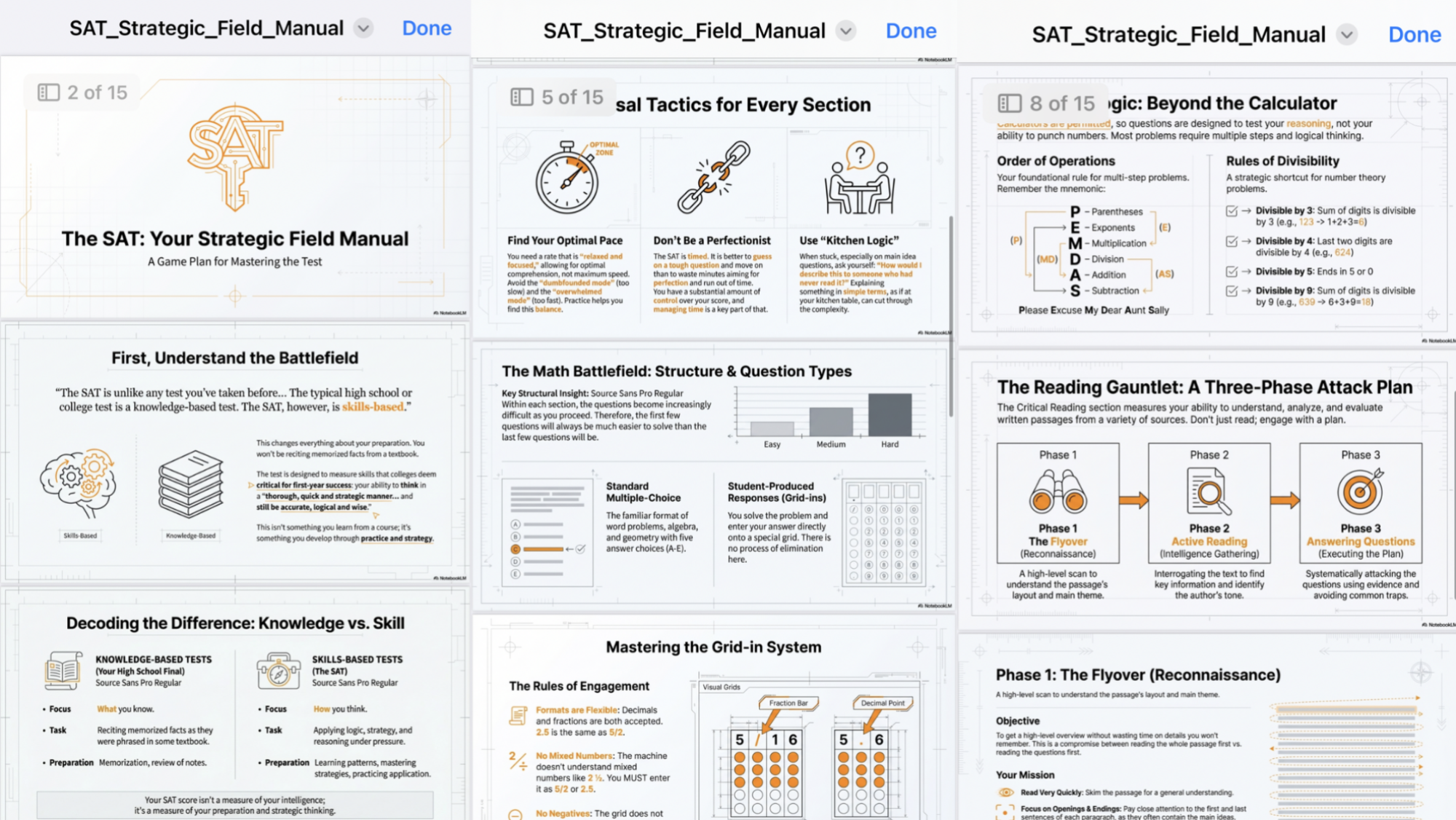
With the slide PDF, however, I get a ready-made study guide complete with visuals, which I can send to myself via iMessage and study on the go. When I generate my own study materials without NotebookLM, I almost always do it in Google Slides, then download the full PDF and review the slides like a giant study guide, so this new feature is taking a bunch of the work out of doing that for me.
An anonymous reader quotes a report from Ars Technica: Google has increasingly moved toward keeping features locked to its hardware products, but the Translate app is bucking that trend. The live translate feature is breaking out of the Google bubble with support for any earbuds you happen to have connected to your Android phone. The app is also getting improved translation quality across dozens of languages and some Duolingo-like learning features.
The latest version of Google’s live translation is built on Gemini and initially rolled out earlier this year. It supports smooth back-and-forth translations as both on-screen text and audio. Beginning a live translate session in Google Translate used to require Pixel Buds, but that won’t be the case going forward. Google says a beta test of expanded headphone support is launching today in the US, Mexico, and India.
The audio translation attempts to preserve the tone and cadence of the original speaker, but it’s not as capable as the full AI-reproduced voice translations you can do on the latest Pixel phones. Google says this feature should work on any earbuds or headphones, but it’s only for Android right now. The feature will expand to iOS in the coming months. […] The new translation model, which is also available in the search-based translation interface, supports over 70 languages.


Read more of this story at Slashdot.
Kali Linux 2025.4 ships with GNOME 49, KDE Plasma 6.5, full Wayland support, updated tools, kernel 6.16, and desktop-wide refinements.