YouTube is letting creators make playable games with a Gemini 3 tool

Google’s at it again, once more insisting that AI is something people need or want more of in their lives. The latest move comes from YouTube Gaming, which announced an open beta for a project called Playables Builder. This allows select YouTube Creators to use a “prototype web app built using Gemini 3” to make bite-sized games, no coding required. 

YouTube is launching a closed Beta test for Playables Builder, a prototype web app built using Gemini 3 where users create games with short text, video or image prompts. we’ve partnered with YouTube Creators like @sambucha, @AyChristene, @goharsguide and @Mogswamp to start making… pic.twitter.com/1Gx0v4oZFA

— YouTube Gaming (@YouTubeGaming) December 16, 2025

YouTube was testing the addition of small-scale games to its desktop and mobile platforms back in 2023, then added multiplayer capability to Playables last year. Since AI is appearing all over Google-owned services, today’s news probably shouldn’t be a surprise.   

The premise sounds similar to the Disco and GenTabs projects that Google Labs recently announced. They offer an AI layer to web browsing: provide a natural language input, get an interactive widget that does what you asked for. Despite my skeptical attitude toward AI, I can see those tools having some practical applications for search, where the goal is to aggregate whatever data you’re looking for into a manageable, easy-to-read interface. 

But a game is not simple. A good game takes what might be a simple idea and, with finesse and iteration and skill, transforms it into a genuinely fun experience. It’s a cute parlor trick that AI assistants can help people to make stuff without technical knowledge, but there’s a reason professional game devs work hard to amass all their know-how. Playables Builder is a peak example of misunderstanding what artificial intelligence is best at. Just because a chatbot can make a game doesn’t mean anyone will enjoy playing it.

This article originally appeared on Engadget at https://www.engadget.com/ai/youtube-is-letting-creators-make-playable-games-with-a-gemini-3-tool-195500318.html?src=rss

Beware Of SantaStealer Malware, The Unwanted Gift That Keeps On Pilfering

Beware Of SantaStealer Malware, The Unwanted Gift That Keeps On Pilfering
Security researchers at Rapid7 Labs have unmasked a new piece of malware dubbed SantaStealer, which got its name due to the proximity of Christmas. If this app makes its way down the chimney, though it’s looking for more than just milk and cookies.

Attackers can utilize SantaStealer to steal a variety of data from unsuspecting Windows users.

Crunchyroll annual subscriptions are on sale for the holidays

If you’re looking for something to watch during a holiday break from work or school, you can’t go wrong with anime, and right now you can sign-up for a year of Crunchyroll for as low as $65. Holiday discounts running through December 29 bring the anime streaming service’s year-long Fan subscription from $80 down to $67 and its Mega Fan subscription from $120 down to $100. That’s either $13 or $20 off access to one of the largest libraries of anime series and movies out there.

While both the Fan and Mega Fan plans are ad-free, you do get some different benefits depending on which you decide to pay for. Fan subscribers get full access to Crunchyroll’s library, new episodes “shortly after they air in Japan” and five percent off select purchases in the Crunchyroll Store. Mega Fan subscribers get all those benefits, plus the ability to stream on four devices at the same time, download HD quality episodes and movies to view offline, play games from the Crunchyroll Game Vault and receive 10 percent off select products in the Crunchyroll Store.

Notably missing from either subscription is access to Crunchyroll’s new Manga service, but unless you’re specifically looking for reading material, you’ll get plenty of entertainment out of Crunchyroll’s video library. Outside of Netflix, which produces and licenses its own growing collection of anime, Crunchyroll is the de facto place to watch Japanese animation in the US. You’ll find long-running series like One Piece and newer hits like Spy X Family, alongside hundreds of more niche series.

Crunchyroll has its issues, of course. Since the streaming service was acquired by Sony, it’s been particularly interested in using generative AI to subtitle shows, which has already produced poor results. It’s hard to beat Crunchyroll’s library, though, and for as little as $65, you’ll get more than your money’s worth.

Check out our coverage of the best streaming deals for more discounts, and follow @EngadgetDeals on X for the latest tech deals and buying advice.

This article originally appeared on Engadget at https://www.engadget.com/entertainment/streaming/crunchyroll-annual-subscriptions-are-on-sale-for-the-holidays-194345327.html?src=rss

Netflix will soon start airing video podcasts like The Breakfast Club

Netflix has inked a deal with iHeartMedia to begin showing video podcasts, so the content will never, ever run out. The partnership covers new episodes from more than 15 popular podcasts, including The Breakfast Club, Dear Chelsea, My Favorite Murder and others. Customers will have access to video podcast episodes in early 2026. 

In addition to new footage, the partnership includes a select library of archival episodes from each show. It’s worth noting that YouTube already platforms video versions of many popular podcasts, including stuff like The Breakfast Club.

This follows a similar deal from earlier this year in which Netflix announced plans to stream video podcast episodes from Spotify. That partnership covers stuff like The Bill Simmons Podcast and The Zach Lowe Show, among others.

Many people use podcasts for background noise and soon Netflix will be a major player in that market, such as it is. Disney+ also recently started prioritizing those “barely paying attention” eyeballs, as it inked its own deal to air The Rich Eisen Show on weekdays.

This article originally appeared on Engadget at https://www.engadget.com/entertainment/streaming/netflix-will-soon-start-airing-video-podcasts-like-the-breakfast-club-193112093.html?src=rss

Racks of AI Chips Are Too Damn Heavy

The weight of AI server racks has reached a point where legacy data centers cannot accommodate them even with significant retrofitting efforts, The Verge reports. Chris Brown, chief technical officer at Uptime Institute, said most retrofitting attempts would require “bulldozing the building and starting over from scratch.”

AI racks are projected to reach 5,000 pounds compared to the 400 to 600 pounds that racks weighed three decades ago. The dramatic increase stems from hundreds to 1,000 GPUs packed densely into each rack alongside memory chips and liquid cooling systems that can add substantial weight. AI workloads now consume up to 350 kilowatts per rack, 35 times the 10 kilowatts that traditional computer chip workloads averaged a decade ago. Legacy data centers with raised floors typically max out at around 1,250 pounds per square foot for static loads.

Chris McLean, president of Critical Facility Group, said that rack heights have grown from 6 feet to 9 feet over nearly two decades, creating problems with doorframes and freight elevators in older buildings.


Read more of this story at Slashdot.

Intel’s Cache Aware Scheduling Presentation At LPC 2025

One of the exciting Intel innovations to the Linux kernel this year has been around the Cache Aware Scheduling for helping to deliver better performance on modern CPUs with multiple last level caches. The kernel patches have yet to be upstreamed but testing has shown to be quite promising for grouping tasks sharing data to the same LLC domain to help reduce cache misses and cache bouncing. Those wishing to learn more about Cache Aware Scheduling, there was a presentation on it last week by Intel engineers Tim Chen and Chen Yu at the Linux Plumbers Conference 2025 in Tokyo…

Meta is rolling out Conversation Focus and AI-powered Spotify features to its smart glasses

Back in September during Meta Connect, the company previewed a new ability for its smart glasses lineup called Conversation Focus. The feature, which is able to amplify the voices of people around you, is now starting to roll out in the company’s latest batch of software updates.

When enabled, the feature is meant to make it easier to hear the people you’re speaking with in a crowded or otherwise noisy environment. “You’ll hear the amplified voice sound slightly brighter, which will help you distinguish the conversation from ambient background noise,” Meta explains. It can be enabled either via voice commands (“hey Meta, start Conversation Focus”) or by adding it as a dedicated “tap-and-hold” shortcut. 

Meta is also adding a new multimodal AI feature for Spotify. With the update, users can ask their glasses to play music on Spotify that corresponds with what they’re looking at by saying “hey Meta, play a song to match this view.” Spotify will then start a playlist “based on your unique taste, customized for that specific moment.” For example, looking at holiday decor might trigger a similarly-themed playlist, though it’s not clear how Meta and Spotify may translate more abstract concepts into themed playlists. 

Both updates are starting to roll out now to Meta Ray-Ban glasses (both Gen 1 and Gen 2 models), as well as the Oakley Meta HSTN frames. The update will arrive first to those enrolled in Meta’s early access program, and will be available “gradually” to everyone else.

Meta’s newest mode of smart glasses, the Oakley Meta Vanguard shades, are also getting some new features in the latest software update. Meta is adding the option to trigger specific commands with a single word, rather than having to say “hey Meta.” For example, saying “photo” will be enough to snap a picture and saying “video” will start a new recording. The company says the optional feature is meant to help athletes “save some breath” while on a run or bike ride. 

This article originally appeared on Engadget at https://www.engadget.com/wearables/meta-is-rolling-out-conversation-focus-and-ai-powered-spotify-features-to-its-smart-glasses-192133928.html?src=rss

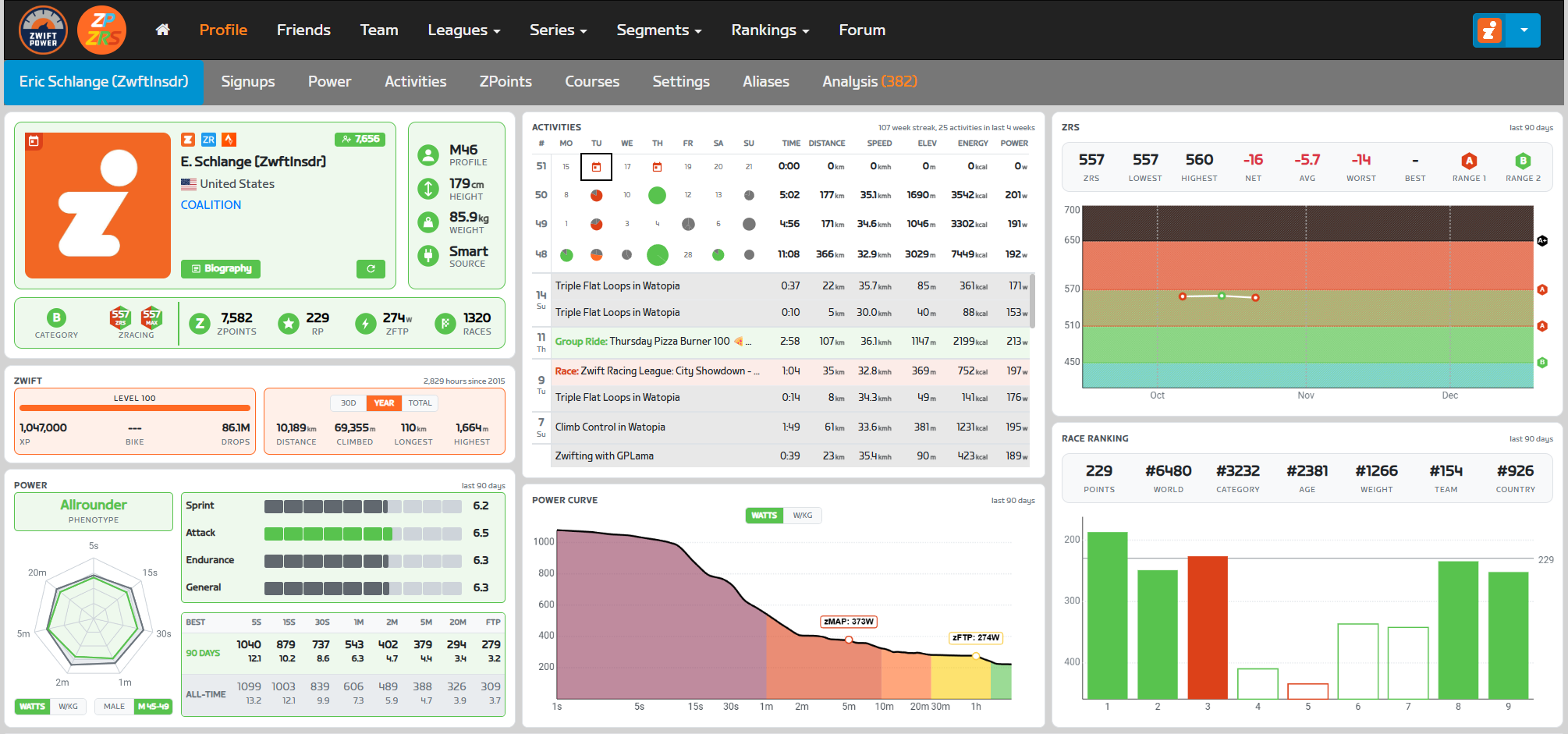
ZwiftPower ZRS Browser Extension Updated: ZRS History, Power Curves, + More

A few months ago, I wrote about the ZwiftPower ZRS Browser Extension. Since then, it has undergone substantial upgrades, including an incredibly detailed new profile page that charts your ZRS history! So I reached out to the creator (who goes by the pseudonym “int” on socials) for a look at what has changed, including a detailed list of new features. Here’s what I received…

From the Creator

Since the last Zwift Insider article, the extension has grown quite a bit.

The very first version took only a few hours to build. I probably spent almost the same amount of time writing my response to Zwift Insider when he first reached out. It was just a simple script to inject ZRS scores into ZwiftPower event pages. Nothing fancy.

Back then, I mentioned the article may “give the project new life.” Well, it did. The article brought in more users, and with them came requests. Profile page support. History graphs. More detailed analytics. Each feature request led to another and the codebase went from a few hundred lines to… well, something more substantial.

So here we are again, writing another response after Eric reached out asking if I had any “juicy details” to share.

Recent Development

The active users of the extension already know that not everything went smoothly.

The first major update went live and didn’t last long. Users started processing their lifetime event histories, and some corrupt Zwift events from years ago triggered an infinite fetching loop.

The combination—hundreds of users processing thousands of events each, plus the bug causing endless retries—created an API spike. I fixed the bug immediately after it was reported, but the damage was already done. Zwift decided to enforce authentication requirements, breaking the extension for everyone.

I reached out to Zwift, acknowledged I should have coordinated beforehand, and didn’t hear back. So a few days later I implemented a workaround that captures the user’s Zwift token (with the user’s permission, of course) to get things going again.

Besides restoring functionality, authentication unlocked additional API endpoints that made most of the newly added features possible. In the end, the authentication enforcement turned out to be a good thing.

Looking Forward

The extension serves a niche within the Zwift community, and I’m glad people find it useful. There’s still plenty to improve—I won’t be running out of ideas anytime soon. I appreciate everyone who’s taken the time to report bugs, suggest features, or simply tell your buddy about it. And special thanks to the testers.

Hopefully, Eric will have a reason to check in again down the road.

If you have thoughts or ideas, feel free to reach out.

(That goes for Zwift, too. It would be cool if we could implement proper OAuth2 authentication and you could relax your CORS restrictions a little bit.)

ZRS Extension: Technical Overview

What ZRS Extension Does

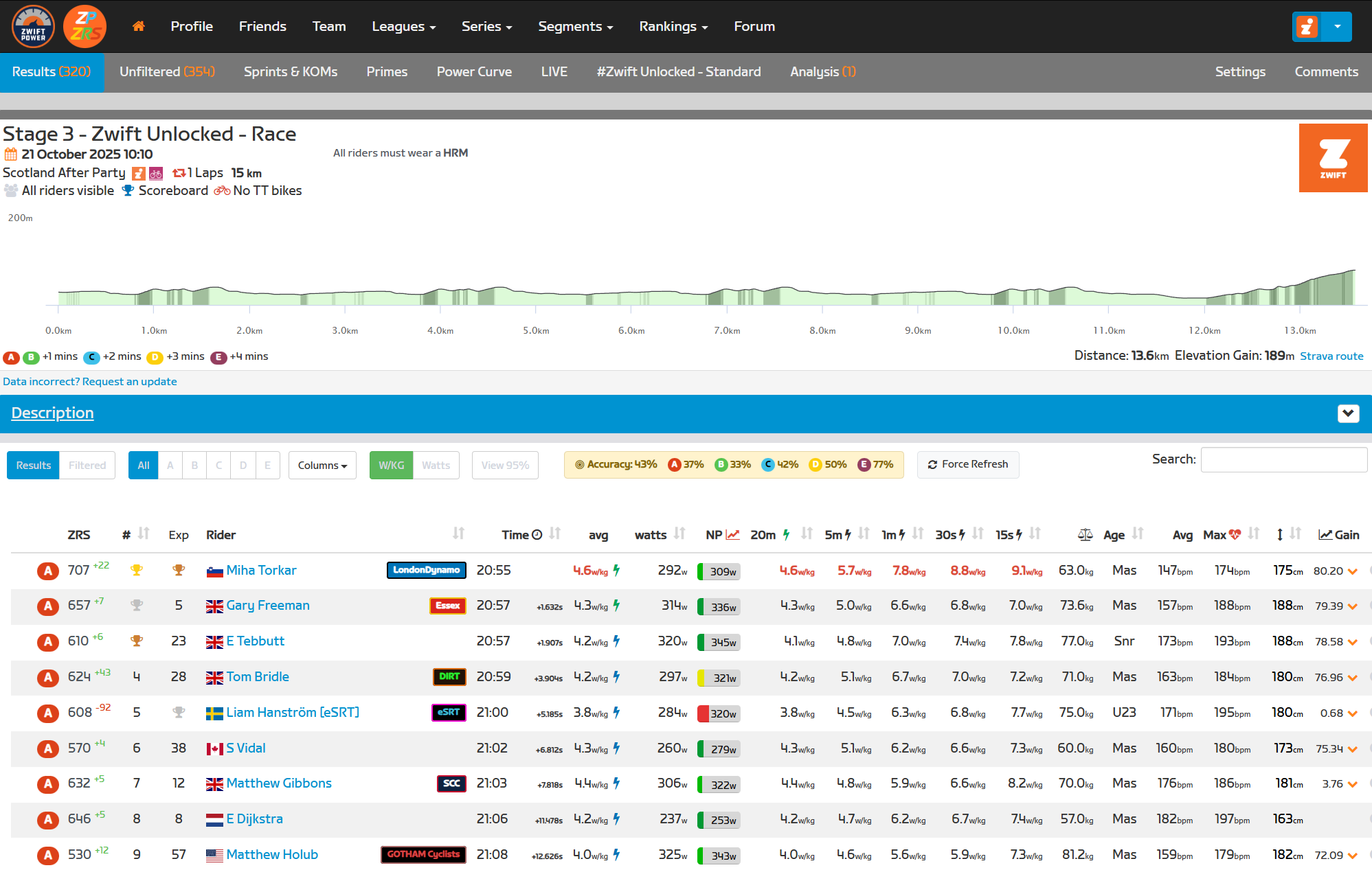
The ZRS extension enhances ZwiftPower.com by adding ZRS (Zwift Racing Score) data, performance analytics, and racing statistics to profile and event pages. The extension operates as a fully decentralized system, running entirely within the browser environment. All data processing, storage, and analytics occur locally on the user’s device, with no external servers or databases involved.

Key Capabilities

  • ZRS Score Integration: Adds ZRS scores and changes directly into ZwiftPower event tables
  • Performance Analytics: Power analysis, phenotype detection, activity tracking
  • Racing Statistics: Head-to-head comparisons, ranking points visualization, ZRS history graphs

The Profile Dashboard

Layout Overview

The extension redesigns the ZwiftPower profile page with a three-column dashboard layout:

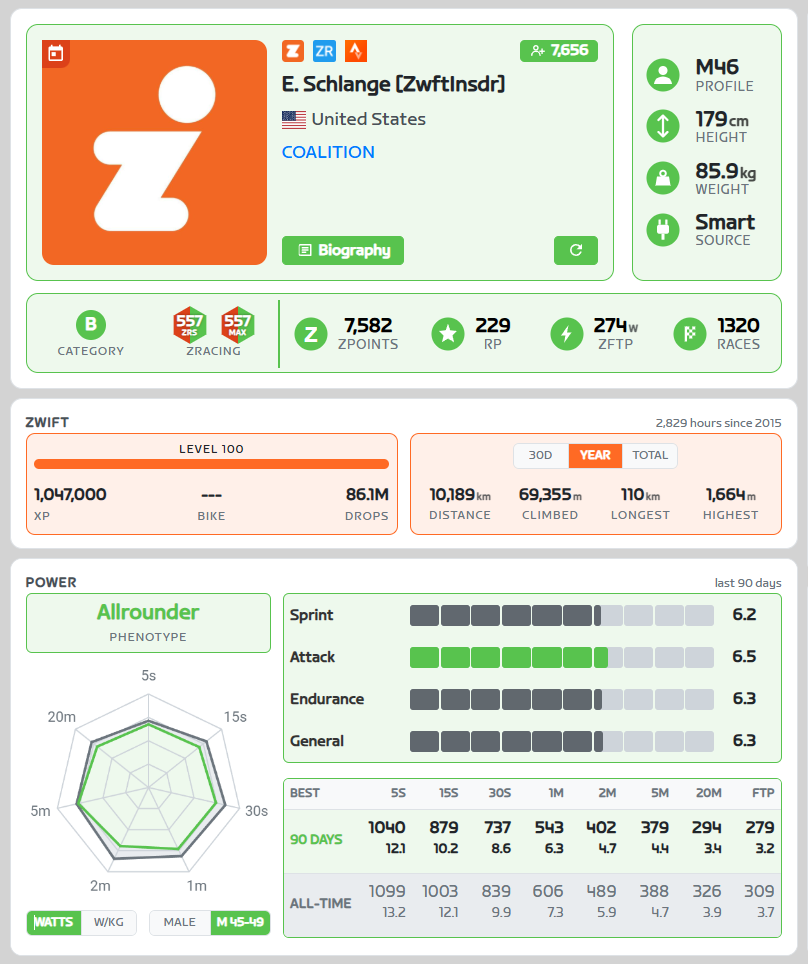
  • Left Column: Athlete profile, Zwift stats, and power analysis
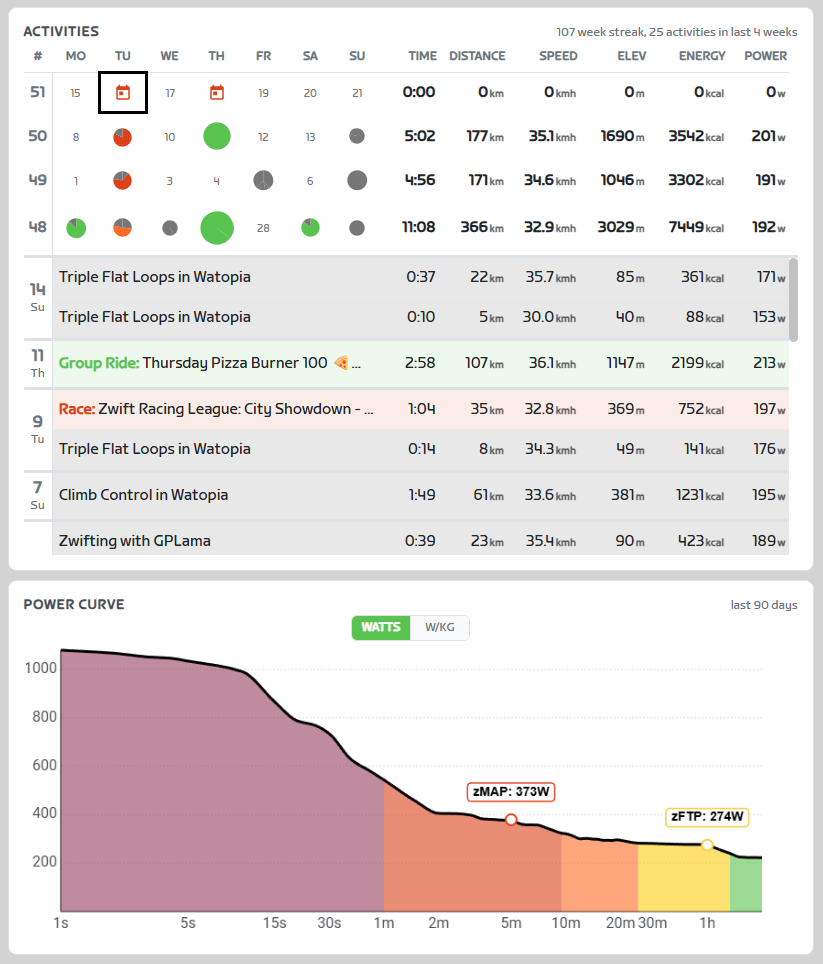
  • Middle Column: Activities, and context-aware panels (power curve for personal profiles, head-to-head for opponents)
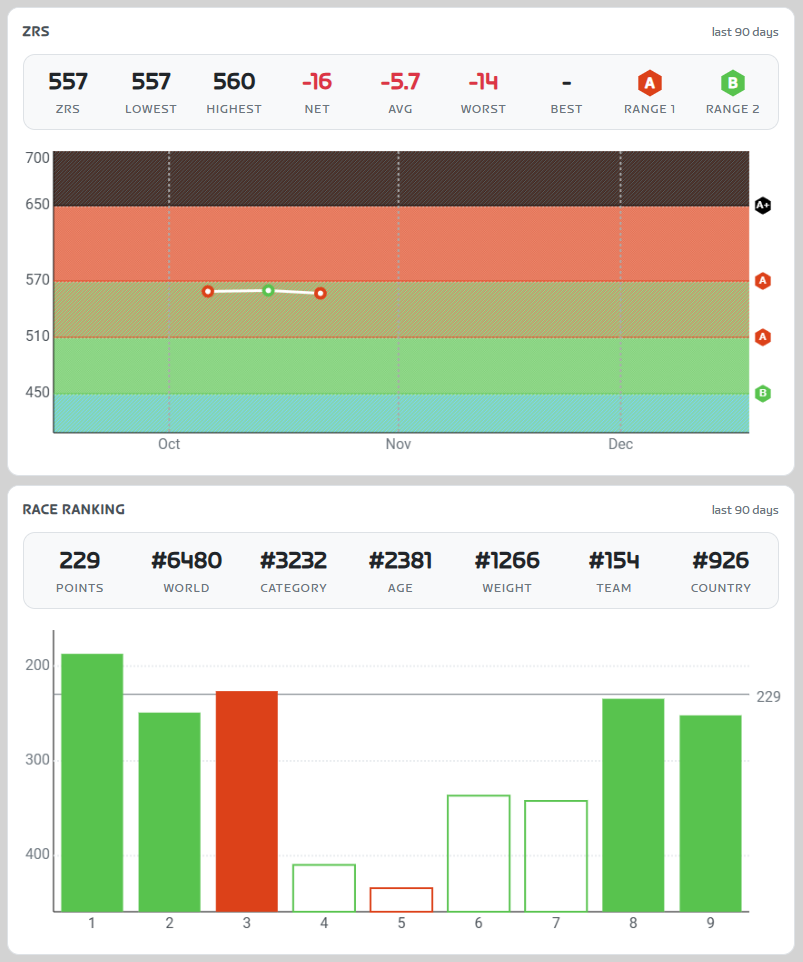
  • Right Column: ZRS score history and race ranking points

Left Column: Athlete Profile & Performance

Main Profile Panel

Identity Section:

  • Profile picture (or ZRS logo placeholder if no picture)
  • Zwift in-game name
  • Country flag and name (or “Zwifterland” fallback)
  • Team name (clickable link if available)
  • Platform links: Zwift.com, ZwiftRacing.app, Strava.com
  • Follower count button (links to Zwift follower page)
  • Bio button (displays rider biography in modal)
  • Refresh button (navigates to ZwiftPower profile update page)

Overlays (on profile picture):

  • Online indicator (if currently riding)
  • Signup indicator (if upcoming registered events exist)

Athlete Stats Section:

  • Profile: Gender and age (e.g., “M45”, “F33”)
  • Height (cm) with variation tooltip
  • Weight (kg) with variation tooltip
  • Power source (Smart Trainer, Power Meter, zPower)

Racing Stats Panel:

  • Category: Shows racing category with color-coded circle (Mixed and Women’s categories for female riders)
  • ZRS: Current racing score (dual badge showing both current and MAX30 score for personal profiles)
  • ZPoints and Ranking Points (metrics from ZwiftPower)
  • zFTP: Functional threshold power in watts and W/kg
  • Race count with win and podium rate in tooltip

All sections use category-based color theming (A+ = black, A = red, B = green, etc.).

Zwift Stats Panel

Progression Subpanel:

  • Level with progress bar showing percentage to next level
  • XP (experience points)
  • Current bike frame model
  • Drops

Riding Stats Subpanel (toggleable between 30d/Year/Total):

  • Distance (km)
  • Elevation climbed (m)
  • Longest ride (km)
  • Highest climb (m)

Header: Shows total hours and “since [year]” (year joined Zwift)

Power Panel

Power Radar Chart:

  • Spider web visualization for 7 durations (5s, 15s, 30s, 1min, 2min, 5min, 20min)
  • Shows both 90-day recent bests and all-time bests
  • Overlays intervals.icu distribution data (toggle between gender or gender-age data)
  • Interactive hover tooltips for exact values
  • Toggle between watts and W/kg display modes

Duration Power Table:

  • Numerical values for all durations plus FTP

Power Skills:
Three skill categories rated 0.0-10.0 based on percentile vs. intervals.icu distribution data:

  • Sprint (5s, 15s, 30s)
  • Attack (1min, 2min, 5min)
  • Endurance (20min)
  • General average score

Phenotype Detection:
Analyzes power distribution to classify rider into one of six types:

  • Sprinter: Explosive short-duration power specialist (example: Mark Cavendish)
  • Puncheur: 1-5 minute effort specialist (example: Mathieu van der Poel)
  • Time Trialist: High sustained raw watts (example: Stefan Küng)
  • Climber: High sustained W/kg (example: Nairo Quintana)
  • Allrounder: Balanced across all durations (example: Tadej Pogačar)
  • Pursuiter: High sprint and endurance, weak middle durations (example: Dan Bigham)

Middle Column: Context-Aware Analytics

The middle column displays different panels depending on whether viewing your own profile or an opponent’s profile.

Activity Panel

4-Week Calendar Grid:

  • Last 28 days displayed as 4 weeks × 7 days
  • Activity type icons color-coded by type (race, TT, group workout, group ride, etc.)
  • Signup indicator (calendar icon) for upcoming registered events
  • Weekly totals column

Scrollable Activity List:

  • Chronological list of recent activities
  • Background colors match activity type
  • Clickable rows link to detailed activity page on zwift.com

1v1 Head-to-Head Panel (Opponent Profile)

Summary Metrics:

  • Total shared events (same category races)
  • Win/loss record
  • Win rate percentage
  • Average position advantage/disadvantage (% of field size)

Match History List:

  • Scrollable list of all shared events
  • Each row shows: event name, category circle, zwift ingame name, date
  • Win/loss indicator (green/red)
  • Clickable to view full event results

This feature requires complete lifetime event processing for the user’s own profile. First-time processing may require a few minutes depending on race history volume.

Power Curve Panel (Personal Profile Only)

Power Curve Graph:

  • Line chart of best power outputs across all durations
  • X-axis: Duration (logarithmic scale, 5s to 60min)
  • Y-axis: Power (toggle between watts and W/kg)
  • Shows only 90-day best (all-time data from Zwift API is unreliable)

Power Zone Background:

Shaded regions showing Zwift’s 7 power zones based on FTP percentage:

  • Z1 Recovery (<60% FTP) – Gray
  • Z2 Endurance (60-75%) – Cyan
  • Z3 Tempo (75-89%) – Green
  • Z4 Threshold (89-104%) – Yellow
  • Z5 VO2 Max (104-118%) – Orange
  • Z6 Anaerobic (118-200%) – Red
  • Z7 Sprint (>200%) – Magenta

Interactive hover shows exact values at specific durations.

Right Column: Racing Performance

ZRS Graph Panel

Dashboard Metrics (7 cells):

  • Current ZRS score
  • Lowest score in last 90 days
  • Highest score in last 90 days
  • Net change (total gains/losses)
  • Average change per event
  • Worst single event loss
  • Best single event gain
  • Eligible race categories (hexagon badges, clickable to show upcoming events in that category)

Score History Graph:

  • Time-series line chart showing ZRS progression (last 90 days)
  • X-axis: Time with month labels
  • Y-axis: ZRS score (0-1000)
  • Background diagonal stripe patterns show category boundaries:
  • Range 1: E (0-159), D (160-269), C (270-389), B (390-509), A (510-649)
  • Range 2: E (0-209), D (210-329), C (330-449), B (450-569), A (570-724)
  • Advanced: A+ (650-1000)
  • Data points colored by category of event
  • Trophy icons displayed to highlight podium finishes
  • Hover tooltips show event name, date, score change, rank, field size
  • Smooth connecting lines show trajectory

Race Ranking Panel

Ranking Points Bar Chart:

  • X-axis: Chronological event sequence (oldest to newest)
  • Y-axis: Ranking points earned (0-100)
  • Each bar represents one ranked event
  • Bar height = points earned
  • Bar color = event category
  • Top 5 events highlighted with filled background (these count toward ranking)
  • Hover tooltips: event name, category, exact points, rider’s position

ZwiftPowers’s ranking system uses top 5 events from last 90 days. This visualization shows which races currently contribute to the ranking score.

Event Pages & Table Enhancements

ZwiftPower Table Enhancement

New ZRS Columns

  • “ZRS” column displaying current score
  • “±” column showing score change from the event
  • Score change type indicators (floor increased, at floor)

ZRS Prediction Accuracy

The extension calculates how accurately ZRS scores predicted the actual race results using Spearman’s rank correlation coefficient (ρ):

  • Compares predicted finishing order (based on pre-race ZRS scores) vs. actual results
  • Calculated per category, then weighted by field size for overall accuracy
  • Displayed as percentage: +100% = perfect prediction, 0% = random, -100% = inverse
  • Color-coded indicator: green (≥60%), yellow (30-59%), red (<30%)

This metric provides insight into whether the race results aligned with pre-race ZRS expectations (an objective way of determining how well ZRS is actually working).

Non-ZRS Event Detection

Events where no ZRS changes occurred (workouts, group rides, etc.) are identified and labeled with a “Non-ZRS Event” indicator, preventing confusion when no scores appear.

Under the Hood: Data Sources & Integration

The extension aggregates data from multiple sources to provide comprehensive racing analytics:

ZwiftPower

Profile and event metadata is extracted from ZwiftPower.com through two complementary methods:

Scraping: The extension reads visible event tables directly from the rendered page HTML to extract:

  • Event IDs and dates
  • Race categories and results
  • Rider rankings and positions
  • Event names and metadata

Interception: When ZwiftPower loads profile data via API calls, the extension intercepts these requests to capture:

  • Complete event history
  • ZwiftPower-specific metadata (race types, categories)
  • Signup information
  • Event results

Zwift Official API

ZRS scores and detailed race results come directly from Zwift’s official API.

Race Results Endpoint:

  • ZRS scores (current and change)
  • Score change types (floor increased, etc.)
  • Subgroup assignments
  • Field sizes and rankings

Profile Endpoint:

  • Rider name and basic info
  • Weight, height, FTP
  • Country and platform data

Activities Endpoint:

  • Recent ride history
  • Activity types (races, group rides, workouts)
  • Performance metrics

Max30 Endpoint: (personal profile only)

  • Only accessible for the authenticated user’s own profile

Power Curve Endpoint:

  • Complete power profile data across all durations
  • Recent best efforts (5s, 15s, 30s, 1min, 2min, 5min, 10min, 20min, 60min, etc.)
  • Only accessible for the authenticated user’s own profile

Intervals.icu Power Data

Benchmark power data embedded directly in the extension from Intervals.icu’s analysis of thousands of real cyclist power files:

Coverage: Age/gender-specific percentile data for:

  • Multiple age brackets (Under 23, 30-34, 40+, 50+, 60+, etc.)
  • Male and female categories
  • Seven key durations (5s, 15s, 30s, 1min, 2min, 5min, 20min)

Questions or Comments

Share your thoughts below!

Software leaks point to the first Apple Silicon “iMac Pro,” among other devices

Apple doesn’t like to talk about its upcoming products before it’s ready, but sometimes the company’s software does the talking for it. So far this week we’ve had a couple of software-related leaks that have outed products Apple is currently testing—one a pre-release build of iOS 26, and the other some leaked files from a kernel debug kit (both via MacRumors).

Most of the new devices referenced in these leaks are straightforward updates to products that already exist: a new Apple TV, a HomePod mini 2, new AirTags and AirPods, an M4 iPad Air, a 12th-generation iPad to replace the current A16 version, next-generation iPhones (including the 17e, 18, and the rumored foldable model), a new Studio Display model, some new smart home products we’ve already heard about elsewhere, and M5 updates for the MacBook Air, Mac mini, Mac Studio, and the other MacBook Pros. There’s also yet another reference to the lower-cost MacBook that Apple is apparently planning to replace the M1 MacBook Air it still sells via Walmart for $599.

For power users, though, the most interesting revelation might be that Apple is working on a higher-end Apple Silicon iMac powered by an M5 Max chip. The kernel debug kit references an iMac with the internal identifier J833c, based on a platform identified as H17C—and H17C is apparently based on the M5 Max, rather than a lower-end M5 chip. (For those who don’t have Apple’s branding memorized, “Max” is associated with Apple’s second-fastest chips; the M5 Max would be faster than the M5 or M5 Pro, but slower than the rumored M5 Ultra.)

Read full article

Comments

US Threatens Penalties Against European Tech Firms Amid Regulatory Fight

U.S. officials excoriated the European Union for discriminating against American technology companies and threatened to penalize European tech companies in return, in a social media post on Tuesday. From a report: The pronouncement appeared to signal a rockier period for U.S.-E.U. trade relations, as the two governments work to finalize a trade framework they announced this year. The United States has been pushing Europe to open up its tech sector to American firms. But U.S. officials have complained that the European Union has not walked back broader regulation of company business practices while also proceeding with investigations of major American tech firms like Google, X, Amazon and Meta.

In a social media post, the Office of the United States Trade Representative, which has carried out the negotiations, said that the European Union and some member states had “persisted in a continuing course of discriminatory and harassing lawsuits, taxes, fines and directives” against American companies.

The United States had raised concerns with the European Union about these issues for years “without meaningful engagement,” all while allowing European companies to operate freely in the United States, it said. If the European Union continues these policies, the United States would “have no choice but to begin using every tool at its disposal to counter these unreasonable measures,” the U.S.T.R. said. It named fees and restrictions on service companies among the possibilities, and said it would use the same approach against other countries that echoed Europe’s strategy.

The post singled out potential European service providers that could be targeted by name, listing Accenture, DHL, Mistral, SAP, Siemens and Spotify, among others.


Read more of this story at Slashdot.

Texas Sues TV Makers For Taking Screenshots of What People Watch

mprindle writes: The Texas Attorney General sued five major television manufacturers, accusing them of illegally collecting their users’ data by secretly recording what they watch using Automated Content Recognition (ACR) technology.

The lawsuits target Sony, Samsung, LG, and China-based companies Hisense and TCL Technology Group Corporation. Attorney General Ken Paxton’s office also highlighted “serious concerns” about the two Chinese companies being required to follow China’s National Security Law, which could give the Chinese government access to U.S. consumers’ data.

According to complaints filed this Monday in Texas state courts, the TV makers can allegedly use ACR technology to capture screenshots of television displays every 500 milliseconds, monitor the users’ viewing activity in real time, and send this information back to the companies’ servers without the users’ knowledge or consent.


Read more of this story at Slashdot.

ChatGPT image generation is now faster and better at following tweaks

Following the release of GPT-5.2 last week, OpenAI has begun rolling out a new image generation model. The company says the updated ChatGPT Images is four times faster than its predecessor. If you’re a frequent ChatGPT user, you’ll know it can sometimes take a while for OpenAI’s servers to create images, particularly during peak times and if you’re not paying for ChatGPT Plus. In that respect, any improvement in speed is welcome.

The new version is also better at following instructions, including when you want to edit something the new model just generated. You can ask the system to add, subtract, combine, blend and even transpose elements. At the same time, OpenAI says the update offers better text rendering. That’s something many image models have traditionally struggled with, but according to the company, the new ChatGPT Images is capable of handling denser and smaller text. As part of the today’s model update, OpenAI is additionally adding a dedicated Images section to the ChatGPT sidebar. Here you’ll find preset filters and prompts you can look to for inspiration. 

A portrait of Sam Altman, in the style of Johannes Vermeer's Girl with a Pearl Earring.
A portrait of Sam Altman, in the style of Johannes Vermeer’s Girl with a Pearl Earring.
OpenAI

The new ChatGPT Images arrives just as Nano Banana Pro is responsible for a surge in Gemini usage. In October, Google said its chatbot had 650 million users, up from 450 million just a few months earlier in July. Nano Banana Pro has proven so popular, the company recently limited free users to just two image generations per day. For OpenAI, a strong response to Nano Banana Pro probably wasn’t as important as ensuring it came out swinging against Gemini 3 Pro, but ChatGPT Images is a big part of why there are 800 million ChatGPT users.    

“We believe we’re still at the beginning of what image generation can enable,” OpenAI said. “Today’s update is a meaningful step forward with more to come, from finer-grained edits to richer, more detailed outputs across languages.”

OpenAI is rolling out the new ChatGPT Images to all users starting today. If you’re one of those people who miss GPT-4o, you’ll be happy to learn you can continue to use the older version of the tool through a custom GPT.  

This article originally appeared on Engadget at https://www.engadget.com/ai/chatgpt-image-generation-is-now-faster-and-better-at-following-tweaks-180000750.html?src=rss

Instagram Reels May Be Coming to Your TV

As I write this, I’m coming off a lunch break that lasted a little too long because I couldn’t stop watching YouTube Shorts on my TV. And if Instagram Reels are your own vertical video poison—and you own an Amazon Fire TV device—you can now do the same. Starting today, you can download the new Instagram for TV app to watch Reels on your big screen via a dedicated interface that should be way more natural than simply casting the mobile app from your phone.

Currently exclusive to Amazon devices, the Instagram for TV app supports up to five accounts and comes with full functionality for searching for Reels and profiles, as well as liking Reels and browsing comments or reactions (although text posts and photo posts are not included). Unlike on the standard mobile feed, Amazon says “Reels are organized into channels tuned to your interests,” which you can see from a horizontal home screen.

These channels are somewhat similar to the YouTube Shorts interface that’s baked into the standard YouTube TV app, showing you a small selection of shorts you can choose from based on a thumbnail. Examples include “For you” and “Popular with Friends,” but you’re also still able to swipe past any Reel to your heart’s content, and let the algorithm take you for a ride. A post from Meta also says channels could include Reels tailored to a specific topics that match your interests, like “sports highlights” or “hidden travel gems,” although the company hasn’t provided any screenshots or videos showing this off quite yet.

According to Meta, the new app is currently “an early test.” It’s starting with U.S.-based Amazon devices, and the company says it will “expand to more devices and countries” as it learns more (Amazon also says it’s the “first” company to get the app, implying others will get their own versions in the future).

What devices support Instagram for TV?

Currently, the Instagram for TV app is available in the Amazon Appstore for the following devices:

  • Fire TV Stick HD

  • Fire TV Stick 4K Plus

  • Fire TV Stick 4K Max (1st and 2nd Gen)

  • Fire TV 2-Series

  • Fire TV 4-Series

  • Fire TV Omni QLED Series

In addition to adding channels to the Reels experience, Meta says that future updates may also add ways to use your phone as a remote, share feeds with friends, and explore “a more intuitive way to channel surf.”

Instagram for TV leaves TikTok as the last major short form video platform without a dedicated TV app, although The Information reported earlier this Summer that TikTok is looking to catch up soon.

How to watch Instagram Reels on any smart TV or streaming device

While official Instagram for TV support is currently limited to Amazon devices, that doesn’t mean you’re out of luck if you don’t have a Fire TV stick or display. To watch Instagram Reels on your TV without using the Instagram for TV app, open Instagram Reels on your phone and start browsing. Next, pull up your phone’s quick settings menu by swiping down from the top-right corner.

On iOS, search for the screen mirroring button (which looks like two overlapping screens), and on Android, search for a button that says something like “Cast” (it will vary depending on your device). Tap it to see any compatible wireless screen mirroring devices nearby, which will let you view the mobile Instagram app on a TV screen, and even send audio over with it. It’s not foolproof—my LG OLED TV works with iOS Screen Mirroring but not Pixel casting—but it’s worth a shot.

Rainbow Six Mobile will finally be available in February after years of testing

The long-awaited Rainbow Six Mobile comes out on February 23 for iOS and Android devices. This is a global release and follows years of testing and some significant delays.

This is basically a smartphone version of the popular tactical shooter Rainbow Six Siege. It was “developed exclusively” for mobile devices and features a trio of 5v5 multiplayer modes. There’s a team deathmatch, of course, and a pair of bomb-defusing games that are riffs on a pre-existing mode from Siege.

Rainbow Six Mobile offers access to a bunch of maps, including some that will be familiar to fans of the franchise. There are more than 20 operators to choose from and Ubisoft promises it’ll be adding more content with each new season.

The company is rolling the game out early in some parts of the world. It’s already playable in Poland, France, Canada and parts of Latin America. Everyone else has to wait until February.

This article originally appeared on Engadget at https://www.engadget.com/gaming/rainbow-six-mobile-will-finally-be-available-in-february-after-years-of-testing-174001081.html?src=rss

Reporter suggests Half-Life 3 will be a Steam Machine launch title

If you can take your mind way back to the beginning of 2025, you might remember a fresh wave of rumors suggesting that Half-Life 3 was finally reaching the final stages of production, and could be announced and/or released at any moment. Now, though, 2025 seems set to come to a close without any official news of a game fans have been waiting literal decades for.

That doesn’t necessarily mean a Half-Life 3 announcement and/or release isn’t imminent, though. On the contrary, veteran journalist Mike Straw insisted on a recent Insider Gaming podcast that “everybody I’ve talked to are still adamant [Half-Life 3] is a game that will be a launch title with the Steam Machine.”

Straw—who has a long history of reporting gaming rumors from anonymous sources—said this Half-Life 3 information is “not [from] these run-of-the-mill sources that haven’t gotten me information before. … These aren’t like random, one-off people.” And those sources are “still adamant that the game is coming in the spring,” Straw added, noting that he was “specifically told [that] spring 2026 [is the window] for the Steam Machine, for the Frame, for the Controller, [and] for Half-Life 3.”

Read full article

Comments

McKinsey Plots Thousands of Job Cuts in Slowdown for Consulting Industry

McKinsey, the consulting giant that has spent a century advising companies on how to cut costs and restructure operations, is now turning that advice inward as it plans to eliminate thousands of jobs across its non-client-facing departments over the next 18 to 24 months.

The firm’s leadership has discussed a roughly 10% headcount reduction in support functions, according to Bloomberg. McKinsey’s revenue has hovered around $15 billion to $16 billion for the past five years after a decade of rapid expansion that saw employee count climb from 17,000 in 2012 to 45,000 by 2022. The headcount has since slid to about 40,000.

The cuts come as consulting firms face cost-conscious clients, Trump administration pressure on government consulting spending, and reduced payments from Saudi Arabia, which had been paying McKinsey at least $500 million annually in the decade up to 2024. McKinsey cut about 1,400 jobs in 2023 under a plan internally labeled Project Magnolia, and axed 200 global tech positions last month. The firm still plans to hire consultants even as it shrinks support staff.


Read more of this story at Slashdot.

Utah leaders hinder efforts to develop solar energy supply

Utah Gov. Spencer Cox believes his state needs more power—a lot more. By some estimates, Utah will require as much electricity in the next five years as it generated all last century to meet the demands of a growing population as well as chase data centers and AI developers to fuel its economy.

To that end, Cox announced Operation Gigawatt last year, declaring the state would double energy production in the next decade. Although the announcement was short on details, Cox, a Republican, promised his administration would take an “any of the above” approach, which aims to expand all sources of energy production.

Despite that goal, the Utah Legislature’s Republican supermajority, with Cox’s acquiescence, has taken a hard turn against solar power—which has been coming online faster than any other source in Utah and accounts for two-thirds of the new projects waiting to connect to the state’s power grid.

Read full article

Comments

What happened to iRobot can happen to anyone

The company which popularized robot vacuum cleaners around the world has filed for Chapter 11 bankruptcy. iRobot, makers of the Roomba, has been synonymous with the category since its inception, but its star had dulled in recent years. The company plans to sell its assets to its primary supplier, China’s Picea Robotics, in the hope of maintaining its business.

Everyone’s got a strident opinion as to why iRobot fell from grace. The rugged individualists blame limp regulators on both sides of the pond (and their hatred for big tech) for blocking Amazon’s attempted purchase in 2023. Those on the hardware side of the fence say iRobot’s refusal to embrace LiDAR for navigation until this year left it behind rivals.

Then there’s the geopolitical experts, who can point at China’s industrial policy, subsidies and favorable regulatory environment compared to the US approach. After all, iRobot’s US gear is made in Vietnam, which is now subject to a 46 percent import levy. As BBC News reported, that added around $23 million to iRobot’s costs and increased the price of its hardware.

The real answer is that iRobot’s demise was caused by a perfect storm of all these factors piling on to the company. More importantly, iRobot’s situation isn’t any way unique, and should serve as a warning to every major American technology brand. It’s also a lesson in why companies need to deal with existential threats when they have the time and cash to do so. 

For instance, once iRobot perfected the concept for the Roomba, it wasn’t long before the first copies burst onto the scene. iRobot had the brand and the know-how, but that only goes so far against well-motivated copycats. Think about the first Samsung Android handsets, and how quickly they went from iPhone imitations to class-defining devices of their own — and how hard Apple fought in court to prevent it.

Even before this year’s tariffs, iRobot struggled to compete on price in a manner we’ve seen in other fields. Remember Fitbit before Google purchased it, happily selling $80 fitness trackers for years until Xiaomi swiped the low-end part of its business for itself. Even if the early MiBands weren’t very good, you could buy three for the price of a single Fitbit Charge. Yes, the argument around quality and reliability is important, but it’s often not as loud or compelling as a competing product sold for a fraction of the price.

iRobot should have either made more of an effort to offer a dirt-cheap model to undercut its rivals, or more likely pull out of the low end altogether. Earlier today, I checked out local retail listings for Roombas and its nearest competitors. Next to one another were the Roomba 405 Combo with Dock and the Roborock Q7 L5+ — both capable of vacuuming and mopping your floor. The former is currently on sale for $400 direct from iRobot, while the latter is currently selling for $220. I’m sure plenty of buyers would have seen the price difference and opted for the cheaper model.

I’m not going to throw too many Told You So’s over iRobot’s fence for not embracing LiDAR sooner. Its omission was a mistake, but you could see why it was shy about abandoning its existing setup. But the company had forgotten one key mantra about the tech world, Andy Grove’s maxim that “only the paranoid survive.” Even the fanciest, highest-end Roombas of the last five years felt a generation behind rival products.

And, at the risk of sounding like a marketing guru, it was never clear what iRobot, or Roomba, stood for. When companies flooded the market with cheaper models, iRobot needed to make it clear what it meant when you bought a Roomba over a generic model. What did, and could, it offer beyond the name and history that made it stand out against cheaper competitors? Companies like Apple and Dyson command a premium, but you almost always know what you’re getting for your money.

All I can say is that it’s good that there isn’t another American company presently in a similar position. I certainly can’t think of a controversial US company that builds things with wheels that has historically rejected LiDAR for its autonomous services. One that has a brand that doesn’t stand for much, or has its identity tied too closely to the identity of its CEO. One that is staring down the barrel at a raft of better equipped and often cheaper Chinese alternatives. Because that company could surely be looking at a similar fate a decade or so down the road.

This article originally appeared on Engadget at https://www.engadget.com/home/what-happened-to-irobot-can-happen-to-anyone-164500625.html?src=rss