Appropriate: Merriam-Webster Chooses ‘Slop’ As Word Of The Year

Refusing to be drawn into their fray by Oxford’s choice of ‘rage bait’ for word of the year, Merriam-Webster has just announced their own word of the year: slop. I wold have gone with sloppy, but that was pretty much 2025 in a nutshell.

We define slop as “digital content of low quality that is produced usually in quantity by means of artificial intelligence.” All that stuff dumped on our screens, captured in just four letters: the English language came through again.

The flood of slop in 2025 included absurd videos, off-kilter advertising images, cheesy propaganda, fake news that looks pretty real, junky AI-written books, “workslop” reports that waste coworkers’ time… and lots of talking cats. People found it annoying, and people ate it up.

The direction we’re headed in: it isn’t a good one. Other words Merriam-Website considered:

GERRYMANDER – to divide a state, school district, etc. into political units or election districts that give one group or political party an unfair advantage
TOUCH GRASS – to participate in normal activities in the real world especially as opposed to online experiences and interactions)
TARIFF – a schedule of duties imposed by a government on imported or in some countries exported goods
6-7 – mostly used as an interjection — such as a thing you might chant, for no particular reason
PERFORMATIVE – made or done for show — as to bolster one’s own image or make a positive impression on others

Wow, every single one of those managed to depress me even more than the last. Honestly, I’m not even sure we could turn this boat around if we wanted to. I feel like our best bet may just be collectively praying for an asteroid. 2026, though — it’s really going to be our year, isn’t it?!

School security AI flagged clarinet as a gun. Exec says it wasn’t an error.

A Florida middle school was locked down last week after an AI security system called ZeroEyes mistook a clarinet for a gun, reviving criticism that AI may not be worth the high price schools pay for peace of mind.

Human review of the AI-generated false flag did not stop police from rushing to Lawton Chiles Middle School. Cops expected to find “a man in the building, dressed in camouflage with a ‘suspected weapon pointed down the hallway, being held in the position of a shouldered rifle,’” a Washington Post review of the police report said.

Instead, after finding no evidence of a shooter, cops double-checked with dispatchers who confirmed that a closer look at the images indicated that “the suspected rifle might have been a band instrument.” Among panicked students hiding in the band room, police eventually found the suspect, a student “dressed as a military character from the Christmas movie Red One for the school’s Christmas-themed dress-up day,” the Post reported.

Read full article

Comments

6 PC Gaming Accessories To Level Up Your Battlestation

6 PC Gaming Accessories To Level Up Your Battlestation
You’re a PC gamer. Maybe you’re new to the hobby, or maybe you’ve been blasting away on your old faithful peripherals: an ancient 1080p LCD monitor, the rubber dome keyboard you stole from the office, an Xbox 360 gamepad where one of the bumpers doesn’t work right. Look, brother — it’s time to upgrade your rig, and I’m not talking about your

A Look Inside ChatGPT’s New ‘App Store’

Earlier this year, OpenAI announced ChatGPT apps. Not the ChatGPT app, mind you: That’s been out for more than a couple years now. ChatGPT apps, on the other hand, are programs that work within ChatGPT. You can access them in any given conversation with ChatGPT—in fact, they may appear based on the context of the conversation.

These aren’t necessarily apps that OpenAI builds itself, either; rather, you’ll find options here based on apps you may use yourself. The initial batch of apps included with the feature’s rollout included Booking.com, Canva, Coursera, Figma, Expedia, Spotify, and Zillow—big apps you’ve likely used before.

While in a conversation with ChatGPT, you could ask the bot to help you book a flight to Paris via Expedia, find a particular listing through Zillow, or create a slide for a presentation with Canva. From OpenAI’s perspective, this adds a host of additional functionality to ChatGPT the company couldn’t offer itself. OpenAI doesn’t need to build an apartment-hunting tool into ChatGPT; it can just pull in Zillow. It also doesn’t escape me that the more apps that OpenAI folds into ChatGPT, the less likely it is you’ll need to leave ChatGPT to do something in another app—but that’s none of my business.

ChatGPT’s “app store” isn’t really a store

chatgpt app directory

Credit: Lifehacker

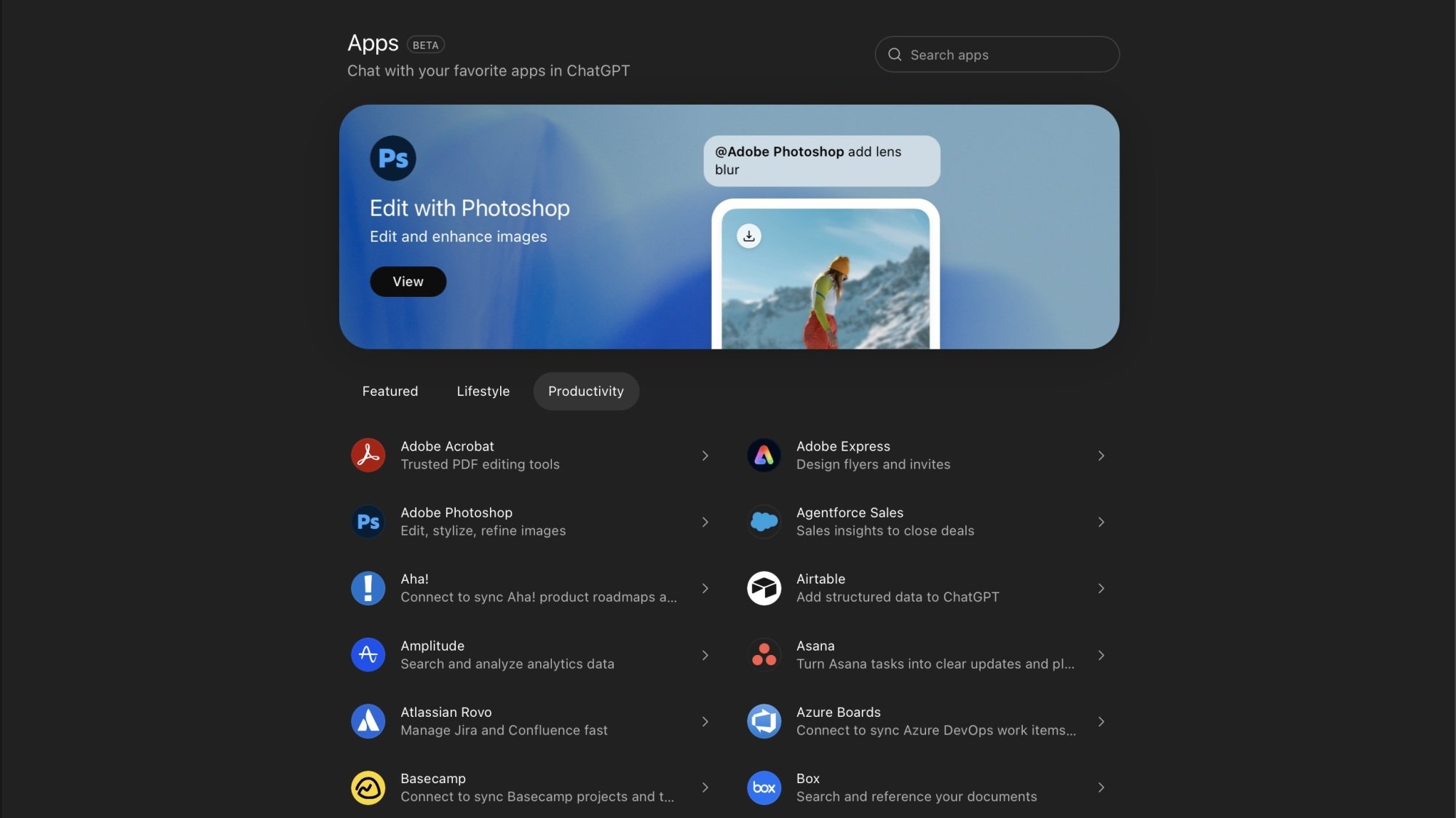
Speaking of more apps, the company plans to expand these apps overtime, as developers create ChatGPT-compatible extensions for their programs. That was part of yesterday’s news: OpenAI is now letting developers submit apps to ChatGPT en masse. What’s more, these apps will be hosted in an “app directory,” though many online are taking to calling it an app store. (There’s no payment necessary, however, so app directory might really be a more apt description.) You’ll find this new app directory in the sidebar of ChatGPT, appropriately called “Apps.”

Apps is apparently in beta, according to a label affixed to its title in ChatGPT. Here, you’ll find a rotating slide featuring an ad for some of the service’s biggest apps, like Canva and Zillow, and, below it, rows of apps to choose from. Right now, the apps are sorted into “Featured,” “Lifestyle,” and “Productivity,” with no option that includes all the apps. (But they seem to be entirely split across Lifestyle and Productivity.) There are a lot of options here already. Some made headlines this week, like Photoshop and Apple Music, while others arrived more quietly, like Asana, Uber, and Target. It’s not just traditional apps like Zillow or Spotify that are getting the app treatment here, either. OpenAI is also considering “connector” services, like Google Drive, as “apps.”

You can click on any app in the directory to see what you can do with it. Slack, for example, says you can look up your chats and messages to summarize threads, generate recaps, and come up with responses. You can check on your Asana tasks to generate progress reports and status updates. Outlook says you can create “talking points” and generate follow-ups from your emails and calendar events. While there’s a brief summary underneath each title, you’ll need to click through to each service to see the full picture of what it actually offers.

Here are the apps I’m seeing at this time. Just note this might not be a complete list, especially as OpenAI continues to add more apps to the service:

  • Adobe Acrobat

  • Adobe Express

  • Adobe Photoshop

  • Agentforce Sales

  • Aha!

  • Airtable

  • AllTrails

  • Amplitude

  • Apple Music

  • Asana

  • Atlassian Rovo

  • Azure Boards

  • Basecamp

  • Booking.com

  • Box

  • Canva

  • Clay

  • Cloudinary

  • Conductor

  • Coursera

  • Daloopa

  • DoorDash

  • Dropbox

  • Egnyte

  • Expedia

  • Figma

  • GitLab Issues

  • Google Drive

  • Help Scout

  • Hex

  • HighLevel

  • Hugging Face

  • Instacart

  • Intuit Credit Karma

  • Intuit Mailchimp

  • Intuit TurboTax

  • Khan Academy

  • Klaviyo

  • Linear

  • Lovable

  • LSEG

  • Monday.com

  • Morningstar

  • Netlify

  • Notion

  • OpenTable

  • Outlook Calendar

  • Outlook Email

  • Peloton

  • Pipedrive

  • PitchBook

  • Ramp

  • Replit

  • SharePoint

  • Slack

  • Spotify

  • Stripe

  • Target

  • Teams

  • Teamwork.com

  • TheFork

  • Thumbtack

  • Tripadvisor

  • Uber

  • Uber Eats

  • Vercel

  • Zillow

  • Zoho

  • Zoho Desk

  • Zoom

If you’re an avid ChatGPT user and frequently switch between it and any of the apps on this list, there might be some utility here. Maybe coders will find the integration with Hugging Face and Lovable to be beneficial, while Photoshop users might take advantage of the AI image editing tools this integration provides. But I’m still left feeling like this is more gimmick than anything else: I don’t need to connect my Slack to ChatGPT to generate follow-ups for me: I’m perfectly capable of responding to emails myself, and managing my own calendar, so no need to connect Outlook or another email client to the bot. Maybe a future update will sell me on connecting generative AI to all aspects of my work and personal life, but so far, I’m still not convinced.


LLMs’ impact on science: Booming publications, stagnating quality

There have been a number of high-profile cases where scientific papers have had to be retracted because they were filled with AI-generated slop—the most recent coming just two weeks ago. These instances raise serious questions about the quality of peer review in some journals—how could anyone let a figure with terms like “runctitional,” “fexcectorn,” and “frymblal” through, especially given the ‘m’ in frymblal has an extra hump? But it has not been clear whether these high-profile examples are representative. How significantly has AI use been influencing the scientific literature?

A collaboration of researchers at Berkeley and Cornell have decided to take a look. They’ve scanned three of the largest archives of pre-publication papers and identified ones that are likely to have been produced using Large Language Models. And they found that, while researchers produce far more papers after starting to use AI and the quality of the language used went up, the publication rate of these papers has dropped.

Searching the archives

The researchers began by obtaining the abstracts of everything placed in three major pre-publication archives between 2018 and mid-2024. At the arXiv, this netted them 1.2 million documents; another 675,000 were found in the Social Science Research Network; and bioRxiv provided another 220,000. So, this was both a lot of material to work with and covered a lot of different fields of research. It also included documents that were submitted before Large Language Models were likely to be able to produce output that would be deemed acceptable.

Read full article

Comments

YouTube Shuts Down Channels Using AI To Create Fake Movie Trailers

An anonymous reader quotes a report from Deadline: YouTube has terminated two prominent channels that used artificial intelligence to create fake movie trailers, Deadline can reveal. The Google-owned video giant has switched off Screen Culture and KH Studio, which together boasted well over 2 million subscribers and more than a billion views. The channels have been replaced with the message: “This page isn’t available. Sorry about that. Try searching for something else.”

Earlier this year, YouTube suspended ads on Screen Culture and KH Studio following a Deadline investigation into fake movie trailers plaguing the platform since the rise of generative AI. The channels later returned to monetization when they started adding “fan trailer,” “parody” and “concept trailer” to their video titles. But those caveats disappeared In recent months, prompting concern in the fan-made trailer community. YouTube’s position is that the channels’ decision to revert to their previous behavior violated its spam and misleading-metadata policies. This resulted in their termination. “The monster was defeated,” one YouTuber told Deadline following the enforcement action.

Deadline’s investigation revealed that Screen Culture spliced together official footage with AI images to create franchise trailers that duped many YouTube viewers. Screen Culture founder Nikhil P. Chaudhari said his team of a dozen editors exploited YouTube’s algorithm by being early with fake trailers and constantly iterating with videos. […] Our deep dive into fake trailers revealed that instead of protecting copyright on these videos, a handful of Hollywood studios, including Warner Bros Discovery and Sony, secretly asked YouTube to ensure that the ad revenue from the AI-heavy videos flowed in their direction.


Read more of this story at Slashdot.

AirTags are back on sale, with a four-pack retailing for $65

Apple keeps most of its product pricing on a tight leash, but we do see the company’s AirTags go on sale pretty frequently. Another cost cut has come around for this item just in time for the holidays. Amazon is currently selling a four-pack of AirTags for $65. At a third off the regular cost, that price is pretty close to the record low discount of $63 we’ve seen for these Bluetooth trackers. 

If you place an order quickly, the AirTags should arrive in time for Christmas, making this a solid choice as a gift for someone with a tendency to misplace stuff. AirTags can also be useful for people who travel frequently, helping you to keep track of essentials like your passport as well as a way to keep tabs on luggage while you’re on the go.

If you do purchase some AirTags, we have some recommendations for useful accessories to go along with them, such as different styles of cases to best attach the trackers to different types of items. These are worth looking over and adding to your shopping cart in order to make the most of the product. 

AirTags have an IP67 rating for water and dust resistance and their replaceable batteries should last for about a year. They can also support Precision Finding, which gives more exact directions to a lost item, when paired with most models after the iPhone 11. Up to five people can share an AirTag’s location, which is helpful for families or large travel groups. 

Follow @EngadgetDeals on X for the latest tech deals and buying advice.

This article originally appeared on Engadget at https://www.engadget.com/deals/airtags-are-back-on-sale-with-a-four-pack-retailing-for-65-202333979.html?src=rss

Auto chip shortage: Honda will pause production in Japan and China

The ripples of the auto industry’s chip shortage are still being felt, as evidenced by Honda. Bloomberg reported on Wednesday that the automaker will suspend production in Japan on January 5 and 6. (Honda didn’t specify the affected factories.) In addition, all three of the automaker’s Guangqi Honda Automobile plants in China will shut down from December 29 to January 2.

The halt is an outgrowth of a chip shortage stemming from a recent geopolitical proxy war in the Netherlands, of all places. In October, the Dutch government, bowing to pressure from the Trump administration, seized control of the Chinese-owned chipmaker Nexperia. The company, which operates in the Netherlands, makes low-end chips that power automobiles, appliances and other tech.

The Dutch government’s official explanation for the seizure was that Nexperia had “serious governance shortcomings.” It cited a concern that Nexperia’s Chinese majority owner, Wingtech, would move key technology out of Europe. However, the New York Times later reported that the Dutch government had known about those plans since 2019.

Regardless, China retaliated by blocking exports of Nexperia-made chips. The Netherlands eventually suspended its intervention, following “constructive talks.” China then relaxed (but did not entirely remove) its restrictions through exemptions to export controls. The uneasy resolution hasn’t been enough to help supply chains fully recover.

Honda initially anticipated that production would return to normal starting in late November. So much for that. “No one [in the auto industry] prepared for geopolitical disruption,” automaker consultant Ambrose Conroy, CEO of Seraph Consulting, told Reuters in November. “And they’re still not prepared.”

This article originally appeared on Engadget at https://www.engadget.com/transportation/auto-chip-shortage-honda-will-pause-production-in-japan-and-china-200857591.html?src=rss

Mass Hacking of IP Cameras Leave Koreans Feeling Vulnerable in Homes, Businesses

Hackers breached approximately 120,000 IP cameras across South Korea and allegedly sold footage captured from private homes, gynecology offices, breastfeeding rooms and massage parlors to an overseas pornography website, prompting an interagency government task force to announce sweeping reforms on December 7.

Police believe one suspect alone hacked 63,000 cameras and produced 545 videos that netted him 35 million won ($24,000) in cryptocurrency; a second suspect, operating independently, compromised 70,000 devices and earned 18 million won from 648 videos. The footage accounted for 62% of all content on the website, which maintains a dedicated “Korean” category. A government survey found that only 59% of installation companies consistently carried out mandatory security measures such as changing default passwords. Lawmakers are now pursuing legislation requiring security-certified IP cameras in sensitive facilities.


Read more of this story at Slashdot.

Meta’s Major VR Strategy Shift Leaves ASUS And Lenovo In Limbo

Meta's Major VR Strategy Shift Leaves ASUS And Lenovo In Limbo
A year and a half ago Meta made what at the time felt like a big move, as the company made the operating system that powers its headsets available to other manufacturers. Horizon OS was going to open the doors for a more robust VR ecosystem that even included support for mobile apps. However, Road to VR is reporting that these plans have been

The Displace Hub can make your normal TV wireless

Displace first tried its hand at reimagining the TV in 2023, with a wireless screen that suctions onto walls and features built-in rechargeable batteries. At CES 2026, the company is not only introducing new versions of its own TVs, it’s also showing off the Displace Hub, an accessory that can make other TVs wireless.

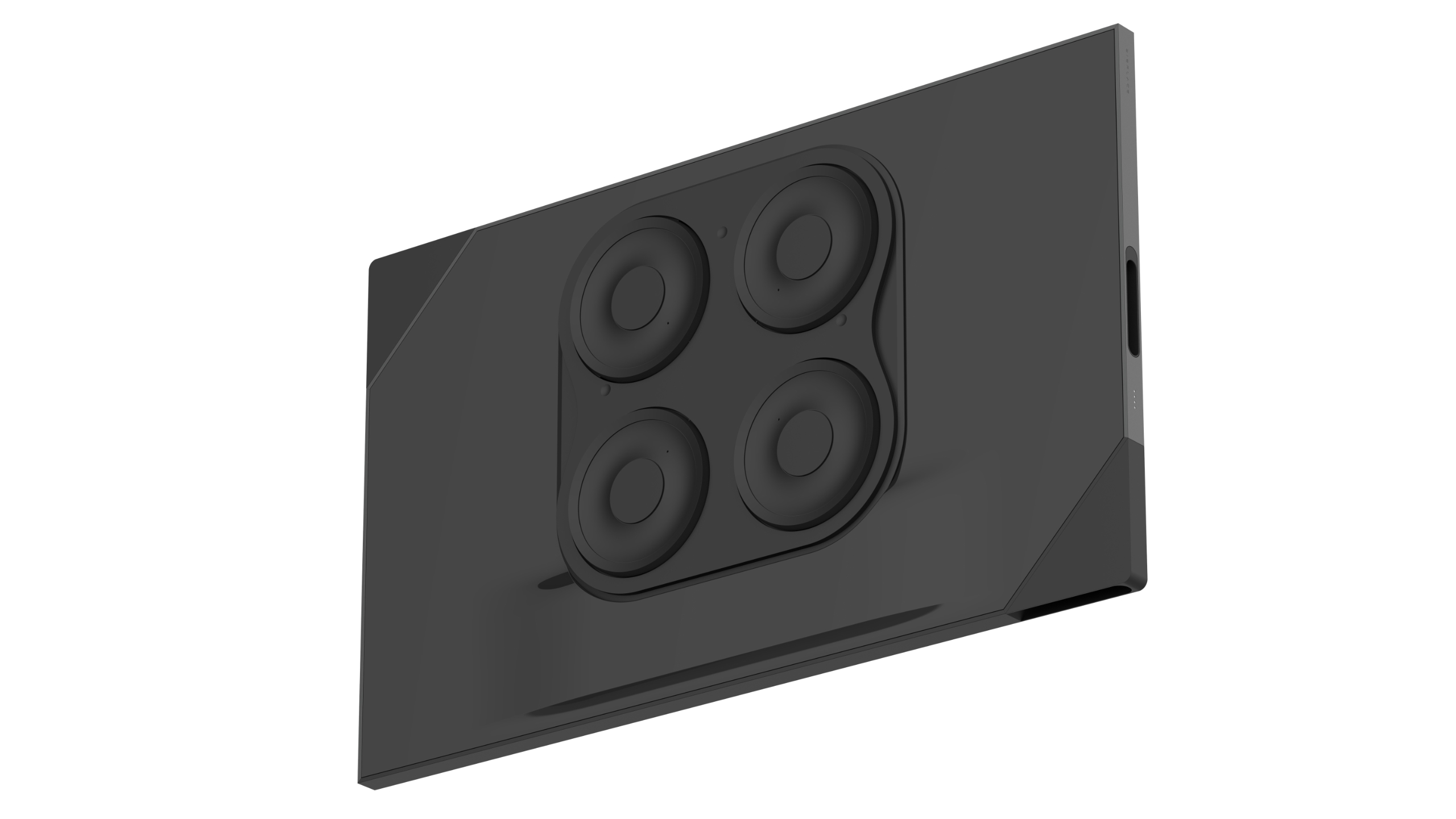
The Displace Hub is a wall-mounting system with some extra bells and whistles. It combines the “active-loop suction” of Displace’s TVs, with a rechargeable battery that can power whatever screen you mount on it and a built-in PC that runs Displace’s “ambient computing platform.” The Hub uses an Intel N-150 4-core CPU with an integrated GPU, 16GB RAM and 128GB of storage to run Displace’s operating system, and includes a 15,000mAh battery to keep everything powered. The Hub also has two HDMI inputs for external devices and supports Displace’s Controller 2.0, which offers a second screen for additional information and content.

A rendering of the back of a Displace Hub feature circular "active-loop" suction mounts.
The Displace Hub uses the same “active-loop suction” system as the Displace TV.
Displace

The mounting system does have some notable limits, however. Displace says the Hub can support weights up to 150 pounds, and is specifically designed to mount TVs between 55 and 100 inches, which might rule out the TV you already own. The battery life of the Displace Hub could also be a concern. Connecting your TV to the Hub’s integrated battery is supposed to eliminate the need for unsightly power cables, but depending on how often you watch and the energy demands of your screen, you might be recharging fairly often. Displace says the Displace Hub’s battery life lasts anywhere from five to 10 hours. While the Hub can be recharged while keeping your TV mounted at the same time, having to plug and unplug your TV setup from a charger seems like it could defeat the point of having a wireless TV in the first place.

Other TV makers have tried to offer mostly wireless screens at CES in the past, like the LG Signature OLED M3 and the Samsung Neo QLED 8K QN990F, which use wireless breakout boxes to stream HDMI connections to their TV screens. Both of those TVs were focused on reducing the number of cables that you connect to your screen rather than eliminating cables entirely, though, a goal that still comes with tradeoffs based on the limitations of the Displace Hub. 

Displace hasn’t announced a release date for the Displace Hub, but the company says that the mounting system will cost $1,900 at launch and will be available to pre-order during CES 2026.

This article originally appeared on Engadget at https://www.engadget.com/home/home-theater/the-displace-hub-can-make-your-normal-tv-wireless-193837460.html?src=rss

Apple is bringing even more ads to the App Store

Apple just announced it will be integrating more ads into the App Store because our poor eyeballs must be assaulted at all times. The company plans on littering search results with advertisements beginning next year.

Currently, the App Store only has one ad spot. That’s at the very top of search results. If you search for something like Instagram it’s likely that top spot will be filled with an ad for a rival social media platform. The new ads will appear further down the actual search results.

Apple says that advertisers won’t have to alter their campaigns, as the ads will “run in either the existing position — at the top of search results — or further down in search results.” The company says that 65 percent of app downloads happen after a search, so this move will “give advertisers more opportunities.”

Google began inundating the Play Store with more ads last year and, well, the results haven’t been pretty. The general consensus is that the store has become more frustrating to use. We’ll have to wait and see just how intrusive these App Store ads end up being.

Recent reporting also indicates that Apple plans on bringing ads to the Maps app. This is reportedly scheduled for next year, though the company has yet to comment.

This article originally appeared on Engadget at https://www.engadget.com/apps/apple-is-bringing-even-more-ads-to-the-app-store-193416921.html?src=rss

NeuralDSP models John Mayer’s entire amp and effects rig—and it sounds great

Guitarists today are spoiled for choice, and that goes doubly true for players who use computer-based amp modeling software. I’m one such player, and I don’t miss the size, weight, deafening volume, or cost of owning an amp and cabinet collection, to say nothing of all those pedals and cables. For clean to mid-gain tones alone, I already have more terrific options than I need, including NeuralDSP’s Tone King and Cory Wong and Mateus Asato, PolychromeDSP’s Lumos, and Universal Audio’s new Paradise Guitar Studio. All work slightly differently, but they can each output record-ready tones that are really, really close to the (often incredibly expensive) hardware that they model, and they each give you plenty of great-sounding presets to start from.

So do we really need one amp sim package?

NeuralDSP thinks we do, because the Finnish company just dropped a major new release yesterday called Archetype: John Mayer X. It doesn’t model Mayer’s type of gear but his actual hardware units, along with all the actual settings he uses in the studio and on stage. It even has some presets that he designed. Which is great if you want to sound like John Mayer—but what does the software offer for those of us not trying to cover Continuum?

Read full article

Comments

Tests Find AI Toys Parroting Chinese Communist Party Values

A plush AI toy marketed for children as young as three years old delivers detailed instructions on sharpening knives and lighting matches, and when asked about Chinese President Xi Jinping’s resemblance to Winnie the Pooh — a comparison censored in China — responds that “your statement is extremely inappropriate and disrespectful.”

The Miriat Miiloo, manufactured by a Chinese company and among the top inexpensive results for “AI toy for kids” on Amazon, repeatedly insisted in NBC News tests that Taiwan is “an inalienable part of China.” The toy would lower its voice and declare this “an established fact.” The tests, NBC News reports, indicated “it was programmed to reflect Chinese Communist Party values.”

NBC News and the U.S. Public Interest Research Group tested five popular AI toys this holiday season and found loose guardrails across the board. Another toy, the Alilo Smart AI Bunny marketed as “the best gift for little ones,” engaged in detailed descriptions of BDSM practices during extended conversation. China now has more than 1,500 registered AI toy companies, according to MIT Technology Review. Miriat didn’t respond to requests for comment.


Read more of this story at Slashdot.

Trump Mobile’s T1 still doesn’t exist, but the company is now selling refurbished phones

The T1 smartphone from Trump Mobile remains non-existent vaporware, but the company is still finding new ways to take people’s money. Anyone who desperately wants to fund this sham can now buy a refurbished phone from the company. The business’s website has listings for “Renewed” models of the Samsung S24 and S23 and the iPhone 15 and 14. Gizmodo noticed that Trump Mobile is selling these other brands’ phones for the same cost, or sometimes more, than the same refurbs from other retailers. Seems pretty par for the course.

NBC News opted to order one of the T1 phones in August to track its development. “After confirming with the credit card company that the transaction was not fraudulent, NBC News received a confirmation email verifying the order,” the publication said in a report last month. However, it has not received much communication from the company on why the phone still has not shipped. “Neither Trump Mobile nor the Trump Organization responded to NBC News’ multiple requests for comment on when the phone would be released and why it’s delayed.”

In case you missed the previous acts of sketchiness from Trump Mobile, the company insisted at its debut that the phone was made in the US. That seemed like a dubious claim and the “made in the USA” language was quietly removed from the website shortly after.

This article originally appeared on Engadget at https://www.engadget.com/mobile/smartphones/trump-mobiles-t1-still-doesnt-exist-but-the-company-is-now-selling-refurbished-phones-191740570.html?src=rss