China reportedly has a prototype EUV machine built by ex-ASML employees

A report from Reuters claims that scientists in China have created a prototype of a machine that could eventually be used to produce semiconductor chips capable of powering artificial intelligence. Sources told the publication that a team in Shenzhen completed the prototype of an extreme ultraviolet lithography machine earlier this year and it is allegedly now undergoing testing. The EUV machine was reportedly made by former engineers from Dutch semiconductor supplier ASML. Reuters states that China is targeting production of its own EUV chips beginning in 2028, although other experts have projected 2030 as a more likely date. 

EUV is a supremely complicated bit of technology; we have an explainer below that gets into some of the details. It is at the heart of the chips made by companies such as Intel and TSMC, so any company trying to compete would also need access to EUV. Although the Chinese prototype is not yet making chips, it is reportedly able to generate the extreme ultraviolet light needed for chip manufacturing.

If confirmed, this development would put China in control of tech much sooner than analysts had previously expected. To date, EUV has largely been kept out of reach by Western companies and used as a bargaining chip by the US government. Chinese President Xi Jinping has placed a high priority on the country being able to produce its own semiconductors. “The aim is for China to eventually be able to make advanced chips on machines that are entirely China-made,” a source told Reuters. “China wants the United States 100 percent kicked out of its supply chains.”

This article originally appeared on Engadget at https://www.engadget.com/big-tech/china-reportedly-has-a-prototype-euv-machine-built-by-ex-asml-employees-235833756.html?src=rss

Meta ‘Pauses’ Third-Party Headset Program

Meta has paused its third-party Horizon OS headset program, effectively canceling planned VR headsets from Asus and Lenovo as it refocuses on “building the world-class first-party hardware and software needed to advance the VR market.” Road to VR reports: A little over a year and a half ago, Meta made an “industry-altering announcement,” as I called the move in my reporting: the company was rebranding the Quest operating system to ‘Horizon OS’ and announced it was working with select partners to launch third-party VR headsets powered by the operating system. Meta specifically named Asus and Lenovo as the first partners it was working with to build new Horizon OS headsets. Asus was said to be building an “all-new performance gaming headset,” while Lenovo was purportedly working on “mixed reality devices for productivity, learning, and entertainment.”

But as we’ve now learned, neither headset is likely to see the light of day. Meta say it has frozen the third-party Horizon OS headset program. “We have paused the program to focus on building the world-class first-party hardware and software needed to advance the VR market,” a Meta spokesperson told Road to VR. “We’re committed to this for the long term and will revisit opportunities for 3rd-party device partnerships as the category evolves.”


Read more of this story at Slashdot.

Netflix To Add Soccer Video Game Based On FIFA World Cup Next Year

An anonymous reader quotes a report from Reuters: Netflix on Wednesday said it will add a soccer simulation title to its gaming portfolio, as the streaming giant looks to leverage the FIFA World Cup 2026 tournament to deepen its video game push. The soccer title will be developed and published by Delphi Interactive, which is also helping create a premium James Bond game called “007 First Light,” and in association with the sport’s governing body, FIFA. Netflix said the game will launch in time for the world’s most-watched sporting event, scheduled to start June next year in the U.S.


Read more of this story at Slashdot.

A Facebook test makes link-sharing a paid feature for creators

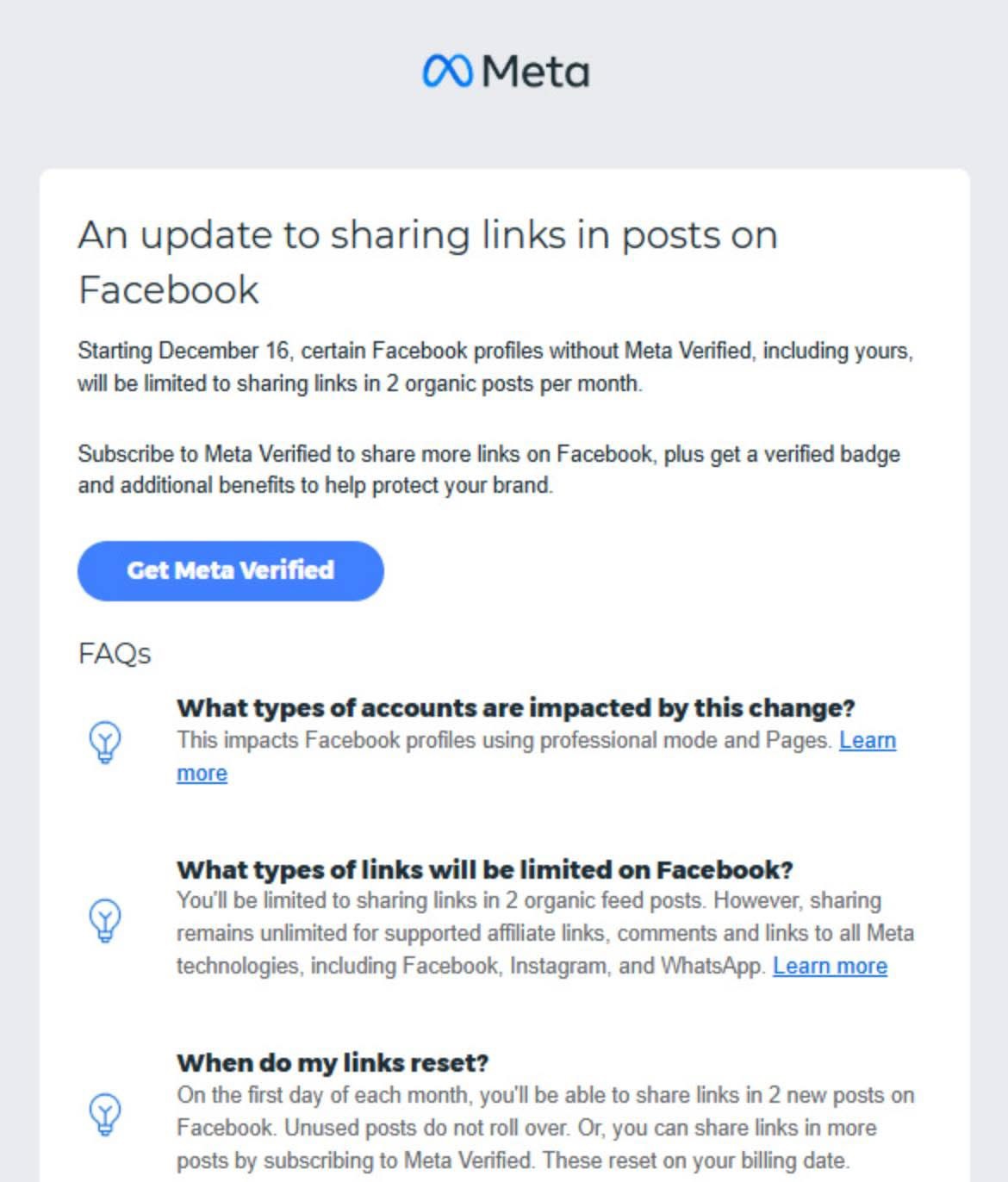
Creators and publishers have long worried about Meta’s ability to throttle links to outside content. Now, the company is testing out a new scheme that effectively puts link-sharing behind a paywall for creators on Facebook.

Under the test, a Meta Verified subscription will determine how many links a creator can share another profile per month. According to a screenshot shared by social meda consultant Matt Navarra, creators in the test recently received a notification from Meta informing them that “certain Facebook profiles without Meta Verified, including yours, will be limited to sharing links in 2 organic posts per month.”  

Meta is making link sharing pay to play with a new test.

A spokesperson for Meta confirmed the test to Engadget. The test is currently affecting an unspecified number of creators and pages using “professional mode” on Facebook. Publishers aren’t affected for now. “This is a limited test to understand whether the ability to publish an increased volume of posts with links adds additional value for Meta Verified subscribers,” the spokesperson said.

While Meta seems to be trying to downplay the significance of the test, it’s a notable shift for the company. Many creators and businesses rely on Facebook and reducing their ability to send traffic to outside websites could be a significant hit. Many creators are already frustrated that the company puts its better customer service features behind the Meta Verified subscription, which starts at $14.99/month. Making link-sharing a premium feature as well would be even more unpopular.

Have a tip for Karissa? You can reach her by email, on X, Bluesky, Threads, or send a message to @karissabe.51 to chat confidentially on Signal.

This article originally appeared on Engadget at https://www.engadget.com/social-media/a-facebook-test-makes-link-sharing-a-paid-feature-for-creators-224632957.html?src=rss

Physicists 3D-printed a Christmas tree of ice

Physicists at the University of Amsterdam came up with a really cool bit of Christmas decor: a miniature 3D-printed Christmas tree, a mere 8 centimeters tall, made of ice, without any refrigeration equipment or other freezing technology, and at minimal cost. The secret is evaporative cooling, according to a preprint posted to the physics arXiv.

Evaporative cooling is a well-known phenomenon; mammals use it to regulate body temperature. You can see it in your morning cup of hot coffee: the hotter atoms rise to the top of the magnetic trap and “jump out” as steam. It also plays a role (along with shock wave dynamics and various other factors) in the formation of “wine tears.” It’s a key step in creating Bose-Einstein condensates.

And evaporative cooling is also the main culprit behind the infamous “stall” that so frequently plagues aspiring BBQ pit masters eager to make a successful pork butt. The meat sweats as it cooks, releasing the moisture within, and that moisture evaporates and cools the meat, effectively canceling out the heat from the BBQ. That’s why a growing number of competitive pit masters wrap their meat in tinfoil after the first few hours (usually when the internal temperature hits 170° F).

Read full article

Comments

Astronomers find mysterious lemon-shaped exoplanet with NASA’s Webb telescope

Space is full of unsolved mysteries, and a team using NASA’s James Webb Space Telescope have recently turned up a doozy. “I remember after we got the data down, our collective reaction was ‘What the heck is this?’ It’s extremely different from what we expected,” said Peter Gao of the Carnegie Earth and Planets Laboratory in Washington, a co-author on the study.

The researchers found an exoplanet dubbed PSR J2322-2650b that orbits a small, dense star emitting electromagnetic radiation known as a pulsar. They are an example of a black widow system, where a rapidly spinning pulsar is paired with a smaller astronomical body. A black widow duo isn’t unusual, but this pair has sparked questions about how the exoplanet originally formed.

The exoplanet’s proximity to the pulsar and its intense gravitational pull have distorted it into an oblong lemon shape. More unusually, PSR J2322-2650b also has a unique atmosphere comprised mostly of helium and carbon. “Instead of finding the normal molecules we expect to see on an exoplanet — like water, methane, and carbon dioxide — we saw molecular carbon,” principal investigator Michael Zhang of University of Chicago said. Given its strange atmosphere, the team isn’t certain how the exoplanet formed. “It’s very hard to imagine how you get this extremely carbon-enriched composition. It seems to rule out every known formation mechanism,” Zhang said. For now, we’ll chalk this up as another mystery of the universe.

This article originally appeared on Engadget at https://www.engadget.com/science/space/astronomers-find-mysterious-lemon-shaped-exoplanet-with-nasas-webb-telescope-223722244.html?src=rss

OpenAI’s new ChatGPT image generator makes faking photos easy

For most of photography’s roughly 200-year history, altering a photo convincingly required either a darkroom, some Photoshop expertise, or, at minimum, a steady hand with scissors and glue. On Tuesday, OpenAI released a tool that reduces the process to typing a sentence.

It’s not the first company to do so. While OpenAI had a conversational image-editing model in the works since GPT-4o in 2024, Google beat OpenAI to market in March with a public prototype, then refined it to a popular model called Nano Banana image model (and Nano Banana Pro). The enthusiastic response to Google’s image-editing model in the AI community got OpenAI’s attention.

OpenAI’s new GPT Image 1.5 is an AI image synthesis model that reportedly generates images up to four times faster than its predecessor and costs about 20 percent less through the API. The model rolled out to all ChatGPT users on Tuesday and represents another step toward making photorealistic image manipulation a casual process that requires no particular visual skills.

Read full article

Comments

GitHub Is Going To Start Charging You For Using Your Own Hardware

GitHub will begin charging $0.002 per minute for self-hosted Actions runners used on private repositories starting in March. “At the same time, GitHub noted in a Tuesday blog post that it’s lowering the prices of GitHub-hosted runners beginning January 1, under a scheme it calls ‘simpler pricing and a better experience for GitHub Actions,'” reports The Register. “Self-hosted runner usage on public repositories will remain free.” From the report: Regardless of the public repo distinction, enterprise-scale developers who rely on self-hosted runners were predictably not pleased about the announcement. “Github have just sent out an email announcing a $0.002/minute fee for self-hosted runners,” Reddit user markmcw posted on the DevOps subreddit. “Just ran the numbers, and for us, that’s close to $3.5k a month extra on our GitHub bill.” […]

“Historically, self-hosted runner customers were able to leverage much of GitHub Actions’ infrastructure and services at no cost,” the repo host said in its blog FAQ. “This meant that the cost of maintaining and evolving these essential services was largely being subsidized by the prices set for GitHub-hosted runners.” The move, GitHub said, will align costs more closely with usage. Like many similar changes to pricing models pushed by tech firms, GitHub says “the vast majority of users … will see no price increase.”

GitHub claims that 96 percent of its customers will see no change to their bill, and that 85 percent of the 4 percent affected by the pricing update will actually see their Actions costs decrease. The company says the remaining 15 percent of impacted users will face a median increase of about $13 a month. For those using self-hosted runners and worried about increased costs, GitHub has updated its pricing calculator to include the cost of self-hosted runners.


Read more of this story at Slashdot.

Jared Isaacman is NASA’s new leader

NASA has a leader again. On Wednesday, the US Senate confirmed Jared Isaacman as the agency’s administrator, with a 67-30 vote. The billionaire entrepreneur (and Elon Musk ally) will have his hands full navigating political waters while managing a severely downsized workforce.

You might recall that this wasn’t Isaacman’s first shot at the job. He was nominated to the post earlier this year. But days before he was scheduled for a confirmation vote, President Donald Trump withdrew his nomination.

The reversal reportedly came after the president was told that Isaacman had donated to prominent Democrats. (Trump’s description of his decision, as based on a “thorough review of prior associations,” seemed to lend weight to that.) However, that was also around the time the Trump-Musk feud was about to boil over. Regardless, Isaacman was nominated again in November.

The new NASA head reportedly has broad support from the space community. (That makes him something of an aberration among Trump appointees in scientific fields.) “I am optimistic that Mr. Isaacman will bring a steady hand and clear vision to NASA,” Sen. Marie Cantwell (D-WA) told The New York Times.

The new administrator has traveled to space twice on private missions. In a document published in May, Isaacman shared his three objectives for NASA. These included human missions to the Moon, Mars and deep space; helping the organization do more with a constrained budget; and cost-cutting through industry and academic partnerships.

This article originally appeared on Engadget at https://www.engadget.com/science/space/jared-isaacman-is-nasas-new-leader-220833691.html?src=rss

Billboard’s charts are increasingly weighted towards on-demand streaming, but not enough for YouTube

YouTube announced that it will no longer share data with Billboard for the creation of the Billboard Hot 100 and other charts because the video platform doesn’t believe they’re calculated fairly. The issue lies, per YouTube, with how Billboard weighs on-demand streams in its rankings: The publication weighs streams from paid music streaming services over ad-supported streams, and YouTube just so happens to run an ad-supported streaming service.

Much like getting a book on The New York Times Bestseller list, landing a spot on the Billboard charts doesn’t carry quite the same importance that it once did. When the majority of the media people consume is digital and on-demand, sales numbers aren’t a guaranteed indicator of success or popularity. That’s part of the reason why Billboard started including digital streams in its calculations way back in 2007, and why it announced plans to adjust how it weighs on-demand streaming just yesterday.

On Tuesday, Billboard announced that it would add more weight to streaming to “better reflect an increase in streaming revenue and changing consumer behaviors.” Billboard currently counts an “album consumption unit” as an album sale, which either breaks down to “3,750 ad-supported or 1,250 paid/subscription on-demand official audio and video streams.” In the new ranking scheme that will go into effect in January 2026, “each album consumption unit will now equal 2,500 ad-supported or 1,000 paid/subscription on-demand official audio and video streams.” 

“The change means that it will take 33.3 percent fewer ad-supported on-demand streams of songs from an album, and 20 percent fewer paid/subscription on-demand streams of songs from an album, to equal an album unit,” Billboard says. Put another way, things are moving in YouTube’s favor, just apparently not as quickly as the company wants.

YouTube characterizes pulling its data from Billboard as fighting for fairness and equality, but it’s equally connected to the platform’s demonstration of its own power. It already funnels billions of dollars to artists and labels from the money it makes on ads and subscriptions, but it clearly also wants the power to mint new chart-topping stars. “We are committed to achieving equitable representation across the charts and hopefully can work with Billboard to return to theirs,” YouTube says in its announcement. “Until then, if you’re curious about what music is making waves on YouTube, you can visit our charts here.”

This article originally appeared on Engadget at https://www.engadget.com/entertainment/music/billboards-charts-are-increasingly-weighted-towards-on-demand-streaming-but-not-enough-for-youtube-220238291.html?src=rss

Gemini 3 Flash Outperforms Gemini 3 Pro and GPT 5.2 In These Key Benchmarks

The AI wars continue to heat up. Just weeks after OpenAI declared a “code red” in its race against Google, the latter released its latest lightweight model: Gemini 3 Flash. This particular Flash is the latest in Google’s Gemini 3 family, which started with Gemini 3 Pro, and Gemini 3 Deep Think. But while this latest model is meant to be a lighter, less expensive variant of the existing Gemini 3 models, Gemini 3 Flash is actually quite powerful in its own right. In fact, it beats out both Gemini 3 Pro and OpenAI’s GPT-5.2 models in some benchmarks.

Lightweight models are typically meant for more basic queries, for lower-budget requests, or to be run on lower-powered hardware. That means they’re often faster than more powerful models that take longer to process, but can do more. According to Google, Gemini 3 Flash combines the best of both those worlds, producing a model with Gemini 3’s “Pro-grade reasoning,” with “Flash-level latency, efficiency, and cost.” While that likely matters most to developers, general users should also notice the improvements, as Gemini 3 Flash is now the default for both Gemini (the chatbot) and AI Mode, Google’s AI-powered search.

Gemini 3 Flash performance

You can see these improvements in Google’s reported benchmarking stats for Gemini 3 Flash. In Humanity’s Last Exam, an academic reasoning benchmark that tests LLMs on 2,500 questions across over 100 subjects, Gemini 3 Flash scored 33.7% with no tools, and 43.5% with search and code execution. Compare that to Gemini 3 Pro’s 37.5% and 45.8% scores, respectively, or OpenAI’s GPT-5.2’s scores of 34.5% and 45.5%. In MMMU-Pro, a benchmark that test a model’s multimodal understanding and reasoning, Gemini 3 Flash got the top score (81.2%), compared to Gemini 3 Pro (81%) and GPT-5.2 (79.5). In fact, across the 21 benchmarking tests Google highlights in its announcement, Gemini 3 Flash has the top score in three: MMMU-Pro (tied with Gemini 3 Pro), Toolathlon, and MMMLU. Gemini 3 Pro still takes the number one spot on the most tests here (14), and GPT-5.2 topped eight tests, but Gemini 3 Flash is holding its own.

Google notes that Gemini 3 Flash also outperforms both Gemini 3 Pro and the entire 2.5 series in the SWE-bench Verified benchmark, which tests the model’s coding agent capabilities. Gemini 3 Flash scored a 78%, while Gemini 3 Pro scored 76.2%, Gemini 2.5 Flash scored 60.4%, and Gemini 2.5 Pro scored 59.6%. (Note that GPT-5.2 scored the best of the models Google mentions in this announcement.) It’s a close race, especially when you consider this is a lightweight model scoring alongside these company’s flagship models.

Gemini 3 Flash cost

That might present an interesting dilemma for developers who pay to use AI models in their programs. Gemini 3 Flash costs $0.50 per every million input tokens (what you ask the model to do), and $3.00 per every million output tokens (the result the models returns from your prompt). Compare that to Gemini 3 Pro, which costs $2.00 per every million input tokens, and $12.00 per every million output tokens, or GPT-5.2’s $3.00 and $15.00 costs, respectively. For what it’s worth, it’s not as cheap as Gemini 2.5 Flash ($0.30 and $2.50), or Grok 4.1 Fast for that matter ($0.20 and $0.50), but it does outperform these models in Google’s reported benchmarks. Google notes that Gemini 3 Flash uses 30% fewer tokens on average than 2.5 Pro, which will save on cost, while also being three times faster.

If you’re someone who needs LLMs like Gemini 3 Flash to power your products, but you don’t want to pay the higher costs associated with more powerful models, I could image this latest lightweight model looking appealing from a financial perspective.

How the average user will experience Gemini 3 Flash

Most of us using AI aren’t doing so as developers who need to worry about API pricing. The majority of Gemini users are likely experiencing the model through Google’s consumer products, like Search, Workspace, and the Gemini app.

Starting today, Gemini 3 Flash is the default model in the Gemini app. Google says it can handle many tasks “in just a few seconds.” That might include asking Gemini for tips on improving your golf swing based on a video of yourself, or uploading a speech on a given historical topic and requesting any facts you might have missed. You could also ask the bot to code you a functioning app from a series of thoughts.

You’ll also experience Gemini 3 Flash in Google Search’s AI Mode. Google says the new model is better at “parsing the nuances of your question,” and thinks through each part of your request. AI Mode tries to return a more complete search result by scanning hundreds of sites at once, and putting together a summary with sources for your answer. We’ll have to see if Gemini 3 Flash improves on previous iterations of AI Mode.

I’m someone who still doesn’t find much use for generative AI products in their day-to-day lives, and I’m not entirely sure Gemini 3 Flash is going to change that for me. However, the balance of performance gains with the cost to process that power is interesting, and I’m particularly intrigued to see how OpenAI responds.

Gemini 3 Flash is available to all users starting today. In addition to general users in Gemini and AI Mode, developers will find it in the Gemini API in Google AI Studio, Gemini CLI, and Google Antigravity, the company’s new agentic development platform. Enterprise users can use it in Vertex AI and Gemini Enterprise.

Man sues cops who jailed him for 37 days for trolling a Charlie Kirk vigil

Larry Bushart, a man who was jailed for 37 days for reposting a Trump meme, has now sued the cops who allegedly schemed to keep him imprisoned for as long as possible simply because they disagreed with his point of view.

Bushart is a former cop who lost his post-retirement job after a seemingly vengeful sheriff jailed him for trolling a Charlie Kirk vigil post in a Facebook group. Upset that Kirk’s death commanded more attention than other victims of gun violence, Bushart posted a string of memes, among which was an image of Trump with an actual quote saying “We have to get over it” about a 2024 school shooting.

Perry County sheriff Nick Weems has since acknowledged that he “knew” that the meme referenced a prior school shooting. However, the entire time that Bushart was detained, Weems maintained that Bushart’s post incited “mass hysteria” from parents concerned that he was threatening violence at a local high school. Painting Bushart as indifferent to the supposed hysteria, Weems justified his arrest, as well as the $2 million bond ensuring Bushart couldn’t afford bail and remained behind bars.

Read full article

Comments

FCC deletes “independent agency” from website as Carr defends allegiance to Trump

Federal Communications Commission Chairman Brendan Carr today faced blistering criticism in a Senate hearing for his September threats to revoke ABC station licenses over comments made by Jimmy Kimmel. While Democrats provided nearly all the criticism, Sen. Ted Cruz (R-Texas) said that Congress should act to restrict the FCC’s power to intimidate news broadcasters.

As an immediate result of today’s hearing, the FCC removed a statement from its website that said it is an independent agency. Carr, who has embraced President Trump’s declaration that independent agencies may no longer operate independently from the White House, apparently didn’t realize that the website still called the FCC an independent agency.

“Yes or no, Is the FCC an independent agency?” Sen. Ben Ray Luján (D-N.M.) asked. Carr answered that the FCC is not independent, prompting Luján to point to a statement on the FCC website calling the FCC “an independent US government agency overseen by Congress.”

Read full article

Comments