
One of the features that sadly didn’t make it into the recent Linux 6.19 merge window was the long-awaited AMD ISP4 driver for supporting the web camera found with the high-end HP ZBook Ultra G1a and also expected to be used by future flagship AMD Ryzen laptops…
Category Archives: Unfiltered RSS
Will Work Change Over the Next 20 Years?
What is the future of work? The Wall Street Journal asked five workplace experts and practitioners.
So while AI “is already doing tasks once relegated to newly minted college graduates in many professions,” the Journal predicts that in the next 20 years AI “will have an impact on the role of managers, how organizations measure business outcomes and accelerate tasks that once took months.”
A senior partner at the consulting firm Mercer predicts AI (plus advances in quantum computing) will enable entrepreneurs to reshape industries with a fraction of the resources traditionally required.
Some other predictions:
Alan Guarino, vice chairman and CEO of board services at the global consulting firm Korn Ferry: In 25 years, the workplace will likely be unrecognizable, with employees and AI operating as one. Yes, there will be tasks and entire jobs taken over by AI, but we will all be elevated to a whole new superpower to make critical and creative decisions. The idea that work was once done strictly by people will seem quaint to some. Tasks that took entire teams, and months to complete, will be crunched down to a few minutes, with success measured on metrics we can’t imagine today.
The middle layers of management — so central to today’s corporate structure — could be a vestige of the past. The role of the leader too will change, as they directly oversee a collaboration of people and intelligent systems. The attitude toward in-person collaboration is growing and 25 years from now, counterintuitively, I believe face-to-face connection won’t just be indispensable, but invaluable. Emotional intelligence will still set leaders apart. Those who blend empathy with tech savvy will be the ones shaping the future.
Peter Fasolo, a former executive vice president and chief human resources officer at Johnson & Johnson, and director of the Human Resource Policy Institute at Boston University’s Questrom School of Business: There will be fewer available workers in Europe, Japan and the U.S. over this time frame and the demographic shift will be profound. In addition, there will be even fewer young adults available for colleges in the U.S., even if they decide the investment is worth it.
The implications of this shift will be the need for more investments in vocational and trade schools, and the need to invest in skill-based, not pedigree-based training. There will also be more on-the-job specific training. Companies will become classrooms. Companies that want a more sustainable relationship with employees will need an investment model versus a transactional one: We will invest in your skills so you can be a competitive professional in your domain.


Read more of this story at Slashdot.
A San Francisco power outage left Waymo’s self-driving cars stranded at intersections
Several of Waymo’s autonomous vehicles were seen stuck in the middle of San Francisco streets following a significant power outage that took out the city’s traffic lights. Waymo responded to the power outage by suspending its ride-hailing services in the city, but images and videos on social media showed the self-driving taxis stopped at intersections with hazard lights on.
“We have temporarily suspended our ride-hailing services in the San Francisco Bay Area due to the widespread power outage,” Suzanne Philion, a spokesperson for Waymo, told Engadget in an email. “Our teams are working diligently and in close coordination with city officials, and we are hopeful to bring our services back online soon.”
The power outage was attributed to a fire at one of Pacific Gas & Electric (PG&E)’s substations. The incident began sometime on Saturday morning, which PG&E said affected approximately 130,000 customers. As of Sunday morning, the Californian power company said its crews have restored power to about 110,000 of those customers, while working on the remaining 21,000 customers in “the Presidio, Richmond District, Golden Gate Park and small areas of downtown San Francisco.”
Waymo hasn’t provided an explanation as to why the power outage left its autonomous cars stranded in San Francisco streets, but this episode may have revealed a notable fault with the Waymo Driver system. Waymo indicates on its website that its autonomous driving system “responds to signs and signals, like traffic light colors and temporary stop signs,” which could indicate that the self-driving cars struggled with the out-of-order street lights. Tesla’s CEO, Elon Musk, also saw an opportunity to chime in on X, posting that “Tesla Robotaxis were unaffected by the SF power outage.”
This article originally appeared on Engadget at https://www.engadget.com/transportation/a-san-francisco-power-outage-left-waymos-self-driving-cars-stranded-at-intersections-172316970.html?src=rss
Chimera Linux Releases New Images With Kernel 6.18
Chimera Linux has published new December 2025 images based on kernel 6.18, delivering updated desktops and refreshed system components.
Here Are The Top Games Of 2025, Ranked By Gamers

2025 was an eventful year for indie and AAA gaming alike, but what were the most-played new releases of 2025 per actual data? Sales and Steam charts can only tell so much of the story, but Alinea Analytics have published a report with a clear estimate on the top games in 2025 across Steam, PlayStation, and Xbox platforms including the MS Store
FSF Says Nintendo’s New DRM Allows Them to Remotely Render User’s Device ‘Permanently Unusuable’
“In the lead up to its Switch 2 console release, Nintendo updated its user agreement,” writes the Free Software Foundation, warning that Nintendo now claims “broad authority to make consoles owned by its customers permanently unusable.”
“Under Nintendo’s most aggressive digital restrictions management (DRM) update to date, game console owners are now required to give Nintendo the unilateral right to revoke access to games, security updates, and the Internet, at its sole discretion.”
The new agreement states: “You acknowledge that if you fail to comply with [Nintendo’s restrictions], Nintendo may render the Nintendo Account Services and/or the applicable Nintendo device permanently unusable in whole or in part….”
There are probably other reasons that Nintendo has and will justify bricking game consoles, but here are some that we have seen reported:
— “Tampering” with hardware or software in pretty much any way;
— Attempting to play a back-up game;
— Playing a “used” game; or
— Use of a third-party game or accessory…
Nintendo’s promise to block a user from using their game console isn’t just an empty threat: it has already been wielded against many users. For example, within a month of the Switch 2’s release, one user unknowingly purchased an open-box return that had been bricked, and despite functional hardware, it was unusable for many games. In another case, a user installing updates for game cartridges purchased via a digital marketplace had their console disabled. Though it’s unclear exactly why they were banned, it’s possible that the cartridge’s previous owner made a copy and an online DRM check determined that the current and previous owner’s use were both “fraudulent.” The user only had their console released through appealing to Nintendo directly and providing evidence of their purchase, a laborious process.
Nintendo’s new console banning spree is just one instance of the threat that nonfree software and DRM pose to users. DRM is but one injustice posed by nonfree software, and the target of the FSF’s Defective by Design campaign. Like with all software, users ought to be able to freely copy, study, and modify the programs running on their devices. Proprietary software developers actively oppose and antagonize their users. In the case of Nintendo, this means punishing legitimate users and burdening them with proving that their use is “acceptable.” Console users shouldn’t have to tread so carefully with a console that they own, and should they misstep, beg Nintendo to allow them to use their consoles again.


Read more of this story at Slashdot.
Ventoy 1.1.10 Bootable USB Creator Released with Support for AerynOS
Ventoy 1.1.10 open-source bootable USB solution has been released today as a maintenance and feature update that supports new distro releases and improves support for existing distributions.
Trump Admin to Hire 1,000 for New ‘Tech Force’ to Build AI Infrastructure
An anonymous reader shared this report from CNBC:
The Trump administration on Monday unveiled a new initiative dubbed the “U.S. Tech Force,” comprising about 1,000 engineers and other specialists who will work on artificial intelligence infrastructure and other technology projects throughout the federal government.
Participants will commit to a two-year employment program working with teams that report directly to agency leaders in “collaboration with leading technology companies,” according to an official government website. [“…and work closely with senior managers from companies partnering with the Tech Force.”] Those “private sector partners” include Amazon Web Services, Apple, Google Public Sector, Dell Technologies, Microsoft, Nvidia, OpenAI, Oracle, Palantir, Salesforce and numerous others [including AMD, IBM, Coinbase, Robinhood, Uber, xAI, and Zoom], the website says.
The Tech Force shows the Trump administration increasing its focus on developing America’s AI infrastructure as it competes with China for dominance in the rapidly growing industry… The engineering corps will be working on “high-impact technology initiatives including AI implementation, application development, data modernization, and digital service delivery across federal agencies,” the site says.
“Answer the call,” says the new web site at TechForce.gov.
“Upon completing the program, engineers can seek employment with the partnering private-sector companies for potential full-time roles — demonstrating the value of combining civil service with technical expertise.” [And those private sector companies can also nominate employees to participate.] “Annual salaries are expected to be in the approximate range of $150,000 to $200,000.”


Read more of this story at Slashdot.
Results from the 2025 TAB election
The 2025 election for members of the Linux Foundation Technical Advisory
Board has
concluded; the winners are Greg Kroah-Hartman, Steven Rostedt, Julia
Lawall, David Hildenbrand, and Ted Ts’o.
This is what happens inside your body during the toughest rides – and it’s not pretty
Anyone who has really pushed their limits on a bike during an event will have experienced burning thighs, screaming lungs, a pounding heart and oceans of sweat.
But have you ever wondered what is happening to your body when you pedal? And how you can energise it to ensure you arrive at the finish line in the most efficient way?
We lift the lid on the physiology and psychology involved so you can leave the competition wheezing in your wake.
- Read more: How to get fit fast
Heart of the matter

You’re lined up on the start line. The nerves are cranked up, meaning your kidneys’ adrenal medulla is stimulated into action and secreting adrenaline.
It’s the hormonal cause of that ‘flight or flight’ mechanism and results in a cascade of cardio repercussions before you’ve even set off.
“These include an increase in heart rate and cardiac output,” says cardiologist Andre La Gerche. “It also leads to a rise in blood pressure and metabolism.”
Further adrenaline-fuelled physiological changes include the relaxation of the smooth muscle in the wall of the bronchioles, which leads to a better supply of air to the alveoli; an increase in respiration rate; and dilation of coronary blood vessels and those of skeletal muscle, thus providing increased blood supply to those areas.
So, your body’s started to prepare for the physical challenge ahead. But it’s still a shock to the system when you pedal, especially if your ride opens with a high mountain pass.
This is where ‘oxygen uptake kinetics’ comes into play. Essentially, this is the speed at which your body can deliver oxygen to working muscles from a state of rest and so click swiftly into a steady state.
Not surprisingly, the fitter you are, the more proficient your system is at flicking the switch from one to the other, with distance runner Paula Radcliffe reportedly having the fastest VO2 kinetics of all time at 8-9 seconds.
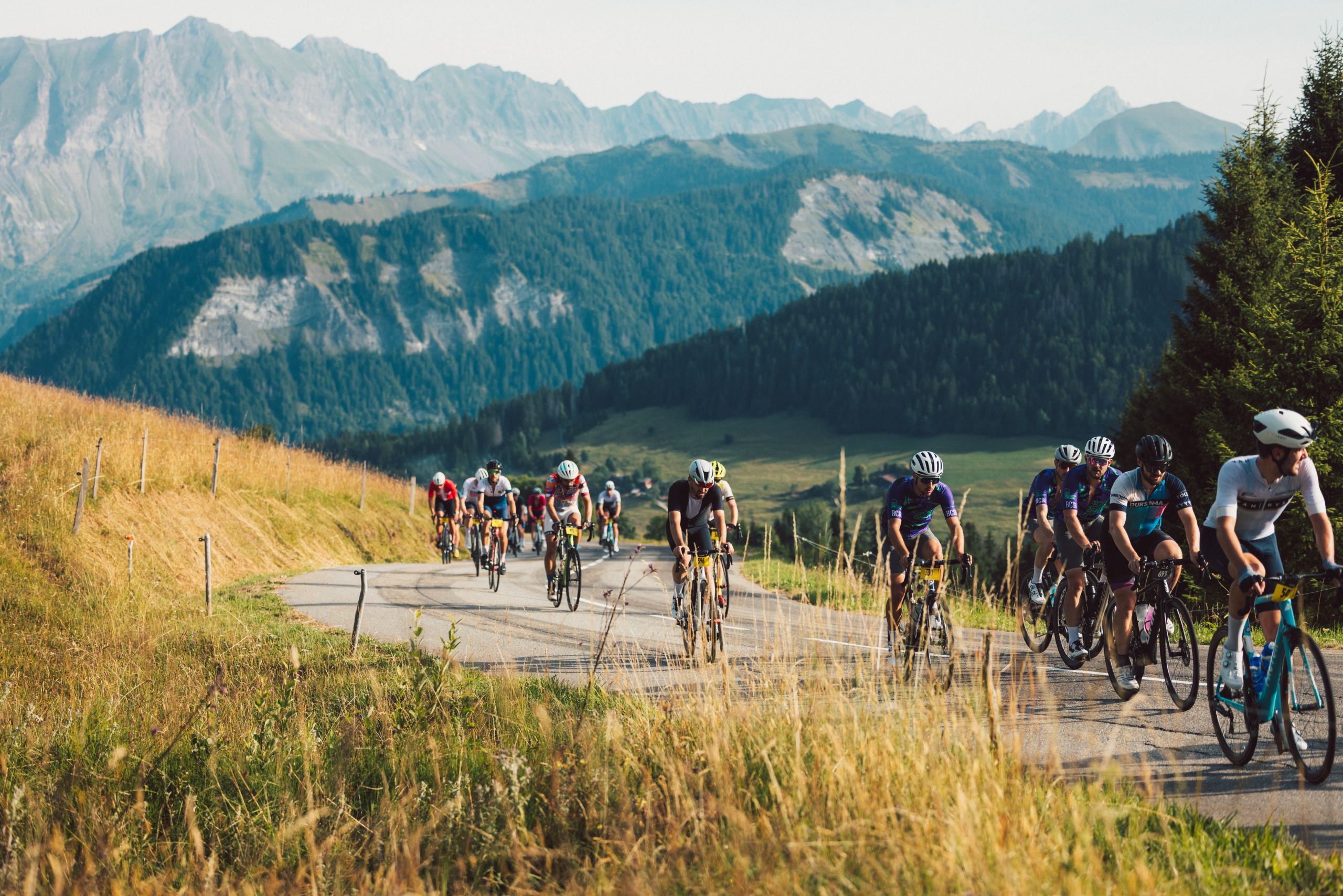
However, one study showed that recreational endurance athletes improved theirs by 30% after only six weeks of training. For this brief period, you’re leaning heavily on the anaerobic system to generate energy without oxygen.
When the oxygen supply meets demand, your aerobic system can sustainably power the effort at a constant rate (up to around 70% of your maximum heart rate).
“The speed at which your heart beats is no different between elites and recreational riders,” says La Gerche.
“No matter how hard you train, you can’t change that. But you can change its size. In general terms, the fitter you get, the bigger your heart is. A normal heart is around 300g – the size of a fist – while a Tour de France rider’s is up to a kilogram.”
Consistent training thickens the heart walls and increases chamber size. This is important during your sportive adventure due to stroke volume, which is the volume of blood pumped from the heart with each beat.
“During exercise your heart has about a 70% efficiency rate at pumping out blood. A 400g heart can accommodate around 200ml of blood, which means you’re pumping out around 140ml of blood with every beat,” says La Gerche.
“Professional cyclists’ chambers fill with around 400ml of blood. Apply that 70% figure and that’s 280ml of blood with every beat.”
Its importance becomes clear when you apply it to cardiac output, which is the amount of blood pumped out each minute.
If both our recreational and elite examples are riding at 135bpm, the former’s sending out 27l of blood each minute, while the latter’s pumping out 54l.
And as blood carries the oxygen and nutrients to serve your working muscles, you can see how a bigger, stronger heart can boost cycling performance.
This benefits higher-intensity efforts, too, because that greater blood flow also means swifter recovery between efforts, such as when the ascent undulates.
Which begs the question: during a tough ride, does your heart fatigue? “After five or six hours of intense exercise, we can put an ultrasound on the heart and see that the heart is fatigued,” says La Gerche.
“It’s easy to squeeze your leg muscles and see that they’re sore. But the effect on your heart is underestimated because it’s a silent partner. Just respect the challenge.”
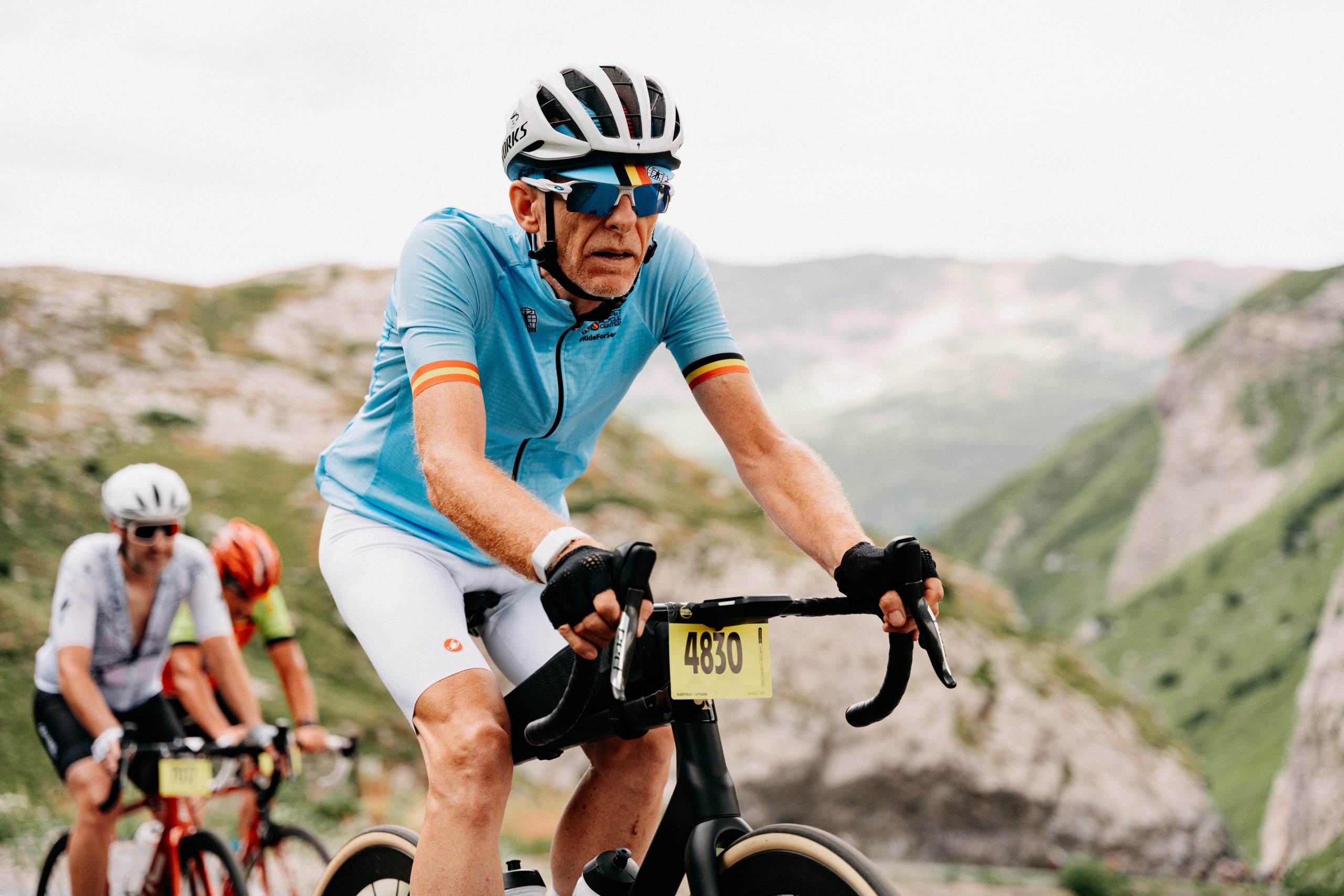
As the day rolls on, your muscular system also suffers, especially if you push it well beyond what you manage in training.
This is down partly to increasing the production of reactive oxygen species, or ROS, that results in oxidative stress in the blood and skeletal muscle itself.
Essentially, it’s down to the huge number of muscular contractions required to send you sky-rocketing over the next mountain and has been associated with accelerating muscle fatigue.
It’s also mooted to be one of the reasons behind delayed onset muscle soreness (aka DOMS). If you haven’t trained as much as you’d hoped, a well-balanced post-event diet, including antioxidant-rich fruit and veg, will help.
Power carbs

Why did our early ancestors eat each other? Because they saw each other as a nutritious snack, according to a 2017 study by James Cole, an archaeologist at Brighton University.
According to Cole’s calculations, the average human body contained 125,822cals. Much of that figure is down to fat’s high calorie content, with 1g furnishing 9cals. Even a WorldTour rider, who weighs only 60kg and has 7% body fat, has more than 37,000 stored fat calories.
So why do we bonk in a sportive? Well, that’s down to exercise intensity and the fact that you’re burning predominantly carbohydrates to avoid being swept up by the broom wagon.
“Your most readily accessed carbohydrate store is muscle glycogen, which is mooted at around 500g or 2,000cals,” says Tim Podlogar, nutritionist at Tudor Pro Cycling. “Riding at a high intensity, you can burn through this in two-and-a-half hours.”
This is why Podlogar recommends filling up your glycogen stores the day before. “That means multiple meals that are high in carbohydrate and low in fibre,” he says, “easy-to-digest foods such as white rice, white pasta and even Haribos.”
Also, avoid a gentle ride late on the eve of your big day because that’ll eat into your glycogen levels.
When it comes to race day, a high-carb breakfast further boosts glycogen stocks. Porridge, a buttered bagel or white toast and jam are popular.
And then it’s riding time. Many of you will already consume gels, bars and energy drinks in search of glucose replenishment, following a traditional 60-to-90g-an-hour strategy. You might be capable of more, however, especially if you’re one of the fitter cyclists out there.
“Our research shows that many amateur riders can handle 120g carbohydrate an hour,” he says, which goes some way to compensating for the 6,000cals-plus burned during a long day in the saddle. “At an elite level, we had many riders at last year’s Giro d’Italia who were consuming way more than that.”
Feeding should start from your first pedal stroke and, according to Podlogar, comprise sugar from solids only, keeping fluids to water because separating makes it easier to monitor how much sugar and fluid you’re consuming. You can go for an electrolyte drink, albeit Podlogar says you can tick this off from most gels.
But when should you feed to optimise the sugar hit? “I recommend to my riders that they fuel well downhill.
“You’re not pedalling so it’s easier to digest; the bloodflow to the intestines increases and so absorption improves.”
Three energy hits per hour – one bar and two gels, for instance – will boost your muscle glycogen levels. Not only should this prevent a sugar low, it could prevent muscle degradation, too.
“We know that your muscle is damaged if there’s insufficient glycogen around it; it’ll break down protein to a higher degree from the muscle itself in search of energy.”
Core values

Should your event be one of the big Alpine challenges, you could well be enduring temperatures over 30°C.
That means you’ll heat up like a nuclear reactor, which isn’t great because a swathe of biochemical reactions and nerve conductivity are optimised at around the 37°C mark.
But you can’t argue with science or, more precisely, the body’s inefficiency. “It’s around 20% efficient at generating energy,” says Chris Jones of body-temperature sensor outfit Core.
“That means for every 5cals of energy you burn, only 1cal is used for mechanical work. The remaining 4cals are released as heat energy.”
This means you’re almost combustible on steep ascents. Take WorldTour rider Simon Clarke, who Core monitored on stage 14 of the 2021 Tour de France, specifically a 100km stretch that included the ascent of the Col de Montségur: 4.2km at an average gradient of 8.7%.
“This section and the following ascent up the Col de la Croix de Morts saw the fastest increase in Clarke’s core body temperature, where it hit 39.2°C,” says Jones.
“The steeper the ascent, the faster the increase in core body temperature. This is because of the increased physical intensity and because there is less cooling from the wind at slower speeds.”
On the flipside, the rapid descent of Col de Montségur saw Clarke’s core drop to 38.1°C, which was below what it was when he started the climb.
This highlights that pacing is even more integral to reaching your goals when it’s hot, although your body will try its best to lose heat via the same way it gains it, namely radiation, convection and conduction.
Sweating is key to maintaining balance in the body. Around 580cals per litre of heat energy is needed to turn water from liquid to gas so it can evaporate from your skin (or your breath).
So, whenever water leaves your body via evaporation, a corresponding amount of heat also leaves your body into the surrounding air, helping you cool down. So, it’s great for cooling but clearly not wonderful for your water stores.
You can sweat over 1.5l an hour on a sweltering Alpine sportive. Covering those losses is difficult on two fronts: the practical side of drinking from a water bottle and the physical side of absorbing so much fluid.
It might be manageable for an hour, but the deeper a rider digs into a ride, the more uncomfortable the gut becomes. If you can manage 750ml an hour, that’s a good start.
Again, training will help cool your engine because low aerobic fitness makes you more susceptible to heat illness.
There’s a strong correlation between an individual’s aerobic capacity and their ability to offload heat. Studies show that if someone’s working at half their aerobic capacity, their core temperature reaches around 38°C.
If you and I do the same amount of work and you’re twice as fit as me, your core temperature will be lower and you’ll suffer less.
Beyond training, acclimatise from home by having a 15-minute hot bath after a ride. Doing this five or six times in the final two or three weeks before your event will really help.
“Dressing lightly will also help,” says Jones. “And keep it old-school by pouring water over your body and head. That can change your perception of the pain.”
Mental maths
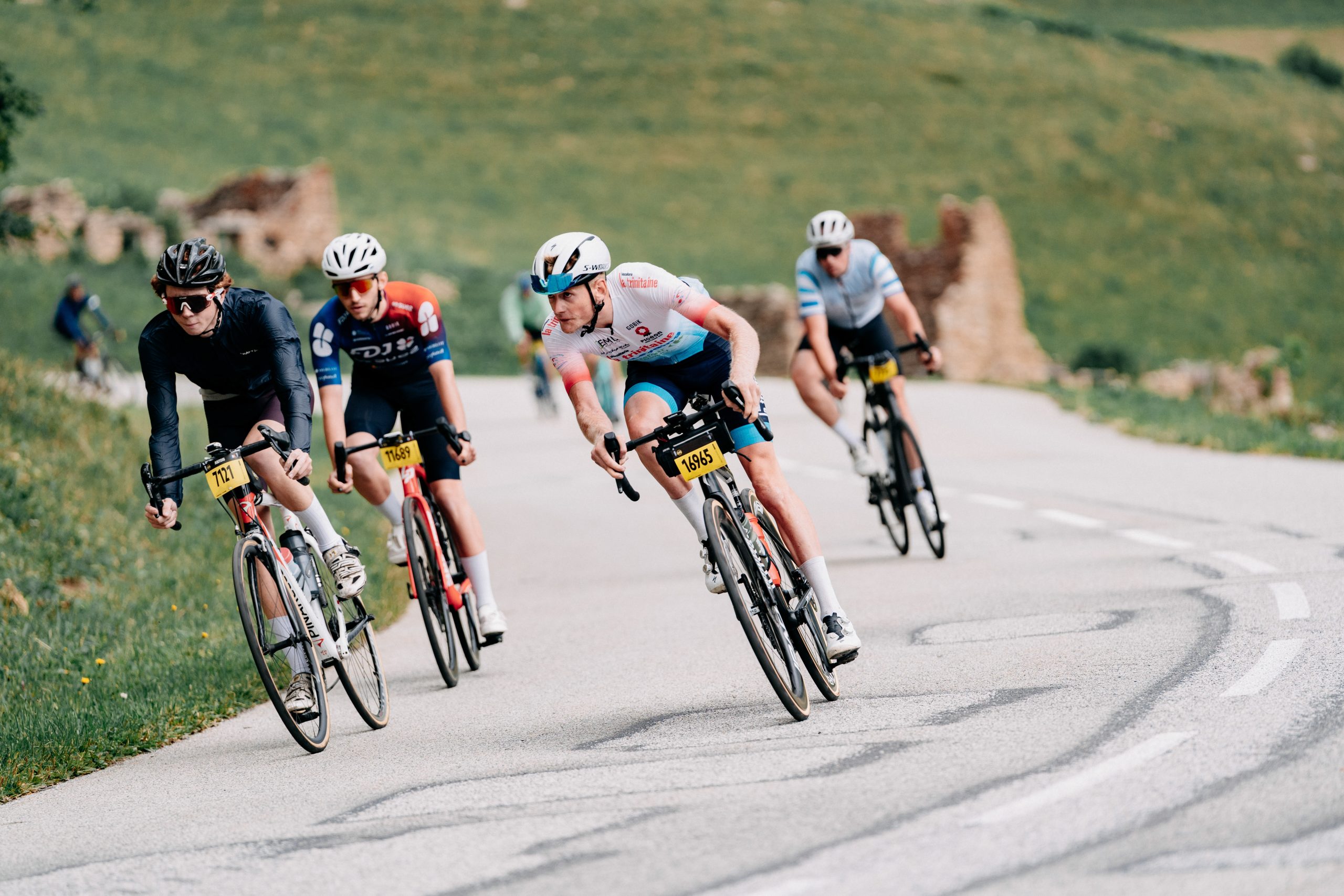
It’s not just your body that suffers during a sportive – your mind does, too, and you can be on the back foot from the start, according to a 2017 study, The Effects of Mental Fatigue on Physical Performance: A Systematic Review.
The authors showed that seven of eight key studies “reported that endurance performance was negatively affected by mental fatigue, which was evidenced by a decrease in time to exhaustion”. In short, don’t cause yourself unnecessary pre-race stress or you’ll be drained before the off.
Of course, even the most diligent planner can see motivation drop when they’re halfway up a mountain, miles from the finish line.
This, according to round-the-world record-holder Mark Beaumont, is to be expected and he calls it the ‘psychological arc’.
“You start fresh, dig deep at the end and finish strongly but there’s that bit in the middle where you’re far from starting and, in your head, far from finishing,” he told us. This is true whether you’re riding 50 miles or 500 miles.
To ride the arc rather than sink in, try some psychological games. Chunking is one of the most common and involves breaking the event down into smaller, more mentally manageable chunks.
If your next ascent features 10 hairpins, for example, tick off each hairpin. Many events supply a route sticker to smooth onto your top tube that can show natural chunks.
Ultimately, the biggest driver of your mental state is motivation. Take a 2008 study by Professor Samuele Marcora that involved 10 rugby players cycling at a fixed power output based on 90% of their VO2 max.
When they could no longer maintain that wattage, he had them ride as hard as they could for five extra seconds.
From an average power output of 242 watts in the test, despite apparent fatigue, they generated 731 watts.
The results convinced Marcora that fatigue is no physical phenomenon – if it was, how could the cyclists generate such power when they’d slowed down?
Instead, Marcora says your decision to slow or quit stems from two key areas – motivation and perception – and lays the foundations for his psychobiological model of fatigue.
When effort is perceived as maximal or when effort required eclipses the amount of effort you’re willing to exert, then you stop. In essence, fatigue is an increase in time of perception of effort.
Whether you agree with Marcora or not, one thing’s clear: despite your body’s suffering, it’s the mind that’ll often decide whether you reach the finish line or not.
Intel Prepares For KVM Guest VMs To Support Advanced Performance Extensions (APX)
Since Linux 6.16 the Intel APX support has been ready for the kernel infrastructure and goes along with the compiler toolchain support for Advanced Performance Extensions with the likes of GCC and LLVM/Clang. The latest element being worked on for APX enablement in the open-source/Linux world is for allowing KVM guest virtual machines (VMs) to make use of APX…
Linux 6.19-rc2 Adding Support For CRKD Guitar Controllers
Most notable with the input subsystem updates sent out today ahead of the Linux 6.19-rc2 release is some new hardware support. New this week is adding support for CRKD Guitars for those into musical gaming/apps…
WMI Marshalling Support For Linux Aims To Match Windows’ ACPI/WMI Handling
Open-source developer Armin Wolf has been working most recently on marshalling support for the Windows Management Instrumentation (WMI) platform code within the Linux kernel. This WMI marshalling support is to better match the behavior of Microsoft Windows’ WMI ACPI driver and ultimately to allow for better compatibility with some ACPI firmware and enhancing some WMI drivers…
Linux 6.19 Lands Fix For Seagate Barracuda HDD Taking Down The SATA Bus
It’s not often getting to talk about hard drives on Phoronix these days, but there’s an important fix merged to the Linux 6.19 kernel today ahead of Linux 6.19-rc2. If you happen to be using a Seagate ST2000DM008 Barracuda 2TB HDD, an important fix was merged to avoid it taking down the systems’ SATA bus and/or potentially other issues…
Why I Wouldn’t Want John Solomon’s New CMO Job at Mozilla
Firefox’s market share has cratered while Mozilla’s dependence on Google and executive pay have soared. We look at what John Solomon is really walking into.
The post Why I Wouldn’t Want John Solomon’s New CMO Job at Mozilla appeared first on FOSS Force.
Darktable 5.4 RAW Photography Software Reaches Parity Between X11 & Wayland
Darktable 5.4 is out today as the newest feature release to this open-source RAW photography software. Besides improving camera support, UI enhancements, and more the Wayland support has been improved with Darktable. With today’s Darktable 5.4 release, the Wayland support should be on par with the X11 support…
Steam Client Now Runs Fully 64-Bit on Windows 10 and 11
The Steam client is now 64-bit on Windows 10 and 11, while 32-bit Windows systems will continue receiving updates until 2026.
Immich 2.4 Released With Command Palette and UI Refinements
Immich 2.4, a self-hosted photo and video management platform, introduces a new command palette, refined UI animations, shared album improvements, and more.
Bell Labs ‘Unix’ Tape from 1974 Successfully Dumped to a Tarball
Archive.org now has a page with “the raw analog waveform and the reconstructed digital tape image (analog.tap), read at the Computer History Museum’s Shustek Research Archives on 19 December 2025 by Al Kossow using a modified tape reader and analyzed with Len Shustek’s readtape tool.” A Berlin-based retrocomputing enthusiast has created a page with the contents of the tape ready for bootstrapping, “including a tar file of the filesystem,” and instructions on dumping an RK05 disk image from tape to disk (and what to do next).
Research professor Rob Ricci at the University of Utah’s school of computing posted pictures and video of the tape-reading process, along with several updates. (“So far some of our folks think they have found Hunt The Wumpus and the C code for a Snobol interpreter.”)
University researcher Mike Hibler noted the code predates the famous comment “You are not expected to understand this” — and found part of the C compiler with a copyright of 1972.
The version of Unix recovered seems to have some (but not all) of the commands that later appeared in Unix v5, according to discussion on social media. “UNIX wasn’t versioned as we know it today,” explains University of Utah PhD student Thalia Archibald, who researched early Unix history (including the tape) and also worked on its upload. “In the early days, when you wanted to cut a tape, you’d ask Ken if it was a good day — whether the system was relatively bug-free — and copy off the research machine… I’ve been saying It’s probably V5 minus a tiny bit, which turned out to be quite true.”


Read more of this story at Slashdot.
MIT and Apache 2.0 Lead Open Source Licensing in 2025
According to the Open Source Initiative, MIT and Apache 2.0 remain the most widely used open source licenses in 2025.