Meta Just Bought Manus, an AI Startup Everyone Has Been Talking About

Meta has agreed to acquire viral AI agent startup Manus, “a Singapore-based AI startup that’s become the talk of Silicon Valley since it materialized this spring with a demo video so slick it went instantly viral,” reports TechCrunch. “The clip showed an AI agent that could do things like screen job candidates, plan vacations, and analyze stock portfolios. Manus claimed at the time that it outperformed OpenAI’s Deep Research.” From the report: By April, just weeks after launch, the early-stage firm Benchmark led a $75 million funding round that assigned Manus a post-money valuation of $500 million. General partner Chetan Puttagunta joined the board. Per Chinese media outlets, some other big-name backers had already invested in Manus at that point, including Tencent, ZhenFund, and HSG (formerly known as Sequoia China) via an earlier $10 million round.

Though Bloomberg raised questions when Manus started charging $39 or $199 a month for access to its AI models (the outlet noted the pricing seemed “somewhat aggressive… for a membership service still in a testing phase,”) the company recently announced it had since signed up millions of users and crossed $100 million in annual recurring revenue. That’s when Meta started negotiating with Manus, according to the WSJ, which says Meta is paying $2 billion — the same valuation Manus was seeking for its next funding round.

For Zuckerberg, who has staked Meta’s future on AI, Manus represents something new: an AI product that’s actually making money (investors have grown increasingly twitchy about Meta’s $60 billion infrastructure spending spree). Meta says it’ll keep Manus running independently while weaving its agents into Facebook, Instagram, and WhatsApp, where Meta’s own chatbot, Meta AI, is already available to users.


Read more of this story at Slashdot.

PhDs Can’t Find Work as Boston’s Biotech Engine Sputters

The Wall Street Journal reports that Boston’s once-booming biotech sector has hit a sharp downturn, leaving newly minted Ph.D.s struggling to find work as venture funding dries up, lab space sits empty, and companies downsize or relocate amid rising costs and policy uncertainty. The Wall Street Journal reports: Boston’s biotech sector, long a vital economic engine for one of America’s wealthiest metro areas, is sputtering. A double whammy of cutbacks in venture capital and government funding have taken a toll, leading to layoffs and struggles for job seekers. For workers who thought they would easily launch into a well-paying science career, the downturn has been especially harsh.

Massachusetts experienced a slight decline in its roughly 65,000 biotech research-and-development jobs in 2024 after years of mostly strong increases, including during the Covid-19 pandemic, according to federal data. The numbers indicate that job losses continued through at least June, while hiring remains sluggish. By the end of September, nearly 28% of greater Boston’s laboratory space sat empty, according to the latest estimates from real-estate firm CBRE. “Every stage of the life cycle has been impacted by policy or regulatory uncertainty this year,” said Kendalle Burlin O’Connell, chief executive of MassBio, an industry trade group. The impact has hit startups especially hard, she said.

A continued downturn poses risks for a region where workers will put up with sky-high real-estate costs if they can land high-paying jobs. Massachusetts faces competition from other states and China, which are eager to peel away talent and investment. “There are states and countries chasing us every single day,” Gov. Maura Healey said in an interview. In late October, the Democrat testified before the Massachusetts legislature in support of a $400 million “competitiveness agenda” that she is seeking to spur new investment and supplement research funding lost this year. Lawmakers are reviewing the bill, a House spokesman said.


Read more of this story at Slashdot.

Russian Enthusiasts Planning DIY DDR5 Memory Amidst Worldwide Shortage

Amid a global DDR5 shortage and soaring prices, Russian hardware enthusiasts are experimenting with do-it-yourself DDR5 RAM by sourcing empty PCBs and soldering memory chips by hand. Tom’s Hardware reports: The idea comes from Russian YouTuber PRO Hi-Tech’s Telegram channel, where a local enthusiast known as “Vik-on” already performs VRAM upgrades for GPUs, so this is a relatively safe operation for him. According to Vik-on, empty RAM PCBs can be sourced from China for as little as $6.40 per DIMM. The memory chips themselves, though, that’s a different challenge.

The so-called spot market for memory doesn’t really exist at the moment, since no manufacturer has the production capacity to make more RAM, and even if they did, they’d sell to better-paying AI clients instead. Still, you can find SK Hynix and Samsung chips across Chinese marketplaces if you search for the correct part number, as shown in the attached screenshots.

Moreover, the Telegram thread says it would cost roughly 12,000 Russian Rubles ($152) to build a 16 GB stick with “average” specs, which is about the same as a retail 16 GB kit. There’s also a ZenTimings snapshot showing CL28 timings, claiming that even relatively high-end DDR5 RAM can be built using this method, but it won’t be cost-effective. Therefore, it doesn’t make too much sense just yet to get the BGA rework station out and assemble your own DDR5. Things are expected to get worse, though, so maybe these Russians are on to something.


Read more of this story at Slashdot.

It Took 6+ Years For Linux’s “New” Mount API To Be Properly Documented In Man Pages

In demonstrating one of the gaps of man pages in modern times and likely having hindered the adoption of the Linux kernel’s new mount API, it took more than six years for those system calls to be properly documented within man pages. The Linux “new” mount API was introduced back in mid-2019 with Linux 5.2 and since supported by key file-systems after several years but not until weeks ago was this file descriptor based mount API scoped out within man pages…

‘Pull Over and Show Me Your Apple Wallet’

Longtime Slashdot reader theodp writes: MacRumors reports that Apple plans to expand iPhone and Apple Watch driver’s licenses to 7 U.S. states (CT, KY, MS, OK, UT, AR, VA). A recent convert is the State of Illinois, whose website videos demo how you can use your Apple Wallet license to display proof of identity or age the next time you get carded by a cop, bartender, or TSA agent. The new states will join 13 others who already offer driver’s licenses in the Wallet app (AZ, MD, CO, GA, OH, HI, CA, IA, NM, MT, ND, WV, IL).

There’s certainly been a lot of foot-dragging by the states when it comes to embracing phone-based driver’s licenses — Slashdot reported that Iowa was ready to launch a mobile driver’s license in 2014; they didn’t get one until nearly a decade later, in late 2023.


Read more of this story at Slashdot.

Tough Job Market Has People Using Dating Apps To Get Interviews

An anonymous reader quotes a report from Bloomberg: Most people use dating apps to find love. Tiffany Chau used one to hunt for a summer internship. This fall, the 20-year-old junior at California College of the Arts tailored her Hinge profile to connect with people who could offer job referrals or interviews. One match brought her to a Halloween party, where she networked in hopes of landing a product-design internship for the summer. While there, she got some tips from someone who had recently interviewed at Accenture. As for the connection with her date? Not so much. “I feel like my approach to the dating apps is it being another networking platform like everything else, like Instagram or LinkedIn,” Chau said.

Chau is among a cadre of workers who are using dating apps to boost their job searches. They’re recognizing that the online job hunt is broken as unemployed workers flood the system, AI screens out resumes and many job matching programs are overwhelmed. Automation has squeezed human contact out of hiring, which has pushed applicants to seek any path to a live hiring manager, no matter the means.

The overall US unemployment rate continued to climb throughout 2025, reaching 4.6%, according to the Bureau of Labor Statistics. And while the number of unemployed high school graduates held steady at about 4.4% in November, the rate for workers with a bachelor’s degree rose to 2.9% from 2.5% a year ago. About a third of dating app users said they had sought matches for job hook-ups, according to a ResumeBuilder.com survey of about 2,200 US dating site customers in October. Two-thirds targeted potential paramours who worked at a desirable employer. Three-quarters said they matched with people working in roles they wanted. “People are doing it to expand their networks, make connections, because the best way to get a job today is who you know,” said Stacie Haller, ResumeBuilder.com’s chief career advisor. “Networking is the only way people are rising above the horror show that the job search is today.”


Read more of this story at Slashdot.

Sam Altman Offers $555K Salary To Fill Most Daunting Role In AI

OpenAI is offering a $555,000 salary (plus equity) to recruit a new “head of preparedness,” a high-pressure role tasked with anticipating and mitigating extreme AI risks. “This will be a stressful job, and you’ll jump into the deep end pretty much immediately,” said Sam Altman as he launched the hunt to fill “a critical role” to “help the world.” The Guardian reports: In what may be close to the impossible job, the “head of preparedness” at OpenAI will be directly responsible for defending against risks from ever more powerful AIs to human mental health, cybersecurity and biological weapons. That is before the successful candidate has to start worrying about the possibility that AIs may soon begin training themselves amid fears from some experts they could “turn against us.”

The successful candidate will be responsible for evaluating and mitigating emerging threats and “tracking and preparing for frontier capabilities that create new risks of severe harm.” Some previous executives in the post have lasted only for short periods. Altman said on X as he launched the job search: “We have a strong foundation of measuring growing capabilities, but we are entering a world where we need more nuanced understanding and measurement of how those capabilities could be abused, and how we can limit those downsides both in our products and in the world, in a way that lets us all enjoy the tremendous benefits. These questions are hard and there is little precedent.”

One user responded sardonically: “Sounds pretty chill, is there vacation included?” What is included is an unspecified slice of equity in OpenAI, a company that has been valued at $500 billion.


Read more of this story at Slashdot.

Nvidia Takes $5 Billion Stake In Intel Under September Agreement

Nvidia has completed its previously announced $5 billion investment in Intel, buying over 214 million shares at a fixed price after the deal received clearance from Federal Trade Commission. “The leading AI chip designer said in September it would pay $23.28 per share for Intel common stock, in a deal that is seen as a major financial lifeline for the chipmaker after years of missteps and capital intensive production capacity expansions drained its finances,” reports Reuters.


Read more of this story at Slashdot.

Watching A Completely Transparent Dishwasher Running

Because the things that happen behind closed doors are usually the steamiest things to happen (especially in this case), YouTuber GopherDope (easily some of my favorite dope, beaverdope too) went and constructed a clear dishwasher to see what happens in there during a wash cycle. SPOILER: lots of water blasting everywhere. Looks like it gets the dishes pretty clean though. My dishwasher? It stops after it can’t see any more food particles, then starts licking the floor. “You’re talking about your dog.” You’re very perceptive. *offering plate* Care for a cookie? “I’ll pass.” Smart too.

US can’t deport hate speech researcher for protected speech, lawsuit says

Imran Ahmed’s biggest thorn in his side used to be Elon Musk, who made the hate speech researcher one of his earliest legal foes during his Twitter takeover.

Now, it’s the Trump administration, which planned to deport Ahmed, a legal permanent resident, just before Christmas. It would then ban him from returning to the United States, where he lives with his wife and young child, both US citizens.

After suing US officials to block any attempted arrest or deportation, Ahmed was quickly granted a temporary restraining order on Christmas Day. Ahmed had successfully argued that he risked irreparable harm without the order, alleging that Trump officials continue “to abuse the immigration system to punish and punitively detain noncitizens for protected speech and silence viewpoints with which it disagrees” and confirming that his speech had been chilled.

Read full article

Comments

Stingless Bees From the Amazon Granted Legal Rights in World First

Stingless bees from the Amazon have become the first insects to be granted legal rights anywhere in the world, in a breakthrough supporters hope will be a catalyst for similar moves to protect bees elsewhere. From a report: It means that across a broad swathe of the Peruvian Amazon, the rainforest’s long-overlooked native bees — which, unlike their cousins the European honeybees, have no sting — now have the right to exist and to flourish. Cultivated by Indigenous peoples since pre-Columbian times, stingless bees are thought to be key rainforest pollinators, sustaining biodiversity and ecosystem health.

But they are faced with a deadly confluence of climate change, deforestation and pesticides, as well as competition from European bees, and scientists and campaigners have been racing against time to get stingless bees on international conservation red lists. Constanza Prieto, Latin American director at the Earth Law Center, who was part of the campaign, said: “This ordinance marks a turning point in our relationship with nature: it makes stingless bees visible, recognises them as rights-bearing subjects, and affirms their essential role in preserving ecosystems.”


Read more of this story at Slashdot.

NTFSPLUS Linux Driver Renamed To Just “NTFS” With Latest Code Restructuring

One of the unexpected Linux kernel surprises of 2025 was NTFSPLUS being announced as a new driver for Microsoft’s NTFS file-system with better performance and more features compared to the classic read-only NTFS driver or the “NTFS3” kernel driver that Paragon Software submitted upstream. That NTFSPLUS driver has continued expanding its feature set and robustness and sent out today was the third iteration of the patches. Now this driver is simply being called “NTFS” with no longer going by the NTFSPLUS name…

After a Decade of Dead Ends, $70 Million Rides on Locating Flight MH370

More than a decade after Malaysia Airlines flight MH370 vanished over the Indian Ocean en route from Kuala Lumpur to Beijing, the marine robotics company that located Sir Ernest Shackleton’s Endurance is preparing to resume its hunt for the missing Boeing 777. Ocean Infinity, a UK and US-based seabed survey firm, began searching a 15,000 sq km priority area in the Indian Ocean in February but called off the expedition in April after 22 days due to poor weather conditions.

The company plans to resume operations on December 30 for 55 days under a $70 million “no find, no fee” contract from the Malaysian government. The company has already covered nearly 10,000 sq km and intends to search another 25,000 sq km. Richard Godfrey, an independent aviation investigator, estimates Ocean Infinity has spent “tens of millions of dollars” on ships and equipment. “I don’t think they’re in this for the monetary reward of $70m, because this search is very, very expensive,” Godfrey says. “I think they’re in this for the achievement and their ability to market themselves as the greatest underwater-search firm in the world because they found MH370.”

The search relies on Hugin 6000 autonomous underwater vehicles capable of mapping the ocean floor at depths up to 6,000 metres using sonar, laser, and acoustic technology. Each AUV can operate independently for 100 hours before surfacing. The machines carry magnetometers that can detect metal buried under several metres of sediment. The story adds: One of the biggest challenges Ocean Infinity faces is the risk of being very close to the MH370 wreckage and missing it because of difficult terrain or gaps in the survey data.


Read more of this story at Slashdot.

CD Projekt Founder Buys GOG, Promising Stability And Few Changes

CD Projekt Founder Buys GOG, Promising Stability And Few Changes
GOG has just been acquired by its original co-founder, Michał Kiciński, and in an industry where acquisitions usually signal disruption, consolidation, or slow erosion of consumer-friendly policies, the most notable thing about this one is just how little is expected to change about the GOG user experience. To be clear, that’s not a complaint;

NASA finally has a leader, but its future is no more certain

After a rudderless year and an exodus of around 4,000 employees due to Trump administration cuts, NASA got what may be its first piece of good news recently. On December 17, the Senate confirmed billionaire Jared Isaacman as the agency’s new administrator. He now holds the power to rehabilitate a battered engine of scientific research, or steer it towards even more disruption. 

Considering the caliber of President Trump’s other appointees, Isaacman is probably the best candidate for the job. Outside of being a successful entrepreneur, he has flown fighter jets and been to space twice as part of the Inspiration4 and Polaris Dawn private missions. One of those flights saw him complete the first commercial space walk, and travel farther from Earth than any human since the end of the Apollo program.   

“Perfect is the enemy of the good. Isaacman checks a lot of boxes,” says Keith Cowing, a former NASA employee and the founder of NASA Watch, a blog dedicated to the agency. “He’s passed every requirement to fly in a spacecraft that American astronauts at NASA are required to pass. He also went out of his way to have a diverse crew, and shove as much science as he could in those missions.” 

And yet if you’re a NASA employee or just someone who cares about the agency’s work, there are still plenty of reasons to be concerned for its future. When Trump first nominated Isaacman in the spring, the billionaire wrote a 62-page document detailing his vision for NASA. In November, Politico obtained a copy of that plan, titled Project Athena.

To some insiders, Project Athena painted a picture of someone who, at least at the time when it was written, fundamentally misunderstood how NASA works and how scientific discovery is funded in the US and elsewhere. It also suggests Isaacman may be more open to Trump’s NASA agenda than would appear at first glance.   

When asked about the plan by Politico, one former NASA official characterized it as “bizarre and careless.” Another called it “presumptuous,” given many of the proposed changes to the agency’s structure would require Congressional approval. In one section, Isaacman recommended taking “NASA out of the taxpayer funded climate science business and [leaving] it for academia to determine.” In another section, he promised to evaluate the “relevance and ongoing necessity” of every agency center, particularly NASA’s iconic Jet Propulsion Laboratory, saying the facility and others must increase the “output and time to science KPI.” 

A lot has changed since Isaacman first wrote that document. It came before the workforce cuts, before the future of Goddard Space Flight Center became uncertain and before Trump surprised everyone by renominating Isaacman. But during his Senate testimony earlier this month, the billionaire said “I do stand behind everything in the document, even though it was written seven months ago. I think it was all directionally correct.”  

He did appear to distance himself from some viewpoints expressed in or inferred by Project Athena, however. Isaacman stated that “anything suggesting that I am anti-science or want to outsource that responsibility is simply untrue.” He also came out against the administration’s plan to cut NASA’s science budget nearly in half, claiming the proposals would not lead to “an optimal outcome.”

One thing is clear, Isaacman is not your typical bureaucrat. “One of the pitfalls of some prior NASA administrators has been that they’ve shown too much reverence for the internal processes and bureaucratic structure of the agency to the detriment of decision-making and performance,” said Casey Drier, chief of space policy at The Planetary Society, a nonprofit that advocates for the exploration and study of space. “Isaacman has positioned himself as the opposite of that. Clearly, that’s something that could lead to a lot of political and congressional challenges if taken too far.”   

Even if Isaacman doesn’t follow through on any of the proposals made in Project Athena, there’s only so much a NASA administrator — even one sympathetic to civil servants working under them — can do. 

“Once a budget request goes out publicly, everyone in the administration has to defend it. Anything he does will have to be internal and private,” Drier explains. “He never explicitly criticized the administration during his hearing. He’s also coming relatively late in the budget process.”    

A lot of NASA’s future will depend on the White House Office of Management and Budget (OMB), which is responsible for implementing the president’s agenda across the executive branch. As a direct result of guidance the OMB issued over the summer, NASA awarded 25 percent fewer new grants in 2025 than it did on average between 2020 and 2024.   

“The OMB has added layers of requirements that scientists now have to go through to spend the money they’ve already been allocated. The administration has worked against its own stated goals of efficiency,” Drier said. “Isaacman can’t solve that himself. He can’t tell the OMB what to do. That’s going to be a serious challenge.” 

Looming over everything is the fact NASA still does not have a full-year budget for 2026. Congress has until January 30 to fund NASA and the rest of the federal government before the short-term funding bill it passed on November 12 runs out. “On paper, the official policy of the administration is still to terminate a third of NASA’s scientific capability,” Drier points out.

There are reasons to be cautiously optimistic. Publicly, both the House and Senate have come out against Trump’s funding cuts. And some science missions that were slated to be cancelled, such as OSIRIS-APEX, have been approved for another full year of operations.   

What NASA needs now is someone who will, as Drier puts it, “vigorously advocate” for the agency in whatever way they can. It remains to be seen if that’s Jared Isaacman.

This article originally appeared on Engadget at https://www.engadget.com/science/space/nasa-finally-has-a-leader-but-its-future-is-no-more-certain-201109072.html?src=rss

How Windows 10 Earned Its Good Reputation While Planting the Seeds of Windows 11’s Problems

Windows 10’s formal end-of-support arrived in October, and while the operating system is generally remembered as one of the “good” versions of Windows — the most widely used since XP — many of the annoyances people complain about in Windows 11 actually started during the Windows 10 era, ArsTechnica writes.

Windows 10 earned its positive reputation primarily by not being Windows 8. It restored a version of the traditional Start menu, rolled out as a free upgrade to Windows 7 and 8 users, and ran on virtually all the same hardware as those older versions. Microsoft introduced the Windows Subsystem for Linux during this period and eventually rebuilt Edge on Chromium. The company seemed more willing to meet users where they were rather than forcing them to change their behavior.

But Windows 10 also began collecting more information about how users interacted with the operating system, cluttered the lock screen with advertisements and news articles, and added third-party app icons to the Start menu without user consent. The mandatory Microsoft Account sign-in requirement — one of Windows 11’s most frequently complained-about features — was a Windows 10 innovation, easier to circumvent at the time but clearly a step down the road Windows 11 is currently traveling.

To be sure, Windows 11 has made things worse by stacking new irritants on top of old ones. The Microsoft Account requirement expanded to both Home and Pro editions, the SCOOBE screen now regularly nags users to “finish setting up” years-old installations and Microsoft’s Copilot push changed the default PC keyboard layout for the first time in 30 years.


Read more of this story at Slashdot.

So, I Tried an AI Shopping Cart

The first supermarket, the Piggly Wiggly in Memphis, opened its doors in 1916. It was the first time people could wander around a store and pick their items from a shelf instead of handing a list to a clerk who would gather everything for them—typically without any choice of brand or style. Grocery shopping remains a daily or weekly ritual for most people, and it can be a real chore—especially if you’re shopping for a large family. My own grocery lists aren’t all that long, but I still find myself juggling my phone and a scrap of paper as I walk around the store, checking for digital coupons and trying to do quick math. So when I read that one of the local grocery stores (a ShopRite) was rolling out Smart Shopping Carts powered by artificial intelligence (AI), I was intrigued.

I’m naturally dubious about a lot of AI tools, but grocery shopping seemed like a place where a little digital help might come in handy. So I headed out to see whether these fancy new carts would offer real benefits or just a lot of targeted advertisements.

What are caper carts?

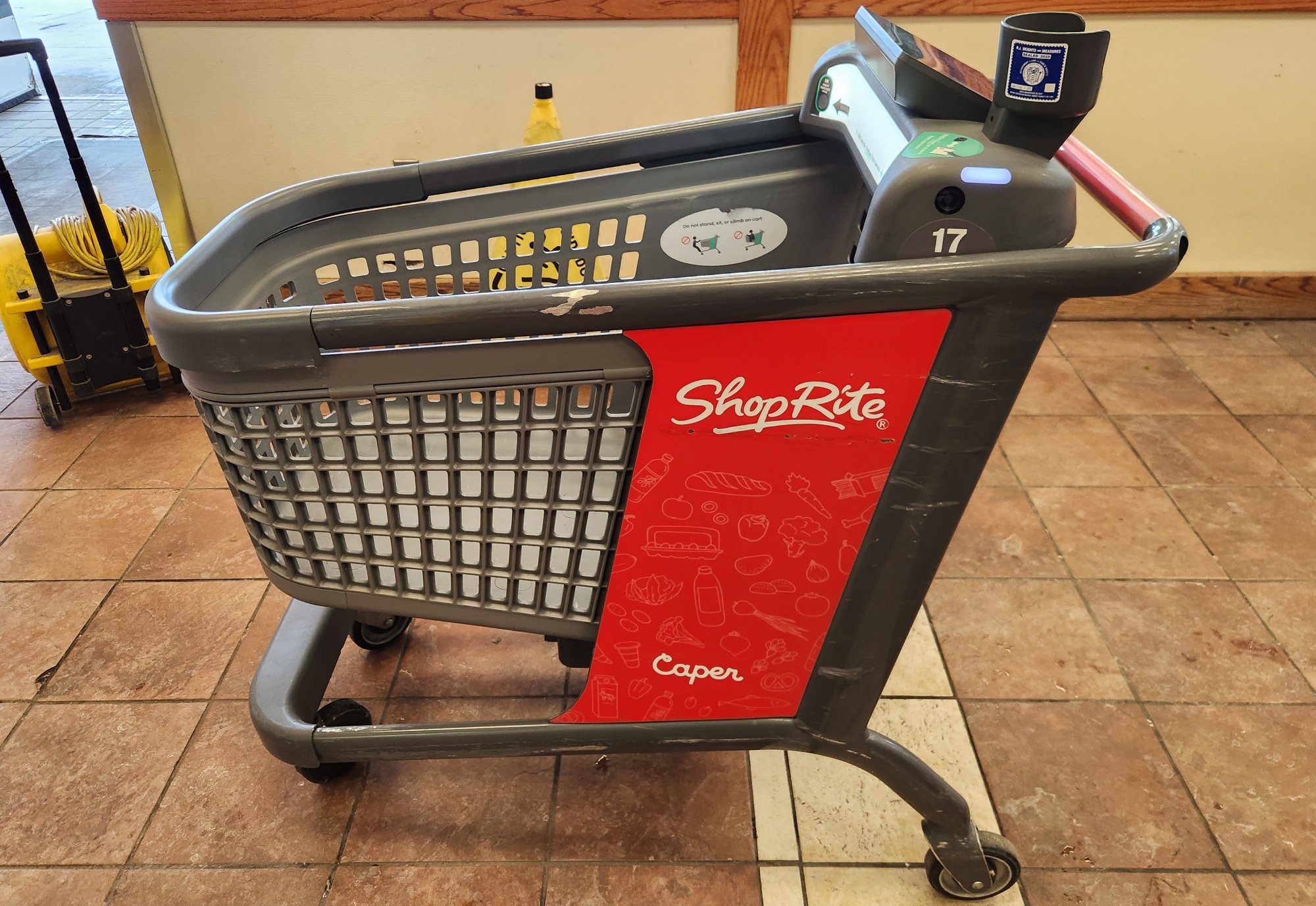
The carts in question are Caper Carts, which is owned by Instacart. They’re pretty large and tank-like, and kind of heavy to push.

A Caper Cart
The Caper Carts are pretty big and heavy.
Credit: Jeff Somers

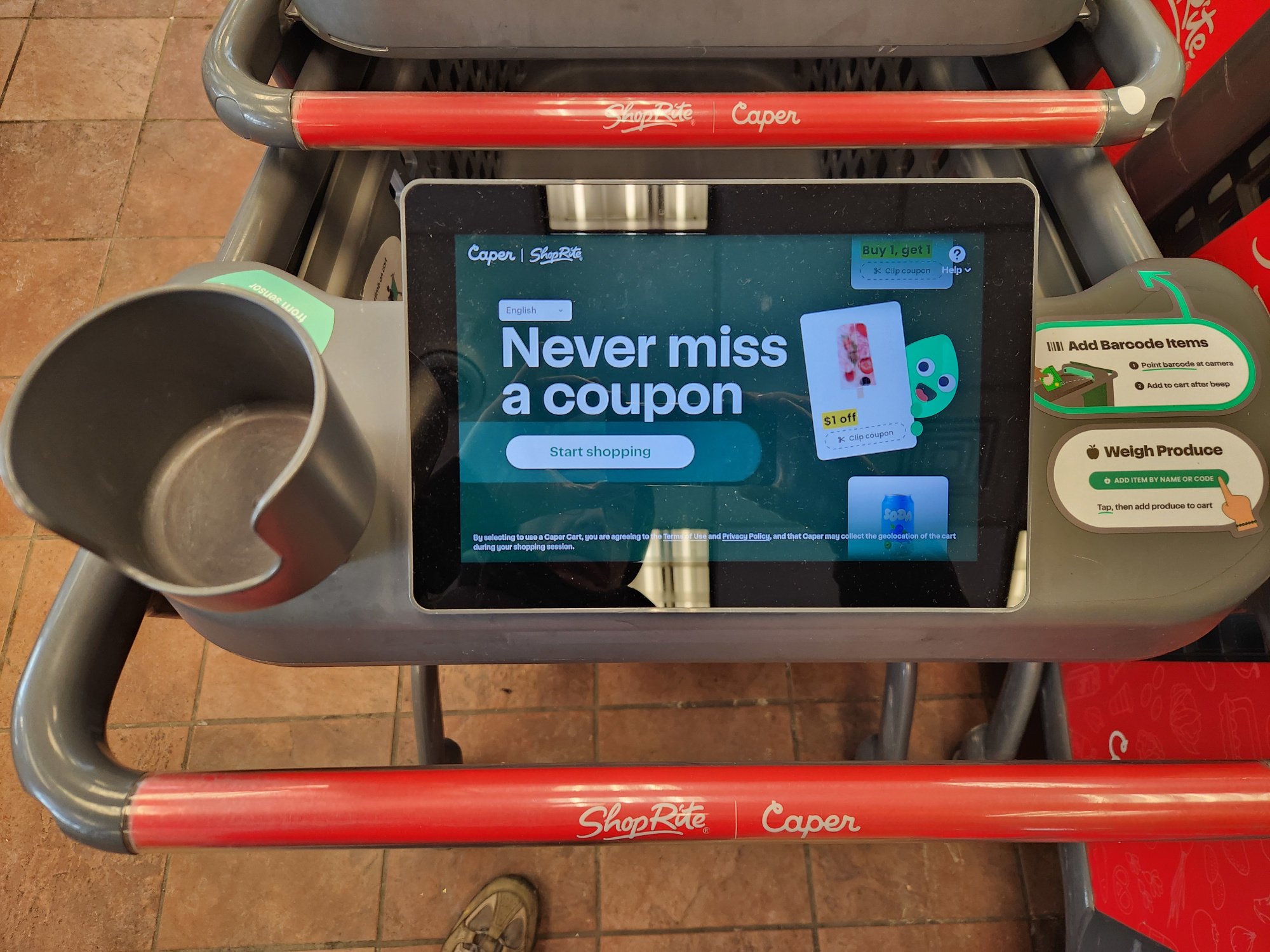
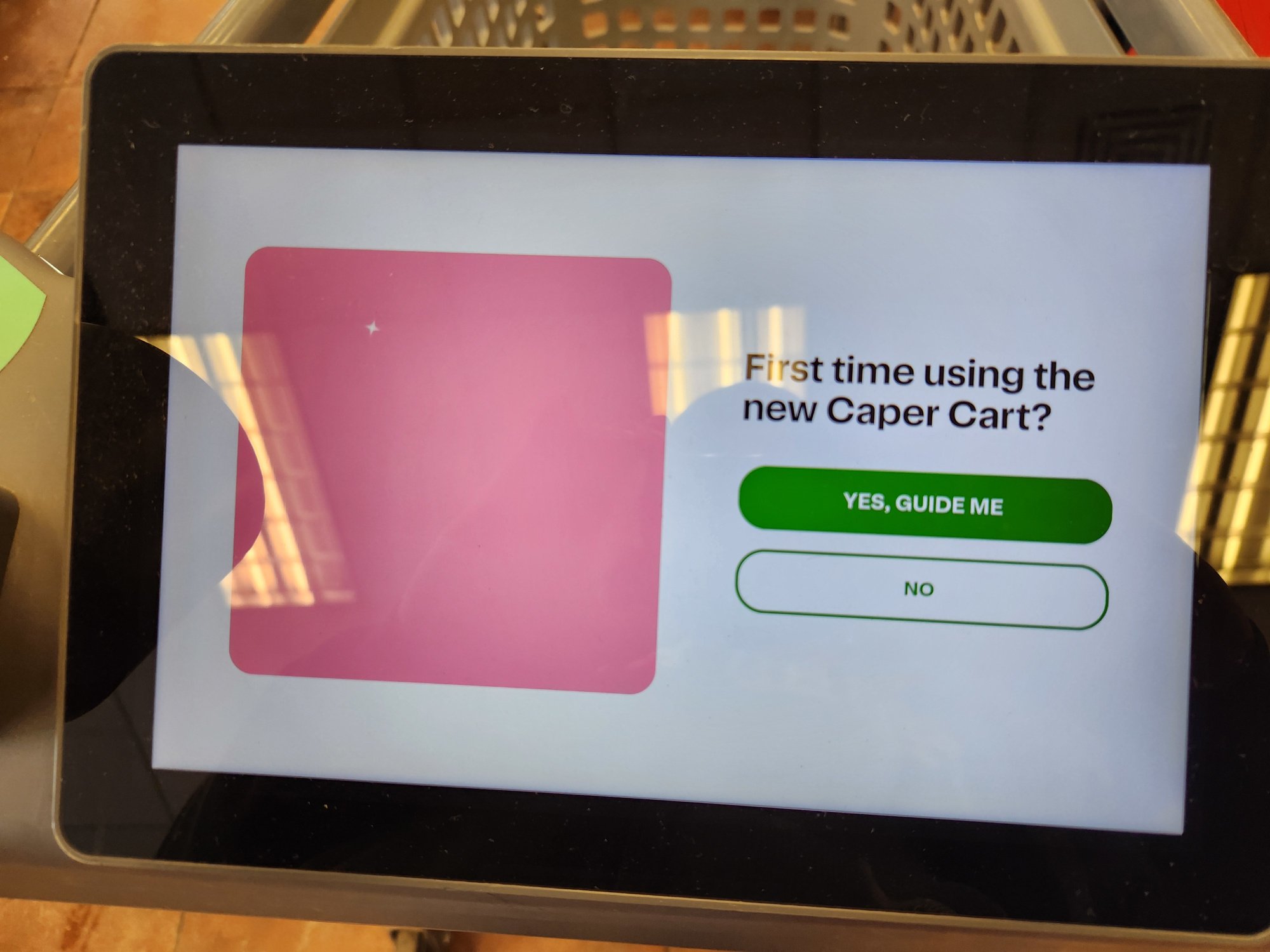
You need to have an account with ShopRite in order to use these carts, as they use your phone number to track your purchases; you can choose to store a credit card or other form of payment in there for convenience, but it’s not required. When you walk in the store, the Caper Carts are right there in the entrance area. When you pull one out, the screen lets you enter your phone number, then offers you a (mercifully brief) tutorial.

The Caper Cart screen
The welcome screen on the AI shopping cart.
Credit: Jeff Somers

The log-in screen
The log-in screen
Credit: Jeff Somers

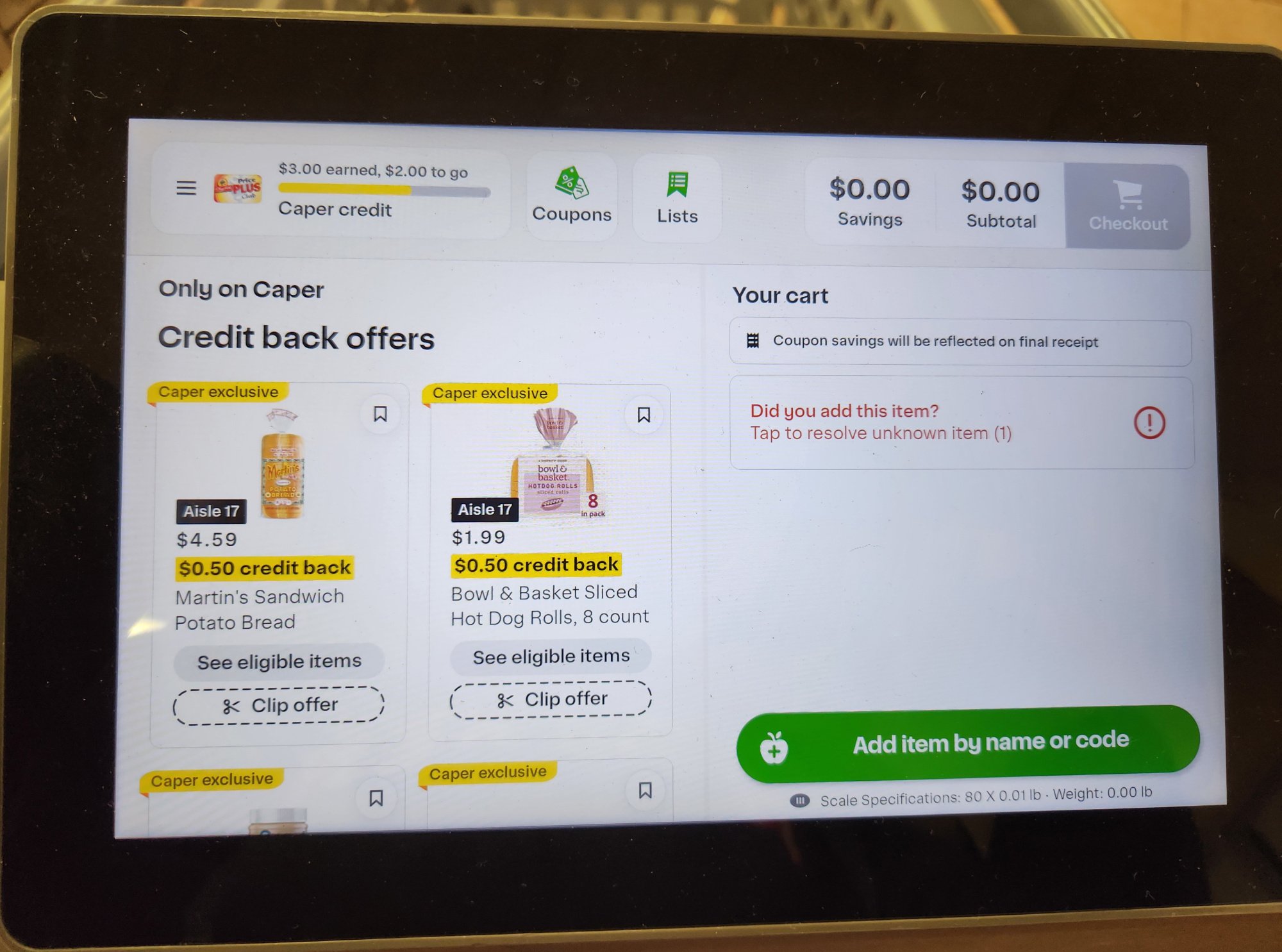
The carts have barcode scanners mounted on both sides of the back of the cart, and the cart itself is a scale, which is both how it ensures you’ve scanned everything in the cart and how it calculates the cost of loose produce. If you’ve ever used a self-checkout in a grocery store, it’s kind of similar: You hold items up to the scanners and then drop them into your cart. For produce, you look up what you’re buying and then drop it into the cart, where it’s weighed and added to the total. Along the way, the cart will look for potential coupons or deals you might be interested in. The carts can import your shopping lists from the store’s app, if you want, and will keep track of your loyalty points and rewards as well.

How to use a Caper Cart

The first Caper Cart I selected didn’t work; nothing would scan no matter how I held things up to the scanners. This wasn’t a big deal—I let the store folks know, logged out of the cart, and grabbed another. The second cart worked perfectly.

The  Caper Cart screen while shopping
The Caper Cart screen while shopping
Credit: Jeff Somers

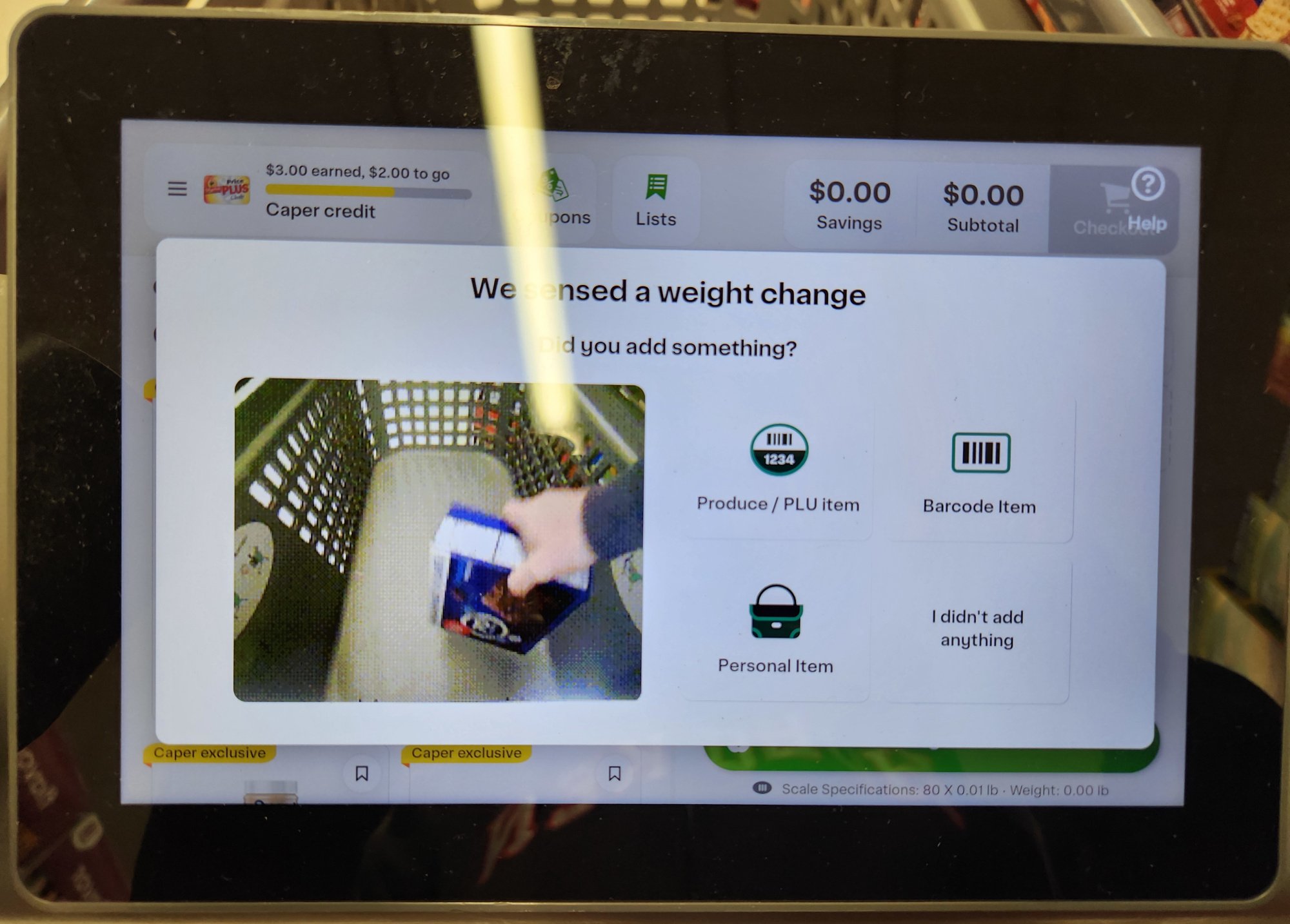
These carts are pretty heavy, and the second cart I used had a loose wheel which made it rumble loudly as I walked the aisles—you aren’t going to be racing these carts and jumping on for a quick glide. When I dropped an item in the cart without scanning it, the cart politely showed me a video of me placing the item (creepy) and asked if I wanted to fess up to adding something to the cart. It did, however, give me the option to declare a “personal item,” which is a solid feature.

A video pops up if you try putting an un-scanned item in the cart
Credit: Jeff Somers

I forgot to put my shopping bags in the cart, because I am frequently dumb. You’re supposed to bag as you go, which saves you time; I had to bag after checkout, which did not save me time. On the other hand, I don’t always shop in bagging order, so bagging as I go might result in some of my items getting crushed under heavier groceries, or me having to re-arrange everything in the middle of the shopping experience. I kind of like bagging at the end, when I can make decisions about how to arrange everything optimally.

If you change your mind about an item, you just remove it from the cart. The Caper system will notice and remove the item from your bill.

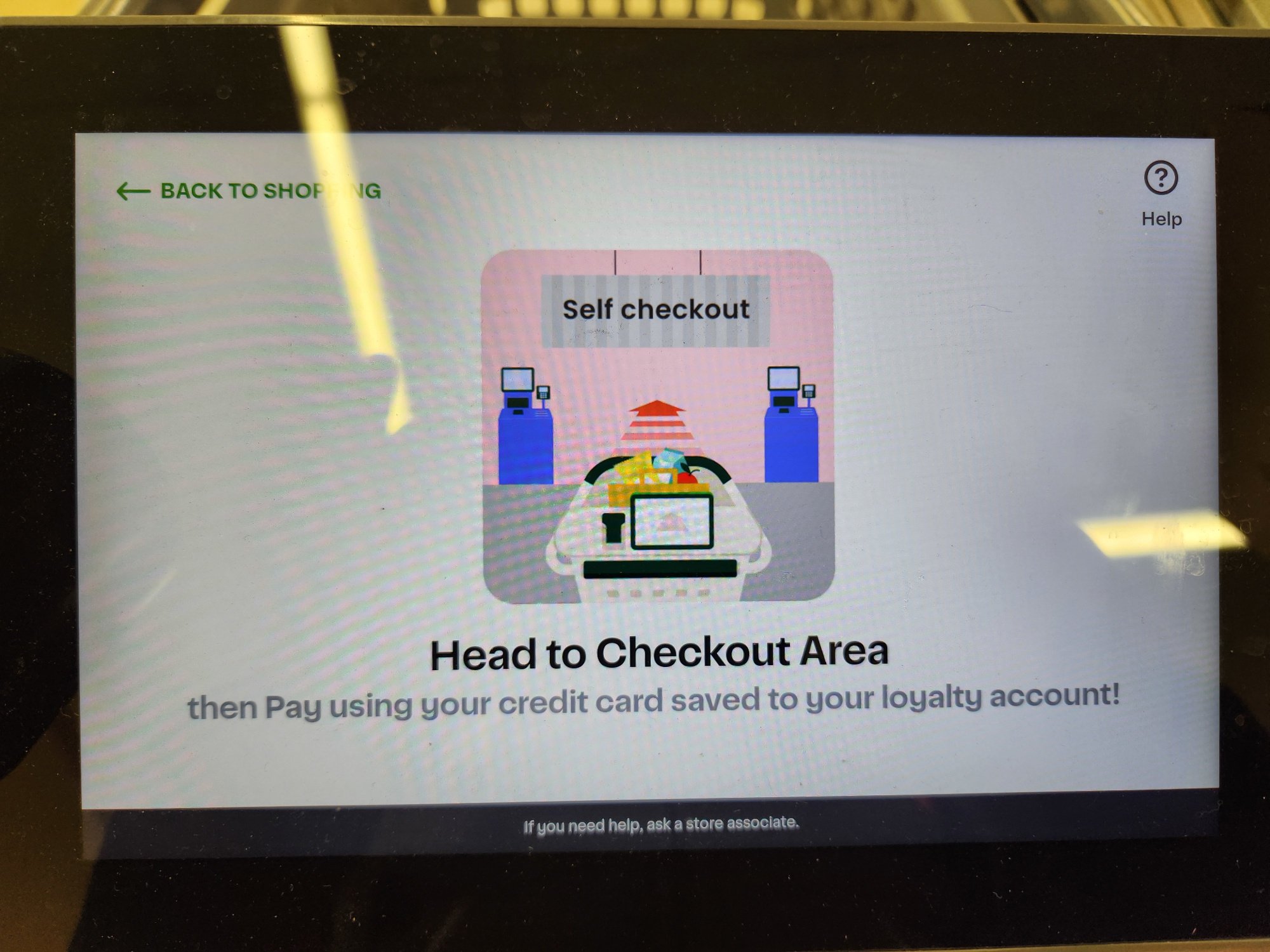
When you’re done, you just tap “Checkout” and head to the Checkout Area.

Checking out with a Caper Cart
Credit: Jeff Somers

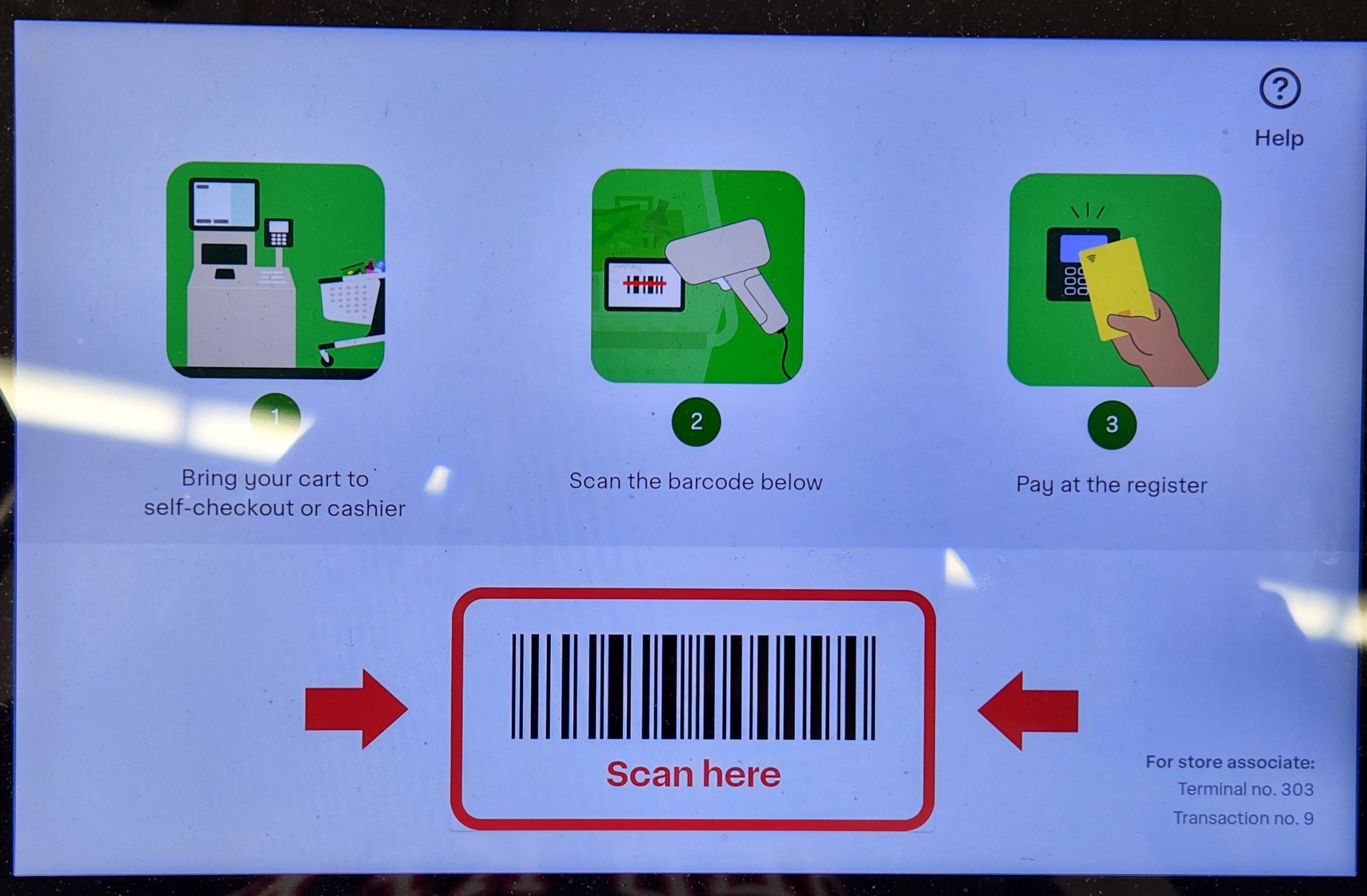
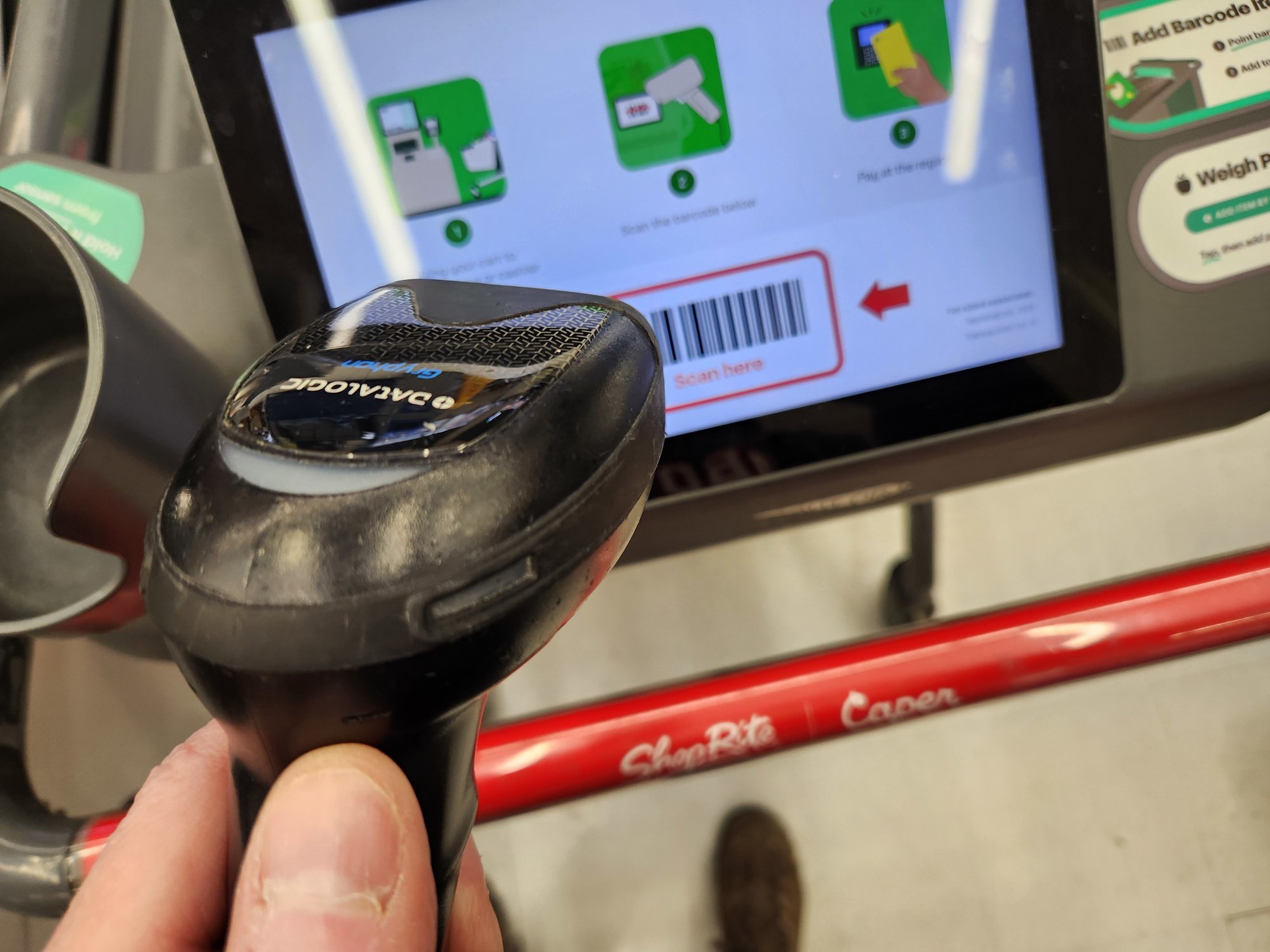
This will be different depending on the specific store you’re in—some stores don’t have checkout lanes for the Caper Carts, but this ShopRite did. There was only one lane for Caper Carts, and I had to wait behind someone as they checked themselves out. Then I scanned a barcode on my screen with a gun and tapped my card to pay while a security guard loomed nearby, presumably to discourage folks from making a run for it.

Barcode for checking out with a Caper Cart
Credit: Jeff Somers

Scanning the checkout barcode on a Caper Cart
Credit: Jeff Somers

The pros and cons of AI shopping carts

Overall, the AI shopping cart experience was a slight upgrade from typical grocery shopping. Bagging as you go is convenient, and checkout is a little easier because you scan a single barcode instead of two dozen. I didn’t receive many personalized coupons or recipe suggestions because this was my first time using the system, but I can see how that could become very useful if the cart is able to dig up coupons or offers that I missed.

A few specific notes:

  • The cart can accidentally scan a barcode if you get close to a shelf, which can cause confusion, though the cart will quickly delete it if the weight doesn’t change.

  • As noted above, the carts are pretty heavy. If you’re going to be buying a lot of groceries all at once, this could become a real workout.

  • Adding produce can be a little complicated: You have to locate the “price look up” (PLU) code for the specific produce you’re adding, then scan or type it into the screen before dropping it into the cart. That means sometimes hunting for those little stickers and tapping a bunch of numbers into your cart over and over again.

  • Seeing your total spend add up in real time is useful, especially if you’re tracking costs. If an item costs more than expected, you see it immediately, and if the overall cost is more than anticipated you have time to adjust your selections before you hit the checkout.

  • Because you have to go through a checkout lane as usual (and there was only one dedicated lane for Caper Carts), during busy times you might wind up waiting a long time to get out of the store, which kind of cancels out the convenience factor. Of course, as more people use these carts, ShopRite might add more dedicated Caper lanes.

Depending on how you shop for groceries, these AI shopping carts might be worth a try—but don’t expect a revolutionary experience.