All About Tour de Zwift 2026

First launched in 2017, Tour de Zwift is the biggest annual tour on the platform – a celebration of discovery across all Zwift worlds!

This year’s tour has just been announced. Beginning January 5, it consists of six weeklong stages spread across Zwift’s worlds. Each stage offers three group ride options of varying lengths, a race option for those who want to go all out, and two run options. The Ultimate Challenge has also returned, with bonus XP and a big prize giveaway.

So grab a friend and explore! Here’s everything Zwifters need to know about this year’s TdZ.

Sign up at zwift.com/events/tag/tourdezwift2026

Stage Details

Ride stages can be completed on demand as a solo effort, or join a group ride or race to complete them with friends. Group rides are available in three lengths, and races use the same route as the “short” group rides. Run stages can only be completed in events.

Group rides, races, and runs are scheduled every hour, except during the makeup week, when they’ll be scheduled every 30 minutes.

Here are the route details for each stage:

Stage 1 (Jan 5-11): Makuri Islands

Stage 2 (Jan 12-18): France

Stage 3 (Jan 19-25): Innsbruck/Yorkshire/Scotland

Stage 4 (Jan 26-Feb 1): London

Stage 5 (Feb 2-8): Watopia

Stage 6 (Feb 9-15): NYC/Richmond

Sign up at zwift.com/events/tag/tourdezwift2026

Make-Up Week: Feb 16-22

If you miss any group stages, they will all be available to ride during the make-up week. During this week, make-up rides are scheduled every 30 minutes, with each stage following the next every half hour.

Peak Zwift Day

On Tuesday, January 20th, Zwift is planning a slate of events led by pros, creators, and other Zwift legends. The goal? Wall-to-wall Zwifters all rolling out together in the biggest rides of the Tour.

The full ride leader list is still to be confirmed, but here’s what we know right now:

  • Eric Min – @ 3:00AM PST | 9:30PM ACDT | 11:00AM UTC
  • Lucy Charles-Barclay – @ 4:00AM PST | 12:00PM UTC
  • Lionel Sanders – @ 10:00AM PST | 6:00PM UTC
  • Sam Laidlow – @ 9:00AM PST | 5:00PM UTC

Registration

To register, just join an event! See all events at zwift.com/events/tag/tourdezwift2026.

Unlocks

Riders and runners will unlock items progressively as they complete TdZ stages:

  • Party Shadess: 1 stage
  • Party Cap: 3 stages
  • Ride Kit: all 6 stages
  • Run Kit: 1 stage

To complete a stage, simply finish one of the group rides, races, or runs.

The Ultimate Challenge

Just like last year, this year’s Tour includes “The Ultimate Challenge.” This is for riders only, and completing the challenge requires you to complete all 18 routes featured in this year’s stages.

Note: Zwift and our ZIMetrics estimate it will take riders ~21.5 hours to complete all 18 stages at 2 W/kg.

Completing The Ultimate Challenge earns you bragging rights, bonus XP, and a backwards version of the After Party cap:

  • 9 Route Bonus: 500 XP
  • 12 Route Bonus: 500 XP
  • 15 Route Bonus: 500 XP
  • 18 Route Bonus: 11,000 XP + Backwards After Party Cap

The Ultimate Giveaway

Finish the Ultimate Challenge for a chance to win a one-of-a-kind TDZ x Pedal Mafia Zwift Ride Smart Frame!

Pedal Mafia Kit

The real-life version of the in-game kit will be available from Pedal Mafia… watch this space for details.

Questions or Comments?

Post below!

The best gear to help you stick to your New Year’s resolutions

The start of a new year always feels like a reset button. Everyone’s talking about moving more, eating better, sleeping longer or finally taming their digital chaos. But resolutions rarely survive on willpower alone. The right tools or piece of tech can make those goals easier to keep by turning motivation into a habit. Whether you’re trying to close your rings, track your progress or just build better routines, these smart picks make self-improvement feel a little more achievable, and a lot more enjoyable.

Gear that can help you stick to your New Year’s resolutions

This article originally appeared on Engadget at https://www.engadget.com/the-best-gear-to-help-you-stick-to-your-new-years-resolutions-130000389.html?src=rss

Waymos Are Now Coming For Your Coveted San Francisco Parking Spots

An anonymous reader quotes a report from the San Francisco Chronicle: A long stretch of curb in San Francisco’s Mission District might contain a whole menagerie of parked vehicles: hatchbacks, SUVs, dusty pick-ups, chic Teslas. And recently, Waymo robotaxis. That’s what Kyle Grochmal saw walking through the northeast Mission District on Monday afternoon. Cutting down York Street, he glimpsed a tell-tale white electric Jaguar in one of the coveted one-hour spots, its sensors spinning. The Waymo sat there for at least 20 minutes, Grochmal said. He whipped out his cell phone and started recording. After the Waymo drove off, another one showed up within an hour and took the same spot.

“This is something I started to notice about six months ago,” Grochmal said, recalling how disorienting it was to be strolling down a largely deserted sidewalk, and suddenly hear the purring motor and soft click of autonomous vehicle cameras. He’d look up to see a Waymo “just sitting there, not loading anyone.” But Waymo’s use of public curb space raised questions for Grochmal, who wonders whether San Franciscans are prepared to have their infrastructure dominated by autonomous vehicles. “Say Tesla gets to self-driving, so people have personal AVs,” he said. “So then do people from Palo Alto get dropped off in San Francisco and let their cars drive around all day searching for free parking?”

Such a future seems particularly unsettling in the northeast Mission, where snug streets couldn’t handle much traffic, and competition for parking is already fierce. A recent influx of Artificial Intelligence companies brought many more workers and cars, as well as robotaxis that trawl the blocks, waiting for fares. It makes sense, to Grochmal, that some of them wind up squatting in one-hour spaces. […] Still, it’s conceivable that residents will lose patience with Waymo, and other AV companies, as the fleets scale up and the vehicles compete more aggressively with humans for parking.


Read more of this story at Slashdot.

Film Technica: Our top picks for the best films of 2025

Editor’s note: Warning: Although we’ve done our best to avoid spoiling anything too major, please note this list does include a few specific references that some might consider spoiler-y.

It’s been a strange year for movies. Most of the big, splashy tentpole projects proved disappointing, while several more modest films either produced or acquired by streaming platforms—and only briefly released in theaters—wound up making our year-end list. This pattern was not intentional. But streaming platforms have been increasingly moving into the film space with small to medium-sized budgets—i.e., the kind of fare that used to be commonplace but has struggled to compete over the last two decades as blockbusters and elaborate superhero franchises dominated the box office.

Add in lingering superhero fatigue—only one superhero saga made our final list this year—plus Netflix’s controversial bid to acquire Warner Bros., and we just might be approaching a sea change in how movies are made and distributed, and by whom. How this all plays out in the coming year is anybody’s guess.

Read full article

Comments

More Improvements To Old AMD GPU Support On Linux Are Planned For 2026

With Linux 6.19 aging AMD GCN 1.0 and GCN 1.1 GPUs switched the default kernel driver used to provide for much better performance, RADV Vulkan support out-of-the-box, and other improvements compared to using the legacy Radeon DRM kernel driver. For 2026, Timur Kristóf of Valve’s Linux graphics team has more improvements still planned to enhance these older AMD graphics cards on Linux…

The UCI rule changes for 2026 you need to know about

The UCI is making some additions to its rule book for 2026. Even if you’re not planning to take part in any WorldTour races in 2026, the UCI’s rule changes will affect you because they influence bike brands’ design decisions for mass-market bikes. 

In 2025, we’ve already seen the effect of the relaxation of the UCI frame geometry regulations, for example.

While road bikes were converging on the lightweight/aero paradigm exemplified by the Specialized Tarmac SL8 and the Trek Madone Gen 8, brands have now again started to design out-and-out aero bikes, such as the Ridley Noah Fast and Van Rysel RCR-F, and put their lightweight bikes, such as the Cervélo R5, back on a diet.

So here are the UCI rule changes for 2026 that will affect bike and component design, plus the one the bike industry has effectively put on ice – for now.

Helmets

Man wearing a POC Procen Air helmet
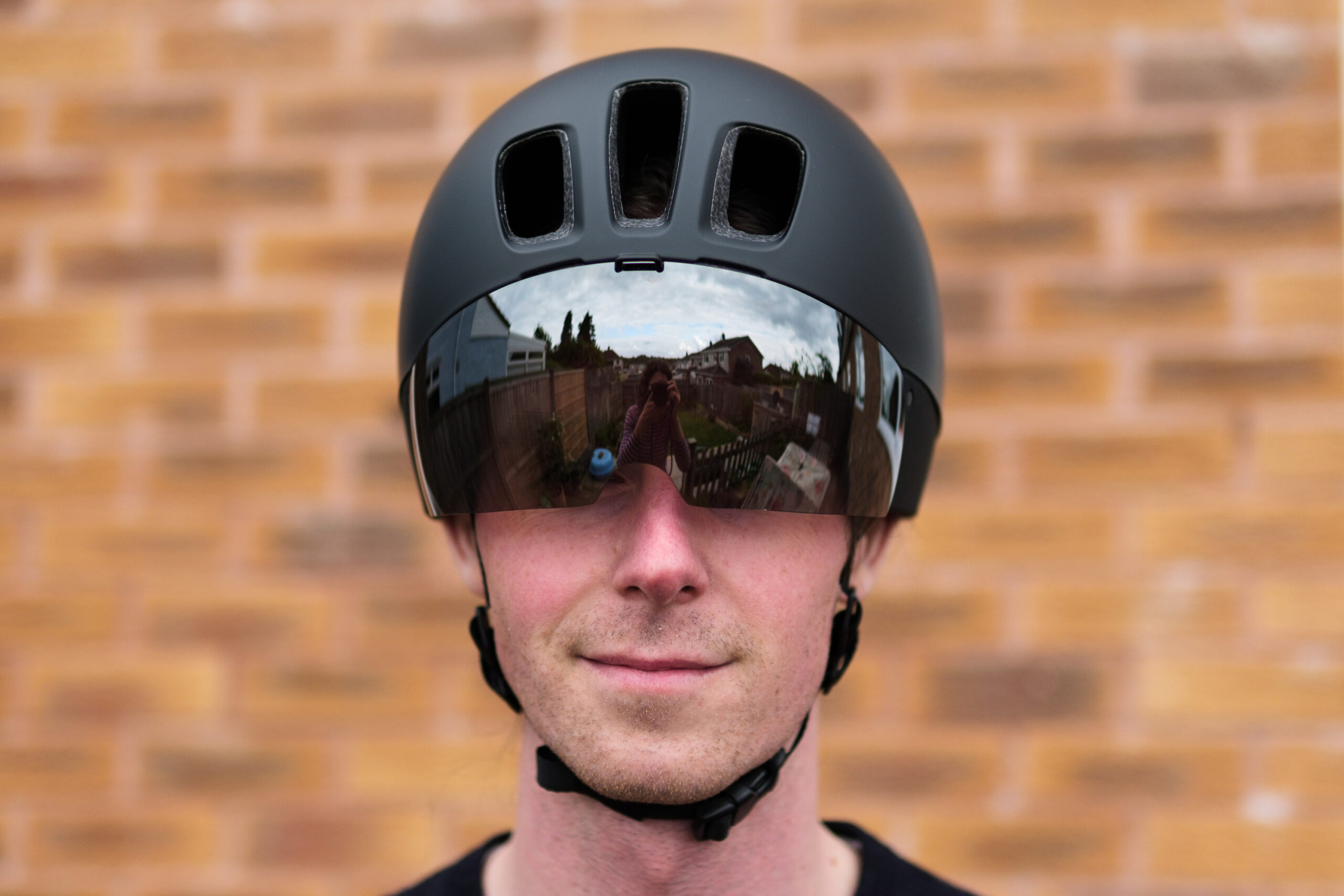
The POC Procen Air passes the UCI’s test for a “traditional” helmet on its three vents, but fails on its ear covers and visor. Yogamaya von Bromley / Our Media

Road helmets, for example the Poc Procen Air, have become more and more like time trial helmets over the last few years. Pros have been riding in helmets marketed as time trial helmets too, for example, some Visma-Lease a Bike riders, who have been using the (first-generation) Giro Aerohead in races.

Now the UCI has put a stop to that with Article 1.3.031. It’s been causing consternation during 2025, but the UCI has now defined what the difference is and restricted which helmets can be worn for road races.

In both cases, the maximum size is the same, but “traditional” (ie road) helmets must have three inlet vents, must not cover the ears and must not have a visor. For now, you may be happy to wear your Procen Air, but it’s probably going to be the last of the line of TT-like aero road bike helmets.

Handlebars

38cm handlebar width on a Black Inc handlebar
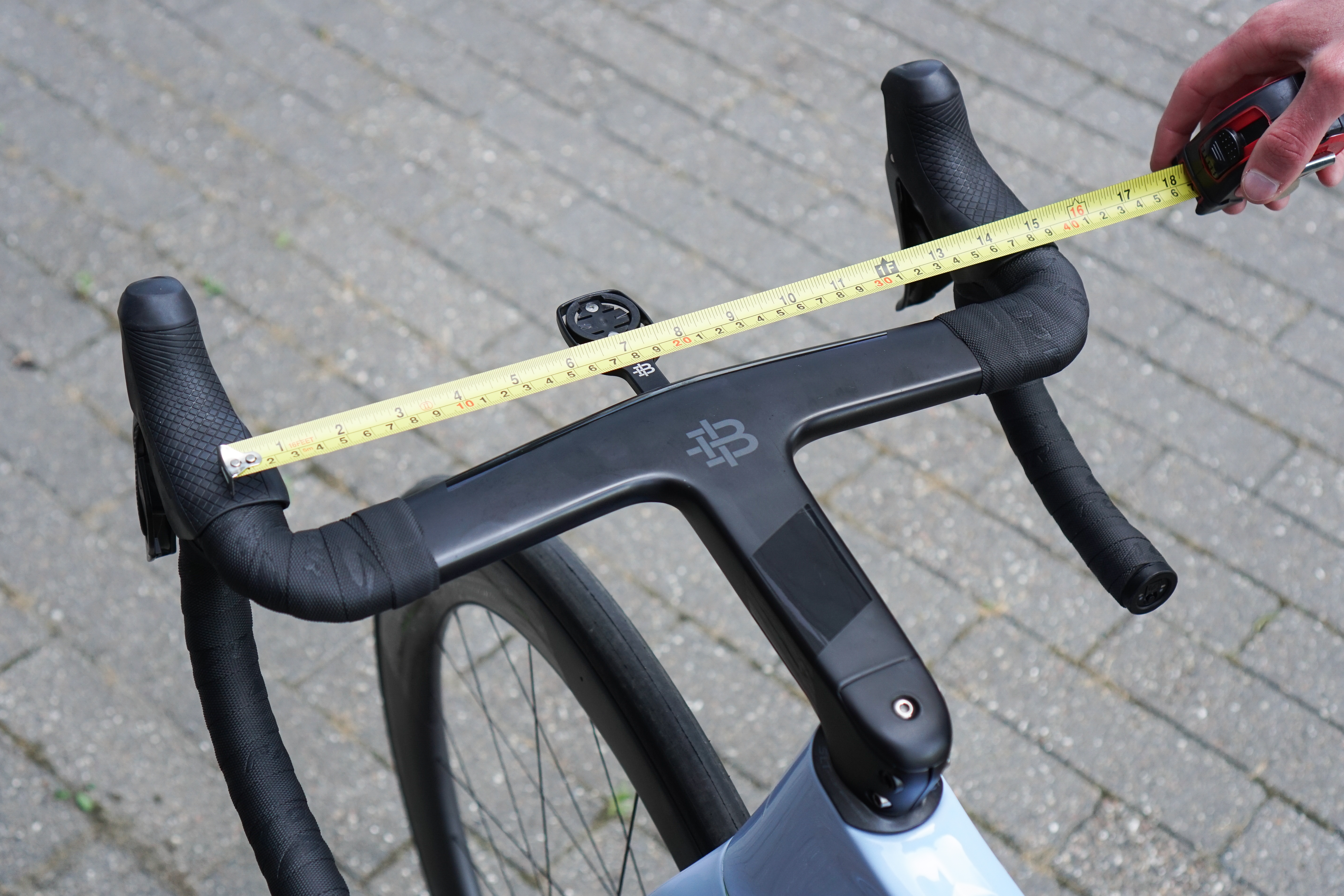
Handlebars must be a minimum of 400mm across from January 2026. George Scott / Our Media

Existing technical specifications for handlebars in article 1.3.022 already impose restrictions on how high, how low, how far forward and how far back they can be placed. 

But from the start of 2026, road and cyclocross handlebars used in competition have to be a minimum of 400mm across, outside to outside, with a maximum 65mm flare from the inside edge of the tops to the outside edge of the drops. The brake levers must have a maximum inward tilt of 10 degrees and a minimum of 280mm between the inside edges of the two levers. 

So you’re unlikely to find many road bikes sold with extra-narrow or extra-flared bars, as brands fall into line with the UCI bar geometry regs, even if (like the 6.8kg bike weight limit) it discriminates against women cyclists and smaller riders.

Wheel depth

Swiss Side Hadron rear wheel shod with a Continental GP5000 S TR tubeless tyre on the Van Rysel RCR Pro
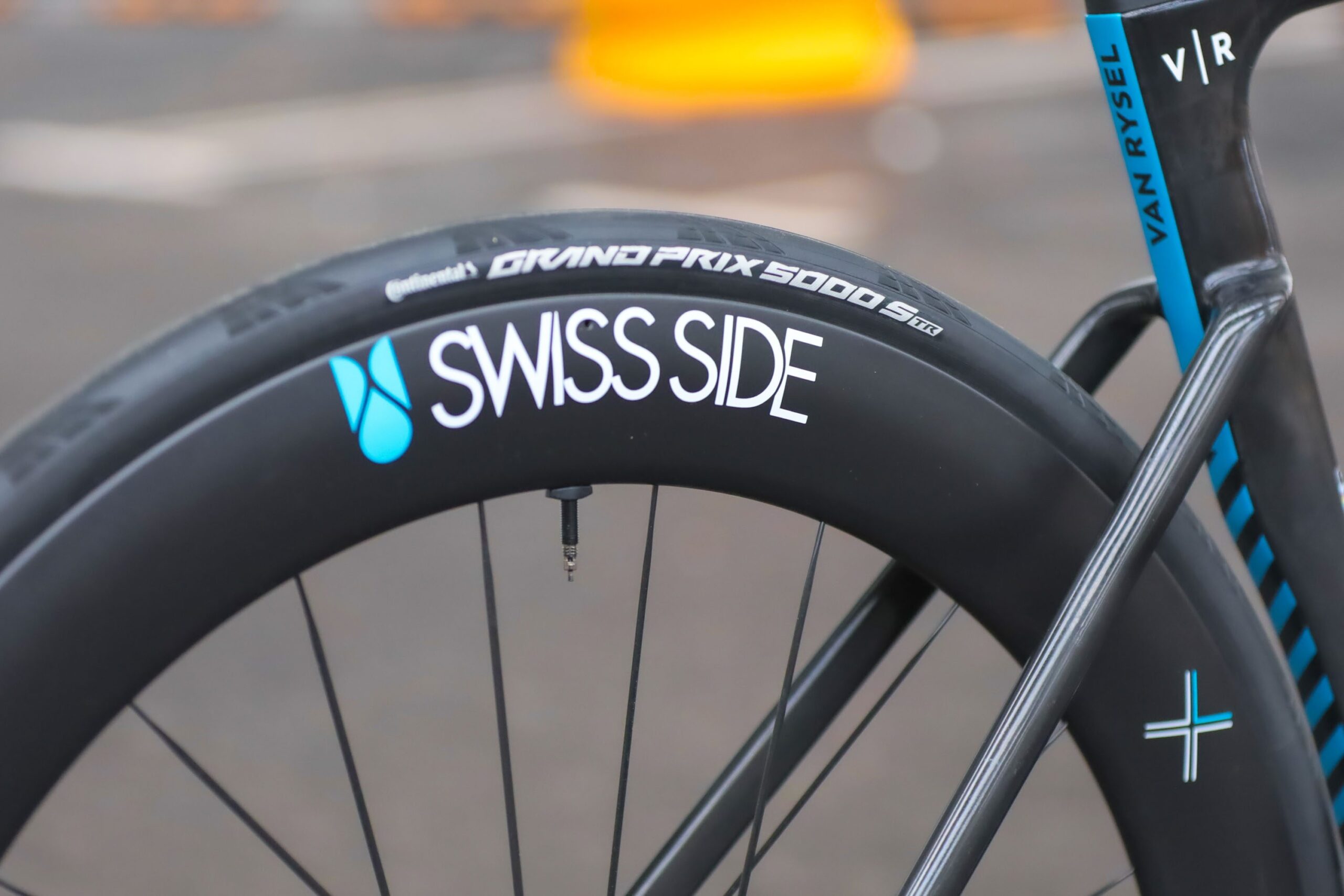
Swiss Side’s Hadron 680 wheel depth is 3mm outside the UCI’s new limit. Liam Cahill / Our Media

UCI article 1.3.018 has been modified to state that, in mass start competitions:

“The maximum height of the rim does not measure more than 65mm (measured as the perpendicular distance from the tangential line passing through any point of the outer extremity of the rim to the inner extremity of the rim).” 

The UCI has stuck to its guns on this one, despite protests from wheel brands including Swiss Side, whose Hadron Ultimate 680 wheels fall 3mm outside the limit. Swiss Side claims its measurements show that tyre width, tread pattern and steering geometry have a far more significant effect than rim depth on bike handling. 

Fork leg and stay width

Front end of Factor aero bike showing wide fork.
The fork legs on Factor’s unreleased aero bike are apparently 1mm within the UCI’s new limit. Stan Portus / Our Media

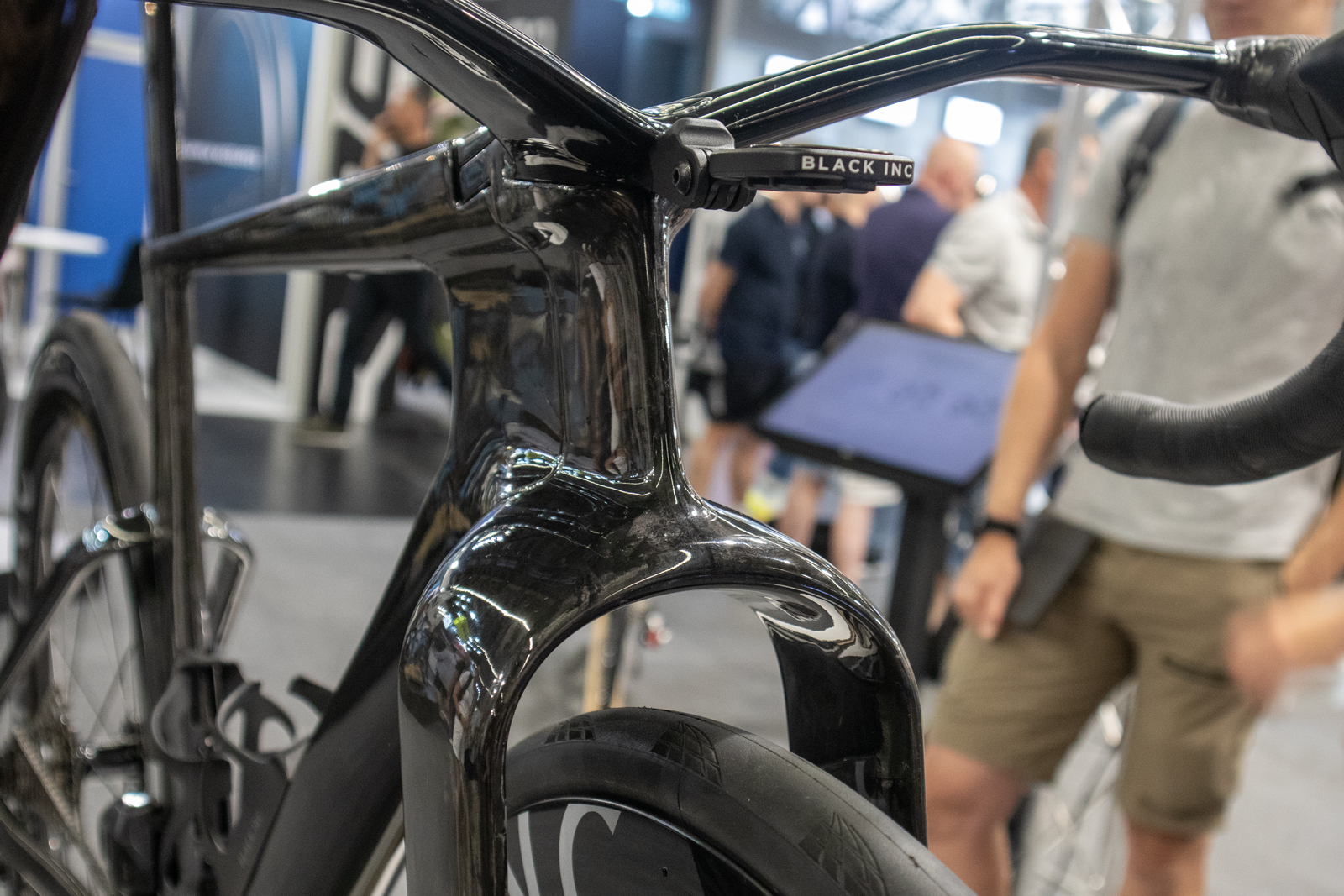
From January 2026, the UCI has imposed a maximum width for the fork legs and stays on road bikes, with track bikes to follow from 2027. The maximum distance between the inside edge of the fork legs must be 115mm and between the seatstays 145mm.

So the trend for ever-wider fork legs seen, for example, on the Hope HB.T track bike and the BMC Teammachine R road bike is likely to cease. Apparently, Factor’s prototype aero bike, first seen at the Critérium du Dauphiné (now renamed the Tour Auvergne-Rhône-Alpes, by the way), is 1mm within the new reg at 114mm – canny design choice.

Gearing restrictions

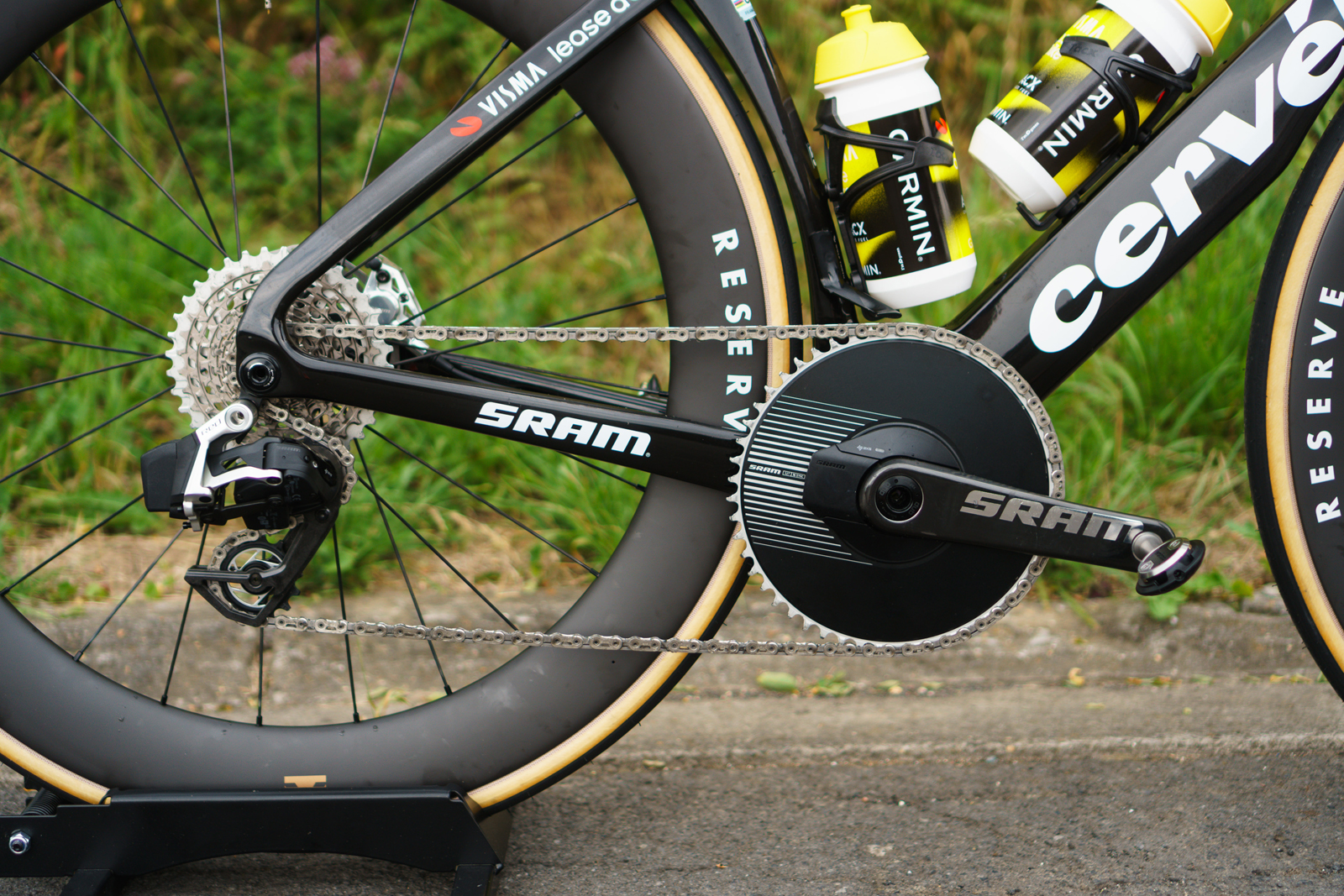
SRAM Red 1x drivetrain on Jonas Vingegaard's new Cervélo S5 at the 2025 Tour de France.
SRAM’s 10-tooth smallest sprocket would put it outside the UCI’s proposed gearing restriction regs, now on ice. Simon von Bromley / Our Media

This one’s on hold, following SRAM’s appeal to the Belgian Competition Authority. The UCI had proposed restricting the maximum gear ratio for bikes used in road races to 54x11t, putting a spanner in SRAM’s (and Campagnolo’s) 10-tooth smallest sprockets. 

The UCI’s proposed solution: knock out the top gear, restricting SRAM-supplied teams to 11 speeds.   

Will regulations covering gearing restrictions return during 2026? It remains to be seen.

UCI team rankings

Pauline Ferrand-Prevot riding an unreleased Pinarello cross-country mountain bike
From 2027, high placings in other disciplines will add points to teams’ annual ranking scores. Thomas Maheux / SWPix.com

Finally, from 2027, points garnered by riders in disciplines other than road racing will be added to their team’s UCI ranking. 

There have always been road pros racing in other disciplines, particularly track and cyclocross. But riders including Pauline Ferrand-Prévot, Mathieu van der Poel and Tom Pidcock have taken their multidisciplinary skills to new levels.

Their teams will, from 2027, be rewarded with extra UCI points for high placings in the UCI World Championships in competitions other than road racing.

UK Company Sends Factory With 1,000C Furnace Into Space

A UK-based company has successfully powered up a microwave-sized space factory in orbit, proving it can run a 1,000C furnace to manufacture ultra-pure semiconductor materials in microgravity. “The work that we’re doing now is allowing us to create semiconductors up to 4,000 times purer in space than we can currently make here today,” says Josh Western, CEO of Space Forge. “This sort of semiconductor would go on to be in the 5G tower in which you get your mobile phone signal, it’s going to be in the car charger you plug an EV into, it’s going to be in the latest planes.” The BBC reports: Conditions in space are ideal for making semiconductors, which have the atoms they’re made of arranged in a highly ordered 3D structure. When they are being manufactured in a weightless environment, those atoms line up absolutely perfectly. The vacuum of space also means that contaminants can’t sneak in. The purer and more ordered a semiconductor is, the better it works.

[…] The company’s mini-factory launched on a SpaceX rocket in the summer. Since then the team has been testing its systems from their mission control in Cardiff. Veronica Viera, the company’s payload operations lead, shows us an image that the satellite beamed back from space. It’s taken from the inside of the furnace, and shows plasma – gas heated to about 1,000C — glowing brightly. […]

The team is now planning to build a bigger space factory — one that could make semiconductor material for 10,000 chips. They also need to test the technology to bring the material back to Earth. On a future mission, a heat shield named Pridwen after the legendary shield of King Arthur will be deployed to protect the spacecraft from the intense temperatures it will experience as it re-enters the Earth’s atmosphere.


Read more of this story at Slashdot.

NASA’s Largest Library Is Closing Amid Staff and Lab Cuts

NASA is closing its largest research library at the Goddard Space Flight Center amid budget cuts and campus consolidation, putting tens of thousands of largely non-digitized historical and scientific documents at risk of being warehoused or discarded. The New York Times reports: Jacob Richmond, a NASA spokesman, said the agency would review the library holdings over the next 60 days and some material would be stored in a government warehouse while the rest would be tossed away. “This process is an established method that is used by federal agencies to properly dispose of federally owned property,” Mr. Richmond said.

The shutdown of the library at NASA’s Goddard Space Flight Center in Greenbelt, Md., is part of a larger reorganization under the Trump administration that includes the closure of 13 buildings and more than 100 science and engineering laboratories on the 1,270-acre campus by March 2026. “This is a consolidation not a closure,” said NASA spokeswoman Bethany Stevens. The changes were part of a long-planned reorganization that began before the Trump administration took office, she said. She said that shutting down the facilities would save $10 million a year and avoid another $63.8 million in deferred maintenance.

Goddard is the nation’s premiere spaceflight complex. Its website calls it “the largest organization of scientists, engineers, and technologists who build spacecraft, instruments, and new technology to study Earth, the Sun, our solar system, and the universe.” […] The library closure on Friday follows the shutdown of seven other NASA libraries around the country since 2022, and included three libraries this year. As of next week, only three — at the Glenn Research Center in Cleveland, the Ames Research Center in Mountain View, Calif., and the Jet Propulsion Laboratory in Pasadena, Calif. — will remain open.


Read more of this story at Slashdot.

Heart Association Revives Theory That Light Drinking May Be Good For You

An anonymous reader quotes a report from the New York Times: For a while, it seemed the notion that light drinking was good for the heart had gone by the wayside, debunked by new studies and overshadowed by warnings that alcohol causes cancer. Now the American Heart Association has revived the idea in a scientific review that is drawing intense criticism, setting off a new round of debate about alcohol consumption. The paper, which sought to summarize the latest research and was aimed at practicing cardiologists, concluded that light drinking — one to two drinks a day — posed no risk for coronary disease, stroke, sudden death and possibly heart failure, and may even reduce the risk of developing these conditions.

Controversy over the influential organization’s review has been simmering since it was published in the association’s journal Circulation in July. Public health groups and many doctors have warned on the basis of recent studies that alcohol can be harmful even in small amounts. Groups like the European Heart Network and the World Heart Federation have stressed that even modest drinking increases the odds of cardiovascular disease. “It says in all our guidelines right now, ‘If you don’t drink, don’t start.’ There’s not enough evidence to suggest conclusively that it prevents heart disease,” said Dr. Mariell Jessup, the chief science and medical officer at the heart association, adding that the review was not meant to serve as a guideline and that the group’s advice to patients has not changed.

Critics argue that suggesting any heart-health benefits from alcohol is dangerous given its well-documented risks, and they accuse the heart association of selectively weighing studies. They also say a past tie to the alcohol industry by one author should have disqualified him from participating.

“The cardiovascular benefits of moderate drinking are questionable at best,” said Dr. Elizabeth Farkouh, an internist and alcohol researcher. “But even if there was a benefit, there are so many other ways to reduce cardiovascular risk that don’t come with an associated cancer risk.”

The new review’s conclusion is also at odds with the CDC’s guidance on alcohol, which notes that “even moderate drinking may increase your risk of death and other alcohol-related harms, compared to not drinking.” It also seems to diverge from the heart association’s diet and lifestyle recommendation to consume “limited or preferably no alcohol,” along with its 2023 statement that recent research suggests there is “no safe level of alcohol use.”


Read more of this story at Slashdot.

AMD Ryzen AI Max, Intel Graphics & Other Linux Benchmarks That Commanded 2025

This looks to be a wrap on 2025, Happy New Year to all the Phoronix readers over the past 21+ years. This year on Phoronix there were 226 original Linux hardware reviews and featured benchmark articles written by your’s truly. Plus another 3,286 original open-source/Linux software and hardware news articles this calendar year. Here were the big topics of 2025 for the featured Linux hardware reviews and benchmark articles…

Warren Buffett Retires As Berkshire Hathaway CEO After 55 Years

Warren Buffett is retiring as CEO of Berkshire Hathaway at age 95, ending a 55-year run that reshaped how generations of Americans think about investing. “The 95-year-old, often referred to as the ‘Oracle of Omaha’ and the ‘billionaire next door,’ will relinquish the title after a career that saw him turn a failing textile firm into one of the most successful asset managers in the world,” reports NBC News. From the report: Greg Abel, the 63-year-old lesser-known CEO of Berkshire’s energy business, will take the helm of the conglomerate on Thursday. Buffett will remain its chairman.

Under Buffett’s leadership, Nebraska-based Berkshire has thrived at the intersection of Wall Street and Main Street, with investments in industries ranging from railroads and insurance to candy and ice cream.

Along the way, while living in the same house he bought for just over $30,000 in the late 1950s, he redefined investing for the American public with his folksy and practical advice, became one of the wealthiest people on Earth and dedicated much of that fortune to philanthropy. Berkshire’s most significant tech bet was initiated in 2016 when it invested $1 billion. Apple has since become Berkshire Hathaway’s largest single holding, representing over 20% of the portfolio and valued at more than $65 billion.

While Buffett largely avoided pure tech for decades, Buffett long considered technology a blind spot, famously saying “I wish I had” bought Apple earlier.

Throughout the years, Buffett expressed his disinterest in cryptocurrency and said he would “never own bitcoin,” referring to it as “probably rat poison squared” and a “gambling token.”


Read more of this story at Slashdot.

Stewart Cheifet, Computer Chronicles Host, Dies At 87

Pibroch(CiH) writes: According to the obituary linked, Stewart Cheifet of Computer Chronicles fame has died. The obituary states he passed Dec 28, 2025. Cheifet and Digital Research founder Gary Kildall hosted the public television show The Computer Chronicles starting in 1984, and Stewart continued to host the show well into the 1990s. He was well-known for his affable presence and adeptness at interviewing guests and finding out the straight dope about their products. He had recently undergone spinal surgery and had somewhat disappeared from public view after the death of his wife Peta in 2024.


Read more of this story at Slashdot.

Tech Startups Are Handing Out Free Nicotine Pouches to Boost Productivity

The Wall Street Journal reports that a growing number of tech startups are stocking offices with free nicotine pouches as founders and employees chase sharper focus and stamina in hyper-competitive AI-era work environments. The Wall Street Journal reports: Earlier this year, two nicotine startups — Lucy Nicotine and Sesh — made branded vending machines filled with flavored products for analytics company Palantir Technologies. Both machines are in the company’s Washington, D.C., offices. The pouches are free for employees and guests over the age of 21, a spokeswoman for Palantir said. Palantir pays to stock the nicotine products.

Alex Cohen, a startup founder based in Austin, Texas, said he was first exposed to nicotine pouches in the workplace after seeing tins of Zyns on the desks of his software engineers. His company, Hello Patient, makes AI-powered healthcare-communication software. “They were very productive, so I thought maybe there’s something here,” he said. Those engineers soon asked him if he could buy it for the office.

Cohen said he initially bought the nicotine pouches as a joke for social media. He posted a picture of a drawer in his startup’s office filled with nicotine pouches made by different brands with the caption, “We’re hiring.” “Then, I accidentally got addicted,” said Cohen. He said he uses around two to three pouches a day. His go-to flavors are mango or minty. Cohen said he has attention-deficit/hyperactivity disorder, or ADHD, and he has found that the pouches can provide a quick productivity boost. “It helps with reining in my focus because it is a stimulant,” he said. Today, Hello Patient has a nicotine-pouch fridge in its office kitchen.


Read more of this story at Slashdot.

DarkSpectre Hackers Spread Malware To 8.8 Million Chrome, Edge, and Firefox Users

An anonymous reader quotes a report from Cyber Press: A newly uncovered Chinese threat group, DarkSpectre, has been linked to one of the most widespread browser-extension malware operations to date, compromising more than 8.8 million users of Chrome, Edge, Firefox, and Opera over the past seven years. According to research by Koi.ai, the group operates three interconnected campaigns: ShadyPanda, GhostPoster, and a newly identified one named The Zoom Stealer, forming a single, strategically organized operation.

DarkSpectre’s structure differs from that of ordinary cybercrime operations. The group runs separate but interconnected malware clusters, each with distinct goals. The ShadyPanda campaign, responsible for 5.6 million infections, focuses on long-term user surveillance and e-commerce affiliate fraud. Its extensions have appeared legitimate for years, offering new tab pages and translation utilities, before secretly downloading malicious configurations from command-and-control servers such as jt2x.com and infinitynewtab.com. Once activated, they inject remote scripts, hijack search results, and track browsing activity.

The second campaign, GhostPoster, spreads via Firefox and Opera extensions that conceal malicious payloads in PNG images via steganography. After lying dormant for several days, the extensions extract and execute JavaScript hidden within images, enabling stealthy remote code execution. This campaign has affected over one million users and relies on domains like gmzdaily.com and mitarchive.info for payload delivery.

The most recent discovery, The Zoom Stealer, exposes around 2.2 million users to corporate espionage. These extensions masquerade as productivity tools or video downloaders while secretly harvesting corporate meeting links, credentials, and speaker profiles from more than 28 video conferencing platforms, including Zoom, Microsoft Teams, and Google Meet. The extensions use real-time WebSocket connections to exfiltrate data to Firebase databases, such as zoocorder.firebaseio.com, and to Google Cloud functions, such as webinarstvus.cloudfunctions.net.


Read more of this story at Slashdot.