With GeForce Super GPUs missing in action, Nvidia focuses on software upgrades

For the first time in years, Nvidia declined to introduce new GeForce graphics card models at CES. CEO Jensen Huang’s characteristically sprawling and under-rehearsed 90-minute keynote focused almost entirely on the company’s dominant AI business, relegating the company’s gaming-related announcements to a separate video posted later in the evening.

Instead, the company focused on software improvements for its existing hardware. The biggest announcement in this vein is DLSS 4.5, which adds a handful of new features to Nvidia’s basket of upscaling and frame generation technologies.

DLSS upscaling is being improved by a new “second-generation transformer model” that Nvidia says has been “trained on an expanded data set” to improve its predictions when generating new pixels. According to Nvidia’s Bryan Catanzaro, this is particularly beneficial for image quality in the Performance and Ultra Performance modes, where the upscaler has to do more guessing because it’s working from a lower-resolution source image.

Read full article

Comments

Man Records A Single Word A Day In 2025 To Produce 365-Word Essay About The Passing Of Time

This is a 365-word essay about the passing of time written and performed by artist Henry Brown, who recorded himself speaking a single word of the essay every day in 2025. An impressive feat. If I’d attempted the same thing there’s no way my essay would be longer than four, maybe six words. The full thing:

What is a year? When I was younger, anything over a few minutes was inconceivable. Going somewhere “in an hour” might as well have meant tomorrow. These days, next weekend comes around before I’ve even finished processing last week; and my August is already fully booked at the start of the year. And a year sometimes feels like nothing at all. I suppose this is inevitable. Everyone laments that time speeds up as you get older. And it’s fair — units of time are like the routes you regularly travel. By the hundredth time you make the trip to work, or your partner’s house, or the grocery store, you know what comes after every turn. And the journey feels so much shorter than when everything was new. But— is time really flying? Right now, I’m twenty-five – twenty-six years old. In just 4 years, I’ll be 30. But how can I say that my twenties “flew past” if I can’t remember what I did on [June 15, 2025]? It’s impossible to hold all the moments of your life all the time. Sure. But pick a random date 5 years ago, and try to remember exactly what you did and felt. Chances are that it’ll start feeling a lot further away. Like I was a completely different person at 20. Still me, only a different me. So then— since when have I been THIS me? 14-year-old me was definitely someone else, but last February feels just as foreign to me sometimes. How much DO the circumstances of my life need to change before I can consider myself… evolved? Maybe I get to decide. Cause theoretically, I am not the me who wrote this sentence. Nor am I the me who’s uploading this video. And who knows who I’ll be by the time you watch/see this. All these versions of me may look similar, but there’s a new “me” in my skin every day, each carrying a different set of experiences, and a different outlook on life. Making decisions to the best of his abilities. It’s hard to imagine THIS me making meaningful changes to my life, but three hundred sixty-five me’s might just make a difference.

Time really is flying by, like a bounce house in high winds. I’ve been trying to get it to slow down lately but have had zero luck. I’ll blink and be 800. “Did you mean 80?” Noooooo…I’m already pushing 600. “Not with the undead warlock thing again.” You think I want to be like this? I was cursed! With a monster johnson too.

NVIDIA DLSS 4.5 Benchmarked Across GeForce RTX 50, 40 And 30 GPUs

NVIDIA DLSS 4.5 Benchmarked Across GeForce RTX 50, 40 And 30 GPUs
If you haven’t caught up on the latest CES coverage, NVIDIA announced and released the latest version of DLSS late last night, or early this morning if you’re in most of the rest of the world. DLSS 4.5 brings along major updates to frame generation and super resolution, including support for 6x Multi-Frame Generation as well as Dynamic Frame

8BitDo Ultimate 3E Modular Xbox Controller Can Swap Buttons And Joysticks On The Fly

8BitDo Ultimate 3E Modular Xbox Controller Can Swap Buttons And Joysticks On The Fly
8BitDo is releasing an evolved version of its Ultimate 3 controller this summer, and it’s aimed squarely at the high-end gamepad market—meet the 8BitDo Ultimate 3E. The Ultimate 3E builds upon the foundation of the Ultimate 3 with two additional bumpers, swappable D-Pad, and even swappable face buttons. Like Ultimate 3, Ultimate 3E also has

12 Shows Like ‘Heated Rivalry’ You Should Watch Next

We may earn a commission from links on this page.

My Canadian in-laws include a famous (I’m told) ice hockey star, and yet I’ve still spent more time engaging with hockey via the HBO Max streaming sensation Heated Rivalry than from the stands of any actual court or rink or whatever it is you call the place where people pass around their pucks. Not that I know any more about the game after watching, because frankly, that’s not why we’re here, nor is that what the buzz is all about.

Heated Rivalry is all about the very horny relationship between Japanese-Canadian team captain Shane (Hudson Williams) and Ilya (Connor Storrie), a headstrong Russian playing for a different team (not a euphemism). Even as their public relationship remains contentious over a period of years, the two develop a casual (at least at first) sexual relationship that grows increasingly sweaty and romantic, ice notwithstanding. Not to be outdone, the show also traces the complicated relationship between an American team captain and a smoothie barista.

In the increasingly backward-looking world of streamer programming, Heated Rivalry managed to draw eyes and a renewal by being the horniest, gayest show out there. Once you’ve binged it, you can follow up with one of these steamy streamalikes.

Yuri on Ice (2016)

It’s a short flight from horny gay ice hockey in Canada to horny gay figure skating in Japan and, yet, Yuri on Ice has just been sitting there waiting to be rediscovered. One of the best-reviewed anime of the last decade or so, the show finds defeated 23-year-old skater Yuri Katsuki returning to his hometown in Kyushu before an impromptu routine goes viral and draws the attention of Victor, a former champ who hopes to coach Yuki to revive his own career. The developing relationship is complex and compellingly twisty, and the animation is gorgeous; the show also gets a lot of credit for accuracy from both figure skaters…and pole dancers. Stream Yuri on Ice on Hulu and Crunchyroll.


A League of Their Own (2022)

A standout of its year that, of course, got cancelled, the show expands on the 1992 film of the same name, diving further into the real-life story of the Rockford Peaches, women’s professional baseball team in 1943. Abbi Jacobson, Chanté Adams, and D’Arcy Carden star as Carson, Max, and Greta, all three characters queer, either comfortably or in a process of exploration. Lest that sounds like some kind of ultra-woke revisionism, the show, while highly fictionalized, approaches the LGBTQ+ makeup of the Peaches far more accurately than did the earlier movie (despite including both Rosie O’Donnell and Madonna among its cast). Stream A League of Their Own on Prime Video.


Olympo (2025)

Sex, desire, and queer longing in the high-pressure world of competitive sports? Sounds like a theme. This Spanish-language show involves young athletes at the Pirineos Center of High Performance (better them than me), battling to be the best in their respective sports and, with a bit of luck, earning sponsorship deals with the global fashion brand of the title. The central, steamy, but secretive relationship is between Roque Pérez (Agustín Della Corte) and Sebas Senghor (Juan Perale)—think Heated Rivalry, but in Spanish and with rugby. Stream Olympo on Netflix.


Twenties (2020 – 2021)

Lena Waithe created this comedy following Hattie, an aspiring screenwriter and queer Black woman navigating life and work in LA with her straight besties, Marie (Christina Elmore) and Nia (Gabrielle Graham). The tone is loose and funny, involving friends who spend as much time trash-talking as they do working, but there’s still a sense of young people in a hyper-competitive industry fighting to make it. Stream Twenties on Paramount+ and BET+.


Yellowjackets (2021 – )

Tonally, this time-jumping survival drama is a total mismatch, but I’m throwing it in the mix for its blend of sports and queer characters, especially leads Taissa (Jasmin Savoy Brown) and Van (Liv Hewson). The show is about a group of teenage girls becoming stranded in the wilderness on the way to a soccer match in 1996 and doing terrible things to survive—the extent of which we only learn about via flashbacks from the present, where the events of those 19 months continue to have an impact. There are ambiguous teases of the supernatural, and plenty of horror unfolds in a past that we’re still seeing fleshed out going into the fourth and final season. The show rather cynically posits that there’s a huge difference between the version of the past we talk about and the one that really happened. Stream Yellowjackets on Paramount+ and Netflix (for the first two seasons).


Young Royals (2021 – 2024)

Steamy soap Young Royals follows Wilhelm (Edvin Ryding), the fictional prince of Sweden, as he embarks on a romance with another student, Simon Eriksson (Omar Rudberg), at their elite boarding school—it’s not hockey, but there’s no shortage of intense competition among these attractive young queers and their classmates. While possessed of all the addictive qualities of the teen drama genre, Young Royals takes itself a bit more seriously than some, and feels remarkably fresh in its commitment to casting age-appropriate actors in all the key roles. Stream Young Royals on Netflix.


GLOW (2017 – 2019)

A fun comedy-drama set during the 1980s, GLOW’s ensemble is lead by Alison Brie as Ruth Wilder, a serious yet very out-of-work actor who signs on with Gorgeous Ladies of Wrestling, a fictionalized version of the real sports organization of the same name. The show’s heightened drama, period detail, and willingness to be a little silly were highlights, as were the multiple queer characters: the growing relationship between Yolanda (Shakira Barrera) and Arthie (Sunita Mani) is a prominent focus; menwhile, Bash, the wrestling producer, explores his own sexuality amid the Reagan-era AIDS crisis. Stream GLOW on Netflix.


Shoresy (2022 – )

Let’s say that you’re into Heated Rivalry for the hockey. Which: sure. To each their own. If so, you could do a lot worse than this (largely standalone) Letterkenny spin-off, starring and created by Jared Keeso, who also plays the title character. The veteran player moves to the small-ish city of Sudbury, Ontario after making a bet that he can save the struggling Sudbury Bulldogs. The comedy is simultaneously raunchy and sweet (think Ted Lasso), with some solid queer rep among some of the secondary characters. More to the point, perhaps, is the involvement of executive producer and frequent director Jacob Tierney, who just happens to have also created Heated Rivalry. Stream Shoresy on Hulu.


Overcompensating (2025 – )

Comedian Benito Skinner plays himself, kinda, in this buzzy comedy that sees a former high school jock facing his freshman year in college while desperately trying to convince himself and everyone else that he’s as straight as they come (relatable, except for the jock part). Much of the appeal is in its deft blending of tones: It’s a frequently raunchy college comedy, and simultaneously a sweet coming-of-age story about accepting yourself without worrying about what everyone else thinks. The cast includes Adam DiMarco (The White Lotus) and Rish Shah (Ms. Marvel) and, just like Heated Rivalry, it’s a streaming show with queer leads that’s actually been renewed. Stream Overcompensating on Prime Video.


Given (2019)

Another BL anime (as in “Boy’s Love,” a significant sub-genre), Given follows four adults who come together to form the titular rock band, with music connecting the characters while also helping them to navigate past trauma. The manga on which the show is based interweaves several gay storylines, but the anime puts a focus on the growing relationship between Ritsuka and Mafuyu, whose guitarist boyfriend died by suicide. In common with Heated Rivalry, it’s about navigating a complicated relationship in a high-pressure environment. Stream Given on Crunchyroll or buy it from Prime Video.


Boots (2025)

There were a few impressive LGBTQ+ shows this past season, with Boots generating buzz and predating both Pluribus and Heated Rivalry by just about a month. Alas, while those two survived the (more than) annual streaming purge, Boots didn’t make it out of camp. Based on a memoir from Greg Cope White, the Netflix series stars Miles Heizer as Cameron Cope, a closeted gay teen who follows his bestie into the Army in the era before “Don’t ask, don’t tell,” and well before serving in the open was a possibility. Stream Boots on Netflix.


Heartstopper (2022 – )

The affirming coming-of-age/queer teen love story that we all kinda need right about now, Heartstopper is more about kisses and significant glances than it is about the hot, illicit sex of Heated Rivalry—and do with that what you will. While it never soft-peddles the dangers of homophobia, it likewise doesn’t wallow in tragedy. Kit Connor and Joe Locke deliver sensitive (and often very funny) performances in a show that’s nearly all smiles without feeling treacly. Stream Heartstopper on Netflix.

Study Casts Doubt on Potential For Life on Jupiter’s Moon Europa

Jupiter’s moon Europa is on the short list of places in our solar system seen as promising in the search for life beyond Earth, with a large subsurface ocean thought to be hidden under an outer shell of ice. But new research is raising questions about whether Europa in fact has what it takes for habitability. Reuters: The study assessed the potential on Europa’s ocean bottom for tectonic and volcanic activity, which on Earth facilitate interactions between rock and seawater that generate essential nutrients and chemical energy for life. After modeling Europa’s conditions, the researchers concluded that its rocky seafloor is likely mechanically too strong to allow such activity.

The researchers considered factors including Europa’s size, the makeup of its rocky core and the gravitational forces exerted by Jupiter, the solar system’s largest planet. Their evaluation that there probably is little to no active faulting at Europa’s seafloor suggests this moon is barren of life.

“On Earth, tectonic activity such as fracturing and faulting exposes fresh rock to the environment where chemical reactions, principally involving water, generate chemicals such as methane that microbial life can use,” said planetary scientist Paul Byrne of Washington University in St. Louis, lead author of the study published on Tuesday in the journal Nature Communications. “Without such activity, those reactions are harder to establish and sustain, making Europa’s seafloor a challenging environment for life,” Byrne added.


Read more of this story at Slashdot.

Letting prisons jam contraband phones is a bad idea, phone companies tell FCC

A Federal Communications Commission proposal to let state and local prisons jam contraband cell phones has support from Republican attorneys general and prison phone companies but faces opposition from wireless carriers that say it would disrupt lawful communications. Groups dedicated to Wi-Fi and GPS also raised concerns in comments to the FCC.

“Jamming will block all communications, not just communications from contraband devices,” wireless lobby group CTIA said in December 29 comments in response to Chairman Brendan Carr’s proposal. The CTIA said that “jamming blocks all communications, including lawful communications such as 911 calling,” and argued that the FCC “has no authority to allow jamming.”

CTIA members AT&T and Verizon expressed their displeasure in separate comments to the FCC. “The proposed legal framework is based on a flawed factual premise,” AT&T wrote.

Read full article

Comments

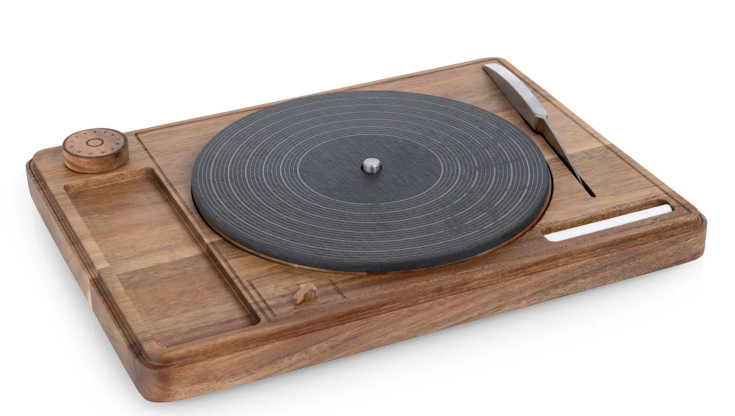
Record Turntable Cheese Plate

Because taste is half presentation, this is a cheese board that was designed to look like a record turntable, complete with spinnable slate platter, cheese knife tone arm, and some moveable dials. That’s fun. Of course if I see this at a party I’ll have no choice but to spin that platter so hard the camembert splatters the sofa. I will leave soon after, almost certainly without saying goodbye. “IT WAS YOU!” Haha, great New Year’s party, sorry I had to run.

This Is the Best Free Mac Cleanup Tool I’ve Found

There are a lot of apps on the market that claim to “clean up” your Mac—for a price. Some offer subscriptions, some cost a lot up front, but for the most part, they offer the same few features—wiping things like caches and logs, completely uninstalling apps, and monitoring system health. These apps all tend to be a little on the bloated side, with a lot of animations and graphics.

The free, open source, Terminal-based Mole is the opposite of those applications. Running entirely from the command line, Mole couldn’t possibly look less flashy, but it combines a number of different tools that can free up hard drive space on your Mac while also keeping things running smoothly.

To get started, you’ll need to install Mole. The simplest way to do this is by using Homebrew, which any Mac user interested in a Terminal-based application should probably do anyway. There is, alternatively, a script you can use to install Mole on the download page.

To use the application, just type “mole” in the Terminal and hit enter—you’ll be presented with the five main tools offered: Clean, Uninstall, Optimize, Analyze, and Status. (You can, alternatively, type “mole” followed by the tool you want to use—more on that later.)

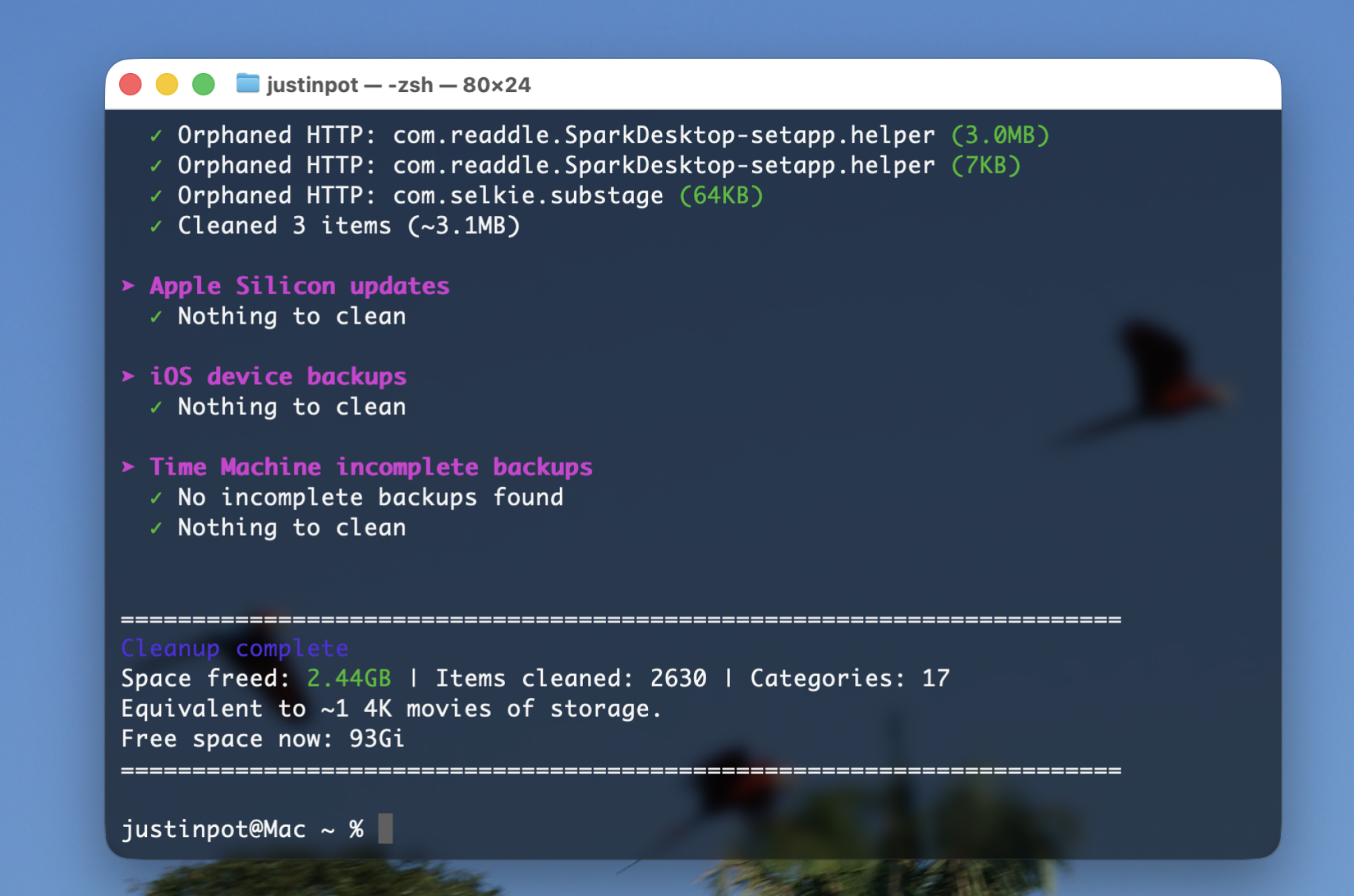
A list of cleaned caches, including Time Machine and iOS backups, is shown in a Terminal window

Credit: Justin Pot

The first, Clean, scans your hard drive for caches and temporary files, then deletes them. The application explains what it’s doing every step of the way, and you can always do a dry run using the command mole clean --dry-run if you’d like to see an overview before affecting any system files.

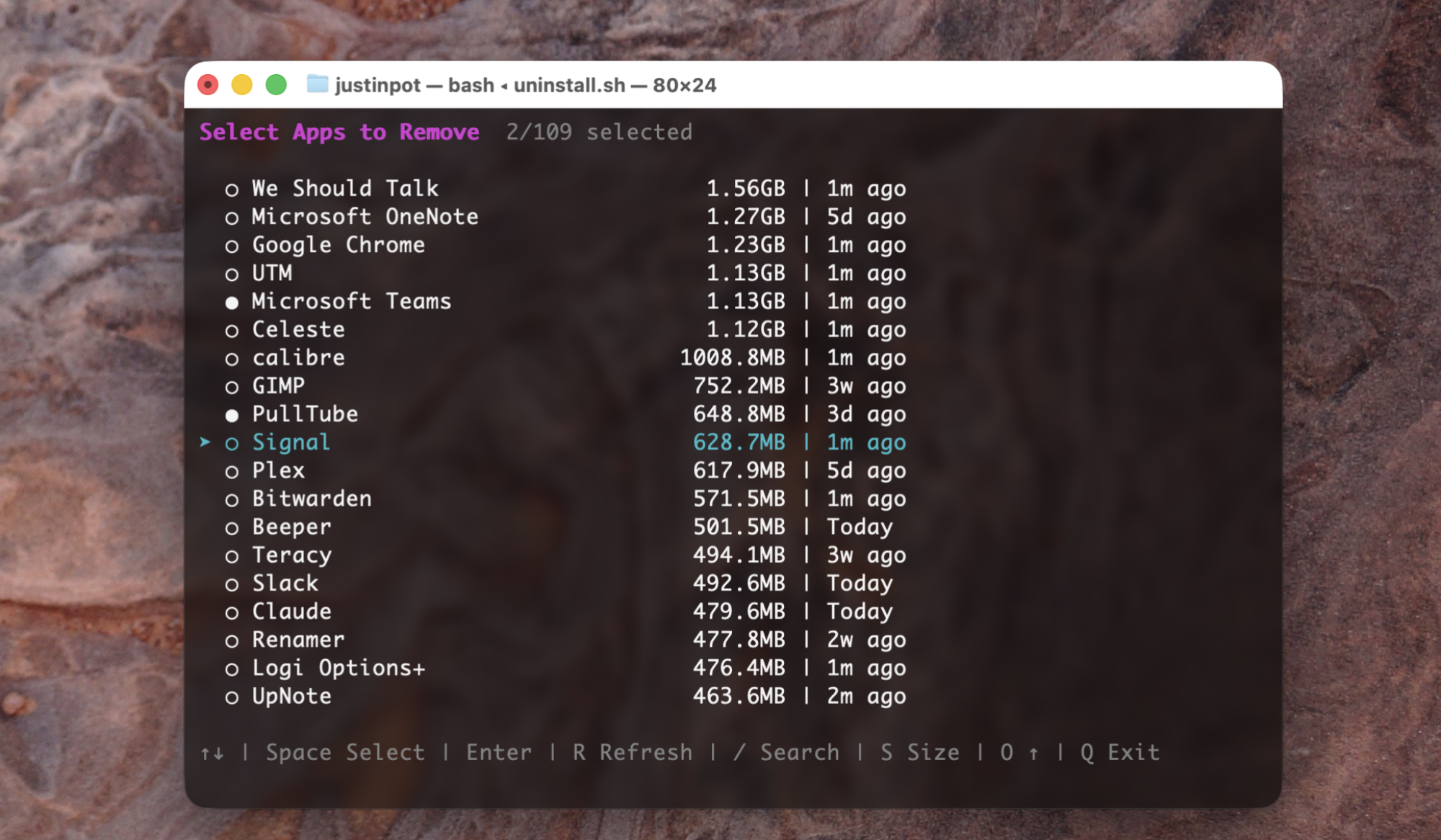
A list of applications you can install in a Terminal window

Credit: Justin Pot

The second tool, Uninstall, presents you with a list of applications installed on your computer and lets you know how much storage space they’re using. You can select as many applications as you want with the spacebar, then hit enter in order to completely remove them. This doesn’t just uninstall the application itself—it also removes all associated files, including settings.

The third tool, Optimize, performs a number of routine maintenance tasks such as flushing the DNS cache, optimizing databases, and refreshing the Finder. I find this useful when my Mac is hanging for seemingly no reason.

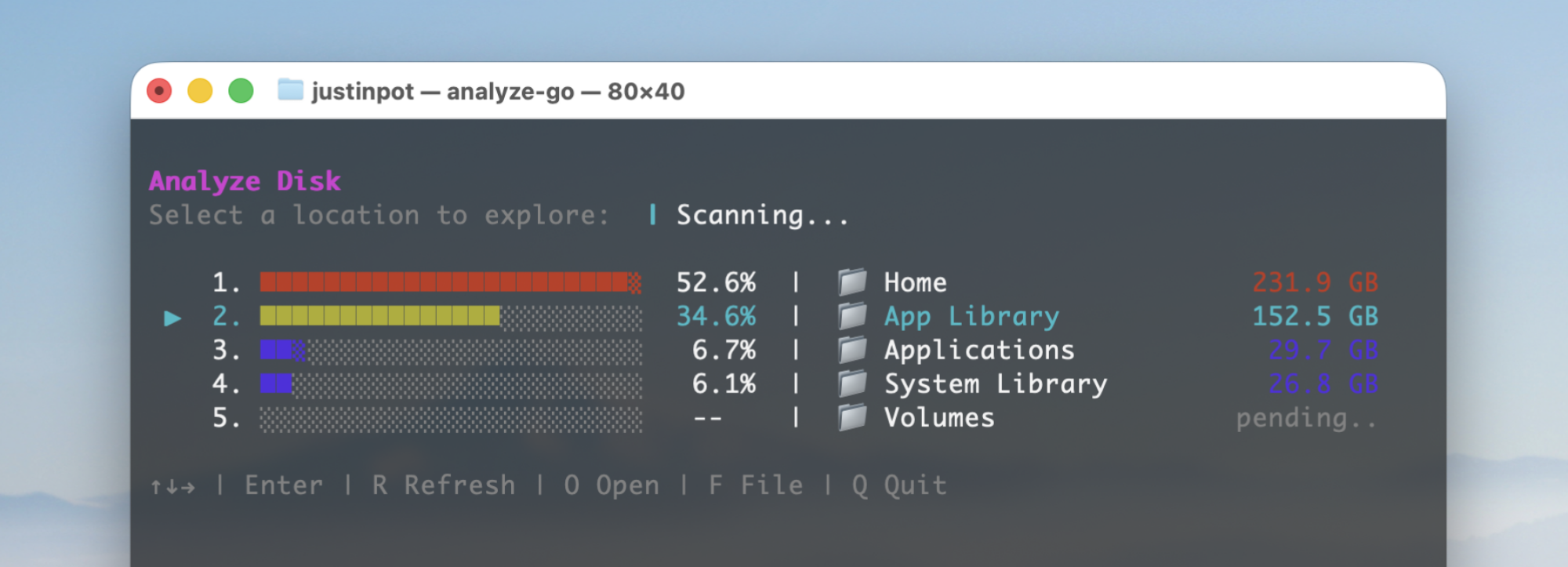
A breakdown of folder sizes in a Terminal window

Credit: Justin Pot

The fourth tool, Analyze, lets you see which folders are taking up the most space on your hard drive—useful if you’re trying to free up disk space on your Mac. You’ll see a list of folders alongside how much space they’re taking up. Open a folder to see a breakdown of the folders and files inside it. I was able to find a number of large files using this tool, some of which I didn’t need anymore.

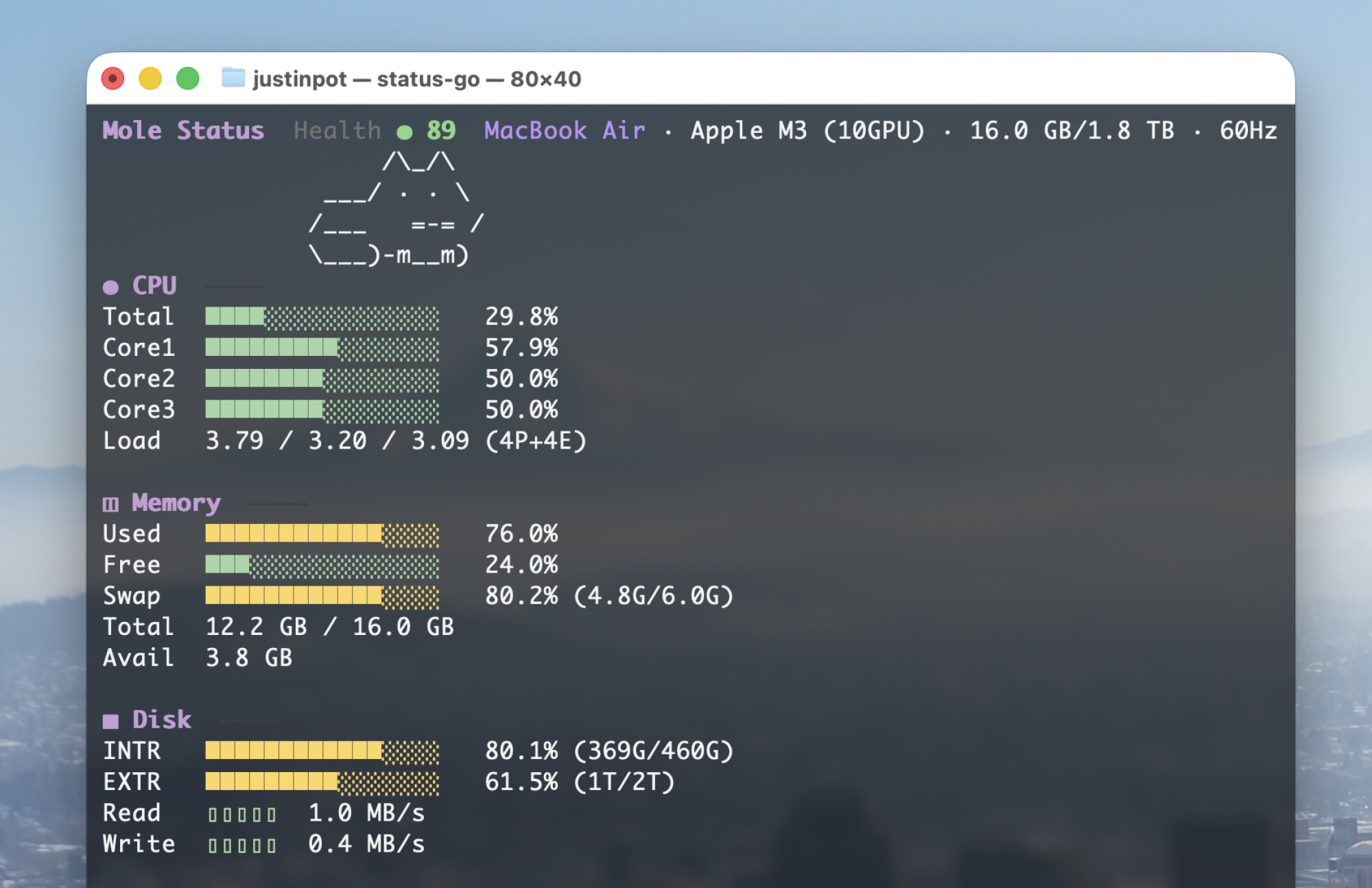
A Terminal window showing bars for CPU usage, memory, and hard drive space

Credit: Justin Pot

The final tool, Status, is a simple dashboard with stats including CPU, memory, and hard drive usage alongside an animated ascii-art cat. It’s simple.

It’s all very straight forward to use, and there are generally instructions on the screen telling you what to do next. One thing I do want to point out is that you can run most of these tools directly from the Terminal, without the initial menu. You can, for example, type mole clean to run the cleaner or mole status to open the dashboard. You can read more on the project’s Github page.

Dreame’s robot vacuum with an arm is back at CES 2026 and it can do more than pick up shoes

Last year at CES, Dreame showed off a robot vacuum prototype with a mechanical arm. But while we were able to see the arm extend and retract, we didn’t see the device, which was described as a prototype at the time, actually grab anything, which was a bit disappointing.

This year, though, the company has made its arm-enabled vacuum a reality with the Cyber 10 Ultra. Dreame previewed it recently at IFA in Berlin, but has now confirmed it will be on sale later this year. 

The vacuum has an extendable arm that looks pretty similar to the prototype version we saw last year. It extends from the top of the vacuum and has a claw-like device at the end for scooping up objects. According to Dreame, it can pick up items that weigh up to 500 grams (about 1 pound) so it should be able to grab a wider variety of stuff than the Roborock vac we saw last year, which had a 300-gram weight limit for its arm. 

The arm can also do more than pick up stuff from the floor. It supports its own cleaning accessories, and can grab vacuum nozzles and brush attachments from its base station. This allows the arm to act as an extension of the vacuum itself so it can be used similarly to how you might use hose attachments to reach hard-to-get areas with a traditional vacuum. 

And, like Dreame’s other robot vacuums, the Cyber 10 Ultra also has mopping abilities and can climb up small steps up to 6cm (about 2.4 inches). That’s not quite as impressive as the tank-like stair-climbing Cyber X prototype it also brought to CES, but should help the Cyber 10 reach a few extra places in the house. 

The company hasn’t announced an exact release date, but says it’s targeting August of this year and currently expects the Cyber 10 Ultra to cost around €1799 (about $2,100).

This article originally appeared on Engadget at https://www.engadget.com/home/smart-home/dreames-robot-vacuum-with-an-arm-is-back-at-ces-2026-and-it-can-do-more-than-pick-up-shoes-210000020.html?src=rss

Dreame’s latest robot vacuum concept has slightly terrifying legs that can climb full-size stairs

Robot vacuum companies are once again trying to outdo each other at CES 2026. This year, Chinese appliance maker Dreame is showing off a prototype of a device that can climb up and down an entire flight of stairs.

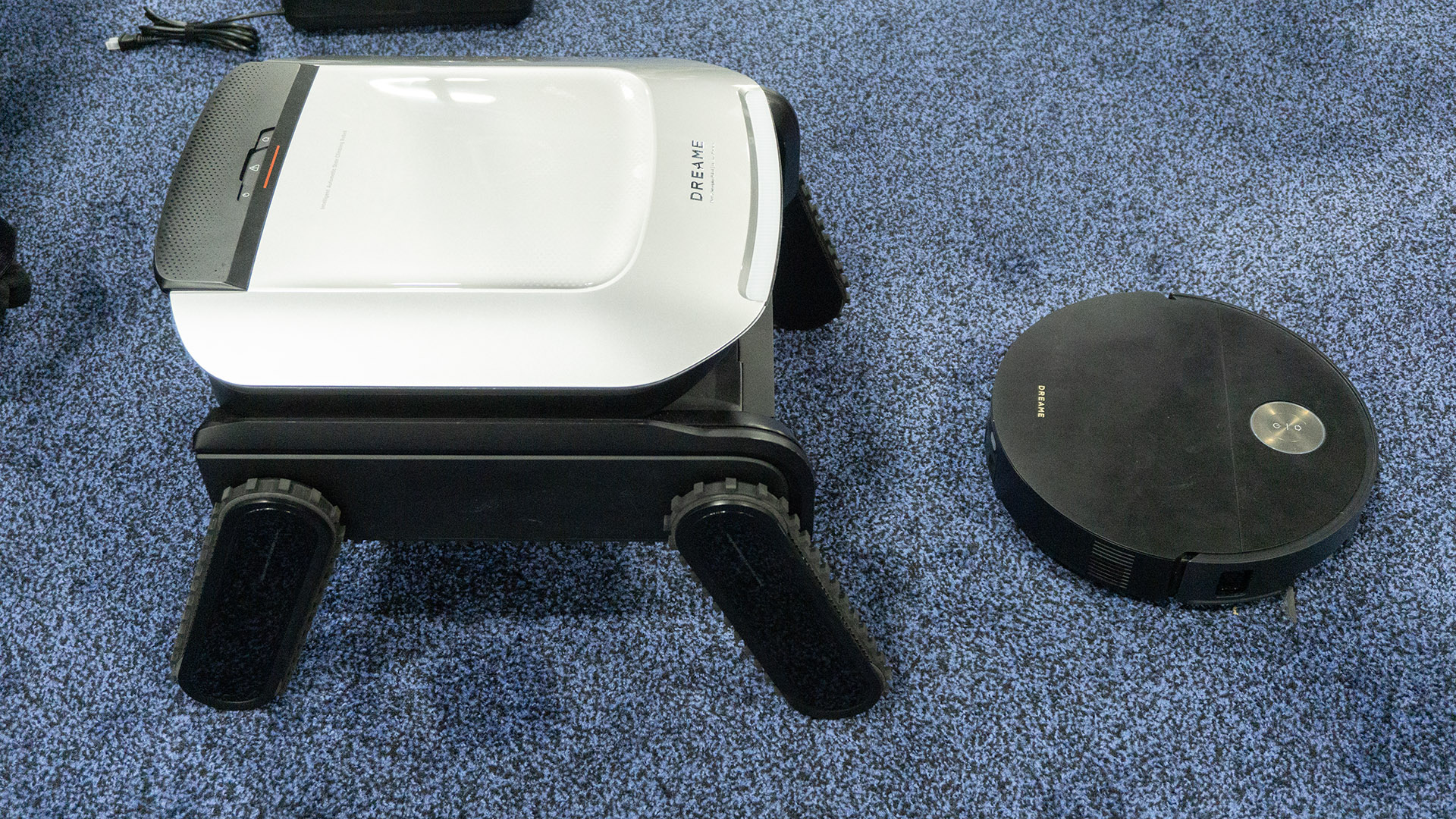
The concept, called the Cyber X, was previewed last year at IFA in Berlin. The vacuum sports a somewhat terrifying set of legs with rubber treads that allow it to autonomously navigate multi-story environments. While Dreame has previously shown off vacuums that can move up smaller steps, it says the Cyber X can climb stairs up to 25cm (9.8 inches) high and slopes up to 42 degrees. It can manage both straight and curved staircases, and can climb a flight of steps in 27 seconds, according to the company.

In addition to its legs, the Cyber X also has a built-in water tank to support mopping abilities, and a laser-powered navigation system to help it maneuver up stairs and around other obstacles. It also has a braking system that allows it to stay stable on floors and stairs, even if the battery dies. We haven’t been able to see it in action yet, but Dreame is expected to show off its abilities at its CES booth and we’ll update this post once we’re able to get an up-close look. 

Dreame's Cyber X concept and the X60.
Dreame’s Cyber X concept and the X60.
Karissa Bell for Engadget

For now, Dreame says Cyber X is just a research prototype and hasn’t indicated if it plans to make it, or a robo vac like it, more widely available at some point in the future. But Dreame has a history of showing off innovative features at CES ahead of an actual release. Last year, the company had a prototype vacuum with a mechanical arm at its CES booth. This year, it announced a new vacuum with very similar abilities. 

The company also announced the Dreame X60 Max Ultra, its latest flagship robot vacuum that can roll up smaller steps. The X60 Max Ultra, which costs $1,699, can move over stairs up to 8.8cm (about 3.4 inches), a small improvement over last year’s X50, which could clear heights of 6cm (about 2.4 inches). That’s not enough to manage a full-size stair, which is typically around 7 inches, but it should make the X60 flexible enough to navigate threshold steps and other small obstacles.

This article originally appeared on Engadget at https://www.engadget.com/home/dreames-latest-robot-vacuum-concept-has-slightly-terrifying-legs-that-can-climb-full-size-stairs-210000399.html?src=rss

Micron’s New 3610 SSD With G9 QLC Aims To Bring Gen5 Storage To Everyone

Micron's New 3610 SSD With G9 QLC Aims To Bring Gen5 Storage To Everyone
Micron’s out at the Consumer Electronics Show shouting, ‘You get a Gen5 SSD, you get Gen5 SSD, you get a Gen5 SSD!’. Okay, maybe not quite literally, but it did use the annual tech showcase as a launchpad for its new Micron 3610 NVMe solid state drive family, which it’s billing as the industry’s first PCIe Gen5 Q9 QLC SSDs for client computing.

The

EU Digital Laws Spark FOSS Liability Fears: The GNOPPIX Case and Wider Impacts

The European Union’s ambitious digital regulatory agenda has positioned the bloc as a global leader in technology governance. From data protection to platform accountability, EU lawmakers have enacted sweeping legislation designed to make the digital ecosystem safer, more transparent, and more accountable. Yet for the free and open-source software (FOSS) community, these well-intentioned regulations have created an unexpected crisis of confidence, with volunteer developers and small projects increasingly questioning whether they can safely operate within EU jurisdiction. At the heart of this tension lies a fundamental mismatch: regulations designed to rein in Big Tech giants are being applied, or could be applied, to volunteer-driven projects with no legal departments, no compliance budgets, and no ability to absorb the risks that come with regulatory uncertainty. The result is a growing chorus of concern from open-source advocates who warn that the EU’s regulatory framework could inadvertently chill the very innovation it seeks to protect.

Dell’s XPS revival is a welcome reprieve from the “AI PC” fad

After making the obviously poor decision to kill its XPS laptops and desktops in January 2025, Dell started selling 16- and 14-inch XPS laptops again today.

“It was obvious we needed to change,” Jeff Clarke, vice chairman and COO at Dell Technologies, said at a press event in New York City previewing Dell’s CES 2026 announcements.

A year ago, Dell abandoned XPS branding, as well as its Latitude, Inspiron, and Precision PC lineups. The company replaced the reputable brands with Dell Premium, Dell Pro, and Dell Pro Max. Each series included a base model, as well as “Plus” and “Premium.” Dell isn’t resurrecting its Latitude, Inspiron, or Precision series, and it will still sell “Dell Pro” models.

Read full article

Comments

The Google Pixel Buds Pro 2 earbuds are on sale for $165

Google’s Pixel Buds Pro 2 earbuds are on sale for $165 via Amazon. That’s a nice discount of $64, which breaks down to 28 percent. There is a spot of bad news. The deal only applies to the hazel colorway. Other colors are discounted, but they aren’t as cheap. It’s not as if the hazel is hideous. These are standard dark brown-hued earbuds.

The device made our list of the best wireless earbuds, and this is particularly true for those tied into the Pixel ecosystem. These earbuds are on the smaller side and, more importantly, comfortable to wear for long periods of time. They also manage to deliver pristine audio, as we were fans of the punchy bass, full mids and crisp highs on offer.

The battery lasts for 30 hours when you include return trips to the charging case, at around eight hours a pop. They offer multipoint Bluetooth that switches between audio sources with just a single button press. There’s an app for keeping an eye on battery levels and ANC levels.

The primary downside when these were first released was the high price tag, which has been alleviated by this sale. Beyond that, there’s really just one nitpick. Smaller earbuds translate to a smaller touch panel, which requires precision to operate.

Follow @EngadgetDeals on X for the latest tech deals and buying advice.

This article originally appeared on Engadget at https://www.engadget.com/deals/the-google-pixel-buds-pro-2-earbuds-are-on-sale-for-165-193444491.html?src=rss

The New LTE Google Pixel Watch 4 Is $100 Off Right Now

We may earn a commission from links on this page. Deal pricing and availability subject to change after time of publication.

The new Google Pixel Watch 4 came out in the late summer of 2025, and it’s already heavily discounted. You can now get the 41mm LTE Google Pixel Watch 4 in all three colors for $349.99 (originally $449.99), the lowest price it has ever been, according to price tracking tools. It now comes with a much faster charging time, satellite SOS, dual-band GPS, and a new circular display design.

Senior Health Editor Beth Skwarecki got her hands on a Google Pixel Watch 4 to review and loved it. The new charging dock sits flat on a surface, and you pop the watch on it sideways, almost like a MagSafe charger. Speaking of charging, it only takes a little over 30 minutes to fully charge; a 15-minute charge takes it from 0% to 50%. It’s one of the fastest charge times I’ve ever seen on any device. The new design has a bigger, expanded circular display running 320 pixels per inch. It also gets brighter with up to 3,000 nits of brightness.

If you get this LTE version, you’ll have some nice features that the wifi version doesn’t. You can send satellite SOS messages to emergency services and your emergency contacts, even if you don’t have cellular service. As long as you have a clear view of the sky, you should have satellite communication. This satellite SOS feature lets you alert 911 and receive emergency services.

Most of the other features are pretty similar to the Pixel Watch 3. You get built-in Gemini for voice control, accurate sleep tracking and exercise data with Accelerometer, Heart Rate Monitor, GPS, Blood Oxygen Monitor, Temperature Sensor, Pedometer, Gyroscope, Barometer, ECG, and Light Sensor.

The Pixel Watch 4 is one of the best-looking and longest-lasting Android smartwatches in the market right now, and at its lowest price, it’s a worthwhile deal.