Bandcamp bans purely AI-generated music from its platform

On Tuesday, Bandcamp announced on Reddit that it will no longer permit AI-generated music on its platform. “Music and audio that is generated wholly or in substantial part by AI is not permitted on Bandcamp,” the company wrote in a post to the r/bandcamp subreddit. The new policy also prohibits “any use of AI tools to impersonate other artists or styles.”

The policy draws a line that some in the music community have debated: Where does tool use end and full automation begin? AI models are not artists in themselves, since they lack personhood and creative intent. But people do use AI tools to make music, and the spectrum runs from using AI for minor assistance (cleaning up audio, suggesting chord progressions) to typing a prompt and letting a model generate an entire track. Bandcamp’s policy targets the latter end of that spectrum while leaving room for human artists who incorporate AI tools into a larger creative process.

The announcement emphasized the platform’s desire to protect its community of human artists. “The fact that Bandcamp is home to such a vibrant community of real people making incredible music is something we want to protect and maintain,” the company wrote. Bandcamp asked users to flag suspected AI-generated content through its reporting tools, and the company said it reserves “the right to remove any music on suspicion of being AI generated.”

Read full article

Comments

McKinsey Asks Graduates To Use AI Chatbot in Recruitment Process

McKinsey is asking graduate applicants to “collaborate” with an AI tool as part of its recruitment process, as competence with the technology becomes a requirement in competing for top-level jobs. From a report: The blue-chip consultancy is incorporating an “AI interview” into some final-round interviews, according to CaseBasix, a US company that helps candidates apply for posts at leading strategic consulting companies.

In an online post, CaseBasix said candidates in “select final rounds” in the US have been asked to complete tests using McKinsey’s internal AI tool, Lilli. They are required to carry out practical consulting tasks with the help of Lilli. “In the McKinsey AI interview, you are expected to prompt the AI, review its output, and apply judgment to produce a clear and structured response. The focus is on collaboration and reasoning rather than technical AI expertise,” CaseBasix said.


Read more of this story at Slashdot.

Man got $2,500 whole-body MRI that found no problems—then had massive stroke

A New York man is suing Prenuvo, a celebrity-endorsed whole-body magnetic resonance imaging (MRI) provider, claiming that the company missed clear signs of trouble in his $2,500 whole-body scan—and if it hadn’t, he could have acted to avert the catastrophic stroke he suffered months later.

Sean Clifford and his legal team claim that his scan on July 15, 2023, showed a 60 percent narrowing and irregularity in a major artery in his brain—the proximal right middle cerebral artery, a branch of the most common artery involved in acute strokes. But Prenuvo’s reviews of the scan did not flag the finding and otherwise reported everything in his brain looked normal; there was “no adverse finding.” (You can read Prenuvo’s report and see Clifford’s subsequent imaging here.)

Clifford suffered a massive stroke on March 7, 2024. Subsequent imaging found that the proximal right middle cerebral artery progressed to a complete blockage, causing the stroke. Clifford suffered paralysis of his left hand and leg, general weakness on his left side, vision loss and permanent double vision, anxiety, depression, mood swings, cognitive deficits, speech problems, and permanent difficulties with all daily activities.

Read full article

Comments

Scientists sequence a woolly rhino genome from a 14,400-year-old wolf’s stomach

A 14,400-year-old wolf puppy’s last meal is shedding light on the last days of one of the Ice Age’s most iconic megafauna species, the woolly rhinoceros.

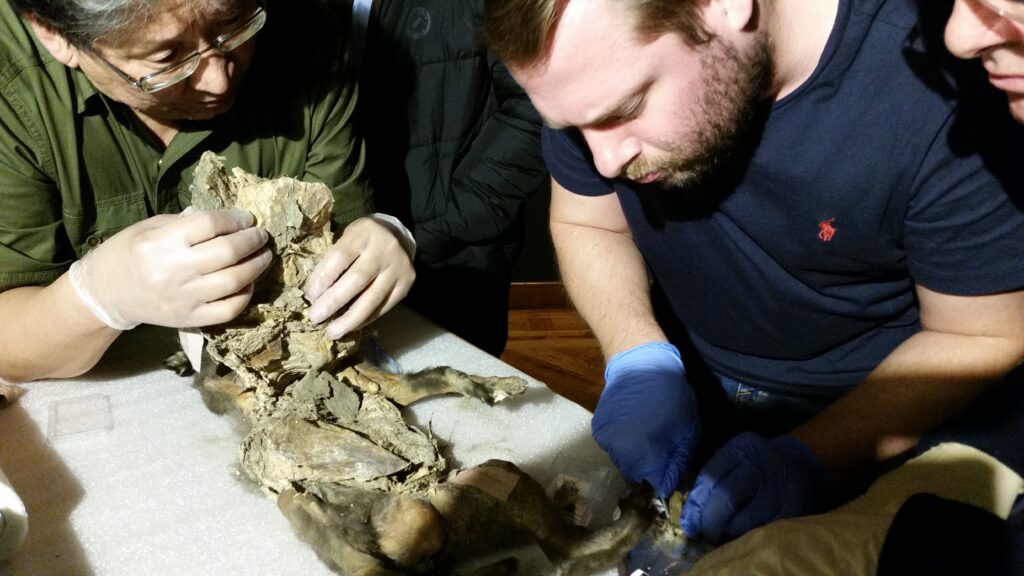
When researchers dissected the frozen mummified remains of an Ice Age wolf puppy, they found a partially digested chunk of meat in its stomach: the remnants of the puppy’s last meal 14,400 years ago. DNA testing revealed that the meat was a prime cut of woolly rhinoceros, a now-extinct 2-metric-ton behemoth that once stomped across the tundras of Europe and Asia. Stockholm University paleogeneticist Sólveig Guðjónsdóttir and her colleagues recently sequenced a full genome from the piece of meat, which reveals some secrets about woolly rhino populations in the centuries before their extinction.

photo of a mummified wolf corpse being dissected by two people.
Scientists carefully autopsy the remains of a wolf puppy who lived and died 14,400 years ago near Tumat village in Sibera.
Credit:
Guðjónsdóttir et al. 2026

One bad day for a rhino, one giant leap for paleogenomics

“Sequencing the entire genome of an Ice Age animal found in the stomach of another animal has never been done before,” said Uppsala University paleogeneticist Camilo Chacón-Duque, a coauthor of the study, in a recent press release.

Read full article

Comments

NVIDIA Reportedly Cuts 16GB RTX 5060 Ti And 5070 Ti Shipments As VRAM Prices Spike

NVIDIA Reportedly Cuts 16GB RTX 5060 Ti And 5070 Ti Shipments As VRAM Prices Spike
Another week, another NVIDIA industry rumor—and unfortunately, this one seems likely to be true, even if it may be worse for some end customers. If the reports are indeed true, NVIDIA will be focusing shipments of its GeForce RTX 5060 Ti and 5070 Ti GPUs to the 8GB models in order to maximize cards shipped during the ongoing RAM shortage.

Bezos’s Vision of Rented Cloud PCs Looks Less Far-Fetched

Amazon founder Jeff Bezos once told an audience that he views local PC hardware the same way he views a 100-year-old electric generator he saw in a brewery museum — as a relic of a pre-grid era, destined to be replaced by centralized utilities that users simply rent rather than own. The anecdote, shared at a talk a few years ago, positioned Amazon Web Services and Microsoft Azure as the inevitable successors to the desktop tower. Bezos argued that users would eventually abandon local computing for cloud-based solutions, much as businesses once abandoned on-site power generation for the electrical grid.

Current market dynamics have made that prediction feel more plausible. DRAM prices have become increasingly untenable for consumers, and companies like Dell and ASUS have signaled price increases across their PC ranges. Micron has shut down its consumer DRAM operations entirely, prioritizing AI datacenter demand instead. SSD storage is expected to face similar constraints. Cloud gaming services from Amazon Luna, NVIDIA GeForce Now and Xbox are seeing steady growth.

Microsoft previously developed a consumer version of its business-grade Windows 365 cloud PC product, though the company deprioritized it — the economics didn’t work when cheap laptops remained available. That calculus could shift. Xbox Game Pass’s 1440p cloud gaming runs $30 monthly and NVIDIA recently imposed a 100-hour cap on its cloud platform. The infrastructure remains expensive to operate, but rising local hardware costs may eventually close that gap.


Read more of this story at Slashdot.

HotHardware’s 12 Best Of CES 2026: Top Tech To Watch For This Year

HotHardware’s 12 Best Of CES 2026: Top Tech To Watch For This Year
This year’s Consumer Electronics Show (CES) in Las Vegas has officially ended, and with the HotHardware crew back home, it’s time to look back on the trip and highlight some of our favorite, stand-out products. As is usually the case, CES 2026 was packed with an array of new technologies, from high-powered AI accelerators to low-power…

The first-gen Bose QuietComfort Ultra headphones are $150 off right now

The first-generation Bose QuietComfort Ultra headphones are on sale right now for $280, marked down from $430. That 35 percent savings is an even steeper discount than we saw last year Black Friday.

In our review of the first-generation Ultras, we gave them a score of 86 out of 100, noting their best-in-class active noise cancellation (ANC) and comfort. Bose improved its stock tuning for these headphones, which we could immediately tell sounded warmer and clearer. Bose has typically lagged behind the likes of Sony and Sennheiser in raw sound quality, but the first-generation QuietComfort Ultra was a big step toward catching up.

Bose added “Immersive Audio” to this model, which is the company’s take on spatial audio. The company claims this feature effectively puts you in the acoustic sweet spot of a set of stereo speakers. In our testing, we felt this didn’t always make songs sound better, but it did make them louder and in some cases made certain details more noticeable.

The Ultras offer up to 24 hours of battery life with ANC turned on and about 18 hours with both ANC and Immersive Audio enabled. In our testing, however, we were actually able to beat Bose’s estimates for battery life.

The second generation of these headphones are currently our top pick for best noise-canceling headphones, but when this older model is heavily on sale, the differences between them are less dramatic. If you’re in the market for a pair of great noise-canceling cans, consider checking these out.

Follow @EngadgetDeals on X for the latest tech deals and buying advice.

This article originally appeared on Engadget at https://www.engadget.com/deals/the-first-gen-bose-quietcomfort-ultra-headphones-are-150-off-right-now-164826329.html?src=rss

Gemini can now scan your photos, email, and more to provide better answers

Google has toyed with personalized answers in Gemini, but that was just a hint of what was to come. Today, the company is announcing extensive “personal intelligence” in Gemini that allows the chatbot to connect to Gmail, Photos, Search, and YouTube to craft more useful answers to your questions. If you don’t want Gemini to get to know you, there’s some good news. Personal intelligence is beginning as a feature for paid users, and it’s entirely optional.

By every measure, Google’s models are at or near the top of the AI heap. In general, the more information you feed into a generative AI, the better the outputs are. And when that data is personal to you, the resulting inference is theoretically more useful. Google just so happens to have a lot of personal data on all its users, so it’s relatively simple to feed that data into Gemini.

As Personal Intelligence rolls out over the coming weeks, AI Pro and AI Ultra subscribers will see the option to connect those data sources. Each can be connected individually, so you might choose to allow Gmail access but block Photos, for example. When Gemini is allowed access to other Google products, it incorporates that data into its responses.

Read full article

Comments

Why TikTokers Are Injecting Salmon Sperm Into Their Faces

Scroll through TikTok or Instagram, and you’ll find influencers swearing by unconventional treatments, posting dramatic before-and-after photos and glowing testimonials about their rejuvenated skin. And the skincare “It Girl” of the moment? It’s salmon sperm. Yeah.

As we kick off the new year—prime time for beauty resolutions!—a growing number of people are seeking out “salmon sperm facials.” Before your imagination paints an extra fishy picture (pun intended), understand that people aren’t really smearing straight-up salmon sperm on their face. The secret ingredient is something called PDRN, or polydeoxyribonucleotide, a compound extracted from salmon DNA. So, what exactly is this secret ingredient, and is it truly the next frontier in anti-aging skincare?

The science behind the hype

PDRN isn’t totally snake oil; the compound has legitimate clinical backing for its regenerative properties. Research suggests that PDRN can stimulate tissue repair, promote collagen production, and improve skin elasticity by activating adenosine receptors in cells. Several sources claim it’s been used in medical applications since the 1980s in Italy and South Korea. Whatever the actual origins, PDRN has gradually made its way into mainstream skincare.

The treatment typically involves a series of micro-injections delivered directly into the skin, similar to mesotherapy or microneedling procedures. In the U.S., however, PDRN is only legal to use topically, since the FDA qualifies it as a beauty product and not a drug. Proponents claim it can reduce fine lines, improve skin texture, minimize scarring, and create an overall more youthful appearance. Unlike other cosmetic procedures that simply fill or temporarily plump the skin, PDRN is said to actually stimulate the skin’s natural healing processes. But as always, there’s a significant gap between reality and what you see online.

The reality check

Social media thrives on transformation narratives, and skincare content is no exception. The algorithms favor dramatic reveals, leading creators to emphasize stunning results while downplaying less glamorous details—like the fact that these injections can be quite painful according to some. “While PDRN has legitimate clinical data supporting skin repair and regeneration,” says Dr. Claudia Kim, “viral content often exaggerates results and glosses over who is—and isn’t—an appropriate candidate. Context and medical supervision matter.” When it comes to the injections specifically, these treatments can cause temporary swelling and bruising. At the very least, they could require multiple sessions to see results.

Again: If you’re in the U.S., and there’s a syringe full of salmon sperm headed straight for you, it might not be FDA-approved. That means its purity, safety, and effectiveness are not regulated. As with any medical aesthetic procedure, you shouldn’t sign up for PDRN treatments without careful consideration—considerations that extend beyond the promise of better skin. Do you know which salmon DNA procedure you’re signing up for? Is it an injection, or is it technically microneedling? Did you opt for PDRN or PN (polynucleotides), a purer and more concentrated form of PDRN? To make things even more confusing, these treatments can go by different names, from “salmon skin facials,” to “salmon sperm injections,” or “PDRN facials” to the brand name Rejuran. One thing is sure: As demand grows, so does the risk of unqualified practitioners offering the treatment, potentially leading to complications or disappointing results.

The bottom line

The salmon sperm trend may sound bizarre, but there is science backing it up. And when your favorite beauty influencer credits their glowing skin to a specific treatment, it’s tempting to believe you can achieve the same results. Social media will always continue to drive beauty trends, and there’s nothing inherently wrong with being inspired by what you see online. But for your looks and your safety, you need to understand the difference between a carefully curated social media moment and the full reality of medical aesthetic procedures.

If you’re intrigued by PDRN treatments after seeing them online, consult with a qualified dermatologist or licensed aesthetic practitioner. They can assess whether you’re an appropriate candidate, explain realistic expectations, discuss potential side effects, and ensure the treatment is administered safely. As more advanced treatments become increasingly accessible and visible online, don’t let TikTok influencers replace professional medical consultation.

Deny, deny, admit: UK police used Copilot AI “hallucination” when banning football fans

After repeatedly denying for weeks that his force used AI tools, the chief constable of the West Midlands police has finally admitted that a hugely controversial decision to ban Maccabi Tel Aviv football fans from the UK did involve hallucinated information from Microsoft Copilot.

In October 2025, Birmingham’s Safety Advisory Group (SAG) met to decide whether an upcoming football match between Aston Villa (based in Birmingham) and Maccabi Tel Aviv could be held safely.

Tensions were heightened in part due to an October 2 terror attack against a synagogue in Manchester where several people were killed by an Islamic attacker.

Read full article

Comments

[$] Debian discusses removing GTK 2 for forky

The Debian GNOME team would like to remove the GTK 2 graphics
toolkit, which has been unmaintained upstream for more than five
years, and ship Debian 14 (“forky”) without it. As one might
expect, however, there are those who would like to find a way to keep
it. Despite its age and declared obsolescence, quite a few Debian
packages still depend on GTK 2. Many of those applications are
unlikely to be updated, and users are not eager to give them
up. Discussion about how to handle this is ongoing; it seems likely
that Debian developers will find some way to continue supporting
applications that require GTK 2, but users may have to look
outside official Debian repositories.

The latest Animal Crossing: New Horizons expansion has arrived earlier than expected

For a number of very obvious reasons, we don’t want to roll back the clock to early 2020. No thank you. But if there was a feel-good lockdown story, it was the perfectly timed arrival of Animal Crossing: New Horizons, which allowed friends who could no longer meet up IRL to do so virtually on their carefully pruned islands.

The game will almost certainly never be as popular as it was back then again, but Nintendo is hoping a good chunk of lapsed islanders will return for its latest DLC drop, which has arrived a day earlier than planned. As spotted by Eurogamer, the free Animal Crossing: New Horizons 3.0 update is available to download now and, as previously announced, brings a host of new features to the cozy life sim, including a brand new resort hotel on the pier that you can help decorate.

There are new items and quality-of-life additions too, as well as the ability to build fresh islands with your friends and family in the “Slumber Island” dream world. All you need to do is go to the New Horizons game icon on your Switch’s home screen and download the software update.

Nintendo also announced last year that New Horizons would be coming to Switch 2 on January 15, improving the visuals, unlocking mouse controls and GameChat functionality, and expanding the online multiplayer capacity from eight players to 12. As of now, the Switch 2 edition of the game remains locked, so you’ll be stuck with the standard Switch version until tomorrow. Upgrading costs $5, while first-time players can purchase the Switch 2 version of Animal Crossing: New Horizons for $65.

This article originally appeared on Engadget at https://www.engadget.com/gaming/nintendo/the-latest-animal-crossing-new-horizons-expansion-has-arrived-earlier-than-expected-160739040.html?src=rss

Matthew McConaughey Trademarks Himself To Fight AI Misuse

Matthew McConaughey is taking a novel legal approach to combat unauthorized AI fakes: trademarking himself. From a report: Over the past several months, the “Interstellar” and “Magic Mike” star has had eight trademark applications approved by the U.S. Patent and Trademark Office featuring him staring, smiling and talking. His attorneys said the trademarks are meant to stop AI apps or users from simulating McConaughey’s voice or likeness without permission — an increasingly common concern of performers.

The trademarks include a seven-second clip of the Oscar-winner standing on a porch, a three-second clip of him sitting in front of a Christmas tree, and audio of him saying “Alright, alright, alright,” his famous line from the 1993 movie “Dazed and Confused,” according to the approved applications. “My team and I want to know that when my voice or likeness is ever used, it’s because I approved and signed off on it,” the actor said in an email. “We want to create a clear perimeter around ownership with consent and attribution the norm in an AI world.”


Read more of this story at Slashdot.

Gemini can now pull context the rest of your Google apps, if you let it

Gemini is adding a feature that’s designed to feel more tailored to individual users. Once enabled, “Personal Intelligence” can pull context from across your Google ecosystem, including Gmail, Google Photos, Search and YouTube History, to gain specific insight that will shape its answers and recommendations. Personal Intelligence is available starting today in the US for Google AI Pro and Ultra subscribers. The feature is opt-in only and is off by default.

Gemini Personal Intelligence
Google

Google says users will have the ability to control what apps Gemini pulls from and, in the future, which chats it uses Personal Intelligence for. The company says this new feature might still make some mistakes, such as “over-personalization” where it draws connections between unrelated things.

According to Google, Gemini will not train directly on the data it pulls for personalization like your photos and emails, but will instead train on your prompts and its responses. Users can also prompt Gemini to “try again” without personalization and will have the option to delete chat histories.

For now, Personal Intelligence works in the Gemini app across web, Android and iOS for personal Google accounts. Google says it’s coming to Search’s AI Mode soon, with plans to expand to more countries and the free tier down the line.

Google has been on a tear integrating Gemini into everything, including Gmail, TVs and Chrome on mobile. This week, Apple announced that Siri AI will be powered by Gemini as part of a multi-year collaboration. AI remains an imperfect tool, and Google’s AI has a long history of malfunctions like explaining made-up idioms, calling itself a “failure” in a depressing doom loop and generating images of the Founding Fathers as people of color.

This article originally appeared on Engadget at https://www.engadget.com/ai/gemini-can-now-pull-context-the-rest-of-your-google-apps-if-you-let-it-160039468.html?src=rss