Britain Awards Wind Farm Contracts That Will Power 12 Million Homes

The UK government has awarded guaranteed electricity prices to offshore wind projects totaling 8.4 GW in a bid to revive wind development, attract nearly $30 billion in private investment, and stabilize energy costs. The New York Times reports: On Wednesday, the British government said that it would provide guaranteed electricity prices for a group of wind farms off England, Scotland and Wales that would, once built, provide power for 12 million homes. The 8.4 gigawatts, a power capacity measure, that won support is the largest amount that has been achieved in an auction in Britain. The government said that these wind farms could lead to 22 billion pounds, or almost $30 billion, in private investment.

The government holds regular auctions, roughly on an annual basis. Results have been improving after a failed auction in 2023 that produced no bids from developers. The government almost doubled its original budget for the recent auction to about 1.8 billion pounds per year. To encourage renewable energy sources like offshore wind, Britain offers a price floor to provide certainty for investors. The average floor, or strike price, from the auction on Wednesday was about 91 pounds, or $122 per megawatt-hour, in 2024 prices, up about 11 percent from the last auction.

Over the past year the wholesale price for electricity in Britain was on average about 79 pounds, according to Drax Electric Insights, a market analysis website. The bulk of the planned wind farms that won price supports will be off eastern England. Support will also go to wind farms off Scotland and Wales. The British government wants at least 95 percent of the country’s electricity generation to come from clean sources by 2030. Political consensus for ambitious climate goals is eroding in Britain, but the government of Prime Minister Keir Starmer believes that an enormous bet on clean energy, especially offshore wind, is necessary to protect consumers from volatile fossil fuel prices.


Read more of this story at Slashdot.

The Swedish Start-Up Aiming To Conquer America’s Full-Body-Scan Craze

An anonymous reader quotes a report from DealBook: Fifteen years ago, Daniel Ek broke into America’s digital-content wars with his streaming music start-up, Spotify, which has turned into a publicly traded company with a $110 billion market value. Now he and his business partner, the Swedish entrepreneur Hjalmar Nilsonne, aim to crack a higher-stakes consumer market: American health care. The pair plan to bring Neko Health, the health tech start-up they founded in 2018, to New York this spring, DealBook is first to report.

Mr. Ek and Mr. Nilsonne hope to capitalize on the growing number of prevention-minded Americans who are hungry to track their biometric data. Whether through wearables like Oura rings or more intensive screenings, consumers are turning to technology to improve their health and help spot the early onset of some big killers, including cardiovascular and metabolic diseases. The United States will be the third market, after Sweden and Britain, for Neko Health, which offers full-body diagnostic scans and is valued at roughly $1.7 billion.

[…] Mr. Nilsonne and Mr. Ek said Neko Health’s big aim was to change the health care model, in which spending across much of the developed world skyrockets but longevity gains have stalled. They want to make their noninvasive scans as routine as an annual checkup. The company, which advertises its service as “a health check for your future self,” did not say what the U.S. scans would cost. But in Stockholm, an hourlong visit at one of its clinics costs 2,750 Swedish krona (about $300). Prenuvo’s and Ezra’s most comprehensive scans can cost $3,999.

[…] Neko Health’s technology differs from that of many of its U.S. rivals. It does not use M.R.I. or X-rays, instead relying on scores of sensors and cameras and a mix of proprietary and off-the-shelf technologies to measure heart function and circulation, and to photograph and map every inch of a patient’s body looking for cancerous lesions. At the moment, the company’s biggest challenge is scaling.

[…] Mr. Nilsonne said Neko Health scans have detected the early onset of diseases or serious medical conditions for thousands of its patients. But the medical community is divided on the need for proactive screening technologies. The fear is that mass adoption could spur a wave of false positives and send healthy people to seek follow-up medical advice, overwhelming an already swamped health care system. Mr. Ek and Mr. Nilsonne believe they have built a better solution. And now they’re ready to test it in the U.S. market.


Read more of this story at Slashdot.

Are QWERTY Phones Trying To Make a Comeback?

After nearly two decades of touchscreen dominance, QWERTY smartphones are staging a niche comeback, with Clicks and Unihertz unveiling new physical-keyboard phones at CES 2026. Gizmodo reports: At CES 2026, Clicks, the company behind the Clicks keyboard case and the new Power Keyboard, announced plans to sell the Communicator, a “second phone” with a QWERTY keypad. Clicks pitches the $500 phone, launching later this year, as a device primarily intended for messaging — sending texts, DMs, Slack messages, whatever. The company didn’t have a functional unit — only a mockup dummy to fondle at the show — but it looked cool enough, even if it’ll be a very niche product. It’s a cool idea, but how many people will carry a companion phone to their main phone just to shoot off a few DMs? $500 is a lot to ask for that satisfaction.

But Clicks isn’t the only one trying to bring back QWERTY phones. Unihertz, makers of the really tiny Jelly Android phones and also Tank phones with massive battery capacities, also teased a new phone with a physical keyboard. The Titan 2 Elite seems to be a less gimmicky version of the Titan 2, which itself was a BlackBerry Passport knockoff but with a bizarre square screen on the backside.

Look closely, and there are some weird similarities between the Clicks Communicator and the Titan 2 Elite. We don’t have dimension specs yet, but the screens seem to have the same rounded corners, and even the hole-punch camera is in the same upper-left corner. The only difference seems to be the keyboards; the Communicator uses individual keys, whereas the Titan 2 Elite’s keyboard is more BlackBerry-esque. After digging into the Clicks Communicator’s specs, a few other features stood out that Slashdotters might appreciate. There’s a dedicated 3.5mm headphone jack, a physical “kill switch” (essentially an alert slider), fingerprint scanner and even a customizable notification LED. The last time we saw a phone with a dedicated notification LED was around 2019!


Read more of this story at Slashdot.

Digg Launches Its New Reddit Rival To the Public

Digg is officially back under the ownership of its original founder, Kevin Rose, along with Reddit co-founder Alexis Ohanian. “Similar to Reddit, the new Digg offers a website and mobile app where you can browse feeds featuring posts from across a selection of its communities and join other communities that align with your interests,” reports TechCrunch. “There, you can post, comment, and upvote (or ‘digg’) the site’s content.” From the report: [T]he rise of AI has presented an opportunity to rebuild Digg, Rose and Ohanian believe, leading them to acquire Digg last March through a leveraged buyout by True Ventures, Ohanian’s firm Seven Seven Six, Rose and Ohanian themselves, and the venture firm S32. The company has not disclosed its funding. They’re betting that AI can help to address some of the messiness and toxicity of today’s social media landscape. At the same time, social platforms will need a new set of tools to ensure they’re not taken over by AI bots posing as people.

“We obviously don’t want to force everyone down some kind of crazy KYC process,” said Rose in an interview with TechCrunch, referring to the ‘know your customer’ verification process used by financial institutions to confirm someone’s identity. Instead of simply offering verification checkmarks to designate trust, Digg will try out new technologies, like using zero-knowledge proofs (cryptographic methods that verify information without revealing the underlying data) to verify the people using its platform. It could also do other things, like require that people who join a product-focused community verify they actually own or use the product being discussed there.

As an example, a community for Oura ring owners could verify that everyone who posts has proven they own one of the smart rings. Plus, Rose suggests Digg could use signals acquired from mobile devices to help verify members — for instance, the app could identify when Digg users attended a meetup in the same location. “I don’t think there’s going to be any one silver bullet here,” said Rose. “It’s just going to be us saying … here’s a platter of things that you can add together to create trust.”


Read more of this story at Slashdot.

‘Are You Dead Yet’ App A Viral Hit In China

‘Are You Dead Yet’ is an app recently released in China that asks a user daily if they’re still alive. After two missed button-press confirmations, it notifies the emergency contact they entered when they signed up via an email. I want to read that email.

[App developer] Guo and his colleagues initially charged users a one-time payment of 1 RMB (14 cents) to use the app; amid the heightened attention this week, they raised the price to 8 RMB ($1.15), still a minimal amount considering there’s no subscription required.

“On Tuesday, the developers announced on Chinese social media that Are You Dead Yet would officially change its name to Demumu in order to better serve the global market. That name, which was also used for the app’s overseas version previously, was inspired by another Chinese business success. Guo says Demumu is a combination of the word “death” and the naming pattern of Labubu”

Really, trying to hitch your wagon to the Labubu star? That’s a mistake if you ask me — Labubu is already on its way out. Besides, the original name was half the appeal. Are You Dead Yet? For quite some time now, just look at my eyes. “Super glassy.” Right? And that’s not just all the gin and tonics talking either.

Another RADV Ray-Tracing Merge Lands Some Additional Gains For Mesa 26.0

Separate from the Mesa merge request talked about earlier today for new RADV code that can deliver 10x faster ray-tracing pipeline compilation for this open-source Radeon Vulkan driver, another merge request landed today in Mesa 26.0 that was also carried out by Valve contractor Natalie Vock. That second merge request now in Mesa 26.0 delivers some additional gains for at least some ray-tracing games on RDNA3 and RDNA4 GPUs…

Cerebras Scores OpenAI Deal Worth Over $10 Billion

Cerebras Systems landed a more than $10 billion deal to supply up to 750 megawatts of compute to OpenAI through 2028, according to a blog post by OpenAI. CNBC reports: The deal will help diversify Cerebras away from the United Arab Emirates’ G42, which accounted for 87% of revenue in the first half of 2024. “The way you have three very large customers is start with one very large customer, and you keep them happy, and then you win the second one,” Cerebras’ co-founder and CEO Andrew Feldman told CNBC in an interview.

Cerebras has built a large processor that can train and run generative artificial intelligence models. […] “Cerebras adds a dedicated low-latency inference solution to our platform,” Sachin Katti, who works on compute infrastructure at OpenAI, wrote in the blog. “That means faster responses, more natural interactions, and a stronger foundation to scale real-time AI to many more people.”

The deal comes months after OpenAI worked with Cerebras to ensure that its gpt-oss open-weight models would work smoothly on Cerebras silicon, alongside chips from Nvidia and Advanced Micro Devices. OpenAI’s gpt-oss collaboration led to technical conversations with Cerebras, and the two companies signed a term sheet just before Thanksgiving, Feldman said in an interview with CNBC. The report notes that this deal helps strengthen Cerebras’ IPO prospects. The $10+ billion OpenAI deal materially improves revenue visibility, customer diversification, and strategic credibility, addressing key concerns from its withdrawn filing and setting the stage for a more compelling refile with updated financials and narrative.


Read more of this story at Slashdot.

Piano That Lights Up Bioluminescent Algae As It’s Played

This is an entirely non-CGI video created by He Tongxue of HTX Studio featuring a piano keyboard attached to a tank filled with bioluminescent algae. As the piano is played it releases air bubbles, disturbing the algae and making them glow around the bubbles as they travel to the top. How whimsical! And you know how I feel about whimsy. “It’s all you have left in the world.” And it’s getting harder and harder to find, like decent candy cigarettes.

[$] LWN.net Weekly Edition for January 15, 2026

Inside this week’s LWN.net Weekly Edition:

  • Front: SFC v. VIZIO; GPLv2 requirements; Debian and GTK 2; OpenZL; kernel scheduler QoS; Rust concurrent data access; Asciinema.
  • Briefs: OpenSSL and Python; LSFMM+BPF 2026; Fedora elections; Gentoo retrospective; EU lawmaking; Git data model; Firefox 147; Radicle 1.6.0; Quotes; …
  • Announcements: Newsletters, conferences, security updates, patches, and more.

DoorDash and UberEats Cost Drivers $550 Million In Tips, NYC Says

An anonymous reader quotes a report from Gothamist: City regulators on Tuesday accused Uber and DoorDash of deliberately altering their app interfaces to discourage customers from tipping food delivery workers, a move that has cost the employees more than $550 million over the last two years. A report (PDF) published by the Department of Consumer and Worker Protection argues that food delivery app giants retaliated against minimum wage rules for delivery drivers that took effect in December 2023 by implementing “design tricks” that obscure opportunities to offer a tip in their mobile apps.

DoorDash explicitly blames the new wage rules for removing the simpler tipping option. “In response to regulations in New York City, you will now only be able to add a tip for your Dasher after they have been assigned,” a message on the app’s checkout page states. Other food delivery apps like GrubHub allow customers the option to add a tip before checking out. The average tip for DoorDash and Uber Eats drivers in the city fell from $2.17 to 76 cents per delivery after the companies made the changes to their apps, the report found. Both companies also issue messages to customers in the city telling them the prices for their orders were “set by an algorithm using your personal data.” Further reading: Uber and DoorDash Try To Halt NYC Law That Encourages Tipping


Read more of this story at Slashdot.

A British redcoat’s lost memoir resurfaces

History buffs are no doubt familiar with the story of Shadrack Byfield, a rank-and-file British redcoat who fought during the War of 1812 and lost his left arm to a musket ball for his trouble. Byfield has been featured in numerous popular histories—including a children’s book and a 2011 PBS documentary—as a shining example of a disabled soldier’s stoic perseverance. But a newly rediscovered memoir that Byfield published in his later years is complicating that idealized picture of his post-military life, according to a new paper published in the Journal of British Studies.

Historian Eamonn O’Keeffe of Memorial University of Newfoundland in St. John’s, Canada, has been a Byfield fan ever since he read the 1985 children’s novel, Redcoat, by Gregory Sass. His interest grew when he was working at Fort York, a War of 1812-era fort and museum, in Toronto. “There are dozens of memoirs written by British rank-and-file veterans of the Napoleonic Wars, but only a handful from the War of 1812, which was much smaller in scale,” O’Keeffe told Ars. “Byfield’s autobiography seemed to offer an authentic, ground-level view of the fighting in North America, helping us look beyond the generals and politicians and grapple with the implications of this conflict for ordinary people.

Born in 1789 in Wiltshire’s Bradford-on-Avon suburbs, Byfield’s parents intended him to follow in his weaver father’s footsteps. He enlisted in the county militia when he turned 18 instead, joining the regular army the following year. When the War of 1812 broke out, Byfield was stationed at Fort George along the Niagara River, participating in the successful siege of Fort Detroit. At the Battle of Frenchtown in January 1813, he was shot in the neck, but he recovered sufficiently to join the campaigns against Fort Meigs and Fort Stephenson in Ohio.

Read full article

Comments

Pentagon’s “Arsenal of Freedom” tour borrows name from Star Trek episode—about killer AI

This week, SpaceX CEO Elon Musk and Secretary of Defense Pete Hegseth touted their desire to “make Star Trek real”—while unconsciously reminding us of what the utopian science fiction franchise is fundamentally about.

Their Tuesday event was the latest in Hegseth’s ongoing “Arsenal of Freedom” tour, which was held at SpaceX headquarters in Starbase, Texas. (Itself a newly created town that takes its name from a term popularized by Star Trek.)

Neither Musk nor Hegseth seemed to recall that the “Arsenal of Freedom” phrase—at least in the context of Star Trek—is also the title of a 1988 episode of Star Trek: The Next Generation. That episode depicts an AI-powered weapons system, and its automated salesman, which destroys an entire civilization and eventually threatens the crew of the USS Enterprise. (Some Trekkies made the connection, however.)

Read full article

Comments

US Approves Sale of Nvidia’s Advanced AI Chips To China

The U.S. has approved limited sales of Nvidia’s H200 AI chips to China, the Department of Commerce said on Tuesday. Exports will be allowed to “approved customers” with security safeguards and a 25% U.S. government cut. The company’s most advanced Blackwell chips will remain restricted. The BBC reports: The H200, Nvidia’s second-most-advanced semiconductor, had been restricted by Washington over concerns that it would give China’s technology industry and military an edge over the U.S. The Commerce Department said the chips can be shipped to China granted that there is sufficient supply of the processors in the U.S.

Nvidia’s spokesperson told the BBC that the company welcomed the move, saying it will benefit manufacturing and jobs in the U.S. The Commerce Department’s Bureau of Industry and Security said its revised export policy applies to Nvidia’s H200 chips, as well as less advanced processors. Chinese customers must also show “sufficient security procedures” and cannot use the chips for military uses.

Chinese embassy spokesman Liu Pengyu told the BBC on Wednesday that Beijing has consistently opposed the “politicization and weaponization of tech and trade issues.” “We oppose blocking and restricting China, which disrupts the stability of industrial and supply chains,” he said. “This approach does not serve the common interests of both sides.”


Read more of this story at Slashdot.

X says Grok will no longer edit images of real people into bikinis

X says it is changing its policies around Grok’s image-editing abilities following a multi-week outcry over the chatbot repeatedly being accused of generating sexualized images of children and nonconsensual nudity. In an update shared from the @Safety account on X, the company said it has “implemented technological measures to prevent the Grok account from allowing the editing of images of real people in revealing clothing such as bikinis.”

The new safeguards, according to X, will apply to all users regardless of whether they pay for Grok. xAI is also moving all of Grok’s image-generating features behind its subscriber paywall so that non-paying users will no longer be able to create images. And it will geoblock “the ability of all users to generate images of real people in bikinis, underwear, and similar attire via the Grok account and in Grok in X” in regions where it’s illegal.

The company’s statement comes hours after the state of California opened an investigation into xAI and Grok over its handling of AI-generated nudity and child exploitation material. A statement from California Attorney General Rob Bonta cited one analysis that found “more than half of the 20,000 images generated by xAI between Christmas and New Years depicted people in minimal clothing,” including some that appeared to be children.

In its update, X said that it has “zero tolerance” for child exploitation and that it removes “high-priority violative content, including Child Sexual Abuse Material (CSAM) and non-consensual nudity” from its platform. Earlier in the day, Elon Musk said he was “not aware of any naked underage images generated by Grok.” He later added that when its NSFW setting is enabled, “Grok is supposed [sic] allow upper body nudity of imaginary adult humans (not real ones) consistent with what can be seen in R-rated movies on Apple TV.” He added that “this will vary in other regions” based on local laws.  

Malaysia and Indonesia both recently moved to block Grok citing safety concerns and its handling of sexually explicit AI-generated material. In the UK, where regulator Ofcom is also investigating xAI and Grok, officials have also said they would back a similar block of the chatbot. 

Have a tip for Karissa? You can reach her by email, on X, Bluesky, Threads, or send a message to @karissabe.51 to chat confidentially on Signal.

This article originally appeared on Engadget at https://www.engadget.com/ai/x-says-grok-will-no-longer-edit-images-of-real-people-into-bikinis-231430257.html?src=rss

SC measles outbreak has gone berserk: 124 cases since Friday, 409 quarantined

A measles outbreak in South Carolina that began in October is now wildly accelerating, doubling in just the past week to a total of 434 cases, with 409 people currently in quarantine.

Amid the outbreak, South Carolina health officials have been providing updates on cases every Tuesday and Friday. On Tuesday, state health officials reported 124 more cases since last Friday, which had 99 new cases since the previous Tuesday. On that day, January 6, officials noted a more modest increase of 26 cases, bringing the outbreak total at that point to 211 cases.

With the 3-month-old outbreak now doubled in just a week, health officials are renewing calls for people to get vaccinated against the highly infectious virus—an effort that has met with little success since October. Still, the health department is activating its mobile health unit to offer free measles-mumps-rubella (MMR) vaccinations, as well as flu vaccinations at two locations today and Thursday in the Spartanburg area, the epicenter of the outbreak.

Read full article

Comments

What I Learned After Trying Out Every Exoskeleton at CES

We may earn a commission from links on this page.

While I was covering CES, the big consumer electronics show in Las Vegas, I gave myself a side quest: try on every exoskeleton I could find. I kept seeing them at booths and events, promising to help me walk farther without fatigue, or reach my athletic potential as I’m (judging from their marketing videos) sprinting up a mountain. I ended up testing six of them—four assisted me at the hip, one at the knee, and one at the ankle.

Exoskeletons first landed on my radar as I was considering products for the Best of CES awards. I was helping to judge “age tech”—devices designed to help people as they age—and devices that assist with mobility were potentially in the running. But I was skeptical about whether consumer exoskeleton technology was mature enough to be safe and reliable, and whether people would realistically find exoskeletons convenient enough to use. Those are still open questions. In the end, we didn’t include any exoskeletons among our finalists, although I wouldn’t rule out the possibility for future years. 

Many of the exoskeleton companies positioned their products as fitness tech, with companies like Ascentiz and Hypershell using images of hikers and athletes in their marketing. My colleague James Bricknell from CNET took a Hypershell exoskeleton for a hike on a nearby canyon trail during CES, and said that it helped him easily keep up with more experienced hikers. (I borrowed that exact exoskeleton from him when we ran into each other in CNET’s newsroom and took it out for some impromptu sprints in the hallway.)

First, since I know you all want to see what they looked like and hear how they felt, I’ll give you a tour of the ones I tried, ranked from my least to most favorite. Then, below, I’ll give some thoughts on whether I think exoskeletons are worthwhile, and what I learned after talking to an expert who uses medical grade exoskeletons for physical therapy in rehabilitation facilities.

Unimpressive: WiRobotics WIM-S ($1,905)

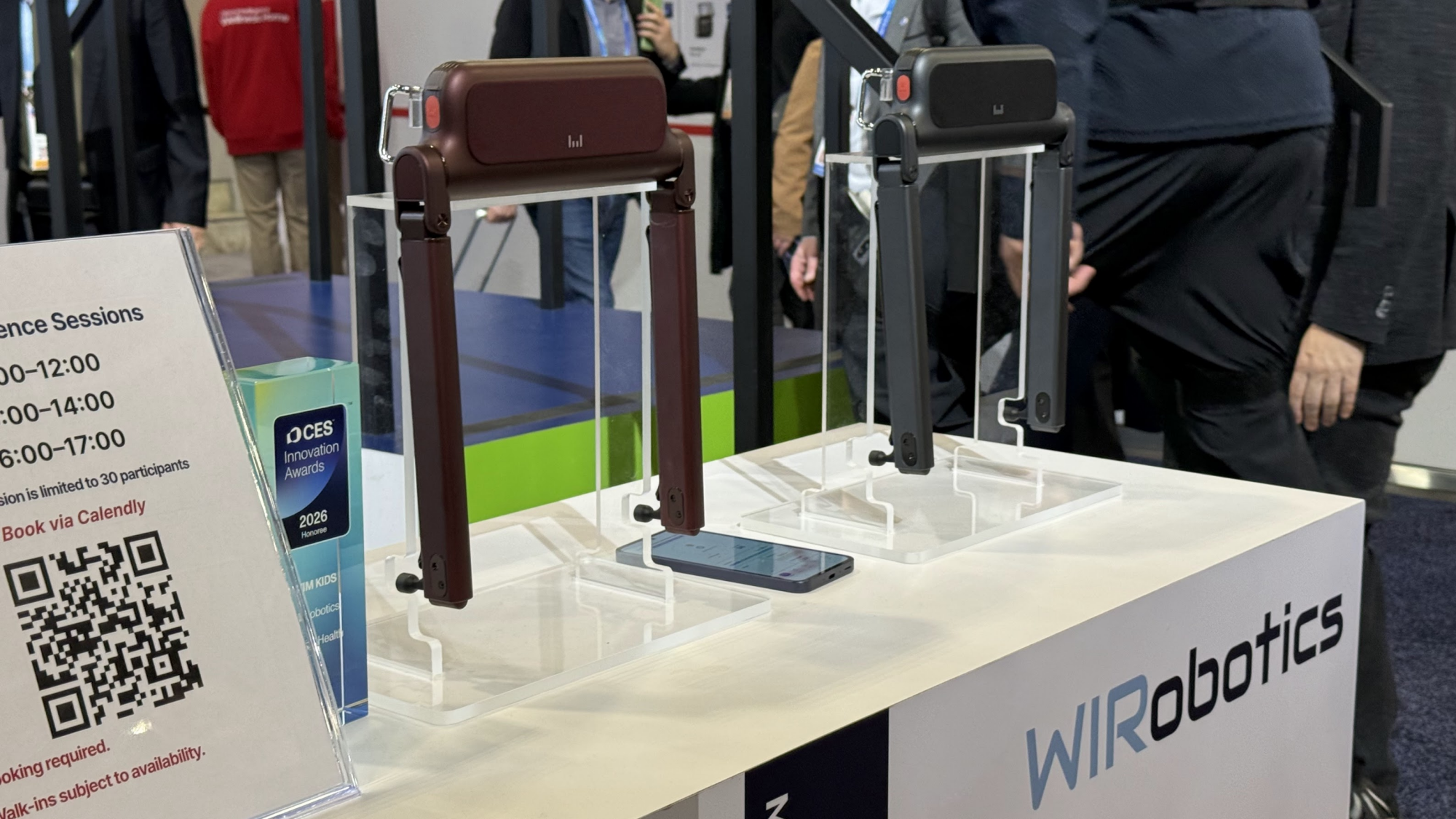
WiRobotics exoskeleton on display

Credit: Beth Skwarecki

This minimalist unit from WiRobotics was the last one I tried before leaving CES, and I’m sorry to say it comes in last place in my ranking as well. By this point, I’d tried several other hip-based exoskeletons that fit well and provided a significant boost to my walking and stepping. I loved the slim profile and simple design of the WIM-S—that is, until I turned it on. I was led up and down a mini staircase in the WiRobotics booth a few times before it was time to hand over the device to the next person in line. The WIM-S just didn’t feel like it was doing much.

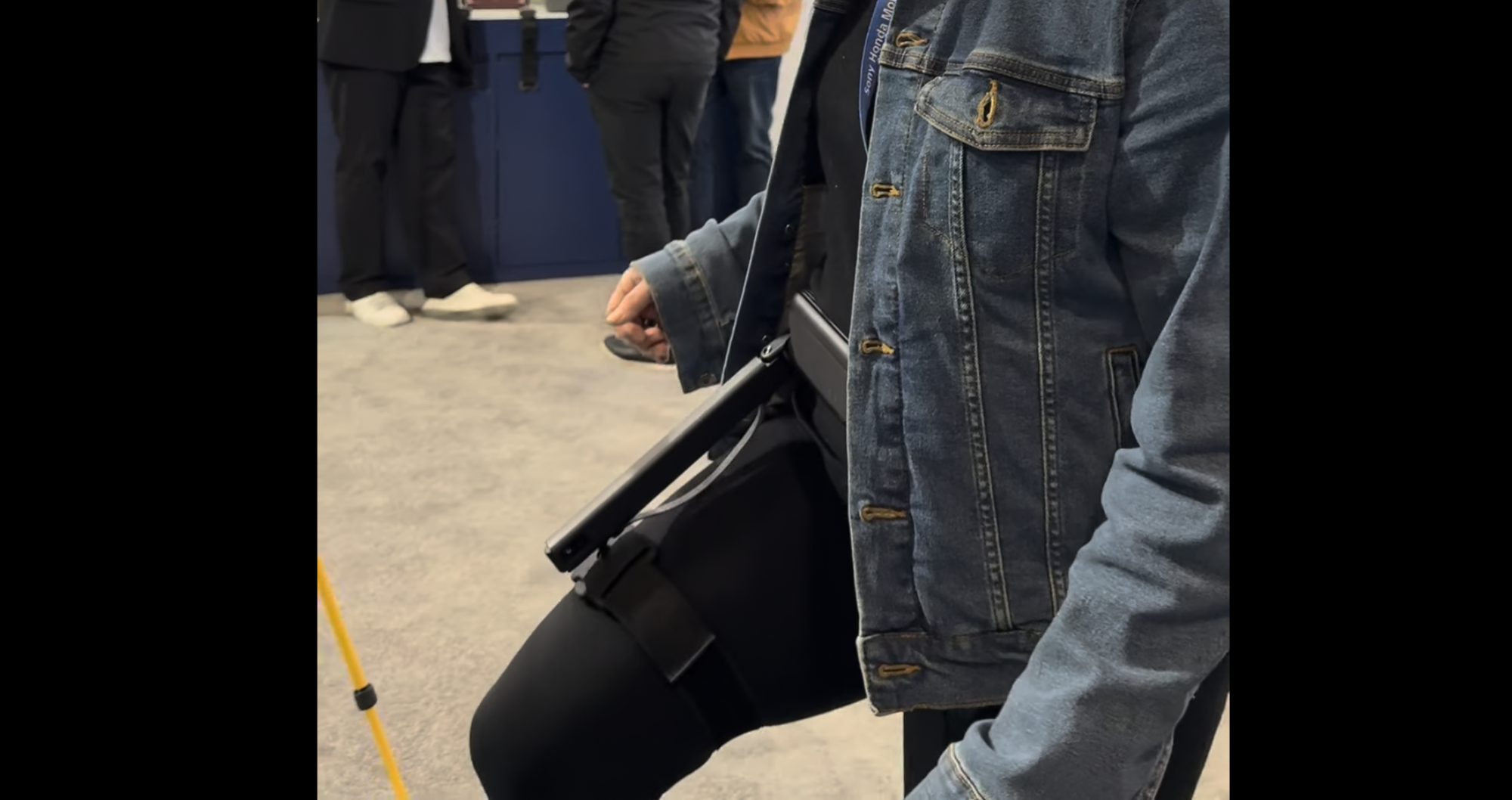
WiRobotics exoskeleton helping me walk

Credit: Beth Skwarecki

WiRobotics’ design keeps the device fully in front of your hips, pushing down on the front of your leg. It feels a bit like when you push your hand against your knee to help you stand up. The WIM-S isn’t available for sale in the U.S. yet, but goes for the equivalent of $1,905 in South Korea. 

I’m definitely feeling something: Sumbu ($1,199-$1,999)

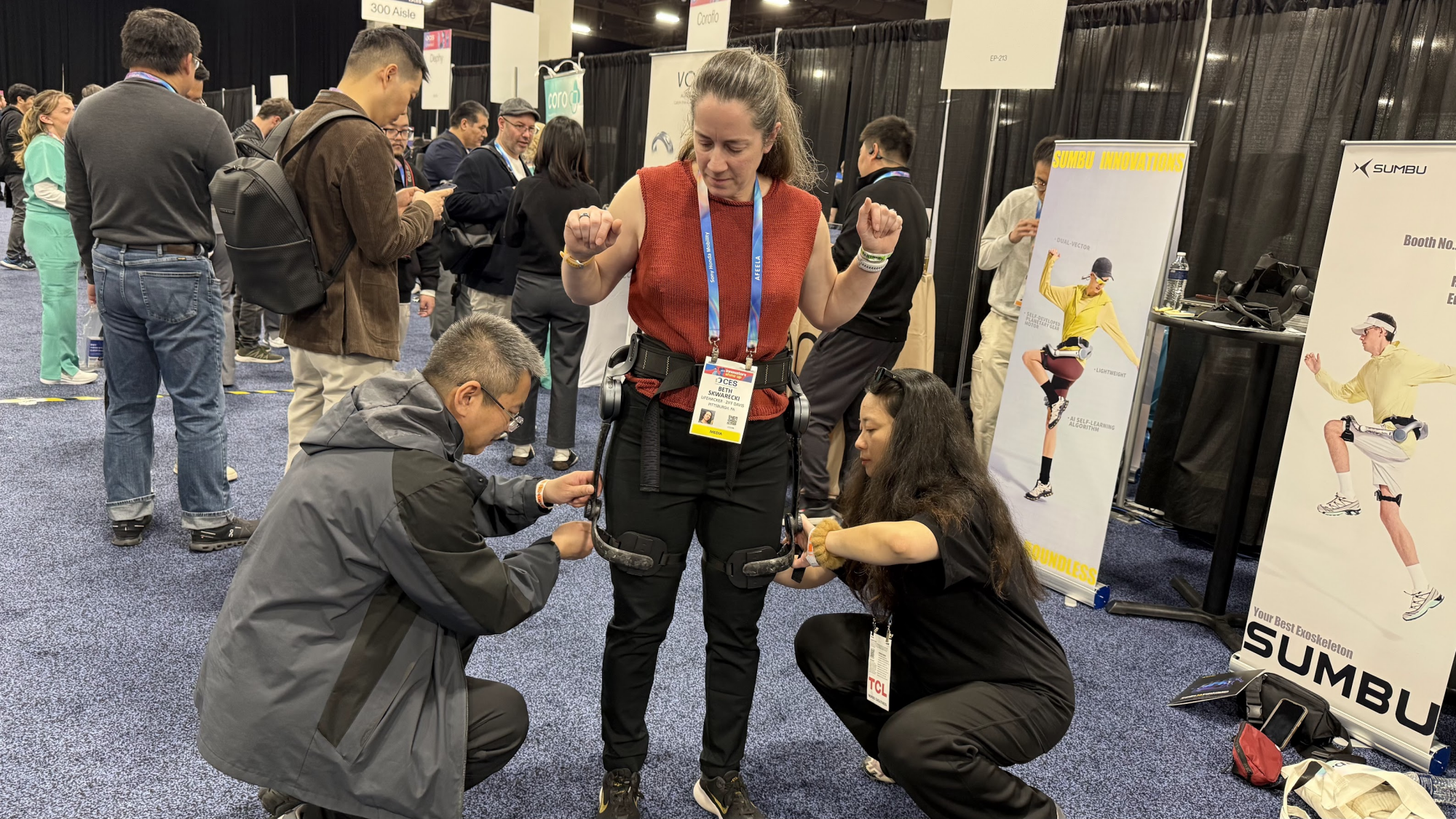
Trying on the Sumbu exoskeleton

Credit: Rena Goldman

I first tried a Sumbu exoskeleton at CES Unveiled, a media preview event that occurs a few days before the show officially opens. For the first time that week, but not the last, I had people help me strap a belt around my waist and then they tightened cuffs around my legs just above my knees. Walking around, I could feel the device helping to move my legs; jogging in place, I commented that it would be nice if I could try these on stairs. Good news! The company’s real booth would have stairs. 

I visited the booth later on, in CES’s “Eureka Park” area dedicated to startups. I walked up and down the provided mini stairs, and felt the exoskeleton helping me easily step up, even when I took the stairs two at a time. I also stepped up onto the top of the stair unit when I was standing next to it—three stairs tall, I think—slightly surprising the people at the booth. But the exoskeleton made it feel easy. 

To be totally honest, this exoskeleton and the next two I list (Ascentiz and Hypershell) all had a similar fit and feel. It’s tough to rank them against each other based on just a few minutes of testing for each, so take my conclusions with a grain of salt. 

Sumbu sells three models of exoskeletons: the lightweight S3 ($1,199), the more powerful S3 Pro ($1,499), and the “maximum power” S3 Ultra ($1,999).

Helping me run: Ascentiz ($1,499 and up)

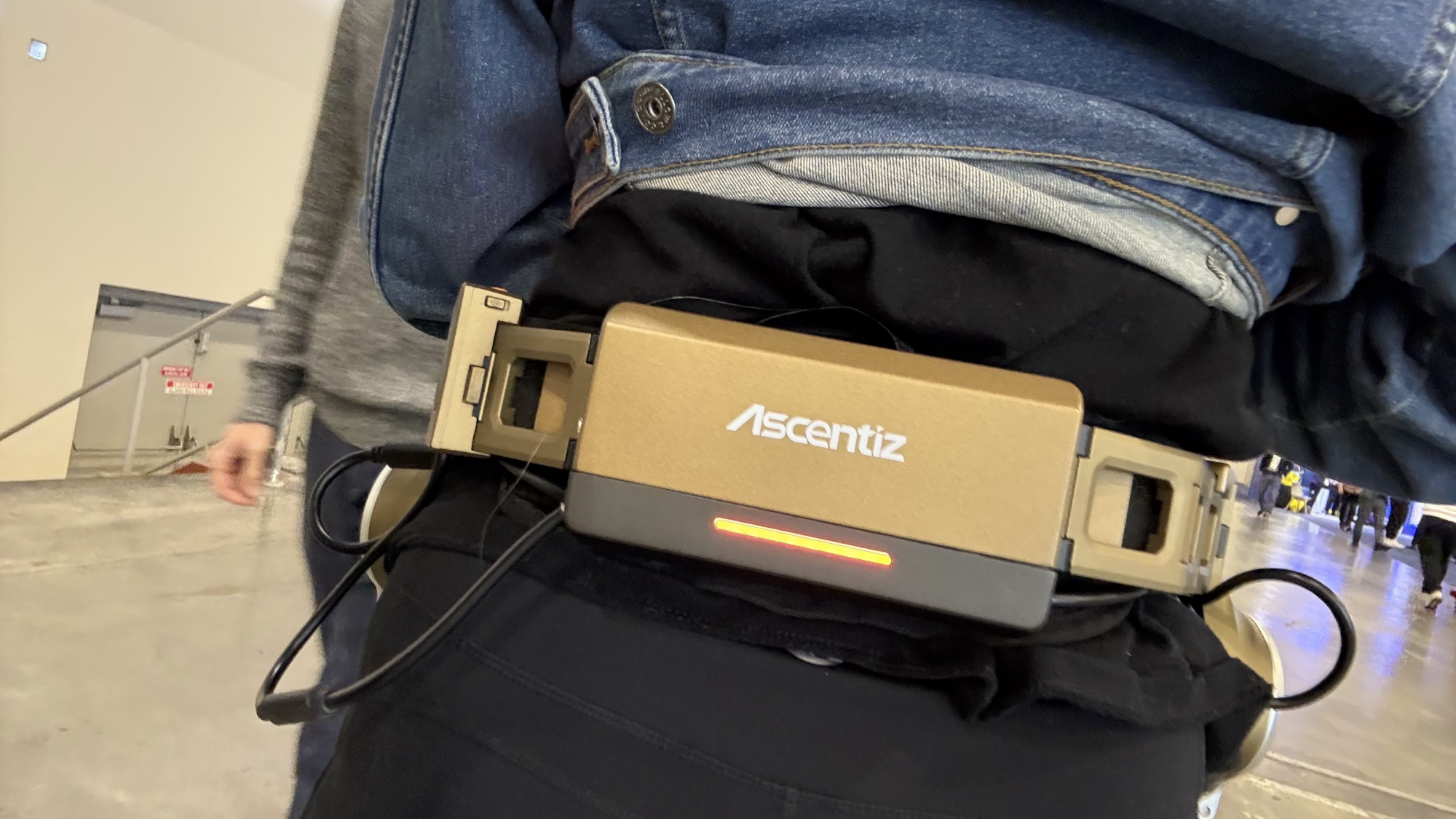
Ascentiz battery pack

Credit: Beth Skwarecki

Ascentiz makes a modular exoskeleton that can assist you at both the hip and the knee, but only the hip module was available for me to try. Hip exoskeletons seemed to be more popular; including Ascentiz, I tried four hip exoskeletons this week, and only found one each of knee and ankle exoskeletons (not including Ascentiz—you’ll see the knee exoskeleton I did try below). 

Each exoskeleton basically treats a joint of your body as a hinge. Your knee is a natural hinge joint; your hip can move in different directions, but when you’re wearing an exoskeleton, it only assists you in forward and backward motion—hip extension and flexion, to put it in terms a physical therapist or fitness trainer would recognize. Hip-based exoskeletons assist your glutes in straightening your hip and/or assist your hip flexors in raising your leg in front of you. 

Ascentiz exoskeleton

Credit: Beth Skwarecki

Ascentiz wisely set up its booth at the edge of the show floor, near a set of steps and also near a not-too-crowded area where I could walk and jog. The exoskeleton helped me climb stairs, and then I took it back and forth for a couple of jogs and even attempted a sprint. It felt smooth and my movements felt natural, with the power assisting me at just the right time during each stride. 

Ascentiz is currently running a Kickstarter for funding, and lists prices on its website. The H1 (hip) module is going for $699 to $999, and will have a suggested retail price of $1,499 to $1,999 depending on whether you go for the “Pro” or “Ultra” model. The knee module (K1) covers both knees and costs about $100 more. The full set, with both hip and knee assistance, will sell for $2,499 to $3,399.

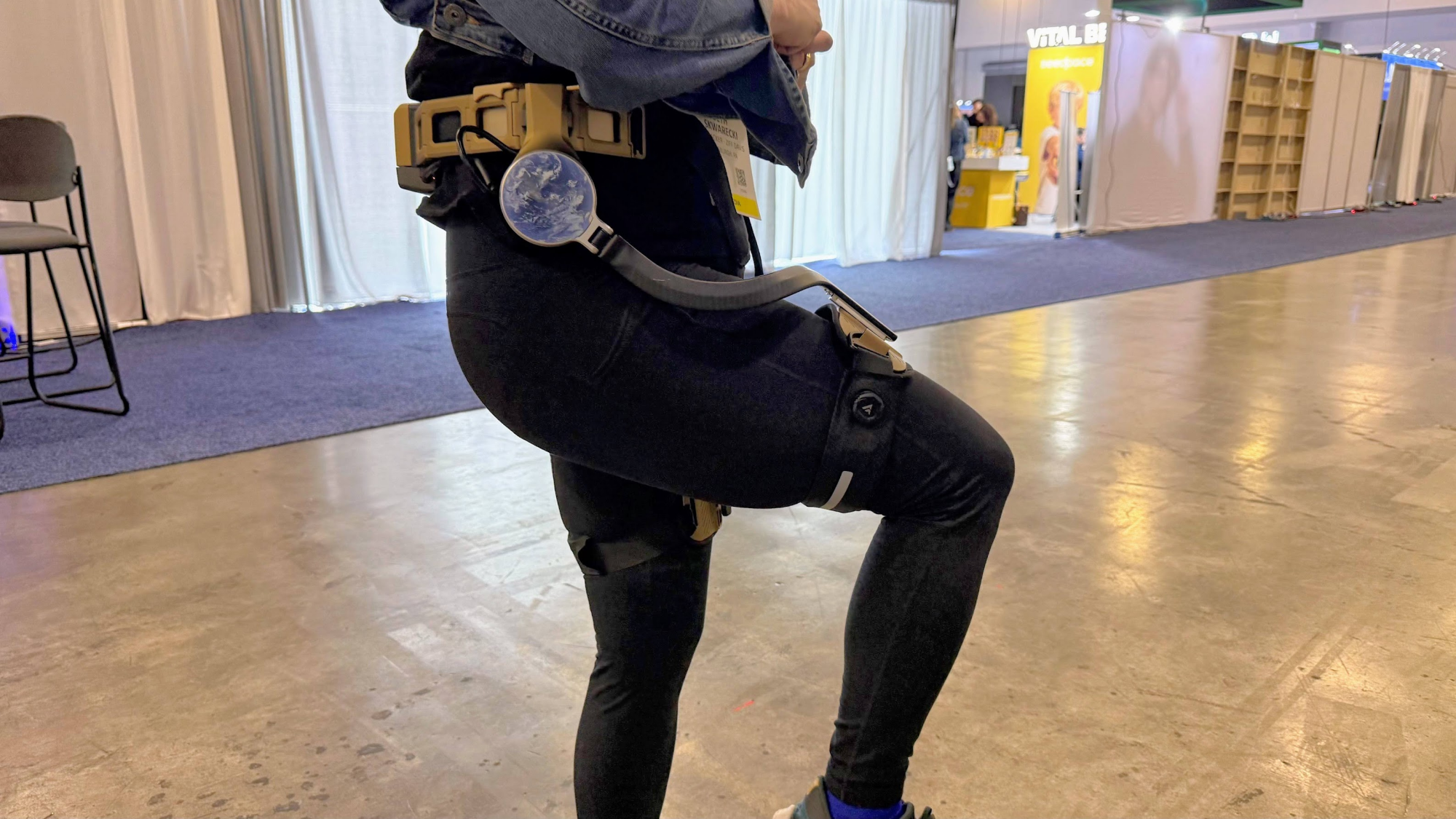
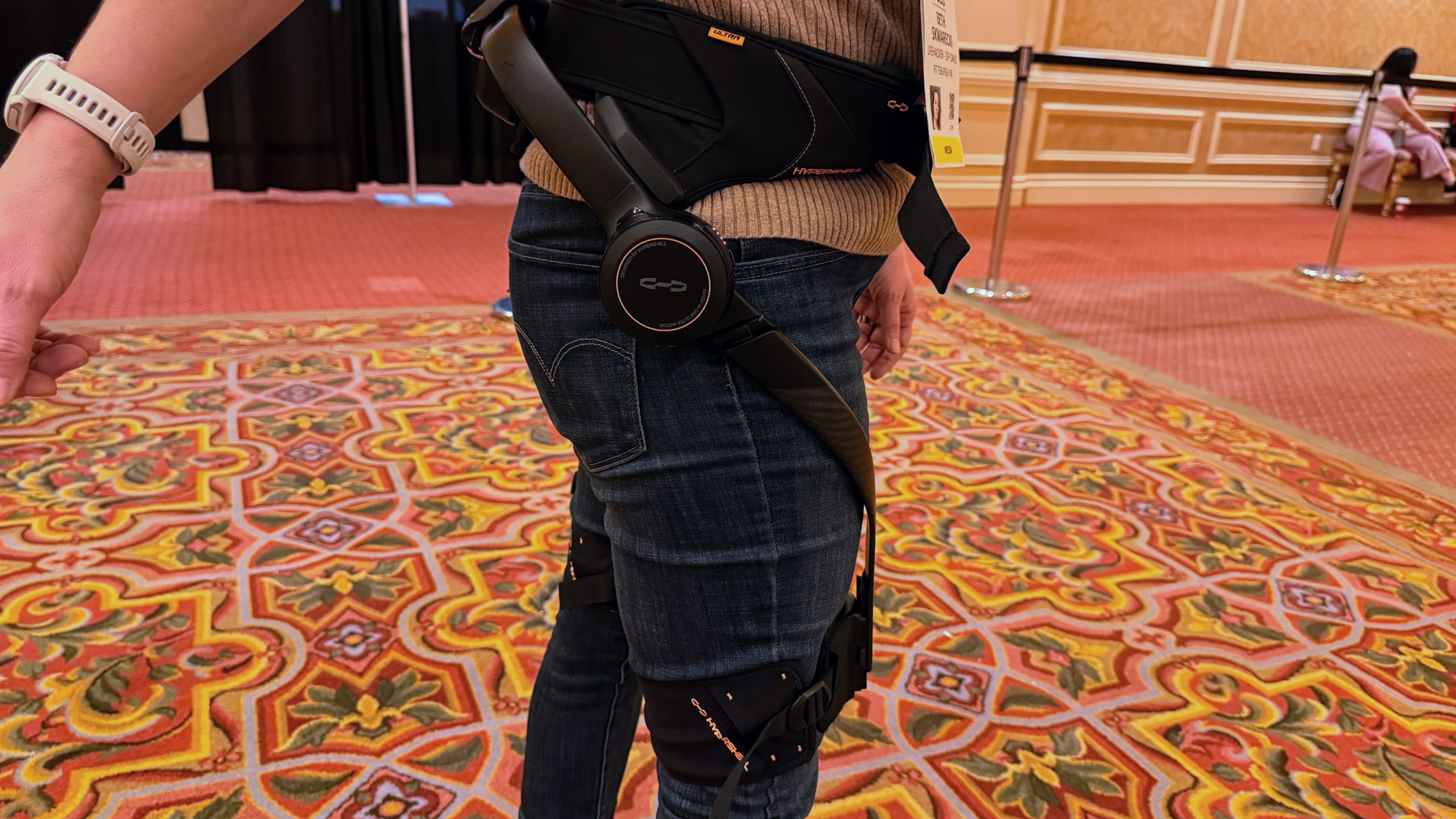
Sprinting around the hallways like a goofball: Hypershell X Ultra ($1,999)

Hypershell X Ultra

Credit: Rena Goldman

As I mentioned above, I borrowed my CNET colleague James Bricknell’s Hypershell X Ultra unit for a quick spin around the conference halls. I was impressed at how much its “beast mode” helped me do step-ups onto a chair, so then I decided to see if it could help me jog…and then run…and then sprint. And then attempt some quick turns and stops to see if it could keep up. (This was the first hip-based exoskeleton I tried to run in.) 

Beth running with an exoskeleton on

Credit: Beth Skwarecki

To my surprise, it felt great. To be fair, the Ascentiz felt pretty good to run in, too. I didn’t have space to run in the Sumbu one. The Hypershell kept up with my movements and assisted seamlessly. The others would sometimes think I was taking a step when I was actually standing still; the Hypershell wasn’t as prone to these missteps. 

Unlike some of the other exoskeletons on this list, the Hypershell is already on the market, and that’s probably why its technology feels a bit more mature. (It claims to be the first consumer outdoor exoskeleton.) The Hypershell X Ultra goes for $1,999 and the company’s lowest-price model is the Hypershell Go, at $899.

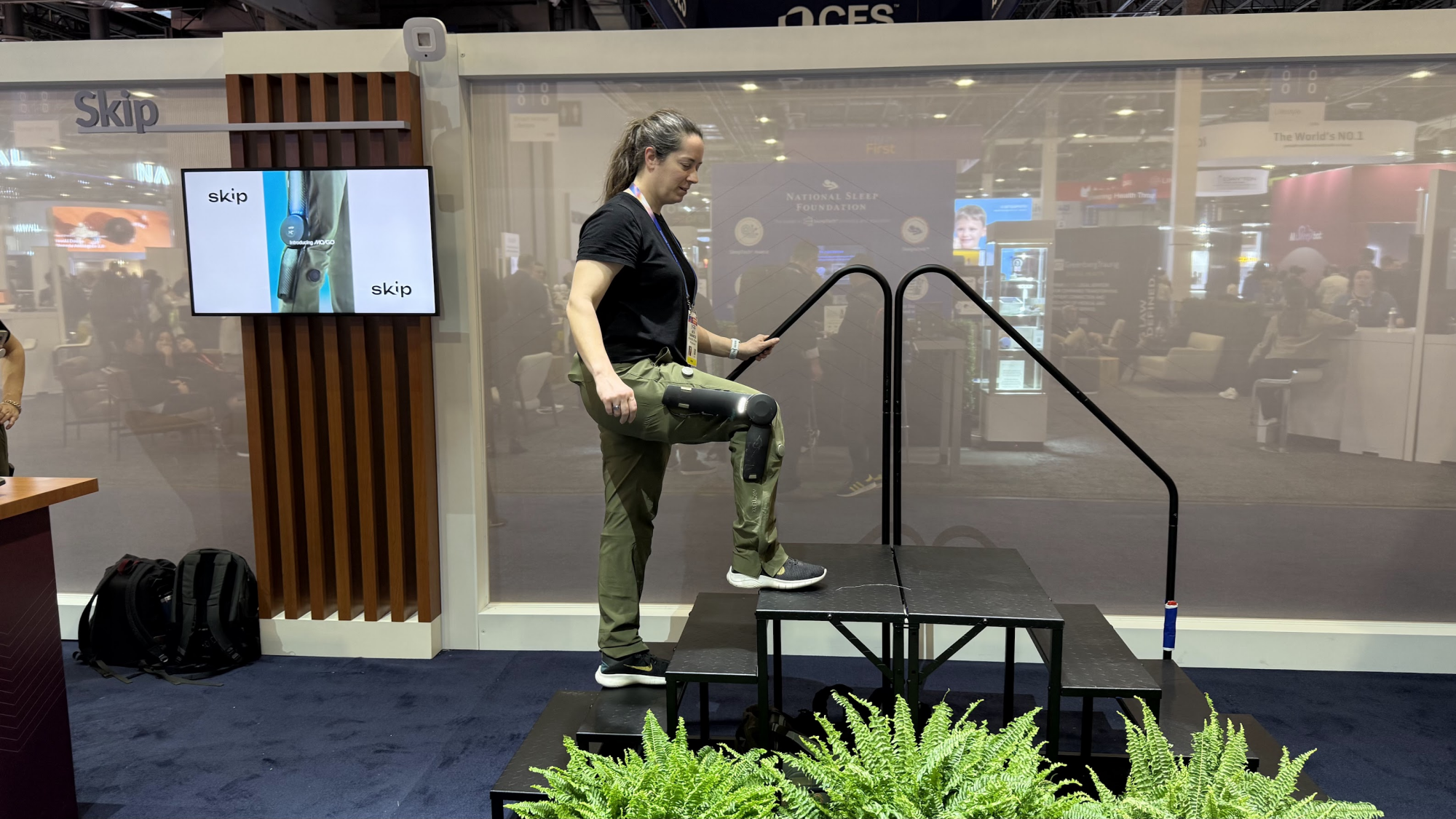
Going easy on my knees: Skip Mo/Go ($4,999)

Using the Skip exoskeleton to climb stairs

Credit: Beth Skwarecki

I found the Skip booth in the AARP’s AgeTech Collaborative section. There, I tried a version of its Mo/Go exoskeleton, which is built into a pair of pants and operates at the knee. The pants hide leg cuffs, which feel a bit like a medical knee brace. The motorized unit snaps onto the outside of the pants, so it looks like you’re wearing normal hiking pants but with a robot’s joint at the side of your knee. 

I had to change out of my jeans and into the special pants, and then I could snap on the motor and start climbing stairs and squatting. The feeling is different than on the hip exoskeletons, as you might imagine. The motor essentially acts as an extra quad muscle, helping to straighten my knee, and slowing me down as I’m descending stairs. 

I went up and down the stairs. I did some squats in place. I sat down on a low seat and stood back up again. Having been through knee pain and knee surgery in the past, I instantly understood why this product would be in demand (and why it was one of AARP’s picks). The other exoskeletons try to decelerate you on the way down stairs, but this one really works. Sitting down, the robot knees helped me gently settle, rather than having that “plop” at the end of the motion that we all probably do without thinking about it. 

I only ran a few steps, but the running didn’t feel great—you can tell it’s not meant for that motion, at least not yet. I didn’t find these as comfortable as the other exoskeletons I tried, because the cuffs were inside the pants. That meant I had them contacting my bare skin, where they got sweaty and seemed like they might chafe. It also wasn’t particularly easy to get the pants on—if I had mobility issues, I’d probably want help with that. The Skip representative mentioned that the exoskeleton can be removed from the pants and worn without them, which is probably what I’d do if I owned a pair.

Skip’s Mo/Go isn’t available yet, but you can place a pre-order on the device now, which will eventually cost $4,999.

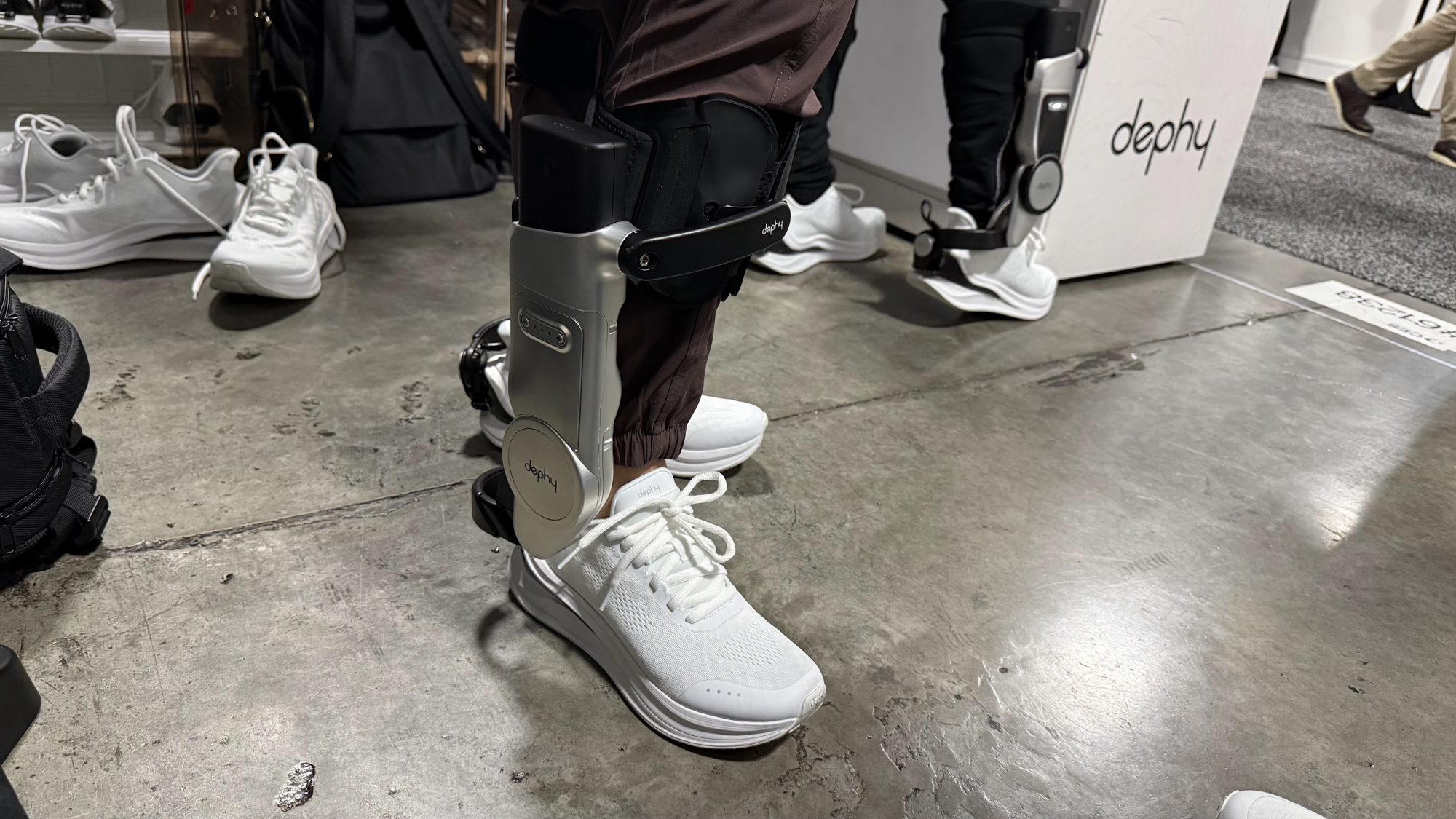
Putting a spring in my step: Dephy’s Sidekick ($4,500)

Dephy Sidekick powered footwear

Credit: Beth Skwarecki

This was both the first and nearly the last exoskeleton I tried at CES. I took it for a quick spin at Unveiled and visited the booth in Eureka Park for a longer try-on later in the week. 

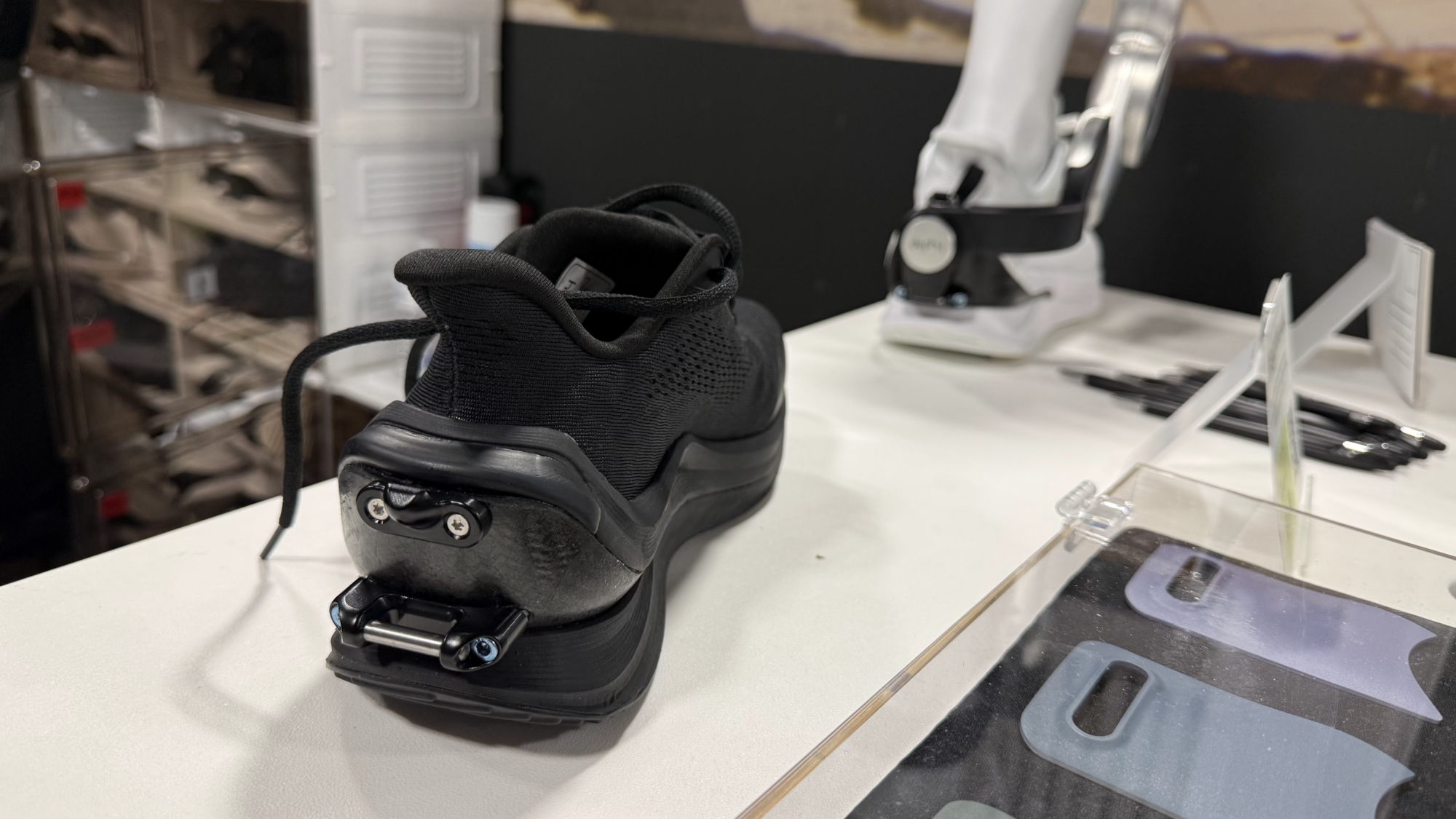
Dephy calls its exoskeleton “powered footwear.” The Sidekick has two parts: a shoe with a carbon plate, and a robotic arm that hugs your shin just below the knee. Dephy worked with Nike, and both companies came up with their own version of the exoskeleton; you can see Nike’s version here, branded as “Project Amplify.” 

The shoes can be worn on their own, and they’re cushy—I kept hearing people compare them to Hokas. They were certainly more comfortable than my own beat-up Nikes that I was wearing to get around the show halls. There’s a connector on the back, and the robotic arm hooks into it. If the arm were to detach while you’re wearing it, it would fall behind you, rather than in front. 

Dephy shoe from the back

Credit: Beth Skwarecki

The Dephy Sidekick assists your calf muscles in helping you walk. They don’t start to assist until you’ve walked several steps, but then I felt them lift my heel on every step. The device doesn’t help you lift your foot, but it does help you to flex your foot downward, pushing you forward as you walk. Dephy says it targeted this movement since the calf muscles are “unsung heroes” of walking, providing most of the energy. 

I took a few steps at Unveiled, and even did a sprint through the crowd. Running felt weird, but not necessarily bad. Later, taking a longer walk through Eureka Park, I could definitely believe that Dephy’s ankle-based exoskeleton would save me more work and fatigue than the hip-based models I mentioned earlier.

Overall this design felt the best thought-out and most comfortable of all the exoskeletons I tried. The places where it attached to my body were the shoe and a pad on the front of my shin—both very comfortable, and easily worn over my normal socks and pants. The device hooks on quickly, and the battery packs slip in and out without any fuss. 

I worried about the quick motion of the motor pulling me (or, hypothetically, an older person with mobility issues) off balance, but the way the device is programmed, that seems a lot less likely than I assumed. The motor only kicks in while you’re walking forward, and stops assisting when it detects a sideways, backward, or otherwise unexpected step. At one point I dodged around somebody’s dog in a cramped corner of the show floor, and the Sidekick stopped assisting for those few steps, then went right back to helping me move forward.

The Sidekick starts shipping later this month, and the starter pack, including the shoes, batteries, and a charger, costs $4,500. 

How useful are exoskeletons, really? 

Before I can say that exoskeletons are useful in the real world, I’d have to know that they work, that they’re worth the cost, and that they make sense for the people who are most likely to want them. 

Trying them on convinced me that they do, in fact, work. Five out of six (sorry, WiRobotics) gave assistance that felt helpful and useful. I wasn’t sure that they’d pass even this low bar, so I’m already impressed. 

Cost is a problem, though. Who is going to spend $1,000 to $5,000 for a little assistance in walking or hiking? Serious hikers and runners would probably rather train harder to handle tough terrain and spend the money on gear or coaching. People who don’t normally hike might enjoy keeping up with their friends, but what non-hiker is going to spend that kind of money on a hiking exoskeleton? 

I could definitely see exoskeletons in a rental market—borrow a Hypershell unit to hike up a scenic mountain on vacation, or wear Dephy’s powered footwear to stay on your feet longer in a theme park (remembering that you’d need to swap out the batteries once or twice during the day).

After trying the devices and frowning at the cost, my biggest question was whether exoskeletons could be useful for people with mobility issues due to disability or chronic health conditions. And to get a better sense of that, I talked to someone who has been working with exoskeletons in a medical setting for years.

How these consumer exoskeletons compare to medical devices

Amanda Clark, director of Good Shepherd Creates, is a physical therapist by training. Good Shepherd is a rehabilitation network that has been using exoskeletons in physical therapy for over 10 years, including the Ekso Bionics robotic suit used for physical therapy sessions, the Trexo Plus for children, and the ReWalk personal device that people can take home. 

These exoskeletons can help people to walk who may not have been able to walk on their own before, or who are recovering from strokes or brain or spinal cord injuries. The more steps you get in, the better your nervous system gets at learning how to balance and walk. 

Clark told me that the models that are used in rehab may cost a facility around $250,000, plus another 10% of that per year for maintenance. Typically a person needs a device like a walker or crutches to use them, and must have a person assisting them—such as a physical therapist at a rehab facility, or a family member in the case of the few personal exoskeletons that are now on the medical market. 

Getting an exoskeleton approved as a medical device takes a lot of time and money for the manufacturer, Clark explained. Medical devices need to undergo a type of FDA approval similar to that for drugs. The manufacturer has to show that they use good manufacturing processes, and they have to run clinical trials showing that the device is safe, and then that it is effective for a specific medical condition. 

That explains why the company reps I talked to were very careful to say that they made a “consumer” or “recreational” or “athletic” device, and not a medical device. But consumer devices can’t usually be covered by insurance, which puts a pretty big barrier in the way of access. People with disabilities and chronic conditions—especially if they have trouble working—usually don’t have a thousands of dollars to drop on devices like these. 

With the particular models I saw being so new, if I were in that position, I’d also be nervous about whether the devices work as promised, whether they’re safe, and whether the company would stay in business over the years to provide support in case anything goes wrong. 

But as a technology with room to grow, there’s definitely a possibility that these devices could become useful and worthwhile for people with mobility issues. Clark said she’s happy to see the technological progress that has been made to get these devices small and light enough to be wearable outside the clinic.

Still, she sees cost as a major barrier. “My challenge to these companies is: how do you create something that is user friendly, that is slim profile, that could really promote these changes in independence and quality of life—but at a price point or in a way that is accessible to them?”

That’s where I land as well. The technology is promising, but at the current price point, I’m not sure that they’re accessible to enough people with mobility issues, or worthwhile enough for athletes. But since the devices I tried are new to the consumer market, I’m looking forward to seeing if there are improvements in price and technology in the years to come.

Netflix will air new video podcasts from Pete Davidson and Michael Irvin this month

Netflix is continuing to double down on podcasts, with the streaming service’s announcement that it has hired talent to host two original shows for its platform. The first show stars NFL Hall of Famer-turned-analyst Michael Irvin and the second is a talk show for former Saturday Night Live cast member Pete Davidson.

The White House with Michael Irvin premieres January 19. The abode in the title refers to a building near the Dallas Cowboys facilities rather than the seat of US presidential power, but the overlap was intentional. “In a crowded media landscape, recognition matters — and few names carry the same immediate weight,” Irvin said. The podcast will have new episodes twice weekly with a rotating panel of co-hosts and guests covering sports news, commentary and analysis. 

The other project is titled The Pete Davidson Show, and the comedian will host weekly discussions with special guests. Episodes will primarily be filmed in Davidson’s garage. The Netflix exclusive premieres its first episode on January 30 at 12:01AM PT.

These programs will join a lineup of other video podcasts from iHeartRadio’s library after the media company inked a deal with Netflix in December 2025. Netflix also landed access to begin streaming some Spotify programming this year.

This article originally appeared on Engadget at https://www.engadget.com/entertainment/streaming/netflix-will-air-new-video-podcasts-from-pete-davidson-and-michael-irvin-this-month-224353011.html?src=rss