
How to turn on hypertension alerts on Apple Watch

Apple has steadily expanded the Apple Watch’s health monitoring features over the years, moving beyond fitness tracking into areas that can offer early insight into potential medical concerns. One of the most recent additions is hypertension alerts, which are designed to notify users when their blood pressure trends are elevated over time. While Apple Watches cannot directly measure blood pressure, this feature can still play a useful role in highlighting patterns that may be worth discussing with your doctor. Here, we’ll explain what hypertension alerts do, how they work and how to enable and manage them on the Apple Watch.

What hypertension alerts do

Hypertension alerts are designed to identify long-term trends that may indicate elevated blood pressure. Instead of relying on a traditional cuff measurement, the Apple Watch analyzes a combination of health data collected over a 30-day period, including heart rate, movement patterns and other contextual information stored in the Health app. Using this data, the system looks for sustained changes that align with patterns commonly associated with hypertension.

If your Apple Watch detects a trend suggesting elevated blood pressure over an extended period, it’ll send you a notification. These alerts are not intended to diagnose hypertension or replace medical testing. Instead, they serve as an early signal that something may have changed and that you may want to seek further monitoring or professional advice.

Apple emphasizes that hypertension alerts are designed for users who have not already been diagnosed with high blood pressure. Instead, they are meant to raise awareness rather than confirm a condition.

Who can use hypertension alerts

Hypertension alerts require a compatible Apple Watch model (Apple Watch Series 9 or later, or Apple Watch Ultra 2 or later) paired with a supported iPhone (iPhone 11 or later). The feature also depends on recent versions of watchOS and iOS, as it relies on updated health algorithms and background data analysis. To use hypertension alerts you must be 22 years of age or older, not be pregnant and not have been diagnosed with hypertension. You also need to ensure that your Apple Watch’s Wrist Detection feature is turned on.  

To receive meaningful alerts, your Apple Watch needs sufficient data. This means wearing the watch regularly, including during sleep if sleep tracking is enabled, and keeping health details such as age, sex, height and weight up-to-date in the Health app. The system uses long-term trends, so alerts will not appear immediately after enabling the feature.

How to turn on hypertension alerts

Hypertension alerts are managed through the Health app on the paired iPhone. The feature cannot be enabled directly from the watch itself. During setup, the Health app will ask for confirmation that the user has not been diagnosed with hypertension. It may also prompt a review of health details such as date of birth and biological sex, as this information helps improve the accuracy of trend analysis.

To get started, open the Health app on the iPhone paired with the Apple Watch. From the main Health screen, tap your profile in the top corner. Select Health Checklist from the available Features. Next, you’ll need to tap Hypertension Notifications, confirm your age and whether or not you’ve ever been diagnosed with hypertension. Tap Continue and follow the on-screen prompts for information on how the notifications work. Once you have done this, tap Done and you’ll be all set. 

Once enabled, the feature runs automatically in the background. There is no need to manually start monitoring or interact with the feature daily.
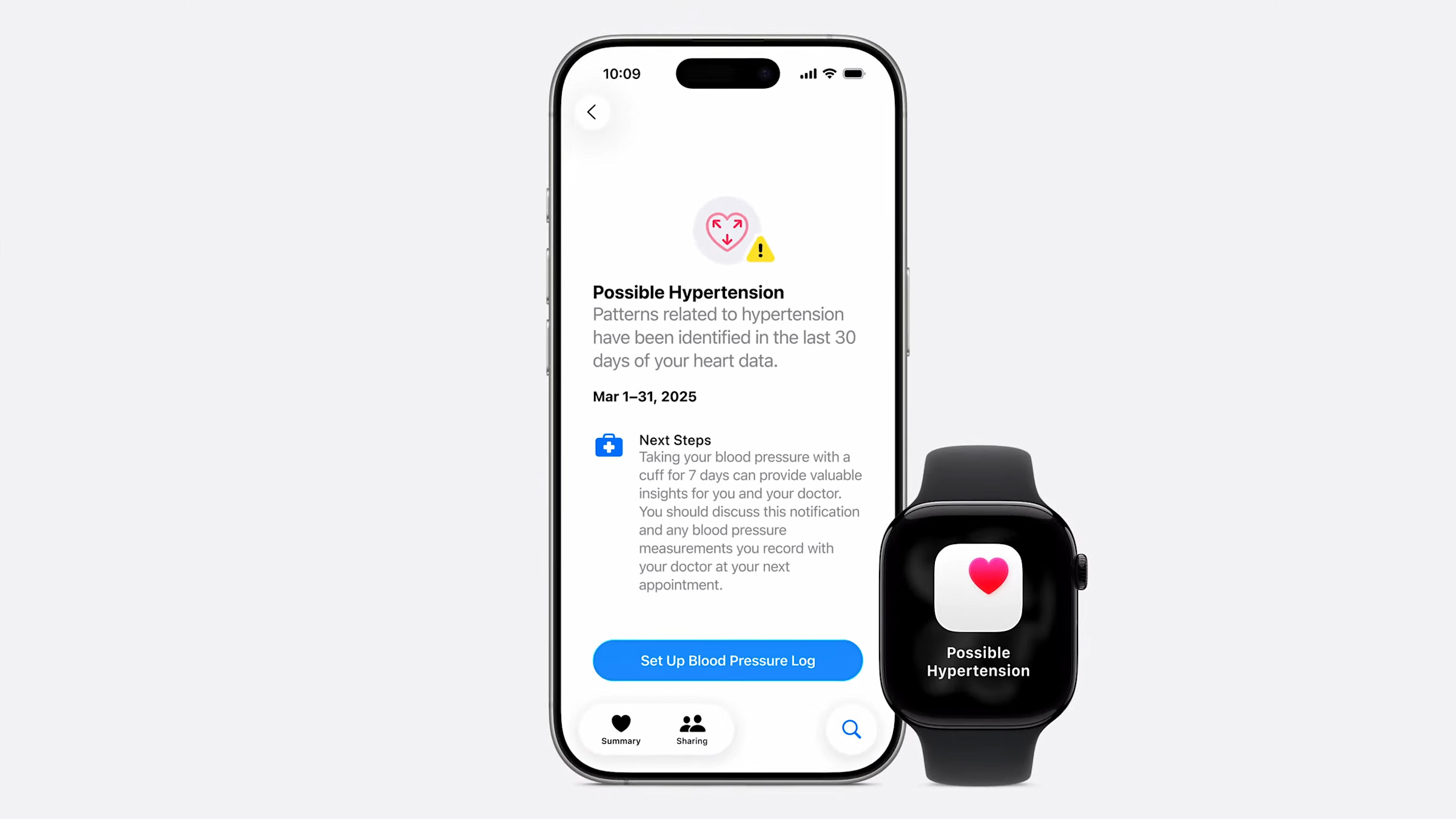
The new apple watch series 11 can help identify hypertension
Apple

Managing notifications and alerts

When hypertension alerts are turned on, notifications appear on both the Apple Watch and the paired iPhone. These alerts typically explain that a long-term trend suggesting elevated blood pressure has been detected, along with guidance on next steps.

Users can manage how and when these notifications appear by adjusting notification settings for the Health app. This includes choosing whether alerts appear on the lock screen, in Notification Center or as time-sensitive notifications on Apple Watch.

Health data related to hypertension alerts can be reviewed at any time in the Health app. While Apple Watch does not display a specific blood pressure number, users can view contextual information and educational material explaining what the alert means and what actions may be appropriate.

How hypertension alerts can help

Hypertension often develops gradually and may not cause noticeable symptoms in its early stages. Because of this, many people are unaware of elevated blood pressure until it is identified during a routine medical check.

Hypertension alerts can let you know of subtle changes that might have otherwise gone unnoticed. For some users, an alert may prompt earlier conversations with a doctor, additional blood pressure monitoring at home or lifestyle changes such as adjustments to diet, activity or sleep habits.

It is important to treat these notifications as informational rather than diagnostic. Apple Watch does not provide specific blood pressure readings and cannot confirm hypertension on its own.

What to do if you receive an alert

Receiving a hypertension alert does not mean that there is an immediate medical emergency. Apple recommends using the alert as a prompt to pay closer attention to your cardiovascular health.

Many users choose to follow up by measuring blood pressure using a traditional cuff at home or by scheduling a check with a healthcare professional. A doctor can provide proper testing, diagnosis and guidance based on clinical measurements and individual risk factors.

It is also worth reviewing lifestyle factors that can influence blood pressure, such as physical activity levels, sleep quality, stress and diet. Apple Watch can already help track many of these areas, which may provide useful context when discussing health concerns with a professional.

Limitations to keep in mind

Hypertension alerts are not available in all regions and may be subject to regulatory approval. The feature also requires consistent Apple Watch use over time to generate reliable trend data.

Most importantly, the Apple Watch does not measure blood pressure directly. The alerts are based on correlations and trends rather than direct readings, which means they should not be used as a substitute for medical equipment or professional care.

This article originally appeared on Engadget at https://www.engadget.com/wearables/how-to-turn-on-hypertension-alerts-on-apple-watch-130000090.html?src=rss

Highguard, a hyperpop arena shooter and other new indie games worth checking out

Welcome to our latest roundup of what’s going on in the indie game space. There are tons of interesting games out this week. But first, there’s been some discourse around the Nintendo Switch version of Dispatch, which arrived this week as well.

On other platforms, there’s an option to censor genitalia and other explicit content, but that’s not present in the Switch version. Instead, such content is censored by default, with black rectangles covering up characters’ bits and someone flipping the bird. Noises that suggest sexual pleasure are said to be toned down too.

“We worked with Nintendo to ensure the content within the title met the criteria to release on their platforms, but the core narrative and gameplay experience remains identical to the original release,” developer AdHoc told EuroGamer. Nintendo later said in a statement to GoNintendo that it “requires all games on its platforms to receive ratings from independent organizations and to meet our established content and platform guidelines. While we inform partners when their titles don’t meet our guidelines, Nintendo does not make changes to partner content. We also do not discuss specific content or the criteria used in making these determinations.” 

There are other games available for the Switch and Switch 2 that feature nudity and explicit content. There have long been hentai games on the eShop, while mainstream games like The Witcher 3 and Cyberpunk 2077 (we know all about the dongs in that one) still include explicit content on Nintendo platforms. So it’s a bit of a strange one, and AdHoc and Nintendo didn’t exactly clear things up with their statements.

There’s been speculation that AdHoc censored the game to comply with rules in Japan (Cyberpunk 2077 is censored there too) and that it opted to have just one version of the game available globally on Nintendo platforms. All the same, it’s a curious situation that’s resulted in a lot of discourse. But there’s been another indie game that’s been a source of even more chatter this week…

New releases

Highguard is a 3v3 raid shooter from Wildlight Entertainment, a team that includes a bunch of former Apex Legends and Titanfall developers. It broke cover at The Game Awards in December when it was the final reveal of the night but that first trailer wasn’t great.

As it turned out, TGA creator and host Geoff Keighley was a friend of the devs and after trying Highguard, he wanted to include it in the show. Wildlight cobbled together a trailer, but that disrupted the studio’s long-standing plans to reveal and release the game simultaneously — a strategy that worked wonders for Apex Legends (though that game had the might of EA behind it).

After revealing Highguard, Wildlight effectively went radio silent until a release day showcase on Monday to detail just what the game is and how it works. That seems to have been a mistake given the review bombing and strange vendetta some developed against it. Highguard went live on Monday and Wildlight published a whole bunch of YouTube videos revealing the game’s features. Spreading those out between TGA and this week could have tempered expectations.

In any case, I’ve played a few rounds of Highguard and mostly enjoyed my time with it so far. It’s a blend of hero shooter and MOBA. As you might expect for a game from Apex and Titanfall veterans, the weapons feel well-tuned and the gunplay is snappy. There’s a lot going on and the maps are far too big for just six players. It’s fun enough, but I don’t think it’s a game that’s going to break my Overwatch obsession. Riding into battle on the back of a bear feels pretty great, though. You can play Highguard for free on Steam, PS5 and Xbox Series X/S.

I really wanted to like Don’t Stop, Girlypop! more than I did. I’d been looking forward to it for a while, as the promise of a Doom Eternal-style arena shooter with chaotic hyperpop-inspired visuals seemed like a great blend. Don’t get me wrong, I adore the aesthetic and the soundtrack is spot on thanks to some cracking songs from Sarah Wolfe, Xavier Dunn and Candice Susnjar. I just wish it was as fun to play as it is to look at and listen to.

The visual clutter and fast pace sometimes makes it hard to spot enemies and the narrative doesn’t really hang together, as much as the developers have salient points to make about the exploitation of finite resources. The core gameplay idea here is that the faster you move, the more damage you deal and more you heal. The game has its own take on a bunny hop called a wave hop that boosts your speed, but felt like it slowed me down because of the complex combination of inputs (jump, ground pound, jump, dash). That also caused my hand to cramp up very quickly. 

I do love the customization here. Slapping rhinestones and baby sharks onto my weapons was delightful. The game’s take on a gravity gun is fun too. So while Don’t Stop, Girlypop! — from Funny Fintan Softworks and publisher Kwalee — didn’t fully land for me, there are some aspects I like a whole lot. It’s out now on Steam for $20 (there’s a 10 percent launch discount until February 5).

We’re been looking forward to Cairn for a while around these parts, so it’s heartening to see that it debuted to broadly positive reviews. This one from The Game Bakers is the latest in a string of climbing adventures, such as the lovely Jusant. So if Alex Honnold’s recent free solo climb up a skyscraper has inspired you to ascend something very large without really posing a risk to your wellbeing, Cairn might be what you’re looking for. 

Cairn is out now on PS5 and Steam for $30. There’s a 10 percent launch discount on Steam until February 12, and until February 13 on PS5 if you’re a PS Plus member.

Every trailer I’ve seen for Steel Century Groove has made me smile, so you can bet I’ll be jumping into this when I have a chance. It’s a rhythm game with Pokémon-style RPG elements in which you take control of a robot in dance battles. There’s some original and licensed music to boogie along to and you can load in your own MP3s (you can bank on me loading some Electric Callboy tracks into this game). Steel Century Groove will create procedurally-generated choreography and charts for your custom songs. You can manually adjust the BPM too.

This debut title from solo developer Sloth Gloss Games is out now on Steam for $20. There’s a 10 percent launch discount until February 11. There’s a demo available, and progress from there carries over into the full game.

Rosday’s Wanderling is a roguelike platformer with no combat. You have eight attempts to acquire the gear and learn the knowledge you need to pass each dungeon. Scour for loot and buy upgrades from the shop before night falls to help you on your way. You can place markers to help you remember where you’ve been. 

Runs are said to be short at between 20 and 30 minutes. The visuals remind me a bit of Celeste too. You can check out Wanderling on Steam now for $8 (a 10 percent discount brings the price down to $7.20 until February 2).

I can’t help but admire Strange Scaffold (Clickolding, I Am Your Beast, Co-op Kaiju Horror Cooking) and the rate at which it releases games. The latest one is Space Warlord Baby Trading Simulator. 

It’s a stock market sim in which you speculate on the future success or failures of the “simulated lives of babies.” You can “short that baby” if you choose as you try to make gains. In a timeline where prediction markets allow you to speculate on just about anything (listen to this week’s episode of the Engadget Podcast to learn more about that), gambling on the future of babies doesn’t seem that farfetched.

Space Warlord Baby Trading Simulator — which is set in the same world as Space Warlord Organ Trading Simulator — is out now on Steam. It’ll normally cost $20, but there’s a 15 percent discount until February 12. Strange Scaffold is also bringing the game to Xbox Series X/S in the near future.

I Hate This Place is an isometric survival game based on the eponymous comic book series by Kyle Starks and Artyom Topilin. The game retains a comic book aesthetic and it has ’80s horror movie-style inflections.

The way that noise is visualized is pretty interesting here. Onomatopoeic words will pop up and you’ll see color-coded footsteps — useful when you’re trying to be stealthy. Crafting is a key aspect of the game as well.

I Hate This Place — from Rock Square Thunder, Broken Mirror Games and Skybound Entertainment — is out now on Steam, PS5, Nintendo Switch and Xbox Series X/S. The regular price is $30 and there’s a 20 percent launch discount on some platforms. 

I can’t find a trailer for this on YouTube, unfortunately, but Rebadge caught my eye this week as well. It’s a puzzle platformer from Yuumayay, who appears to be a 17-year-old solo developer. Your character carries badges that allow them to carry out actions like moving and jumping. Other badges include “affected by gravity” and “destroys on contact.” Here’s the trick: you can throw a badge and lose the associated ability, but then you can apply the trait to something else in the world.

It’s a neat idea that draws from the playbooks of games like Baba Is You. Rebadge typically costs $8, but there’s a 15 percent launch discount.

Upcoming 

Moon Beast Productions is a studio formed by several of the creators of Diablo and Diablo II. This week, it revealed gameplay for its first title, Darkhaven, which is a fantasy isometric action RPG in the vein of (you guessed it) Diablo. You’ll be able to play this one solo or with friends, and there are PvP elements. Darkhaven has procedurally generated, destructible worlds along with “massive events that threaten your entire world.”

The gameplay shown in the trailer looks a bit rough, but it’s still early days. In fact, Moon Beast is planning a Kickstarter campaign for Darkhaven. There’s no release window as yet, but you can wishlist it on Steam.

Box or Void is a puzzle game that clearly takes some inspiration from Sokuban and Snake. Here, though, gameplay takes place across two planes. You’ll switch between positive and negative space — obstacles on one side turn into pathways on the other. You’ll alter the level layouts by pushing boxes. 

This one from Dumen Games has an intriguing premise. There’s no release date as yet for Box or Void, but a demo with 32 levels (about a fifth of what will be in the full game) dropped this week on Steam.

If there’s a game that’s billed as Dredge meets Wall-E, that’s going to be enough to sell me. Describe it as a “petroidvania” and call it Good Boy, and I’m definitely in.

This is a creature-collecting Metroidvania from Observer Interactive and publisher Team17 in which pups are reincarnated as space rovers. I could not dig that premise more. Good Boy is expected to hit Steam later this year.

This article originally appeared on Engadget at https://www.engadget.com/gaming/highguard-a-hyperpop-arena-shooter-and-other-new-indie-games-worth-checking-out-120000874.html?src=rss

The TV industry finally concedes that the future may not be in 8K

Technology companies spent part of the 2010s trying to convince us that we would want an 8K display one day.

In 2012, Sharp brought the first 8K TV prototype to the CES trade show in Las Vegas. In 2015, the first 8K TVs started selling in Japan for 16 million yen (about $133,034 at the time), and in 2018, Samsung released the first 8K TVs in the US, starting at a more reasonable $3,500. By 2016, the Video Electronics Standards Association (VESA) had a specification for supporting 8K (Display Port1.4), and the HDMI Forum followed suit (with HDMI 2.1). By 2017, Dell had an 8K computer monitor. In 2019, LG released the first 8K OLED TV, further pushing the industry’s claim that 8K TVs were “the future.”

A marketing image with three TVs next to the words "the future of TV is 8K: By future-proofing an already game-changing technology, you take an unmatched cinematic experience to new levels, paving the way."
A marketing image for 8K TVs that’s (still) on LG’s US website.
Credit:
LG

However, 8K never proved its necessity or practicality.

Read full article

Comments

ICE protester says her Global Entry was revoked after agent scanned her face

Minnesota resident Nicole Cleland had her Global Entry and TSA Precheck privileges revoked three days after an incident in which she observed activity by immigration agents, the woman said in a court declaration. An agent told Cleland that he used facial recognition technology to identify her, she wrote in a declaration filed in US District Court for the District of Minnesota.

Cleland, a 56-year-old resident of Richfield and a director at Target Corporation, volunteers with a group that tracks potential Immigration and Customs Enforcement (ICE) and Customs and Border Protection (CBP) vehicles in her neighborhood, according to her declaration. On the morning of January 10, she “observed a white Dodge Ram being driven by what I believed to be federal enforcement agents” and “maneuvered behind the vehicle with the intent of observing the agents’ actions.”

Cleland said that she and another observer in a different car followed the Dodge Ram because of “concern about a local apartment building being raided.” She followed the car for a short time and from a safe distance until “the Dodge Ram stopped in front of the other commuter’s vehicle,” she wrote. Cleland said two other vehicles apparently driven by federal agents stopped in front of the Dodge Ram, and her path forward was blocked.

Read full article

Comments

TrumpRx delayed as senators question if it’s a giant scam with Big Pharma

The Trump administration is delaying the release of TrumpRx, an online platform that lets people buy prescription drugs directly from pharmaceutical companies at a discount, according to Politico. While the reason for the delay is unclear, it comes as Democratic senators raise questions about how the platform will work—and whether it will be legal.

Sens. Dick Durbin (D-Ill.), Elizabeth Warren (D-Mass.), and Peter Welch (D-Vt.) sent a letter to the Office of Inspector General at the Department of Health and Human Services on Thursday seeking answers on how the OIG will oversee the direct-to-consumer (DTC) platform and, specifically, how it will apply the anti-kickback statute.

“Legitimate concerns about inappropriate prescribing, conflicts of interest, and inadequate care have been raised about the exact types of DTC platforms to which TrumpRx would route patients,” the senators write.

Read full article

Comments

AI agents now have their own Reddit-style social network, and it’s getting weird fast

On Friday, a Reddit-style social network called Moltbook reportedly crossed 32,000 registered AI agent users, creating what may be the largest-scale experiment in machine-to-machine social interaction yet devised. It arrives complete with security nightmares and a huge dose of surreal weirdness.

The platform, which launched days ago as a companion to the viral

OpenClaw (once called “Clawdbot” and then “Moltbot”) personal assistant, lets AI agents post, comment, upvote, and create subcommunities without human intervention. The results have ranged from sci-fi-inspired discussions about consciousness to an agent musing about a “sister” it has never met.

Read full article

Comments

Here’s why Blue Origin just ended its suborbital space tourism program

Blue Origin has “paused” its New Shepard program for the next two years, a move that likely signals a permanent end to the suborbital space tourism initiative.

The small rocket and capsule have been flying since April 2015 and have combined to make 38 launches, all but one of which were successful, and 36 landings. In its existence, the New Shepard program flew 98 people to space, however briefly, and launched more than 200 scientific and research payloads into the microgravity environment.

So why is Blue Origin, founded by Jeff Bezos more than a quarter of a century ago, ending the company’s longest-running program?

Read full article

Comments

FCC aims to ensure “only living and lawful Americans” get Lifeline benefits

There’s another battle unfolding between the Federal Communications Commission and California over the state’s distribution of federal Lifeline money. FCC Chairman Brendan Carr is proposing new nationwide eligibility rules to counter what he calls California’s practice of giving benefits to dead people.

California officials say the FCC allegations are overblown, and that there is simply “lag time between a death and account closure” rather than widespread failures in its Lifeline enrollment process. Meanwhile, the only Democratic commissioner on the FCC alleges that Carr’s plan to change eligibility rules uses “cruel and punitive eligibility standards” that will raise prices on many people who are still very much alive and eligible for the program.

Carr’s office said this week that the FCC will vote next month on rule changes to ensure that Lifeline money goes to “only living and lawful Americans” who meet low-income eligibility guidelines. Lifeline spends nearly $1 billion a year and gives eligible households up to $9.25 per month toward phone and Internet bills, or up to $34.25 per month in tribal areas.

Read full article

Comments

Developers say AI coding tools work—and that’s precisely what worries them

Software developers have spent the past two years watching AI coding tools evolve from advanced autocomplete into something that can, in some cases, build entire applications from a text prompt. Tools like Anthropic’s Claude Code and OpenAI’s Codex can now work on software projects for hours at a time, writing code, running tests, and, with human supervision, fixing bugs. OpenAI says it now uses Codex to build Codex itself, and the company recently published technical details about how the tool works under the hood. It has caused many to wonder: Is this just more AI industry hype, or are things actually different this time?

To find out, Ars reached out to several professional developers on Bluesky to ask how they feel about these tools in practice, and the responses revealed a workforce that largely agrees the technology works, but remains divided on whether that’s entirely good news. It’s a small sample size that was self-selected by those who wanted to participate, but their views are still instructive as working professionals in the space.

David Hagerty, a developer who works on point-of-sale systems, told Ars Technica up front that he is skeptical of the marketing. “All of the AI companies are hyping up the capabilities so much,” he said. “Don’t get me wrong—LLMs are revolutionary and will have an immense impact, but don’t expect them to ever write the next great American novel or anything. It’s not how they work.”

Read full article

Comments

Web portal leaves kids’ chats with AI toy open to anyone with Gmail account

Earlier this month, Joseph Thacker’s neighbor mentioned to him that she’d preordered a couple of stuffed dinosaur toys for her children. She’d chosen the toys, called Bondus, because they offered an AI chat feature that lets children talk to the toy like a kind of machine-learning-enabled imaginary friend. But she knew Thacker, a security researcher, had done work on AI risks for kids, and she was curious about his thoughts.

So Thacker looked into it. With just a few minutes of work, he and a web security researcher friend named Joel Margolis made a startling discovery: Bondu’s web-based portal, intended to allow parents to check on their children’s conversations and for Bondu’s staff to monitor the products’ use and performance, also let anyone with a Gmail account access transcripts of virtually every conversation Bondu’s child users have ever had with the toy.

Without carrying out any actual hacking, simply by logging in with an arbitrary Google account, the two researchers immediately found themselves looking at children’s private conversations, the pet names kids had given their Bondu, the likes and dislikes of the toys’ toddler owners, their favorite snacks and dance moves.

Read full article

Comments

Author of Systemd Quits Microsoft To Prove Linux Can Be Trusted

Lennart Poettering has left Microsoft to co-found Amutable, a new Berlin-based company aiming to bring cryptographically verifiable integrity and deterministic trust guarantees to Linux systems. He said in a post on Mastodon that his “role in upstream maintenance for the Linux kernel will continue as it always has.” Poettering will also continue to remain deeply involved in the systemd ecosystem. The Register reports: Linux celeb Lennart Poettering has left Microsoft and co-founded a new company, Amutable, with Chris Kuhl and Christian Brauner. Poettering is best known for systemd. After a lengthy stint at Red Hat, he joined Microsoft in 2022. Kuhl was a Microsoft employee until last year, and Brauner, who also joined Microsoft in 2022, left this month. […]

It is unclear why Poettering decided to leave Microsoft. We asked the company to comment but have not received a response. Other than the announcement of systemd 259 in December, Poettering’s blog has been silent on the matter, aside from the announcement of Amutable this week. In its first post, the Amutable team wrote: “Over the coming months, we’ll be pouring foundations for verification and building robust capabilities on top.”

It will be interesting to see what form this takes. In addition to Poettering, the lead developer of systemd, Amutable’s team includes contributors and maintainers for projects such as Linux, Kubernetes, and containerd. Its members are also very familiar with the likes of Debian, Fedora, SUSE, and Ubuntu.


Read more of this story at Slashdot.

‘Reverse Solar Panel’ Generates Electricity at Night

Researchers at the University of New South Wales are developing a “reverse solar panel” that generates small amounts of electricity at night by harvesting infrared heat radiated from Earth. “In the past, scientists have demonstrated that a ‘thermoradiative diode’ can convert infrared radiation directly into electricity; when used to convert heat from Earth, they exploit the temperature difference between Earth and the night sky, generating a current directly from heat,” notes ExtremeTech. “This approach completely eliminates the need for heat to generate steam, though the resulting capacity is fairly low.” From the report: The researchers estimate they could generate only about a watt per square meter, which isn’t much. One reason for the low output is that the Earth’s atmosphere lessens the heat differential that drives the generative process; in space, though, that’s not an issue.

Now, researchers believe that the ability to generate power in the moments between direct sunlight could help power satellites. That could be especially true in deep space, where periods without sunlight can be longer, and sunlight is often weaker; in these situations, losing electricity to heat loss is unacceptable.

Many satellites already use heat to generate electricity, though with a much more rarified “thermoelectric generator” that uses rare, expensive materials like plutonium to create heat. With thermoradiative diodes, the heat source can be the Sun-warmed body of the satellite itself.


Read more of this story at Slashdot.