Saturday Nvidia CEO Jensen Huang said they still planned a “huge” investment in OpenAI, according to CNBC.
Friday the Wall Street Journal had reported that Nvidia’s plan to invest up to $100 billion in OpenAI “has stalled after some inside the chip giant expressed doubts about the deal, people familiar with the matter said…”
[T]he talks haven’t progressed beyond the early stages, some of the people said. Now, the two sides are rethinking the future of their partnership, some of the people said. The latest discussions, they said, include an equity investment of tens of billions of dollars as part of OpenAI’s current funding round. Nvidia CEO Jensen Huang has privately emphasized to industry associates in recent months that the original $100 billion agreement was nonbinding and not finalized, people familiar with the matter said. He has also privately criticized what he has described as a lack of discipline in OpenAI’s business approach and expressed concern about the competition it faces from the likes of Google and Anthropic, some of the people said…
OpenAI is laying the foundation to go public by the end of 2026, and has spent much of the past year racing to secure large amounts of computing capacity to help power OpenAI’s future products and growth. The stalled Nvidia pact is a blow to this effort and shows how Chief Executive Sam Altman’s penchant for announcing flashy big-ticket deals carries the potential to backfire if the terms have yet to be finalized. In a joint announcement unveiling the September deal with Altman and OpenAI President Greg Brockman, Huang called the deal “the largest computing project in history….” OpenAI went on to sign a string of other agreements with chip and cloud companies that helped fuel a global stock market rally.
But investors have since grown jittery about the startup’s ability to pay for these deals, leading to a sell-off in some tech stocks tied to OpenAI. Altman has said that the deals put the startup on the hook for $1.4 trillion in computing commitments — more than 100 times the revenue it was on pace to generate last year. OpenAI executives say the total commitments are lower when you account for overlap in some of the deals, and that the agreements will take place over a long period of time…. Huang has indicated to associates that he still believes it’s crucially important to provide OpenAI with financial support in one form or another, in part because OpenAI is one of the chip designer’s largest customers, people familiar with the matter said. If OpenAI were to fall behind other AI developers, it could dent Nvidia’s sales.
“Speaking to reporters in Taipei, Huang said it was ‘nonsense’ to say he was unhappy with OpenAI,” CNBC reported Saturday:
“We are going to make a huge investment in OpenAI. I believe in OpenAI, the work that they do is incredible, they are one of the most consequential companies of our time and I really love working with Sam,” he said, referring to OpenAI CEO Sam Altman. “Sam is closing the round (of investment) and we will absolutely be involved,” Huang added. “We will invest a great deal of money, probably the largest investment we’ve ever made.”
Asked whether it would be over $100 billion, he said: “No, no, nothing like that.”
Elsewhere the Journal has reported that Amazon is in talks to invest up to $50 billion in OpenAI.
Thanks to Slashdot reader sinij for sharing the article.
Evangelos Ribeiro Tzaras presented today at FOSDEM on the latest work around Phosh, the mobile phone user interface / Wayland shell project for mobile Linux environments. Phosh has been making steady progress and has more features out on the horizon…
Jeff Bezos’ space company Blue Origin is pausing its space tourism flights for “no less than two years” in order to focus all of its resources on upcoming missions to the moon, the company announced Friday. The decision puts a temporary halt on a program that Blue Origin has been using to fly humans past the Kármán line, the recognized boundary of space, for the last five years. Blue Origin made the announcement just a few weeks ahead of the expected third launch of its New Glenn mega-rocket, which is slated for late February…
The company said Friday that New Shepard has flown 38 times and carried 98 humans to space, along with more than 200 scientific and research payloads.
“The move is a clear sign that Blue Origin is going all in on its moon program as the company races with rival SpaceX,” reports the Business Standard, “to be the first private company to land humans on the lunar surface for Nasa’s Artemis program.”
Blue Origin holds a $3.4 billion contract with Nasa to develop its Blue Moon lander, designed to shuttle astronauts to and from the moon, with a landing originally targeted for 2029… The company is targeting the launch and landing of a cargo version of its lander as soon as this year, as a test ahead of eventually landing humans. Blue Origin has also presented an accelerated plan to Nasa for developing a lander that may be ready for carrying astronauts ahead of Starship, the large new rocket from Elon Musk’s SpaceX.
When you think NVIDIA, you think “GPUs.” It’s easy to forget that NVIDIA’s been making system-on-a-chip products for nearly 20 years; the first Tegra SoC came out in early 2008. The company’s chips haven’t really found their way into mainstream laptops, but that’s about to change with the release of the N1/N1X processors.
OnlyFans is looking to cash out once again, but this time in a deal that would value it at several billion dollars less than a potential sale that previously fell through. As reported by TechCrunch, the online platform known for subscription-based pornographic content is in talks to sell a majority stake to Architect Capital, an investment firm based in San Francisco.
According to the report, the proposed deal includes $3.5 billion in equity and $2 billion in debt, which values OnlyFans at $5.5 billion. TechCrunch also reported that Architect Capital and OnlyFans are currently in exclusive talks, where the website’s owner can’t negotiate with other potential buyers for a certain amount of time.
With no set timeline yet for the deal, the deal is far from an official closing. Last year, OnlyFans’ owner Leonid Radvinsky was also negotiating with another investment firm, Forest Road Company, to sell the platform. Although that deal never went through, the talks leading up to the sale valued OnlyFans at a much higher $8 billion. The London-based website, which still doesn’t want to be known as just a porn site, is still growing and reported a nine percent increase in gross revenue for its 2024 fiscal year, earning more than $7.2 billion.
This article originally appeared on Engadget at https://www.engadget.com/social-media/onlyfans-is-reportedly-in-talks-to-sell-a-60-percent-stake-to-a-san-francisco-investment-firm-191842666.html?src=rss
Google has a deeply-vested interest in cybersecurity and unparalleled resources to take down bad actors. The latest target on Google’s kill list was a malicious proxy network called IPIDEA, and through coordinated efforts inside and outside of Google’s umbrella, IPIDEA has been taken down. However, cybercriminals are a notoriously resourceful
“There’s one big bright spot in the fight against climate change that most people never think about,” reports the Washington Post.
“It could prevent nearly half a degree of global warming this century, a huge margin for a planet that has warmed almost 1.5 degrees Celsius and is struggling to keep that number below 2 degrees…”
[M]ore than 170 countries — including the U.S. — have agreed to act on this one solution. That solution: phasing out hydrofluorocarbons (HFCs), a group of gases used in refrigerators, air conditioners and other cooling systems that heat the atmosphere more than almost any other pollutant on Earth. Pound for pound, HFCs are hundreds or even thousands of times better at trapping heat than carbon dioxide.
Companies are replacing HFCs with new gases that trap much less heat. If you buy a new fridge or AC unit in the United States today, it’ll probably use one of these new refrigerants — and you’re unlikely to notice the difference, according to Francis Dietz, a spokesperson for the Air-Conditioning, Heating and Refrigeration Institute, a trade group representing U.S. HVAC manufacturers… But that invisible transition is one of the most important short-term tactics to keep Earth’s climate from going catastrophically off-kilter this century. HFCs are powerful super-pollutants, but the most common ones break down in the atmosphere within about 15 years. That means stopping emissions from HFCs — and other short-lived super-pollutants such as methane — is like pulling an emergency brake on climate change.
“It’s really the fastest, easiest and, some would say, the only way to slow the rate of warming between now and 2050,” said Kiff Gallagher, executive director of the Global Heat Reduction Initiative, a business that advises companies and cities on cutting greenhouse gas emissions. The only other solution that comes close to the speed and scale of slashing HFCs would be dimming the sun, a much more controversial and potentially dangerous option… [P]hasing out HFCs now “would buy us a little bit of time to develop other solutions that maybe take longer to implement,” said Sarah Gleeson, a climate solutions research manager at Project Drawdown, a nonprofit that models how much different strategies would slow climate change. It could also keep the planet from crossing dangerous climate tipping points this century.
Elon Musk and his aerospace company have requested to build a network that’s 100 times the number of satellites that are currently in orbit. On Friday, SpaceX filed an application with the Federal Communications Commission (FCC) to launch a million satellites meant to create an “orbital data center.” This isn’t the first time we’re hearing of Musk’s plans to build an orbital data center, as it was mentioned by company insiders following the news that the CEO was reportedly preparing to take SpaceX public.
According to the filing spotted by PCMag, this data center would run off solar power and deliver computing capacity for artificial intelligence needs. SpaceX is requesting to “deploy a system of up to one million satellites to operate within narrow orbital shells spanning up to 50 km each,” as detailed in the filing. According to SpaceX’s filing, “orbital data centers are the most efficient way to meet the accelerating demand for AI computing power” since they use “solar power with little operating and maintenance costs.”
To give some scale of the astronomical number of satellites SpaceX is asking for, the company recently hit a milestone of the 11,000th Starlink satellite launched. There aren’t as many in orbit since the satellites can run into issues, but an unofficial website that tracks Starlink stats claims there are more than 9,600 satellites in orbit as of January 30, 2026. The FCC is likely to whittle down the amount that SpaceX is asking for in its filing, as the federal agency has done in the past. Earlier this month, the FCC approved SpaceX’s request to deploy 7,500 more Starlink satellites, following another 7,500 launched in 2022. However, it’s much less than the nearly 30,000 amount that SpaceX first asked for in 2020.
This article originally appeared on Engadget at https://www.engadget.com/science/space/spacex-wants-to-launch-a-constellation-of-a-million-satellites-to-power-ai-needs-175607771.html?src=rss
Presented today at FOSDEM in Brussels was the state of gaming on FreeBSD by Thibault Payet. Besides various open-source games able to be compiled natively for FreeBSD, this BSD can get in on the Steam Play gaming scene thanks to the “linuxulator-steam-utils” project as a set of workarounds for the Steam Linux client on FreeBSD 14 and newer. Linuxulator-steam-utils builds off FreeBSD’s Linuxulator support for running Linux binaries to enjoy the likes of Steam and even Steam Play (Proton) Windows games running on this translation layer for Linux and in turn running on FreeBSD…
Slashdot reader alternative_right writes: Quantum computers need extreme cold to work, but the very systems that keep them cold also create noise that can destroy fragile quantum information. Scientists in Sweden have now flipped that problem on its head by building a tiny quantum refrigerator that actually uses noise to drive cooling instead of fighting it. By carefully steering heat at unimaginably small scales, the device can act as a refrigerator, heat engine, or energy amplifier inside quantum circuits.
Having a goal is a great way to stay motivated when training, and picking out a distant event can be enough to power you through the depths of winter.
While events range in size, distance and attendance, boxing off something big in the calendar, alone or with friends, gives you something to look forward to and train for.
In this article, we share the top 10 events in Europe that you should circle on your calendar.
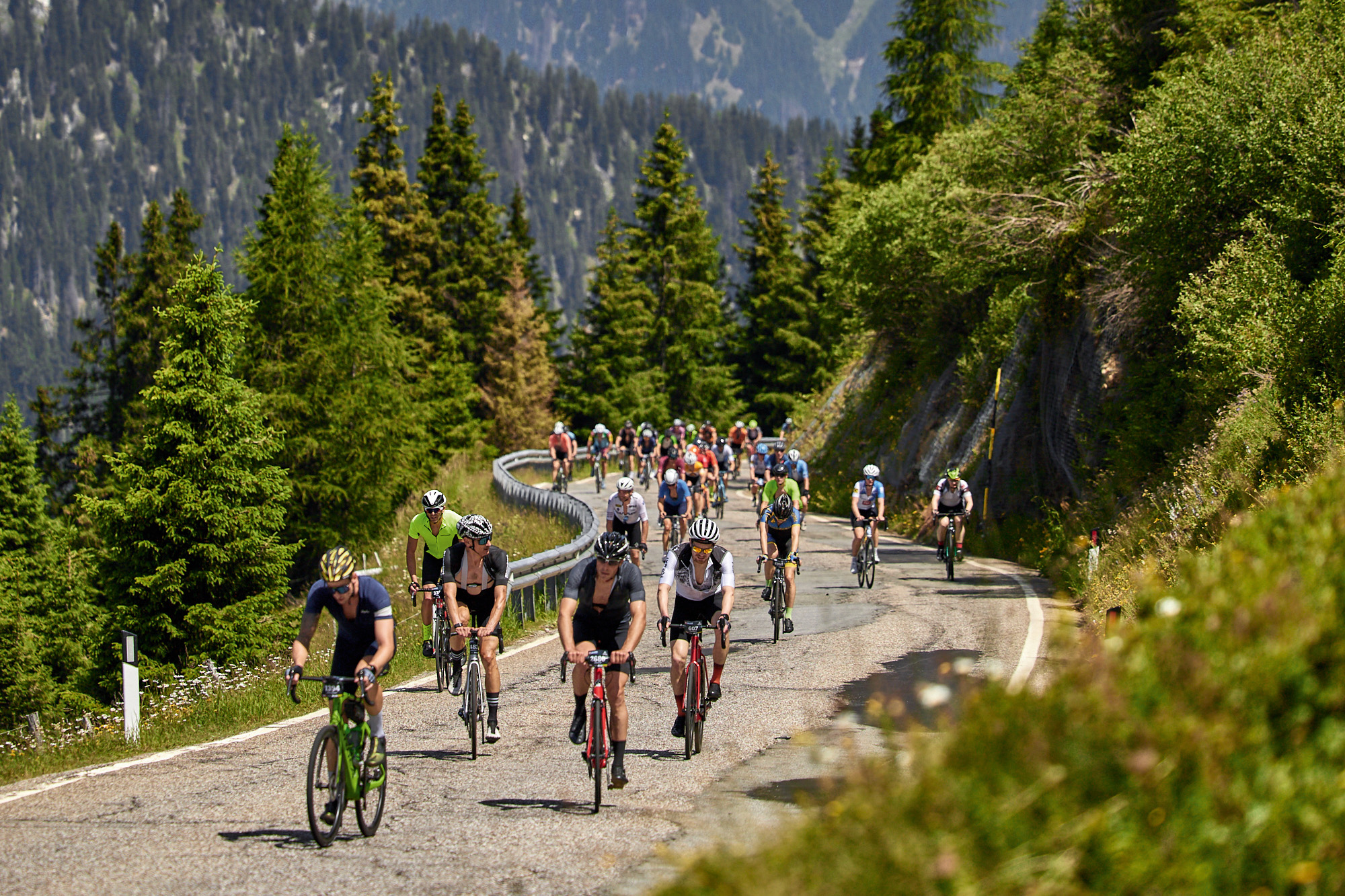
The Ötztaler Radmarathon is for serious climbers. Joe Cotterill
Fresh, rarefied air is the order of the day here, with more than 5,000 metres of Tyrolean Alpine climbing packed into 227km.
Your exertions start in Sölden before rolling onto this area’s most legendary giants, namely the ascents of Kühtai (17.9km at 6.8%), Jaufenpass (15.5km at 7%) and Timmelsjoch (22.1km at 5%).
To soften the pain, organisers stir up a festival feel, thanks to fireworks, oompah parades, stunt shows, skydiving and even group leg shaving.
Registration opens in February. If you’re lucky (or not), you’ll be one of the 4,000.
Date: 30 August 2026
UCI Gravel Switzerland – Villars, Switzerland
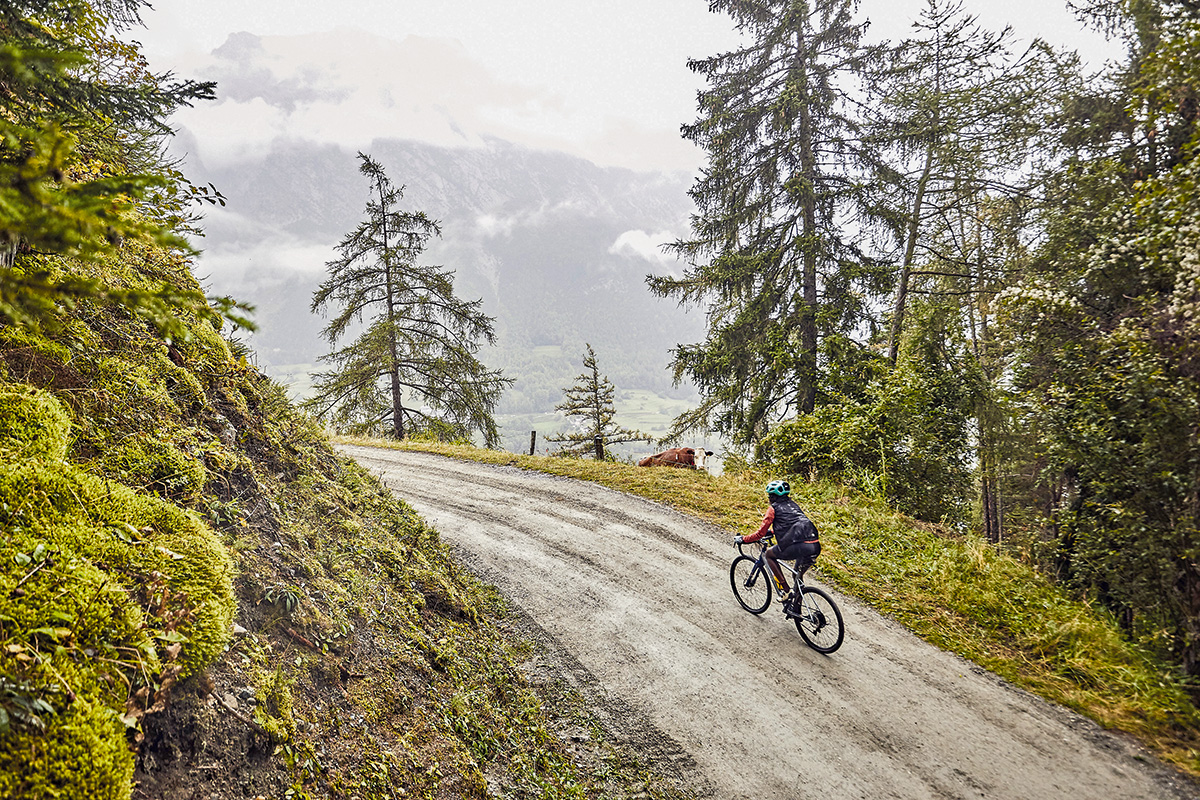
There are multiple distance options for the UCI Gravel Switzerland. Joe Cotterill
There are two routes on offer in Villars, which sits on the doorstep of the UCI (international cycling governing body) headquarters in Aigle.
Go for the 60.2km option, which features nearly 1,900m of climbing, or crank it up to the longer route, which comes in at 101km and nearly 2,500m of climbing.
Either way, you’ll be entranced by the beauty of the Vaudois Alps that surround Villars. You’ll also be exasperated by a series of stiff, long climbs.
Just over half the parcours of each distance is gravel, with the remainder a pretty equal split between asphalt and older paved roads. It’s an event not to be missed.
Date: 10-12 July 2026
Gran Fondo Mont Ventoux – Vaison-la-Romaine, France
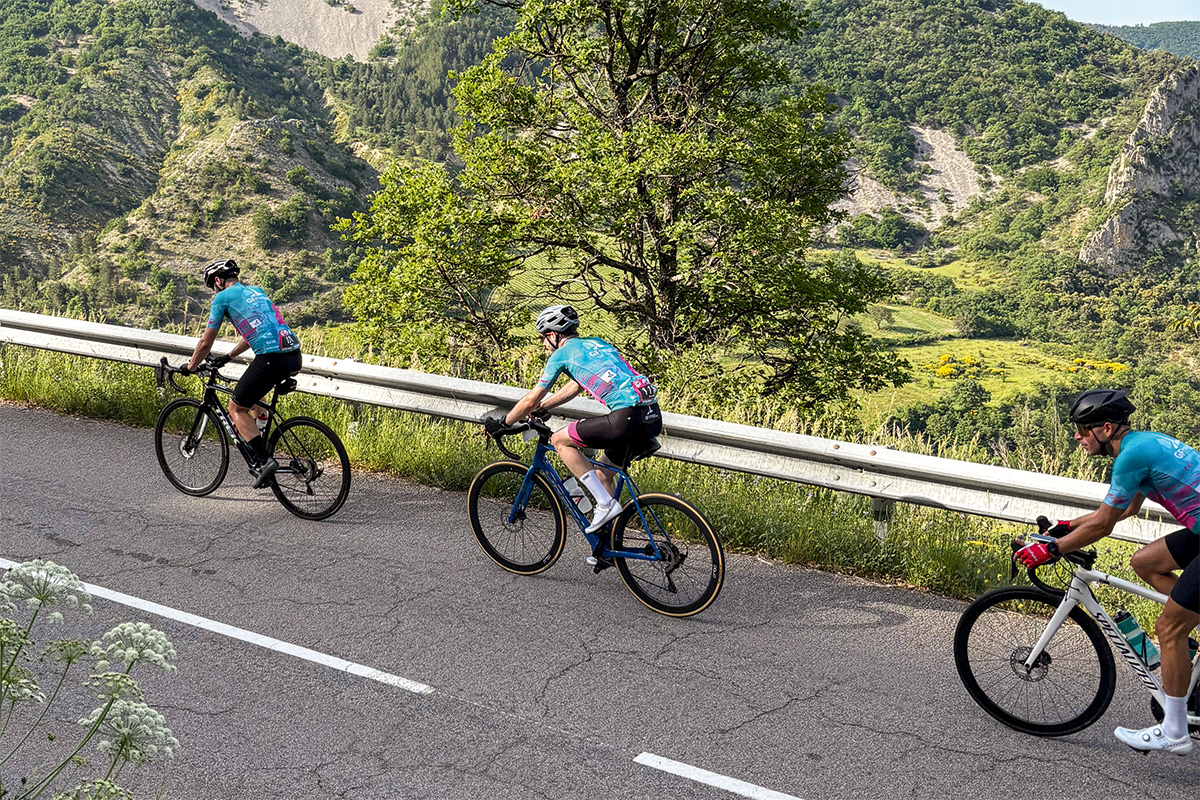
Having this event in the planner will get you back on the bike in no time. Joe Cotterill
Fancy doing battle with the Giant of Provence? If so, you have three routes to the top of the iconic Mont Ventoux: 80, 106 or 135km.
Before you hit the barren upper slopes of this brutal mountain, you can enjoy pedalling through Provence’s stunning landscapes, from lavender fields and vineyards to the dramatic Gorges de la Nesque and quaint Provencal villages.
It’s a truly astounding part of the world to ride a bike in – and rather exhausting when you come to Ventoux.
Sportive Breaks (sportivebreaks.com) offers three-night packages starting at £699, but make sure you factor in that race entry is extra.
Date: 7 June 2026
Tour of Flanders Cyclo – Antwerp, Belgium
This event enables you to enjoy the Tour of Flanders route at a relaxed pace. Joe Cotterill
Of all the mass-participation rides associated with pro racing’s Monuments – the five most prestigious races on the calendar – the Tour of Flanders ‘Cyclo’ is by far the most leisurely.
In Belgium, competitive racing is clearly defined: racing is for races and tours such as the Tour of Flanders Cyclo are all about fun and experiencing the culture of bike riding.
That said, the extent of the ‘fun’ could be decided by which of the three challenges you sign up for.
Date: 4 April 2026
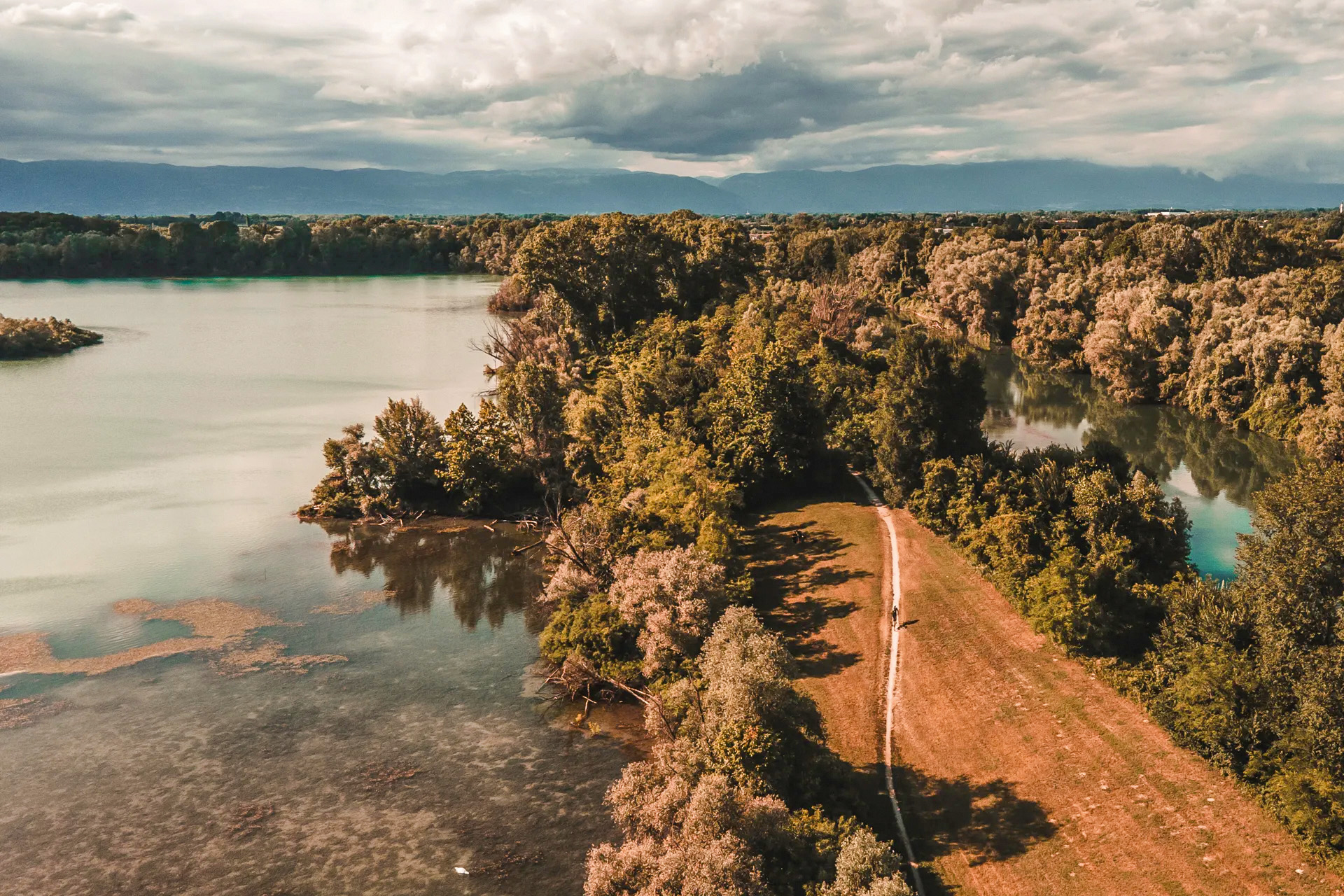
Veneto Gravel – Veneto, Italy
The Veneto Gravel is an Italian bonanza. Joe Cotterill
If you felt Strade Bianche’s white gravel roads were ominous, that’s nothing compared to Veneto Gravel’s 27% of gravel.
That’s nearly 189km of the white stuff. Around 3% of the parcours – 20-plus kilometres – is singletrack.
‘Testing’ is an understatement, whether you pitch for the 720km or 400km version.
Mind you, you’ll enjoy some glorious countryside and enigmatic Venetian cities on your unsupported bikepacking adventure.
You’ll also pass vineyards, orchards, pine forests and azure-blue lakes. In short, picture-postcard doesn’t do this race justice.
There are checkpoints to ensure you’re officially on track, although there’s no official cut-off time. However, the free showers stop on the Wednesday evening!
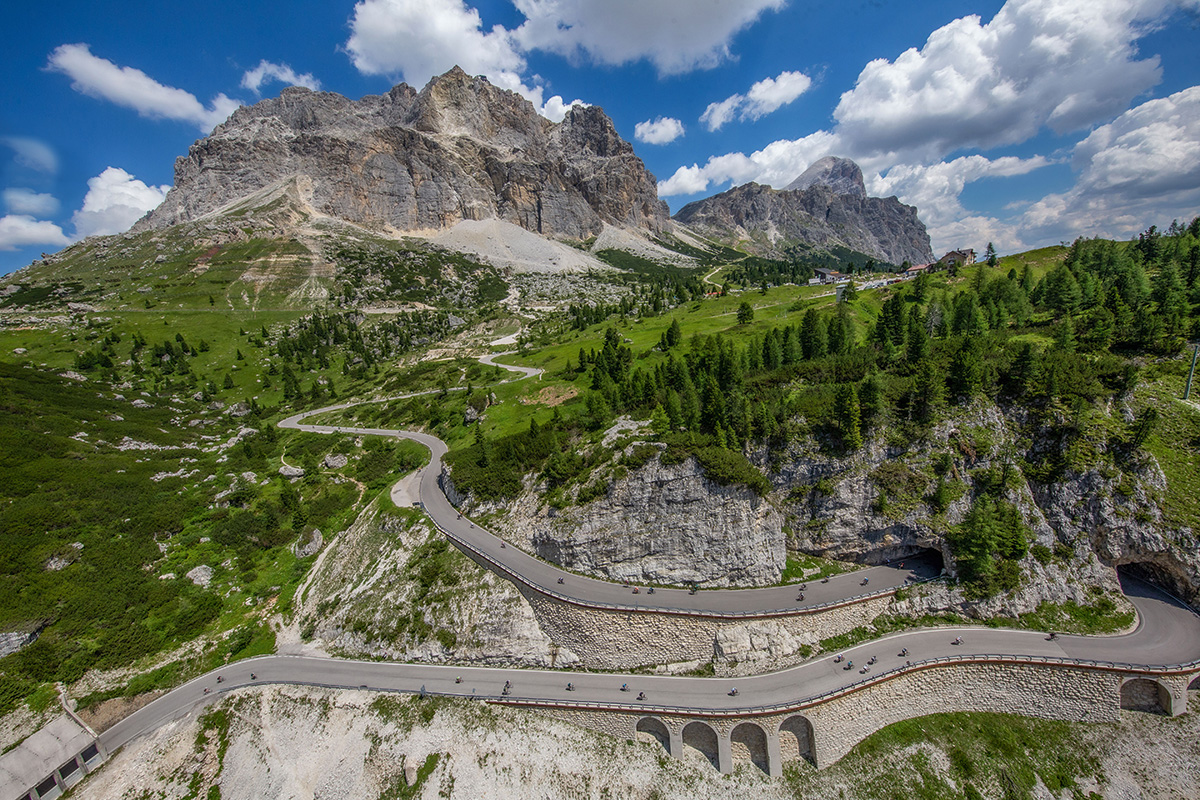
The Maratona Dles Dolomites is short on paper, but the climbs are humbling. Joe Cotterill
The Maratona dles Dolomites is arguably the jewel in the Italian crown. “It’s only 138km,” we hear you lament.
It is – as well as 106km and 55km options – but it’s the vertical challenge that’ll test your mettle, with 4,230m of elevation including the Giau, a 9.9km ascent that averages 9.3%.
Incredible rock formations and lush green valleys offer some natural respite, while the road surfaces are silky smooth.
Date: 5 July 2026
Paris-Roubaix Challenge – Paris, France
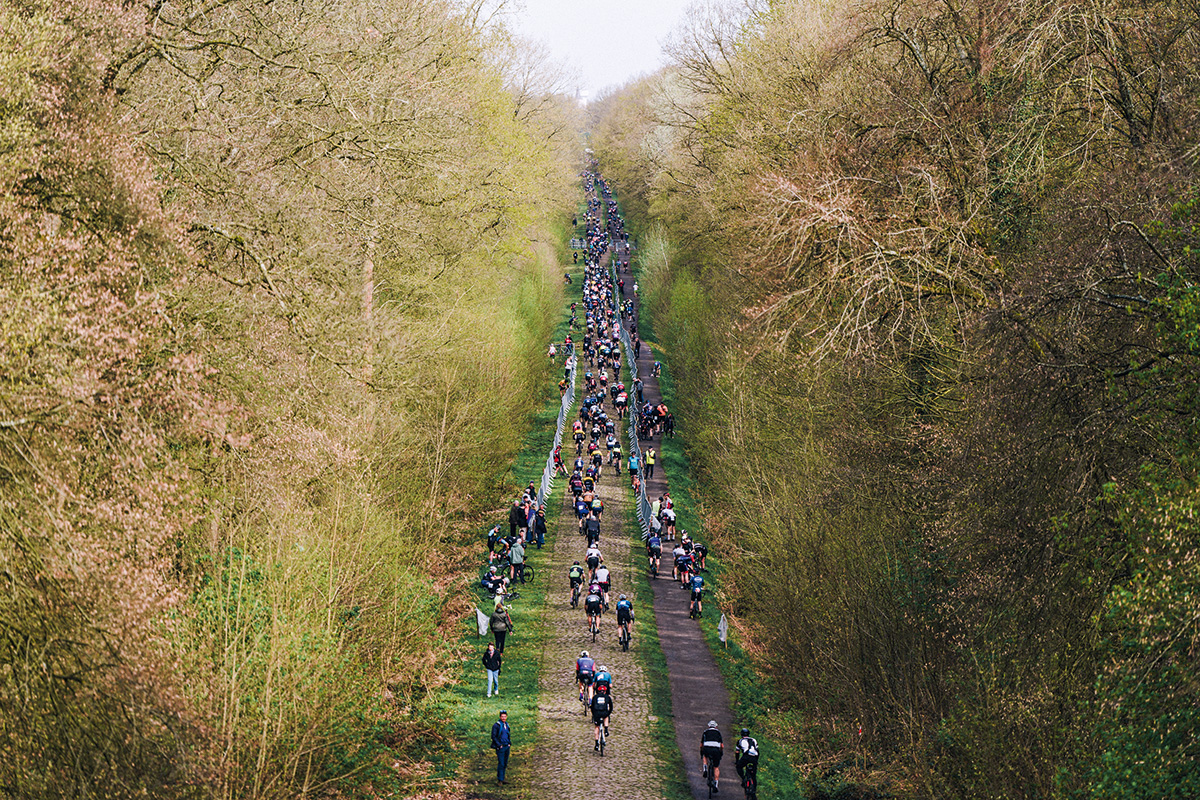
The Paris-Roubaix Challenge will give you a taster of A Sunday In Hell. Joe Cotterill
Sample the brutal delights of the Hell of the North over 70km, 145km or 170km.
Do battle with iconic stretches like the Trouée d’Arenberg where jagged cobbles that could consume a small human are flanked by leafless trees.
There’s often rows of spectators, too, warming up for the women’s and men’s elite races 24 hours later. But concentrate.
Distraction can lead to a tumble on terrain that shouldn’t be underestimated.
Our colleagues at BikeRadar completed this event years ago and their palms are still vibrating from the experience.
Prepare for blisters, exhaustion and a shuddering of fun on a parcours that even includes a ceremonial sojourn around the velodrome.
La Marmotte Granfondo Alpes – Bourg d’Oisans, France
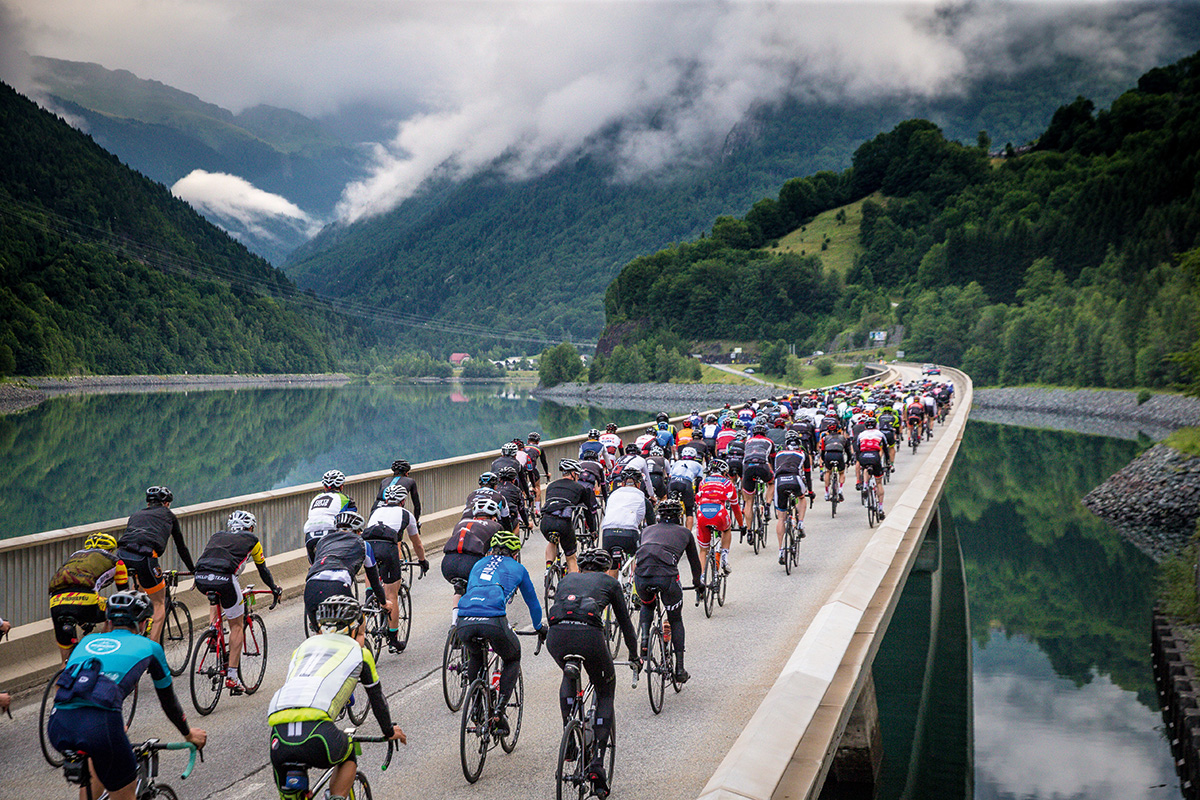
The scenery on La Marmotte Granfondo Alpes is epic. Joe Cotterill
“La Marmotte begins at sunrise in the heart of Bourg d’Oisans.
“Once the starting shot has sounded, the tension makes way for adrenaline and determined pedalling, all to the soundtrack of loud applause.”
So say the organisers, and so begins what many believe is the toughest day imaginable in the saddle.
Who are we to argue when entrants compete against 177 kilometres and more than 5,000 metres of ascending?
The highlight – or low point – of the day is arguably the climb of Alpe d’Huez and its 21 hairpin bends.
Or is it the Col du Glandon that stretches out to 24.1km at 5%? Or the legendary Col du Galibier? You get the picture.
Date: 22 June 2026
Vätternrundan – Motala, Sweden
The Vätternrundan is 315km in distance. Joe Cotterill
There’s every chance you’ve never heard of the Vätternrundan.
Unless you’re from Scandinavia, of course, where thousands descend on this event each year – as they have done since its first running in 1966.
The premise sounds boringly simple: just ride around a lake. And that’s it.
But before you turn away, this is the fifth largest lake in Europe, Lake Vattern, meaning the entire loop and length of the ride is 315km.
It’s also one of the most beautiful landscapes in Sweden (south-west of Stockholm), the long, finger-shaped body of water shadowed by spruce, pine and deciduous forest.
This year is its 61st running, so what better time to enter and crank up those long Sunday morning rides?
Date: 12-13 June 2026
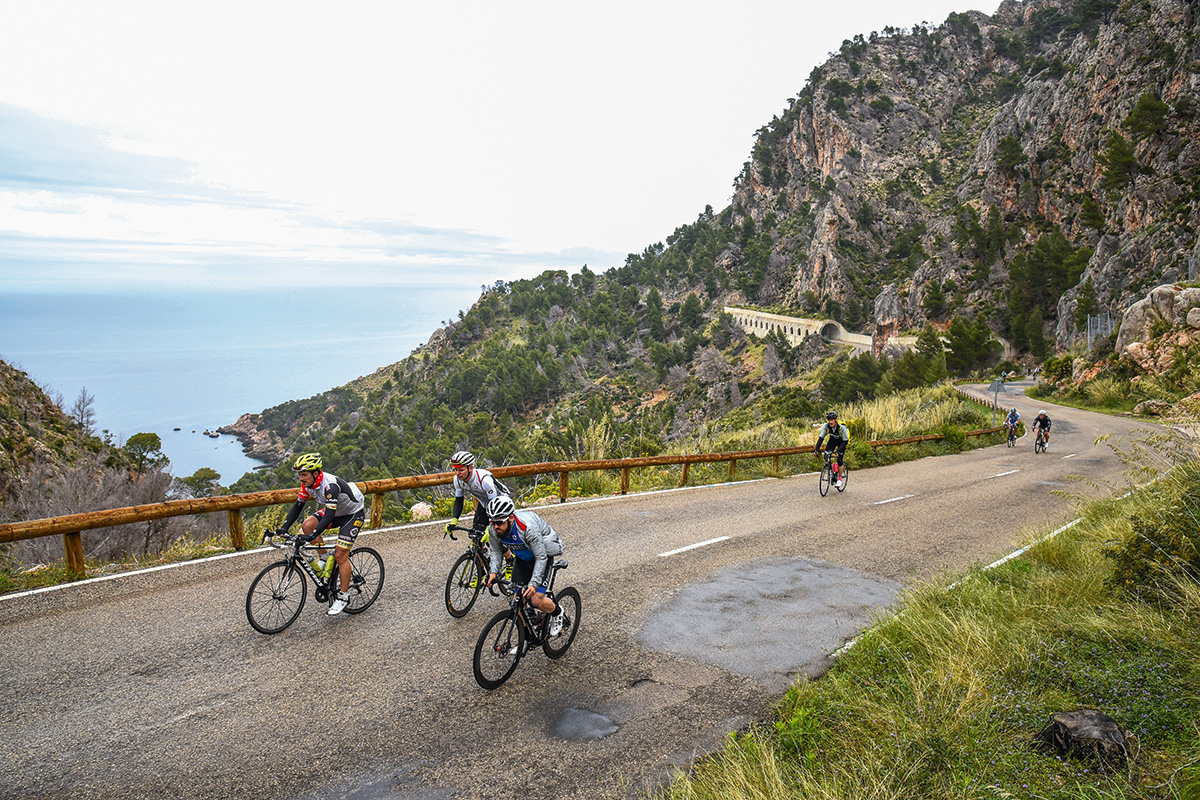
Mallorca 312 – Mallorca, Spain
The Mallorca 312 is a great way to start the season. Joe Cotterill
Fancy racking up 312km and over 4,500m of climbing in one day? Of course you do, you bona fide sadist.
For those less inclined towards total self-flagellation, there are shorter but still taxing distances of 225km and 167km.
Unusually, but appreciatively, you can change distance while you’re riding.
For many, that’ll be dropping down. For some, whose legs are oozing power, it’ll mean cranking up.
In times gone by, Mallorca 312 ticked off a lap of the island. Now it’s a closed-road event more focused in the Sierra de Tramuntana mountains to the north of the island.
Guaranteed sunshine makes this a great season opener.
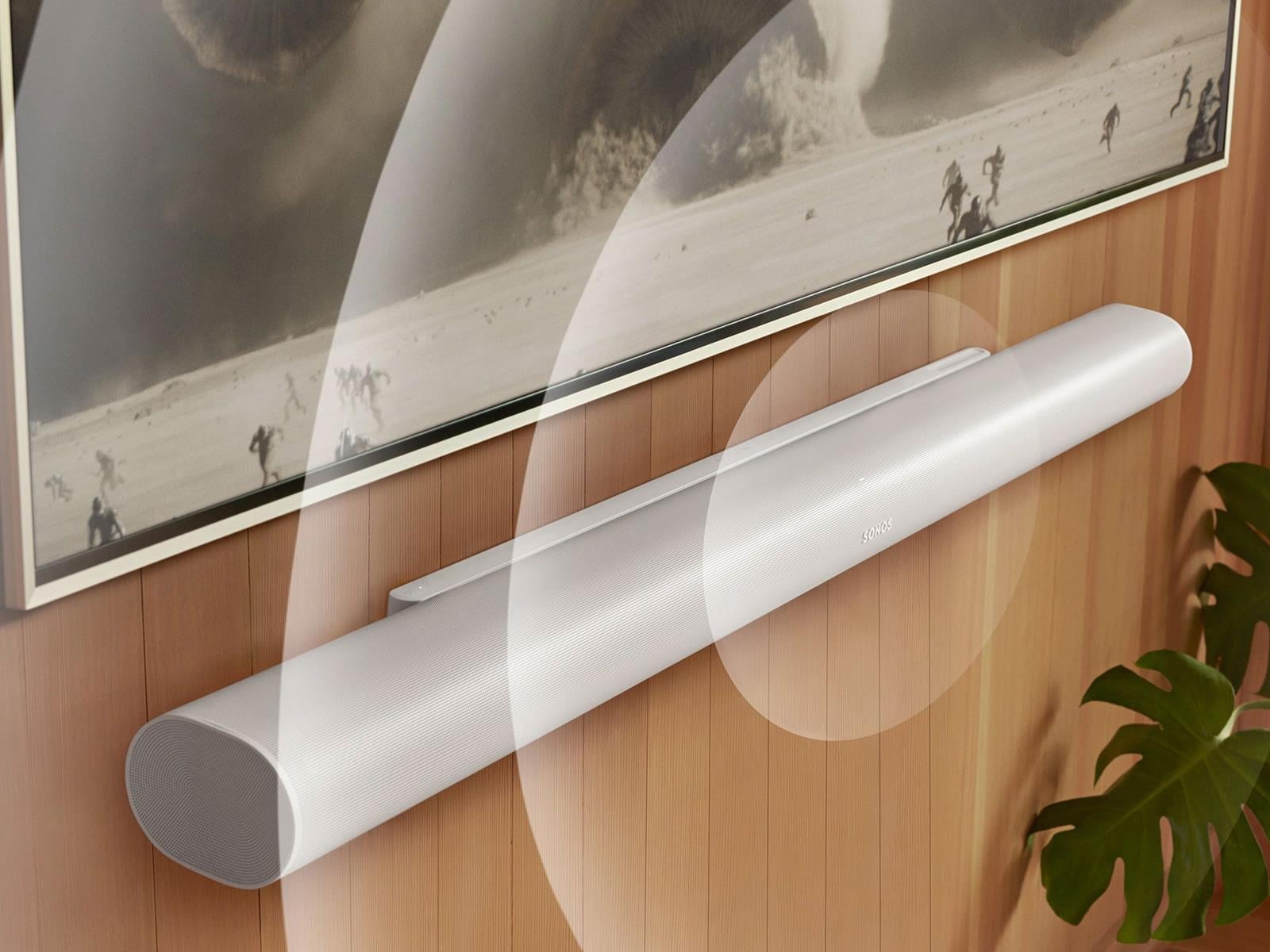
Are you ready for some football?! The Super Bowl featuring New England Patriots (woohoo!) and Seattle Seahawks (boo!) is just a week away, and if you want to hear every bone-crunching hit, you’ll want to ditch your TV’s wimpy built-in speakers for a discrete audio setup. You don’t have to break the bank, either, not when there are several
Want to use your PS4 / DualShock 4 controller wirelessly on Linux? I just tested a simple Bluetooth method to connect them, and it works flawlessly. No extra drivers, no headachejust pair and play. Tested on KDE Plasma, but it should be compatible with other desktop environments since they share the same Bluetooth backend. Check out the full setup and gameplay test in the video!
Several security experts have “questioned the lack of technical detail” in that lawsuit alleging WhatsApp has no end-to-end encryption, reports the Washington Post:
“It’s pretty long on accusations and thin on any sort of evidence,” Matthew Green, a cryptography professor at Johns Hopkins University, said over Signal. “WhatsApp has been very consistent about using end-to-end encryption. This lawsuit seems to be a nothingburger.” Nicholas Weaver, a security researcher at the International Computer Science Institute, criticized the lawsuit in a post on Bluesky for lacking detail needed to back up its claims. “They don’t even do a citation to the actual whistleblowers,” he wrote, calling the suit “ludicrous.”
And Meta has done more than just deny the allegations:
On Wednesday, WhatsApp sent a letter to [law firm] Quinn Emanuel threatening to seek sanctions against the firm’s lawyers in court if they do not withdraw the suit, according to a copy reviewed by The Washington Post. “We’re pursuing sanctions against Quinn Emanuel for filing a meritless lawsuit that was designed purely to grab headlines,” Woog said by WhatsApp message. Woog also suggested the suit against WhatsApp was related to Quinn Emanuel’s work on a separate case, between the social network giant and the spyware company NSO Group. The surveillance vendor is appealing a $167 million judgment entered against it in federal court last May, after a jury found that NSO’s Pegasus tool exploited a weakness in the WhatsApp app to take over control of the phones of more than 1,000 users. An attorney from Quinn Emanuel joined NSO’s legal team on that case on Jan. 22, according to legal filings, and different attorneys from that firm filed the case against WhatsApp on Jan. 23. “We believe a lawsuit like this is an attempt to launder false claims and divert attention from their dangerous spyware,” Woog said.
“It’s very suspicious timing that this is happening as that appeal is happening,” Maria Villegas Bravo, counsel at the Electronic Privacy Information Center, told the site Decrypt, “as NSO Group is trying to lobby to get delisted from sanctions in the U.S. government.”
EPIC’s counsel also told the site that the complaint appears light on factual detail about WhatsApp’s software:
“I’m not seeing any factual allegations or any information about the actual software itself,” Villegas Bravo said. “I have a lot of questions that I would want answered before I would want this lawsuit to proceed…. I don’t think there’s any merit in this lawsuit,” Villegas Bravo said.
Meta has forcefully rejected the allegations. In a statement shared with Decrypt, a company spokesperson called the claims “categorically false and absurd… WhatsApp has been end-to-end encrypted using the Signal protocol for a decade,” the spokesperson said. “This lawsuit is a frivolous work of fiction, and we will pursue sanctions against plaintiffs’ counsel.”
The Daily Beast:
“Salacious claims from Jeffrey Epstein that Bill Gates contracted an STD following ‘sex with Russian girls,’ and colluded with the disgraced financier on a plot to secretly slip his wife antibiotics, were revealed in the latest Epstein files release.”
The New York Times. (Alternate URL)
“A representative of the Gates Foundation said, ‘These claims — from a proven, disgruntled liar — are absolutely absurd and completely false. The only thing these documents demonstrate is Epstein’s frustration that he did not have an ongoing relationship with Gates and the lengths he would go to entrap and defame.'”
And Yahoo News points out the error of social media posts about the news:
None paid attention to who actually wrote the email. The email was from Epstein — to Epstein… Both the “From” and “To” fields list Epstein’s personal Gmail address. The message appears to be a draft, written during a period when Epstein’s relationship with Gates had deteriorated. In it, Epstein alleges that Gates asked him to delete messages related to an STD. But the document does not show Gates making that request, nor does it provide independent confirmation that any of the claims are true.
It reads like Epstein venting. It is not Gates confessing.
“In a 2021 interview with CNN’s Anderson Cooper, Gates called his relationship with the disgraced financier ‘a huge mistake’,” notes the New York Times. “He also sought to downplay his interactions with Epstein, saying he had several dinners with Epstein, with the hope of getting him to generate donations to the Gates Foundation.”
Blue Origin plans to put a focus on the development of its human lunar capabilities, so it won’t be sending tourists to space for at least the next two years. That means we won’t be seeing any New Shepard launches for quite some time. Blue Origin is one of the companies NASA chose to develop human landing systems for its Artemis program, along with SpaceX. Specifically, it will work on landers for the Artemis III and Artemis V missions.
The company was originally contracted to build the human landing system that would transfer astronauts from NASA’s Gateway station to the moon’s South Pole region for the Artemis V mission. But last year, NASA asked Blue Origin to design an alternative lander for Artemis III after SpaceX experienced delays due to Starship’s failed tests. Artemis III is expected to be the first crewed moon landing mission of the program, and the Trump administration wants it to happen before the end of the president’s term.
New Shepard takes tourists to suborbital space, where they experience a few minutes of weightlessness before the spacecraft makes its way back to Earth. Jeff Bezos was one of the passengers on New Shepard’s first tourist flight back in 2021. Since then, it has flown and landed 37 more times and carried 98 passengers to the Karman line, including Katy Perry and William Shatner.
This article originally appeared on Engadget at https://www.engadget.com/science/space/blue-origin-is-pausing-its-space-tourist-flights-to-work-on-lunar-landers-for-nasa-143000058.html?src=rss
Philips Evnia is laying claim to what it says is the world’s first dual-mode gaming monitor to hit a blistering-fast 1,000Hz refresh rate. While HKC may take umbrage with the claim, Philips Evnia’s new flagship 27M2N5500XD is certainly in an elite class, one that will likely grow in number as time goes on but, for now, stands out from the
An anonymous reader quotes a report from Wired: About a decade ago, many media outlets — including WIRED — zeroed in on a weird trend at the intersection of mental health, drug science, and Silicon Valley biohacking: microdosing, or the practice of taking a small amount of a psychedelic drug seeking not full-blown hallucinatory revels but gentler, more stable effects. Typically using psilocybin mushrooms or LSD, the archetypal microdoser sought less melting walls and open-eye kaleidoscopic visuals than boosts in mood and energy, like a gentle spring breeze blowing through the mind. Anecdotal reports pitched microdosing as a kind of psychedelic Swiss Army knife, providing everything from increased focus to a spiked libido and (perhaps most promisingly) lowered reported levels of depression. It was a miracle for many. Others remained wary. Could 5 percent of a dose of acid really do all that?
A new, wide-ranging study by an Australian biopharma company suggests that microdosing’s benefits may indeed be drastically overstated — at least when it comes to addressing symptoms of clinical depression. A Phase 2B trial of 89 adult patients conducted by Melbourne-based MindBio Therapeutics, investigating the effects of microdosing LSD in the treatment of major depressive disorder, found that the psychedelic was actually outperformed by a placebo. Across an eight-week period, symptoms were gauged using the Montgomery-Asberg Depression Rating Scale (MADRS), a widely recognized tool for the clinical evaluation of depression. The study has not yet been published. But MindBio’s CEO Justin Hanka recently released the top-line results on his LinkedIn, eager to show that his company was “in front of the curve in microdosing research.”
He called it “the most vigorous placebo controlled trial ever performed in microdosing.” It found that patients dosed with a small amount of LSD (ranging from 4 to 20g, or micrograms, well below the threshold of a mind-blowing hallucinogenic dose) showed observable upticks in feelings of well-being, but worse MADRS scores, compared to patients given a placebo in the form of a caffeine pill. (Because patients in psychedelic trials typically expect some kind of mind-altering effect, studies are often blinded using so-called “active placebos,” like caffeine or methylphenidate, which have their own observable psychoactive properties.) This means, essentially, that a medium-strength cup of coffee may prove more beneficial in treating major depressive disorder than a tiny dose of acid. Good news for habitual caffeine users, perhaps, but less so for researchers (and biopharma startups) counting on the efficacy of psychedelic microdosing. “It’s probably a nail in the coffin of using microdosing to treat clinical depression,” Hanka says. “It probably improves the way depressed people feel — just not enough to be clinically significant or statistically meaningful.”