How the Race Was Lost: Box Hill Survival (ZRL on London Loop)

Tuesday was the last race of Zwift Racing League Round 3, and we were in London for a two-lapper of the classic London Loop. That meant 30km of racing but, more importantly, two trips up Box Hill! This was going to hurt…

Planning and Warmup

Heading into the race, we were scrambling to line up enough riders. We brought on a new Coalition teammate, Neale, and Captain Neil signed on to race even though he was going to be racing an earlier edition with another Coalition team that was short on riders. So our starting lineup was:

  • Captain Neil
  • Enrico
  • Dylan
  • Neale
  • Fabian
  • Myself

I pulled my S-Works Aethos out of the garage and installed the ENVE 4.5 wheels, because I wanted every advantage I could get on Box Hill. I got out on course early, so I could take my time with a 20-30 minute warmup. Then I signed onto Discord, downed a SIS gel, and got ready to rumble!
Lap 1

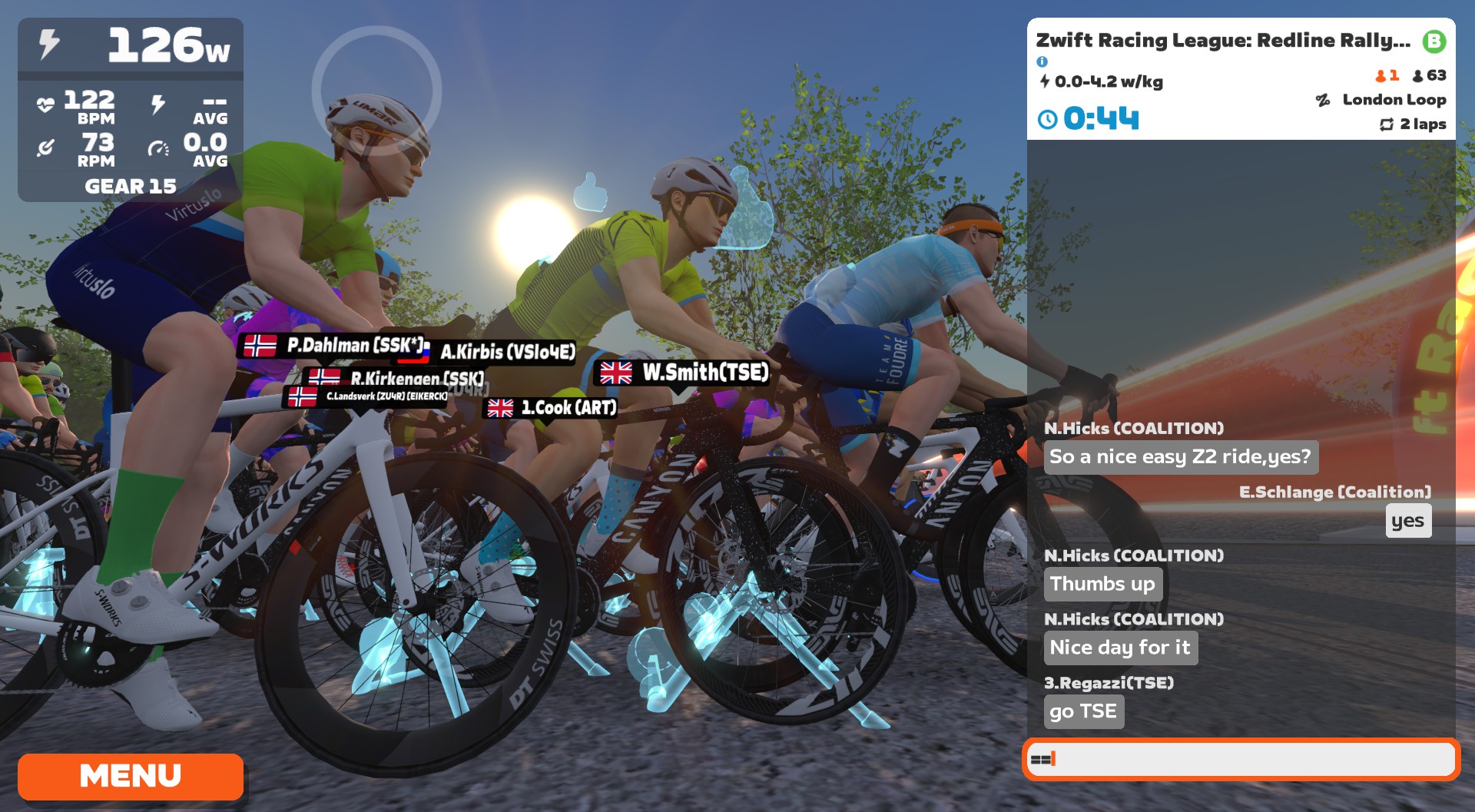
63 riders rolled out of the pens to begin the first of two London Loops. We all got feather powerups at the lap arch, and we all tucked them away for safekeeping. We knew what was coming up the road.
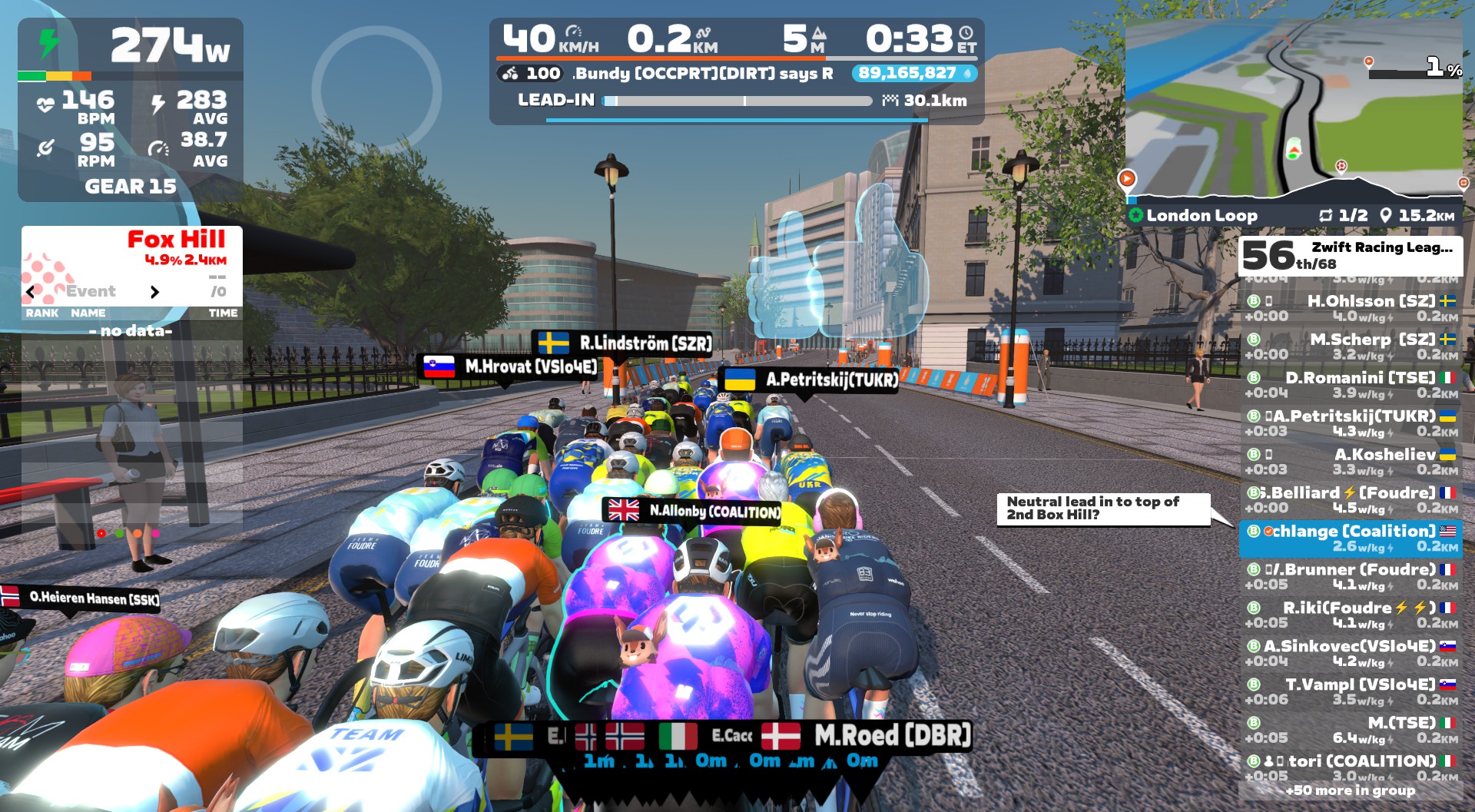
The first little effort of the race was short climb (Northumberland Avenue) you hit when you turn a hard right away from the Thames 3.5km into lap one. It wasn’t bad, though – just 30 seconds of slightly higher effort. The feathers still weren’t flying, and none of us was brave enough to attack in earnest this early.

An average of just 250W brought me (and all 63 starters) from the start of the race to the bottom of Box Hill. That’s where the action began.

While I know Box Hill is a ~7-minute effort for me, I don’t think of it that way. Rather, I mentally break it into a few sections:

  • The Lead-In: The bit before we turn a hard right and the climb gets steep. Nobody pushes hard this early.
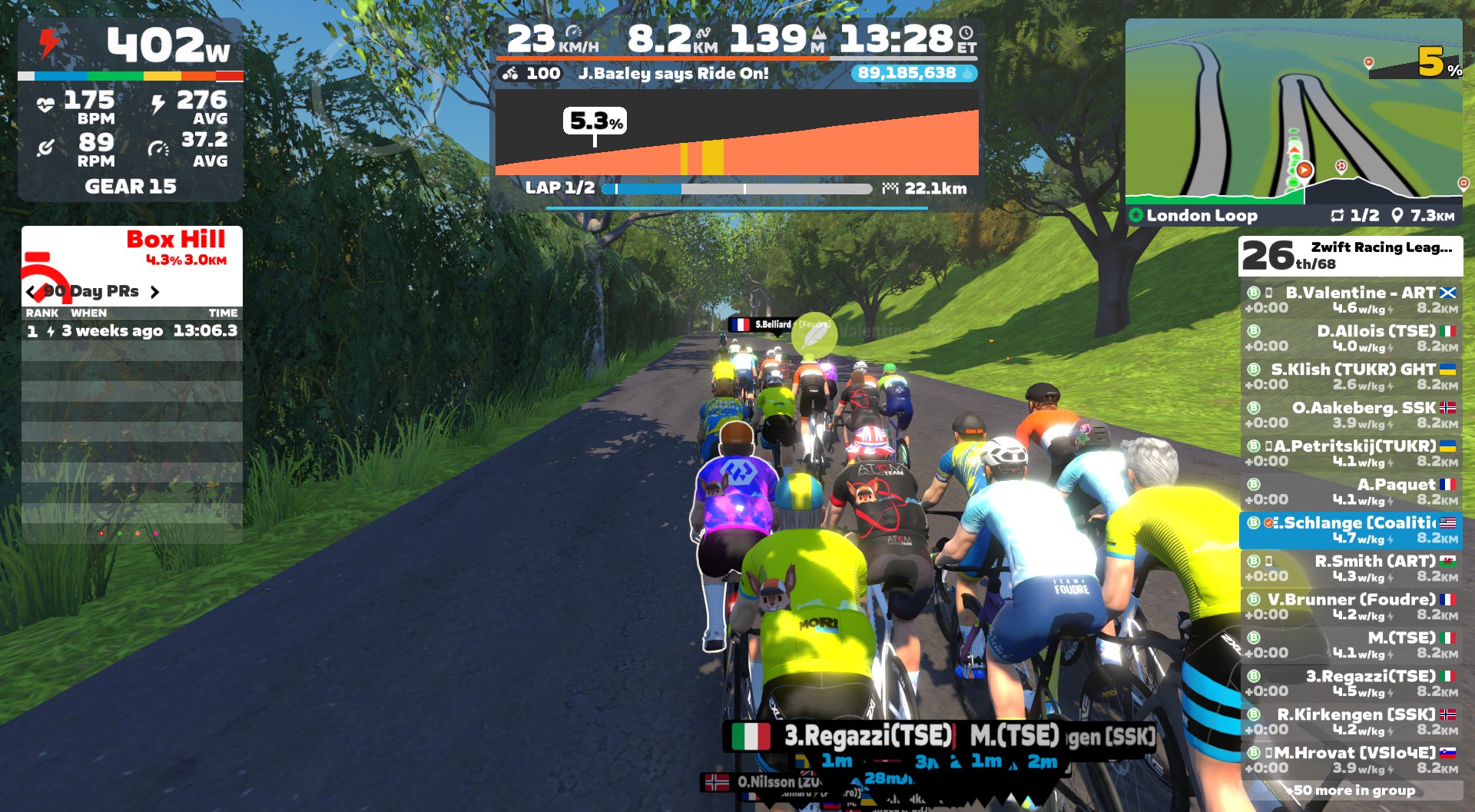
  • The Steep Bit: The first long stretch averages 7-8% until it eases a bit before the left hairpin. This is where the pack quickly separates and elastic snaps, and it’s where I’ve been dropped in the past. I used my feather to help me hold a good position near the front. Sauce showed the front group had shrunk to 44 by the end of this section.
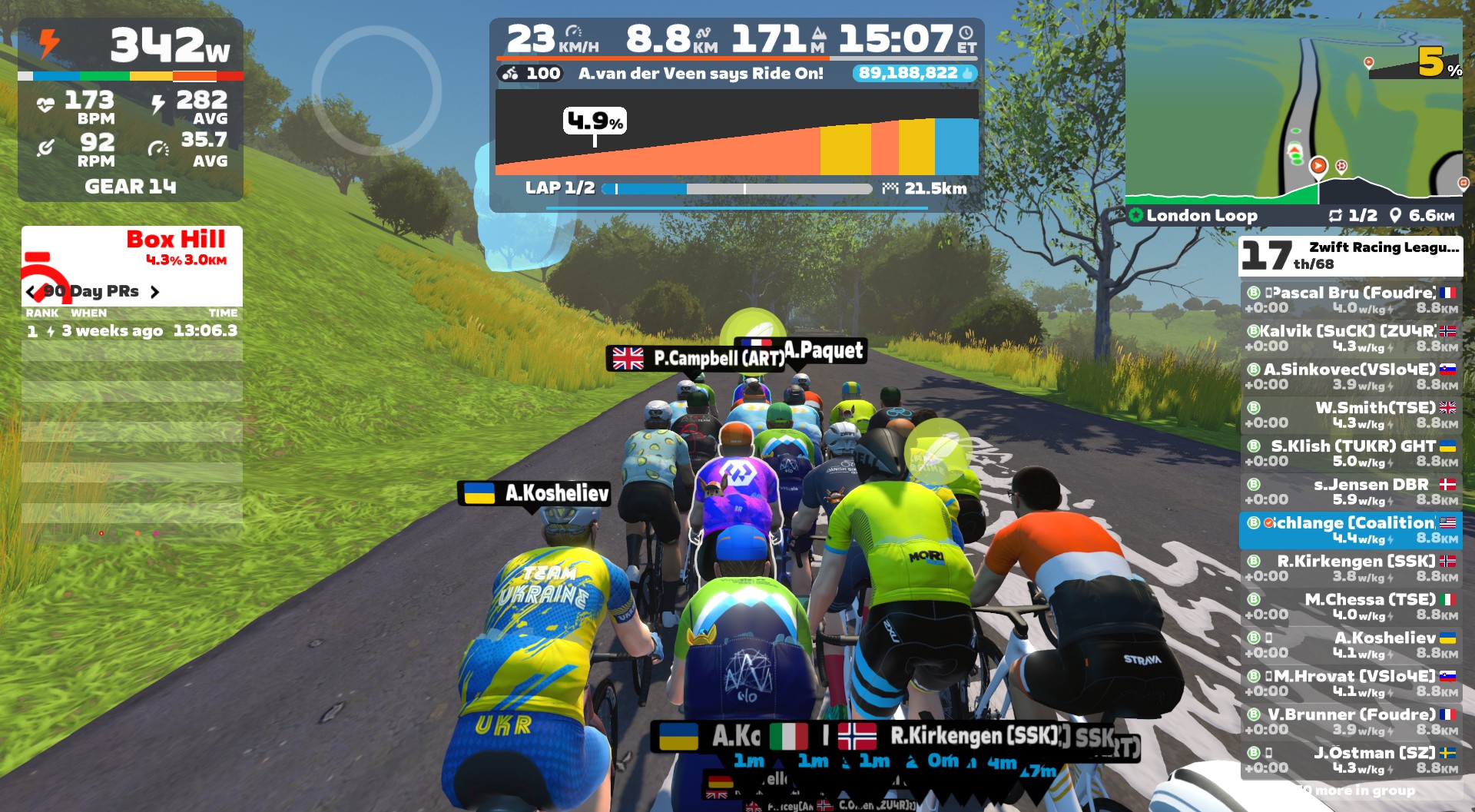
  • The Middle: When we “zag” back to the left, the pack tends to ease a bit, and the road even flattens momentarily, although it pitches back up and ends up averaging around 5%. Things often come back together a bit in here, but not for long.
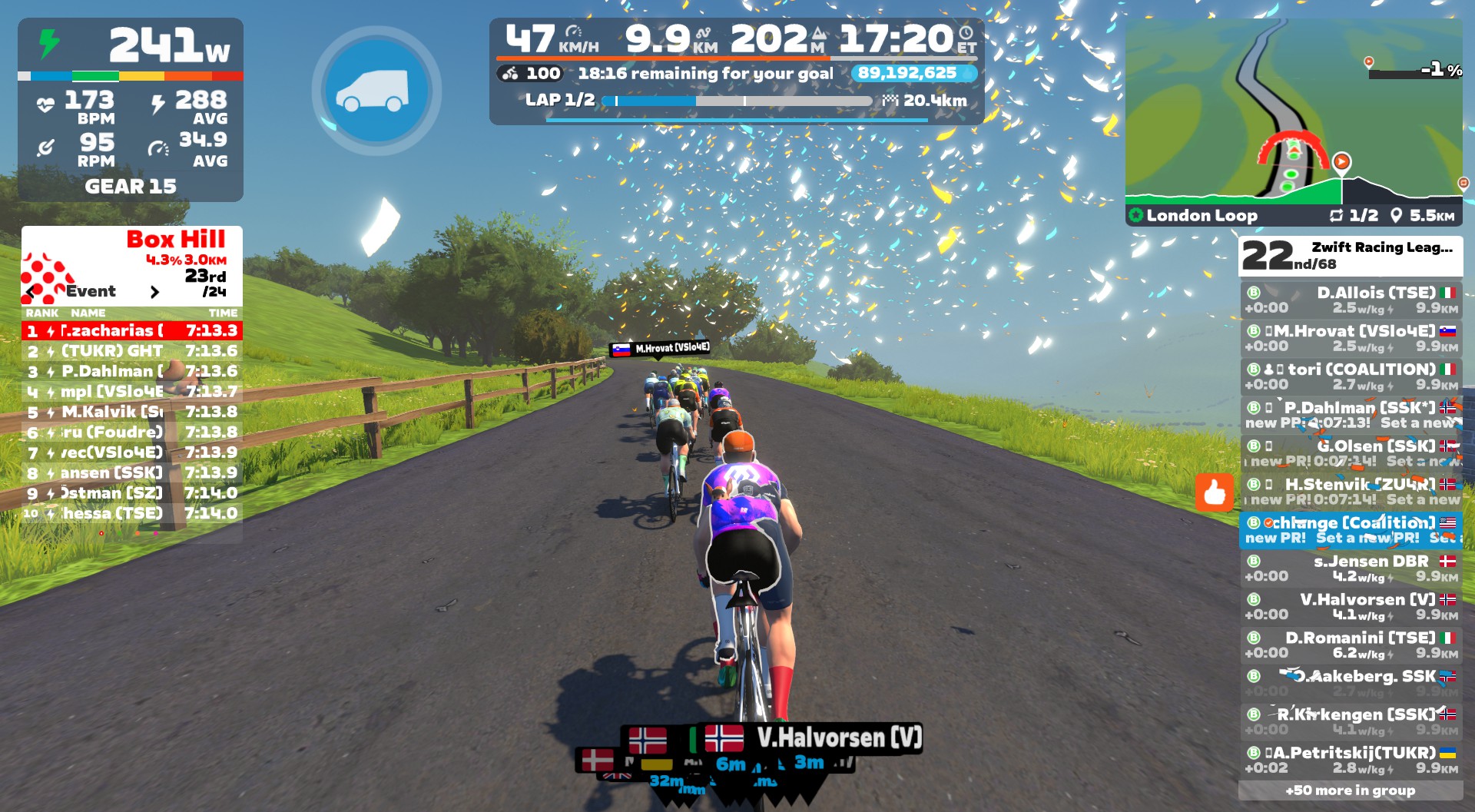
  • The Long Haul: Turn a hard right and hit the white painted roads – this is the long final haul to the top. Some riders held their feathers for the end of this bit, which made me work harder than anticipated. I was close to being on my limit, but I also knew what was up the road, so I knew I could push hard here since recovery was waiting. Sauce showed 32 riders left at the top of this section.
  • The Flat Finish: Turn right at the top of the Long Haul, and you’ve got a flattish final 600 meters to the KOM banner. If I’m still in touch with the group at this point, I know I’ve survived the climb. And I was still in touch! Sauce showed 26 left in the group as we went through. This was the selection. This group of 26 would stay together to the end of the race.
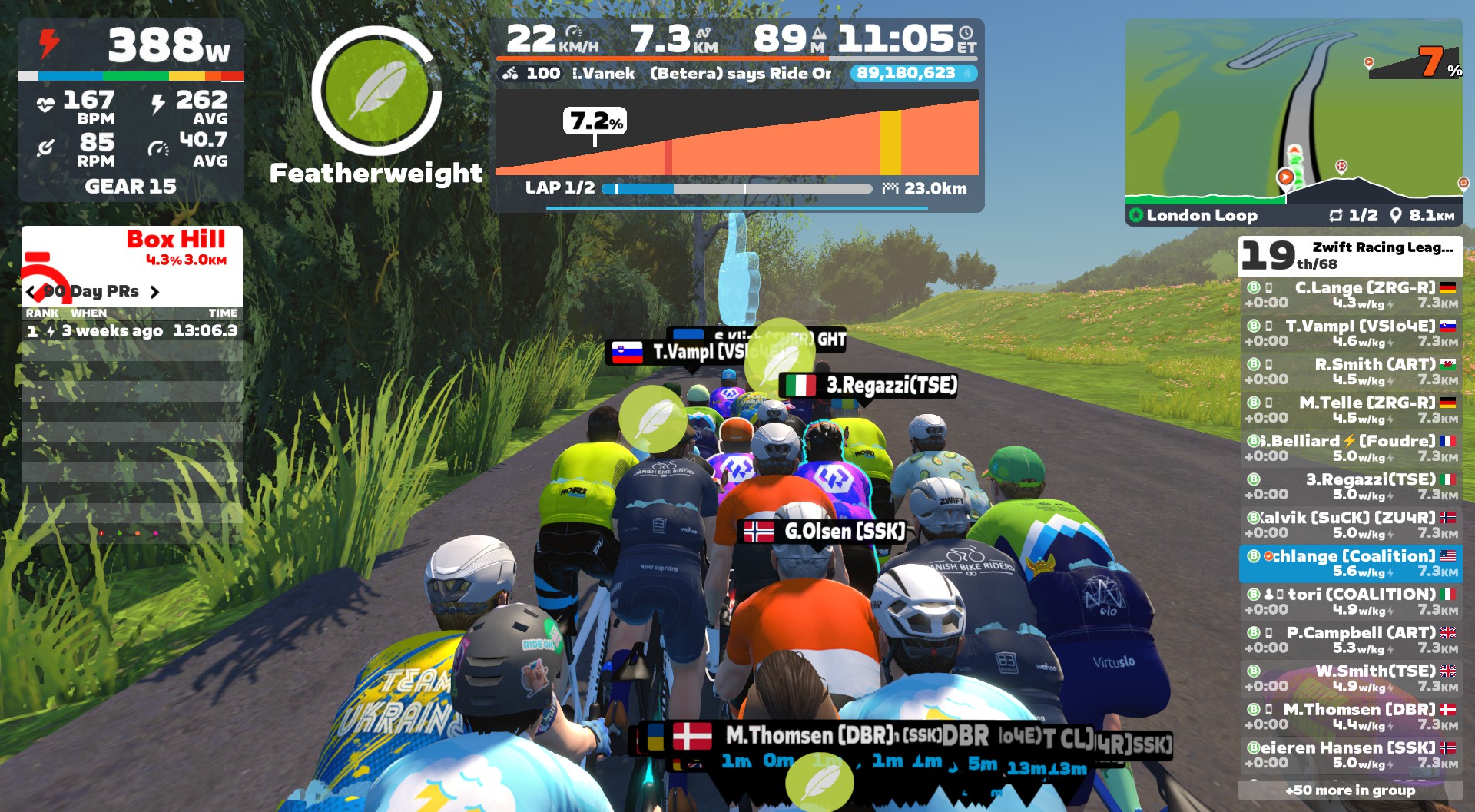
Using my feather on the steep bit
On the middle
The Long Haul
90-day Box Hill PR (7:13)!

Instead of the promised anvil powerup at the KOM arch, I saw the standard powerup animation pop up through the KOM arch, flipping between Draft, Aero, and Feather. I got a feather, which I used on the short kicker that comes just before the long descent of Fox Hill.

We all took a big breath as we flew down Fox, put in a quick dig to get up and out of The Underground, then spun our way to the finish of the first lap.

26 riders had survived in the front group… but only 2 of us (Enrico and myself) were Coalition. Clearly, this wasn’t going to be a team win for us, but if I could hang on over the second Box Hill, I would have a shot at the podium. That became my only goal.
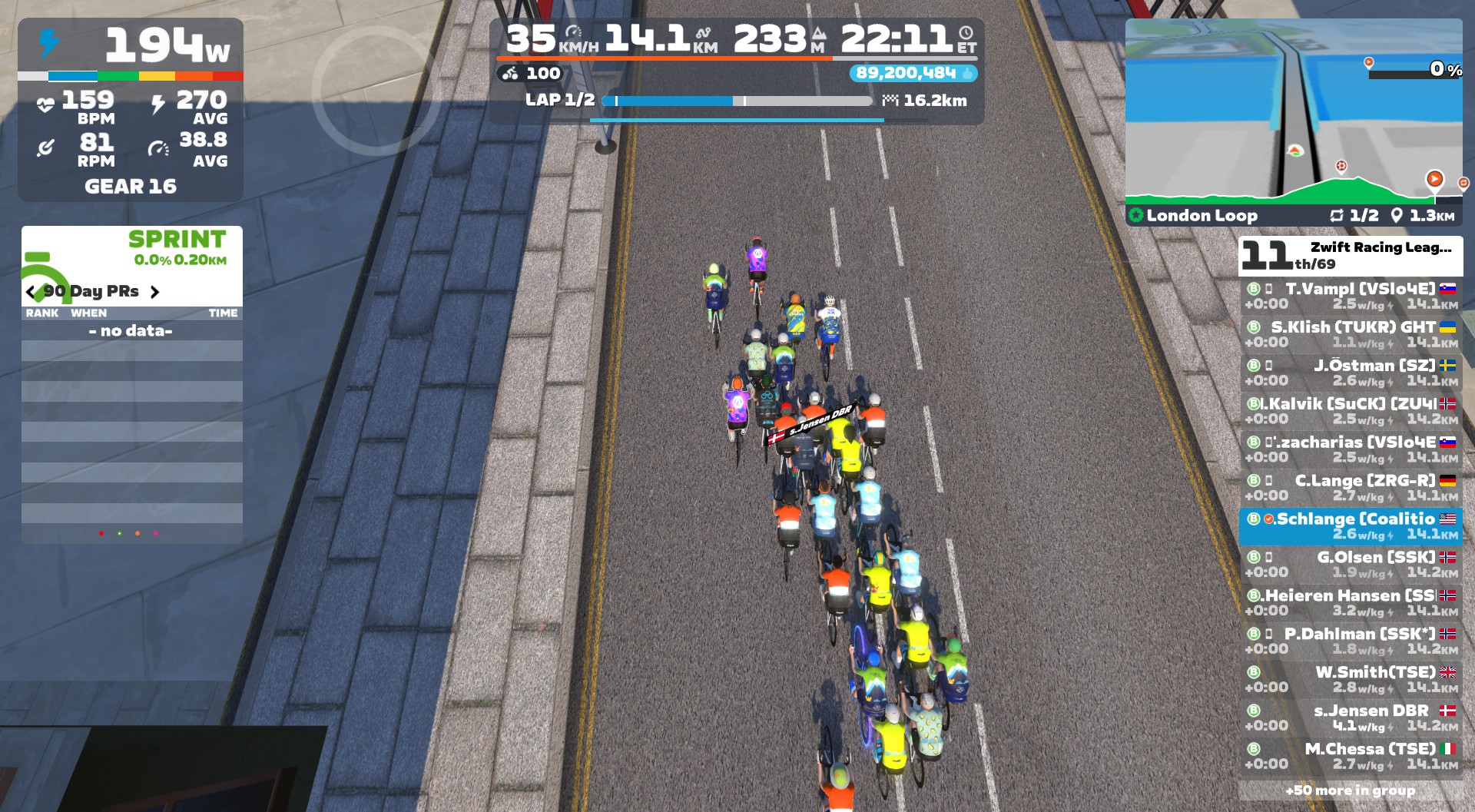
Continuing the powerup weirdness, we all got feathers at the end of Tower Bridge (there’s a white line on the road there that acts as a sort of “invisible arch” marking the start of some routes). I could have used my feather right there for a bit of relief, but I wasn’t convinced there was another one waiting for me at the lap banner, and I knew I wanted one for Box Hill. So I just held onto the feather I had.

Lap 2

The lead into Box Hill #2 was unremarkable, with some riders putting in harder pulls on the front, but never hard enough to drop any riders. All 26 of us arrived at the bottom of Box Hill, ready for the next big battle.

This time around, I decided to hold onto my feather until the end of the climb, unless I felt like I was getting dropped. It seemed like everyone else had the same idea: I only saw a couple of feathers fly before we reached the final stretch of The Long Haul near the top of Box Hill.

Even though the second climb was a bit slower (7:25 at 326W average vs the first lap’s 7:13 at 340W average), this second Box Hill effort was tougher than the first. I could feel that I was even closer to being on the limit, but I also knew everyone was suffering. This is bike racing, after all. So I kept digging, and eventually the road flattened, and I was still in the wheels. I’d made it! Hurray!

The powerup spinner at the top gave me a feather, which was not ideal (more on that later). I decided to hold onto it for use on the ramp out of The Underground.
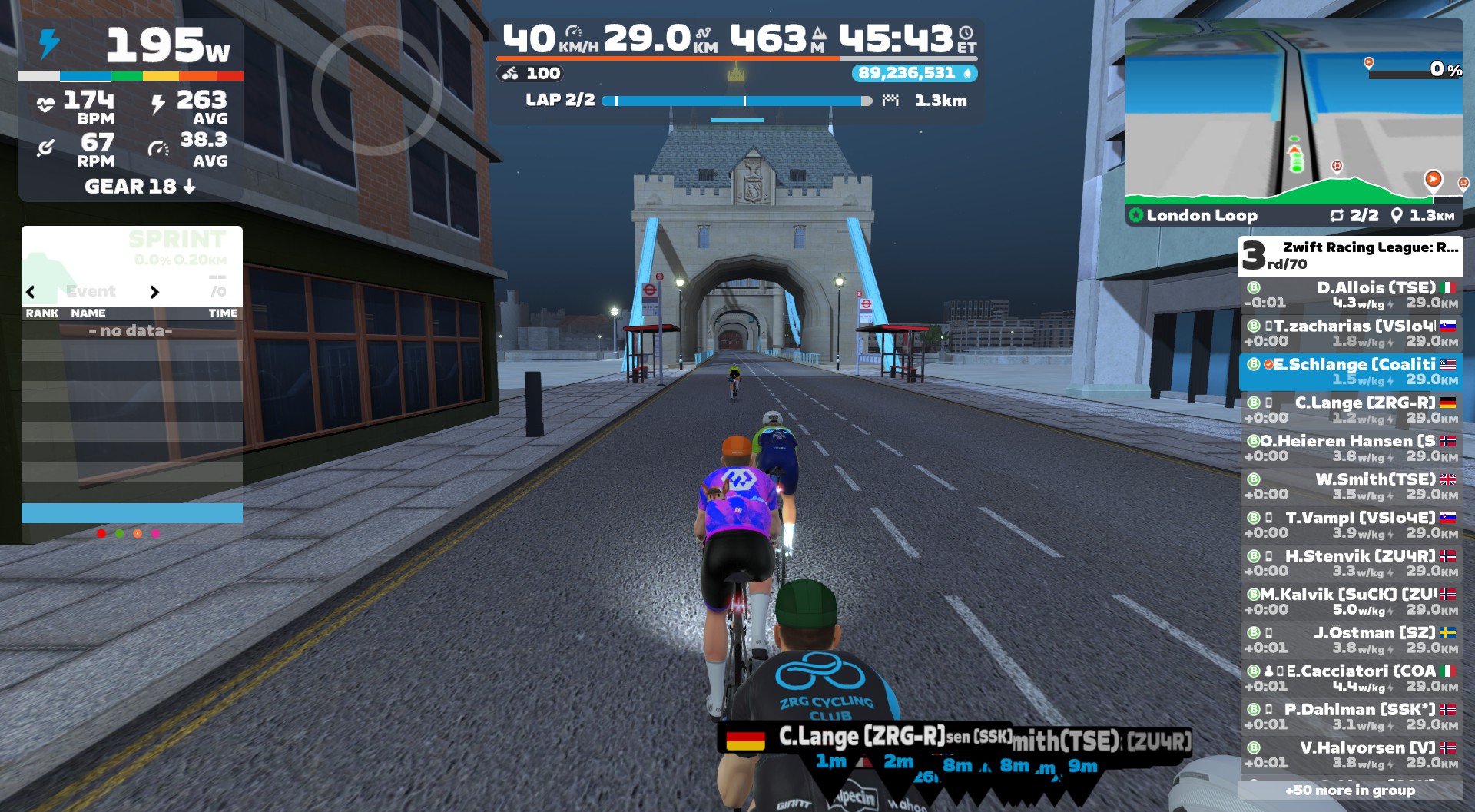
Everyone lit it up on that ramp, so the feather helped. I found myself in 2nd position, in fact, chasing on to a long attack from Allois (TSE). I quickly decided that was a bad idea, though, as my legs needed a break. So I sat up, getting in the wheels, and waited to time my final effort.

As we left the Tower Bridge, we got another feather powerup. I used it right away, hoping it would give me a bit of relief, because I figured it wouldn’t be much help on the downhill finish. I was sitting in 6th in a strung-out group, and Allois was 2 seconds up the road.

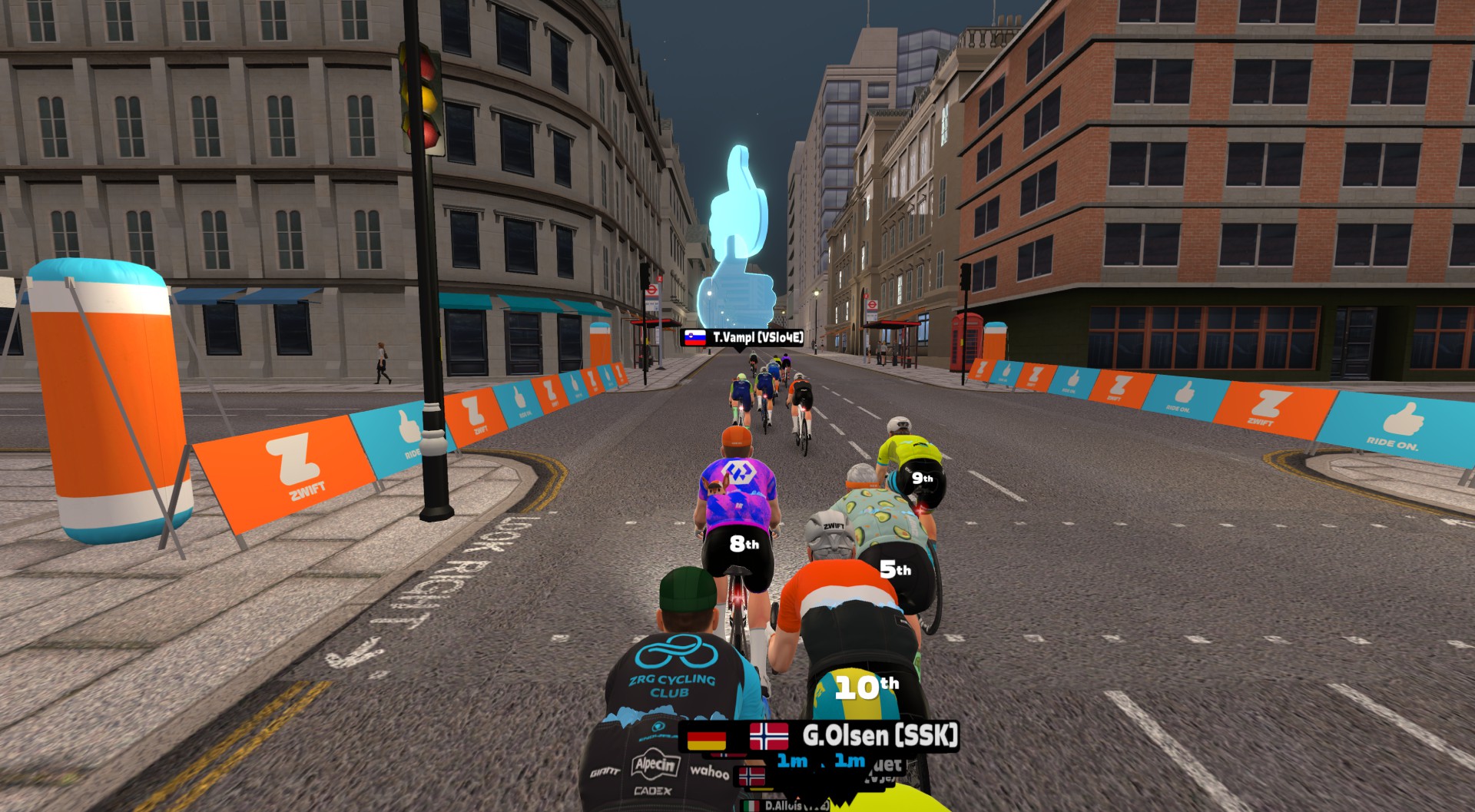
With a few hundred meters left, the road tilted down a bit, and the powerups started to fly. First the feathers and the draft boost vans. The near the end, the aero boost helmets. I hammered with all my tired legs had, and came across the line in 8th.
See my ride on Strava >

Watch the Video

Results and Takeaways

I’m going to break this section up for clarity…

Finishing Position Inconsistency

While the on-screen results showed me in 8th, ZwiftPower (and WTRL’s final results) show me in 9th.

In the grand scheme of things, this doesn’t matter much at all. But it could have been a really big deal, because:

  • My team tied with another team (ART) in total points for this race, meaning it goes to whoever had the highest finishing points (not counting podium bonus points). That means ART beats us. But had I finished in 8th, we would have beat ART.
  • It turns out, we held onto 2nd place for Round 3. But just barely (by 2 points).

Look, we all know that, if Zwift wants to be taken seriously in the e-racing space, they need to solidify the finishing position experience. It’s been an issue for a long time. But this particular issue is a weird one I haven’t seen before: how is the game showing one result, while ZwiftPower/WTRL are showing another? That shouldn’t be possible, right? Aren’t both of those based on the same server-side system?

Powerup Madness

Can we talk about powerups… again?

If you watch the finish of this race (video above), you’ll see that nearly all (or possibly all, it’s hard to tell) of the riders who finished ahead of me had draft or aero boost powerups. (Reminder: I had a feather.)

Let me remind you: we were all supposed to get anvils at the KOM arch. Everyone was supposed to get the same powerup, and therefore have the same advantage in the finish.

But that wasn’t the case. A bug/misconfiguration of all the races on the day meant we got a random pick of three powerups at the KOM. I, unfortunately, got a feather. Had I landed a draft or aero boost, I can promise you I would have held onto it for the finish, used it wisely, and finished higher than 8/9th place.

This is the second time in Round 3 that my ZRL result was affected negatively by how powerups were handed out in the race (read about the first time here). And while I’m happy to take the blame for a poor race result, it’s irritating and demotivating to know that the finishes to these races were, in some part, determined by the “luck of the draw.” It shouldn’t work that way.

My opinion: powerups shouldn’t be randomly assigned, unless it’s an event like a Crit City race, where you’ve got lots of chances to get powerups, and thus the choice to use or hold them becomes a strategy in itself.

Personal Performance

I’m happy I survived in the front group in this race, as that was far from a foregone conclusion. Could I have played my cards better for a better result? Probably. Easing a bit more out of The Underground on lap 2, then saving my feather for the final 30 seconds may have gained me a few places.

Apart from that, I’m not sure if I’d change anything else about how I raced this one.

Final Team Result for Round 3

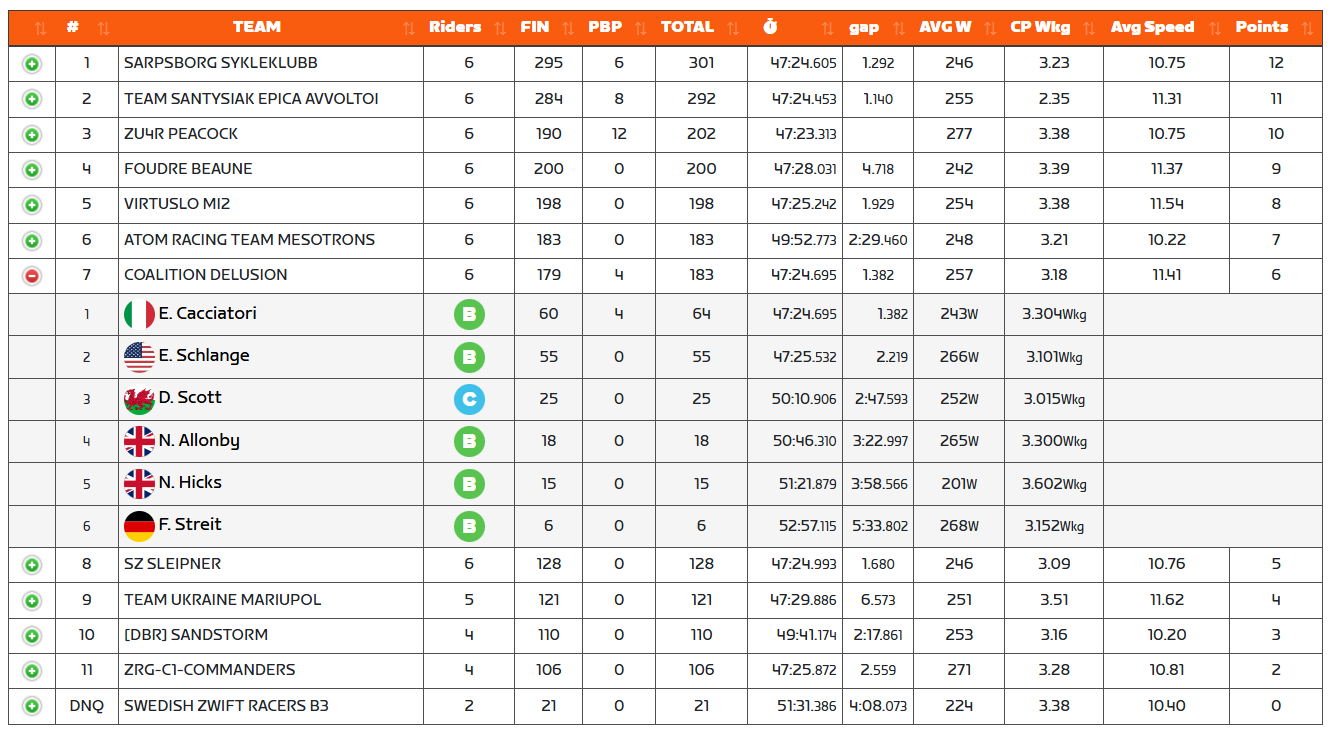
Despite an unimpressive 7th-place finish on the day, my team managed to hold onto 2nd place overall for Round 3. Congrats to TSE, who beat us once again, just like Round 2:

We finished off the round with our traditional team Discord photo:
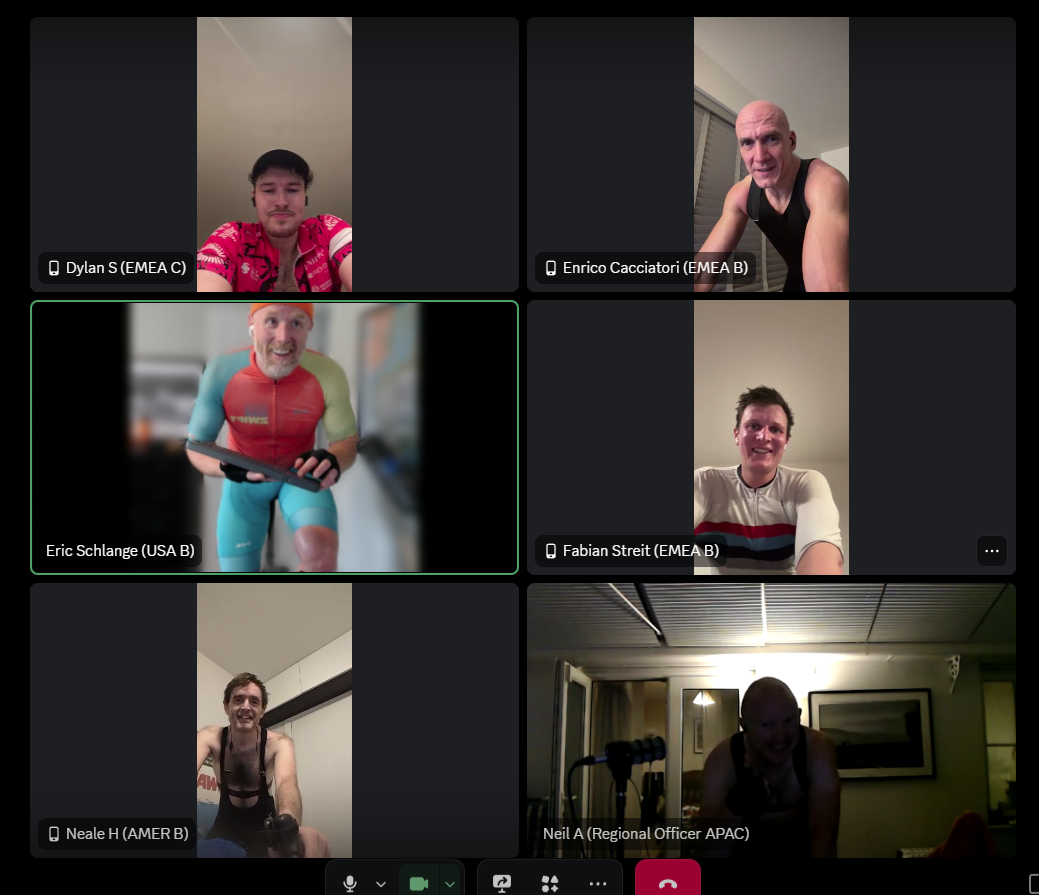
It was good racing with you lads. See you in Round 4!

What about you?

How did your last race of Round 3 go? Did you win at powerup roulette? Share below!
You Can Pick Up a Refurbished Kindle Paperwhite for $115 During Amazon’s Early Presidents Day Sale

We may earn a commission from links on this page. Deal pricing and availability subject to change after time of publication.

Presidents’ Day sales are around the corner, and the deals are coming in early; right now, Amazon has the latest Kindle Paperwhite from 2024 in “Like-New” conditions for $114.99 (originally $143.99). This Paperwhite in new condition would cost you $159.99, making the refurbished version a much cheaper choice to get while it lasts (discounted Kindle Paperwhites usually sell out quickly).

The Kindle Paperwhite is the most popular reading tablet from Amazon, and it’s the best for most people, according to PCMag’s “outstanding” review. It offers many improvements over the 11th-generation version from 2021—mainly a larger seven-inch display and a much faster boost in performance. It still retains all of the great attributes that made the previous version great, like a fully waterproof design with an IPX8 rating, enough storage to hold more than 10,000 books, and unlimited cloud storage. If you want an ad-free experience with some better features, get the Signature Edition.

If you’re not sure if this is the right Kindle for you, check out the Colorsoft version—it offers color, so it can make reading manga or comics more lively. We also have a breakdown of every kind of Kindle to help you decide. If you already own the 11th generation, there might not be enough here to warrant an upgrade, unless you just want the latest Amazon has to offer. However, any devices older than that may be worth an upgrade for features like Bluetooth compatibility, which is great for audiobooks.

The screen features a 300 ppi (pixels per inch) display with 16 levels of background lighting, and optional warm lighting as well. I use this feature to read before bed and not strain my eyes. I also love the absurdly long battery life. This one is estimated at up to 12 weeks on a single charge, depending on your use and brightness settings.

Our Best Editor-Vetted Presidents’ Day Deals Right Now


HP Omen 35L (Intel Core Ultra 9 285K, RTX 5080, 2TB SSD, 64GB RAM)


—


(List Price $3,099.99 With Code “PRESDAYPC100”)

Deals are selected by our commerce team

FTC Ratchets Up Microsoft Probe, Queries Rivals on Cloud, AI

The US Federal Trade Commission is accelerating scrutiny of Microsoft as part of an ongoing probe into whether the company illegally monopolizes large swaths of the enterprise computing market with its cloud software and AI offerings, including Copilot. From a report: The agency has issued civil investigative demands in recent weeks to companies that compete with Microsoft in the business software and cloud computing markets, according to people familiar with the matter. The demands feature an array of questions on Microsoft’s licensing and other business practices, according to the people, who were granted anonymity to discuss a confidential investigation.

With the demands, which are effectively like civil subpoenas, the FTC is seeking evidence that Microsoft makes it harder for customers to use Windows, Office and other products on rival cloud services. The agency is also requesting information on Microsoft’s bundling of artificial intelligence, security and identity software into other products, including Windows and Office, some of the people said.


Read more of this story at Slashdot.

The Easiest (and Cheapest) Ways to Turn Your Attic Into Useful Storage Space

We may earn a commission from links on this page.

If you own a home with an unfinished attic, you’ve probably thought about all that precious space and how you might make it more useful. Your attic already serves an important purpose in temperature and moisture regulation in the house, of course, but that doesn’t mean it can’t do more. If you’ve got the budget, you can transform an attic into a bedroom or office space, or a crisp, well-lit storage option.

If you don’t have the budget to really build out your attic, though, you can still make it into a more useful space, even if it’s small or slightly scary. With just a few modest purchases (and possibly some sweat equity), you can make your attic an ideal storage space.

Install easy, modular flooring on the attic’s floor

Your first step towards making your attic useful is to make it safe to walk around. Even if your attic is shallow and standing up straight is impossible, having a stable surface will reduce your chances of falling through the ceiling.

Putting down plywood or oriented strand board (OSB) is a cheap and relatively easy option, but it’s also labor-intensive and pretty permanent. If you want a faster solution, floor panels like these from Attic Dek are sized to fit most standard joist spacings and are designed to just snap together, allowing you to quickly drop a floor into place without needing to cut them. They come with screws, and it’s a good idea to secure them in place, but if you just need a temporary floor that can bear weight (up to 250 pounds) you can just click them into place and bolt them down later.

Add no-wiring lights to the attic’s ceiling

If your attic isn’t wired up or lacks light fixtures, you don’t need to hire an electrician and spend a mountain of cash. Just pick up one or two of these rechargeable ceiling lights and stick them to the ceiling or overhead joist (literally—you place a magnetic sticker on the ceiling and that holds the light in place—no screws required). It’s motion-activated, so every time you haul yourself up into the attic, the light will come on and save you from stumbling about in the dark.

Install adjustable storage that fits the space

Once you have a sturdy, safe floor in your attic, you can start installing storage options. You could, of course, just pile up some boxes or bins and call it a day, but you can do a lot better than that without breaking the bank:

  • Installing some hanging rods designed for slanted surfaces (like an attic ceiling or rafters) will give you the option of hanging clothing or storage bags without cluttering up the floor.

  • A few cheap, adjustable shelving units like this one can add all the shelf space you need to keep bins of stuff organized and off the floor, making it easy to store or retrieve items.

  • If your attic is tight and trusses make it difficult to store anything, you can install some truss-friendly shelving. This can be a relatively easy DIY job involving screwing some support brackets into the trusses (as seen here). If you don’t have a floor in your attic, you have to avoid placing heavy storage boxes or bins directly on insulation—compressed insulation isn’t very effective. You can purchase some truss brackets that support plastic bins or other storage boxes off the floor.

Install a way to transport your stuff into the attic

Once you’ve got storage, you need a way to get stuff up into the attic, which can be more challenging than you expect. Carrying awkward, heavy boxes up flimsy, pull-down attic stairs is a recipe for accidents, so consider rigging up some mechanical assistance. You can spend a fair amount of money on a fancy lift system that will make bringing stuff up to your attic pretty easy, but if that’s too rich for your blood, you could opt for a simpler winch system that will allow you to haul up to 440lbs of stuff up there at a time. If that’s still a little too much, you could also opt for a classic pulley system, using good old-fashioned mechanical advantage to get your stuff up into the attic.

$1.8 million MST3K Kickstarter brings in (almost) everyone from the old show

Longtime fans of the cult TV show Mystery Science Theater 3000 know that the series’ one constant is change (well, that and bad movies).

The show’s cast and crew were in a near-constant state of flux, a byproduct of the show’s existence as a perennial bubble show produced in the Twin Cities rather than a TV-and-comedy hub like New York or LA. It was rare, especially toward the middle of its 10-season original run on national TV, for the performers in front of the camera (and the writers’ room, since they were all the same people) to stay the same for more than a season or two.

Series creator Joel Hodgson embraced that spirit of change for the show’s Kickstarter-funded, Netflix-aired revival in the mid-2010s, featuring a brand-new cast and mostly new writers. And that change only accelerated in the show’s brief post-Netflix “Gizmoplex” era, which featured a revolving cast of performers that could change from episode to episode. Hodgson leaned into the idea that as long as there were silhouettes and puppets talking in front of a bad movie, it didn’t matter much who was doing the talking.

Read full article

Comments

EPA Reverses Long-Standing Climate Change Finding, Stripping Its Own Ability To Regulate Emissions

President Donald Trump announced Thursday that the Environmental Protection Agency is rescinding the legal finding that it has relied on for nearly two decades to limit the heat-trapping pollution that spews from vehicle tailpipes, oil refineries and factories. From a report: The repeal of that landmark determination, known as the endangerment finding, will upend most U.S. policies aimed at curbing climate change. The finding — which the EPA issued in 2009 — said the global warming caused by greenhouse gases like carbon dioxide and methane endangers the health and welfare of current and future generations.

“We are officially terminating the so-called endangerment finding, a disastrous Obama-era policy,” Trump said at a news conference. “This determination had no basis in fact — none whatsoever. And it had no basis in law. On the contrary, over the generations, fossil fuels have saved millions of lives and lifted billions of people out of poverty all over the world.”

Major environmental groups have disputed the administration’s stance on the endangerment finding and have been preparing to sue in response to its repeal.


Read more of this story at Slashdot.

Tiny, 45 base long RNA can make copies of itself

There are plenty of unanswered questions about the origin of life on Earth. But the research community has largely reached consensus that one of the key steps was the emergence of an RNA molecule that could replicate itself. RNA, like its more famous relative DNA, can carry genetic information. But it can also fold up into three-dimensional structures that act as catalysts. These two features have led to the suggestion that early life was protein-free, with RNA handling both heredity and catalyzing a simple metabolism.

For this to work, one of the reactions that the early RNAs would need to catalyze is the copying of RNA molecules, without which any sort of heritability would be impossible. While we’ve found a number of catalytic RNAs that can copy other molecules, none have been able to perform a key reaction: making a copy of themselves. Now, however, a team has found an incredibly short piece of RNA—just 45 bases long—that can make a copy of itself.

Finding an RNA polymerase

We have identified a large number of catalytic RNAs (generically called ribozymes, for RNA-based enzymes), and some of them can catalyze reactions involving other RNAs. A handful of these are ligases, which link together two RNA molecules. In some cases, they need these molecules to be held together by a third RNA molecule that base pairs with both of them. We’ve only identified a few that can act as polymerases, which add RNA bases to a growing molecule, one at a time, with each new addition base pairing with a template molecule.

Read full article

Comments

Nintendo’s Virtual Boy accessory lets you play VR Mario and Zelda on Switch 2

The forthcoming Nintendo Virtual Boy accessory for Switch and Switch 2 can play VR-supported games, as reported by Video Games Chronicle. There are four available games to play, including Super Mario Odyssey, Super Smash Bros Ultimate, The Legend of Zelda: Breath of the Wild and Captain Toad: Treasure Tracker.

These aren’t new VR builds of the games, rather they are the versions previously released for the Nintendo Labo VR set. This was a kit for the original Switch that allowed users to build a cardboard VR headset, among other items.

However, this is very good news for Switch 2 owners as Labo creations generally don’t work with Nintendo’s shiny new console. So this is the only way to experience the VR versions of the aforementioned four games. It’s also worth noting that the Switch 2 upgrade for Breath of the Wild still includes the VR mode.

There are some caveats. The Virtual Boy accessory is available to purchase as a hardware unit or in cardboard. The cardboard version is much cheaper, at $25, and is actually the preferred method for playing these games in VR.

That’s because the hardware version sits on a stand, like the original Virtual Boy, making it harder to move one’s head around. The cardboard headset is free from those constraints. The hardware also includes red filters over the lenses, to better mimic the original experience, but these can be removed.

However, the hardware version is better for playing actual Virtual Boy games, as they were designed for a static headset resting on a table. You’ll have to decide if that trade-off is worth $100. It’s also worth noting that Virtual Boy games will not work with the original Labo VR headset, which is a bummer for OG Switch fans.

Both versions of the Virtual Boy accessories will be available on February 17, which is the same day several of the retro console’s games head to the Nintendo Switch Online + Expansion Pack subscription service. They can be purchased at the My Nintendo Store. We got a chance to try the headset and came away fairly impressed, though noted that the revamped accessory is “just as eccentric and ungainly as the original was three decades ago.”

For those wondering what all the fuss is about, the Virtual Boy was an actual console released by Nintendo all the way back in 1995. It was one of the first mass-market VR devices and, as such, was decades ahead of the curve. It was cumbersome, the games were only in red and there was nothing by way of motion control. Americans only got 14 games before the console was discontinued.

This article originally appeared on Engadget at https://www.engadget.com/gaming/nintendo/nintendos-virtual-boy-accessory-lets-you-play-vr-mario-and-zelda-on-switch-2-172138483.html?src=rss

Sony Touts PS5 Console Leasing Plans In The UK, Will The US Be Next?

Sony Touts PS5 Console Leasing Plans In The UK, Will The US Be Next?
If buying a modern game console is too expensive these days, Sony has an alternative solution—lease a PlayStation 5 and select accessories for a monthly fee (cue the groans). Interested gamers can select from 12-month, 24-month, and 36-month lease options, after which they have to option to upgrade, keep paying a monthly fee, or return the

OpenAI Claims DeepSeek Distilled US Models To Gain an Edge

An anonymous reader shares a report: OpenAI has warned US lawmakers that its Chinese rival DeepSeek is using unfair and increasingly sophisticated methods to extract results from leading US AI models to train the next generation of its breakthrough R1 chatbot, according to a memo reviewed by Bloomberg News.

In the memo, sent Thursday to the House Select Committee on China, OpenAI said that DeepSeek had used so-called distillation techniques as part of “ongoing efforts to free-ride on the capabilities developed by OpenAI and other US frontier labs.” The company said it had detected “new, obfuscated methods” designed to evade OpenAI’s defenses against misuse of its models’ output.

OpenAI began privately raising concerns about the practice shortly after the R1 model’s release last year, when it opened a probe with partner Microsoft Corp. into whether DeepSeek had obtained its data in an unauthorized manner, Bloomberg previously reported. In distillation, one AI model relies on the output of another for training purposes to develop similar capabilities.

Distillation, largely tied to China and occasionally Russia, has persisted and become more sophisticated despite attempts to crack down on users who violate OpenAI’s terms of service, the company said in its memo, citing activity it has observed on its platform.


Read more of this story at Slashdot.

10 Hacks for Hanging Pictures Perfectly Every Time

We may earn a commission from links on this page.

Who among us has not looked at a newly framed picture, then looked at their wall and thought, “Eh, surely I can eye-ball it this time.” Hanging pictures should be an easy feat, but so often they end up uncentered or slightly crooked, causing us to add more holes the wall than intended or desired. The next time you hang pictures or artwork in your home, use one of these 10 hacks so they’re level and evenly spaced on the first try.

Use a small ball as a makeshift level to hang pictures

A level is essential when hanging art—a frame that’s even slightly crooked will be an eyesore, and if you’re hanging multiple pieces in a group, it’s even more important that everything be level. If you forgot to grab your level, or you don’t have one, you can use a small ball, like a ping pong ball or a marble. Place it on top of the frame and adjust until the ball sits still, then mark it on the wall.

Use painter’s tape to accurately space two nails when hanging a picture

If your frame has two widely spaced hooks, knowing where to insert your nail, screw, or other fastener on the wall can be a mind-bending challenge. But if you have some painter’s tape on hand, it’s easy: Place a piece of tape across the back of the frame, with the top of the tape lined up with the top of the hooks. Mark the position of the hooks with a marker or pen, then remove the tape and place it on the wall at the desired height. Using a level, adjust the tape until it’s placed correctly. Then drive your nails right through the tape at the marked locations, remove the tape, and hang your picture. Here’s a visual tutorial.

Use toothpaste to help you mark the spots where hooks or nails need to go

An alternative to the painter’s tape method is to use some toothpaste (or any gooey, sticky stuff that will wash off your wall easily). Mark the hooks on the back of the frame with a gob of toothpaste, check that it’s level and at the desired height on your wall, then press the frame against the wall. The toothpaste will mark the precise spot where you need to drive your nails to hang the frame. Insert your fasteners, clean everything up, and hang that picture in the perfect spot. Here’s a visual tutorial.

Make this quick DIY tool to mark the spot for a hook or nail when hanging a picture

If you have spare cardboard (a cereal box will do) and a pin or thumbtack, you can make a little DIY tool that will make marking the spot for a hook or nail easy. Cut out a rectangle of cardboard, then cut a tab at the bottom that’s narrow enough to fit through the hook on the back of the frame. Slide the tab through, and push a pin or tack through from the back. Then push the picture into the wall at the right spot, and the pin will create a tiny hole where your hook or nail needs to be. Here’s a visual tutorial.

Use string to guide a hook onto a nail when hanging a picture

Got the nail in the wall, but can’t seem to catch the hook on the picture frame? Get a piece of string and loop it around the nail, then adjust so the ends are even. Take both ends together and run them through the hook, then pull the string tight as you bring the frame toward the wall. The string will guide the hook right onto the nail, no guesswork required. Here’s a visual tutorial.

Use a fork to guide wire onto a nail when hanging a picture

If your frame uses a wire across the back to catch a nail or hook in the wall, you know that sometimes you question your own perception of reality as you repeatedly fail to catch the hook on the wire. There’s an easy hack: Grab a fork from the kitchen and place it on the nail or hook in the wall so it leans outward. Then hook the wire onto the stem of the fork and slide the frame down, letting the fork guide the wire down. When it’s hooked, remove the fork and admire your work. (And wash the fork, probably.) Here’s a visual tutorial.

Hang pictures with Monkey Hooks if you don’t want to use any tools

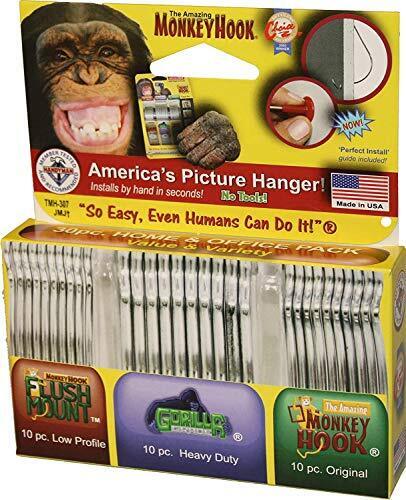
Hanging art on drywall and dread all the mess and trouble of drilling or nailing? Skip it by using Monkey Hooks instead. These are self-drilling pieces of wire—you just poke them through the wall with a tiny bit of elbow grease—that spin around and provide strong, secure hooks that can hold up to 50 pounds of weight, all without a single tool. Here’s a visual tutorial.

Make this paper template when you’re hanging multiple pictures in one area

If you’re going to be hanging multiple frames on the wall, grab some paper and create a template first. You can use wrapping paper, butcher paper or any kind of paper you have lying around or can get your hands on cheap (you can also use cardboard if that’s what you have on hand). Lay your frames out on the paper and trace them carefully. Then use the toothpaste or cardboard/nail hacks described above to mark where the nails need to be placed. Hang the template on the wall (ensuring it’s level), hammer in your nails, remove the template, and hang your frames. Here’s a visual tutorial.

Use an envelope to catch dust when drilling to hang a picture

If you’re going to drill or nail into your walls to hang pictures, you’re going to get a lot of annoying dust all over the place, unless you use a very simple hack: Tape an envelope to the wall underneath where you’ll be drilling. It will catch all that dust and save you the extra step of vacuuming afterward. If you don’t have any envelopes (or tape), some Post-it Notes will do in a pinch—just fold one in half and stick it to the wall under the spot where you’ll be drilling, and it will catch that dust. You can combine more than one Post-it if you need to. Here’s a visual tutorial.

Use your own saliva to mark the spot where you need to hang a picture

If all else fails, and you need to hang a framed picture but you are short on time or patience, there’s a simple solution: Lick the back of your finger, curl it over the hanging hook on the back of the frame, and place it against the wall at the desired height (typically around 57-60 inches from the floor). Your own saliva will leave a faint, temporary mark on the wall where you can confidently place your hook without fuss or delay.

Good Luck, Have Fun, Don’t Die rails against AI in style

You’ve seen this movie before: A disheveled man (Sam Rockwell) busts into a restaurant, threatening to blow up the joint unless a crew of people joins him. Like Groundhog Day, he’s been through this countless times before, and he immediately starts recounting otherwise unknowable details to convince the diner patrons. Like 12 Monkeys, he’s from the future — the timely twist in Good Luck, Have Fun, Don’t Die is that, rather than a world-ending virus, he needs help preventing a humanity-ending AI from being born. 

Good Luck is more of a primal scream than a thoughtful articulation about where everything went wrong. There’s a bit of “old man yells at cloud” energy here (director Gore Verbinski is 61, and screenwriter Matthew Robinson is 47), but it fits the film’s satirical tone. Looking around at the world today, who doesn’t wish they could warn their past selves about the tech industry and the new ruling class it helped breed. 

Rockwell’s character eventually wrangles a ragtag crew of future saviors: Mark and Janet (Michael Pena and Zazie Beetz), a married couple of high school teachers; Susan (Juno Temple), a distraught mother; and Ingrid (Haley Lu Richardson), a sad woman wearing a princess dress. There’s also Asim Chaudhry’s Scott, who mostly serves as comic relief, but doesn’t get any real backstory like the others. 

Good Luck wastes no time fleshing out its present near-dystopia in episodic chapters. It turns out Mark and Janet are also on the run from smartphone-obsessed high schoolers, who spend their days scrolling through endless TikTok-like feeds. Susan is forced to confront a horrific situation around her son (I won’t get into specifics here, but it’s a distinctly American phenomenon). And Ingrid is literally allergic to Wi-Fi and smart devices, which makes it hard to fit into the modern world. 

Each of these scenarios play out like mini Black Mirror episodes. Everything is heightened to the absurd, and all the problems can be traced back to unchecked technological encroachment and capitalism. Nothing subtle there. The glimpses of an apocalyptic future are even less so — all we see are destroyed cities, people trapped in VR headsets (which place them in an AI-generated reality) and robots hunting down anti-AI humans. 

Sam Rockwell in Good Luck, Have Fun, Don't Die.
Sam Rockwell in Good Luck, Have Fun, Don’t Die.
Briarcliff Entertainment

Good Luck is at its best when it’s simply having fun. As Rockwell and crew make their way to their final destination — a child who is about to invent true AI — they encounter pig-faced assassins, Stepford-esque parents and an adorably horrific kaiju. Even when faced with half-baked scripts, Verbinski always manages to impress visually (think back to the creepiness of The Ring, or the wildly entertaining set pieces in Pirates of the Caribbean). That’s as true as ever here, where the final scene evokes the hyper-tech chaos of Akira.

As much as Good Luck, Have Fun, Don’t Die, evokes classic sci-fi, it still can’t hold a candle to the sheer terror of seeing AI unleash a nuclear bomb in Terminator 2. And despite its zanines, it doesn’t reach the madcap heights of Gilliam’s Brazil or 12 Monkeys. But if you’re sick of having AI products shoved down your throat, and you think the notion of “true AI” is a farce, it’s a fun way to channel your rage.

This article originally appeared on Engadget at https://www.engadget.com/entertainment/tv-movies/good-luck-have-fun-dont-die-rails-against-ai-in-style-154437854.html?src=rss

Reserve Samsung’s Galaxy S26 For A Preorder Credit And Chance At $5,000

Reserve Samsung's Galaxy S26 For A Preorder Credit And Chance At $5,000
As Samsung is apt to do, it’s dangling a promotional incentive for anyone who makes a ‘reservation’ ahead of its next big Galaxy device unveiling. Samsung isn’t saying what exactly it plans to announce at its Galaxy Unpacked event next week, but unless all of the leaks and rumors have it wrong (very doubtful), we anticipate the Galaxy S26

New delegation for Debian’s data protection team

Debian Project Leader (DPL) Andreas Tille has announced
a new delegation for Debian’s data projection team:

Following the end of the previous delegation, Debian was left
without an active Data Protection team. This situation has
understandably drawn external attention and highlighted the importance
of having a clearly identified point of contact for data protection
matters within the project.

I am therefore very pleased to announce that new volunteers have
stepped forward, allowing us to re-establish the Debian Data
Protection team with a fresh delegation.

Tille had put out a call for
volunteers
in January after all previous members of the team had
stepped down. He has appointed Aigars Mahinovs, Andrew M.A. Cater,
Bart Martens, Emmanuel Arias, Gunnar Wolf, Kiran S Kunjumon, and Salvo
Tomaselli as the new members of the team. The team provides a central
coordination and advisory function around Debian’s data handling,
retention, dealing with deletion requests, and more.

[$] The first half of the 7.0 merge window

The merge window for Linux 7.0 has opened, and with it
comes a number of interesting improvements and enhancements. At the time of
writing, there have been 7,695 non-merge commits accepted. The 7.0 release is
not special,

according to the kernel’s versioning scheme
— just the release
that comes after 6.19. Humans love symbolism and round numbers, though, so it
may feel like something of a milestone.

What if riders don’t close a robotaxi door after a ride? Try DoorDash.

Autonomous vehicles have a lot of potential. As long as you program them right, they won’t speed, won’t break traffic laws, and won’t get drunk, high, abusive, or violent. And the technology has been getting much more capable, even as some of the hype has died down, taking some of the related companies with it. Waymo still easily leads the field and is already operating commercially in six cities across America, with a dozen more (plus London) coming soon. Waymos can even drop you off and pick you up at the airport in Phoenix and San Francisco.

Soon, Waymo will begin deploying its sixth-generation Waymo Driver, using upfitted Zeekr Ojai minivans, adding to the Jaguar I-Paces that have become so common on San Francisco streets and to its fleet of Hyundai Ioniq 5 electric vehicles. It has upgraded the cameras, lidar, and radar, meaning the cars can better sense their environments at night and in inclement weather. There are even microphones that can pick up sounds like sirens to better inform the robotaxi of the direction the emergency vehicle(s) are coming from.

But even with all these advances since the pod-like two-seater that predates even the Waymo name, there are still a few things that remain beyond a robotaxi’s capabilities. Like closing a door a passenger left open on their way out. All the sophisticated sensors and high-powered computer processing in the world are useless if the car can’t move until the door closes and there’s no one there to give it a hand.

Read full article

Comments